EP1017539B1 - Beschichtetes schleifmittel mit einem träger zum verhindern des verwickelns - Google Patents
Beschichtetes schleifmittel mit einem träger zum verhindern des verwickelns Download PDFInfo
- Publication number
- EP1017539B1 EP1017539B1 EP96915368A EP96915368A EP1017539B1 EP 1017539 B1 EP1017539 B1 EP 1017539B1 EP 96915368 A EP96915368 A EP 96915368A EP 96915368 A EP96915368 A EP 96915368A EP 1017539 B1 EP1017539 B1 EP 1017539B1
- Authority
- EP
- European Patent Office
- Prior art keywords
- backing
- resin
- mat
- tensile strength
- fibers
- Prior art date
- Legal status (The legal status is an assumption and is not a legal conclusion. Google has not performed a legal analysis and makes no representation as to the accuracy of the status listed.)
- Expired - Lifetime
Links
- 239000003082 abrasive agent Substances 0.000 title description 10
- 229920005989 resin Polymers 0.000 claims abstract description 51
- 239000011347 resin Substances 0.000 claims abstract description 51
- 239000000463 material Substances 0.000 claims abstract description 38
- 239000011159 matrix material Substances 0.000 claims abstract description 17
- 239000000835 fiber Substances 0.000 claims description 55
- VTYYLEPIZMXCLO-UHFFFAOYSA-L Calcium carbonate Chemical group [Ca+2].[O-]C([O-])=O VTYYLEPIZMXCLO-UHFFFAOYSA-L 0.000 claims description 13
- 239000000203 mixture Substances 0.000 claims description 13
- 239000011342 resin composition Substances 0.000 claims description 12
- 239000000945 filler Substances 0.000 claims description 11
- 239000006061 abrasive grain Substances 0.000 claims description 8
- 239000003822 epoxy resin Substances 0.000 claims description 8
- 229920001568 phenolic resin Polymers 0.000 claims description 8
- 239000005011 phenolic resin Substances 0.000 claims description 8
- 229920000647 polyepoxide Polymers 0.000 claims description 8
- OKTJSMMVPCPJKN-UHFFFAOYSA-N Carbon Chemical compound [C] OKTJSMMVPCPJKN-UHFFFAOYSA-N 0.000 claims description 7
- 229910000019 calcium carbonate Inorganic materials 0.000 claims description 6
- 239000004952 Polyamide Substances 0.000 claims description 5
- 229920002647 polyamide Polymers 0.000 claims description 5
- 229920003235 aromatic polyamide Polymers 0.000 claims description 4
- 229920000728 polyester Polymers 0.000 claims description 4
- 229920001187 thermosetting polymer Polymers 0.000 claims description 4
- 239000004642 Polyimide Substances 0.000 claims description 3
- 239000011521 glass Substances 0.000 claims description 3
- LNEPOXFFQSENCJ-UHFFFAOYSA-N haloperidol Chemical compound C1CC(O)(C=2C=CC(Cl)=CC=2)CCN1CCCC(=O)C1=CC=C(F)C=C1 LNEPOXFFQSENCJ-UHFFFAOYSA-N 0.000 claims description 3
- 229920001721 polyimide Polymers 0.000 claims description 3
- 229920000098 polyolefin Polymers 0.000 claims description 3
- 239000004814 polyurethane Substances 0.000 claims description 3
- 229920002635 polyurethane Polymers 0.000 claims description 3
- 230000001747 exhibiting effect Effects 0.000 claims description 2
- 229920006305 unsaturated polyester Polymers 0.000 claims description 2
- 239000004634 thermosetting polymer Substances 0.000 claims 3
- 229910052799 carbon Inorganic materials 0.000 claims 2
- 229920006149 polyester-amide block copolymer Polymers 0.000 claims 2
- 238000000227 grinding Methods 0.000 abstract description 9
- 239000007787 solid Substances 0.000 abstract 1
- 239000000047 product Substances 0.000 description 12
- 238000009472 formulation Methods 0.000 description 5
- 239000010439 graphite Substances 0.000 description 5
- 229910002804 graphite Inorganic materials 0.000 description 5
- 238000000034 method Methods 0.000 description 5
- 239000002131 composite material Substances 0.000 description 4
- KXGFMDJXCMQABM-UHFFFAOYSA-N 2-methoxy-6-methylphenol Chemical compound [CH]OC1=CC=CC([CH])=C1O KXGFMDJXCMQABM-UHFFFAOYSA-N 0.000 description 3
- HEMHJVSKTPXQMS-UHFFFAOYSA-M Sodium hydroxide Chemical compound [OH-].[Na+] HEMHJVSKTPXQMS-UHFFFAOYSA-M 0.000 description 3
- 239000003795 chemical substances by application Substances 0.000 description 3
- 239000011248 coating agent Substances 0.000 description 3
- 238000000576 coating method Methods 0.000 description 3
- 239000002657 fibrous material Substances 0.000 description 3
- 230000035515 penetration Effects 0.000 description 3
- 239000011800 void material Substances 0.000 description 3
- AHDSRXYHVZECER-UHFFFAOYSA-N 2,4,6-tris[(dimethylamino)methyl]phenol Chemical compound CN(C)CC1=CC(CN(C)C)=C(O)C(CN(C)C)=C1 AHDSRXYHVZECER-UHFFFAOYSA-N 0.000 description 2
- 239000004593 Epoxy Substances 0.000 description 2
- XLOMVQKBTHCTTD-UHFFFAOYSA-N Zinc monoxide Chemical compound [Zn]=O XLOMVQKBTHCTTD-UHFFFAOYSA-N 0.000 description 2
- 239000000654 additive Substances 0.000 description 2
- XAGFODPZIPBFFR-UHFFFAOYSA-N aluminium Chemical compound [Al] XAGFODPZIPBFFR-UHFFFAOYSA-N 0.000 description 2
- 229910052782 aluminium Inorganic materials 0.000 description 2
- 230000015572 biosynthetic process Effects 0.000 description 2
- IISBACLAFKSPIT-UHFFFAOYSA-N bisphenol A Chemical compound C=1C=C(O)C=CC=1C(C)(C)C1=CC=C(O)C=C1 IISBACLAFKSPIT-UHFFFAOYSA-N 0.000 description 2
- 239000003054 catalyst Substances 0.000 description 2
- 238000005520 cutting process Methods 0.000 description 2
- 239000003365 glass fiber Substances 0.000 description 2
- HJOVHMDZYOCNQW-UHFFFAOYSA-N isophorone Chemical compound CC1=CC(=O)CC(C)(C)C1 HJOVHMDZYOCNQW-UHFFFAOYSA-N 0.000 description 2
- 238000004519 manufacturing process Methods 0.000 description 2
- 239000002904 solvent Substances 0.000 description 2
- KUBDPQJOLOUJRM-UHFFFAOYSA-N 2-(chloromethyl)oxirane;4-[2-(4-hydroxyphenyl)propan-2-yl]phenol Chemical compound ClCC1CO1.C=1C=C(O)C=CC=1C(C)(C)C1=CC=C(O)C=C1 KUBDPQJOLOUJRM-UHFFFAOYSA-N 0.000 description 1
- 229920000049 Carbon (fiber) Polymers 0.000 description 1
- BRLQWZUYTZBJKN-UHFFFAOYSA-N Epichlorohydrin Chemical compound ClCC1CO1 BRLQWZUYTZBJKN-UHFFFAOYSA-N 0.000 description 1
- 229920003369 Kevlar® 49 Polymers 0.000 description 1
- MCMNRKCIXSYSNV-UHFFFAOYSA-N ZrO2 Inorganic materials O=[Zr]=O MCMNRKCIXSYSNV-UHFFFAOYSA-N 0.000 description 1
- 239000004917 carbon fiber Substances 0.000 description 1
- 239000007859 condensation product Substances 0.000 description 1
- 238000005336 cracking Methods 0.000 description 1
- 239000003431 cross linking reagent Substances 0.000 description 1
- 230000001351 cycling effect Effects 0.000 description 1
- 238000000354 decomposition reaction Methods 0.000 description 1
- 230000003247 decreasing effect Effects 0.000 description 1
- 230000008021 deposition Effects 0.000 description 1
- 230000000694 effects Effects 0.000 description 1
- 229920001971 elastomer Polymers 0.000 description 1
- 239000004744 fabric Substances 0.000 description 1
- 239000012530 fluid Substances 0.000 description 1
- 239000012634 fragment Substances 0.000 description 1
- 238000005470 impregnation Methods 0.000 description 1
- 239000012948 isocyanate Substances 0.000 description 1
- 150000002513 isocyanates Chemical class 0.000 description 1
- 238000003475 lamination Methods 0.000 description 1
- 239000000314 lubricant Substances 0.000 description 1
- 239000000395 magnesium oxide Substances 0.000 description 1
- CPLXHLVBOLITMK-UHFFFAOYSA-N magnesium oxide Inorganic materials [Mg]=O CPLXHLVBOLITMK-UHFFFAOYSA-N 0.000 description 1
- AXZKOIWUVFPNLO-UHFFFAOYSA-N magnesium;oxygen(2-) Chemical compound [O-2].[Mg+2] AXZKOIWUVFPNLO-UHFFFAOYSA-N 0.000 description 1
- 238000002156 mixing Methods 0.000 description 1
- 238000009952 needle felting Methods 0.000 description 1
- 230000000704 physical effect Effects 0.000 description 1
- 229910001220 stainless steel Inorganic materials 0.000 description 1
- 239000010935 stainless steel Substances 0.000 description 1
- 238000003756 stirring Methods 0.000 description 1
- 238000006467 substitution reaction Methods 0.000 description 1
- 239000000758 substrate Substances 0.000 description 1
- XLYOFNOQVPJJNP-UHFFFAOYSA-N water Substances O XLYOFNOQVPJJNP-UHFFFAOYSA-N 0.000 description 1
- 239000011787 zinc oxide Substances 0.000 description 1
Images
Classifications
-
- B—PERFORMING OPERATIONS; TRANSPORTING
- B24—GRINDING; POLISHING
- B24D—TOOLS FOR GRINDING, BUFFING OR SHARPENING
- B24D3/00—Physical features of abrasive bodies, or sheets, e.g. abrasive surfaces of special nature; Abrasive bodies or sheets characterised by their constituents
-
- B—PERFORMING OPERATIONS; TRANSPORTING
- B24—GRINDING; POLISHING
- B24D—TOOLS FOR GRINDING, BUFFING OR SHARPENING
- B24D3/00—Physical features of abrasive bodies, or sheets, e.g. abrasive surfaces of special nature; Abrasive bodies or sheets characterised by their constituents
- B24D3/02—Physical features of abrasive bodies, or sheets, e.g. abrasive surfaces of special nature; Abrasive bodies or sheets characterised by their constituents the constituent being used as bonding agent
- B24D3/20—Physical features of abrasive bodies, or sheets, e.g. abrasive surfaces of special nature; Abrasive bodies or sheets characterised by their constituents the constituent being used as bonding agent and being essentially organic
- B24D3/28—Resins or natural or synthetic macromolecular compounds
-
- B—PERFORMING OPERATIONS; TRANSPORTING
- B24—GRINDING; POLISHING
- B24D—TOOLS FOR GRINDING, BUFFING OR SHARPENING
- B24D11/00—Constructional features of flexible abrasive materials; Special features in the manufacture of such materials
- B24D11/02—Backings, e.g. foils, webs, mesh fabrics
-
- Y—GENERAL TAGGING OF NEW TECHNOLOGICAL DEVELOPMENTS; GENERAL TAGGING OF CROSS-SECTIONAL TECHNOLOGIES SPANNING OVER SEVERAL SECTIONS OF THE IPC; TECHNICAL SUBJECTS COVERED BY FORMER USPC CROSS-REFERENCE ART COLLECTIONS [XRACs] AND DIGESTS
- Y10—TECHNICAL SUBJECTS COVERED BY FORMER USPC
- Y10T—TECHNICAL SUBJECTS COVERED BY FORMER US CLASSIFICATION
- Y10T428/00—Stock material or miscellaneous articles
- Y10T428/29—Coated or structually defined flake, particle, cell, strand, strand portion, rod, filament, macroscopic fiber or mass thereof
- Y10T428/2904—Staple length fiber
-
- Y—GENERAL TAGGING OF NEW TECHNOLOGICAL DEVELOPMENTS; GENERAL TAGGING OF CROSS-SECTIONAL TECHNOLOGIES SPANNING OVER SEVERAL SECTIONS OF THE IPC; TECHNICAL SUBJECTS COVERED BY FORMER USPC CROSS-REFERENCE ART COLLECTIONS [XRACs] AND DIGESTS
- Y10—TECHNICAL SUBJECTS COVERED BY FORMER USPC
- Y10T—TECHNICAL SUBJECTS COVERED BY FORMER US CLASSIFICATION
- Y10T428/00—Stock material or miscellaneous articles
- Y10T428/29—Coated or structually defined flake, particle, cell, strand, strand portion, rod, filament, macroscopic fiber or mass thereof
- Y10T428/2904—Staple length fiber
- Y10T428/2905—Plural and with bonded intersections only
-
- Y—GENERAL TAGGING OF NEW TECHNOLOGICAL DEVELOPMENTS; GENERAL TAGGING OF CROSS-SECTIONAL TECHNOLOGIES SPANNING OVER SEVERAL SECTIONS OF THE IPC; TECHNICAL SUBJECTS COVERED BY FORMER USPC CROSS-REFERENCE ART COLLECTIONS [XRACs] AND DIGESTS
- Y10—TECHNICAL SUBJECTS COVERED BY FORMER USPC
- Y10T—TECHNICAL SUBJECTS COVERED BY FORMER US CLASSIFICATION
- Y10T428/00—Stock material or miscellaneous articles
- Y10T428/29—Coated or structually defined flake, particle, cell, strand, strand portion, rod, filament, macroscopic fiber or mass thereof
- Y10T428/2904—Staple length fiber
- Y10T428/2907—Staple length fiber with coating or impregnation
-
- Y—GENERAL TAGGING OF NEW TECHNOLOGICAL DEVELOPMENTS; GENERAL TAGGING OF CROSS-SECTIONAL TECHNOLOGIES SPANNING OVER SEVERAL SECTIONS OF THE IPC; TECHNICAL SUBJECTS COVERED BY FORMER USPC CROSS-REFERENCE ART COLLECTIONS [XRACs] AND DIGESTS
- Y10—TECHNICAL SUBJECTS COVERED BY FORMER USPC
- Y10T—TECHNICAL SUBJECTS COVERED BY FORMER US CLASSIFICATION
- Y10T442/00—Fabric [woven, knitted, or nonwoven textile or cloth, etc.]
- Y10T442/60—Nonwoven fabric [i.e., nonwoven strand or fiber material]
- Y10T442/699—Including particulate material other than strand or fiber material
Definitions
- This invention relates to coated abrasives such as abrasive belts and discs, and particularly to curl-resistant coated abrasives that are particularly adapted for use in applications in which the material is subject to very high levels of stress during use.
- coated abrasives are those in which excellent non-directional strength properties and the ability to absorb sudden stresses during use are important.
- An example would be an abrasive disc adapted for coarse grinding applications. It is foreseen however that the coated abrasive might also have applications in forms other than such discs.
- coated abrasives should preferably have isotropic physical properties, particularly tensile strength, in all directions in the plane of the disc.
- isotropic a tensile strength variation in the plane of the disc of not more than about 30% is considered “isotropic” and a disc with a tensile strength variation in the plane of the disc of not more than about 10% is considered to be "highly isotropic”.
- Discs for typical heavy duty grinding purposes should also preferably have the capability of absorbing impact energy such as might result if the edge of the disc is snagged and should exhibit dimensional stability, that is they should not warp or curl when heated or cooled or subjected to varying humidity conditions.
- the present invention provides a coated abrasive that can be produced in the form of discs meeting all these desirable criteria, including dimensional stability, at a level that meets or, more often, excedes that of conventional products.
- abrasive discs that are erodable, that is to say discs that are provided with backings that can be worn away at essentially the same rate as the abrasive grains coated on the backings such that the discs can be used in angle grinding applications until the diameter of the disc has been reduced by a significant percentage, (about 10% or more), of the original diameter.
- This is essentially a function of the tensile strength and the isotropic character of the backing and the strength of the bond between the backing and the abrasive-containing layer.
- the invention comprises an isotropic backing material as defined in claim 14.
- the tensile strength of the backing in any direction in the plane of the backing is at least 45 MPa and preferably at least 50 MPa.
- the invention comprises a dimensionally stable coated abrasive product as defined in claim 1.
- the dimensional stability is determined by cutting a disc with a diameter of 23 cm from the coated abrasive and then subjecting this disc to a humidity cycling between 20% and 90% at room temperature for about 2 hours. If the coated abrasive demonstrates "dimensional stability", after this treatment no point on the surface will be more than 2.5 cm above or below the plane of disc at its center point and the curvature, if any, will leave the abrasive on the convex surface.
- the invention provides an erodable coated abrasive disc comprising an isotropic backing and an abrasive layer deposited thereon as defined in claim 12.
- the coated abrasive product comprises randomly oriented fibers bonded by a thermosetting resin, said product having a minimum tensile strength of at least about 45 and preferably at least about 50 MPa.
- the resin is present as a matrix and this implies that the resin forms a continuous structure in which the fibers are dispersed rather than merely as a bond linking the fibers together.
- the resin composition (which includes the resin along with any fillers incorporated therein), represents from about 50 to about 95% and more preferably from about 75 to 90% of the volume of the backing material though lesser amounts of resin may be used without departing from the essential scope of the invention.
- the resin composition preferably comprises a filler such that the volume proportion of the resin itself in the preferred formulations is from about 25 to about 65% of the weight of the backing material and more preferably from about 35 to about 45% of the backing weight.
- the resin composition provides a matrix
- preferred products according to the invention may be made by impregnating a fibrous mat with the resin composition so as to provide a continuous matrix within the fibrous mat.
- the backing is isotropic in nature and this derives principally from the orientation of the fibers in the mat.
- To secure the isotropic nature of the backing it is possible to lay down a fiber mat that is truly without directionality, that is, with no predominant orientation for the fibers. This is difficult to obtain in practice so it is often preferred to lay a number of thin scrims each with some residual, (or even full), directionality on top of one another with the angles of directionality of succeeding scrims varying around the compass such that, overall, the laminate formed from the scrims lacks directionality. For example three scrims with a clear directionality can be laid on top of one another with the directionality of each at an angle of 120° to that of both of the other scrims.
- Isotropy in the fibrous mat will be translated to isotropy in the backing itself since the resin has no preferred orientation.
- the test for isotropy can equally be applied to the backing material to which the abrasive-containing layer is adhered or to the mat which is used to form the backing material.
- Abrasive discs according to the invention retain their shape very well and this is principally demonstrated by the fact that they have a significantly reduced degree of curl. In addition they do not readily shed abrasive grain from the edges during use. As a result the disc can be used for a much longer time in angle grinding applications, with the edge wearing away to expose new cutting grains as grinding proceeds. Thus an operation in which the wear occurs predominantly at the edges of the disc can be continued for much longer, provided that any backing pad used permits operation with discs of reduced diameters or if reduced-size backing discs are periodically substituted. Often however the backings of the discs will have such high tensile strengths and dimensional stability that no backing disc is needed and the issue does not arise.
- Randomly oriented fiber materials can be randomly air tangled and laid as a web on a foraminous surface. This ideally leads to a completely isotropic web but, as indicated above, in reality some minor directionality is encountered since the deposition surface is typically in motion.
- the fibers used can be staple fibers with an aspect ratio, (the ratio of the length to the diameter), that is preferably above about 20, preferably more than about 50 and most preferably more than about 300.
- the web may be laid down in a single operation or, where there is a residual directionality as a result of the manner of lay-down, a laminate can be formed from a plurality of webs with their directionalities evenly distributed to give a laminate that is essentially isotropic. Strength and isotropy can often be improved by needle-felting the web.
- the symbols have meanings as follows:
- Typical tensile strengths of some fibers are as follows: graphite 1.03 to 3.1 GPa glass fiber 3.03 to 4.6 GPa kevlar 49 (polyaramid) fiber 3.17 GPa
- the L/D ratio of the graphite fibers, (the aspect ratio), and the volume proportion of the fibers in the matrix should be as follows: Aspect Ratio Fiber Volume% 20 14 50 11 300 10
- brittle fibers such as glass and carbon fibers imposes restrictions on the products of the invention on account of their limited ability to absorb stress by expansion.
- products reinforced in this way find their utility in other applications where the above considerations are less important.
- the isotropic mat used to produce the backing material has a tensile strength of not less than about 45 MPa and more preferably at least 50 MPa and most preferably more than about 55 MPa. Since the mat is isotropic, the tensile strength in any direction in the plane of the mat does not differ by more than 30% from the value in any other direction and preferably does not vary by more than about 15%.
- the volume ratio of fiber to resin composition can be from about 0.05:1 to about 3:1 depending on the tensile strength of the fiber and its aspect ratio and preferably from about 0.1:1 to 1:1.
- the fibers from which the mat is made can be formed from glass, polyamide, polyaramid, polyester, polyolefin, graphite and the like, as well as mixtures of such fibers.
- the fibers are laid down in staple form to produce an isotropic fibrous mat or an anisotropic layer that can, as a result of lamination of several such layers each having some degree of anisotropy, be formed into a mat exhibiting overall isotropy in the plane of the mat.
- the resin component can be any that meets the physical requirements of strength without excessive brittleness.
- epoxy based resins are the most satisfactory but other resins such as phenolic resins, cross-Inked polyimides, unsaturated polyesters, polyurethanes and the like may be employed.
- the preferred resins are epoxy-based resins that cure quickly at temperatures below those at which the fibers comprising the mat impregnated by the resin are susceptible to damage. Generally cure temperatures below about 250°C and more preferably below about 200°C are desirable.
- the resin should preferably cure quite quickly such that it can be used in an in-line process. This implies a gel time for the preferred epoxy resins in the order of a few minutes such as for example from about 1 to 10 minutes at an appropriate temperature.
- the resin composition may also comprise filler materials, such as calcium carbonate, as well as the conventional crosslinking agents, catalysts and solvents that are well-known in the context of the wet application of resin formulations.
- filler materials such as calcium carbonate
- conventional crosslinking agents, catalysts and solvents that are well-known in the context of the wet application of resin formulations.
- an excessive amount of a filler such as calcium carbonate can result in slower penetration of the substrate, especially if it is somewhat lumpy. It is desirable therefore to ensure that any filler is dry and free-flowing.
- some additives such as magnesium oxide and zinc oxide speed up the cure of the resin. When phenolic resins are used therefore, these additives can confer special advantages in terms of cure time.
- the preferred coated abrasives of the invention are built upon backing materials that have a relatively low void fraction of from 0 to about 20% by volume, with values at the lower end of this range such as from about 5 to about 10% being generally preferred.
- the voids can be air or gas filled. In some cases it may be desirable to form the voids by decomposition of a void former during the curing of the resin. Usually however the natural porosity of the mat is sufficient to provide any desired level of porosity.
- Techniques for obtaining a high level of penetration of the fibrous mat such as is desirable for the preferred backing materials are well-known in the art and include for example laying the fibrous mat in a layer of the uncured resin and applying a further resin coating on top of the web, allowing a partial cure and then passing the resin/mat combination through the nip of at least one set of rollers so as to force the still-fluid resin into the interstices of the mat and form a continuous phase within the resultant backing.
- the tensile strength of the backing is measured by the ASTM D-638 using strips of the backing cut at a variety of orientations in the plane of the disc.
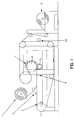
- Figure 1 is a schematic drawing showing the general design of a machine capable of producing the abrasive material of the invention from which appropriately shaped coated abrasives may be cut. This machine was essentially the same as that used to produce the abrasive discs evaluated according to the Examples reported below.
- FIG. 1 A suitable machine for the production of abrasive materials according to the present invention appears in Figure 1.
- a roll of a non-woven fibrous mat, 1 is unrolled and fed into contact with a stainless steel conveyor belt, 2, supplied with a coating of a lubricant or a release agent, so as to contact said belt at a point after a resin composition has been applied to the belt surface at a resin application station by means of a blade applicator, 3.
- the mat and resin then pass through a heater device, 4, which preheats the resin before it the resin and mat pass through the nip between a nip roll, 5, and a heated roll, 6. This has the effect of forcing the resin into the interstices of the fibrous mat so as to form a continuous matrix.
- the backing can then subjected to conventional, optional back and front fill operations before a maker coat is applied to one surface followed by a layer of abrasive grits. Following at least partial cure of the maker coat, a size coat is conventionally applied over the grits. When fully cured the product is a coated abrasive according to the invention.
- a polyester fiber material having a denier of 1.5, a 45% elongation at break and a staple length of 3.8 cm was formed into a mat with a weight of 380 gm/m 2 and a thickness of 9.5-12.7 mm.
- a matrix resin to form the bond in the backing was formed by blending: 38.27% of Epon 828, (a condensation product of bisphenol A and epichlorohydrin available under that trade name from Shell Chemical Co.); 2.88% of-Mondur XP-743, (an isocyanate available from Miles Inc.); 9.57% of isophorone, (a solvent); 1.43% of DMP-30, (2,4,6-tri(dimethylamino-methyl) phenol, a catalyst available from Rohm and Haas Corp.); and 47.85% of Atomite, (a calcium carbonate filler available under that trade name from ECC International), all percentages being by weight.
- Epon 828 a condensation product of bisphenol A and epichlorohydrin available under that trade name from Shell Chemical Co.
- -Mondur XP-743 an isocyanate available from Miles Inc.
- isophorone (a solvent)
- DMP-30 (2,4,6-tri(dimethylamino-methyl) phenol, a catalyst
- a backing material was made from the above resin composition and fibrous sheet using the machine described in the Figure 1.
- the resin composition was deposited in an amount equivalent to a thickness of about 0.75 mm
- the belt speed was 61 cm/minute, (2 ft/minute), the gauge pressure at the nip was 0.86 MPa, and the tension on the belt was maintained at 6.89 MPa.
- the drum was heated to about 143°C and the infra-red heaters raised the belt and the resin impregnated sheet to a temperature of about 127°C.
- the knife blade resin applicator was set with a knife gap of 0.74 mm, and resulted in a resin composition addition to the sheet of 0.68 kg/m 2 (20 ounces/square yard).
- the thickness of the finished backing material was about 0.81 mm and the total weight of the backing material product obtained was 1.22 kg/m 2 (80 lbs/sandpaper maker's ream).
- the resin composition provided about 49% of the volume of the finished backing material and the fibers of the sheet provided about 51%.
- the thickness of the backing material product was about 0.81 mm, only slighly thicker than the thickness of the film of resin applied to the mat at the beginning of the process, indicating that the mat had been compressed such that the resin occupied essentially all the void space in the mat after it passed through the nip.
- the above backing was used to produce abrasive discs that performed very well under heavy stress grinding conditions.
- the discs are in fact both dimensionally stable and erodable as the terms are used herein.
- abrasive disc according to the invention was compared with the performance of an otherwise identical conventional disc having a backing made from vulcanized fiber materials.
- the comparison material was a commercially available disc, sold by Norton Company under the designation "F826".
- the application on which the discs were tested was the removal of excess epoxy resin and phenolic-cloth composite from insulated rail joints.
- the abrasive grain on each was an alumina-zirconia abrasive grain and the backing on the F826 disc was made from vulcanized fiber with standard back- and front-fill operations.
- the diameter of the disc decreased from 17.78 cm (seven inches) to 17.3 cm (six and thirteen-sixteenths inches). Although there was a limited amount of cracking in the grain coating, these cracks did not propogate into the backing. No grain shedding had occurred. Thet were therefore "erodable" as the term is used herein.
- New F826 discs sometimes have significant curl with the abrading surface inside due to inadequate curl correction.
- Unused discs according to the invention showed dimensional stability and in fact had only a slight curl with the abrading surface outside.
- the usual rail-grinding technique (as indicated above), is to apply new discs over the top of the old discs.
- remaining grain on the used disc can lead to holes in the back of the new disc.
- Use of the new discs according to the invention showed no evidence of this kind of wear.
- the improved coated abrasive according to the invention was therefore extremely effective in providing a significantly extended useful life for the disc in this application.
- the improvement cannot be attributed to the grain or the maker or size coats since these were identical. Only the nature of the backing was changed and the improvements are clearly attributable to this substitution.
- Example 2 a phenolic resin is used to impregnate a web similar to that used to make the backing material described in Example 1. The impregnation was performed on a 20cm square sample of the web using plates and a press rather than the arrangement illustrated in the Drawing.
- Phenolic resin (BM-12, available from Allied Signal Bendix) 75 gm Water 15 gm 60% NaOH solution 19 gm Calcium Carbonate filler 38 gm
- Example 2 Two flat aluminum plates were sprayed with a release agent and then air dried.
- the above phenolic resin formulation was applied to one of the plates using a doctor blade to deposit a layer 0.66 mm thick on the plate.
- the non-woven backing used in Example 1 was laid on the plate in the form of 20 cm square piece and the second aluminum plate was placed on top to form a sandwich.
- the sandwich was placed in a press heated to about 93°C and a pressure of 4,545 kg was applied to the plates for 10 seconds, after which the applied pressure was reduced to zero and the sandwich remained in the press for a further two minutes at the same temperature. This regime was adopted to simulate the condition in the equipment illustrated in the Drawing.
- the sample showed excellent resin penetration.
- the resin had cured and the backing material obtained had smooth and uniform surfaces and showed dimensional stability.
Landscapes
- Engineering & Computer Science (AREA)
- Mechanical Engineering (AREA)
- Polishing Bodies And Polishing Tools (AREA)
Claims (21)
- Beschichtetes Schleifmittel umfassend ein Trägermaterial mit einer Zugfestigkeit von mindestens 45 MPa, wobei der Träger ein Stapelfaservlies umfasst, das durch eine Duroplastharzzusammensetzung gebunden ist, die in dem Vlies eine kontinuierliche Matrix bildet, wobei das Harz und die Fasern in einem Volumenverhältnis von etwa 1 : 3 bis etwa 30 : 1 vorliegen, wobei der Träger isotrop ist, so dass die Veränderung der Zugfestigkeit in der Trägerebene nicht größer als 30 % ist, sowie eine Schleifkorn enthaltende Schicht aufweisend, die auf einer Oberfläche davon haftet, um ein beschichtetes Schleifmittel zu bilden, das Dimensionsstabilität aufweist.
- Beschichtetes Schleifmittel nach Anspruch 1, wobei das Vlies aus Stapelfasern gebildet ist, die aus der Gruppe bestehend aus Polyamiden, Polyaramiden, Polyestern, Polyolefinen, Kohlenstoff, Glas und Mischungen derartiger Fasern ausgewählt ist.
- Beschichtetes Schleifmittel nach Anspruch 1, wobei der Träger hochisotrop ist, so dass die Veränderung der Zugfestigkeit in der Trägerebene nicht mehr als 10 % beträgt.
- Beschichtetes Schleifmittel nach Anspruch 1, wobei die Fasern des Vlieses ein Längenverhältnis ("aspect ratio") von etwa 20 bis etwa 300 aufweisen.
- Beschichtetes Schleifmittel nach Anspruch 1, wobei das Harz aus der Gruppe bestehend aus Epoxyharzen, Phenolharzen, duroplastischen Polyurethanen, ungesättigten Polyestern und Polyimiden ausgewählt ist.
- Beschichtetes Schleifmittel nach Anspruch 1, wobei das Vlies von etwa 5 bis etwa 50 Gew.-% des Trägers beiträgt, das Harz von etwa 45 bis etwa 25 Gew.-% des gesamten Trägergewichts beiträgt und der Rest durch einen inerten Füllstoff bereitgestellt wird.
- Beschichtetes Schleifmittel nach Anspruch 6, wobei der inerte Füllstoff Calciumcarbonat ist.
- Beschichtetes Schleifmittel nach Anspruch 1, wobei die Zugfestigkeit des Trägermaterials größer als 50 MPa ist.
- Hochisotrope dimensionsstabile beschichtete Schleifscheibe, umfassend ein Trägermaterial mit einer Zugfestigkeit von mindestens 50 MPa und ein Polyester-oder Polyamidstapelfaservlies umfassend, das mit einer duroplastischen Epoxyharzzusammensetzung gebunden ist, welches in dem Vlies eine kontinuierliche Matrix bildet, wobei die Fasern und das Harz in einem Volumenverhältnis von etwa 0,05 : 1 bis etwa 1 : 3 vorliegen, und der Träger hochisotrop ist, so dass die Veränderung der Zugfestigkeit in der Trägerebene nicht mehr als 10% beträgt, sowie eine Schleifkom enthaltende Schicht aufweisend, die auf einer Oberfläche davon haftet.
- Beschichtetes Schleifmittel nach Anspruch 9, wobei das Volumenverhältnis von Fasern zu Harz etwa 0,1 : 1 bis etwa 1 : 1 beträgt.
- Beschichtetes Schleifmittel nach Anspruch 9, wobei die Fasern ein Längenverhältnis von etwa 20 bis etwa 300 aufweisen.
- Eine erodierbare, dimensionsstabile, isotrope, beschichtete Schleifscheibe, umfassend ein Trägermaterial mit einer Zugfestigkeit von mindestens 50 MPa, umfassend ein Stapelfaservlies, das mit einer duroplastischen Harzzusammensetzung gebunden ist, die eine kontinuierliche Matrix in dem Vlies bildet, wobei die Fasern und die Harzzusammensetzung in einem Volumenverhältnis von etwa 0,05 : 1bis etwa 1 : 1 vorliegen, und derTräger isotrop ist, so dass die Veränderung der Zugfestigkeit in der Trägerebene nicht mehr als 30% beträgt, sowie eine Schleifkorn enthaltende Schicht aufweisend, die auf einer Oberfläche davon haftet, um eine beschichtete Schleifscheibe zu bilden.
- Erodierbare, dimensionsstabile, hochisotrope, beschichtete Schleifscheibe nach Anspruch 12, umfassend ein Trägermaterial mit einer Zugfestigkeit von mindestens 50 MPa und ein Polyester- oder Polyamidstapelfaservlies umfassend, das mit einem Epoxyharz gebunden ist, welches eine kontinuierliche Matrix in dem Vlies bildet, wobei die Fasern und das Harz in einem Volumenverhältnis von etwa 0,1 : 1 bis etwa 0,75 : 1 vorliegen, und das Trägermaterial isotrop ist, so dass die Veränderung der Zugfestigkeit in der Trägerebene nicht mehr als 10% beträgt, sowie eine Schleifkorn enthaltende Schicht aufweisend, die auf einer Oberfläche davon haftet.
- Trägermaterial für ein beschichtetes Schleifmittel mit einer Zugfestigkeit von mindestens 45 MPa und ein Stapelfaservlies umfassend, das mittels einer duroplastischen Harzzusammensetzung gebunden ist, die eine kontinuierliche Matrix in dem Vlies bildet, wobei das Harz und die Fasern in einem Volumenverhältnis von etwa 1 : 3 bis etwa 30 : 1 vorliegen, wobei das Material isotrop ist und die Veränderung der Zugfestigkeit in der Trägerebene nicht mehr als 30% beträgt.
- Trägermaterial nach Anspruch 14, wobei das Vlies aus Stapelfasern gebildet ist, die aus der Gruppe bestehend aus Polyamiden, Polyaramiden, Polyestern, Polyolefinen, Kohlenstoff, Glas und Mischungen derartiger Fasern ausgewählt ist.
- Trägermaterial nach Anspruch 14, wobei der Träger hochisotrop ist und die Veränderung der Zugfestigkeit in der Trägerebene nicht mehr als 10% beträgt.
- Trägermaterial nach Anspruch 14, wobei die Fasern des Vlieses ein Längenverhältnis von etwa 20 bis etwa 300 aufweisen.
- Trägermaterial nach Anspruch 14, wobei das Harz aus der Gruppe bestehend aus Epoxyharzen, Phenolharzen, duroplastischen Polyurethanen und Polyimiden ausgewählt ist.
- Trägermaterial nach Anspruch 14, wobei das Vlies etwa 5 bis etwa 50 Gew.-% des Trägers beiträgt, das Harz etwa 45 bis etwa 25 Gew.-% zum Trägergesamtgewicht beiträgt, und ein beliebiger Rest von einem inerten Füllstoff bereitgestellt wird.
- Trägermaterial nach Anspruch 19, wobei der inerte Füllstoff Calciumcarbonat ist.
- Trägermaterial nach Anspruch 14, wobei die Zugfestigkeit in der Trägerebene größer als 50 MPa ist.
Applications Claiming Priority (3)
| Application Number | Priority Date | Filing Date | Title |
|---|---|---|---|
| US08/456,587 US5582625A (en) | 1995-06-01 | 1995-06-01 | Curl-resistant coated abrasives |
| US456587 | 1995-06-01 | ||
| PCT/US1996/005823 WO1996038263A1 (en) | 1995-06-01 | 1996-04-26 | Curl-resistant coated abrasives |
Publications (2)
| Publication Number | Publication Date |
|---|---|
| EP1017539A1 EP1017539A1 (de) | 2000-07-12 |
| EP1017539B1 true EP1017539B1 (de) | 2002-03-13 |
Family
ID=23813366
Family Applications (1)
| Application Number | Title | Priority Date | Filing Date |
|---|---|---|---|
| EP96915368A Expired - Lifetime EP1017539B1 (de) | 1995-06-01 | 1996-04-26 | Beschichtetes schleifmittel mit einem träger zum verhindern des verwickelns |
Country Status (10)
| Country | Link |
|---|---|
| US (1) | US5582625A (de) |
| EP (1) | EP1017539B1 (de) |
| JP (1) | JP3130945B2 (de) |
| KR (1) | KR100271893B1 (de) |
| AT (1) | ATE214322T1 (de) |
| AU (1) | AU685705B2 (de) |
| BR (1) | BR9608512A (de) |
| CA (1) | CA2217692C (de) |
| DE (1) | DE69619879T2 (de) |
| WO (1) | WO1996038263A1 (de) |
Families Citing this family (54)
| Publication number | Priority date | Publication date | Assignee | Title |
|---|---|---|---|---|
| US6432549B1 (en) | 1998-08-27 | 2002-08-13 | Kimberly-Clark Worldwide, Inc. | Curl-resistant, antislip abrasive backing and paper |
| US6261328B1 (en) * | 2000-02-15 | 2001-07-17 | Norton Company | Dimensionally stable abrasive discs |
| US6758734B2 (en) | 2002-03-18 | 2004-07-06 | 3M Innovative Properties Company | Coated abrasive article |
| US6773474B2 (en) | 2002-04-19 | 2004-08-10 | 3M Innovative Properties Company | Coated abrasive article |
| US20050120636A1 (en) * | 2003-12-09 | 2005-06-09 | Yong Bum Kim | Preparation of coated abrasive disk |
| US20060265966A1 (en) * | 2005-05-24 | 2006-11-30 | Rostal William J | Abrasive articles and methods of making and using the same |
| US20060265967A1 (en) * | 2005-05-24 | 2006-11-30 | 3M Innovative Properties Company | Abrasive articles and methods of making and using the same |
| EP2111326A4 (de) * | 2006-12-20 | 2013-01-16 | 3M Innovative Properties Co | Beschichtete schleifscheibe und verfahren zu ihrer herstellung |
| WO2011017358A2 (en) * | 2009-08-03 | 2011-02-10 | Saint-Gobain Abrasives, Inc. | Abrasive tool having a particular porosity variation |
| EP2658680B1 (de) | 2010-12-31 | 2020-12-09 | Saint-Gobain Ceramics & Plastics, Inc. | Schleifgegenstanden mit Schleifpartikeln mit besonderen Formen und Verfahren zur Formung solcher Gegenständen |
| WO2013003830A2 (en) | 2011-06-30 | 2013-01-03 | Saint-Gobain Ceramics & Plastics, Inc. | Abrasive articles including abrasive particles of silicon nitride |
| WO2013003831A2 (en) | 2011-06-30 | 2013-01-03 | Saint-Gobain Ceramics & Plastics, Inc. | Liquid phase sintered silicon carbide abrasive particles |
| US9517546B2 (en) | 2011-09-26 | 2016-12-13 | Saint-Gobain Ceramics & Plastics, Inc. | Abrasive articles including abrasive particulate materials, coated abrasives using the abrasive particulate materials and methods of forming |
| KR20140106737A (ko) | 2011-12-30 | 2014-09-03 | 생-고뱅 세라믹스 앤드 플라스틱스, 인코포레이티드 | 형상화 연마입자들 형성 |
| KR102074138B1 (ko) | 2011-12-30 | 2020-02-07 | 생-고뱅 세라믹스 앤드 플라스틱스, 인코포레이티드 | 형상화 연마입자 및 이의 형성방법 |
| PL2797716T3 (pl) | 2011-12-30 | 2021-07-05 | Saint-Gobain Ceramics & Plastics, Inc. | Kompozytowe ukształtowane cząstki ścierne i sposób ich formowania |
| EP2802436B1 (de) | 2012-01-10 | 2019-09-25 | Saint-Gobain Ceramics & Plastics, Inc. | Schleifpartikel mit komplexen formen |
| US8840696B2 (en) | 2012-01-10 | 2014-09-23 | Saint-Gobain Ceramics & Plastics, Inc. | Abrasive particles having particular shapes and methods of forming such particles |
| WO2013149209A1 (en) | 2012-03-30 | 2013-10-03 | Saint-Gobain Abrasives, Inc. | Abrasive products having fibrillated fibers |
| KR101813466B1 (ko) | 2012-05-23 | 2017-12-29 | 생-고뱅 세라믹스 앤드 플라스틱스, 인코포레이티드 | 형상화 연마입자들 및 이의 형성방법 |
| WO2014005120A1 (en) | 2012-06-29 | 2014-01-03 | Saint-Gobain Ceramics & Plastics, Inc. | Abrasive particles having particular shapes and methods of forming such particles |
| EP2906392B1 (de) | 2012-10-15 | 2025-04-16 | Saint-Gobain Abrasives, Inc. | Schleifpartikel mit besonderen formen und verfahren zur formung solcher partikel |
| CN104994995B (zh) | 2012-12-31 | 2018-12-14 | 圣戈本陶瓷及塑料股份有限公司 | 颗粒材料及其形成方法 |
| WO2014161001A1 (en) | 2013-03-29 | 2014-10-02 | Saint-Gobain Abrasives, Inc. | Abrasive particles having particular shapes and methods of forming such particles |
| TW201502263A (zh) | 2013-06-28 | 2015-01-16 | Saint Gobain Ceramics | 包含成形研磨粒子之研磨物品 |
| CN111978921A (zh) | 2013-09-30 | 2020-11-24 | 圣戈本陶瓷及塑料股份有限公司 | 成形磨粒及其形成方法 |
| BR112016012064A2 (pt) * | 2013-12-06 | 2017-08-08 | Saint Gobain Abrasives Inc | Artigo abrasivo revestido incluindo um material não tecido |
| KR102081045B1 (ko) | 2013-12-31 | 2020-02-26 | 생-고뱅 어브레이시브즈, 인코포레이티드 | 형상화 연마 입자들을 포함하는 연마 물품 |
| US9771507B2 (en) | 2014-01-31 | 2017-09-26 | Saint-Gobain Ceramics & Plastics, Inc. | Shaped abrasive particle including dopant material and method of forming same |
| AU2015247826A1 (en) | 2014-04-14 | 2016-11-10 | Saint-Gobain Ceramics & Plastics, Inc. | Abrasive article including shaped abrasive particles |
| AU2015247739B2 (en) | 2014-04-14 | 2017-10-26 | Saint-Gobain Ceramics & Plastics, Inc. | Abrasive article including shaped abrasive particles |
| WO2015184355A1 (en) | 2014-05-30 | 2015-12-03 | Saint-Gobain Abrasives, Inc. | Method of using an abrasive article including shaped abrasive particles |
| US9707529B2 (en) | 2014-12-23 | 2017-07-18 | Saint-Gobain Ceramics & Plastics, Inc. | Composite shaped abrasive particles and method of forming same |
| US9914864B2 (en) | 2014-12-23 | 2018-03-13 | Saint-Gobain Ceramics & Plastics, Inc. | Shaped abrasive particles and method of forming same |
| WO2016106212A1 (en) | 2014-12-23 | 2016-06-30 | Saint-Gobain Abrasives, Inc. | Compressed polymer impregnated backing material, abrasive articles incorporating same, and processes of making and using |
| US9676981B2 (en) | 2014-12-24 | 2017-06-13 | Saint-Gobain Ceramics & Plastics, Inc. | Shaped abrasive particle fractions and method of forming same |
| TWI634200B (zh) | 2015-03-31 | 2018-09-01 | 聖高拜磨料有限公司 | 固定磨料物品及其形成方法 |
| US10196551B2 (en) | 2015-03-31 | 2019-02-05 | Saint-Gobain Abrasives, Inc. | Fixed abrasive articles and methods of forming same |
| EP3307483B1 (de) | 2015-06-11 | 2020-06-17 | Saint-Gobain Ceramics&Plastics, Inc. | Schleifartikel mit geformten schleifpartikeln |
| CN108430702A (zh) | 2015-12-29 | 2018-08-21 | 3M创新有限公司 | 磨料制品及其制备方法 |
| EP4071224A3 (de) | 2016-05-10 | 2023-01-04 | Saint-Gobain Ceramics and Plastics, Inc. | Verfahren zur formung von schleifpartikeln |
| KR102313436B1 (ko) | 2016-05-10 | 2021-10-19 | 생-고뱅 세라믹스 앤드 플라스틱스, 인코포레이티드 | 연마 입자들 및 그 형성 방법 |
| EP3496897A1 (de) * | 2016-08-10 | 2019-06-19 | Klingspor AG | Schruppscheibe mit trägerschicht |
| EP4349896A3 (de) | 2016-09-29 | 2024-06-12 | Saint-Gobain Abrasives, Inc. | Feste schleifartikel und verfahren zur formung davon |
| US10563105B2 (en) | 2017-01-31 | 2020-02-18 | Saint-Gobain Ceramics & Plastics, Inc. | Abrasive article including shaped abrasive particles |
| US10759024B2 (en) | 2017-01-31 | 2020-09-01 | Saint-Gobain Ceramics & Plastics, Inc. | Abrasive article including shaped abrasive particles |
| CN110719946B (zh) | 2017-06-21 | 2022-07-15 | 圣戈本陶瓷及塑料股份有限公司 | 颗粒材料及其形成方法 |
| US11926019B2 (en) | 2019-12-27 | 2024-03-12 | Saint-Gobain Ceramics & Plastics, Inc. | Abrasive articles and methods of forming same |
| EP4081370A4 (de) | 2019-12-27 | 2024-04-24 | Saint-Gobain Ceramics & Plastics Inc. | Schleifartikel und verfahren zur formung davon |
| WO2021133876A1 (en) | 2019-12-27 | 2021-07-01 | Saint-Gobain Ceramics & Plastics, Inc. | Abrasive articles and methods of forming same |
| BR112022012960A2 (pt) | 2019-12-31 | 2022-11-29 | Saint Gobain Abrasives Inc | Retrocola rígida para evitar ondulação de discos de fibra |
| EP4457054A4 (de) | 2021-12-30 | 2026-01-14 | Saint Gobain Abrasives Inc | Schleifartikel und verfahren zur formung davon |
| CN118591436A (zh) | 2021-12-30 | 2024-09-03 | 圣戈班磨料磨具有限公司 | 磨料制品及其形成方法 |
| MX2024007593A (es) | 2021-12-30 | 2024-08-20 | Saint Gobain Abrasives Inc | Artículos abrasivos y métodos de formación de los mismos. |
Family Cites Families (23)
| Publication number | Priority date | Publication date | Assignee | Title |
|---|---|---|---|---|
| DE1694594C3 (de) * | 1960-01-11 | 1975-05-28 | Minnesota Mining And Manufacturing Co., Saint Paul, Minn. (V.St.A.) | Reinigungs- und Polierkörper |
| US3324609A (en) * | 1964-08-11 | 1967-06-13 | Norton Co | Non-woven webs |
| US3688453A (en) * | 1970-12-11 | 1972-09-05 | Minnesota Mining & Mfg | Abrasive articles |
| JPS6037810B2 (ja) * | 1978-12-08 | 1985-08-28 | 東邦レーヨン株式会社 | ストランドプリプレグ組成物 |
| DE2933307C2 (de) * | 1979-08-17 | 1984-10-31 | Akzo Gmbh, 5600 Wuppertal | Beschichtetes textiles Flächengebilde |
| US4331453A (en) * | 1979-11-01 | 1982-05-25 | Minnesota Mining And Manufacturing Company | Abrasive article |
| US4355489A (en) * | 1980-09-15 | 1982-10-26 | Minnesota Mining And Manufacturing Company | Abrasive article comprising abrasive agglomerates supported in a fibrous matrix |
| US4437865A (en) * | 1982-08-27 | 1984-03-20 | Carborundum Abrasive Company | Flexible backing material for use in coated abrasives |
| US4478610A (en) * | 1982-08-27 | 1984-10-23 | Carborundum Abrasives Company | Method of preparing flexible backing material for use in coated abrasives |
| JPS6279970A (ja) * | 1985-09-30 | 1987-04-13 | Achilles Corp | 研磨基布及びその製造方法 |
| DD248313A1 (de) * | 1986-04-17 | 1987-08-05 | Berlin Industriebuersten | Verfahren zur herstellung eines schleifschaumkoerperverbundes |
| US4776316A (en) * | 1987-04-29 | 1988-10-11 | Ashkenazi Brian I | Wafering device and method of using same |
| US5272000A (en) * | 1987-05-22 | 1993-12-21 | Guardian Industries Corp. | Non-woven fibrous product containing natural fibers |
| JP2577977B2 (ja) * | 1988-10-28 | 1997-02-05 | チッソ株式会社 | 伸縮性不織布及びその製造方法 |
| JPH0266959U (de) * | 1988-11-09 | 1990-05-21 | ||
| JPH0822509B2 (ja) * | 1990-02-08 | 1996-03-06 | 株式会社ノリタケカンパニーリミテド | 研削砥石 |
| JPH03270883A (ja) * | 1990-03-22 | 1991-12-03 | Mitsui Mining & Smelting Co Ltd | 酸化セリウム研磨材 |
| CA2036247A1 (en) * | 1990-03-29 | 1991-09-30 | Jeffrey L. Berger | Nonwoven surface finishing articles reinforced with a polymer backing layer and method of making same |
| US5193550A (en) * | 1990-11-30 | 1993-03-16 | Medtronic, Inc. | Method and apparatus for discriminating among normal and pathological tachyarrhythmias |
| US5227229A (en) * | 1990-12-20 | 1993-07-13 | Minnesota Mining And Manufacturing Company | Nonwoven polyester articles and method of making same |
| US5385775A (en) * | 1991-12-09 | 1995-01-31 | Kimberly-Clark Corporation | Composite elastic material including an anisotropic elastic fibrous web and process to make the same |
| US5316812A (en) * | 1991-12-20 | 1994-05-31 | Minnesota Mining And Manufacturing Company | Coated abrasive backing |
| JP2514541B2 (ja) * | 1992-09-08 | 1996-07-10 | 大阪ダイヤモンド工業株式会社 | 超砥粒砥石 |
-
1995
- 1995-06-01 US US08/456,587 patent/US5582625A/en not_active Expired - Lifetime
-
1996
- 1996-04-26 KR KR1019970708546A patent/KR100271893B1/ko not_active Expired - Fee Related
- 1996-04-26 WO PCT/US1996/005823 patent/WO1996038263A1/en not_active Ceased
- 1996-04-26 AT AT96915368T patent/ATE214322T1/de not_active IP Right Cessation
- 1996-04-26 EP EP96915368A patent/EP1017539B1/de not_active Expired - Lifetime
- 1996-04-26 BR BR9608512-6A patent/BR9608512A/pt not_active IP Right Cessation
- 1996-04-26 CA CA002217692A patent/CA2217692C/en not_active Expired - Fee Related
- 1996-04-26 JP JP08536474A patent/JP3130945B2/ja not_active Expired - Fee Related
- 1996-04-26 AU AU57161/96A patent/AU685705B2/en not_active Ceased
- 1996-04-26 DE DE69619879T patent/DE69619879T2/de not_active Expired - Fee Related
Also Published As
| Publication number | Publication date |
|---|---|
| WO1996038263A1 (en) | 1996-12-05 |
| CA2217692C (en) | 2000-08-15 |
| DE69619879T2 (de) | 2002-11-07 |
| ATE214322T1 (de) | 2002-03-15 |
| JP3130945B2 (ja) | 2001-01-31 |
| DE69619879D1 (de) | 2002-04-18 |
| KR100271893B1 (ko) | 2000-11-15 |
| US5582625A (en) | 1996-12-10 |
| EP1017539A1 (de) | 2000-07-12 |
| MX9709161A (es) | 1998-03-31 |
| AU5716196A (en) | 1996-12-18 |
| CA2217692A1 (en) | 1996-12-05 |
| AU685705B2 (en) | 1998-01-22 |
| JPH11503077A (ja) | 1999-03-23 |
| KR19990022067A (ko) | 1999-03-25 |
| BR9608512A (pt) | 1999-10-26 |
Similar Documents
| Publication | Publication Date | Title |
|---|---|---|
| US5582625A (en) | Curl-resistant coated abrasives | |
| EP0061457B1 (de) | Schleifkörper mit einem in einer faserigen matrix eingebetteten schleifmittel | |
| US5681612A (en) | Coated abrasives and methods of preparation | |
| US2880080A (en) | Reinforced abrasive articles and intermediate products | |
| US4486200A (en) | Method of making an abrasive article comprising abrasive agglomerates supported in a fibrous matrix | |
| US4629473A (en) | Resilient abrasive polishing product | |
| KR950011674B1 (ko) | 유리 또는 세라믹 물질을 연마하기 위한 연마재(硏磨材) | |
| US6776868B2 (en) | Coated abrasive having laminate backing material and method of making the same | |
| US5556438A (en) | Composite abrasive products | |
| US5695533A (en) | Abrasive products | |
| US4437865A (en) | Flexible backing material for use in coated abrasives | |
| JP2001527468A (ja) | 被覆研摩材およびそれに使用するバッキング | |
| JP3898234B2 (ja) | 結合基材部材を有する研磨布紙材 | |
| US6120878A (en) | Abrasive articles comprising vinyl ether functional resins | |
| US2981615A (en) | Abrasive articles and method of making the same | |
| CA2457249A1 (en) | Preparation of coated abrasive disk | |
| AU680012B2 (en) | Abrasive belts with an endless, flexible, seamless backing and methods of preparation | |
| MXPA97009161A (en) | Abrasives coated resistant to ondulac | |
| HK30389A (en) | Abrasive article comprising abrasive agglomerates supported in a fibrous matrix |
Legal Events
| Date | Code | Title | Description |
|---|---|---|---|
| PUAI | Public reference made under article 153(3) epc to a published international application that has entered the european phase |
Free format text: ORIGINAL CODE: 0009012 |
|
| 17P | Request for examination filed |
Effective date: 19980102 |
|
| AK | Designated contracting states |
Kind code of ref document: A1 Designated state(s): AT DE FR GB IT SE |
|
| 17Q | First examination report despatched |
Effective date: 20000929 |
|
| GRAG | Despatch of communication of intention to grant |
Free format text: ORIGINAL CODE: EPIDOS AGRA |
|
| GRAG | Despatch of communication of intention to grant |
Free format text: ORIGINAL CODE: EPIDOS AGRA |
|
| GRAH | Despatch of communication of intention to grant a patent |
Free format text: ORIGINAL CODE: EPIDOS IGRA |
|
| REG | Reference to a national code |
Ref country code: GB Ref legal event code: IF02 |
|
| GRAH | Despatch of communication of intention to grant a patent |
Free format text: ORIGINAL CODE: EPIDOS IGRA |
|
| GRAA | (expected) grant |
Free format text: ORIGINAL CODE: 0009210 |
|
| AK | Designated contracting states |
Kind code of ref document: B1 Designated state(s): AT DE FR GB IT SE |
|
| REF | Corresponds to: |
Ref document number: 214322 Country of ref document: AT Date of ref document: 20020315 Kind code of ref document: T |
|
| REF | Corresponds to: |
Ref document number: 69619879 Country of ref document: DE Date of ref document: 20020418 |
|
| RAP2 | Party data changed (patent owner data changed or rights of a patent transferred) |
Owner name: SAINT-GOBAIN ABRASIVES, INC. |
|
| ET | Fr: translation filed | ||
| PLBQ | Unpublished change to opponent data |
Free format text: ORIGINAL CODE: EPIDOS OPPO |
|
| PLBI | Opposition filed |
Free format text: ORIGINAL CODE: 0009260 |
|
| PLBF | Reply of patent proprietor to notice(s) of opposition |
Free format text: ORIGINAL CODE: EPIDOS OBSO |
|
| 26 | Opposition filed |
Opponent name: 3M INNOVATIVE PROPERTIES COMPANY3M CENTER Effective date: 20021212 |
|
| PLAX | Notice of opposition and request to file observation + time limit sent |
Free format text: ORIGINAL CODE: EPIDOSNOBS2 |
|
| PLAX | Notice of opposition and request to file observation + time limit sent |
Free format text: ORIGINAL CODE: EPIDOSNOBS2 |
|
| PLBB | Reply of patent proprietor to notice(s) of opposition received |
Free format text: ORIGINAL CODE: EPIDOSNOBS3 |
|
| PGFP | Annual fee paid to national office [announced via postgrant information from national office to epo] |
Ref country code: AT Payment date: 20040401 Year of fee payment: 9 |
|
| PLCK | Communication despatched that opposition was rejected |
Free format text: ORIGINAL CODE: EPIDOSNREJ1 |
|
| PLBN | Opposition rejected |
Free format text: ORIGINAL CODE: 0009273 |
|
| STAA | Information on the status of an ep patent application or granted ep patent |
Free format text: STATUS: OPPOSITION REJECTED |
|
| 27O | Opposition rejected |
Effective date: 20040929 |
|
| PG25 | Lapsed in a contracting state [announced via postgrant information from national office to epo] |
Ref country code: AT Free format text: LAPSE BECAUSE OF NON-PAYMENT OF DUE FEES Effective date: 20050426 |
|
| PLAB | Opposition data, opponent's data or that of the opponent's representative modified |
Free format text: ORIGINAL CODE: 0009299OPPO |
|
| PGFP | Annual fee paid to national office [announced via postgrant information from national office to epo] |
Ref country code: SE Payment date: 20090429 Year of fee payment: 14 Ref country code: IT Payment date: 20090428 Year of fee payment: 14 Ref country code: DE Payment date: 20090429 Year of fee payment: 14 |
|
| EUG | Se: european patent has lapsed | ||
| PG25 | Lapsed in a contracting state [announced via postgrant information from national office to epo] |
Ref country code: DE Free format text: LAPSE BECAUSE OF NON-PAYMENT OF DUE FEES Effective date: 20101103 |
|
| PG25 | Lapsed in a contracting state [announced via postgrant information from national office to epo] |
Ref country code: IT Free format text: LAPSE BECAUSE OF NON-PAYMENT OF DUE FEES Effective date: 20100426 |
|
| PGFP | Annual fee paid to national office [announced via postgrant information from national office to epo] |
Ref country code: FR Payment date: 20110504 Year of fee payment: 16 |
|
| PGFP | Annual fee paid to national office [announced via postgrant information from national office to epo] |
Ref country code: GB Payment date: 20110426 Year of fee payment: 16 |
|
| PG25 | Lapsed in a contracting state [announced via postgrant information from national office to epo] |
Ref country code: SE Free format text: LAPSE BECAUSE OF NON-PAYMENT OF DUE FEES Effective date: 20100427 |
|
| GBPC | Gb: european patent ceased through non-payment of renewal fee |
Effective date: 20120426 |
|
| REG | Reference to a national code |
Ref country code: FR Ref legal event code: ST Effective date: 20121228 |
|
| PG25 | Lapsed in a contracting state [announced via postgrant information from national office to epo] |
Ref country code: GB Free format text: LAPSE BECAUSE OF NON-PAYMENT OF DUE FEES Effective date: 20120426 |
|
| PG25 | Lapsed in a contracting state [announced via postgrant information from national office to epo] |
Ref country code: FR Free format text: LAPSE BECAUSE OF NON-PAYMENT OF DUE FEES Effective date: 20120430 |