EP1017735B1 - Verbindungen für eine elektronische anordnung - Google Patents
Verbindungen für eine elektronische anordnung Download PDFInfo
- Publication number
- EP1017735B1 EP1017735B1 EP98941598A EP98941598A EP1017735B1 EP 1017735 B1 EP1017735 B1 EP 1017735B1 EP 98941598 A EP98941598 A EP 98941598A EP 98941598 A EP98941598 A EP 98941598A EP 1017735 B1 EP1017735 B1 EP 1017735B1
- Authority
- EP
- European Patent Office
- Prior art keywords
- compound
- component
- fused thiophene
- bdt
- derivative
- Prior art date
- Legal status (The legal status is an assumption and is not a legal conclusion. Google has not performed a legal analysis and makes no representation as to the accuracy of the status listed.)
- Expired - Lifetime
Links
- 150000001875 compounds Chemical class 0.000 title claims abstract description 29
- 238000000034 method Methods 0.000 claims abstract description 27
- 229930192474 thiophene Natural products 0.000 claims abstract description 27
- 150000003577 thiophenes Chemical class 0.000 claims abstract description 18
- 238000005859 coupling reaction Methods 0.000 claims abstract description 10
- 238000010168 coupling process Methods 0.000 claims abstract description 9
- 230000008878 coupling Effects 0.000 claims abstract description 7
- 238000004519 manufacturing process Methods 0.000 claims abstract description 7
- YTPLMLYBLZKORZ-UHFFFAOYSA-N Thiophene Chemical compound C=1C=CSC=1 YTPLMLYBLZKORZ-UHFFFAOYSA-N 0.000 claims description 27
- 239000000758 substrate Substances 0.000 claims description 19
- 239000000463 material Substances 0.000 claims description 17
- 239000010409 thin film Substances 0.000 claims description 12
- MZRVEZGGRBJDDB-UHFFFAOYSA-N N-Butyllithium Chemical compound [Li]CCCC MZRVEZGGRBJDDB-UHFFFAOYSA-N 0.000 claims description 11
- 125000000217 alkyl group Chemical group 0.000 claims description 11
- 230000005669 field effect Effects 0.000 claims description 11
- -1 thiophene compound Chemical class 0.000 claims description 11
- 238000000151 deposition Methods 0.000 claims description 10
- 125000000896 monocarboxylic acid group Chemical group 0.000 claims description 10
- 230000008021 deposition Effects 0.000 claims description 9
- 230000005693 optoelectronics Effects 0.000 claims description 7
- 238000001953 recrystallisation Methods 0.000 claims description 7
- 125000003118 aryl group Chemical group 0.000 claims description 5
- 238000000859 sublimation Methods 0.000 claims description 4
- 230000008022 sublimation Effects 0.000 claims description 4
- XCMISAPCWHTVNG-UHFFFAOYSA-N 3-bromothiophene Chemical compound BrC=1C=CSC=1 XCMISAPCWHTVNG-UHFFFAOYSA-N 0.000 claims description 3
- 229910021592 Copper(II) chloride Inorganic materials 0.000 claims description 3
- 229910052799 carbon Inorganic materials 0.000 claims description 3
- ORTQZVOHEJQUHG-UHFFFAOYSA-L copper(II) chloride Chemical compound Cl[Cu]Cl ORTQZVOHEJQUHG-UHFFFAOYSA-L 0.000 claims description 3
- 239000002243 precursor Substances 0.000 claims description 3
- 150000003536 tetrazoles Chemical group 0.000 claims description 3
- 150000003852 triazoles Chemical class 0.000 claims description 3
- 238000002061 vacuum sublimation Methods 0.000 claims description 3
- 239000012212 insulator Substances 0.000 claims description 2
- LZKLAOYSENRNKR-LNTINUHCSA-N iron;(z)-4-oxoniumylidenepent-2-en-2-olate Chemical compound [Fe].C\C(O)=C\C(C)=O.C\C(O)=C\C(C)=O.C\C(O)=C\C(C)=O LZKLAOYSENRNKR-LNTINUHCSA-N 0.000 claims description 2
- 125000004432 carbon atom Chemical group C* 0.000 claims 2
- QUBJDMPBDURTJT-UHFFFAOYSA-N 3-chlorothiophene Chemical compound ClC=1C=CSC=1 QUBJDMPBDURTJT-UHFFFAOYSA-N 0.000 claims 1
- WGKRMQIQXMJVFZ-UHFFFAOYSA-N 3-iodothiophene Chemical class IC=1C=CSC=1 WGKRMQIQXMJVFZ-UHFFFAOYSA-N 0.000 claims 1
- YQUSJUJNDKUWAM-UHFFFAOYSA-N benzenesulfonylsulfanylsulfonylbenzene Chemical compound C=1C=CC=CC=1S(=O)(=O)SS(=O)(=O)C1=CC=CC=C1 YQUSJUJNDKUWAM-UHFFFAOYSA-N 0.000 claims 1
- 229920006395 saturated elastomer Polymers 0.000 claims 1
- 229910052710 silicon Inorganic materials 0.000 claims 1
- 239000010703 silicon Substances 0.000 claims 1
- 125000001424 substituent group Chemical group 0.000 claims 1
- 230000037230 mobility Effects 0.000 description 34
- 239000000243 solution Substances 0.000 description 29
- 239000010408 film Substances 0.000 description 25
- YMWUJEATGCHHMB-UHFFFAOYSA-N Dichloromethane Chemical compound ClCCl YMWUJEATGCHHMB-UHFFFAOYSA-N 0.000 description 24
- 239000000203 mixture Substances 0.000 description 24
- VLKZOEOYAKHREP-UHFFFAOYSA-N n-Hexane Chemical compound CCCCCC VLKZOEOYAKHREP-UHFFFAOYSA-N 0.000 description 24
- WYURNTSHIVDZCO-UHFFFAOYSA-N Tetrahydrofuran Chemical compound C1CCOC1 WYURNTSHIVDZCO-UHFFFAOYSA-N 0.000 description 22
- YXFVVABEGXRONW-UHFFFAOYSA-N Toluene Chemical compound CC1=CC=CC=C1 YXFVVABEGXRONW-UHFFFAOYSA-N 0.000 description 21
- 239000013078 crystal Substances 0.000 description 17
- VYPSYNLAJGMNEJ-UHFFFAOYSA-N Silicium dioxide Chemical compound O=[Si]=O VYPSYNLAJGMNEJ-UHFFFAOYSA-N 0.000 description 13
- 239000007787 solid Substances 0.000 description 13
- 239000010931 gold Substances 0.000 description 11
- 239000004065 semiconductor Substances 0.000 description 11
- IJGRMHOSHXDMSA-UHFFFAOYSA-N Atomic nitrogen Chemical compound N#N IJGRMHOSHXDMSA-UHFFFAOYSA-N 0.000 description 10
- RTZKZFJDLAIYFH-UHFFFAOYSA-N Diethyl ether Chemical compound CCOCC RTZKZFJDLAIYFH-UHFFFAOYSA-N 0.000 description 10
- LFQSCWFLJHTTHZ-UHFFFAOYSA-N Ethanol Chemical compound CCO LFQSCWFLJHTTHZ-UHFFFAOYSA-N 0.000 description 9
- 238000010521 absorption reaction Methods 0.000 description 9
- 125000002347 octyl group Chemical group [H]C([*])([H])C([H])([H])C([H])([H])C([H])([H])C([H])([H])C([H])([H])C([H])([H])C([H])([H])[H] 0.000 description 9
- SLIUAWYAILUBJU-UHFFFAOYSA-N pentacene Chemical compound C1=CC=CC2=CC3=CC4=CC5=CC=CC=C5C=C4C=C3C=C21 SLIUAWYAILUBJU-UHFFFAOYSA-N 0.000 description 9
- 229920000642 polymer Polymers 0.000 description 9
- XLYOFNOQVPJJNP-UHFFFAOYSA-N water Substances O XLYOFNOQVPJJNP-UHFFFAOYSA-N 0.000 description 9
- KUJYDIFFRDAYDH-UHFFFAOYSA-N 2-thiophen-2-yl-5-[5-[5-(5-thiophen-2-ylthiophen-2-yl)thiophen-2-yl]thiophen-2-yl]thiophene Chemical compound C1=CSC(C=2SC(=CC=2)C=2SC(=CC=2)C=2SC(=CC=2)C=2SC(=CC=2)C=2SC=CC=2)=C1 KUJYDIFFRDAYDH-UHFFFAOYSA-N 0.000 description 8
- HEDRZPFGACZZDS-UHFFFAOYSA-N Chloroform Chemical compound ClC(Cl)Cl HEDRZPFGACZZDS-UHFFFAOYSA-N 0.000 description 8
- HEDRZPFGACZZDS-MICDWDOJSA-N Trichloro(2H)methane Chemical compound [2H]C(Cl)(Cl)Cl HEDRZPFGACZZDS-MICDWDOJSA-N 0.000 description 8
- 230000021615 conjugation Effects 0.000 description 7
- 238000012856 packing Methods 0.000 description 7
- 238000005160 1H NMR spectroscopy Methods 0.000 description 6
- VSCWAEJMTAWNJL-UHFFFAOYSA-K aluminium trichloride Chemical compound Cl[Al](Cl)Cl VSCWAEJMTAWNJL-UHFFFAOYSA-K 0.000 description 6
- 230000015572 biosynthetic process Effects 0.000 description 6
- HKNRNTYTYUWGLN-UHFFFAOYSA-N dithieno[3,2-a:2',3'-d]thiophene Chemical compound C1=CSC2=C1SC1=C2C=CS1 HKNRNTYTYUWGLN-UHFFFAOYSA-N 0.000 description 6
- 239000000377 silicon dioxide Substances 0.000 description 6
- 238000003756 stirring Methods 0.000 description 6
- VEXZGXHMUGYJMC-UHFFFAOYSA-N Hydrochloric acid Chemical compound Cl VEXZGXHMUGYJMC-UHFFFAOYSA-N 0.000 description 5
- 229910052681 coesite Inorganic materials 0.000 description 5
- 229910052906 cristobalite Inorganic materials 0.000 description 5
- 239000000539 dimer Substances 0.000 description 5
- 239000010410 layer Substances 0.000 description 5
- 229910052757 nitrogen Inorganic materials 0.000 description 5
- 238000002360 preparation method Methods 0.000 description 5
- 238000001228 spectrum Methods 0.000 description 5
- 229910052682 stishovite Inorganic materials 0.000 description 5
- 229910052905 tridymite Inorganic materials 0.000 description 5
- CSCPPACGZOOCGX-UHFFFAOYSA-N Acetone Chemical compound CC(C)=O CSCPPACGZOOCGX-UHFFFAOYSA-N 0.000 description 4
- XKRFYHLGVUSROY-UHFFFAOYSA-N Argon Chemical compound [Ar] XKRFYHLGVUSROY-UHFFFAOYSA-N 0.000 description 4
- CSNNHWWHGAXBCP-UHFFFAOYSA-L Magnesium sulfate Chemical compound [Mg+2].[O-][S+2]([O-])([O-])[O-] CSNNHWWHGAXBCP-UHFFFAOYSA-L 0.000 description 4
- CDBYLPFSWZWCQE-UHFFFAOYSA-L Sodium Carbonate Chemical compound [Na+].[Na+].[O-]C([O-])=O CDBYLPFSWZWCQE-UHFFFAOYSA-L 0.000 description 4
- NINIDFKCEFEMDL-UHFFFAOYSA-N Sulfur Chemical compound [S] NINIDFKCEFEMDL-UHFFFAOYSA-N 0.000 description 4
- 238000002441 X-ray diffraction Methods 0.000 description 4
- 238000000862 absorption spectrum Methods 0.000 description 4
- YMWUJEATGCHHMB-DICFDUPASA-N dichloromethane-d2 Chemical compound [2H]C([2H])(Cl)Cl YMWUJEATGCHHMB-DICFDUPASA-N 0.000 description 4
- VGWBXRXNERKBSJ-UHFFFAOYSA-N dithieno[2,3-a:2',3'-d]thiophene Chemical compound C1=CSC2=C1SC1=C2SC=C1 VGWBXRXNERKBSJ-UHFFFAOYSA-N 0.000 description 4
- 238000001704 evaporation Methods 0.000 description 4
- 230000008020 evaporation Effects 0.000 description 4
- 238000002347 injection Methods 0.000 description 4
- 239000007924 injection Substances 0.000 description 4
- 238000004776 molecular orbital Methods 0.000 description 4
- 239000000843 powder Substances 0.000 description 4
- 239000002904 solvent Substances 0.000 description 4
- 239000000126 substance Substances 0.000 description 4
- 239000000725 suspension Substances 0.000 description 4
- CDVAIHNNWWJFJW-UHFFFAOYSA-N 3,5-diethoxycarbonyl-1,4-dihydrocollidine Chemical compound CCOC(=O)C1=C(C)NC(C)=C(C(=O)OCC)C1C CDVAIHNNWWJFJW-UHFFFAOYSA-N 0.000 description 3
- QTBSBXVTEAMEQO-UHFFFAOYSA-N Acetic acid Chemical compound CC(O)=O QTBSBXVTEAMEQO-UHFFFAOYSA-N 0.000 description 3
- UHOVQNZJYSORNB-UHFFFAOYSA-N Benzene Chemical compound C1=CC=CC=C1 UHOVQNZJYSORNB-UHFFFAOYSA-N 0.000 description 3
- CURLTUGMZLYLDI-UHFFFAOYSA-N Carbon dioxide Chemical compound O=C=O CURLTUGMZLYLDI-UHFFFAOYSA-N 0.000 description 3
- XEKOWRVHYACXOJ-UHFFFAOYSA-N Ethyl acetate Chemical compound CCOC(C)=O XEKOWRVHYACXOJ-UHFFFAOYSA-N 0.000 description 3
- OKKJLVBELUTLKV-UHFFFAOYSA-N Methanol Chemical compound OC OKKJLVBELUTLKV-UHFFFAOYSA-N 0.000 description 3
- HEMHJVSKTPXQMS-UHFFFAOYSA-M Sodium hydroxide Chemical compound [OH-].[Na+] HEMHJVSKTPXQMS-UHFFFAOYSA-M 0.000 description 3
- 239000005864 Sulphur Substances 0.000 description 3
- 239000011149 active material Substances 0.000 description 3
- 230000008859 change Effects 0.000 description 3
- 238000004440 column chromatography Methods 0.000 description 3
- 239000012065 filter cake Substances 0.000 description 3
- 239000011521 glass Substances 0.000 description 3
- PCHJSUWPFVWCPO-UHFFFAOYSA-N gold Chemical compound [Au] PCHJSUWPFVWCPO-UHFFFAOYSA-N 0.000 description 3
- 229910052737 gold Inorganic materials 0.000 description 3
- 125000000623 heterocyclic group Chemical group 0.000 description 3
- 229910052739 hydrogen Inorganic materials 0.000 description 3
- 238000005259 measurement Methods 0.000 description 3
- 230000003287 optical effect Effects 0.000 description 3
- 239000011368 organic material Substances 0.000 description 3
- WYURNTSHIVDZCO-SVYQBANQSA-N oxolane-d8 Chemical compound [2H]C1([2H])OC([2H])([2H])C([2H])([2H])C1([2H])[2H] WYURNTSHIVDZCO-SVYQBANQSA-N 0.000 description 3
- 238000001556 precipitation Methods 0.000 description 3
- 230000008569 process Effects 0.000 description 3
- 238000000746 purification Methods 0.000 description 3
- 230000009467 reduction Effects 0.000 description 3
- 238000010992 reflux Methods 0.000 description 3
- 230000002441 reversible effect Effects 0.000 description 3
- 238000012546 transfer Methods 0.000 description 3
- 230000007704 transition Effects 0.000 description 3
- KQUMHPUBCXOWRL-UHFFFAOYSA-N 2-[2,3-bis(4,5-dihydro-1h-imidazol-2-yl)phenyl]-4,5-dihydro-1h-imidazole Chemical compound N1CCN=C1C1=CC=CC(C=2NCCN=2)=C1C1=NCCN1 KQUMHPUBCXOWRL-UHFFFAOYSA-N 0.000 description 2
- VYQBXRLSOGGQPU-UHFFFAOYSA-N 6-(dithieno[2,3-a:2',3'-d]thiophen-6-yl)dithieno[2,3-a:2',3'-d]thiophene Chemical compound C1=CSC2=C1SC1=C2SC(C2=CC=3SC=4C=CSC=4C=3S2)=C1 VYQBXRLSOGGQPU-UHFFFAOYSA-N 0.000 description 2
- OKKJLVBELUTLKV-MZCSYVLQSA-N Deuterated methanol Chemical compound [2H]OC([2H])([2H])[2H] OKKJLVBELUTLKV-MZCSYVLQSA-N 0.000 description 2
- 238000005033 Fourier transform infrared spectroscopy Methods 0.000 description 2
- 229910052786 argon Inorganic materials 0.000 description 2
- 229910002092 carbon dioxide Inorganic materials 0.000 description 2
- 238000006243 chemical reaction Methods 0.000 description 2
- 239000003153 chemical reaction reagent Substances 0.000 description 2
- 229920000547 conjugated polymer Polymers 0.000 description 2
- 238000002447 crystallographic data Methods 0.000 description 2
- 238000002484 cyclic voltammetry Methods 0.000 description 2
- 238000013480 data collection Methods 0.000 description 2
- 230000000694 effects Effects 0.000 description 2
- 238000010438 heat treatment Methods 0.000 description 2
- FFUAGWLWBBFQJT-UHFFFAOYSA-N hexamethyldisilazane Chemical compound C[Si](C)(C)N[Si](C)(C)C FFUAGWLWBBFQJT-UHFFFAOYSA-N 0.000 description 2
- 229910052943 magnesium sulfate Inorganic materials 0.000 description 2
- 239000011159 matrix material Substances 0.000 description 2
- 230000008018 melting Effects 0.000 description 2
- 238000002844 melting Methods 0.000 description 2
- 239000012044 organic layer Substances 0.000 description 2
- 239000002244 precipitate Substances 0.000 description 2
- 238000012545 processing Methods 0.000 description 2
- 239000000047 product Substances 0.000 description 2
- 238000004088 simulation Methods 0.000 description 2
- 229910000029 sodium carbonate Inorganic materials 0.000 description 2
- 230000005469 synchrotron radiation Effects 0.000 description 2
- 238000003786 synthesis reaction Methods 0.000 description 2
- CRUIOQJBPNKOJG-UHFFFAOYSA-N thieno[3,2-e][1]benzothiole Chemical compound C1=C2SC=CC2=C2C=CSC2=C1 CRUIOQJBPNKOJG-UHFFFAOYSA-N 0.000 description 2
- LFKXWKGYHQXRQA-FDGPNNRMSA-N (z)-4-hydroxypent-3-en-2-one;iron Chemical compound [Fe].C\C(O)=C\C(C)=O.C\C(O)=C\C(C)=O LFKXWKGYHQXRQA-FDGPNNRMSA-N 0.000 description 1
- GJPDBURPGLWRPW-UHFFFAOYSA-N 1-(hexyldisulfanyl)hexane Chemical compound CCCCCCSSCCCCCC GJPDBURPGLWRPW-UHFFFAOYSA-N 0.000 description 1
- 238000001644 13C nuclear magnetic resonance spectroscopy Methods 0.000 description 1
- LWTIGYSPAXKMDG-UHFFFAOYSA-N 2,3-dihydro-1h-imidazole Chemical compound C1NC=CN1 LWTIGYSPAXKMDG-UHFFFAOYSA-N 0.000 description 1
- IWGHHNOVXUPLPA-UHFFFAOYSA-N 2-[3,5-bis(4,5-dihydro-1h-imidazol-2-yl)phenyl]-4,5-dihydro-1h-imidazole Chemical compound N1CCN=C1C1=CC(C=2NCCN=2)=CC(C=2NCCN=2)=C1 IWGHHNOVXUPLPA-UHFFFAOYSA-N 0.000 description 1
- WEVYAHXRMPXWCK-UHFFFAOYSA-N Acetonitrile Chemical compound CC#N WEVYAHXRMPXWCK-UHFFFAOYSA-N 0.000 description 1
- 239000007832 Na2SO4 Substances 0.000 description 1
- OWVMIGOTYSRPIT-UHFFFAOYSA-N S1C=CC2=C1SC1=C2SC(CCCCCCCC)=C1 Chemical compound S1C=CC2=C1SC1=C2SC(CCCCCCCC)=C1 OWVMIGOTYSRPIT-UHFFFAOYSA-N 0.000 description 1
- PMZURENOXWZQFD-UHFFFAOYSA-L Sodium Sulfate Chemical compound [Na+].[Na+].[O-]S([O-])(=O)=O PMZURENOXWZQFD-UHFFFAOYSA-L 0.000 description 1
- 239000004809 Teflon Substances 0.000 description 1
- 229920006362 Teflon® Polymers 0.000 description 1
- 239000007983 Tris buffer Substances 0.000 description 1
- 238000009825 accumulation Methods 0.000 description 1
- 230000002411 adverse Effects 0.000 description 1
- 229910021417 amorphous silicon Inorganic materials 0.000 description 1
- 238000004458 analytical method Methods 0.000 description 1
- 239000000538 analytical sample Substances 0.000 description 1
- 238000000149 argon plasma sintering Methods 0.000 description 1
- VQLYBLABXAHUDN-UHFFFAOYSA-N bis(4-fluorophenyl)-methyl-(1,2,4-triazol-1-ylmethyl)silane;methyl n-(1h-benzimidazol-2-yl)carbamate Chemical compound C1=CC=C2NC(NC(=O)OC)=NC2=C1.C=1C=C(F)C=CC=1[Si](C=1C=CC(F)=CC=1)(C)CN1C=NC=N1 VQLYBLABXAHUDN-UHFFFAOYSA-N 0.000 description 1
- 238000009835 boiling Methods 0.000 description 1
- 238000004364 calculation method Methods 0.000 description 1
- 239000001569 carbon dioxide Substances 0.000 description 1
- 150000001732 carboxylic acid derivatives Chemical class 0.000 description 1
- 230000015556 catabolic process Effects 0.000 description 1
- 238000012512 characterization method Methods 0.000 description 1
- 239000002800 charge carrier Substances 0.000 description 1
- 229940125782 compound 2 Drugs 0.000 description 1
- 238000001816 cooling Methods 0.000 description 1
- 238000012937 correction Methods 0.000 description 1
- 125000004122 cyclic group Chemical group 0.000 description 1
- 238000006731 degradation reaction Methods 0.000 description 1
- 239000000412 dendrimer Substances 0.000 description 1
- 229920000736 dendritic polymer Polymers 0.000 description 1
- 238000013461 design Methods 0.000 description 1
- 230000008034 disappearance Effects 0.000 description 1
- 238000004090 dissolution Methods 0.000 description 1
- 238000001035 drying Methods 0.000 description 1
- 238000002848 electrochemical method Methods 0.000 description 1
- 238000003487 electrochemical reaction Methods 0.000 description 1
- 238000000295 emission spectrum Methods 0.000 description 1
- 238000005538 encapsulation Methods 0.000 description 1
- CCGKOQOJPYTBIH-UHFFFAOYSA-N ethenone Chemical compound C=C=O CCGKOQOJPYTBIH-UHFFFAOYSA-N 0.000 description 1
- 125000001495 ethyl group Chemical group [H]C([H])([H])C([H])([H])* 0.000 description 1
- 230000001747 exhibiting effect Effects 0.000 description 1
- 238000001914 filtration Methods 0.000 description 1
- 229920002457 flexible plastic Polymers 0.000 description 1
- 238000004896 high resolution mass spectrometry Methods 0.000 description 1
- 239000001257 hydrogen Substances 0.000 description 1
- 230000002209 hydrophobic effect Effects 0.000 description 1
- RAXXELZNTBOGNW-UHFFFAOYSA-N imidazole Substances C1=CNC=N1 RAXXELZNTBOGNW-UHFFFAOYSA-N 0.000 description 1
- 150000002460 imidazoles Chemical class 0.000 description 1
- 230000006872 improvement Effects 0.000 description 1
- 239000002655 kraft paper Substances 0.000 description 1
- 239000007788 liquid Substances 0.000 description 1
- 239000012280 lithium aluminium hydride Substances 0.000 description 1
- 230000007246 mechanism Effects 0.000 description 1
- 229910052751 metal Inorganic materials 0.000 description 1
- 239000002184 metal Substances 0.000 description 1
- 238000001465 metallisation Methods 0.000 description 1
- 238000004452 microanalysis Methods 0.000 description 1
- 239000013081 microcrystal Substances 0.000 description 1
- 239000000178 monomer Substances 0.000 description 1
- 239000012299 nitrogen atmosphere Substances 0.000 description 1
- REEZZSHJLXOIHL-UHFFFAOYSA-N octanoyl chloride Chemical compound CCCCCCCC(Cl)=O REEZZSHJLXOIHL-UHFFFAOYSA-N 0.000 description 1
- 150000002894 organic compounds Chemical class 0.000 description 1
- 125000001979 organolithium group Chemical group 0.000 description 1
- 230000003647 oxidation Effects 0.000 description 1
- 238000007254 oxidation reaction Methods 0.000 description 1
- 238000005691 oxidative coupling reaction Methods 0.000 description 1
- 230000001590 oxidative effect Effects 0.000 description 1
- RVZRBWKZFJCCIB-UHFFFAOYSA-N perfluorotributylamine Chemical compound FC(F)(F)C(F)(F)C(F)(F)C(F)(F)N(C(F)(F)C(F)(F)C(F)(F)C(F)(F)F)C(F)(F)C(F)(F)C(F)(F)C(F)(F)F RVZRBWKZFJCCIB-UHFFFAOYSA-N 0.000 description 1
- 238000000103 photoluminescence spectrum Methods 0.000 description 1
- 229920000301 poly(3-hexylthiophene-2,5-diyl) polymer Polymers 0.000 description 1
- 238000001314 profilometry Methods 0.000 description 1
- 238000010926 purge Methods 0.000 description 1
- 230000005855 radiation Effects 0.000 description 1
- 150000005839 radical cations Chemical class 0.000 description 1
- 238000011160 research Methods 0.000 description 1
- 230000000717 retained effect Effects 0.000 description 1
- 238000007788 roughening Methods 0.000 description 1
- 239000000523 sample Substances 0.000 description 1
- 239000012047 saturated solution Substances 0.000 description 1
- 238000010583 slow cooling Methods 0.000 description 1
- 229910052938 sodium sulfate Inorganic materials 0.000 description 1
- 239000007858 starting material Substances 0.000 description 1
- 238000000967 suction filtration Methods 0.000 description 1
- 238000010408 sweeping Methods 0.000 description 1
- 238000002216 synchrotron radiation X-ray diffraction Methods 0.000 description 1
- 238000012360 testing method Methods 0.000 description 1
- 125000003258 trimethylene group Chemical group [H]C([H])([*:2])C([H])([H])C([H])([H])[*:1] 0.000 description 1
- 238000009281 ultraviolet germicidal irradiation Methods 0.000 description 1
- 235000012431 wafers Nutrition 0.000 description 1
- 238000010792 warming Methods 0.000 description 1
- 230000005428 wave function Effects 0.000 description 1
Images




Classifications
-
- C—CHEMISTRY; METALLURGY
- C07—ORGANIC CHEMISTRY
- C07D—HETEROCYCLIC COMPOUNDS
- C07D495/00—Heterocyclic compounds containing in the condensed system at least one hetero ring having sulfur atoms as the only ring hetero atoms
- C07D495/02—Heterocyclic compounds containing in the condensed system at least one hetero ring having sulfur atoms as the only ring hetero atoms in which the condensed system contains two hetero rings
- C07D495/04—Ortho-condensed systems
-
- C—CHEMISTRY; METALLURGY
- C07—ORGANIC CHEMISTRY
- C07D—HETEROCYCLIC COMPOUNDS
- C07D495/00—Heterocyclic compounds containing in the condensed system at least one hetero ring having sulfur atoms as the only ring hetero atoms
- C07D495/12—Heterocyclic compounds containing in the condensed system at least one hetero ring having sulfur atoms as the only ring hetero atoms in which the condensed system contains three hetero rings
- C07D495/14—Ortho-condensed systems
-
- C—CHEMISTRY; METALLURGY
- C08—ORGANIC MACROMOLECULAR COMPOUNDS; THEIR PREPARATION OR CHEMICAL WORKING-UP; COMPOSITIONS BASED THEREON
- C08G—MACROMOLECULAR COMPOUNDS OBTAINED OTHERWISE THAN BY REACTIONS ONLY INVOLVING UNSATURATED CARBON-TO-CARBON BONDS
- C08G61/00—Macromolecular compounds obtained by reactions forming a carbon-to-carbon link in the main chain of the macromolecule
- C08G61/12—Macromolecular compounds containing atoms other than carbon in the main chain of the macromolecule
- C08G61/122—Macromolecular compounds containing atoms other than carbon in the main chain of the macromolecule derived from five- or six-membered heterocyclic compounds, other than imides
- C08G61/123—Macromolecular compounds containing atoms other than carbon in the main chain of the macromolecule derived from five- or six-membered heterocyclic compounds, other than imides derived from five-membered heterocyclic compounds
- C08G61/126—Macromolecular compounds containing atoms other than carbon in the main chain of the macromolecule derived from five- or six-membered heterocyclic compounds, other than imides derived from five-membered heterocyclic compounds with a five-membered ring containing one sulfur atom in the ring
-
- H—ELECTRICITY
- H10—SEMICONDUCTOR DEVICES; ELECTRIC SOLID-STATE DEVICES NOT OTHERWISE PROVIDED FOR
- H10K—ORGANIC ELECTRIC SOLID-STATE DEVICES
- H10K85/00—Organic materials used in the body or electrodes of devices covered by this subclass
- H10K85/10—Organic polymers or oligomers
- H10K85/111—Organic polymers or oligomers comprising aromatic, heteroaromatic, or aryl chains, e.g. polyaniline, polyphenylene or polyphenylene vinylene
- H10K85/113—Heteroaromatic compounds comprising sulfur or selene, e.g. polythiophene
-
- H—ELECTRICITY
- H10—SEMICONDUCTOR DEVICES; ELECTRIC SOLID-STATE DEVICES NOT OTHERWISE PROVIDED FOR
- H10K—ORGANIC ELECTRIC SOLID-STATE DEVICES
- H10K85/00—Organic materials used in the body or electrodes of devices covered by this subclass
- H10K85/60—Organic compounds having low molecular weight
- H10K85/649—Aromatic compounds comprising a hetero atom
- H10K85/655—Aromatic compounds comprising a hetero atom comprising only sulfur as heteroatom
-
- H—ELECTRICITY
- H10—SEMICONDUCTOR DEVICES; ELECTRIC SOLID-STATE DEVICES NOT OTHERWISE PROVIDED FOR
- H10K—ORGANIC ELECTRIC SOLID-STATE DEVICES
- H10K85/00—Organic materials used in the body or electrodes of devices covered by this subclass
- H10K85/60—Organic compounds having low molecular weight
- H10K85/649—Aromatic compounds comprising a hetero atom
- H10K85/657—Polycyclic condensed heteroaromatic hydrocarbons
- H10K85/6576—Polycyclic condensed heteroaromatic hydrocarbons comprising only sulfur in the heteroaromatic polycondensed ring system, e.g. benzothiophene
-
- H—ELECTRICITY
- H10—SEMICONDUCTOR DEVICES; ELECTRIC SOLID-STATE DEVICES NOT OTHERWISE PROVIDED FOR
- H10K—ORGANIC ELECTRIC SOLID-STATE DEVICES
- H10K10/00—Organic devices specially adapted for rectifying, amplifying, oscillating or switching; Organic capacitors or resistors having potential barriers
- H10K10/40—Organic transistors
- H10K10/46—Field-effect transistors, e.g. organic thin-film transistors [OTFT]
-
- Y—GENERAL TAGGING OF NEW TECHNOLOGICAL DEVELOPMENTS; GENERAL TAGGING OF CROSS-SECTIONAL TECHNOLOGIES SPANNING OVER SEVERAL SECTIONS OF THE IPC; TECHNICAL SUBJECTS COVERED BY FORMER USPC CROSS-REFERENCE ART COLLECTIONS [XRACs] AND DIGESTS
- Y10—TECHNICAL SUBJECTS COVERED BY FORMER USPC
- Y10S—TECHNICAL SUBJECTS COVERED BY FORMER USPC CROSS-REFERENCE ART COLLECTIONS [XRACs] AND DIGESTS
- Y10S362/00—Illumination
- Y10S362/80—Light emitting diode
Definitions
- the present invention is concerned with conjugated organic compounds that can be used in electronic devices .
- fused thiophene oligomers or polymers can be used to fabricate thin-film transistors (TFTs) or field-effect transistors (FETs).
- Organic semiconductors that consist of conjugated oligomers or polymers are subject of considerable current research interest, due to their fundamental opto-electronic physics and their potential applications in photo-diodes (see reference 1), light-emitting devices (LEDs) (see reference 2) and thin film transistors (TFTs) (see reference 3) etc.
- the judicious choice of conjugated segments and their various combinations to form different length oligomers or polymers allows for sophisticated fine tuning of such molecular semiconductors, giving rise to surprisingly useful properties.
- Soluble regioregular poly(3-hexylthiophene) has very recently shown high mobility (10 -5 to 0.045 cm 2 /Vs) (see reference 7), although its on/off ratio was rather low (10 to 10 3 ) for reasons mentioned above. Therefore, the large majority of the past work into organic TFT materials has been concentrated on the hexamer of thiophene (or sexithiophene, a-hexathienyl, a-6T) and its alkylated derivatives. As a result, TFTs with mobilities of 0.03 cm 2 V -1 s -1 and on/off ratios of more than 10 6 were achievable.
- Pentacene TFTs prepared by molecular beam deposition have recently shown high mobility (0.03 cm 2 V -1 s -1 ). Using purer material and a slower deposition rate, workers raised pentacene TFTs to a record high mobility of 0.3-0.7 cm 2 V -1 s -1 (see references 12, 13). The high mobility has been associated both with ⁇ stacking and the macroscopic single-crystal nature of sublimed pentacene films (see reference 14). Most organic materials suffer from poor "On/Off" characteristics (10 2 -10 5 ) and high threshold slopes.
- an object of the present invention is to solve the above problems associated with prior art materials and devices. Accordingly, the present invention provides a compound or complex comprising at least two moieties, each moiety being comprised of two or more thiophenes fused directly to each other.
- the term moiety is intended to extend to different parts of a single monomeric molecule and also repeating units of a dimer, oligomer or polymer.
- the present invention also provides a method for the production of a compound as defined above, which method comprises the coupling of one fused thiophene derivative to another fused thiophene derivative.
- the present invention further provides an electric, electronic, or optoelectronic component or device comprising a compound as defined above.
- the present invention uses organic semiconductors based on fused thiophenes in which the use of a thin layer of the material enables the fabrication of solid state heterostructural devices for instance, thin-film transistors (TFTs) with high performance.
- the organic semiconductors consist of oligomers or polymers based on fused thiophenes, which allow a maximal intermolecular ⁇ overlapping to form compressed ⁇ stacks in a supramolecular structure. High field-effect mobility and high On/Off ratio can therefore be achieved using this sort of organic semiconductor as an active material.
- the present invention provides a means to design and synthesise organic semiconductors with both high mobilities and On/Off ratios used for use in high performance TFTs or FETs.
- the fused thiophenes typically dithieno[3,2- b :2',3'- d ]thiophene are employed as building blocks for oligomers or polytriers.
- the fused thiophenes not only provide a planar conjugated segment but also a sulphur rich source, which may adjust molecular structure and ordering. High field effect mobilities of 0.05 cm 2 V -1 s -1 and high On/Off ratios of more than 10 8 have been achieved.
- This invention refers to the synthesis of novel fused heterocyclic ring compounds, their oligomers and polymers and their application as active materials in electronic devices, specifically thin film transistors.
- the fused heterocycles (more specifically thiophenes) may consist of two, three, four and five-fused thiophenes, preferably the three fused thiophenes (Scheme 1).
- the fused thiophene "dimer" 5 exemplifies the invention.
- solubilising side chains may be attached or deposition of films may take place from solution using precursor materials.
- Solubilising groups can have an advantageous effect on solution processability and supramolecular order in the active layer of a device. They may be attached at various positions on the heterocyclic ring to afford solution-processable organic materials. Solution processability plays an important part in controlling the morphology of the final thin film. Oligometric and polymeric substances may be selected from one of the following categories (Scheme 1). Monomeric units may also be selected from the representative examples shown in Scheme 1:
- R 1 , R 2 , R 3 and R 4 may be selected from any combination of the following H, (CH 2 ) n CH 3 , O(CH 2 ) n CH 3 , S(CH 2 ) n CH 3 , or a branched chain derivative carrying aryl, alkyl or heterocyclic substituents or other solubilising side chain alkyl, aryl or heterocyclic substituents.
- R 1 may also be COOH, triazole, tetrazole or a derivative thereof.
- Polymeric units may be selected from the structure 6 and a selection of repeat units from scheme 2:
- R 1 , R 2 , and R 3 may be selected from any combination of the following H, (CH 2 ) n CH 3 , O(CH 2 ) n CH 3 , S(CH 2 ) n CH 3 , or a branched chain derivative carrying aryl, alkyl or heterocyclic substituents or other solubilising side chain alkyl, aryl or heterocyclic substituents.
- R 1 may also be COOH, triazole, tetrazole or a derivative thereof.
- BDT was found to fluoresce with an orange colour in the solid state and blue in dilute solution under UV irradiation.
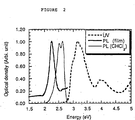
- Figure 2 shows the UV absorption and emission spectra for the dimer.
- a ⁇ - ⁇ * gap of 2.8 eV in dilute solution (CHCl 3 as solvent) was observed from the absorption edge or from the photoluminescent emission peak, and 2.3 eV ⁇ - ⁇ * gap in solid film was obtained from its solid film'emission peak.
- the emissive properties of BDT may be exploited in organic electroluminescent devices.
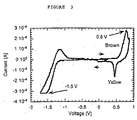
- Cyclic voltammetric measurement of the thin film of BDT revealed that both electrons and holes can be injected into the film, or in other words, BDT can be both n-doped or p-doped.
- Figure 3 shows a full sweep cyclic voltammogram for BDT film on Au coated glass substrate. A distinct colour change from yellow to brown to yellow was observed upon oxidative sweeping from 0 to 0.9 to 0 V (versus FOC), indicating an electrochemical quasi-reversible process upon p-doping (or hole injection) that may be related to the formation of a radical cation (see reference 17). A similar electrochemical process was noticed during the reduction sweep, suggesting a reversible n-doping (or election injection) process.
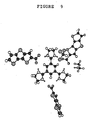
- BDT single crystal of BDT has been grown by the inventors by very slow cooling down of the saturated solution of BDT in toluene. Full crystallographic data were collected by a Synchrotron radiation source detailed below, as the single crystal was relatively small. Similar to ⁇ -6T and ⁇ -octathiophene, BDT crystallises in the monoclinic system, but has a C2/c space group. It is apparent that BDT has the greatest density, perhaps due to the high ratio of S/C in the molecule, or its highly packed structure. The BDT molecule has a completely planar conformation (see Figure 4), like 6 T and pentacene.
- each crystal unit cell there are four molecules packing in a unique way that differs from both 6T and pentacene.
- the BDT molecules packed more planar than either pentacene (which has a herringbone angle of 54°) or 6T (which has a herringbone angle of 66°) (see Figure 5).
- the BDT molecules in fact, pack each other face to face to form stacks with an angle of between two adjacent stacks.
- the driving force for this unique packing may be contributed from its advanced fused thiophene system and its sulphur atom's self-recognition.
- the BDT has the shortest ⁇ (A)- ⁇ (B) distance (3.56 ⁇ ) compared with 3.71 ⁇ for pentacene and 3.82 ⁇ for 6T, giving BDT a record close packing molecular system.
- the ⁇ (A)- ⁇ (B) stack distance is crucial to determine how strongly and how closely the parallel ⁇ systems will interact with each other; a shorter ⁇ stack distance should favour higher charge mobility.
- the shortest distance is between sulphur atoms of two tilted molecules, being 3.39 ⁇ .
- the invention exploits this phenomenon in processable organic thin films deposited by vapour and solution methods and is readily extended to include oligomers, polymers and precursor materials.
- TFTs Thin film transistors based on conjugated organic semiconductors are envisioned as the key component of low-cost, large-area electronics on flexible plastic substrates.
- the two most important material parameters for TFT applications are the field-effect mobility F FE and the ON/OFF ratio, i.e., the ratio of the current in the ON state of the TFT to that in the OFF state.
- F FE field-effect mobility
- ON/OFF ratio i.e., the ratio of the current in the ON state of the TFT to that in the OFF state.
- the film has to be highly crystalline with strong wavefunction overlap between adjacent molecules in the plane of the film.
- Intermolecular ordering is most easily achieved if a short-chain conjugated oligomer or a molecular semiconductor ( ⁇ -6T (reference 7), Cu-Pc (reference 19), C 60 (reference 20)) is deposited by vacuum sublimation.
- ⁇ -6T reference 7
- Cu-Pc reference 19
- C 60 reference 20
- fused ring compounds which have less conformational freedom than the prototype oligothiophenes (see reference 19) might yield stronger inter- and intramolecular ⁇ overlap. It is worth mentioning, however, that with conjugated polymers processed from solution a high degree of order can be obtained by making use of self-organisation mechanisms (see reference 20).
- TFTs comprising a fused ring compound of this invention, bis(dithienothiophene) (BDT) have exceptionally high ON/OFF ratios of up to 10 8 with sharp threshold characteristics.
- Field-effect mobilities are 0.0.2-0.05cm 2 /Vs.
- the TFT substrates were highly doped Si wafers with 2000 ⁇ SiO 2 gate oxide and interdigitated Au source/drain contacts.
- the surface of the SiO 2 was prepared so as to be hydrophobic by treating it with a solution of hexamethyldisilazane/chloroform (1:2) at 70 1 C for 3h. 100-200 nm thick BDT films were deposited by vacuum sublimation at a pressure of 1-2x10 -6 Torr.
- Optimum TFT performance was obtained for T ⁇ 100°C and r ⁇ 3 ⁇ /s.
- the TFT characteristics were measured with an HP 4145B parameter analyser under a dry N 2 atmosphere.
- FIG 6 shows the output (a) and transfer (b) characteristics of a typical BDT TFT deposited at 100°C.
- BDT is a p-type semiconductor and the devices operate in the accumulation mode.
- Typical ON/OFF ratios over a gate voltage range of 40V are 10 7 , but on some samples ON/OFF ratios up to 10 8 have been obtained (see Figure 6).
- the experimental characteristics are quadratic only in the range 5V ⁇
- ⁇ 20V and exhibits poor current saturation at higher gate voltages. Within the quadratic range, values of F sat FE 0.02-0.05 cm 2 /Vs are obtained under optimised deposition conditions (substrate temperature .1001C and deposition rates 1-3 ⁇ /s).
- These non-idealities may at least partly be related to a non-ohmic source/drain contact. As discussed below BDT is a high band gap semiconductor to which even a high workfunction metal like Au might not form an ohmic contact.
- the BDT material for the evaporation is purified by recrystallisation and vacuum thermal gradient sublimation. After the growth the films are transferred to a N 2 glove box within ⁇ 5 minutes, where the FET characteristics are measured. If stored under dry N 2 the TFT characteristics are stable over a period of weeks. However, operation in air results in rapid degradation. If the channel is turned on in air, I sd rapidly increases after a few minutes of operation and roughening around the Au hole-injecting source electrode is observed under an optical microscope, whereas the drain electrode remains intact. By Dektak profilometry the thickness of the Au source electrode is found to decrease in time (from initially 150nm to about 40nm after 2-3 hours of operation).
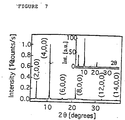
- Figure 7 shows a 6-2 ⁇ diffraction pattern of a 250nm BDT film deposited at ⁇ 100°C onto SiO 2 . In this geometry only Bragg reflections along the substrate normal can be measured. The observed pattern of sharp reflections can well be explained with the crystal structure of BDT, which has been determined by synchrotron XRD on a single crystal and has been described in detail above. It is sufficient to note that the unit cell is monoclinic with space group C2/c.
- the simulation shows that in the experimental diffraction pattern of the thin film only (h,0,0) reflections are observed (see inset of Figure 7). Their positions and intensities are in good agreement with the experimental pattern.
- Figure 8 shows polarised optical absorption spectra of a BDT film deposited' onto a Spectrosil glass substrate -held near 100°C.
- the absorption is characterised by two main peaks at 3.7eV and 4.7eV.
- the spectra exhibit a significant polarisation dependence confirming the high degree of structural order in the film.
- the absorption at 3.7eV is stronger by a factor of 2-3 for TM polarisation. Since the molecular axis is close to the substrate normal, this peak must correspond to transitions polarised along the long axis of the molecule.
- TM polarisation at least two weaker transitions around 2.65eV and 2.9eV below the main absorption at 3.7eV were reproducibly observed.
- the onset of absorption is at 2.4 ⁇ 0.2eV. It was determined by measuring a thick film (not shown) immersed into an inert liquid Teflon solution (Fluorinert FC-104, 3MTM) to reduce light scattering. The value is in good agreement with the photoluminescence spectra of BDT films exhibiting a peak at 2.25 eV.
- the relatively short conjugation length of the BDT molecule may explain the high ON/OFF ratio of the TFTs.
- Short chain molecules with a high ⁇ - ⁇ * energy gap tend to be more stable against unintentional chemical doping during synthesis and deposition.
- MIS metal-insulator-semiconductor
- the origin of the relatively high mobility must be related to the crystal structure of BDT.
- the long axis of the planar molecule is standing up on the substrate, which favours in-plane carrier transport along the stacking direction of the molecules.
- the coplanar stacking in BDT is likely to result in a stronger ⁇ - ⁇ overlap between adjacent molecules.
- the relatively high mobilities (0.02-0.05cm 2 /Vs) are explained by the coplanar stacking of the BDT molecules. Further improvement of the carrier mobility may be achieved by improving the carrier injection at the source/drain contacts and extending the' conjugation length using dithienothiophene as a building block.
- the largest peak and hole in the final difference map were 0.445 and -0.490 e ⁇ -3 .
- the lithiated dithienothiophene was added via syringe and refluxed for 1h. During this time the mixture turned dart red and some precipitation was observed.
- the mixture was cooled and poured into water (40 cm 3 ), the solids were filtered and washed with 2% aqueous HCl (2 x 50 cm 3 ), water (40 cm 3 ), aqueous Na 2 CO 3 then acetone (3 x 30 cm 3 ). Recrystallisation of the dark brown filter cake was attempted in toluene. This was difficult due to the intense dark brown coloration of the suspension in which dissolution was difficult to define. The mixture was allowed to cool slowly then the solids were filtered off to give a lighter brown filter cake.
- Carbon dioxide was added in small lumps to a flask against a fast flow of nitrogen. The flask was then sealed under a nitrogen bubbler and cooled to the -78°C. THF was added to cover the CO 2 and the mixture stirred. The cooled lithiodithienothiophene was added dropwise via syringe and a violent reaction was observed resulting in the formation of a yellow suspension. Once addition was complete the mixture was allowed to warm to r.t. during which time the mixture turned to an off white colour. After stirring for a further 30 min. water (30 cm 3 ) was added and the mixture turned to a light green/brown solution. This was washed with ether (2 x 20 cm 3 ) and the organics discarded.
- aqueous layer was acidified by the addition of HCl (10 cm 3 , 5 M) which precipitated out a fine yellow solid. Recrystallisation was attempted in 33% acetic acid. A fine, insoluble suspension remained after heating and this was left to further crystallise overnight to give the title compound as a fine yellow/green powder (286 mg, 61%); ⁇ H 7.31, (1H, d, J5.1), 7.56 (2H, d, J5.1), 7.94 (1H, s); ⁇ max/cm -1 (KBr) 3090 m, 2823 m, 2559 m, 1652 s, 1504 s, 1470 w, 1428 s, 1311 s, 1265 m, 1164 m, 928 s, 750 s, 716 s and 602 s; m.p. 276°C (sublimes) m.p.(lit.reference 29) 275-277°C)
- a solution of octanoyl chloride (1.00 g, 6.02 mmol) in dichloromethane (20 cm 3 ) was added dropwise over a 20 minute period and the mixture was then allowed to stand at room temperature for a further thirty minutes. It was then added to ice and the mixture was acidified with dilute hydrochloric acid (100 cm 3 ).
- Aluminium chloride (82 mg, 0.615 mmol) was dissolved in anhydrous diethyl ether (6. cm 3 ) and the solution was added slowly to an ice-cooled mixture of lithium aluminium hydride (103 mg, 2.71 mmol) in anhydrous diethyl ether (6 cm 3 ).
Landscapes
- Chemical & Material Sciences (AREA)
- Organic Chemistry (AREA)
- Engineering & Computer Science (AREA)
- Materials Engineering (AREA)
- Spectroscopy & Molecular Physics (AREA)
- Physics & Mathematics (AREA)
- Medicinal Chemistry (AREA)
- Polymers & Plastics (AREA)
- Chemical Kinetics & Catalysis (AREA)
- Health & Medical Sciences (AREA)
- Thin Film Transistor (AREA)
- Heterocyclic Carbon Compounds Containing A Hetero Ring Having Oxygen Or Sulfur (AREA)
- Polyoxymethylene Polymers And Polymers With Carbon-To-Carbon Bonds (AREA)
- Coupling Device And Connection With Printed Circuit (AREA)
- Electrotherapy Devices (AREA)
- Organic Low-Molecular-Weight Compounds And Preparation Thereof (AREA)
- Nitrogen Condensed Heterocyclic Rings (AREA)
Claims (27)
- Verbindung oder Komplex mit sich wiederholenden Einheiten der folgenden Formel (6):
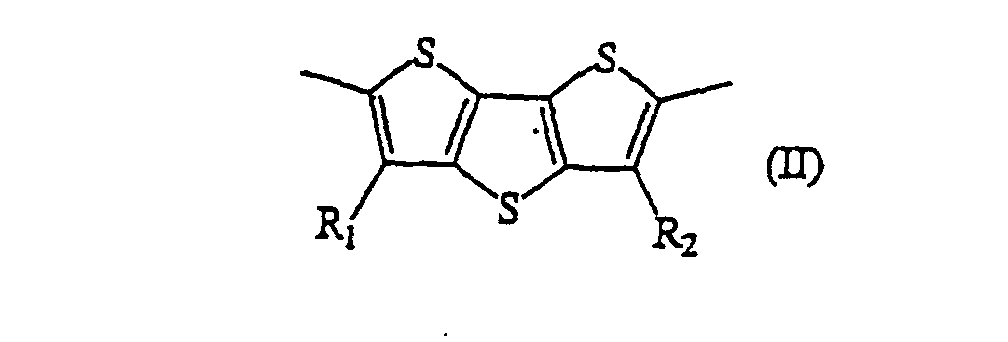
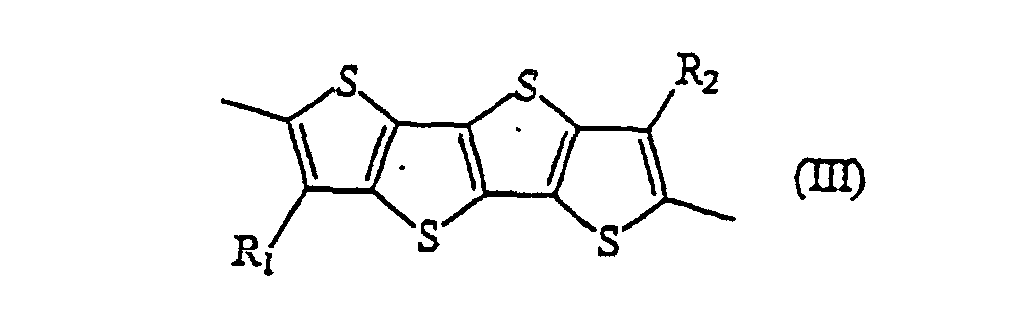
 worin R1, R2 und R3 unabhängig voneinander H, -(CH2)nCH3, -O(CH2)nCH3, -S(CH2)nCH3, eine solubilisierende Seitenkette, eine Alkylgruppe oder eine Arylgruppe bedeuten, R1 und/oder R2 gegebenenfalls einen gesättigten oder ungesättigten Ringsubstituenten mit dem Kohlenstoffatom bilden, das dem Kohlenstoffatom, an welches sie gebunden sind, benachbart ist, und R1 COOH, eine Triazol- oder Tetrazol-Gruppe oder ein Derivat davon sein kann und n=0 oder 1-40 ist, wobei m 2, 3 oder 4 ist, wenn die Verbindung aus einer sich wiederholenden Einheit der Formel (6) besteht, in der das kondensierte Thiophen eine Gruppe der Formel (II) ist und R1=R2=H ist.
- Verbindung nach Anspruch 1, die zusätzlich eine oder mehrere Einheiten der Formel (I) umfaßt:worin R1 und R2 die in Anspruch 1 genannten Bedeutungen besitzen.

- Verbindung nach einem der vorhergehenden Ansprüche, die zusätzlich eine oder mehrere nicht-kondensierte Thiophengruppen und/oder Einheiten umfaßt.
- Verbindung nach Anspruch 1 der Formel (VII):

- Verfahren zur Herstellung einer Verbindung gemäß einem der vorhergehenden Ansprüche, bei dem ein kondensiertes Thiophenderivat mit einem anderen kondensierten Thiophenderivat verbunden wird.
- Verfahren nach Anspruch 5, bei dem ein einziges kondensiertes Thiophenderivat mit sich selbst verbunden wird.
- Verfahren nach Anspruch 6, das die folgenden Schritte umfaßt:(a) ein 3-Halothiophen-Derivat wird mit BuLi und anschließend mit (PhSO2)2S unter Bildung einer Thiophenverbindung, die eine Sulfidbrücke enthält, umgesetzt;(b) die entstandene Verbindung wird mit BuLi und anschließend mit CuCl2 unter Bildung einer kondensierten Thiophenverbindung umgesetzt; und(c) die entstandene kondensierte Thiophenverbindung wird durch Umsetzung mit BuLi und anschließend mit Fe(acac)3 oder CuCl2 mit sich selbst verbunden.
- Verfahren nach Anspruch 7, bei dem das 3-Halothiophen-Derivat ein 3-Chlorthiophen-, ein 3-Bromthiophen- oder ein 3-Iodthiophen-Derivat ist.
- Verfahren nach einem der Ansprüche 5 bis 8, bei dem die nach dem Verbindungsschritt entstandene Verbindung durch Rekristallisation und/oder Vakuum-Wärmegradienten-Sublimation gereinigt wird.
- Elektrisches, elektronisches oder optoelektronisches Bauelement bzw. Anordnung, umfassend eine Verbindung gemäß einem der Ansprüche 1 bis 4.
- Bauelement bzw. Anordnung nach Anspruch 10, das bzw. die ein optoelektronisches Bauelement bzw. eine optoelektronische Anordnung ist.
- Bauelement bzw. Anordnung nach Anspruch 10 oder 11, das bzw. die eine lichtemittierende Anordnung, wie z.B. eine lichtemittierende Diode (LED), oder ein Dünnfilmtransistor (TFT) ist.
- Bauelement bzw. Anordnung nach Anspruch 12, umfassend eine Ladungstransport- oder -injektionsschicht, die eine Verbindung gemäß einem der Ansprüche 1 bis 4 enthält.
- Bauelement bzw. Anordnung nach einem der Ansprüche 10 bis 13, das bzw. die ein Dünnfilmtransistor (TFT)-Bauelement bzw. Anordnung mit einem Ein/Aus-Stromverhältnis von 106 oder mehr ist.
- Bauelement bzw. Anordnung nach Anspruch 14 mit einem Ein/Aus-Stromverhältnis von 108 oder mehr.
- Bauelement bzw. Anordnung nach einem der Ansprüche 10 bis 15 mit einer Feldeffektmobilität von 0,02 cm2/Vs oder mehr.
- Bauelement bzw. Anordnung nach Anspruch 16 mit einer Feldeffektmobilität von 0,05 cm2/Vs oder mehr.
- Verfahren zur Herstellung eines Bauelements bzw. einer Anordnung gemäß einem der Ansprüche 10 bis 17, bei dem eine Verbindung gemäß einem der Ansprüche 1 bis 4 auf einem Substrat abgeschieden wird.
- Verfahren nach Anspruch 18, bei dem die Abscheidung durch Vakuumsublimation durchgeführt wird.
- Verfahren nach Anspruch 18, bei dem die Abscheidung aus einer Lösung durchgeführt wird.
- Verfahren nach einem der Ansprüche 18 bis 20, bei dem Vorläufermaterialien abgeschieden werden.
- Verfahren nach einem der Ansprüche 18 bis 21, bei dem das Substrat dotiertes Silizium umfaßt.
- Verfahren nach Anspruch 22, bei dem das Substrat zusätzlich einen Gate-Isolator umfaßt.
- Verfahren nach Anspruch 22 oder 23, bei dem das Substrat zusätzlich einen Source-Kontakt und einen Drain-Kontakt umfaßt.
- Verwendung einer LED oder eines TFT gemäß einem der Ansprüche 12 bis 17 in einem elektrischen, elektronischen oder optoelektronischen Bauelement bzw. einer solchen Anordnung.
- Verwendung einer kondensierten Thiophenverbindung in einem elektrischen, elektronischen oder optoelektronischen Bauelement bzw. einer solchen Anordnung, wobei die kondensierte Thiophenverbindung eine Verbindung gemäß einem der Ansprüche 1 bis 4 ist.
- Verwendung nach Anspruch 26, wobei das Bauelement bzw. die Anordnung eine lichtemittierende Anordnung, wie z.B. eine lichtemittierende Diode (LED), oder ein Dünnfilmtransistor (TFT) ist.
Applications Claiming Priority (5)
| Application Number | Priority Date | Filing Date | Title |
|---|---|---|---|
| GBGB9718919.5A GB9718919D0 (en) | 1997-09-05 | 1997-09-05 | Organic semiconductors for electronic devices |
| GB9718919 | 1997-09-05 | ||
| GB9814814 | 1998-07-08 | ||
| GBGB9814814.1A GB9814814D0 (en) | 1998-07-08 | 1998-07-08 | Organic semiconductors for electronic devices |
| PCT/GB1998/002672 WO1999012989A1 (en) | 1997-09-05 | 1998-09-04 | Compounds for electronic devices |
Publications (2)
| Publication Number | Publication Date |
|---|---|
| EP1017735A1 EP1017735A1 (de) | 2000-07-12 |
| EP1017735B1 true EP1017735B1 (de) | 2003-11-19 |
Family
ID=26312196
Family Applications (1)
| Application Number | Title | Priority Date | Filing Date |
|---|---|---|---|
| EP98941598A Expired - Lifetime EP1017735B1 (de) | 1997-09-05 | 1998-09-04 | Verbindungen für eine elektronische anordnung |
Country Status (7)
| Country | Link |
|---|---|
| US (2) | US6403809B1 (de) |
| EP (1) | EP1017735B1 (de) |
| JP (1) | JP3313357B2 (de) |
| AT (1) | ATE254637T1 (de) |
| AU (1) | AU8991698A (de) |
| DE (1) | DE69819923T2 (de) |
| WO (1) | WO1999012989A1 (de) |
Families Citing this family (55)
| Publication number | Priority date | Publication date | Assignee | Title |
|---|---|---|---|---|
| US6265243B1 (en) * | 1999-03-29 | 2001-07-24 | Lucent Technologies Inc. | Process for fabricating organic circuits |
| WO2000079617A1 (en) * | 1999-06-21 | 2000-12-28 | Cambridge University Technical Services Limited | Aligned polymers for an organic tft |
| JP3377494B2 (ja) | 2000-03-13 | 2003-02-17 | 科学技術振興事業団 | ポリチオフェンラダー化合物とその製造法 |
| US6414164B1 (en) * | 2000-07-12 | 2002-07-02 | International Business Machines Corporation | Synthesis of soluble derivatives of sexithiophene and their use as the semiconducting channels in thin-film filed-effect transistors |
| US6750603B2 (en) * | 2000-08-17 | 2004-06-15 | Lumera Corporation | Second order nonlinear optical chromophores and electro-optic devices therefrom |
| WO2002014305A2 (en) * | 2000-08-17 | 2002-02-21 | Lumera Corporation | Design and synthesis of advanced nlo materials for electro-optic applications |
| SG92833A1 (en) | 2001-03-27 | 2002-11-19 | Sumitomo Chemical Co | Polymeric light emitting substance and polymer light emitting device using the same |
| GB0111423D0 (en) | 2001-05-10 | 2001-07-04 | Koninkl Philips Electronics Nv | An electronic device including a thin film transistor |
| US6515144B2 (en) * | 2001-05-22 | 2003-02-04 | The Board Of Regents Of The University Of Nebraska | Oligothiophenes and synthesis thereof |
| EP1275652A3 (de) * | 2001-07-09 | 2003-05-02 | MERCK PATENT GmbH | Mono-, Oligo- und Polydithienopyridine und ihre Verwendung als Ladungstransportmaterialien |
| EP1275651B1 (de) * | 2001-07-09 | 2005-08-31 | MERCK PATENT GmbH | Thienothiophen-Derivate |
| EP1275650A3 (de) * | 2001-07-09 | 2003-05-02 | MERCK PATENT GmbH | Thienthiophene mit einer polymerisierbaren Gruppe |
| ATE303389T1 (de) | 2001-07-09 | 2005-09-15 | Merck Patent Gmbh | Thienothiophen-derivate |
| KR100911136B1 (ko) * | 2001-07-09 | 2009-08-06 | 메르크 파텐트 게엠베하 | 반응성 티에노티오펜 |
| DE60206506T2 (de) * | 2001-07-09 | 2006-07-13 | Merck Patent Gmbh | Polymerisierbare verbindungen für den ladungstransport |
| DE60235679D1 (de) | 2001-08-17 | 2010-04-29 | Merck Patent Gmbh | Konjugierte Copolymere aus Dithienothiophen und Vinylen oder Acetylen |
| EP1284276B1 (de) * | 2001-08-17 | 2010-03-17 | MERCK PATENT GmbH | Konjugierte Copolymere aus Dithienothiophen und Vinylen oder Acetylen |
| JP4928694B2 (ja) * | 2001-09-18 | 2012-05-09 | 三菱重工業株式会社 | 薄膜多結晶の膜構造同定方法 |
| SG124249A1 (en) | 2001-12-07 | 2006-08-30 | Sumitomo Chemical Co | New polymer and polymer light-emitting device using the same |
| WO2003089515A1 (en) * | 2002-04-22 | 2003-10-30 | Konica Minolta Holdings, Inc. | Organic semiconductor composition, organic semiconductor element, and process for producing the same |
| EP1357163B1 (de) * | 2002-04-24 | 2006-05-31 | MERCK PATENT GmbH | Reaktive mesogene Benzodithiophene |
| US6803262B2 (en) * | 2002-10-17 | 2004-10-12 | Xerox Corporation | Process using self-organizable polymer |
| EP1477504A1 (de) * | 2003-05-16 | 2004-11-17 | MERCK PATENT GmbH | Mono-, Oligo-, und Polymere mit Dithienotiophen- und Aryleinheiten |
| US7244809B2 (en) * | 2003-05-16 | 2007-07-17 | Merck Patent Gmbh | Mono-, oligo- and polymers comprising dithienothiophene and aryl groups |
| JPWO2005022660A1 (ja) * | 2003-08-29 | 2006-10-26 | 松下電器産業株式会社 | 有機半導体膜、それを用いた電子デバイス、およびそれらの製造方法 |
| KR100623229B1 (ko) * | 2003-11-29 | 2006-09-18 | 삼성에스디아이 주식회사 | 유기 전계 발광 표시 장치 및 그의 제조 방법 |
| DE102004004863B4 (de) * | 2004-01-30 | 2007-01-25 | Infineon Technologies Ag | Resistiv arbeitende Speicherzelle |
| WO2005111045A1 (en) * | 2004-05-18 | 2005-11-24 | Merck Patent Gmbh | MONO-, OLIGO- AND POLYTHIENO[3,2-b]THIOPHENES |
| JP2006005036A (ja) * | 2004-06-16 | 2006-01-05 | Sony Corp | 有機化合物結晶及び電界効果型トランジスタ |
| US7838623B2 (en) | 2004-09-14 | 2010-11-23 | Corning Incorporated | Fused thiophenes, methods for making fused thiophenes, and uses thereof |
| KR101206202B1 (ko) * | 2004-09-14 | 2012-11-29 | 코닝 인코포레이티드 | 융합 티오펜, 융합 티오펜의 제조방법 및 그 용도 |
| US7893191B2 (en) | 2007-02-28 | 2011-02-22 | Corning Incorporated | Fused thiophenes, methods for making fused thiophenes, and uses thereof |
| US7161726B2 (en) * | 2004-11-05 | 2007-01-09 | Lumera Corporation | Linear optical modulators and method of linear optical modulation |
| US7321133B2 (en) * | 2004-11-17 | 2008-01-22 | Plextronics, Inc. | Heteroatomic regioregular poly(3-substitutedthiophenes) as thin film conductors in diodes which are not light emitting or photovoltaic |
| EP1847544B1 (de) * | 2005-01-19 | 2011-10-19 | National University of Corporation Hiroshima University | Neue kondensierte polycyclische aromatische verbindung und anwendung davon |
| WO2006086480A2 (en) * | 2005-02-10 | 2006-08-17 | Plextronics, Inc. | Hole injection/transport layer compositions and devices |
| JP2006232898A (ja) * | 2005-02-23 | 2006-09-07 | Ricoh Co Ltd | 導電性高分子材料、それを用いた電界効果型トランジスタ及びその製造方法 |
| JP2006232986A (ja) * | 2005-02-24 | 2006-09-07 | Mitsubishi Chemicals Corp | 導電性高分子並びにそれを用いた有機電子デバイス及び電界効果トランジスタ |
| US7385221B1 (en) * | 2005-03-08 | 2008-06-10 | University Of Kentucky Research Foundation | Silylethynylated heteroacenes and electronic devices made therewith |
| WO2008047896A1 (en) * | 2006-10-20 | 2008-04-24 | Nippon Kayaku Kabushiki Kaisha | Field-effect transistor |
| KR101314998B1 (ko) * | 2006-12-13 | 2013-10-04 | 삼성전자주식회사 | 헤테로아센 화합물, 이를 포함하는 유기 박막 및 당해 박막을 포함하는 전자 소자 |
| KR20080101229A (ko) | 2007-05-16 | 2008-11-21 | 삼성전자주식회사 | 액정성을 가지는 유기반도체 고분자, 이의 제조방법 및이를 이용한 유기박막트랜지스터 |
| KR101652533B1 (ko) * | 2008-03-31 | 2016-08-30 | 코닝 인코포레이티드 | 융합 티오펜 화합물, 이들을 제조하는 방법 및 이들의 용도 |
| US20120024382A1 (en) * | 2008-11-28 | 2012-02-02 | The University Of Ulm | Novel compounds, derivatives thereof and their use in heterojunction devices |
| GB2467293B (en) * | 2008-11-28 | 2013-07-10 | Cambridge Display Tech Ltd | Organic semiconductors |
| JP5600267B2 (ja) * | 2009-05-28 | 2014-10-01 | 日本化薬株式会社 | 新規な化合物及びその利用 |
| US7919634B2 (en) | 2009-05-28 | 2011-04-05 | Corning Incorporated | Fused thiophenes, articles, and methods thereof |
| KR101694917B1 (ko) | 2009-08-28 | 2017-01-23 | 에이전시 포 사이언스, 테크놀로지 앤드 리서치 | 폴리머 반도체, 소자 및 이를 제조하는 방법 |
| CN102549791B (zh) | 2009-08-28 | 2015-01-07 | 新加坡科技研究局 | 双极性聚合物半导体材料及有机电子器件 |
| US8389670B2 (en) * | 2009-12-02 | 2013-03-05 | Basf Se | Dithienobenzo-thieno[3,2-B]thiophene-copolymer and its use as high performance solution processable semiconducting polymer |
| JP2011136921A (ja) * | 2009-12-28 | 2011-07-14 | Jnc Corp | 有機トランジスタ材料およびこれを用いた有機トランジスタ |
| US8278346B2 (en) | 2010-08-06 | 2012-10-02 | Corning Incorporated | Di-tin fused thiophene compounds and polymers and methods of making |
| KR101099601B1 (ko) | 2011-01-13 | 2011-12-29 | 한국화학연구원 | 디티에노티오펜 화합물이 도입된 전도성 고분자 및 그를 광전변환재료로 이용한 유기 태양전지 |
| KR101860084B1 (ko) | 2012-07-06 | 2018-05-23 | 삼성전자주식회사 | 유기 광전 재료, 상기 유기 광전 재료를 포함하는 유기 광전 소자 및 이미지 센서 |
| KR102270175B1 (ko) * | 2014-05-09 | 2021-06-25 | 삼성전자주식회사 | 광전자 재료, 유기 광전자 소자 및 이미지 센서 |
Family Cites Families (12)
| Publication number | Priority date | Publication date | Assignee | Title |
|---|---|---|---|---|
| DE3342631A1 (de) * | 1983-11-25 | 1985-06-05 | Merck Patent Gmbh, 6100 Darmstadt | Thienothiophenderivate |
| BE899925A (fr) * | 1984-06-15 | 1984-10-01 | B L Facultes Universitaires No | Nouveaux polymeres heteroaromatiques de monomeres bicycliques, conducteurs d'electricite. |
| US5210217A (en) * | 1987-10-29 | 1993-05-11 | Miles Inc. | Substituted bithiophenes and dithienylpyrroles |
| US5412105A (en) * | 1992-06-29 | 1995-05-02 | Shin-Etsu Chemical Co., Ltd. | Thiophene-silole copolymer and its method of manufacture |
| DE4234230C2 (de) * | 1992-10-10 | 2003-08-14 | Covion Organic Semiconductors | Substituierte Thieno[3,2-b]thiophene und ihre Verwendung |
| WO1995016681A1 (en) * | 1993-12-14 | 1995-06-22 | The Trustees Of The University Of Pennsylvania | Derivatized polythiophenes and devices comprising same |
| JP3132630B2 (ja) * | 1994-08-25 | 2001-02-05 | 科学技術振興事業団 | チオフェン誘導体の重合体とその製造法 |
| US6166172A (en) * | 1999-02-10 | 2000-12-26 | Carnegie Mellon University | Method of forming poly-(3-substituted) thiophenes |
| JP3362008B2 (ja) * | 1999-02-23 | 2003-01-07 | シャープ株式会社 | 液晶表示装置およびその製造方法 |
| US6130339A (en) * | 1999-06-01 | 2000-10-10 | The United States Of America As Represented By The Secretary Of The Air Force | Electro-active monomers comprised of aniline-thiophene units |
| JP2001077366A (ja) * | 1999-08-20 | 2001-03-23 | Internatl Business Mach Corp <Ibm> | 薄膜トランジスタ、液晶表示装置、及び薄膜トランジスタの製造方法 |
| JP2002050764A (ja) * | 2000-08-02 | 2002-02-15 | Matsushita Electric Ind Co Ltd | 薄膜トランジスタ、アレイ基板、液晶表示装置、有機el表示装置およびその製造方法 |
-
1998
- 1998-09-04 AU AU89916/98A patent/AU8991698A/en not_active Abandoned
- 1998-09-04 JP JP2000510790A patent/JP3313357B2/ja not_active Expired - Lifetime
- 1998-09-04 AT AT98941598T patent/ATE254637T1/de not_active IP Right Cessation
- 1998-09-04 US US09/508,035 patent/US6403809B1/en not_active Expired - Lifetime
- 1998-09-04 WO PCT/GB1998/002672 patent/WO1999012989A1/en not_active Ceased
- 1998-09-04 EP EP98941598A patent/EP1017735B1/de not_active Expired - Lifetime
- 1998-09-04 DE DE69819923T patent/DE69819923T2/de not_active Expired - Lifetime
-
2002
- 2002-05-24 US US10/155,823 patent/US6626566B2/en not_active Expired - Lifetime
Also Published As
| Publication number | Publication date |
|---|---|
| DE69819923D1 (de) | 2003-12-24 |
| EP1017735A1 (de) | 2000-07-12 |
| JP3313357B2 (ja) | 2002-08-12 |
| AU8991698A (en) | 1999-03-29 |
| US6626566B2 (en) | 2003-09-30 |
| ATE254637T1 (de) | 2003-12-15 |
| US20030088112A1 (en) | 2003-05-08 |
| DE69819923T2 (de) | 2004-09-02 |
| JP2001515933A (ja) | 2001-09-25 |
| US6403809B1 (en) | 2002-06-11 |
| WO1999012989A1 (en) | 1999-03-18 |
Similar Documents
| Publication | Publication Date | Title |
|---|---|---|
| EP1017735B1 (de) | Verbindungen für eine elektronische anordnung | |
| US7374702B2 (en) | n-Type thiophene semiconductors | |
| US7964650B2 (en) | Carbonyl-functionalized thiophene compounds and related device structures | |
| US8232546B2 (en) | Fused polycyclic aromatic compound, process for producing the same, and use thereof | |
| US6399224B1 (en) | Conjugated polymers with tunable charge injection ability | |
| US9944663B2 (en) | Process for preparing substituted pentacenes | |
| US20020053666A1 (en) | n-type thiophene semiconductors | |
| US20090314997A1 (en) | Substituted benzodithiophenes and benzodiselenophenes | |
| CN102083883A (zh) | 基于供体/受体交替共聚物的高性能可溶液加工半导体聚合物 | |
| US20080303000A1 (en) | Monomers, Oligomers and Polymers Comprising Thiophene and Selenophene | |
| TWI472550B (zh) | 具有噻吩并〔3,2-b〕噻吩部分之聚合物 | |
| CN103068811B (zh) | 蒽并[2,3-b:7,6-b’]二噻吩衍生物及其作为有机半导体的用途 | |
| US20130146858A1 (en) | SEMICONDUCTORS BASED ON SUBSTITUTED [1]BENZOTHIENO[3,2-b][1]-BENZOTHIOPHENES | |
| KR101956970B1 (ko) | 티에노[2,3c]피롤-디온 유도체 및 유기 반도체에 대한 이들의 용도 | |
| WO2016132179A1 (en) | Thienothiophene/dithienothiophene - triphenylamine/tetraphenylethylene derivatives for organic light emitting diodes | |
| US20070028962A1 (en) | Low molecular weight conjugated nitrogen compounds and devices fabricated using the same | |
| US8431682B2 (en) | Regioregular polyselenophenes | |
| CA2977171C (en) | Thienothiophene boron (donor-acceptor) based materials for organic light emitting diodes | |
| US20210135131A1 (en) | Phosphorescent light-emitting compound |
Legal Events
| Date | Code | Title | Description |
|---|---|---|---|
| PUAI | Public reference made under article 153(3) epc to a published international application that has entered the european phase |
Free format text: ORIGINAL CODE: 0009012 |
|
| 17P | Request for examination filed |
Effective date: 20000320 |
|
| AK | Designated contracting states |
Kind code of ref document: A1 Designated state(s): AT BE CH CY DE DK ES FI FR GB GR IE IT LI LU MC NL PT SE |
|
| 17Q | First examination report despatched |
Effective date: 20011016 |
|
| GRAH | Despatch of communication of intention to grant a patent |
Free format text: ORIGINAL CODE: EPIDOS IGRA |
|
| GRAS | Grant fee paid |
Free format text: ORIGINAL CODE: EPIDOSNIGR3 |
|
| GRAA | (expected) grant |
Free format text: ORIGINAL CODE: 0009210 |
|
| AK | Designated contracting states |
Kind code of ref document: B1 Designated state(s): AT BE CH CY DE DK ES FI FR GB GR IE IT LI LU MC NL PT SE |
|
| PG25 | Lapsed in a contracting state [announced via postgrant information from national office to epo] |
Ref country code: LI Free format text: LAPSE BECAUSE OF FAILURE TO SUBMIT A TRANSLATION OF THE DESCRIPTION OR TO PAY THE FEE WITHIN THE PRESCRIBED TIME-LIMIT Effective date: 20031119 Ref country code: IT Free format text: LAPSE BECAUSE OF FAILURE TO SUBMIT A TRANSLATION OF THE DESCRIPTION OR TO PAY THE FEE WITHIN THE PRESCRIBED TIME-LIMIT;WARNING: LAPSES OF ITALIAN PATENTS WITH EFFECTIVE DATE BEFORE 2007 MAY HAVE OCCURRED AT ANY TIME BEFORE 2007. THE CORRECT EFFECTIVE DATE MAY BE DIFFERENT FROM THE ONE RECORDED. Effective date: 20031119 Ref country code: FI Free format text: LAPSE BECAUSE OF FAILURE TO SUBMIT A TRANSLATION OF THE DESCRIPTION OR TO PAY THE FEE WITHIN THE PRESCRIBED TIME-LIMIT Effective date: 20031119 Ref country code: CY Free format text: LAPSE BECAUSE OF FAILURE TO SUBMIT A TRANSLATION OF THE DESCRIPTION OR TO PAY THE FEE WITHIN THE PRESCRIBED TIME-LIMIT Effective date: 20031119 Ref country code: CH Free format text: LAPSE BECAUSE OF FAILURE TO SUBMIT A TRANSLATION OF THE DESCRIPTION OR TO PAY THE FEE WITHIN THE PRESCRIBED TIME-LIMIT Effective date: 20031119 Ref country code: BE Free format text: LAPSE BECAUSE OF FAILURE TO SUBMIT A TRANSLATION OF THE DESCRIPTION OR TO PAY THE FEE WITHIN THE PRESCRIBED TIME-LIMIT Effective date: 20031119 Ref country code: AT Free format text: LAPSE BECAUSE OF FAILURE TO SUBMIT A TRANSLATION OF THE DESCRIPTION OR TO PAY THE FEE WITHIN THE PRESCRIBED TIME-LIMIT Effective date: 20031119 |
|
| REG | Reference to a national code |
Ref country code: GB Ref legal event code: FG4D |
|
| REG | Reference to a national code |
Ref country code: CH Ref legal event code: EP |
|
| REF | Corresponds to: |
Ref document number: 69819923 Country of ref document: DE Date of ref document: 20031224 Kind code of ref document: P |
|
| REG | Reference to a national code |
Ref country code: IE Ref legal event code: FG4D |
|
| PG25 | Lapsed in a contracting state [announced via postgrant information from national office to epo] |
Ref country code: SE Free format text: LAPSE BECAUSE OF FAILURE TO SUBMIT A TRANSLATION OF THE DESCRIPTION OR TO PAY THE FEE WITHIN THE PRESCRIBED TIME-LIMIT Effective date: 20040219 Ref country code: GR Free format text: LAPSE BECAUSE OF FAILURE TO SUBMIT A TRANSLATION OF THE DESCRIPTION OR TO PAY THE FEE WITHIN THE PRESCRIBED TIME-LIMIT Effective date: 20040219 Ref country code: DK Free format text: LAPSE BECAUSE OF FAILURE TO SUBMIT A TRANSLATION OF THE DESCRIPTION OR TO PAY THE FEE WITHIN THE PRESCRIBED TIME-LIMIT Effective date: 20040219 |
|
| PG25 | Lapsed in a contracting state [announced via postgrant information from national office to epo] |
Ref country code: ES Free format text: LAPSE BECAUSE OF FAILURE TO SUBMIT A TRANSLATION OF THE DESCRIPTION OR TO PAY THE FEE WITHIN THE PRESCRIBED TIME-LIMIT Effective date: 20040302 |
|
| REG | Reference to a national code |
Ref country code: CH Ref legal event code: PL |
|
| REG | Reference to a national code |
Ref country code: GB Ref legal event code: 732E |
|
| ET | Fr: translation filed | ||
| PG25 | Lapsed in a contracting state [announced via postgrant information from national office to epo] |
Ref country code: LU Free format text: LAPSE BECAUSE OF NON-PAYMENT OF DUE FEES Effective date: 20040904 |
|
| PG25 | Lapsed in a contracting state [announced via postgrant information from national office to epo] |
Ref country code: IE Free format text: LAPSE BECAUSE OF NON-PAYMENT OF DUE FEES Effective date: 20040906 |
|
| PLBE | No opposition filed within time limit |
Free format text: ORIGINAL CODE: 0009261 |
|
| STAA | Information on the status of an ep patent application or granted ep patent |
Free format text: STATUS: NO OPPOSITION FILED WITHIN TIME LIMIT |
|
| PG25 | Lapsed in a contracting state [announced via postgrant information from national office to epo] |
Ref country code: MC Free format text: LAPSE BECAUSE OF NON-PAYMENT OF DUE FEES Effective date: 20040930 |
|
| 26N | No opposition filed |
Effective date: 20040820 |
|
| REG | Reference to a national code |
Ref country code: IE Ref legal event code: MM4A |
|
| PG25 | Lapsed in a contracting state [announced via postgrant information from national office to epo] |
Ref country code: PT Free format text: LAPSE BECAUSE OF NON-PAYMENT OF DUE FEES Effective date: 20040419 |
|
| REG | Reference to a national code |
Ref country code: FR Ref legal event code: PLFP Year of fee payment: 19 |
|
| REG | Reference to a national code |
Ref country code: FR Ref legal event code: PLFP Year of fee payment: 20 |
|
| PGFP | Annual fee paid to national office [announced via postgrant information from national office to epo] |
Ref country code: FR Payment date: 20170823 Year of fee payment: 20 Ref country code: GB Payment date: 20170829 Year of fee payment: 20 |
|
| PGFP | Annual fee paid to national office [announced via postgrant information from national office to epo] |
Ref country code: NL Payment date: 20170913 Year of fee payment: 20 |
|
| PGFP | Annual fee paid to national office [announced via postgrant information from national office to epo] |
Ref country code: DE Payment date: 20170928 Year of fee payment: 20 |
|
| REG | Reference to a national code |
Ref country code: DE Ref legal event code: R071 Ref document number: 69819923 Country of ref document: DE |
|
| REG | Reference to a national code |
Ref country code: NL Ref legal event code: MK Effective date: 20180903 |
|
| REG | Reference to a national code |
Ref country code: GB Ref legal event code: PE20 Expiry date: 20180903 |
|
| PG25 | Lapsed in a contracting state [announced via postgrant information from national office to epo] |
Ref country code: GB Free format text: LAPSE BECAUSE OF EXPIRATION OF PROTECTION Effective date: 20180903 |