EP1018365A2 - Anwendung von kodierten Partikeln zur Verfolgung der Verfahrensstufenreihe in der Herstellung von Bibliotheken aus kombinatorischen Verbindungen - Google Patents
Anwendung von kodierten Partikeln zur Verfolgung der Verfahrensstufenreihe in der Herstellung von Bibliotheken aus kombinatorischen Verbindungen Download PDFInfo
- Publication number
- EP1018365A2 EP1018365A2 EP00105243A EP00105243A EP1018365A2 EP 1018365 A2 EP1018365 A2 EP 1018365A2 EP 00105243 A EP00105243 A EP 00105243A EP 00105243 A EP00105243 A EP 00105243A EP 1018365 A2 EP1018365 A2 EP 1018365A2
- Authority
- EP
- European Patent Office
- Prior art keywords
- particle
- support
- particles
- phase
- library
- Prior art date
- Legal status (The legal status is an assumption and is not a legal conclusion. Google has not performed a legal analysis and makes no representation as to the accuracy of the status listed.)
- Withdrawn
Links
Images


Classifications
-
- C—CHEMISTRY; METALLURGY
- C07—ORGANIC CHEMISTRY
- C07K—PEPTIDES
- C07K1/00—General methods for the preparation of peptides, i.e. processes for the organic chemical preparation of peptides or proteins of any length
- C07K1/04—General methods for the preparation of peptides, i.e. processes for the organic chemical preparation of peptides or proteins of any length on carriers
- C07K1/045—General methods for the preparation of peptides, i.e. processes for the organic chemical preparation of peptides or proteins of any length on carriers using devices to improve synthesis, e.g. reactors, special vessels
-
- B—PERFORMING OPERATIONS; TRANSPORTING
- B01—PHYSICAL OR CHEMICAL PROCESSES OR APPARATUS IN GENERAL
- B01J—CHEMICAL OR PHYSICAL PROCESSES, e.g. CATALYSIS OR COLLOID CHEMISTRY; THEIR RELEVANT APPARATUS
- B01J19/00—Chemical, physical or physico-chemical processes in general; Their relevant apparatus
- B01J19/0046—Sequential or parallel reactions, e.g. for the synthesis of polypeptides or polynucleotides; Apparatus and devices for combinatorial chemistry or for making molecular arrays
-
- C—CHEMISTRY; METALLURGY
- C07—ORGANIC CHEMISTRY
- C07K—PEPTIDES
- C07K1/00—General methods for the preparation of peptides, i.e. processes for the organic chemical preparation of peptides or proteins of any length
- C07K1/04—General methods for the preparation of peptides, i.e. processes for the organic chemical preparation of peptides or proteins of any length on carriers
- C07K1/047—Simultaneous synthesis of different peptide species; Peptide libraries
-
- B—PERFORMING OPERATIONS; TRANSPORTING
- B01—PHYSICAL OR CHEMICAL PROCESSES OR APPARATUS IN GENERAL
- B01J—CHEMICAL OR PHYSICAL PROCESSES, e.g. CATALYSIS OR COLLOID CHEMISTRY; THEIR RELEVANT APPARATUS
- B01J2219/00—Chemical, physical or physico-chemical processes in general; Their relevant apparatus
- B01J2219/00274—Sequential or parallel reactions; Apparatus and devices for combinatorial chemistry or for making arrays; Chemical library technology
- B01J2219/00277—Apparatus
- B01J2219/00497—Features relating to the solid phase supports
- B01J2219/005—Beads
-
- B—PERFORMING OPERATIONS; TRANSPORTING
- B01—PHYSICAL OR CHEMICAL PROCESSES OR APPARATUS IN GENERAL
- B01J—CHEMICAL OR PHYSICAL PROCESSES, e.g. CATALYSIS OR COLLOID CHEMISTRY; THEIR RELEVANT APPARATUS
- B01J2219/00—Chemical, physical or physico-chemical processes in general; Their relevant apparatus
- B01J2219/00274—Sequential or parallel reactions; Apparatus and devices for combinatorial chemistry or for making arrays; Chemical library technology
- B01J2219/00277—Apparatus
- B01J2219/00497—Features relating to the solid phase supports
- B01J2219/00502—Particles of irregular geometry
-
- B—PERFORMING OPERATIONS; TRANSPORTING
- B01—PHYSICAL OR CHEMICAL PROCESSES OR APPARATUS IN GENERAL
- B01J—CHEMICAL OR PHYSICAL PROCESSES, e.g. CATALYSIS OR COLLOID CHEMISTRY; THEIR RELEVANT APPARATUS
- B01J2219/00—Chemical, physical or physico-chemical processes in general; Their relevant apparatus
- B01J2219/00274—Sequential or parallel reactions; Apparatus and devices for combinatorial chemistry or for making arrays; Chemical library technology
- B01J2219/00277—Apparatus
- B01J2219/0054—Means for coding or tagging the apparatus or the reagents
- B01J2219/00547—Bar codes
-
- B—PERFORMING OPERATIONS; TRANSPORTING
- B01—PHYSICAL OR CHEMICAL PROCESSES OR APPARATUS IN GENERAL
- B01J—CHEMICAL OR PHYSICAL PROCESSES, e.g. CATALYSIS OR COLLOID CHEMISTRY; THEIR RELEVANT APPARATUS
- B01J2219/00—Chemical, physical or physico-chemical processes in general; Their relevant apparatus
- B01J2219/00274—Sequential or parallel reactions; Apparatus and devices for combinatorial chemistry or for making arrays; Chemical library technology
- B01J2219/00277—Apparatus
- B01J2219/0054—Means for coding or tagging the apparatus or the reagents
- B01J2219/00547—Bar codes
- B01J2219/00549—2-dimensional
-
- B—PERFORMING OPERATIONS; TRANSPORTING
- B01—PHYSICAL OR CHEMICAL PROCESSES OR APPARATUS IN GENERAL
- B01J—CHEMICAL OR PHYSICAL PROCESSES, e.g. CATALYSIS OR COLLOID CHEMISTRY; THEIR RELEVANT APPARATUS
- B01J2219/00—Chemical, physical or physico-chemical processes in general; Their relevant apparatus
- B01J2219/00274—Sequential or parallel reactions; Apparatus and devices for combinatorial chemistry or for making arrays; Chemical library technology
- B01J2219/00277—Apparatus
- B01J2219/0054—Means for coding or tagging the apparatus or the reagents
- B01J2219/00554—Physical means
- B01J2219/00556—Perforations
-
- B—PERFORMING OPERATIONS; TRANSPORTING
- B01—PHYSICAL OR CHEMICAL PROCESSES OR APPARATUS IN GENERAL
- B01J—CHEMICAL OR PHYSICAL PROCESSES, e.g. CATALYSIS OR COLLOID CHEMISTRY; THEIR RELEVANT APPARATUS
- B01J2219/00—Chemical, physical or physico-chemical processes in general; Their relevant apparatus
- B01J2219/00274—Sequential or parallel reactions; Apparatus and devices for combinatorial chemistry or for making arrays; Chemical library technology
- B01J2219/00277—Apparatus
- B01J2219/0054—Means for coding or tagging the apparatus or the reagents
- B01J2219/00554—Physical means
- B01J2219/00558—Cuts-out
-
- B—PERFORMING OPERATIONS; TRANSPORTING
- B01—PHYSICAL OR CHEMICAL PROCESSES OR APPARATUS IN GENERAL
- B01J—CHEMICAL OR PHYSICAL PROCESSES, e.g. CATALYSIS OR COLLOID CHEMISTRY; THEIR RELEVANT APPARATUS
- B01J2219/00—Chemical, physical or physico-chemical processes in general; Their relevant apparatus
- B01J2219/00274—Sequential or parallel reactions; Apparatus and devices for combinatorial chemistry or for making arrays; Chemical library technology
- B01J2219/00277—Apparatus
- B01J2219/0054—Means for coding or tagging the apparatus or the reagents
- B01J2219/00554—Physical means
- B01J2219/0056—Raised or sunken areas
-
- B—PERFORMING OPERATIONS; TRANSPORTING
- B01—PHYSICAL OR CHEMICAL PROCESSES OR APPARATUS IN GENERAL
- B01J—CHEMICAL OR PHYSICAL PROCESSES, e.g. CATALYSIS OR COLLOID CHEMISTRY; THEIR RELEVANT APPARATUS
- B01J2219/00—Chemical, physical or physico-chemical processes in general; Their relevant apparatus
- B01J2219/00274—Sequential or parallel reactions; Apparatus and devices for combinatorial chemistry or for making arrays; Chemical library technology
- B01J2219/00583—Features relative to the processes being carried out
- B01J2219/00585—Parallel processes
-
- B—PERFORMING OPERATIONS; TRANSPORTING
- B01—PHYSICAL OR CHEMICAL PROCESSES OR APPARATUS IN GENERAL
- B01J—CHEMICAL OR PHYSICAL PROCESSES, e.g. CATALYSIS OR COLLOID CHEMISTRY; THEIR RELEVANT APPARATUS
- B01J2219/00—Chemical, physical or physico-chemical processes in general; Their relevant apparatus
- B01J2219/00274—Sequential or parallel reactions; Apparatus and devices for combinatorial chemistry or for making arrays; Chemical library technology
- B01J2219/00583—Features relative to the processes being carried out
- B01J2219/00592—Split-and-pool, mix-and-divide processes
-
- B—PERFORMING OPERATIONS; TRANSPORTING
- B01—PHYSICAL OR CHEMICAL PROCESSES OR APPARATUS IN GENERAL
- B01J—CHEMICAL OR PHYSICAL PROCESSES, e.g. CATALYSIS OR COLLOID CHEMISTRY; THEIR RELEVANT APPARATUS
- B01J2219/00—Chemical, physical or physico-chemical processes in general; Their relevant apparatus
- B01J2219/00274—Sequential or parallel reactions; Apparatus and devices for combinatorial chemistry or for making arrays; Chemical library technology
- B01J2219/00583—Features relative to the processes being carried out
- B01J2219/00596—Solid-phase processes
-
- C—CHEMISTRY; METALLURGY
- C40—COMBINATORIAL TECHNOLOGY
- C40B—COMBINATORIAL CHEMISTRY; LIBRARIES, e.g. CHEMICAL LIBRARIES
- C40B70/00—Tags or labels specially adapted for combinatorial chemistry or libraries, e.g. fluorescent tags or bar codes
Definitions
- This invention relates to particles which are individually and optionally uniquely coded with a machine readable code.
- One particular application is in the field of Combinatorial Compound Library (CCL) synthesis wherein many compounds are synthesised on small supporting particles or beads, and rapidly screened for desired biological, pharmacological or chemical activity.
- CCL Combinatorial Compound Library
- This application is given by way of illustration only and is in no way limiting.
- CCL's combinatorial compound libraries
- the process allows CCL's containing vast numbers of "ligands" (library compounds or elements) to be created in relatively few discrete process steps, albeit with each ligand present in minute quantity.
- ligands library compounds or elements
- compounds with specific, desired chemical or pharmacological activity may be expediently identified.
- activity may include for example inhibition or stimulation of an enzyme or pharmacological receptor, the catalysis of a chemical process and the like. This technology is particularly useful when used in conjunction with high throughput screens.
- CCL's may be synthesised is based upon the use of minute beads or particles upon which the library of compounds may be produced.
- the procedure typically utilises a significant number of small'beads of diameter from a few tens of microns or less to a few hundreds of microns or more which act as the supporting matrices upon which compound synthesis may subsequently take place.
- the beads are typically of crosslinked polystyrene, polyamide, sintered glass, or similar insoluble material, and possess chemical bonding sites spread throughout the volume of the beads.
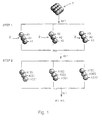
- the procedure for handling the beads is shown schematically in Figure 1.
- a suspension of beads 1, is separated into three separate parts, 2, each of which is then exposed to a specific reagent, Al, A2, or A3 which becomes attached to the beads
- the three suspensions of beads are then recombined within a single vessel and thoroughly mixed before being divided once again into three separate parts, each part containing a proportion of all three compound types.
- the large number of beads involved in the process ensures that statistically the numbers of each type of compound in each vessel are approximately equal.
- the three suspensions are then further exposed to the same or different reagents B1, B2, or B3, and this results, for example in compounds A1B1, A2B1, and A3B1 in the first vessel; A1B2, A2B2, and A3B2 in the second vessel; and A1B3.
- One method of generating this information is to follow up each synthesis step with an independent process wherein a chemical "tag” is added to all the beads in that particular vessel [Janda, Proc, Natl. Acad. Sci USA, 1994, 91:10779-85].
- tags are built up in parallel with the ligands so that at the end of the process the sequence of operations any particular bead has gone through may be retraced by separately analysing the tag sequence.
- the first tags to be employed in this way were oligonucleotides and peptides [Brenner and Lerner, Proc. Natl. Acad. Sci. USA, 1992, 89:5181-5183; Nikolaiev et al, Peptide Res., 1993, 6:161-170; Needels et al, Proc. Natl. Acad. Sci. USA, 1993. 90:10700-10704].
- a further example of this approach is disclosed in PCT WO 93/06121.
- a disadvantage of this procedure is that these are generally sensitive molecules which are unlikely to be able to withstand some of the harsh reaction conditions (e.g. strong acid, strong base etc ) necessary for the preparation of a broad variety of ligands.
- Another disadvantage of this procedure is that they have rather limited coding capacity.
- a system has been devised for providing a desired number of particles or solid supports, each with a permanent, machine-readable code, which may be read "on-the-fly" between process steps, thus allowing the process sequence, or audit trail, for each bead to be recorded.
- the code may be read when the beads are stationary.
- a Combinatorial Chemistry solid support particle marked with a machine readable code said code being adapted to remain substantially unchanged during Combinatorial Chemistry Library Synthesis, characterised in that the machine readable code is in the form of a binary code and in that at least one dimension of the particle exceeds 50 ⁇ m, rendering such a particle visible to the naked eye.
- the machine readable code is in the form of a binary code and in that at least one dimension of the particle exceeds 50 ⁇ m, rendering such a particle visible to the naked eye.
- the support particle comprises a first phase comprising a solid support suitable for use in Combinatorial Chemistry techniques and a second phase containing a machine readable code.
- a first phase comprising a solid support suitable for use in Combinatorial Chemistry techniques
- a second phase containing a machine readable code.
- the particle has a bi-layer structure, the first and second phases being in the form of layers superimposed one on another. The two layers are therefore bonded together.
- the second phase incorporating the machine readable code is substantially encapsulated within the first phase, substantially the whole outer surface of the particle thus being free for use as a chemical support. This increases the available area of the support.
- the two phases are mechanically linked.
- the second phase takes the form of a wafer incorporating an aperture and the first phase extends through said aperture such that a portion of the first phase exists on each side of the aperture, the aperture and therefore the wafer, forming a so-called waste in the first phase thus tending to cause the two phases to remain in mechanical contact.
- the second phase incorporates one or more barbed or hook like protrusions adapted to engage the surface of the first phase. This can be likened to a miniature version of hook and loop fastening.
- the support on which chemical synthesis takes place comprises one or more of the following materials:- porous silicates, for example controlled pore glass; polymeric resin materials for example polystyrene, poly(substituted-styrene), for example poly(halomethylstyrene), poly(halostyrene), poly(acetoxystyrene): polyacrylamides, for example poly(acryloylsarcosine methyl ester); other polyesters, polyacrylates and polymethacrylates; as well as derivatised versions of these resins, for example polystyrene which has been chloromethylated, or poly(acryloylsarcosine methyl ester) wherein the ester has been saponified and the resultant acid derivatised with another moiety of utility in CCL synthesis, as well as optionally cross-linked versions of these resins.
- polymeric resin materials for example polystyrene, poly(substituted-styrene), for example poly(hal
- the code consists of one or more of the following features: pits, holes, hollows, grooves or notches or any combination thereof.
- the code resides in the shape of the particle or the shape of the second phase where a second phase is present.
- the machine readable code is readable optically. This enables technology and equipment from related fields to be used.
- the particle further incorporates an orientation marker. This results in increased reliability of results by ensuring that the code is always interpreted correctly.
- a set of support particles consisting of particles as described above substantially each particle in the set having a unique machine readable code.
- the invention also encompasses a method of building and deconvoluting a Combinatorial library comprising the steps of:-
- a multiplicity of chemically-inert, micrometer-sized, solid support particles each labelled with a unique, permanent binary code which is machine-readable remotely during the handling of a fluid containing the solid support particles, and each arranged to support and carry a sequence of compounds introduced successively through the fluid in use whereby to build up a labelled compound library
- the code is readable optically, but it is envisaged that alternative forms could be used, provided they did not interfere chemically with the library compounds.
- the invention encompasses a compound library which in accordance with the invention is supported on the support particles as defined immediately above. It also provides a method of building a compound library using support particles as defined above comprising the steps of dividing a fluid containing the support particles into portions, whilst reading the labels and tracking the movments of the support particles into the respective portions, allowing the support particles of each portion to combine with and subsequently carry a different respective compound, and repeating the fluid division, tracking and combination steps at least once so as to create a compound library of which each member contains a machine-readable code which can be used with the associated tracking information to identify the sequence of compound combinations and hence the specific compounds.
- the present invention thus provides a method for the characterisation and deconvolution of a compound library, which method comprises (i) synthesising the library on a plurality of support particles substantially each particle having an individual, machine-readable code, (ii) testing library compounds in a biological assay, (iii) selecting library compounds of interest, and (iv) identifying such compounds by reference to the code on the associated support particle.
- the solid support which constitutes the first aspect of the invention conveniently comprises any suitable support material which is inert, that is to say it is of a chemical composition which is not affected by the rigours of library synthesis and testing to any relevant extent.
- Preferred materials for the synthesis of CCL's according to the method of this invention are porous silicates, for example controlled pore glass, polymeric resin materials for example polystyrene; poly(substituted-styrene), for example poly(halomethylstyrene), poly(halostyrene), poly(acetoxystyrene); polyacrylamides, for example poly(acryloylsarcosine methyl ester); other polyesters, polyacrylates and polymethacrylates; as well as derivatised versions of these resins, for example polystyrene which has been chloromethylated, or poly(acryloylsarcosine methyl ester) wherein the ester has been saponified and the resultant acid derivatised with another
- the support is made of or in part comprises some material, natural or synthetic, which is suitable for use in the chemistry used in Combinatorial Chemistry techniques. This includes materials not yet known or discovered.
- a further aspect of this invention is that the individual solid supports each carry a machine-readable code as described hereinbelow.
- the solid supports are also conveniently in the form of particles, preferably microparticles whose longest dimension is between 1 and 500 microns.
- microparticles whose longest dimension is between 1 and 500 microns.
- alternative solid support materials for example specially prepared porous silicon dioxide (glass) particles, which also have utility in the synthesis of combinatorial compound libraries, can, under specific growth conditions, be micromachined to produce particles which can be directly encoded in a manner analogous to that described hereinbelow.
- porous silicon dioxide glass particles
- the process for achieving such low density porous silicon dioxide that would be suitable for CCL synthesis is not presently well understood and though certainly technically feasible, such particles may not be regarded as an optimum embodiment of the invention. This embodiment is illustrated in Figure 5.
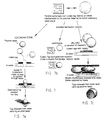
- Figure 5 illustrates a wafer-shaped particle 20 at least one flat surface of which includes a series of machine readable dots 21.
- This arrangement has the advantage that only a single solid phase is required and there is no requirement for bonding to dissimilar materials.
- the particle may incorporate an orientation marker e.g. a corner cut off, shaped groove or the like (not shown) to facilitate accurate reading of the code.
- a preferred embodiment of the invention comprises a microparticle which conveniently consists of two distinct phases, one, a solid support material for library synthesis and the other a phase containing a machine-readable code.
- a particularly preferred embodiment of the invention encompasses a microparticle which comprises one or more of the polymeric solid support materials outlined above, attached to, encapsulating, or otherwise permanently associated with a rigid, opaque, coded subparticle, and which combines the desired properties of both the polymeric solid support material and the coded microparticle. This principle is illustrated in Figure 6. Such individually coded particles are then useful in combinatorial processes to allow the tracking of each particle through the various chemical processing steps, the particle codes being machine-read 'on-the-fly' as the particles move from one process step to another or after completion of the screening process.
- Code marks may be applied to rigid materials such as silicon, silicon dioxide, or a metal, using the process of micromachining. These materials can then be further micromachined into particles of defined size and shape. Such materials offer the additional advantage of comparative robustness and, in certain cases, chemical inertness. By way of exemplification, it has been shown by Kaye et. al. in the Journal of Aerosol Science Vol. 23 [1992, Supplement 1, 201-204] that extremely uniform particles of silicon or silicon dioxide (glass) can be made using the technology of micromachining. Particles may also be manufactured from metals such as aluminium or gold, as well as polyamide or other polymeric or resin materials. Preferred materials for the manufacture of subparticles are silicon and silicon dioxide.
- the machining technology was developed from the microelectronics industry and uses similar processes of deposition and etching to those used to make microelectronic integrated circuits.
- the manufacture of such particles involves typically:- the design of the required particle geometry (or geometries) using computer aided design (CAD) tools; the manufacture of appropriate photolithographic masks which delineate the particle shapes; the deposit onto a previously prepared silicon wafer substrater i.e.
- CAD computer aided design
- a sacraficial layer and (typically 3, 4 or 8 inches in diameter) of a layer of, for example, silicon or silicon dioxide from which the particles will be made; the coating of this layer with a photosensitive polymer resist which, upon ultraviolet exposure through the photographic mask, defines the particle shapes; and finally the creation of the particles on the wafer substrate by removing unexposed resist and etching away the revealed inter-particle areas of silicon or silicon dioxide.
- the particles may then be freed from the wafer substrate by dissolution of a sacrificial layer (typically made of aluminium if the particles are silicon or silicon dioxide) which underlies the particles.
- Subparticles can be designed to have widths from a few microns to greater than 100 microns and thicknesses up to the order of 10 microns.
- a wafer substrate may thus be etched by micromachining processes to yield typically a million or more particles, each, if desired, carrying a different binary code.
- the microscopic code on the particles may be interrogated and read using appropriate microscope-based image processing systems.
- a code containing just twenty binary sites would allow a million particles to be uniquely numbered from 1 to 1,000,000.
- Figures 3a and 3b show preferred embodiments of the polymer-coated, micromachined subparticles - the microparticles of the invention.
- the polymer coating, 9, is applied principally to one surface the upper surface of the micromachined subparticle as illustrated, 3, to give a bilayer microparticle.
- the subparticle, 3, is encapsulated within the polymer coating, 9, to give a cored microparticle.
- a preferred, but non-limiting method of producing single-surface coated microparticles is as follows.
- the silicon or silicon dioxide particles are etched on a silicon wafer substrate of say 4 inches diameter as described by Kaye et. al (vide supra).
- the particles are etched following exposure through an appropriate photolithographic mask such that each particle carries a unique binary, ternary or other code.
- an additional layer of the desired polymer is applied across the entire wafer.
- the thickness of the layer would typically be of the order of 10 to 30 microns.
- the layer would be deposited in a similar way to normal photosensitive polymer photoresists which are routinely used in the microelectronics and micromachining technologies.
- the polymer layer is coated with a further photoresist layer and this is exposed through an additional photolithographic mask to define discrete areas covering each of the coded micromachined particles.
- the unexposed resist is subsequently removed by a photoresist-specific solvent, exposing the inter-particle areas of polymer layer which may then be removed by a suitable polymer dissolving solvent.
- the silicon, or silicon dioxide/polymer microparticles are finally released from the wafer by dissolution of the sacrificial aluminium layer underlying them.
- One preferred, but non-limiting, method of producing fully polymer-coated microparticles is as follows.
- the coded micromachined silicon or silicon dioxide particles are freed from the wafer in the manner described by Kaye et. al. These subparticles are then suspended in a melt or solution of the polymer to be applied as a coating. The suspension is then sprayed with sufficient pressure through a fine orifice to produce a droplet jet. Under the correct fluid dynamic conditions, determined by experimentation, the micromachined particles encapsulated in a layer of polymer will be ejected singly from the orifice.
- the polymer coated, coded microparticles may be separated from the remainder by centrifugation in an aqueous suspension (the coded silicon particles being of greater density than the polymer would cause the required coated particles to precipitate below the homogeneous polymer beads), or by suspension in an organic solvent which caused the polymer to swell.
- the coated particles, though also exhibiting polymer swelling, would be less buoyant than the homogeneous polymer particles (which float to the surface of the suspension) and would sink, facilitating their removal.
- a second preferred, but non-limiting method involves preformed silicon or silicon dioxide subparticles being introduced into a heterogeneous aqueous mixture of monomer precursors, for example styrene, halomethylstyrene, halostyrene, acryloylsarcosine methyl ester etc., or mixtures thereof, along with, optionally, crosslinking agents as well as such polymerisation catalysts and initiators as would be known to any person skilled in the art, such that, under controlled conditions of emulsion polymerisation, the polymer forms, encapsulates the subparticles and generates the microparticles. The microparticles are then recovered by filtration and washed copiously to remove all by-products of the polymerisation reaction.
- monomer precursors for example styrene, halomethylstyrene, halostyrene, acryloylsarcosine methyl ester etc., or mixtures thereof, along with, optionally, crosslink
- a particularly preferred material for the production of coded subparticles is silicon because of its opacity at visible wavelengths and inertness to most chemicals used in the processes of combinatorial chemistry.
- Particularly preferred machine readable codes carried by the subparticles are pits, holes, grooves, notches, or combinations thereof.
- the codes are also preferably binary in nature.
- the subparticles carry some form of micromachined orientation marking, for example one or more grooves or holes, in order to render the microparticles non-symmetrical and thus to assist the code reading process.
- a further embodiment of this application comprises subparticles which are derived from a non-porous, rigid, inert material such as silicate (glass) into which has been deposited, during or after production, but before association with the polymeric solid support, a suitable number of individual materials which can be altered by application of an external non-chemical stimulus, for example electromagnetic radiation. By virtue of the changes imbued in them by the particular stimulus, these materials can, by suitable readout of the residual deposits, reveal the process sequences that those particles/subparticles have experienced.
- Non-limiting examples of such materials include fluorescent and phosphorescent chemicals, which can be selectively modified by light of a specific wavelength, and also detected by a machine capable of detecting transmitted, refracted or reflected light at one or many wavelengths.
- the material deposited within the subparticle may not be modifiable.
- the information that such material can reveal would pertain to the very first process that the particular particle/subparticle had experienced.
- one or more heavy metals were to be incorporated into a glass subparticle such that each metal element or combination of metals were to be indicative of a particular building block to be added in the first stage of the combinatorial synthesis (for example, in Figure 1, copper might be the "tag" for building block 'A1')
- any active or interesting ligand, as defined herein, which is associated with a bead that, upon analysis by, for example atomic absorption spectroscopy, reveals copper to be present, can be inferred to have originated from the process that involved the chemical process aimed at introducing building block A1.
- the coded microparticle may be linked to the appropriate polymer mechanically by a variety of methods. Numerous methods of fabrication of such a mechanically linked assembly are possible.
- the polymer beads are suspended in an appropriate liquid, e.g. water or a solvent, and drawn by suction through an appropriately shaped hole in the coded tag as shown. The tag is released from the silicon wafer as described previously.
- the coded tag is fabricated in such a way that a hook or harpoon is incorporated. Under turbulent mixing the polymer bead will become attached. In these methods it may be advantageous to soften the polymer by exposure to solvent before carrying out these operations.
- the polymer beads may be attached to the coded tag bearing one or more hooks by mechanically pressing the beads against the tags with an appropriate flat surface. The tag is released from the silicon wafer as described previously.
- Figures 7b and 7c illustrate just two possible methods by which a support particle suitable for carrying out Combinatorial Chemistry can be mechanically linked to a coded particle. These methods are intended as illustrations only. This invention is intended to encompass all methods of mechanical fixing, be they temporary or permanent.
- the strength and mechanical stability of the link between the two phases may be adjusted according to the desired conditions of use.
- the geometry of the coded phase will depend on the shape of the first phase, the nature of the coded information amongst other factors.
- each coded microparticle possesses a unique code.
- a CCL of, for example, a million compounds can be represented by a million unique coded microparticles using a binary code of 20 binary sites, or a CCL of, for example, 100,000 elements can be represented by a million coded microparticles using a code of 20 binary sites such that each compound is represented, redundantly, ten times.
- the combinatorial compound library may comprise any convenient number of individual members, for example tens to hundreds to thousands to millions etc., of suitable compounds, for example peptides, peptoids and other oligomeric compounds (cyclic or linear), and template-based molecules, for example benzodiazepines, hydantoins, biaryls, polycyclic compounds (e. g. naphthalenes, phenothiazines, acridines, steroids etc.), carbohydrate and amino acid derivatives, dihydropyridines, benzhydryls and heterocycles (e.g.. triazines, indoles etc.).
- suitable compounds for example peptides, peptoids and other oligomeric compounds (cyclic or linear)
- template-based molecules for example benzodiazepines, hydantoins, biaryls, polycyclic compounds (e. g. naphthalenes, phenothiazines, acridines, steroids
- the compound library preferably comprises chemical compounds of low molecular weight and potential therapeutic agents. Such compounds are for example of less than about 1000 daltons, such as less than 800, 600 or 400 daltons.
- Combinatorial Libraries are intended for testing in a variety of assays.
- the purpose of any assay is to test the ability of library elements or compounds to modulate activity in a test system of interest.
- Particularly preferred, but in no way limiting, are biological assays, biological systems and biologicals of interest including high throughput screens.
- Convenient biologicals of interest include proteins such as enzymes, receptors, signalling systems, reporter genes and the like. Suitable test systems will be apparent to the scientist of ordinary skill. Any convenient number of library compounds may be tested in the biological assay.
- Synthesis of the compound library on the microparticles may comprise any convenient number of individual reaction steps.
- Chemical libraries synthesised on a plurality of coded microparticles as hereinbefore defined are novel and represent further and independent aspects of this invention.
- the coded microparticles as herein described form further and independent aspects of the invention.
- the beads are separated into a multiwell container, for example a 96 well plate, such as used in robotic systems used for screening compounds in biological assays, the code may be read when the beads are stationary.
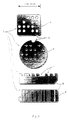
- Figure 4 shows an embodiment of a code reading station. It comprises a capillary flow channel, 10, carrying in suspension the coded microparticles, 3, between process steps, and a reading station, 11, which incorporates a microscope objective lens system and which is capable of acquiring an image or images of each particle as it traverses the reading station. Each image may then be processed electronically by a computing system, 13, to identify the code.
- the desired particle flow may be achieved by applying over-pressure to the upstream reaction vessel, by manual pipetting, or by some other technique. At one point the flow passes through a transparent channel, 10, whose dimensions are such that the particles tend to align in single file as they pass through the channel.
- This type of particle trajectory control may be achieved simply by appropriate channel design, although the use of laminar flow focusing (commonly used in flow-cytometers to align biological cells in liquid flow) would be preferred.
- the particles can be made to travel along the channel with their long axis preferentially aligned with the axis of flow, thus facilitating observation of the codes.
- a particularly preferred embodiment of the invention encompasses coded microparticles with a suitable aspect ratio of length to width of between 3:1 and 10:1.
- a "lozenge"-shaped microparticle of 150 microns length would preferably possess a width dimension of between 15 and 50 microns, and one of 300 microns length, a width of between 30 and 100 microns.
- each individual particle is more difficult to control and therefore the code reading station, 11, must be capable of observing the particle from several directions simultaneously. This could be achieved either by the use of mirrors at either side of the channel reflecting images to a single objective lens system, or preferably by the use of four orthogonally arranged objective lens imaging systems (see Fig.4).
- the image(s) of the particle may be captured via a microscope objective lens system by conventional miniature charge-coupled-device (CCD) cameras 12.
- CCD charge-coupled-device
- monochromatic illumination from, for example, a diode laser, which may improve the contrast ratio in the acquired image.
- the captured image(s) from each particle may then be processed by a dedicated computing system, 13, using either conventional commercial image processing software such as Optimas (TM) or Visilog (TM), or preferably dedicated custom software which could be programmed to provide desirable speed advantages.
- the processing would deduce the orientation of the particle and ascertain the positions of the code marks on the particle. From this, the complete code would be determined and recorded.
- particle codes would be read at maximum rates of typically 50 to 100 per second. This rate will be dependent on the particular application and technology available. The use of two reading stations in series along a channel would allow checking of code data and minimise the possibilities of misread codes due to particle coincidences within the measurement zone.
- the polymer coating is sufficiently transparent for the code on the particle to be successfully read.
- Most polymers are translucent rather than transparent at visible wavelengths, and therefore the thickness of the coating should not be such that the code information is unreadable.
- Preferred polymer thicknesses are between 5 and 50 microns.
- Particularly preferred thicknesses are between 10 and 30 microns.
- an optically acceptable thickness of 15 microns would, when coating a silicon particle of, for example, 120 microns x 25 microns x 10 microns in size, constitute a total polymer volume equivalent to that of a 130 microns diameter solid polymer bead, and would be quite suitable for use in combinatorial chemistry.
- the code information recorded at each of many reading stations arranged between the chemical process vessels would be collated on a central computer system and be available for interrogation to ascertain the specific route each coded microparticle had taken through the reaction processes.
Landscapes
- Chemical & Material Sciences (AREA)
- Organic Chemistry (AREA)
- Analytical Chemistry (AREA)
- Health & Medical Sciences (AREA)
- Life Sciences & Earth Sciences (AREA)
- Biochemistry (AREA)
- Biophysics (AREA)
- General Health & Medical Sciences (AREA)
- Genetics & Genomics (AREA)
- Medicinal Chemistry (AREA)
- Molecular Biology (AREA)
- Proteomics, Peptides & Aminoacids (AREA)
- Chemical Kinetics & Catalysis (AREA)
- Organic Low-Molecular-Weight Compounds And Preparation Thereof (AREA)
- Physical Or Chemical Processes And Apparatus (AREA)
- Pyrane Compounds (AREA)
- Steroid Compounds (AREA)
- Pharmaceuticals Containing Other Organic And Inorganic Compounds (AREA)
- Powder Metallurgy (AREA)
- Acyclic And Carbocyclic Compounds In Medicinal Compositions (AREA)
- Investigating Or Analysing Biological Materials (AREA)
- Saccharide Compounds (AREA)
- Peptides Or Proteins (AREA)
- Auxiliary Devices For And Details Of Packaging Control (AREA)
- Manufacture And Refinement Of Metals (AREA)
- Control And Other Processes For Unpacking Of Materials (AREA)
- Immobilizing And Processing Of Enzymes And Microorganisms (AREA)
Applications Claiming Priority (3)
| Application Number | Priority Date | Filing Date | Title |
|---|---|---|---|
| GBGB9521943.2A GB9521943D0 (en) | 1995-10-26 | 1995-10-26 | Coded particles for process sequence tracking in combinatorial compound library preparation |
| GB9521943 | 1995-10-26 | ||
| EP96935090A EP0863797B1 (de) | 1995-10-26 | 1996-10-25 | Kodierten partikeln zur verfolgung der verfahrensstufenreihe in der herstellung von bibliotheken aus kombinatorischen verbindungen |
Related Parent Applications (1)
| Application Number | Title | Priority Date | Filing Date |
|---|---|---|---|
| EP96935090A Division EP0863797B1 (de) | 1995-10-26 | 1996-10-25 | Kodierten partikeln zur verfolgung der verfahrensstufenreihe in der herstellung von bibliotheken aus kombinatorischen verbindungen |
Publications (4)
| Publication Number | Publication Date |
|---|---|
| EP1018365A2 true EP1018365A2 (de) | 2000-07-12 |
| EP1018365A3 EP1018365A3 (de) | 2000-10-11 |
| EP1018365A8 EP1018365A8 (de) | 2001-03-28 |
| EP1018365A9 EP1018365A9 (de) | 2001-05-16 |
Family
ID=10782942
Family Applications (2)
| Application Number | Title | Priority Date | Filing Date |
|---|---|---|---|
| EP96935090A Expired - Lifetime EP0863797B1 (de) | 1995-10-26 | 1996-10-25 | Kodierten partikeln zur verfolgung der verfahrensstufenreihe in der herstellung von bibliotheken aus kombinatorischen verbindungen |
| EP00105243A Withdrawn EP1018365A3 (de) | 1995-10-26 | 1996-10-25 | Anwendung von kodierten Partikeln zur Verfolgung der Verfahrensstufenreihe in der Herstellung von Bibliotheken aus kombinatorischen Verbindungen |
Family Applications Before (1)
| Application Number | Title | Priority Date | Filing Date |
|---|---|---|---|
| EP96935090A Expired - Lifetime EP0863797B1 (de) | 1995-10-26 | 1996-10-25 | Kodierten partikeln zur verfolgung der verfahrensstufenreihe in der herstellung von bibliotheken aus kombinatorischen verbindungen |
Country Status (11)
| Country | Link |
|---|---|
| EP (2) | EP0863797B1 (de) |
| JP (1) | JP2000516195A (de) |
| AT (1) | ATE210496T1 (de) |
| AU (1) | AU696505B2 (de) |
| CA (1) | CA2235837A1 (de) |
| DE (1) | DE69618001T2 (de) |
| DK (1) | DK0863797T3 (de) |
| ES (1) | ES2170276T3 (de) |
| GB (2) | GB9521943D0 (de) |
| PT (1) | PT863797E (de) |
| WO (1) | WO1997015390A1 (de) |
Cited By (9)
| Publication number | Priority date | Publication date | Assignee | Title |
|---|---|---|---|---|
| US6919009B2 (en) | 1999-10-01 | 2005-07-19 | Nanoplex Technologies, Inc. | Method of manufacture of colloidal rod particles as nanobarcodes |
| US7045049B1 (en) | 1999-10-01 | 2006-05-16 | Nanoplex Technologies, Inc. | Method of manufacture of colloidal rod particles as nanobar codes |
| US7225082B1 (en) | 1999-10-01 | 2007-05-29 | Oxonica, Inc. | Colloidal rod particles as nanobar codes |
| EP1581792A4 (de) * | 2002-06-21 | 2008-07-23 | Stephen D Nightingale | Mehrfunktions-produktmarkierungen und verfahren zur herstellung und verwendung dieser |
| CN101303348A (zh) * | 2007-05-10 | 2008-11-12 | 索尼株式会社 | 珠体组、珠体组的制造方法和珠体组的使用方法 |
| EP1995329A2 (de) | 2007-05-10 | 2008-11-26 | Sony Corporation | Kügelchensatz, Herstellungsverfahren und Verwendungsmethode dafür |
| WO2009083717A1 (en) * | 2007-12-28 | 2009-07-09 | Phadia Ab | Improved microparticles |
| US7572642B2 (en) | 2001-04-18 | 2009-08-11 | Ambrigen, Llc | Assay based on particles, which specifically bind with targets in spatially distributed characteristic patterns |
| EP2312393A1 (de) * | 2009-10-14 | 2011-04-20 | Biocartis SA | Verfahren zur Herstellung von Mikropartikeln |
Families Citing this family (93)
| Publication number | Priority date | Publication date | Assignee | Title |
|---|---|---|---|---|
| US6284459B1 (en) | 1995-04-25 | 2001-09-04 | Discovery Partners International | Solid support matrices with memories and combinatorial libraries therefrom |
| US6352854B1 (en) | 1995-04-25 | 2002-03-05 | Discovery Partners International, Inc. | Remotely programmable matrices with memories |
| US6340588B1 (en) | 1995-04-25 | 2002-01-22 | Discovery Partners International, Inc. | Matrices with memories |
| US6025129A (en) | 1995-04-25 | 2000-02-15 | Irori | Remotely programmable matrices with memories and uses thereof |
| US6017496A (en) | 1995-06-07 | 2000-01-25 | Irori | Matrices with memories and uses thereof |
| US6329139B1 (en) | 1995-04-25 | 2001-12-11 | Discovery Partners International | Automated sorting system for matrices with memory |
| US6319668B1 (en) | 1995-04-25 | 2001-11-20 | Discovery Partners International | Method for tagging and screening molecules |
| US6416714B1 (en) * | 1995-04-25 | 2002-07-09 | Discovery Partners International, Inc. | Remotely programmable matrices with memories |
| US5741462A (en) | 1995-04-25 | 1998-04-21 | Irori | Remotely programmable matrices with memories |
| US6100026A (en) * | 1995-04-25 | 2000-08-08 | Irori | Matrices with memories and uses thereof |
| US6331273B1 (en) | 1995-04-25 | 2001-12-18 | Discovery Partners International | Remotely programmable matrices with memories |
| US5874214A (en) | 1995-04-25 | 1999-02-23 | Irori | Remotely programmable matrices with memories |
| CA2216645A1 (en) | 1995-04-25 | 1996-11-21 | Irori | Remotely programmable matrices with memories and uses thereof |
| US5961923A (en) * | 1995-04-25 | 1999-10-05 | Irori | Matrices with memories and uses thereof |
| GB2326152B (en) * | 1996-03-07 | 2000-06-28 | Imperial College | A composite for combinatorial organic synthesis |
| GB2337269B (en) * | 1997-04-17 | 2002-10-09 | Zeneca Ltd | Method for the preparation of a chemical library |
| GB9707742D0 (en) * | 1997-04-17 | 1997-06-04 | Zeneca Ltd | Methods |
| GB9707741D0 (en) * | 1997-04-17 | 1997-06-04 | Zeneca Ltd | Process |
| US6096496A (en) * | 1997-06-19 | 2000-08-01 | Frankel; Robert D. | Supports incorporating vertical cavity emitting lasers and tracking apparatus for use in combinatorial synthesis |
| WO1999004895A1 (en) * | 1997-07-24 | 1999-02-04 | Argonaut Technologies, Inc. | Compositions for the storage and delivery of solid phase reactive particles and methods of using the same |
| US6960457B1 (en) * | 1997-09-04 | 2005-11-01 | Stanford University | Reversible immobilization of arginine-tagged moieties on a silicate surface |
| WO1999041006A1 (en) * | 1998-02-13 | 1999-08-19 | University Of Hertfordshire | An improved method of fabricating coded particles |
| GB9814259D0 (en) * | 1998-07-02 | 1998-09-02 | Univ Hertfordshire | Improvements to the fabrication and method of use of coded particles in the field of combinatorial chemistry |
| GB2334347B (en) * | 1998-02-13 | 2001-02-28 | Univ Hertfordshire | An improved method of fabricating coded particles |
| EP1062034A1 (de) * | 1998-03-13 | 2000-12-27 | Central Research Laboratories Limited | Vorrichtung und verfahren zur herstellung von eindeutlich markierten objekten |
| GB9808783D0 (en) * | 1998-04-25 | 1998-06-24 | Central Research Lab Ltd | Labelling of small articles |
| EP1090293B2 (de) | 1998-06-24 | 2019-01-23 | Illumina, Inc. | Dekodierung von matrixartig-angeordneten Sensoren durch Mikropartikel |
| GB9820163D0 (en) * | 1998-09-17 | 1998-11-11 | Sentec Ltd | Micro-fabricated coded labels, reading systems and their applications |
| CZ20013647A3 (cs) * | 1999-04-09 | 2002-04-17 | Glaxo Group Limited | Chemická knihovna |
| US7253435B2 (en) | 1999-04-15 | 2007-08-07 | Millipore Corporation | Particles with light-polarizing codes |
| KR20020026421A (ko) * | 1999-04-15 | 2002-04-10 | 버츄얼 어레이즈 인코포레이티드 | 코딩 위치에 표시를 갖는 조합적인 화학 라이브러리지지체 및 이의 사용 방법 |
| US6908737B2 (en) | 1999-04-15 | 2005-06-21 | Vitra Bioscience, Inc. | Systems and methods of conducting multiplexed experiments |
| WO2000063695A1 (en) | 1999-04-16 | 2000-10-26 | Tibotec N.V. | Encoding of microcarriers |
| JP2004501344A (ja) * | 2000-04-19 | 2004-01-15 | スリー・ディ・モレキュラー・サイエンシィズ・リミテッド | コード化された粒子を製造する方法 |
| JP2004537712A (ja) | 2000-10-18 | 2004-12-16 | バーチャル・アレイズ・インコーポレーテッド | 多重細胞分析システム |
| US7015047B2 (en) | 2001-01-26 | 2006-03-21 | Aviva Biosciences Corporation | Microdevices having a preferential axis of magnetization and uses thereof |
| US7811768B2 (en) | 2001-01-26 | 2010-10-12 | Aviva Biosciences Corporation | Microdevice containing photorecognizable coding patterns and methods of using and producing the same |
| GB0109545D0 (en) * | 2001-04-18 | 2001-06-06 | Scient Generics Ltd | Chemical libraries based on coded particles |
| GB0109746D0 (en) * | 2001-04-18 | 2001-06-13 | Scient Generics Ltd | Chemical libraries based on coded particles |
| GB0111470D0 (en) * | 2001-05-10 | 2001-07-04 | Scient Generics Ltd | Homogenous photoresist functionalisation |
| WO2003038558A2 (en) * | 2001-10-30 | 2003-05-08 | Nanomics Biosystems Pty, Ltd. | Device and methods for directed synthesis of chemical libraries |
| US7923260B2 (en) | 2002-08-20 | 2011-04-12 | Illumina, Inc. | Method of reading encoded particles |
| US7900836B2 (en) | 2002-08-20 | 2011-03-08 | Illumina, Inc. | Optical reader system for substrates having an optically readable code |
| US7619819B2 (en) | 2002-08-20 | 2009-11-17 | Illumina, Inc. | Method and apparatus for drug product tracking using encoded optical identification elements |
| US7399643B2 (en) | 2002-09-12 | 2008-07-15 | Cyvera Corporation | Method and apparatus for aligning microbeads in order to interrogate the same |
| US7164533B2 (en) | 2003-01-22 | 2007-01-16 | Cyvera Corporation | Hybrid random bead/chip based microarray |
| US7508608B2 (en) | 2004-11-17 | 2009-03-24 | Illumina, Inc. | Lithographically fabricated holographic optical identification element |
| US7901630B2 (en) | 2002-08-20 | 2011-03-08 | Illumina, Inc. | Diffraction grating-based encoded microparticle assay stick |
| US7441703B2 (en) | 2002-08-20 | 2008-10-28 | Illumina, Inc. | Optical reader for diffraction grating-based encoded optical identification elements |
| US7872804B2 (en) | 2002-08-20 | 2011-01-18 | Illumina, Inc. | Encoded particle having a grating with variations in the refractive index |
| US20040058457A1 (en) * | 2002-08-29 | 2004-03-25 | Xueying Huang | Functionalized nanoparticles |
| US20100255603A9 (en) | 2002-09-12 | 2010-10-07 | Putnam Martin A | Method and apparatus for aligning microbeads in order to interrogate the same |
| US7092160B2 (en) | 2002-09-12 | 2006-08-15 | Illumina, Inc. | Method of manufacturing of diffraction grating-based optical identification element |
| EP1540591A1 (de) | 2002-09-12 | 2005-06-15 | Cyvera Corporation | Mit hilfe eines beugungsgitters kodierte mikropartikeln für multiplex-experimente |
| WO2004038037A2 (en) * | 2002-09-20 | 2004-05-06 | Intel Corporation | Controlled alignment of nano-barcodes encoding specific information for scanning probe microscopy (spm) reading |
| US7361821B2 (en) | 2002-09-20 | 2008-04-22 | Intel Corporation | Controlled alignment of nanobarcodes encoding specific information for scanning probe microscopy (SPM) reading |
| US8791053B2 (en) | 2002-09-27 | 2014-07-29 | Mpm-Holding Aps | Spatially encoded polymer matrix |
| GB2393785B (en) | 2002-10-03 | 2005-08-31 | Toshiba Res Europ Ltd | Method of making a free standing structure |
| GB2393784B (en) * | 2002-10-03 | 2005-06-15 | Toshiba Res Europ Ltd | An identification tag and method of making an identification tag |
| US7312257B2 (en) | 2003-01-23 | 2007-12-25 | General Electric Company | Polymer encapsulation of high aspect ratio materials and methods of making same |
| GB2405013B (en) * | 2003-08-11 | 2006-02-15 | Toshiba Res Europ Ltd | A security marker and security marking method |
| US7488451B2 (en) | 2003-09-15 | 2009-02-10 | Millipore Corporation | Systems for particle manipulation |
| WO2005061094A1 (en) | 2003-12-22 | 2005-07-07 | Versamatrix A/S | Identification of encoded beads |
| EP1699553A2 (de) | 2003-12-22 | 2006-09-13 | VersaMatrix A/S | Vorrichtung und verfahren zur analyse und sortierung von teilchen wie polymerperlen |
| US7433123B2 (en) | 2004-02-19 | 2008-10-07 | Illumina, Inc. | Optical identification element having non-waveguide photosensitive substrate with diffraction grating therein |
| US20050277710A1 (en) * | 2004-06-14 | 2005-12-15 | Joyce Richard P | Tagged resin, method of making a tagged resin, and articles made therefrom |
| US7604173B2 (en) | 2004-11-16 | 2009-10-20 | Illumina, Inc. | Holographically encoded elements for microarray and other tagging labeling applications, and method and apparatus for making and reading the same |
| WO2006055735A2 (en) | 2004-11-16 | 2006-05-26 | Illumina, Inc | Scanner having spatial light modulator |
| EP2194485B1 (de) | 2004-11-16 | 2012-10-17 | Illumina, Inc. | Verfahren und Vorrichtung zum Auslesen kodierter Mikroperlen |
| GB2422686A (en) * | 2004-12-07 | 2006-08-02 | Univ Southampton | Preparation of solid support particles for chemical reactions |
| WO2006061600A1 (en) * | 2004-12-07 | 2006-06-15 | University Of Southampton | Particles for use as a solid support and process for their preparation |
| US8178278B2 (en) | 2005-09-13 | 2012-05-15 | Affymetrix, Inc. | Miniaturized microparticles |
| US20100227770A1 (en) | 2005-09-13 | 2010-09-09 | Randall True | Brownian microbarcodes for bioassays |
| US7623624B2 (en) | 2005-11-22 | 2009-11-24 | Illumina, Inc. | Method and apparatus for labeling using optical identification elements characterized by X-ray diffraction |
| EP2384811A1 (de) | 2006-01-11 | 2011-11-09 | Novo Nordisk A/S | Kodiertes Kügelchen mit Ultraschallidentifikationschip |
| US7830575B2 (en) | 2006-04-10 | 2010-11-09 | Illumina, Inc. | Optical scanner with improved scan time |
| JP4973993B2 (ja) * | 2007-07-23 | 2012-07-11 | 財団法人生産技術研究奨励会 | マイクロビーズの配列装置における解放装置及びその解放装置の設定方法 |
| JP2009174954A (ja) * | 2008-01-23 | 2009-08-06 | Fujitsu Ltd | コード化粒子 |
| JP4582224B2 (ja) | 2008-05-02 | 2010-11-17 | ソニー株式会社 | マイクロビーズ作製方法及びマイクロビーズ |
| US9182406B2 (en) | 2008-08-04 | 2015-11-10 | Biodesy, Inc. | Nonlinear optical detection of molecules comprising an unnatural amino acid possessing a hyperpolarizability |
| GB2503604B (en) | 2011-03-21 | 2020-04-22 | Biodesy Llc | Classification of kinase inhibitors using second harmonic optical techniques |
| US9139863B2 (en) | 2012-03-16 | 2015-09-22 | Genentech, Inc. | Engineered conformationally-stabilized proteins |
| RU2014141617A (ru) | 2012-03-16 | 2016-05-10 | Дженентек, Инк. | Сконструированные конформационно-стабилизированные белки |
| GB2517857A (en) | 2012-04-25 | 2015-03-04 | Biodesy Inc | Methods for detecting allosteric modulators of proteins |
| US10436778B2 (en) | 2013-03-15 | 2019-10-08 | Plexbio Co., Ltd. | Methods and systems for multiplex assays |
| EP3636073B1 (de) | 2014-05-05 | 2023-11-15 | Regeneron Pharmaceuticals, Inc. | Humanisierte c5- und c3-tiere |
| WO2016106286A1 (en) | 2014-12-23 | 2016-06-30 | Biodesy, Inc. | Attachment of proteins to interfaces for use in nonlinear optical detection |
| TWI737614B (zh) | 2015-06-11 | 2021-09-01 | 博錸生技股份有限公司 | 已編碼微載體及其製造方法以及用以進行多工分析之包含該等已編碼微載體之套件 |
| US11135221B2 (en) | 2015-12-23 | 2021-10-05 | Moonshot Pharma Llc | Methods for inducing an immune response |
| EP3513186A4 (de) | 2016-09-16 | 2020-04-29 | Plexbio Co., Ltd. | Verfahren und systeme für multiplex-assays |
| SG10202111663PA (en) | 2017-02-27 | 2021-12-30 | Regeneron Pharma | Humanized model of kidney and liver disorders |
| JP2020525434A (ja) | 2017-06-22 | 2020-08-27 | ムーンショット ファーマ エルエルシー | アンレキサノクス及び免疫調節剤を含む組成物で癌を治療する方法 |
| EP4293568B1 (de) * | 2019-01-23 | 2025-08-27 | BGI Shenzhen | Mikroperle |
Family Cites Families (9)
| Publication number | Priority date | Publication date | Assignee | Title |
|---|---|---|---|---|
| US4053433A (en) * | 1975-02-19 | 1977-10-11 | Minnesota Mining And Manufacturing Company | Method of tagging with color-coded microparticles |
| CA1056653A (en) * | 1975-11-10 | 1979-06-19 | Edward J. Stevens | Color-coded identifier microparticles |
| US4390452A (en) * | 1979-08-20 | 1983-06-28 | Minnesota Mining & Manufacturing Company | Microparticles with visual identifying means |
| US4631211A (en) * | 1985-03-25 | 1986-12-23 | Scripps Clinic & Research Foundation | Means for sequential solid phase organic synthesis and methods using the same |
| US4767205A (en) * | 1986-01-28 | 1988-08-30 | Flow Cytometry Standards Corporation | Composition and method for hidden identification |
| US5770358A (en) * | 1991-09-18 | 1998-06-23 | Affymax Technologies N.V. | Tagged synthetic oligomer libraries |
| AU680450B2 (en) * | 1992-11-06 | 1997-07-31 | Mimotopes Pty Ltd | Support for the synthesis of modular polymers |
| US5429392A (en) * | 1993-06-18 | 1995-07-04 | Loving; Charles D. | Composite microdot and method |
| GB2289150B (en) * | 1994-04-25 | 1998-07-15 | Univ Hertfordshire | Coded items for labelling objects |
-
1995
- 1995-10-26 GB GBGB9521943.2A patent/GB9521943D0/en active Pending
-
1996
- 1996-10-25 JP JP09516411A patent/JP2000516195A/ja not_active Ceased
- 1996-10-25 WO PCT/GB1996/002617 patent/WO1997015390A1/en not_active Ceased
- 1996-10-25 EP EP96935090A patent/EP0863797B1/de not_active Expired - Lifetime
- 1996-10-25 CA CA002235837A patent/CA2235837A1/en not_active Abandoned
- 1996-10-25 AU AU73184/96A patent/AU696505B2/en not_active Ceased
- 1996-10-25 DE DE69618001T patent/DE69618001T2/de not_active Expired - Fee Related
- 1996-10-25 GB GB9622249A patent/GB2306484B/en not_active Expired - Fee Related
- 1996-10-25 EP EP00105243A patent/EP1018365A3/de not_active Withdrawn
- 1996-10-25 AT AT96935090T patent/ATE210496T1/de not_active IP Right Cessation
- 1996-10-25 DK DK96935090T patent/DK0863797T3/da active
- 1996-10-25 ES ES96935090T patent/ES2170276T3/es not_active Expired - Lifetime
- 1996-10-25 PT PT96935090T patent/PT863797E/pt unknown
Cited By (12)
| Publication number | Priority date | Publication date | Assignee | Title |
|---|---|---|---|---|
| US6919009B2 (en) | 1999-10-01 | 2005-07-19 | Nanoplex Technologies, Inc. | Method of manufacture of colloidal rod particles as nanobarcodes |
| US7045049B1 (en) | 1999-10-01 | 2006-05-16 | Nanoplex Technologies, Inc. | Method of manufacture of colloidal rod particles as nanobar codes |
| US7225082B1 (en) | 1999-10-01 | 2007-05-29 | Oxonica, Inc. | Colloidal rod particles as nanobar codes |
| US7572642B2 (en) | 2001-04-18 | 2009-08-11 | Ambrigen, Llc | Assay based on particles, which specifically bind with targets in spatially distributed characteristic patterns |
| EP1581792A4 (de) * | 2002-06-21 | 2008-07-23 | Stephen D Nightingale | Mehrfunktions-produktmarkierungen und verfahren zur herstellung und verwendung dieser |
| CN101303348A (zh) * | 2007-05-10 | 2008-11-12 | 索尼株式会社 | 珠体组、珠体组的制造方法和珠体组的使用方法 |
| EP1995329A2 (de) | 2007-05-10 | 2008-11-26 | Sony Corporation | Kügelchensatz, Herstellungsverfahren und Verwendungsmethode dafür |
| EP1995329A3 (de) * | 2007-05-10 | 2010-05-26 | Sony Corporation | Kügelchensatz, Herstellungsverfahren und Verwendungsmethode dafür |
| WO2009083717A1 (en) * | 2007-12-28 | 2009-07-09 | Phadia Ab | Improved microparticles |
| EP2312393A1 (de) * | 2009-10-14 | 2011-04-20 | Biocartis SA | Verfahren zur Herstellung von Mikropartikeln |
| WO2011044708A1 (en) | 2009-10-14 | 2011-04-21 | Biocartis Sa | Method for producing microparticles |
| US9162518B2 (en) | 2009-10-14 | 2015-10-20 | Mycartis Nv | Method for producing microparticles |
Also Published As
| Publication number | Publication date |
|---|---|
| ATE210496T1 (de) | 2001-12-15 |
| DE69618001D1 (de) | 2002-01-24 |
| ES2170276T3 (es) | 2002-08-01 |
| EP1018365A3 (de) | 2000-10-11 |
| CA2235837A1 (en) | 1997-05-01 |
| GB9521943D0 (en) | 1996-01-03 |
| AU696505B2 (en) | 1998-09-10 |
| GB9622249D0 (en) | 1996-12-18 |
| DK0863797T3 (da) | 2002-04-15 |
| DE69618001T2 (de) | 2002-08-14 |
| PT863797E (pt) | 2002-05-31 |
| GB2306484A (en) | 1997-05-07 |
| EP0863797B1 (de) | 2001-12-12 |
| EP0863797A1 (de) | 1998-09-16 |
| EP1018365A9 (de) | 2001-05-16 |
| JP2000516195A (ja) | 2000-12-05 |
| WO1997015390A1 (en) | 1997-05-01 |
| EP1018365A8 (de) | 2001-03-28 |
| GB2306484B (en) | 1997-09-24 |
| AU7318496A (en) | 1997-05-15 |
Similar Documents
| Publication | Publication Date | Title |
|---|---|---|
| EP0863797B1 (de) | Kodierten partikeln zur verfolgung der verfahrensstufenreihe in der herstellung von bibliotheken aus kombinatorischen verbindungen | |
| US20030203390A1 (en) | Coded particles for process sequence tracking in combinatorial compound library preparation | |
| AU2001293381B2 (en) | A method of fabricating coded particles | |
| AU2001293381A1 (en) | A method of fabricating coded particles | |
| CA2729739C (en) | Composite arrays utilizing microspheres | |
| AU2002364034B2 (en) | Arrays of microparticles and methods of preparation thereof | |
| AU2001239760B2 (en) | Array of individual arrays as substrate for bead-based simultaneous processing of samples and manufacturing method therefor | |
| CA2414618C (en) | Composite arrays utilizing microspheres with a hybridization chamber | |
| AU2001239760A1 (en) | Array of individual arrays as substrate for bead-based simultaneous processing of samples and manufacturing method therefor | |
| US20030153092A1 (en) | Method of fabricating coded particles | |
| WO1999041006A1 (en) | An improved method of fabricating coded particles | |
| WO2008000031A1 (en) | Bead immobilisation method and bead arrays made thereby | |
| WO2000001475A1 (en) | Fabrication and method of use of coded particles in the field of combinatorial chemistry | |
| Tamiya et al. | Nanosystems for Biosensing | |
| WO2002091081A2 (en) | Functionalising polymeric materials |
Legal Events
| Date | Code | Title | Description |
|---|---|---|---|
| PUAI | Public reference made under article 153(3) epc to a published international application that has entered the european phase |
Free format text: ORIGINAL CODE: 0009012 |
|
| 17P | Request for examination filed |
Effective date: 20000313 |
|
| AC | Divisional application: reference to earlier application |
Ref document number: 863797 Country of ref document: EP |
|
| AK | Designated contracting states |
Kind code of ref document: A2 Designated state(s): AT BE CH DE DK ES FR GB IE IT LI NL PT SE |
|
| AX | Request for extension of the european patent |
Free format text: LT;LV;SI |
|
| PUAL | Search report despatched |
Free format text: ORIGINAL CODE: 0009013 |
|
| AK | Designated contracting states |
Kind code of ref document: A3 Designated state(s): AT BE CH DE DK ES FR GB IE IT LI NL PT SE |
|
| AX | Request for extension of the european patent |
Free format text: LT;LV;SI |
|
| RIC1 | Information provided on ipc code assigned before grant |
Free format text: 7B 01J 19/00 A, 7C 07H 21/00 B, 7C 07K 1/04 B, 7G 06K 19/06 B, 7G 09F 3/00 B |
|
| AKX | Designation fees paid |
Free format text: AT BE CH DE DK ES FR GB IE IT LI NL PT SE |
|
| 17Q | First examination report despatched |
Effective date: 20010622 |
|
| STAA | Information on the status of an ep patent application or granted ep patent |
Free format text: STATUS: THE APPLICATION IS DEEMED TO BE WITHDRAWN |
|
| 18D | Application deemed to be withdrawn |
Effective date: 20020305 |