EP1018533B1 - Film de polysiloxane à faible tension superficielle - Google Patents
Film de polysiloxane à faible tension superficielle Download PDFInfo
- Publication number
- EP1018533B1 EP1018533B1 EP00300084A EP00300084A EP1018533B1 EP 1018533 B1 EP1018533 B1 EP 1018533B1 EP 00300084 A EP00300084 A EP 00300084A EP 00300084 A EP00300084 A EP 00300084A EP 1018533 B1 EP1018533 B1 EP 1018533B1
- Authority
- EP
- European Patent Office
- Prior art keywords
- polyolefin
- vinyl
- acid
- group
- ethylene
- Prior art date
- Legal status (The legal status is an assumption and is not a legal conclusion. Google has not performed a legal analysis and makes no representation as to the accuracy of the status listed.)
- Expired - Lifetime
Links
Classifications
-
- C—CHEMISTRY; METALLURGY
- C08—ORGANIC MACROMOLECULAR COMPOUNDS; THEIR PREPARATION OR CHEMICAL WORKING-UP; COMPOSITIONS BASED THEREON
- C08L—COMPOSITIONS OF MACROMOLECULAR COMPOUNDS
- C08L23/00—Compositions of homopolymers or copolymers of unsaturated aliphatic hydrocarbons having only one carbon-to-carbon double bond; Compositions of derivatives of such polymers
- C08L23/02—Compositions of homopolymers or copolymers of unsaturated aliphatic hydrocarbons having only one carbon-to-carbon double bond; Compositions of derivatives of such polymers not modified by chemical after-treatment
-
- C—CHEMISTRY; METALLURGY
- C08—ORGANIC MACROMOLECULAR COMPOUNDS; THEIR PREPARATION OR CHEMICAL WORKING-UP; COMPOSITIONS BASED THEREON
- C08K—Use of inorganic or non-macromolecular organic substances as compounding ingredients
- C08K5/00—Use of organic ingredients
- C08K5/04—Oxygen-containing compounds
- C08K5/14—Peroxides
-
- C—CHEMISTRY; METALLURGY
- C08—ORGANIC MACROMOLECULAR COMPOUNDS; THEIR PREPARATION OR CHEMICAL WORKING-UP; COMPOSITIONS BASED THEREON
- C08K—Use of inorganic or non-macromolecular organic substances as compounding ingredients
- C08K5/00—Use of organic ingredients
- C08K5/54—Silicon-containing compounds
-
- C—CHEMISTRY; METALLURGY
- C08—ORGANIC MACROMOLECULAR COMPOUNDS; THEIR PREPARATION OR CHEMICAL WORKING-UP; COMPOSITIONS BASED THEREON
- C08K—Use of inorganic or non-macromolecular organic substances as compounding ingredients
- C08K5/00—Use of organic ingredients
- C08K5/56—Organo-metallic compounds, i.e. organic compounds containing a metal-to-carbon bond
- C08K5/57—Organo-tin compounds
-
- C—CHEMISTRY; METALLURGY
- C08—ORGANIC MACROMOLECULAR COMPOUNDS; THEIR PREPARATION OR CHEMICAL WORKING-UP; COMPOSITIONS BASED THEREON
- C08L—COMPOSITIONS OF MACROMOLECULAR COMPOUNDS
- C08L23/00—Compositions of homopolymers or copolymers of unsaturated aliphatic hydrocarbons having only one carbon-to-carbon double bond; Compositions of derivatives of such polymers
- C08L23/02—Compositions of homopolymers or copolymers of unsaturated aliphatic hydrocarbons having only one carbon-to-carbon double bond; Compositions of derivatives of such polymers not modified by chemical after-treatment
- C08L23/04—Homopolymers or copolymers of ethene
-
- C—CHEMISTRY; METALLURGY
- C08—ORGANIC MACROMOLECULAR COMPOUNDS; THEIR PREPARATION OR CHEMICAL WORKING-UP; COMPOSITIONS BASED THEREON
- C08L—COMPOSITIONS OF MACROMOLECULAR COMPOUNDS
- C08L23/00—Compositions of homopolymers or copolymers of unsaturated aliphatic hydrocarbons having only one carbon-to-carbon double bond; Compositions of derivatives of such polymers
- C08L23/02—Compositions of homopolymers or copolymers of unsaturated aliphatic hydrocarbons having only one carbon-to-carbon double bond; Compositions of derivatives of such polymers not modified by chemical after-treatment
- C08L23/04—Homopolymers or copolymers of ethene
- C08L23/06—Polyethylene
-
- C—CHEMISTRY; METALLURGY
- C08—ORGANIC MACROMOLECULAR COMPOUNDS; THEIR PREPARATION OR CHEMICAL WORKING-UP; COMPOSITIONS BASED THEREON
- C08L—COMPOSITIONS OF MACROMOLECULAR COMPOUNDS
- C08L23/00—Compositions of homopolymers or copolymers of unsaturated aliphatic hydrocarbons having only one carbon-to-carbon double bond; Compositions of derivatives of such polymers
- C08L23/02—Compositions of homopolymers or copolymers of unsaturated aliphatic hydrocarbons having only one carbon-to-carbon double bond; Compositions of derivatives of such polymers not modified by chemical after-treatment
- C08L23/04—Homopolymers or copolymers of ethene
- C08L23/08—Copolymers of ethene
- C08L23/0807—Copolymers of ethene with unsaturated hydrocarbons only containing four or more carbon atoms
- C08L23/0815—Copolymers of ethene with unsaturated hydrocarbons only containing four or more carbon atoms with aliphatic 1-olefins containing one carbon-to-carbon double bond
-
- C—CHEMISTRY; METALLURGY
- C08—ORGANIC MACROMOLECULAR COMPOUNDS; THEIR PREPARATION OR CHEMICAL WORKING-UP; COMPOSITIONS BASED THEREON
- C08L—COMPOSITIONS OF MACROMOLECULAR COMPOUNDS
- C08L2207/00—Properties characterising the ingredient of the composition
- C08L2207/06—Properties of polyethylene
- C08L2207/064—VLDPE
-
- C—CHEMISTRY; METALLURGY
- C08—ORGANIC MACROMOLECULAR COMPOUNDS; THEIR PREPARATION OR CHEMICAL WORKING-UP; COMPOSITIONS BASED THEREON
- C08L—COMPOSITIONS OF MACROMOLECULAR COMPOUNDS
- C08L2312/00—Crosslinking
-
- C—CHEMISTRY; METALLURGY
- C08—ORGANIC MACROMOLECULAR COMPOUNDS; THEIR PREPARATION OR CHEMICAL WORKING-UP; COMPOSITIONS BASED THEREON
- C08L—COMPOSITIONS OF MACROMOLECULAR COMPOUNDS
- C08L83/00—Compositions of macromolecular compounds obtained by reactions forming in the main chain of the macromolecule a linkage containing silicon with or without sulfur, nitrogen, oxygen or carbon only; Compositions of derivatives of such polymers
- C08L83/04—Polysiloxanes
Definitions
- the present invention relates to resins for films or coatings having release or peelability characteristics and modified surface tension properties, which makes them suitable for use in release films such as those used to protect adhesive films.
- a further aspect of the present invention relates to a multi-layer film comprising release films formed from polyolefin, specific polysiloxanes and a vinyl silane as a layer and a polyolefin forming another layer.
- the release film of this invention can also be adhered to or coated onto a subweb of paper, aluminum, plastics such as nylon and polyester, or other subwebs suitable for coating.
- Films containing a polyolefin, a polysiloxane, an organo-peroxide agent and a vinyl silane are known from United States Patent Nos. 4,978,436 and 5,169,900. Such films are useful for their slip, release, peelability or related characteristics, making them suitable for use as peelable coatings on adhesive materials, as removable protective layers for substrates, and as slip layers used in high-speed coating and packaging apparatuses. These two patents suggest a nominal film thickness of 25 microns and a gauge uniformity for such films of 25 to 30 microns.
- PCT International application number PCT/CA97/00665 published 19 March 1998 discloses resins and films made from (i) polyolefin, (ii) dimethyl polysiloxane having functional end-groups, (iii) vinyl silane compound, and (iv) ultra-high molecular weight silicone polymer optionally using (v) an organo-peroxide agent and (vi) an organo-metallic moisture curing agent
- a preferred formulation disclosed in that PCT International application is Bynel 47E534.
- the film is suitable for use in release films.
- Low surface tension films are generally formed by coextrusion or extrusion coating onto an appropriate substrate, such as paper, plastic film, etc.
- an appropriate substrate such as paper, plastic film, etc.
- the most widely used release coating in industry is a solvent-based cured silicon coating. The silicone migrates to the surface, is cured in place at the surface, where it acts as a release or slip agent.
- the low tension layer preferably should display the following characteristics:
- the release layer it is also useful in certain applications for the release layer to allow the adhesive layer to be peeled off with minimal noise being produced.
- One such application for example, are pouches or outer wraps for feminine sanitary napkins, where it is desirable for the user to make minimal noise when opening the pouch.
- low release force does not necessarily result in low release noise.
- the currently available solvent-based silicone coatings meet some of these criteria, but are more expensive than coatings made from coextrusion or extrusion since they require a 2-step process to make: the first step is to make the film and the second is to have it coated or cured.
- silicone containing low surface tension resins and films can be made by coextrusion or extrusion coating using certain polysiloxanes that provide improved release properties from adhesives and good processability. Further, some of these release films have been found to significantly decrease the noise made when the adhesive layer is peeled off in applications where the adhesive is applied in the molten state.
- a silicone-containing resin obtainable by admixing starting materials comprising:
- a process for making a silicone containing low surface tension resin comprising the steps of:
- Polyolefin whether used in the substrate layer or the release layer of the film of the present invention, means homopolymers and copolymers of unsaturated hydrocarbons having 2-20 carbon atoms (“unfunctionalized”) or as defined alternatively below (“functionalized”). They can be made by processes well known in the art, including metallocene processes. In particular, the polymers are homopolymers of ethylene or propylene or copolymers of ethylene with one or more alpha-olefin hydrocarbons having 3-10 carbon atoms, especially propylene, butene-1, hexene-1 and octene-1 and styrene.
- Suitable alpha-olefins also include dienes, that is, monomers with more than 1 site of unsaturation, especially 1,3 butadiene, 1,5 hexadiene and norbornadiene.
- the Polyolefins are copolymers of ethylene with a hydrocarbon alpha-olefin having from 4-8 carbon atoms and having a density in the range of about 0.850 to about 0.970 grams per cubic centimeter (g/cm 3 ) and especially in the range of 0.920 to 0.930 g/cm 3 .
- the polymers have a melt index (MI) in the range of 0.05 to 120 dg/min, especially 0.1 to 75 dg/min and in particular 1 to 15 dg/min. (as measured per ASTM D-1238, condition 3).
- MI melt index
- Polymers may be used.
- the polymers are of the type that may be extruded in the form of film.
- the Polyolefin may contain additives, for example antioxidants and other stabilizers, anti-block and slip agents.
- the Polyolefin may also contain fillers, e.g., talc, mica, calcium carbonate, and/or pigments such as titanium dioxide.
- the Polyolefin may contain modifying polymers, e.g., rubber-like modifying polymers such as ethylene/propylene/diene, styrene butadiene styrene, and other elastomers. It is to be understood that any additive must not cause undue adverse effects on the release and/or surface tension properties of the film.
- direct copolymers or blends of copolymers of ethylene and a polar monomer e.g., an ethylene/vinyl silane copolymer or ⁇ , ⁇ -ethylenically-unsaturated C 3 -C 8 carboxylic acid ("ethylene-acid copolymers"), or ester thereof, or an ethylenically unsaturated ester of a carboxylic acid may be employed as the Polyolefins or may be blended with the Polyolefins.
- direct copolymer it is meant that the copolymer is made by polymerization of monomers together at the same time, as distinct from a “graft copolymer” where a monomer is attached or polymerized onto an existing polymer chain. Preparation of the direct ethylene-acid copolymers is described in United States Patent No. 4,351,931.
- the ethylene-acid copolymers can be E/X/Y copolymers where E is ethylene; X is a modifying comonomer and Y is the ⁇ , ⁇ -ethylenically-unsaturated C 3 -C 8 carboxylic acid, particularly acrylic or methacrylic acid, or ester thereof.
- the ethylene-acid copolymer is a dipolymer (no modifying comonomer).
- the preferred acid moieties are methacrylic acid and acrylic acid.
- Suitable modifying comonomers (X) are selected from alkyl acrylate and alkyl methacrylate, the alkyl groups having from 1-12 carbons atoms, which, when present, may be up to 30 (preferably up to 25, most preferably up to 15) wt.% of the ethylene-acid copolymer.
- X may also be vinyl acetate or carbon monoxide.
- a wide range of percent acid moiety in the ethylene-acid copolymer may be used.
- the acid moiety may be present in a range of about 1 to 30 weight percent of the acid copolymer, preferably in a range of about 5 to 25, alternatively about 10 to about 20.
- the ethylene-acid copolymers with high levels of acid are difficult to prepare in continuous polymerizers because of monomer-polymer phase separation. This difficulty can be avoided however by use of "cosolvent technology" as described in United States Patent No. 5,028,674, or by employing somewhat higher pressures than those at which copolymers with lower acid can be prepared.
- copolymers examples include ethylene/acrylic acid copolymers, ethylene/methacrylic acid copolymers, ethylene/itaconic acid copolymers, ethylene/alkyl acrylate copolymers and ethylene/alkyl methacrylate copolymers especially where the alkyl group is methyl, ethyl, propyl or butyl, ethylene/vinyl silane copolymers and ethylene/vinyl acetate copolymers.
- copolymers include ethylene/alkyl acrylate/acrylic acid, ethylene/alkyl acrylate/methacrylic acid, ethylene/alkyl acrylate/maleic anhydride, and ethylene/alkyl methacrylate/maleic anhydride, wherein the alkyl group can have 1-10 carbon atoms, preferably n-butyl, iso butyl, or methyl, ethylene/vinyl acetate/methacrylic acid, ethylene/vinyl acetate/maleic anhydride, ethylene/vinyl acetate/carbon monoxide, ethylene/alkyl acrylate/carbon monoxide, ethylene/alkyl methacrylate/carbon monoxide, ethylene/carbon monoxide/acrylic acid, ethylene/vinyl tri-alkoxy silane, ethylene/vinyl acetate/tri-alkoxy silane, ethylene/alkyl acrylate/vinyl tri-alkoxy silane, ethylene/vinyl
- ionomeric copolymers may be employed as the Polyolefins or may be blended therewith. These ionomers are derived from direct copolymers of ethylene with acid containing monomers and ethylene-acid copolymers by neutralization with metal ions. Methods of preparing such ionomers are well known and are described in United States Patent No. 3,264,262.
- the ethylene-acid copolymers are partially neutralized (15 to 75 percent) with metal cations, particularly monovalent and/or bivalent metal cations. Preferably about 25 to about 60 of the acid is neutralized.
- Preferred metal cations include lithium, sodium, and zinc, or a combination of such cations. Zinc is most preferred.
- graft copolymers or blends of graft copolymers of polyolefins may be used as the Polyolefin, either by themselves or blended with the Polyolefins, ethylene/polar-monomer direct copolymers, or ionomeric copolymers. These graft copolymers are made by means well known in the art with one or more graft monomers.
- the graft monomers can be selected from the group consisting of ethylenically unsaturated acidic monomers and their derivatives including acrylic acid, methacrylic acid, maleic acid, fumaric acid, itaconic acid, crotonic acid, 5-norbornene-2,3-dicarboxylic acid, maleic anhydride, monosodium maleate, disodium maleate, itaconic anhydride, citraconic anhydride, monomethyl fumarate and monomethyl maleate.
- ethylenically unsaturated acidic monomers and their derivatives including acrylic acid, methacrylic acid, maleic acid, fumaric acid, itaconic acid, crotonic acid, 5-norbornene-2,3-dicarboxylic acid, maleic anhydride, monosodium maleate, disodium maleate, itaconic anhydride, citraconic anhydride, monomethyl fumarate and monomethyl maleate.
- the graft monomers can be selected from ethylenically unsaturated monomers containing amino or hydroxy functional groups including vinyl pyridines, vinyl silanes, 4-vinyl pyridine, vinyltriethoxysilane, and hydroxy ethyl methacrylate.
- the graft monomers can also include styrene and glycidyl methacrylate.
- the grafting monomers, and mixtures thereof, can be present in the graft polymer in an amount of about 0.05 to about 5 weight percent.
- Preferred polyolefins for grafting include polyethylene, polypropylene, ethylene propylene diene terpolymer and copolymers of ethylene with vinyl acetate, carbon monoxide, or ethylenically unsaturated carboxylic acids or esters thereof.
- Dimethyl Polysiloxane means a dimethyl polysiloxane having functional end groups.
- the preferred functional end group is a hydroxyl group.
- Such dimethyl polysiloxanes are commercially available, for example as silanol-terminated dimethyl polysiloxane from Hommes America Inc., U.S.A. under the trade name OHEB.
- dimethyl polysiloxanes having other terminal groups that are reactable with vinyl silanes, especially when grafted onto polyolefins may be used, e.g., polysiloxanes with amine, epoxy, methoxy groups or the like.
- the Polysiloxane may be a moisture-crosslinkable polysiloxane, in which event the amount of vinyl silane used in the manufacture of the release film may be lowered.
- the dimethyl polysiloxane is of the formula:
- Vinyl Silane Compounds are known in the art and include vinyl trimethoxy silane, vinyl triethoxy silane, vinyl triacetoxy silane, trisbutanoxime vinyl silane, divinyl tetramethoxy disiloxane and hexamethyl bisdimethylaminoxy cyclotetrasiloxane. Mixtures of such silanes may be used.
- release layer (b) is a polyolefin/vinyl silane copolymer
- the admixture of additional vinyl silane compound is not required.
- the process for preparing release layer (b) in this case would include the combination of components in an extruder in any of the ways described in detail above, with the exception that no vinyl silane compound would be fed to the extruder. It should be noted in this regard that the addition of too much vinyl silane can lead to excessive cross-linking of the copolymer, which may adversely affect the formation of thin films in accordance with the present invention. Accordingly, the total amount of vinyl silane used in the preparation of release layer (b), i.e.
- the amount added via vinyl silane copolymer and the amount added via vinyl silane monomer should not be excessive. In particular, this amount should not exceed an amount of about 2% by weight and preferably, an amount of about 1% by weight of the total weight of the polymer formulation.
- Organic-metallic Moisture Curing Agents are known in the art, and for use in the present invention, will typically be organo-tin or organo-titanium compounds.
- the preferred cross-linking agent is dibutyl tin dilaurate.
- compositions containing vinyl silane, organic peroxide and cross-linking agent are available under the trade name SILFIN®6, which is believed to contain vinyl trimethoxy silane, dicumyl peroxide and dibutyl tin dilaurate.
- Ultra-high molecular weight silcone polymer means an ultra high molecular weight silicone polymer with a number average molecular weight range from about 350,000 to 1 million.
- Ultra-high molecular weight silcone polymer suitable for use in the present invention may be non-reactive, that is, comprise no functionalities.
- the ultra-high molecular weight silcone polymer may be reactive, comprising functionalities, for example, hydroxy ends.
- the Ultra-high molecular weight silcone polymer preferably has a viscosity in the range of about 10 million to about 50 million centistokes.
- Ultra-high molecular weight silcone polymer may be made "in situ" by crosslinking vinyl silane with Polysiloxane.
- Tie Layer means an extrudable adhesive layer well known in the art selected for its capability to bond a core layer to outer layers.
- adhesive, tie layer polymer are based on either polyethylene or ethylene vinyl acetate copolymers.
- Ethylene-based and propylene-based homopolymers and copolymers, modified to enhance adhesion, are marketed by E.I. du Pont de Nemours and Company under the tradename, BYNEL®. They are typically modified with carboxyl groups such as anhydride.
- substantially uniform in thickness means that the silicone containing film layer has uniform or substantially uniform thickness across the surface area of the film. It also means that the thickness variation is not more than plus or minus 10% and preferably is not more than plus or minus 5% across a given unit surface area.
- reduced migration of silicone means that a silicone containing reagent or agent capable of migrating to an adhesive layer in contact therewith occurs to a lesser degree so that the adhesive layer which is contacted with a release film of the invention retains its adhesive properties without a diminishment in such properties because of the migration of silicone present in an adjacent layer.
- the term "functionalized polyolefin” means that the polymer or copolymer is capable of directly reacting with a dimethylpolysiloxane having functional end groups to form a polymer chain with a dimethylpolysiloxane directly bonded thereto without an intervening vinyl silane moiety.
- the reaction can occur at a functional group on the polymer chain such as carboxyl group on an ethylene acrylic acid or methacrylic acid copolymer or onto the silicone moiety on an ethylene vinyl silane copolymer.
- the silicone-containing low surface tension resin or film is made from starting materials comprising:
- the silicone-containing low surface tension resin or film of the present invention is made of starting materials comprising:
- the amount of organic peroxide is sufficiently low that not all of the vinyl silane compound grafts to the polyolefin under grafting conditions.
- conditions i.e. process parameters and feed rates
- Polyolefins used preferably are copolymers of ethylene with a hydrocarbon alpha-olefin having from 4-8 carbon atoms and having a density in the range of 0.850 to 9.70 grams per cubic centimeter (g/cm 3 ) and especially in the range of 0.920 to 0.930 g/cm 3 .
- the polymers have a melt index (MI) in the range of 0.05 to 120 dg/min, especially 0.1 to 75 dg/min and in particular in the range of 1 to 15 dg/min. (as measured per ASTM D-1238, condition E).
- a silicone-containing film comprising a resin of the present invention.
- the silicone-containing resin comprises the branched diorganopolysiloxaneas the first polysiloxane
- the resin is useful as a release film for mild adhesives.
- silicone adhesive it is meant an adhesive having relatively low adhesion to stainless steel and having a relatively low number of functional groups (reactive groups) in the adhesive.
- mild adhesives are those used in sanitary napkins. These silicone-containing films are, therefore, useful in making the release layer in an outer pouch for sanitary napkins, and preferably the films are surface treated by corona discharge.
- a multi-layer structure which comprises a subweb as layer (a) and the silicone-containing low surface tension film of this invention as layer (b) placed on the subweb.
- Layer (a) will typically have a thickness of 10 to 250 microns (micrometers), preferably from 15 to 150 microns, and most preferably from 15 to125 microns.
- Layer (b) will typically have a thickness of 1 to 25 microns, preferably from 1 to 6 microns, and most preferably from 1 to 4 microns.
- Substrate layer (a), the subweb may be any subweb known in the art suitable for extrusion or co-extrusion coating or being laminated to the silicone-containing polymer of release layer (b) or being simultaneously co-extruded with release layer (b).
- the subweb may be paper, particularly kraft paper, non-wovens, metal foil such as steel or aluminium, plastics such as nylon and polyesters particularly polyethylene terephthalate, or other subwebs suitable for coating.
- the subweb is a Polyolefin, particularly the same Polyolefin used in the film of layer (b).
- the multi-layer film wherein the subweb is Polyolefin can be used as a pouch or outer wrap for feminine sanitary napkins or hygiene pads, baby diapers and incontinence products.
- the release film of the present invention may further be contacted with a first layer having an adhesive layer thereon to form a multilayer structure comprising a first layer of olefinic or non-olefinic material; an adhesive layer thereon; and a release film layer having the silicone containing compositions of the invention.
- the olefinic or non-olefinic materials can be selected from, for example, those materials described above for the subweb and can also include biaxial polyester or polypropylene.
- Pressure sensitive adhesives are selected from those normally found on, for example, sticky tape and labels.
- the silicone-containing low surface tension film of the present invention preferably is surface treated, preferably by a corona discharge, when the first polysiloxane is the branched diorganopolysiloxane.
- the corona discharge is applied after formation of the film, preferably shortly after formation of the film, e.g., prior to the film being wound up, and prior to the film being subjected to significant amounts of moisture.
- the corona discharge is formed between two elongated electrodes, using techniques that are known to those skilled in the art, at a sufficient level to improve the release properties of the film. The film is passed between the electrodes while the corona discharge is formed between the electrodes.
- silicone-containing polyolefin film Subjecting the silicone-containing polyolefin film to a corona discharge results in a release film having superior release characteristics compared with film that has not been so treated.
- the film may conveniently be treated at the speeds at which film is extruded from an extruder in the manufacture thereof.
- Other techniques for chemically activating the surface of the film such as flame treatment and plasma discharge, may be used in place of corona discharge. Such techniques and the associated equipment are known to those skilled in the art.
- the corona-discharge treated embodiments of the films of the present invention may be used in a variety of end-uses.
- the film may be in the form of a film that is peelable from another substrate, examples of such applications being pouches or outer wraps for feminine sanitary napkins or hygiene pads, baby diapers and incontinence products.
- pouches or outer wraps for feminine sanitary napkins or hygiene pads for feminine sanitary napkins
- baby diapers and incontinence products are desirable that minimal noise is made when the adhesive substrate is peeled from the release substrate and substantially no adhesive remains on the release substrate.
- the corona-treated release films made from the branched diorganopolysiloxane as the first polysiloxane have been found to provide such minimal noise.
- the release films of the present invention may be embossed, roughened or textured as is commonly known in the art after they are extruded onto a suitable substrate.
- Multi-layer films preferably are made by coextrusion of a substrate layer (a) and release layer (b).
- this first polyolefin is fed to one extruder to form layer (a)
- a release resin of the present invention is fed in a suitable manner to a second extruder to form layer (b).
- the second extruder should be capable of forming a uniform mixture of such components and of extruding a uniform mixture in the form of a molten web so as to form a uniform film, which may be in the form of a sheet or a coating on layer (a).
- the process should be operated in the absence of excessive moisture prior to the extrusion of the composition from the extruder, to reduce premature cross-linking reactions of the vinyl silane.
- layer (b) may be coextruded with a tie layer between layer (a) and layer (b).
- the components that form the layer (b) may be fed to the extruder in a number of ways. For instance, all components may be fed to the hopper of the extruder, using suitable carrier materials where appropriate, as is described in greater detail below. In alternative procedures, some of the components may be fed through the hopper of the extruder and the remainder fed directly into the extruder. For example, the polyolefin may be fed to the hopper and heated in the extruder until a molten condition. Subsequently, the remaining ingredients may be introduced into the extruder by means of suitable feed ports on the extruder.
- the remaining ingredients may be fed into a cavity transfer mixer located in the extruder after the barrel of the extruder containing the extruder screw and prior to the extrusion die or other orifice through which the polymer is extruded.
- Cavity transfer mixers are known and are used for admixing of two or more materials in an extruder immediately prior to extrusion.
- the remaining ingredients may be introduced into the extruder through a gear pump, which is also known for the introduction of ingredients into an extruder.
- a composition of polyolefin, the second polysiloxane, and vinyl silane compound, plus optionally organic peroxide grafting agent and organo-metallic moisture curing agent if used may be melt-blended as one component in a twin-screw extruder, and allowed to age (cure) for a sufficient time (typically 1 to 2 weeks) prior to pellet (dry blending) or melt blending with a melt-blended composition of polyolefin and the first polysiloxane, as well as optionally with the ultra-high molecular weight silicone polymer, all of which in combination form the composition of layer (b) to be extruded.
- This final composition for layer (b) can be extruded using a single-screw extruder.
- the aforementioned composition for forming layer (b) may be blended with any polyolefin compatible with polyolefin used to make layer (b), for example low density polyethylene (LDPE), without adversely effecting the properties of the resulting film.
- LDPE low density polyethylene
- Such blending can range from 0.1 parts to 1.5 parts LDPE to 1 part layer (b) composition, depending on the desired end use performance.
- Other additives as defined above may also be added.
- a first polyolefin (for substrate (a)) is coextruded or extrusion coated with a resin (release layer (b)) to make the final multi-layer structure.
- the resin composition for release layer (b) is made by admixing in a first extruder a composition comprising: a polysiloxane selected consisting of the branched diorganopolysiloxane, and a polyolefin in molten state selected from (i) an unfunctionalized polyolefin homopolymer or copolymer of unsaturated hydrocarbons having 2-20 carbon atoms or mixtures thereof or from (ii) a functionalized polyolefin selected from a direct copolymer of ethylene and a polar monomer as defined herein or from (iii) an ionomeric copolymer or blends thereof as defined herein or from (iv) a graft copolymer or blends of graft copolymers as defined herein or mixture of (i), (ii), (iii) or (iv).
- a polysiloxane selected consisting of the branched diorganopolysiloxane
- a composition comprising: a polyolefin in molten state selected from (i) an unfunctionalized polyolefin homopolymer or copolymer of unsaturated hydrocarbons having 2-20 carbon atoms or mixtures thereof or from (ii) a functionalized polyolefin selected from a direct copolymer of ethylene and a polar monomer as defined herein or from (iii) an ionomeric copolymer or blends thereof as defined herein or from (iv) a graft copolymer or blends of graft copolymers as defined herein or mixture of (i), (ii), (iii) or (iv), and a dimethyl polysiloxane having functional end-groups as defined herein, or the branched diorganopolysiloxane, or mixtures thereof, and a vinyl silane compound.
- a polyolefin in molten state selected from (i) an unfunctionalized polyolefin homopoly
- the products from the first and second extruders are then blended together to make the resin.
- an organic peroxide grafting agent to graft a portion of the vinyl silane onto the polyolefin, and an organo-metallic moisture curing agent may be added in the second extruder.
- dimethyl polysiloxane may be used at levels up to about 15%, which may be advantageous to the properties of the product that is obtained.
- the polyolefin used to form release layer (b) is a polyolefin/vinyl silane copolymer
- the admixture of additional vinyl silane compound is not required.
- the process for preparing layer (b) in this case would include the combination of components in an extruder in any of the ways described in detail above, with the exception that no vinyl silane compound would be fed to the extruder. It should be noted in this regard that the addition of too much vinyl silane can lead to excessive cross-linking of the copolymer, which may adversely affect the formation of thin films in accordance with the present invention. Accordingly, the total amount of vinyl silane used in the preparation of layer (b), i.e.
- the amount added via vinyl silane copolymer and the amount added via vinyl silane monomer should not be excessive. In particular, this amount should not exceed an amount of about 2% by weight and preferably, an amount of about 1% by weight of the total weight of the polymer formulation.
- other components may be added to the resins and films of the present invention, such as heat stabilizers, anti-oxidants, processing acids, anti-block (i.e. silica), colorants, various tougheners, tackifiers, rubber modifiers, slip additives, etc.
- Film 2423-102 AH this resin (the Bynel 47E534 as described in PCT International application PCT/CA97/00665) was compounded on a 96 mm Berstorff twin-screw extruder, 38:1 Length/Diameter (L/D) ratio, screw speed 300 rpm. Barrel temperatures set at 180°C for component (A) manufacture, and 190°C for component (B) manufacture.
- the screw used in the extruder was a compounding screw of sufficient shear-mixing capability (both distributive and dispersive mixing) as to uniformly disperse the silicone into the polyethylene. All the ingredients were added at, or just downstream of, the feed throat of the extruder.
- Component (B) was made separate from component (A), component (B) was then aged for at least 2 weeks, then a salt and pepper (dry) blend of component (A) (36 % wt.) + component (B) (24 % wt) + 30% LLDPE + 10% EPA-25 was made.
- EPA-25 is "Extrusion Process Aid 25" made by Dow Corning, and is a masterbatch of 25% of Ultra High Molecular Weight Silicone Polymer in LDPE resin.
- Component (A) 93% wt. of LLDPE, 7% silicone (OHEB-1000 polydimethylsiloxane from Hüls).
- Film 2423-102-C this resin comprised 100% of a siliconized LDPE resin, called Lubotene® RLF 4003, supplied by Optatech in Finland.
- the above two resins were then made into film on a semi-commercial cast coextrusion line.
- the total 2-layer coex film thickness was 30.5 microns (1.2 mils) thick, with the thinner siliconized release layer being about 2 microns thick.
- Room Temperature Peel Using Always® Maxi pads (available from Procter & Gamble), peel the siliconized paper from the pads, and immediately apply the pads against the siliconized side of the siliconized release film of the invention. Place composite structure (up to three layers deep, each layer containing two pad/film composites) into a Dake press. Close the press and apply pressure until the gauge indicates 3175 kg (3.5 tons). Take the samples out of the press, and cut 2.5 cm by 15.2 cm (1" by 6") strips, in the middle of the pad, using a die cutter. Use an Instron machine, or a slip-peel tester, to do a 180 degree peel at a peel speed of 1270 mm/minute (50 inches/minute).
- Re-adhesion Immediately after each pad is stripped from the film, apply the pad to a stainless steel panel with two passes of a tape roller (2Kg or 4.5 lbs rubber-faced tape roller). Peel the pad off the stainless steel using the Instron machine or slip/peel tester, at a 180° angle and a speed of 1270 mm/minute (50 inches/minute).
- Film 2497-01-1 was made from a fully compounded resin, Bynel 47E534. The conditions were the same as described for film 2423-102 AH (Example 1 above), except that components (A), (B), LLDPE and EPA-25 were melt compounded together in another step through the 96 mm Berstorff extruder.
- Film 2497-01-9 was made from resins compounded on a 25 mm Berstorff twin-screw extruder, 38:1 L/D, at a screw speed of 300 rpm and barrel temperatures set at 200°C.
- the screw used in the extruder was a compounding screw of sufficient shear mixing capability (both dispersive and distributive mixing) as to uniformly disperse the silicone into the polyethylene. All the ingredients were added into, or just downstream of, the feed throat of the extruder.
- the component (A) comprised 93% wt. of LLDPE resin, and 7% of the polysiloxane specified in the example.
- Component (B) was the same formulation as component (B) in Example 1.
- the final blend consisted of either a salt and pepper (dry) blend of 60% wt. of component (A) and 40% wt. of component (B), or a fully compounded melt blend of 60% wt. of component (A) and 40% wt. of component (B).
- a salt and pepper (dry) blend of 60% wt. of component (A) and 40% wt. of component (B)
- a fully compounded melt blend 60% wt. of component (A) and 40% wt. of component (B).
- the films were made on a cast coextrusion line.
- the extruder feeding the siliconized layer was a 16 mm (5/8") diameter vertical Randcastle single screw extruder, with a mixing screw.
- the barrel temperatures were set at 230°C, and the die was set at 240°C.
- the die is a Cloeren 20 cm (8-inch) wide coex flat film die.
- the line speed was about 7 mpm (23 fpm), and the film was quenched on a high-gloss chrome chill roll set at 60°C (140 deg F).
- the film thickness was 35 microns, with the thinner siliconized release layer being about 10 microns thick, and the thicker plain LLDPE layer being about 25 microns thick.
- the coefficient of friction for some of the films in Example 2 was measured. This test measures the slipperiness of the film surface, against either itself (film against film) or against a metal surface (film against metal). Static coefficient of friction refers to the force needed initiate the movement of the surfaces past each other, whereas kinetic coefficient of friction is the force needed to maintain the movement of the surfaces past each other.
- the method used to measure coefficient of friction is ASTM D-1894.
- F-F St refers to film on film static coefficient of friction
- F-F Kin refers to film on film kinetic coefficient of friction
- F-M St refers to film on metal static coefficient of friction
- F-M Kin refers to film on metal kinetic coefficient of friction.
- Film 2459-26-01 is a control film made from LLDPE having no silicone content and which was not corona treated.
- Film 2512-163-1 plain LLDPE resin was used.
- Film 2512-163-2 resin was made from a fully compounded resin, Bynel 47E534. The conditions were the same as described for 2423-102 AH (Example 1 above), except that components (A), (B), LLDPE and EPA-25 were melt compounded together in another step through the 96 mm Berstorff extruder.
- Films 2512-163-3 and -7 made from resins compounded on a 25 mm Berstorff twin-screw extruder, 38:1 L/D, at a screw speed of 300 rpm and barrel temperatures set at 200°C.
- the screw used in the extruder was a compounding screw of sufficient shear mixing capability (both dispersive and distributive mixing) as to uniformly disperse the silicon into the polyethylene. All the ingredients were added into, or just downstream of, the feed throat of the extruder.
- Component (A) comprised 93% wt. off LLDPE resin, and 7% of the polysiloxane as specified in the example.
- Component (B) was the same component (B) as in Example 1.
- the final blend consisted of a fully compounded melt blend of 60% wt. of component (A) and 40% wt. of component (B).
- Components (A) and (B) were processed through the 25 mm Berstorff extruder at the same conditions as outlined above.
- the above resins were casted using a 19 mm (3 ⁇ 4") diameter Killion single screw extruder, 30:1 L/D, attached to a 15 cm (6-inch) wide Killion slot die.
- the barrel temperatures were set to 220°C, and the film was quenched to a temperature of 60 °C (140°F).
- the films were monolayer (single layer) of about 102 microns (4 mils) thick.
- Film 2512-163-4 was made in the same way, but with the changes noted in the Table below.
- the adhesive side of a masking sheet supplied by JenCoat was peeled from its cured-silicone backing sheet, and was immediately applied to the siliconized side of the release films of the invention.
- the composite structure was placed into a Drake press, closed and pressure was applied to the equivalent of 140 psi for 8 minutes at room temperature.
- the samples were taken out of the press and were cut into 2.5 cm by 15.2 cm (1" by 6" strips).
- a slip/peel tester was used to perform a 180 degree peel at a speed of 30.5 cm/min (12"/min).
- Re-Adhesion Immediately after the completion of the peel test, the adhesive strip was removed completely from the release film and applied to a stainless steel panel with 2 passes of a tape roller (2 Kg or 4.5 lbs rubber-faced tape roller). The adhesive strip was then peeled from the stainless steel panel using the slip/peel tester, at a 180 degree peel angle and a speed of 30.5 cm/min (12"/min).
- the release layers were co-extruded on a semi-commercial line as a 4-5 micron thick layer on a 30 micron thick polyolefin layer.
- the surface of the release layer was corona treated.
- the peel conditions were as follows. 180 degree peel, along the long axis of the adhesive strip. Peel done manually, at a moderate speed.
- This example shows that the films made in accordance with the present invention give quieter peels than that using Bynel 47E534.
- the noise level was reduced even more, almost to the level for silicone-coated film.
- the new films of the present invention therefore, overcome the deficiencies in the prior art by providing good release and lower noise off mild adhesives when the adhesive is applied to the release surface in a molten state, and then cooled, and good release off aggressive adhesives when the film is applied on solidified adhesives.
Landscapes
- Chemical & Material Sciences (AREA)
- Health & Medical Sciences (AREA)
- Chemical Kinetics & Catalysis (AREA)
- Medicinal Chemistry (AREA)
- Polymers & Plastics (AREA)
- Organic Chemistry (AREA)
- Laminated Bodies (AREA)
- Compositions Of Macromolecular Compounds (AREA)
Claims (9)
- Résine contenant de la silicone, susceptible d'être obtenue en mélangeant des matières de départ comprenant :a) un premier polysiloxane consistant en:où R est méthyle, éthyle, isopropyle, butyle ou des mélanges de ceux-ci et R1 est un radical hydrocarboné contenant 1 à 30 atomes de carbone, etun diorganopolysiloxane ramifié de formule générale:
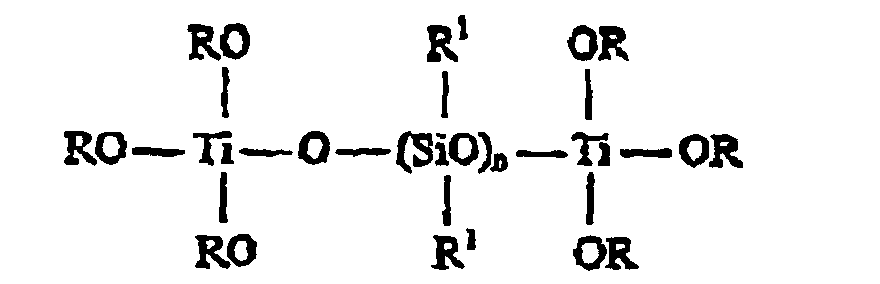 b) une polyoléfine choisie parmi (i) un homopolymère ou copolymère polyoléfinique non fonctionnalisé d'hydrocarbures insaturés ayant 2 à 20 atomes de carbone ou des mélanges de ceux-ci ou (ii) une polyoléfine fonctionnalisée choisie parmi un copolymère direct d'éthylène et d'un monomère polaire, dans lequel le monomère polaire est choisi dans le groupe constitué par le vinyl silane, les acides carboxyliques en C3 à C8 α,β-éthyléniquement insaturés ou un ester de ceux-ci, et un ester éthyléniquement insaturé d'un acide carboxylique ou (iii) un copolymère ionomère ou des mélanges de celui-ci, choisi dans le groupe constitué par les copolymères directs, partiellement neutralisés avec des ions métalliques, d'éthylène avec des monomères contenant un acide on (iv) un copolymère polyoléfine/monomère greffé ou des mélanges de copolymères polyoléfine/monomère greffe, où la polyoléfine est choisie dans le groupe constitué par un polyéthylène, un polypropylène, un terpolymère éthylène propylène diène et les copolymères d'éthylène avec de l'acétate de vinyle, le monoxyde de carbone, ou les acides carboxyliques éthyléniquement insaturés ou les esters de ceux-ci, et les monomères greffés sont choisis dans le groupe constitué par l'acide acrylique, l'acide méthacrylique, l'acide maléique, l'acide fumarique, l'acide itaconique, l'acide crotonique, l'acide 5-norbornère-2,3-dicarboxylique, l'anhydride maléique, le maléate monosodique, le maléate disodique, l'anhydride itaconique, l'anhydride citraconique, le fumarate de monométhyle et le maléate de monométhyle, les vinyl pyridines, les vinyl silanes, la 4-vinyl pyridine, le vinyltriéthoxysilane, le méthacrylate d'hydroxyéthyle, le styrène et le méthacrylate de glycidyle; ou un mélange de (i), (ii) (iii) ou (iv), etc) un second polysiloxane choisi dans le groupe constitué par:i) un dimethylpolysiloxane ayant des groupes terminaux fonctionnels choisis parmi les groupes hydroxyle, aminés, époxy et méthoxy,ii) le diorganopolysiloxane ramifié, etiii) des mélanges de ceux-ci, etd) un composé de vinylsilane.
 - Résine selon la revendication 1, dans laquelle:a) le diméthylpolysiloxane a la formule,où Me = méthyle et n est dans la gamme de 200 à 2300, et
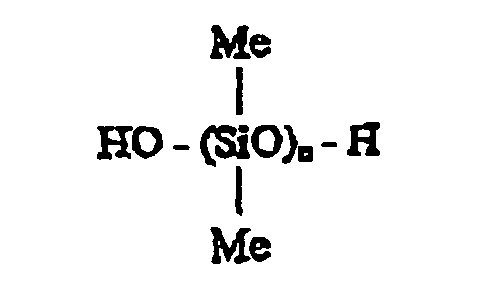 b) le composé de vinyl silane est choisi dans le groupe constitué par le vinyl triméthoxy silane, le vinyl triéthoxy silane, le vinyl triacétoxy silane, le tributanoxime vinyl silane, le divinyl tétraméthoxy disiloxane et l'hexaméthyl bisdiméthylaminoxy cyclotétrasiloxane et des mélanges de ceux-ci.
 - Résine selon la revendication 1, susceptible d'être obtenue à partir de matières de départ comprenant:a) 1,0% en poids à 9,0% en poids de composés contenant de la silicone dans le premier groupe polysiloxane;b) 0,24% en poids à 4,8% en poids de composés contenant de la silicone dans le second groupe polysiloxane;c) 0,01% en poids à 1,0% en poids du composé de vinylsilane; etd) le reste étant la polyoléfine.
- Résine selon la revendication 3, comprenant en outre:a) 1 à 400 parties par million d'un agent greffant de type peroxyde organique;b) 1 à 500 parties par million d'un agent de durcissement par l'humidité organo-métallique, etc) 0,01% en poids à 2,5% en poids d'un polymère de silicone de poids moléculaire ultra-élevé ayant une gamme de poids moléculaire moyen en nombre de 350000 à 1 million.
- Résine selon la revendication 1, dans laquelle le vinyl silane est présent en une quantité suffisante pour que seulement une partie du vinyl silane soit greffé sur la polyoléfine en laissant un peu de vinyl silane libre après le greffage.
- Film contenant de la silicone, comprenant la résine selon l'une quelconque des revendications 1 à 5.
- Film contenant de la silicone, comprenant la résine de la revendication 1, dans lequel le premier polysiloxane est le diorganopolysiloxane ramifié, et le film contenant de la silicone est un film détachable combiné avec un adhésif léger.
- Procédé pour fabriquer une résine contenant de la silicone, comprenant les étapes consistant:a) à préparer un premier constituant en mélangeant dans une première extrudeuse une composition comprenant:i) un premier polysiloxane choisi dans un premier groupe constitué par:où R est méthyle, éthyle, isopropyle, butyle ou des mélanges de ceux-ci et R1 est un radical hydrocarboné contenant 1 à 30 atomes de carbone, etun diorganopolysiloxane ramifié de formule générale:
 ii) une polyoléfine à l'état fondu choisie parmi (i) un homopolymère ou copolymère polyoléfinique non fonctionnalisé d'hydrocarbures insaturés ayant 2 à 20 atomes de carbone ou des mélanges de ceux-ci ou (ii) une polyoléfine fonctionnalisée choisie parmi un copolymère direct d'éthylène et d'un monomère polaire, dans lequel le monomère polaire est choisi dans le groupe constitué par le vinyl silane, les acides carboxyliques en C3 à C8 α,β-éthyléniquement insaturés on un ester de ceux-ci, et un ester éthyléniquement insaturé d'un acide carboxylique ou (iii) un copolymère ionomère ou des mélanges de celui-ci, choisi dans le groupe constitué par les copolymères directs, partiellement neutralisés avec des ions métalliques, d'éthylène avec des monomères contenant un acide ou (iv) un copolymère polyoléfine/monomère greffé ou des mélanges de copolymères polyoléfine/monomère greffé, où la polyoléfine est choisie dans le groupe constitué par un polyéthylène, un polypropyléne, un terpolymère éthylène propylène diène et les copolymères d'éthylène avec de l'acétate de vinyle, le monoxyde de carbone, ou les acides carboxyliques éthyléniquement insaturés ou les esters de ceux-ci, et les monomères greffés sont choisis dans le groupe constitué par l'acide acrylique, l'acide méthacrylique, l'acide maléique, l'acide fumarique, l'acide itaconique, l'acide crotonique, l'acide 5-norbornène-2,3-dicarboxylique, l'anhydride maléique, le maléate monosodique, le maléate disodique, l'anhydride itaconique, l'anhydride citraconique, le fumarate de monométhyle et le maléate de monométhyle, les vinyl pyridines, les vinyl silanes, la 4-vinyl pyridine, le vinyltriéthoxysilane, le méthacrylate d'hydroxyéthyle, le styrène et le méthacrylate de glycidyle; ou un mélange de (i), (ii) (iii) ou (iv), etb) à préparer un second constituant en mélangeant dans une seconde extrudeuse une composition comprenant:i) une polyoléfine à l'état fondu choisie parmi (i) un homopolymère ou copolymère polyoléfinique non fonctionnalisé d'hydrocarbures insaturés ayant 2 à 20 atomes de carbone ou des mélanges de ceux-ci ou (ii) une polyoléfine fonctionnalisée choisie parmi un copolymère direct d'éthylène et d'un monomère polaire, dans lequel le monomère polaire est choisi dans le groupe constitué par le vinyl silane, les acides carboxyliques en C3 à C8 α,β-éthyléniquement insaturés ou un ester de ceux-ci, et un ester éthyléniquement insaturé d'un acide carboxylique ou (iii) un copolymère ionomère ou des mélanges de celui-ci, choisi dans le groupe constitué par les copolymères directs, partiellement neutralisés avec des ions métalliques, d'éthylène avec des monomères contenant un acide ou (iv) un copolymère polyoléfine/monomère greffé ou des mélanges de copolymères polyoléfine/monomère greffé, où la polyoléfine est choisie dans le groupe constitué par un polyéthylène, un polypropylène, un terpolymère éthylène propylène diène et les copolymères d'éthylène avec de l'acétate de vinyle, le monoxyde de carbone, ou les acides carboxyliques éthyléniquement insaturés ou les esters de ceux-ci, et les monomères greffés sont choisis dans le groupe constitué par l'acide acrylique, l'acide méthacrylique, l'acide maléique, l'acide fumarique, l'acide itaconique, l'acide crotonique, l'acide 5-norbornène-2,3-dicarboxylique, l'anhydride maléique, le maléate monosodique, le maléate disodique, l'anhydride itaconique, l'anhydride citraconique, le fumarate de monométhyle et le maléate de monométhyle, les vinyl pyridines, les vinyl silanes, la 4-vinyl pyridine, le vinyltriéthoxysilane, le méthacrylate d'hydroxyéthyle, le styrène et le méthacrylate de glycidyle; ou un mélange de (i), (ii) (iii) ou (iv), etii) un second polysiloxane choisi dans le groupe constitué par:1) un diméthylpolysiloxane ayant des groupes terminaux fonctionnels choisis parmi les groupes hydroxyle, aminés, époxy et méthoxy,2) le diorganopolysiloxane ramifié, et3) des mélanges de ceux-ci, etiii) un composé de vinylsilane, etc) à mélanger les premier et second constituants ensemble.
 - Procédé selon la revendication 8, dans lequel la composition mélangée dans l'étape b) comprend en outre:a) un agent greffant de type peroxyde organique pour greffer une partie du vinyl silane sur la polyoléfine, etb) un agent de durcissement par l'humidité organo-métallique.
Applications Claiming Priority (4)
| Application Number | Priority Date | Filing Date | Title |
|---|---|---|---|
| US378370 | 1982-05-14 | ||
| US22773799A | 1999-01-08 | 1999-01-08 | |
| US227737 | 1999-01-08 | ||
| US37837099A | 1999-08-20 | 1999-08-20 |
Publications (3)
| Publication Number | Publication Date |
|---|---|
| EP1018533A2 EP1018533A2 (fr) | 2000-07-12 |
| EP1018533A3 EP1018533A3 (fr) | 2001-07-04 |
| EP1018533B1 true EP1018533B1 (fr) | 2005-12-07 |
Family
ID=26921714
Family Applications (1)
| Application Number | Title | Priority Date | Filing Date |
|---|---|---|---|
| EP00300084A Expired - Lifetime EP1018533B1 (fr) | 1999-01-08 | 2000-01-07 | Film de polysiloxane à faible tension superficielle |
Country Status (3)
| Country | Link |
|---|---|
| EP (1) | EP1018533B1 (fr) |
| CA (1) | CA2291316A1 (fr) |
| DE (1) | DE60024505T2 (fr) |
Cited By (5)
| Publication number | Priority date | Publication date | Assignee | Title |
|---|---|---|---|---|
| US7316832B2 (en) | 2001-12-20 | 2008-01-08 | The Procter & Gamble Company | Articles and methods for applying color on surfaces |
| US7722938B2 (en) | 2003-02-14 | 2010-05-25 | The Procter & Gamble Company | Dry paint transfer laminate |
| US7727607B2 (en) | 2003-06-09 | 2010-06-01 | The Procter & Gamble Company | Multi-layer dry paint decorative laminate having discoloration prevention barrier |
| US7842364B2 (en) | 2003-02-14 | 2010-11-30 | The Procter & Gamble Company | Differential release system for a self-wound multilayer dry paint decorative laminate having a pressure sensitive adhesive |
| US7897227B2 (en) | 2001-12-20 | 2011-03-01 | The Procter & Gamble Company | Articles and methods for applying color on surfaces |
Families Citing this family (9)
| Publication number | Priority date | Publication date | Assignee | Title |
|---|---|---|---|---|
| GB0812186D0 (en) | 2008-07-03 | 2008-08-13 | Dow Corning | Modified polyolefins |
| GB0812185D0 (en) | 2008-07-03 | 2008-08-13 | Dow Corning | Polymers modified by silanes |
| CA2774284C (fr) * | 2009-09-16 | 2017-11-28 | Union Carbide Chemicals & Plastics Technology Llc | Articles faconnes a l'etat fondu, reticules, et compositions pour les obtenir |
| GB201000120D0 (en) | 2010-01-06 | 2010-02-17 | Dow Corning | Process for forming crosslinked and branched polymers |
| GB201000121D0 (en) | 2010-01-06 | 2010-02-17 | Dow Corning | Modified polyolefins |
| GB201000117D0 (en) | 2010-01-06 | 2010-02-17 | Dow Corning | Organopolysiloxanes containing an unsaturated group |
| GB201000116D0 (en) * | 2010-01-06 | 2010-02-17 | Dow Corning | Polyolefins modified by silicones |
| CN111073505A (zh) * | 2019-12-30 | 2020-04-28 | 昆山裕凌导热科技有限公司 | 一种纳米防结冻涂覆料及其制备方法 |
| KR20250172041A (ko) * | 2024-05-31 | 2025-12-09 | 주식회사 엘지화학 | 폴리올레핀 조성물 |
Family Cites Families (3)
| Publication number | Priority date | Publication date | Assignee | Title |
|---|---|---|---|---|
| US5169900A (en) * | 1988-08-05 | 1992-12-08 | Du Pont Canada Inc. | Polyolefin coatings and films having release characteristics |
| FI93649C (fi) * | 1990-10-29 | 1995-05-10 | Neste Oy | Polymeerituote, joka toimii irrokekalvona sen päälle kiinnitettäviä paineherkkiä liimoja sisältäviä pintoja varten |
| CA2265868A1 (fr) * | 1996-09-13 | 1998-03-19 | Dupont Canada Inc. | Film en polyolefine contenant de la silicone |
-
1999
- 1999-11-30 CA CA002291316A patent/CA2291316A1/fr not_active Abandoned
-
2000
- 2000-01-07 EP EP00300084A patent/EP1018533B1/fr not_active Expired - Lifetime
- 2000-01-07 DE DE60024505T patent/DE60024505T2/de not_active Expired - Fee Related
Cited By (10)
| Publication number | Priority date | Publication date | Assignee | Title |
|---|---|---|---|---|
| US7316832B2 (en) | 2001-12-20 | 2008-01-08 | The Procter & Gamble Company | Articles and methods for applying color on surfaces |
| US7897227B2 (en) | 2001-12-20 | 2011-03-01 | The Procter & Gamble Company | Articles and methods for applying color on surfaces |
| US7897228B2 (en) | 2001-12-20 | 2011-03-01 | The Procter & Gamble Company | Articles and methods for applying color on surfaces |
| US7722938B2 (en) | 2003-02-14 | 2010-05-25 | The Procter & Gamble Company | Dry paint transfer laminate |
| US7807246B2 (en) | 2003-02-14 | 2010-10-05 | The Procter & Gamble Company | Dry paint transfer laminate |
| US7842364B2 (en) | 2003-02-14 | 2010-11-30 | The Procter & Gamble Company | Differential release system for a self-wound multilayer dry paint decorative laminate having a pressure sensitive adhesive |
| US7842363B2 (en) | 2003-02-14 | 2010-11-30 | The Procter & Gamble Company | Differential release system for a self-wound multilayer dry paint decorative laminate having a pressure sensitive adhesive |
| US7846522B2 (en) | 2003-02-14 | 2010-12-07 | The Procter & Gamble Company | Discoloration-resistant articles for applying color on surfaces and methods of reducing discoloration in articles for applying color on surfaces |
| US7905981B2 (en) | 2003-02-14 | 2011-03-15 | The Procter & Gamble Company | Method of making a dry paint transfer laminate |
| US7727607B2 (en) | 2003-06-09 | 2010-06-01 | The Procter & Gamble Company | Multi-layer dry paint decorative laminate having discoloration prevention barrier |
Also Published As
| Publication number | Publication date |
|---|---|
| EP1018533A2 (fr) | 2000-07-12 |
| EP1018533A3 (fr) | 2001-07-04 |
| CA2291316A1 (fr) | 2000-07-08 |
| DE60024505D1 (de) | 2006-01-12 |
| DE60024505T2 (de) | 2006-08-17 |
Similar Documents
| Publication | Publication Date | Title |
|---|---|---|
| US6465107B1 (en) | Silicone-containing polyolefin film | |
| US5169900A (en) | Polyolefin coatings and films having release characteristics | |
| US6437046B1 (en) | Low-acid ethylene copolymers for improving the adhesion of LDPE to aluminum foil in extrusion coating | |
| EP0136059B1 (fr) | Mélanges d'ionomères et de copolymères de propylène | |
| CA2396203C (fr) | Polypropylene isotactique greffe obtenu par catalyse metallocene | |
| EP1018533A2 (fr) | Film de polysiloxane à faible tension superficielle | |
| JPH10501273A (ja) | 押出可能な剥離被膜 | |
| JP2016532745A (ja) | 無溶剤押出プロセスによる剥離フィルム | |
| WO1998010724A1 (fr) | Film en polyolefine contenant de la silicone | |
| WO1999016796A1 (fr) | Resine de polyethylene basse densite pour stratifie, composition, contrecollage ainsi realise, et procede de production | |
| EP0222789B1 (fr) | Composition thermoplastique comprenant un copolymere a base d'ethylene et d'anhydride maleique, et articles industriels obtenus a partir d'une telle composition | |
| EP1749072B1 (fr) | Composition adhésive ayant une clarté améliorée pour films barrières coextrudés | |
| WO1998010928A1 (fr) | Film de polyolefine contenant de l'oxyde de polyethylene | |
| JP4269779B2 (ja) | 離型剤および粘着性積層テープ | |
| WO2000018578A1 (fr) | Stratifie et son procede de production | |
| AU5041390A (en) | Resealable packaging material | |
| KR100188183B1 (ko) | 저온 열봉합성 및 이지필성이 우수한 압출 라미네이션용 수지 조성물 | |
| KR100188179B1 (ko) | 직접 접착이 가능하고, 저온 열봉합성 및 이지필성이 우수한 압출 라미네이션용 수지 조성물 | |
| JP2002265704A (ja) | 表面保護フィルム用エチレン−酢酸ビニル共重合体組成物及びそれよりなるフィルム | |
| JPH0364330A (ja) | 表面保護フイルム | |
| JP3945140B2 (ja) | 変性エチレン系重合体の製造方法 | |
| JP2000143903A (ja) | 押出ラミネ―ト用樹脂組成物及びそれを用いた積層体 | |
| JP3702730B2 (ja) | 易開封性シーラント用重合体組成物 | |
| JPH1087908A (ja) | ヒートシール用樹脂組成物 | |
| WO2020212807A1 (fr) | Composition de polyoléfine comprenant un copolymère séquencé de polydioorganosiloxane comportant une séquence alkyle en c16-c70 appropriée pour un revêtement antiadhésif et article adhésif autocollant |
Legal Events
| Date | Code | Title | Description |
|---|---|---|---|
| PUAI | Public reference made under article 153(3) epc to a published international application that has entered the european phase |
Free format text: ORIGINAL CODE: 0009012 |
|
| AK | Designated contracting states |
Kind code of ref document: A2 Designated state(s): DE FI FR GB IT |
|
| AX | Request for extension of the european patent |
Free format text: AL;LT;LV;MK;RO;SI |
|
| PUAL | Search report despatched |
Free format text: ORIGINAL CODE: 0009013 |
|
| AK | Designated contracting states |
Kind code of ref document: A3 Designated state(s): AT BE CH CY DE DK ES FI FR GB GR IE IT LI LU MC NL PT SE |
|
| AX | Request for extension of the european patent |
Free format text: AL;LT;LV;MK;RO;SI |
|
| 17P | Request for examination filed |
Effective date: 20011214 |
|
| AKX | Designation fees paid |
Free format text: DE FI FR GB IT |
|
| 17Q | First examination report despatched |
Effective date: 20030120 |
|
| GRAP | Despatch of communication of intention to grant a patent |
Free format text: ORIGINAL CODE: EPIDOSNIGR1 |
|
| RAP1 | Party data changed (applicant data changed or rights of an application transferred) |
Owner name: E.I. DU PONT DE NEMOURS AND COMPANY |
|
| GRAS | Grant fee paid |
Free format text: ORIGINAL CODE: EPIDOSNIGR3 |
|
| GRAA | (expected) grant |
Free format text: ORIGINAL CODE: 0009210 |
|
| AK | Designated contracting states |
Kind code of ref document: B1 Designated state(s): DE FI FR GB IT |
|
| REG | Reference to a national code |
Ref country code: GB Ref legal event code: FG4D |
|
| REF | Corresponds to: |
Ref document number: 60024505 Country of ref document: DE Date of ref document: 20060112 Kind code of ref document: P |
|
| ET | Fr: translation filed | ||
| PLBE | No opposition filed within time limit |
Free format text: ORIGINAL CODE: 0009261 |
|
| STAA | Information on the status of an ep patent application or granted ep patent |
Free format text: STATUS: NO OPPOSITION FILED WITHIN TIME LIMIT |
|
| 26N | No opposition filed |
Effective date: 20060908 |
|
| PGFP | Annual fee paid to national office [announced via postgrant information from national office to epo] |
Ref country code: DE Payment date: 20080104 Year of fee payment: 9 Ref country code: FI Payment date: 20080115 Year of fee payment: 9 Ref country code: GB Payment date: 20080102 Year of fee payment: 9 Ref country code: IT Payment date: 20080129 Year of fee payment: 9 |
|
| PGFP | Annual fee paid to national office [announced via postgrant information from national office to epo] |
Ref country code: FR Payment date: 20080108 Year of fee payment: 9 |
|
| GBPC | Gb: european patent ceased through non-payment of renewal fee |
Effective date: 20090107 |
|
| PG25 | Lapsed in a contracting state [announced via postgrant information from national office to epo] |
Ref country code: FI Free format text: LAPSE BECAUSE OF NON-PAYMENT OF DUE FEES Effective date: 20090107 Ref country code: DE Free format text: LAPSE BECAUSE OF NON-PAYMENT OF DUE FEES Effective date: 20090801 |
|
| REG | Reference to a national code |
Ref country code: FR Ref legal event code: ST Effective date: 20091030 |
|
| PG25 | Lapsed in a contracting state [announced via postgrant information from national office to epo] |
Ref country code: GB Free format text: LAPSE BECAUSE OF NON-PAYMENT OF DUE FEES Effective date: 20090107 |
|
| PG25 | Lapsed in a contracting state [announced via postgrant information from national office to epo] |
Ref country code: FR Free format text: LAPSE BECAUSE OF NON-PAYMENT OF DUE FEES Effective date: 20090202 |
|
| PG25 | Lapsed in a contracting state [announced via postgrant information from national office to epo] |
Ref country code: IT Free format text: LAPSE BECAUSE OF NON-PAYMENT OF DUE FEES Effective date: 20090107 |