EP1019105B1 - Polarer druckempfindlicher haftkleber und ihn verwendende medizinische vorrichtungen - Google Patents
Polarer druckempfindlicher haftkleber und ihn verwendende medizinische vorrichtungen Download PDFInfo
- Publication number
- EP1019105B1 EP1019105B1 EP95944679A EP95944679A EP1019105B1 EP 1019105 B1 EP1019105 B1 EP 1019105B1 EP 95944679 A EP95944679 A EP 95944679A EP 95944679 A EP95944679 A EP 95944679A EP 1019105 B1 EP1019105 B1 EP 1019105B1
- Authority
- EP
- European Patent Office
- Prior art keywords
- adhesive
- weight percent
- water
- skin
- polar
- Prior art date
- Legal status (The legal status is an assumption and is not a legal conclusion. Google has not performed a legal analysis and makes no representation as to the accuracy of the status listed.)
- Expired - Lifetime
Links
- 239000000203 mixture Substances 0.000 title claims abstract description 94
- 239000004820 Pressure-sensitive adhesive Substances 0.000 title claims abstract description 38
- 239000004094 surface-active agent Substances 0.000 claims abstract description 53
- 239000011159 matrix material Substances 0.000 claims abstract description 25
- 150000002894 organic compounds Chemical class 0.000 claims abstract description 16
- 229920001477 hydrophilic polymer Polymers 0.000 claims abstract description 10
- 230000001070 adhesive effect Effects 0.000 claims description 175
- 239000000853 adhesive Substances 0.000 claims description 173
- 239000010410 layer Substances 0.000 claims description 48
- 239000000463 material Substances 0.000 claims description 35
- XLYOFNOQVPJJNP-UHFFFAOYSA-N water Substances O XLYOFNOQVPJJNP-UHFFFAOYSA-N 0.000 claims description 34
- -1 poly(ethylene oxide) Polymers 0.000 claims description 33
- 239000004020 conductor Substances 0.000 claims description 28
- 239000000178 monomer Substances 0.000 claims description 26
- WCUXLLCKKVVCTQ-UHFFFAOYSA-M Potassium chloride Chemical compound [Cl-].[K+] WCUXLLCKKVVCTQ-UHFFFAOYSA-M 0.000 claims description 18
- 239000003814 drug Substances 0.000 claims description 16
- 150000003839 salts Chemical class 0.000 claims description 16
- 229920000642 polymer Polymers 0.000 claims description 14
- 238000004891 communication Methods 0.000 claims description 13
- 235000014113 dietary fatty acids Nutrition 0.000 claims description 13
- 239000000194 fatty acid Substances 0.000 claims description 13
- 229930195729 fatty acid Natural products 0.000 claims description 13
- 238000000034 method Methods 0.000 claims description 13
- PEDCQBHIVMGVHV-UHFFFAOYSA-N Glycerine Chemical compound OCC(O)CO PEDCQBHIVMGVHV-UHFFFAOYSA-N 0.000 claims description 12
- 239000012790 adhesive layer Substances 0.000 claims description 12
- 238000000576 coating method Methods 0.000 claims description 10
- 150000004665 fatty acids Chemical class 0.000 claims description 10
- 239000004014 plasticizer Substances 0.000 claims description 10
- 239000011248 coating agent Substances 0.000 claims description 9
- 239000001103 potassium chloride Substances 0.000 claims description 9
- 235000011164 potassium chloride Nutrition 0.000 claims description 9
- 238000004519 manufacturing process Methods 0.000 claims description 8
- 125000000217 alkyl group Chemical group 0.000 claims description 7
- 229920002678 cellulose Polymers 0.000 claims description 7
- 239000001913 cellulose Substances 0.000 claims description 7
- 235000010980 cellulose Nutrition 0.000 claims description 7
- 229920001577 copolymer Polymers 0.000 claims description 7
- 239000000758 substrate Substances 0.000 claims description 7
- 229940124597 therapeutic agent Drugs 0.000 claims description 7
- LYCAIKOWRPUZTN-UHFFFAOYSA-N Ethylene glycol Chemical compound OCCO LYCAIKOWRPUZTN-UHFFFAOYSA-N 0.000 claims description 6
- 230000008569 process Effects 0.000 claims description 6
- 239000003792 electrolyte Substances 0.000 claims description 5
- 239000003961 penetration enhancing agent Substances 0.000 claims description 5
- 229910052709 silver Inorganic materials 0.000 claims description 5
- 239000004332 silver Substances 0.000 claims description 5
- 239000002904 solvent Substances 0.000 claims description 5
- 230000001225 therapeutic effect Effects 0.000 claims description 5
- 150000003626 triacylglycerols Chemical class 0.000 claims description 5
- NIXOWILDQLNWCW-UHFFFAOYSA-M Acrylate Chemical compound [O-]C(=O)C=C NIXOWILDQLNWCW-UHFFFAOYSA-M 0.000 claims description 4
- FBPFZTCFMRRESA-FSIIMWSLSA-N D-Glucitol Natural products OC[C@H](O)[C@H](O)[C@@H](O)[C@H](O)CO FBPFZTCFMRRESA-FSIIMWSLSA-N 0.000 claims description 4
- 229910021607 Silver chloride Inorganic materials 0.000 claims description 4
- FAPWRFPIFSIZLT-UHFFFAOYSA-M Sodium chloride Chemical group [Na+].[Cl-] FAPWRFPIFSIZLT-UHFFFAOYSA-M 0.000 claims description 4
- 150000002191 fatty alcohols Chemical group 0.000 claims description 4
- 150000004676 glycans Chemical class 0.000 claims description 4
- 239000002736 nonionic surfactant Substances 0.000 claims description 4
- 239000000546 pharmaceutical excipient Substances 0.000 claims description 4
- 229920001282 polysaccharide Polymers 0.000 claims description 4
- 239000005017 polysaccharide Substances 0.000 claims description 4
- HKZLPVFGJNLROG-UHFFFAOYSA-M silver monochloride Chemical compound [Cl-].[Ag+] HKZLPVFGJNLROG-UHFFFAOYSA-M 0.000 claims description 4
- 239000000600 sorbitol Substances 0.000 claims description 4
- 230000000699 topical effect Effects 0.000 claims description 4
- HRPVXLWXLXDGHG-UHFFFAOYSA-N Acrylamide Chemical compound NC(=O)C=C HRPVXLWXLXDGHG-UHFFFAOYSA-N 0.000 claims description 3
- WHNWPMSKXPGLAX-UHFFFAOYSA-N N-Vinyl-2-pyrrolidone Chemical compound C=CN1CCCC1=O WHNWPMSKXPGLAX-UHFFFAOYSA-N 0.000 claims description 3
- 229920003171 Poly (ethylene oxide) Polymers 0.000 claims description 3
- 229920002472 Starch Polymers 0.000 claims description 3
- 150000001412 amines Chemical class 0.000 claims description 3
- 239000004599 antimicrobial Substances 0.000 claims description 3
- FJKIXWOMBXYWOQ-UHFFFAOYSA-N ethenoxyethane Chemical class CCOC=C FJKIXWOMBXYWOQ-UHFFFAOYSA-N 0.000 claims description 3
- 239000001814 pectin Substances 0.000 claims description 3
- 235000010987 pectin Nutrition 0.000 claims description 3
- 229920001277 pectin Polymers 0.000 claims description 3
- 238000010526 radical polymerization reaction Methods 0.000 claims description 3
- 239000008107 starch Substances 0.000 claims description 3
- 235000019698 starch Nutrition 0.000 claims description 3
- IAUGBVWVWDTCJV-UHFFFAOYSA-N 1-(prop-2-enoylamino)propane-1-sulfonic acid Chemical compound CCC(S(O)(=O)=O)NC(=O)C=C IAUGBVWVWDTCJV-UHFFFAOYSA-N 0.000 claims description 2
- GAWIXWVDTYZWAW-UHFFFAOYSA-N C[CH]O Chemical group C[CH]O GAWIXWVDTYZWAW-UHFFFAOYSA-N 0.000 claims description 2
- FBPFZTCFMRRESA-JGWLITMVSA-N D-glucitol Chemical class OC[C@H](O)[C@@H](O)[C@H](O)[C@H](O)CO FBPFZTCFMRRESA-JGWLITMVSA-N 0.000 claims description 2
- CERQOIWHTDAKMF-UHFFFAOYSA-N Methacrylic acid Chemical class CC(=C)C(O)=O CERQOIWHTDAKMF-UHFFFAOYSA-N 0.000 claims description 2
- QGZKDVFQNNGYKY-UHFFFAOYSA-O ammonium group Chemical group [NH4+] QGZKDVFQNNGYKY-UHFFFAOYSA-O 0.000 claims description 2
- 125000004432 carbon atom Chemical group C* 0.000 claims description 2
- 150000002148 esters Chemical class 0.000 claims description 2
- 125000002496 methyl group Chemical group [H]C([H])([H])* 0.000 claims description 2
- 229920001223 polyethylene glycol Polymers 0.000 claims description 2
- 229920001522 polyglycol ester Polymers 0.000 claims description 2
- 239000003505 polymerization initiator Substances 0.000 claims description 2
- 229920005862 polyol Polymers 0.000 claims description 2
- ULWHHBHJGPPBCO-UHFFFAOYSA-N propane-1,1-diol Chemical compound CCC(O)O ULWHHBHJGPPBCO-UHFFFAOYSA-N 0.000 claims description 2
- 239000011780 sodium chloride Substances 0.000 claims description 2
- 150000005846 sugar alcohols Polymers 0.000 claims description 2
- 150000001735 carboxylic acids Chemical class 0.000 claims 1
- 239000003431 cross linking reagent Substances 0.000 claims 1
- 230000037311 normal skin Effects 0.000 abstract 1
- 210000003491 skin Anatomy 0.000 description 60
- 239000003921 oil Substances 0.000 description 35
- 235000019198 oils Nutrition 0.000 description 35
- 238000010276 construction Methods 0.000 description 25
- 238000012360 testing method Methods 0.000 description 21
- 229920006262 high density polyethylene film Polymers 0.000 description 19
- HCLJOFJIQIJXHS-UHFFFAOYSA-N 2-[2-[2-(2-prop-2-enoyloxyethoxy)ethoxy]ethoxy]ethyl prop-2-enoate Chemical compound C=CC(=O)OCCOCCOCCOCCOC(=O)C=C HCLJOFJIQIJXHS-UHFFFAOYSA-N 0.000 description 16
- 239000012212 insulator Substances 0.000 description 13
- 230000001965 increasing effect Effects 0.000 description 12
- 238000012544 monitoring process Methods 0.000 description 11
- 229920006267 polyester film Polymers 0.000 description 11
- 239000004971 Cross linker Substances 0.000 description 10
- 229920001903 high density polyethylene Polymers 0.000 description 10
- 239000004700 high-density polyethylene Substances 0.000 description 10
- 238000003475 lamination Methods 0.000 description 9
- SMZOUWXMTYCWNB-UHFFFAOYSA-N 2-(2-methoxy-5-methylphenyl)ethanamine Chemical compound COC1=CC=C(C)C=C1CCN SMZOUWXMTYCWNB-UHFFFAOYSA-N 0.000 description 8
- NIXOWILDQLNWCW-UHFFFAOYSA-N 2-Propenoic acid Natural products OC(=O)C=C NIXOWILDQLNWCW-UHFFFAOYSA-N 0.000 description 8
- 206010040880 Skin irritation Diseases 0.000 description 8
- 230000000052 comparative effect Effects 0.000 description 8
- 230000036556 skin irritation Effects 0.000 description 8
- 231100000475 skin irritation Toxicity 0.000 description 8
- RTZKZFJDLAIYFH-UHFFFAOYSA-N Diethyl ether Chemical compound CCOCC RTZKZFJDLAIYFH-UHFFFAOYSA-N 0.000 description 7
- 239000012711 adhesive precursor Substances 0.000 description 7
- 230000002999 depolarising effect Effects 0.000 description 7
- 150000004820 halides Chemical class 0.000 description 7
- 150000002632 lipids Chemical class 0.000 description 7
- 239000004698 Polyethylene Substances 0.000 description 6
- 229920002556 Polyethylene Glycol 300 Polymers 0.000 description 6
- 230000005540 biological transmission Effects 0.000 description 6
- 238000004132 cross linking Methods 0.000 description 6
- 229940079593 drug Drugs 0.000 description 6
- 229920000573 polyethylene Polymers 0.000 description 6
- 241001465754 Metazoa Species 0.000 description 5
- 238000006664 bond formation reaction Methods 0.000 description 5
- 229920000728 polyester Polymers 0.000 description 5
- 238000006116 polymerization reaction Methods 0.000 description 5
- 239000002243 precursor Substances 0.000 description 5
- YYGNTYWPHWGJRM-UHFFFAOYSA-N (6E,10E,14E,18E)-2,6,10,15,19,23-hexamethyltetracosa-2,6,10,14,18,22-hexaene Chemical compound CC(C)=CCCC(C)=CCCC(C)=CCCC=C(C)CCC=C(C)CCC=C(C)C YYGNTYWPHWGJRM-UHFFFAOYSA-N 0.000 description 4
- KFZMGEQAYNKOFK-UHFFFAOYSA-N Isopropanol Chemical compound CC(C)O KFZMGEQAYNKOFK-UHFFFAOYSA-N 0.000 description 4
- BQCADISMDOOEFD-UHFFFAOYSA-N Silver Chemical compound [Ag] BQCADISMDOOEFD-UHFFFAOYSA-N 0.000 description 4
- BHEOSNUKNHRBNM-UHFFFAOYSA-N Tetramethylsqualene Natural products CC(=C)C(C)CCC(=C)C(C)CCC(C)=CCCC=C(C)CCC(C)C(=C)CCC(C)C(C)=C BHEOSNUKNHRBNM-UHFFFAOYSA-N 0.000 description 4
- 206010052428 Wound Diseases 0.000 description 4
- 208000027418 Wounds and injury Diseases 0.000 description 4
- 239000013543 active substance Substances 0.000 description 4
- PRAKJMSDJKAYCZ-UHFFFAOYSA-N dodecahydrosqualene Natural products CC(C)CCCC(C)CCCC(C)CCCCC(C)CCCC(C)CCCC(C)C PRAKJMSDJKAYCZ-UHFFFAOYSA-N 0.000 description 4
- 238000005516 engineering process Methods 0.000 description 4
- 238000009472 formulation Methods 0.000 description 4
- IPCSVZSSVZVIGE-UHFFFAOYSA-N hexadecanoic acid Chemical compound CCCCCCCCCCCCCCCC(O)=O IPCSVZSSVZVIGE-UHFFFAOYSA-N 0.000 description 4
- 239000003999 initiator Substances 0.000 description 4
- 230000007794 irritation Effects 0.000 description 4
- 239000007788 liquid Substances 0.000 description 4
- ZQPPMHVWECSIRJ-KTKRTIGZSA-N oleic acid Chemical compound CCCCCCCC\C=C/CCCCCCCC(O)=O ZQPPMHVWECSIRJ-KTKRTIGZSA-N 0.000 description 4
- 229920002635 polyurethane Polymers 0.000 description 4
- 239000004814 polyurethane Substances 0.000 description 4
- 238000002360 preparation method Methods 0.000 description 4
- 210000001732 sebaceous gland Anatomy 0.000 description 4
- 239000007787 solid Substances 0.000 description 4
- 229940031439 squalene Drugs 0.000 description 4
- TUHBEKDERLKLEC-UHFFFAOYSA-N squalene Natural products CC(=CCCC(=CCCC(=CCCC=C(/C)CCC=C(/C)CC=C(C)C)C)C)C TUHBEKDERLKLEC-UHFFFAOYSA-N 0.000 description 4
- 150000003467 sulfuric acid derivatives Chemical class 0.000 description 4
- 230000037317 transdermal delivery Effects 0.000 description 4
- 229920002554 vinyl polymer Polymers 0.000 description 4
- WRIDQFICGBMAFQ-UHFFFAOYSA-N (E)-8-Octadecenoic acid Natural products CCCCCCCCCC=CCCCCCCC(O)=O WRIDQFICGBMAFQ-UHFFFAOYSA-N 0.000 description 3
- LQJBNNIYVWPHFW-UHFFFAOYSA-N 20:1omega9c fatty acid Natural products CCCCCCCCCCC=CCCCCCCCC(O)=O LQJBNNIYVWPHFW-UHFFFAOYSA-N 0.000 description 3
- QSBYPNXLFMSGKH-UHFFFAOYSA-N 9-Heptadecensaeure Natural products CCCCCCCC=CCCCCCCCC(O)=O QSBYPNXLFMSGKH-UHFFFAOYSA-N 0.000 description 3
- LFQSCWFLJHTTHZ-UHFFFAOYSA-N Ethanol Chemical compound CCO LFQSCWFLJHTTHZ-UHFFFAOYSA-N 0.000 description 3
- 239000005642 Oleic acid Substances 0.000 description 3
- ZQPPMHVWECSIRJ-UHFFFAOYSA-N Oleic acid Natural products CCCCCCCCC=CCCCCCCCC(O)=O ZQPPMHVWECSIRJ-UHFFFAOYSA-N 0.000 description 3
- KWYUFKZDYYNOTN-UHFFFAOYSA-M Potassium hydroxide Chemical compound [OH-].[K+] KWYUFKZDYYNOTN-UHFFFAOYSA-M 0.000 description 3
- 206010039792 Seborrhoea Diseases 0.000 description 3
- 239000002253 acid Substances 0.000 description 3
- 239000003795 chemical substances by application Substances 0.000 description 3
- 239000002131 composite material Substances 0.000 description 3
- 150000001875 compounds Chemical class 0.000 description 3
- 230000007423 decrease Effects 0.000 description 3
- 230000001419 dependent effect Effects 0.000 description 3
- 239000003599 detergent Substances 0.000 description 3
- 238000012377 drug delivery Methods 0.000 description 3
- QXJSBBXBKPUZAA-UHFFFAOYSA-N isooleic acid Natural products CCCCCCCC=CCCCCCCCCC(O)=O QXJSBBXBKPUZAA-UHFFFAOYSA-N 0.000 description 3
- 238000005065 mining Methods 0.000 description 3
- 230000037312 oily skin Effects 0.000 description 3
- 239000012071 phase Substances 0.000 description 3
- 229920006112 polar polymer Polymers 0.000 description 3
- 238000011084 recovery Methods 0.000 description 3
- 230000000717 retained effect Effects 0.000 description 3
- 229920006395 saturated elastomer Polymers 0.000 description 3
- 241000894007 species Species 0.000 description 3
- 239000000126 substance Substances 0.000 description 3
- 238000002646 transcutaneous electrical nerve stimulation Methods 0.000 description 3
- KWVGIHKZDCUPEU-UHFFFAOYSA-N 2,2-dimethoxy-2-phenylacetophenone Chemical group C=1C=CC=CC=1C(OC)(OC)C(=O)C1=CC=CC=C1 KWVGIHKZDCUPEU-UHFFFAOYSA-N 0.000 description 2
- OZAIFHULBGXAKX-UHFFFAOYSA-N 2-(2-cyanopropan-2-yldiazenyl)-2-methylpropanenitrile Chemical compound N#CC(C)(C)N=NC(C)(C)C#N OZAIFHULBGXAKX-UHFFFAOYSA-N 0.000 description 2
- ZITBHNVGLSVXEF-UHFFFAOYSA-N 2-[2-(16-methylheptadecoxy)ethoxy]ethanol Chemical compound CC(C)CCCCCCCCCCCCCCCOCCOCCO ZITBHNVGLSVXEF-UHFFFAOYSA-N 0.000 description 2
- 206010015150 Erythema Diseases 0.000 description 2
- 241000282412 Homo Species 0.000 description 2
- 206010030113 Oedema Diseases 0.000 description 2
- 229910019142 PO4 Inorganic materials 0.000 description 2
- 235000021314 Palmitic acid Nutrition 0.000 description 2
- 239000004164 Wax ester Substances 0.000 description 2
- 238000010521 absorption reaction Methods 0.000 description 2
- 230000002378 acidificating effect Effects 0.000 description 2
- 150000007513 acids Chemical class 0.000 description 2
- 239000002280 amphoteric surfactant Substances 0.000 description 2
- 125000000129 anionic group Chemical group 0.000 description 2
- 230000000845 anti-microbial effect Effects 0.000 description 2
- 230000008901 benefit Effects 0.000 description 2
- 125000002091 cationic group Chemical group 0.000 description 2
- 238000003745 diagnosis Methods 0.000 description 2
- POULHZVOKOAJMA-UHFFFAOYSA-N dodecanoic acid Chemical compound CCCCCCCCCCCC(O)=O POULHZVOKOAJMA-UHFFFAOYSA-N 0.000 description 2
- 231100000321 erythema Toxicity 0.000 description 2
- 239000006260 foam Substances 0.000 description 2
- 235000021588 free fatty acids Nutrition 0.000 description 2
- 239000000499 gel Substances 0.000 description 2
- 230000036541 health Effects 0.000 description 2
- 239000003906 humectant Substances 0.000 description 2
- 208000015181 infectious disease Diseases 0.000 description 2
- NUJOXMJBOLGQSY-UHFFFAOYSA-N manganese dioxide Chemical compound O=[Mn]=O NUJOXMJBOLGQSY-UHFFFAOYSA-N 0.000 description 2
- UQDUPQYQJKYHQI-UHFFFAOYSA-N methyl laurate Chemical compound CCCCCCCCCCCC(=O)OC UQDUPQYQJKYHQI-UHFFFAOYSA-N 0.000 description 2
- 238000002156 mixing Methods 0.000 description 2
- ZIUHHBKFKCYYJD-UHFFFAOYSA-N n,n'-methylenebisacrylamide Chemical compound C=CC(=O)NCNC(=O)C=C ZIUHHBKFKCYYJD-UHFFFAOYSA-N 0.000 description 2
- WQEPLUUGTLDZJY-UHFFFAOYSA-N n-Pentadecanoic acid Natural products CCCCCCCCCCCCCCC(O)=O WQEPLUUGTLDZJY-UHFFFAOYSA-N 0.000 description 2
- 239000004006 olive oil Substances 0.000 description 2
- 235000008390 olive oil Nutrition 0.000 description 2
- 238000005191 phase separation Methods 0.000 description 2
- 235000021317 phosphate Nutrition 0.000 description 2
- 150000003013 phosphoric acid derivatives Chemical class 0.000 description 2
- 229920003023 plastic Polymers 0.000 description 2
- 239000004033 plastic Substances 0.000 description 2
- 229920000191 poly(N-vinyl pyrrolidone) Polymers 0.000 description 2
- 229920001515 polyalkylene glycol Polymers 0.000 description 2
- 230000036555 skin type Effects 0.000 description 2
- HEMHJVSKTPXQMS-UHFFFAOYSA-M sodium hydroxide Inorganic materials [OH-].[Na+] HEMHJVSKTPXQMS-UHFFFAOYSA-M 0.000 description 2
- 229940032147 starch Drugs 0.000 description 2
- 210000004243 sweat Anatomy 0.000 description 2
- 210000001519 tissue Anatomy 0.000 description 2
- UFTFJSFQGQCHQW-UHFFFAOYSA-N triformin Chemical compound O=COCC(OC=O)COC=O UFTFJSFQGQCHQW-UHFFFAOYSA-N 0.000 description 2
- 235000019386 wax ester Nutrition 0.000 description 2
- OYHQOLUKZRVURQ-NTGFUMLPSA-N (9Z,12Z)-9,10,12,13-tetratritiooctadeca-9,12-dienoic acid Chemical compound C(CCCCCCC\C(=C(/C\C(=C(/CCCCC)\[3H])\[3H])\[3H])\[3H])(=O)O OYHQOLUKZRVURQ-NTGFUMLPSA-N 0.000 description 1
- LDVVTQMJQSCDMK-UHFFFAOYSA-N 1,3-dihydroxypropan-2-yl formate Chemical compound OCC(CO)OC=O LDVVTQMJQSCDMK-UHFFFAOYSA-N 0.000 description 1
- HMUNWXXNJPVALC-UHFFFAOYSA-N 1-[4-[2-(2,3-dihydro-1H-inden-2-ylamino)pyrimidin-5-yl]piperazin-1-yl]-2-(2,4,6,7-tetrahydrotriazolo[4,5-c]pyridin-5-yl)ethanone Chemical compound C1C(CC2=CC=CC=C12)NC1=NC=C(C=N1)N1CCN(CC1)C(CN1CC2=C(CC1)NN=N2)=O HMUNWXXNJPVALC-UHFFFAOYSA-N 0.000 description 1
- FPCIMTXGLBSAEE-UHFFFAOYSA-N 1-ethenyl-3-[1-(1-ethenyl-2-oxopyrrolidin-3-yl)ethyl]pyrrolidin-2-one Chemical compound C1CN(C=C)C(=O)C1C(C)C1CCN(C=C)C1=O FPCIMTXGLBSAEE-UHFFFAOYSA-N 0.000 description 1
- ARIWANIATODDMH-AWEZNQCLSA-N 1-lauroyl-sn-glycerol Chemical compound CCCCCCCCCCCC(=O)OC[C@@H](O)CO ARIWANIATODDMH-AWEZNQCLSA-N 0.000 description 1
- HWSSEYVMGDIFMH-UHFFFAOYSA-N 2-[2-[2-(2-methylprop-2-enoyloxy)ethoxy]ethoxy]ethyl 2-methylprop-2-enoate Chemical compound CC(=C)C(=O)OCCOCCOCCOC(=O)C(C)=C HWSSEYVMGDIFMH-UHFFFAOYSA-N 0.000 description 1
- SKIIKRJAQOSWFT-UHFFFAOYSA-N 2-[3-[1-(2,2-difluoroethyl)piperidin-4-yl]oxy-4-[2-(2,3-dihydro-1H-inden-2-ylamino)pyrimidin-5-yl]pyrazol-1-yl]-1-(2,4,6,7-tetrahydrotriazolo[4,5-c]pyridin-5-yl)ethanone Chemical compound FC(CN1CCC(CC1)OC1=NN(C=C1C=1C=NC(=NC=1)NC1CC2=CC=CC=C2C1)CC(=O)N1CC2=C(CC1)NN=N2)F SKIIKRJAQOSWFT-UHFFFAOYSA-N 0.000 description 1
- KGIGUEBEKRSTEW-UHFFFAOYSA-N 2-vinylpyridine Chemical compound C=CC1=CC=CC=N1 KGIGUEBEKRSTEW-UHFFFAOYSA-N 0.000 description 1
- BCFOOQRXUXKJCL-UHFFFAOYSA-N 4-amino-4-oxo-2-sulfobutanoic acid Chemical class NC(=O)CC(C(O)=O)S(O)(=O)=O BCFOOQRXUXKJCL-UHFFFAOYSA-N 0.000 description 1
- HIQIXEFWDLTDED-UHFFFAOYSA-N 4-hydroxy-1-piperidin-4-ylpyrrolidin-2-one Chemical compound O=C1CC(O)CN1C1CCNCC1 HIQIXEFWDLTDED-UHFFFAOYSA-N 0.000 description 1
- DXPPIEDUBFUSEZ-UHFFFAOYSA-N 6-methylheptyl prop-2-enoate Chemical compound CC(C)CCCCCOC(=O)C=C DXPPIEDUBFUSEZ-UHFFFAOYSA-N 0.000 description 1
- 229920001817 Agar Polymers 0.000 description 1
- 239000004342 Benzoyl peroxide Substances 0.000 description 1
- OMPJBNCRMGITSC-UHFFFAOYSA-N Benzoylperoxide Chemical compound C=1C=CC=CC=1C(=O)OOC(=O)C1=CC=CC=C1 OMPJBNCRMGITSC-UHFFFAOYSA-N 0.000 description 1
- OKTJSMMVPCPJKN-UHFFFAOYSA-N Carbon Chemical compound [C] OKTJSMMVPCPJKN-UHFFFAOYSA-N 0.000 description 1
- 239000004215 Carbon black (E152) Substances 0.000 description 1
- 229920003043 Cellulose fiber Polymers 0.000 description 1
- VEXZGXHMUGYJMC-UHFFFAOYSA-M Chloride anion Chemical compound [Cl-] VEXZGXHMUGYJMC-UHFFFAOYSA-M 0.000 description 1
- 229920002785 Croscarmellose sodium Polymers 0.000 description 1
- 229920002307 Dextran Polymers 0.000 description 1
- 108010010803 Gelatin Proteins 0.000 description 1
- 241000206672 Gelidium Species 0.000 description 1
- 229920002907 Guar gum Polymers 0.000 description 1
- 229920000569 Gum karaya Polymers 0.000 description 1
- UFHFLCQGNIYNRP-UHFFFAOYSA-N Hydrogen Chemical compound [H][H] UFHFLCQGNIYNRP-UHFFFAOYSA-N 0.000 description 1
- 239000004354 Hydroxyethyl cellulose Substances 0.000 description 1
- 229920000663 Hydroxyethyl cellulose Polymers 0.000 description 1
- DGAQECJNVWCQMB-PUAWFVPOSA-M Ilexoside XXIX Chemical compound C[C@@H]1CC[C@@]2(CC[C@@]3(C(=CC[C@H]4[C@]3(CC[C@@H]5[C@@]4(CC[C@@H](C5(C)C)OS(=O)(=O)[O-])C)C)[C@@H]2[C@]1(C)O)C)C(=O)O[C@H]6[C@@H]([C@H]([C@@H]([C@H](O6)CO)O)O)O.[Na+] DGAQECJNVWCQMB-PUAWFVPOSA-M 0.000 description 1
- 229910002567 K2S2O8 Inorganic materials 0.000 description 1
- 239000005639 Lauric acid Substances 0.000 description 1
- ARIWANIATODDMH-UHFFFAOYSA-N Lauric acid monoglyceride Natural products CCCCCCCCCCCC(=O)OCC(O)CO ARIWANIATODDMH-UHFFFAOYSA-N 0.000 description 1
- 229920000881 Modified starch Polymers 0.000 description 1
- 239000004368 Modified starch Substances 0.000 description 1
- 239000004743 Polypropylene Substances 0.000 description 1
- ZLMJMSJWJFRBEC-UHFFFAOYSA-N Potassium Chemical compound [K] ZLMJMSJWJFRBEC-UHFFFAOYSA-N 0.000 description 1
- 229920005654 Sephadex Polymers 0.000 description 1
- 239000012507 Sephadex™ Substances 0.000 description 1
- 206010048625 Skin maceration Diseases 0.000 description 1
- 235000021355 Stearic acid Nutrition 0.000 description 1
- 241000934878 Sterculia Species 0.000 description 1
- ULUAUXLGCMPNKK-UHFFFAOYSA-N Sulfobutanedioic acid Chemical class OC(=O)CC(C(O)=O)S(O)(=O)=O ULUAUXLGCMPNKK-UHFFFAOYSA-N 0.000 description 1
- 230000005856 abnormality Effects 0.000 description 1
- 150000001242 acetic acid derivatives Chemical class 0.000 description 1
- DPXJVFZANSGRMM-UHFFFAOYSA-N acetic acid;2,3,4,5,6-pentahydroxyhexanal;sodium Chemical compound [Na].CC(O)=O.OCC(O)C(O)C(O)C(O)C=O DPXJVFZANSGRMM-UHFFFAOYSA-N 0.000 description 1
- 150000001252 acrylic acid derivatives Chemical class 0.000 description 1
- 229920000122 acrylonitrile butadiene styrene Polymers 0.000 description 1
- 230000004913 activation Effects 0.000 description 1
- 239000011149 active material Substances 0.000 description 1
- 230000002411 adverse Effects 0.000 description 1
- 235000010419 agar Nutrition 0.000 description 1
- 239000003513 alkali Substances 0.000 description 1
- 229910001854 alkali hydroxide Inorganic materials 0.000 description 1
- 150000008044 alkali metal hydroxides Chemical class 0.000 description 1
- 150000004996 alkyl benzenes Chemical class 0.000 description 1
- 150000008051 alkyl sulfates Chemical class 0.000 description 1
- 229940045714 alkyl sulfonate alkylating agent Drugs 0.000 description 1
- 150000008052 alkyl sulfonates Chemical class 0.000 description 1
- 229940100198 alkylating agent Drugs 0.000 description 1
- 239000002168 alkylating agent Substances 0.000 description 1
- 150000001408 amides Chemical class 0.000 description 1
- KTYVHLCLTPLSGC-UHFFFAOYSA-N amino propanoate Chemical class CCC(=O)ON KTYVHLCLTPLSGC-UHFFFAOYSA-N 0.000 description 1
- 239000003945 anionic surfactant Substances 0.000 description 1
- 239000008346 aqueous phase Substances 0.000 description 1
- 230000001580 bacterial effect Effects 0.000 description 1
- 230000009286 beneficial effect Effects 0.000 description 1
- 239000012965 benzophenone Substances 0.000 description 1
- 150000008366 benzophenones Chemical class 0.000 description 1
- 235000019400 benzoyl peroxide Nutrition 0.000 description 1
- 230000005250 beta ray Effects 0.000 description 1
- 230000015572 biosynthetic process Effects 0.000 description 1
- 210000001124 body fluid Anatomy 0.000 description 1
- 239000010839 body fluid Substances 0.000 description 1
- IAFKYHKADVFANN-UHFFFAOYSA-N bromyloxy bromate Chemical compound Br(=O)(=O)OOBr(=O)=O IAFKYHKADVFANN-UHFFFAOYSA-N 0.000 description 1
- 229910052799 carbon Inorganic materials 0.000 description 1
- 239000001768 carboxy methyl cellulose Substances 0.000 description 1
- 235000010418 carrageenan Nutrition 0.000 description 1
- 239000000679 carrageenan Substances 0.000 description 1
- 229920001525 carrageenan Polymers 0.000 description 1
- 229940113118 carrageenan Drugs 0.000 description 1
- 239000003093 cationic surfactant Substances 0.000 description 1
- 238000006243 chemical reaction Methods 0.000 description 1
- 239000000084 colloidal system Substances 0.000 description 1
- 230000003750 conditioning effect Effects 0.000 description 1
- 239000000356 contaminant Substances 0.000 description 1
- 238000007334 copolymerization reaction Methods 0.000 description 1
- 239000006184 cosolvent Substances 0.000 description 1
- 239000001767 crosslinked sodium carboxy methyl cellulose Substances 0.000 description 1
- 235000010947 crosslinked sodium carboxy methyl cellulose Nutrition 0.000 description 1
- 239000008367 deionised water Substances 0.000 description 1
- 229910021641 deionized water Inorganic materials 0.000 description 1
- LSXWFXONGKSEMY-UHFFFAOYSA-N di-tert-butyl peroxide Chemical compound CC(C)(C)OOC(C)(C)C LSXWFXONGKSEMY-UHFFFAOYSA-N 0.000 description 1
- 238000002405 diagnostic procedure Methods 0.000 description 1
- 150000005690 diesters Chemical class 0.000 description 1
- 201000010099 disease Diseases 0.000 description 1
- 208000037265 diseases, disorders, signs and symptoms Diseases 0.000 description 1
- 238000001035 drying Methods 0.000 description 1
- 230000000694 effects Effects 0.000 description 1
- 229920001971 elastomer Polymers 0.000 description 1
- 239000000806 elastomer Substances 0.000 description 1
- 238000010894 electron beam technology Methods 0.000 description 1
- 239000003995 emulsifying agent Substances 0.000 description 1
- 230000002708 enhancing effect Effects 0.000 description 1
- 210000002615 epidermis Anatomy 0.000 description 1
- 239000005038 ethylene vinyl acetate Substances 0.000 description 1
- 238000011156 evaluation Methods 0.000 description 1
- 210000000416 exudates and transudate Anatomy 0.000 description 1
- 239000012847 fine chemical Substances 0.000 description 1
- 229920002313 fluoropolymer Polymers 0.000 description 1
- 239000004811 fluoropolymer Substances 0.000 description 1
- 210000001061 forehead Anatomy 0.000 description 1
- 230000005251 gamma ray Effects 0.000 description 1
- 239000007863 gel particle Substances 0.000 description 1
- 239000008273 gelatin Substances 0.000 description 1
- 229920000159 gelatin Polymers 0.000 description 1
- 235000019322 gelatine Nutrition 0.000 description 1
- 235000011852 gelatine desserts Nutrition 0.000 description 1
- 238000007429 general method Methods 0.000 description 1
- 230000009477 glass transition Effects 0.000 description 1
- 150000002334 glycols Chemical class 0.000 description 1
- 229930182470 glycoside Natural products 0.000 description 1
- 150000002338 glycosides Chemical class 0.000 description 1
- 239000003102 growth factor Substances 0.000 description 1
- 239000000665 guar gum Substances 0.000 description 1
- 235000010417 guar gum Nutrition 0.000 description 1
- 229960002154 guar gum Drugs 0.000 description 1
- 230000035876 healing Effects 0.000 description 1
- 230000036571 hydration Effects 0.000 description 1
- 238000006703 hydration reaction Methods 0.000 description 1
- 229930195733 hydrocarbon Natural products 0.000 description 1
- 150000002430 hydrocarbons Chemical class 0.000 description 1
- 229910052739 hydrogen Inorganic materials 0.000 description 1
- 239000001257 hydrogen Substances 0.000 description 1
- 230000007062 hydrolysis Effects 0.000 description 1
- 238000006460 hydrolysis reaction Methods 0.000 description 1
- 125000002887 hydroxy group Chemical group [H]O* 0.000 description 1
- 235000019447 hydroxyethyl cellulose Nutrition 0.000 description 1
- 230000000774 hypoallergenic effect Effects 0.000 description 1
- MTNDZQHUAFNZQY-UHFFFAOYSA-N imidazoline Chemical compound C1CN=CN1 MTNDZQHUAFNZQY-UHFFFAOYSA-N 0.000 description 1
- 150000002462 imidazolines Chemical class 0.000 description 1
- 230000006872 improvement Effects 0.000 description 1
- 238000011065 in-situ storage Methods 0.000 description 1
- 208000014674 injury Diseases 0.000 description 1
- 229910052809 inorganic oxide Inorganic materials 0.000 description 1
- 230000003993 interaction Effects 0.000 description 1
- 229920000831 ionic polymer Polymers 0.000 description 1
- 230000005865 ionizing radiation Effects 0.000 description 1
- 230000001678 irradiating effect Effects 0.000 description 1
- SUMDYPCJJOFFON-UHFFFAOYSA-N isethionic acid Chemical class OCCS(O)(=O)=O SUMDYPCJJOFFON-UHFFFAOYSA-N 0.000 description 1
- 235000010494 karaya gum Nutrition 0.000 description 1
- 239000000231 karaya gum Substances 0.000 description 1
- 229940039371 karaya gum Drugs 0.000 description 1
- WABPQHHGFIMREM-UHFFFAOYSA-N lead(0) Chemical compound [Pb] WABPQHHGFIMREM-UHFFFAOYSA-N 0.000 description 1
- 150000002634 lipophilic molecules Chemical class 0.000 description 1
- 239000007791 liquid phase Substances 0.000 description 1
- 230000002535 lyotropic effect Effects 0.000 description 1
- 229920001427 mPEG Polymers 0.000 description 1
- 230000014759 maintenance of location Effects 0.000 description 1
- 239000000693 micelle Substances 0.000 description 1
- 235000019426 modified starch Nutrition 0.000 description 1
- 230000003472 neutralizing effect Effects 0.000 description 1
- 238000011587 new zealand white rabbit Methods 0.000 description 1
- 231100000344 non-irritating Toxicity 0.000 description 1
- 239000004745 nonwoven fabric Substances 0.000 description 1
- QIQXTHQIDYTFRH-UHFFFAOYSA-N octadecanoic acid Chemical compound CCCCCCCCCCCCCCCCCC(O)=O QIQXTHQIDYTFRH-UHFFFAOYSA-N 0.000 description 1
- OQCDKBAXFALNLD-UHFFFAOYSA-N octadecanoic acid Natural products CCCCCCCC(C)CCCCCCCCC(O)=O OQCDKBAXFALNLD-UHFFFAOYSA-N 0.000 description 1
- JRZJOMJEPLMPRA-UHFFFAOYSA-N olefin Natural products CCCCCCCC=C JRZJOMJEPLMPRA-UHFFFAOYSA-N 0.000 description 1
- 229920000620 organic polymer Polymers 0.000 description 1
- 230000002093 peripheral effect Effects 0.000 description 1
- 230000035479 physiological effects, processes and functions Effects 0.000 description 1
- 229920000139 polyethylene terephthalate Polymers 0.000 description 1
- 239000005020 polyethylene terephthalate Substances 0.000 description 1
- 229920001155 polypropylene Polymers 0.000 description 1
- 229920001296 polysiloxane Polymers 0.000 description 1
- 229920000136 polysorbate Polymers 0.000 description 1
- 229940068965 polysorbates Drugs 0.000 description 1
- 229920006306 polyurethane fiber Polymers 0.000 description 1
- 125000002924 primary amino group Chemical group [H]N([H])* 0.000 description 1
- 230000001681 protective effect Effects 0.000 description 1
- 150000003856 quaternary ammonium compounds Chemical class 0.000 description 1
- 230000005855 radiation Effects 0.000 description 1
- 238000003847 radiation curing Methods 0.000 description 1
- 150000003254 radicals Chemical class 0.000 description 1
- 229920005989 resin Polymers 0.000 description 1
- 239000011347 resin Substances 0.000 description 1
- 239000000565 sealant Substances 0.000 description 1
- 230000035945 sensitivity Effects 0.000 description 1
- 238000000926 separation method Methods 0.000 description 1
- 238000002791 soaking Methods 0.000 description 1
- 239000000344 soap Substances 0.000 description 1
- 235000019812 sodium carboxymethyl cellulose Nutrition 0.000 description 1
- 229920001027 sodium carboxymethylcellulose Polymers 0.000 description 1
- 229920003109 sodium starch glycolate Polymers 0.000 description 1
- 239000012453 solvate Substances 0.000 description 1
- 125000006850 spacer group Chemical group 0.000 description 1
- 229910001220 stainless steel Inorganic materials 0.000 description 1
- 239000010935 stainless steel Substances 0.000 description 1
- 239000008117 stearic acid Substances 0.000 description 1
- 238000003756 stirring Methods 0.000 description 1
- 238000003860 storage Methods 0.000 description 1
- 238000012719 thermal polymerization Methods 0.000 description 1
- 231100000027 toxicology Toxicity 0.000 description 1
- 238000013271 transdermal drug delivery Methods 0.000 description 1
- 238000012546 transfer Methods 0.000 description 1
- 230000008733 trauma Effects 0.000 description 1
- 230000029663 wound healing Effects 0.000 description 1
- UHVMMEOXYDMDKI-JKYCWFKZSA-L zinc;1-(5-cyanopyridin-2-yl)-3-[(1s,2s)-2-(6-fluoro-2-hydroxy-3-propanoylphenyl)cyclopropyl]urea;diacetate Chemical compound [Zn+2].CC([O-])=O.CC([O-])=O.CCC(=O)C1=CC=C(F)C([C@H]2[C@H](C2)NC(=O)NC=2N=CC(=CC=2)C#N)=C1O UHVMMEOXYDMDKI-JKYCWFKZSA-L 0.000 description 1
Images

Classifications
-
- A—HUMAN NECESSITIES
- A61—MEDICAL OR VETERINARY SCIENCE; HYGIENE
- A61K—PREPARATIONS FOR MEDICAL, DENTAL OR TOILETRY PURPOSES
- A61K9/00—Medicinal preparations characterised by special physical form
- A61K9/70—Web, sheet or filament bases ; Films; Fibres of the matrix type containing drug
- A61K9/7023—Transdermal patches and similar drug-containing composite devices, e.g. cataplasms
- A61K9/703—Transdermal patches and similar drug-containing composite devices, e.g. cataplasms characterised by shape or structure; Details concerning release liner or backing; Refillable patches; User-activated patches
-
- A—HUMAN NECESSITIES
- A61—MEDICAL OR VETERINARY SCIENCE; HYGIENE
- A61L—METHODS OR APPARATUS FOR STERILISING MATERIALS OR OBJECTS IN GENERAL; DISINFECTION, STERILISATION OR DEODORISATION OF AIR; CHEMICAL ASPECTS OF BANDAGES, DRESSINGS, ABSORBENT PADS OR SURGICAL ARTICLES; MATERIALS FOR BANDAGES, DRESSINGS, ABSORBENT PADS OR SURGICAL ARTICLES
- A61L15/00—Chemical aspects of, or use of materials for, bandages, dressings or absorbent pads
- A61L15/16—Bandages, dressings or absorbent pads for physiological fluids such as urine or blood, e.g. sanitary towels, tampons
- A61L15/42—Use of materials characterised by their function or physical properties
- A61L15/48—Surfactants
-
- A—HUMAN NECESSITIES
- A61—MEDICAL OR VETERINARY SCIENCE; HYGIENE
- A61L—METHODS OR APPARATUS FOR STERILISING MATERIALS OR OBJECTS IN GENERAL; DISINFECTION, STERILISATION OR DEODORISATION OF AIR; CHEMICAL ASPECTS OF BANDAGES, DRESSINGS, ABSORBENT PADS OR SURGICAL ARTICLES; MATERIALS FOR BANDAGES, DRESSINGS, ABSORBENT PADS OR SURGICAL ARTICLES
- A61L15/00—Chemical aspects of, or use of materials for, bandages, dressings or absorbent pads
- A61L15/16—Bandages, dressings or absorbent pads for physiological fluids such as urine or blood, e.g. sanitary towels, tampons
- A61L15/42—Use of materials characterised by their function or physical properties
- A61L15/58—Adhesives
- A61L15/585—Mixtures of macromolecular compounds
-
- C—CHEMISTRY; METALLURGY
- C09—DYES; PAINTS; POLISHES; NATURAL RESINS; ADHESIVES; COMPOSITIONS NOT OTHERWISE PROVIDED FOR; APPLICATIONS OF MATERIALS NOT OTHERWISE PROVIDED FOR
- C09J—ADHESIVES; NON-MECHANICAL ASPECTS OF ADHESIVE PROCESSES IN GENERAL; ADHESIVE PROCESSES NOT PROVIDED FOR ELSEWHERE; USE OF MATERIALS AS ADHESIVES
- C09J9/00—Adhesives characterised by their physical nature or the effects produced, e.g. glue sticks
- C09J9/02—Electrically-conducting adhesives
Definitions
- This invention relates to polar, lipophilic pressure-sensitive adhesive compositions for contacting a variety of types of mammalian skin.
- the invention relates to a biomedical electrode having a pressure-sensitive adhesive as the ionically-conductive, skin interfacing material.
- the invention relates to skin-contacting medical articles that include either a drug in the adhesive composition to form a transdermal delivery device or an anti-microbial agent as a wound dressing.
- Pressure-sensitive adhesives find broad utility in skin-contacting medical applications providing the means for reversibly securing tapes, dressings, and devices to the patient as detailed in "Porous and Other Medical Pressure Sensitive Adhesives", K. Krug and N. M. Marecki, Adhesives Age, p. 19, November 1983 and "Hospital and First Aid Products", D. Satas and A. M. Satas, Chapter 25 in Handbook of Pressure Sensitive Adhesive Technology, Second Edition, D. Satas, Editor, Van Nostrand, Rheinhold, 1989.
- An adhesive composition can also serve to adhere a biomedical electrode to skin and to establish an electrical connection between skin and an electrical medical apparatus and desirably has multiple characteristics that are difficult to achieve in one composition.
- the composition should have the characteristics of a good medical adhesive and those of a good electrical conductor. Electrical conductivity is imparted by ionic species in polar adhesive compositions.
- Ionically-conductive, pressure-sensitive adhesives suitable for use in many biomedical electrodes are shown in many patents.
- US-A-4,524,087; US-A-4,539,996; US-A-4,554,924; US-A-4,581,821; US-A-4,674,512; US-A-4,777,954; US-A-4,684,558, and US-A-4,848,353 are exemplary.
- Ionically-conductive adhesives made according to the above listed patents are used in patient grounding plates, transcutaneous electrical nerve stimulation (TENS) electrodes, and diagnostic electrocardiogram (EKG/ECG) electrodes. While these adhesives provide adequate adhesive and electrical properties for some applications, optimizing the electrical properties without adversely affecting adhesion properties has been difficult. It is known that increasing the water content of the adhesive compositions described in the above mentioned US-patents to about 25 % improves the electrical performance of electrodes coated with the adhesives. The reason for this empirical observation is not known. One possible explanation is that the increased water facilitates hydration of skin, thereby reducing skin impedance. Unfortunately, increasing water content to optimum levels for electrical performance is found to decrease the tack of the adhesive, resulting in lower skin adhesion.
- ionically-conductive adhesive is disclosed in GB-A-2,115,431 and U.S. Pat. Nos. 4,699,146 and 4,750,482.
- the adhesives described therein are formed by dissolving or dispersing polymers in a plasticizing liquid and subjecting the mixture to radiation energies at least equivalent to 100,000 electron volt (X-ray, gamma and beta ray, and electron beam irradiation).
- X-ray, gamma and beta ray, and electron beam irradiation X-ray, gamma and beta ray, and electron beam irradiation.
- irradiation-compatible, nonvolatile elasticizers that among others include mono-or diethers of a polyalkylene glycol, mono- or diesters of a polyalkylene glycol, and an imidazoline derivative amphoteric surfactant.
- WO 93/10201 relates to a hydrophilic, pressure-sensitive adhesive composition prepared by irradiating solid poly(N-vinyl lactam) with ionizing radiation to crosslink the poly(N-vinyl lactam) and thereafter mixing the radiation-crosslinked poly(N-vinyl lactam) with essentially unirradiated plasticizer in an amount sufficient to form a cohesive, pressure-sensitive adhesive composition.
- the composition is useful as a biomedical adhesive for transmitting or receiving electrical signals as a component of a biomedical electrode.
- Human skin surface lipids are produced both by sebaceous gland activity and by the epidermis as noted in "Sebaceous Glands", John S. Strauss, Donald T. Downing, and F. John Ebling, p. 569, Chapter 26 of Biochemistry and Physiology of the Skin, Lowell A. Goldsmith, editor, Oxford University Press, New York, 1983. Areas rich in sebaceous glands have a higher total lipid concentration, ranging in one study from a high of 160 micrograms/sq cm on the forehead to 19 micrograms/sq cm on the leg.
- Moderate levels are seen on the chest (59 micrograms), side (29 micrograms) and arm (30 micrograms) which along with the leg are areas of application of the biomedical electrodes which are one of the uses for the adhesive of the present invention.
- the composition of these lipids varies somewhat dependent on the relative contributions of these two sources with areas rich in sebaceous glands having higher concentrations of wax esters and squalene.
- Major components in the skin surface lipids include triglycerides (average 30%), free fatty acids obtained from bacterial hydrolysis of the triglycerides (average 30%), wax esters (20%), and squalene (10%).
- the fatty acids that make up the triglycerides are predominately linear saturated C16 (palmitic acid, 24%), mono-unsaturated C18 (oleic acid, 36%), mono-unsaturated C16 (9%) and linear saturated C18 (stearic acid, 8%) according to C. Carruthers, in Biochemistry of Skin in Health and Disease , Chapter 4, "Lipid Composition", p. 73, Charles C. Thomas Publisher, Springfield, IL, 1962.
- This layer of skin surface lipid serves as a weak boundary layer, limiting the ability of a pressure sensitive adhesive for a rapid bond with the skin.
- a pressure sensitive adhesive such as an acrylate or rubber-resin based material, may absorb the skin oil away from the interface allowing for bond formation.
- Polar adhesives such as those ionically conductive adhesives cited above, tend to be incompatible with the oil, leading to surface detackification and poorer bond formation.
- pressure-sensitive adhesives used in transdermal drug delivery devices may also serve as a reservoir for the drug.
- Pressure-sensitive adhesives used in wound dressings may require high moisture vapor transmission rates to prevent skin maceration and aid healing.
- Pressure-sensitive adhesives used in biomedial electrodes may need to be ionically-conductive.
- the present invention solves the problem unrecognized or unaddressed by the prior art.
- the present invention provides a polar, lipophilic, pressure-sensitive adhesive that maintains adhesiveness in the presence of oily mammalian skin.
- the pressure-sensitive adhesive composition comprises a skin compatible, lipophilic, polar pressure-sensitive adhesive, comprising a hydrophilic polymer matrix and a plasticizer in an amount sufficient to render the matrix cohesive and pressure-sensitive adhesive.
- the plasticizer comprises a water-soluble polar organic compound and at least 9 weight percent of the adhesive of a compatible surfactant having a HLB-value of 10 to 17 or mixture of compatible surfactants combining to have a HLB-value of 10 to 17.
- a compatible surfactant as a portion of the plasticizer creates a phase in the adhesive that imparts structural strength to the adhesive composition, reduces moisture sensitivity in the adhesive composition, and also allows the adhesive composition to absorb oily substances away from the adhesive/substrate interface into the bulk of the adhesive resulting in improved bond formation and retention.
- a "compatible" surfactant is a surfactant that acts as a cosolvent for the hydrophilic polymer matrix such that the mixture of water soluble, polar organic compound, surfactant, and water when used solvate and swell the hydrophilic polymer matrix forming a macroscopically homogeneous composition with no gross phase separation of liquid or solid.
- the mixture of surfactant, polar organic compound, and water when used is compatible with the polymeric matrix it functions as a plasticizer, observed experimentally by a depression in the glass transition temperature.
- the surfactant may bloom to the surface, causing detackification of the adhesive.
- the ability of the adhesive to absorb oil away from the interface and the rate at which that oil is absorbed into the bulk (which determines the speed of bond formation) are determined by the nature and quantity of the surfactant used.
- the amount of surfactant is increased beyond relatively low concentrations (where only monomers and micelles exist)
- liquid crystalline structures or mesophases are encountered. These mesophases may take the form of bilayered lamellar phases. We believe that this lamellar structure allows for rapid absorption of skin oil into the polar adhesive by providing non-polar conduits into the bulk.
- Mesophases are normally lyotropic, meaning that the characteristics of the system are highly dependent on the nature and amount of solvent present.
- further components such as an electrolyte, the polar organic compound, and the hydrophilic polymeric network will alter the thermodynamic balance of the system and will, as a result, alter the nature of the aggregated species present. Because of these interactions it is difficult to predict utility of a given surfactant for preparation of the adhesive compositions of the present invention.
- the pressure-sensitive adhesive compositions of the present invention may be prepared by generating a hydrophilic polymeric matrix in the presence of the plasticizing solution using polymerization or crosslinking techniques or by first generating the hydrophilic polymer matrix and then mixing it with the plasticizing solution to yield the adhesive.
- the hydrophilic polymer matrix is formed from a free radically polymerizable adhesive precursor having at least one water-soluble monomer and a free radical initiator of the photo or thermal class.
- the matrix can be formed by a crosslinking of polymers having random pendent functionality of photoactive pendent groups (such as photoactive benzophenones or photoinitiable (meth)acrylates).
- composition does not need to be covalently crosslinked, but a crosslinker may be used.
- a multifunctional crosslinker may be added to the adhesive precursor up to about 1.5 weight%.
- Fig. 1 is a top plan view of a biomedical electrode containing an adhesive composition of the present invention, used for diagnosis or monitoring of heart conditions of a mammalian patient.
- Fig. 2 is a cross-sectional view of the biomedical electrode of Fig. 1.
- Fig. 3 is a top plan view of a monitoring biomedical electrode containing an adhesive composition of the present invention, used for longer term diagnosis or monitoring of heart conditions.
- Fig 4 is a cross-sectional view of the monitoring biomedical electrode of Fig. 3.
- Fig. 5 is a cross-sectional view of another monitoring biomedical electrode containing an adhesive compositon of the present invention and a stud connector.
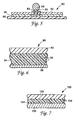
- Fig. 6 is a sectional view of a medical mammalian skin covering containing adhesive composition of the present invention.
- Fig. 7 is a sectional view of a pharmaceutical delivery device containing an adhesive composition of the present invention.
- the hydrophilic polymer matrix may be selected from the group consisting of poly(ethylene oxide), natural and synthetic polysaccharides and their derivatives, and homo- and copolymers of ethylenically unsaturated hydrophilic monomers including ⁇ , ⁇ -ethylenic unsaturated carhoxylic acids having 3 to 8 carbon atoms and salts thereof such as (meth)acrylic acid and salts thereof, acrylamide, N-vinyl pyrrolidone, hydroxyethyl (meth)acrylate, acrylamidopropane sulfonic acid and salts thereof, methyl and ethyl vinyl ether, and polymers having ammonium functionality derived from reaction of amine containing monomers with alkylating agents or protic acids, for example N,N'-dimethylaminoethyl (meth)acrylate and vinyl pyridine.
- ⁇ , ⁇ -ethylenic unsaturated carhoxylic acids having 3 to 8 carbon atoms and salts thereof
- the polymer matrix contains a homo- or copolymer of acrylic acid, wherein the acidic groups may be preferably neutralized from 0.5 to 95 % in accordance with the teachings of U.S. Pat. No. 4,848,353.
- Alkali hydroxides may be used as a neutralizing agent for the acidic groups, sodium and potassium hydroxide being preferred.
- the hydrophilic polymeric matrix can comprise from 10 to 40 weight percent of the adhesive composition of the present invention, and preferably may comprise from 20 to 35 weight percent.
- Compositions containing this level of hydrophilic polymeric matrix have a desirable balance of tack, softness, adhesiveness, and cohesive strength.
- the composition has substantially a homogeneous appearance, i. e. the aqueous, liquid phase is retained in the polymeric matrix, and essentially no phase separation can be observed with the eye.
- the plasticizing solution is compatible with the polymer matrix and comprises from 0 to 80 weight percent water-soluble polar organic compound, 0 to 60 weight percent water and at least 9 weight percent, preferably at least 10 weight percent of a surfactant or mixture of surfactants. All of these weight percents are based on the total weight of the adhesive composition.
- an anionic, cationic, nonionic or amphoteric surfactant may be used as a compatible surfactant.
- the use of such surfactants improves the adhesion of the pressure-sensitive adhesive electrodes to oily skin by giving the adhesive lipophilic properties.
- By incorporating the surfactants into the adhesive the compatibility between the adhesive and the oily skin is improved.
- Suitable anionic compatible surfactants include alkyl benzene sulfonates, alkyl sulfonates, olefin sulfonates, alkyl ethersuffonates, glycerol ethersulfonates, ⁇ -methyl ethersulfonates, sulfonic fatty acids, alkyl sulfates, fatty alcohol ethersulfates, glycerol ethersulfales, mixed hydroxy ethersulfates, monoglyceride (ether)sulfates, fatty acid amide (ether)sulfates, sulfosuccinates, sulfosuccinamates, sulfatrigtycerides, amide soaps, ether carboxylic acids, isethionates, sarcosinates, taurides, alkyl oligoglycoside sulfates and alkyl (ether)phosphates.
- Suitable nonionic compatible surfactants include fatty alcohol polyglycolethers, alkyl phenylpolyglycolethers, fatty acid polyglycolesters, fatty acid amide polyglycolethers, fatty amine polyglycolethers, alkoxylated triglycerides, alk(en)yl oligoglycosides, fatty acid glucamides, polyol fatty acid esters, sugar esters, sorbitol esters and sorbitol ester ethoxylates and polysorbates.
- Suitable cationic compatible surfactants include quaternary ammonium compounds and quaternized difatty acid trialkanol amine esters.
- Suitable amphoteric compatible surfactants include alkyl betaines, alkyl amidobetaines, amino propionates, amino glycinates, imidazolinium betaines and sulfobetaines.
- Useful compatible surfactants or mixtures of compatible surfactants have a HLB-value of 10 to 17 or the mixture of compatible surfactants combines to have a HLB-value of 10 to 17.
- Preferred compatible surfactants may be selected from nonionic surfactants having an HLB-value of 10 to 17.
- Fatty alcohol polyglycolethers, sorbitol fatty acid esters, and sorbitol fatty ester ethoxylates in this HLB range are particularly preferred.
- the HLB-value is an acronym for the hydrophilic-lipophilic balance and indicates the extent to which a given surfactant will behave as an oil-soluble vs. a water-soluble type of emulsifier as described in Chapter 20 of Surface Active Agents and Detergents, Volume II, Anthony M. Schwartz, James W. Perry, and Julian Berch, Robert E. Krieger Publishing Co., Huntington, New York, 1977.
- HLB-values in this range help assure that the surfactant is soluble in the adhesive formulation and also have high enough hydrocarbon content to impart desired oil absorbancy at lower usage.
- the water-soluble, polar organic compound of the plasticizing solution has the function of a humectant and is used as means for retaining sufficient water within the aqueous phase of the adhesive to keep the electrolyte salts dissolved and ionized if an ionically conductive adhesive is desired or to keep drug in solution if a transdermal delivery device is desired or to keep anti-microbial agents in solution if a wound dressing is desired.
- the water-soluble, polar compound may be selected from a compound consisting of mono- and polyhydric alcohols. Low molecular weight polyoxyethylene glycols are suitable (average molecular weight up to 600, e. g. CarbowaxTM 200 and 600 available from Union Carbide) Among these compounds glycerol, poly(ethylene glycol), monomethoxypoly(ethylene glycol) and propanediol are preferred because they give good adhesive performance and good water retention.
- the adhesive composition of the present invention can contain the water-soluble, polar organic compound in an amount up to 80 weight percent, preferably 10 to 50 weight percent and water in an amount up to 60 weight percent and preferably 10 to 30 weight percent.
- water and the polar organic compound provide adhesive compositions with a good balance of pressure sensitive adhesive performance while maintaining good ionic conductivity.
- the adhesive composition of the present invention can also contain up to 12 weight percent of a water-soluble salt such as alkali and alkaline earth halides, acetates, phosphates, and sulfates that impart conductivity to adhesive compositions based on nonionic polymer matrices or enhance conductivity of adhesive compositions that contain ionic polymer matrices.
- a water-soluble salt such as alkali and alkaline earth halides, acetates, phosphates, and sulfates that impart conductivity to adhesive compositions based on nonionic polymer matrices or enhance conductivity of adhesive compositions that contain ionic polymer matrices.
- a chloride containing salt such as potassium or sodium chloride, in an amount between about 0.5 and 3 weight percent of the adhesive composition, be present in the adhesive composition and that the adhesive composition be used with a silver/silver chloride conductor.
- the adhesiveness and peel adhesion of the pressure-sensitive adhesive compositions of the present invention can be improved by incorporating components having the ability to adsorb body fluids such as sweat from patient skin and to retain water. That means, in practical application such component adsorbs water (e.g. sweat) from patient skin, thus a decrease of the adhesion of the composition to the skin does not occur.
- Another advantage is, water is retained in the composition. Usually, when a package of adhesives, for example electrodes, is opened the adhesive composition dries out when not all of them are used immediately. When using the adhesive composition of present invention water is retained and drying out of the electrodes is minimized.
- Different kinds of components having such properties are useful in the adhesive composition of present invention and may be selected from the group of cellulose and its derivatives, starch and its derivatives and pectins of different origin. These components may be used in an amount up to 10 by weight, most preferably 1 to 8 % by weight.
- the water adsorbing components are selected from the group consisting of natural polysaccharides such as karaya gum, agar-agar (polysaccharide); crosslinked dextran (for example Sephadex, a product of Pharmacia Fine Chemicals, AB, Upsalla, Sweden); cellulose and modified cellulose polymers such as sodium carboxy methyl cellulose, hydroxyethyl cellulose, crosslinked sodium carboxy methylcellulose; starch and synthetically modified starch polymers such as sodium starch glycolates; guar gum; pectin (glycoside); gelatin; carrageenan; etc.
- crosslinked poly(N-vinyl lactams) can be used in accordance with U.S. Pat. No. 5,362,420 (Itoh et al.). These various materials can also be used to thicken the precursor prior to coating the precursor on the substrate.
- the composition of present invention has covalent crosslinking.
- the adhesive precursor includes a multifunctional monomer.
- Suitable crosslinkers include triethylene-glycol-bismethacrylate (TEGBM), ethylene-glycol-bis-methacrylate, methylene bis-acrylamide, tetraethylene-glycol-diacrylate (TEGDA), and 3,3'-ethylidene-bis (N-vinyl-2-pyrrolidone). Additional crosslinkers are listed in US-A-4,536,554. The amount of the crosslinker may be varied depending on the choice of monomers and crosslinkers and the polymerization conditions.
- the crosslinker is preferably triethylene-glycol-bismethacrylate (TEGBM) or tetraethylene-glycol-diacrylate (TEGDA).
- TGBM triethylene-glycol-bismethacrylate
- TAGDA tetraethylene-glycol-diacrylate
- the present invention also provides a process for the preparation of the pressure-sensitive adhesive composition.
- the pressure-sensitive adhesive compositions of the present invention may be obtained by subjecting a curable composition comprising 10 to 40 weight-% of a hydrophilic, ethylenically unsaturated monomer curable to the hydrophilic polymer matrix dissolved to make a solution with up to 60 weight percent water, up to 80 weight percent watersoluble, polar organic compound, and at least 9 weight percent, preferably at least 10 weight percent of a surfactant or a mixture of surfactants and a polymerization initiator for the hydrophilic monomer to free radical polymerization conditions.
- the components may be mixed together.
- the curable composition also may contain the above defined components such as water-soluble salt, one or more water adsorbing components and a crosslinker.
- the polymerization may be started with an initiator of either the photo or thermal class.
- Photoinitiators are preferred. Examples of useful photoinitiators are disclosed in the article "Photoinitiators - An Overview" by Berner et al., in the Journal of Radiation Curing (April 1979, pp. 2 through 9). The preferred photoinitiator is 2,2-dimethoxy-2-phenylacetophenone.
- useful thermal initiators are K 2 S 2 O 8 , benzoyl peroxide, azo-bis-isobutyronitrile, di-t-butyl peroxide and bromyl peroxide. The actual selection of initiator is dependent on the monomers and other components of the adhesive precursor.
- the materials present in the precursor are present in the same or modified form in the final composition.
- the plasticizing solution can serve as a solvent for the monomers in the polymerization step and can be present as the plasticizing liquid in the final composition.
- the obtained copolymer matrix may be, but need not be, covalently crosslinked.
- a difunctional crosslinking monomer is included and polymerization is carried out to substantial completion leaving less than 1 % monomer in the final composition.
- the process may be carried out in situ with the adhesive precursor coated on an electrode conductor or backing substrate.
- the adhesive precursor can be coated on a transfer sheet to make a web of adhesive that subsequently may be incorporated into a composite such as a biomedical electrode.
- the adhesive precursor is preferably coated and cured on a thin scrim, e. g. 0.1 mm CerexTM material (Monsanto), to facilitate mechanical handling in the manufacturing process.
- the process of the present invention can also employ crosslinking via random pendent functionality of photoreactive pendent groups or photoinitiable pendent groups.
- that method comprises preparing polar polymers via thermal polymerization with copolymerizable pendant photoreactive moieties that undergo activation to provide crosslinked hydrophilic pressure sensitive adhesives when plasticized with humectants.
- this pendant photoactive moiety is obtained from a "system soluble", (meth)acrylated photoinitiator, very rapid, reproducible, and complete crosslinking can be obtained with high intensity UV lights allowing for efficient manufacture of adhesive coated articles and tapes, especially when thick coatings of adhesive are desired.
- System soluble means that the photoinitiator is soluble in a mixture of water, plasticizer, and monomer at a temperature used in copolymerization.
- the functionalized polar polymer should be present in an amount of 10 to 40 weight percent with plasticizer being present in amount of 90 to 60 weight percent.
- the polar polymer can contain from 95 weight percent to 99.5 weight percent, preferably 97 weight percent to 99 weight percent, hydrophilic monomer and from 0.5 weight percent to 5 weight percent, preferably 1 to 3 weight percent, of system soluble (meth)acrylated photoinitiator.
- Adhesive compositions of the present invention can be used in a variety of applications where pressure sensitive adhesives are industrially or commercially applied in the manufacture of tapes, adhesive substrates, and the like.
- adhesive compositions of the present invention can be used in the field of health care where adhesive requirements are particularly stringent and difficult when adhesion to oily mammalian skin is involved.
- the adhesive composition of the present invention is particularly suitable for use in mammalian skin covering applications such as biocompatible medical adhesives such as for receipt or delivery of electrical signals at or through mammalian skin, delivery of pharmaceuticals or active agents to or through mammalian skin, or treatment of mammalian skin or mammalian skin openings against the possibilities of infection.
- Biomedical electrodes employing adhesive compositions of the present invention having electrolyte contained therein are useful for diagnostic (including monitoring) and therapeutic purposes.
- a biomedical electrode comprises a conductive medium contacting mammalian skin and a means for electrical communication interacting between the conductive medium and electrical diagnostic, therapeutic, or electrosurgical equipment.
- FIGS. 1 and 2 show either a disposable diagnostic electrocardiogram (ECG or EKG) or a transcutaneous electrical nerve stimulation (TENS) electrode 10 on a release liner 12.
- Electrode 10 includes a field 14 of a biocompatible and adhesive conductive medium for contacting mammalian skin of a patient upon removal of protective release liner 12.
- Electrode 10 includes means for electrical communication 16 comprising a conductor member having a conductive interface portion 18 contacting field 14 of conductive medium and a tab portion 20 extending beyond field 14 of conductive medium for mechanical and electrical contact with electrical instrumentation (not shown).
- Means 16 for electrical communication includes a conductive layer 26 coated on at least the side 22 contacting field 14 of conductive medium.
- a typical conductor member 16 will comprise a strip of material having a thickness of about 0.05-0.2 millimeters, such as polyester film and have a coating 26 on side 22 of silver/silver chloride of about 2.5-12 micrometers, and preferably about 5 micrometers thick thereon.
- Presently preferred for conductor member 16 are polyester films commercially available as ScotchpakTM brand film from Minnesota Mining and Manufacturing Company of St. Paul, MN or "Melinex" 505-300, 329, or 339 brand film from ICI Americas of Hopewell, VA. coated with a silver/silver chloride ink commercially available as "R-300" ink from Ercon, Inc. of Waltham, MA.
- a TENS conductor member 16 can be made of a nonwoven web, such as a web of polyester/cellulose fibers commercially available as "Manniweb” material from Lydall, Inc. of Troy, NY and have a carbon ink layer 26 commercially available as "SS24363” ink from Acheson Colloids Company of Port Huron, MI on side 22 thereof.
- a nonwoven web such as a web of polyester/cellulose fibers commercially available as "Manniweb” material from Lydall, Inc. of Troy, NY and have a carbon ink layer 26 commercially available as "SS24363” ink from Acheson Colloids Company of Port Huron, MI on side 22 thereof.
- an adhesively-backed polyethylene tape can be applied to tab portion 20 on the side opposite side 22 having the conductive coating 26.
- a surgical tape commercially available from 3M Company as "Blenderm” tape can be employed for this purpose.
- conductor member can be a multi-layered construction of a nonconductive, flexible polymeric film having a sulfur-reactive surface, a metallic layer deposited on and interacting with the surface and an optional metallic halide layer, according to the disclosure of PCT Publication WO 94/026950.
- the conductive interface portion 18 of member 16 comprises a metallic layer deposited on a sulfur-reactive surface on at least the side of polymeric film substrate facing field 14 of the conductive medium and the optional metallic halide layer coated on the metallic layer and contacting field 14. Because depolarizing is not needed for the mechanical and electrical contact with electrical equipment, the optional metallic halide layer does not need to extend to tab portion 20.
- conductor member 16 can be a multi-layered construction of a nonconductive, flexible polymeric film, an electrically conductive layer, and a thin, conformable depolarizing layer of inorganic oxide, preferably manganese dioxide.
- conductor member 16 is a multi-layered construction of film with electrically conductive and depolarizing layers blended together. Both of these alternative embodiments can be constructed according to the disclosure of PCT International Patent Publication WO 95/20350, the disclosure of which is incorporated by reference herein.
- the conductive interface portion of member comprises an electrically conductive layer coated on at least the side of polymeric film facing field 14 of conductive medium and the thin, depolarizing layer coated on the electrically conductive layer and contacting field 14. Because depolarizing is not needed for the mechanical and electrical contact with electrical equipment, the depolarizing layer does not need to extend to tab portion 20.
- Non-limiting examples of biomedical electrodes which can use adhesive compositions of the present invention, either as conductive or nonconductive adhesive fields include electrodes disclosed in U.S. Pat. Nos. 4,524,087; 4,539,996; 4,554,924; 4,848,353 (all Engel); 4,846,185 (Carim); 4,771,783 (Roberts); 4,715,382 (Strand); 5,012,810 (Strand et al.); and 5,133,356 (Bryan et al.).
- border areas become optional with the use of adhesive compositions of the present invention. Desirably, such border areas can be eliminated because it is no longer necessary.
- the means for electrical communication can be an electrically conductive tab extending from the periphery of the biomedical electrodes such as that seen in U.S. Pat. No. 4,848,353 or can be a conductor member extending through a slit or seam in an insulating backing member, such as that seen in U.S. Pat. No. 5,012,810.
- the means for electrical communication can be an eyelet or other snap-type connector such as that disclosed in U.S. Pat. No. 4,846,185.
- the means for electrical communication can be a lead wire such as that seen in U.S. Pat. No. 4,771,783.
- an adhesive composition of the present invention, containing an electrolyte can reside as a field of conductive adhesive on a biomedical electrode for diagnostic (including monitoring), therapeutic, or electrosurgical purposes.
- biomedical electrode of the present invention Another type of diagnostic procedure which can employ a biomedical electrode of the present invention is the longer term monitoring of electrical wave patterns of the heart of a patient to detect patterns of abnormality.
- a preferred biomedical electrode structure is disclosed in U.S. Pat. No. 5,012,810 (Strand et al.).
- the adhesive of the present invention can be used as the ionically conductive medium in any of the embodiments shown therein.
- the adhesive of the present invention is used as the field of conductive adhesive in the biomedical electrode of the embodiment shown in Figs. 2, 3, and 4 of U.S. Pat. No. 5,012,810.
- Electrode 40 includes an insulator construction 41, and a conductor member 42.
- the insulator construction 41 includes first and second sections 44 and 45 which, together, define opposite sides 46 and 47 of the insulator construction 41.
- each section 44 and 45 includes an elongate edge portion 50 and 51, respectively.
- the edge portions 50 and 51 each include a border portion 52 and 53, respectively, which comprise a peripheral portion of each section 44 and 45, respectively, and extending along edges 50 and 51, respectively.
- sections 44 and 45 are oriented to extend substantially parallel to one another, with edge portions 50 and 51 overlapping one another such that border portions 52 and 53 overlap.
- a seam 60 is created between edge portions 50 and 51.
- “Substantially parallel” does not mean that the sections 44 and 45 are necessarily precisely parallel. They may be out of precise coplanar alignment due, for example, to the thickness of the conductor member 42.
- Conductor member 42 is substantially similar to biomedical electrical conductor 16 described above, having a tab portion 61 corresponding to tab portion 20 described above and a pad portion 62 corresponding to conductive interface portion 18 described above. Like biomedical electrical conductor member 16, conductor member 42 can be any of the embodiments disclosed above. In this embodiment, conductor member 42 is a multi-layered construction of a nonconductive, flexible organic polymer substrate 63 having an organosulfur surface 64, a metallic layer 65 adhered thereto, and, optionally, a metallic halide layer 66, produced according to the disclosure of PCT Patent Publication WO 94/26950.
- the pad portion 62 of member 42 comprises the portion of the metallic film facing field 70 of conductive adhesive, optionally with metallic halide layer 66 contacting field 70. Because depolarizing is not needed for the mechanical and electrical contact with electrical equipment, metallic halide layer 66 need not extend to tab portion 61.
- an adhesively-backed polyethylene tape can be applied to tab portion 61 in the same manner as that for the embodiment of Figs. 1 and 2 in order to enhance mechanical contact.
- electrode 40 is constructed such that tab portion 61 of conductor member 42 projects through seam 60 and over a portion of surface or side 46.
- pad portion 62 of conductor member 42 is positioned on one side 47 of insulator construction 41, and the tab portion 61 of conductor member 42 is positioned on an opposite side 46 of insulator construction 41.
- the seam may be sealed by means of an adhesive or the like.
- a field 70 of conductive adhesive of the present invention is shown positioned generally underneath conductive member 42.
- field 70 of conductive adhesive will be surrounded by a field 71 of biocompatible skin adhesive also applied to insulator construction 41 the side thereof having pad portion 62 thereon.
- field 71 can be eliminated or can be also the adhesive of the present invention.
- a layer of release liner 75 is shown positioned against that side of electrode 40 which has optional skin adhesive 71, conductive adhesive 70 and pad portion 62 thereon.
- a spacer 76 or tab 76 can be positioned between release liner 75 and a portion of insulator construction 41, to facilitate the separation.
- release liners 75 may be utilized; for example, a liner comprising a polymer such as a polyester or polypropylene material, coated with a silicone release type coating which is readily separable from the skin adhesive and conductive adhesive.
- a variety of materials may be utilized to form the sections 44 and 45 of the insulator construction 41.
- a flexible material is preferred which will be comfortable to the user, and is relatively strong and thin.
- Preferred materials are polymer foams, especially polyethylene foams, non-woven pads, especially polyester non-wovens, various types of paper, and transparent films.
- transparent films include polyester film such as a "Melinex" polyester film commercially available from ICI Americas, Hopewell, VA having a thickness of 0.05 mm and a surgical tape commercially available from 3M Company as "Transpore” unembossed tape.
- melt blown polyurethane materials usable in insulator construction 41 in electrodes according to the present invention are generally described in European Patent Publication 0 341 875 (Meyer) and corresponding U.S. Pat. No. 5,230,701 (Meyer et al.).
- the insulator construction has a skin adhesive on its surface contacting the remainder of the electrode 40.
- Preferred web materials (melt blown polyurethanes) for use in insulator construction 41 have a web basis weight of about 60-140 g/m 2 (preferably about 120 g/m 2 ). Such materials have an appropriate tensile strength and moisture vapor transmission rate. A preferred moisture vapor transmission rate is about 500-3000 grams water/m 2 /24 hours (preferably 500-1500 grams water/m 2 /24 hours) when tested according to ASTM E96-80 at 21°C and 50% relative humidity.
- An advantage to such materials is that webs formed from them can be made which exhibit good elasticity and stretch recovery. This means that the electrode can stretch well, in all directions, with movement of the subject, without loss of electrode integrity and/or failure of the seal provided by the skin adhesive. Material with a stretch recovery of at least about 85%, in all directions, after stretch of 50% is preferred.
- acrylate ester adhesives will be preferred.
- Acrylate ester copolymer adhesives are particularly preferred. Such material are generally described in U.S. Pat. Nos. 2,973,826; Re 24,906; Re 33,353; 3,389,827; 4,112,213; 4,310,509; 4,323,557; 4,732,808; 4,917,928; 4,917,929; and European Patent Publication 0 051 935.
- an adhesive copolymer having from about 95 to about 97 weight percent isooctyl acrylate and from about 5 to about 3 percent acrylamide and having an inherent viscosity of 1.1-1.25 dl/g is presently preferred.
- Adhesive useful for adhesive 69 can be any of the acrylate ester adhesives described above in double stick tape form.
- a presently preferred adhesive is the same adhesive as presently preferred for the skin adhesive except having an inherent viscosity of about 1.3-1.45 dl/g.
- Electrode 80 has a nonconductive backing 82 having an opening 83 covered by snap 84 through which stud or eyelet 85 protrudes.
- the snap 84 is secured to eyelet 85 to provide a point of electrical connection to electrical instrumentation.
- Covering eyelet 85 and backing 82 are a field 86 of the adhesive of the present invention.
- a release liner 88 protects the PSA field 86 prior to use.
- Backing 82 can be made of the same or similar materials as insulator construction 41.
- Eyelet 85 can be a plastic, metallic plated eyelet (such as an ABS plastic eyelet silver-plated and chlorided and commercially available from Micron Products of Fitchburg, MA).
- Snap 84 can be a metallic snap (such as stainless steel eyelet No. 304 commercially available from Eyelets for Industry of Thomason, CN). Electrode 80 is particularly preferred because the adhesive of the present invention can serve both as the biocompatible skin adhesive and as the ionically conductive medium in the electrode 80. By comparison, a monitoring electrode that requires a skirt of biocompatible skin adhesive to surround a nonadhesive but ionically conductive gel pad, such as a Red DotTM brand electrode commercially available from Minnesota Mining and Manufacturing Company is a more complicated construction.
- adhesive of the present invention can be substituted for the field of conductive adhesive and optionally also the field of skin adhesive disclosed in such patents.
- FIGS. 4 and 5 of U.S. Pat. No. 4,848,353 Engel in which the electrically conductive adhesive 36 is replaced by the adhesive of the present invention, and in which the biocompatible PSA 32 is optionally eliminated or optionally replaced by the adhesive of the present invention.
- electrodes shown in Figs. 1 and 2 or those electrodes shown in U.S. Pat. No. 4,539,996 are preferred.
- electrodes shown in Figs. 3 and 4 and those disclosed in U.S. Patent Nos. 4,539,996, 4,848,353, 5,012,810 and 5,133,356 are preferred.
- the biomedical electrical conductor can be an electrically conductive tab extending from the periphery of the biomedical electrodes such as that seen in U.S. Pat. No. 4,848,353 or can be a conductor member extending through a slit or seam in a insulating backing member, such as that seen in U.S. Patent No. 5,012,810.
- the means for electrical communication can be an eyelet or other snap-type connector such as that disclosed in U.S. Pat. No. 4,846,185.
- an electrically conductive tab such as that seen in U.S. Pat. No. 5,012,810 can have an eyelet or other snap-type connector secured thereto.
- Medical skin coverings employing adhesive compositions of the present invention, optionally having antimicrobial and other biologically active agents contained therein, are useful for treatment of mammalian skin or mammalian skin openings, preferably against the possibility of infection and also for the transmission of moisture vapor and exudate from skin.
- FIG. 6 shows a sectional view of a medical skin covering 90 having a backing material 92, a layer 94 of adhesive of the present invention coated on backing material 92, and protected until use by a release liner 96.
- antimicrobial 98 is contained in layer 94 by adding agent 98 prior to coating on backing material 92.
- layer 94 can be used as a caulkable sealant according to U.S. Pat. No. 4,931,282 (Asmus et al.).
- the release liner 96 is removed and the layer 94 of adhesive of the present invention can be applied to the skin of the patient as a part of a medical tape, a wound dressing, a bandage of general medicinal utility, or other medical device having water or moisture absorbing properties.
- the adhesive layer 94 may be coated on a layer of backing material 92 selected from any of several backing materials having a high moisture vapor transmission rate for use as medical tapes, dressings, bandages, and the like.
- Suitable backing materials include those disclosed in U.S. Patents 3,645,835 and 4,595,001.
- Other examples of a variety of films commercially available as extrudable polymers include "Hytrel R 4056" and “Hytrel R 3548" branded polyester elastomers available from E.I. DuPont de Nemours and Company of Wilmington, Delaware, "Estane” branded polyurethanes available from B.F. Goodrich of Cleveland, Ohio or "Q-thane” branded polyurethanes available from K.J. Quinn & Co. of Malden, Massachusetts.
- the layer 94 of adhesive of the invention combined with a layer 92 of suitable backing material can be used as a dressing.
- Adhesive compositions of the present invention can be used as discrete gel particles dispersed in a continuous pressure-sensitive adhesive matrix to form a two phase composite useful in medical applications, as described in U.S. Pat. No. 5,270,358, the disclosure of which is incorporated by reference herein.
- the adhesive layer 94 can be coated on the backing layer 92 by a variety of processes, including, direct coating, lamination, and hot lamination.
- the release liner 96 can thereafter be applied using direct coating, lamination, and hot lamination.
- the methods of lamination and hot lamination involve the application of pressure, or heat and pressure, respectively, on the layer of adhesive layer 94 to the backing material layer 92.
- the temperature for hot lamination ranges from about 50°C to about 250°C, and the pressures applied to both lamination and hot lamination range from 0.1 Kg/cm 2 to about 50 Kg/cm 2 .
- compositions of the present invention are useful for delivery of pharmaceuticals or other active agents to or through mammalian skin.
- FIG. 7 shows a sectional view of a transdermal or topical drug delivery device 100 having a backing layer 102, a layer 104 containing adhesive of the present invention coated thereon and protected by a release liner 106.
- Other layers can be present between layer 102 and layer 104 to house pharmaceuticals or other therapeutic agents. Otherwise, as shown in FIG. 7, pharmaceutical and other agents 108 are dispersed in adhesive layer 104.
- the backing layer 102 can be any backing material known to those skilled in the art and useful for drug delivery devices.
- Non-limiting examples of such backing materials are polyethylene, ethylene-vinyl acetate copolymer, polyethylene-aluminum-polyethylene composites, and ScotchPakTM brand backings commercially available from Minnesota Mining and Manufacturing Company of St. Paul, Minnesota.
- the release liner 106 can be any release liner material known to those skilled in the art.
- Non-limiting examples of such release liners commercially available include siliconized polyethylene terephthalate films commercially available from H.P. Smith Co. and fluoropolymer coated polyester films commercially available from 3M under the brand ScotchPakTM release liners.
- the therapeutic agent 108 can be any therapeutically active material known to those skilled in the art and approved for delivery topically to or transdermally or iontophoretically through the skin of a patient.
- therapeutic agents useful in transdermal delivery devices are any active drug or salts of those drugs, used in topical or transdermal applications, or growth factors for use in enhancing wound healing.
- Other therapeutic agents identified as drugs or pharmacologically active agents are disclosed in U.S. Patent Nos. 4,849,224 and 4,855,294, and PCT Patent Publication WO 89/07951.
- Excipients or penetration enhancing agents are also known to those skilled in the art.
- Non-limiting examples of penetration enhancing agents include ethanol, methyl laurate, oleic acid, isopropyl myristate, and glycerol monolaurate.
- Other penetration enhancing agents known to those skilled in the art are disclosed in U.S. Patent Nos. 4,849,224 and 4,855,294; and PCT Patent Publication WO 89/07951.
- the method of manufacturing a transdermal delivery device depends on its construction.
- the drug delivery device 100 shown in FIG. 7 can be prepared using the following general method.
- a solution is prepared by dissolving the therapeutic agent 108 and such optional excipients as are desired in a suitable solvent and mixed into the precursor prior to forming the composition, during the formation of the composition, or directly into the already formed composition.
- the resulting loaded adhesive composition is coated on the backing layer 102.
- a release liner 106 is applied to cover loaded adhesive layer 104.
- the plasticizing solution is prepared by dissolving a water-soluble salt in water and adding a polar organic compound.
- the crosslinker and the photoinitiator are dissolved in the hydrophilic polymerizable monomer. Both solutions are mixed and stirred until they are homogeneous.
- the surfactant and the water-adsorbing component are then added and the whole mixture is stirred again.
- the mixture is coated at a caliper of 0.8 mm on to a 75 ⁇ m polyester film and covered with a siliconized 75 ⁇ m polyester film. This construction is then irradiated 6 min with a UV lamp (wavelength 351 nm, intensity 1 mW/cm 2 , dose 360 mJ/cm 2 ).
- the siliconized polyester film is removed and the adhesive with the remaining polyester film is used to determine its properties.
- Gel-to-gel impedance was measured according to "American National Standard for Pregelled ECG Disposable Electrodes" (ANSI/AAMI EC12-1983) with Prep-Check Model EIM105 from General Devices of Bogota, New Jersey. Adhesive samples were laminated to a silver backing and die cut into electrode shape. The polyester was removed and two electrodes were connected with their adhesive sides and combined with the wires of the Prep-Check Instrument. Impedance Value was read 1 minute after connection to the instrument (in Kohms).
- PSI Primary Skin Irritation
- New Zealand white rabbits The Primary Skin Irritation (PSI) test on New Zealand white rabbits is widely recognized as a predictor of the potential for skin irritation in humans as described in Chapter 10, "Predictive Skin Irritation Tests in Animals and Humans", Esther Patrick and Howard Maibach, in Dermatotoxicology , Fourth Edition, Francis Marzulli and Howard Maibach, Editors, Hemisphere Publishing Corp., New York, 1991.
- Such a test meets the irritation testing requirements of the "Tripartite Biocompatibility Guidance for Medical Devices" prepared by Toxicology Subgroup of the Tripartite Sub-Committee on Medical Devices, September 1986 which directs the testing required to substantiate the safety of materials in a medical device.
- the test involves clipping the hair from the back and flanks of each of six animals, selecting two test sites lateral to the midline of the back approximately ten centimeters apart. One of the two sites is abraded by making four epidermal incisions in a crosshatch pattern. One square inch of the adhesive to be tested is applied to the abraded and intact sites on each animal and secured. The trunk of each animal is wrapped with impervious plastic sheeting to occlude the test article during the one day exposure period. One hour and two days after removal of the test article, the intact and abraded test sites are examined and scored separately for erythema and edema on a graded scale of 0 to 4 as outlined in Table 1 of Patrick and Maibach cited above.
- the mean scores (averaged over the six animals) for erythema and edema at both the abraded and intact sites at both one hour and two days after removal are totaled and divided by four to obtain the mean primary irritation index.
- This is assigned a descriptive primary skin irritation rating as follows: Mean Primary Irritation Score Descriptive Rating 0 Non-irritating 0.1-0.5 Minimally Irritating 0.6-1.5 Slightly Irritating 1.6-3.0 Mildly Irritating 3.1-5.0 Moderately Irritating 5.1-6.5 Severely Irritating 6.6-8.0 Extremely Irritating Past experience has shown that adhesives with scores of 3.0 or less (i.e. at most mildly irritating) on this scale of 8 are acceptable for use in biomedical electrode testing, presenting low risk of skin irritation during human trials.
- Example 1 the peel adhesion of adhesives containing increasing amounts of surfactant was measured.
- the compositions of the adhesives are shown in Table 1 and were obtained by systemically increasing the level of surfactant while holding other components constant.
- the results of 180° peel adhesion test at room temperature to HDPE film and oil contaminated HDPE film (N/dm) are shown in Table 2.
- Example Comp. Example 1 Comp.
- Example 2 1 2 3 4 Comp.
- Example 3 Components parts by weight Water 15.75 14.34 13.16 12.16 11.30 10.56 15.75 KCl 1.18 1.08 0.99 0.97 0.85 0.79 1.18 PEG 300 39.38 35.85 32.90 30.40 28.26 26.39 39.38 Acrylic acid 35.44 37.27 29.69 37.36 25.43 23.75 35.44 Irgacure® 651 0.075 0.068 0.063 0.058 0.054 0.050 0.075 TEGDA 0.295 0.267 0.247 0.228 0.292 0.198 0.295 Technocel® 30/2 7.88 7.17 6.58 6.08 5.65 5.28 7.88 Lamesorb® SMS-20 0 8.96 16.45 27.80 28.26 32.99 0 Example Dwell time Comp. Example 1 Comp.
- Example 2 1 2 3 4 Comp..
- Example 3 1 min 3.6 6.9 11.9 11.5 12.0 11.1 5.4 1 min. (oil) ⁇ 0.1 ⁇ 0.1 2.3 4.3 3.9 5.8 ⁇ 0.1 24 h 4.4 8.0 12.4 13.3 12.4 12.6 6.2 24 h (oil) ⁇ 0.1 0.5 5.9 10.0 9.3 8.8 ⁇ 0.1
- the inventive conductive adhesives containing increasing amounts of surfactant show good adhesion as well as to a HDPE film as to a HDPE film contaminated with oil after both one minute and after 24 hour dwell.
- the peel adhesion value from the oil-contaminated HDPE surface is at least 15 % of the peel adhesion value obtained from the same HDPE surface that has not been contaminated with oil providing that the level of surfactant is high enough.
- composition of examples 5-9 and comparative example 6 contains Parts by wt. Water 16 KCl 2 PEG 300 70 Acrylic Acid 36 Irgacure® 1 651 0.076 TEGDA 0.3 Technocel® 2 30/2 8.0 Surfactant 50
- the inventive conductive adhesives show good adhesion as well as to a HDPE film as to a HDPE film contaminated with oil.
- the adhesion to the HDPE film contaminated with oil of commercial available electrodes containing adhesives of the state of art decreases to a value of less 15 % of the peel adhesion of the value obtained from the same HDPE surface that has not been contaminated with oil as shown in comparative examples 4 and 5.
- Comparative example 6 demonstrates that use of a surfactant with an HLB value of 8.3 also does not give adhesion to the oil contaminated film. The adhesion is not sufficient for the use as an electrode over a long application period.
- Examples 10-14 the peel adhesion of adhesives containing increasing amounts of cellulose derivative was measured.
- the compositions of the adhesives are shown in Table 4, the results of 180° peel adhesion test at room temperature to HDPE film and oil contaminated HDPE film (N/dm) are shown in Table 5.
- Example 10 11 12 13 14 Components parts by weight Water 18.0 18.0 18.0 18.0 KCl 2.0 2.0 2.0 2.0 2.0 PEG 300 40.0 40.0 40.0 40.0 Acrylic acid 36.0 36.0 36.0 36.0 36.0 Irgacure® 651 0.076 0.076 0.076 0.076 0.076 TEGDA 0.3 0.3 0.3 0.3 0.3 0.3 Technocel® 30/2 2.0 4.0 6.0 10.0 12.0 Lamesorb® SMS-20 50.0 50.0 50.0 50.0 50.0 50.0 50.0 Example Dwell time 11 12 13 14 15 1 min. 12.6 14.2 14.2 13.8 14.6 1 min.
- the inventive conductive adhesives containing increasing amounts of a cellulose derivative show good adhesion as well as to a HDPE film as to a HDPE film contaminated with oil.
- the peel adhesion value from the oil-contaminated HDPE surface is at least 15 % of the peel adhesion value obtained from the same HDPE surface that has not been contaminated with oil.
- An improvement in adhesion to both surfaces under humid conditions is noted as the level of cellulose derivative is increased.
- Example 15 16 17 18 19 20 Components parts by weight Water 16.0 16.0 16.0 16.0 16.0 16.0 KCI - 0.4 0.8 1.2 1.6 2.0 PEG 300 40.0 40.0 40.0 40.0 40.0 40.0 Acrylic acid 36.0 36.0 36.0 36.0 36.0 36.0 Irgacure® 651 0.076 0.076 0.076 0.076 0.076 TEGDA 0.3 0.3 0.3 0.3 0.3 0.3 0.3 0.3 0.3 0.3 0.3 0.3 0.3 0.3 0.3 0.3 0.3 0.3 0.3 0.3 0.3 0.3 0.3 Technocel® 30/2 8.0 8.0 8.0 8.0 8.0 Lamesorb® SMS-20 50.0 50.0 50.0 50.0 50.0 50.0 50.0 50.0 50.0 Example dwell time 16 17 18 19 20 21 1 min. 11.0 12.2 13.4 12.6 13.4 15.4 1 min.
- the inventive conductive adhesives that contain increasing amounts of a water soluble salt (KCl) show good adhesion as welt as to a HDPE film as to a HDPE film contaminated with oil.
- the peel adhesion value from the oil-contaminated HDPE surface is at least 15 % of the peel adhesion value obtained from the same HDPE surface that has not been contaminated with oil.
- Example 22 23 24 25 26 Components Parts by Weight Water 28.0 28.0 28.0 18.0 18.0 KCl 2.0 2.0 2.0 2.0 Methoxy PEG 350 15.0 15.0 15.0 15.0 15.0 Acrylic acid 24.83 24.83 24.83 29.67 29.69
- Irgacure 651 0.07 0.07 0.07 0.07 0.07 Methylene bis(acrylamide) 0.10 0.10 0.10
- Arosurf®66PE12 30.0 Arosurf®66E20 30.0 Brij®97 30.0 Surfonic®L24-7 35.0 Tergitol®15-S-9 35.0 PSI 2.2/8.0 1.1/8.0 2.4/8.0 1.6/8.0 1.0/8.0
Landscapes
- Health & Medical Sciences (AREA)
- Engineering & Computer Science (AREA)
- Chemical & Material Sciences (AREA)
- Veterinary Medicine (AREA)
- Epidemiology (AREA)
- Life Sciences & Earth Sciences (AREA)
- Animal Behavior & Ethology (AREA)
- General Health & Medical Sciences (AREA)
- Public Health (AREA)
- Materials Engineering (AREA)
- Hematology (AREA)
- Bioinformatics & Cheminformatics (AREA)
- Organic Chemistry (AREA)
- Dermatology (AREA)
- Medicinal Chemistry (AREA)
- Pharmacology & Pharmacy (AREA)
- Adhesives Or Adhesive Processes (AREA)
- Electrotherapy Devices (AREA)
- Measurement And Recording Of Electrical Phenomena And Electrical Characteristics Of The Living Body (AREA)
- Medicinal Preparation (AREA)
- Materials For Medical Uses (AREA)
- Adhesive Tapes (AREA)
Claims (28)
- Hautverträglicher, lipophiler, polarer Haftkleber, umfassend eine hydrophile Polymermatrix und einen Weichmacher in einer Menge, die ausreicht, um die Matrix kohäsiv und haftklebend zu machen, wobei der Weichmacher eine wasserlösliche, polare, organische Verbindung und ein verträgliches grenzflächenaktives Mittel oder ein Gemisch aus verträglichen grenzflächenaktiven Mitteln umfasst, die, bezogen auf den Klebstoff, in einer Menge von mindestens 9 Gewichtsprozent vorliegen, wobei das verträgliche grenzflächenaktive Mittel einen HLB-Wert von 10 bis 17 aufweist oder wobei das Gemisch aus verträglichen grenzflächenaktiven Mitteln insgesamt einen HLB-Wert von 10 bis 17 aufweist.
- Klebstoff nach Anspruch 1, wobei die hydrophile Polymermatrix ausgewählt ist aus Poly(ethylenoxid), natürlichen und synthetischen Polysacchariden und ihren Derivaten und Homo- und Copolymeren aus ethylenisch ungesättigten, hydrophilen Monomeren, einschließlich α,β-ethylenisch ungesättigter Carbonsäuren mit bis zu acht Kohlenstoffatomen und Salzen davon, Acrylamid, N-Vinylpyrrolidon, (Meth)acrylsäurehydroxyethylester, Acrylamidopropansulfonsäure und Salzen davon, Methyl- und Ethylvinylethern und Polymeren mit einer funktionellen Ammoniumgruppe.
- Klebstoff nach Anspruch 2, wobei die Polymermatrix ein Homo- oder Copolymer aus Monomeren, einschließlich ihrer (Meth)acrylsäuresalze, umfasst.
- Klebstoff nach einem der Ansprüche 1 bis 3, wobei die wasserlösliche, polare, organische Verbindung ausgewählt ist aus ein- und mehrwertigen Alkoholen.
- Klebstoff nach Anspruch 4, wobei die wasserlösliche, polare, organische Verbindung ausgewählt ist aus Glycerin, Poly(ethylenglycol), Monomethoxypoly(ethylenglycol) oder Propandiol.
- Klebstoff nach einem der Ansprüche 1 bis 5, wobei das grenzflächenaktive Mittel ein nicht-ionisches grenzflächenaktives Mittel ist.
- Klebstoff nach Anspruch 6, wobei das nicht-ionische grenzflächenaktive Mittel ausgewählt ist aus Fettalkoholpolyglycolethern, Alkylphenylpolyglycolethern, Fettsäurepolyglycolestern, Fettsäureamidpolyglycolethern, Fettaminpolyglycolethern, alkoxylierten Triglyceriden, Alk(en)yloligoglycosiden, Fettsäureglucamiden, Polyolfettsäureestern, Zuckerestern, Sorbitestern und Sorbitesterethoxylaten.
- Klebstoff nach einem der Ansprüche 1 bis 7, ferner umfassend ein wasserlösliches Salz in einer Menge von bis zu 12 Gewichtsprozent, bezogen auf die weichmachende Lösung.
- Klebstoff nach Anspruch 8, wobei das wasserlösliche Salz ausgewählt ist aus Natriumchlorid oder Kaliumchlorid.
- Klebstoff nach einem der Ansprüche 1 bis 9, ferner umfassend eine oder mehrere wasseradsorbierende Komponenten, ausgewählt aus Cellulose, Stärke und Pektinen und ihren Derivaten.
- Klebstoff, umfassend 10 bis 40 Gewichtsprozent eines hydrophilen, ethylenisch ungesättigten Monomers, 0 bis 60 Gewichtsprozent Wasser, 0 bis 80 Gewichtsprozent einer wasserlöslichen, polaren, organischen Verbindung und mindestens 9 Gewichtsprozent eines verträglichen grenzflächenaktiven Mittels oder eines Gemisches aus verträglichen grenzflächenaktiven Mitteln.
- Klebstoff nach Anspruch 11, ferner umfassend ein Vernetzungsmittel.
- Verfahren zur Herstellung des Klebstoffes nach Anspruch 1, das die Anwendung von Radikalkettenpolymerisationsbedingungen auf eine Lösung mit 10 bis 40 Gewichtsprozent eines hydrophilen, ethylenisch ungesättigten Monomers, das in 0 bis 60 Gewichtsprozent Wasser gelöst ist, 0 bis 80 Gewichtsprozent einer wasserlöslichen, polaren, organischen Verbindung und mindestens 9 Gewichtsprozent, bezogen auf den Klebstoff, eines grenzflächenaktiven Mittels oder eines Gemisches aus grenzflächenaktiven Mitteln und eines Polymerisationsinitiators für das hydrophile Monomer umfasst.
- Verfahren nach Anspruch 13, wobei die Radikalkettenpolymerisation in Gegenwart von ultraviolettem Licht durchgerührt wird.
- Biomedizinische Elektrode, umfassend:einen Bereich aus einem klebenden, leitfähigen Medium zum Inkontaktbringen mit Säugerhaut und ein Mittel zur elektrischen Übertragung durch Grenzflächenkontakt mit dem klebenden, leitfähigen Medium und der elektrischen, diagnostischen, therapeutischen oder elektrochirurgischen Apparatur, wobei das klebende, leitfähige Medium auf das Mittel zur elektrischen Übertragung geklebt ist und einen Klebstoff nach Anspruch 1 umfasst.
- Biomedizinische Elektrode nach Anspruch 15, wobei das klebende, leitfähige Medium ferner einen Elektrolyten aus einem ionischen Salz umfasst, der, bezogen auf das klebende, leitfähige Medium, in einer Menge von etwa 0,5 bis etwa 5 Gewichtsprozent vorliegt.
- Biomedizinische Elektrode nach Anspruch 15, wobei das klebende, leitfähige Medium ferner ein Redoxpaar umfasst, das, bezogen auf das klebende, leitfähige Medium, in einer Menge von nicht mehr als etwa 20 Gewichtsprozent vorliegt.
- Biomedizinische Elektrode nach Anspruch 15, wobei das Mittel zur elektrischen Übertragung einen leitenden Teil mit einem Grenzflächenteil, der mit dem klebenden, leitfähigen Medium in Kontakt ist, und einem Laschenteil umfasst, der für den mechanischen und elektrischen Kontakt mit der elektrischen, diagnostischen, therapeutischen oder elektrochirurgischen Apparatur zur Verfügung steht.
- Biomedizinische Elektrode nach Anspruch 15, wobei das Mittel zur elektrischen Übertragung einen leitenden Teil mit einem Ösen- oder Schnappverbindungsstück umfasst, der mit dem klebenden, leitfähigen Medium in Kontakt ist.
- Biomedizinische Elektrode nach Anspruch 15, wobei das Mittel zur elektrischen Übertragung einen leitenden Teil mit einem Überzug aus einer leitfähigen Schicht auf mindestens einer Seite des leitenden Teils umfasst, der mit dem klebenden, leitfähigen Medium in Kontakt ist.
- Biomedizinische Elektrode nach Anspruch 20, wobei der Überzug aus einer leitfähigen Schicht Silber/Silberchlorid ist.
- Säugerhautbedeckung, umfassend: eine Klebstoffschicht zum Inkontaktbringen mit Säugerhaut und eine Trägerschicht, wobei die Klebstoffschicht auf die Trägerschicht geklebt ist und einen polaren, lipophilen Hartkleber nach Anspruch 1 umfasst.
- Säugerhautbedeckung nach Anspruch 22, wobei die Klebstoffschicht ferner ein antimikrobielles Mittel umfasst.
- Säugerhautbedeckung nach Anspruch 22, wobei die Trägerschicht eine Folie, ein Substrat oder ein elastisches, poröses oder luftdurchlässiges, gewebtes Material oder Vliesmaterial umfasst.
- Säugerhautbedeckung nach Anspruch 22, wobei die Bedeckung ein medizinisches Pflaster, einen Wundverband, eine Bandage von allgemeinem medizinischem Nutzen oder eine medizinische Vorrichtung zum Inkontaktbringen mit Säugerhaut umfasst.
- Vorrichtung zur Arzneimittelbereitstellung, umfassend: eine Klebstoffschicht zum Inkontaktbringen mit Säugerhaut und eine Trägerschicht, wobei die Klebstoffschicht auf die Trägerschicht geklebt ist und einen polaren, lipophilen Haftkleber nach Anspruch 1 umfasst.
- Vorrichtung zur Arzneimittelbereitstellung nach Anspruch 26, wobei die Klebstoffschicht ferner einen topischen, transdermalen oder iontophoretischen Wirkstoff oder Arzneimittel umfasst.
- Vorrichtung zur Arzneimittelbereitstellung nach Anspruch 26, wobei die Klebstoffschicht ferner einen Excipienten, ein Lösungsmittel oder ein Mittel zur Verbesserung des Eindringens umfasst.
Applications Claiming Priority (1)
| Application Number | Priority Date | Filing Date | Title |
|---|---|---|---|
| PCT/US1995/016996 WO1997024149A1 (en) | 1995-12-29 | 1995-12-29 | Polar, lipophilic pressure-sensitive adhesive compositions and medical devices using same |
Publications (2)
| Publication Number | Publication Date |
|---|---|
| EP1019105A1 EP1019105A1 (de) | 2000-07-19 |
| EP1019105B1 true EP1019105B1 (de) | 2002-09-04 |
Family
ID=22250391
Family Applications (1)
| Application Number | Title | Priority Date | Filing Date |
|---|---|---|---|
| EP95944679A Expired - Lifetime EP1019105B1 (de) | 1995-12-29 | 1995-12-29 | Polarer druckempfindlicher haftkleber und ihn verwendende medizinische vorrichtungen |
Country Status (5)
| Country | Link |
|---|---|
| EP (1) | EP1019105B1 (de) |
| JP (1) | JP2000503009A (de) |
| AU (1) | AU4743896A (de) |
| DE (1) | DE69528088T2 (de) |
| WO (1) | WO1997024149A1 (de) |
Cited By (1)
| Publication number | Priority date | Publication date | Assignee | Title |
|---|---|---|---|---|
| WO2026013446A1 (en) * | 2024-07-09 | 2026-01-15 | Birmingham Hand And Nerve Ltd | Therapeutic dressing |
Families Citing this family (37)
| Publication number | Priority date | Publication date | Assignee | Title |
|---|---|---|---|---|
| GB9909348D0 (en) * | 1998-07-31 | 1999-06-16 | First Water Ltd | Bioadhesive compositions |
| GB9816826D0 (en) | 1998-07-31 | 1998-09-30 | First Water Ltd | Bioadhesive compositions |
| US6007532A (en) | 1997-08-29 | 1999-12-28 | 3M Innovative Properties Company | Method and apparatus for detecting loss of contact of biomedical electrodes with patient skin |
| AU8267098A (en) * | 1998-06-26 | 2000-01-17 | Procter & Gamble Company, The | Faecal collector with improved adhesive flange attachment means to facilitate removal with low pain level |
| WO2000006215A1 (en) * | 1998-07-31 | 2000-02-10 | First Water Limited | Bioadhesive compositions comprising hydrophobic polymers |
| US6534002B1 (en) * | 1998-12-30 | 2003-03-18 | Ethicon, Inc. | Flow of fluid through a lumen device from smaller-caliber end to larger-caliber end |
| US6710099B2 (en) | 1999-02-02 | 2004-03-23 | The Procter & Gamble Company | Disposable absorbent articles with improved adhesive for attachment to the skin to facilitate water adhesion stability with low pain level removal |
| US6878756B2 (en) | 1999-02-02 | 2005-04-12 | The Procter & Gamble Company | Disposable human waste management devices with improved adhesive flange attachment means to facilitate water adhesion stability with low pain level removal |
| US6607516B2 (en) | 1999-02-02 | 2003-08-19 | The Procter & Gamble Company | Disposable human waste management devices with improved adhesive flange to facilitate adhesion in oily conditions |
| EP1025824A1 (de) | 1999-02-02 | 2000-08-09 | The Procter & Gamble Company | Wegwerfartikel für menschliche Fäkalien mit verbesserter Flanschanhaftung |
| US6544642B2 (en) | 1999-02-02 | 2003-04-08 | The Procter & Gamble Company | Disposable absorbent articles with improved adhesive for attachment to the skin to facilitate adhesion in oily conditions |
| US6356779B1 (en) | 1999-06-04 | 2002-03-12 | 3M Innovative Properties Company | Universally functional biomedical electrode |
| WO2001019421A1 (en) * | 1999-09-16 | 2001-03-22 | Medicotest A/S | Adhesive for establishing a contact between a device and the skin of a mammal |
| FR2805275B1 (fr) * | 2000-02-21 | 2004-12-10 | Plasto Sa | Procede de fixation de protheses externes |
| US6921574B2 (en) * | 2002-03-29 | 2005-07-26 | The Procter & Gamble Company | Hydrogel adhesives for use on hair or fiber-populated surfaces |
| WO2003087250A1 (en) * | 2002-04-10 | 2003-10-23 | Flexcon Company, Inc. | Hydro-insensitive alternating current responsive composites |
| US7187985B2 (en) | 2003-07-18 | 2007-03-06 | 3M Innovative Properties Company | Biomedical electrode with current spreading layer |
| GB0400434D0 (en) | 2004-01-09 | 2004-02-11 | First Water Ltd | Protecting ophthalmic instruments against contamination and cross-infection |
| DE502004007444D1 (de) * | 2004-07-16 | 2008-08-07 | Collano Ag | Heissschmelzzusammensetzung mit Hydrocolloid |
| US7620439B2 (en) * | 2005-08-04 | 2009-11-17 | 3M Innovative Properties Company | Conductive adhesives and biomedical articles including same |
| US20110045056A1 (en) | 2008-01-17 | 2011-02-24 | First Water Limited | Hydrogel co-polymer composition and its uses, for example as a wound dressing |
| JP2009261727A (ja) * | 2008-04-25 | 2009-11-12 | Nitto Denko Corp | 医療用粘着組成物及び粘着テープもしくはシート |
| KR20150129045A (ko) | 2008-07-18 | 2015-11-18 | 플렉스콘 컴퍼니 인코포레이티드 | 심전도 검출 시스템에서 사용하기 위한 고임피던스 신호 검출 시스템 및 방법 |
| CA2952444C (en) | 2008-08-06 | 2019-05-07 | Flexcon Company, Inc. | Multiple electrode composite systems and methods for use in electrocardiogram detection systems |
| US20100152687A1 (en) | 2008-12-17 | 2010-06-17 | Carlozzi Antonella F | Feminine undergarment |
| GB0905290D0 (en) | 2009-03-27 | 2009-05-13 | First Water Ltd | Multilayer compositions and dressings |
| EP2438432A4 (de) * | 2009-06-05 | 2015-11-25 | Univ Arizona | Integrierter optochemischer sensor für stickstoffoxide in gasförmigen proben |
| AU2011213886B2 (en) | 2010-08-26 | 2014-06-19 | First Water Ramsbury Limited | Wound dressing |
| CN104812865A (zh) | 2012-11-21 | 2015-07-29 | 爱乐康株式会社 | 皮肤用粘合剂组合物、皮肤用粘合剂和皮肤用粘合片 |
| JP5974162B2 (ja) * | 2013-03-29 | 2016-08-23 | 積水化成品工業株式会社 | 仮止め用仮固定材 |
| GB201318842D0 (en) | 2013-10-24 | 2013-12-11 | First Water Ltd | Flexible hydrogel wound dressings |
| EP3302683B1 (de) * | 2015-05-28 | 2023-12-20 | Koninklijke Philips N.V. | Trockenelektrode zur erfassung von biopotenzial und hautimpedanz |
| KR101705229B1 (ko) * | 2015-12-17 | 2017-02-09 | 에스케이씨 주식회사 | 방열 점착 테이프, 방열 시트 및 이의 제조에 사용되는 조성물 |
| GB201713511D0 (en) | 2017-08-23 | 2017-10-04 | Scapa Uk Ltd | Wound dressing |
| JP7039386B2 (ja) * | 2018-05-16 | 2022-03-22 | 第一工業製薬株式会社 | ハイドロゲル |
| CA3131757A1 (en) | 2019-03-07 | 2020-09-10 | Henkel Ag & Co. Kgaa | Dry electrode adhesive |
| US12011911B2 (en) | 2020-03-25 | 2024-06-18 | Flexcon Company, Inc. | Isotropic non-aqueous electrode sensing material |
Family Cites Families (8)
| Publication number | Priority date | Publication date | Assignee | Title |
|---|---|---|---|---|
| US4215696A (en) * | 1978-03-20 | 1980-08-05 | Graphic Controls Corporation | Biomedical electrode with pressurized skin contact |
| US4524087A (en) * | 1980-01-23 | 1985-06-18 | Minnesota Mining And Manufacturing Company | Conductive adhesive and biomedical electrode |
| US4539996A (en) * | 1980-01-23 | 1985-09-10 | Minnesota Mining And Manufacturing Company | Conductive adhesive and biomedical electrode |
| AU543967B2 (en) * | 1980-01-23 | 1985-05-09 | Minnesota Mining And Manufacturing Company | Conductive adhesive and biomedical electrode |
| CA1218954A (en) * | 1982-02-25 | 1987-03-10 | David L. Sieverding | Hydrophilic, elastomeric, pressure-sensitive adhesive |
| US4465074A (en) * | 1982-04-20 | 1984-08-14 | Gilbert Buchalter | Method of applying an electrode to the skin of a patient |
| US4848353A (en) * | 1986-09-05 | 1989-07-18 | Minnesota Mining And Manufacturing Company | Electrically-conductive, pressure-sensitive adhesive and biomedical electrodes |
| US5276079A (en) * | 1991-11-15 | 1994-01-04 | Minnesota Mining And Manufacturing Company | Pressure-sensitive poly(n-vinyl lactam) adhesive composition and method for producing and using same |
-
1995
- 1995-12-29 AU AU47438/96A patent/AU4743896A/en not_active Abandoned
- 1995-12-29 JP JP09524284A patent/JP2000503009A/ja not_active Ceased
- 1995-12-29 EP EP95944679A patent/EP1019105B1/de not_active Expired - Lifetime
- 1995-12-29 WO PCT/US1995/016996 patent/WO1997024149A1/en not_active Ceased
- 1995-12-29 DE DE69528088T patent/DE69528088T2/de not_active Expired - Lifetime
Cited By (1)
| Publication number | Priority date | Publication date | Assignee | Title |
|---|---|---|---|---|
| WO2026013446A1 (en) * | 2024-07-09 | 2026-01-15 | Birmingham Hand And Nerve Ltd | Therapeutic dressing |
Also Published As
| Publication number | Publication date |
|---|---|
| WO1997024149A1 (en) | 1997-07-10 |
| DE69528088D1 (de) | 2002-10-10 |
| AU4743896A (en) | 1997-07-28 |
| DE69528088T2 (de) | 2003-08-07 |
| EP1019105A1 (de) | 2000-07-19 |
| JP2000503009A (ja) | 2000-03-14 |
Similar Documents
| Publication | Publication Date | Title |
|---|---|---|
| US6121508A (en) | Polar, lipophilic pressure-sensitive adhesive compositions and medical devices using same | |
| EP1019105A1 (de) | Polarer druckempfindlicher haftkleber und ihn verwendende medizinische vorrichtungen | |
| US5846558A (en) | Ionically conductive adhesives prepared from zwitterionic materials and medical devices using such adhesives | |
| US5622168A (en) | Conductive hydrogels and physiological electrodes and electrode assemblies therefrom | |
| US5354790A (en) | Methods for the preparation of non-stringy adhesive hydrophilic gels | |
| US6592898B2 (en) | Bioadhesive compositions comprising hydrophobic polymers | |
| US4989607A (en) | Highly conductive non-stringy adhesive hydrophilic gels and medical electrode assemblies manufactured therefrom | |
| JP3457308B2 (ja) | 二相複合導性感圧接着剤の施された生物医療電極 | |
| US4273135A (en) | Biomedical electrode | |
| US5674275A (en) | Polyacrylate and polymethacrylate ester based hydrogel adhesives | |
| US5405366A (en) | Adhesive hydrogels having extended use lives and process for the preparation of same | |
| US6709716B2 (en) | Microemulsion compositions and methods of making and using same | |
| US6613030B1 (en) | Disposable absorbent articles with improved adhesive for skin attachment | |
| US5674561A (en) | Polymerized microemulsion pressure sensitive adhesive compositions and methods of preparing and using same | |
| CA1218954A (en) | Hydrophilic, elastomeric, pressure-sensitive adhesive | |
| JP2002536073A (ja) | 生体接着剤組成物 | |
| EP0869977A1 (de) | Verwendung von photoreaktiven seitengruppen von polymervorläufern zur herstellung von druckempfindlichen klebstoffen | |
| EP1559437A2 (de) | Bioadhesive Zusammensetzungen mit hydrophoben Polymeren | |
| JPS6330010B2 (de) |
Legal Events
| Date | Code | Title | Description |
|---|---|---|---|
| PUAI | Public reference made under article 153(3) epc to a published international application that has entered the european phase |
Free format text: ORIGINAL CODE: 0009012 |
|
| 17P | Request for examination filed |
Effective date: 19980720 |
|
| AK | Designated contracting states |
Kind code of ref document: A1 Designated state(s): DE GB |
|
| 17Q | First examination report despatched |
Effective date: 20001108 |
|
| GRAG | Despatch of communication of intention to grant |
Free format text: ORIGINAL CODE: EPIDOS AGRA |
|
| GRAG | Despatch of communication of intention to grant |
Free format text: ORIGINAL CODE: EPIDOS AGRA |
|
| GRAG | Despatch of communication of intention to grant |
Free format text: ORIGINAL CODE: EPIDOS AGRA |
|
| GRAH | Despatch of communication of intention to grant a patent |
Free format text: ORIGINAL CODE: EPIDOS IGRA |
|
| GRAH | Despatch of communication of intention to grant a patent |
Free format text: ORIGINAL CODE: EPIDOS IGRA |
|
| GRAA | (expected) grant |
Free format text: ORIGINAL CODE: 0009210 |
|
| AK | Designated contracting states |
Kind code of ref document: B1 Designated state(s): DE GB |
|
| REG | Reference to a national code |
Ref country code: GB Ref legal event code: FG4D |
|
| REF | Corresponds to: |
Ref document number: 69528088 Country of ref document: DE Date of ref document: 20021010 |
|
| PLBE | No opposition filed within time limit |
Free format text: ORIGINAL CODE: 0009261 |
|
| STAA | Information on the status of an ep patent application or granted ep patent |
Free format text: STATUS: NO OPPOSITION FILED WITHIN TIME LIMIT |
|
| 26N | No opposition filed |
Effective date: 20030605 |
|
| PGFP | Annual fee paid to national office [announced via postgrant information from national office to epo] |
Ref country code: GB Payment date: 20101229 Year of fee payment: 16 |
|
| PGFP | Annual fee paid to national office [announced via postgrant information from national office to epo] |
Ref country code: DE Payment date: 20111221 Year of fee payment: 17 |
|
| GBPC | Gb: european patent ceased through non-payment of renewal fee |
Effective date: 20111229 |
|
| PG25 | Lapsed in a contracting state [announced via postgrant information from national office to epo] |
Ref country code: GB Free format text: LAPSE BECAUSE OF NON-PAYMENT OF DUE FEES Effective date: 20111229 |
|
| PG25 | Lapsed in a contracting state [announced via postgrant information from national office to epo] |
Ref country code: DE Free format text: LAPSE BECAUSE OF NON-PAYMENT OF DUE FEES Effective date: 20130702 |
|
| REG | Reference to a national code |
Ref country code: DE Ref legal event code: R119 Ref document number: 69528088 Country of ref document: DE Effective date: 20130702 |