EP1021967A2 - Schuheinlagensystem - Google Patents
Schuheinlagensystem Download PDFInfo
- Publication number
- EP1021967A2 EP1021967A2 EP00100272A EP00100272A EP1021967A2 EP 1021967 A2 EP1021967 A2 EP 1021967A2 EP 00100272 A EP00100272 A EP 00100272A EP 00100272 A EP00100272 A EP 00100272A EP 1021967 A2 EP1021967 A2 EP 1021967A2
- Authority
- EP
- European Patent Office
- Prior art keywords
- adhesive
- blank
- shoe insert
- shoe
- sole
- Prior art date
- Legal status (The legal status is an assumption and is not a legal conclusion. Google has not performed a legal analysis and makes no representation as to the accuracy of the status listed.)
- Granted
Links
Images

Classifications
-
- A—HUMAN NECESSITIES
- A43—FOOTWEAR
- A43B—CHARACTERISTIC FEATURES OF FOOTWEAR; PARTS OF FOOTWEAR
- A43B7/00—Footwear with health or hygienic arrangements
- A43B7/14—Footwear with health or hygienic arrangements with foot-supporting parts
- A43B7/28—Adapting the inner sole or the side of the upper of the shoe to the sole of the foot
-
- A—HUMAN NECESSITIES
- A43—FOOTWEAR
- A43B—CHARACTERISTIC FEATURES OF FOOTWEAR; PARTS OF FOOTWEAR
- A43B17/00—Insoles for insertion, e.g. footbeds or inlays, for attachment to the shoe after the upper has been joined
- A43B17/02—Insoles for insertion, e.g. footbeds or inlays, for attachment to the shoe after the upper has been joined wedge-like or resilient
-
- A—HUMAN NECESSITIES
- A43—FOOTWEAR
- A43B—CHARACTERISTIC FEATURES OF FOOTWEAR; PARTS OF FOOTWEAR
- A43B7/00—Footwear with health or hygienic arrangements
- A43B7/14—Footwear with health or hygienic arrangements with foot-supporting parts
- A43B7/1405—Footwear with health or hygienic arrangements with foot-supporting parts with pads or holes on one or more locations, or having an anatomical or curved form
- A43B7/141—Footwear with health or hygienic arrangements with foot-supporting parts with pads or holes on one or more locations, or having an anatomical or curved form having an anatomical or curved form
-
- A—HUMAN NECESSITIES
- A43—FOOTWEAR
- A43B—CHARACTERISTIC FEATURES OF FOOTWEAR; PARTS OF FOOTWEAR
- A43B7/00—Footwear with health or hygienic arrangements
- A43B7/14—Footwear with health or hygienic arrangements with foot-supporting parts
- A43B7/1405—Footwear with health or hygienic arrangements with foot-supporting parts with pads or holes on one or more locations, or having an anatomical or curved form
- A43B7/1415—Footwear with health or hygienic arrangements with foot-supporting parts with pads or holes on one or more locations, or having an anatomical or curved form characterised by the location under the foot
- A43B7/1445—Footwear with health or hygienic arrangements with foot-supporting parts with pads or holes on one or more locations, or having an anatomical or curved form characterised by the location under the foot situated under the midfoot, i.e. the second, third or fourth metatarsal
-
- A—HUMAN NECESSITIES
- A61—MEDICAL OR VETERINARY SCIENCE; HYGIENE
- A61F—FILTERS IMPLANTABLE INTO BLOOD VESSELS; PROSTHESES; DEVICES PROVIDING PATENCY TO, OR PREVENTING COLLAPSING OF, TUBULAR STRUCTURES OF THE BODY, e.g. STENTS; ORTHOPAEDIC, NURSING OR CONTRACEPTIVE DEVICES; FOMENTATION; TREATMENT OR PROTECTION OF EYES OR EARS; BANDAGES, DRESSINGS OR ABSORBENT PADS; FIRST-AID KITS
- A61F5/00—Orthopaedic methods or devices for non-surgical treatment of bones or joints; Nursing devices ; Anti-rape devices
- A61F5/01—Orthopaedic devices, e.g. long-term immobilising or pressure directing devices for treating broken or deformed bones such as splints, casts or braces
- A61F5/14—Special medical insertions for shoes for flat-feet, club-feet or the like
Definitions
- the present invention relates to a shoe insert system and a anatomically shaped blank for a shoe insert system, in particular for Manufacture of customizable orthopedic shoe insoles.
- Orthopedic shoe inserts have so far been manufactured so that individual prefabricated shoe insert elements at least partially by gluing with a liquid contact adhesive in the desired arrangement with each other be inextricably linked. This allows a one-time individual adjustment of the shoe insert elements on the patient's foot. This adjustment is done usually by an orthopedic shoemaker.
- Orthopedic shoe inserts usually consist of the following Shoe insert elements: an anatomically shaped blank, which with is provided with one or more leather cover elements and, if necessary Pads, which are inserted between the blank and the cover elements.
- pads are metatarsal pads.
- the leather cover elements and the The pads can be arranged individually on the foot of the patient or wearer be adjusted.
- a prefabricated shoe insert system is known in the prior art, which consists of an anatomically shaped blank and a leather upper and a leather blanket, the blank between these two Leather ceilings is arranged.
- the leather underblanket is completely with that Blank and glued to part of the leather top cover.
- the leather top cover is not glued to the blank.
- the orthopedic shoemaker can use shoe inserts like leather top cover Use pads for individual adjustment to a patient's foot.
- the object of the present invention is a shoe insert system to create especially for orthopedic shoe insoles, which a cost-effective and time-saving production of orthopedic shoe insoles, especially allowed on the part of the orthopedic shoemaker, the Shoe insoles should be individually adaptable to the foot of a patient and elaborate gluing work should be avoided.
- an individually adaptable, especially orthopedic Shoe insert provided which has at least three connectable Shoe insert elements, which consist of an anatomically shaped blank, at least one cover element and at least one between the cover element and the blank arranged pad exist. At least one of the Shoe insert elements is an adhesive at least in the area of the pad having. According to the shoe insert elements are releasably connected.
- the adhesive is preferably a re-softenable adhesive, in particular a hot glue. Rubber glue can also be used. Both Adhesives have the advantage, for example after application or Coating the blank and sticking a pad on the blank, under Heat to be re-softenable. All previously glued parts are removable from each other.
- shoe insert elements such as pads and cover elements, for example leather coverlet and / or leather coverlet are applied.
- the Leather top cover preferably extends over the entire foot surface.
- the Shoe insert elements are placed on the adhesive and only briefly pressed. The shoe insert is then immediately load-bearing. An order from Adhesive is omitted, so that no health-threatening solvents escape.
- a method for producing an individually adapted Shoe insert provided, in particular an orthopedic shoe insert, which is a blank, at least one on a top or bottom of the blank attached cover element and at least one between the blank and one Has cover element arranged pad, at least one of the Shoe insert elements is coated with a re-softenable adhesive.
- the shoe insert elements form a firm bond when cold and are at least partially restored by means of heat treatment detachable from each other.
- the separated elements can then be new be arranged, i.e. for example, it becomes the pad at one for the foot position of a patient individually on the blank arranged.
- all shoe insert elements can be put together again so that after the adhesive has cooled, they form a firm bond, the now finished, individually adapted insole.
- the heat treatment is carried out at Temperatures in the range of 75 ° C to 150 ° C carried out. Above 75 ° C begins to soften the adhesive, leaving elements coated with it were detachable from each other again.
- the blank of the Shoe insert system should preferably be made of plastic preferably a temperature of about 150 ° C during the heat treatment is not be crossed, be exceeded, be passed.
- temperatures can advantageously be obtained in a conventional heating furnace be achieved; but it is also possible, for example, the heat treatment using a heat lamp.
- a shoe insert system at least two shoe insert elements to be connected in the form of a anatomically shaped blank and at least one cover element. At least one of the shoe insert elements to be connected has one Adhesive, by means of which the shoe insert elements are ready to wear are connectable. On at least one of the shoe insert elements applied adhesive is partially or completely with one removable cover covered. This coating is especially a silicone paper or a film, by means of which a well-adhering cover of the adhesive is created so that the adhesive does not dry out or contaminate can. So the shoe insert system according to the invention is also still good storable and transportable.
- the adhesive is preferably a re-softenable adhesive, in particular a hot melt.
- the embodiment can also be a re-softenable adhesive Rubber glue can be used.
- the softenable adhesive has the Advantage that the shoe insert elements for processing the Finished shoe insert system to an individually adapted shoe insert Offer adhesive coating that can be processed by simple heating is.
- the shoe insert system preferably has a further shoe insert element a pad.
- the pad is between the blank and the cover element attachable.
- pads are within the scope of the present invention Metatarsal pads made of foam rubber or foam rubber with or without leather cover.
- shoe insert elements are heel wedges, heel cushions and Heel cups.
- Cover elements which are used in the context of the present invention, are preferably made of leather or synthetic materials. Especially advantageous properties are achieved through the use of cowhide.
- the shoe insert system has at least one top cover, which on the surface of the anatomically shaped blank facing the sole of the foot is applicable. In addition to or instead of the top cover, it has a On the ceiling, which is directed towards the surface of the anatomically shaped blank can be applied.
- the top cover stretches preferably over the entire area of the foot.
- the false ceiling stretches just like the anatomically shaped blank, preferably over the whole Area of the orthopedic insert including the heel area and the Midfoot to ball of the foot.
- the top and bottom ceiling formed so that their outer contours, which the Outer contours of the foot are adjusted, are congruent.
- the false ceiling and / or the top cover is preferably slightly larger than the anatomical shaped blank designed so that in the glued state by the Blank unsupported edge area is formed. This has the advantage that the shoe insert adapts better to the inner contours of the shoe and is slip-proof in the shoe.
- the adhesive is either on the anatomically shaped blank or on the cover element. According to another preferred In the exemplary embodiment, the adhesive can also be applied to the pad. Advantageously, the adhesive is on the entire surface of the area, in which the shoe length elements are to be connected later, upset. It is particularly advantageous if the anatomically shaped blank on its entire surface facing the sole of the foot and the false ceiling has adhesive on its entire surface facing the blank.
- the shoe insert system can be partially already be prefabricated, namely in such a way that the individual Shoe insert elements are already partially connected to each other. This facilitates transportation.
- the adhesive is then in the connected areas no longer covered with a coating. But there remain areas of with Cover free adhesive, preferably where for example pads for individual adaptation to the foot of a patient of the orthopedic shoemaker are attachable.
- an anatomically shaped blank for Shoe inserts in particular for orthopedic shoe inserts, provided, which has a surface facing the sole of the foot and a surface facing Shoe insole facing surface, at least one of the Surfaces has an adhesive, which at least partially with is covered with a removable cover.
- the coating is preferably off Silicone paper and completely covers the adhesive. Silicone paper has Combined with the hot glue used, the best adhesive properties and still ensures problem-free transport of the blank or also of the individual shoe insert elements. With the glue they are Shoe insert elements, in particular pads and cover elements, ready to wear the surface facing the sole of the foot after removing the cover and The adhesive can be re-softened and attached.
- the adhesive preferably retains over a long period of time Exposure to body heat and sweat its adhesiveness and elasticity. By treating with heat, the adhesive allows repeated Application and removal of the shoe insert elements for try-on purposes, it remains on the blank after removal of the shoe insert elements.
- Adhesive used a hot glue, which offers the advantages mentioned above. But it can also be coated with a shoe insert elements Rubber adhesive may be provided.
- an anatomically shaped blank is also used for Orthopedic shoe inserts are provided, one towards the sole of the foot directed surface and a surface facing the insole of the shoe has, wherein at least one of the surfaces is an adhesive in the form of a has self-adhesive film which is adhesive on both sides and which at least in regions is covered with a removable cover in the form of a protective film and by means of which shoe insert elements, in particular pads and cover elements, ready for use on the surface facing the sole of the foot after removing the Protective film can be attached self-adhesive.
- the adhesive in the form of a thin, double-sided self-adhesive film is preferably designed such that it is repeated application and Removing the shoe insert elements for trying on, the Self-adhesive film remains on the blank after removing the shoe insert elements.
- the adhesive is in a further preferred exemplary embodiment on the entire surface facing the sole of the foot and / or on the entire surface facing the sole of the shoe.
- the adhesive can only be applied to the surfaces in certain areas, for example stripes or dots.
- the adhesive is advantageously applied to a fleece surrounding the blank applied, which ensures an even better adhesion. Also relieved Use of a fleece the manufacturing process for the invention Blank, which is explained in more detail below, and is also used for Improvement of the optical design of the blank.
- the blank consists of a plastic material, for example an amorphous thermoplastic, preferably polypropylene.
- the blank is anatomically shaped, i.e. adapted to the natural shape of the foot and is preferably made in different shoe sizes.
- the blank can extend over the entire length of the foot. Such an embodiment is advantageous of the blank, that it extends from the heel of the foot to the beginning of the ball, therefore only extends over two thirds of the entire length of the foot.
- the edge areas of the Blanks are preferably made thinner than the central areas.
- the adhesive is preferably only on the side facing the sole of the foot Surface of the anatomically shaped blank applied. Especially It is advantageous to apply adhesive to the entire surface.
- the adhesive is preferably re-softenable and is mixed with a Roller application machine applied to the shoe insert elements. This but can also in another preferred embodiment be coated in a spraying machine. Preferably that is re-softenable adhesives covered with silicone paper.
- the adhesive is one self-adhesive film on both sides, which is applied during injection molding.
- the self-adhesive film is preferably covered with a protective film.
- the cover is made by Shoe insert elements, for example the anatomically shaped blank or the cover elements, subtracted, and then those to be connected Shoe insert elements placed on top of each other and by lightly pressing - in The case of the re-softenable adhesive in the heated or softened state - connected with each other.
- the shoe insert is ready to wear immediately. This creates an orthopedic shoe insert, which consists of a previously described Shoe insert system is manufactured.
- the shoe insert elements can be made into one without extensive adhesive work immediately load-bearing shoe insert can be connected.
- the anatomically shaped The blank and the shoe insert system may also allow one repeated individual adaptation to the foot of a patient, pads and other shoe insert elements can be positioned as desired. Because of that no additional adhesive has to be used arises with No vapors harmful to health. Besides, can Glue can be saved because the prefabricated shoe insert elements only have a very thin adhesive layer or film.
- the present Invention leads to considerable time savings of up to about 50% in the Manufacture of orthopedic shoe insoles.
- the orthopedic shoemaker has in addition, the possibility to add your own shoe insert elements
- Shoe insert system according to the invention which is a semi-finished product for the Orthopedic field represents adding what is even more individual Adaptation to a patient's foot allowed, with the orthopedic shoemaker can work without the use of other adhesives.
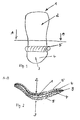
- Fig. 1 is an embodiment of an anatomically shaped blank 1 for illustrated orthopedic shoe insoles.
- the shape of the anatomically shaped Blank 1 is adapted to the natural shape of the foot, whereby the blank 1 is not extends over the entire foot surface. It extends from the heel of the foot to at the beginning of football, i.e. about two-thirds of the entire foot length.
- the anatomically shaped blank 1 has a sole facing the sole of the foot Surface 2 and a surface 3 facing towards the insole of the shoe. On there is an adhesive 4 on these surfaces, which is releasable Cover 5 is covered.
- the adhesive 4 and the coating 5 are on the entire surface facing the sole of the foot 2, 3.
- the outer contours of the anatomically shaped blank 1 are the outer contours of the foot customized.
- FIG. 2 shows a section through the anatomically shaped blank 1 according to FIG. 1 along the line A-A.
- the edge areas of the anatomically shaped blank 1 are thinner than the central areas.
- FIG 3 shows a shoe insert system according to the present invention.
- This The shoe insert system has a) an upper cover 7 and an unillustrated one Ceiling 8 each made of leather, b) with an anatomically shaped blank 1 peeled off cover and c) a pad 6, which in the area of the joints the toes are arranged.
- the shoe insert elements are not yet connected with each other.
- the anatomically shaped blank 1 points to it an adhesive 4 on the entire surface 2 facing the sole of the foot.
- the Adhesive 4 is completely covered with a releasable coating 5. Between there is the anatomically shaped blank 1 and the adhesive 4 Fleece 9 (not shown in this illustration, see Fig. 5).
- Blank 1 does not extend over the entire length of the foot, but about two thirds of the total Foot length, namely from the heel of the foot to the beginning of the ball of foot.
- the pad 6 is a foam rubber cushion.
- the top cover 7 consists of Cowhide and has no adhesive 4 on it extends over the entire Foot surface.
- the outer contours of the top cover 7 correspond essentially to that natural outer contours of a human foot.
- the false ceiling 8 exists made of leather and has essentially similar outer contours as the Blank 1. The false ceiling 8 does not therefore extend over the entire length of the foot, but over an area from the heel to the ball of the foot.
- the lower ceiling 8 and the upper ceiling 7 are larger than the blank 1, so that in the glued state an edge region not supported by the blank 10 is formed.
- the coatings 5 are removed from the blank 1 and from the false ceiling 8 and then the blank is subjected to a heat treatment. Then the Pad 6 in the manner shown in Fig. 3 on the blank 1 at the desired Positioned and pressed. The top cover 7 in the in Fig. 3 shown arrangement placed on the blank 1 and pressed. Then the lower blanket 8 is directed towards the sole of the shoe Surface 3 of the blank 1 applied. The one made in the way Shoe insert is immediately wearable.
- FIG. 4 shows the individual in the manner described above Orthopedic shoe insert elements.
- the Figure shows that the lower ceiling 8 and the upper ceiling 7 are larger than the blank 1, so that in the glued state a not through the blank 1 supported edge area 10 is formed. Lie in the hatched area 11 the top cover 7 and the bottom cover 8 directly on top of each other and are there glued together.
- the middle layer represents the anatomically shaped blank 1, on its surface facing the sole 2 the fleece 9 and the adhesive 4 applied to it are located.
- the Adhesive 4 On the Adhesive 4, the pad 6 and the top cover 7 are glued.
- the adhesive 4 On the for Shoe insole facing surface 3 of the anatomically shaped Blank 1 is the adhesive 4, by means of which the false ceiling 8 the blank was raised.
Landscapes
- Health & Medical Sciences (AREA)
- General Health & Medical Sciences (AREA)
- Public Health (AREA)
- Epidemiology (AREA)
- Engineering & Computer Science (AREA)
- Orthopedic Medicine & Surgery (AREA)
- Nursing (AREA)
- Biomedical Technology (AREA)
- Heart & Thoracic Surgery (AREA)
- Vascular Medicine (AREA)
- Life Sciences & Earth Sciences (AREA)
- Animal Behavior & Ethology (AREA)
- Veterinary Medicine (AREA)
- Footwear And Its Accessory, Manufacturing Method And Apparatuses (AREA)
- Pharmaceuticals Containing Other Organic And Inorganic Compounds (AREA)
Abstract
Description
- Fig. 1
- ein Ausführungsbeispiel eines anatomisch geformten Rohlings gemäß der vorliegenden Erfindung mit teilweise abgezogenem Überzug;
- Fig. 2
- einen Schnitt entlang der Linie A-A durch den anatomisch geformten Rohling gemäß Fig. 1;
- Fig. 3
- ein Schuheinlagensystem gemäß der vorliegenden Erfindung mit teilweise abgezogenem Überzug, bestehend aus a) Oberdecke, b) Rohling mit teilweise abgezogenem Überzug und c) Überzug und Pelotte;
- Fig. 4
- eine Draufsicht auf eine orthopädische Schuheinlage, welche aus einem in Fig. 3 dargestellten Schuheinlagensystem hergestellt ist; und
- Fig. 5
- einen Schnitt entlang der Linie A-A durch die in Fig. 4 dargestellte Schuheinlage.
Claims (21)
- Schuheinlage, insbesondere individuell anpaßbare orthopädische Schuheinlage, welche mindestens drei verbundene Schuheinlagenelemente in Form eines anatomisch geformten Rohlings (1), zumindest eines Deckelementes (7) und zumindest einer zwischen dem Rohling (1) und dem Deckelement (7) angeordnete Pelotte (6) aufweist, wobei zumindest eines der Schuheinlagenelemente zumindest im Bereich der Pelotte (6) ein Klebemittel (4) aufweist, welches die Schuheinlagenelemente lösbar verbindet.
- Schuheinlage nach Anspruch 1, bei welcher das Klebemittel (4) ein wiedererweichbarer Kleber, insbesondere ein Heißkleber (hot melt) oder ein Kautschukkleber, oder eine beidseitig klebende Selbstklebefolie ist.
- Verfahren zur Herstellung einer individuell angepaßten Schuheinlage nach einem der Ansprüche 1 bis 2, insbesondere einer orthopädischen Schuheinlage, welche einen Rohling, mindestens ein an einer Ober- oder Unterseite des Rohlings angebrachtes Deckelement und mindestens eine zwischen dem Rohling und einem Deckelement angeordnete Pelotte aufweist, wobei zumindest eines der Schuheinlagenelemente mit einem wiedererweichbaren Kleber beschichtet ist, wobei das Verfahren die folgenden Schritte umfaßt:derartiges Wärmebehandeln der zu einem Verbund zusammengefügten Schuheinlagenelemente, daß die Schuheinlagenelemente zumindest bereichsweise voneinander lösbar sind,Anordnen der gelösten Pelotte an einer individuell für einen Fuß eines Patienten zu orthopädischen Zwecken vorgesehenen Position auf dem Rohling, undZusammenfügen der Schuheinlagenelemente nach der Positionierung der Pelotte zu einem eine individuell angepaßte Schuheinlage bildenden Verbund.
- Verfahren nach Anspruch 3, wobei die Wärmebehandlung zum Lösen der den Verbund bildenden Schuheinlagenelemente bei einer Temperatur oberhalb 75 °C, insbesondere in einem Bereich von 75 bis 150 °C, insbesondere in einem Ofen oder unter einer Heizlampe durchgeführt wird.
- Schuheinlagensystem, insbesondere für orthopädische Schuheinlagen, welches mindestens zwei zu verbindende Schuheinlagenelemente in Form eines anatomisch geformten Rohlings (1) und zumindest eines Deckelementes (7, 8) aufweist, bei welchem zumindest auf eines der Schuheinlagenelemente ein Klebemittel (4) aufgebracht ist, mittels welchem die Schuheinlagenelemente tragfertig verbindbar sind, wobei das Klebemittel (4) zumindest bereichsweise mit einem lösbaren Überzug (5) abgedeckt ist.
- Schuheinlagensystem nach Anspruch 5, bei welchem das Klebemittel (4) ein wiedererweichbarer Kleber, insbesondere ein Heißkleber (hot melt) oder ein Kautschukkleber, oder eine beidseitig klebende Selbstklebefolie ist.
- Schuheinlagensystem nach Anspruch 5 oder 6, welches als weiteres Schuheinlagenelement eine Pelotte (6) aufweist, welche so ausgebildet ist, daß sie zwischen dem Rohling (1) und dem Deckelement (7, 8) anbringbar ist.
- Schuheinlagensystem nach einem der Ansprüche 5 bis 7, welches mindestens eine Oberdecke (7), welche mit einer zur Fußsohle hin gerichteten Oberfläche (2) des Rohlings (1) verbindbar ist, und mindestens eine Unterdecke (8) aufweist, welche mit einer zur Schuhinnensohle hin gerichteten Oberfläche (3) des Rohlings (1) verbindbar ist, wobei die Deckelemente (7, 8) insbesondere aus Leder oder Synthetik sind, und bei welchem die Unterdecke (8) und/oder die Oberdecke (7) größer ausgebildet sind als der anatomisch geformte Rohling (1), so daß im verklebten Zustand ein nicht durch den anatomisch geformten Rohling (1) gestützter Bereich (10) ausgebildet ist.
- Schuheinlagensystem nach einem der Ansprüche 5 bis 8, bei welchem sich das Klebemittel (4) auf dem Deckelement (7, 8) oder auf dem anatomisch geformten Rohling oder auf der Pelotte (6) befindet.
- Schuheinlagensystem nach einem der Ansprüche 5 bis 9, bei welchem der anatomisch geformte Rohling (1) auf seiner gesamten, zur Fußsohle hin gerichteten Oberfläche (2) und die Unterdecke (8) auf ihrer gesamten, zum anatomisch geformten Rohling (1) hin gerichteten Oberfläche Klebemittel (4) aufweist.
- Anatomisch geformter Rohling (1) für Schuheinlagen, insbesondere für idividuell anpaßbare orthopädische Schuheinlagen, welcher eine zur Fußsohle hin gerichtete Oberfläche (2) und eine zur Schuhinnensohle hin gerichtete Oberfläche (3) aufweist, bei welchem zumindest eine der Oberflächen (2, 3) ein wiedererweichbares Klebemittel (4) aufweist, welches zumindest bereichsweise mit einem lösbaren Überzug (5), insbesondere mit Silikonpapier, abgedeckt ist, und welcher so ausgebildet ist, daß Schuheinlagenelemente, insbesondere Pelotten (6) und Deckelemente (7, 8) tragfertig auf der zur Fußsohle hin gerichteten Oberfläche (2) und/oder auf der zur Schuhinnensohle hin gerichteten Oberfläche (3) nach Entfernen des Überzugs (5) und Wiedererweichen des Klebemittels (4) klebend befestigbar sind.
- Anatomisch geformter Rohling (1) nach Anspruch 11, bei welchem das Klebemittel (4) unter Wärmeeinfluß, insbesondere in einem Ofen oder unter einer Heizlampe, wiedererweichbar ist, und bei welchem das Klebemittel (4) insbesondere ein Heißkleber (hot melt) oder ein Kautschukkleber ist, welches durch Behandeln mit Wärme ein wiederholtes Aufbringen und Entfernen der Schuheinlagenelemente zur Anprobe erlaubt, wobei das Klebemittel (4) nach Entfernen der Schuheinlagenelemente am Rohling (1) verbleibt.
- Anatomisch geformter Rohling (1) für Schuheinlagen, insbesondere für individuell anpaßbare orthopädische Schuheinlagen, welcher eine zur Fußsohle hin gerichtete Oberfläche (2) und eine zur Schuhinnensohle hin gerichtete Oberfläche (3) aufweist, bei welchem zumindest eine der Oberflächen (2, 3) ein Klebemittel (4), insbesondere in Form einer beidseitig klebenden Selbstklebefolie, aufweist, welches zumindest bereichsweise mit einem lösbaren Überzug (5), insbesondere mit lösbarer Schutzfolie, abgedeckt ist, und mittels welchem Schuheinlagenelemente, insbesondere Pelotten (6) und Deckelemente (7, 8) tragfertig auf der zur Fußsohle hin gerichteten Oberfläche (2) und/oder auf der zur Schuhinnensohle hin gerichteten Oberfläche (3) nach Entfernen der Schutzfolie (5) selbstklebend befestigbar sind.
- Anatomisch geformter Rohling (1) nach Anspruch 13, bei welchem das Klebemittel (4) eine dünne, beidseitig klebende Selbstklebefolie ist, welche ein wiederholtes Aufbringen und Entfernen der Schuheinlagenelemente zur Anprobe erlaubt, wobei das Klebemittel (4) nach Entfernen der Schuheinlagenelemente am Rohling (1) verbleibt.
- Anatomisch geformter Rohling nach einem der Ansprüche 11 bis 14, bei welchem sich das Klebemittel (4) auf der gesamten zur Fußsohle hin gerichteten Oberfläche (2) und/oder auf der gesamten zur Schuhinnensohle hin gerichteten Oberfläche (3) befindet.
- Anatomisch geformter Rohling nach einem der Ansprüche 11 bis 15, bei welchem das Klebemittel (4) auf ein Vlies (9) aufgebracht ist.
- Verfahren zur Herstellung eines anatomisch geformten Rohlings (1) für individuell anpaßbare orthopädische Schuheinlagen, bei welchem der Rohling (1) durch Spritzgießen aus Kunststoff geformt und auf seiner zur Fußsohle hin gerichteten Oberfläche (2) und/oder auf seiner zur Schuhinnensohle hin gerichteten Oberfläche (3) ein zumindest bereichsweise mit einem Überzug (5) nach außen abgedecktes Klebemittel (4) aufgebracht wird.
- Verfahren nach Anspruch 17, bei welchem zwischen dem anatomisch geformten Rohling (1) und dem Klebemittel (4) ein Vlies (9) eingefügt wird.
- Verfahren nach Anspruch 17 oder 18, bei welchem nur auf der zur Fußsohle hin gerichteten Oberfläche (2) des anatomisch geformten Rohlings (1) das Klebemittel (4), und zwar auf der gesamten Oberfläche (2), aufgebracht wird.
- Verfahren nach einem der Ansprüche 17 bis 19, bei welchem das Klebemittel (4) wiedererweichbar ist und mit einer Walzenauftragsmaschine oder mit einer Sprühmaschine aufgebracht wird, und bei welchem das Klebemittel (4) mit Silikonpapier abgedeckt wird.
- Verfahren nach einem der Ansprüche 17 bis 19, bei welchem das Klebemittel (4) eine beidseitig klebende Selbstklebefolie ist und beim Spritzgießen aufgebracht wird und bei welchem die Selbstklebefolie mit einer Schutzfolie abgedeckt wird.
Priority Applications (1)
| Application Number | Priority Date | Filing Date | Title |
|---|---|---|---|
| DE20023245U DE20023245U1 (de) | 1999-01-20 | 2000-01-19 | Schuheinlagensystem |
Applications Claiming Priority (4)
| Application Number | Priority Date | Filing Date | Title |
|---|---|---|---|
| DE1999102147 DE19902147C2 (de) | 1999-01-20 | 1999-01-20 | Anatomisch deformter Rohling, Schuheinlagensystem und Verfahren zur Herstellung eines anatomisch geformten Rohlings |
| DE19902147 | 1999-01-20 | ||
| DE19944263A DE19944263C2 (de) | 1999-01-20 | 1999-09-15 | Anatomisch geformter Rohling, Schuheinlagensystem und Verfahren zu seiner Herstellung |
| DE19944263 | 1999-09-15 |
Publications (4)
| Publication Number | Publication Date |
|---|---|
| EP1021967A2 true EP1021967A2 (de) | 2000-07-26 |
| EP1021967A3 EP1021967A3 (de) | 2003-01-02 |
| EP1021967B1 EP1021967B1 (de) | 2004-08-25 |
| EP1021967B2 EP1021967B2 (de) | 2006-11-29 |
Family
ID=26051409
Family Applications (1)
| Application Number | Title | Priority Date | Filing Date |
|---|---|---|---|
| EP00100272A Expired - Lifetime EP1021967B2 (de) | 1999-01-20 | 2000-01-19 | Schuheinlagensystem |
Country Status (4)
| Country | Link |
|---|---|
| EP (1) | EP1021967B2 (de) |
| AT (1) | ATE274313T1 (de) |
| DE (2) | DE19944263C2 (de) |
| DK (1) | DK1021967T4 (de) |
Cited By (2)
| Publication number | Priority date | Publication date | Assignee | Title |
|---|---|---|---|---|
| FR2853224A1 (fr) * | 2003-04-02 | 2004-10-08 | Nathalie Palkowslki | Semelle orthopedique et son procede de realisation |
| WO2007025703A1 (de) * | 2005-08-28 | 2007-03-08 | Peter Lenhart | Fussbettstruktur, insbesondere schuheinlage und verfahren zur herstellung derselben |
Citations (1)
| Publication number | Priority date | Publication date | Assignee | Title |
|---|---|---|---|---|
| DE3114534A1 (de) | 1981-04-10 | 1982-10-28 | Perpedes-Fusstützen GmbH, 7000 Stuttgart | Verfahren zur herstellung einer schuheinlage, insbesondere einer orthopaedischen schuheinlage und eine nach diesem verfahren hergestellte schuheinlage |
Family Cites Families (15)
| Publication number | Priority date | Publication date | Assignee | Title |
|---|---|---|---|---|
| GB312124A (en) * | 1928-02-20 | 1929-05-21 | Alexander Eleazer Block | Improvements in or relating to foot-arch supports |
| AT136121B (de) † | 1931-09-02 | 1934-01-10 | Frei & Kasser A G | Schuheinlage. |
| US2409594A (en) † | 1944-07-11 | 1946-10-15 | Louis H Sherman | Method of forming pedal appliances |
| GB943674A (en) † | 1960-12-29 | 1963-12-04 | Kamborian Jacob S | Lasting shoes with polyester adhesives |
| US3265071A (en) * | 1964-04-30 | 1966-08-09 | Hapad Inc | Orthopedic pads |
| DE7622369U1 (de) * | 1976-07-15 | 1978-12-21 | Emsold-Gesellschaft Gert Helmers, 2902 Rastede | Einlegesohle |
| DE3506809A1 (de) * | 1985-02-27 | 1986-09-04 | Manfred 2081 Heist Koch | Schuheinlage |
| CA1277135C (fr) * | 1986-07-21 | 1990-12-04 | Pierre Charles Lepine | Semelle interieure reglable pour chaussure |
| DE3855432T2 (de) † | 1987-12-09 | 1997-02-06 | May Coating Technologies Inc | Spender für schmelzbare klebemittel |
| DE9101515U1 (de) * | 1991-02-09 | 1991-05-02 | Emsold-Gesellschaft Gert Helmers GmbH & Co KG, 2902 Rastede | Sohlenelement, vorzugsweise Schuheinlage oder Schuhsohlen-Einbauteil |
| DE4200362C2 (de) * | 1992-01-09 | 1994-06-09 | Bauerfeind Gmbh | Einlegesohle |
| DE19706808A1 (de) * | 1997-02-21 | 1998-08-27 | Harald Lodenkaemper | Schuheinlegesohle |
| DE29703056U1 (de) † | 1997-02-21 | 1997-07-10 | Lodenkämper, Harald, 24558 Henstedt-Ulzburg | Schuheinlegesohle |
| DE29810518U1 (de) * | 1998-06-04 | 1998-09-17 | Schelchen GmbH, 15711 Zeesen | Baukastensystem für eine Schuheinlage |
| DE10056908A1 (de) * | 2000-11-16 | 2002-05-23 | Merck Patent Gmbh | Verfahren zum Verbinden von Kunststoffteilen |
-
1999
- 1999-09-15 DE DE19944263A patent/DE19944263C2/de not_active Expired - Lifetime
-
2000
- 2000-01-19 EP EP00100272A patent/EP1021967B2/de not_active Expired - Lifetime
- 2000-01-19 DK DK00100272T patent/DK1021967T4/da active
- 2000-01-19 AT AT00100272T patent/ATE274313T1/de active
- 2000-01-19 DE DE50007526T patent/DE50007526D1/de not_active Expired - Lifetime
Patent Citations (1)
| Publication number | Priority date | Publication date | Assignee | Title |
|---|---|---|---|---|
| DE3114534A1 (de) | 1981-04-10 | 1982-10-28 | Perpedes-Fusstützen GmbH, 7000 Stuttgart | Verfahren zur herstellung einer schuheinlage, insbesondere einer orthopaedischen schuheinlage und eine nach diesem verfahren hergestellte schuheinlage |
Cited By (2)
| Publication number | Priority date | Publication date | Assignee | Title |
|---|---|---|---|---|
| FR2853224A1 (fr) * | 2003-04-02 | 2004-10-08 | Nathalie Palkowslki | Semelle orthopedique et son procede de realisation |
| WO2007025703A1 (de) * | 2005-08-28 | 2007-03-08 | Peter Lenhart | Fussbettstruktur, insbesondere schuheinlage und verfahren zur herstellung derselben |
Also Published As
| Publication number | Publication date |
|---|---|
| EP1021967A3 (de) | 2003-01-02 |
| DE19944263C2 (de) | 2001-12-06 |
| DK1021967T4 (da) | 2007-04-10 |
| ATE274313T1 (de) | 2004-09-15 |
| DE50007526D1 (de) | 2004-09-30 |
| EP1021967B1 (de) | 2004-08-25 |
| DE19944263A1 (de) | 2001-03-29 |
| EP1021967B2 (de) | 2006-11-29 |
| DK1021967T3 (da) | 2005-01-03 |
Similar Documents
| Publication | Publication Date | Title |
|---|---|---|
| EP1090563B1 (de) | Orthopädische Schuheinlage | |
| EP2575525B1 (de) | Vorrichtung und verfahren zum anpassen eines schuhs | |
| DE2516945A1 (de) | Formbare orthopaedische vorrichtung | |
| AT512305B1 (de) | Vorrichtung und Verfahren zur Herstellung einer an einen Fuß bzw. ein Bein eines Benutzers angepassten Schale eines Schischuhs | |
| DE102010060419B4 (de) | Einlage mit sensomotorischen Stimulationselementen | |
| EP3708018B1 (de) | Schuheinlegesohlen-rohling und verfahren zum individuellen anpassen eines solchen schuheinlegesohlen-rohlings | |
| DE102010015145B4 (de) | Thermoplastisch verformbare Schuheinlegesohle | |
| DE69117183T2 (de) | Therapeutisches hilfsmittel, insbesondere plattfusseinlage | |
| EP1021967B1 (de) | Schuheinlagensystem | |
| EP0264898A2 (de) | Verfahren zum Herstellen eines Schuhes | |
| DE102005017100A1 (de) | Vorrichtung und Verfahren zum orthopädischen Zurichten von Schuhwerk | |
| DE69807328T2 (de) | Rüstelement für ein körperteil, das dessen komfort verbessert und/oder eine stützfunktion erfüllt, insbesondere ein innenschuh | |
| EP0468351B1 (de) | Orthopädische Therapie-Schuhe und -Innenschuhe | |
| DE60311880T2 (de) | Verfahren zum herstellen von schuhen | |
| EP2636327B1 (de) | Schuhsohlenkunststoff | |
| DE19902147C2 (de) | Anatomisch deformter Rohling, Schuheinlagensystem und Verfahren zur Herstellung eines anatomisch geformten Rohlings | |
| DE4224827C2 (de) | Verfahren zur Herstellung eines Abdruckes eines Teiles des menschlichen oder tierischen Körpers | |
| DE20023245U1 (de) | Schuheinlagensystem | |
| AT518404B1 (de) | Vorrichtung zur Herstellung einer an einen Fuß bzw. ein Bein eines Benutzers bereichsweise angepassten Schale | |
| DE3614064A1 (de) | Daempfungskoerper | |
| DE10102345C1 (de) | Deckelement und Modulsystem zur Herstellung von Schuheinlagen | |
| EP4070681B1 (de) | Orthopädischer schuheinlegesohlenrohling | |
| DE102009015630B4 (de) | Hufbelagbefestigung | |
| DE10148621B4 (de) | Innenschuh für Skischuhe oder dergleichen sowie Grundmaterial dafür | |
| DE102017217557A1 (de) | Orthopädisches Produkt und Verfahren zur Herstellung eines orthopädischen Produkts |
Legal Events
| Date | Code | Title | Description |
|---|---|---|---|
| PUAI | Public reference made under article 153(3) epc to a published international application that has entered the european phase |
Free format text: ORIGINAL CODE: 0009012 |
|
| AK | Designated contracting states |
Kind code of ref document: A2 Designated state(s): AT BE CH CY DE DK ES FI FR GB GR IE IT LI LU MC NL PT SE |
|
| AX | Request for extension of the european patent |
Free format text: AL;LT;LV;MK;RO;SI |
|
| PUAL | Search report despatched |
Free format text: ORIGINAL CODE: 0009013 |
|
| AK | Designated contracting states |
Kind code of ref document: A3 Designated state(s): AT BE CH CY DE DK ES FI FR GB GR IE IT LI LU MC NL PT SE |
|
| AX | Request for extension of the european patent |
Free format text: AL;LT;LV;MK;RO;SI |
|
| 17P | Request for examination filed |
Effective date: 20030611 |
|
| AKX | Designation fees paid |
Designated state(s): AT BE CH CY DE DK ES FI FR GB GR IE IT LI LU MC NL PT SE |
|
| 17Q | First examination report despatched |
Effective date: 20030908 |
|
| GRAP | Despatch of communication of intention to grant a patent |
Free format text: ORIGINAL CODE: EPIDOSNIGR1 |
|
| GRAS | Grant fee paid |
Free format text: ORIGINAL CODE: EPIDOSNIGR3 |
|
| GRAA | (expected) grant |
Free format text: ORIGINAL CODE: 0009210 |
|
| TPAC | Observations filed by third parties |
Free format text: ORIGINAL CODE: EPIDOSNTIPA |
|
| AK | Designated contracting states |
Kind code of ref document: B1 Designated state(s): AT BE CH CY DE DK ES FI FR GB GR IE IT LI LU MC NL PT SE |
|
| PG25 | Lapsed in a contracting state [announced via postgrant information from national office to epo] |
Ref country code: IE Free format text: LAPSE BECAUSE OF FAILURE TO SUBMIT A TRANSLATION OF THE DESCRIPTION OR TO PAY THE FEE WITHIN THE PRESCRIBED TIME-LIMIT Effective date: 20040825 Ref country code: IT Free format text: LAPSE BECAUSE OF FAILURE TO SUBMIT A TRANSLATION OF THE DESCRIPTION OR TO PAY THE FEE WITHIN THE PRESCRIBED TIME-LIMIT;WARNING: LAPSES OF ITALIAN PATENTS WITH EFFECTIVE DATE BEFORE 2007 MAY HAVE OCCURRED AT ANY TIME BEFORE 2007. THE CORRECT EFFECTIVE DATE MAY BE DIFFERENT FROM THE ONE RECORDED. Effective date: 20040825 Ref country code: FI Free format text: LAPSE BECAUSE OF FAILURE TO SUBMIT A TRANSLATION OF THE DESCRIPTION OR TO PAY THE FEE WITHIN THE PRESCRIBED TIME-LIMIT Effective date: 20040825 |
|
| REG | Reference to a national code |
Ref country code: GB Ref legal event code: FG4D Free format text: NOT ENGLISH |
|
| REG | Reference to a national code |
Ref country code: CH Ref legal event code: EP |
|
| REG | Reference to a national code |
Ref country code: IE Ref legal event code: FG4D Free format text: GERMAN |
|
| REF | Corresponds to: |
Ref document number: 50007526 Country of ref document: DE Date of ref document: 20040930 Kind code of ref document: P |
|
| PG25 | Lapsed in a contracting state [announced via postgrant information from national office to epo] |
Ref country code: SE Free format text: LAPSE BECAUSE OF FAILURE TO SUBMIT A TRANSLATION OF THE DESCRIPTION OR TO PAY THE FEE WITHIN THE PRESCRIBED TIME-LIMIT Effective date: 20041125 Ref country code: GR Free format text: LAPSE BECAUSE OF FAILURE TO SUBMIT A TRANSLATION OF THE DESCRIPTION OR TO PAY THE FEE WITHIN THE PRESCRIBED TIME-LIMIT Effective date: 20041125 |
|
| PG25 | Lapsed in a contracting state [announced via postgrant information from national office to epo] |
Ref country code: ES Free format text: LAPSE BECAUSE OF FAILURE TO SUBMIT A TRANSLATION OF THE DESCRIPTION OR TO PAY THE FEE WITHIN THE PRESCRIBED TIME-LIMIT Effective date: 20041206 |
|
| REG | Reference to a national code |
Ref country code: DK Ref legal event code: T3 |
|
| GBT | Gb: translation of ep patent filed (gb section 77(6)(a)/1977) | ||
| PG25 | Lapsed in a contracting state [announced via postgrant information from national office to epo] |
Ref country code: LU Free format text: LAPSE BECAUSE OF NON-PAYMENT OF DUE FEES Effective date: 20050119 Ref country code: CY Free format text: LAPSE BECAUSE OF FAILURE TO SUBMIT A TRANSLATION OF THE DESCRIPTION OR TO PAY THE FEE WITHIN THE PRESCRIBED TIME-LIMIT Effective date: 20050119 |
|
| PG25 | Lapsed in a contracting state [announced via postgrant information from national office to epo] |
Ref country code: CH Free format text: LAPSE BECAUSE OF NON-PAYMENT OF DUE FEES Effective date: 20050131 Ref country code: MC Free format text: LAPSE BECAUSE OF NON-PAYMENT OF DUE FEES Effective date: 20050131 Ref country code: LI Free format text: LAPSE BECAUSE OF NON-PAYMENT OF DUE FEES Effective date: 20050131 |
|
| REG | Reference to a national code |
Ref country code: IE Ref legal event code: FD4D |
|
| PLAQ | Examination of admissibility of opposition: information related to despatch of communication + time limit deleted |
Free format text: ORIGINAL CODE: EPIDOSDOPE2 |
|
| PLBQ | Unpublished change to opponent data |
Free format text: ORIGINAL CODE: EPIDOS OPPO |
|
| PLBI | Opposition filed |
Free format text: ORIGINAL CODE: 0009260 |
|
| PLAQ | Examination of admissibility of opposition: information related to despatch of communication + time limit deleted |
Free format text: ORIGINAL CODE: EPIDOSDOPE2 |
|
| PLAR | Examination of admissibility of opposition: information related to receipt of reply deleted |
Free format text: ORIGINAL CODE: EPIDOSDOPE4 |
|
| PLBQ | Unpublished change to opponent data |
Free format text: ORIGINAL CODE: EPIDOS OPPO |
|
| PLAB | Opposition data, opponent's data or that of the opponent's representative modified |
Free format text: ORIGINAL CODE: 0009299OPPO |
|
| PLAX | Notice of opposition and request to file observation + time limit sent |
Free format text: ORIGINAL CODE: EPIDOSNOBS2 |
|
| 26 | Opposition filed |
Opponent name: SCHELCHEN GMBH Effective date: 20050518 |
|
| ET | Fr: translation filed | ||
| R26 | Opposition filed (corrected) |
Opponent name: SCHELCHEN GMBH Effective date: 20050518 |
|
| NLR1 | Nl: opposition has been filed with the epo |
Opponent name: SCHELCHEN GMBH |
|
| REG | Reference to a national code |
Ref country code: CH Ref legal event code: PL |
|
| PLBB | Reply of patent proprietor to notice(s) of opposition received |
Free format text: ORIGINAL CODE: EPIDOSNOBS3 |
|
| PLBP | Opposition withdrawn |
Free format text: ORIGINAL CODE: 0009264 |
|
| PUAH | Patent maintained in amended form |
Free format text: ORIGINAL CODE: 0009272 |
|
| STAA | Information on the status of an ep patent application or granted ep patent |
Free format text: STATUS: PATENT MAINTAINED AS AMENDED |
|
| 27A | Patent maintained in amended form |
Effective date: 20061129 |
|
| AK | Designated contracting states |
Kind code of ref document: B2 Designated state(s): AT BE CH CY DE DK ES FI FR GB GR IE IT LI LU MC NL PT SE |
|
| REG | Reference to a national code |
Ref country code: ES Ref legal event code: FD2A Effective date: 20050120 |
|
| NLR2 | Nl: decision of opposition |
Effective date: 20061129 |
|
| GBTA | Gb: translation of amended ep patent filed (gb section 77(6)(b)/1977) | ||
| REG | Reference to a national code |
Ref country code: DK Ref legal event code: T4 |
|
| NLR3 | Nl: receipt of modified translations in the netherlands language after an opposition procedure | ||
| ET3 | Fr: translation filed ** decision concerning opposition | ||
| PG25 | Lapsed in a contracting state [announced via postgrant information from national office to epo] |
Ref country code: PT Free format text: LAPSE BECAUSE OF NON-PAYMENT OF DUE FEES Effective date: 20050125 |
|
| REG | Reference to a national code |
Ref country code: FR Ref legal event code: PLFP Year of fee payment: 17 |
|
| REG | Reference to a national code |
Ref country code: FR Ref legal event code: PLFP Year of fee payment: 18 |
|
| REG | Reference to a national code |
Ref country code: FR Ref legal event code: PLFP Year of fee payment: 19 |
|
| PGFP | Annual fee paid to national office [announced via postgrant information from national office to epo] |
Ref country code: DE Payment date: 20190327 Year of fee payment: 20 Ref country code: NL Payment date: 20190129 Year of fee payment: 20 Ref country code: GB Payment date: 20190221 Year of fee payment: 20 Ref country code: FR Payment date: 20190130 Year of fee payment: 20 |
|
| PGFP | Annual fee paid to national office [announced via postgrant information from national office to epo] |
Ref country code: DK Payment date: 20190129 Year of fee payment: 20 Ref country code: AT Payment date: 20190129 Year of fee payment: 20 Ref country code: BE Payment date: 20190129 Year of fee payment: 20 |
|
| REG | Reference to a national code |
Ref country code: DE Ref legal event code: R071 Ref document number: 50007526 Country of ref document: DE |
|
| REG | Reference to a national code |
Ref country code: DK Ref legal event code: EUP Effective date: 20200119 |
|
| REG | Reference to a national code |
Ref country code: NL Ref legal event code: MK Effective date: 20200118 |
|
| REG | Reference to a national code |
Ref country code: GB Ref legal event code: PE20 Expiry date: 20200118 |
|
| REG | Reference to a national code |
Ref country code: AT Ref legal event code: MK07 Ref document number: 274313 Country of ref document: AT Kind code of ref document: T Effective date: 20200119 |
|
| REG | Reference to a national code |
Ref country code: BE Ref legal event code: MK Effective date: 20200119 |
|
| PG25 | Lapsed in a contracting state [announced via postgrant information from national office to epo] |
Ref country code: GB Free format text: LAPSE BECAUSE OF EXPIRATION OF PROTECTION Effective date: 20200118 |