EP1022703B1 - Procédé d'aménagement des flux de circulation pour un contôle optimisé du trafic, de même la planification des réseaux routiers en fonction des besoins - Google Patents
Procédé d'aménagement des flux de circulation pour un contôle optimisé du trafic, de même la planification des réseaux routiers en fonction des besoins Download PDFInfo
- Publication number
- EP1022703B1 EP1022703B1 EP00100862A EP00100862A EP1022703B1 EP 1022703 B1 EP1022703 B1 EP 1022703B1 EP 00100862 A EP00100862 A EP 00100862A EP 00100862 A EP00100862 A EP 00100862A EP 1022703 B1 EP1022703 B1 EP 1022703B1
- Authority
- EP
- European Patent Office
- Prior art keywords
- traffic
- analysis
- vehicles
- identification
- section
- Prior art date
- Legal status (The legal status is an assumption and is not a legal conclusion. Google has not performed a legal analysis and makes no representation as to the accuracy of the status listed.)
- Expired - Lifetime
Links
- 238000000034 method Methods 0.000 title claims description 32
- 238000004458 analytical method Methods 0.000 claims abstract description 20
- 238000005206 flow analysis Methods 0.000 claims abstract description 4
- 238000011156 evaluation Methods 0.000 claims description 12
- 230000003287 optical effect Effects 0.000 claims description 8
- 238000004088 simulation Methods 0.000 claims description 6
- 238000010972 statistical evaluation Methods 0.000 claims description 5
- 238000012854 evaluation process Methods 0.000 claims description 2
- 230000007787 long-term memory Effects 0.000 claims description 2
- 238000005259 measurement Methods 0.000 claims description 2
- 230000007246 mechanism Effects 0.000 claims description 2
- 230000015654 memory Effects 0.000 claims description 2
- 230000000007 visual effect Effects 0.000 claims 2
- 238000003909 pattern recognition Methods 0.000 claims 1
- 238000001514 detection method Methods 0.000 description 11
- 230000006399 behavior Effects 0.000 description 4
- 238000005457 optimization Methods 0.000 description 4
- 230000001133 acceleration Effects 0.000 description 1
- 230000000903 blocking effect Effects 0.000 description 1
- 230000015556 catabolic process Effects 0.000 description 1
- 238000010276 construction Methods 0.000 description 1
- 238000006731 degradation reaction Methods 0.000 description 1
- 238000013461 design Methods 0.000 description 1
- 238000011161 development Methods 0.000 description 1
- 238000009434 installation Methods 0.000 description 1
- 238000012544 monitoring process Methods 0.000 description 1
- 238000012567 pattern recognition method Methods 0.000 description 1
- 230000001953 sensory effect Effects 0.000 description 1
- 238000011895 specific detection Methods 0.000 description 1
- 230000036962 time dependent Effects 0.000 description 1
Images


Classifications
-
- G—PHYSICS
- G08—SIGNALLING
- G08G—TRAFFIC CONTROL SYSTEMS
- G08G1/00—Traffic control systems for road vehicles
- G08G1/01—Detecting movement of traffic to be counted or controlled
- G08G1/0104—Measuring and analyzing of parameters relative to traffic conditions
-
- G—PHYSICS
- G08—SIGNALLING
- G08G—TRAFFIC CONTROL SYSTEMS
- G08G1/00—Traffic control systems for road vehicles
- G08G1/01—Detecting movement of traffic to be counted or controlled
- G08G1/04—Detecting movement of traffic to be counted or controlled using optical or ultrasonic detectors
Definitions
- the invention relates to a method for the analysis of traffic flows for optimized traffic flow control and for the demand-oriented planning of road traffic networks, according to the preamble of patent claim 1.
- the traffic flow analysis as a basis for traffic flow control and route planning is sometimes created by means of counting procedures.
- all vehicles of the traffic sections in question are usually counted manually during the period under consideration. This gives an indication of the time-dependent traffic density and accordingly any need for roadway construction.
- the method finds its limits in the detection of more complex dependencies, for example in the intersection area.
- this method is not usable if, for example, the distances are too large and unmanageable, more frequent lane changes of vehicles present and also high vehicle speeds and high traffic levels are present.
- This is shown by way of example in FIG.
- a multi-lane motorway contains in a relatively short sequence three junctions a, b and c and three departures d, e and f.
- the traffic density could be recorded in all directions by manual or automatic counting of the passing vehicles, the actual cause of the congestion can not be determined, since this method makes no statement as to which traffic flows lead to which shares.
- a possible Extension of the motorway by another lane brings in the considered case no remedy if a high statistical traffic mix is present on all entrances and exits.
- the cause of congestion is then often in the mutual blocking of the vehicles at times mandatory or supposedly advantageous lane change, the theoretical throughput limit of the respective lanes and the arrivals and departures is far from achieved.
- the remedy of the traffic problem could exist in an additional connection ae (bypass) between the traffic routes a and e, as shown in FIG.
- ae bypass
- the complex analysis and traffic optimization in such cases for the aforementioned reasons is not possible, which can be seen from the daily situation on the highways. This situation is to be remedied by the present invention.
- US-A-5 801 943 discloses a method of traffic monitoring and simulation of a road network in which a plurality of vehicles moving in the road network are detected by intelligent sensors. The recorded vehicles are tracked individually and recorded their driving behavior. Based on this vehicle data is a traffic forecast, which is constantly checked by the actual movement of vehicles and corrected if necessary. The focus of this method is clearly on a simulation of traffic flow. To check the simulation results, it is sufficient to detect the driving behavior and the route of several vehicles by means of sensors. Not all vehicles are registered.
- the present invention has for its object to propose a method on the basis of an automatic analysis of complex traffic flows for the purpose of optimized traffic flow control and needs-based planning of road networks is possible.
- the inventive method is based on a comprehensive sensory detection of a traffic section or observation area to be considered, at least one detection at all arrival and access points of the traffic section, as well as on a vehicle-specific detection and traffic tracking and an automatic traffic analysis.
- a comprehensive sensory detection of a traffic section or observation area to be considered at least one detection at all arrival and access points of the traffic section, as well as on a vehicle-specific detection and traffic tracking and an automatic traffic analysis.
- Of primary interest here is the statistical distribution of traffic flows with regard to origin and destination of all individual vehicles, but also the statistical one Evaluation of lane change processes.
- a computer-aided traffic simulation with optimization and subsequent actual traffic route optimization can be carried out in the further development process.
- the method requires the at least temporary installation of preferably optical sensors on all lanes, preferably at the boundaries of the viewing area and for tracking changes at accordingly interesting points within the viewing area, with a sufficiently reliable vehicle identification for statistical evaluation by reproducible criteria, such as the evaluation of the plate , or an alternative vehicle analysis according to size, color, number and characteristics of recognizable persons, noise behavior, or electronic detection mechanisms (eg responders) for the identification of vehicles or the like.
- vehicle identification for statistical evaluation by reproducible criteria, such as the evaluation of the plate , or an alternative vehicle analysis according to size, color, number and characteristics of recognizable persons, noise behavior, or electronic detection mechanisms (eg responders) for the identification of vehicles or the like.
- the description / identification of the vehicles preferably takes place by means of parameter sets assigned to the optical criteria.
- a direct allocation and expansion of the local movement profile of the vehicles to already stored data sets of other measurement stations is provided, whereby a station independent superordinate evaluation process allows a permanent statistical evaluation of the complex traffic flow with all desired parameters and at least the analyzed values for be stored later in subsequent storage and use in resistant memory devices.
- Another embodiment of the invention provides that statistical traffic flow data are saved in a long-term memory in such a way that they can be used for later computer-aided simulation of alternative traffic flow guidance models or modified traffic route guidance Optimization of the traffic flow in the traffic section / viewing area are usable.
- the process of vehicle identification by a method of permanent gapless vehicle tracking - by means of a software procedure based on pattern recognition methods - takes place in the entire traffic section / observation area, in which case the entire observation area is completely covered with corresponding sensors, e.g. optical sensors, and the collected data for evaluation and analysis to a common gapless record, e.g. an overall entry screen, for subsequent evaluation.
- sensors e.g. optical sensors
- FIGS. 1 and 2 have already been described in the introductory part, with a further example of a traffic section according to FIG. 1 being assumed.
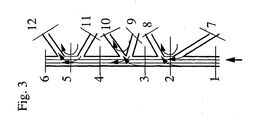
- Fig. 3 shows the preferred analysis positions in the considered traffic section, ie the preferred arrangement of the detection sensors here continuously with the numbers 1 - 12 marked.
- the detection sensors are arranged primarily at the entrances and exits of the traffic section and on the main route between the entrances and exits.
- an analysis of the passing vehicles is carried out first, wherein the detection system of all access points 1, 7, 9 and 11, the task of identification as well as the identification and temporary storage of vehicles in a database including additional required parameters, such as Time, speed, lane, location, relative position to other vehicles etc.
- a statistical evaluation of the traffic situation can take place permanently during operation (online), with a corresponding traffic profile over the time axis being able to be used as an evaluation criterion for, for example, a time-controlled traffic flow control for further analysis.
- the arrangement of the preferably optical sensors 1-12 for example, on temporarily or permanently installed mounting bridges or poles in a corresponding height across the road, or for example with a corresponding speed limit between the lanes - but here with appropriate traffic degradation - done. If only one or two lanes are present, an arrangement of the sensors on the roadside is possible.
- Additional criteria such as the position between other stored vehicles can be used for detection.
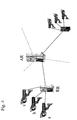
- Fig. 4 shows an example of decentralized data acquisition by means of optical sensors, e.g.
- a data acquisition computer acquires all possibly required track sensors (a, b, c) of a respective observation position and preprocesses the data in such a way that each detected vehicle is described individually with a defined parameter set that is identical for all data acquisition computers. which is then transmitted together with the required location and time-specific traffic flow parameters to the central evaluation or analysis computer (AR).
- AR central evaluation or analysis computer
- the storage and allocation, as well as the statistical evaluation of all data then takes place in the central evaluation or analysis computer.
- a method with object-related tracking of all vehicles is possible in the event that the entire observation area is monitored in closed form, so that there are no gaps in the vehicle tracking for an example based on optical detection analysis system.
Landscapes
- Physics & Mathematics (AREA)
- General Physics & Mathematics (AREA)
- Chemical & Material Sciences (AREA)
- Analytical Chemistry (AREA)
- Traffic Control Systems (AREA)
Claims (7)
- Procédé d'analyse de flux de circulation pour le contrôle optimisé du flux de circulation et pour la planification de réseaux routiers en fonction des besoins, selon lequel un tronçon de trafic à considérer ou une zone d'observation est équipé, au moins à tous les points d'entrée et de sortie importants (a, b, c ou d, e, f), de dispositifs de détection appropriés (1-12) à l'aide desquels des véhicules sont détectés individuellement comme tels de manière reproductible et sont mis en mémoire à l'aide d'un code d'identification approprié, avec un profil de déplacement associé, sous forme d'enregistrement logique dans un calculateur d'analyse ou sont reconnus par celui-ci dans le cas d'enregistrements logiques déjà stockés, ces enregistrements logiques étant complétés par le profil de déplacement actuel des véhicules concernés, ce qui permet une analyse de flux de circulation complexe dans le tronçon de circulation ou la zone d'observation concerné,
caractérisé en ce que les dispositifs de détection (1, 12) sont disposés aux entrées et sorties du tronçon de circulation et sur le tronçon principal situé entre celles-ci,
en ce qu'une analyse des véhicules qui passent a lieu tout d'abord au niveau de chaque dispositif de détection individuel,
les dispositifs de détection de tous les points d'accès (1, 7, 9, 11) ayant pour rôle d'identifier et, en plus de cela, de mettre temporairement en mémoire les véhicules dans une base de données, avec des paramètres nécessaires en supplément,
et au niveau de tous les autres points de détection (2-6, 8, 10, 12) a lieu, après chaque détection et selon un procédé et une affectation des paramètres d'identification correspondants, une recherche de l'objet correspondant dans l'enregistrement logique stocké de la mémoire centrale, ainsi que l'inscription supplémentaire de toutes les nouvelles données relevant du déplacement, pour chaque objet. - Procédé selon la revendication 1, caractérisé en ce que pour une analyse du flux de circulation à l'intérieur du tronçon de circulation/de la zone d'observation, des dispositifs de détection sont aussi prévus au niveau d'autres points importants pour l'analyse.
- Procédé selon la revendication 1 ou 2,
caractérisé en ce qu'on utilise comme dispositifs de détection des capteurs optiques sous forme de caméras et/ou de détecteurs à infrarouge. - Procédé selon l'une au moins des revendications précédentes, caractérisé en ce que la reconnaissance et l'identification des véhicules dans le tronçon de circulation/la zone d'observation se fait de manière reproductible avec une fiabilité suffisante, au cours de la mesure globale, en étant basées sur une reconnaissance de la plaque d'immatriculation du véhicule et/ou sur d'autres caractéristiques optiques du véhicule et/ou sur des mécanismes de reconnaissance électroniques, la description/identification des véhicules se faisant à l'aide d'ensembles de paramètres affectés aux critères optiques/électroniques reconnus.
- Procédé selon l'une au moins des revendications précédentes, caractérisé en ce qu'il est prévu une affectation et une extension directes du profil de déplacement local des véhicules à des enregistrements logiques, déjà mis en mémoire, d'autres dispositifs de détection, un processus d'évaluation prioritaire indépendant de ces derniers permettant une évaluation statistique permanente du déroulement de circulation complexe avec tous les paramètres voulus, et au moins les valeurs analysées sont mises en mémoire en vue d'une observation et d'une utilisation ultérieures dans des dispositifs de stockage résistants.
- Procédé selon l'une au moins des revendications précédentes, caractérisé en ce qu'au moins des données statistiques de flux de circulation sont sauvegardées dans une mémoire à long terme de manière à pouvoir être utilisées pour une simulation assistée par ordinateur ultérieure d'autres modèles d'orientation de flux de circulation ou d'un guidage modifié, en vue d'optimiser le flux de circulation dans le tronçon de circulation/la zone d'observation.
- Procédé selon l'une au moins des revendications précédentes, caractérisé en ce que le processus d'identification de véhicules a lieu dans tout le tronçon de trafic/la zone d'observation considéré grâce à un procédé de suivi de véhicules permanent et ininterrompu à l'aide d'une procédure de logiciel basée sur des procédés de reconnaissance de modèles, tout le tronçon de trafic/la zone d'observation étant détecté de manière ininterrompue à l'aide de dispositifs de détection, et les données recueillies destinées à être évaluées et analysées sont réunies en un enregistrement logique commun ininterrompu en vue d'être analysées ensuite.
Applications Claiming Priority (2)
| Application Number | Priority Date | Filing Date | Title |
|---|---|---|---|
| DE19902365A DE19902365A1 (de) | 1999-01-21 | 1999-01-21 | Verfahren zur Analyse von Verkehrsflüssen zur optimierten Verkehrsflußsteuerung sowie zur bedarfsgerechten Planung von Straßenverkehrsnetzen |
| DE19902365 | 1999-01-21 |
Publications (3)
| Publication Number | Publication Date |
|---|---|
| EP1022703A2 EP1022703A2 (fr) | 2000-07-26 |
| EP1022703A3 EP1022703A3 (fr) | 2002-10-02 |
| EP1022703B1 true EP1022703B1 (fr) | 2006-08-23 |
Family
ID=7894995
Family Applications (1)
| Application Number | Title | Priority Date | Filing Date |
|---|---|---|---|
| EP00100862A Expired - Lifetime EP1022703B1 (fr) | 1999-01-21 | 2000-01-18 | Procédé d'aménagement des flux de circulation pour un contôle optimisé du trafic, de même la planification des réseaux routiers en fonction des besoins |
Country Status (3)
| Country | Link |
|---|---|
| EP (1) | EP1022703B1 (fr) |
| AT (1) | ATE337594T1 (fr) |
| DE (2) | DE19902365A1 (fr) |
Cited By (1)
| Publication number | Priority date | Publication date | Assignee | Title |
|---|---|---|---|---|
| DE202008003979U1 (de) | 2008-03-20 | 2008-06-26 | Fraas, Alfred, Dipl.-Ing. | Messsystem für die Verkehrsstromanalyse |
Families Citing this family (5)
| Publication number | Priority date | Publication date | Assignee | Title |
|---|---|---|---|---|
| DE102006046063B4 (de) * | 2006-09-27 | 2010-07-22 | Deutsches Zentrum für Luft- und Raumfahrt e.V. | Verfahren und System zur Erfassung von Vehikelbewegungen |
| FR2922347B1 (fr) * | 2007-10-11 | 2010-10-15 | Bouchaib Hoummady | Procede et dispositif de gestion dynamique de guidage et de la mobilite dans le trafic par la prise en compte de l'occupation au sol par les vehicules de l'espace de circulation |
| WO2010119182A1 (fr) * | 2009-04-14 | 2010-10-21 | Bouchaib Hoummady | Procédé et dispositif dynamique de guidage et de la mobilité dans le trafic |
| DE102014019106B4 (de) * | 2014-12-19 | 2023-06-29 | Audi Ag | Verfahren zum Betrieb eines Fahrzeugsystems zur Auswahl einer Fahrspur und Kraftfahrzeug |
| CN118158249B (zh) * | 2024-03-11 | 2025-01-07 | 湖北华中电力科技开发有限责任公司 | 物联网数据处理方法、相关装置、计算设备及存储介质 |
Family Cites Families (1)
| Publication number | Priority date | Publication date | Assignee | Title |
|---|---|---|---|---|
| US5801943A (en) * | 1993-07-23 | 1998-09-01 | Condition Monitoring Systems | Traffic surveillance and simulation apparatus |
-
1999
- 1999-01-21 DE DE19902365A patent/DE19902365A1/de not_active Withdrawn
-
2000
- 2000-01-18 DE DE50013340T patent/DE50013340D1/de not_active Expired - Lifetime
- 2000-01-18 EP EP00100862A patent/EP1022703B1/fr not_active Expired - Lifetime
- 2000-01-18 AT AT00100862T patent/ATE337594T1/de active
Cited By (2)
| Publication number | Priority date | Publication date | Assignee | Title |
|---|---|---|---|---|
| DE202008003979U1 (de) | 2008-03-20 | 2008-06-26 | Fraas, Alfred, Dipl.-Ing. | Messsystem für die Verkehrsstromanalyse |
| DE102009013841A1 (de) | 2008-03-20 | 2009-09-24 | Fraas, Alfred | Messsystem für die Verkehrsstromanalyse |
Also Published As
| Publication number | Publication date |
|---|---|
| DE50013340D1 (de) | 2006-10-05 |
| DE19902365A1 (de) | 2000-07-27 |
| EP1022703A3 (fr) | 2002-10-02 |
| ATE337594T1 (de) | 2006-09-15 |
| EP1022703A2 (fr) | 2000-07-26 |
Similar Documents
| Publication | Publication Date | Title |
|---|---|---|
| EP0789341B1 (fr) | Détection de bouchon de circulation embarquée dans le véhicule | |
| EP1298620B1 (fr) | Système de commande pour dispositif lumineux de signalisation d'un carrefour | |
| DE102006034999A1 (de) | Strassenkarten-Verwaltungssystem | |
| DE112019000714T5 (de) | Glasfasererfassung zur autobahninstandhaltung | |
| DE102012219849A1 (de) | Intelligentes Mautnetzwerk zur Verbesserung der Leistung von Fahrzeugidentifikationssystemen | |
| DE102015212027A1 (de) | Verfahren und Vorrichtung zum automatischen Ermitteln von Verkehrsregelungen an Straßenkreuzungen | |
| DE102007056225A1 (de) | Verfahren und Vorrichtung zum Steuern eines Verkehrsflusses an einer Kreuzung | |
| DE102008003039A1 (de) | Verfahren zur Verkehrszustandsbestimmung in einem Fahrzeug | |
| EP3621052A1 (fr) | Procédé d'analyse du comportement routier de véhicules à moteur, dont de véhicules autonomes | |
| WO2024002589A1 (fr) | Procédé de détermination et de fourniture de tracés de voies | |
| EP4222725B1 (fr) | Procédé pour fournir un dégagement pour l'utilisation d'une bande d'arrêt d'urgence au moyen d'un système de surveillance, et système de surveillance | |
| EP1022703B1 (fr) | Procédé d'aménagement des flux de circulation pour un contôle optimisé du trafic, de même la planification des réseaux routiers en fonction des besoins | |
| EP1245017B1 (fr) | Procede pour decrire et produire des reseaux routiers et reseau routier correspondant | |
| EP3688659A1 (fr) | Procédé d'identification automatisée des surfaces de stationnement et/ou des surfaces de non stationnement | |
| EP0978811A2 (fr) | Procédé et appareil de saisie de durée de trajets de véhicules | |
| DE102007062741A1 (de) | Verfahren und Prüfeinrichtung zum Prüfen eines Verkehrssteuerungssystems | |
| EP0889454A2 (fr) | Procédé et centrale de pronostic et d'analyse d'un réseau de circulation | |
| DE102009037461A1 (de) | Assistenzsystem zur Erhöhung einer Verkehrssicherheit | |
| DE102019211100A1 (de) | Verfahren, Vorrichtung und Computerprogramm zum Aufbereiten von Daten über eine Ampelanlage | |
| DE102018220844A1 (de) | Verfahren zum Steuern eines Fahrerassistenzsystems, Fahrerassistenzsystem, Kraftfahrzeug und zentrale Datenverarbeitungseinrichtung | |
| EP1696208B1 (fr) | Procédé de détection de la position de véhicules et système de détection de véhicules dans une zone géographique | |
| EP1758065B1 (fr) | Procédé destiné à prévoir l'état du trafic dans un réseau routier et centrale de gestion du trafic | |
| EP2254104A2 (fr) | Procédé de reconnaissance automatique d'une modification de situation | |
| DE102023128160A1 (de) | Verfahren und system zum erkennen und vorhersagen von strassenüberlastungen auf fahrspur-ebene für navigationsanwendungen | |
| DE4434131A1 (de) | Anordnung und Verfahren zum Detektieren und Lokalisieren von Fahrzeugen |
Legal Events
| Date | Code | Title | Description |
|---|---|---|---|
| PUAI | Public reference made under article 153(3) epc to a published international application that has entered the european phase |
Free format text: ORIGINAL CODE: 0009012 |
|
| AK | Designated contracting states |
Kind code of ref document: A2 Designated state(s): AT BE CH CY DE DK ES FI FR GB GR IE IT LI LU MC NL PT SE |
|
| AX | Request for extension of the european patent |
Free format text: AL;LT;LV;MK;RO;SI |
|
| RAP1 | Party data changed (applicant data changed or rights of an application transferred) |
Owner name: T-MOBILE DEUTSCHLAND GMBH |
|
| PUAL | Search report despatched |
Free format text: ORIGINAL CODE: 0009013 |
|
| AK | Designated contracting states |
Kind code of ref document: A3 Designated state(s): AT BE CH CY DE DK ES FI FR GB GR IE IT LI LU MC NL PT SE |
|
| AX | Request for extension of the european patent |
Free format text: AL;LT;LV;MK;RO;SI |
|
| 17P | Request for examination filed |
Effective date: 20030203 |
|
| 17Q | First examination report despatched |
Effective date: 20030513 |
|
| AKX | Designation fees paid |
Designated state(s): AT BE CH CY DE DK ES FI FR GB GR IE IT LI LU MC NL PT SE |
|
| GRAP | Despatch of communication of intention to grant a patent |
Free format text: ORIGINAL CODE: EPIDOSNIGR1 |
|
| GRAS | Grant fee paid |
Free format text: ORIGINAL CODE: EPIDOSNIGR3 |
|
| GRAA | (expected) grant |
Free format text: ORIGINAL CODE: 0009210 |
|
| AK | Designated contracting states |
Kind code of ref document: B1 Designated state(s): AT BE CH CY DE DK ES FI FR GB GR IE IT LI LU MC NL PT SE |
|
| PG25 | Lapsed in a contracting state [announced via postgrant information from national office to epo] |
Ref country code: IT Free format text: LAPSE BECAUSE OF FAILURE TO SUBMIT A TRANSLATION OF THE DESCRIPTION OR TO PAY THE FEE WITHIN THE PRESCRIBED TIME-LIMIT;WARNING: LAPSES OF ITALIAN PATENTS WITH EFFECTIVE DATE BEFORE 2007 MAY HAVE OCCURRED AT ANY TIME BEFORE 2007. THE CORRECT EFFECTIVE DATE MAY BE DIFFERENT FROM THE ONE RECORDED. Effective date: 20060823 Ref country code: IE Free format text: LAPSE BECAUSE OF FAILURE TO SUBMIT A TRANSLATION OF THE DESCRIPTION OR TO PAY THE FEE WITHIN THE PRESCRIBED TIME-LIMIT Effective date: 20060823 Ref country code: FI Free format text: LAPSE BECAUSE OF FAILURE TO SUBMIT A TRANSLATION OF THE DESCRIPTION OR TO PAY THE FEE WITHIN THE PRESCRIBED TIME-LIMIT Effective date: 20060823 |
|
| REG | Reference to a national code |
Ref country code: GB Ref legal event code: FG4D Free format text: NOT ENGLISH |
|
| REG | Reference to a national code |
Ref country code: CH Ref legal event code: EP |
|
| REG | Reference to a national code |
Ref country code: IE Ref legal event code: FG4D Free format text: LANGUAGE OF EP DOCUMENT: GERMAN |
|
| REF | Corresponds to: |
Ref document number: 50013340 Country of ref document: DE Date of ref document: 20061005 Kind code of ref document: P |
|
| PG25 | Lapsed in a contracting state [announced via postgrant information from national office to epo] |
Ref country code: DK Free format text: LAPSE BECAUSE OF FAILURE TO SUBMIT A TRANSLATION OF THE DESCRIPTION OR TO PAY THE FEE WITHIN THE PRESCRIBED TIME-LIMIT Effective date: 20061123 Ref country code: SE Free format text: LAPSE BECAUSE OF FAILURE TO SUBMIT A TRANSLATION OF THE DESCRIPTION OR TO PAY THE FEE WITHIN THE PRESCRIBED TIME-LIMIT Effective date: 20061123 |
|
| REG | Reference to a national code |
Ref country code: CH Ref legal event code: NV Representative=s name: LUCHS & PARTNER PATENTANWAELTE |
|
| PG25 | Lapsed in a contracting state [announced via postgrant information from national office to epo] |
Ref country code: ES Free format text: LAPSE BECAUSE OF FAILURE TO SUBMIT A TRANSLATION OF THE DESCRIPTION OR TO PAY THE FEE WITHIN THE PRESCRIBED TIME-LIMIT Effective date: 20061204 |
|
| GBT | Gb: translation of ep patent filed (gb section 77(6)(a)/1977) |
Effective date: 20061121 |
|
| PG25 | Lapsed in a contracting state [announced via postgrant information from national office to epo] |
Ref country code: PT Free format text: LAPSE BECAUSE OF FAILURE TO SUBMIT A TRANSLATION OF THE DESCRIPTION OR TO PAY THE FEE WITHIN THE PRESCRIBED TIME-LIMIT Effective date: 20070124 |
|
| PG25 | Lapsed in a contracting state [announced via postgrant information from national office to epo] |
Ref country code: MC Free format text: LAPSE BECAUSE OF NON-PAYMENT OF DUE FEES Effective date: 20070131 |
|
| REG | Reference to a national code |
Ref country code: IE Ref legal event code: FD4D |
|
| ET | Fr: translation filed | ||
| PLBE | No opposition filed within time limit |
Free format text: ORIGINAL CODE: 0009261 |
|
| STAA | Information on the status of an ep patent application or granted ep patent |
Free format text: STATUS: NO OPPOSITION FILED WITHIN TIME LIMIT |
|
| 26N | No opposition filed |
Effective date: 20070524 |
|
| PG25 | Lapsed in a contracting state [announced via postgrant information from national office to epo] |
Ref country code: GR Free format text: LAPSE BECAUSE OF FAILURE TO SUBMIT A TRANSLATION OF THE DESCRIPTION OR TO PAY THE FEE WITHIN THE PRESCRIBED TIME-LIMIT Effective date: 20061124 |
|
| PG25 | Lapsed in a contracting state [announced via postgrant information from national office to epo] |
Ref country code: CY Free format text: LAPSE BECAUSE OF FAILURE TO SUBMIT A TRANSLATION OF THE DESCRIPTION OR TO PAY THE FEE WITHIN THE PRESCRIBED TIME-LIMIT Effective date: 20060823 Ref country code: LU Free format text: LAPSE BECAUSE OF NON-PAYMENT OF DUE FEES Effective date: 20070118 |
|
| PGFP | Annual fee paid to national office [announced via postgrant information from national office to epo] |
Ref country code: IT Payment date: 20120125 Year of fee payment: 13 |
|
| PG25 | Lapsed in a contracting state [announced via postgrant information from national office to epo] |
Ref country code: IT Free format text: LAPSE BECAUSE OF NON-PAYMENT OF DUE FEES Effective date: 20130118 |
|
| REG | Reference to a national code |
Ref country code: FR Ref legal event code: PLFP Year of fee payment: 17 |
|
| PGFP | Annual fee paid to national office [announced via postgrant information from national office to epo] |
Ref country code: CH Payment date: 20160121 Year of fee payment: 17 |
|
| PGFP | Annual fee paid to national office [announced via postgrant information from national office to epo] |
Ref country code: BE Payment date: 20160121 Year of fee payment: 17 Ref country code: AT Payment date: 20160120 Year of fee payment: 17 |
|
| REG | Reference to a national code |
Ref country code: FR Ref legal event code: PLFP Year of fee payment: 18 |
|
| PG25 | Lapsed in a contracting state [announced via postgrant information from national office to epo] |
Ref country code: BE Free format text: LAPSE BECAUSE OF NON-PAYMENT OF DUE FEES Effective date: 20170131 |
|
| REG | Reference to a national code |
Ref country code: CH Ref legal event code: PL |
|
| REG | Reference to a national code |
Ref country code: AT Ref legal event code: MM01 Ref document number: 337594 Country of ref document: AT Kind code of ref document: T Effective date: 20170118 |
|
| PG25 | Lapsed in a contracting state [announced via postgrant information from national office to epo] |
Ref country code: AT Free format text: LAPSE BECAUSE OF NON-PAYMENT OF DUE FEES Effective date: 20170118 Ref country code: LI Free format text: LAPSE BECAUSE OF NON-PAYMENT OF DUE FEES Effective date: 20170131 Ref country code: CH Free format text: LAPSE BECAUSE OF NON-PAYMENT OF DUE FEES Effective date: 20170131 |
|
| REG | Reference to a national code |
Ref country code: FR Ref legal event code: PLFP Year of fee payment: 19 |
|
| REG | Reference to a national code |
Ref country code: BE Ref legal event code: MM Effective date: 20170131 |
|
| PGFP | Annual fee paid to national office [announced via postgrant information from national office to epo] |
Ref country code: DE Payment date: 20190124 Year of fee payment: 20 Ref country code: NL Payment date: 20190122 Year of fee payment: 20 Ref country code: GB Payment date: 20190124 Year of fee payment: 20 Ref country code: FR Payment date: 20190122 Year of fee payment: 20 |
|
| REG | Reference to a national code |
Ref country code: DE Ref legal event code: R071 Ref document number: 50013340 Country of ref document: DE |
|
| REG | Reference to a national code |
Ref country code: NL Ref legal event code: MK Effective date: 20200117 |
|
| REG | Reference to a national code |
Ref country code: GB Ref legal event code: PE20 Expiry date: 20200117 |
|
| PG25 | Lapsed in a contracting state [announced via postgrant information from national office to epo] |
Ref country code: GB Free format text: LAPSE BECAUSE OF EXPIRATION OF PROTECTION Effective date: 20200117 |