EP1025834B1 - Utilisation pour la teinture directe des fibres kératiniques d'une association de deux colorants cationiques - Google Patents
Utilisation pour la teinture directe des fibres kératiniques d'une association de deux colorants cationiques Download PDFInfo
- Publication number
- EP1025834B1 EP1025834B1 EP99403290A EP99403290A EP1025834B1 EP 1025834 B1 EP1025834 B1 EP 1025834B1 EP 99403290 A EP99403290 A EP 99403290A EP 99403290 A EP99403290 A EP 99403290A EP 1025834 B1 EP1025834 B1 EP 1025834B1
- Authority
- EP
- European Patent Office
- Prior art keywords
- dye
- radical
- composition
- cationic
- chosen
- Prior art date
- Legal status (The legal status is an assumption and is not a legal conclusion. Google has not performed a legal analysis and makes no representation as to the accuracy of the status listed.)
- Revoked
Links
- 0 Cc1cc2*(*)cccc2cc1 Chemical compound Cc1cc2*(*)cccc2cc1 0.000 description 30
- MDWXIRVMWNFYSL-VXPUYCOJSA-N CC(Cc1c2)N(C)c1ccc2/N=N\C1=CC(C)=N[I](C)N1C Chemical compound CC(Cc1c2)N(C)c1ccc2/N=N\C1=CC(C)=N[I](C)N1C MDWXIRVMWNFYSL-VXPUYCOJSA-N 0.000 description 1
- WFYWPLDLFQIDNZ-BLWLNTJKSA-N CN(/C=N\N)/C(/N=N\c(cc1)ccc1N)=[I]/C Chemical compound CN(/C=N\N)/C(/N=N\c(cc1)ccc1N)=[I]/C WFYWPLDLFQIDNZ-BLWLNTJKSA-N 0.000 description 1
Classifications
-
- A—HUMAN NECESSITIES
- A61—MEDICAL OR VETERINARY SCIENCE; HYGIENE
- A61K—PREPARATIONS FOR MEDICAL, DENTAL OR TOILETRY PURPOSES
- A61K8/00—Cosmetics or similar toiletry preparations
- A61K8/18—Cosmetics or similar toiletry preparations characterised by the composition
- A61K8/30—Cosmetics or similar toiletry preparations characterised by the composition containing organic compounds
- A61K8/49—Cosmetics or similar toiletry preparations characterised by the composition containing organic compounds containing heterocyclic compounds
- A61K8/494—Cosmetics or similar toiletry preparations characterised by the composition containing organic compounds containing heterocyclic compounds with more than one nitrogen as the only hetero atom
- A61K8/4946—Imidazoles or their condensed derivatives, e.g. benzimidazoles
-
- A—HUMAN NECESSITIES
- A61—MEDICAL OR VETERINARY SCIENCE; HYGIENE
- A61K—PREPARATIONS FOR MEDICAL, DENTAL OR TOILETRY PURPOSES
- A61K8/00—Cosmetics or similar toiletry preparations
- A61K8/18—Cosmetics or similar toiletry preparations characterised by the composition
- A61K8/30—Cosmetics or similar toiletry preparations characterised by the composition containing organic compounds
- A61K8/33—Cosmetics or similar toiletry preparations characterised by the composition containing organic compounds containing oxygen
- A61K8/35—Ketones, e.g. benzophenone
- A61K8/355—Quinones
-
- A—HUMAN NECESSITIES
- A61—MEDICAL OR VETERINARY SCIENCE; HYGIENE
- A61K—PREPARATIONS FOR MEDICAL, DENTAL OR TOILETRY PURPOSES
- A61K8/00—Cosmetics or similar toiletry preparations
- A61K8/18—Cosmetics or similar toiletry preparations characterised by the composition
- A61K8/30—Cosmetics or similar toiletry preparations characterised by the composition containing organic compounds
- A61K8/40—Cosmetics or similar toiletry preparations characterised by the composition containing organic compounds containing nitrogen
- A61K8/41—Amines
- A61K8/416—Quaternary ammonium compounds
-
- A—HUMAN NECESSITIES
- A61—MEDICAL OR VETERINARY SCIENCE; HYGIENE
- A61K—PREPARATIONS FOR MEDICAL, DENTAL OR TOILETRY PURPOSES
- A61K8/00—Cosmetics or similar toiletry preparations
- A61K8/18—Cosmetics or similar toiletry preparations characterised by the composition
- A61K8/30—Cosmetics or similar toiletry preparations characterised by the composition containing organic compounds
- A61K8/49—Cosmetics or similar toiletry preparations characterised by the composition containing organic compounds containing heterocyclic compounds
-
- A—HUMAN NECESSITIES
- A61—MEDICAL OR VETERINARY SCIENCE; HYGIENE
- A61K—PREPARATIONS FOR MEDICAL, DENTAL OR TOILETRY PURPOSES
- A61K8/00—Cosmetics or similar toiletry preparations
- A61K8/18—Cosmetics or similar toiletry preparations characterised by the composition
- A61K8/30—Cosmetics or similar toiletry preparations characterised by the composition containing organic compounds
- A61K8/49—Cosmetics or similar toiletry preparations characterised by the composition containing organic compounds containing heterocyclic compounds
- A61K8/4906—Cosmetics or similar toiletry preparations characterised by the composition containing organic compounds containing heterocyclic compounds with one nitrogen as the only hetero atom
- A61K8/4926—Cosmetics or similar toiletry preparations characterised by the composition containing organic compounds containing heterocyclic compounds with one nitrogen as the only hetero atom having six membered rings
-
- A—HUMAN NECESSITIES
- A61—MEDICAL OR VETERINARY SCIENCE; HYGIENE
- A61K—PREPARATIONS FOR MEDICAL, DENTAL OR TOILETRY PURPOSES
- A61K8/00—Cosmetics or similar toiletry preparations
- A61K8/18—Cosmetics or similar toiletry preparations characterised by the composition
- A61K8/30—Cosmetics or similar toiletry preparations characterised by the composition containing organic compounds
- A61K8/49—Cosmetics or similar toiletry preparations characterised by the composition containing organic compounds containing heterocyclic compounds
- A61K8/494—Cosmetics or similar toiletry preparations characterised by the composition containing organic compounds containing heterocyclic compounds with more than one nitrogen as the only hetero atom
-
- A—HUMAN NECESSITIES
- A61—MEDICAL OR VETERINARY SCIENCE; HYGIENE
- A61K—PREPARATIONS FOR MEDICAL, DENTAL OR TOILETRY PURPOSES
- A61K8/00—Cosmetics or similar toiletry preparations
- A61K8/18—Cosmetics or similar toiletry preparations characterised by the composition
- A61K8/30—Cosmetics or similar toiletry preparations characterised by the composition containing organic compounds
- A61K8/49—Cosmetics or similar toiletry preparations characterised by the composition containing organic compounds containing heterocyclic compounds
- A61K8/494—Cosmetics or similar toiletry preparations characterised by the composition containing organic compounds containing heterocyclic compounds with more than one nitrogen as the only hetero atom
- A61K8/496—Triazoles or their condensed derivatives, e.g. benzotriazoles
-
- A—HUMAN NECESSITIES
- A61—MEDICAL OR VETERINARY SCIENCE; HYGIENE
- A61P—SPECIFIC THERAPEUTIC ACTIVITY OF CHEMICAL COMPOUNDS OR MEDICINAL PREPARATIONS
- A61P43/00—Drugs for specific purposes, not provided for in groups A61P1/00-A61P41/00
-
- A—HUMAN NECESSITIES
- A61—MEDICAL OR VETERINARY SCIENCE; HYGIENE
- A61Q—SPECIFIC USE OF COSMETICS OR SIMILAR TOILETRY PREPARATIONS
- A61Q5/00—Preparations for care of the hair
- A61Q5/06—Preparations for styling the hair, e.g. by temporary shaping or colouring
- A61Q5/065—Preparations for temporary colouring the hair, e.g. direct dyes
-
- C—CHEMISTRY; METALLURGY
- C08—ORGANIC MACROMOLECULAR COMPOUNDS; THEIR PREPARATION OR CHEMICAL WORKING-UP; COMPOSITIONS BASED THEREON
- C08L—COMPOSITIONS OF MACROMOLECULAR COMPOUNDS
- C08L75/00—Compositions of polyureas or polyurethanes; Compositions of derivatives of such polymers
- C08L75/04—Polyurethanes
Definitions
- the subject of the invention is the use of a combination of two particular cationic dyes, as direct dyes, in compositions intended for direct dyeing of keratinous fibers, in particular human keratin fibers such as the hair, the compositions direct dyeing the container, the corresponding direct dyeing processes and dyeing devices employing said compositions.
- the first is permanent coloring or oxidation dyeing which uses oxidation dyes that develop their dyeing power in the presence of oxidizing agents.
- the second is the semi-permanent or temporary coloring, or direct dyeing, which uses dyes capable of providing the natural color of the hair, a more or less marked color change possibly resistant to several shampoos.
- These dyes are called direct dyes; they can be used with or without an oxidizing agent.
- the coloring In the presence of oxidizing agent, the coloring is said to be lightening; without oxidizing agent, it is the direct direct dyeing and non-lightening.
- the present invention relates to conventional direct dyeing and therefore without oxidizing agent, less aggressive for keratinous fibers.
- the present invention therefore has as its first object, the use as a direct dye in, or for the manufacture of, direct dyeing compositions for keratinous fibers and in particular human keratin fibers such as the hair and which do not contain any autooxile dye, a combination comprising, (i) at least one cationic dye selected from (I) the Basic Brown 17, the Basic Brown 16, the Basic Red 76, the Basic Red 118 (II) the Basic Yellow 57, ( III) Basic Blue 99 and (ii) at least one cationic dye of formulas (IV) and (VI) defined below.
- the alkyl or C 1 -C 4 alkoxy group preferably denotes methyl, ethyl, butyl, methoxy or ethoxy.
- cationic direct dyes of formulas (IV) and (VI) that can be used in the dyeing compositions in accordance with the invention are known compounds and are described, for example, in patent applications. WO 95/01772 , WO 95/15144 and EP-A-0 714 954 .
- cationic direct dyes of formula (IV) that may be used in the dyeing compositions in accordance with the invention, there may be mentioned more particularly the compounds corresponding to the following structures (IV1) to (IV54):
- compounds (IV1), (IV2), (IV14) and (IV31) are particularly preferred.
- cationic direct dyes of formula (VI) that can be used in the dyeing compositions in accordance with the invention, mention may be made more particularly of the compounds corresponding to the following structures (VI1) to (VI18):
- the subject of the invention is also a direct dyeing composition for keratinous fibers, in particular human keratinous fibers such as hair which does not contain a self-oxidation dye, characterized in that it comprises, in a medium which is suitable for dyeing an association of cationic dyes as defined above.
- the cationic dye (s) (I) to (III) used according to the invention preferably represent from 0.001 to 10% by weight approximately of the total weight of the direct dyeing composition and even more preferentially from 0.005 to 5% by weight approximately. of this weight.
- the cationic dye (s) of formulas (IV) and (VI) used according to the invention preferably represent from 0.001 to 10% by weight approximately of the total weight of the direct dyeing composition and even more preferentially from 0.005 to 5% by weight. about weight of this weight.
- the combination of cationic dyes according to the invention can also be used, as a direct dye, in the well-known oxidation dyeing processes, using oxidation dyes (oxidation dye precursors and possibly couplers), to shade or enhance the dyes obtained with the oxidation dyes.
- the dyeing composition according to the invention may also contain, in order to broaden the palette of shades and to obtain various hues, in addition to the combination of cationic dyes according to the invention, other direct dyes conventionally used, and in particular nitrobenzene dyes. , anthraquinone dyes, naphthoquinone dyes, triarylmethane dyes, xanthene dyes, non-cationic azo dyes.
- the medium suitable for dyeing is generally constituted by water or a mixture of water and at least one organic solvent to solubilize compounds that are not sufficiently soluble in water.
- organic solvents that may be mentioned are lower C 1 -C 4 alkanols, such as ethanol and isopropanol; aromatic alcohols such as benzyl alcohol, as well as similar products and mixtures thereof.
- the solvents may be present in proportions preferably of between 1 and 40% by weight approximately relative to the total weight of the dye composition, and even more preferably between 5 and 30% by weight approximately.
- the pH of the dye composition according to the invention is generally between 2 and 11 approximately, and preferably between 5 and 10 approximately. It can be adjusted to the desired value by means of acidifying or alkalizing agents usually used for dyeing keratinous fibers.
- acidifying agents examples include, for example, inorganic or organic acids such as hydrochloric acid, orthophosphoric acid, sulfuric acid, carboxylic acids such as acetic acid, tartaric acid, citric acid, lactic acid, sulfonic acids.
- inorganic or organic acids such as hydrochloric acid, orthophosphoric acid, sulfuric acid, carboxylic acids such as acetic acid, tartaric acid, citric acid, lactic acid, sulfonic acids.
- alkalinizing agents that may be mentioned, by way of example, are ammonia, alkaline carbonates, alkanolamines such as mono-, di- and triethanolamines and their derivatives, sodium or potassium hydroxides and following formula (VIII): wherein W is a propylene residue optionally substituted with a hydroxyl group or a C 1 -C 6 alkyl radical; R 39, R 40, R 41 and R 42, identical or different, represent a hydrogen atom, an alkyl radical C 1 -C 6 alkyl or hydroxy C 1 -C 6.
- the direct dyeing composition according to the invention may also contain various adjuvants conventionally used in compositions for dyeing hair, such as antioxidants, penetrating agents, sequestering agents, thickening agents, perfumes, buffers , dispersing agents, anionic, nonionic, cationic or amphoteric surfactants, cationic, anionic, nonionic or amphoteric polymers, film-forming agents, ceramides, preserving agents, filtering agents, opacifying agents.
- adjuvants conventionally used in compositions for dyeing hair, such as antioxidants, penetrating agents, sequestering agents, thickening agents, perfumes, buffers , dispersing agents, anionic, nonionic, cationic or amphoteric surfactants, cationic, anionic, nonionic or amphoteric polymers, film-forming agents, ceramides, preserving agents, filtering agents, opacifying agents.
- the direct dyeing composition according to the invention may be in various forms, such as in the form of liquids, shampoos, creams, gels, or in any other form suitable for dyeing keratinous fibers, and especially human hair. It can be obtained by extemporaneous mixing of a composition, optionally pulverulent, containing the combination of cationic dyes defined above with an aqueous composition.
- Another subject of the invention is a process for the direct dyeing of keratinous fibers and in particular human keratinous fibers such as the hair using the dyeing composition as defined above.
- At least one dye composition as defined above is applied to the fibers for a time sufficient to develop the desired coloration, after which it is rinsed, washed optionally with shampoo, rinse again and dry.
- the time required for the development of the coloration on the keratin fibers is generally between 3 and 60 minutes and even more precisely 5 and 40 minutes.
- At least one dye composition as defined above is applied to the fibers for a time sufficient to develop the desired coloration, without final rinsing.
- Another subject of the invention is a multi-compartment device or "kit” for dyeing or any other multi-compartment packaging system of which a first compartment contains a composition containing the cationic dye (I) to (III) defined above. and a second compartment contains a composition containing the cationic dye of formulas (IV) and (VI) defined above.
- the first compartment contains a pulverulent composition containing the combination of at least one cationic dye (I) to (III) and at least one cationic dye of formulas (IV) and (VI) defined, according to the invention and the second compartment an aqueous composition serving as a vehicle for dyeing.
- These devices may be equipped with means for delivering the desired mixture onto the hair, such as the devices described in the patent. FR-2,586,913 in the name of the plaintiff.
- the four direct dyeing compositions were prepared in the following table: (all levels expressed in grams) Example 1 Example 2 Example 3 Example 4 Arianor Madder Red (WARNER JENKINSON) 0.1 Arianor Steel Blue (WARNER JENKINSON) 0.1 0.12 Arianor Straw Yellow (WARNER JENKINSON) 0.12 Cationic direct dye of formula (IV 31 ) 0.1 Cationic direct dye of formula (VII 27 ) 0.12 Cationic direct dye of formula (VI 4 ) 0.15 Cationic direct dye of formula (IV 1 ) 0.1 hydroxyethyl 1.0 MA * 1.0 MA * 1.0 MA * 1.0 MA * 1.0 MA * Ethanol 10 10 10 2-amino-2-methyl-1-propanol qs pH 9 pH 9 pH 9 Demineralized water qs 100 100 100 100 100 MA * means Active Matter
- compositions were each applied for 30 minutes on locks of gray hair natural to 90% white.
- the locks of hair were then rinsed, washed with a standard shampoo and dried.
Landscapes
- Health & Medical Sciences (AREA)
- Life Sciences & Earth Sciences (AREA)
- Public Health (AREA)
- Veterinary Medicine (AREA)
- Animal Behavior & Ethology (AREA)
- General Health & Medical Sciences (AREA)
- Epidemiology (AREA)
- Birds (AREA)
- Chemical & Material Sciences (AREA)
- Medicinal Chemistry (AREA)
- Chemical Kinetics & Catalysis (AREA)
- Organic Chemistry (AREA)
- Emergency Medicine (AREA)
- Polymers & Plastics (AREA)
- Bioinformatics & Cheminformatics (AREA)
- Nuclear Medicine, Radiotherapy & Molecular Imaging (AREA)
- General Chemical & Material Sciences (AREA)
- Pharmacology & Pharmacy (AREA)
- Engineering & Computer Science (AREA)
- Cosmetics (AREA)
- Coloring (AREA)
- Pyridine Compounds (AREA)
Description
- L'invention a pour objet l'utilisation d'une association de deux colorants cationiques particuliers, à titre de colorants directs, dans des compositions destinées à la teinture directe des fibres kératiniques, en particulier des fibres kératiniques humaines telles que les cheveux, les compositions de teinture directe la contenant, les procédés de teinture directe correspondants et les dispositifs de teinture mettant en oeuvre lesdites compositions.
- Dans le domaine capillaire, on peut distinguer deux types de coloration.
- Le premier est la coloration permanente ou coloration d'oxydation qui utilise des colorants d'oxydation qui développent leur pouvoir tinctorial en présence d'agents oxydants.
- Le second est la coloration semi-permanente ou temporaire, ou coloration directe, qui fait appel à des colorants capables d'apporter à la coloration naturelle des cheveux, une modification de couleur plus ou moins marquée résistant éventuellement à plusieurs shampooings. Ces colorants sont appelés colorants directs ; ils peuvent être mis en oeuvre avec ou sans agent oxydant. En présence d'agent oxydant, la coloration est dite éclaircissante ; sans agent oxydant, c'est la teinture directe classique et non éclaircissante.
La présente invention concerne la coloration directe classique et donc sans agent oxydant, moins agressive pour les fibres kératiniques. - Parmi les colorants directs cationiques disponibles dans le domaine de la teinture des fibres kératiniques notamment humaines, on connaît déjà les composés de formules (I) à (III) dont la structure est développée dans le texte qui va suivre; néanmoins, ces colorants généralement appelés colorants ARIANORS, conduisent à des colorations qui présentent des caractéristiques encore insuffisantes, à la fois sur le plan de la puissance et de la chromaticité des nuances obtenues, sur le plan de l'homogénéité de la couleur répartie le long de la fibre (on dit alors que la coloration est trop sélective), et sur le plan de la tenacité, en terme de résistance aux diverses agressions que peuvent subir les cheveux (lumière, intempéries, shampooings). Par ailleurs, le document
WO 95/01772 - Or, la demanderesse vient maintenant de découvrir, de façon totalement inattendue et surprenante, qu'une association d'au moins un colorant cationique de formules (I) à (III) définies ci-après et d'au moins un colorant cationique de formules (IV) à (VII) définies ci-après, convient pour la teinture directe et qu'en outre elle permet d'obtenir des compositions tinctoriales conduisant à des colorations peu sélectives, très chromatiques et résistant bien aux diverses agressions que peuvent subir les cheveux.
- Cette découverte est à la base de la présente invention.
- La présente invention a donc pour premier objet, l'utilisation à titre de colorant direct dans des, ou pour la fabrication de, compositions de teinture directe pour fibres kératiniques et en particulier des fibres kératiniques humaines telles que les cheveux et qui ne contiennent pas de colorant autooxydable, d'une association comprenant, (i)au moins un colorant cationique choisi parmi (I) le Basic Brown 17, le Basic Brown 16, le Basic Red 76, le Basic Red 118 (II) le Basic Yellow 57, (III) le Basic Blue 99 et (ii)au moins un colorant cationique de formules (IV) et (VI) définies ci-après.
- Les appellations du Color Index relatives aux colorants cationiques (I) à (III) recouvrent les structures chimiques suivantes (sous forme de chlorures) :
- 8-[(4-aminophényl)azo]-7-hydroxy-2- triméthylammonio-naphtalène,
- 8-[(2-méthoxyphényl)azo]-7-hydroxy-2-triméthylammonio-naphtalène,
- 8-[(4-amino-3-nitrophényl)azo]-7-hydroxy-2-triméthylammonio-naphtalène,
- 8-[(4-amino-2-nitrophényl)azo]-7-hydroxy-2-triméthylammonio-naphtalène,
- 3-[(3-méthyl-5-hydroxy-1-phényl-1 H-pyrazol-4-yl)azo]-triméthylammoniobenzène,
- 3-[(4-amino-6-bromo-5,8-dihydro-1-hydroxy-8-imino-5-oxo-2-naphtalényl)amino]-triméthylammonio-benzène,
- 3-[(3,7-dibromo-5,8-dihydro-4-hydroxy-5-imino-8-oxo-1-naphtalényl)- amino]triméthylammonio-benzène.
- ARIANOR MAHOGANY ; ARIANOR STEEL BLUE ; ARIANOR MADDER RED ; ARIANOR SIENNA BROWN ; ARIANOR STRAW YELLOW ; ARIANOR BORDEAUX.
- (ii) colorant cationique de formules (IV), (VI), suivantes :
- a) les composés de formule (IV) suivante :

- D représente un atome d'azote ou le groupement -CH,
- R7 et R8, identiques ou différents, représentent un atome d'hydrogène ; un radical alkyle en C1-C4 pouvant être substitué par un radical -CN, -OH ou -NH2 ou forment avec un atome de carbone du cycle benzénique un hétérocycle éventuellement oxygéné ou azoté, pouvant être substitué par un ou plusieurs radicaux alkyle en C1-C4 ; un radical 4'-aminophényle,
- R9 et R'9, identiques ou différents, représentent un atome d'hydrogène ou d'halogène choisi parmi le chlore, le brome, l'iode et le fluor, un radical cyano, alkyl en C1-C4, alcoxy en C1-C4 ou acétyloxy,
- X- représente un anion de préférence choisi parmi le chlorure, le méthyl sulfate et l'acétate,
- A représente un groupement choisi par les structures A1 à A19 suivantes :


- (i) lorsque D représente -CH, que A représente A4 ou A13 et que R9 est différent d'un radical alcoxy, alors R7 et R8 ne désignent pas simultanément un atome d'hydrogène ;
- (ii) lorsque D représente un atome d'azote, que A représente A6, alors R7 et R8 ne désignent pas simultanément un radical méthyle.
- c) les composés de formules (VI) suivantes :

- R19 représente un atome d'hydrogène, un radical alcoxy en C1-C4, un atome d'halogène tel que le brome, le chlore, l'iode ou le fluor ou un radical amino,
- R20 représente un atome d'hydrogène, un radical alkyle en C1-C4 ou forme avec un atome de carbone du cycle benzénique un hétérocycle éventuellement oxygéné et/ou substitué par un ou plusieurs groupements alkyle en C1-C4,
- R21 représente un atome d'hydrogène ou d'halogène tel que le brome, le chlore, l'iode ou le fluor,
- D1 et D2, identiques ou différents, représentent un atome d'azote ou le groupement -CH, m = 0 ou 1,
étant entendu que lorsque R19 représente un groupement amino non substitué, alors D1 et D2 représentent simultanément un groupement -CH et m = 0, - X- représente un anion de préférence choisi parmi le chlorure, le méthyl sulfate et l'acétate,
- E représente un groupement choisi par les structures E1 à E8 suivantes :
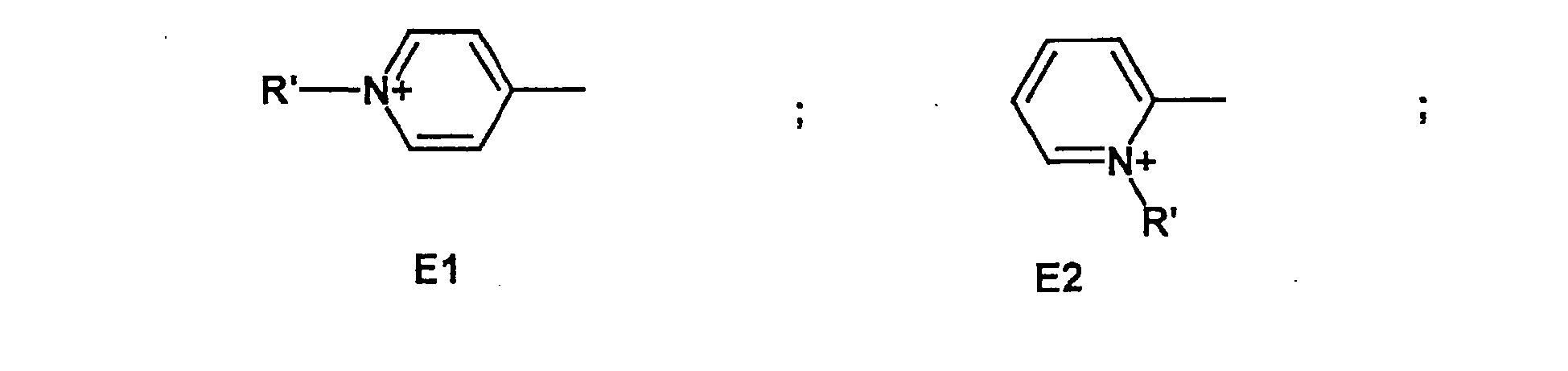


- Dans les structures (IV) et (VI) comme dans les structures (I) à (III) définies ci-dessus le groupement alkyle ou alcoxy en C1-C4 désigne de préférence méthyle, éthyle, butyle, méthoxy, éthoxy.
- Les colorants directs cationiques de formules (IV), (VI) utilisables dans les compositions tinctoriales conformes à l'invention, sont des composés connus et sont décrits par exemple dans les demandes de brevets
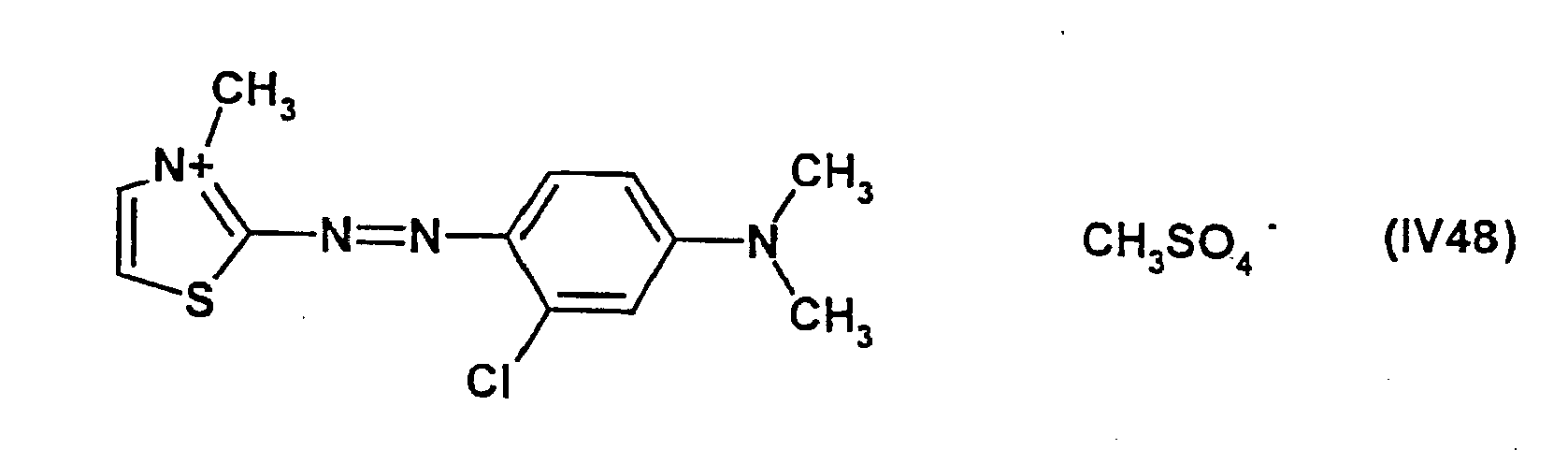
WO 95/01772 WO 95/15144 EP-A-0 714 954 . - Parmi les colorants directs cationiques de formule (IV) utilisables dans les compositions tinctoriales conformes à l'invention, on peut plus particulièrement citer les composés répondant aux structures (IV1) à (IV54) suivantes :


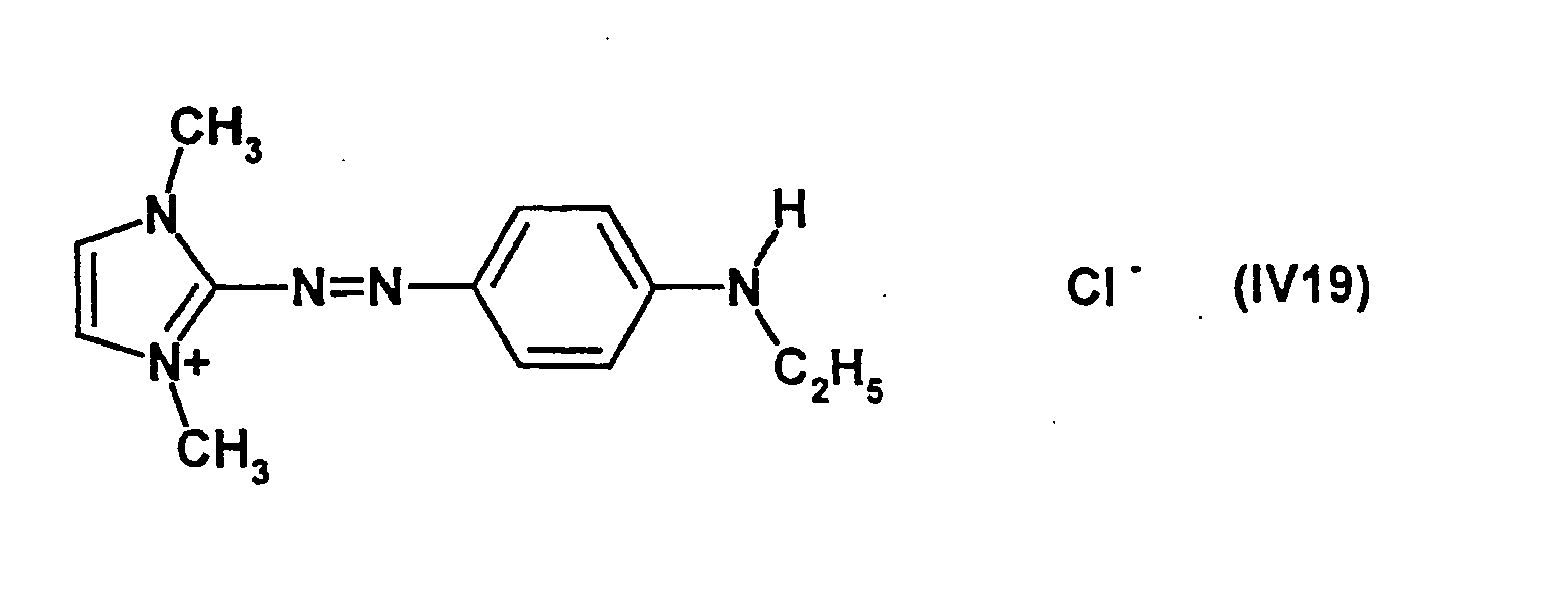

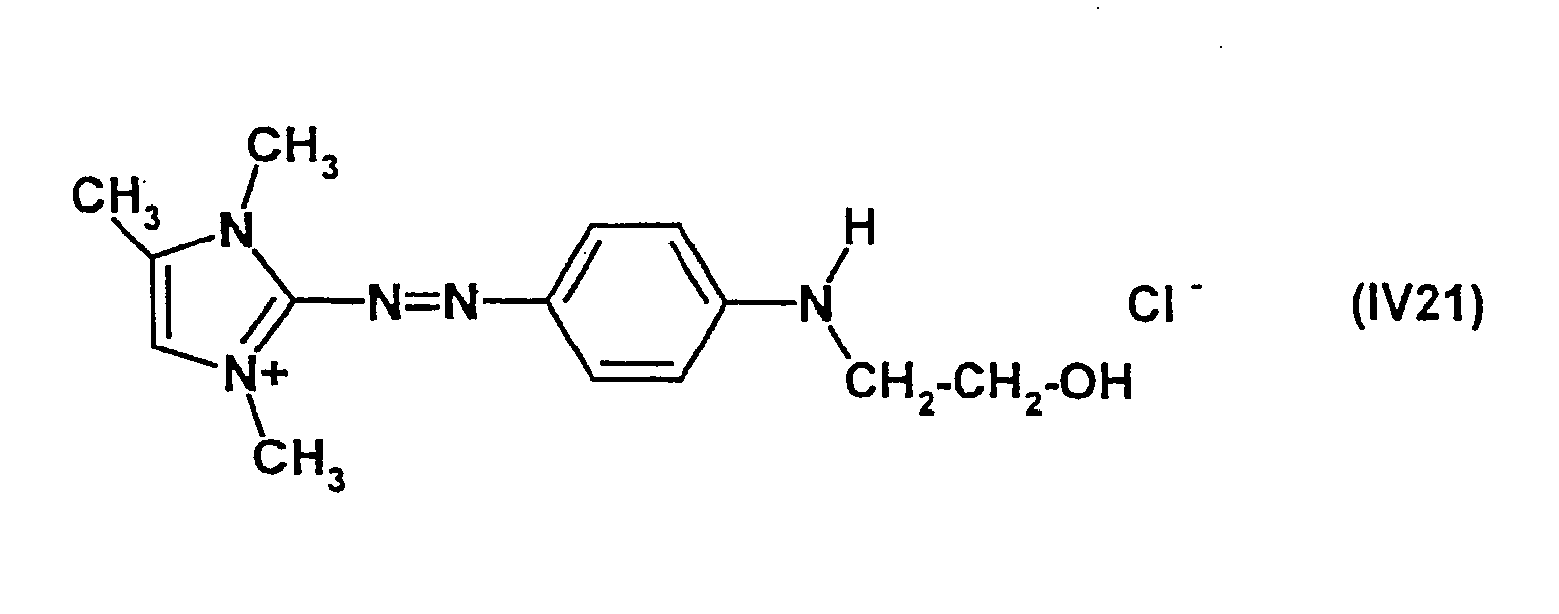


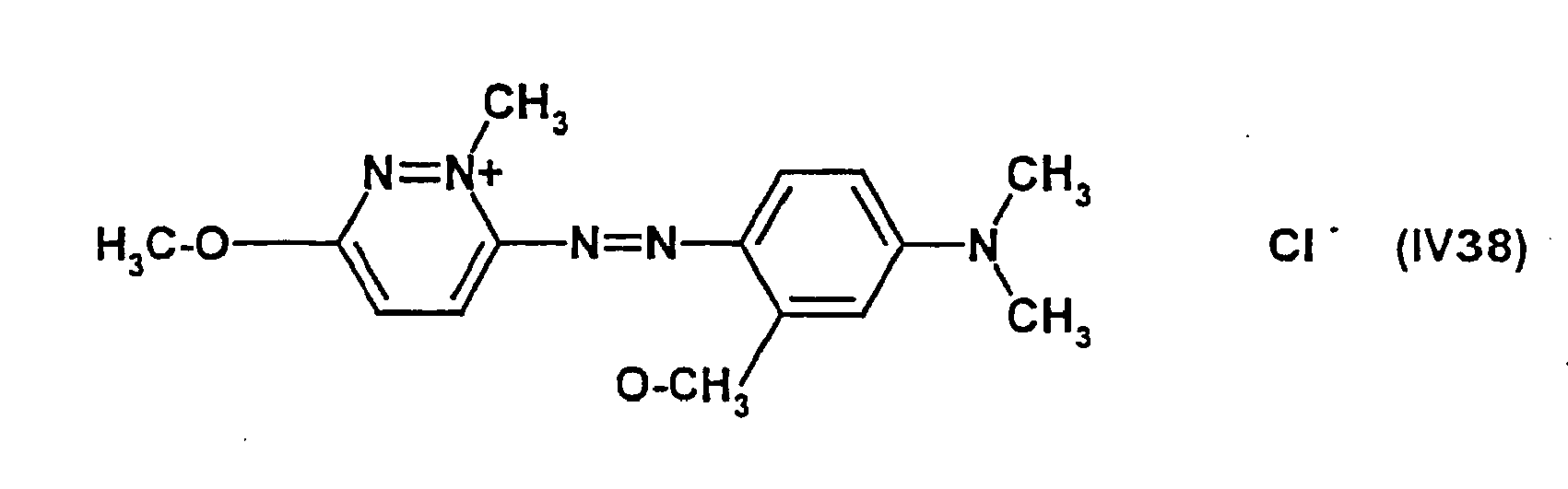




- Parmi les composés de structures (IV1) à (IV54) décrits ci-dessus, on préfère tout particulièrement les composés répondant aux structures (IV1), (IV2), (IV14) et (IV31).
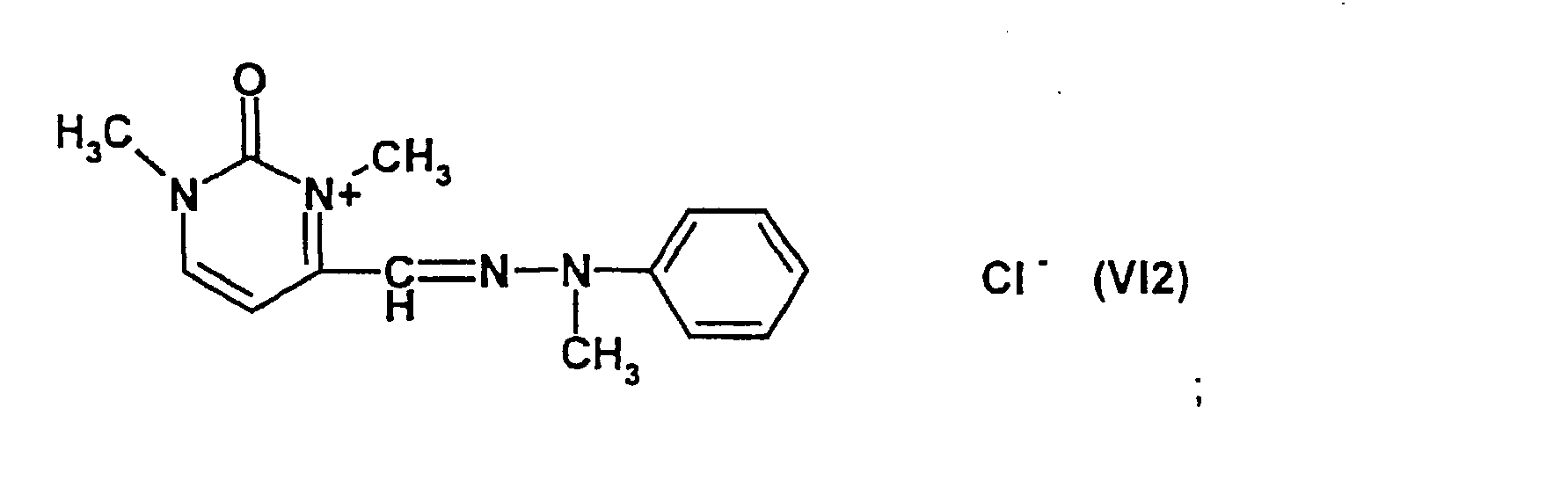
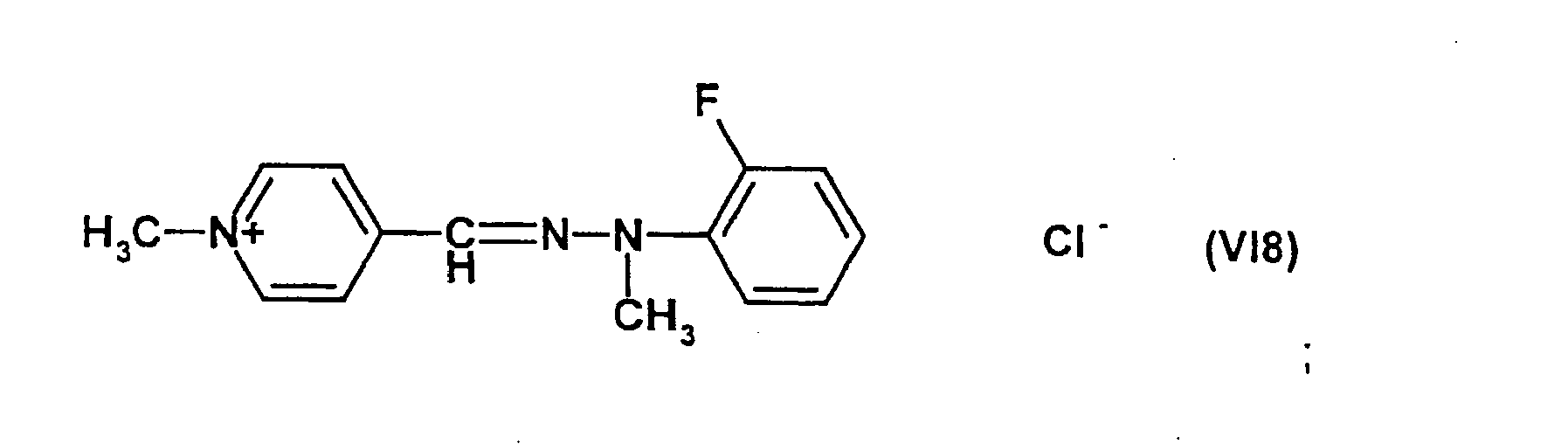
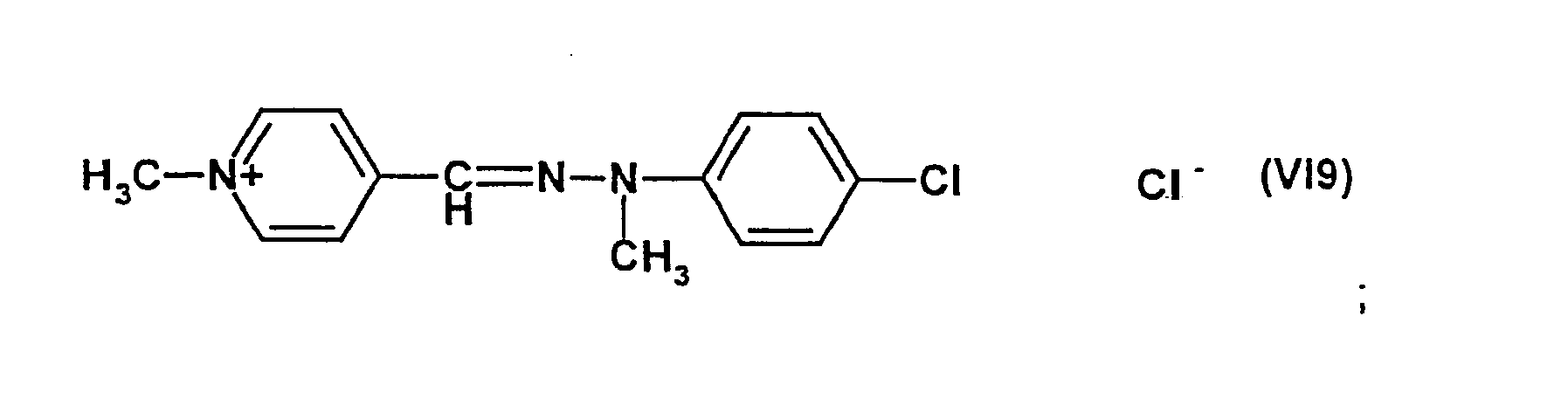
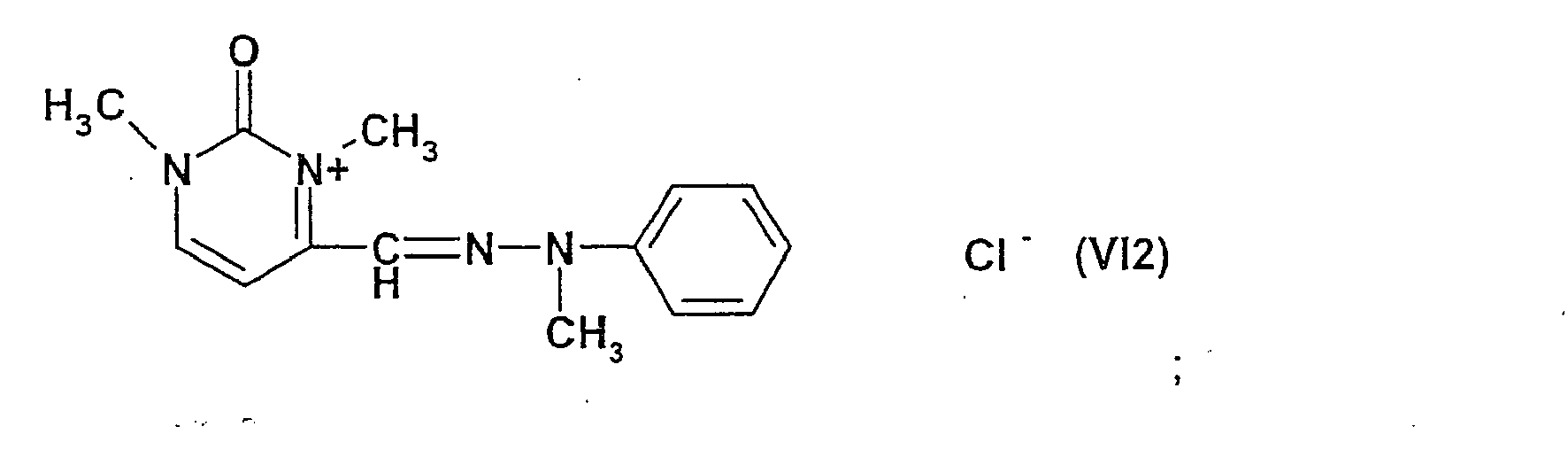
- Parmi les colorants directs cationiques de formule (VI), utilisables dans les compositions tinctoriales conformes à l'invention, on peut plus particulièrement citer les composés répondant aux structures (VI1) à (VI18) suivantes :





- Parmi les composés particuliers de structures (VI1) à (VI18) décrits ci-dessus, on préfère tout particulièrement les composés répondant aux structures (VI4), (VI5) et (VI13).
- L'invention a également pour objet une composition de teinture directe des fibres kératiniques, en particulier des fibres kératiniques humaines telles que les cheveux qui ne contient pas de colorant autooxydable, caractérisée par le fait qu'elle comprend, dans un milieu approprié pour la teinture, une association de colorants cationiques telle que définie ci-dessus.
- Le ou les colorants cationiques (I) à (III) utilisés selon l'invention, représentent de préférence de 0,001 à 10 % en poids environ du poids total de la composition de teinture directe et encore plus préférentiellement de 0,005 à 5 % en poids environ de ce poids.
- Le ou les colorants cationiques de formules (IV) et (VI) utilisés selon l'invention, représentent de préférence de 0,001 à 10 % en poids environ du poids total de la composition de teinture directe et encore plus préférentiellement de 0,005 à 5 % en poids environ de ce poids.
L'association de colorants cationiques selon l'invention peut également servir, à titre de colorant direct, dans les procédés bien connus de teinture d'oxydation, utilisant des colorants d'oxydation (précurseurs de colorants d'oxydation et éventuellement des coupleurs), à nuancer ou enrichir de reflets les teintures obtenues avec les colorants d'oxydation. - La composition tinctoriale selon l'invention peut encore contenir, pour élargir la palette de nuances et obtenir des teintes variées, outre l'association de colorants cationiques selon l'invention, d'autres colorants directs classiquement utilisés, et notamment, des colorants nitrés benzéniques, des colorants anthraquinoniques, des colorants naphtoquinoniques, des colorants triarylméthaniques, dles colorants xanthéniques, des colorants azoïques non cationiques.
- Le milieu approprié pour la teinture (ou support) est généralement constitué par de l'eau ou par un mélange d'eau et d'au moins un solvant organique pour solubiliser les composés qui ne seraient pas suffisamment solubles dans l'eau. A titre de solvant organique, on peut par exemple citer les alcanols inférieurs en C1-C4, tels que l'éthanol et l'isopropanol ; les alcools aromatiques comme l'alcool benzylique, ainsi que les produits analogues et leurs mélanges.
- Les solvants peuvent être présents dans des proportions de préférence comprises entre 1 et 40 % en poids environ par rapport au poids total de la composition tinctoriale, et encore plus préférentiellement entre 5 et 30 % en poids environ.
- Le PH de la composition tinctoriale conforme à l'invention est généralement compris entre 2 et 11 environ, et de préférence entre 5 et 10 environ. Il peut être ajusté à la valeur désirée au moyen d'agents acidifiants ou alcalinisants habituellement utilisés en teinture des fibres kératiniques.
- Parmi les agents acidifiants, on peut citer, à titre d'exemple, les acides minéraux ou organiques comme l'acide chlorhydrique, l'acide orthophosphorique, l'acide sulfurique, les acides carboxyliques comme l'acide acétique, l'acide tartrique, l'acide citrique, l'acide lactique, les acides sulfoniques.
- Parmi les agents alcalinisants on peut citer, à titre d'exemple, l'ammoniaque, les carbonates alcalins, les alcanolamines telles que les mono-, di- et triéthanolamines ainsi que leurs dérivés, les hydroxydes de sodium ou de potassium et les composés de formule (VIII) suivante :

- La composition de teinture directe conforme à l'invention peut également renfermer divers adjuvants utilisés classiquement dans les compositions pour la teinture des cheveux, tels que des agents antioxydants, des agents de pénétration, des agents séquestrants, des agents épaississants, des parfums, des tampons, des agents dispersants, des agents tensioactifs anioniques, non ioniques, cationiques ou amphotères, des polymères cationiques, anioniques, non ioniques ou amphotères, des agents filmogènes, des céramides, des agents conservateurs, des agents filtrants, des agents opacifiants.
- Bien entendu, l'homme de l'art veillera à choisir ce ou ces éventuels composés complémentaires de manière telle que les propriétés avantageuses attachées intrinsèquement à la composition tinctoriale conforme à l'invention ne soient pas, ou substantiellement pas, altérées par la ou les adjonctions envisagées.
- La composition de teinture directe selon l'invention peut se présenter sous des formes diverses, telles que sous forme de liquides, de shampooings, de crèmes, de gels, ou sous toute autre forme appropriée pour réaliser une teinture des fibres kératiniques, et notamment des cheveux humains. Elle peut être obtenue par mélange extemporané d'une composition, éventuellement pulvérulente, contenant l'association de colorants cationiques définie ci-dessus avec une composition aqueuse.
- Un autre objet de l'invention est un procédé de teinture directe des fibres kératiniques et en particulier des fibres kératiniques humaines telles que les cheveux mettant en oeuvre la composition de teinture telle que définie précédemment.
- Selon une première variante de ce procédé de teinture directe conforme à l'invention, on applique sur les fibres au moins une composition tinctoriale telle que définie précédemment, pendant un temps suffisant pour développer la coloration désirée, après quoi on rince, on lave éventuellement au shampooing, on rince à nouveau et on sèche.
- Le temps nécessaire au développement de la coloration sur les fibres kératiniques est généralement compris entre 3 et 60 minutes et encore plus précisément 5 et 40 minutes.
- Selon une deuxième variante de ce procédé de teinture directe conforme à l'invention, on applique sur les fibres au moins une composition tinctoriale telle que définie précédemment, pendant un temps suffisant pour développer la coloration désirée, sans rinçage final.
- Un autre objet de l'invention est un dispositif à plusieurs compartiments ou "kit" de teinture ou tout autre système de conditionnement à plusieurs compartiments dont un premier compartiment renferme une composition contenant le colorant cationique (I) à (III) défini ci-dessus et un second compartiment renferme une composition contenant le colorant cationique de formules (IV) et (VI) défini ci-dessus. Dans une variante de l'invention, le premier compartiment renferme une composition pulvérulente contenant l'association d'au moins un colorant cationique (I) à (III) et d'au moins un colorant cationique de formules (IV) et (VI) défini, selon l'invention et le second compartiment une composition aqueuse servant de véhicule pour la teinture. Ces dispositifs peuvent être équipés d'un moyen permettant de délivrer sur les cheveux le mélange souhaité, tel que les dispositifs décrits dans le brevet
FR-2 586 913 - Les exemples qui suivent sont destinés à illustrer l'invention sans pour autant en limiter la portée.
- On a préparé les quatre compositions de teinture directe réunies dans le tableau suivant :
(toutes teneurs exprimées en grammes)Exemple 1 Exemple 2 Exemple 3 Exemple 4 Arianor Madder Red (WARNER JENKINSON) 0,1 Arianor Steel Blue (WARNER JENKINSON) 0,1 0,12 Arianor Straw Yellow (WARNER JENKINSON) 0,12 Colorant direct cationique de formule (IV31) 0,1 Colorant direct cationique de formule (VII27) 0,12 Colorant direct cationique de formule (VI4) 0,15 Colorant direct cationique de formule (IV1) 0,1 Hydroxyéthylcellulose 1,0 MA* 1,0 MA* 1,0 MA* 1,0 MA* Ethanol 10 10 10 10 2-amino-2-méthyl-1-propanol qs pH 9 pH 9 pH 9 pH 9 Eau déminéralisée qsp 100 100 100 100 MA* désigne Matière Active - Les compositions ci-dessus ont été appliquées chacune pendant 30 minutes sur des mèches de cheveux gris naturels à 90 % de blancs. Les mèches de cheveux ont ensuite été rincées, lavées avec un shampooing standard puis séchées.
- Les mèches ont été teintes dans les nuances suivantes :
Exemples Nuances obtenues 1 Rouge puissant 2 Volet bleu puissant 3 Violet puissant 4 Jaune puissant
lorsque m = 0 et que D1 représente un atome d'azote, alors E peut également désigner un groupement de structure E9 suivante :

Claims (18)
- Utilisation à titre de colorants directs dans des, ou pour la fabrication de, compositions de teinture directe pour fibres kératiniques en particulier pour fibres kératiniques humaines et notamment les cheveux et qui ne contiennent pas de colorant autooxydable, d'une association comprenant (i) au moins un colorant cationique choisi parmi (I) le basic brown 17, le basic brown 16, le basic red 16, le basic red 118, (II) le basic yellow 57, (III) le basic blue 99 et (ii) au moins un colorant cationique de formules (IV) ou VI) suivantes :
(ii) colorant cationique de formules (IV), (VI), suivantes:a) les composés de formule (IV) suivante :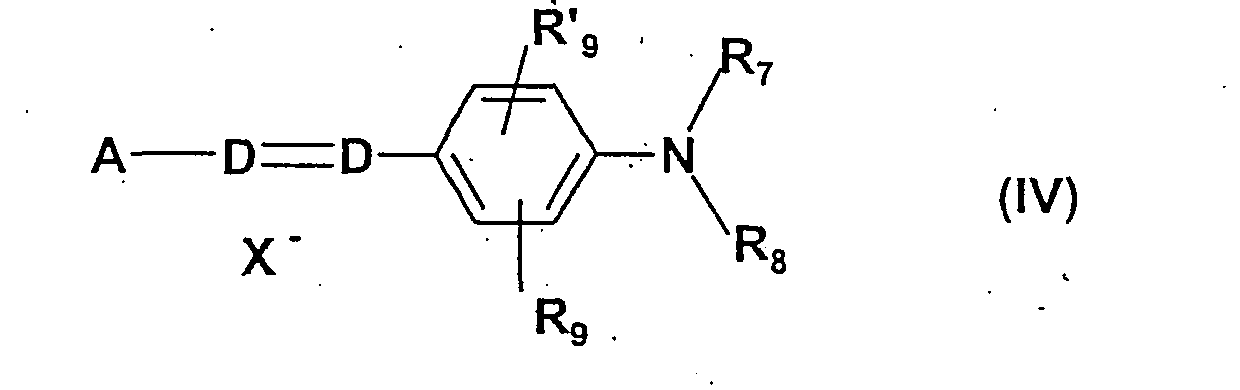 D représente un atome d'azote ou le groupement -CH,R7 et R8, identiques ou différents, représentent un atome d'hydrogène ; un radical alkyle en C1-C4 pouvant être substitué par un radical -CN, -OH ou -NH2 ou forment avec un atome de carbone du cycle benzénique un hétérocycle éventuellement oxygéné ou azoté, pouvant être substitué par un ou plusieurs radicaux alkyle en C1-C4 ; un radical 4'-aminophényle,R9 et R'9, identiques ou différents, représentent un atome d'hydrogène ou d'halogène choisi parmi le chlore, le brome, l'iode et le fluor, un radical cyano, alkyl en C1-C4, alcoxy en C1-C4 ou acétyloxyX- représente un anion de préférence choisi parmi le chlorure, le méthyl sulfate et l'acétate,dans lesquelles R10 représente un radical alkyle en C1-C4 pouvant être substitué par un radical hydroxyle et R11 représente un radical alcoxy en C1-C4, sous réserve que
A représente un groupement choisi par les structures A1 à A19 suivantes :

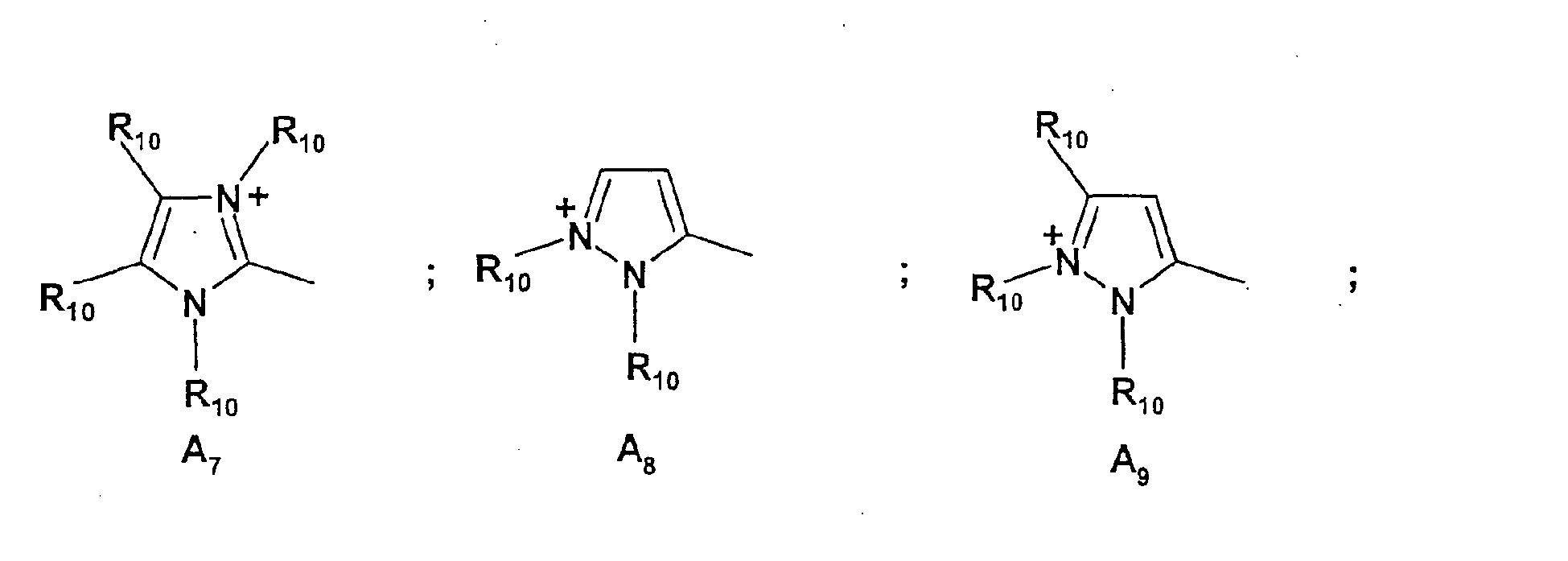


 (i) lorsque D représente -CH, que A représente A4 ou A13 et que R9 est différent d'un radical alcoxy, alors R7 et R8 ne désignent pas simultanément un atome d'hydrogène ;(ii) lorsque D représente un atome d'azote, que A représente A6, alors R7 et R8 ne désignent pas simultanément un radical méthyle.c) les composés de formules (VI) suivantes :dans lesquelles R' représente un radical alkyle en C1-C4 ;
 R19 représente un atome d'hydrogène, un radical alcoxy en C1-C4, un atome d'halogène tel que le brome, le chlore, l'iode ou le fluor ou un radical amino,R20 représente un atome d'hydrogène, un radical alkyle en C1-C4 ou forme avec un atome de carbone du cycle benzénique un hétérocycle éventuellement oxygéné et/ou substitué par un ou plusieurs groupement alkyle en C1-C4,R21 représente un atome d'hydrogène ou d'halogène tel que le brome, le chlore, l'iode ou le fluor,D1 et D2, identiques ou différents, représentent un atome d'azote ou le groupement -CH,m = 0 ou 1,étant entendu que lorsque R19 représente un groupement amino non substitué, alors D1 et D2 représentent simultanément un groupement -CH et m = 0,X- représente un anion de préférence choisi parmi le chlorure, le méthyl sulfate et l'acétate,E représente un groupement choisi par les structures E1 à E8 suivantes :


lorsque m = 0 et que D13 représente un atome d'azote, alors E peut également désigner un groupement de structure E9 suivante :
- Utilisation selon la revendication 1, caractérisée par le fait que le colorant cationique est le Basic Blue 99.
- Utilisation selon la revendication 1, caractérisée par le fait que les colorants cationiques de formule (IV) sont choisis parmi les composés de formules (IV1) à (IV54) suivantes :


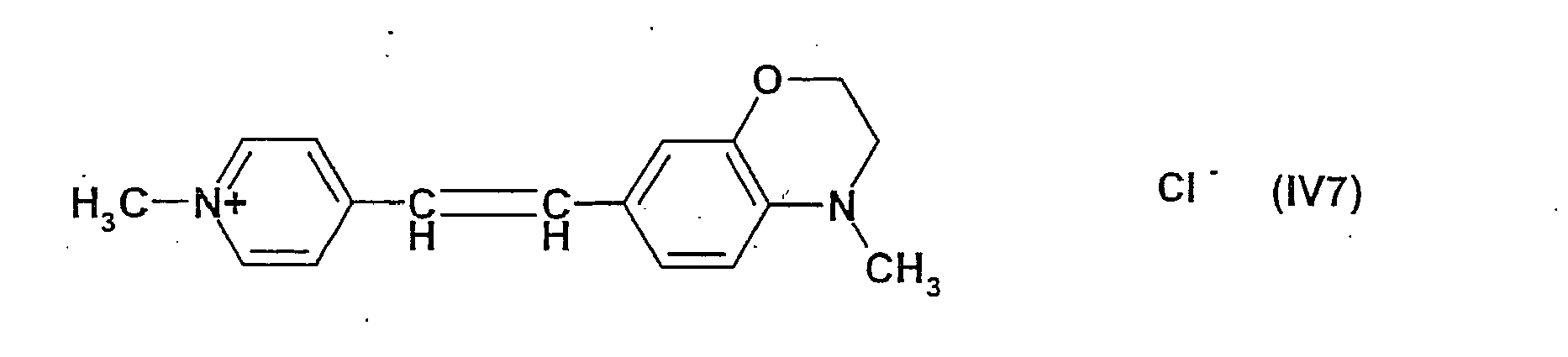


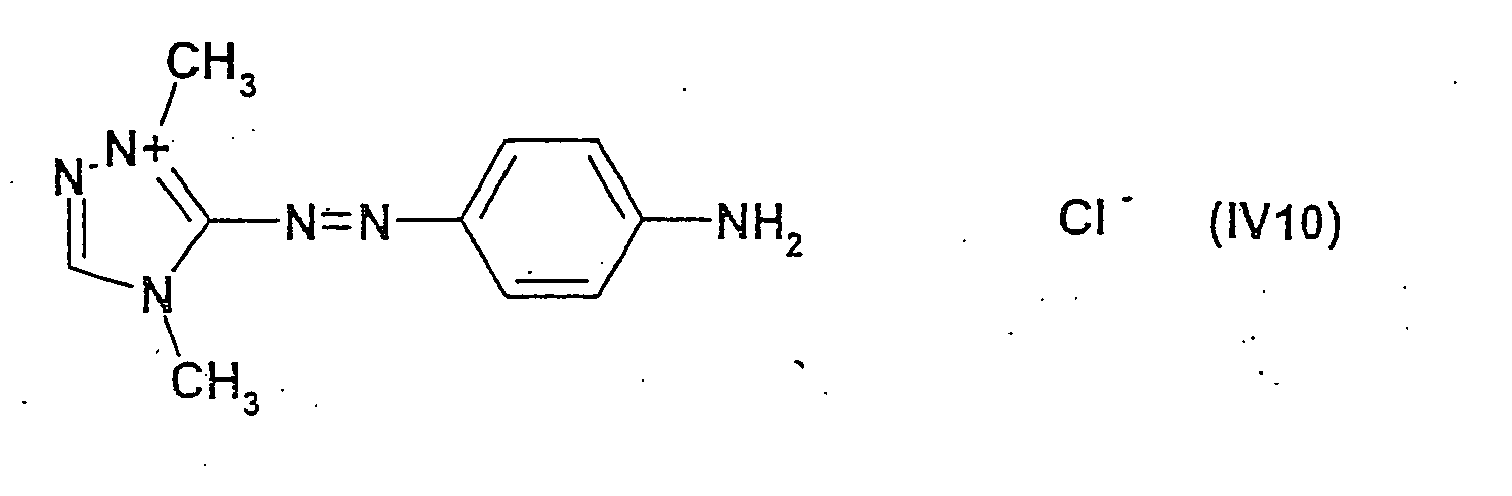


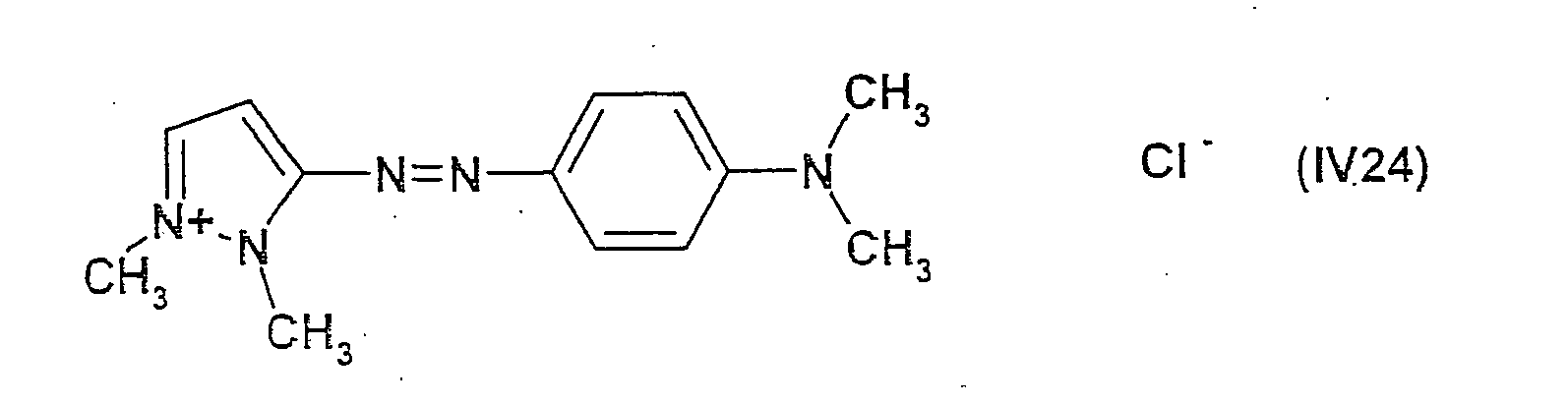


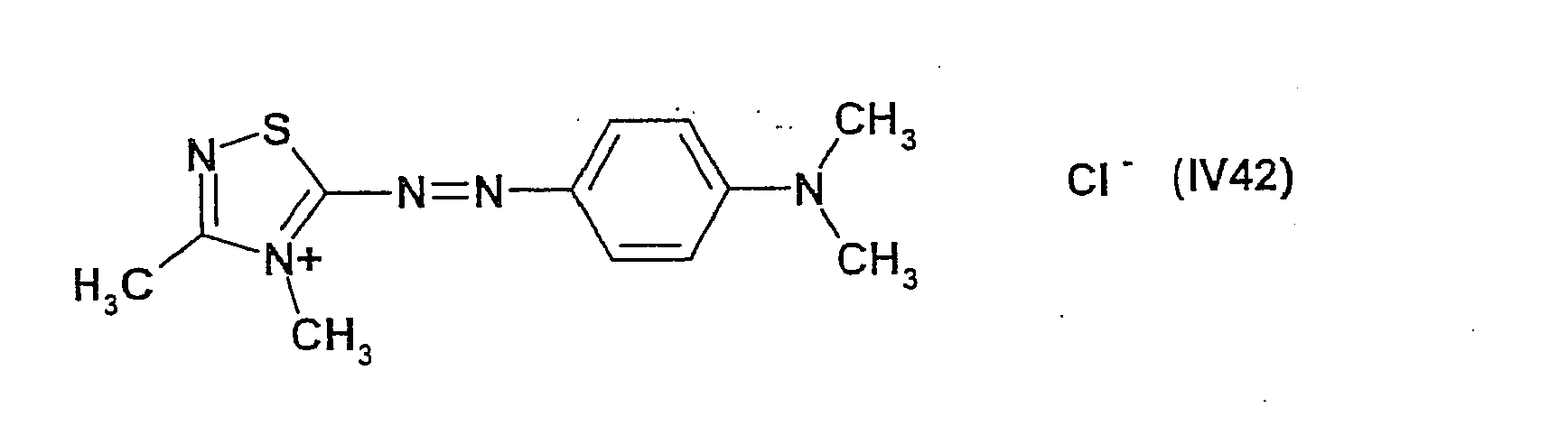


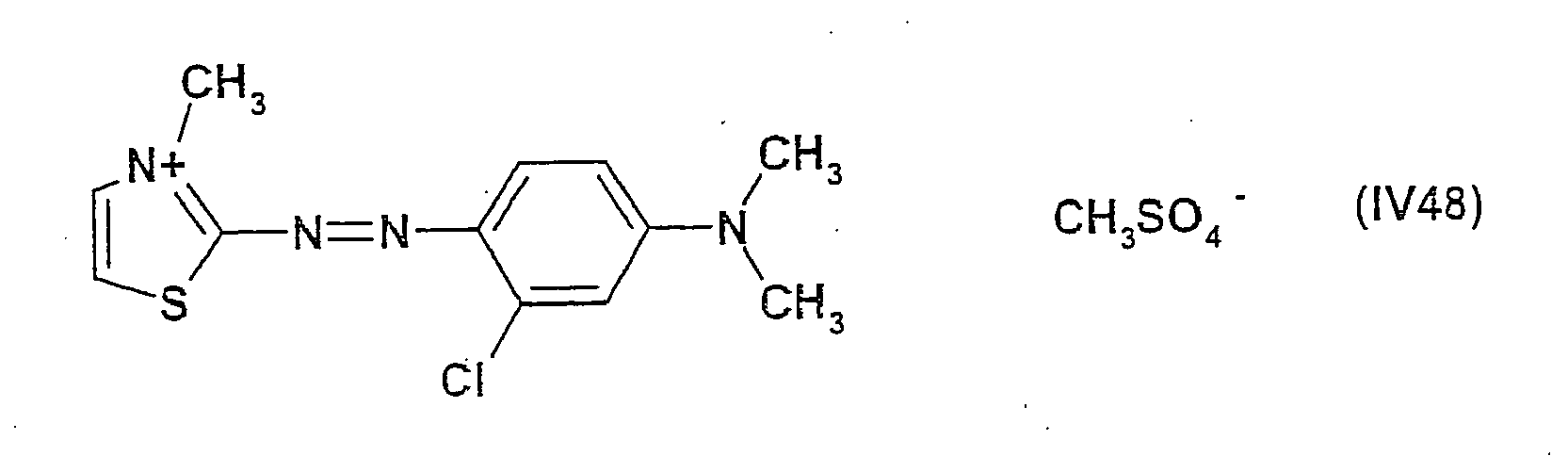


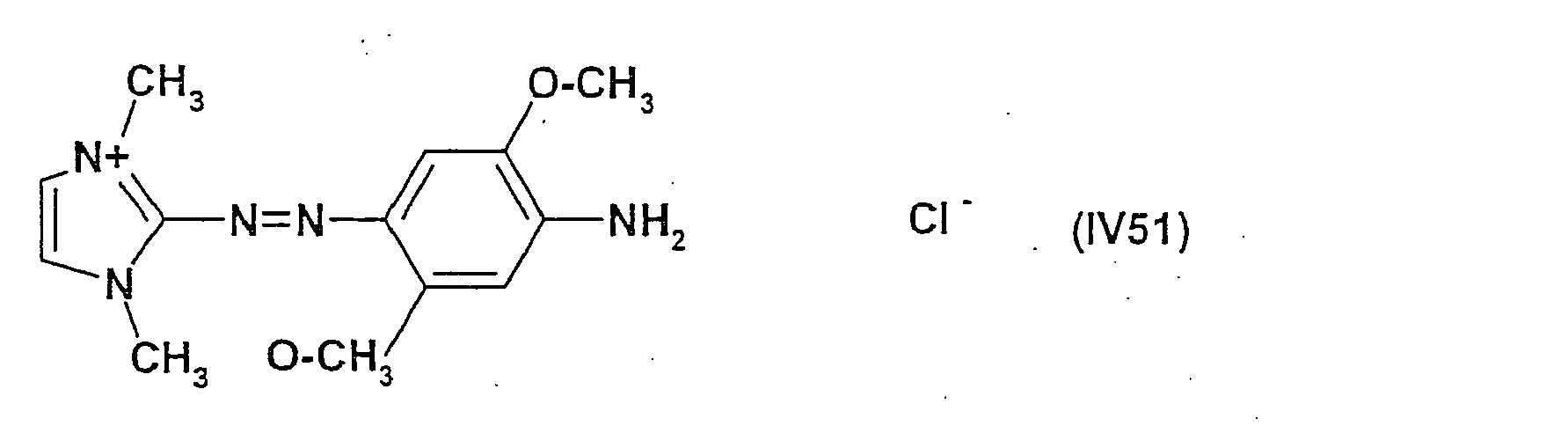


- Utilisation selon la revendication 3, caractérisée par le fait que les colorants cationiques de formule (IV) sont choisis parmi les composés de formules (IV1) (IV2), (IV14), et (IV31).
- Utilisation selon la revendication 1, caractérisée par le fait que les colorants cationiques de formule (VI) sont choisis parmi les composés de formules (VI1) à (VI18) suivantes :



- Utilisation selon la revendication 5, caractérisée par le fait que les colorants cationiques de formule (VI) sont choisis parmi les composés de formules (VI4), (VI5) et (VI13).
- Composition de teinture directe pour fibres kératiniques et en particulier pour fibres kératiniques humaines et notamment les cheveux qui ne contient pas de colorant autooxydable, caractérisée par le fait qu'elle comprend, dans un milieu approprié pour la teinture, une association d'au moins un colorant de formules (I) à (III) et d'au moins un colorant de formules (IV) ou (VI) définies à l'une quelconque des revendications 1 à 6.
- Composition selon la revendication 7, caractérisée par le fait que le où les colorants cationiques (I), (II), (III) sont présents dans une concentration allant de 0,001 à 10 % en poids du poids total de la composition.
- Composition selon la revendication 8, caractérisée par le fait que le ou les colorants cationiques (I), (II), (III) sont présents dans une concentration allant de 0,005 à 5 % en poids du poids total de la composition.
- Composition selon la revendications 7, caractérisée par le fait que le ou les colorants cationiques de formules (IV), (VI), représentent de 0,001 à 10 % en poids du poids total de la composition.
- Composition selon la revendication 10, caractérisée par le fait que le ou les colorants cationiques de formules (IV), (VI), représentent de 0,001 à 10 % en poids du poids total de la composition.
- Composition selon l'une quelconque des revendications 7 à 11, caractérisée par le fait que le milieu approprié pour la teinture (ou support) est constitué par de l'eau ou par un mélange d'eau et d'au moins un solvant organique.
- Composition selon l'une quelconque des revendications 7 à 12, caractérisée par le fait qu'elle présente un pH compris entre 2 et 11, et de préférence entre 5 et 10.
- Composition selon l'une quelconque des revendications 7 à 13, caractérisée par le fait qu'elle renferme des adjuvants choisis parmi des agents antioxydants, des agents de pénétration, des agents séquestrants, des agents épaississants, des parfums, des tampons, des agents dispersants, des agents tensioactifs, des polymères, des agents filmogènes, des céramides, des agents conservateurs, des agents filtrants, des agents opacifiants.
- Procédé de teinture directe des fibres kératiniques et en particulier des fibres kératiniques humaines telles que les cheveux, caractérisé par le fait que qu'on applique sur les fibres au moins une composition tinctoriale telle que définie à l'une quelconque des revendications 7 à 14, pendant un temps suffisant pour développer la coloration désirée, après quoi on rince, on lave éventuellement au shampooing, on rince à nouveau et on sèche.
- Procédé de teinture directe des fibres kératiniques et en particulier des fibres kératiniques humaines telles que les cheveux, caractérisé par le fait que qu'on applique sur les fibres au moins une composition tinctoriale telle que définie à l'une quelconque des revendications 17 à 14, pendant un temps suffisant pour développer la coloration désirée, sans rinçage final.
- Dispositif à plusieurs compartiments ou "kit" de teinture à plusieurs compartiments, caractérisé par le fait qu'un premier compartiment renferme au moins un colorant cationique (I) à (III) défini à la revendication 1 et un second compartiment renferme au moins un colorant cationique de formules (IV) ou (VI) définies à l'une quelconque des revendications 1, et 3 à 6.
- Dispositif à plusieurs compartiments ou « kit « de teinture à plusieurs compartiments, caractérisé par le fait qu'un premier compartiment renferme une composition pulvérulente contenant l'association d'au moins un colorant cationique (I) à (III) défini à la revendication 1 et d'au moins un colorant de formules (IV) ou (VI) définies à l'une quelconque des revendications 1, 3 à 6, et qu'un second compartiment renferme une composition aqueuse servant de véhicule pour la teinture.
Applications Claiming Priority (2)
| Application Number | Priority Date | Filing Date | Title |
|---|---|---|---|
| FR9900501 | 1999-01-19 | ||
| FR9900501A FR2788432B1 (fr) | 1999-01-19 | 1999-01-19 | Utilisation pour la teinture directe des fibres keratiniques d'une association de deux colorants cationiques |
Publications (2)
| Publication Number | Publication Date |
|---|---|
| EP1025834A1 EP1025834A1 (fr) | 2000-08-09 |
| EP1025834B1 true EP1025834B1 (fr) | 2007-07-04 |
Family
ID=9540982
Family Applications (1)
| Application Number | Title | Priority Date | Filing Date |
|---|---|---|---|
| EP99403290A Revoked EP1025834B1 (fr) | 1999-01-19 | 1999-12-27 | Utilisation pour la teinture directe des fibres kératiniques d'une association de deux colorants cationiques |
Country Status (21)
| Country | Link |
|---|---|
| US (1) | US6432146B1 (fr) |
| EP (1) | EP1025834B1 (fr) |
| JP (1) | JP2000212052A (fr) |
| KR (1) | KR100360517B1 (fr) |
| CN (1) | CN1191050C (fr) |
| AR (1) | AR023367A1 (fr) |
| AT (1) | ATE366103T1 (fr) |
| AU (1) | AU726530B2 (fr) |
| BR (1) | BR0000740A (fr) |
| CA (1) | CA2296141C (fr) |
| CZ (1) | CZ2000130A3 (fr) |
| DE (1) | DE69936441T2 (fr) |
| DK (1) | DK1025834T3 (fr) |
| ES (1) | ES2289804T3 (fr) |
| FR (1) | FR2788432B1 (fr) |
| HU (1) | HUP0000160A3 (fr) |
| MX (1) | MX244422B (fr) |
| PL (1) | PL196970B1 (fr) |
| PT (1) | PT1025834E (fr) |
| RU (1) | RU2200537C2 (fr) |
| ZA (1) | ZA200000213B (fr) |
Families Citing this family (38)
| Publication number | Priority date | Publication date | Assignee | Title |
|---|---|---|---|---|
| JP2001316230A (ja) * | 2000-05-11 | 2001-11-13 | Kao Corp | 染毛剤組成物 |
| FR2813016B1 (fr) * | 2000-08-21 | 2002-10-11 | Oreal | Composition de decoloration des fibres keratiniques teintes |
| FR2817467B1 (fr) | 2000-12-04 | 2003-01-10 | Oreal | Composition de teinture pour fibres keratiniques comprenant un polymere associatif et un polymere a motifs acrylamide, halogenure de dialkyldiallylammonium et acide carboxylique vinylique |
| FR2817466B1 (fr) | 2000-12-04 | 2004-12-24 | Oreal | Composition de teinture d'oxydation pour fibres keratiniques comprenant un polymere associatif et un agent nacrant |
| DE10139561A1 (de) * | 2001-08-10 | 2003-02-20 | Henkel Kgaa | Mittel zum Färben von keratinhaltigen Fasern |
| FR2833837B1 (fr) | 2001-12-21 | 2005-08-05 | Oreal | Composition pour la teinture d'oxydation des fibres keratiniques comprenant un amide d'acide gras de colza oxyethylene |
| US20040181883A1 (en) * | 2002-12-20 | 2004-09-23 | Frederic Legrand | Pasty anhydrous composition for simultaneously bleaching and dyeing human keratin fibers comprising at least one peroxygenated salt, at least one alkaline agent, at least one inert organic liquid and at least one cationic direct dye; process using such a compound; and kit comprising such a compound |
| WO2004072183A1 (fr) * | 2003-02-17 | 2004-08-26 | Ciba Specialty Chemicals Holding Inc. | Colorants cationiques a base d'hydrazone substitue |
| AU2004222107A1 (en) * | 2003-03-18 | 2004-09-30 | Ciba Specialty Chemicals Holding Inc. | Cationic dimeric dyes |
| US20040244126A1 (en) * | 2003-06-04 | 2004-12-09 | Vena Lou Ann Christine | Method, compositions, and kit for coloring hair |
| FR2860149B1 (fr) * | 2003-09-29 | 2006-01-06 | Oreal | Composition tinctoriale comprenant au moins une base paraphenylenediamine secondaire hydroxyalkylee, un coupleur et au moins un colorant direct particulier |
| FR2863486B1 (fr) * | 2003-12-11 | 2007-02-16 | Oreal | Traitement de fibres keratiniques colorees avec une composition comprenant un tensioactif non ionique et/ou amphotere et/ou anionique doux particulier et utilisation pour proteger la couleur |
| US20050125913A1 (en) | 2003-12-11 | 2005-06-16 | Saroja Narasimhan | Method and compositions for coloring hair |
| WO2005097051A2 (fr) | 2004-04-08 | 2005-10-20 | Ciba Specialty Chemicals Holding Inc. | Colorants a base de sulfide |
| US7235645B2 (en) * | 2004-07-23 | 2007-06-26 | L'oreal, S.A. | Cationic azo monomers or symmetric dimers, preparation thereof, compositions comprising same and process for dyeing keratin fibers |
| FR2873369B1 (fr) | 2004-07-23 | 2006-09-22 | Oreal | Monomeres ou dimeres symetriques azoiques cationiques, leur preparation, compositions les comprenant et procede de coloration de fibres keratiniques |
| FR2886132B1 (fr) | 2005-05-31 | 2007-07-20 | Oreal | Composition pour la teinture des fibres keratiniques comprenant un derive de diamino-n,n-dihydro-pyrazolone, un coupleur et un colorant direct heterocyclique |
| US7485156B2 (en) | 2005-05-31 | 2009-02-03 | L'oreal S.A. | Composition for dyeing keratin fibers, comprising at least one diamino-N,N-dihydropyrazolone derivative, at least one coupler and at least one associative polyurethane polymer |
| US7488356B2 (en) | 2005-05-31 | 2009-02-10 | L'oreal S.A. | Composition for dyeing keratin fibers, comprising at least one diamino-N,N-dihydropyrazolone derivative, at least one coupler, and at least one surfactant |
| US7582121B2 (en) | 2005-05-31 | 2009-09-01 | L'oreal S.A. | Composition for dyeing keratin fibers, comprising at least one diamino-N,N-dihydropyrazolone derivative, at least one coupler, and at least one heterocyclic direct dye |
| US7488355B2 (en) | 2005-05-31 | 2009-02-10 | L'oreal S.A. | Composition for dyeing keratin fibers, comprising a diamino-N,N-dihydropyrazolone compound, a coupler, and a polyol |
| US7771490B2 (en) | 2005-08-30 | 2010-08-10 | Ciba Corporation | Dyes containing a thiol group |
| WO2007071689A1 (fr) * | 2005-12-22 | 2007-06-28 | L'oréal | Composition pour la teinture de fibres de keratine contenant un colorant cationique direct a la tetraazapentamethine et un autre colorant direct particulier |
| FR2895246B1 (fr) * | 2005-12-22 | 2008-02-22 | Oreal | Composition de teinture pour fibres keratiniques avec un colorant direct cationique tetraazapenta-methinique et un autre colorant direct particulier |
| WO2007122340A1 (fr) * | 2006-04-13 | 2007-11-01 | L'oréal | Compose dichromophorique cationique comportant deux motifs de type hydrazone et a bras de liaison cationique, composition tinctoriale comprenant au moins un tel compose, procede de mise en œuvre et utilisations |
| FR2899896B1 (fr) * | 2006-04-13 | 2008-06-27 | Oreal | Compose dichromophorique cationique comportant deux motifs de type hydrazone et a bras de liaison cationique, composition tinctoriale comprenant au moins un tel compose, procede de mise en oeuvre et utilisations |
| MX2008015854A (es) | 2006-06-13 | 2009-02-23 | Ciba Holding Inc | Tintes tricationicos. |
| US7578857B1 (en) | 2008-12-24 | 2009-08-25 | Combe Incorporated | Color shampoo formula |
| US8992633B2 (en) | 2011-05-03 | 2015-03-31 | Basf Se | Disulfide dyes |
| RU2680068C2 (ru) | 2013-09-02 | 2019-02-14 | Л'Ореаль | Способ окрашивания кератиновых волокон с применением катионных стириловых дисульфидных красителей и композиция, содержащая указанные красители |
| EP3034066A1 (fr) | 2014-12-19 | 2016-06-22 | Unilever PLC | Compositions de coloration capillaire |
| MX2017012137A (es) * | 2015-03-19 | 2018-02-19 | Basf Se | Tinturas directas cationicas. |
| US9855202B2 (en) * | 2015-03-19 | 2018-01-02 | Noxell Corporation | Compositions for dyeing hair with cationic direct dyes |
| CN106398309A (zh) * | 2015-07-25 | 2017-02-15 | 大连理工大学 | 吡啶酮基杂环偶氮分散染料及其制备方法 |
| FR3045358B1 (fr) * | 2015-12-18 | 2020-10-30 | Oreal | Composition pour colorer les fibres keratiniques comprenant un colorant direct styryle ou napthylamide a fonction hydroxyalkyle, procede de coloration et colorant |
| FR3045359B1 (fr) * | 2015-12-18 | 2020-10-30 | Oreal | Composition pour colorer les fibres keratiniques comprenant un colorant direct styryle ou napthylamide a fonction aminoalkyle, procede de coloration et colorant |
| FR3060984B1 (fr) * | 2016-12-22 | 2019-08-02 | L'oreal | Utilisation de colorants anthraquinones et de colorants fluorescents pour la teinture des fibres keratiniques, procede de coloration et composition |
| CN110724395B (zh) * | 2019-10-30 | 2021-12-21 | 河南省化工研究所有限责任公司 | 一种阳离子蓝染料的制备方法 |
Citations (1)
| Publication number | Priority date | Publication date | Assignee | Title |
|---|---|---|---|---|
| WO1995001772A1 (fr) * | 1993-07-05 | 1995-01-19 | Ciba-Geigy Ag | Procede de teinture de fibres keratiniques |
Family Cites Families (17)
| Publication number | Priority date | Publication date | Assignee | Title |
|---|---|---|---|---|
| CH560539A5 (fr) | 1971-06-04 | 1975-04-15 | Oreal | |
| US4151162A (en) | 1971-06-04 | 1979-04-24 | L'oreal | Diazomerocyanines and mesomeric forms thereof |
| US3985499A (en) | 1971-06-04 | 1976-10-12 | L'oreal | Diazamerocyanines for dyeing keratinous fibers |
| LU65539A1 (fr) | 1972-06-19 | 1973-12-21 | ||
| US4153065A (en) | 1972-06-19 | 1979-05-08 | L'oreal | Azo derivatives of pyridine n-oxide for use in hair dye compositions |
| LU71015A1 (fr) * | 1974-09-27 | 1976-08-19 | ||
| DE2932489B1 (de) * | 1979-08-10 | 1980-06-04 | Schwarzkopf Gmbh Hans | Verfahren zum Faerben von Humanhaar sowie Mittel zu seiner Durchfuehrung |
| SU1308182A3 (ru) * | 1980-08-22 | 1987-04-30 | Велла Аг (Фирма) | Средство дл окислительной окраски волос |
| FR2586913B1 (fr) * | 1985-09-10 | 1990-08-03 | Oreal | Procede pour former in situ une composition constituee de deux parties conditionnees separement et ensemble distributeur pour la mise en oeuvre de ce procede |
| TW325998B (en) * | 1993-11-30 | 1998-02-01 | Ciba Sc Holding Ag | Dyeing keratin-containing fibers |
| DE59510392D1 (de) | 1994-11-03 | 2002-10-31 | Ciba Sc Holding Ag | Kationische Imidazolazofarbstoffe |
| JP3297056B2 (ja) * | 1996-04-25 | 2002-07-02 | ロレアル | 酸化染料前駆体および粉末直接染料を用いるケラチン繊維の染色方法 |
| FR2757387B1 (fr) * | 1996-12-23 | 1999-01-29 | Oreal | Composition de teinture d'oxydation des fibres keratiniques et procede de teinture mettant en oeuvre cette composition |
| FR2757388B1 (fr) * | 1996-12-23 | 1999-11-12 | Oreal | Composition de teinture d'oxydation des fibres keratiniques et procede de teinture mettant en oeuvre cette composition |
| FR2757384B1 (fr) * | 1996-12-23 | 1999-01-15 | Oreal | Composition de teinture d'oxydation des fibres keratiniques et procede de teinture mettant en oeuvre cette composition |
| BR9806825A (pt) * | 1997-10-22 | 2000-04-25 | Oreal | Composição pronta para o uso, processo de tintura das fibras queratìnicas e dispositivo com vários compartimentos |
| FR2779056B1 (fr) | 1998-05-28 | 2001-09-07 | Oreal | Composition de teinture pour fibres keratiniques avec un colorant direct cationique et un polyol ou ether de polyol |
-
1999
- 1999-01-19 FR FR9900501A patent/FR2788432B1/fr not_active Expired - Lifetime
- 1999-12-27 DE DE69936441T patent/DE69936441T2/de not_active Expired - Lifetime
- 1999-12-27 EP EP99403290A patent/EP1025834B1/fr not_active Revoked
- 1999-12-27 AT AT99403290T patent/ATE366103T1/de active
- 1999-12-27 PT PT99403290T patent/PT1025834E/pt unknown
- 1999-12-27 DK DK99403290T patent/DK1025834T3/da active
- 1999-12-27 ES ES99403290T patent/ES2289804T3/es not_active Expired - Lifetime
-
2000
- 2000-01-06 AU AU10129/00A patent/AU726530B2/en not_active Ceased
- 2000-01-14 CZ CZ2000130A patent/CZ2000130A3/cs unknown
- 2000-01-17 MX MXPA00000617 patent/MX244422B/es active IP Right Grant
- 2000-01-18 RU RU2000101579/14A patent/RU2200537C2/ru not_active IP Right Cessation
- 2000-01-18 AR ARP000100207A patent/AR023367A1/es active IP Right Grant
- 2000-01-18 PL PL337885A patent/PL196970B1/pl unknown
- 2000-01-18 CA CA002296141A patent/CA2296141C/fr not_active Expired - Fee Related
- 2000-01-18 KR KR20000002237A patent/KR100360517B1/ko not_active Expired - Fee Related
- 2000-01-18 BR BR0000740-4A patent/BR0000740A/pt not_active IP Right Cessation
- 2000-01-18 CN CNB001011324A patent/CN1191050C/zh not_active Expired - Fee Related
- 2000-01-18 HU HU0000160A patent/HUP0000160A3/hu unknown
- 2000-01-19 ZA ZA200000213A patent/ZA200000213B/xx unknown
- 2000-01-19 US US09/487,665 patent/US6432146B1/en not_active Expired - Lifetime
- 2000-01-19 JP JP11040A patent/JP2000212052A/ja active Pending
Patent Citations (1)
| Publication number | Priority date | Publication date | Assignee | Title |
|---|---|---|---|---|
| WO1995001772A1 (fr) * | 1993-07-05 | 1995-01-19 | Ciba-Geigy Ag | Procede de teinture de fibres keratiniques |
Also Published As
| Publication number | Publication date |
|---|---|
| FR2788432B1 (fr) | 2003-04-04 |
| PT1025834E (pt) | 2007-09-24 |
| CZ2000130A3 (cs) | 2000-09-13 |
| ZA200000213B (en) | 2000-07-19 |
| CA2296141C (fr) | 2009-12-22 |
| HU0000160D0 (en) | 2000-03-28 |
| AU1012900A (en) | 2000-08-17 |
| DE69936441T2 (de) | 2008-03-13 |
| DK1025834T3 (da) | 2007-08-27 |
| FR2788432A1 (fr) | 2000-07-21 |
| CA2296141A1 (fr) | 2000-07-19 |
| HUP0000160A2 (en) | 2001-02-28 |
| PL337885A1 (en) | 2000-07-31 |
| DE69936441D1 (de) | 2007-08-16 |
| AU726530B2 (en) | 2000-11-09 |
| BR0000740A (pt) | 2001-05-02 |
| PL196970B1 (pl) | 2008-02-29 |
| EP1025834A1 (fr) | 2000-08-09 |
| ATE366103T1 (de) | 2007-07-15 |
| KR20000057768A (ko) | 2000-09-25 |
| RU2200537C2 (ru) | 2003-03-20 |
| MXPA00000617A (es) | 2002-01-01 |
| HUP0000160A3 (en) | 2002-02-28 |
| CN1265307A (zh) | 2000-09-06 |
| MX244422B (en) | 2007-03-26 |
| AR023367A1 (es) | 2002-09-04 |
| JP2000212052A (ja) | 2000-08-02 |
| CN1191050C (zh) | 2005-03-02 |
| ES2289804T3 (es) | 2008-02-01 |
| KR100360517B1 (ko) | 2002-11-14 |
| US6432146B1 (en) | 2002-08-13 |
Similar Documents
| Publication | Publication Date | Title |
|---|---|---|
| EP0962219B2 (fr) | Compositon de teinture directe pour fibres kératiniques avec un colorant direct cationique et un polyol et/ou un ether de polyol | |
| EP0971682B2 (fr) | Composition de teinture des fibres keratiniques et procede de teinture mettant en oeuvre cette composition | |
| EP1025834A1 (fr) | Utilisation pour la teinture directe des fibres kératiniques d'une association de deux colorants cationiques | |
| EP0999823B1 (fr) | Composition de teinture des fibres keratiniques et procede de teinture mettant en oeuvre cette composition | |
| EP1047387B1 (fr) | Composition de teinture pour fibres keratiniques avec un colorant direct cationique et un sel d'ammonium quaternaire | |
| EP0920856B1 (fr) | Procédé de teinture directe en deux étapes des fibres kératiniques mettant en oeuvre des colorants directs basiques | |
| EP0749748B1 (fr) | Compositions pour la teinture des fibres kératiniques comprenant un ortho-diamino pyrazole et un sel de manganèse, procédé de teinture mettant en oeuvre ces compositions | |
| EP0970685B2 (fr) | Composition de teinture pour fibres kératiniques avec un colorant direct cationique et un polymère épaississant | |
| EP1047388B2 (fr) | Composition de teinture pour fibres keratiniques avec un colorant direct cationique et un agent tensio-actif anionique | |
| EP0970687B1 (fr) | Composition de teinture pour fibres kératiniques avec un colorant direct cationique et un polymère épaississant | |
| EP1006153A1 (fr) | Amino-di-anthraquinones cationiques, utilisation, compositions de teinture les renfermant et procédés de teinture | |
| WO2003028684A2 (fr) | Composition contenant un derive de pyrazine et utilisation pour la teinture directe ou d'oxydation et/ou l'eclaircissement optique des fibres keratiniques | |
| EP1627626B1 (fr) | Composition tinctoriale comprenant un colorant hydrophobe particulier et un acide | |
| EP1006154A1 (fr) | Aminoanthraquinones cationiques, leur utilisation pour la teinture des fibres kératiniques, compositions tinctoriales les renfermant et procédés de teinture | |
| EP0970686B1 (fr) | Composition de teinture pour fibres kératiniques avec un colorant direct cationique et un polymère épaississant | |
| EP0962220B1 (fr) | Composition de teinture pour fibres kératiniques avec un colorant direct cationique et un polyol ou ether de polyol | |
| FR2874178A1 (fr) | Procede de coloration de fibres keratiniques a partir d'une composition comprenant un colorant hydrophobe particulier | |
| EP0728463B1 (fr) | Composition pour la teinture d'oxydation des fibres kératiniques comprenant au moins deux bases d'oxydation et un coupleur indolique et procédé de teinture | |
| EP1093790A2 (fr) | Composition de teinture d'oxydation des fibres kératiniques et procédé de teinture mettant en oeuvre cette composition | |
| EP0819424A1 (fr) | Composition de teinture d'oxydation des fibres kératiniques et procédé de teinture mettant en oeuvre cette composition | |
| CA2301079A1 (fr) | Composition de teinture d'oxydation des fibres keratiniques et procede de teinture mettant en oeuvre cette composition | |
| EP0954275A1 (fr) | Composition de teinture d'oxydation des fibres keratiniques comprenant un derive de paraphenylenediamine et procede de teinture mettant en oeuvre cette composition | |
| EP1426036A1 (fr) | Utilisation de pigments latents pour la coloration haute tenue, composition contenant lesdits pigments et procédés les mettant en oeuvre | |
| WO1999033436A1 (fr) | Utilisation d'un colorant direct polycyclique pour la teinture directe ou d'oxydation des fibres keratiniques, compositions tinctoriales le contenant et procedes de teinture |
Legal Events
| Date | Code | Title | Description |
|---|---|---|---|
| PUAI | Public reference made under article 153(3) epc to a published international application that has entered the european phase |
Free format text: ORIGINAL CODE: 0009012 |
|
| AK | Designated contracting states |
Kind code of ref document: A1 Designated state(s): AT BE CH CY DE DK ES FI FR GB GR IE IT LI LU MC NL PT SE |
|
| AX | Request for extension of the european patent |
Free format text: AL;LT;LV;MK;RO;SI |
|
| 17P | Request for examination filed |
Effective date: 20010209 |
|
| AKX | Designation fees paid |
Free format text: AT BE CH CY DE DK ES FI FR GB GR IE IT LI LU MC NL PT SE |
|
| 17Q | First examination report despatched |
Effective date: 20031204 |
|
| GRAP | Despatch of communication of intention to grant a patent |
Free format text: ORIGINAL CODE: EPIDOSNIGR1 |
|
| GRAS | Grant fee paid |
Free format text: ORIGINAL CODE: EPIDOSNIGR3 |
|
| GRAA | (expected) grant |
Free format text: ORIGINAL CODE: 0009210 |
|
| AK | Designated contracting states |
Kind code of ref document: B1 Designated state(s): AT BE CH CY DE DK ES FI FR GB GR IE IT LI LU MC NL PT SE |
|
| REG | Reference to a national code |
Ref country code: GB Ref legal event code: FG4D Free format text: NOT ENGLISH |
|
| REG | Reference to a national code |
Ref country code: CH Ref legal event code: EP |
|
| REG | Reference to a national code |
Ref country code: IE Ref legal event code: FG4D Free format text: LANGUAGE OF EP DOCUMENT: FRENCH |
|
| REF | Corresponds to: |
Ref document number: 69936441 Country of ref document: DE Date of ref document: 20070816 Kind code of ref document: P |
|
| REG | Reference to a national code |
Ref country code: DK Ref legal event code: T3 |
|
| REG | Reference to a national code |
Ref country code: PT Ref legal event code: SC4A Free format text: AVAILABILITY OF NATIONAL TRANSLATION Effective date: 20070911 |
|
| GBT | Gb: translation of ep patent filed (gb section 77(6)(a)/1977) |
Effective date: 20070906 |
|
| REG | Reference to a national code |
Ref country code: SE Ref legal event code: TRGR |
|
| PG25 | Lapsed in a contracting state [announced via postgrant information from national office to epo] |
Ref country code: FI Free format text: LAPSE BECAUSE OF FAILURE TO SUBMIT A TRANSLATION OF THE DESCRIPTION OR TO PAY THE FEE WITHIN THE PRESCRIBED TIME-LIMIT Effective date: 20070704 |
|
| REG | Reference to a national code |
Ref country code: ES Ref legal event code: FG2A Ref document number: 2289804 Country of ref document: ES Kind code of ref document: T3 |
|
| PGFP | Annual fee paid to national office [announced via postgrant information from national office to epo] |
Ref country code: CH Payment date: 20071224 Year of fee payment: 9 |
|
| REG | Reference to a national code |
Ref country code: IE Ref legal event code: FD4D |
|
| PGFP | Annual fee paid to national office [announced via postgrant information from national office to epo] |
Ref country code: SE Payment date: 20071205 Year of fee payment: 9 |
|
| PLBI | Opposition filed |
Free format text: ORIGINAL CODE: 0009260 |
|
| PG25 | Lapsed in a contracting state [announced via postgrant information from national office to epo] |
Ref country code: GR Free format text: LAPSE BECAUSE OF FAILURE TO SUBMIT A TRANSLATION OF THE DESCRIPTION OR TO PAY THE FEE WITHIN THE PRESCRIBED TIME-LIMIT Effective date: 20071005 |
|
| 26 | Opposition filed |
Opponent name: HENKEL KOMMANDITGESELLSCHAFT AUF AKTIEN Effective date: 20080403 Opponent name: KPSS-KAO PROFESSIONAL SALON SERVICES GMBH Effective date: 20080331 |
|
| PLAX | Notice of opposition and request to file observation + time limit sent |
Free format text: ORIGINAL CODE: EPIDOSNOBS2 |
|
| PG25 | Lapsed in a contracting state [announced via postgrant information from national office to epo] |
Ref country code: IE Free format text: LAPSE BECAUSE OF FAILURE TO SUBMIT A TRANSLATION OF THE DESCRIPTION OR TO PAY THE FEE WITHIN THE PRESCRIBED TIME-LIMIT Effective date: 20070704 |
|
| NLR1 | Nl: opposition has been filed with the epo |
Opponent name: HENKEL KOMMANDITGESELLSCHAFT AUF AKTIEN Opponent name: KPSS-KAO PROFESSIONAL SALON SERVICES GMBH |
|
| PG25 | Lapsed in a contracting state [announced via postgrant information from national office to epo] |
Ref country code: MC Free format text: LAPSE BECAUSE OF NON-PAYMENT OF DUE FEES Effective date: 20071231 |
|
| PLAF | Information modified related to communication of a notice of opposition and request to file observations + time limit |
Free format text: ORIGINAL CODE: EPIDOSCOBS2 |
|
| PLBB | Reply of patent proprietor to notice(s) of opposition received |
Free format text: ORIGINAL CODE: EPIDOSNOBS3 |
|
| PG25 | Lapsed in a contracting state [announced via postgrant information from national office to epo] |
Ref country code: CY Free format text: LAPSE BECAUSE OF FAILURE TO SUBMIT A TRANSLATION OF THE DESCRIPTION OR TO PAY THE FEE WITHIN THE PRESCRIBED TIME-LIMIT Effective date: 20070704 |
|
| REG | Reference to a national code |
Ref country code: CH Ref legal event code: PL |
|
| EUG | Se: european patent has lapsed | ||
| PG25 | Lapsed in a contracting state [announced via postgrant information from national office to epo] |
Ref country code: LU Free format text: LAPSE BECAUSE OF NON-PAYMENT OF DUE FEES Effective date: 20071227 |
|
| PG25 | Lapsed in a contracting state [announced via postgrant information from national office to epo] |
Ref country code: LI Free format text: LAPSE BECAUSE OF NON-PAYMENT OF DUE FEES Effective date: 20081231 Ref country code: CH Free format text: LAPSE BECAUSE OF NON-PAYMENT OF DUE FEES Effective date: 20081231 |
|
| PG25 | Lapsed in a contracting state [announced via postgrant information from national office to epo] |
Ref country code: SE Free format text: LAPSE BECAUSE OF NON-PAYMENT OF DUE FEES Effective date: 20081228 |
|
| PGFP | Annual fee paid to national office [announced via postgrant information from national office to epo] |
Ref country code: DK Payment date: 20101210 Year of fee payment: 12 Ref country code: AT Payment date: 20101129 Year of fee payment: 12 |
|
| PGFP | Annual fee paid to national office [announced via postgrant information from national office to epo] |
Ref country code: PT Payment date: 20101217 Year of fee payment: 12 |
|
| PGFP | Annual fee paid to national office [announced via postgrant information from national office to epo] |
Ref country code: NL Payment date: 20101210 Year of fee payment: 12 |
|
| PGFP | Annual fee paid to national office [announced via postgrant information from national office to epo] |
Ref country code: BE Payment date: 20110222 Year of fee payment: 12 |
|
| BERE | Be: lapsed |
Owner name: L'OREAL Effective date: 20111231 |
|
| REG | Reference to a national code |
Ref country code: PT Ref legal event code: MM4A Free format text: LAPSE DUE TO NON-PAYMENT OF FEES Effective date: 20120627 |
|
| REG | Reference to a national code |
Ref country code: NL Ref legal event code: V1 Effective date: 20120701 |
|
| REG | Reference to a national code |
Ref country code: DK Ref legal event code: EBP |
|
| PG25 | Lapsed in a contracting state [announced via postgrant information from national office to epo] |
Ref country code: PT Free format text: LAPSE BECAUSE OF NON-PAYMENT OF DUE FEES Effective date: 20120627 |
|
| PG25 | Lapsed in a contracting state [announced via postgrant information from national office to epo] |
Ref country code: BE Free format text: LAPSE BECAUSE OF NON-PAYMENT OF DUE FEES Effective date: 20111231 |
|
| REG | Reference to a national code |
Ref country code: AT Ref legal event code: MM01 Ref document number: 366103 Country of ref document: AT Kind code of ref document: T Effective date: 20111227 |
|
| PG25 | Lapsed in a contracting state [announced via postgrant information from national office to epo] |
Ref country code: AT Free format text: LAPSE BECAUSE OF NON-PAYMENT OF DUE FEES Effective date: 20111227 Ref country code: NL Free format text: LAPSE BECAUSE OF NON-PAYMENT OF DUE FEES Effective date: 20120701 Ref country code: DK Free format text: LAPSE BECAUSE OF NON-PAYMENT OF DUE FEES Effective date: 20120102 |
|
| PLAB | Opposition data, opponent's data or that of the opponent's representative modified |
Free format text: ORIGINAL CODE: 0009299OPPO |
|
| R26 | Opposition filed (corrected) |
Opponent name: KAO GERMANY GMBH Effective date: 20080331 |
|
| PLCK | Communication despatched that opposition was rejected |
Free format text: ORIGINAL CODE: EPIDOSNREJ1 |
|
| APBM | Appeal reference recorded |
Free format text: ORIGINAL CODE: EPIDOSNREFNO |
|
| APBP | Date of receipt of notice of appeal recorded |
Free format text: ORIGINAL CODE: EPIDOSNNOA2O |
|
| APAH | Appeal reference modified |
Free format text: ORIGINAL CODE: EPIDOSCREFNO |
|
| APBM | Appeal reference recorded |
Free format text: ORIGINAL CODE: EPIDOSNREFNO |
|
| APBP | Date of receipt of notice of appeal recorded |
Free format text: ORIGINAL CODE: EPIDOSNNOA2O |
|
| APBQ | Date of receipt of statement of grounds of appeal recorded |
Free format text: ORIGINAL CODE: EPIDOSNNOA3O |
|
| REG | Reference to a national code |
Ref country code: FR Ref legal event code: PLFP Year of fee payment: 17 |
|
| REG | Reference to a national code |
Ref country code: FR Ref legal event code: PLFP Year of fee payment: 18 |
|
| PGFP | Annual fee paid to national office [announced via postgrant information from national office to epo] |
Ref country code: GB Payment date: 20161221 Year of fee payment: 18 Ref country code: DE Payment date: 20161220 Year of fee payment: 18 |
|
| PGFP | Annual fee paid to national office [announced via postgrant information from national office to epo] |
Ref country code: IT Payment date: 20161221 Year of fee payment: 18 Ref country code: ES Payment date: 20161111 Year of fee payment: 18 |
|
| PLAB | Opposition data, opponent's data or that of the opponent's representative modified |
Free format text: ORIGINAL CODE: 0009299OPPO |
|
| R26 | Opposition filed (corrected) |
Opponent name: KAO GERMANY GMBH Effective date: 20080331 |
|
| REG | Reference to a national code |
Ref country code: DE Ref legal event code: R103 Ref document number: 69936441 Country of ref document: DE Ref country code: DE Ref legal event code: R064 Ref document number: 69936441 Country of ref document: DE |
|
| APBU | Appeal procedure closed |
Free format text: ORIGINAL CODE: EPIDOSNNOA9O |
|
| RDAF | Communication despatched that patent is revoked |
Free format text: ORIGINAL CODE: EPIDOSNREV1 |
|
| REG | Reference to a national code |
Ref country code: FR Ref legal event code: PLFP Year of fee payment: 19 |
|
| RDAG | Patent revoked |
Free format text: ORIGINAL CODE: 0009271 |
|
| 27W | Patent revoked |
Effective date: 20170704 |
|
| GBPR | Gb: patent revoked under art. 102 of the ep convention designating the uk as contracting state |
Effective date: 20170704 |
|
| REG | Reference to a national code |
Ref country code: SE Ref legal event code: ECNC |
|
| PGFP | Annual fee paid to national office [announced via postgrant information from national office to epo] |
Ref country code: FR Payment date: 20171113 Year of fee payment: 19 |
|
| REG | Reference to a national code |
Ref country code: AT Ref legal event code: MA03 Ref document number: 366103 Country of ref document: AT Kind code of ref document: T Effective date: 20170704 |