EP1025877A1 - Atemschutzmaske für intermittierenden Gebrauch - Google Patents
Atemschutzmaske für intermittierenden Gebrauch Download PDFInfo
- Publication number
- EP1025877A1 EP1025877A1 EP00400359A EP00400359A EP1025877A1 EP 1025877 A1 EP1025877 A1 EP 1025877A1 EP 00400359 A EP00400359 A EP 00400359A EP 00400359 A EP00400359 A EP 00400359A EP 1025877 A1 EP1025877 A1 EP 1025877A1
- Authority
- EP
- European Patent Office
- Prior art keywords
- jaw
- protection mask
- respiratory protection
- person
- filter element
- Prior art date
- Legal status (The legal status is an assumption and is not a legal conclusion. Google has not performed a legal analysis and makes no representation as to the accuracy of the status listed.)
- Withdrawn
Links
- 230000029058 respiratory gaseous exchange Effects 0.000 title description 4
- 238000005192 partition Methods 0.000 claims abstract description 5
- 230000000241 respiratory effect Effects 0.000 claims description 33
- 210000000214 mouth Anatomy 0.000 claims description 22
- 238000011144 upstream manufacturing Methods 0.000 claims description 14
- 230000006835 compression Effects 0.000 claims description 5
- 238000007906 compression Methods 0.000 claims description 5
- 238000001914 filtration Methods 0.000 description 17
- 210000001331 nose Anatomy 0.000 description 13
- 210000003811 finger Anatomy 0.000 description 12
- 210000004247 hand Anatomy 0.000 description 6
- 230000001681 protective effect Effects 0.000 description 6
- 239000002689 soil Substances 0.000 description 5
- 238000010276 construction Methods 0.000 description 3
- 210000003813 thumb Anatomy 0.000 description 3
- 241000196324 Embryophyta Species 0.000 description 2
- 239000003570 air Substances 0.000 description 2
- 239000000809 air pollutant Substances 0.000 description 2
- 231100001243 air pollutant Toxicity 0.000 description 2
- 239000012080 ambient air Substances 0.000 description 2
- 210000003128 head Anatomy 0.000 description 2
- 241001465754 Metazoa Species 0.000 description 1
- 238000013459 approach Methods 0.000 description 1
- 230000000711 cancerogenic effect Effects 0.000 description 1
- 238000004140 cleaning Methods 0.000 description 1
- 238000011109 contamination Methods 0.000 description 1
- 230000000694 effects Effects 0.000 description 1
- 239000003344 environmental pollutant Substances 0.000 description 1
- 239000000417 fungicide Substances 0.000 description 1
- 239000011521 glass Substances 0.000 description 1
- 239000007788 liquid Substances 0.000 description 1
- 231100000219 mutagenic Toxicity 0.000 description 1
- 230000003505 mutagenic effect Effects 0.000 description 1
- 210000000492 nasalseptum Anatomy 0.000 description 1
- 231100000572 poisoning Toxicity 0.000 description 1
- 230000000607 poisoning effect Effects 0.000 description 1
- 231100000719 pollutant Toxicity 0.000 description 1
- 239000011148 porous material Substances 0.000 description 1
- 239000000843 powder Substances 0.000 description 1
- 210000002345 respiratory system Anatomy 0.000 description 1
- 239000000126 substance Substances 0.000 description 1
- 239000012209 synthetic fiber Substances 0.000 description 1
- 229920002994 synthetic fiber Polymers 0.000 description 1
- 231100000378 teratogenic Toxicity 0.000 description 1
- 230000003390 teratogenic effect Effects 0.000 description 1
- 231100000925 very toxic Toxicity 0.000 description 1
- XLYOFNOQVPJJNP-UHFFFAOYSA-N water Substances O XLYOFNOQVPJJNP-UHFFFAOYSA-N 0.000 description 1
Images


Classifications
-
- A—HUMAN NECESSITIES
- A62—LIFE-SAVING; FIRE-FIGHTING
- A62B—DEVICES, APPARATUS OR METHODS FOR LIFE-SAVING
- A62B9/00—Component parts for respiratory or breathing apparatus
- A62B9/06—Mouthpieces; Nose-clips
Definitions
- the present invention relates to a respiratory protection mask for use intermittent.
- a filtering part intended to filter air pollutants the most common consist of two parts: on the one hand, a filtering part with single use or can be cleaned or changed, intended to cover effectively both the wearer's mouth and nose and, on the other hand, a device for attachment which is associated with the filtering part, to press it down and hold it on the wearer's breathing ports.
- the person wishing to put on the mask must, on the one hand, grasp the filtering part with one hand to apply it on his face and, on the other hand, using with his other hand, pass the ties to the back of his head.
- air pollutants often come from handling of chemicals handled by the person wearing the mask. This is for example the case of soil treatment products, plants, or animals in agriculture, such as weed killers, fungicides, etc. These treatment products are packaged and marketed with concentrations very strong, and have teratogenic or mutagenic carcinogenic effects when inhaled or contacted with the skin. In the latter case, certain products pass directly through the pores and can cause poisoning. They are therefore very toxic to humans.
- the operator in charge of the operation use an industrial sprayer that should be moved above the surface to treat, with an agricultural tractor for example.
- the operator must, at regular intervals, recharge the sprayer with water and soil treatment products, presented in powder or liquid form, in a fixed proportion.
- the operator must use as protection, at least a respiratory mask, a pair of gloves and Protective glasses.
- the object of the invention is therefore to propose a protective mask breathing machine for intermittent use, easy to put on with one hand, and the break does not create a risk of contamination by the hand placing it.
- a respiratory protection mask is characterized in that the fixing device is a jaw of cross section in shape of Tee, so as to allow its attachment by the teeth of a person, said jaw connecting a person's oral cavity with the part upstream of a filter element by isolating the upstream part from the downstream part of the element filtering when the respiratory mask is worn by the person.
- the jaw is fixed in a interior passage of a first cylinder by at least one partition, said passage interior opening opposite to the jaw in a double outlet.
- the double outlet comprises, on the one hand, a first outlet in which is housed a filter element and, on the other share, a second outlet in which is housed an expulsion valve.
- the first cylinder is extended jaw side by a covering face provided to match the lip part of a person.
- a nose clip is fixed radially on the first cylinder.
- the jaw is extended axially by a mouth, a flange mounted sliding in a cylindrical housing a cylindrical support, a rod passing through the cylindrical support, and a pusher; an imprint is placed on the outer wall of the cylindrical support near one of its ends, and allows its gripping by two fingers while allowing the operation of the pusher by a third finger.
- a compression spring acts on the flange so as to bring the jaw closer to the cylindrical support.
- an interior recess crosses axially the jaw and opens laterally into a cylindrical part of the mouth, located outside the cylindrical support and in the upstream part of the filter element.
- the filter element is mounted in a groove made in the outer wall of the cylindrical support.
- the respiratory protection mask shown is symmetrical in the median plane of FIG. 1.
- This mask includes a covering face 100 provided to cover by an interior wall 110, the labial portion 410 of a 400 person likely to wear the respiratory protection mask.
- Wall interior 110 has a semi-cylindrical profile of radius R with axis XX ′ in FIG. 1.
- the middle part 130 of the covering face 100 is higher than its edges side 140 connected by a radius N.
- the covering face 100 has in its middle part an opening 150 of circular appearance which opens, perpendicular to the interior wall 110, in a filtering part 200 consisting of a first cylinder 210, the length is sufficient to allow the gripping of the protective mask respiratory, by its external wall T, with two fingers 420 and 421 with one hand, in the occurrence of the thumb and index finger in FIG. 1.
- the first cylinder 210 includes an interior passage 220 of appearance cylindrical which carries at the border of the circular opening 150 at least one partition 230 of small thickness radially crossing the interior passage 220 of the first cylinder 210.
- This partition 230 extends inside the covering face 100 by an arm 240 which supports a T-shaped jaw 250 in the section plane of the Fig. 1.
- Jaw 250 may take the form of a cylinder segment or a parallelepiped whose inner wall 260 is positioned at a distance substantially constant with respect to the outer wall 270.
- This jaw can be introduced into the oral cavity 445 and pinched behind the teeth 440 of person 400.
- the interior passage 220 of the first cylinder 210 opens opposite jaw 250 in a double exit 275 in the form of a bezel visible from the front Fig. 2.
- This double exit 275 leads to the outside.
- each outlet 275a and 275b is visible in section in FIG. 1.
- the first outlet 275a visible in the upper part of this FIG. 1 includes an internal bore 280a in which is housed a filter element 290.
- This filter element 290 is composed of organic or synthetic fibers with controlled porosity. It can optionally be removed from the first exit 275a to allow its cleaning or be replaced by a new element.
- the second outlet 275b visible in the lower part of FIG. 1 has a inner bore 280b in which is housed an expulsion valve 295.
- This valve 295 consists of a flexible valve 296 fixed in the internal bore 280b, and the periphery 297 rests in the absence of expiration of the person 400, on a crown 281b of the inner bore 280b.
- the upstream part 215 of the filter element 290 and of the expulsion valve 295 is then connected to the circular appearance opening 150.
- the downstream part 216 of the element filter 290 is exposed to ambient air.
- a nose clip 300 is attached radially to the first cylinder 210.
- the nose clip 300 consists of two branches 310a and 310b which are positioned opposite each other.
- Each branch 310a or 310b has a flexible curved profile which is attached by one of its ends to the external wall of the first cylinder 210.
- each branch 310a or 310b takes the form of a ball 320a or 320b.
- the arrangement of the branches 310a or 310b allows the two balls 320a or 320b to exert against each other a force F sufficient to pinch the septum 450 of the nose 455 of the person 400 as seen in FIG. 2.
- Person 400 who wishes to wear the respiratory protection mask handles as follows. Person 400 catches between thumb 420 and the index 421 the outer wall T of the first cylinder 210, and approaches towards its face the respiratory protection mask. The person then slides the balls 320a and 320b of the nose clip 300, covering the nasal septum 450 with its nose 455 to obstruct the nasal passage.
- the person introduces the jaw 250 into his oral cavity 445, and comes rest the inner wall 110 of the covering face 100 on its part labial 410 so as to isolate the upstream part 215 from the downstream part 216 of the element filter 290.
- the respiratory protection mask in place, the person can breathe through the mouth through the interior passage 220.
- the exhalation takes place through the expulsion valve 295, while inspiration takes place through the filter element 290.
- the respiratory protection mask of the invention is of a construction simple and has the advantage of being able to be set up and removed very easily at using one hand. Its filtering part and its mouth are not contaminated by dirt or pollutants which can be deposited on the gloved hands or not the person when handling dangerous products.
- the person's gloved or ungloved hands do not touch the person's skin during application or removal of the respiratory protection mask.
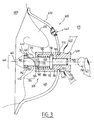
- Fig. 3 shows a second alternative embodiment of the protective mask respiratory system using a wrap-around commercial filter element.
- the mask consists of a cylindrical support 500 comprising on its wall exterior 510 and positioned at one of its ends 520, an imprint 530 allowing the gripping of the outer wall 510 of the cylindrical support 500 between two fingers 420 and 422 with one of his hands.
- This imprint 530 can for example be made on the entire periphery of the outer wall 510.
- a groove 540 is also produced on the outer wall 510 and makes it possible to receive a filter element 600 of the flexible or semi-rigid type, through an opening 610 practiced in its filtering part 620.
- the filtering element 600 is mounted so as to that its upstream part 630 can cover the nose 455 and the mouth 460 of the 400 person wearing the mask.
- the downstream part 631 of the filter element 600 is exposed to ambient air.
- An expulsion valve 640 of a construction similar to that described in the Fig. 1 is added through the filtering part 620.
- the cylindrical support 500 comprises a succession of coaxial housings.
- a first cylindrical housing 550 opens, on the one hand, through the end 520 and, on the other hand, in a second cylindrical housing 560 by a first shoulder 561.
- the internal diameter of the second cylindrical housing 560 is of dimension larger than the internal diameter of the first housing cylindrical 550.
- a cylindrical lumen 565 connects through a second shoulder 562, the second cylindrical housing 560, with a second end 570 of the support cylindrical 500.
- a conduit 700 in the shape of a part of revolution passes right through the cylindrical support 500.
- the conduit 700 comprises a mouth 705 consisting a jaw 710 of section 711 cylindrical or oval, emerging from the cylindrical support 500, and can be introduced into the oral cavity 445 and pinched at the back of the teeth 440 of the person.
- the 705 mouthpiece takes the form of a T in the cut of the Fig. 3.
- the conduit 700 also comprises a cylindrical part 720 which can slide in the cylindrical opening 565, a flange 730 able to move in the second cylindrical housing 560.
- a rod 740 extends the collar 730 and passes through the first housing cylindrical 550 opening at the end 520 of the cylindrical support 500.
- An O-ring 745 mounted on the rod 740 seals between the rod 740 and the first cylindrical housing 550.
- the free end of the rod 740 includes a pusher 750 which can be actuated by a third finger 421 of one of the person's hands for the purpose of slide the conduit 700 through the cylindrical support 500.
- An internal recess 760 passes axially through the jaw 710 and opens out laterally in the cylindrical part 720 of the mouth 705, as well as in the upstream part 630 of the filter element 600.
- a compression spring 800 is housed in the second cylindrical housing 560 between the second shoulder 562 and the collar 730, pushing it into abutment naturally on the first shoulder 561.
- a filter element 600 is mounted in the groove 540.
- the person 400 grasps the imprint 530 of the respiratory protection mask using two fingers 420 and 422, for example the thumb and middle finger, then, thanks to a third finger 421, for example the index finger, presses and axially displaces the pusher 750 while counteracting the compression spring 800.
- the mouth 705 comes out more from the support cylindrical 500 and can be introduced into the oral cavity 445, when the support cylindrical 500 provided with its filtering element 600 is applied around the nose 450 and the mouth 460 of the person 400. Under these conditions, the upstream part 630 is isolated from the downstream part 631 of the filter element 620.
- the person 400 then pinches the jaw 710 at the back of his teeth 440.
- Compression spring 800 pushes the flange 730 towards the first shoulder 561.
- the cylindrical support 500 provided with its filter element 600 is close to the jaw 710, which has the effect of allowing the filter element 600 to apply correctly around the edge of the nose 450 and the mouth 460 of the 400 person, to ensure a proper seal with the external environment.
- the respiratory protection mask is then put on and the two fingers 420 and 422 of the person can leave the 530 fingerprint.
- the person can breathe through the nose 420, or through the mouth 460 thanks to the internal recess 760 opening into the upstream part 630 of the filter element 600.
- the exhaled air is evacuated through the expulsion valve 640, while the air inspired is filtered by the filtering part 620 of the filtering element 600.
- the person To remove the respiratory protection mask, the person retains it while holding the imprint 530 between his two fingers 420 and 421 and by loosening the upper lips 441 and below 442.
- This construction variant of the respiratory protection mask allows also put it in place and remove it with one hand, and without touch neither the duct nor the filtering part. No contact also takes place between the hand and skin of the person when applying or removing the mask respiratory protection.
- the respiratory protection mask is also put on without having to deform the filtering part of the filtering element, which allows a flexible filter element to be correctly positioned.
- the protective mask can also use filter elements from the trade.
Landscapes
- Health & Medical Sciences (AREA)
- Pulmonology (AREA)
- General Health & Medical Sciences (AREA)
- Business, Economics & Management (AREA)
- Emergency Management (AREA)
- Respiratory Apparatuses And Protective Means (AREA)
Applications Claiming Priority (2)
| Application Number | Priority Date | Filing Date | Title |
|---|---|---|---|
| FR9901586A FR2789318B1 (fr) | 1999-02-08 | 1999-02-08 | Masque de protection respiratoire a usage intermittent |
| FR9901586 | 1999-02-08 |
Publications (1)
| Publication Number | Publication Date |
|---|---|
| EP1025877A1 true EP1025877A1 (de) | 2000-08-09 |
Family
ID=9541847
Family Applications (1)
| Application Number | Title | Priority Date | Filing Date |
|---|---|---|---|
| EP00400359A Withdrawn EP1025877A1 (de) | 1999-02-08 | 2000-02-08 | Atemschutzmaske für intermittierenden Gebrauch |
Country Status (2)
| Country | Link |
|---|---|
| EP (1) | EP1025877A1 (de) |
| FR (1) | FR2789318B1 (de) |
Citations (5)
| Publication number | Priority date | Publication date | Assignee | Title |
|---|---|---|---|---|
| GB2045091A (en) | 1979-03-19 | 1980-10-29 | Btr Industries Ltd | Improvements in or relating to facepieces |
| US4470413A (en) * | 1982-01-29 | 1984-09-11 | Dr/a/ gerwerk Aktiengesellschaft | Protective breathing apparatus including a mask and mouthpiece |
| US5186165A (en) * | 1991-06-05 | 1993-02-16 | Brookdale International Systems Inc. | Filtering canister with deployable hood and mouthpiece |
| EP0695561A1 (de) * | 1994-08-03 | 1996-02-07 | F.X.K. Patents Limited | Atemausrüstung |
| WO1996011037A1 (en) * | 1994-10-06 | 1996-04-18 | Philip Michael Leworthy | A filtering device |
-
1999
- 1999-02-08 FR FR9901586A patent/FR2789318B1/fr not_active Expired - Fee Related
-
2000
- 2000-02-08 EP EP00400359A patent/EP1025877A1/de not_active Withdrawn
Patent Citations (6)
| Publication number | Priority date | Publication date | Assignee | Title |
|---|---|---|---|---|
| GB2045091A (en) | 1979-03-19 | 1980-10-29 | Btr Industries Ltd | Improvements in or relating to facepieces |
| US4470413A (en) * | 1982-01-29 | 1984-09-11 | Dr/a/ gerwerk Aktiengesellschaft | Protective breathing apparatus including a mask and mouthpiece |
| US5186165A (en) * | 1991-06-05 | 1993-02-16 | Brookdale International Systems Inc. | Filtering canister with deployable hood and mouthpiece |
| US5315987A (en) * | 1991-06-05 | 1994-05-31 | Brookdale International Systems Inc. | Filtering canister with deployable hood and mouthpiece |
| EP0695561A1 (de) * | 1994-08-03 | 1996-02-07 | F.X.K. Patents Limited | Atemausrüstung |
| WO1996011037A1 (en) * | 1994-10-06 | 1996-04-18 | Philip Michael Leworthy | A filtering device |
Also Published As
| Publication number | Publication date |
|---|---|
| FR2789318B1 (fr) | 2001-11-02 |
| FR2789318A1 (fr) | 2000-08-11 |
Similar Documents
| Publication | Publication Date | Title |
|---|---|---|
| FR2734487A1 (fr) | Appareil respiratoire de sauvetage d'urgence | |
| US10912959B1 (en) | Breathable respirator mask with air filters and opening covers | |
| FR2548910A1 (fr) | Masque facial de respirateur | |
| CA2525563A1 (fr) | Masque respiratoire a protection hygienique | |
| FR2583645A1 (fr) | Respirateur | |
| FR2890568A1 (fr) | Dispositif portatif de distribution de gaz | |
| FR2543836A1 (fr) | Ensemble de masque respiratoire | |
| KR101250421B1 (ko) | 타인 보호용 위생마스크 | |
| GB2603285A (en) | Improvements relating to face masks | |
| FR2618340A1 (fr) | Perfectionnement a la fixation des masques respiratoires | |
| KR20160028202A (ko) | 마스크 | |
| WO2002098249A1 (fr) | Gant de protection ambidextre. | |
| FR3094236A1 (fr) | Système de masque pour les membres de l’équipage d'un avion | |
| KR101250425B1 (ko) | 타인 보호용 위생마스크 | |
| EP1025877A1 (de) | Atemschutzmaske für intermittierenden Gebrauch | |
| FR2466997A1 (fr) | Masque respiratoire comportant une soupape de respiration | |
| US5503167A (en) | Deformable face shield with mouthpiece | |
| WO2013004633A1 (fr) | Dispositif de maintien d'une articulation d'un utilisateur | |
| AU2010212282A1 (en) | Improved Respirator | |
| KR20210027723A (ko) | 코 호흡기 | |
| FR2771932A1 (fr) | Dispositif constitue de lunettes creuses permettant d'inspirer, par les narines de l'air provenant de filtres caches derriere les oreilles | |
| EP4005732B1 (de) | Tragbares werkzeug zur oberflächenbehandlung mit absaugung, das mit einem von einem handschuh getragenen ansatzstück versehen ist, und sein anwendungsverfahren | |
| KR200482144Y1 (ko) | 위생 마스크용 잠금용 지지대 | |
| FR2549730A1 (fr) | Masque de protection contre les gaz | |
| CH717014B1 (fr) | Masque de protection. |
Legal Events
| Date | Code | Title | Description |
|---|---|---|---|
| PUAI | Public reference made under article 153(3) epc to a published international application that has entered the european phase |
Free format text: ORIGINAL CODE: 0009012 |
|
| AK | Designated contracting states |
Kind code of ref document: A1 Designated state(s): AT BE CH CY DE DK ES FI FR GB GR IE IT LI LU MC NL PT SE |
|
| AX | Request for extension of the european patent |
Free format text: AL;LT;LV;MK;RO;SI |
|
| AKX | Designation fees paid | ||
| 17P | Request for examination filed |
Effective date: 20001208 |
|
| RBV | Designated contracting states (corrected) |
Designated state(s): AT BE CH CY DE DK ES FI FR GB GR IE IT LI LU MC NL PT SE |
|
| STAA | Information on the status of an ep patent application or granted ep patent |
Free format text: STATUS: THE APPLICATION IS DEEMED TO BE WITHDRAWN |
|
| 18D | Application deemed to be withdrawn |
Effective date: 20040901 |