EP1027346B1 - Derives photochromiques de naphtopyranes carbocycliquement fusionnes - Google Patents
Derives photochromiques de naphtopyranes carbocycliquement fusionnes Download PDFInfo
- Publication number
- EP1027346B1 EP1027346B1 EP98950777A EP98950777A EP1027346B1 EP 1027346 B1 EP1027346 B1 EP 1027346B1 EP 98950777 A EP98950777 A EP 98950777A EP 98950777 A EP98950777 A EP 98950777A EP 1027346 B1 EP1027346 B1 EP 1027346B1
- Authority
- EP
- European Patent Office
- Prior art keywords
- alkyl
- mono
- alkoxy
- group
- phenyl
- Prior art date
- Legal status (The legal status is an assumption and is not a legal conclusion. Google has not performed a legal analysis and makes no representation as to the accuracy of the status listed.)
- Expired - Lifetime
Links
- 150000001875 compounds Chemical class 0.000 claims abstract description 59
- 239000000463 material Substances 0.000 claims abstract description 40
- -1 dibenzofuranyl Chemical group 0.000 claims description 124
- 239000000178 monomer Substances 0.000 claims description 50
- 125000004191 (C1-C6) alkoxy group Chemical group 0.000 claims description 36
- 125000004169 (C1-C6) alkyl group Chemical group 0.000 claims description 35
- 125000006273 (C1-C3) alkyl group Chemical group 0.000 claims description 28
- 125000003118 aryl group Chemical group 0.000 claims description 28
- 125000001997 phenyl group Chemical group [H]C1=C([H])C([H])=C(*)C([H])=C1[H] 0.000 claims description 28
- 239000000126 substance Substances 0.000 claims description 25
- 125000006274 (C1-C3)alkoxy group Chemical group 0.000 claims description 22
- 125000001153 fluoro group Chemical group F* 0.000 claims description 20
- 230000003287 optical effect Effects 0.000 claims description 19
- 125000004178 (C1-C4) alkyl group Chemical group 0.000 claims description 18
- 125000001309 chloro group Chemical group Cl* 0.000 claims description 18
- 229920001577 copolymer Chemical compound 0.000 claims description 17
- 125000004171 alkoxy aryl group Chemical group 0.000 claims description 16
- 125000002877 alkyl aryl group Chemical group 0.000 claims description 16
- 125000004104 aryloxy group Chemical group 0.000 claims description 16
- 239000001257 hydrogen Substances 0.000 claims description 15
- 229910052739 hydrogen Inorganic materials 0.000 claims description 15
- 125000001544 thienyl group Chemical group 0.000 claims description 14
- 125000002541 furyl group Chemical group 0.000 claims description 13
- 125000004244 benzofuran-2-yl group Chemical group [H]C1=C(*)OC2=C([H])C([H])=C([H])C([H])=C12 0.000 claims description 12
- 125000004534 benzothien-2-yl group Chemical group S1C(=CC2=C1C=CC=C2)* 0.000 claims description 12
- 125000000000 cycloalkoxy group Chemical group 0.000 claims description 12
- 150000002430 hydrocarbons Chemical group 0.000 claims description 12
- 229920000642 polymer Polymers 0.000 claims description 12
- 229920006395 saturated elastomer Polymers 0.000 claims description 12
- 125000005913 (C3-C6) cycloalkyl group Chemical group 0.000 claims description 11
- 125000001072 heteroaryl group Chemical group 0.000 claims description 11
- QVGXLLKOCUKJST-UHFFFAOYSA-N atomic oxygen Chemical group [O] QVGXLLKOCUKJST-UHFFFAOYSA-N 0.000 claims description 10
- 125000001246 bromo group Chemical group Br* 0.000 claims description 10
- 239000001301 oxygen Chemical group 0.000 claims description 10
- 229910052760 oxygen Chemical group 0.000 claims description 10
- 125000004435 hydrogen atom Chemical class [H]* 0.000 claims description 9
- 125000001424 substituent group Chemical group 0.000 claims description 9
- XFCMNSHQOZQILR-UHFFFAOYSA-N 2-[2-(2-methylprop-2-enoyloxy)ethoxy]ethyl 2-methylprop-2-enoate Chemical compound CC(=C)C(=O)OCCOCCOC(=O)C(C)=C XFCMNSHQOZQILR-UHFFFAOYSA-N 0.000 claims description 8
- OKTJSMMVPCPJKN-UHFFFAOYSA-N Carbon Chemical group [C] OKTJSMMVPCPJKN-UHFFFAOYSA-N 0.000 claims description 8
- UFHFLCQGNIYNRP-UHFFFAOYSA-N Hydrogen Chemical compound [H][H] UFHFLCQGNIYNRP-UHFFFAOYSA-N 0.000 claims description 8
- 238000010521 absorption reaction Methods 0.000 claims description 8
- 229910052799 carbon Inorganic materials 0.000 claims description 8
- JHQVCQDWGSXTFE-UHFFFAOYSA-N 2-(2-prop-2-enoxycarbonyloxyethoxy)ethyl prop-2-enyl carbonate Chemical compound C=CCOC(=O)OCCOCCOC(=O)OCC=C JHQVCQDWGSXTFE-UHFFFAOYSA-N 0.000 claims description 7
- PPBRXRYQALVLMV-UHFFFAOYSA-N Styrene Chemical compound C=CC1=CC=CC=C1 PPBRXRYQALVLMV-UHFFFAOYSA-N 0.000 claims description 7
- 125000001624 naphthyl group Chemical group 0.000 claims description 7
- 125000006559 (C1-C3) alkylamino group Chemical group 0.000 claims description 6
- 125000000229 (C1-C4)alkoxy group Chemical group 0.000 claims description 6
- 125000004890 (C1-C6) alkylamino group Chemical group 0.000 claims description 6
- 125000002733 (C1-C6) fluoroalkyl group Chemical group 0.000 claims description 6
- NIXOWILDQLNWCW-UHFFFAOYSA-M Acrylate Chemical compound [O-]C(=O)C=C NIXOWILDQLNWCW-UHFFFAOYSA-M 0.000 claims description 6
- JKJWYKGYGWOAHT-UHFFFAOYSA-N bis(prop-2-enyl) carbonate Chemical compound C=CCOC(=O)OCC=C JKJWYKGYGWOAHT-UHFFFAOYSA-N 0.000 claims description 6
- 125000004965 chloroalkyl group Chemical group 0.000 claims description 6
- QUZSUMLPWDHKCJ-UHFFFAOYSA-N bisphenol A dimethacrylate Chemical class C1=CC(OC(=O)C(=C)C)=CC=C1C(C)(C)C1=CC=C(OC(=O)C(C)=C)C=C1 QUZSUMLPWDHKCJ-UHFFFAOYSA-N 0.000 claims description 5
- IJGRMHOSHXDMSA-UHFFFAOYSA-N nitrogen Substances N#N IJGRMHOSHXDMSA-UHFFFAOYSA-N 0.000 claims description 5
- 229910052757 nitrogen Inorganic materials 0.000 claims description 5
- 229920001223 polyethylene glycol Polymers 0.000 claims description 5
- 239000004814 polyurethane Substances 0.000 claims description 5
- 229920002635 polyurethane Polymers 0.000 claims description 5
- HIACAHMKXQESOV-UHFFFAOYSA-N 1,2-bis(prop-1-en-2-yl)benzene Chemical compound CC(=C)C1=CC=CC=C1C(C)=C HIACAHMKXQESOV-UHFFFAOYSA-N 0.000 claims description 4
- SKESERDUDQOXKM-UHFFFAOYSA-N 2-methylprop-2-enoic acid;phenol Chemical class CC(=C)C(O)=O.CC(=C)C(O)=O.OC1=CC=CC=C1 SKESERDUDQOXKM-UHFFFAOYSA-N 0.000 claims description 4
- 125000004532 benzofuran-3-yl group Chemical group O1C=C(C2=C1C=CC=C2)* 0.000 claims description 4
- 125000004197 benzothien-3-yl group Chemical group [H]C1=C(*)C2=C([H])C([H])=C([H])C([H])=C2S1 0.000 claims description 4
- 125000000609 carbazolyl group Chemical group C1(=CC=CC=2C3=CC=CC=C3NC12)* 0.000 claims description 4
- 125000000753 cycloalkyl group Chemical group 0.000 claims description 4
- 125000004367 cycloalkylaryl group Chemical group 0.000 claims description 4
- 125000004986 diarylamino group Chemical group 0.000 claims description 4
- 125000004988 dibenzothienyl group Chemical group C1(=CC=CC=2SC3=C(C21)C=CC=C3)* 0.000 claims description 4
- 125000003983 fluorenyl group Chemical group C1(=CC=CC=2C3=CC=CC=C3CC12)* 0.000 claims description 4
- 125000003709 fluoroalkyl group Chemical group 0.000 claims description 4
- 125000002496 methyl group Chemical group [H]C([H])([H])* 0.000 claims description 4
- 150000002829 nitrogen Chemical class 0.000 claims description 4
- 125000000587 piperidin-1-yl group Chemical group [H]C1([H])N(*)C([H])([H])C([H])([H])C([H])([H])C1([H])[H] 0.000 claims description 4
- 229920002037 poly(vinyl butyral) polymer Polymers 0.000 claims description 4
- 239000004926 polymethyl methacrylate Substances 0.000 claims description 4
- 229920002689 polyvinyl acetate Polymers 0.000 claims description 4
- 239000011118 polyvinyl acetate Substances 0.000 claims description 4
- 125000002924 primary amino group Chemical group [H]N([H])* 0.000 claims description 4
- 125000004076 pyridyl group Chemical group 0.000 claims description 4
- 239000011347 resin Substances 0.000 claims description 4
- 229920005989 resin Polymers 0.000 claims description 4
- 239000007787 solid Substances 0.000 claims description 4
- 229920001169 thermoplastic Polymers 0.000 claims description 4
- 239000004416 thermosoftening plastic Substances 0.000 claims description 4
- KYVKMMSHBWHUIX-UHFFFAOYSA-N 2,2-bis(4-methoxyphenyl)-5,6,7,8-tetrahydrophenanthro[9,10-b]pyran Chemical compound C1=CC(OC)=CC=C1C1(C=2C=CC(OC)=CC=2)C=CC(C2=C(CCCC2)C=2C3=CC=CC=2)=C3O1 KYVKMMSHBWHUIX-UHFFFAOYSA-N 0.000 claims description 3
- GTELLNMUWNJXMQ-UHFFFAOYSA-N 2-ethyl-2-(hydroxymethyl)propane-1,3-diol;prop-2-enoic acid Chemical class OC(=O)C=C.OC(=O)C=C.OC(=O)C=C.CCC(CO)(CO)CO GTELLNMUWNJXMQ-UHFFFAOYSA-N 0.000 claims description 3
- 239000004793 Polystyrene Substances 0.000 claims description 3
- 229920002301 cellulose acetate Polymers 0.000 claims description 3
- 229920006217 cellulose acetate butyrate Polymers 0.000 claims description 3
- STVZJERGLQHEKB-UHFFFAOYSA-N ethylene glycol dimethacrylate Chemical compound CC(=C)C(=O)OCCOC(=O)C(C)=C STVZJERGLQHEKB-UHFFFAOYSA-N 0.000 claims description 3
- 229920003229 poly(methyl methacrylate) Polymers 0.000 claims description 3
- 239000004417 polycarbonate Substances 0.000 claims description 3
- 229920000515 polycarbonate Polymers 0.000 claims description 3
- 229920000728 polyester Polymers 0.000 claims description 3
- 229920002223 polystyrene Polymers 0.000 claims description 3
- OOXMQACSWCZQLX-UHFFFAOYSA-N 3,9-bis(ethenyl)-2,4,8,10-tetraoxaspiro[5.5]undecane Chemical compound C1OC(C=C)OCC21COC(C=C)OC2 OOXMQACSWCZQLX-UHFFFAOYSA-N 0.000 claims description 2
- NPYBIWXHVOUHRF-UHFFFAOYSA-N 6,6-diphenyl-11-oxatetracyclo[8.7.0.01,14.04,9]heptadeca-2,4,7,9,14,16-hexaene Chemical compound C1=CC2=C3OCCC4=CC=CC43C=CC2=CC1(C=1C=CC=CC=1)C1=CC=CC=C1 NPYBIWXHVOUHRF-UHFFFAOYSA-N 0.000 claims description 2
- 229920008347 Cellulose acetate propionate Polymers 0.000 claims description 2
- 229920002284 Cellulose triacetate Polymers 0.000 claims description 2
- CERQOIWHTDAKMF-UHFFFAOYSA-M Methacrylate Chemical compound CC(=C)C([O-])=O CERQOIWHTDAKMF-UHFFFAOYSA-M 0.000 claims description 2
- 229920001328 Polyvinylidene chloride Polymers 0.000 claims description 2
- NNLVGZFZQQXQNW-ADJNRHBOSA-N [(2r,3r,4s,5r,6s)-4,5-diacetyloxy-3-[(2s,3r,4s,5r,6r)-3,4,5-triacetyloxy-6-(acetyloxymethyl)oxan-2-yl]oxy-6-[(2r,3r,4s,5r,6s)-4,5,6-triacetyloxy-2-(acetyloxymethyl)oxan-3-yl]oxyoxan-2-yl]methyl acetate Chemical compound O([C@@H]1O[C@@H]([C@H]([C@H](OC(C)=O)[C@H]1OC(C)=O)O[C@H]1[C@@H]([C@@H](OC(C)=O)[C@H](OC(C)=O)[C@@H](COC(C)=O)O1)OC(C)=O)COC(=O)C)[C@@H]1[C@@H](COC(C)=O)O[C@@H](OC(C)=O)[C@H](OC(C)=O)[C@H]1OC(C)=O NNLVGZFZQQXQNW-ADJNRHBOSA-N 0.000 claims description 2
- 125000002252 acyl group Chemical group 0.000 claims description 2
- 150000008371 chromenes Chemical class 0.000 claims description 2
- UHESRSKEBRADOO-UHFFFAOYSA-N ethyl carbamate;prop-2-enoic acid Chemical compound OC(=O)C=C.CCOC(N)=O UHESRSKEBRADOO-UHFFFAOYSA-N 0.000 claims description 2
- 125000004407 fluoroaryl group Chemical group 0.000 claims description 2
- VOZRXNHHFUQHIL-UHFFFAOYSA-N glycidyl methacrylate Chemical compound CC(=C)C(=O)OCC1CO1 VOZRXNHHFUQHIL-UHFFFAOYSA-N 0.000 claims description 2
- QJGQUHMNIGDVPM-UHFFFAOYSA-N nitrogen group Chemical group [N] QJGQUHMNIGDVPM-UHFFFAOYSA-N 0.000 claims description 2
- 150000004893 oxazines Chemical class 0.000 claims description 2
- RPQRDASANLAFCM-UHFFFAOYSA-N oxiran-2-ylmethyl prop-2-enoate Chemical compound C=CC(=O)OCC1CO1 RPQRDASANLAFCM-UHFFFAOYSA-N 0.000 claims description 2
- 125000005702 oxyalkylene group Chemical group 0.000 claims description 2
- QIWKUEJZZCOPFV-UHFFFAOYSA-N phenyl 2-methylprop-2-enoate Chemical class CC(=C)C(=O)OC1=CC=CC=C1 QIWKUEJZZCOPFV-UHFFFAOYSA-N 0.000 claims description 2
- 229920003251 poly(α-methylstyrene) Polymers 0.000 claims description 2
- 229920000139 polyethylene terephthalate Polymers 0.000 claims description 2
- 239000005020 polyethylene terephthalate Substances 0.000 claims description 2
- 229920002451 polyvinyl alcohol Polymers 0.000 claims description 2
- 239000004800 polyvinyl chloride Substances 0.000 claims description 2
- 229920000915 polyvinyl chloride Polymers 0.000 claims description 2
- 150000005846 sugar alcohols Polymers 0.000 claims description 2
- 125000002887 hydroxy group Chemical group [H]O* 0.000 claims 4
- XGIZPIRKALPEKJ-UHFFFAOYSA-N 2,2-diphenyl-5,6,7,8-tetrahydrophenanthro[9,10-b]pyran Chemical compound C1CCCC(C2=CC=CC=C2C=2O3)=C1C=2C=CC3(C=1C=CC=CC=1)C1=CC=CC=C1 XGIZPIRKALPEKJ-UHFFFAOYSA-N 0.000 claims 1
- 150000004880 oxines Chemical class 0.000 abstract 2
- WYURNTSHIVDZCO-UHFFFAOYSA-N Tetrahydrofuran Chemical compound C1CCOC1 WYURNTSHIVDZCO-UHFFFAOYSA-N 0.000 description 18
- 238000006243 chemical reaction Methods 0.000 description 18
- 239000000203 mixture Substances 0.000 description 18
- 238000012360 testing method Methods 0.000 description 15
- 125000004309 pyranyl group Chemical class O1C(C=CC=C1)* 0.000 description 14
- JOXIMZWYDAKGHI-UHFFFAOYSA-N toluene-4-sulfonic acid Chemical compound CC1=CC=C(S(O)(=O)=O)C=C1 JOXIMZWYDAKGHI-UHFFFAOYSA-N 0.000 description 12
- LFQSCWFLJHTTHZ-UHFFFAOYSA-N Ethanol Chemical compound CCO LFQSCWFLJHTTHZ-UHFFFAOYSA-N 0.000 description 11
- 239000002904 solvent Substances 0.000 description 11
- 125000003003 spiro group Chemical group 0.000 description 11
- UHOVQNZJYSORNB-UHFFFAOYSA-N monobenzene Natural products C1=CC=CC=C1 UHOVQNZJYSORNB-UHFFFAOYSA-N 0.000 description 10
- 230000007935 neutral effect Effects 0.000 description 10
- KWYUFKZDYYNOTN-UHFFFAOYSA-M Potassium hydroxide Chemical compound [OH-].[K+] KWYUFKZDYYNOTN-UHFFFAOYSA-M 0.000 description 9
- YLQBMQCUIZJEEH-UHFFFAOYSA-N tetrahydrofuran Natural products C=1C=COC=1 YLQBMQCUIZJEEH-UHFFFAOYSA-N 0.000 description 9
- HEDRZPFGACZZDS-UHFFFAOYSA-N Chloroform Chemical compound ClC(Cl)Cl HEDRZPFGACZZDS-UHFFFAOYSA-N 0.000 description 8
- SIKJAQJRHWYJAI-UHFFFAOYSA-N Indole Chemical compound C1=CC=C2NC=CC2=C1 SIKJAQJRHWYJAI-UHFFFAOYSA-N 0.000 description 8
- 239000002253 acid Substances 0.000 description 8
- XLYOFNOQVPJJNP-UHFFFAOYSA-N water Substances O XLYOFNOQVPJJNP-UHFFFAOYSA-N 0.000 description 8
- HIXDQWDOVZUNNA-UHFFFAOYSA-N 2-(3,4-dimethoxyphenyl)-5-hydroxy-7-methoxychromen-4-one Chemical compound C=1C(OC)=CC(O)=C(C(C=2)=O)C=1OC=2C1=CC=C(OC)C(OC)=C1 HIXDQWDOVZUNNA-UHFFFAOYSA-N 0.000 description 7
- VCMLCMCXCRBSQO-UHFFFAOYSA-N 3h-benzo[f]chromene Chemical class C1=CC=CC2=C(C=CCO3)C3=CC=C21 VCMLCMCXCRBSQO-UHFFFAOYSA-N 0.000 description 7
- 230000008859 change Effects 0.000 description 7
- RTZKZFJDLAIYFH-UHFFFAOYSA-N ether Substances CCOCC RTZKZFJDLAIYFH-UHFFFAOYSA-N 0.000 description 7
- 238000000034 method Methods 0.000 description 7
- CSCPPACGZOOCGX-UHFFFAOYSA-N Acetone Chemical compound CC(C)=O CSCPPACGZOOCGX-UHFFFAOYSA-N 0.000 description 5
- 239000002585 base Substances 0.000 description 5
- 229920003023 plastic Polymers 0.000 description 5
- 239000004033 plastic Substances 0.000 description 5
- 229920000137 polyphosphoric acid Polymers 0.000 description 5
- 230000005855 radiation Effects 0.000 description 5
- 239000011541 reaction mixture Substances 0.000 description 5
- KJCVRFUGPWSIIH-UHFFFAOYSA-N 1-naphthol Chemical compound C1=CC=C2C(O)=CC=CC2=C1 KJCVRFUGPWSIIH-UHFFFAOYSA-N 0.000 description 4
- UJBOOUHRTQVGRU-UHFFFAOYSA-N 3-methylcyclohexan-1-one Chemical compound CC1CCCC(=O)C1 UJBOOUHRTQVGRU-UHFFFAOYSA-N 0.000 description 4
- SECXISVLQFMRJM-UHFFFAOYSA-N N-Methylpyrrolidone Chemical compound CN1CCCC1=O SECXISVLQFMRJM-UHFFFAOYSA-N 0.000 description 4
- PMZURENOXWZQFD-UHFFFAOYSA-L Sodium Sulfate Chemical compound [Na+].[Na+].[O-]S([O-])(=O)=O PMZURENOXWZQFD-UHFFFAOYSA-L 0.000 description 4
- XTXRWKRVRITETP-UHFFFAOYSA-N Vinyl acetate Chemical compound CC(=O)OC=C XTXRWKRVRITETP-UHFFFAOYSA-N 0.000 description 4
- 150000001562 benzopyrans Chemical class 0.000 description 4
- 230000000295 complement effect Effects 0.000 description 4
- 125000004386 diacrylate group Chemical group 0.000 description 4
- 239000000975 dye Substances 0.000 description 4
- 125000004356 hydroxy functional group Chemical group O* 0.000 description 4
- 125000006413 ring segment Chemical group 0.000 description 4
- 238000001228 spectrum Methods 0.000 description 4
- 238000012546 transfer Methods 0.000 description 4
- UKEWNKMLBUUDAS-UHFFFAOYSA-N 11-oxatetracyclo[8.7.0.02,7.013,17]heptadeca-1(10),2,4,6,8,12,14,16-octaene Chemical class C1=CC=CC2=C(C=3C(C=CC=3)=CO3)C3=CC=C21 UKEWNKMLBUUDAS-UHFFFAOYSA-N 0.000 description 3
- FAQVDANXTSFXGA-UHFFFAOYSA-N 2,3-dihydro-1h-benzo[g]indole Chemical compound C1=CC=CC2=C(NCC3)C3=CC=C21 FAQVDANXTSFXGA-UHFFFAOYSA-N 0.000 description 3
- AJISOTXJRAKMCS-UHFFFAOYSA-N 2-(2-hydroxy-2-phenylcyclohexyl)acetic acid Chemical compound OC(=O)CC1CCCCC1(O)C1=CC=CC=C1 AJISOTXJRAKMCS-UHFFFAOYSA-N 0.000 description 3
- ZWEHNKRNPOVVGH-UHFFFAOYSA-N 2-Butanone Chemical compound CCC(C)=O ZWEHNKRNPOVVGH-UHFFFAOYSA-N 0.000 description 3
- BIXBNZDQRGVVJE-UHFFFAOYSA-N 2h-naphtho[2,1-f]chromene Chemical class C1=CC=C2C3=CC=C4OCC=CC4=C3C=CC2=C1 BIXBNZDQRGVVJE-UHFFFAOYSA-N 0.000 description 3
- QGJOPFRUJISHPQ-UHFFFAOYSA-N Carbon disulfide Chemical compound S=C=S QGJOPFRUJISHPQ-UHFFFAOYSA-N 0.000 description 3
- YMWUJEATGCHHMB-UHFFFAOYSA-N Dichloromethane Chemical compound ClCCl YMWUJEATGCHHMB-UHFFFAOYSA-N 0.000 description 3
- XEKOWRVHYACXOJ-UHFFFAOYSA-N Ethyl acetate Chemical compound CCOC(C)=O XEKOWRVHYACXOJ-UHFFFAOYSA-N 0.000 description 3
- LYCAIKOWRPUZTN-UHFFFAOYSA-N Ethylene glycol Chemical compound OCCO LYCAIKOWRPUZTN-UHFFFAOYSA-N 0.000 description 3
- OKKJLVBELUTLKV-UHFFFAOYSA-N Methanol Chemical compound OC OKKJLVBELUTLKV-UHFFFAOYSA-N 0.000 description 3
- YXFVVABEGXRONW-UHFFFAOYSA-N Toluene Chemical compound CC1=CC=CC=C1 YXFVVABEGXRONW-UHFFFAOYSA-N 0.000 description 3
- 230000004913 activation Effects 0.000 description 3
- IISBACLAFKSPIT-UHFFFAOYSA-N bisphenol A Chemical compound C=1C=C(O)C=CC=1C(C)(C)C1=CC=C(O)C=C1 IISBACLAFKSPIT-UHFFFAOYSA-N 0.000 description 3
- 239000007844 bleaching agent Substances 0.000 description 3
- 125000004432 carbon atom Chemical group C* 0.000 description 3
- 239000003086 colorant Substances 0.000 description 3
- 229920001519 homopolymer Polymers 0.000 description 3
- 150000002576 ketones Chemical class 0.000 description 3
- 125000000325 methylidene group Chemical group [H]C([H])=* 0.000 description 3
- 238000000655 nuclear magnetic resonance spectrum Methods 0.000 description 3
- 239000003960 organic solvent Substances 0.000 description 3
- 229920005862 polyol Polymers 0.000 description 3
- 150000003077 polyols Chemical class 0.000 description 3
- TVDSBUOJIPERQY-UHFFFAOYSA-N prop-2-yn-1-ol Chemical compound OCC#C TVDSBUOJIPERQY-UHFFFAOYSA-N 0.000 description 3
- 230000002441 reversible effect Effects 0.000 description 3
- 238000002834 transmittance Methods 0.000 description 3
- 238000001429 visible spectrum Methods 0.000 description 3
- LBUJPTNKIBCYBY-UHFFFAOYSA-N 1,2,3,4-tetrahydroquinoline Chemical compound C1=CC=C2CCCNC2=C1 LBUJPTNKIBCYBY-UHFFFAOYSA-N 0.000 description 2
- OZAIFHULBGXAKX-UHFFFAOYSA-N 2-(2-cyanopropan-2-yldiazenyl)-2-methylpropanenitrile Chemical compound N#CC(C)(C)N=NC(C)(C)C#N OZAIFHULBGXAKX-UHFFFAOYSA-N 0.000 description 2
- VCDAWCBLCCVSKE-UHFFFAOYSA-N 2h-benzo[h]chromene Chemical class C1=CC2=CC=CC=C2C2=C1C=CCO2 VCDAWCBLCCVSKE-UHFFFAOYSA-N 0.000 description 2
- 238000005727 Friedel-Crafts reaction Methods 0.000 description 2
- 239000007818 Grignard reagent Substances 0.000 description 2
- VEXZGXHMUGYJMC-UHFFFAOYSA-N Hydrochloric acid Chemical compound Cl VEXZGXHMUGYJMC-UHFFFAOYSA-N 0.000 description 2
- 238000005481 NMR spectroscopy Methods 0.000 description 2
- UFWIBTONFRDIAS-UHFFFAOYSA-N Naphthalene Chemical compound C1=CC=CC2=CC=CC=C21 UFWIBTONFRDIAS-UHFFFAOYSA-N 0.000 description 2
- VYPSYNLAJGMNEJ-UHFFFAOYSA-N Silicium dioxide Chemical compound O=[Si]=O VYPSYNLAJGMNEJ-UHFFFAOYSA-N 0.000 description 2
- 239000001089 [(2R)-oxolan-2-yl]methanol Substances 0.000 description 2
- 238000002835 absorbance Methods 0.000 description 2
- VSCWAEJMTAWNJL-UHFFFAOYSA-K aluminium trichloride Chemical compound Cl[Al](Cl)Cl VSCWAEJMTAWNJL-UHFFFAOYSA-K 0.000 description 2
- 125000002837 carbocyclic group Chemical group 0.000 description 2
- 238000000576 coating method Methods 0.000 description 2
- 238000001816 cooling Methods 0.000 description 2
- SBZXBUIDTXKZTM-UHFFFAOYSA-N diglyme Chemical compound COCCOCCOC SBZXBUIDTXKZTM-UHFFFAOYSA-N 0.000 description 2
- 230000000694 effects Effects 0.000 description 2
- 239000012259 ether extract Substances 0.000 description 2
- 238000005213 imbibition Methods 0.000 description 2
- QSHDDOUJBYECFT-UHFFFAOYSA-N mercury Chemical compound [Hg] QSHDDOUJBYECFT-UHFFFAOYSA-N 0.000 description 2
- 229910052753 mercury Inorganic materials 0.000 description 2
- ANRQGKOBLBYXFM-UHFFFAOYSA-M phenylmagnesium bromide Chemical compound Br[Mg]C1=CC=CC=C1 ANRQGKOBLBYXFM-UHFFFAOYSA-M 0.000 description 2
- 239000002985 plastic film Substances 0.000 description 2
- 230000035945 sensitivity Effects 0.000 description 2
- 239000000741 silica gel Substances 0.000 description 2
- 229910002027 silica gel Inorganic materials 0.000 description 2
- BSYVTEYKTMYBMK-UHFFFAOYSA-N tetrahydrofurfuryl alcohol Chemical compound OCC1CCCO1 BSYVTEYKTMYBMK-UHFFFAOYSA-N 0.000 description 2
- HTSABYAWKQAHBT-UHFFFAOYSA-N trans 3-methylcyclohexanol Natural products CC1CCCC(O)C1 HTSABYAWKQAHBT-UHFFFAOYSA-N 0.000 description 2
- WFKWXMTUELFFGS-UHFFFAOYSA-N tungsten Chemical compound [W] WFKWXMTUELFFGS-UHFFFAOYSA-N 0.000 description 2
- 229910052721 tungsten Inorganic materials 0.000 description 2
- 239000010937 tungsten Substances 0.000 description 2
- 238000012795 verification Methods 0.000 description 2
- 229910052724 xenon Inorganic materials 0.000 description 2
- FHNFHKCVQCLJFQ-UHFFFAOYSA-N xenon atom Chemical compound [Xe] FHNFHKCVQCLJFQ-UHFFFAOYSA-N 0.000 description 2
- HSOOIVBINKDISP-UHFFFAOYSA-N 1-(2-methylprop-2-enoyloxy)butyl 2-methylprop-2-enoate Chemical compound CC(=C)C(=O)OC(CCC)OC(=O)C(C)=C HSOOIVBINKDISP-UHFFFAOYSA-N 0.000 description 1
- HTBXJIRLFMEKSS-UHFFFAOYSA-N 2-(2-hydroxy-2-phenylcyclopentyl)acetic acid Chemical compound OC(=O)CC1CCCC1(O)C1=CC=CC=C1 HTBXJIRLFMEKSS-UHFFFAOYSA-N 0.000 description 1
- HWSSEYVMGDIFMH-UHFFFAOYSA-N 2-[2-[2-(2-methylprop-2-enoyloxy)ethoxy]ethoxy]ethyl 2-methylprop-2-enoate Chemical compound CC(=C)C(=O)OCCOCCOCCOC(=O)C(C)=C HWSSEYVMGDIFMH-UHFFFAOYSA-N 0.000 description 1
- 125000003903 2-propenyl group Chemical group [H]C([*])([H])C([H])=C([H])[H] 0.000 description 1
- 125000003682 3-furyl group Chemical group O1C([H])=C([*])C([H])=C1[H] 0.000 description 1
- 125000001541 3-thienyl group Chemical group S1C([H])=C([*])C([H])=C1[H] 0.000 description 1
- VXXGQSQWBILDHH-UHFFFAOYSA-N 6,6-bis(4-methoxyphenyl)-11-oxatetracyclo[8.7.0.01,14.04,9]heptadeca-2,4,7,9,14,16-hexaene Chemical compound C1=CC(OC)=CC=C1C1(C=2C=CC(OC)=CC=2)C=C2C=CC34C=CC=C4CCOC3=C2C=C1 VXXGQSQWBILDHH-UHFFFAOYSA-N 0.000 description 1
- OZAIFHULBGXAKX-VAWYXSNFSA-N AIBN Substances N#CC(C)(C)\N=N\C(C)(C)C#N OZAIFHULBGXAKX-VAWYXSNFSA-N 0.000 description 1
- NLHHRLWOUZZQLW-UHFFFAOYSA-N Acrylonitrile Chemical compound C=CC#N NLHHRLWOUZZQLW-UHFFFAOYSA-N 0.000 description 1
- 229920002799 BoPET Polymers 0.000 description 1
- BVKZGUZCCUSVTD-UHFFFAOYSA-L Carbonate Chemical compound [O-]C([O-])=O BVKZGUZCCUSVTD-UHFFFAOYSA-L 0.000 description 1
- DQEFEBPAPFSJLV-UHFFFAOYSA-N Cellulose propionate Chemical compound CCC(=O)OCC1OC(OC(=O)CC)C(OC(=O)CC)C(OC(=O)CC)C1OC1C(OC(=O)CC)C(OC(=O)CC)C(OC(=O)CC)C(COC(=O)CC)O1 DQEFEBPAPFSJLV-UHFFFAOYSA-N 0.000 description 1
- XDTMQSROBMDMFD-UHFFFAOYSA-N Cyclohexane Chemical compound C1CCCCC1 XDTMQSROBMDMFD-UHFFFAOYSA-N 0.000 description 1
- JIGUQPWFLRLWPJ-UHFFFAOYSA-N Ethyl acrylate Chemical compound CCOC(=O)C=C JIGUQPWFLRLWPJ-UHFFFAOYSA-N 0.000 description 1
- 238000005863 Friedel-Crafts acylation reaction Methods 0.000 description 1
- 229920004142 LEXAN™ Polymers 0.000 description 1
- 239000002841 Lewis acid Substances 0.000 description 1
- 239000004418 Lexan Substances 0.000 description 1
- VVQNEPGJFQJSBK-UHFFFAOYSA-N Methyl methacrylate Chemical compound COC(=O)C(C)=C VVQNEPGJFQJSBK-UHFFFAOYSA-N 0.000 description 1
- 239000005041 Mylar™ Substances 0.000 description 1
- CTQNGGLPUBDAKN-UHFFFAOYSA-N O-Xylene Chemical compound CC1=CC=CC=C1C CTQNGGLPUBDAKN-UHFFFAOYSA-N 0.000 description 1
- YGYAWVDWMABLBF-UHFFFAOYSA-N Phosgene Chemical compound ClC(Cl)=O YGYAWVDWMABLBF-UHFFFAOYSA-N 0.000 description 1
- 229920005372 Plexiglas® Polymers 0.000 description 1
- 239000002202 Polyethylene glycol Substances 0.000 description 1
- 229910021627 Tin(IV) chloride Inorganic materials 0.000 description 1
- 230000003213 activating effect Effects 0.000 description 1
- 150000001266 acyl halides Chemical class 0.000 description 1
- DCBMHXCACVDWJZ-UHFFFAOYSA-N adamantylidene Chemical group C1C(C2)CC3[C]C1CC2C3 DCBMHXCACVDWJZ-UHFFFAOYSA-N 0.000 description 1
- 239000000654 additive Substances 0.000 description 1
- 150000008365 aromatic ketones Chemical class 0.000 description 1
- 230000008901 benefit Effects 0.000 description 1
- 150000001555 benzenes Chemical class 0.000 description 1
- 239000012965 benzophenone Substances 0.000 description 1
- 150000008366 benzophenones Chemical class 0.000 description 1
- 150000005130 benzoxazines Chemical class 0.000 description 1
- PASDCCFISLVPSO-UHFFFAOYSA-N benzoyl chloride Chemical class ClC(=O)C1=CC=CC=C1 PASDCCFISLVPSO-UHFFFAOYSA-N 0.000 description 1
- OOSCHYDNHHSIKU-UHFFFAOYSA-N bicyclo[4.3.2]undecane Chemical compound C1CC2CCCC1CCCC2 OOSCHYDNHHSIKU-UHFFFAOYSA-N 0.000 description 1
- 230000005540 biological transmission Effects 0.000 description 1
- 230000015572 biosynthetic process Effects 0.000 description 1
- CQEYYJKEWSMYFG-UHFFFAOYSA-N butyl acrylate Chemical compound CCCCOC(=O)C=C CQEYYJKEWSMYFG-UHFFFAOYSA-N 0.000 description 1
- 238000005266 casting Methods 0.000 description 1
- 229920001727 cellulose butyrate Polymers 0.000 description 1
- 229920006218 cellulose propionate Polymers 0.000 description 1
- QZHPTGXQGDFGEN-UHFFFAOYSA-N chromene Chemical compound C1=CC=C2C=C[CH]OC2=C1 QZHPTGXQGDFGEN-UHFFFAOYSA-N 0.000 description 1
- 239000011248 coating agent Substances 0.000 description 1
- 239000008199 coating composition Substances 0.000 description 1
- 238000004040 coloring Methods 0.000 description 1
- 230000000052 comparative effect Effects 0.000 description 1
- 229910000365 copper sulfate Inorganic materials 0.000 description 1
- ARUVKPQLZAKDPS-UHFFFAOYSA-L copper(II) sulfate Chemical compound [Cu+2].[O-][S+2]([O-])([O-])[O-] ARUVKPQLZAKDPS-UHFFFAOYSA-L 0.000 description 1
- 230000003247 decreasing effect Effects 0.000 description 1
- 238000010586 diagram Methods 0.000 description 1
- 229910003460 diamond Inorganic materials 0.000 description 1
- 239000010432 diamond Substances 0.000 description 1
- 230000005670 electromagnetic radiation Effects 0.000 description 1
- 238000005516 engineering process Methods 0.000 description 1
- 125000003700 epoxy group Chemical group 0.000 description 1
- 125000000524 functional group Chemical group 0.000 description 1
- 239000011521 glass Substances 0.000 description 1
- 238000010438 heat treatment Methods 0.000 description 1
- 150000002390 heteroarenes Chemical class 0.000 description 1
- 150000002391 heterocyclic compounds Chemical class 0.000 description 1
- 125000000623 heterocyclic group Chemical group 0.000 description 1
- 150000002431 hydrogen Chemical class 0.000 description 1
- 238000007654 immersion Methods 0.000 description 1
- 239000004615 ingredient Substances 0.000 description 1
- 150000007517 lewis acids Chemical class 0.000 description 1
- 239000011159 matrix material Substances 0.000 description 1
- 238000005259 measurement Methods 0.000 description 1
- 230000007246 mechanism Effects 0.000 description 1
- 150000002734 metacrylic acid derivatives Chemical class 0.000 description 1
- 238000012544 monitoring process Methods 0.000 description 1
- SFDZETWZUCDYMD-UHFFFAOYSA-N monosodium acetylide Chemical compound [Na+].[C-]#C SFDZETWZUCDYMD-UHFFFAOYSA-N 0.000 description 1
- 239000011368 organic material Substances 0.000 description 1
- 239000003973 paint Substances 0.000 description 1
- PNJWIWWMYCMZRO-UHFFFAOYSA-N pent‐4‐en‐2‐one Natural products CC(=O)CC=C PNJWIWWMYCMZRO-UHFFFAOYSA-N 0.000 description 1
- 229920006255 plastic film Polymers 0.000 description 1
- 229920000058 polyacrylate Polymers 0.000 description 1
- 229920005668 polycarbonate resin Polymers 0.000 description 1
- 239000004431 polycarbonate resin Substances 0.000 description 1
- 238000006116 polymerization reaction Methods 0.000 description 1
- 229920001451 polypropylene glycol Polymers 0.000 description 1
- 125000006239 protecting group Chemical group 0.000 description 1
- 238000010992 reflux Methods 0.000 description 1
- 230000004044 response Effects 0.000 description 1
- 230000025600 response to UV Effects 0.000 description 1
- 229910052938 sodium sulfate Inorganic materials 0.000 description 1
- 235000011152 sodium sulphate Nutrition 0.000 description 1
- 230000003595 spectral effect Effects 0.000 description 1
- 238000003756 stirring Methods 0.000 description 1
- 238000003786 synthesis reaction Methods 0.000 description 1
- 239000004753 textile Substances 0.000 description 1
- HPGGPRDJHPYFRM-UHFFFAOYSA-J tin(iv) chloride Chemical compound Cl[Sn](Cl)(Cl)Cl HPGGPRDJHPYFRM-UHFFFAOYSA-J 0.000 description 1
- 239000012808 vapor phase Substances 0.000 description 1
- 239000008096 xylene Substances 0.000 description 1
Classifications
-
- C—CHEMISTRY; METALLURGY
- C07—ORGANIC CHEMISTRY
- C07D—HETEROCYCLIC COMPOUNDS
- C07D311/00—Heterocyclic compounds containing six-membered rings having one oxygen atom as the only hetero atom, condensed with other rings
- C07D311/02—Heterocyclic compounds containing six-membered rings having one oxygen atom as the only hetero atom, condensed with other rings ortho- or peri-condensed with carbocyclic rings or ring systems
- C07D311/94—Heterocyclic compounds containing six-membered rings having one oxygen atom as the only hetero atom, condensed with other rings ortho- or peri-condensed with carbocyclic rings or ring systems condensed with rings other than six-membered or with ring systems containing such rings
-
- G—PHYSICS
- G02—OPTICS
- G02B—OPTICAL ELEMENTS, SYSTEMS OR APPARATUS
- G02B5/00—Optical elements other than lenses
- G02B5/20—Filters
- G02B5/22—Absorbing filters
- G02B5/23—Photochromic filters
Definitions
- the present invention relates to certain novel derivatives of naphthopyran compounds. More particularly, this invention relates to novel derivatives of photochromic carbocyclic fused naphthopyran compounds and to compositions and articles containing such novel compounds.
- electromagnetic radiation containing ultraviolet rays such as the ultraviolet radiation in sunlight or the light of a mercury lamp
- many photochromic compounds exhibit a reversible change in color.
- the ultraviolet radiation is discontinued, such a photochromic compound will return to its. original color or colorless state.
- U.S. Patent 5,066,818 describes various 3,3-diaryl-3H-naphtho[2,1-b]pyrans as having desirable photochromic properties, i.e., high colorability and acceptable fade, for ophthalmic and other applications. Also disclosed by way of comparative example in the '818 patent are the isomeric 2,2-diaryl-2H-naphtho[1,2-b]pyrans, which are reported to require unacceptably long periods of time to fade after activation.
- U.S. Patent 5,565,147 describes certain 3,3'-substituted-3H-naphtho[2,1-b]pyrans having a substituted or unsubstituted five or six member oxygen or nitrogen-containing heterocyclic ring-fused to the g, i, or 1 side of the naphthopyran.
- U.S. Patent 3,627,690 describes photochromic 2,2-di-substituted-2H-naphtho[1,2-b]pyran compositions containing minor amounts of either a base or weak-to-moderate strength acid.
- the addition of either an acid or base to the naphthopyran composition is reported to increase the fade rate of the colored naphthopyrans, thereby making them useful in eye protection applications such as sunglasses. It is reported therein further that the fade rate of 2H-naphtho-[1,2-b]pyrans without the aforementioned additives ranges from several hours to many days to reach complete reversion.
- U.S. Patent 4,818,096 discloses purple/blue coloring photochromic benzo- or naphthopyrans having at the position alpha to the oxygen of the pyran ring a phenyl group having a nitrogen containing substituent in the ortho or para positions.
- U.S. Patent 5,645,767 describes novel photochromic indeno-fused 2H-naphtho[1,2-b]pyran compounds, the 2,1-positions of the indeno group being fused to the f side of the naphthopyran.
- Patent 5,458,814 discloses photochromic 2H-naphtho[1,2-b]pyran compounds having certain substituents at the number 5 and 6 carbon atoms of the naphtho portion of the naphthopyran and at the 2-position of the pyran ring.
- the present invention relates to novel derivatives of carbocyclic fused substituted naphthopyran compounds, e.g., pentahydrophenanthropyrans and tetrahydrocyclopentanaphthopyrans, having certain substituents at the 2 position of the pyran ring.
- Photochromic compounds of the present invention include compounds that exhibit acceptable photochromic performance properties, i.e., activated intensity, coloration rate and fade rate.
- photochromic plastic materials particularly plastic materials for optical applications
- photochromic ophthalmic plastic lenses have been investigated because of the weight advantage they offer, vis-à-vis, glass lenses.
- photochromic transparencies for vehicles such as cars and airplanes, have been of interest because of the potential safety features that such transparencies offer.
- Certain substituents may also be present at the number 9, 10, 11 or 12 ring atoms of the phenanthropyran compound and at the number 8, 9, 10 or 11 ring atoms of the cyclopenta-[c]-naphthopyran compound.
- phenanthropyran compounds and cyclopenta-[c]-naphthopyran compounds may be represented by the following graphic formulae I and I', respectively.
- graphic formula I the numbers 1 through 12 identify the ring atoms of the phenanthropyran and in graphic formula I', the numbers 1 through 11 identify the ring atoms of the cyclopenta-[c]-naphthopyran.
- like symbols have the same meaning unless stated otherwise.
- each R 1 is selected from the group consisting of C 1 -C 6 alkyl, C 1 -C 6 alkoxy, chloro, fluoro, the unsubstituted, mono-, di- or tri-substituted aryl groups, phenyl and naphthyl, and the unsubstituted, mono- and di-substituted heteroaromatic groups pyridyl, furanyl, benzofuran-2-yl, benzofuran-3-yl, thienyl, benzothien-2-yl, benzothien-3-yl, dibenzofuranyl, dibenzothienyl, carbazolyl and fluorenyl, each of said aryl and heteroaromatic substituents being selected from the group consisting of aryl, mono(C 1 -C 6 )alkoxyaryl, di(C 1 -C 6 )alkoxyaryl, mono(C 1 -C 6 )
- each R 1 is selected from the group consisting of C 1 -C 4 alkyl, C 1 -C 4 alkoxy, chloro, fluoro, phenyl, mono-substituted phenyl and di-substituted phenyl, preferably substituted in the meta and/or para positions and the unsubstituted, mono- and di-substituted heteroaromatic groups furanyl, benzofuran-2-yl, thienyl, benzothien-2-yl, dibenzofuran-2-yl and dibenzothien-2-yl, each of said phenyl and heteroaromatic substituents being selected from the group consisting of aryl, aryloxy, aryl(C 1 -C 3 )alkyl.
- each R 1 is selected from the group consisting of C 1 -C 3 alkyl, C 1 -C 3 alkoxy, phenyl, mono- and di-substituted phenyl and the unsubstituted, mono- and di-substituted heteroaromatic groups furanyl, benzofuran-2-yl, thienyl and benzothien-2-yl, each of said phenyl and heteroaromatic substituents being selected from the group consisting of C 1 -C 3 alkyl, C 1 -C 3 alkoxy, aryl and indolino, and n is the integer o or 1.
- B and B' are each selected from the group consisting of: (i) phenyl, mono-substituted phenyl and di-substituted phenyl, preferably substituted in the meta and/or para positions; (ii) the unsubstituted, mono- and di-substituted heteroaromatic groups furanyl, benzofuran-2-yl, thienyl, benzothien-2-yl, dibenzofuran-2-yl and dibenzothien-2-yl, each of said phenyl and heteroaromatic substituents in (i) and (ii) being selected from the group consisting of hydroxy, aryl, aryloxy, aryl(C 1 -C 3 )alkyl, amino, mono(C 1 -C 3 )alkylamino, di(C 1 -C 3 )alkylamino, N-(C 1 -C 3 )alkylpiperazino, indolino
- B and B' are each selected from the group consisting of (i) phenyl, mono- and di-substituted phenyl; (ii) the unsubstituted, mono- and di-substituted heteroaromatic groups furanyl, benzofuran-2-yl, thienyl and benzothien-2-yl, each of said phenyl and heteroaromatic substituents in (i) and (ii) being selected from the group consisting of hydroxy, C 1 -C 3 alkyl, C 1 -C 3 alkoxy, aryl, indolino, fluoro and chloro; and (iii) the group represented by graphic formula IIA, wherein E is carbon and D is oxygen, R 2 is C 1 -C 3 alkyl or C 1 -C 3 alkoxy, R 3 and R 4 are each hydrogen or C 1 -C 3 alkyl, and p is the integer 0 or 1; or (iv) B and B' taken together
- Compounds represented by graphic formula I may be prepared by the following Reactions A through E.
- Compounds represented by graphic formula V or VA are either purchased or prepared by Friedel-Crafts methods shown in Reaction A using an appropriately substituted or unsubstituted benzoyl chloride of graphic formula IV with a commercially available substituted or unsubstituted benzene compound of graphic formula III. See the publication Friedel-Crafts and Related Reactions , George A. Olah, Interscience Publishers, 1964, Vol.
- Reaction A the compounds represented by graphic formulae III and IV are dissolved in a solvent, such as carbon disulfide or methylene chloride, and reacted in the presence of a Lewis acid, such as aluminum chloride or tin tetrachloride, to form the corresponding substituted benzophenone represented by graphic formula V (or VA in Reaction B).
- a solvent such as carbon disulfide or methylene chloride
- a Lewis acid such as aluminum chloride or tin tetrachloride
- Reaction B the substituted or unsubstituted ketone represented by graphic formula VA, in which B and B' may represent groups other than substituted or unsubstituted phenyl, as shown in graphic formula V, is reacted with sodium acetylide in a suitable solvent, such as anhydrous tetrahydrofuran (THF), to form the corresponding propargyl alcohol represented by graphic formula VI.
- a suitable solvent such as anhydrous tetrahydrofuran (THF)
- Propargyl alcohols having B or B' groups other than substituted and unsubstituted phenyl may be prepared from commercially available ketones or ketones prepared via reaction of an acyl halide with a substituted or unsubstituted benzene, naphthalene or heteroaromatic compound.
- Propargyl alcohols having a B or B' group represented by graphic formula IIC may be prepared by the methods described in U.S. Patent 5,274,132, column 2, lines 40
- Reaction D compound VIII is reacted with two equivalents of the phenyl magnesium bromide represented by graphic formula IX (or other phenyl Grignard reagent) in a suitable solvent such as tetrahydrofuran (THF) to form the corresponding 2-(2-phenyl-2-hydroxycyclohexyl) acetic acid represented by graphic formula X.
- a suitable solvent such as tetrahydrofuran (THF)
- THF tetrahydrofuran
- the compound represented by graphic formula X is cyclized with polyphosphoric acid (PPA) to form the corresponding naphthol represented by graphic formula XI.
- PPA polyphosphoric acid
- Reaction G Compound VIII' is reacted with two equivalents of the phenyl Grignard reagent represented by graphic formula IX in a suitable solvent such as tetrahydrofuran (THF) to form the corresponding 2-(2-phenyl-2-hydroxycyclopentyl)acetic acid represented by graphic formula X'.
- a suitable solvent such as tetrahydrofuran (THF)
- THF tetrahydrofuran
- the compound represented by graphic formula X' is cyclized with polyphosphoric acid (PPA) to form the corresponding naphthol represented by graphic formula XI'.
- PPA polyphosphoric acid
- Compounds represented by graphic formulae I and I' may be used in those applications in which organic photochromic substances may be employed, such as optical lenses, e.g., vision correcting ophthalmic lenses and piano lenses, face shields, goggles, visors, camera lenses, windows, automotive windshields, aircraft and automotive transparencies, e.g., T-roofs, sidelights and backlights, plastic films and sheets, textiles and coatings, e.g., coating compositions such as paints, and verification marks on security documents, e.g., documents such as banknotes, passports and drivers' licenses for which authentication or verification of authenticity may be desired.
- the tetrahydrophenanthropyrans represented by graphic formula I exhibit activated colors ranging from yellow to red.
- phenanthropyran compounds and cyclopenta-[c]-naphthopyran compounds within the scope of the invention include the following:
- organic photochromic phenanthropyrans and cyclopenta-[c]-naphthopyrans of the present invention may be used alone, in combination with other phenanthropyrans and cyclopenta-[c]-naphthopyrans of the present invention, or in combination with one or more other appropriate complementary organic photochromic materials, i.e., organic photochromic compounds having at least one activated absorption maxima within the range of between about 400 and 700 nanometers (or substances containing same), which color when activated to an appropriate hue.
- the photochromic compounds of the present invention may be incorporated, e.g., dissolved or dispersed, in or associated with a polymeric organic host material used to prepare photochromic articles and.
- complementary organic photochromic compounds include but are not limited to, other phenanthropyrans, other naphthopyrans, chromenes and oxazines, benzopyran compounds having substituents at the 2-position of the pyran ring including a dibenzo-fused 5 member heterocyclic compound and a substituted or unsubstituted heterocyclic ring, such as a benzothieno or benzofurano ring fused to the benzene portion of the benzopyrans, spiro(benzindoline)naphthopyrans, spiro(indoline)benzopyrans, spiro(indoline)naphthopyrans, spiro(indoline)quinopyrans, spiro(indoline)pyrans, spiro(indoline)napthoxazines, Spiro(indoline)pyridobenzoxazines, Spiro(benzindo
- photochromic metal-dithizonates e.g. mercury dithizonates which are described in, for example, U.S. Patent 3,361,706; and fulgides and fulgimides, e.g., the 3-furyl and 3-thienyl fulgides and fulgimides which are described in U.S. Patent 4,931,220 at column 20, line 5 through column 21, line 38.
- the photochromic articles of the present invention may contain one photochromic compound or a mixture of photochromic compounds, as desired.
- Each of the photochromic substances described herein may be used in amounts (or in a ratio) such that an organic host material to which the photochromic compounds or mixture of compounds is applied or in which they are incorporated exhibits a desired resultant color, e.g., a substantially neutral color when activated with unfiltered sunlight, i.e., as near a neutral color as possible given the colors of the activated photochromic compounds.
- a desired resultant color e.g., a substantially neutral color when activated with unfiltered sunlight, i.e., as near a neutral color as possible given the colors of the activated photochromic compounds.
- Neutral gray and neutral brown colors are preferred.
- a neutral gray color exhibits a spectrum that has relatively equal absorption in the visible range between 400 and 700 nanometers.
- a neutral brown color exhibits a spectrum in which the absorption in the 400-550 nanometer range is moderately larger than in the 550-700 nanometer range.
- the amount of photochromic substance or composition containing same applied to or incorporated into a host material is not critical provided that a sufficient amount is used to produce a photochromic effect discernible to the naked eye upon activation. Generally such amount can be described as a photochromic amount. The particular amount used depends often upon the intensity of color desired upon irradiation thereof and upon the method used to incorporate or apply the photochromic substances. Typically, the more photochromic substance applied or incorporated, the greater is the color intensity up to a certain limit.
- the relative amounts of the aforesaid photochromic compounds used will vary and depend in part upon the relative intensities of the color of the activated species of such compounds, and the ultimate color desired.
- the amount of total photochromic substance incorporated into or applied to a photochromic optical host material may range from 0.05 to 1.0, e.g., from 0.1 to 0.45, milligrams per square centimeter of surface to which the photochromic substance(s) is incorporated or applied.
- the photochromic substances of the present invention may be applied to, associated with or incorporated into a host material such as a polymeric organic host material by various methods described in the art. Such methods include dissolving or dispersing the photochromic substance within the host material, e.g., casting it in place by adding the photochromic substance to the monomeric host material prior to polymerization; imbibition of the photochromic substance into the host material by immersion of the host material in a hot solution of the photochromic substance or by thermal transfer; providing the photochromic substance as a separate layer between adjacent layers of the host material, e.g., as a part of a polymeric film; and applying the photochromic substance as part of a coating or film placed on the surface of the host material.
- imbibition or "imbibe” is intended to mean and include permeation of the photochromic substance alone into the host material, solvent assisted transfer of the photochromic substance into a porous polymer, vapor phase transfer, and other such transfer mechanisms.
- Compatible (chemically and color-wise) tints i.e., dyes
- the particular dye selected will vary and depend on the aforesaid need and result to be achieved.
- the dye may be selected to complement the color resulting from the activated photochromic substances, e.g., to achieve a more neutral color or absorb a particular wavelength of incident light.
- the dye may be selected to provide a desired hue to the host matrix when the photochromic substances is in an unactivated state.
- the host material will usually be transparent, but may be translucent or even opaque.
- the host material need only be transparent to that portion of the electromagnetic spectrum, which activates the photochromic substance, i.e., that wavelength of ultraviolet (UV) light that produces the open form of the substance and that portion of the visible spectrum that includes the absorption maximum wavelength of the substance in its UV activated form, i.e., the open form.
- the host color should not be such that it masks the color of the activated form of the photochromic substance, i.e., so the change in color is readily apparent to the observer.
- the host material article is a solid transparent or optically clear material, e.g., materials suitable for optical applications, such as plano and ophthalmic lenses, windows, automotive transparencies, e.g., windshields, aircraft transparencies, plastic sheeting, polymeric films, etc.
- materials suitable for optical applications such as plano and ophthalmic lenses, windows, automotive transparencies, e.g., windshields, aircraft transparencies, plastic sheeting, polymeric films, etc.
- the photochromic compounds of the present invention may be present in an organic solvent or an organic polymeric host.
- the organic solvent may be selected from the group consisting of benzene, toluene, methyl ethyl ketone, acetone, ethanol, tetrahydrofurfuryl alcohol, N-methyl pyrrolidinone, 2-methoxyethyl ether, xylene, cyclohexane, 3-methyl cyclohexanone, ethyl acetate, tetrahydrofuran, methanol, methyl propinate, ethylene glycol and mixtures thereof.
- the organic solvent is selected from the group consisting of acetone, ethanol, tetrahydrofurfuryl alcohol, 2-methoxyethyl ether, 3-methyl cyclohexanone, N-methyl pyrrolidinone and mixtures thereof.
- the organic polymeric host material is a solid transparent or optically clear material, e.g., materials suitable for optical applications, such as plano and ophthalmic lenses, windows, automotive transparencies, e.g., windshields, aircraft transparencies, plastic sheeting, polymeric films, etc.
- materials suitable for optical applications such as plano and ophthalmic lenses, windows, automotive transparencies, e.g., windshields, aircraft transparencies, plastic sheeting, polymeric films, etc.
- polymeric organic host materials are polymers prepared from individual monomers or mixtures of monomers selected from the following groups:
- Examples of diacrylate or dimethacrylate compounds represented by graphic formulae XII and XIII include diethylene glycol dimethacrylate, triethylene glycol dimethacrylate, etc., butanediol dimethacrylate and poly(oxyalkylene dimethacrylates), e.g., polyethylene glycol (600) dimethacrylate.
- Examples of acrylate or methacrylate compounds represented by graphic formula XIV include glycidyl acrylate and glycidyl methacrylate.
- polymeric organic host materials which may be used with the photochromic compounds described herein include: polymers, i.e., homopolymers and copolymers, of the monomers and mixtures of monomers represented by graphic formulae XII, XIII and XIV, bis(allyl carbonate) monomers, diisopropenyl benzene monomers, ethoxylated bisphenol A dimethacrylate monomers, ethylene glycol bismethacrylate monomers, poly(ethylene glycol) bismethacrylate monomers, ethoxylated phenol bismethacrylate monomers, alkoxylated polyhydric alcohol polyacrylate monomers, such as ethoxylated trimethylol propane triacrylate monomers, urethane acrylate monomers, such as those described in U.S.
- Patent 5,373,033, and vinylbenzene monomers such as those described in U.S. Patent 5,475,074 and styrene; polymers, i.e., homopolymers and copolymers, of polyfunctional, e.g., mono-, di- or multi-functional, acrylate and/or methacrylate monomers, poly(C 1 -C 12 alkyl methacrylates), such as poly(methyl methacrylate), poly(alkoxylated phenol methacrylates), cellulose acetate, cellulose triacetate, cellulose acetate propionate, cellulose acetate butyrate, poly(vinyl acetate), poly(vinyl alcohol), poly(vinyl chloride), poly(vinylidene chloride), polyurethanes, thermoplastic polycarbonates, polyesters, poly(ethylene terephthalate), polystyrene, poly(alpha methylstyrene), copoly(styrene-methyl methacrylate), copoly
- Transparent copolymers and blends of transparent polymers are also suitable as host materials.
- the host material is an optically clear polymerized organic material prepared from a thermoplastic polycarbonate resin, such as the carbonate-linked resin derived from bisphenol A and phosgene, which is sold under the trademark, LEXAN; a polyester, such as the material sold under the trademark, MYLAR; a poly(methyl methacrylate), such as the material sold under the trademark, PLEXIGLAS; polymerizates of a polyol(allyl carbonate) monomer, especially diethylene glycol bis(allyl carbonate), which monomer is sold under the trademark CR-39, and polymerizates of copolymers of a polyol (allyl carbonate), e.g., diethylene glycol bis(allyl carbonate), with other copolymerizable monomeric materials, such as copolymers with vinyl acetate, e.g., copolymers of from 80-90 percent diethylene glycol bis(allyl carbonate
- optically clear polymerizates i.e., materials suitable for optical applications, such as for example piano and ophthalmic lenses, windows, and automotive transparencies.
- optically clear polymerizates may have a refractive index that may range from about 1.48 to about 1.75, e.g., from about 1.495 to about 1.66.
- the 2-cyclohexanoneacetic acid of step 1 (14.5 grams) was added to a reaction flask containing tetrahydrofuran (60 mL). Phenyl magnesium bromide (150 mL, 2.0 molar in tetrahydrofuran) was slowly added to the stirred reaction mixture. The reaction mixture was stirred for one hour and then poured into a beaker containing a mixture of ice, hydrochloric acid and ether. The resulting ether layer was recovered, washed twice with water and dried over anhydrous sodium sulfate. The solvent, ether, was removed on a rotary evaporator yielding 20.9 grams of product. An NMR spectrum showed the product to have a structure consistent with 2-(2-phenyl-2-hydroxycyclohexyl)acetic acid.
- the 2-(2-phenyl-2-hydroxycyclohexyl)acetic acid of Step 2 (20.9 grams) was mixed with polyphosphoric acid (100 grams) in a 250 mL round bottom flask and maintained at a temperature of 100°C for two hours.
- the reaction mixture was poured into a beaker containing ice, and the resulting mixture was extracted three times with ether.
- the ether extracts were combined, washed twice with water and dried over anhydrous sodium sulfate.
- the solvent, ether was removed on a rotary evaporator.
- the product was purified on a silica gel column yielding 9.4 grams of a viscous oil which slowly crystallized.
- An NMR spectrum showed the product to have a structure consistent with 1,2,3,4-tetrahydrophenanthro-9-ol.
- the 1,2,3,4-tetrahydrophenanthro-9-ol of Step 3 (7.2 grams) was mixed with 1,1-bis (4-methoxyphenyl)propargyl alcohol (11.3 grams) and p-toluene sulfonic acid (PTSA) (0.3 gram) in chloroform (100 mL) in a 500 mL round bottom flask. The mixture was refluxed for six hours. After cooling to room temperature, the reaction mixture was washed twice with water and dried over sodium sulfate. The solvent, chloroform, was removed on a rotary evaporator. The product was purified on a silica gel column to yield 1.0 gram of a foamy product. An NMR spectrum showed the product to have a structure consistent with 2,2-bis(4-methoxyphenyl)-2,5,6,7,8-pentahydrophenanthro[9,10-b]pyran.
- PTSA p-toluene sulfonic acid
- Example 1 Testing was done with the photochromic compound described in Example 1 in the following manner.
- a quantity of photochromic compound calculated to yield a 1.5 x 10 -3 molal solution was added to a flask containing 50 grams of a monomer blend of 4 parts ethoxylated bisphenol A dimethacrylate (BPA 2EO DMA), 1 part poly(ethylene glycol) 600 dimethacrylate, and 0.033 weight percent 2,2'-azobis(2-methyl propionitrile) (AIBN).
- BPA 2EO DMA ethoxylated bisphenol A dimethacrylate
- AIBN 2,2'-azobis(2-methyl propionitrile)
- the photochromic compound was dissolved into the monomer blend by stirring and gentle heating. After a clear solution was obtained, it was poured into a flat sheet mold having the interior dimensions of 2.2 mm x 6 inches (15.24 cm) x 6 inches (15.24 cm).
- the mold was sealed and placed in a horizontal air flow, programmable oven programmed to increase the temperature from 40°C to 95°C over a 5 hour interval, hold the temperature at 95°C for 3 hours, lower it to 60°C over a 2 hour interval and then hold at 60°C for 16 hours.
- the polymer sheet was cut using a diamond blade saw into 2 inch (5.1 centimeters) test squares.
- the photochromic test squares prepared in Part A were tested for photochromic response on an optical bench. Prior to testing on the optical bench, the photochromic test squares were exposed to 365 nanometer ultraviolet light for about 15 minutes to activate the photochromic compounds and then placed in a 76°C oven for about 15 minutes to bleach or inactivate the photochromic compounds. The test squares were then cooled to room temperature, exposed to fluorescent room lighting for at least 2 hours and then kept covered for at least 2 hours prior to testing on an optical bench maintained at 72°F (22.2°C).
- the bench was fitted with a 150 watt Xenon arc lamp, a remote controlled shutter, a copper sulfate bath acting as a heat sink for the arc lamp, a Schott WG-320 nm cut-off filter which removes short wavelength radiation; neutral density filter(s) and a sample holder in which the square to be tested was inserted.
- the power output of the optical bench i.e., the dosage of light that the sample lens would be exposed to, was calibrated with a photochromic test square used as a reference standard. This resulted in a power output ranging from 0.15 to 0.20 milliwatts per square centimeter (mW/cm 2 ).
- Measurement of the power output was made using a GRASEBY Optronics Model S-371 portable photometer (Serial #21536) with a UV-A detector (Serial #22411) or comparable equipment.
- the UV-A detector was placed into the sample holder and the light output was measured. Adjustments to the power output were made by increasing or decreasing the lamp wattage or by adding or removing neutral density filters in the light path.
- a monitoring, collimated beam of light from a tungsten lamp was passed through the square at a small angle (approximately 30°) normal to the square. After passing through the square, the light from the tungsten lamp was directed to a detector through Spectral Energy Corp. GM-200 monochromator set at the previously determined visible lambda max of the photochromic compound being measured. The output signals from the detector were processed by a radiometer.
- the optical properties of the photochromic compound in the test squares are reported in Table 1.
- the ⁇ OD/Min which represents the sensitivity of the photochromic compound's response to UV light, was measured over the first five (5) seconds of UV exposure, then expressed on a per minute basis.
- the saturation optical density ( ⁇ OD@ Sat) was taken under identical conditions as the ⁇ OD/Min, except UV exposure was continued for 15 minutes.
- the lambda max (Vis) is the wavelength in nanometers (nm) in the visible spectrum at which the maximum absorption of the activated (colored) form of the photochromic compound in a test square occurs.
- the lambda max (Vis) wavelength was determined by testing the photochromic test square polymerizates of Part A in a Varian Cary 3 UV-Visible spectrophotometer.
- the lambda ( ⁇ ) max (UV) is the wavelength in nanometers in the ultraviolet range closest to the visible spectrum at which the absorption of the photochromic compound occurs. This absorption was also determined with the same spectrophotometer.
- the Bleach Rate (T 1/2) is the time interval in seconds for the absorbance of the activated form of the photochromic compound in the test squares to reach one half the highest absorbance at room temperature (72°F) after removal of the source of activating light.
Landscapes
- Chemical & Material Sciences (AREA)
- Organic Chemistry (AREA)
- Physics & Mathematics (AREA)
- General Physics & Mathematics (AREA)
- Optics & Photonics (AREA)
- Pyrane Compounds (AREA)
- Heterocyclic Carbon Compounds Containing A Hetero Ring Having Oxygen Or Sulfur (AREA)
- Plural Heterocyclic Compounds (AREA)
Abstract
Claims (15)
- Composé photochromique représenté par les formules graphiques suivantes :dans lesquelles
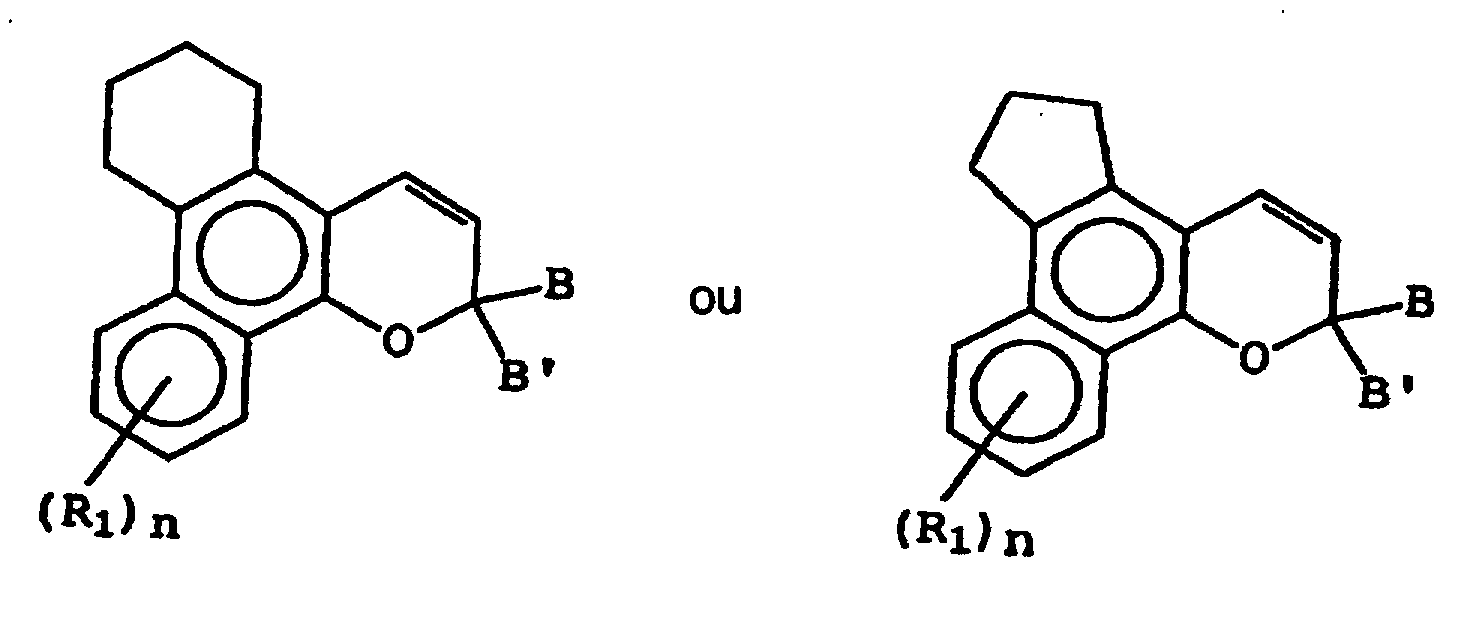 (a) chaque R1 est choisi dans le groupe comprenant les groupes alkyle en C1-C6, alcoxy en C1-C6, chloro, fluoro, les groupes aryle non substitués, mono-, di- et trisubstitués choisis parmi les groupes phényle et naphtyle, et les groupes hétéroaromatiques non substitués, mono- et disubstitués pyridyle, furannyle, benzofurann-2-yle, benzofurann-3-yle, thiényle, benzothién-2-yle, benzothién-3-yle, dibenzofurannyle, dibenzothiényle, carbazolyle et fluorényle, chacun desdits substituants de ces groupes aryle et hétéroaromatiques étant choisi dans le groupe comprenant les groupes aryle choisis parmi les groupes phényle et naphtyle, monoalcoxy(C1-C6)aryle, dialcoxy(C1-C6)aryle, monoalkyl(C1-C6)aryle, dialkyl(C1-C6)aryle, cycloalkylaryle en C3-C7, cycloalkyle en C3-C7, cycloalkyloxy en C3-C7, cycloalkyloxy(C3-C7)alkyle en C1-C6, cycloalkyloxy(C3-C7)alcoxy en C1-C6, arylalkyle en C1-C6, arylalcoxy en C1-C6, aryloxy, aryloxyalkyle en C1-C6, aryloxyalcoxy en C1-C6, mono- et dialkyl(C1-C6)arylalkyle en C1-C6, mono- et dialcoxy(C1-C6)arylalkyle en C1-C6, mono- et dialkyl(C1-C6)arylalcoxy en C1-C6, mono- et dialcoxy(C1-C6)-arylalcoxy en C1-C6, dialkylamino en C1-C6, diarylamino, N-alkyl(C1-C6)-pipérazino, N-arylpipérazino, aziridino, indolino, pipéridino, arylpipéridino, morpholino, thiomorpholino, tétrahydroquinoléino, tétrahydroisoquinoléino, pyrryle, alkyle en C1-C6, fluoroalkyle en C1-C6, alcoxy en C1-C6 et monoalcoxy(C1-C6)alkyle en C1-C4, et n est le nombre entier 0, 1, 2 ou 3; et(b) B et B' sont chacun choisis dans le groupe comprenant :(i) les groupes aryle non substitués, mono-, di- et trisubstitués choisis parmi les groupes phényle et naphtyle;(ii) les groupes hétéroaromatiques non substitués, mono- et disubstitués pyridyle, furannyle, benzofurann-2-yle, benzofurann-3-yle, thiényle, benzothién-2-yle, benzothién-3-yle, dibenzofurannyle, dibenzothiényle, carbazolyle et fluorényle, chacun desdits substituants de ces groupes aryle et hétéroaromatiques dans (b)(i) et (ii) étant choisis dans le groupe comprenant les groupes hydroxy, aryle, monoalcoxy(C1-C6)aryle, dialcoxy(C1-C6)aryle, monoalkyl(C1-C6)aryle, dialkyl(C1-C6)aryle, bromoaryle, chloroaryle, fluoroaryle, cycloalkylaryle en C3-C7, cycloalkyle en C3-C7, cycloalkyloxy en C3-C7, cycloalkyloxy(C3-C7)alkyle en C1-C6, cycloalkyloxy(C3-C7)alcoxy en C1-C6, arylalkyle en C1-C6, arylalcoxy en C1-C6, aryloxy, aryloxyalkyle en C1-C6, aryloxyalcoxy en C1-C6, mono- et dialkyl(C1-C6)arylalkyle en C1-C6, mono- et dialcoxy(C1-C6)arylalkyle en C1-C6, mono- et dialkyl(C1-C6)arylalcoxy en C1-C6, mono- et dialcoxy(C1-C6)arylalcoxy en C1-C6, amino, monoalkylamino en C1-C6, dialkylamino en C1-C6, diarylamino, N-alkyl(C1-C6)pipérazino, N-arylpipérazino, aziridino, indolino, pipéridino, arylpipéridino, morpholino, thiomorpholino, tétrahydroquinoléino, tétrahydroisoquinoléino, pyrryle, alkyle en C1-C6, bromoalkyle en C1-C6, chloroalkyle en C1-C6, fluoroalkyle en C1-C6, alcoxy en C1-C6, monoalcoxy(C1-C6)alkyle en C1-C4, acryloxy, méthacryloxy, bromo, chloro et fluoro;(iii) les groupes représentés par les formules graphiques suivantes :dans lesquelles E est du carbone ou de l'oxygène et D est de l'oxygène ou de l'azote substitué, pour autant que lorsque D est de l'azote substitué, E soit du carbone, lesdits substituants de l'azote étant choisis dans le groupe comprenant l'hydrogène et les groupes alkyle en C1-C6 et acyle en C2-C6, chaque R2 est un groupe alkyle en C1-C6, alcoxy en C1-C6, hydroxy, bromo, chloro ou fluoro, R3 et R4 sont chacun de l'hydrogène ou un groupe alkyle en C1-C6, et p est le nombre entier 0, 1 ou 2;
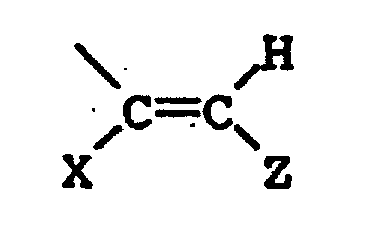
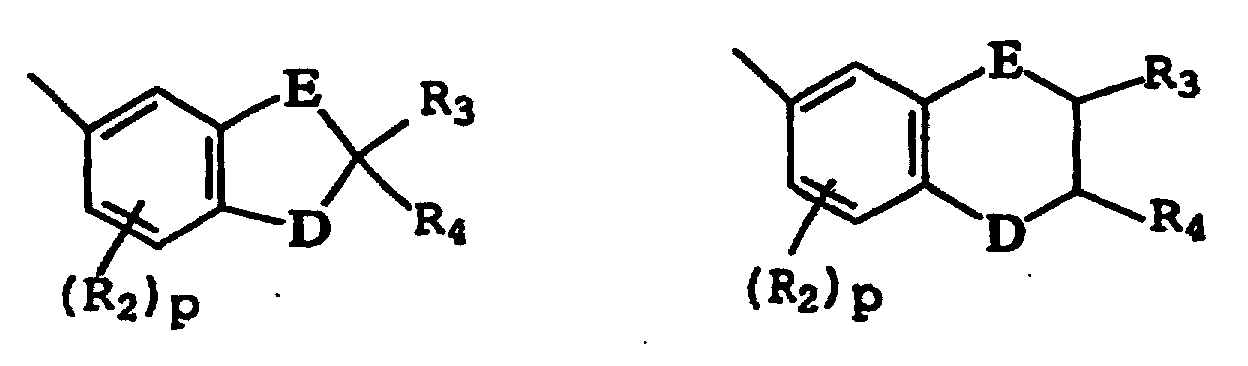 (iv) les groupes alkyle en C1-C6, bromoalkyle en C1-C6, chloroalkyle en C1-C6, fluoroalkyle en C1-C6. alcoxy(C1-C6)alkyle en C1-C4, cycloalkyle en C3-C6, monoalcoxy(C1-C6)cycloalkyle en C3-C6, monoalkyl(C1-C6)cycloalkyle en C3-C6, bromocycloalkyle en C3-C6, chlorocycloalkyle en C3-C6 et fluorocycloalkyle en C3-C6; et(v) le groupe représenté par la formule graphique suivante :dans laquelle X est de l'hydrogène ou un groupe alkyle en C1-C4 et Z est choisi parmi les membres non substitués, mono- et disubstitués du groupe comprenant les groupes naphtyle, phényle, furannyle et thiényle, chacun des disubstituants de ces groupes étant un groupe alkyle en C1-C4, alcoxy en C1-C4, bromo, chloro ou fluoro; ou bien
 B et B' pris ensemble forment un groupe fluorén-9-ylidène, fluorén-9-ylidène mono- ou disubstitué ou un membre choisi dans le groupe comprenant les cycles d'hydrocarbures spiro-monocycliques en C3-C12 saturés, les cycles d'hydrocarbures spiro-bicycliques en C7-C12 saturés et les cycles d'hydrocarbures spiro-tricycliques en C7-C12 saturés, chacun desdits substituants de fluorén-9-ylidène étant choisi dans le groupe comprenant les groupes alkyle en C1-C4, alcoxy en C1-C4, bromo, fluoro et chloro.
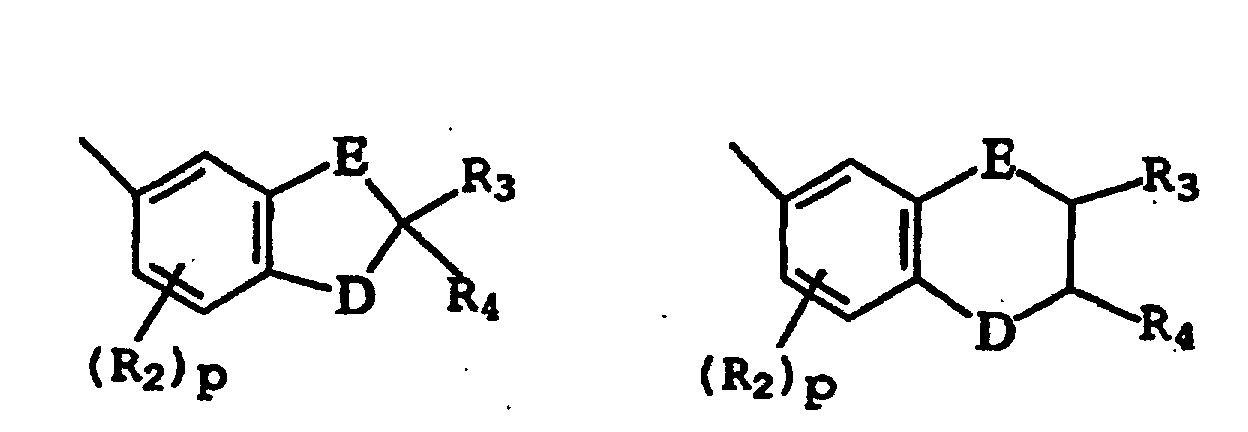
 - Composé suivant la revendication 1, dans lequel :(a) chaque R1 est choisi dans le groupe comprenant les groupes alkyle en C1-C4, alcoxy en C1-C4, chloro, fluoro, phényle, phényle monosubstitués et phényle disubstitués, et les groupes hétéroaromatiques non substitués, mono- et disubstitués furannyle, benzofurann-2-yle, thiényle, benzothién-2-yle, dibenzofurann-2-yle et dibenzothièn-2-yle, chacun desdits substituants de ces groupes phényle et hétéroaromatiques étant choisi dans le groupe comprenant les groupes aryle, aryloxy, arylalkyle en C1-C3, dialkylamino en C1-C3, N-alkyl(C1-C3)pipérazino, indolino, pipéridino, morpholino, pyrryle, alkyle en C1-C3, fluoroalkyle en C1-C3, alcoxy en C1-C3 et monoalcoxy(C1-C3)alkyle en C1-C3, et n est le nombre entier 0, 1 ou 2; et(b) B et B' sont chacun choisis dans le groupe comprenant :(i) les groupes phényle, phényle monosubstitués et phényle disubstitués;(ii) les groupes hétéroaromatiques non substitués, monosubstitués et disubstitués furannyle, benzofurann-2-yle, thiényle, benzothièn-2-yle, dibenzofurann-2-yle et dibenzothièn-2-yle, chacun desdits substituants de ces groupes phényle et hétéroaromatiques dans (b)(i) et (ii) étant choisi dans le groupe comprenant les groupes hydroxy, aryle, aryloxy, arylalkyle en C1-C3, amino, monoalkylamino en C1-C3, dialkylamino en C1-C3, N-alkyl(C1-C3)pipérazino, indolino, pipéridino, morpholino, pyrryle, alkyle en C1-C3, chloroalkyle en C1-C3, fluoroalkyle en C1-C3, alcoxy en C1-C3, monoalcoxy(C1-C3)alkyle en C1-C3, fluoro et chloro;(iii) les groupes représentés par les formules graphiques suivantes :dans lesquelles E est du carbone et D est de l'oxygène, R2 est un groupe alkyle en C1-C3 ou alcoxy en C1-C3, R3 et R4 sont chacun de l'hydrogène ou un groupe alkyle en C1-C4; et p est le nombre entier 0 ou 1;
 (iv) les groupes alkyle en C1-C4; et(v) le groupe représenté par la formule graphique suivante :dans laquelle X est de l'hydrogène ou du méthyle et Z est un groupe phényle ou phényle monosubstitué, ledit substituant de phényle étant choisi dans le groupe comprenant les groupes alkyle en C1-C3, alcoxy en C1-C3 et fluoro; ou bien
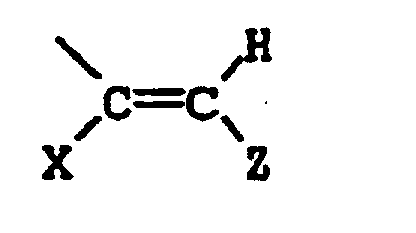 (vi) B et B' pris ensemble forment un groupe fluorén-9-ylidène, fluorén-9-ylidène monosubstitué ou un membre choisi dans le groupe comprenant les cycles d'hydrocarbures spiro-monocycliques en C3-C8 saturés, les cycles d'hydrocarbures spiro-bicycliques en C7-C10 saturés et les cycles d'hydrocarbures spiro-tricycliques en C7-C10 saturés, ledit substituant de fluorén-9-ylidène étant choisi dans le groupe comprenant les groupes alkyle en C1-C3, alcoxy en C1-C3, fluoro et chloro.
 - Composé suivant la revendication 2, dans lequel :(a) chaque R1 est choisi dans le groupe comprenant les groupes alkyle en C1-C3, alcoxy en C1-C3, phényle monosubstitués et disubstitués, et les groupes hétérocycliques aromatiques non substitués, mono- et disubstitués furannyle, benzofurann-2-yle, thiényle et benzothién-2-yle, chacun desdits substituants de ces groupes phényle et hétérocycliques aromatiques étant choisi dans le groupe comprenant les groupes aryle en C1-C3, alcoxy en C1-C3, aryle et indolino et n est le nombre entier 0 ou 1; et(b) B et B' sont chacun choisis dans le groupe comprenant :(i) les groupes phényle et phényle monosubstitués et disubstitués;(ii) les groupes hétéroaromatiques non substitués, mono- et disubstitués furannyle, benzofurann-2-yle, thiényle et benzothién-2-yle, chacun desdits substituants de ces groupes phényle et hétéroaromatiques dans (b)(i) et (ii) étant choisi dans le groupe comprenant les groupes hydroxy, alkyle en C1-C3, alcoxy en C1-C3, aryle, indolino, fluoro et chloro; et(iii) le groupe représenté par la formule graphique suivante :dans laquelle E est du carbone et D est de l'oxygène, R2 est un groupe alkyle en C1-C3 ou alcoxy en C1-C3, R3 et R4 sont chacun de l'hydrogène ou un groupe alkyle en C1-C3, et p est le nombre entier 0 ou 1 ; ou bien
 (iv) B et B' pris ensemble forment un groupe fluorén-9-ylidène, adamantylidène, bomylidène, norbomylidène ou bicyclo(3.3.1)-nonan-9-ylidène.
 - Composé photochromique suivant la revendication 1 choisi dans le groupe comprenant :(a) le 2,2-diphényl-2,5,6,7,8-pentahydrophénanthro[9,10-b]-pyranne;(b) le 2,2-bis(4-méthoxyphényl)-2,5,6,7,8-pentahydrophénanthro[9,10-b]pyranne;(c) le 2,2-diphényl-2,5,6,7-tétrahydrocyclopenta-[c]-naphto[1,2-b]-pyranne. et(d) le 2,2-bis(4-méthoxyphényl)-2,5,6,7-tétrahydro-2H-cyclopenta[c]-naphto[1,2-b]pyranne.
- Article photochromique comprenant une matière hôte organique polymérique et une quantité photochromique du composé de l'une quelconque des revendications 1 à 4.
- Article photochromique suivant la revendication 5 comprenant, en combinaison, une matière hôte organique polymérique transparente solide et une quantité photochromique de chacun (a) d'au moins un composé de l'une quelconque des revendications 1 à 4 et (b) d'au moins un autre composé photochromique organique ayant au moins un maximum d'absorption activé dans la gamme entre environ 400 et 700 nanomètres.
- Article photochromique suivant la revendication 6, dans lequel le composé photochromique organique (b) est choisi dans le groupe comprenant d'autres phénanthropyrannes, d'autres naphtopyrannes, les chromènes, les oxazines, les dithizonates métalliques, les fulgides et les fulgimides.
- Article photochromique suivant l'une quelconque des revendications 5 à 7, dans lequel la quantité totale de composé photochromique présent est de 0,05 à 1,0 mg par centimètre carré de surface de matière hôte organique à laquelle la ou les substances photochromiques sont incorporées ou appliquées.
- Article photochromique suivant l'une quelconque des revendications 5 à 8, dans lequel la matière hôte est un polymérisat d'un monomère de résine organique optique.
- Article photochromique suivant la revendication 9, dans lequel l'indice de réfraction du polymérisat est d'environ 1,48 à environ 1,75.
- Article photochromique suivant la revendication 10, dans lequel l'indice de réfraction du polymérisat est d'environ 1,495 à environ 1,66.
- Article photochromique suivant l'une quelconque des revendications 5 à 8, dans lequel la matière hôte organique polymérique est choisie dans le groupe comprenant les poly(méthacrylates d'alkyle en C1-C12), les poly(diméthacrylates d'oxyalkylène), les poly(méthacrylates phénoliques alcoxylés), l'acétate de cellulose, le triacétate de cellulose, l'acétopropionate de cellulose, l'acétobutyrate de cellulose, le poly(acétate de vinyle), le poly(alcool vinylique), le poly(chlorure de vinyle), le poly(chlorure de vinylidène), les polycarbonates thermoplastiques, les polyesters, les polyuréthannes, le poly(éthylène téréphtalate), le polystyrène, le poly(alpha-méthylstyrène), le copoly(styrène-méthacrylate de méthyle), le copoly(styrène-acrylonitrile), le polyvinylbutyral et les polymères des membres du groupe comprenant les monomères de bis(allyl carbonate), les monomères d'acrylate polyfonctionnels, les monomères de méthacrylate polyfonctionnels, les monomères de diéthylène glycol diméthacrylate, les monomères de diisopropényl benzène, les monomères de diméthacrylate de bisphénol A éthoxylé, les monomères d'éthylène glycol bisméthacrylate, les monomères de poly(éthylène glycol) bisméthacrylate, les monomères de bisméthacrylate de phénol éthoxylé, les monomères d'acrylate d'alcool polyatomique alcoxylé, les monomères de styrène, les monomères d'uréthanne acrylate, les monomères d'acrylate de glycidyle, les monomères de méthacrylate de glycidyle et les monomères de diallylidène pentaérythritol.
- Article photochromique suivant la revendication 12, dans lequel la matière hôte organique polymérique est un polymère transparent solide choisi dans le groupe comprenant le poly(méthacrylate de méthyle), le poly(éthylène glycol bisméthacrylate), le poly(diméthacrylate de bisphénol A éthoxylé), les polycarbonates thermoplastiques, le poly(acétate de vinyle), le polyvinylbutyral, les polyuréthannes et les polymères des membres du groupe comprenant les monomères de diéthylène glycol bis(allyl carbonate), les monomères de diéthylène glycol diméthacrylate, les monomères de bisméthacrylate de phénol éthoxylé, les monomères de diisopropényl benzène et les monomères de triméthylol propane triacrylate éthoxylé.
- Article photochromique suivant l'une quelconque des revendications 5 à 13, dans lequel ledit polymère transparent est un élément optique.
- Article photochromique suivant la revendication 14, dans lequel ledit élément optique est une lentille.
Applications Claiming Priority (3)
| Application Number | Priority Date | Filing Date | Title |
|---|---|---|---|
| US08/951,335 US5783116A (en) | 1997-10-16 | 1997-10-16 | Derivatives of carbocyclic fused naphthopyrans |
| US951335 | 1997-10-16 | ||
| PCT/US1998/020468 WO1999020619A1 (fr) | 1997-10-16 | 1998-09-29 | Derives photochromiques de naphtopyranes carbocycliquement fusionnes |
Publications (2)
| Publication Number | Publication Date |
|---|---|
| EP1027346A1 EP1027346A1 (fr) | 2000-08-16 |
| EP1027346B1 true EP1027346B1 (fr) | 2002-11-20 |
Family
ID=25491571
Family Applications (1)
| Application Number | Title | Priority Date | Filing Date |
|---|---|---|---|
| EP98950777A Expired - Lifetime EP1027346B1 (fr) | 1997-10-16 | 1998-09-29 | Derives photochromiques de naphtopyranes carbocycliquement fusionnes |
Country Status (5)
| Country | Link |
|---|---|
| US (1) | US5783116A (fr) |
| EP (1) | EP1027346B1 (fr) |
| AU (1) | AU729314B2 (fr) |
| DE (1) | DE69809584T2 (fr) |
| WO (1) | WO1999020619A1 (fr) |
Families Citing this family (30)
| Publication number | Priority date | Publication date | Assignee | Title |
|---|---|---|---|---|
| US5783116A (en) * | 1997-10-16 | 1998-07-21 | Ppg Industries, Inc. | Derivatives of carbocyclic fused naphthopyrans |
| JPH11209750A (ja) * | 1998-01-26 | 1999-08-03 | Tokuyama Corp | フォトクロミック硬化性組成物 |
| WO1999067234A1 (fr) * | 1998-06-19 | 1999-12-29 | Optische Werke G. Rodenstock | Naphtopyranes photochromes |
| DE69903042T2 (de) * | 1998-07-10 | 2003-08-07 | Transitions Optical, Inc. | Photochrome sechsgliedrige heterocyclisch kondensierte naphthopyrane |
| US6022497A (en) * | 1998-07-10 | 2000-02-08 | Ppg Industries Ohio, Inc. | Photochromic six-membered heterocyclic-fused naphthopyrans |
| FR2783249B1 (fr) * | 1998-09-11 | 2001-06-22 | Flamel Tech Sa | Naphtopyranes anneles en c5-c6, leur preparation et les compositions et matrices (co)polymeres les renfermant |
| FR2783250B1 (fr) | 1998-09-11 | 2001-02-23 | Flamel Tech Sa | Naphtopyranes anneles en c6-c7, leur preparation, et les compositions et matrices (co)polymeres les renfermant |
| FR2783248A1 (fr) * | 1998-09-11 | 2000-03-17 | Flamel Tech Sa | Naphtopyranes anneles en c5-c6, leur preparation, et les compositions et matrices (co)polymeres les renfermant |
| FR2786186B1 (fr) * | 1998-11-20 | 2001-03-02 | Flamel Tech Sa | [pyrrole]naphtopyranes, leur preparation, les compostions et matrices (co)polymeres les renfermant |
| FR2789680B1 (fr) * | 1999-02-17 | 2002-05-17 | Corning Sa | Naphtopyranes et phenanthropyranes anneles en c5-c6 avec un groupe bicyclique et les compositions et matrices (co)polymeres les renfermant |
| FR2794748B1 (fr) | 1999-06-10 | 2001-09-21 | Corning Sa | Naphtopyranes anneles en c5-c6 avec un cycle c6 de type lactame et les compositions et matrices (co)polymeres les renfermant |
| FR2794749A1 (fr) | 1999-06-10 | 2000-12-15 | Corning Sa | Benzopyranes anneles en c7-c8 avec un heterocycle aromatique et les compositions et matrices (co) polymeres les renfermant |
| FR2800739B1 (fr) | 1999-11-04 | 2002-10-11 | Corning Sa | Naphtopyranes avec un heterocycle en position 5,6, preparation et compositions et matrices (co) polymeres les renfermant |
| FR2800738B1 (fr) | 1999-11-04 | 2002-02-08 | Corning Sa | Naphtopyranes ayant un substituant perfluoroalkyle en position 5, preparation et compositions et matrices (co)polymeres les renfermant |
| FR2801052B1 (fr) | 1999-11-17 | 2004-04-02 | Corning Sa | Naphtopyranes anneles en c5-c6 par un carbocycle de type indene ou dihydronaphtalene et les compositions et matrices (co) polymeres les renfermant |
| FR2815034B1 (fr) * | 2000-10-11 | 2003-02-07 | Corning Sa | Naphtopyranes anneles en c5-c6 par un carbocycle de type dihydrobenzocycloheptatriene et les compositions et matrices les refermant |
| US6608215B2 (en) | 2001-09-20 | 2003-08-19 | Vision-Ease Lens, Inc. | Oxygen-containing heterocyclic fused naphthopyrans |
| ES2326215T3 (es) * | 2003-11-05 | 2009-10-05 | Corning Incorporated | Piranos condensados fotocromicos sustituidos con fenilo que porta un grupo carbamilo o urea. |
| KR20080091349A (ko) | 2006-01-25 | 2008-10-10 | 가부시끼가이샤 도꾸야마 | 크로멘 화합물 |
| KR101295435B1 (ko) * | 2008-08-05 | 2013-08-09 | 주식회사 엘지화학 | 신규한 페난트로파이란 유도체 및 이를 포함하는 광변색염료 |
| CN103087032B (zh) * | 2013-01-18 | 2015-01-07 | 常州南京大学高新技术研究院 | 一种萘并吡喃类化合物的制备方法 |
| US9029532B2 (en) * | 2013-03-11 | 2015-05-12 | Transitions Optical, Inc. | 5,6-ring-substituted naphthopyran compounds |
| WO2021181307A1 (fr) | 2020-03-11 | 2021-09-16 | Alcon Inc. | Agents de réticulation vinyliques de polydiorganosiloxane photochromique |
| EP4158392A1 (fr) | 2020-06-02 | 2023-04-05 | Alcon Inc. | Procédé de fabrication de lentilles de contact photochromiques |
| US11945181B2 (en) | 2020-10-28 | 2024-04-02 | Alcon Inc. | Method for making photochromic contact lenses |
| HUE069913T2 (hu) | 2020-11-04 | 2025-04-28 | Alcon Inc | Eljárás fotokróm kontaktlencsék elõállítására |
| EP4240578B1 (fr) | 2020-11-04 | 2024-12-18 | Alcon Inc. | Méthode de fabrication de lentilles de contact photochromiques |
| EP4304842B1 (fr) | 2021-03-08 | 2026-05-06 | Alcon Inc. | Méthode de fabrication de lentilles de contact photofonctionnelles |
| KR20230144634A (ko) | 2021-04-01 | 2023-10-16 | 알콘 인코포레이티드 | 광변색성 콘택트 렌즈의 제조 방법 |
| TW202406726A (zh) | 2022-04-28 | 2024-02-16 | 瑞士商愛爾康公司 | 用於製造uv吸收性和hevl吸收性眼科鏡片之方法 |
Family Cites Families (33)
| Publication number | Priority date | Publication date | Assignee | Title |
|---|---|---|---|---|
| US3361706A (en) * | 1964-03-06 | 1968-01-02 | American Cyanamid Co | Control of the photochromic return rate of (arylazo) thioformic arylhydrazidates |
| US3567605A (en) * | 1966-03-30 | 1971-03-02 | Ralph S Becker | Photochemical process |
| GB1186987A (en) * | 1967-08-30 | 1970-04-08 | Fuji Photo Film Co Ltd | Photochromic Compounds |
| JPS4948631B1 (fr) * | 1968-10-28 | 1974-12-23 | ||
| US3627690A (en) * | 1969-10-01 | 1971-12-14 | Itek Corp | Photochromic naphthopyran compositions |
| US4215010A (en) * | 1978-09-08 | 1980-07-29 | American Optical Corporation | Photochromic compounds |
| US4342668A (en) * | 1978-09-08 | 1982-08-03 | American Optical Corporation | Photochromic compounds |
| US4360653A (en) * | 1981-10-23 | 1982-11-23 | Ppg Industries, Inc. | Polymerizate of (allyl carbonate) and aliphatic polyurethane having acrylic unsaturation |
| US4880667A (en) * | 1985-09-24 | 1989-11-14 | Ppg Industries, Inc. | Photochromic plastic article and method for preparing same |
| GB8611837D0 (en) * | 1986-05-15 | 1986-06-25 | Plessey Co Plc | Photochromic spiropyran compounds |
| GB8614680D0 (en) * | 1986-06-17 | 1986-07-23 | Plessey Co Plc | Photoreactive lenses |
| US4816584A (en) * | 1986-11-12 | 1989-03-28 | Ppg Industries, Inc. | Photochromic spiro(indoline)benzoxazines |
| US4931219A (en) * | 1987-07-27 | 1990-06-05 | Ppg Industries, Inc. | Photochromic compound and articles containing the same |
| US4931220A (en) * | 1987-11-24 | 1990-06-05 | Ppg Industries, Inc. | Organic photochromic pigment particulates |
| US4980089A (en) * | 1989-07-12 | 1990-12-25 | Ppg Industries, Inc. | Photochromic spiropyran compounds |
| US5066818A (en) * | 1990-03-07 | 1991-11-19 | Ppg Industries, Inc. | Photochromic naphthopyran compounds |
| US5373033A (en) * | 1990-04-20 | 1994-12-13 | Sola International Holdings Limited | Casting composition |
| US5200483A (en) * | 1991-11-07 | 1993-04-06 | Ppg Industries, Inc. | Polyol(allyl carbonate) composiitons and articles prepared there from |
| US5238981A (en) * | 1992-02-24 | 1993-08-24 | Transitions Optical, Inc. | Photochromic naphthopyrans |
| US5274132A (en) * | 1992-09-30 | 1993-12-28 | Transitions Optical, Inc. | Photochromic naphthopyran compounds |
| US5405958A (en) * | 1992-12-21 | 1995-04-11 | Transitions Optical, Inc. | Photochromic spiro(indoline)naphthoxazine compounds |
| AU665480B2 (en) * | 1993-01-29 | 1996-01-04 | Tokuyama Corporation | Polymerizable composition, polymer, organic glass and ophthalmic lens |
| US5552091A (en) * | 1993-03-12 | 1996-09-03 | Ppg Industries, Inc. | Benzopyran compounds |
| WO1994020869A1 (fr) * | 1993-03-12 | 1994-09-15 | Ppg Industries, Inc. | Nouveaux benzopyrannes |
| US5578252A (en) * | 1993-06-21 | 1996-11-26 | Transitions Optical, Inc. | Photochromic substituted naphthopyran compounds |
| US5552090A (en) * | 1993-06-21 | 1996-09-03 | Ppg Industries, Inc. | Photochromic naphthopyran compounds |
| US5466398A (en) * | 1993-06-21 | 1995-11-14 | Transitions Optical, Inc. | Photochromic substituted naphthopyran compounds |
| US5384077A (en) * | 1993-06-21 | 1995-01-24 | Transitions Optical, Inc. | Photochromic naphthopyran compounds |
| US5458814A (en) * | 1993-12-09 | 1995-10-17 | Transitions Optical, Inc. | Substituted naphthopyrans |
| US5451344A (en) * | 1994-04-08 | 1995-09-19 | Transitions Optical, Inc. | Photochromic naphthopyran compounds |
| US5514817A (en) * | 1994-08-04 | 1996-05-07 | Ppg Industries, Inc. | Substituted phenanthropyrans |
| US5645767A (en) * | 1994-11-03 | 1997-07-08 | Transitions Optical, Inc. | Photochromic indeno-fused naphthopyrans |
| US5783116A (en) * | 1997-10-16 | 1998-07-21 | Ppg Industries, Inc. | Derivatives of carbocyclic fused naphthopyrans |
-
1997
- 1997-10-16 US US08/951,335 patent/US5783116A/en not_active Expired - Lifetime
-
1998
- 1998-09-29 WO PCT/US1998/020468 patent/WO1999020619A1/fr not_active Ceased
- 1998-09-29 DE DE69809584T patent/DE69809584T2/de not_active Expired - Lifetime
- 1998-09-29 EP EP98950777A patent/EP1027346B1/fr not_active Expired - Lifetime
- 1998-09-29 AU AU96740/98A patent/AU729314B2/en not_active Ceased
Also Published As
| Publication number | Publication date |
|---|---|
| WO1999020619A1 (fr) | 1999-04-29 |
| DE69809584D1 (de) | 2003-01-02 |
| AU729314B2 (en) | 2001-02-01 |
| AU9674098A (en) | 1999-05-10 |
| US5783116A (en) | 1998-07-21 |
| DE69809584T2 (de) | 2003-07-03 |
| EP1027346A1 (fr) | 2000-08-16 |
Similar Documents
| Publication | Publication Date | Title |
|---|---|---|
| EP1027346B1 (fr) | Derives photochromiques de naphtopyranes carbocycliquement fusionnes | |
| US6022495A (en) | Photochromic benzopyrano-fused naphthopyrans | |
| EP1097155B1 (fr) | Nouveaux naphtopyranes photochromiques condenses au noyau heterocyclique a six elements | |
| US5869658A (en) | Photochromic indeno-fused naptho 2,1-b!pyrans | |
| US6022497A (en) | Photochromic six-membered heterocyclic-fused naphthopyrans | |
| AU740418B2 (en) | Photochromic 6-aryl substituted 3H-naphtho(2,1-b)pyrans | |
| EP0958514B1 (fr) | Nouveaux indenonaphthopyrans photochromiques heterocycliques fusionnes | |
| US5658501A (en) | Substituted naphthopyrans | |
| EP0954522B1 (fr) | Nouveaux naphtopyrannes substitues | |
| US5650098A (en) | Substituted naphthopyrans | |
| EP1036077B1 (fr) | Nouveaux naphtopyranes pyrano-condenses photochromiques | |
| EP1025104B1 (fr) | Naphtopyranes condenses de 7-methylidene-5-oxo-furo | |
| US5891368A (en) | Fluoranthenopyrans | |
| EP1017690B1 (fr) | Nouveaux naphotpyrans aromatiques substitues | |
| US6478989B1 (en) | Aromatic substituted naphthopyrans | |
| EP0994871B1 (fr) | Nouveaux naphtopyranes substitues |
Legal Events
| Date | Code | Title | Description |
|---|---|---|---|
| PUAI | Public reference made under article 153(3) epc to a published international application that has entered the european phase |
Free format text: ORIGINAL CODE: 0009012 |
|
| 17P | Request for examination filed |
Effective date: 20000428 |
|
| AK | Designated contracting states |
Kind code of ref document: A1 Designated state(s): CH DE ES FR GB IE IT LI NL |
|
| RIN1 | Information on inventor provided before grant (corrected) |
Inventor name: LIN, JIBING |
|
| 17Q | First examination report despatched |
Effective date: 20010828 |
|
| GRAG | Despatch of communication of intention to grant |
Free format text: ORIGINAL CODE: EPIDOS AGRA |
|
| GRAG | Despatch of communication of intention to grant |
Free format text: ORIGINAL CODE: EPIDOS AGRA |
|
| GRAH | Despatch of communication of intention to grant a patent |
Free format text: ORIGINAL CODE: EPIDOS IGRA |
|
| GRAH | Despatch of communication of intention to grant a patent |
Free format text: ORIGINAL CODE: EPIDOS IGRA |
|
| GRAA | (expected) grant |
Free format text: ORIGINAL CODE: 0009210 |
|
| AK | Designated contracting states |
Kind code of ref document: B1 Designated state(s): CH DE ES FR GB IE IT LI NL |
|
| PG25 | Lapsed in a contracting state [announced via postgrant information from national office to epo] |
Ref country code: NL Free format text: LAPSE BECAUSE OF FAILURE TO SUBMIT A TRANSLATION OF THE DESCRIPTION OR TO PAY THE FEE WITHIN THE PRESCRIBED TIME-LIMIT Effective date: 20021120 Ref country code: LI Free format text: LAPSE BECAUSE OF FAILURE TO SUBMIT A TRANSLATION OF THE DESCRIPTION OR TO PAY THE FEE WITHIN THE PRESCRIBED TIME-LIMIT Effective date: 20021120 Ref country code: IT Free format text: LAPSE BECAUSE OF FAILURE TO SUBMIT A TRANSLATION OF THE DESCRIPTION OR TO PAY THE FEE WITHIN THE PRESCRIBED TIME-LIMIT;WARNING: LAPSES OF ITALIAN PATENTS WITH EFFECTIVE DATE BEFORE 2007 MAY HAVE OCCURRED AT ANY TIME BEFORE 2007. THE CORRECT EFFECTIVE DATE MAY BE DIFFERENT FROM THE ONE RECORDED. Effective date: 20021120 Ref country code: CH Free format text: LAPSE BECAUSE OF FAILURE TO SUBMIT A TRANSLATION OF THE DESCRIPTION OR TO PAY THE FEE WITHIN THE PRESCRIBED TIME-LIMIT Effective date: 20021120 |
|
| REG | Reference to a national code |
Ref country code: GB Ref legal event code: FG4D |
|
| REG | Reference to a national code |
Ref country code: CH Ref legal event code: EP |
|
| REG | Reference to a national code |
Ref country code: IE Ref legal event code: FG4D |
|
| REF | Corresponds to: |
Ref document number: 69809584 Country of ref document: DE Date of ref document: 20030102 |
|
| NLV1 | Nl: lapsed or annulled due to failure to fulfill the requirements of art. 29p and 29m of the patents act | ||
| PG25 | Lapsed in a contracting state [announced via postgrant information from national office to epo] |
Ref country code: ES Free format text: LAPSE BECAUSE OF FAILURE TO SUBMIT A TRANSLATION OF THE DESCRIPTION OR TO PAY THE FEE WITHIN THE PRESCRIBED TIME-LIMIT Effective date: 20030529 |
|
| REG | Reference to a national code |
Ref country code: CH Ref legal event code: PL |
|
| ET | Fr: translation filed | ||
| PLBE | No opposition filed within time limit |
Free format text: ORIGINAL CODE: 0009261 |
|
| STAA | Information on the status of an ep patent application or granted ep patent |
Free format text: STATUS: NO OPPOSITION FILED WITHIN TIME LIMIT |
|
| PG25 | Lapsed in a contracting state [announced via postgrant information from national office to epo] |
Ref country code: IE Free format text: LAPSE BECAUSE OF NON-PAYMENT OF DUE FEES Effective date: 20030929 |
|
| 26N | No opposition filed |
Effective date: 20030821 |
|
| REG | Reference to a national code |
Ref country code: IE Ref legal event code: MM4A |
|
| REG | Reference to a national code |
Ref country code: DE Ref legal event code: R082 Ref document number: 69809584 Country of ref document: DE Representative=s name: FLEISCHER, ENGELS & PARTNER MBB, PATENTANWAELT, DE |
|
| REG | Reference to a national code |
Ref country code: FR Ref legal event code: PLFP Year of fee payment: 18 |
|
| PGFP | Annual fee paid to national office [announced via postgrant information from national office to epo] |
Ref country code: GB Payment date: 20150928 Year of fee payment: 18 |
|
| PGFP | Annual fee paid to national office [announced via postgrant information from national office to epo] |
Ref country code: FR Payment date: 20150917 Year of fee payment: 18 |
|
| PGFP | Annual fee paid to national office [announced via postgrant information from national office to epo] |
Ref country code: DE Payment date: 20150929 Year of fee payment: 18 |
|
| REG | Reference to a national code |
Ref country code: GB Ref legal event code: 732E Free format text: REGISTERED BETWEEN 20160421 AND 20160428 |
|
| REG | Reference to a national code |
Ref country code: FR Ref legal event code: CL Name of requester: TRANSITIONS OPTICAL LIMITED, IE Effective date: 20160729 |
|
| REG | Reference to a national code |
Ref country code: DE Ref legal event code: R119 Ref document number: 69809584 Country of ref document: DE |
|
| GBPC | Gb: european patent ceased through non-payment of renewal fee |
Effective date: 20160929 |
|
| REG | Reference to a national code |
Ref country code: FR Ref legal event code: ST Effective date: 20170531 |
|
| PG25 | Lapsed in a contracting state [announced via postgrant information from national office to epo] |
Ref country code: DE Free format text: LAPSE BECAUSE OF NON-PAYMENT OF DUE FEES Effective date: 20170401 Ref country code: FR Free format text: LAPSE BECAUSE OF NON-PAYMENT OF DUE FEES Effective date: 20160930 Ref country code: GB Free format text: LAPSE BECAUSE OF NON-PAYMENT OF DUE FEES Effective date: 20160929 |