EP1027351B1 - Derives de phenanthroline - Google Patents
Derives de phenanthroline Download PDFInfo
- Publication number
- EP1027351B1 EP1027351B1 EP98967153A EP98967153A EP1027351B1 EP 1027351 B1 EP1027351 B1 EP 1027351B1 EP 98967153 A EP98967153 A EP 98967153A EP 98967153 A EP98967153 A EP 98967153A EP 1027351 B1 EP1027351 B1 EP 1027351B1
- Authority
- EP
- European Patent Office
- Prior art keywords
- alkyl
- phenanthroline
- oxo
- dihydro
- carbamoyl
- Prior art date
- Legal status (The legal status is an assumption and is not a legal conclusion. Google has not performed a legal analysis and makes no representation as to the accuracy of the status listed.)
- Expired - Lifetime
Links
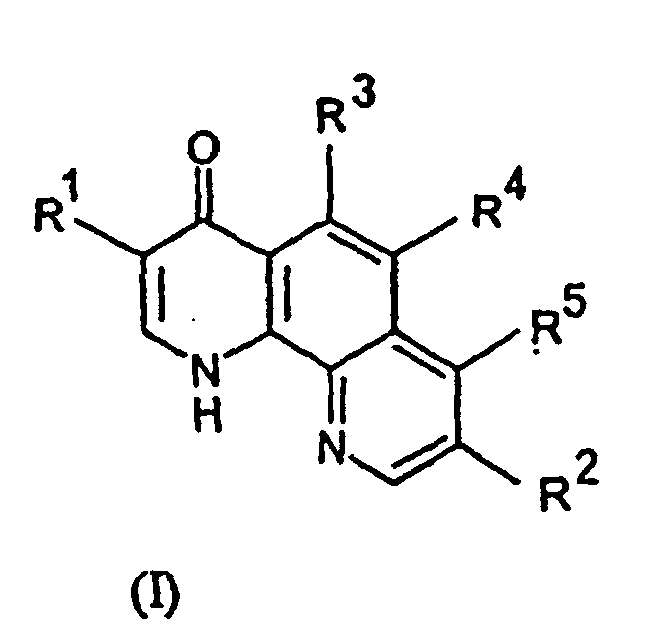
- 0 *c1c(*)c(c(*)c(*)c2c3NC=C(*)C2=O)c3nc1 Chemical compound *c1c(*)c(c(*)c(*)c2c3NC=C(*)C2=O)c3nc1 0.000 description 1
Images


Classifications
-
- C—CHEMISTRY; METALLURGY
- C07—ORGANIC CHEMISTRY
- C07D—HETEROCYCLIC COMPOUNDS
- C07D471/00—Heterocyclic compounds containing nitrogen atoms as the only ring hetero atoms in the condensed system, at least one ring being a six-membered ring with one nitrogen atom, not provided for by groups C07D451/00 - C07D463/00
- C07D471/02—Heterocyclic compounds containing nitrogen atoms as the only ring hetero atoms in the condensed system, at least one ring being a six-membered ring with one nitrogen atom, not provided for by groups C07D451/00 - C07D463/00 in which the condensed system contains two hetero rings
- C07D471/04—Ortho-condensed systems
-
- A—HUMAN NECESSITIES
- A61—MEDICAL OR VETERINARY SCIENCE; HYGIENE
- A61K—PREPARATIONS FOR MEDICAL, DENTAL OR TOILETRY PURPOSES
- A61K31/00—Medicinal preparations containing organic active ingredients
- A61K31/33—Heterocyclic compounds
- A61K31/395—Heterocyclic compounds having nitrogen as a ring hetero atom, e.g. guanethidine or rifamycins
- A61K31/435—Heterocyclic compounds having nitrogen as a ring hetero atom, e.g. guanethidine or rifamycins having six-membered rings with one nitrogen as the only ring hetero atom
- A61K31/47—Quinolines; Isoquinolines
- A61K31/4738—Quinolines; Isoquinolines ortho- or peri-condensed with heterocyclic ring systems
- A61K31/4745—Quinolines; Isoquinolines ortho- or peri-condensed with heterocyclic ring systems condensed with ring systems having nitrogen as a ring hetero atom, e.g. phenantrolines
-
- A—HUMAN NECESSITIES
- A61—MEDICAL OR VETERINARY SCIENCE; HYGIENE
- A61P—SPECIFIC THERAPEUTIC ACTIVITY OF CHEMICAL COMPOUNDS OR MEDICINAL PREPARATIONS
- A61P1/00—Drugs for disorders of the alimentary tract or the digestive system
- A61P1/16—Drugs for disorders of the alimentary tract or the digestive system for liver or gallbladder disorders, e.g. hepatoprotective agents, cholagogues, litholytics
-
- A—HUMAN NECESSITIES
- A61—MEDICAL OR VETERINARY SCIENCE; HYGIENE
- A61P—SPECIFIC THERAPEUTIC ACTIVITY OF CHEMICAL COMPOUNDS OR MEDICINAL PREPARATIONS
- A61P17/00—Drugs for dermatological disorders
- A61P17/02—Drugs for dermatological disorders for treating wounds, ulcers, burns, scars, keloids, or the like
-
- A—HUMAN NECESSITIES
- A61—MEDICAL OR VETERINARY SCIENCE; HYGIENE
- A61P—SPECIFIC THERAPEUTIC ACTIVITY OF CHEMICAL COMPOUNDS OR MEDICINAL PREPARATIONS
- A61P19/00—Drugs for skeletal disorders
- A61P19/02—Drugs for skeletal disorders for joint disorders, e.g. arthritis, arthrosis
-
- A—HUMAN NECESSITIES
- A61—MEDICAL OR VETERINARY SCIENCE; HYGIENE
- A61P—SPECIFIC THERAPEUTIC ACTIVITY OF CHEMICAL COMPOUNDS OR MEDICINAL PREPARATIONS
- A61P29/00—Non-central analgesic, antipyretic or antiinflammatory agents, e.g. antirheumatic agents; Non-steroidal antiinflammatory drugs [NSAID]
-
- A—HUMAN NECESSITIES
- A61—MEDICAL OR VETERINARY SCIENCE; HYGIENE
- A61P—SPECIFIC THERAPEUTIC ACTIVITY OF CHEMICAL COMPOUNDS OR MEDICINAL PREPARATIONS
- A61P43/00—Drugs for specific purposes, not provided for in groups A61P1/00-A61P41/00
Definitions
- the present invention relates to phenanthroline derivatives which inhibit the enzyme prolyl 4-hydroxylase, processes for preparing these compounds and pharmaceutical compositions thereof.
- the present invention also relates to the therapeutical use of such compounds. More specifically, the present invention relates to the use of the phenanthroline derivatives in disorders that are related to the proliferation of fibrotic disorders and/or wherein the regeneration of normal cells, in contrast to fibrotic cells, are indicated.
- disorders known wherein the proliferation of fibrotic tissue are a characteristic feature.
- disorders include, for example, rheumatoid arthritis, chronic arthritis, osteoarthritis, hepatic fibrosis, hepatic cirrhosis, pulmonary fibrosis, renal fibrosis, cardiac fibrosis, arteriosclerosis tumour-associated fibrosis and the formation of scar tissue following injury or surgery.
- Additional examples include disorders related to the over proliferation of connective tissue in such areas systems as the central nervous system.
- a therapeutic agent which possesses anti-fibrotic properties may be of value in the treatment of one or more of these disorders.
- prolyl 4-hydroxylase is involved in the hydroxylation of proline residues in collagenous protein, and that 4-hydroxyproline residues are essential for the formation of the characteristic triple helical form of collagen which is secreted into fibrotic tissue. Consequently, a compound which inhibits the activity of prolyl 4-hydroxylase may be of potential value in the treatment of fibroproliferative disease, which is characterized by excessive collagen production.
- the present invention provides certain phenanthroline derivatives useful for inhibiting prolyl 4-hydroxylase.
- the present invention provides phenanthroline derivatives of formula (I) wherein R 1 is hydrogen, carboxy or an ester derivative thereof, cyano, halo, nitro, amino, (1-4C)alkyl, (1-4C)alkylamino, di-(1-4C)alkylamino, (1-6C)alkoxycarbonyl, (2-4C)alkanoyl, hydroxy-(1-4C)alkyl, carbamoyl, N-(1-4C)alkylcarbamoyl, (1-4C)alkylthio, (1-4C)alkylsulfinyl, (1-4C)alkylsulfonyl, phenylthio, phenylsulfinyl, phenylsulfonyl, fluoro-(1-4C)alkylthio, fluoro-(1-4C)alkylsulfinyl, fluoro-(1-4C)alkylsulfonyl, (1-4C)alkor
- R 1 may additionally include morpholino-(2-4C)alkoxycarbonyl and R 3 may additionally include methoxy.
- the phenyl groups in the afore-mentioned substituents are optionally substituted with one to four substituents selected from halo, (1-4C)alkoxy, (1-4C)alkyl, cyano, hydroxy and trifluoromethyl.
- the heterocyclic groups pyrrolidin-1-yl, piperidino, piperazin-1-yl and morpholino in the afore-mentioned substituents are optionally substituted in any vacant position with one to four substituents selected from (1-4C)alkyl and benzyl.
- ester derivatives preferably includes metabolically labile ester derivatives.
- alkyl includes both straight and branched chain groups. However, reference to individual groups such as propyl are specific for the straight chain version only.
- (1-4C)alkyl includes, for example, methyl, ethyl, propyl, iso propyl, butyl, iso -butyl, sec -butyl and tert -butyl.
- halo includes, for example, fluoro, chloro, bromo and iodo.
- (1-4C)alkylamino includes methylamino, ethylamino and propyl amino.
- di-[(1-4C)alkyl]amino includes dimethylamino, N -ethyl- N -methyl amino, diethylamino, N -methyl- N -propylamino and dipropyl amino.
- (2-4C)alkanoyl includes acetyl, propionyl and butyryl.
- (1-6C)alkoxycarbonyl includes methoxycarbonyl, ethoxycarbonyl, propoxycarbonyl, tert -butoxycarbonyl and pentoxycarbonyl.
- N-[amino-(2-8C)alkyl]carbamoyl includes N -(3-aminopropyl)carbamoyl, N -(6-aminohexyl)carbamoyl and N -(8-aminooctyl)carbamoyl.
- (1-4C)alkoxy includes methoxy, ethoxy, propoxy, isopropoxy, butoxy, isobutoxy, sec -butoxy and tert -butoxy.
- hydroxy-(1-4C)alkyl includes hydroxymethyl, 1-hydroxyethyl, 2-hydroxyethyl and 3-hydroxypropyl.
- (1-4C)alkylthio includes methylthio, ethylthio and propylthio.
- (1-4C)alkylsulfinyl includes methylsulfinyl, ethylsulfinyl and propylsulfinyl.
- (1-4C)alkylsulfonyl includes methylsulfonyl, ethylsulfonyl and propylsulfonyl.
- fluoro-(1-4C)alkylthio includes trifluoromethylthio, 2,2,2-trifluoroethylthio and 3,3,3-trifluoropropylthio.
- fluoro-(1-4C)alkylsulfinyl includes trifluoromethylsulfinyl, 2,2,2-trifluoroethylsulfinyl and 3,3,3-trifluoropropylsulfinyl.
- fluoro-(1-4C)alkylsulfonyl includes trifluoromethylsulfonyl, 2,2,2-trifluoroethylsulfonyl and 3,3,3-trifluoropropylsulfonyl.
- (1-4C)alkoxy-(2-4C)alkoxycarbonyl includes 2-methoxyethoxycarbonyl, 2-ethoxyethoxycarbonyl and 3-methoxypropoxycarbonyl.
- N -(1-4C)alkylcarbamoyl includes N -methylcarbamoyl, N -ethylcarbamoyl and N -butylcarbamoyl.
- N , N -di-[(1-4C)alkyl]carbamoyl-(1-4C)alkoxycarbonyl includes N , N -dimethylcarbamoylmethoxycarbonyl, N , N -diethylcarbamoylmethoxycarbonyl, 2-( N , N -dimethylcarbamoyl)-ethoxycarbonyl, 2-( N , N -diethylcarbamoyl)-ethoxycarbonyl and 3-( N , N -dimethylcarbamoyl)-propoxycarbonyl.
- (1-4C)alkylamino-(2-4C)alkoxycarbonyl includes 2-(methylamino) ethoxycarbonyl, 2-(ethylamino)ethoxycarbonyl and 3-(methylamino)propylcarbonyl.
- di-(1-4C)alkylamino-(2-4C)alkoxycarbonyl includes 2-(dimethylamino)ethoxycarbonyl, 2-(diethylamino)ethoxycarbonyl, 2-( N -ethyl N -methylamino)ethoxycarbonyl and 3-(dimethylamino)propoxycarbonyl.
- (1-4C)alkoxy-(2-4C)alkoxy-(2-4C)alkoxycarbonyl includes 2-(2-methoxyethoxy)ethoxycarbonyl, 2-(2-ethoxyethoxy)ethoxycarbonyl and 3-(2-methoxyethoxy)propoxycarbonyl.
- (2-4)alkanoyloxy-(1-4C)alkyl includes acetoxymethyl, propionyloxymethyl, butyryloxymethyl, 2-acetoxyethyl and 3-acetoxypropyl.
- (2-4C)alkoxy includes ethoxy, propoxy, iso -propoxy, butoxy, iso -butoxy, sec -butoxy and tert -butoxy.
- carboxy-(1-4C)alkoxy includes carboxymethoxy, 2-carboxyethoxy and 3-carboxypropoxy.
- (1-4C)alkoxycarbonyl-(1-4C)alkoxy includes methoxycarbonylmethoxy, 2-(methoxycarbonyl)ethoxy and 2-(ethoxycarbonyl)ethoxy
- N -( 1-8C)alkylcarbamoyl includes N -methylcarbamoyl, N -ethylcarbamoyl, N -butylcarbamoyl, N -hexylcarbamoyl and N -octylcarbamoyl.
- N , N -di-(1-8C)alkylcarbamoyl includes N , N -dimethylcarbamoyl, N , N -diethylcarbamoyl, N , N -di- sec -butylcarbamoyl, N , N -dibutylcarbamoyl, N -methyl- N -butylcarbamoyl, N -methyl- N -hexylcarbamoyl, N -methyl- N -ethyl carbamoyl, N -ethyl- N -butylcarbamoyl, N -ethyl- N -pentylcarbamoyl, N -ethyl- N -propylcarbamoyl and N -ethyl- N -isopropylcarbamoyl.
- N -(1-4C)alkylamino-(1-8C)alkyl]carbamoyl includes N -[methylaminomethyl]carbamoyl, N -[ethylaminomethyl]carbamoyl, N -[2-methylaminoethyl]carbamoyl, N -[3-methylaminopropyl]carbamoyl, N -[6-methylaminohexyl]carbamoyl and N-[8-methylaminooctyl]carbamoyl.
- N -[di-(1-4C)alkylamino(1-8C)alkyl]carbamoyl includes N -[dimethylaminomethyl]carbamoyl, N -[diethylaminomethyl]carbamoyl, N -[ N -methyl- N -ethylaminomethyl]carbamoyl, N -[2-dimethylaminoethyl]carbamoyl, N -[6-dimethylaminohexyl]carbamoyl and N -[8-dimethylaminooctyl]carbamoyl.
- N -(1-4C)alkyl- N -cyclohexylcarbamoyl includes N -methyl- N -cyclohexylcarbamoyl, N -ethyl- N -cyclohexylcarbamoyl and N -propyl-N-cyclohexylcarbamoyl.
- N -(1-4C)alkyl- N -cyclopentylcarbamoyl includes N -methyl- N -cyclopentylcarbamoyl, N -ethyl- N -cyclopentylcarbamoyl and N -propyl- N -cyclopentylcarbamoyl.
- N -(1-4C)alkyl- N -phenylcarbamoyl incudes N -methyl - N -phenylcarbamoyl, N -ethyl- N -phenylcarbamoyl and N -propyl- N -phenylcarbamoyl.
- N -[phenyl-(1-4C)alkyl]carbamoyl includes N -benzylcarbamoyl, N -(2-phenylethyl)carbamoyl and N -(3-phenylpropyl)carbamoyl.
- N -(1-4C)alkyl- N -[phenyl-(1-4C)alkyl]carbamoyl includes N-methyl- N -benzylcarbamoyl, N -ethyl- N -benzylcarbamoyl, N -isopropyl- N -benzylcarbamoyl, N -methyl- N -(2-phenylethyl)carbamoyl, N -ethyl- N -(2-phenylethyl)carbamoyl and N -methyl- N -(3-phenylpropyl)carbamoyl.
- N , N -di-[phenyl-(1-4)alkyl]carbamoyl includes N , N -dibenzylcarbamoyl, N , N -di-(2-phenylethyl)carbamoyl and N , N -di-(3-phenylpropyl)carbamoyl.
- N -[(2-4C)alkanoyl]carbamoyl includes N -acetylcarbamoyl, N -propionylcarbamoyl and N -butyrylcarbamoyl.
- N -(1-4C)alkoxycarbonyl)carbamoyl includes N -methoxycarbonylcarbamoyl, N -ethoxycarbonylcarbamoyl and N -propoxycarbonylcarbamoyl.
- N -[fluoro-(2-6C)alkyl]carbamoyl includes N -[2,2,2-trifluoroethyl]carbamoyl, N -[2,2,3,3,4,4,4-heptafluorobutyl]carbamoyl and N -[4,4,5,5,5-pentafluoropentyl]carbamoyl.
- N -[fluoro-(2-6C)alkyl]- N -(1-4C)alkylcarbamoyl includes N -[2,2,2-trifluoroethyl]- N -ethylcarbamoyl, N -[2,2,3,3,4,4,4-heptafluorobutyl]- N -methylcarbamoyl and N -[4,4,5,5,5-pentafluoropentyl]- N -methylcarbamoyl.
- N , N -[di-fluoro-(2-6C)alkyl]carbamoyl includes N , N -di-[2,2,3,3,4,4,4-heptafluorobutyl]carbamoyl and N , N -di-[4,4,5,5,5-pentafluoropentyl]carbamoyl.
- N , N -[di-(1-4C)alkyl]thiocarbamoyl includes N , N -dimethylthiocarbamoyl, N , N -diethylthiocarbamoyl and N -methyl- N -ethylthiocarbamoyl.
- N -(2-4C)alkanoylamino includes N -acetylamino- N -propionylamino and N -butyrylamino.
- N-[(1-4C)alkoxycarbonyl]amino includes N -methoxycarbonylamino, N -ethoxycarbonylamino, N -propoxycarbonylamino and N - tert -butoxycarbonylamino.
- fluoro-(1-4C)alkyl includes trifluoromethyl, 2,2,2-trifluoroethyl and 2,2,3,3,4,4,4-heptafluorobutyl.
- pyridinyl includes pyridin-3-yl and pyridin-4-yl.
- (1-4C)alkoxy-(2-4C)alkoxy includes 2-methoxyethoxy, 2-ethoxyethoxy and 3-methoxypropoxy.
- fluoro-(1-6C)alkoxy includes 2,2,2-trifluoroethoxy, 4,4,5,5,5-pentafluoropentoxy and 2,2,3,3,4,4,4-heptafluorobutoxy.
- morpholino-(2-4C)alkoxycarbonyl includes morpholinoethoxycarbonyl.
- Particular novel compounds of the invention include, for example, phenanthroline derivatives of the formula (I), or pharmaceutically-acceptable salts thereof, or a metabolically labile ester derivative of substituents R 1 and R 2 when either, or both, is a carboxy group, as defined in paragraphs (a) to (m) hereinafter and wherein, unless otherwise stated, each of R 1 , R 2 , R 3 , R 4 and R 5 have any of the meanings defined hereinbefore or in this section concerning particular compounds of the invention:
- the phenyl groups in the afore-mentioned substituents in paragraphs (a), (b), (d) and (e) above are optionally substituted with one or two substituents selected from (1-4C)alkoxy, halo, hydroxy and trifluoromethyl; and the pyrrolidin-1-yl, piperidino and piperazin-1-yl groups in the aforementioned substituents in paragraphs (d), (e), (f) and (k) above are optionally substituted with one or two substituents selected from (1-4C)alkyl and benzyl.
- a preferred compound of the invention comprises a phenanthroline derivative of the formula (I), or a pharmaceutically-acceptable salt thereof, or a metabolically labile ester derivative of substituents R 1 and R 2 when either, or both, is a carboxy group, wherein
- a further preferred compound of the invention comprises a phenanthroline derivative of the formula (I), or a pharmaceutically-acceptable salt thereof, or a metabolically labile ester derivative of substituents R 1 and R 2 when either, or both, is a carboxy group, wherein
- a further preferred compound of the invention comprises a phenanthroline derivative of the formula (I), or a pharmaceutically-acceptable salt thereof, or a metabolically labile ester derivative of substituents R 1 and R 2 when either, or both, is a carboxy group, wherein
- Particularly preferred compounds of the invention include, for example, the following phenanthroline derivatives of the formula (I):
- a compound of the invention comprising a phenanthroline derivative of the formula (I) as defined hereinbefore, or a pharmaceutically-acceptable salt thereof, or a metabolically labile ester derivative of substituents R 1 and R 2 when either, or both, is a carboxy group, may be prepared by any process known to be applicable to the preparation of structurally-related compounds.
- R 1 , R 2 , R 3 , R 4 and R 5 have any of the meanings defined hereinbefore, provided that, when there is an amino, hydroxy or carboxy group in R 1 , R 2 , R 3 , R 4 and R 5 , any such group may optionally be protected by a conventional protecting group which may be removed when so desired by conventional means.
- a nitrogen heteroatom may also be optionally protected by a conventional protecting group which may be removed when so desired by conventional means.
- a suitable protecting group for an amino group is, for example, an acyl group, for example, an alkanoyl group such as acetyl, an alkoxycarbonyl group, for example, a methoxycarbonyl, ethoxycarbonyl or tert -butoxycarbonyl group, an arylmethoxycarbonyl group, for example, benzyloxycarbonyl, or an aroyl group, for example, benzoyl.
- the deprotection conditions for the above protecting groups necessarily vary with the choice of protecting group.
- an acyl group such as an alkanoyl or alkoxycarbonyl group or an aroyl group may be removed, for example, by hydrolysis with a suitable base such as an alkali metal hydroxide, for example, lithium or sodium hydroxide.
- a suitable base such as an alkali metal hydroxide, for example, lithium or sodium hydroxide.
- an acyl group such as a tert -butoxycarbonyl group may be removed, for example, by treatment with a suitable acid such as hydrochloric, sulphuric or phosphoric acid or trifluoroacetic acid and an arylmethoxycarbonyl group such as a benzyloxycarbonyl group may be removed, for example, by hydrogenation over a catalyst such as palladium-on-carbon, or by treatment with a ⁇ Lewis acid for example boron tris (trifluoroacetate).
- a suitable acid such as hydrochloric, sulphuric or phosphoric acid or trifluoroacetic acid
- an arylmethoxycarbonyl group such as a benzyloxycarbonyl group
- a suitable alternative protecting group for a primary amino group is, for example, a phthaloyl group which may be removed by treatment with an alkylamine, for example, dimethylaminopropylamine, or with hydrazine.
- a suitable protecting group for a nitrogen heteroatom is, for example, a pivaloyloxymethyl group which may be removed by hydrolysis with a base, for example, sodium hydroxide or ammonia, in a suitable inert solvent or diluent, for example, methanol or ethanol.
- a base for example, sodium hydroxide or ammonia
- a suitable inert solvent or diluent for example, methanol or ethanol.
- a suitable protecting group for a hydroxy group is, for example, an acyl group, for example, an alkanoyl group such as acetyl, an aroyl group, for example, benzoyl, or an arylmethyl group, for example, benzyl.
- the deprotection conditions for the above protecting groups will necessarily vary with the choice of protecting group.
- an acyl group such as an alkanoyl or an aroyl group may be removed, for example, by hydrolysis with a suitable base such as an alkali metal hydroxide, for example, lithium or sodium hydroxide.
- a suitable base such as an alkali metal hydroxide, for example, lithium or sodium hydroxide.
- an arylmethyl group such as a benzyl group may be removed, for example, by hydrogenation over a catalyst such as palladium-on-carbon.
- a suitable protecting group for a carboxy group is, for example, an esterifying group, for example, a methyl or an ethyl group which may be removed, for example, by hydrolysis with a base such as sodium hydroxide, or, for example, a tert -butyl group which may be removed, for example, by treatment with an acid, for example, an organic acid such as trifluoroacetic acid, or, for example a benzyl group which may be removed, for example, by hydrogenation over a catalyst such as palladium-on-carbon.
- a base such as sodium hydroxide
- a tert -butyl group which may be removed, for example, by treatment with an acid, for example, an organic acid such as trifluoroacetic acid, or, for example a benzyl group which may be removed, for example, by hydrogenation over a catalyst such as palladium-on-carbon.
- R 1 -CO-C(R 2 ) CH-(1-4C)alkoxy (II) followed by cyclization of the reaction product; wherein R 1 is a (1-4C)alkoxy or a (1-4C)alkyl group; and R 2 is a (1-4C)alkoxycarbonyl, (1-4C)alkylsulfonyl, fluoro-(1-4C)alkylsulfonyl or a sulfonylphenyl group; or R 1 and R 2 are linked, and together with the carbonyl carbon atom to which R 1 is attached, and the carbon atom to which R 2 is attached, define a 1,3-dioxan-4,6-dione ring (with the carbonyl carbon to which R 1 is attached in the 4-position), and which ring is disubstituted in the 2-position by two (1-4C)alkyl groups :
- the reaction is preferably carried out in the presence of a suitable solvent such as ethanol.
- the reaction may also be carried out using neat reagents.
- the reaction is preferably carried out a temperature in the range 10°C to 100°C , conveniently in the range 75°C to 80°C.
- the cyclization is preferably carried out in the presence of an ether solvent such as, for example, diphenyl ether.
- the cyclization is preferably carried out at a temperature in the range 180°C to 270°C, conveniently at, or near, the reflux temperature of the solvent.
- the hydrolysis is preferably carried out in the presence of a suitable acid or base.
- the reaction is also preferably carried out in aqueous solution, and at a temperature in the range 10°C to 110°C, conveniently in the range 80°C to 100°C.
- a suitable acid is, for example, a mineral acid such as, for example, hydrochloric acid.
- a suitable base is, for example, an alkali or alkaline earth metal carbonate or hydroxide, for example, sodium carbonate, potassium carbonate, sodium hydroxide or potassium hydroxide.
- a suitable nitrating agent is, for example, concentrated nitric acid in acetic anhydride, concentrated nitric acid in glacial acetic acid or a nitrate salt such as, for example, ammonium nitrate in trifluoroacetic acid.
- the reaction is preferably carried out at a temperature in the range 10°C to 100°C.
- the reaction is preferably carried out in an inert solvent or diluent such as, for example, dichloromethane, acetonitrile or dimethylsulfoxide, and at a temperature in the range 0°C to 100°C.
- the reaction is also preferably carried out in the presence of a suitable organic amine base such as, for example, triethylamine.
- a suitable reactive derivative of a carboxy substituent borne by a compound of the formula (I) is, for example, an acyl halide, for example, an acyl chloride formed by the reaction of the carboxy substituent and an acid chloride, for example, thionyl chloride or oxalyl chloride; a mixed anhydride, for example, an anhydride formed by the reaction of the carboxy substituent and a chloroformate such as isobutyl chloroformate; an active ester, for example, an ester formed by the reaction of the carboxy substituent and a phenol such as pentafluorophenol, an ester such as pentafluorophenyl trifluoroacetate or an alcohol such as N -hydroxybenzotriazole; an acyl azide, for example, an azide formed by the reaction of the carboxy substituent and an azide such as diphenylphosphoryl azide; an acyl cyanide, for example, a cyanide formed by the reaction of
- the reaction is preferably carried out in an inert solvent or diluent such as, for example, N , N -dimethylformamide, N , N -dimethylacetamide, N -methylpyrrolidin-2-one or dimethylsulfoxide, and at a temperature in the range 0°C to 150°C, conveniently at or near ambient temperature.
- an inert solvent or diluent such as, for example, N , N -dimethylformamide, N , N -dimethylacetamide, N -methylpyrrolidin-2-one or dimethylsulfoxide
- the reaction is also preferably carried out in the presence of a suitable base such as, for example, an alkali or alkaline earth metal carbonate, alkoxide, hydroxide or hydride, for example, sodium carbonate, potassium carbonate, sodium ethoxide, potassium butoxide, sodium hydroxide, potassium hydroxide, sodium hydride or potassium hydride, or an organometallic base such as an alkyl-lithium, for example, n-butyl-lithium, or a dialkylamino-lithium, for example, lithium di-isopropylamide, or, for example, an organic amine base such as, for example, pyridine, 2,6-lutidine, collidine, 4-dimethylaminopyridine, triethylamine, morpholine or diazabicyclo-[5.4.0]undec-7-ene.
- a suitable base such as, for example, an alkali or alkaline earth metal carbonate, alkoxide, hydroxide or hydride,
- a suitable value for a (1-4C)alkoxy-(2-4C)alkanol is, for example, 2 -methoxyethanol, 2-ethoxyethanol and 3-methoxypropanol.
- a suitable value for a (1-4C)alkoxy-(2-4C)alkoxy-(2-4C)alkanol is, for example, 2-(2-methoxyethoxy)ethanol, 2-(2-ethoxyethoxy)ethanol and 3-(2-methoxyethoxy)propanol.
- the dehydration is preferably carried out at a temperature in the range 0°C to 100°C, conveniently at or near ambient temperature.
- a suitable dehydrating agent is, for example, a mixture of trifluoroacetic anhydride and pyridine, phosphorous pentachloride or phosphorous oxychloride.
- phenanthrolinone derivatives of the present invention possess at least one asymmetric carbon atom (for example, when the substituent R 1 is, for example, a 1-hydroxyethyl group) and can therefore exist in racemic and optically active forms.
- the present invention encompasses a racemic form of any such phenanthroline derivative of the invention, any optically-active form thereof or a mixture thereof which possesses prolyl 4-hydroxylase inhibitory activity. It is a matter of common general knowledge how such optically-active forms may be obtained by stereospecific synthesis or by the separation of mixtures of isomeric compounds.
- a phenanthroline derivative of the formula (I) may exhibit the phenomenon of tautomerism.
- the 4-oxo-3,4-dihydro-1,10-phenanthroline group may be in the form, for example, of a 4-hydroxy-1,10-phenanthroline group, or in the form, for example, of a 4-oxo-1,4-dihydro-1,10-phenanthroline group.
- the invention encompasses any tautomeric form which possesses prolyl 4-hydroxylase inhibitory activity and is not to be limited merely to any one tautomeric form.
- phenanthroline derivatives of the formula (I) can exist in solvated as well as unsolvated forms such as, for example, hydrated forms. It is to be understood that the invention encompasses all such solvated forms which possess prolyl 4-hydroxylase inhibitory activity.
- a suitable pharmaceutically-acceptable salt of a phenanthroline derivative of the invention which is sufficiently basic is an acid-addition salt with, for example, an inorganic or organic acid, for example, hydrochloric, hydrobromic, sulphuric, phosphoric, trifluoroacetic, citric or maleic acid.
- a suitable pharmaceutically-acceptable salt of a phenanthroline derivative of the invention which is sufficiently acidic is an alkali metal salt, for example, a calcium or magnesium salt, an ammonium or tetra-(2-hydroxyethyl) ammonium salt or a salt with organic amines and quaternary bases which afford a physiologically-acceptable cation, for example, a salt with methylamine, dimethylamine, trimethylamine, ethylenediamine, piperidine, morpholine, pyrrolidine, piperazine, lysine, arginine, guanidine, ethanolamine, triethanolamine, N-methylglucamine, tetramethylammonium, hydroxide or benzyltrimethylammonium hydroxide.
- an alkali metal salt for example, a calcium or magnesium salt, an ammonium or tetra-(2-hydroxyethyl) ammonium salt or a salt with organic amines and quaternary bases which afford a physiologically
- a suitable metabolically labile ester derivative of substituents R 1 and R 2 when either, or both, is a carboxy group are esters formed with alcohols such as indanol; adamantol; (1-6C)alkanoyloxy-(1-4C)alkanols such as, for example, pivaloyloxymethyl; glycolamides; (5-methyl-2-oxo-1,3-dioxol-4-yl)methyl alcohol, (1-4C)alkoxycarbonyl-(1-4C)alkanols such as, for example, 2-(methoxycarbonyl)ethyl alcohol and oxa-(1-8C)alkandiols such as, for example, 3-oxapentan-1,5-diol and 3,6-dioxaoctan-1,8-diol.
- alcohols such as indanol; adamantol; (1-6C)alkanoyloxy-(1-4C)alkano
- a pharmaceutically-acceptable salt of a compound of the formula (I) When a pharmaceutically-acceptable salt of a compound of the formula (I) is required, it may be obtained, for example, by reaction of said compound with a suitable acid or base using a conventional procedure.
- an optically active form of a compound of the formula (I) it may be obtained by carrying out one of the aforesaid processes using an optically active starting material, or by resolution of a racemic form of said compound using a conventional procedure.
- the compounds of the present invention are of potential use in treating fibroproliferative disease, and accordingly the present invention also concerns the use of a compound of the formula (I), including those derivatives hereinbefore excluded by way of proviso from the scope of formula (I), or a pharmaceutically-acceptable salt thereof, or a metabolically labile ester derivative of substituents R 1 and R 2 when either, or both, is a carboxy group, in the manufacture of a medicament for use in ameliorating fibroproliferative disease.
- the pharmacological activity may be demonstrated using one or more standard test procedures known in the art or as described in the examples.
- a phenanthroline derivative of the present invention may itself be active or it may be a pro-drug which is converted in vivo to an active compound.
- the present invention further provides a pharmaceutical composition
- a pharmaceutical composition comprising one or more phenanthroline derivatives of the formula (I) defined hereinbefore, and in addition those compounds named as excluded by way of proviso hereinbefore, which possess useful pharmacological activity; or a pharmaceutically-acceptable salt or metabolically labile ester thereof.
- the pharmaceutical composition which may be administered to a warm-blooded animal, including a human, comprises one or more phenanthroline derivatives in association with a pharmaceutically-acceptable diluent or carrier.
- a preferred pharmaceutical composition comprises the phenanthroline derivative selected from
- a further preferred pharmaceutical composition comprises the phenanthroline derivative, 3-carboxy-4-oxo-3,4-dihydro-1,10-phenanthroline, or a pharmaceutically-acceptable salt thereof or a metabolically labile ester derivative of the 3-carboxy substituent, in association with a pharmaceutically-acceptable diluent or carrier.
- the pharmaceutical composition may also comprise a phenanthroline derivative of the formula (I) as defined hereinbefore in the section relating to pharmaceutical compositions, or a pharmaceutically-acceptable salt thereof, or a metabolically labile ester derivative of substituents R 1 and R 2 when either, or both, is a carboxy group, a cyclodextrin and optionally a pharmaceutically-acceptable diluent or carrier.
- a suitable cyclodextrin is, for example, ⁇ -cyclodextrin, ⁇ -cyclodextrin or ⁇ -cyclodextrin.
- An alternative suitable cyclodextrin is, for example, a cyclodextrin derivative such as 2-hydroxypropyl- ⁇ -cyclodextrin, an alkylated cyclodextrin or a branched cyclodextrin.
- the cyclodextrin is ⁇ -cyclodextrin.
- the composition may be in a form suitable for oral use, for example, a tablet, capsule, aqueous or oily solution, suspension or emulsion; for topical use, for example, a cream, ointment, gel or aqueous or oily solution or suspension; for nasal use, for example, a snuff, nasal spray or nasal drops; for vaginal or rectal use, for example, a suppository; for administration by inhalation, for example, as a finely divided powder such as a dry powder, a microcrystalline form or a liquid aerosol; for sub-lingual or buccal use, for example, a tablet or capsule; or for parenteral use (including intravenous, subcutaneous, intramuscular, intravascular or infusion), for example, a sterile aqueous or oily solution, emulsion or suspension.
- parenteral use including intravenous, subcutaneous, intramuscular, intravascular or infusion
- parenteral use including intravenous, subcutaneous, intramuscular, intravascular
- the composition may be a continuous release composition as either a solid or liquid depot formulation, as microparticles or as microparticulate suspensions.
- the above compositions may be prepared in a conventional manner using conventional excipients.
- the pharmaceutical composition may comprise a prodrug of a phenanthroline derivative of the formula (I) as defined hereinbefore in the section relating to pharmaceutical compositions.
- prodrugs include, but are not limited to, metabolically labile ester derivatives of R 1 and R 2 when either, or both, is a carboxy group; other substituents, for example, hydroxy groups, may provide suitable positions for the formation of prodrugs.
- the preparation of suitable prodrugs is within the ordinary skill of a worker in the pharmaceutical sciences.
- the present invention concerns the use of a compound of the present invention, or a pharmaceutically-acceptable salt thereof, or a metabolically labile ester derivative of substituents R 1 and R 2 when either, or both, is a carboxy group, in combatting tibroproliferative disease.
- Other agents are currently known to possess activity against one or more fibroproliferative diseases.
- NSAIA cyclooxygenase inhibitory non-steroidal anti-inflammatory agents
- indomethacin such as indomethacin, acetylsalicyclic acid, ibuprofen, sulindac, tolmetin and piroxicam
- anti-inflammatory steroidal agents such as corticosteroidal agents, for example, beclomethasone dipropionate, betamethasone valerate, prednisolone or triamcinolone are used in the treatment of rheumatoid arthritis.
- Co-administration of a prolyl 4-hydroxylase inhibitor of the present invention with a NSAIA or a steroid derivative as defined hereinbefore can result in a reduction of the dose of the latter agents which is needed to produce a therapeutic effect.
- a pharmaceutical composition which comprises a phenanthroline derivative of the formula (I) as defined hereinbefore in the section relating to pharmaceutical compositions, or a pharmaceutically-acceptable salt thereof, or a metabolically labile ester derivative of substituents R 1 and R 2 when either, or both, is a carboxy group, as defined hereinbefore, in conjunction or admixture with a cyclooxygenase inhibitory non-steroidal anti-inflammatory agent or an anti-inflammatory steroidal agent, and a pharmaceutically-acceptable diluent or carrier.
- certain agents are beneficial in the treatment of liver fibrosis, for example, certain alkaloids such as colchicine and ⁇ -adrenergic receptor blocking agents such as propranolol, atenolol, labetolol and metoprolol may be beneficial.
- Co-administration of a 4-prolyl hydroxylase inhibitor of the present invention with colchicine or a ⁇ -adrenergic receptor blocking agent can result in an improved therapeutic effect.
- a pharmaceutical composition which comprises a phenanthroline derivative of the formula (I) as defined hereinbefore in the section relating to pharmaceutical compositions, or a pharmaceutically-acceptable salt thereof, or a metabolically labile ester derivative of substituents R 1 and R 2 when either, or both, is a carboxy group, as defined hereinbefore, in conjunction or admixture with colchicine or a ⁇ -adrenergic receptor blocking agent, and a pharmaceutically-acceptable diluent or carrier.
- the phenanthroline derivative will normally be administered to a warm-blooded animal at a unit dose within the range 5-5000 mg per square metre body area of the animal, i.e. approximately 1-100mg/kg, and this normally provides a therapeutically-effective dose.
- a unit dose form such as a tablet or capsule will usually contain, for example, 1-250mg of active ingredient.
- a daily dose in the range of 0.1-5mg/kg is employed.
- the daily dose will necessarily be varied depending upon the host treated, the particular route of administration, and the severity of the illness being treated. Accordingly the optimum dosage may be determined by the practitioner who is treating any particular patient.
- a method for producing an anti-fibroproliferative effect in a warm-blooded animal, such as man, in need of such treatment which comprises administering to said animal an effective amount of a phenanthroline derivative of the formula (I) as defined hereinbefore in the section relating to pharmaceutical compositions, or a pharmaceutically-acceptable salt thereof, or a metabolically labile ester derivative of substituents R 1 and R 2 when either, or both, is a carboxy group.
- a method for producing an anti-fibroproliferative effect in a warm-blooded animal, such as man, in need of such treatment which comprises administering to said animal an effective amount of the phenanthroline derivative selected from
- a method for producing an anti-fibroproliferative effect in a warm-blooded animal, such as man, in need of such treatment which comprises administering to said animal an effective amount of the phenanthroline derivative 3-carboxy-4-oxo-3,4-dihydro-1,10-phenanthroline or a pharmaceutically-acceptable salt thereof, or metabolically labile ester derivative of the 3-carboxy substituent.
- the invention also provides the use of a phenanthroline derivative of the formula (I) as defined hereinbefore in the section relating to pharmaceutical compositions, or a pharmaceutically-acceptable salt thereof, or a metabolically labile ester derivative of substituents R 1 and R 2 when either, or both, is a carboxy group, in the manufacture of a novel medicament for use in the production of an anti-fibroproliferative effect in a warm blooded animal, such as man.
- a method for regenerating cells by producing an anti-fibroproliferative effect in a host, such a man, in need of such treatment which comprises administering to said host an effective amount of one or more phenanthroline derivatives of the formula (I) as defined hereinbefore in the section relating to pharmaceutical compositions.
- a phenanthroline derivative and a pharmaceutically-acceptable salt thereof, or a metabolically labile ester derivative of substituents R 1 and R 2 when either, or both, is a carboxy group is selected from:
- the phenanthroline derivative is 3-carboxy-4-oxo-3,4-dihydro-1,10-phenanthroline and compositions thereof.
- a phenanthroline derivative of formula (I) as defined hereinbefore in the section relating to pharmaceutical compositions preferably selected from:
- phenanthroline derivative 3-carboxy-4-oxo-3,4-dihydro-1,10-phenanthroline, or a pharmaceutically-acceptable salt thereof, or a metabolically labile ester derivative of the 3-carboxy substituent in the manufacture of a novel medicament for use in the production of an anti-fibroproliferative (for example for treating the formation of scar tissue following injury or surgery) effect in a warm blooded animal, such as man.
- 1,1'-Carbonyldiimidazole (30.4g ) was added to a stirred mixture of 3-carboxy-4-oxo-3,4-dihydro-1,10-phenanthroline (18g) and DMF (400ml). The mixture was stirred at 100°C for 2.5 hours, and then cooled to ambient temperature. The resulting solid was filtered to give 3-(imidazol-1-ylcarbonyl)-4-oxo-3,4-dihydro-1,10-phenanthroline in 92% yield.
- 3-carboxy-8-nitro-4-oxo-3,4-dihydroquinoline was reacted in turn with thionyl chloride and diethylamine, and was hydrogenated to give 8-amino-3- N , N -diethylcarbamoylquinoline in 71% yield.
- Trifluoroacetic anhydride (0.5ml) was added dropwise to a stirred, ice-cooled mixture of 8-( N -benzyl- N -methylcarbamoyl)-3-carbamoyl-4-chloro-5-fluoro-1,10-phenanthroline (0.3g) in pyridine (3ml). The mixture was stirred at ambient temperature for 1 hour. The mixture was acidified with 3M hydrochloric acid and stirred at ambient temperature for 18 hours.
- the compound described in Example 2 has an IC 50 of 0.4 ⁇ M in test (a), an IC 50 of 1.2 ⁇ M in test (b), an IC 50 of 5.4 ⁇ M in test (c) and an inhibition of 46 % at 50 mg/kg orally (compound dosed 2 hours before proline administration) in test (d).
- the above formulations may be obtained by conventional procedures well known in the pharmaceutical art.
- the tablets (a)-(c) may be enteric coated by conventional means, for example, to provide a coating of cellulose acetate phthalate.
- the aerosol formulations (h)-(k) may be used in conjunction with standard, metered dose aerosol dispensers, and the suspending agents sorbitan trioleate and soya lecithin may be replaced by an alternative suspending agent such as sorbitan monooleate, sorbitan sesquioleate, polysorbate 80, polyglycerol oleate or oleic acid.
- apoptotic cell numbers were also counted and data provided that treatment dose-dependently increased positive staining of apoptotic cells. With respect to this compound, it was also shown that, at higher doses, the compound prevented rebound of collagen accumulation after discontinuing administration of the compound.
- the effectiveness of one of the compounds of the present invention to inhibit cardiac fibrosis and permit the regeneration of cardiac cells was tested in the cardiac fibrosis model generally described above. More specifically, Compound 12 was tested in a rat isoproterenol-induced myocardial fibrosis model (wherein isoproterenol was injected into rats at 1 mg/kg subcutaneously, for four consecutive days) to determine the effectiveness of the compound in inhibiting collagen deposition and improving ventricular function of the heart.
- the compound was administered after suspension in 1% CMC at 50 mg/kg by oral gavage twice daily from day 4 to day 11 and histological data was evaluated on day 11 by general histology (H&E and trichrome) and immunohistochemical staining for proliferating cell nuclear antigen (PCNA).
- Cardiac function left ventricular function was measured by inserting a catheter into the left ventricle for measurement of relaxation and contraction pressure on week 6.
- Compound 12 was determined by using a left carotid artery injury rat model, as generally described above. More specifically, a total of 20 male SD rats (weighing between 250-300 g) were used. Under general anesthesia, the rat right common carotid artery and region of bifurcation were exposed through a midline incision. A 2F Fogarty balloon catheter (Baxter) was introduced through the external carotid artery and advanced into the thoracic aorta. The balloon was inflated with 0.3 ml or air to distend the common carotid artery.
- kidney fibrosis rat model The effectiveness of the compounds of the instant invention to treat kidney fibrosis was determined using a kidney fibrosis rat model, as generally described above. More specifically, male SD rats weighing approximately 200-225 g each were injected intravenously with Adriamycin (Pharmacia, MI) on day 1 and again on day 15. The Adriamycin was dissolved in 0.5 ml sterile physiologic saline and infused slowly into the tail vein to ensure complete delivery and to avoid perivascular tissue destruction of the drug.
- Adriamycin Pharmacia, MI
- Histology examination provided that treatment with the compound, versus control, prevented the development of kidney fibrosis after Adriamycin injection and blocked the development of renal hypertension. Cardiac function was improved on week 12 and long term toxicity, as measured by mean body weight and bone density on week 12, was not material.
Landscapes
- Health & Medical Sciences (AREA)
- Chemical & Material Sciences (AREA)
- Organic Chemistry (AREA)
- General Health & Medical Sciences (AREA)
- Veterinary Medicine (AREA)
- Public Health (AREA)
- Medicinal Chemistry (AREA)
- Animal Behavior & Ethology (AREA)
- Life Sciences & Earth Sciences (AREA)
- Pharmacology & Pharmacy (AREA)
- Nuclear Medicine, Radiotherapy & Molecular Imaging (AREA)
- General Chemical & Material Sciences (AREA)
- Chemical Kinetics & Catalysis (AREA)
- Bioinformatics & Cheminformatics (AREA)
- Engineering & Computer Science (AREA)
- Rheumatology (AREA)
- Pain & Pain Management (AREA)
- Immunology (AREA)
- Orthopedic Medicine & Surgery (AREA)
- Physical Education & Sports Medicine (AREA)
- Dermatology (AREA)
- Gastroenterology & Hepatology (AREA)
- Epidemiology (AREA)
- Pharmaceuticals Containing Other Organic And Inorganic Compounds (AREA)
- Nitrogen Condensed Heterocyclic Rings (AREA)
Claims (37)
- Composé de formule (I) :dans laquelle

R1 est un atome d'hydrogène, un radical carboxy ou un de ses esters labiles sur le plan métabolique, cyano, halogéno, nitro, amino, alkyle en C1 à C4, (alkyle en C1 à C4)amino, di-(alkyle en C1 à C4)amino, (alcoxy en C1 à C6)carbonyle, alcanoyle en C2 à C4, hydroxy-(alkyle en C1 à C4), carbamoyle, N-(alkyle en C1 à C4)carbamoyle, (alkyle en C1 à C4)thio, (alkyle en C1 à C4)sulfinyle, (alkyle en C1 à C4)sulfonyle ; phénylthio, phénylsulfinyle ou phénylsulfonyle, ledit phényle étant éventuellement substitué par 1 à 4 substituants choisis parmi un radical halogéno, (alkyle en C1 à C4)oxy, alkyle en C1 à C4, cyano, hydroxy et trifluorométhyle ; fluoro-(alkyle en C1 à C4)thio, fluoro-(alkyle en C1 à C4)sulfinyle, fluoro-(alkyle en C1 à C4)sulfonyle, (alcoxy en C1 à C4)-(alcoxy en C2 à C4)carbonyle, N,N-di[(alkyle en C1 à C4)]carbamoyl-(alcoxy en C1 à C4)carbonyle, (alkyle en C1 à C4)amino-(alcoxy en C2 à C4)carbonyle, di-(alkyle en C1 à C4)amino-(alcoxy en C2 à C4)carbonyle, (alcoxy en C1 à C4)-(alcoxy en C2 à C4)-(alcoxy en C2 à C4)carbonyle, (alcanoyloxy en C2 à C4)-(alkyle en C1 à C4), morpholino-(alcoxy en C2 à C4)carbonyle ou N-[amino-(alkyle en C2 à C8)]carbamoyle ;
R2 est un atome d'hydrogène, un radical hydroxy, amino, cyano, halogéno, alkyle en C1 à C4, carboxy ou un de ses esters labiles sur le plan métabolique, (alkyle en C1 à C4)amino, di-(alkyle en C1 à C4)amino, (alcoxy en C1 à C6)carbonyle, alcanoyle en C2 à C4, alcoxy en C1 à C4, carboxy-(alcoxy en C1 à C4), (alcoxy en C1 à C4)carbonyle-(alcoxy en C1 à C4), carbamoyle, N-(alkyle en C1 à C8)carbamoyle, N,N-di-(alkyle en C1 à C8)carbamoyle, N-[amino-(alkyle en C2 à C8)carbamoyle, N-[(alkyle en C1 à C4)amino-(alkyle en C1 à C8)carbamoyle, N-[di-(alkyle en C1 à C4)amino-(alkyle en C1 à C8)]carbamoyle, N-cyclohexylcarbamoyle, N-[cyclopentyl]carbamoyle, N-(alkyle en C1 à C4)cyclohexylcarbamoyle ou N-(alkyle en C1 à C4)cyclopentylcarbamoyle ; N-phénylcarbamoyle, N-(alkyle en C1 à C4)-N-phénylcarbamoyle, N,N-diphénylcarbamoyle, N-[phényl-(alkyle en C1 à C4)]carbamoyle, N-(alkyle en C1 à C4)-N-[phényl-(alkyle en C1 à C4)]carbamoyle ou N,N-di-[phényl-(alkyle en C1 à C4)]carbamoyle, ledit phényle ou les groupes phényle étant éventuellement substitués par 1 à 4 substituants choisis parmi un radical halogéno, (alkyloxy en C1 à C4), (alkyle en C1 à C4)], cyano, hydroxy et trifluorométhyle ; N-[(alcanoyle en C2 à C4)]carbamoyle, N-[(alcoxy en C1 à C4)carbonyl]carbamoyle, N-[fluoro-(alkyle en C2 à C6)]-carbamoyle, N-[fluoro-(alkyle en C2 à C6)]-N-(alkyle en C1 à C4)carbamoyle ou N,N-[di-fluoro-(alkyle en C2 à C6)]-carbamoyle ; pyrrolidin-1-ylcarbonyle, pipéridinocarbonyle, pipérazin-1-ylcarbonyle ou morpholinocarbonyle dans lequel le groupe hétérocyclique est éventuellement substitué par 1 à 4 substituants choisis parmi les radicaux (alkyle en C1 à C4) et benzyle ; 1,2,3,4-tétrahydro-isoquinoléin-2-ylcarbonyle, N,N-[di-(alkyle en C1 à C4)]thiocarbamoyle, N-(alcanoyle en C2 à C4)amino ou N-[(alcoxy en C1 à C4)carbonyl]amino ;
R3 et R4, qui peuvent être identiques ou différents, sont un atome d'hydrogène, un radical alkyle en C1 à C4, (alcoxy en C2 à C4), halogéno, nitro, hydroxy, fluoro-(alkyle en C1 à C4) ou pyridinyle ;
ou R4 est un radical méthoxy ; ou R3 est un radical méthoxy ; et
R5 est un atome d'hydrogène, un radical hydroxy, amino, (alkyle en C1 à C4)amino, di-(alkyle en C1 à C4)amino, halogéno, (alcoxy en C1 à C4)-(alcoxy en C2 à C4) ou fluoro-(alcoxy en C1 à C6) ; pyrrolidin-1-yle, pipéridino, pipérazin-1-yle ou morpholino dans lequel le groupe hétérocyclique est éventuellement substitué par 1 à 4 substituants choisis parmi les radicaux (alkyle en C1 à C4) et benzyle ; ou
un de leurs sels acceptables sur le plan pharmaceutique ;
à condition que :où R1 est un radical carboxy et R3 et R4 sont un radical hydroxy ; R2 et R5 ne sont pas ensemble H ;R1, R2, R3, R4 et R5 ne soient pas ensemble H ;
où R1 est un radical carboxy, R2 est H ou OH, R3 est H et R5 est H ; R4 n'est pas H, OH, un radical alcoxy, alkyle ou halogène ;
où R1 est un radical carboxy, R2 est H ou OH, R4 est H et R5 est H ; R3 n'est pas H, OH, un radical alcoxy, alkyle ou halogéno ;
où R1 est un radical éthoxycarbonyle ; R2, R3, R4 et R5 ne sont pas ensemble H ;
où R1 est un radical éthoxycarbonyle et R4 est F ; R2, R3 et R5 ne sont pas ensemble H ;
où R1 est un radical carboxy et R3 est H ou un radical alkyle ; R2, R4 et R5 ne sont pas ensemble H ;
où R3 est OH ; R1, R2, R4 et R5 ne sont pas ensemble H ;
où R5 est OH, R3 est H ou un radical alkyle, et R4 est H ; R1 et R2 ne sont pas ensemble un radical éthoxycarbonyle, carboxy, méthoxycarbonyle ou H ; et
où R5 est -N(CH3)2 ; R1, R2, R3 et R4 ne sont pas ensemble H. - Composé selon la revendication 1, dans lequel R1 est un atome d'hydrogène, un radical carboxy ou un de ses esters labiles sur le plan métabolique, cyano, nitro, amino, (alkyle en C1 à C4 , (alkyle en C1 à C4)amino, di-(alkyle en C1 à C4)amino, (alcoxy en C1 à C6)carbonyle, (alkyle en C1 à C4)thio, (alkyle en C1 à C4)sulfinyle ou (alkyle en C1 à C4)sulfonyle ; phénylthio, phénylsulfinyle ou phénylsulfonyle, ledit radical phényle étant éventuellement substitué par 1 à 2 substituants choisis parmi les radicaux alcoxy en C1 à C4 , halogéno, hydroxy et trifluorométhyle ; fluoro-(alkyle en C1 à C4)sulfinyle, fluoro-(alkyle en C1 à C4)sulfonyle, (alcoxy en C1 à C4)-(alcoxy en C2 à C4)carbonyle, N,N-di-[(alkyle en C1 à C4)]carbamoyle-(alcoxy en C1 à C4)carbonyle, (alkyle en C1 à C4)amino-(alcoxy en C2 à C4)carbonyle, di-(alkyle en C1 à C4)amino-(alcoxy en C2 à C4)carbonyle, (alcoxy en C1 à C4)-(alcoxy en C2 à C4)-(alcoxy en C2 à C4)carbonyle, (alcanoyloxy en C2 à C4)-(alkyle en C1 à C4) ou N-[amino-(alkyle en C2 à C8)]carbamoyle.
- Composé selon la revendication 2, dans lequel R1 est un atome d'hydrogène, un radical carboxy ou un de ses esters labiles sur le plan métabolique, cyano, halogéno, nitro, amino, (alcoxy en C1 à C6)carbonyle, alcanoyle en C2 à C4, hydroxy-(alkyle en C1 à C4), (alkyle en C1 à C4)sulfonyle, phénylsulfonyle, ledit phényle étant éventuellement substitué par 1 à 2 substituants choisis parmi les radicaux (alcoxy en C1 à C4), halogéno, hydroxy et trifluorométhyle ; N-[amino-(alkyle en C2 à C8)]carbamoyle, fluoro-(alkyle en C1 à C4)sulfonyle, (alcoxy en C1 à C4)-(alcoxy en C2 à C4)-carbonyle, N,N-di-[(alkyle en C1 à C4)]carbamoyl-(alcoxy en C1 à C4)carbonyle, (alcoxy en C1 à C4)-(alcoxy en C2 à C4)-(alcoxy en C2 à C4)carbonyle ou (alcanoyloxy en C2 à C4)-(alkyle en C1 à C4).
- Composé selon la revendication 1, dans lequel R1 est un radical carboxy ou un de ses esters labiles sur le plan métabolique, cyano, nitro, (alcoxy en C1 à C6)carbonyle, alcanoyle en C2 à C4, fluoro-(alkyle en C1 à C4)sulfonyle ou (alcoxy en C1 à C4)-(alcoxy en C2 à C4)-(alcoxy en C2 à C4)carbonyle.
- Composé selon la revendication 1, dans lequel R2 est un atome d'hydrogène, un radical hydroxy, amino, cyano, carboxy ou un de ses esters labiles sur le plan métabolique, (alcoxy en C1 à C6)carbonyle, alcanoyle en C2 à C4, (alcoxy en C1 à C4 , carboxy-(alcoxy en C1 à C4), carbamoyle, N-[amino-(alkyle en C2 à C8)]carbamoyle, N,N-di-(alkyle en C1 à C8)carbamoyle ou N-(alkyle en C1 à C4)-N-cyclohexylcarbamoyle ; N-phénylcarbamoyle, N-(alkyle en C1 à C4)-N-phénylcarbamoyle, N-[phényl-(alkyle en C1 à C4)]carbamoyle, N-(alkyle en C1 à C4)-N-[phényl-(alkyle en C1 à C4)]-carbamoyle ou N,N-di-[phényl-(alkyle en C1 à C4)]carbamoyle, ledit phényle ou groupes phényle étant éventuellement substitués par 1 à 2 substituants choisis parmi les radicaux (alcoxy en C1 à C4), halogéno, hydroxy et trifluorométhyle ; N-[(alcanoyle en C2 à C4)]carbamoyle, N-[fluoro-(alkyle en C2 à C6)]carbamoyle ou N-[fluoro-(alkyle en C2 à C6)-N-(alkyle en C1 à C4)carbamoyle ; pyrrolidin-1-ylcarbonyle, pipéridinocarbonyle ou pipérazin-1-ylcarbonyle dans lequel le groupe hétérocyclique est éventuellement substitué par 1 à 2 substituants choisis parmi les radicaux (alkyle en C1 à C4) et benzyle ; 1,2,3,4-tétrahydroisoquinoléin-2-ylcarbonyle, N-(alcanoyle en C2 à C4)amino, N-[di-(alcoxy en C1 à C4)carbonyl]amino ou N,N-[di-(alkyle en C1 à C4)]thiocarbamoyle.
- Composé selon la revendication 1, dans lequel R2 est un atome d'hydrogène, un radical carboxy ou un de ses esters labiles sur le plan métabolique, (alcoxy en C1 à C6)carbonyle, carbamoyle ou N,N-di-(alkyle en C1 à C8)carbamoyle ; N-phénylcarbamoyle ou N-(alkyle en C1 à C4)-N-[phényl-(alkyle en C1 à C4)]carbamoyle, ledit phényle étant éventuellement substitué par 1 à 2 substituants choisis parmi les radicaux alcoxy en C1 à C4, halogéno, hydroxy et trifluorométhyle ; N-[fluoro-(alkyle en C2 à C6)carbamoyle, 1,2,3,4-tétrahydro-isoquinoléin-2-ylcarbonyle, pipérazin-1-ylcarbonyle dans lequel le groupe hétérocyclique est éventuellement substitué par 1 à 2 substituants choisis parmi les radicaux (alkyle en C1 à C4) et benzyle ; ou N,N-[di-(alkyle en C1 à C4)]thiocarbamoyle.
- Composé selon la revendication 1, dans lequel R2 est un atome d'hydrogène, un radical hydroxy, carboxy ou un de ses esters labiles sur le plan métabolique, carboxy-(alcoxy en C1 à C4), carbamoyle, N-(alkyle en C1 à C8)carbamoyle, N,N-di-(alkyle en C1 à C8)carbamoyle, N-[amino-(alkyle en C2 à C8)]carbamoyle, N-[(alkyle en C1 à C4)amino-(alkyle en C1 à C8)]carbamoyle, N-[di-(alkyle en C1 à C4)amino-(alkyle en C1 à C8)]carbamoyle, N-[(alcanoyle en C2 à C4)]carbamoyle, pipérazin-1-ylcarbonyle dans lequel le groupe hétérocyclique est éventuellement substitué par 1 à 2 substituants choisis parmi les radicaux (alkyle en C1 à C4) et benzyle ; morpholinocarbonyle, N-(alcanoyle en C2 à C4)amino ou N-[(alcoxy en C1 à C4)carbonyl]amino.
- Composé selon la revendication 1, dans lequel R3 et R4, qui peuvent être identiques ou différents, sont un atome d'hydrogène, un radical alkyle en C1 à C4, halogéno, pyridinyle, fluoro-(alkyle en C1 à C4), nitro ou hydroxy.
- Composé selon la revendication 8, dans lequel R3 et R4, qui peuvent être identiques ou différents, sont un atome d'hydrogène, un radical alkyle en C1 à C4, halogéno ou pyridinyle.
- Composé selon la revendication 1, dans lequel R3 et R4, qui peuvent être identiques ou différents, sont un atome d'hydrogène, un radical halogéno ou nitro.
- Composé selon la revendication 1, dans lequel R3 est un radical hydroxy.
- Composé selon la revendication 1, dans lequel R5 est un atome d'hydrogène, un radical hydroxy, pyrrolidin-1-yle dans lequel le groupe hétérocyclique est éventuellement substitué par 1 à 2 substituants choisis parmi les radicaux alkyle en C1 à C4 et benzyle ; di-(alkyle en C1 à C4)amino, (alkyle en C1 à C4)amino, halogéno, (alcoxy en C1 à C4)-(alcoxy en C2 à C4) ou fluoro-(alcoxy en C1 à C6).
- Composé selon la revendication 1, dans lequel R5 est un atome d'hydrogène, un radical di-(alkyle en C1 à C4)amino ou halogéno.
- Composé selon la revendication 1, dans lequel R5 est un atome d'hydrogène, un radical hydroxy ou pipérazin-1-yle dans lequel le groupe hétérocyclique est éventuellement substitué par 1 à 2 substituants choisis parmi les radicaux alkyle en C1 à C4 et benzyle.
- Composé selon la revendication 1, dans lequel
R1 est un atome d'hydrogène, un radical carboxy ou un de ses esters labiles sur le plan métabolique, cyano, nitro, amino, bromo, méthoxycarbonyle, éthoxycarbonyle, acétyle, 2,2,2-trifluoroéthylsulfonyle, 2-[2-méthoxyéthoxy]éthoxycarbonyle, 1-hydroxyéthyle, carbamoyle, méthylsulfonyle, phénylsulfonyle, ledit phényle étant éventuellement substitué par 1 à 2 substituants choisis parmi les radicaux éthoxy, fluoro et trifluorométhyl ; N-(6-aminohexyl)carbamoyle, 2-méthoxyéthoxycarbonyle, N,N-diéthylcarbamoylméthoxycarbonyle ou propionyloxyéthyle ;
R2 est un atome d'hydrogène, un radical hydroxy, amino, cyano, carboxy ou un de ses esters labiles sur le plan métabolique, méthoxycarbonyle, éthoxycarbonyle, acétyle, carbamoyle, méthoxy, carboxyméthoxy, N-(6-aminohexyl)-carbamoyle, N-éthyl-N-butylcarbamoyle, N,N-diéthylcarbamoyle, N,N-di-sec-butylcarbamoyle, N-méthyl-N-butylcarbamoyle, N-méthyl-N-hexylcarbamoyle, N-éthyl-N-propylcarbamoyle, N-éthyl-N-isopropylcarbamoyle, N-éthyl-N-pentylcarbamoyle ou N-éthyl-N-cyclohexylcarbamoyle ; N-phénylcarbamoyle, N-méthyl-N-phénylcarbamoyle, N-(2-phényléthyl)carbamoyle, N-méthyl-N-benzylcarbamoyle, N-méthyl-N-(2-phényléthyl)carbamoyle, N-isopropyl-N-benzylcarbamoyle, N-éthyl-N-benzylcarbamoyle ou N,N-dibenzylcarbamoyle,
ledit phényle ou groupes phényle étant éventuellement substitués par 1 à 2 substituants choisis parmi les radicaux éthoxy, fluoro et trifluorométhyle ;
N-[2,2,3,3,4,4,4-heptafluorobutyl]carbamoyle, N-[2,2,3,3,4,4,4-heptafluorobutyl]-N-méthylcarbamoyle, N-[4,4,5,5,5-pentafluoropentyl]-N-méthylcarbamoyle ou 1,2,3,4-tétrahydro-isoquinoléin-2-ylcarbonyle ;
pyrrolidin-1-ylcarbonyle, pipéridinocarbonyle ou pipérazin-1-ylcarbonyle dans lequel le groupe hétérocyclique est éventuellement substitué par un radical méthyle ou benzyle ; N,N-diéthylthiocarbamoyle, N-acétylamino ou N-tert-butoxycarbonylamino ;
R3 et R4, qui peuvent être identiques ou différents, sont un atome d'hydrogène, un radical fluoro, chloro, bromo, nitro, hydroxy, pyridin-4-yle, trifluorométhyle ou méthyle ;
R5 est un atome d'hydrogène, un radical diméthylamino, déthylamino, chloro, bromo, hydroxy, pyrrolidin-1-yle dans lequel le groupe hétérocyclique est éventuellement substitué par un radical méthyle ou benzyle ; méthylamino, 2-méthoxyéthoxy, 2,2,2-trifluoroéthoxy ou 4,4,5,5,5-pentafluoropentoxy. - Composé selon la revendication 1, dans lequel
R1 est un atome d'hydrogène, un radical carboxy ou un de ses esters labiles sur le plan métabolique, cyano, nitro, méthyle, éthyle, méthoxycarbonyle, éthoxycarbonyle, méthylamino, éthylamino, diméthylamino, 2,2,2-trifluoroéthylsulfonyle ou 2,2,2-trifluoroéthylsulfinyle ; phénylsulfinyle, phénylsulfonyle ou phénylthio, ledit phényle étant éventuellement substitué par 1 à 2 substituants choisis parmi les radicaux éthoxy, fluoro et trifluorométhyle ; méthylthio, méthylsulfinyle, méthylsulfonyle, 2-[2-méthoxyéthoxy]-éthoxycarbonyle, N-(6-aminohexyl)carbamoyle, 2-méthoxyéthoxycarbonyle, 2-(méthylamino)éthoxycarbonyle, 2-(diméthylamino)éthoxycarbonyle, N,N-diéthylcarbamoylméthoxycarbonyle ou propionyloxyméthyle ;
R2 est un atome d'hydrogène, un radical hydroxy, carboxy ou un de ses esters labiles sur le plan métabolique, carbamoyle, carboxyméthoxy, N-(6-aminohexyl)carbamoyle, N-éthylcarbamoyle, N-éthyl-N-butylcarbamoyle, N-butylcarbamoyle, N,N-diéthylcarbamoyle, N,N-di-sec-butylcarbamoyle, N-méthyl-N-butylcarbamoyle, N-méthyl-N-hexylcarbamoyle, N-éthyl-N-propylcarbamoyle, N-éthyl-N-isopropylcarbamoyle, N-éthyl-N-pentylcarbamoyle, pipérazin-1-ylcarbonyle dans lequel le groupe hétérocyclique est éventuellement substitué par un radical méthyle ou benzyle ; N-[méthylaminométhyl]carbamoyle, N-[diméthylaminométhyl]-carbamoyle, N-acétylcarbamoyle, morpholinocarbonyle, N-acétylamino ou N-tert-butoxycarbonylamino ;
R3 et R4, qui peuvent être identiques ou différents, sont un atome d'hydrogène, un radical fluoro, chloro, bromo, méthyle ou pyridin-4-yle ; ou R3 est un radical hydroxy ; et
R5 est un atome d'hydrogène, un radical hydroxy ou pipérazin-1-yle. - Composé selon la revendication 15, dans lequel R1 est un radical carboxy ou un de ses esters labiles sur le plan métabolique, cyano, nitro, éthoxycarbonyle, acétyle, 2,2,2-trifluoroéthylsulfonyle ou 2-[2-méthoxyéthoxy]éthoxycarbonyle ;
R2 est un atome d'hydrogène, un radical carboxy, éthoxycarbonyle, carbamoyle, N-éthyl-N-butylcarbamoyle, N-(4-éthoxyphényl)carbamoyle, N-méthyl-N-benzylcarbamoyle, N-méthyl-N-4-fluorobenzylcarbamoyle, N-[2,2,3,3,4,4,4-heptafluorobutyl]carbamoyle, 1,2,3,4-tétrahydro-isoquinoléin-2-ylcarbonyle, 4-benzylpipérazin-1-ylcarbonyle ou N,N-diéthylthiocarbamoyle ;
R3 et R4, qui peuvent être identiques ou différents, sont un atome d'hydrogène, un radical fluoro ou nitro ; et
R5 est un atome d'hydrogène, un radical diméthylamino ou chloro. - Composé selon la revendication 1, qui est :ou un de leurs sels acceptables sur le plan pharmaceutique, ou un ester labile sur le plan métabolique de ces composés portant un ou des groupes carboxy.la 3,8-dicarboxy-4-oxo-3,4-dihydro-1,10-phénanthroline ;la 8-carboxy-4-oxo-3,4-dihydro-1,10-phénanthroline ;la 3-nitro-4-oxo-3,4-dihydro-1,10-phénanthroline ;la 3-cyano-4-oxo-3,4-dihydro-1,10-phénanthroline ;la 3-cyano-5-hydroxy-4-oxo-3,4-dihydro-1,10-phénanthroline ;la 5-chloro-3-cyano-4-oxo-3,4-dihydro-1,10-phénanthroline ;la 5-chloro-3-éthoxycarbonyl-4-oxo-3,4-dihydro-1,10-phénanthroline ;la 3-acétyl-8-carboxy-7-hydroxy-4-oxo-3,4-dihydro-1,10-phénanthroline ;la 3,8-diacétyl-7-hydroxy-4-oxo-3,4-dihydro-1,10-phénanthroline ; oula 3-carboxy-8-(N-benzyl-N-méthylcarbamoyl)-4-oxo-3,4-dihydro-1,10-phénanthroline ;
- Composé selon la revendication 1, qui est :un de leurs sels acceptables sur le plan pharmaceutique, ou un ester labile sur le plan métabolique de ces composés portant un ou des groupes carboxy.la 3-carboxy-8-(4-méthylpipéridinocarbonyl)-4-oxo-3,4-dihydro-1,10-phénanthroline ;la 3-carboxy-8-(N-benzyl-N-méthylcarbamoyl)-5-fluoro-4-oxo-3,4-dihydro-1,10-phénanthroline ;la 8-acétyl-3-carboxy-4-oxo-3,4-dihydro-1,10-phénanthroline ;la 3-carboxy-8-(N-méthyl-N-{2-phényléthyl}carbamoyl)-4-oxo-3,4-dihydro-1,10-phénanthroline ;la 3-carboxy-8-(N-benzyl-N-isopropylcarbamoyl)-4-oxo-3,4-dihydro-1,10-phénanthroline ;la 3-carboxy-8-(N-benzyl-N-méthylcarbamoyl)-7-hydroxy-4-oxo-3,4-dihydro-1,10-phénanthroline ;la 3-carboxy-8-(N-méthyl-N-{4-fluorobenzyl}carbamoyl)-4-oxo-3,4-dihydro-1,10-phénanthroline ;la 3-carboxy-8-(N-méthyl-N-{2,4-difluorobenzyl}carbamoyl)-4-oxo-3,4-dihydro-1,10-phénanthroline ;la 3-cyano-8-(N-benzyl-N-méthylcarbamoyl)-4-oxo-3,4-dihydro-1,10-phénanthroline ;la 3-carboxy-8-(N,N-diéthylcarbamoyl)-4-oxo-3,4-dihydro-1,10-phénanthroline ; oula 3-carboxy-8-(N-benzyl-N-méthylcarbamoyl)-5-méthyl-4-oxo-3,4-dihydro-1,10-phénanthroline ; ou
- Composé selon la revendication 1, qui est :un de leurs sels acceptables sur le plan pharmaceutique, ou ou un ester labile sur le plan métabolique de ces composés portant un ou des groupes carboxy.la 8-(N-benzyl-N-méthylcarbamoyl)-5-fluoro-3-nitro-4-oxo-3,4-dihydro-1,10-phénanthroline ;la 8-(N,N-benzyl-N-méthylcarbamoyl)-3,6-dinitro-5-méthyl-4-oxo-3,4-dihydro-1,10-phénanthroline ;la 8-éthoxycarbonyl-3-nitro-4-oxo-3,4-dihydro-1,10-phénanthroline ;la 8-(N-butyl-N-éthylcarbamoyl)-3-nitro-4-oxo-3,4-dihydro-1,10-phénanthroline ;la 8-(N,N-di-sec-butylcarbamoyl)-3-nitro-4-oxo-3,4-dihydro-1,10-phénanthroline ;la 8-(N-butyl-N-éthylcarbamoyl)-3-cyano-4-oxo-3,4-dihydro-1,10-phénanthroline ;la 3-carboxy-8-méthoxy-4-oxo-3,4-dihydro-1,10-phénanthroline ;la 8-(N-cyclohexyl-N-éthylcarbamoyl)-3-nitro-4-oxo-3,4-dihydro-1,10-phénanthroline ;la 3-carboxy-8-(N-hexyl-N-méthylcarbamoyl)-4-oxo-3,4-dihydro-1,10-phénanthroline ; oula 8-(N-hexyl-N-méthylcarbamoyl)-3-nitro-4-oxo-3,4-dihydro-1,10-phénanthroline ; ou
- Composé selon la revendication 1, qui est :ou un de leurs sels acceptables sur le plan pharmaceutique, ou un ester labile sur le plan métabolique de ces composés portant un ou des groupes carboxy.la 6-fluoro-3-nitro-4-axo-3,4-dihydro-1,10-phénanthroline ;la 3-carboxy-8-(N-butyl-N-méthylcarbamoyl)-4-oxo-3,4-dihydro-1,10-phénanthroline ;la 3-carboxy-8-(N-éthyl-N-isopropylcarbamoyl)-4-oxo-3,4-dihydro-1,10-phénanthroline ;la 3-nitro-8-(N-éthyl-N-propylcarbamoyl)-4-oxo-3,4-dihydro-1,10-phénanthroline ;la 8-(N-acétylamino)-3-carboxy-4-oxo-3,4-dihydro-1,10-phénanthroline ;la 3-carboxy-8-(N-{4,4,5,5,5-pentafluoropentyl}-N-méthylcarbamoyl)-9-oxo-3,4-dihydro-1,10-phénanthroline ;la 3-carboxy-8-(N-méthyl-N-éthylcarbamoyl)-7-diméthylamino-4-oxo-3,4-dihydro-1,10-phénanthroline ;la 3-carboxy-8-(N-tert-butoxycarbonylamino)-4-oxo-3,4-dihydro-1,10-phénanthroline ;la 3-carboxy-6-chloro-8-(N,N-butyl-N-éthylcarbamoyl)-4-oxo-3,4-dihydro-1,10-phénanthroline ;la 8-amino-7-bromo-3-carboxy-4-oxo-3,4-dihydro-1,10-phénanthroline ;la 3-carboxy-8-cyano-4-oxo-3,4-dihydro-1,10-phénanthroline ;la 3-carboxy-8-carboxyméthoxy-4-oxo-3,4-dihydro-1,10-phénanthroline ;
- Composé selon la revendication 1, qui est :un de leurs sels acceptables sur le plan pharmaceutique, ou un ester labile sur le plan métabolique de ces composés portant un ou des groupes carboxy.la 3-[2-(2-méthoxyéthoxy)éthoxycarbonyl]-4-oxo-3,4-dihydro-1,10-phénanthroline ;la 8-(N-butyl-N-éthylcarbamoyl)-3-carboxy-4-oxo-3,4-dihydro-1,10-phénanthroline ;la 3,6-dinitro-4-oxo-3,4-dihydro-1,10-phénanthroline ;la 8-carboxy-3-nitro-4-oxo-3,4-dihydro-1,10-phénanthroline ;la 3-nitro-8-(4-benzylpipérazin-1-ylcarbonyl)-4-oxo-3,4-dihydro-1,10-phénanthroline ;la 3-(2,2,2-trifluoroéthylsulfonyl)-4-oxo-3,4-dihydro-1,10-phénanthroline ;la 8-[N-(4-fluorobenzyl)-N-méthylcarbamoyl]-3-nitro-4-oxo-3,4-dihydro-1,10-phénanthroline ;la 3-carboxy-8-N,N-diéthylthiocarbamoyl-4-oxo-3,4-dihydro-1,10-phénanthroline ;la 8-(N-benzyl-N-méthylcarbamoyl)-3-cyano-5-fluoro-4-oxo-3,4-dihydro-1,10-phénanthroline ;la 3-acétyl-7-chloro-8-éthoxycarbonyl-4-oxo-3,4-dihydro-1,10-phénanthroline ;la 3-carboxy-5-fluoro-8-(N-2,2,3,3,4,4,4-heptafluorobutylcarbamoyl)-4-oxo-3,4-dihydro-1,10-phénanthroline ;la 3-carboxy-8-(N-4-éthoxyphénylcarbamoyl)-4-oxo-3,4-dihydro-1,10-phénanthroline ;la 3-carboxy-8-carbamoyl-4-oxo-3,4-dihydro-1,10-phénanthroline ;la 3-carboxy-6-chloro-4-oxo-3,4-dihydro-1,10-phénanthroline ;la 3-trifluorométhylsulfonyl-4-oxo-3,4-dihydro-1,10-phénanthroline ;la 3-carboxy-4-oxo-8-(1,2,3,4-tétrahydroisoquinoléin-2-ylcarbonyl)-3,4-dihydro-1,10-phénanthroline ;la 3-(2-{morpholino}éthoxycarbonyl)-4-oxo-3,4-dihydro-1,10-phénanthroline ;la 3-éthoxycarbonyl-4-oxo-5-méthoxy-3,4-dihydro-1,10-phénanthroline ; oula 8-(N-benzyl-N-méthylcarbamoyl)-7-diméthylamino-3-éthoxycarbonyl-4-oxo-3,4-dihydro-1,10-phénanthroline ; ou
- Composition pharmaceutique comprenant un ou plusieurs composés de formule (I) :dans laquelle R1 est un atome d'hydrogène, un radical carboxy ou un de ses esters labiles sur le plan métabolique, cyano, halogéno, nitro, amino, alkyle en C1 à C4, (alkyle en C1 à C4)amino, di-(alkyle en C1 à C4)amino, (alcoxy en C1 à C6)carbonyle, alcanoyle en C2 à C4, hydroxy-(alkyle en C1 à C4), carbamoyle, N-(alkyle en C1 à C4)carbamoyle, (alkyle en C1 à C4)thio, (alkyle en C1 à C4)sulfinyle, (alkyle en C1 à C4)sulfonyle ; phénylthio, phénylsulfinyle ou phénylsulfonyle, ledit phényle étant éventuellement substitué par 1 à 4 substituants choisis parmi les radicaux halogéno, alkyloxy en C1 à C4, alkyle en C1 à C4, cyano, hydroxy et trifluorométhyle ; fluoro-(alkyle en C1 à C4)thio, fluoro-(alkyle en C1 à C4)sulfinyle, fluoro-(alkyle en C1 à C4)sulfonyle, (alcoxy en C1 à C4)-(alcoxy en C2 à C4)carbonyle, N,N-di-[(alkyle en C1 à C4)]carbamoyl-(alcoxy en C1 à C4)carbonyle, (alkyle en C1 à C4)amino-(alcoxy en C2 à C4)carbonyle, di-(alkyle en C1 à C4)amino-(alcoxy en C2 à C4)carbonyle, (alcoxy en C1 à C4)-(alcoxy en C2 à C4)-(alcoxy en C2 à C4)carbonyle, (alcanoyloxy en C2 à C4)-(alkyle en C1 à C4), morpholino-(alcoxy en C2 à C4)carbonyle ou N-[amino-(alkyle en C2 à C8)]carbamoyle ;

R2 est un atome d'hydrogène, un radical hydroxy, amino, cyano, halogène, (alkyle en C1 à C4), carboxy ou un de ses esters labiles sur le plan métabolique, (alkyle en C1 à C4)amino, di-(alkyle en C1 à C4)amino, (alcoxy en C1 à C6)carbonyle, alcanoyle en C2 à C4, (alcoxy en C1 à C4), carboxy- (alcoxy en C1 à C4), (alcoxy en C1 à C4)carbonyl-(alcoxy en C1 à C4), carbamoyle, N-(alkyle en C1 à C8)carbamoyle, N,N-di-(alkyle en C1 à C8)carbamoyle, N-[amino-(alkyle en C2 à C8)carbamoyle, N-[(alkyle en C1 à C4)amino-(alkyle en C1 à C8)]carbamoyle, N-[di-(alkyle en C1 à C4)amino-(alkyle en C1 à C8)]carbamoyle, N-cyclohexylcarbamoyle, N-[cyclopentyl]carbamoyle, N-(alkyle en C1 à C4)cyclohexylcarbamoyle ou N-(alkyle en C1 à C4)cyclopentylcarbamoyle ; N-phénylcarbamoyle, N-(alkyle en C1 à C4)-N-phénylcarbamoyle, N,N-diphénylcarbamoyle, N-[phényl-(alkyle en C1 à C4)]carbamoyle, N-(alkyle en C1 à C4)-N-[phényl-(alkyle en C1 à C4)]carbamoyle ou N,N-di-[phényl-(alkyle en C1 à C4)]carbamoyle, ledit phényle ou groupes phényle étant éventuellement substitués par 1 à 4 substituants choisis parmi les radicaux halogéno, alkyloxy en C1 à C4, alkyle en C1 à C4, cyano, hydroxy et trifluorométhyle ; N-[(alcanoyle en C2 à C4)]carbamoyle, N-[(alcoxy en C1 à C4)carbonyl]-carbamoyle, N-[fluoro-(alkyle en C2 à C6)]carbamoyle, N-[fluoro-(alkyle en C2 à C6)]-N-(alkyle en C1 à C4)carbamoyle ou N,N-[di-fluoro-(alkyle en C2 à C6)]carbamoyle ; pyrrolidin-1-ylcarbonyle, pipéridinocarbonyle, pipérazin-1-ylcarbonyle ou morpholinocarbonyle dans lequel le groupe hétérocyclique est éventuellement substitué par 1 à 4 substituants choisis parmi les radicaux (alkyle en C1 à C4) et benzyle ; 1,2,3,4-tétrahydro-isoquinoléin-2-ylcarbonyle, N,N-[di-(alkyle en C1 à C4)]thiocarbamoyle, N-(alcanoyle en C2 à C4)amino ou N-[(alcoxy en C1 à C4)carbonyl]amino ;
R3 et R4, qui peuvent être identiques ou différents, sont un atome d'hydrogène, un radical (alkyle en C1 à C4), (alcoxy en C2 à C4), halogéno, nitro, hydroxy, fluoro-(alkyle en C1 à C4) ou pyridinyle ; ou
R4 est un radical méthoxy ; ou R3 est un radical méthoxy ; et
R5 est un atome d'hydrogène, un radical hydroxy, amino, (alkyle en C1 à C4)amino, di-(alkyle en C1 à C4)amino, halogéno, (alcoxy en C1 à C4)-(alcoxy en C2 à C4) ou fluoro-(alcoxy en C1 à C6) ; pyrrolidin-1-yle, pipéridino, pipérazin-1-yle ou morpholino dans lequel le groupe hétérocyclique est éventuellement substitué par 1 à 4 substituants choisis parmi les radicaux (alkyle en C1 à C4) et benzyle ; ou
un de leurs sels acceptables sur le plan pharmaceutique ; et
un diluant ou véhicule acceptable sur le plan pharmaceutique. - Composition pharmaceutique selon la revendication 23, dans laquelle le composé I est tel que défini selon l'une quelconque des revendications 1 à 22.
- Composition selon l'une quelconque des revendications 23 et 24 ou dérivé phénanthroline de formule (I) :dans laquelle R1 est un atome d'hydrogène, un radical carboxy ou un de ses esters labiles sur le plan métabolique, cyano, halogéno, nitro, amino, (alkyle en C1 à C4), (alkyle en C1 à C4)amino, di-(alkyle en C1 à C4)amino, (alcoxy en C1 à C6)carbonyle, alcanoyle en C2 à C4, hydroxy-(alkyle en C1 à C4), carbamoyle, N-(alkyle en C1 à C4)carbamoyle, (alkyle en C1 à C4)thio, (alkyle en C1 à C4)sulfinyle, (alkyle en C1 à C4)sulfonyle ; phénylthio, phénylsulfinyle ou phénylsulfonyle, ledit phényle étant éventuellement substitué par 1 à 4 substituants choisis parmi les radicaux halogéno, alkyloxy en C1 à C4, (alkyle en C1 à C4), cyano, hydroxy et trifluorométhyle ; fluoro-(alkyle en C1 à C4)thio, fluoro-(alkyle en C1 à C4)sulfnyle, fluoro-(alkyle en C1 à C4)sulfonyle, (alcoxy en C1 à C4)-(alcoxy en C2 à C4)carbonyle, N,N-di-[(alkyle en C1 à C4)]carbamoyl-(alcoxy en C1 à C4)carbonyle, (alkyle en C1 à C4)amino-(alcoxy en C2 à C4)carbonyle, di-(alkyle en C1 à C4)amino-(alcoxy en C2 à C4)carbonyle, (alcoxy en C1 à C4)-(alcoxy en C2 à C4)-(alcoxy en C2 à C4)carbonyle, (alcanoyloxy en C2 à C4)-(alkyle en C1 à C4), morpholino-(alcoxy en C2 à C4)carbonyle ou N-[amino-(alkyle en C2 à C8)]carbamoyle ;
R2 est un atome d'hydrogène, un radical hydroxy, amino, cyano, halogéno, (alkyle en C1 à C4), carboxy ou un de ses esters labiles sur le plan métabolique, (alkyle en C1 à C4)amino, di-(alkyle en C1 à C4)amino, (alcoxy en C1 à C6)carbonyle, alcanoyle en C2 à C4, alcoxy en C1 à C4, carboxy-(alcoxy en C1 à C4), (alcoxy en C1 à C4)carbonyl-(alcoxy en C1 à C4), carbamoyle, N-(alkyle en C1 à C8)carbamoyle, N,N-di-(alkyle en C1 à C8)carbamoyle, N-[amino-(alkyle en C2 à C8)]carbamoyle, N-[(alkyle en C1 à C4)amino-(alkyle en C1 à C8)]carbamoyle, N-[di-(alkyle en C1 à C4)amino-(alkyle en C1 à C8)]carbamoyle, N-cyclohexylcarbamoyle, N-[cyclopentyl]carbamoyle, N-(alkyle en C1 à C4)cyclohexylcarbamoyle ou N-(alkyle en C1 à C4)cyclopentylcarbamoyle ; N-phénylcarbamoyle, N-(alkyle en C1 à C4)-N-phénylcarbamoyle, N,N-diphénylcarbamoyle, N-[phényl-(alkyle en C1 à C4)]carbamoyle, N-(alkyle en C1 à C4)-N-[phényl-(alkyle en C1 à C4)]carbamoyle ou N,N-di-[phényl-(alkyle en C1 à C4)]carbamoyle, ledit phényle ou groupes phényle étant éventuellement substitués par 1 à 4 substituants choisis parmi les radicaux halogéno, alkyloxy en C1 à C4, alkyle en C1 à C4, cyano, hydroxy et trifluorométhyle ; N-[(alcanoyle en C2 à C4)]carbamoyle, N-[(alcoxy en C1 à C4)carbonyl]carbamoyle, N-[fluoro-(alkyle en C2 à C6)]carbamoyle, N,N-[fluoro-(alkyle en C2 à C6)]-N-(alkyle en C1 à C4)carbamoyle ou N,N-[difluoro-(alkyle en C2 à C6)]carbamoyle ; pyrrolidin-1-ylcarbonyle, pipéridinocarbonyle, pipérazin-1-ylcarbonyle ou morpholinocarbonyle dans lequel le groupe hétérocyclique est éventuellement substitué par 1 à 4 substituants choisis parmi les radicaux (alkyle en C1 à C4) et benzyle ; 1,2,3,4-tétrahydro-isoquinoléin-2-ylcarbonyle, N,N-[di-(alkyle en C1 à C4)]thiocarbamoyle, N-(alcanoyle en C2 à C4)amino ou N-[(alcoxy en C1 à C4)carbonyllamino ;
R3 et R4, qui peuvent être identiques ou différents, sont un atome d'hydrogène, un radical alkyle en C1 à C4, alcoxy en C2 à C4, halogéno, nitro, hydroxy, fluoro-(alkyle en C1 à C4) ou pyridinyle ;
ou R4 est un radical méthoxy ; ou R3 est un radical méthoxy ; et
R5 est un atome d'hydrogène, un radical hydroxy, amino, (alkyle en C1 à C4)amino, di-(alkyle en C1 à C4)amino, halogéno, (alcoxy en C1 à C4)-(alcoxy en C2 à C4) ou fluoro-(alcoxy en C1 à C6) ; pyrrolidin-1-yle, pipéridino, pipérazin-1-yle ou morpholino dans lequel le groupe hétérocyclique est éventuellement substitué par 1 à 4 substituants choisis parmi les radicaux alkyle en C1 à C4 et benzyle ou un de leurs sels acceptables sur le plan pharmaceutique pour une utilisation dans un procédé consistant à traiter le corps humain ou animal. - Dérivé phénanthroline selon la revendication 25, dans lequel le composé I est tel que défini selon l'une quelconque des revendications 1 à 22.
- Composition ou dérivé phénanthroline selon l'une quelconque des revendications 25 ou 26, comprenant :ou un de leurs sels acceptables sur le plan pharmaceutique ou un de leurs esters labiles sur le plan métabolique.la 3-carboxy-5-méthyl-4-oxo-3,4-dihydro-1,10-phénanthroline ;la 3-éthoxycarbonyl-4-oxo-3,4-dihydro-1,10-phénanthroline ;la 3-éthoxycarbonyl-6-fluoro-4-oxo-3,4-dihydro-1,10-phénanthroline ;la 3-cyano-4-oxo-3,4-dihydro-1,10-phénanthroline ;la 3-carboxy-8-(N-méthyl-N-{2,4-difluorobenzyl}carbamoyl)-4-oxo-3,4-dihydro-1,10-phénanthroline ;la 3-carboxy-4-oxo-3,4-dihydro-1,10-phénanthroline ;la 3-carboxy-8-(N-benzyl-N-méthylcarbamoyl)-5-méthyl-4-oxo-3,4-dihydro-1,10-phénanthroline ;la 5-chloro 3-carboxy-4-oxo-3,4-dihydro-1,10-phénanthroline ;la 3-cyano-8-(N-benzyl-N-méthylcarbamoyl)-4-oxo-3,4-dihydro-1,10-phénanthroline ;la 3-nitro-8-(N-éthyl-N-propylcarbamoyl)-4-oxo-3,4-dihydro-1,10-phénanthroline ;la 3-carboxy-8-hydroxy-4-oxo-3,4-dihydro-1,10-phénanthroline ;la 3-[2-(2-méthoxyéthoxy)éthoxycarbonyl]-4-oxo-3,4-dihydro-1,10-phénanthroline ;la 3-carboxy-6-chloro-4-oxo-3,4-dihydro-1,10-phénanthroline ;la 3-nitro-8-(4-benzylpipérazine-ylcarbonyl)-4-oxo-3,4-dihydro-1,10-phénanthroline ; oula 3-trifluorométhylsulfonyl-4-oxo-3,4-dihydro-1,10-phénanthroline ;la 3-(2-{morpholino}éthoxycarbonyl)-4-oxo-3,4-dihydro-1,10-phénanthroline ; oula 3-éthoxycarbonyl-4-oxo-5-méthoxy-3,4-dihydro-1,10-phénanthroline
- Composition ou dérivé phénanthroline selon la revendication 27, comprenant la 3-carboxy-4-oxo-3,4-dihydro-1,10-phénanthroline.
- Utilisation d'une composition ou d'un dérivé phénanthroline telle que définie selon l'une quelconque des revendications 25 à 28 dans la fabrication d'un médicament pour une utilisation dans la production d'un effet anti-fibroproliférant.
- Utilisation d'une composition ou d'un dérivé phénanthroline telle que définie selon l'une quelconque des revendications 25 à 28, dans la fabrication d'un médicament pour une utilisation dans le traitement des symptômes d'une maladie ou d'un trouble fibroproliférant chez un hôte nécessitant un tel traitement.
- Utilisation selon la revendication 30, dans laquelle la maladie est l'arthrite rhumatoïde, l'arthrite chronique ou l'arthrose.
- Utilisation selon la revendication 30, dans laquelle la maladie est la cirrhose hépatique.
- Utilisation selon la revendication 30, dans laquelle la maladie est la fibrose pulmonaire, la fibrose rénale, la fibrose cardiaque, l'artériosclérose ou une fibrose associée à une tumeur.
- Utilisation d'une composition ou d'un dérivé phénanthroline telle que définie selon l'une quelconque des revendications 25 à 28, dans la fabrication d'un médicament en vue d'une utilisation dans le traitement de la formation d'un tissu cicatriciel à la suite d'une blessure ou d'une opération chirurgicale chez un hôte nécessitant un tel traitement.
- Utilisation d'une composition ou d'un dérivé phénanthroline telle que définie selon l'une quelconque des revendications 25 à 28, dans la fabrication d'un médicament en vue de régénérer des cellules en produisant un effet anti-fibroproliférant.
- Utilisation d'une composition ou d'un dérivé phénanthroline telle que définie selon l'une quelconque des revendications 25 à 28, dans la fabrication d'un médicament en vue d'inhiber l'enzyme prolyl-4-hydroxylase.
- Utilisation selon l'une quelconque des revendications 29 à 36, dans laquelle le composé I est tel que défini selon l'une quelconque des revendications 1 à 22.
Applications Claiming Priority (5)
| Application Number | Priority Date | Filing Date | Title |
|---|---|---|---|
| US957450 | 1997-10-24 | ||
| US08/957,450 US5916898A (en) | 1997-10-24 | 1997-10-24 | Phenanthroline derivatives |
| US17788898A | 1998-10-23 | 1998-10-23 | |
| US177888 | 1998-10-23 | ||
| PCT/US1998/022704 WO1999021860A1 (fr) | 1997-10-24 | 1998-10-26 | Derives de phenanthroline |
Publications (2)
| Publication Number | Publication Date |
|---|---|
| EP1027351A1 EP1027351A1 (fr) | 2000-08-16 |
| EP1027351B1 true EP1027351B1 (fr) | 2003-12-03 |
Family
ID=26873748
Family Applications (1)
| Application Number | Title | Priority Date | Filing Date |
|---|---|---|---|
| EP98967153A Expired - Lifetime EP1027351B1 (fr) | 1997-10-24 | 1998-10-26 | Derives de phenanthroline |
Country Status (7)
| Country | Link |
|---|---|
| EP (1) | EP1027351B1 (fr) |
| JP (1) | JP2003522093A (fr) |
| AT (1) | ATE255581T1 (fr) |
| AU (1) | AU754607B2 (fr) |
| CA (1) | CA2308551C (fr) |
| DE (1) | DE69820288T2 (fr) |
| WO (1) | WO1999021860A1 (fr) |
Families Citing this family (12)
| Publication number | Priority date | Publication date | Assignee | Title |
|---|---|---|---|---|
| EP2295060B1 (fr) | 2001-12-06 | 2018-10-31 | Fibrogen, Inc. | Traitement de conditions ischémiques ou hypoxiques |
| CN102526045A (zh) * | 2001-12-06 | 2012-07-04 | 法布罗根股份有限公司 | 提高内源性红细胞生成素(epo)的方法 |
| US8318703B2 (en) | 2001-12-06 | 2012-11-27 | Fibrogen, Inc. | Methods for improving kidney function |
| US8124582B2 (en) | 2002-12-06 | 2012-02-28 | Fibrogen, Inc. | Treatment of diabetes |
| US7618940B2 (en) | 2002-12-06 | 2009-11-17 | Fibrogen, Inc. | Fat regulation |
| WO2005007192A2 (fr) * | 2003-06-06 | 2005-01-27 | Fibrogen, Inc. | Cytoprotection |
| ATE470439T1 (de) | 2005-06-15 | 2010-06-15 | Fibrogen Inc | Verwendung von hif 1alfa modulatoren zur behandlung von krebs |
| US7625927B2 (en) | 2006-02-27 | 2009-12-01 | Alcon Research, Ltd. | Method of treating glaucoma |
| GB201102659D0 (en) | 2011-02-15 | 2011-03-30 | Isis Innovation | Assay |
| GB201113101D0 (en) | 2011-07-28 | 2011-09-14 | Isis Innovation | Assay |
| CN104974187A (zh) * | 2014-04-10 | 2015-10-14 | 吉林省博创药业有限公司 | 菲罗啉类衍生物及其制备方法和应用 |
| WO2020209969A2 (fr) * | 2019-03-11 | 2020-10-15 | The Regents Of The University Of California | Hydrogels et leurs procédés d'utilisation |
Family Cites Families (6)
| Publication number | Priority date | Publication date | Assignee | Title |
|---|---|---|---|---|
| JPS5512031B2 (fr) * | 1972-10-31 | 1980-03-29 | ||
| JPS5653678A (en) * | 1980-06-25 | 1981-05-13 | Taisho Pharmaceut Co Ltd | Preparation of 1,10-phenanthroilnes |
| DE3703963A1 (de) * | 1987-02-10 | 1988-08-18 | Hoechst Ag | Pyridin-2,4- und 2,,5-dicarbonsaeure-derivate, verfahren zu ihrer herstellung, verwendung derselben, sowie arzneimittel auf basis dieser verbindungen |
| DE3703959A1 (de) * | 1987-02-10 | 1988-08-18 | Hoechst Ag | Pyridin-2,4- und 2,5-dicarbonsaeureamide, verfahren zu ihrer herstellung, verwendung derselben sowie arzneimittel auf basis dieser verbindungen |
| DE3703962A1 (de) * | 1987-02-10 | 1988-08-18 | Hoechst Ag | Pyridin-2,4- und 2,5-dicarbonsaeure-derivate, verfahren zu ihrer herstellung, verwendung derselben sowie arzneimittel auf basis dieser verbindungen |
| DE3707429A1 (de) * | 1987-03-07 | 1988-09-15 | Hoechst Ag | Substituierte pyridin-2,4-dicarbonsaeure-derivate, verfahren zu ihrer herstellung, verwendung derselben sowie arzneimittel auf basis dieser verbindungen |
-
1998
- 1998-10-26 AT AT98967153T patent/ATE255581T1/de not_active IP Right Cessation
- 1998-10-26 AU AU27027/99A patent/AU754607B2/en not_active Expired
- 1998-10-26 DE DE69820288T patent/DE69820288T2/de not_active Expired - Lifetime
- 1998-10-26 JP JP2000517970A patent/JP2003522093A/ja active Pending
- 1998-10-26 EP EP98967153A patent/EP1027351B1/fr not_active Expired - Lifetime
- 1998-10-26 WO PCT/US1998/022704 patent/WO1999021860A1/fr not_active Ceased
- 1998-10-26 CA CA2308551A patent/CA2308551C/fr not_active Expired - Lifetime
Also Published As
| Publication number | Publication date |
|---|---|
| AU754607B2 (en) | 2002-11-21 |
| DE69820288D1 (de) | 2004-01-15 |
| WO1999021860B1 (fr) | 1999-08-05 |
| CA2308551A1 (fr) | 1999-05-06 |
| JP2003522093A (ja) | 2003-07-22 |
| WO1999021860A1 (fr) | 1999-05-06 |
| CA2308551C (fr) | 2010-02-16 |
| DE69820288T2 (de) | 2004-10-21 |
| HK1030214A1 (en) | 2001-04-27 |
| EP1027351A1 (fr) | 2000-08-16 |
| AU2702799A (en) | 1999-05-17 |
| ATE255581T1 (de) | 2003-12-15 |
Similar Documents
| Publication | Publication Date | Title |
|---|---|---|
| RU2153495C2 (ru) | Производные хиназолина, способ их получения, фармацевтическая композиция и способ достижения антипролиферативного эффекта | |
| EP1167364B1 (fr) | Composés contenant du benzopyrane et leur forme prodrug | |
| US6514934B1 (en) | Imidazoline α-adrenergic receptor antagonist compounds in combination with nitric oxide donors, compositions and methods of use | |
| US6200974B1 (en) | Phenanthroline derivatives | |
| US5916898A (en) | Phenanthroline derivatives | |
| CA2308551C (fr) | Derives de phenanthroline | |
| KR20200022480A (ko) | 모발 성장을 조절하기 위한 조성물 및 방법 | |
| PT2125776T (pt) | Compostos espiro substituídos como inibidores da angiogénese | |
| TWI293301B (en) | A1 adenosine receptor antagonists | |
| JPH11501926A (ja) | 6−アリールピラゾロ[3,4−d]ピリミジン−4−オン、並びにその組成物及び使用法 | |
| JP2002537250A (ja) | 血管損傷活性での置換されたスチルベン化合物 | |
| SK280336B6 (sk) | Farmaceutická kompozícia obsahujúca pyridazino[4,5 | |
| EP1675854B1 (fr) | Derives imidazopyridine servant d'inhibiteurs de no-synthase inductible | |
| CN111116572B (zh) | 噁二唑衍生物及其制备方法和用途 | |
| HK1030214B (en) | Phenanthroline derivatives | |
| CN110317173B (zh) | 用作fgfr不可逆抑制剂的酰胺基吡唑类化合物 | |
| US20050065161A1 (en) | Nitrosated and nitrosylated alpha-adrenergic receptor antagonist compounds, compositions and their uses | |
| EP1911451A1 (fr) | Inhibiteurs de protein-kinase CK2 et leurs applications therapeutiques | |
| AU697643B2 (en) | Use of xanthine oxidase inhibitors as anti-ischaemic agents | |
| SK8072003A3 (en) | Use of pyrazolo[4,3-d]pyrimidines | |
| JP2003518499A (ja) | 痛みの処置のための方法および組成物 | |
| EP4499622A1 (fr) | Dérivés de 2-[(2-oxo-4-phényl-2h-chromen-7-yl)oxy] propanamido | |
| WO2023202554A1 (fr) | Dérivé d'acide arylpropionique chiral et composition pharmaceutique à base de celui-ci, et utilisation associée | |
| CN118812538A (zh) | 一种具有抗肾癌活性的化合物及其制备方法与应用 | |
| AU2002302469A1 (en) | Fused pyridine derivatives for use as vanilloid receptor antagonists for treating pain. |
Legal Events
| Date | Code | Title | Description |
|---|---|---|---|
| PUAI | Public reference made under article 153(3) epc to a published international application that has entered the european phase |
Free format text: ORIGINAL CODE: 0009012 |
|
| 17P | Request for examination filed |
Effective date: 20000524 |
|
| AK | Designated contracting states |
Kind code of ref document: A1 Designated state(s): AT BE CH CY DE DK ES FI FR GB GR IE IT LI LU MC NL PT SE |
|
| RAP1 | Party data changed (applicant data changed or rights of an application transferred) |
Owner name: SYNGENTA LIMITED Owner name: FIBROGEN, INC. |
|
| 17Q | First examination report despatched |
Effective date: 20010924 |
|
| GRAG | Despatch of communication of intention to grant |
Free format text: ORIGINAL CODE: EPIDOS AGRA |
|
| RAP1 | Party data changed (applicant data changed or rights of an application transferred) |
Owner name: SYNGENTA LIMITED Owner name: FIBROGEN, INC. |
|
| GRAG | Despatch of communication of intention to grant |
Free format text: ORIGINAL CODE: EPIDOS AGRA |
|
| GRAG | Despatch of communication of intention to grant |
Free format text: ORIGINAL CODE: EPIDOS AGRA |
|
| GRAH | Despatch of communication of intention to grant a patent |
Free format text: ORIGINAL CODE: EPIDOS IGRA |
|
| GRAH | Despatch of communication of intention to grant a patent |
Free format text: ORIGINAL CODE: EPIDOS IGRA |
|
| GRAA | (expected) grant |
Free format text: ORIGINAL CODE: 0009210 |
|
| AK | Designated contracting states |
Kind code of ref document: B1 Designated state(s): AT BE CH CY DE DK ES FI FR GB GR IE IT LI LU MC NL PT SE |
|
| PG25 | Lapsed in a contracting state [announced via postgrant information from national office to epo] |
Ref country code: NL Free format text: LAPSE BECAUSE OF FAILURE TO SUBMIT A TRANSLATION OF THE DESCRIPTION OR TO PAY THE FEE WITHIN THE PRESCRIBED TIME-LIMIT Effective date: 20031203 Ref country code: LI Free format text: LAPSE BECAUSE OF FAILURE TO SUBMIT A TRANSLATION OF THE DESCRIPTION OR TO PAY THE FEE WITHIN THE PRESCRIBED TIME-LIMIT Effective date: 20031203 Ref country code: FI Free format text: LAPSE BECAUSE OF FAILURE TO SUBMIT A TRANSLATION OF THE DESCRIPTION OR TO PAY THE FEE WITHIN THE PRESCRIBED TIME-LIMIT Effective date: 20031203 Ref country code: CY Free format text: LAPSE BECAUSE OF FAILURE TO SUBMIT A TRANSLATION OF THE DESCRIPTION OR TO PAY THE FEE WITHIN THE PRESCRIBED TIME-LIMIT Effective date: 20031203 Ref country code: CH Free format text: LAPSE BECAUSE OF FAILURE TO SUBMIT A TRANSLATION OF THE DESCRIPTION OR TO PAY THE FEE WITHIN THE PRESCRIBED TIME-LIMIT Effective date: 20031203 Ref country code: BE Free format text: LAPSE BECAUSE OF FAILURE TO SUBMIT A TRANSLATION OF THE DESCRIPTION OR TO PAY THE FEE WITHIN THE PRESCRIBED TIME-LIMIT Effective date: 20031203 Ref country code: AT Free format text: LAPSE BECAUSE OF FAILURE TO SUBMIT A TRANSLATION OF THE DESCRIPTION OR TO PAY THE FEE WITHIN THE PRESCRIBED TIME-LIMIT Effective date: 20031203 |
|
| REG | Reference to a national code |
Ref country code: GB Ref legal event code: FG4D |
|
| REG | Reference to a national code |
Ref country code: CH Ref legal event code: EP |
|
| REG | Reference to a national code |
Ref country code: IE Ref legal event code: FG4D |
|
| REF | Corresponds to: |
Ref document number: 69820288 Country of ref document: DE Date of ref document: 20040115 Kind code of ref document: P |
|
| PG25 | Lapsed in a contracting state [announced via postgrant information from national office to epo] |
Ref country code: SE Free format text: LAPSE BECAUSE OF FAILURE TO SUBMIT A TRANSLATION OF THE DESCRIPTION OR TO PAY THE FEE WITHIN THE PRESCRIBED TIME-LIMIT Effective date: 20040303 Ref country code: GR Free format text: LAPSE BECAUSE OF FAILURE TO SUBMIT A TRANSLATION OF THE DESCRIPTION OR TO PAY THE FEE WITHIN THE PRESCRIBED TIME-LIMIT Effective date: 20040303 Ref country code: DK Free format text: LAPSE BECAUSE OF FAILURE TO SUBMIT A TRANSLATION OF THE DESCRIPTION OR TO PAY THE FEE WITHIN THE PRESCRIBED TIME-LIMIT Effective date: 20040303 |
|
| PG25 | Lapsed in a contracting state [announced via postgrant information from national office to epo] |
Ref country code: ES Free format text: LAPSE BECAUSE OF FAILURE TO SUBMIT A TRANSLATION OF THE DESCRIPTION OR TO PAY THE FEE WITHIN THE PRESCRIBED TIME-LIMIT Effective date: 20040314 |
|
| NLV1 | Nl: lapsed or annulled due to failure to fulfill the requirements of art. 29p and 29m of the patents act | ||
| REG | Reference to a national code |
Ref country code: CH Ref legal event code: PL |
|
| ET | Fr: translation filed | ||
| PLBE | No opposition filed within time limit |
Free format text: ORIGINAL CODE: 0009261 |
|
| STAA | Information on the status of an ep patent application or granted ep patent |
Free format text: STATUS: NO OPPOSITION FILED WITHIN TIME LIMIT |
|
| PG25 | Lapsed in a contracting state [announced via postgrant information from national office to epo] |
Ref country code: LU Free format text: LAPSE BECAUSE OF NON-PAYMENT OF DUE FEES Effective date: 20041026 Ref country code: IE Free format text: LAPSE BECAUSE OF NON-PAYMENT OF DUE FEES Effective date: 20041026 |
|
| PG25 | Lapsed in a contracting state [announced via postgrant information from national office to epo] |
Ref country code: MC Free format text: LAPSE BECAUSE OF NON-PAYMENT OF DUE FEES Effective date: 20041031 |
|
| 26N | No opposition filed |
Effective date: 20040906 |
|
| REG | Reference to a national code |
Ref country code: IE Ref legal event code: MM4A |
|
| PG25 | Lapsed in a contracting state [announced via postgrant information from national office to epo] |
Ref country code: PT Free format text: LAPSE BECAUSE OF NON-PAYMENT OF DUE FEES Effective date: 20040503 |
|
| REG | Reference to a national code |
Ref country code: FR Ref legal event code: PLFP Year of fee payment: 18 |
|
| REG | Reference to a national code |
Ref country code: FR Ref legal event code: PLFP Year of fee payment: 19 |
|
| REG | Reference to a national code |
Ref country code: FR Ref legal event code: PLFP Year of fee payment: 20 |
|
| PGFP | Annual fee paid to national office [announced via postgrant information from national office to epo] |
Ref country code: FR Payment date: 20170918 Year of fee payment: 20 |
|
| PGFP | Annual fee paid to national office [announced via postgrant information from national office to epo] |
Ref country code: DE Payment date: 20171018 Year of fee payment: 20 |
|
| PGFP | Annual fee paid to national office [announced via postgrant information from national office to epo] |
Ref country code: GB Payment date: 20171025 Year of fee payment: 20 Ref country code: IT Payment date: 20171024 Year of fee payment: 20 |
|
| REG | Reference to a national code |
Ref country code: DE Ref legal event code: R071 Ref document number: 69820288 Country of ref document: DE |
|
| REG | Reference to a national code |
Ref country code: GB Ref legal event code: PE20 Expiry date: 20181025 |
|
| PG25 | Lapsed in a contracting state [announced via postgrant information from national office to epo] |
Ref country code: GB Free format text: LAPSE BECAUSE OF EXPIRATION OF PROTECTION Effective date: 20181025 |