EP1028802B1 - Reaktionen mit organischen verbindungen - Google Patents
Reaktionen mit organischen verbindungen Download PDFInfo
- Publication number
- EP1028802B1 EP1028802B1 EP98954569A EP98954569A EP1028802B1 EP 1028802 B1 EP1028802 B1 EP 1028802B1 EP 98954569 A EP98954569 A EP 98954569A EP 98954569 A EP98954569 A EP 98954569A EP 1028802 B1 EP1028802 B1 EP 1028802B1
- Authority
- EP
- European Patent Office
- Prior art keywords
- aromatic compound
- reaction
- reacting
- agent
- reactor
- Prior art date
- Legal status (The legal status is an assumption and is not a legal conclusion. Google has not performed a legal analysis and makes no representation as to the accuracy of the status listed.)
- Expired - Lifetime
Links
- 238000006243 chemical reaction Methods 0.000 title claims abstract description 39
- 150000001491 aromatic compounds Chemical class 0.000 title claims abstract description 36
- 238000000034 method Methods 0.000 claims abstract description 47
- 239000003795 chemical substances by application Substances 0.000 claims abstract description 31
- QAOWNCQODCNURD-UHFFFAOYSA-N Sulfuric acid Chemical compound OS(O)(=O)=O QAOWNCQODCNURD-UHFFFAOYSA-N 0.000 claims abstract description 20
- 239000001117 sulphuric acid Substances 0.000 claims abstract description 20
- 235000011149 sulphuric acid Nutrition 0.000 claims abstract description 20
- 239000000203 mixture Substances 0.000 claims abstract description 9
- 230000000802 nitrating effect Effects 0.000 claims abstract description 5
- 238000002156 mixing Methods 0.000 claims abstract description 3
- UHOVQNZJYSORNB-UHFFFAOYSA-N Benzene Chemical compound C1=CC=CC=C1 UHOVQNZJYSORNB-UHFFFAOYSA-N 0.000 claims description 24
- GRYLNZFGIOXLOG-UHFFFAOYSA-N Nitric acid Chemical compound O[N+]([O-])=O GRYLNZFGIOXLOG-UHFFFAOYSA-N 0.000 claims description 15
- 229910017604 nitric acid Inorganic materials 0.000 claims description 15
- YXFVVABEGXRONW-UHFFFAOYSA-N Toluene Chemical compound CC1=CC=CC=C1 YXFVVABEGXRONW-UHFFFAOYSA-N 0.000 claims description 6
- 239000012071 phase Substances 0.000 abstract description 13
- 238000006396 nitration reaction Methods 0.000 abstract description 12
- 239000000376 reactant Substances 0.000 abstract description 9
- 239000008346 aqueous phase Substances 0.000 abstract description 8
- 239000012074 organic phase Substances 0.000 abstract description 5
- 239000000126 substance Substances 0.000 abstract description 5
- 238000011109 contamination Methods 0.000 abstract description 2
- 239000000047 product Substances 0.000 description 17
- 239000003153 chemical reaction reagent Substances 0.000 description 14
- 238000009792 diffusion process Methods 0.000 description 9
- 239000007788 liquid Substances 0.000 description 7
- 239000006227 byproduct Substances 0.000 description 6
- LQNUZADURLCDLV-UHFFFAOYSA-N nitrobenzene Chemical compound [O-][N+](=O)C1=CC=CC=C1 LQNUZADURLCDLV-UHFFFAOYSA-N 0.000 description 6
- 239000012530 fluid Substances 0.000 description 5
- 239000011260 aqueous acid Substances 0.000 description 4
- 239000011521 glass Substances 0.000 description 4
- 238000004519 manufacturing process Methods 0.000 description 4
- 239000002253 acid Substances 0.000 description 3
- 238000005530 etching Methods 0.000 description 3
- 239000000543 intermediate Substances 0.000 description 3
- 239000000463 material Substances 0.000 description 3
- 238000000746 purification Methods 0.000 description 3
- 238000000926 separation method Methods 0.000 description 3
- WDCYWAQPCXBPJA-UHFFFAOYSA-N 1,3-dinitrobenzene Chemical compound [O-][N+](=O)C1=CC=CC([N+]([O-])=O)=C1 WDCYWAQPCXBPJA-UHFFFAOYSA-N 0.000 description 2
- 208000034809 Product contamination Diseases 0.000 description 2
- 230000015572 biosynthetic process Effects 0.000 description 2
- UZILCZKGXMQEQR-UHFFFAOYSA-N decyl-Benzene Chemical compound CCCCCCCCCCC1=CC=CC=C1 UZILCZKGXMQEQR-UHFFFAOYSA-N 0.000 description 2
- 238000009826 distribution Methods 0.000 description 2
- 231100001261 hazardous Toxicity 0.000 description 2
- 238000012545 processing Methods 0.000 description 2
- 239000012048 reactive intermediate Substances 0.000 description 2
- 238000000638 solvent extraction Methods 0.000 description 2
- 238000006467 substitution reaction Methods 0.000 description 2
- 238000012546 transfer Methods 0.000 description 2
- 238000012369 In process control Methods 0.000 description 1
- 238000001015 X-ray lithography Methods 0.000 description 1
- 238000006172 aromatic nitration reaction Methods 0.000 description 1
- 239000003054 catalyst Substances 0.000 description 1
- 238000003486 chemical etching Methods 0.000 description 1
- 239000007795 chemical reaction product Substances 0.000 description 1
- 238000007796 conventional method Methods 0.000 description 1
- 238000004821 distillation Methods 0.000 description 1
- 238000004049 embossing Methods 0.000 description 1
- 239000000839 emulsion Substances 0.000 description 1
- 239000002360 explosive Substances 0.000 description 1
- 239000012467 final product Substances 0.000 description 1
- 230000017525 heat dissipation Effects 0.000 description 1
- 238000010965 in-process control Methods 0.000 description 1
- 238000000608 laser ablation Methods 0.000 description 1
- 239000007791 liquid phase Substances 0.000 description 1
- 239000002184 metal Substances 0.000 description 1
- 229910052751 metal Inorganic materials 0.000 description 1
- 150000002739 metals Chemical class 0.000 description 1
- 150000002894 organic compounds Chemical class 0.000 description 1
- 229920000642 polymer Polymers 0.000 description 1
- 239000004810 polytetrafluoroethylene Substances 0.000 description 1
- 229920001343 polytetrafluoroethylene Polymers 0.000 description 1
- 238000002360 preparation method Methods 0.000 description 1
- 238000010791 quenching Methods 0.000 description 1
- 230000000171 quenching effect Effects 0.000 description 1
- 238000013341 scale-up Methods 0.000 description 1
- 238000012358 sourcing Methods 0.000 description 1
- 229910001220 stainless steel Inorganic materials 0.000 description 1
- 239000010935 stainless steel Substances 0.000 description 1
- 238000006277 sulfonation reaction Methods 0.000 description 1
- -1 sulphuric acid Chemical compound 0.000 description 1
- 230000000007 visual effect Effects 0.000 description 1
Images

Classifications
-
- C—CHEMISTRY; METALLURGY
- C07—ORGANIC CHEMISTRY
- C07C—ACYCLIC OR CARBOCYCLIC COMPOUNDS
- C07C303/00—Preparation of esters or amides of sulfuric acids; Preparation of sulfonic acids or of their esters, halides, anhydrides or amides
- C07C303/02—Preparation of esters or amides of sulfuric acids; Preparation of sulfonic acids or of their esters, halides, anhydrides or amides of sulfonic acids or halides thereof
- C07C303/04—Preparation of esters or amides of sulfuric acids; Preparation of sulfonic acids or of their esters, halides, anhydrides or amides of sulfonic acids or halides thereof by substitution of hydrogen atoms by sulfo or halosulfonyl groups
- C07C303/06—Preparation of esters or amides of sulfuric acids; Preparation of sulfonic acids or of their esters, halides, anhydrides or amides of sulfonic acids or halides thereof by substitution of hydrogen atoms by sulfo or halosulfonyl groups by reaction with sulfuric acid or sulfur trioxide
-
- B—PERFORMING OPERATIONS; TRANSPORTING
- B01—PHYSICAL OR CHEMICAL PROCESSES OR APPARATUS IN GENERAL
- B01J—CHEMICAL OR PHYSICAL PROCESSES, e.g. CATALYSIS OR COLLOID CHEMISTRY; THEIR RELEVANT APPARATUS
- B01J19/00—Chemical, physical or physico-chemical processes in general; Their relevant apparatus
- B01J19/0093—Microreactors, e.g. miniaturised or microfabricated reactors
-
- C—CHEMISTRY; METALLURGY
- C07—ORGANIC CHEMISTRY
- C07C—ACYCLIC OR CARBOCYCLIC COMPOUNDS
- C07C201/00—Preparation of esters of nitric or nitrous acid or of compounds containing nitro or nitroso groups bound to a carbon skeleton
- C07C201/06—Preparation of nitro compounds
- C07C201/08—Preparation of nitro compounds by substitution of hydrogen atoms by nitro groups
-
- B—PERFORMING OPERATIONS; TRANSPORTING
- B01—PHYSICAL OR CHEMICAL PROCESSES OR APPARATUS IN GENERAL
- B01J—CHEMICAL OR PHYSICAL PROCESSES, e.g. CATALYSIS OR COLLOID CHEMISTRY; THEIR RELEVANT APPARATUS
- B01J2219/00—Chemical, physical or physico-chemical processes in general; Their relevant apparatus
- B01J2219/00781—Aspects relating to microreactors
- B01J2219/00783—Laminate assemblies, i.e. the reactor comprising a stack of plates
-
- B—PERFORMING OPERATIONS; TRANSPORTING
- B01—PHYSICAL OR CHEMICAL PROCESSES OR APPARATUS IN GENERAL
- B01J—CHEMICAL OR PHYSICAL PROCESSES, e.g. CATALYSIS OR COLLOID CHEMISTRY; THEIR RELEVANT APPARATUS
- B01J2219/00—Chemical, physical or physico-chemical processes in general; Their relevant apparatus
- B01J2219/00781—Aspects relating to microreactors
- B01J2219/00819—Materials of construction
- B01J2219/00822—Metal
-
- B—PERFORMING OPERATIONS; TRANSPORTING
- B01—PHYSICAL OR CHEMICAL PROCESSES OR APPARATUS IN GENERAL
- B01J—CHEMICAL OR PHYSICAL PROCESSES, e.g. CATALYSIS OR COLLOID CHEMISTRY; THEIR RELEVANT APPARATUS
- B01J2219/00—Chemical, physical or physico-chemical processes in general; Their relevant apparatus
- B01J2219/00781—Aspects relating to microreactors
- B01J2219/00819—Materials of construction
- B01J2219/00831—Glass
-
- B—PERFORMING OPERATIONS; TRANSPORTING
- B01—PHYSICAL OR CHEMICAL PROCESSES OR APPARATUS IN GENERAL
- B01J—CHEMICAL OR PHYSICAL PROCESSES, e.g. CATALYSIS OR COLLOID CHEMISTRY; THEIR RELEVANT APPARATUS
- B01J2219/00—Chemical, physical or physico-chemical processes in general; Their relevant apparatus
- B01J2219/00781—Aspects relating to microreactors
- B01J2219/00819—Materials of construction
- B01J2219/00833—Plastic
Definitions
- the present invention relates generally to reactions of aromatic compounds.
- it relates to methods of carrying out electrophillic substitution reactions on aromatic compounds using microreactors.
- Aromatic compounds undergo a number of electrophillic substitution reactions, such as nitration and sulphonation, using a variety of reagents.
- aromatic compounds can be nitrated through the use of nitric acid and a catalyst such as sulphuric acid, which are commonly brought into contact with the organic compound to be nitrated in a reactor vessel.
- the product, a nitroaromatic then has to be separated from the resulting mixture using some suitable means such as solvent extraction or distillation and the aqueous phase recycled.
- solvent extraction or distillation Such separation procedures add considerable cost and complexity to the process.
- undesired by-products may be produced in the reaction, e.g. dinitrobenzene in the formation of nitrobenzene. These by-products may result in further purification of the product.
- a method of reacting an aromatic compound with a reacting agent comprising providing a first flow path for the aromatic compound and a second flow path for a reacting agent, the reacting agent being immiscible with the aromatic compound and the flow paths communicating with each other in a region in which the aromatic compound and the reacting agent can contact one another, flowing the aromatic compound and the reacting agent through the first and second flow paths respectively such that, at least in the said region, the flow of the aromatic compound and the reacting agent is essentially laminar, and a stable open interface is formed therebetween, at least the first flow path in the interface region having a width perpendicular to the interface in the range 10-1,000 micrometres, allowing at least a portion of the aromatic compound to react with the reacting agent and flowing the reacted aromatic compound and the reacting agent away from said region, the reaction being carried out without substantial mixing of the unreacted aromatic compound and the reacting agent
- the present method also has advantages over conventional methods, in producing an organic product stream which requires no separation from the aqueous reactants and products.
- the flow rates of the reactants can also be balanced such that a stoichiometric reaction occurs, thereby resulting in a more efficient and cost-effective process which leaves little or no unreacted reagents which would otherwise reduce the yield of the main product. This also reduces the need for extensive purification procedures for the product.
- the flow path carrying the aromatic compound may have a width (defined as perpendicular to the liquid-liquid interface) in the range 10-1,000 micrometres.
- the width lies in the range 30-300 micrometres.
- the width lies in the range 50-150 micrometres.
- the length of the interface region may typically lie in the range 10 mm to 1 metre.
- a reactor length of 10 centimetres has been used to produce high yields.
- the optimum reactor length for a particular reaction will be dependant on the flow rates and reaction kinetics in each case.
- microreactor used in the present method is the same general type of apparatus as disclosed in patent applications WO 96/12541 and WO 96/12540.
- Patent applications WO 96/12541 and WO 96/12540 disclose the advantages of using microengineered fluid flow paths primarily in solvent extraction processes. Surprisingly, we have found that using the apparatus described in WO 96/12541 and WO 96/12540 to carry out aromatic nitration reactions provides unexpectedly large improvements in both product yield and purity.
- the reacting medium has a high surface area to volume ratio which is thought to allow very efficient heat dissipation to the walls of the reactor. In the case of exothermic reactions, heat generated by the reaction will be carried away from the reacting medium thus reducing the tendency of side products to form. Conversely, the high surface area to volume ratio may also allow efficient transfer of heat into the reacting medium from external sources as required. Thus the microreactor provides an efficient means for heat sinking from or heat sourcing to the fluid reacting region. The high surface area to volume ratio also provides for a high interfacial area for chemical transfer compared with the volume of fluid to be reacted.
- the small width of the flow path means that reacting species diffuse over much shorter distances, particularly over distances associated with the diffusion boundary layer width, before they finally react with other reagents than in conventional reactors.
- the use of a flow path with a width perpendicular to the liquid interface ranging from 10 to 1,000 micrometres allows very accurate control over very low flow rates.
- This fine control over flow rate together with precise control over residence time in the reactor provides a highly controllable reacting system which may enable highly reactive intermediate products to be formed in high yield.
- Such highly reactive intermediates can be difficult to produce under conventional reacting conditions and so may be very valuable.
- the intermediate may be used in further reactions.
- the intermediate may be removed from the reactor, or additionally or alternatively, the reaction may be halted before reaching the final product by quenching it with a heat sink or through other methods such as the use of suitable reagents.
- the fine fluidic control of the present method also has the advantage of enabling the matching of the input reagents to the correct stoichiometry of the reaction. This can result in a more efficient and cost-effective process which leaves little or no unreacted reagents which would otherwise reduce the yield of the main product. This also reduces the need for extensive purification procedures for the product.
- the nitration reaction involves reaction of a first phase comprising an organic aromatic compound on a second phase comprising a nitrating agent to produce two new phases of different chemical composition to the starting phases.
- the aqueous and organic phases produced are ideally separated such that minimum contamination occurs.
- the nitrating agent is a mixture of nitric acid and sulphuric acid.
- the reaction is preferably carried out at elevated temperatures, for example, in the nitration of benzene, at 60°-140°C, preferably at 90°-120°C..
- the mass concentration of sulphuric acid in the sulphuric acid/nitric acid mixture is typically from 60%-85%, preferably 65%-80% more preferably from 70%-75%.
- the mass concentration of nitric acid is preferably from 3%-5%.
- the organic volume is preferably from 5%-20% of the total and more preferably of the order of 10%.
- a preferred reactor length for this nitration reaction is in the range 50 ⁇ m to 150 ⁇ m, such a length taking into account reaction performance on the one hand and pressure drop and blockage factors on the other hand.
- Preferred conditions for nitration of aromatic compounds include a sulphuric acid range of 70-75%, about 3% nitric acid, about 10% volumetric organic flow and a temperature of about 100°C.
- the nitric acid content should be balanced with the organic content. Below 5% organic may result in instability and above 20% organic may require excessive quantities of nitric acid, thereby possibly causing DNP to increase and the strength of the sulphuric acid to fall to too low a value.
- reaction examples include the sulphonation of an aromatic compound using sulphuric acid as the sulphonating agent.
- the aromatic compound is slowly consumed in the reaction yielding a single aqueous phase.
- Dt/l 2 is the diffusion coefficient
- t is the time taken for transport of the reagent before it reacts with the other reagents
- I is the length scale over which diffusion takes place.
- Dt/l 2 lies in the range 0.1-1 (see J. Crank - The Mathematics of Diffusion - Second Edition - Oxford University Press, 1975).
- Typical values of D for liquids lie between 10 -10 -10 -9 m 2 /s which, for transport times of around 1 second, require length scales and thus reactor dimensions normal to the reactor surface of between 30-100 microns.
- the improved reaction control in the present method allows the production of reagents under highly defined conditions. This control will allow hazardous reagents to be produced and controlled such that they are maintained in a safe manner.
- the reduced inventory of the reagents, both within the lead-in flow paths or microchannels and within the microreactor itself reduces potential risks associated with handling hazardous or explosive reagents.
- microreactors When large quantities of fluid are required to be reacted, such as in many practical embodiments, a large number of microreactors may be employed. Since large numbers of microreactors may be manufactured relatively cheaply, this provides an efficient way of reacting large quantities of fluid under highly controlled conditions. In addition, in such a "scale-up", the reaction conditions in the microreactors, and hence product distribution, remain unchanged. This is an advantage in comparison to conventional batch reactors where the distribution of products may change as the reaction is scaled up from laboratory-scale to plant-scale.
- the reactor includes an input channel 1 along which, in use, may be flowed an aromatic compound such as benzene.
- Input channel 1 opens into a reactor channel 3 as does a further input channel 5 which is a somewhat larger cross-section than channel 1.
- Channel 5 may carry the other reactant which may be, for instance, an aqueous mixture of nitric acid and sulphuric acid.
- Channel 9 receives the organic output whereas the aqueous acid output proceeds along channel 11.
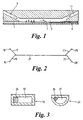
- FIG. 2 of the accompanying drawings there is illustrated more realistically the structure of a reactor suitable for use in a method of the present invention.
- Organic input is introduced through port 13 and aqueous acid input through port 15. These streams are fed through corresponding channels 17 and 19 respectively into the reactor channel 21 which has a width of 100 ⁇ m.
- the organic liquid exits from reactor channel 21 into output channel 23 and out of port 24.
- the aqueous acid exits from reactor channel 21 through output channel 27 and port 29.
- Figure 3 of the accompanying drawings illustrates two typical reactor channel cross-sections, channel 31 having a rectangular cross-section and channel 33 being of semi-circular cross-section. Also shown in Figure 3 are the positions occupied by the organic phase 35 and the acid phase 37 in both reactor channels.
- FIG. 4 of the accompanying drawings illustrates the phase splitting which takes place at the output end of reactor channel 35.
- the organic phase 37 flows naturally into output channel 39 which is angled as illustrated from reactor channel 35.
- the aqueous acid phase enters output channel 41 which extends initially coaxially from reactor channel 35 but then bends as illustrated at 43, the channel becoming of larger width at this position.
- Figure 5 illustrates a multichannel reactor sheet, in this case containing 61 reactor channels at 45.
- the size of the sheet is 130mm x 120mm.
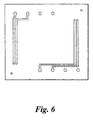
- Figure 6 shows a routing sheet for delivering liquid into the reactor channels in Figure 5.
- the sheet size in this case is also 310mm x 120mm.
- the reactor throughput for the nitration of benzene is typically of the order of 0.1 ⁇ l.s -1 with an acid flow rate of 1.0 ⁇ l.s -1 .
- a typical channel density is of the order of 1 channel per mm width.
- Sheet thickness obtained using etching techniques is of the order of twice the channel width (due to etching from both sides to produce feed holes).
- a multichannel reactor might include at least 1,000 channels, perhaps of the order of several thousand channels.
- a degree of parallel processing may be involved in the manufacture of such reactors.
- the techniques which can be used in order to produce such reactors are the following:-
- Masks are printed onto sheets which contain channel designs. These are then chemically etched, typically using acid, to produce the finished sheet. Some intermediate processing may be required, such as UV exposure, before the etching. Materials that could be used are metals and glass amongst others.
- a technique suited to polymers where a single tool is produced (possibly by non-parallel techniques such as laser ablation or by x-ray lithography).
- the tool embosses out many designs on each sheet in a production run.
- the sheets may be bonded into a single block using the method of diffusion bonding.
- Materials which may be used include PTFE (good chemical resistance and capable of being embossed, stainless steel robust and easy to chemically etch with reasonable chemical resistance; both machinable and weldable) and glass (easy to chemically etch, transparent for visual observation and easily diffusion bonded).
- the sheet thickness may be similar to that of the channel width and is typically in the range 50 ⁇ m to 300 ⁇ m.
- the number of channels per sheet range from 10 to 1,000 and is typically of the order of 100. There may be from 10 to 1,000 sheets per block typically of the order of 100. Accordingly the number of channels per block may be from 100 to 1,000,000 and is preferably 1,000 to 100,000.
- a 15cm x 15cm x 15cm block containing 1,000 sheets (each 200 ⁇ m thick) of 100 channels with 100 routing sheets will produce 10ml.s -1 of organic output. Continuous running of such apparatus will produce 864 litres.day -1 which is equivalent to about 300 tonnes per year.
- nitrobenzene was carried out using a simple reactor with channel widths perpendicular to the liquid-liquid interface of 10-200 microns.
- the reactor is shown schematically in Figure 2.
- Benzene was flowed through port 13, and an aqueous mixture of nitric acid and sulphuric acid was flowed through port 15.
- the flow rates of the reactants were balanced such that a stoichiometric reaction occurred. Reaction occurred along the channel and the product, nitro-benzene, was flowed out of port 25.
- the sulphuric acid and aqueous product was flowed out of port 29.
- the reactor and flow conditions were such that no aqueous phase contaminated the organic product exiting port 25. No separation of the organic product from the aqueous reactants and products was therefore needed. By-products formed were significantly reduced compared to conventional conditions.
- Benzene nitration was carried out using a 178 ⁇ m channel, a temperature of 90°C, 78% sulphuric acid and 4.5% nitric acid.
- the by-product contamination was less than 3,000ppm DNB and less than 300ppm DNP.
- Benzene nitration carried out with a 178 ⁇ m channel, a temperature of 90°C, 73% sulphuric acid and 4.5% nitric acid resulted in a by-product contamination of less than 500ppm DNB and less than 100ppm DNP.
- Toluene nitration was carried out in a glass reactor of 200 ⁇ m x 100 ⁇ m at 100°C with 72% sulphuric acid and 3.0% nitric acid. For a 1 second residence time, 43% conversion was obtained. The isomer output was 57% (2-NT), 6% (3-NT) and 37% (4-NT). The time for "conversion" was estimated at 4 seconds.
Landscapes
- Chemical & Material Sciences (AREA)
- Organic Chemistry (AREA)
- Chemical Kinetics & Catalysis (AREA)
- Organic Low-Molecular-Weight Compounds And Preparation Thereof (AREA)
- Physical Or Chemical Processes And Apparatus (AREA)
Claims (15)
- Verfahren um eine aromatische Verbindung mit einem Reaktionspartner reagieren zu lassen, umfassend Bereitstellen eines ersten Strömungsweges für die aromatische Verbindung und eines zweiten Strömungsweges für einen Reaktionspartner, wobei der Reaktionspartner mit der aromatischen Verbindung unvermischbar ist und die Strömungswege miteinander in einem Bereich kommunizieren, in dem die aromatische Verbindung und der Reaktionspartner miteinander in Kontakt treten können, Durchströmen der aromatischen Verbindung und des Reaktionspartners durch den ersten bzw. zweiten Strömungsweg, so daß mindestens in dem genannten Bereich die Strömung der aromatischen Verbindung und des Reaktionspartners laminar ist und eine stabile, offene Grenzfläche zwischen ihnen gebildet wird, wobei mindestens der erste Strömungsweg in dem Grenzflächenbereich eine zu der Grenzfläche rechtwinklige Breite im Bereich von 10-1000 Mikrometern aufweist, um mindestens einem Anteil der aromatischen Verbindung zu ermöglichen, mit dem Reaktionspartner zu reagieren, und Ausströmen der zur Reaktion gebrachten aromatischen Verbindung und des Reaktionspartners aus dem genannten Bereich, wobei die Reaktion ohne wesentliche Vermischung der nicht zur Reaktion gebrachten aromatischen Verbindung und des Reaktionspartners erfolgt.
- Verfahren nach Anspruchl, wobei die Breite im Bereich von 30-300 Mikrometern liegt.
- Verfahren nach Anspruch 2, wobei die Breite im Bereich von 50-150 Mikrometern liegt.
- Verfahren nach einem der vorangehenden Ansprüche, wobei der Reaktionspartner ein Nitrierungsmittel ist.
- Verfahren nach Anspruch 4, wobei das Nitrierungsmittel eine Mischung aus Salpetersäure und Schwefelsäure aufweist.
- Verfahren nach einem der Ansprüche 1 bis 3, wobei der ReaktionsPartner ein Sulfonierungsmittel ist.
- Verfahren nach Anspruch 6, wobei das Sulfonierungsmittel Schwefelsäure ist.
- Verfahren nach einem der vorangehenden Ansprüche, wobei die aromatische Verbindung Benzol oder Toluol ist.
- Verfahren nach einem der vorangehenden Ansprüche, wobei die Reaktion bei erhöhter Temperatur durchgeführt wird.
- Verfahren nach Anspruch 5, wobei die Massenkonzentration der Schwefelsäure 65% bis 80 % beträgt.
- Verfahren nach Anspruch 10, wobei die Massenkonzentration der Schwefelsäure 70 % bis 75% beträgt.
- Verfahren nach Anspruch 10 oder 11, wobei die Massenkonzentration der Salpetersäure im Bereich von 3% bis 5% liegt.
- Verfahren nach einem der Ansprüche 10 bis 12, wobei der organische Volumenanteil 5% bis 20% beträgt.
- Verfahren nach einem der Ansprüche 10 bis 13, wobei die Reaktionstemperatur 60° bis 140°C beträgt.
- Verfahren nach Anspruch 14, wobei die Reaktionstemperatur 90° bis 120°C beträgt.
Applications Claiming Priority (3)
| Application Number | Priority Date | Filing Date | Title |
|---|---|---|---|
| GB9723262 | 1997-11-05 | ||
| GBGB9723262.3A GB9723262D0 (en) | 1997-11-05 | 1997-11-05 | Reactions of aromatic compounds |
| PCT/GB1998/003288 WO1999022858A1 (en) | 1997-11-05 | 1998-11-05 | Reactions of aromatic compounds |
Publications (2)
| Publication Number | Publication Date |
|---|---|
| EP1028802A1 EP1028802A1 (de) | 2000-08-23 |
| EP1028802B1 true EP1028802B1 (de) | 2003-12-17 |
Family
ID=10821546
Family Applications (1)
| Application Number | Title | Priority Date | Filing Date |
|---|---|---|---|
| EP98954569A Expired - Lifetime EP1028802B1 (de) | 1997-11-05 | 1998-11-05 | Reaktionen mit organischen verbindungen |
Country Status (9)
| Country | Link |
|---|---|
| US (1) | US6515189B1 (de) |
| EP (1) | EP1028802B1 (de) |
| JP (1) | JP2001521913A (de) |
| AT (1) | ATE256498T1 (de) |
| AU (1) | AU1163199A (de) |
| DE (1) | DE69820673T2 (de) |
| ES (1) | ES2212369T3 (de) |
| GB (1) | GB9723262D0 (de) |
| WO (1) | WO1999022858A1 (de) |
Families Citing this family (55)
| Publication number | Priority date | Publication date | Assignee | Title |
|---|---|---|---|---|
| DE19935692A1 (de) | 1999-07-29 | 2001-02-01 | Merck Patent Gmbh | Nitrierung in einem statischen Mikromischer |
| WO2001009318A1 (fr) * | 1999-07-29 | 2001-02-08 | Helix Research Institute | Genes associes au cancer du foie |
| JP4733331B2 (ja) * | 2000-03-14 | 2011-07-27 | マイクロニックス、インコーポレーテッド | マイクロ流動体分析用デバイス |
| DE10026646A1 (de) * | 2000-05-29 | 2001-12-06 | Merck Patent Gmbh | Verfahren zur Herstellung von Indolen |
| DE10031381A1 (de) * | 2000-06-28 | 2002-01-10 | Merck Patent Gmbh | Verfahren zur Kupplung von organischen Verbindungen |
| JP2003028836A (ja) * | 2001-07-11 | 2003-01-29 | Kanagawa Acad Of Sci & Technol | マイクロチャンネル立体交差構造体と立体交差多層流の形成方法 |
| DE10250406B4 (de) | 2001-10-30 | 2007-10-25 | Hitachi, Ltd. | Reaktionsvorrichtung und Mischsystem |
| EP1380337B1 (de) * | 2002-07-12 | 2012-11-14 | Tosoh Corporation | Vorrichtung mit feinen Kanälen und chemisches Verfahren zur Verwendung dieser Vorrichtung für Fluide |
| US7118920B2 (en) * | 2002-10-22 | 2006-10-10 | Battelle Memorial Institute | Multiphasic microchannel reactions |
| WO2004040645A1 (en) * | 2002-10-31 | 2004-05-13 | Stichting Voor De Technische Wetenschappen | Microfluidic heat exchanger for locatized temperature control |
| JP2004181298A (ja) * | 2002-11-29 | 2004-07-02 | National Institute Of Advanced Industrial & Technology | マイクロリアクターとそれによる反応方法 |
| GB0307403D0 (en) | 2003-03-31 | 2003-05-07 | Medical Res Council | Selection by compartmentalised screening |
| GB0307428D0 (en) | 2003-03-31 | 2003-05-07 | Medical Res Council | Compartmentalised combinatorial chemistry |
| US20060078893A1 (en) | 2004-10-12 | 2006-04-13 | Medical Research Council | Compartmentalised combinatorial chemistry by microfluidic control |
| US7470308B2 (en) | 2004-02-10 | 2008-12-30 | Fujifilm Corporation | Method of producing magnetic particles and reaction method using microreactor and microreactor |
| US20050221339A1 (en) | 2004-03-31 | 2005-10-06 | Medical Research Council Harvard University | Compartmentalised screening by microfluidic control |
| US7968287B2 (en) | 2004-10-08 | 2011-06-28 | Medical Research Council Harvard University | In vitro evolution in microfluidic systems |
| DE102004049730B4 (de) * | 2004-10-11 | 2007-05-03 | Technische Universität Darmstadt | Mikrokapillarreaktor und Verfahren zum kontrollierten Vermengen von nicht homogen mischbaren Fluiden unter Verwendung dieses Mikrokapillarreaktors |
| JP4776246B2 (ja) * | 2005-02-08 | 2011-09-21 | 三菱瓦斯化学株式会社 | 過カルボン酸を含む溶液の製造方法 |
| WO2007081385A2 (en) | 2006-01-11 | 2007-07-19 | Raindance Technologies, Inc. | Microfluidic devices and methods of use in the formation and control of nanoreactors |
| US20100298567A1 (en) * | 2006-01-12 | 2010-11-25 | Lonza Ag | Nitration of activated aromatics in microreactors |
| EP2530167A1 (de) | 2006-05-11 | 2012-12-05 | Raindance Technologies, Inc. | Mikrofluidische Vorrichtungen |
| US9562837B2 (en) | 2006-05-11 | 2017-02-07 | Raindance Technologies, Inc. | Systems for handling microfludic droplets |
| EP2077912B1 (de) | 2006-08-07 | 2019-03-27 | The President and Fellows of Harvard College | Fluorkohlenstoffemulsionsstabilisierende tenside |
| WO2008097559A2 (en) | 2007-02-06 | 2008-08-14 | Brandeis University | Manipulation of fluids and reactions in microfluidic systems |
| US20080235122A1 (en) * | 2007-03-22 | 2008-09-25 | First Data Corporation | Master gift card, systems and methods |
| US8592221B2 (en) | 2007-04-19 | 2013-11-26 | Brandeis University | Manipulation of fluids, fluid components and reactions in microfluidic systems |
| JP2009062341A (ja) * | 2007-09-07 | 2009-03-26 | National Institute Of Advanced Industrial & Technology | 脱酸素した高温高圧水環境におけるニトロ化反応方法とその装置 |
| JP5494904B2 (ja) * | 2008-07-03 | 2014-05-21 | 独立行政法人産業技術総合研究所 | モノニトロ化法とその製造反応装置 |
| US12038438B2 (en) | 2008-07-18 | 2024-07-16 | Bio-Rad Laboratories, Inc. | Enzyme quantification |
| EP4047367A1 (de) | 2008-07-18 | 2022-08-24 | Bio-Rad Laboratories, Inc. | Verfahren zum nachweis von zielanalyten unter verwendung von tropfenbibliotheken |
| US8318439B2 (en) | 2008-10-03 | 2012-11-27 | Micronics, Inc. | Microfluidic apparatus and methods for performing blood typing and crossmatching |
| WO2010111231A1 (en) | 2009-03-23 | 2010-09-30 | Raindance Technologies, Inc. | Manipulation of microfluidic droplets |
| US10520500B2 (en) | 2009-10-09 | 2019-12-31 | Abdeslam El Harrak | Labelled silica-based nanomaterial with enhanced properties and uses thereof |
| US10837883B2 (en) | 2009-12-23 | 2020-11-17 | Bio-Rad Laboratories, Inc. | Microfluidic systems and methods for reducing the exchange of molecules between droplets |
| US10351905B2 (en) | 2010-02-12 | 2019-07-16 | Bio-Rad Laboratories, Inc. | Digital analyte analysis |
| US9366632B2 (en) | 2010-02-12 | 2016-06-14 | Raindance Technologies, Inc. | Digital analyte analysis |
| US9399797B2 (en) | 2010-02-12 | 2016-07-26 | Raindance Technologies, Inc. | Digital analyte analysis |
| EP4484577A3 (de) | 2010-02-12 | 2025-03-26 | Bio-Rad Laboratories, Inc. | Digitale analytanalyse |
| US9562897B2 (en) | 2010-09-30 | 2017-02-07 | Raindance Technologies, Inc. | Sandwich assays in droplets |
| EP2457886B1 (de) * | 2010-11-29 | 2014-04-02 | Corning Incorporated | Sulfonierung in Mikroreaktoren mit kontinuierlichem Fluss |
| EP3412778A1 (de) | 2011-02-11 | 2018-12-12 | Raindance Technologies, Inc. | Verfahren zur bildung gemischter tröpfchen |
| WO2012112804A1 (en) | 2011-02-18 | 2012-08-23 | Raindance Technoligies, Inc. | Compositions and methods for molecular labeling |
| EP3216872B1 (de) | 2011-06-02 | 2020-04-01 | Bio-Rad Laboratories, Inc. | Enzymquantifizierung |
| US8841071B2 (en) | 2011-06-02 | 2014-09-23 | Raindance Technologies, Inc. | Sample multiplexing |
| US8658430B2 (en) | 2011-07-20 | 2014-02-25 | Raindance Technologies, Inc. | Manipulating droplet size |
| CN103113232A (zh) * | 2013-01-22 | 2013-05-22 | 南京理工大学 | 一种在微反应器中催化硝化甲苯的方法 |
| WO2014182844A1 (en) | 2013-05-07 | 2014-11-13 | Micronics, Inc. | Microfluidic devices and methods for performing serum separation and blood cross-matching |
| US11901041B2 (en) | 2013-10-04 | 2024-02-13 | Bio-Rad Laboratories, Inc. | Digital analysis of nucleic acid modification |
| US9944977B2 (en) | 2013-12-12 | 2018-04-17 | Raindance Technologies, Inc. | Distinguishing rare variations in a nucleic acid sequence from a sample |
| WO2015103367A1 (en) | 2013-12-31 | 2015-07-09 | Raindance Technologies, Inc. | System and method for detection of rna species |
| US10647981B1 (en) | 2015-09-08 | 2020-05-12 | Bio-Rad Laboratories, Inc. | Nucleic acid library generation methods and compositions |
| CN107890843B (zh) * | 2017-11-16 | 2020-04-07 | 南京工业大学 | 一种微反应器装置及其在制备苯系物的磺化产物中的应用 |
| CN110683956B (zh) * | 2018-08-16 | 2021-02-12 | 中国科学院大连化学物理研究所 | 一种超声微反应器内连续合成单硝基甲苯的系统及方法 |
| CN115260036A (zh) * | 2022-07-15 | 2022-11-01 | 鄂尔多斯市瀚博科技有限公司 | 一种硝基苯的生产工艺 |
Family Cites Families (6)
| Publication number | Priority date | Publication date | Assignee | Title |
|---|---|---|---|---|
| US3976704A (en) * | 1975-01-06 | 1976-08-24 | Varen Technology | Nitration process |
| US4308215A (en) * | 1978-06-15 | 1981-12-29 | Varen Technology | Sulfonation process |
| US5811062A (en) | 1994-07-29 | 1998-09-22 | Battelle Memorial Institute | Microcomponent chemical process sheet architecture |
| ATE235292T1 (de) * | 1994-10-22 | 2003-04-15 | Central Research Lab Ltd | Verfahren und vorichtung fur diffusionsaustausch zwischen nicht mischbare flüssigkeiten |
| CA2203283A1 (en) | 1994-10-22 | 1996-05-02 | British Nuclear Fuels Plc | Method and apparatus for diffusive transfer between immiscible fluids |
| US5932100A (en) * | 1995-06-16 | 1999-08-03 | University Of Washington | Microfabricated differential extraction device and method |
-
1997
- 1997-11-05 GB GBGB9723262.3A patent/GB9723262D0/en not_active Ceased
-
1998
- 1998-11-05 ES ES98954569T patent/ES2212369T3/es not_active Expired - Lifetime
- 1998-11-05 AT AT98954569T patent/ATE256498T1/de not_active IP Right Cessation
- 1998-11-05 US US09/554,692 patent/US6515189B1/en not_active Expired - Fee Related
- 1998-11-05 EP EP98954569A patent/EP1028802B1/de not_active Expired - Lifetime
- 1998-11-05 JP JP2000518779A patent/JP2001521913A/ja active Pending
- 1998-11-05 DE DE69820673T patent/DE69820673T2/de not_active Expired - Fee Related
- 1998-11-05 WO PCT/GB1998/003288 patent/WO1999022858A1/en not_active Ceased
- 1998-11-05 AU AU11631/99A patent/AU1163199A/en not_active Abandoned
Also Published As
| Publication number | Publication date |
|---|---|
| US6515189B1 (en) | 2003-02-04 |
| WO1999022858A1 (en) | 1999-05-14 |
| EP1028802A1 (de) | 2000-08-23 |
| JP2001521913A (ja) | 2001-11-13 |
| AU1163199A (en) | 1999-05-24 |
| ES2212369T3 (es) | 2004-07-16 |
| DE69820673T2 (de) | 2004-10-21 |
| GB9723262D0 (en) | 1998-01-07 |
| ATE256498T1 (de) | 2004-01-15 |
| DE69820673D1 (de) | 2004-01-29 |
Similar Documents
| Publication | Publication Date | Title |
|---|---|---|
| EP1028802B1 (de) | Reaktionen mit organischen verbindungen | |
| EP1028801B1 (de) | Verfahren zur durchfürung einer chemischen reaktion | |
| Wörz et al. | Microreactors–a new efficient tool for reactor development | |
| Plouffe et al. | From Batch to Continuous Chemical Synthesis A Toolbox Approach | |
| KR100743381B1 (ko) | 관형 반응기, 관형 반응기에서 액체/액체 다상 반응의 수행방법 및 관형 반응기에서 방향족 화합물의 환상 니트로화 방법 | |
| US7604781B2 (en) | Microchannel apparatus capable of separating phases and methods of using same | |
| CA2247662A1 (en) | Process and apparatus for the oxidation of organic compounds in liquid phase using peroxide oxidizing agents | |
| Lomel et al. | The microreactor: a systematic and efficient tool for the transition from batch to continuous process? | |
| US20080247923A1 (en) | Plate Design for Mixer Sparger | |
| CN111056934B (zh) | 一种微反应器内制备α-羟基酮光引发剂的方法 | |
| Illg et al. | Continuous Synthesis of tert‐Butyl Peroxypivalate using a Single‐Channel Microreactor Equipped with Orifices as Emulsification Units | |
| CA2307656C (en) | Reactions of aromatic compounds | |
| KR100767266B1 (ko) | 알칼리 금속 알콕사이드의 알콜성 용액의 제조방법 | |
| EP3186215B1 (de) | Herstellung von alkylbenzolhydroperoxid mit dispergierten gashaltigen sauerstoffblasen | |
| Chen et al. | A simple and efficient synthesis protocol for sulfonation of nitrobenzene under solvent-free conditions via a microreactor | |
| WO2010011134A2 (en) | Ozonolysis of aromatics and/or olefins | |
| Cao et al. | Oxidative dehydrogenation of 3-Methyl-2-buten-1-ol in microreactors | |
| EP1702676A1 (de) | Vorrichtung und Verfahren zur Herstellung von Substanzen | |
| Schuster et al. | Modelling a novel miniaturised reactor/separator system | |
| Takac | Oxidation of 2-isopropylnaphthalene to 2-isopropylnaphthalenehydroperoxide | |
| Mleczko et al. | Technology for Continuous Production of Fine Chemicals: A Case Study for Low Temperature Lithiation Reactions | |
| Hessel et al. | Microreactor concepts and processing | |
| Kralj et al. | Preparation of sodium nitrotetrazolate using microreactor technology | |
| Rebrov | Use of microtechnologies for intensifying industrial processes | |
| Aljbour et al. | Simultaneous reaction-separation in a microchannel reactor with the aid of a guideline structure |
Legal Events
| Date | Code | Title | Description |
|---|---|---|---|
| PUAI | Public reference made under article 153(3) epc to a published international application that has entered the european phase |
Free format text: ORIGINAL CODE: 0009012 |
|
| AK | Designated contracting states |
Kind code of ref document: A1 Designated state(s): AT BE CH CY DE DK ES FI FR GB GR IE IT LI LU MC NL PT SE |
|
| 17P | Request for examination filed |
Effective date: 20000531 |
|
| 17Q | First examination report despatched |
Effective date: 20030116 |
|
| GRAH | Despatch of communication of intention to grant a patent |
Free format text: ORIGINAL CODE: EPIDOS IGRA |
|
| GRAS | Grant fee paid |
Free format text: ORIGINAL CODE: EPIDOSNIGR3 |
|
| GRAA | (expected) grant |
Free format text: ORIGINAL CODE: 0009210 |
|
| AK | Designated contracting states |
Kind code of ref document: B1 Designated state(s): AT BE CH CY DE DK ES FI FR GB GR IE IT LI LU MC NL PT SE |
|
| PG25 | Lapsed in a contracting state [announced via postgrant information from national office to epo] |
Ref country code: FI Free format text: LAPSE BECAUSE OF FAILURE TO SUBMIT A TRANSLATION OF THE DESCRIPTION OR TO PAY THE FEE WITHIN THE PRESCRIBED TIME-LIMIT Effective date: 20031217 Ref country code: CY Free format text: LAPSE BECAUSE OF FAILURE TO SUBMIT A TRANSLATION OF THE DESCRIPTION OR TO PAY THE FEE WITHIN THE PRESCRIBED TIME-LIMIT Effective date: 20031217 Ref country code: AT Free format text: LAPSE BECAUSE OF FAILURE TO SUBMIT A TRANSLATION OF THE DESCRIPTION OR TO PAY THE FEE WITHIN THE PRESCRIBED TIME-LIMIT Effective date: 20031217 |
|
| REG | Reference to a national code |
Ref country code: GB Ref legal event code: FG4D |
|
| REG | Reference to a national code |
Ref country code: CH Ref legal event code: EP |
|
| REG | Reference to a national code |
Ref country code: IE Ref legal event code: FG4D |
|
| REF | Corresponds to: |
Ref document number: 69820673 Country of ref document: DE Date of ref document: 20040129 Kind code of ref document: P |
|
| REG | Reference to a national code |
Ref country code: CH Ref legal event code: NV Representative=s name: MICHELI & CIE INGENIEURS-CONSEILS |
|
| PG25 | Lapsed in a contracting state [announced via postgrant information from national office to epo] |
Ref country code: GR Free format text: LAPSE BECAUSE OF FAILURE TO SUBMIT A TRANSLATION OF THE DESCRIPTION OR TO PAY THE FEE WITHIN THE PRESCRIBED TIME-LIMIT Effective date: 20040317 Ref country code: DK Free format text: LAPSE BECAUSE OF FAILURE TO SUBMIT A TRANSLATION OF THE DESCRIPTION OR TO PAY THE FEE WITHIN THE PRESCRIBED TIME-LIMIT Effective date: 20040317 |
|
| REG | Reference to a national code |
Ref country code: SE Ref legal event code: TRGR |
|
| REG | Reference to a national code |
Ref country code: ES Ref legal event code: FG2A Ref document number: 2212369 Country of ref document: ES Kind code of ref document: T3 |
|
| ET | Fr: translation filed | ||
| PLBE | No opposition filed within time limit |
Free format text: ORIGINAL CODE: 0009261 |
|
| STAA | Information on the status of an ep patent application or granted ep patent |
Free format text: STATUS: NO OPPOSITION FILED WITHIN TIME LIMIT |
|
| PG25 | Lapsed in a contracting state [announced via postgrant information from national office to epo] |
Ref country code: LU Free format text: LAPSE BECAUSE OF NON-PAYMENT OF DUE FEES Effective date: 20041105 Ref country code: IE Free format text: LAPSE BECAUSE OF NON-PAYMENT OF DUE FEES Effective date: 20041105 |
|
| PG25 | Lapsed in a contracting state [announced via postgrant information from national office to epo] |
Ref country code: SE Free format text: LAPSE BECAUSE OF NON-PAYMENT OF DUE FEES Effective date: 20041106 |
|
| PG25 | Lapsed in a contracting state [announced via postgrant information from national office to epo] |
Ref country code: MC Free format text: LAPSE BECAUSE OF NON-PAYMENT OF DUE FEES Effective date: 20041130 Ref country code: LI Free format text: LAPSE BECAUSE OF NON-PAYMENT OF DUE FEES Effective date: 20041130 Ref country code: CH Free format text: LAPSE BECAUSE OF NON-PAYMENT OF DUE FEES Effective date: 20041130 Ref country code: BE Free format text: LAPSE BECAUSE OF NON-PAYMENT OF DUE FEES Effective date: 20041130 |
|
| 26N | No opposition filed |
Effective date: 20040920 |
|
| BERE | Be: lapsed |
Owner name: BRITISH *NUCLEAR FUELS P.L.C. Effective date: 20041130 |
|
| PG25 | Lapsed in a contracting state [announced via postgrant information from national office to epo] |
Ref country code: NL Free format text: LAPSE BECAUSE OF NON-PAYMENT OF DUE FEES Effective date: 20050601 |
|
| EUG | Se: european patent has lapsed | ||
| REG | Reference to a national code |
Ref country code: CH Ref legal event code: PL |
|
| NLV4 | Nl: lapsed or anulled due to non-payment of the annual fee |
Effective date: 20050601 |
|
| REG | Reference to a national code |
Ref country code: IE Ref legal event code: MM4A |
|
| REG | Reference to a national code |
Ref country code: GB Ref legal event code: 732E |
|
| BERE | Be: lapsed |
Owner name: *NUCLEAR DECOMMISSIONING AUTHORITY Effective date: 20041130 |
|
| PG25 | Lapsed in a contracting state [announced via postgrant information from national office to epo] |
Ref country code: PT Free format text: LAPSE BECAUSE OF NON-PAYMENT OF DUE FEES Effective date: 20040517 |
|
| PGFP | Annual fee paid to national office [announced via postgrant information from national office to epo] |
Ref country code: ES Payment date: 20080327 Year of fee payment: 10 |
|
| PGFP | Annual fee paid to national office [announced via postgrant information from national office to epo] |
Ref country code: IT Payment date: 20080423 Year of fee payment: 10 |
|
| REG | Reference to a national code |
Ref country code: FR Ref legal event code: TP |
|
| PGFP | Annual fee paid to national office [announced via postgrant information from national office to epo] |
Ref country code: DE Payment date: 20090126 Year of fee payment: 11 |
|
| PGFP | Annual fee paid to national office [announced via postgrant information from national office to epo] |
Ref country code: GB Payment date: 20090130 Year of fee payment: 11 |
|
| PG25 | Lapsed in a contracting state [announced via postgrant information from national office to epo] |
Ref country code: IT Free format text: LAPSE BECAUSE OF NON-PAYMENT OF DUE FEES Effective date: 20081105 |
|
| PGFP | Annual fee paid to national office [announced via postgrant information from national office to epo] |
Ref country code: FR Payment date: 20090213 Year of fee payment: 11 |
|
| REG | Reference to a national code |
Ref country code: ES Ref legal event code: FD2A Effective date: 20081106 |
|
| PG25 | Lapsed in a contracting state [announced via postgrant information from national office to epo] |
Ref country code: ES Free format text: LAPSE BECAUSE OF NON-PAYMENT OF DUE FEES Effective date: 20081106 |
|
| GBPC | Gb: european patent ceased through non-payment of renewal fee |
Effective date: 20091105 |
|
| REG | Reference to a national code |
Ref country code: FR Ref legal event code: ST Effective date: 20100730 |
|
| PG25 | Lapsed in a contracting state [announced via postgrant information from national office to epo] |
Ref country code: FR Free format text: LAPSE BECAUSE OF NON-PAYMENT OF DUE FEES Effective date: 20091130 |
|
| PG25 | Lapsed in a contracting state [announced via postgrant information from national office to epo] |
Ref country code: DE Free format text: LAPSE BECAUSE OF NON-PAYMENT OF DUE FEES Effective date: 20100601 |
|
| PG25 | Lapsed in a contracting state [announced via postgrant information from national office to epo] |
Ref country code: GB Free format text: LAPSE BECAUSE OF NON-PAYMENT OF DUE FEES Effective date: 20091105 |