EP1029367B1 - Solarzellen-dachziegel und herstellungsverfahren - Google Patents
Solarzellen-dachziegel und herstellungsverfahren Download PDFInfo
- Publication number
- EP1029367B1 EP1029367B1 EP98956545A EP98956545A EP1029367B1 EP 1029367 B1 EP1029367 B1 EP 1029367B1 EP 98956545 A EP98956545 A EP 98956545A EP 98956545 A EP98956545 A EP 98956545A EP 1029367 B1 EP1029367 B1 EP 1029367B1
- Authority
- EP
- European Patent Office
- Prior art keywords
- solar cell
- layer
- roof tile
- backskin
- cell roof
- Prior art date
- Legal status (The legal status is an assumption and is not a legal conclusion. Google has not performed a legal analysis and makes no representation as to the accuracy of the status listed.)
- Expired - Lifetime
Links
Images



Classifications
-
- B—PERFORMING OPERATIONS; TRANSPORTING
- B32—LAYERED PRODUCTS
- B32B—LAYERED PRODUCTS, i.e. PRODUCTS BUILT-UP OF STRATA OF FLAT OR NON-FLAT, e.g. CELLULAR OR HONEYCOMB, FORM
- B32B17/00—Layered products essentially comprising sheet glass, or glass, slag, or like fibres
- B32B17/06—Layered products essentially comprising sheet glass, or glass, slag, or like fibres comprising glass as the main or only constituent of a layer, next to another layer of a specific material
- B32B17/10—Layered products essentially comprising sheet glass, or glass, slag, or like fibres comprising glass as the main or only constituent of a layer, next to another layer of a specific material of synthetic resin
- B32B17/10005—Layered products essentially comprising sheet glass, or glass, slag, or like fibres comprising glass as the main or only constituent of a layer, next to another layer of a specific material of synthetic resin laminated safety glass or glazing
- B32B17/10165—Functional features of the laminated safety glass or glazing
- B32B17/10293—Edge features, e.g. inserts or holes
- B32B17/10302—Edge sealing
-
- B—PERFORMING OPERATIONS; TRANSPORTING
- B32—LAYERED PRODUCTS
- B32B—LAYERED PRODUCTS, i.e. PRODUCTS BUILT-UP OF STRATA OF FLAT OR NON-FLAT, e.g. CELLULAR OR HONEYCOMB, FORM
- B32B17/00—Layered products essentially comprising sheet glass, or glass, slag, or like fibres
- B32B17/06—Layered products essentially comprising sheet glass, or glass, slag, or like fibres comprising glass as the main or only constituent of a layer, next to another layer of a specific material
- B32B17/10—Layered products essentially comprising sheet glass, or glass, slag, or like fibres comprising glass as the main or only constituent of a layer, next to another layer of a specific material of synthetic resin
- B32B17/10005—Layered products essentially comprising sheet glass, or glass, slag, or like fibres comprising glass as the main or only constituent of a layer, next to another layer of a specific material of synthetic resin laminated safety glass or glazing
- B32B17/10009—Layered products essentially comprising sheet glass, or glass, slag, or like fibres comprising glass as the main or only constituent of a layer, next to another layer of a specific material of synthetic resin laminated safety glass or glazing characterized by the number, the constitution or treatment of glass sheets
- B32B17/10018—Layered products essentially comprising sheet glass, or glass, slag, or like fibres comprising glass as the main or only constituent of a layer, next to another layer of a specific material of synthetic resin laminated safety glass or glazing characterized by the number, the constitution or treatment of glass sheets comprising only one glass sheet
-
- B—PERFORMING OPERATIONS; TRANSPORTING
- B32—LAYERED PRODUCTS
- B32B—LAYERED PRODUCTS, i.e. PRODUCTS BUILT-UP OF STRATA OF FLAT OR NON-FLAT, e.g. CELLULAR OR HONEYCOMB, FORM
- B32B17/00—Layered products essentially comprising sheet glass, or glass, slag, or like fibres
- B32B17/06—Layered products essentially comprising sheet glass, or glass, slag, or like fibres comprising glass as the main or only constituent of a layer, next to another layer of a specific material
- B32B17/10—Layered products essentially comprising sheet glass, or glass, slag, or like fibres comprising glass as the main or only constituent of a layer, next to another layer of a specific material of synthetic resin
- B32B17/10005—Layered products essentially comprising sheet glass, or glass, slag, or like fibres comprising glass as the main or only constituent of a layer, next to another layer of a specific material of synthetic resin laminated safety glass or glazing
- B32B17/1055—Layered products essentially comprising sheet glass, or glass, slag, or like fibres comprising glass as the main or only constituent of a layer, next to another layer of a specific material of synthetic resin laminated safety glass or glazing characterized by the resin layer, i.e. interlayer
- B32B17/10743—Layered products essentially comprising sheet glass, or glass, slag, or like fibres comprising glass as the main or only constituent of a layer, next to another layer of a specific material of synthetic resin laminated safety glass or glazing characterized by the resin layer, i.e. interlayer containing acrylate (co)polymers or salts thereof
-
- H—ELECTRICITY
- H02—GENERATION; CONVERSION OR DISTRIBUTION OF ELECTRIC POWER
- H02S—GENERATION OF ELECTRIC POWER BY CONVERSION OF INFRARED RADIATION, VISIBLE LIGHT OR ULTRAVIOLET LIGHT, e.g. USING PHOTOVOLTAIC [PV] MODULES
- H02S20/00—Supporting structures for PV modules
- H02S20/10—Supporting structures directly fixed to the ground
-
- H—ELECTRICITY
- H02—GENERATION; CONVERSION OR DISTRIBUTION OF ELECTRIC POWER
- H02S—GENERATION OF ELECTRIC POWER BY CONVERSION OF INFRARED RADIATION, VISIBLE LIGHT OR ULTRAVIOLET LIGHT, e.g. USING PHOTOVOLTAIC [PV] MODULES
- H02S20/00—Supporting structures for PV modules
- H02S20/20—Supporting structures directly fixed to an immovable object
-
- H—ELECTRICITY
- H02—GENERATION; CONVERSION OR DISTRIBUTION OF ELECTRIC POWER
- H02S—GENERATION OF ELECTRIC POWER BY CONVERSION OF INFRARED RADIATION, VISIBLE LIGHT OR ULTRAVIOLET LIGHT, e.g. USING PHOTOVOLTAIC [PV] MODULES
- H02S20/00—Supporting structures for PV modules
- H02S20/20—Supporting structures directly fixed to an immovable object
- H02S20/22—Supporting structures directly fixed to an immovable object specially adapted for buildings
- H02S20/23—Supporting structures directly fixed to an immovable object specially adapted for buildings specially adapted for roof structures
-
- H—ELECTRICITY
- H02—GENERATION; CONVERSION OR DISTRIBUTION OF ELECTRIC POWER
- H02S—GENERATION OF ELECTRIC POWER BY CONVERSION OF INFRARED RADIATION, VISIBLE LIGHT OR ULTRAVIOLET LIGHT, e.g. USING PHOTOVOLTAIC [PV] MODULES
- H02S20/00—Supporting structures for PV modules
- H02S20/20—Supporting structures directly fixed to an immovable object
- H02S20/22—Supporting structures directly fixed to an immovable object specially adapted for buildings
- H02S20/23—Supporting structures directly fixed to an immovable object specially adapted for buildings specially adapted for roof structures
- H02S20/25—Roof tile elements
-
- H—ELECTRICITY
- H10—SEMICONDUCTOR DEVICES; ELECTRIC SOLID-STATE DEVICES NOT OTHERWISE PROVIDED FOR
- H10F—INORGANIC SEMICONDUCTOR DEVICES SENSITIVE TO INFRARED RADIATION, LIGHT, ELECTROMAGNETIC RADIATION OF SHORTER WAVELENGTH OR CORPUSCULAR RADIATION
- H10F19/00—Integrated devices, or assemblies of multiple devices, comprising at least one photovoltaic cell covered by group H10F10/00, e.g. photovoltaic modules
- H10F19/80—Encapsulations or containers for integrated devices, or assemblies of multiple devices, having photovoltaic cells
-
- F—MECHANICAL ENGINEERING; LIGHTING; HEATING; WEAPONS; BLASTING
- F24—HEATING; RANGES; VENTILATING
- F24S—SOLAR HEAT COLLECTORS; SOLAR HEAT SYSTEMS
- F24S25/00—Arrangement of stationary mountings or supports for solar heat collector modules
-
- Y—GENERAL TAGGING OF NEW TECHNOLOGICAL DEVELOPMENTS; GENERAL TAGGING OF CROSS-SECTIONAL TECHNOLOGIES SPANNING OVER SEVERAL SECTIONS OF THE IPC; TECHNICAL SUBJECTS COVERED BY FORMER USPC CROSS-REFERENCE ART COLLECTIONS [XRACs] AND DIGESTS
- Y02—TECHNOLOGIES OR APPLICATIONS FOR MITIGATION OR ADAPTATION AGAINST CLIMATE CHANGE
- Y02B—CLIMATE CHANGE MITIGATION TECHNOLOGIES RELATED TO BUILDINGS, e.g. HOUSING, HOUSE APPLIANCES OR RELATED END-USER APPLICATIONS
- Y02B10/00—Integration of renewable energy sources in buildings
- Y02B10/10—Photovoltaic [PV]
-
- Y—GENERAL TAGGING OF NEW TECHNOLOGICAL DEVELOPMENTS; GENERAL TAGGING OF CROSS-SECTIONAL TECHNOLOGIES SPANNING OVER SEVERAL SECTIONS OF THE IPC; TECHNICAL SUBJECTS COVERED BY FORMER USPC CROSS-REFERENCE ART COLLECTIONS [XRACs] AND DIGESTS
- Y02—TECHNOLOGIES OR APPLICATIONS FOR MITIGATION OR ADAPTATION AGAINST CLIMATE CHANGE
- Y02B—CLIMATE CHANGE MITIGATION TECHNOLOGIES RELATED TO BUILDINGS, e.g. HOUSING, HOUSE APPLIANCES OR RELATED END-USER APPLICATIONS
- Y02B10/00—Integration of renewable energy sources in buildings
- Y02B10/20—Solar thermal
-
- Y—GENERAL TAGGING OF NEW TECHNOLOGICAL DEVELOPMENTS; GENERAL TAGGING OF CROSS-SECTIONAL TECHNOLOGIES SPANNING OVER SEVERAL SECTIONS OF THE IPC; TECHNICAL SUBJECTS COVERED BY FORMER USPC CROSS-REFERENCE ART COLLECTIONS [XRACs] AND DIGESTS
- Y02—TECHNOLOGIES OR APPLICATIONS FOR MITIGATION OR ADAPTATION AGAINST CLIMATE CHANGE
- Y02E—REDUCTION OF GREENHOUSE GAS [GHG] EMISSIONS, RELATED TO ENERGY GENERATION, TRANSMISSION OR DISTRIBUTION
- Y02E10/00—Energy generation through renewable energy sources
- Y02E10/50—Photovoltaic [PV] energy
Definitions
- the invention relates to solar cell roof tiles and methods for forming the solar cell roof tiles.
- a solar cell module is formed by interconnecting individual solar cells and laminating the interconnected cells into an integral solar cell module.
- the module usually includes a stiff transparent cover layer made of a polymer or glass material, a transparent front encapsulant which adheres to the cover material and to a plurality of interconnected solar cells, a rear encapsulant which can be transparent or any other color, a stiff backskin for protecting the rear surface of the module, a protective seal which covers the edges of the module, and a perimeter frame made of aluminum which covers the seal. The frame protects the edges of the module when the front cover is made of glass.
- the module Before the frame is mounted, the module is laminated under heat and pressure. These conditions cause the layers of encapsulant material to melt, bond to adjacent surfaces, and to literally "encapsulate" the solar cells. Since crystalline silicon solar cells are usually brittle, the encapsulant serves to protect the solar cells and reduce breakage when the module is subject to mechanical stress during field usage.
- the frame After the lamination process, the frame is attached to the module.
- the frame includes mounting holes which are used to mount the framed module to an object in the field. The mounting process requires screws, bolts, and nuts and can be accomplished in a variety of ways.
- One known method aimed at reducing solar cell module manufacturing costs includes eliminating the aluminum frame and using a polymeric material as both the backskin and the edging.
- polymeric frames of a molded thermoplastic material are widely practiced.
- Reaction injection molding may be used to mold a polyurethane frame around an amorphous silicon module.
- Reaction injection molding is done in situ (i.e.; on the module), and this is a significant cost savings advantage.
- this molding process has several disadvantages. For example, this process includes the use of a chemical precursor (e.g., isocyanate) which posses environmental hazards. This process also requires a mold, further adding to the overall manufacturing cost.
- a chemical precursor e.g., isocyanate
- modules made this way tend to be small (e.g., 5-10 Watt size), not the 50-80 Watt size more generally deployed using aluminum frames.
- the modules tend to be smaller because of the higher cost of the mold and the limited strength of the resulting polymeric frame with its integral mounting holes.
- reaction injection molding is marginally successful in reducing manufacturing costs for amorphous silicon solar cell modules.
- the backskin material is generally quite costly. There are two widely used backskin materials, both of which tend to be expensive. The most popular material used is a Tedlar® /polyester/ethylene vinyl acetate laminate, and the other widely used backskin material is glass. Two additional layers of material are often deployed between the solar cells in the module and the backskin, further adding to the manufacturing costs.
- Both amorphous and crystalline silicon modules also include a junction box which is mounted onto the backskin material and from which all external electrical connections are made. Further labor is required to make connections to the junction box.
- a frame along with an elastomeric edging material, is often used when the front support for the module is formed of tempered glass. This construction protects the edges, as the tempered glass is vulnerable to breakage if an edge is damaged. While the use of a frame adds durability to the solar cell module, it also adds significantly to the manufacturing costs.
- Modules are mounted by assembling screws, nuts, and bolts to the appropriate mounting holes on the aluminum frame-
- solar cell modules are often located in remote areas which have no other source of electricity-
- the mounting process often involves attaching the hardware in difficult, awkward and not readily accessible locations such as on rugged terrain, or roof tops. Therefore a need exists for a low-cost solar cell module that can be used as a roof tele.
- a conventional solar cell roofing tile and method for its manufacture may be found, for example, in DE3247469 A1 .
- JP 09-045947 Another example of a known manufacturing method for encapsulation of solar cell elements within roof tiles may be found, for example, in JP 09-045947 .
- the invention provides a solar cell roof tile as claimed in claim 1 and a method for its manufacture as claimed in claim 12.
- the roof tile in accordance with the invention features a solar cell module with a backskin material which provides all of the following advantageous features: (i) a strong and weatherable backing for the module; (ii) an edging which can (optionally) eliminate the need for an aluminum frame; (iii) an edge Seal that eliminates the need for any additional seal materials; (iv) a rear encapsulant that eliminates the need for a separate rear sheet of encapsulant material; and (v) the elimination of the need for a scrim layer to remove air during lamination.
- the backskin material is easily formed and molded in situ during the module manufacturing process. The primary advantages of solar cell modules utilizing the backskin material include a significant reduction in manufacturing costs and module mounting costs.
- the backskin material is a thermoplastic olefin which may be composed of two different kinds of ionomer, mineral filler and a pigment.
- Ionomer is a generic name which herein refers to either a co-polymer of ethylene and methacrylic acid or acrylic acid, which has been neutralized with the addition of a salt which supplies a cation such as Na+, Li+, , Zn+-r, Al+++, Mg++, etc., or a co-polymer of polyethylene and an acrylate to which cations such as those listed above have been added.
- the material has the usual covalent bonds which polymers typically have, but also has regions of ionic bonding.
- the latter imparts to the materials a built-in cross linking lonomers are characterized as being tough and weatherable polymers.
- the combination of two ionomers produces a known synergistic effect which improves the water vapor barrier properties of the material over and above the barrier properties of either of the individual ionomer components.
- a mineral filler such as glass fiber
- the addition of a mineral filler, such as glass fiber, to the backskin material provides for a lower coefficient of thermal expansion. This is important for preserving strong, long, lasting bonds to all the adjacent surfaces in a module which undergoes ambient temperature extremes.
- the glass fibers also improve the water vapor and oxygen barrier properties of the material and increase the flexural modulus three or four times over the ionomers themselves. This makes the backskin material very strong, but still flexible.
- a pigment, such as carbon black, is added to the backskin material to provide excellent weathering properties (i.e. resistance to the degradation from the UV light in the solar spectrum).
- the solar cell module may be laminated.
- the module includes a front support layer formed of light transmitting material, such as glass, and having first and second surfaces.
- a transparent encapsulant layer formed of at least one ionomer, is disposed adjacent the second surface of the front support layer.
- a first surface of a plurality of interconnected solar cells are disposed adjacent the transparent encapsulant layer.
- a backskin layer formed of a thermoplastic olefin, has a first surface disposed adjacent a second surface of the interconnected solar cells. The transparent encapsulant layer and the backskin layer, in combination, encapsulate the interconnected solar cells.
- a portion of the backskin layer is wrapped around at least one edge of the module for contacting the first surface of the front support layer, to thereby form an edge seal.
- the presence of acid functionality in the ionomers utilized in the backskin material yields the property of bonding cohesively, not merely adhesively, to various materials including glass, metals, and other polymers. This property is utilized to provide a wraparound backskin that also serves as an edge seal without the need for additional adhesive materials.
- An optional metallic frame may be securely disposed to at least one edge of the module.
- a method of manufacturing a solar cell module is described as follows.
- a front support layer is formed of light transmitting material (eg., glass).
- a transparent encapsulant layer formed of at least one ionomer, is placed adjacent a second surface of the front support layer.
- a plurality of interconnected solar cells having first and second surfaces are positioned adjacent the transparent encapsulant layer.
- a backskin layer formed of thermoplastic olefin is placed adjacent a second surface of the interconnected solar cells to thereby form an assembly.
- the assembly is laminated to form the solar cell module. More specifically, the assembly is subjected to heat and pressure to encapsulate the interconnected solar cells with the encapsulant layer and the backskin layer.
- a portion of the backskin layer is wrapped around at least one edge of the assembly for contacting the first surface of the front support layer to form an edge seal.
- a metallic frame may be secured adjacent at least one edge of the module.
- the electrical leads for the module are coated with a polyolefin material (e.g., polyethylene) or a known blend of rubber and polypropylene.
- the polyolefin coated leads can be heated and bonded into the backskin material to form an integral seal.
- a solar cell module employing the above-described backskin material is bonded directly to the exterior surface of an architectural building material (e.g., aluminum, concrete, stone or glass).
- an architectural building material e.g., aluminum, concrete, stone or glass.
- the above-described electrical leads can be brought out through holes in the building material.
- the invention features a solar cell roof tile.
- the roof tile includes a front support layer, a transparent encapsulant layer, a plurality of interconnected solar cells and a backskin layer.
- the front support layer is formed of light transmitting material and has first and second surfaces.
- the transparent encapsulant layer is disposed adjacent the second surface of the front support layer.
- the interconnected solar cells have a first surface disposed adjacent the transparent encapsulant layer.
- the backskin layer has a first surface disposed adjacent a second surface of the interconnected solar cells, wherein a portion of the backskin layer wraps around and contacts the first surface of the front support layer to form the border region.
- a portion of the border region has an extended width.
- the solar cell roof tile may have stand-offs disposed on the extended width border region for providing vertical spacing with respect to an adjacent solar cell roof tile.
- the invention features a method of manufacturing a solar cell roof tile.
- a front support layer formed of light transmitting material is provided.
- A, transparent encapsulant layer is placed adjacent a second surface of the front support layer.
- a plurality of interconnected solar cells are positioned adjacent the transparent encapsulant layer.
- a backskin layer is placed adjacent a second surface of the interconnected solar cells.
- a border region is formed by wrapping a portion of the backskin layer around to contact the first surface of the front support layer. A portion of the border region has an extended width.
- An assembly of the front support layer, the transparent encapsulant layer, the interconnected solar cells and the backskin layer is laminated to form the solar cell roof tile.
- stand-offs are disposed on the extended width border region for providing vertical spacing with respect to an adjacent solar cell roof tile.
- FIGS. 1A, 1B, and 1C are cross-sectional views of conventional solar cell modules.
- FIG. 1A shows a module with a transparent front support layer 10 of glass or polymer disposed on a transparent encapsulant layer 12.
- the encapsulant layer is disposed on an array of interconnected solar cells 14, which is disposed on a scrim layer 16.
- the scrim layer is disposed on a rear encapsulant layer 18, which is disposed on a backskin 20.
- the backskin 20 may be a Tedlar® laminate of about ten-thousandths of an inch (254 ⁇ m) thickness.
- FIG. 1B shows another module having the same configuration as the module shown in FIG. 1A , except that the backskin 22 is formed of a sheet of glass.
- the assembly shown in FIG. 1A or FIG. 1B is laminated by subjecting the assembly to heat and pressure in a vacuum laminator using a known process.
- the scrim layer 16 is absorbed into the rear encapsulant sheet 18 during lamination and is not therefore shown.
- a perimeter frame 26, typically aluminum, is mounted to surround the edges of the module and a sealing material 28 seals the edges.
- the sealing material 28, in the form of a strip of tape or a caulking type compound, is applied to the edges. Subsequently, sections of the perimeter frame 26 are fastened onto the module and joined together at the corners.
- the color cell roof tile in accordance with the invention features a solar cell module having an improved backskin material which significantly reduces manufacturing costs. This is accomplished by eliminating certain materials which are conventionally used in the construction of prior art modules and by simplifying the steps required to make the module. More particularly, the improved backskin material eliminates the need for a rear encapsulant layer, for a scrim layer, for a sealing strip or sealing material at the module edges, and for the requirement of a perimeter frame of aluminum.
- FIG. 2 shows a solar cell module including the improved backskin material.
- the module 30 includes a front support layer 32 formed of light transmitting material (e.g., glass) and having front and rear surfaces (32s, 32b).
- a transparent encapsulant layer 34 is disposed over the rear surface 32b of the front support layer.
- a first surface 36a of a plurality of interconnected solar cells 36 is disposed over the transparent encapsulant layer 34.
- a flexible backskin layer 38 has a first surface 38a disposed adjacent the second surface 36b of the interconnected solar cells.
- a laminated module is formed by placing the module in a laminator and subjecting it to heat and pressure.
- the lamination process causes the transparent encapsulant layer 34 and the backskin material 38 to melt and bond to the interconnected solar cells 36 and other adjacent surfaces. Once the lamination process is complete, the transparent encapsulant layer 34 and the backskin layer 38, in combination, encapsulate the interconnected solar cells 36.
- the backskin material 38 is a thermoplastic polyolefin including a mixture of at least two ionomers.
- the backskin is a flexible sheet of thermoplastic polyolefin which includes a sodium ionomers, a zinc ionomer, 10-20% glass fibers, and about 5% carbon black and has a thickness of about 0.040 inches (1016 ⁇ m).
- the carbon black is added to provide excellent resistance to weathering effects due to UV sunlight and atmospheric conditions.
- the material 38 combines the features of flexibility, elasticity, strong cohesive bonding to certain surfaces (e.g., glass, metal and polymer), toughness, and excellent resistance to UV light degradation. As a result of these properties and advantages, the use of this material results in significant cost savings in the manufacture of solar cell modules.
- the module can be fitted with a frame.
- a perimeter frame 40 of metallic material can be secured to the module 30.
- a sealant 42 may be applied to the module edges to seal the frame 40 to the module 30.
- the backskin can be wrapped around the edges of the module (see, FIG. 4 ), and the frame heated and bonded directly to the wrapped portion of the backskin material without any adhesive or bonding agent.
- a plurality of mounting brackets are heated and then bonded directly to the backskin material without any adhesive or bonding agent. These aluminum pieces then become slides which allow the module to be slid into place by sliding it along channel brackets (see FIGS. 13-18 ).
- FIG. 4 shows a solar cell module 44 in which portions 46 of the improved backskin material 38 is wrapped around the edges of the assembly and bonds to the solar cells 36, the transparent front encapsulant 34 and the front support layer 32.
- the backskin material 38 provides four functions: (i) the backskin, (ii) the rear encapsulant, (iii) the edge protector, and (iv) the edge sealant.
- the module 44 can be fitted with various types of frames.
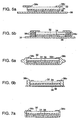
- FIGS. 5a-7a show a processing sequence used to form the solar cell module shown in FIG. 4 .
- a sheet of backskin material 38 about one inch (25.4 mm) wider than the cover layer 32 is positioned adjacent the interconnected solar cells 36.
- Narrow strips of the backskin material 38c are laid down along the perimeter of the cover layer 32 with the strips overlapping at the corners.
- the assembly is then placed in a laminator and subjected to heat and pressure with temperatures on the order of 150°C.
- FIG. 6a illustrates the laminated module.
- the backskin 38 and perimeter strips 38c have completely melted together and formed a tight seal along the edge 32c of the front surface of the cover layer 32. Without the need for a mold of any kind, the lamination of a module with the improved backskin yields edge protection and edge sealing. Any excess backskin material can easily be trimmed off to provide the finished module illustrated in FIG. 7a .
- FIGS. 5b-6b show a processing sequence used to form another solar cell module.
- the module is the same as that described in connection with FIG. 5a , except that a plurality of narrow strips of the backskin material 38c are stacked along the perimeter of the cover layer 32.
- the assembly is then placed in a laminator and subjected to heat and pressure.
- FIG. 6b illustrates the laminated module. As shown, the backskin 38 and perimeter strips 38c have completely melted together and formed a tight seal along the front surface of the cover layer 32. With this process, there is no need to trim excess backskin material as describe in connection with FIG. 6a .
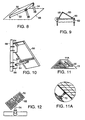
- FIGS. 8-12 illustrate conventional means for mounting modules.
- the solar cell module 50 and the aluminum frame 52 are mounted to metallic mounts 54. These mounts 54 are, in turn, mounted to a metallic structure 56 or to clement.
- the module 50 is connected to a support member 58 which, in turn, is joined to other metal support members 60, 62.
- cross members 64 are mounted to other pieces 66 and directly to a pole 68.
- the module 50 is placed on jacks (or standoffs) 70 which are attached to the roof 72.
- FIG. 12 shows a pole mounting scheme for tracking in which modules 50 are mounted in a metal structure 52 connecting the module frames.
- the solar cell module may include an improved mounting structure.
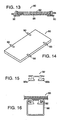
- a solar cell module 80 includes a front support layer 82, a transparent front encapsulant 84, solar cells 86 and the improved backskin material 88.
- the backskin 88 is wrapped around the edges of the assembly and bonds to the solar cells 86, the transparent front encapsulant 84 and the front support layer 82.
- Extruded mounting brackets 90 which may be aluminum or polymeric material, are heated and bonded directly to rear surface of the backskin material.
- FIG. 14 is a plan view of the module 80 including four mounting brackets 90.
- the module may include two mounting brackets (not shown) extending across the rear surface of the backskin material.
- FIGS. 15 and 17 illustrate two possible configurations of extruded mounting brackets (92, 94).
- the bracket include two C-shaped members (92a, 92b or 94a, 94b) connected by linear member. As described below, these brackets slidably engage a channel bracket for mounting a module.
- the C-shaped members (92a, 92b or 94a, 94b) provide stiffness and permit secure engagement to the channel bracket.
- the linear member is multifunctional in that it allows for various mounting configurations to the channel bracket as explained below (see FIGS. 16 , 19 and 20 ).
- a molded plastic insert (not shown) may be inserted adjacent the linear member and between the C-shaped members. The insert wraps around the bottom and sides of the C-shaped members and engages the channel bracket to accommodate tolerance differences along the channel bracket and C-shaped members.
- FIG. 16 illustrates a module mounted to channel bracket disposed on a structure (e.g., a roof, a pole; or the ground).
- a module 80 includes including a mounting bracket 92 directly mounted to the backskin 88.
- the C-shaped members 92a, 92b slidably engage a channel bracket 96 secured to a structure (not shown). As such, the module 80 can be easily slid along the channel bracket 96 to a desired location.
- FIG. 18 illustrates a module mounting configuration using the mounting bracket 94 shown in FIG. 17 .
- FIGS. 19 and 20 illustrate alternative mounting configurations.
- the module 80 includes including an inverted mounting bracket 92 directly mounted to the backskin 88.
- the C-sbaped members 92a, 92b are secured via a bolt 98 to the channel bracket 96.
- an inverted mounting bracket 94 is secured via a rivet 100 to the channel bracket 96.
- FIG. 21 illustrates an embodiment in which the electrical leads for the module are coated with a polyolefin material (e.g., polyethylene) or a known blend of rubber and polypropylene.
- the two electrical leads (102a, 102b) are covered with a polyolefin material (101a, 101b) and bonded into the backskin material (103a, 103b).
- the coated leads form an integral seal and no junction box is required on the module.
- FIG. 22 illustrates an embodiment in which the module 104 (see FIG. 4 ) is bonded directly to the exterior surface of an architectural building material 105 (e.g., aluminum, concrete, stone or glass).
- the exterior surface (or the backskin material) is heated and the module is bonded directly to the building material
- the electrical leads (not shown), formed as described in connection with FIG- 21, are brought out through holes 106 in the building material and extend into the interior of the building.
- FIG. 23 shows a solar cell roof tile 108a in accordance with the invention.
- the solar cell roof tile 108a is similar to the solar cell module of FIG. 7a , except that the roof tile 108a includes a border region 107, where a portion of the border region 107a has an extended width for overlapping with an adjacent roof tile.
- the border region 107 is formed by wrapping around a portion of the backskin layer 108b to contact a first surface of the front support layer 109.
- the extended width border region 107a allows the solar cell roof tiles 108a to be overlapped or shingled, while protecting the solar cells 108a and the front support layer 109.
- the front support layer 109 comprises glass, and the interconnected solar cells 110 are encapsulated under the glass 109.
- the overlap region 107a is bonded to the glass 109 in a region where no solar cells 110 are placed.
- the backskin material, with the wrapped around border region allows for greater mechanical stability for the solar cell roof tile over existing solar cell module roof
- the solar cell roof tile 108a has stand-offs 121 molded in the extended width border region 107a.
- the stand-offs 121 prevent movement between overlapping roof tiles 108a and provide vertical spacing between overlapping roof tiles 108a, thereby facilitating air cooling and water runoff.
- FIG. 24 illustrates how two solar cell roof tiles 111, 111' of FIG. 23 can overlap or shingle.
- the extended width border region 107a with the stand-offs 121 of a first roof tile 111' contacts an edge portion of the second surface of the backskin layer 108b of the second roof tile 111.
- a roof tile 111 has a first group of stand-offs 121 formed on the extended width border region 107a and a second group of stand-offs 122 formed the second surface of the backskin layer 108b.
- the second group of stands-offs 122 are placed on the edge portion of the backskin layer 108b and positioned to intersperse between the first group of stand- offs 121' of an adjacent roof tile 111' when they are overlapped.
- FIG. 25a illustrates a solar cell roof tile 130 in which the border region 117 has extensions 119a, 119b.
- the extensions 119a, 119b may be molded onto the roof tile 130.
- Each extension 119a, 119b has a hole for inserting a nail or a screw when mounting the roof tile 130.
- FIG. 25b illustrates a solar cell roof tile 132 in which the overlap region 118 has an extension 120.
- a solar cell roof tile may further include a connector or an electrical lead embedded on a second surface of the backskin layer.
- the roof tile may include a connector having a male portion or a female portion such that when the roof tiles are installed, the male portion of the connector of one roof tile plugs into the female portion of the connector of an adjacent roof tile.
- the roof tile may include an electrical lead which is molded on the second surface of the backskin layer. The ends of the electrical lead are brought out to edges of the roof tile to be accessible. Once the roof tiles are installed, adjacent roof tiles may be interconnected via the electrical leads.
- the stand-offs, the border region with an extended width and the extensions with holes for mounting the solar cell roof tile can all be formed in a single step in the solar cell lamination process.
Landscapes
- Engineering & Computer Science (AREA)
- Architecture (AREA)
- Civil Engineering (AREA)
- Structural Engineering (AREA)
- Roof Covering Using Slabs Or Stiff Sheets (AREA)
- Photovoltaic Devices (AREA)
Claims (18)
- Solarzellendachplatte (108a - Figur 23) mit:einer Frontträgerschicht (32 - Figur 2; 109 - Figur 23), die aus lichtdurchlässigem Material gebildet ist und eine erste und zweite Oberfläche (32a, 32b - Figur 2) aufweist;einer transparenten Mantelschicht (34 - Figur 2), die neben der zweiten Oberfläche (32b - Figur 2) der Frontträgerschicht angeordnet ist;einer Vielzahl von verbundenen Solarzellen (36 - Figur 2; 110 - Figur 23) mit einer ersten Oberfläche (36a - Figur 2), die neben der transparenten Mantelschicht angeordnet ist; undeiner Rückverkleidungsschicht (38 - Figur 2; 108b - Figur 23) mit einer ersten Oberfläche (38a - Figur 2), die neben einer zweiten Oberfläche (36b - Figur 2) der verbundenen Solarzellen angeordnet ist, wobei ein Teil der Rückverkleidungsschicht die erste Oberfläche (32a - Figur 2) der Fronträgerschicht umwickelt und berührt, um den Grenzbereich (107 - Figur 23) zu bilden, wobei ein Teil des Grenzbereichs (107a - Figur 23) eine erweiterte bzw. erstreckte Breite aufweist.
- Solarzellendachplatte gemäß Anspruch 1, ferner mit einer Vielzahl von Abstandshaltern (121 - Figur 23), die auf dem Grenzbereich mit erstreckter Breite angeordnet sind, um eine vertikale Beabstandung bezüglich einer benachbarten Solarzellendachplatte bereitzustellen.
- Solarzellendachplatte gemäß Anspruch 1, ferner mit einer ersten Gruppe von Abstandshaltern (121 - Figur 24), die auf dem Grenzbereich mit einer erstreckten Breite angeordnet sind, und einer zweiten Gruppe von Abstandshaltern (102 - Figur 24), die auf einer zweiten Oberfläche der Rückverkleidungsschicht angeordnet sind, wobei die erste Gruppe der Abstandshalter einer Solarzellendachplatte ausgestaltet ist, um sich in die zweite Gruppe der Abstandshalter einer benachbarten Solarzellendachplatte einzufügen.
- Solarzellendachplatte gemäß Anspruch 1, bei der der Grenzbereich eine Erstreckung (119a, 119b - Figur 25a; 120 - Figur 25b) aufweist, die ein Loch definiert.
- Solarzellendachplatte gemäß Anspruch 1, bei der die Rückverkleidungsschicht aus thermoplastischem Olefin gebildet ist.
- Solarzellendachplatte gemäß Anspruch 5, bei der das thermoplastische Olefin ein erstes Ionomer und ein zweites Ionomer aufweist.
- Solarzellendachplatte gemäß Anspruch 1, bei der die Rückverkleidungsschicht flexibel ist.
- Solarzellendachplatte gemäß Anspruch 1, bei der die Frontträgerschicht Glas aufweist.
- Solarzellendachplatte gemäß Anspruch 1, bei der die transparente Mantelschicht wenigstens ein Ionomer aufweist.
- Solarzellendachplatte gemäß Anspruch 1, ferner mit einer elektrischen Leitung bzw. Zuleitung, die in einer zweiten Oberfläche (38b - Figur 2) der Rückverkleidungsschicht eingebettet ist.
- Solarzellendachplatte gemäß Anspruch 1, ferner mit einem Verbindungsstück, das in einer zweiten Oberfläche (38b - Figur 2) der Rückverkleidungsschicht eingebettet ist.
- Verfahren zum Herstellen einer Solarzellendachplatte (108a - Figur 23) mit folgenden Schritten:Bereitstellen einer Frontträgerschicht (32 - Figur 208; 109 - Figur 23), die aus lichtdurchlässigem Material gebildet wird und eine erste und zweite Oberfläche (32a, 32b - Figur 2) aufweist;Anordnen einer transparenten Mantelschicht (34 - Figur 2) neben der zweiten Oberfläche (32b - Figur 2) der Frontträgerschicht;Anordnen einer Vielzahl von verbundenen Solarzellen (36 - Figur 2; 110 - Figur 23) mit ersten und zweiten Oberflächen (36a, 36b - Figur 2) neben der transparenten Mantelschicht;Anordnen einer Rückverkleidungsschicht (38 - Figur 2; 108b - Figur 23) neben einer zweiten Oberfläche (36b - Figur 2) der verbundenen Solarzellen;Bilden eines Grenzbereichs (107 - Figur 23) durch Umwickeln eines Teils der Rückverkleidungsschicht, um die erste Oberfläche (32a - Figur 2) der Frontträgerschicht zu berühren, wobei ein Teil des Grenzbereichs (107a - Figur 23) eine erstreckte Breite aufweist; undLaminieren einer Anordnung aus der Frontträgerschicht, der transparenten Mantelschicht, den verbundenen Solarzellen und der Rückverkleidungsschicht, um die Dachplatte zu bilden.
- Verfahren gemäß Anspruch 12, bei dem das Laminieren den Schritt aufweist:Behandeln der Anordnung mit Hitze und Druck, um die verbundenen Solarzellen mit der Mantelschicht und der Rückverkleidungsschicht zu ummanteln.
- Verfahren gemäß Anspruch 12, ferner mit dem Schritt des Formens einer Vielzahl von Abstandshaltern (121 - Figur 23) in dem Grenzbereich mit einer erstreckten Breite zum Bereitstellen einer vertikalen Beabstandung bezüglich einer benachbarten Solarzellendachplatte.
- Verfahren gemäß Anspruch 12, ferner mit dem Schritt des Formens einer ersten Gruppe von Abstandshaltern (121 - Figur 24) in dem Grenzbereich mit einer erstreckten Breite und einer zweiten Gruppe von Abstandshaltern (122 - Figur 24) in einer zweiten Oberfläche der Rückverkleidungsschicht, wobei die zweite Gruppe der Abstandshalter angeordnet ist, um sich in die erste Gruppe der Abstandshalter einer benachbarten Dachplatte einzufügen.
- Verfahren gemäß Anspruch 12, bei dem der Grenzbereich eine Erstreckung (119a, 119b - Figur 25a; 120 - Figur 25b) aufweist, die ein Loch definiert.
- Verfahren gemäß Anspruch 12, ferner mit dem Schritt des Einbettens eines Verbindungsstücks in eine zweite Oberfläche (38b - Figur 2) der Rückverkleidungsschicht.
- Verfahren gemäß Anspruch 12, ferner mit dem Schritt des Einbettens einer elektrischen Leitung bzw. Zuleitung in eine zweite Oberfläche (38b - Figur 2) der Rückverkleidungsschicht.
Applications Claiming Priority (3)
| Application Number | Priority Date | Filing Date | Title |
|---|---|---|---|
| US964368 | 1997-11-04 | ||
| US08/964,368 US5986203A (en) | 1996-06-27 | 1997-11-04 | Solar cell roof tile and method of forming same |
| PCT/US1998/023450 WO1999023706A1 (en) | 1997-11-04 | 1998-11-04 | Solar cell roof tile and method of forming same |
Publications (2)
| Publication Number | Publication Date |
|---|---|
| EP1029367A1 EP1029367A1 (de) | 2000-08-23 |
| EP1029367B1 true EP1029367B1 (de) | 2009-05-06 |
Family
ID=25508465
Family Applications (1)
| Application Number | Title | Priority Date | Filing Date |
|---|---|---|---|
| EP98956545A Expired - Lifetime EP1029367B1 (de) | 1997-11-04 | 1998-11-04 | Solarzellen-dachziegel und herstellungsverfahren |
Country Status (7)
| Country | Link |
|---|---|
| US (1) | US5986203A (de) |
| EP (1) | EP1029367B1 (de) |
| JP (1) | JP2001522147A (de) |
| AU (1) | AU1304599A (de) |
| DE (1) | DE69840814D1 (de) |
| ES (1) | ES2326291T3 (de) |
| WO (1) | WO1999023706A1 (de) |
Families Citing this family (169)
| Publication number | Priority date | Publication date | Assignee | Title |
|---|---|---|---|---|
| JPH11289103A (ja) * | 1998-02-05 | 1999-10-19 | Canon Inc | 半導体装置および太陽電池モジュ―ル及びその解体方法 |
| US8664030B2 (en) | 1999-03-30 | 2014-03-04 | Daniel Luch | Collector grid and interconnect structures for photovoltaic arrays and modules |
| US20100108118A1 (en) * | 2008-06-02 | 2010-05-06 | Daniel Luch | Photovoltaic power farm structure and installation |
| US20090293941A1 (en) * | 2008-06-02 | 2009-12-03 | Daniel Luch | Photovoltaic power farm structure and installation |
| EP1071137A3 (de) * | 1999-07-21 | 2007-03-21 | Kaneka Corporation | Dachziegel mit einem photovoltaischen Modul zum Erzeugen von elektrischer Energie |
| ES2278564T3 (es) * | 1999-07-23 | 2007-08-16 | Sanyo Electric Co., Ltd. | Aparato de energia electrica solar, modulo solar y procedimiento de instalacion de modulo solar. |
| ES2153796B1 (es) * | 1999-08-24 | 2001-10-01 | Fritta S L | Revestimiento generador de energia fotovoltaica. |
| WO2001015239A1 (es) * | 1999-08-24 | 2001-03-01 | Fritta, S.L. | Revestimiento generador de energia fotovoltaica |
| US6362213B1 (en) | 1999-12-23 | 2002-03-26 | Icos Corporation | Cyclic AMP-specific phosphodiesterase inhibitors |
| CN1230433C (zh) * | 1999-12-23 | 2005-12-07 | 艾科斯有限公司 | 环腺苷酸-特异性磷酸二酯酶抑制剂 |
| JP3594540B2 (ja) * | 2000-09-11 | 2004-12-02 | 三洋電機株式会社 | 太陽電池モジュール |
| DE20110459U1 (de) * | 2001-06-25 | 2001-09-20 | Osmer Klaus Dieter | Montagesystem für gerahmte Solarmodule |
| US7001455B2 (en) * | 2001-08-10 | 2006-02-21 | Evergreen Solar, Inc. | Method and apparatus for doping semiconductors |
| US7267721B2 (en) * | 2001-09-19 | 2007-09-11 | Evergreen Solar, Inc. | Method for preparing group IV nanocrystals with chemically accessible surfaces |
| JP2005503984A (ja) * | 2001-09-19 | 2005-02-10 | エバーグリーン ソーラー, インコーポレイテッド | 化学的に接近可能な表面を有するケイ素ナノクリスタルを調製するための高収率方法 |
| AUPS038702A0 (en) * | 2002-02-08 | 2002-02-28 | Sustainable Technologies International | Construction products with integrated photovoltaics |
| US6883290B2 (en) | 2002-02-20 | 2005-04-26 | Powerlight Corporation | Shingle system and method |
| US7178295B2 (en) | 2002-02-20 | 2007-02-20 | Powerlight Corporation | Shingle assembly |
| US20030154667A1 (en) * | 2002-02-20 | 2003-08-21 | Dinwoodie Thomas L. | Shingle system |
| US7578102B2 (en) * | 2002-08-16 | 2009-08-25 | Mark Banister | Electric tile modules |
| US20040139689A1 (en) * | 2003-01-21 | 2004-07-22 | Sunlit Systems | Novel Low Cost Implementation of a High Efficiency Solar Electric System using existing Building Structures |
| US7793467B1 (en) | 2003-01-31 | 2010-09-14 | Melton David S | Passively cooled and heated electrical components and power building |
| US7531741B1 (en) | 2003-03-07 | 2009-05-12 | Sacred Power Corporation | Tracking solar shelter |
| DE10340746A1 (de) * | 2003-09-01 | 2005-03-31 | Decoma (Germany) Gmbh | Dachboxeinrichtung, und Dachmodul mit integrierter Dachboxeinrichtung |
| WO2005045942A1 (ja) * | 2003-11-06 | 2005-05-19 | Firac International Co., Ltd. | ソーラータイルおよびその施工方法 |
| US7587864B2 (en) * | 2003-11-19 | 2009-09-15 | Elk Premium Building Products, Inc. | Photovoltaic building materials and related methods of installation |
| US20050166383A1 (en) * | 2004-01-31 | 2005-08-04 | Dean Newberry | Roof jack |
| US8344239B2 (en) * | 2004-02-13 | 2013-01-01 | Pvt Solar, Inc. | Mechanism for mounting solar modules |
| US7856769B2 (en) * | 2004-02-13 | 2010-12-28 | Pvt Solar, Inc. | Rack assembly for mounting solar modules |
| EP1601022A1 (de) * | 2004-05-28 | 2005-11-30 | Hilber Technic Cooperation GmbH | Solaranlage |
| US7902452B2 (en) | 2004-06-17 | 2011-03-08 | E. I. Du Pont De Nemours And Company | Multilayer ionomer films for use as encapsulant layers for photovoltaic cell modules |
| US7531733B2 (en) * | 2004-06-21 | 2009-05-12 | Mark David Steele | Electronic drum pedal |
| US20090038668A1 (en) * | 2007-08-08 | 2009-02-12 | Joshua Reed Plaisted | Topologies, systems and methods for control of solar energy supply systems |
| ATE382753T1 (de) * | 2005-02-24 | 2008-01-15 | 3S Swiss Solar Systems Ag | Dach- oder fassadenverkleidung |
| US20060225776A1 (en) * | 2005-04-08 | 2006-10-12 | Portable Pipe Hangers, Inc. | Skylight solar panel assembly |
| US20070193618A1 (en) * | 2005-09-19 | 2007-08-23 | Solar Roofing Systems, Inc. | Integrated Solar Roofing System |
| US20090090412A1 (en) * | 2005-12-22 | 2009-04-09 | Hermann Calwer | Photovoltaic device and method for encapsulating |
| US7572334B2 (en) | 2006-01-03 | 2009-08-11 | Applied Materials, Inc. | Apparatus for fabricating large-surface area polycrystalline silicon sheets for solar cell application |
| DE102006009412A1 (de) * | 2006-02-23 | 2007-08-30 | Zentrum für Sonnenenergie- und Wasserstoff-Forschung Baden-Württemberg | Solarmodulsystem mit Tragstruktur |
| US7884279B2 (en) * | 2006-03-16 | 2011-02-08 | United Technologies Corporation | Solar tracker |
| US8884155B2 (en) | 2006-04-13 | 2014-11-11 | Daniel Luch | Collector grid and interconnect structures for photovoltaic arrays and modules |
| US8822810B2 (en) | 2006-04-13 | 2014-09-02 | Daniel Luch | Collector grid and interconnect structures for photovoltaic arrays and modules |
| US8729385B2 (en) | 2006-04-13 | 2014-05-20 | Daniel Luch | Collector grid and interconnect structures for photovoltaic arrays and modules |
| US9865758B2 (en) | 2006-04-13 | 2018-01-09 | Daniel Luch | Collector grid and interconnect structures for photovoltaic arrays and modules |
| US9006563B2 (en) | 2006-04-13 | 2015-04-14 | Solannex, Inc. | Collector grid and interconnect structures for photovoltaic arrays and modules |
| US9236512B2 (en) | 2006-04-13 | 2016-01-12 | Daniel Luch | Collector grid and interconnect structures for photovoltaic arrays and modules |
| WO2007137199A2 (en) * | 2006-05-18 | 2007-11-29 | Pvt Solar, Inc. | Interconnected solar module design and system |
| US20080035140A1 (en) * | 2006-05-26 | 2008-02-14 | Bp Corporation North America Inc. | Solar Roof Tile |
| DE102006027629B4 (de) * | 2006-06-13 | 2013-10-17 | Willi Bihler | Solarelement mit Temperiereinrichtung, Verfahren zur Herstellung, Bausatz, Verwendung für eine Solarenergieanlage sowie Solarenergieanlage |
| WO2007149969A2 (en) * | 2006-06-21 | 2007-12-27 | Evergreen Solar, Inc. | Frameless photovoltaic module |
| US7851694B2 (en) * | 2006-07-21 | 2010-12-14 | E. I. Du Pont De Nemours And Company | Embossed high modulus encapsulant sheets for solar cells |
| US8772624B2 (en) * | 2006-07-28 | 2014-07-08 | E I Du Pont De Nemours And Company | Solar cell encapsulant layers with enhanced stability and adhesion |
| US7847184B2 (en) | 2006-07-28 | 2010-12-07 | E. I. Du Pont De Nemours And Company | Low modulus solar cell encapsulant sheets with enhanced stability and adhesion |
| WO2008028151A2 (en) * | 2006-08-31 | 2008-03-06 | Pvt Solar, Inc. | Technique for electrically bonding solar modules and mounting assemblies |
| US7721492B2 (en) * | 2006-09-06 | 2010-05-25 | Pvt Solar, Inc. | Strut runner member and assembly using same for mounting arrays on rooftops and other structures |
| US20080115825A1 (en) | 2006-09-20 | 2008-05-22 | Patel Rajen M | Electronic Device Module Comprising an Ethylene Multi-Block Copolymer |
| US8581094B2 (en) | 2006-09-20 | 2013-11-12 | Dow Global Technologies, Llc | Electronic device module comprising polyolefin copolymer |
| WO2008036707A2 (en) * | 2006-09-20 | 2008-03-27 | Dow Global Technologies Inc. | Electronic device module comprising an ethylene multi-block copolymer |
| US7857269B2 (en) * | 2006-11-29 | 2010-12-28 | Pvt Solar, Inc. | Mounting assembly for arrays and other surface-mounted equipment |
| US20080135091A1 (en) * | 2006-12-08 | 2008-06-12 | Lap Kin Cheng | Process and device to produce a solar panel with enhanced light capture |
| US8410350B2 (en) | 2006-12-11 | 2013-04-02 | Ns Acquisition Llc | Modular solar panels with heat exchange |
| US7728219B2 (en) * | 2006-12-11 | 2010-06-01 | Sunmodular, Inc. | Photovoltaic cells, modules and methods of making same |
| US20080135088A1 (en) * | 2006-12-11 | 2008-06-12 | Sunmodular, Inc. | Interlocking solar roof tiles with heat exchange |
| EP2092572A1 (de) * | 2006-12-15 | 2009-08-26 | Evergreen Solar, Inc. | Zusammensteckbare fotovoltage module |
| US7557291B2 (en) * | 2006-12-22 | 2009-07-07 | Lumeta, Inc. | Photovoltaic module for roofs |
| US7531740B2 (en) | 2006-12-22 | 2009-05-12 | Lumeta, Inc. | Photovoltaic module for roofs |
| US20080170700A1 (en) * | 2007-01-17 | 2008-07-17 | Prashanth Darba | System for controlling access to digital information |
| US20110154774A1 (en) * | 2007-02-06 | 2011-06-30 | Rawlings Lyle K | System and Method for Passively Securing Solar Panels to a Flat Surface |
| US8168885B2 (en) * | 2007-02-12 | 2012-05-01 | E.I. Du Pont De Nemours And Company | Low modulus solar cell encapsulant sheets with enhanced stability and adhesion |
| US20080196760A1 (en) * | 2007-02-15 | 2008-08-21 | Richard Allen Hayes | Articles such as safety laminates and solar cell modules containing high melt flow acid copolymer compositions |
| US8691372B2 (en) * | 2007-02-15 | 2014-04-08 | E I Du Pont De Nemours And Company | Articles comprising high melt flow ionomeric compositions |
| US20080289681A1 (en) * | 2007-02-27 | 2008-11-27 | Adriani Paul M | Structures for low cost, reliable solar modules |
| FR2914785B1 (fr) * | 2007-04-06 | 2009-05-15 | Saint Gobain Ct Recherches | Revetement de toiture photovoltaique |
| US8080726B2 (en) | 2007-04-30 | 2011-12-20 | E. I. Du Pont De Nemours And Company | Solar cell modules comprising compositionally distinct encapsulant layers |
| US20080264471A1 (en) * | 2007-04-30 | 2008-10-30 | Richard Allen Hayes | Solar cell modules comprising compositionally distinct encapsulant layers |
| US20080271773A1 (en) * | 2007-05-01 | 2008-11-06 | Jacobs Gregory F | Photovoltaic Devices and Photovoltaic Roofing Elements Including Granules, and Roofs Using Them |
| US20080302408A1 (en) * | 2007-06-05 | 2008-12-11 | Solar Roofing Systems, Inc., | Method of manufacturing an integrated solar roofing tile |
| CA2693049A1 (en) * | 2007-06-28 | 2009-01-08 | Certainteed Corporation | Photovoltaic roofing tiles and methods for making them |
| WO2009006110A2 (en) * | 2007-06-28 | 2009-01-08 | Jacobs Gregory F | Photovoltaic devices including cover elements, and photovoltaic systems, arrays, roofs and methods using them |
| WO2009029952A2 (en) * | 2007-09-02 | 2009-03-05 | Robert Stancel | Slidable mounting system for solar modules |
| US8319094B2 (en) * | 2007-11-16 | 2012-11-27 | E I Du Pont De Nemours And Company | Multilayer terionomer encapsulant layers and solar cell laminates comprising the same |
| JP2011507275A (ja) | 2007-12-11 | 2011-03-03 | エバーグリーン ソーラー, インコーポレイテッド | 微細なフィンガーを有する光起電力性パネルおよび光起電力性電池ならびにこれらの製造方法 |
| US20090151772A1 (en) * | 2007-12-14 | 2009-06-18 | E.I. Du Pont De Nemours And Company | Terionomer Films or Sheets and Solar Cell Modules Comprising the Same |
| GB2456166B (en) * | 2008-01-04 | 2012-01-25 | Pv Systems Ltd | A photovoltaic panel |
| US20090183773A1 (en) * | 2008-01-21 | 2009-07-23 | E.I. Du Pont De Nemours And Company | Amine-neutralized ionomer encapsulant layers and solar cell laminates comprising the same |
| US20090194147A1 (en) * | 2008-02-01 | 2009-08-06 | Cardinal Ig Company | Dual seal photovoltaic assembly and method |
| US20090194156A1 (en) * | 2008-02-01 | 2009-08-06 | Grommesh Robert C | Dual seal photovoltaic glazing assembly and method |
| US20090320921A1 (en) * | 2008-02-01 | 2009-12-31 | Grommesh Robert C | Photovoltaic Glazing Assembly and Method |
| WO2009095275A1 (en) * | 2008-02-02 | 2009-08-06 | Renolit Belgium N.V. | Photovoltaic modules |
| EP2245674B2 (de) | 2008-02-02 | 2016-08-17 | RENOLIT Belgium N.V. | Profile zur befestigung starrer platten |
| ES2354535B1 (es) * | 2008-02-14 | 2012-01-27 | Roberto Tejedor Benito | Dispositivo de sujeción y soporte para paneles fotovoltaicos y térmicos con sistema "antirrobo". |
| DE102008010712B4 (de) * | 2008-02-21 | 2012-03-08 | Solon Se | Photovoltaikmodul mit Windsogsicherungen für Flachdächer |
| US20090250100A1 (en) * | 2008-04-04 | 2009-10-08 | E.I. Du Pont De Nemours And Company | Solar cell modules comprising high melt flow poly(vinyl butyral) encapsulants |
| CA2718561A1 (en) * | 2008-04-04 | 2009-10-08 | Bayer Materialscience Ag | Photovoltaic solar module |
| WO2009126186A1 (en) * | 2008-04-10 | 2009-10-15 | Cardinal Ig Company | Manufacturing of photovoltaic subassemblies |
| US20090266352A1 (en) * | 2008-04-24 | 2009-10-29 | Robert Evans Wetmore | Panel and panel mount system |
| EP2999009B1 (de) | 2008-05-05 | 2020-11-11 | Dow Global Technologies LLC | Fotovoltaische vorrichtungsanordnung und verfahren |
| US20090288701A1 (en) * | 2008-05-23 | 2009-11-26 | E.I.Du Pont De Nemours And Company | Solar cell laminates having colored multi-layer encapsulant sheets |
| WO2009149000A2 (en) | 2008-06-02 | 2009-12-10 | E. I. Du Pont De Nemours And Company | Solar cell module having a low haze encapsulant layer |
| US8522490B1 (en) * | 2008-06-11 | 2013-09-03 | Nanosolar, Inc. | Solar module mounting apparatus allowing for at least one degree of freedom |
| US8476523B2 (en) * | 2008-08-25 | 2013-07-02 | Enpulz, L.L.C. | Solar panel ready tiles |
| DE102008050529A1 (de) * | 2008-10-06 | 2010-04-15 | Sunfilm Ag | Photovoltaikanlage, Photovoltaikmodul, Unterkonstruktion und Verfahren zur Bestückung einer Photovoltaikanlage |
| DE102008051249A1 (de) * | 2008-10-10 | 2010-04-29 | Sunfilm Ag | Photovoltaikanlage, Photovoltaikmodul und Verfahren zur Bestückung einer Photovoltaikanlage |
| US20100112354A1 (en) * | 2008-10-31 | 2010-05-06 | E. I. Du Pont De Nemours And Company | Articles with abrasion-resistant terionomer layers |
| US8399096B2 (en) * | 2008-10-31 | 2013-03-19 | E I Du Pont De Nemours And Company | High-clarity ionomer compositions and articles comprising the same |
| CN102333786B (zh) | 2008-10-31 | 2014-12-17 | 纳幕尔杜邦公司 | 包含低雾度包封材料的太阳能电池模块 |
| TW201031003A (en) * | 2008-12-15 | 2010-08-16 | First Solar Inc | Solar module with encapsulated edge |
| US20100154867A1 (en) * | 2008-12-19 | 2010-06-24 | E. I. Du Pont De Nemours And Company | Mechanically reliable solar cell modules |
| FR2940523B1 (fr) * | 2008-12-23 | 2011-02-18 | Jean Baptiste Chevrier | Tuile photovoltaique. |
| JP5712141B2 (ja) | 2008-12-30 | 2015-05-07 | イー・アイ・デュポン・ドウ・ヌムール・アンド・カンパニーE.I.Du Pont De Nemours And Company | 高透明度のブレンドイオノマー組成物およびそれを含む物品 |
| CN102325812A (zh) * | 2008-12-31 | 2012-01-18 | 纳幕尔杜邦公司 | 具有低雾度和高耐湿性的离聚物组合物以及包含该组合物的制品 |
| EP2374156B1 (de) * | 2008-12-31 | 2016-09-07 | E. I. du Pont de Nemours and Company | Solarzellenmodule mit einkapselungsfolien geringer trübung und hoher feuchtigkeitsbeständigkeit |
| US8256169B2 (en) | 2009-03-20 | 2012-09-04 | Northern States Metals Company | Support system for solar panels |
| US8316590B2 (en) * | 2009-03-20 | 2012-11-27 | Northern States Metals Company | Support system for solar panels |
| US20110220596A1 (en) * | 2009-03-20 | 2011-09-15 | Northern States Metals Company | Support system for solar panels |
| US8240109B2 (en) * | 2009-03-20 | 2012-08-14 | Northern States Metals Company | Support system for solar panels |
| US8222514B2 (en) | 2009-04-28 | 2012-07-17 | 7Ac Technologies, Inc. | Backskin material for solar energy modules |
| US8181406B2 (en) * | 2009-06-26 | 2012-05-22 | Verizon Patent And Licensing Inc. | Environmentally-friendly and secure outdoor shelter for operational cellular equipment |
| US8511006B2 (en) | 2009-07-02 | 2013-08-20 | Owens Corning Intellectual Capital, Llc | Building-integrated solar-panel roof element systems |
| IT1400157B1 (it) * | 2009-07-07 | 2013-05-17 | Gioco | Idroprotezione per elementi fotovoltaici |
| CN102470633B (zh) | 2009-07-23 | 2015-12-16 | 雷诺丽特比利时股份有限公司 | 具有聚丙烯基背板的光生伏打模块 |
| FR2949494B1 (fr) * | 2009-08-25 | 2015-02-13 | Avancis Gmbh & Co Kg | Dispositif de fixation et procede de montage de modules solaires |
| US9121545B2 (en) | 2009-09-14 | 2015-09-01 | Bwdt, Llc | System for mounting objects to polymeric membranes |
| US8557070B2 (en) * | 2009-09-14 | 2013-10-15 | Joel A. Stanley | Method of mounting objects to polymeric membranes |
| US8623158B2 (en) | 2009-09-14 | 2014-01-07 | Joel A. Stanley | System for mounting objects to polymeric membranes |
| US8608884B2 (en) * | 2009-09-14 | 2013-12-17 | Joel A. Stanley | Method and system for mounting objects to polymeric membranes |
| US7935202B2 (en) * | 2009-09-14 | 2011-05-03 | Stanley Joel A | System for mounting objects to polymeric membranes |
| US9121180B2 (en) * | 2009-09-14 | 2015-09-01 | Bwdt, Llc | System for mounting objects to polymeric membranes |
| US8499524B2 (en) * | 2009-09-14 | 2013-08-06 | Joel A. Stanley | System for mounting objects to polymeric membranes |
| US9175479B2 (en) | 2009-09-14 | 2015-11-03 | Bwdt, Llc | System for mounting objects to polymeric membranes |
| US20110072740A1 (en) * | 2009-09-29 | 2011-03-31 | Dieter David B | Concrete photovoltaic system |
| NO333520B1 (no) | 2009-11-06 | 2013-07-01 | Flaax Holding As | Solcelletaksten |
| US8153529B2 (en) * | 2009-11-20 | 2012-04-10 | Eastman Kodak Company | Method for selective deposition and devices |
| DK2237325T3 (da) * | 2009-12-17 | 2011-08-01 | Kioto Photovoltaics Gmbh | Fotovoltaisk modul |
| US8912426B2 (en) * | 2010-03-12 | 2014-12-16 | Dow Global Technologies Llc | Photovoltaic device |
| US8984818B2 (en) * | 2010-10-06 | 2015-03-24 | Sunrun South Llc | Snap-in mounting systems for laminate solar panels |
| JP5902711B2 (ja) | 2010-12-17 | 2016-04-13 | ダウ グローバル テクノロジーズ エルエルシー | 改良された光起電力装置 |
| EP2652798A2 (de) | 2010-12-17 | 2013-10-23 | Dow Global Technologies LLC | Pv-element |
| WO2012082604A1 (en) | 2010-12-17 | 2012-06-21 | Dow Global Technologies Llc | Improved photovoltaic device |
| US8701361B2 (en) * | 2011-01-12 | 2014-04-22 | Pierino Ferrara | Rooftop system with integrated photovoltaic modules and method for constructing the same |
| US8839573B2 (en) | 2011-02-11 | 2014-09-23 | Northern States Metals Company | Spring clip |
| US9157665B2 (en) | 2011-03-15 | 2015-10-13 | Richard William Erickson | Unitized photovoltaic assembly |
| WO2012129356A2 (en) | 2011-03-22 | 2012-09-27 | Dow Global Technologies Llc | Improved photovoltaic sheathing element with one or more tabs |
| CN103650158B (zh) * | 2011-03-22 | 2016-08-31 | 陶氏环球技术有限责任公司 | 具有抗滑动特征的改良光伏建筑物覆盖元件 |
| WO2012154307A2 (en) | 2011-03-22 | 2012-11-15 | Dow Global Technologies Llc | Improved photovoltaic sheathing element with a flexible connector assembly |
| US8307606B1 (en) | 2011-07-07 | 2012-11-13 | Solon Corporation | Integrated photovoltaic rooftop modules |
| US8782972B2 (en) | 2011-07-14 | 2014-07-22 | Owens Corning Intellectual Capital, Llc | Solar roofing system |
| US10741712B2 (en) * | 2012-02-15 | 2020-08-11 | Alta Devices, Inc. | Photovoltaic module containing shingled photovoltaic tiles and fabrication processes thereof |
| US20130298968A1 (en) * | 2012-05-14 | 2013-11-14 | Mika Brian Laitila | Solar panel racking system having separate support structure and cover assembly |
| WO2014039967A1 (en) | 2012-09-07 | 2014-03-13 | Advanced Solar Products, Inc. | Pre-assembled solar panel mounting system |
| US9263985B2 (en) | 2012-11-13 | 2016-02-16 | Pi Solar Technology Gmbh | Rooftop photovoltaic modules |
| US9303663B2 (en) | 2013-04-11 | 2016-04-05 | Northern States Metals Company | Locking rail alignment system |
| USD746768S1 (en) | 2013-05-15 | 2016-01-05 | Mika Brian Laitila | Solar panel rack |
| KR101514430B1 (ko) | 2013-07-23 | 2015-04-23 | 이윤기 | 입사 효율이 우수한 태양광 발전 장치 |
| CN203746872U (zh) * | 2013-12-27 | 2014-07-30 | 比亚迪股份有限公司 | 双玻电池组件 |
| US10756669B2 (en) | 2014-12-04 | 2020-08-25 | Solarmass Energy Group Ltd. | Solar roof tile |
| US10361652B2 (en) * | 2015-09-14 | 2019-07-23 | Vivint Solar, Inc. | Solar module mounting |
| US10673373B2 (en) | 2016-02-12 | 2020-06-02 | Solarcity Corporation | Building integrated photovoltaic roofing assemblies and associated systems and methods |
| US9628019B1 (en) * | 2016-09-09 | 2017-04-18 | Polar Racking Inc. | Photovoltaic panel racking system |
| US9966898B1 (en) | 2016-10-26 | 2018-05-08 | Solarcity Corporation | Building integrated photovoltaic system for tile roofs |
| USD804059S1 (en) | 2016-10-28 | 2017-11-28 | Solarcity Corporation | Photovoltaic roof tile |
| USD833382S1 (en) | 2016-10-28 | 2018-11-13 | Solarcity Corporation | Photovoltaic roof tile |
| USD821614S1 (en) | 2017-03-31 | 2018-06-26 | Tesla, Inc. | Photovoltaic roof tile |
| US10505493B2 (en) | 2017-07-18 | 2019-12-10 | Tesla, Inc. | Building integrated photovoltaic tile mounting system |
| CN107658355B (zh) * | 2017-09-04 | 2019-04-26 | 旭科新能源股份有限公司 | 一种柔性太阳能电池组件的制备方法 |
| US10490682B2 (en) | 2018-03-14 | 2019-11-26 | National Mechanical Group Corp. | Frame-less encapsulated photo-voltaic solar panel supporting solar cell modules encapsulated within multiple layers of optically-transparent epoxy-resin materials |
| WO2020033371A1 (en) * | 2018-08-06 | 2020-02-13 | Solar Hardscapes Llc | Landscape pavers for ground installation of photovoltaic panels, landscape paver installations, and installation methods |
| US10530292B1 (en) * | 2019-04-02 | 2020-01-07 | Solarmass Energy Group Ltd. | Solar roof tile with integrated cable management system |
| US12395116B2 (en) * | 2020-08-24 | 2025-08-19 | Colin Felton | Labor saving solar roofing shingle |
Family Cites Families (42)
| Publication number | Priority date | Publication date | Assignee | Title |
|---|---|---|---|---|
| DE190069C (de) * | ||||
| FR1276723A (fr) * | 1960-10-11 | 1961-11-24 | D Electroniques Et De Physique | Perfectionnements aux procédés de fabrication de dispositifs photo-électriques semi-conducteurs et à de tels dispositifs |
| US3502507A (en) * | 1966-10-28 | 1970-03-24 | Textron Inc | Solar cells with extended wrap-around electrodes |
| US3903427A (en) * | 1973-12-28 | 1975-09-02 | Hughes Aircraft Co | Solar cell connections |
| US3903428A (en) * | 1973-12-28 | 1975-09-02 | Hughes Aircraft Co | Solar cell contact design |
| JPS5824951B2 (ja) * | 1974-10-09 | 1983-05-24 | ソニー株式会社 | コウガクソウチ |
| US4104084A (en) * | 1977-06-06 | 1978-08-01 | The United States Of America As Represented By The Administrator Of The National Aeronautics And Space Administration | Solar cells having integral collector grids |
| US4173820A (en) * | 1977-06-24 | 1979-11-13 | Nasa | Method for forming a solar array strip |
| US4133697A (en) * | 1977-06-24 | 1979-01-09 | Nasa | Solar array strip and a method for forming the same |
| US4361950A (en) * | 1980-03-24 | 1982-12-07 | Exxon Research & Engineering Co. | Method of making solar cell with wrap-around electrode |
| US4415780A (en) * | 1981-05-28 | 1983-11-15 | Rogers Corporation | Keyboard with edge vent |
| JPS5817685A (ja) * | 1981-07-24 | 1983-02-01 | Fuji Electric Co Ltd | 太陽電池セルの封止用樹脂材料 |
| US4415607A (en) * | 1982-09-13 | 1983-11-15 | Allen-Bradley Company | Method of manufacturing printed circuit network devices |
| DE3247469A1 (de) * | 1982-12-22 | 1984-07-19 | Bernd 5630 Remscheid Melchior | Dachstein mit halbleiterphotoelementen und kuehlung |
| DE3247468A1 (de) * | 1982-12-22 | 1984-07-12 | Imchemie Kunststoff Gmbh, 5632 Wermelskirchen | Dachstein |
| DE3316417A1 (de) * | 1983-05-05 | 1984-11-08 | Telefunken electronic GmbH, 7100 Heilbronn | Solarzelle |
| US4610077A (en) * | 1984-04-30 | 1986-09-09 | Hughes Aircraft Company | Process for fabricating a wraparound contact solar cell |
| DE3687346T2 (de) * | 1985-09-04 | 1993-04-22 | Ufe Inc | Herstellung von gedruckten schaltungen. |
| US4860444A (en) * | 1986-03-31 | 1989-08-29 | Microelectronics And Computer Technology Corporation | Method of assembling a fluid-cooled integrated circuit package |
| US4758926A (en) * | 1986-03-31 | 1988-07-19 | Microelectronics And Computer Technology Corporation | Fluid-cooled integrated circuit package |
| US4849028A (en) * | 1986-07-03 | 1989-07-18 | Hughes Aircraft Company | Solar cell with integrated interconnect device and process for fabrication thereof |
| US4692557A (en) * | 1986-10-16 | 1987-09-08 | Shell Oil Company | Encapsulated solar cell assemblage and method of making |
| US4755866A (en) * | 1987-02-27 | 1988-07-05 | United Technologies Corporation | Electronic circuit module |
| US4897123A (en) * | 1987-11-28 | 1990-01-30 | Mitsubishi Denki Kabushiki Kaisha | Solar cells and method for producing solar cells |
| US5055907A (en) * | 1989-01-25 | 1991-10-08 | Mosaic, Inc. | Extended integration semiconductor structure with wiring layers |
| US4966631A (en) * | 1989-03-13 | 1990-10-30 | Chronar Corp. | Support for photovoltaic arrays |
| US5143556A (en) * | 1989-03-13 | 1992-09-01 | Matlin Ronald W | Support for photovoltaic arrays |
| CH682831A5 (de) * | 1990-02-23 | 1993-11-30 | Burg Rolf | Energie-Dachziegel mit Solarzelle. |
| US5118362A (en) * | 1990-09-24 | 1992-06-02 | Mobil Solar Energy Corporation | Electrical contacts and methods of manufacturing same |
| US5116459A (en) * | 1991-03-06 | 1992-05-26 | International Business Machines Corporation | Processes for electrically conductive decals filled with organic insulator material |
| US5108541A (en) * | 1991-03-06 | 1992-04-28 | International Business Machines Corp. | Processes for electrically conductive decals filled with inorganic insulator material |
| US5151377A (en) * | 1991-03-07 | 1992-09-29 | Mobil Solar Energy Corporation | Method for forming contacts |
| DE4222806A1 (de) * | 1991-07-13 | 1993-01-14 | Westsolar Gmbh | Solarkollektor-anordnung |
| US5425816A (en) * | 1991-08-19 | 1995-06-20 | Spectrolab, Inc. | Electrical feedthrough structure and fabrication method |
| US5270248A (en) * | 1992-08-07 | 1993-12-14 | Mobil Solar Energy Corporation | Method for forming diffusion junctions in solar cell substrates |
| WO1995008194A1 (de) * | 1993-09-16 | 1995-03-23 | Blue Planet Ag | Solar-dachziegel/dachstein |
| DE4331425A1 (de) * | 1993-09-16 | 1995-03-23 | Bmc Solar Ind Gmbh | Solarmodul mit Lochplatte |
| EP0719458A1 (de) * | 1993-09-16 | 1996-07-03 | Blue Planet Ag | Solarmodul mit lochplatte |
| US5478402A (en) * | 1994-02-17 | 1995-12-26 | Ase Americas, Inc. | Solar cell modules and method of making same |
| US5476553A (en) * | 1994-02-18 | 1995-12-19 | Ase Americas, Inc. | Solar cell modules and method of making same |
| DE4434207A1 (de) * | 1994-09-24 | 1996-03-28 | Blue Planet Ag | Solarplatte |
| US5741370A (en) * | 1996-06-27 | 1998-04-21 | Evergreen Solar, Inc. | Solar cell modules with improved backskin and methods for forming same |
-
1997
- 1997-11-04 US US08/964,368 patent/US5986203A/en not_active Expired - Lifetime
-
1998
- 1998-11-04 ES ES98956545T patent/ES2326291T3/es not_active Expired - Lifetime
- 1998-11-04 JP JP2000519472A patent/JP2001522147A/ja active Pending
- 1998-11-04 AU AU13045/99A patent/AU1304599A/en not_active Abandoned
- 1998-11-04 EP EP98956545A patent/EP1029367B1/de not_active Expired - Lifetime
- 1998-11-04 DE DE69840814T patent/DE69840814D1/de not_active Expired - Fee Related
- 1998-11-04 WO PCT/US1998/023450 patent/WO1999023706A1/en not_active Ceased
Also Published As
| Publication number | Publication date |
|---|---|
| JP2001522147A (ja) | 2001-11-13 |
| AU1304599A (en) | 1999-05-24 |
| WO1999023706A1 (en) | 1999-05-14 |
| DE69840814D1 (de) | 2009-06-18 |
| US5986203A (en) | 1999-11-16 |
| ES2326291T3 (es) | 2009-10-06 |
| EP1029367A1 (de) | 2000-08-23 |
Similar Documents
| Publication | Publication Date | Title |
|---|---|---|
| EP1029367B1 (de) | Solarzellen-dachziegel und herstellungsverfahren | |
| US5762720A (en) | Solar cell modules with integral mounting structure and methods for forming same | |
| US5741370A (en) | Solar cell modules with improved backskin and methods for forming same | |
| WO1997050130A9 (en) | Solar cell modules with improved backskin and methods for forming same | |
| WO1997050131A9 (en) | Solar modules with integral mounting structure and methods for forming same | |
| KR101188647B1 (ko) | 개량된 태양광 장치 및 방법 | |
| US9048358B2 (en) | Photovoltaic device | |
| US9123847B2 (en) | Photovoltaic device | |
| US8186111B2 (en) | Profile roof tile with integrated photovoltaic module | |
| US20080302408A1 (en) | Method of manufacturing an integrated solar roofing tile | |
| US20160142008A1 (en) | Photovoltaic Devices With Improved Connector and Electrical Circuit Assembly | |
| US20110220183A1 (en) | Photovoltaic device | |
| KR102790452B1 (ko) | Bipv 적용 가능한 고출력 슁글드 태양광 모듈 및 그 제조 방법 | |
| WO2008083164A1 (en) | Structural attachment of solar modules to frames by glazing | |
| JP2009033130A (ja) | 太陽電池モジュール及び太陽電池モジュールの製造方法 | |
| WO2000030184A1 (en) | Photovoltaic roof tile | |
| US9564545B2 (en) | Photovoltaic sheathing element with one or more tabs | |
| US20130247986A1 (en) | Photovoltaic device |
Legal Events
| Date | Code | Title | Description |
|---|---|---|---|
| PUAI | Public reference made under article 153(3) epc to a published international application that has entered the european phase |
Free format text: ORIGINAL CODE: 0009012 |
|
| 17P | Request for examination filed |
Effective date: 20000427 |
|
| AK | Designated contracting states |
Kind code of ref document: A1 Designated state(s): BE CH DE ES FI FR GB IE IT LI NL |
|
| GRAP | Despatch of communication of intention to grant a patent |
Free format text: ORIGINAL CODE: EPIDOSNIGR1 |
|
| RIC1 | Information provided on ipc code assigned before grant |
Ipc: E04D 13/18 20060101ALI20080530BHEP Ipc: H01L 31/048 20060101AFI20080530BHEP |
|
| GRAS | Grant fee paid |
Free format text: ORIGINAL CODE: EPIDOSNIGR3 |
|
| RAP1 | Party data changed (applicant data changed or rights of an application transferred) |
Owner name: EVERGREEN SOLAR, INC. |
|
| GRAA | (expected) grant |
Free format text: ORIGINAL CODE: 0009210 |
|
| AK | Designated contracting states |
Kind code of ref document: B1 Designated state(s): BE CH DE ES FI FR GB IE IT LI NL |
|
| REG | Reference to a national code |
Ref country code: GB Ref legal event code: FG4D |
|
| REG | Reference to a national code |
Ref country code: CH Ref legal event code: EP |
|
| REG | Reference to a national code |
Ref country code: IE Ref legal event code: FG4D |
|
| REF | Corresponds to: |
Ref document number: 69840814 Country of ref document: DE Date of ref document: 20090618 Kind code of ref document: P |
|
| REG | Reference to a national code |
Ref country code: ES Ref legal event code: FG2A Ref document number: 2326291 Country of ref document: ES Kind code of ref document: T3 |
|
| PG25 | Lapsed in a contracting state [announced via postgrant information from national office to epo] |
Ref country code: FI Free format text: LAPSE BECAUSE OF FAILURE TO SUBMIT A TRANSLATION OF THE DESCRIPTION OR TO PAY THE FEE WITHIN THE PRESCRIBED TIME-LIMIT Effective date: 20090506 |
|
| NLV1 | Nl: lapsed or annulled due to failure to fulfill the requirements of art. 29p and 29m of the patents act | ||
| PG25 | Lapsed in a contracting state [announced via postgrant information from national office to epo] |
Ref country code: NL Free format text: LAPSE BECAUSE OF FAILURE TO SUBMIT A TRANSLATION OF THE DESCRIPTION OR TO PAY THE FEE WITHIN THE PRESCRIBED TIME-LIMIT Effective date: 20090506 |
|
| PG25 | Lapsed in a contracting state [announced via postgrant information from national office to epo] |
Ref country code: BE Free format text: LAPSE BECAUSE OF FAILURE TO SUBMIT A TRANSLATION OF THE DESCRIPTION OR TO PAY THE FEE WITHIN THE PRESCRIBED TIME-LIMIT Effective date: 20090506 |
|
| PLBE | No opposition filed within time limit |
Free format text: ORIGINAL CODE: 0009261 |
|
| STAA | Information on the status of an ep patent application or granted ep patent |
Free format text: STATUS: NO OPPOSITION FILED WITHIN TIME LIMIT |
|
| 26N | No opposition filed |
Effective date: 20100209 |
|
| REG | Reference to a national code |
Ref country code: CH Ref legal event code: PL |
|
| GBPC | Gb: european patent ceased through non-payment of renewal fee |
Effective date: 20091104 |
|
| REG | Reference to a national code |
Ref country code: FR Ref legal event code: ST Effective date: 20100730 |
|
| PG25 | Lapsed in a contracting state [announced via postgrant information from national office to epo] |
Ref country code: LI Free format text: LAPSE BECAUSE OF NON-PAYMENT OF DUE FEES Effective date: 20091130 Ref country code: IE Free format text: LAPSE BECAUSE OF NON-PAYMENT OF DUE FEES Effective date: 20091104 Ref country code: FR Free format text: LAPSE BECAUSE OF NON-PAYMENT OF DUE FEES Effective date: 20091130 Ref country code: CH Free format text: LAPSE BECAUSE OF NON-PAYMENT OF DUE FEES Effective date: 20091130 |
|
| PG25 | Lapsed in a contracting state [announced via postgrant information from national office to epo] |
Ref country code: DE Free format text: LAPSE BECAUSE OF NON-PAYMENT OF DUE FEES Effective date: 20100601 |
|
| PG25 | Lapsed in a contracting state [announced via postgrant information from national office to epo] |
Ref country code: GB Free format text: LAPSE BECAUSE OF NON-PAYMENT OF DUE FEES Effective date: 20091104 |
|
| REG | Reference to a national code |
Ref country code: ES Ref legal event code: FD2A Effective date: 20110307 |
|
| PG25 | Lapsed in a contracting state [announced via postgrant information from national office to epo] |
Ref country code: IT Free format text: LAPSE BECAUSE OF NON-PAYMENT OF DUE FEES Effective date: 20091104 |
|
| PG25 | Lapsed in a contracting state [announced via postgrant information from national office to epo] |
Ref country code: ES Free format text: LAPSE BECAUSE OF NON-PAYMENT OF DUE FEES Effective date: 20110304 |
|
| PG25 | Lapsed in a contracting state [announced via postgrant information from national office to epo] |
Ref country code: ES Free format text: LAPSE BECAUSE OF NON-PAYMENT OF DUE FEES Effective date: 20091105 |