EP1029530A1 - Utilisation de dérivés substitués en 3 du stilbene comme actifs déodorants dans les compositions cosmétiques - Google Patents
Utilisation de dérivés substitués en 3 du stilbene comme actifs déodorants dans les compositions cosmétiques Download PDFInfo
- Publication number
- EP1029530A1 EP1029530A1 EP00400269A EP00400269A EP1029530A1 EP 1029530 A1 EP1029530 A1 EP 1029530A1 EP 00400269 A EP00400269 A EP 00400269A EP 00400269 A EP00400269 A EP 00400269A EP 1029530 A1 EP1029530 A1 EP 1029530A1
- Authority
- EP
- European Patent Office
- Prior art keywords
- radical
- formula
- denote
- hydrogen atom
- composition according
- Prior art date
- Legal status (The legal status is an assumption and is not a legal conclusion. Google has not performed a legal analysis and makes no representation as to the accuracy of the status listed.)
- Withdrawn
Links
Classifications
-
- A—HUMAN NECESSITIES
- A61—MEDICAL OR VETERINARY SCIENCE; HYGIENE
- A61K—PREPARATIONS FOR MEDICAL, DENTAL OR TOILETRY PURPOSES
- A61K8/00—Cosmetics or similar toiletry preparations
- A61K8/18—Cosmetics or similar toiletry preparations characterised by the composition
- A61K8/30—Cosmetics or similar toiletry preparations characterised by the composition containing organic compounds
- A61K8/33—Cosmetics or similar toiletry preparations characterised by the composition containing organic compounds containing oxygen
- A61K8/34—Alcohols
-
- A—HUMAN NECESSITIES
- A61—MEDICAL OR VETERINARY SCIENCE; HYGIENE
- A61Q—SPECIFIC USE OF COSMETICS OR SIMILAR TOILETRY PREPARATIONS
- A61Q17/00—Barrier preparations; Preparations brought into direct contact with the skin for affording protection against external influences, e.g. sunlight, X-rays or other harmful rays, corrosive materials, bacteria or insect stings
- A61Q17/005—Antimicrobial preparations
-
- A—HUMAN NECESSITIES
- A61—MEDICAL OR VETERINARY SCIENCE; HYGIENE
- A61K—PREPARATIONS FOR MEDICAL, DENTAL OR TOILETRY PURPOSES
- A61K8/00—Cosmetics or similar toiletry preparations
- A61K8/18—Cosmetics or similar toiletry preparations characterised by the composition
- A61K8/19—Cosmetics or similar toiletry preparations characterised by the composition containing inorganic ingredients
- A61K8/26—Aluminium; Compounds thereof
-
- A—HUMAN NECESSITIES
- A61—MEDICAL OR VETERINARY SCIENCE; HYGIENE
- A61K—PREPARATIONS FOR MEDICAL, DENTAL OR TOILETRY PURPOSES
- A61K8/00—Cosmetics or similar toiletry preparations
- A61K8/18—Cosmetics or similar toiletry preparations characterised by the composition
- A61K8/19—Cosmetics or similar toiletry preparations characterised by the composition containing inorganic ingredients
- A61K8/27—Zinc; Compounds thereof
-
- A—HUMAN NECESSITIES
- A61—MEDICAL OR VETERINARY SCIENCE; HYGIENE
- A61K—PREPARATIONS FOR MEDICAL, DENTAL OR TOILETRY PURPOSES
- A61K8/00—Cosmetics or similar toiletry preparations
- A61K8/18—Cosmetics or similar toiletry preparations characterised by the composition
- A61K8/30—Cosmetics or similar toiletry preparations characterised by the composition containing organic compounds
- A61K8/33—Cosmetics or similar toiletry preparations characterised by the composition containing organic compounds containing oxygen
-
- A—HUMAN NECESSITIES
- A61—MEDICAL OR VETERINARY SCIENCE; HYGIENE
- A61K—PREPARATIONS FOR MEDICAL, DENTAL OR TOILETRY PURPOSES
- A61K8/00—Cosmetics or similar toiletry preparations
- A61K8/18—Cosmetics or similar toiletry preparations characterised by the composition
- A61K8/30—Cosmetics or similar toiletry preparations characterised by the composition containing organic compounds
- A61K8/33—Cosmetics or similar toiletry preparations characterised by the composition containing organic compounds containing oxygen
- A61K8/34—Alcohols
- A61K8/347—Phenols
-
- A—HUMAN NECESSITIES
- A61—MEDICAL OR VETERINARY SCIENCE; HYGIENE
- A61K—PREPARATIONS FOR MEDICAL, DENTAL OR TOILETRY PURPOSES
- A61K8/00—Cosmetics or similar toiletry preparations
- A61K8/18—Cosmetics or similar toiletry preparations characterised by the composition
- A61K8/30—Cosmetics or similar toiletry preparations characterised by the composition containing organic compounds
- A61K8/33—Cosmetics or similar toiletry preparations characterised by the composition containing organic compounds containing oxygen
- A61K8/35—Ketones, e.g. benzophenone
-
- A—HUMAN NECESSITIES
- A61—MEDICAL OR VETERINARY SCIENCE; HYGIENE
- A61K—PREPARATIONS FOR MEDICAL, DENTAL OR TOILETRY PURPOSES
- A61K8/00—Cosmetics or similar toiletry preparations
- A61K8/18—Cosmetics or similar toiletry preparations characterised by the composition
- A61K8/30—Cosmetics or similar toiletry preparations characterised by the composition containing organic compounds
- A61K8/46—Cosmetics or similar toiletry preparations characterised by the composition containing organic compounds containing sulfur
- A61K8/466—Cosmetics or similar toiletry preparations characterised by the composition containing organic compounds containing sulfur containing sulfonic acid derivatives; Salts
-
- A—HUMAN NECESSITIES
- A61—MEDICAL OR VETERINARY SCIENCE; HYGIENE
- A61K—PREPARATIONS FOR MEDICAL, DENTAL OR TOILETRY PURPOSES
- A61K8/00—Cosmetics or similar toiletry preparations
- A61K8/18—Cosmetics or similar toiletry preparations characterised by the composition
- A61K8/30—Cosmetics or similar toiletry preparations characterised by the composition containing organic compounds
- A61K8/55—Phosphorus compounds
-
- A—HUMAN NECESSITIES
- A61—MEDICAL OR VETERINARY SCIENCE; HYGIENE
- A61K—PREPARATIONS FOR MEDICAL, DENTAL OR TOILETRY PURPOSES
- A61K8/00—Cosmetics or similar toiletry preparations
- A61K8/18—Cosmetics or similar toiletry preparations characterised by the composition
- A61K8/30—Cosmetics or similar toiletry preparations characterised by the composition containing organic compounds
- A61K8/60—Sugars; Derivatives thereof
-
- A—HUMAN NECESSITIES
- A61—MEDICAL OR VETERINARY SCIENCE; HYGIENE
- A61K—PREPARATIONS FOR MEDICAL, DENTAL OR TOILETRY PURPOSES
- A61K8/00—Cosmetics or similar toiletry preparations
- A61K8/18—Cosmetics or similar toiletry preparations characterised by the composition
- A61K8/96—Cosmetics or similar toiletry preparations characterised by the composition containing materials, or derivatives thereof of undetermined constitution
- A61K8/97—Cosmetics or similar toiletry preparations characterised by the composition containing materials, or derivatives thereof of undetermined constitution from algae, fungi, lichens or plants; from derivatives thereof
- A61K8/9755—Gymnosperms [Coniferophyta]
- A61K8/9767—Pinaceae [Pine family], e.g. pine or cedar
-
- A—HUMAN NECESSITIES
- A61—MEDICAL OR VETERINARY SCIENCE; HYGIENE
- A61K—PREPARATIONS FOR MEDICAL, DENTAL OR TOILETRY PURPOSES
- A61K8/00—Cosmetics or similar toiletry preparations
- A61K8/18—Cosmetics or similar toiletry preparations characterised by the composition
- A61K8/96—Cosmetics or similar toiletry preparations characterised by the composition containing materials, or derivatives thereof of undetermined constitution
- A61K8/97—Cosmetics or similar toiletry preparations characterised by the composition containing materials, or derivatives thereof of undetermined constitution from algae, fungi, lichens or plants; from derivatives thereof
- A61K8/9783—Angiosperms [Magnoliophyta]
- A61K8/9789—Magnoliopsida [dicotyledons]
-
- A—HUMAN NECESSITIES
- A61—MEDICAL OR VETERINARY SCIENCE; HYGIENE
- A61P—SPECIFIC THERAPEUTIC ACTIVITY OF CHEMICAL COMPOUNDS OR MEDICINAL PREPARATIONS
- A61P43/00—Drugs for specific purposes, not provided for in groups A61P1/00-A61P41/00
-
- A—HUMAN NECESSITIES
- A61—MEDICAL OR VETERINARY SCIENCE; HYGIENE
- A61Q—SPECIFIC USE OF COSMETICS OR SIMILAR TOILETRY PREPARATIONS
- A61Q15/00—Anti-perspirants or body deodorants
-
- A—HUMAN NECESSITIES
- A61—MEDICAL OR VETERINARY SCIENCE; HYGIENE
- A61Q—SPECIFIC USE OF COSMETICS OR SIMILAR TOILETRY PREPARATIONS
- A61Q19/00—Preparations for care of the skin
Definitions
- the subject of the present invention is the use of 3,5-dihydroxystilbene or 3-hydroxystilbene and / or their derivatives as deodorant active agents in the preparation of a cosmetic composition, the cosmetic composition deodorant containing these compounds, and the use of said composition for human topical application.
- It also relates to a method for treating human axillary odors consisting in applying to the axillary surface an effective amount of said composition.
- deodorant products containing active substances such as antiperspirants or of the bactericidal type to reduce, or even eliminate, axillary odors generally unpleasant.
- Antiperspirants have the effect of limiting sweat flow. They generally consist of aluminum salts which, on the one hand, are irritating to the skin and which, on the other hand, reduce the sweat flow by modifying the cutaneous physiology, which is not satisfactory. Bactericidal substances inhibit the development of the skin flora responsible for axillary odors. Among the bactericidal products, the most commonly used is Triclosan (2,4,4'-trichloro-2'-hydroxydiphenylether), which has the drawback of significantly modifying the ecology of the skin flora, of being inhibited by certain compounds, such as, for example, nonionic surfactants, commonly used in the formulation of cosmetic compositions. Furthermore, the insoluble nature of Triclosan in water does not allow its incorporation into essentially aqueous formulas.
- the compounds of formula (I), defined below have the property of preventing development body sweat odors, without the disadvantages of active substances previously used in deodorant compositions, and with the advantage, for some of these compounds, of being water-soluble in interesting and sufficient proportions to be easily formulated, especially in water-based cosmetic compositions for application human topical.
- Its second object is a deodorant cosmetic composition
- a deodorant cosmetic composition comprising at least one compound of formula (I) described above.
- composition in, or for the manufacture of deodorant cosmetic products intended for topical application human.
- A denotes a hydrogen atom, or a radical OR 2 , R 1 and R 2 , identical or different, denote a acyl radical R 3 CO in which R 3 denotes a C 4 -C 30 hydrocarbon radical, linear or branched, saturated or unsaturated, hydroxylated or non-hydroxylated, carboxylated or non-carboxylated; a PO (OX 1 ) (OX 2 ) radical or an SO 2 (OX 3 ) radical in which, X 1 , X 2 , X 3 , identical or different, denote a hydrogen atom or a monovalent cation of an alkali metal or NH4 + , X 1 and / or X 2 can also denote a divalent metal cation; a uronyl radical.
- the alkyl radicals can be linear or branched and denote in particular the methyl, ethyl, propyl, isopropyl, n-propyl, butyl, n-butyl, tert-butyl radicals; preferentially the alkyl radical denotes the methyl radical; the glycosyl radical denotes a dare or oside radical, such as arabinose, glucose, fructose or sucrose. Preferably, the glycosyl radical denotes a glucosyl radical.
- the uronyl radical more particularly denotes a mannuronyl or glucuronyl radical.
- the glucoside and glucuronide forms of these compounds of formula (I) are particularly interesting because, due to their water solubility, they have the advantage of being easily formulated in medium essentially aqueous. In addition, they can release the active substance in situ under the action of glycosidases of bacterial origin present in the armpits.
- the 3,5-dihydroxystilbene or Pinosylvin
- Triclosan which compared to Triclosan well known in the field, has the advantage of being more effective at level of deodorant activity, to be odorless at use concentrations, and to better respect the cutaneous bacterial flora, because its bactericidal action is selective for Corynebacterium xerosis, the main odor producing strain sweating.
- the compounds of formula (I) according to the invention preferably represent 0.001 to 10% by weight approximately of the total weight of the cosmetic composition deodorant, more particularly from 0.01 to 5%, and even more preferably from 0.1 to 5% by weight approximately of this weight.
- 3,5-dihydroxystilbene and its monomethyl and dimethyl ethers can be extracted from the woods of plants of the genus Pinus, the monoglucoside of 3,5-dihydroxystilbene can be extracted from the roots of the genus Scutellaria; 3,5-dihydroxystilbene diglucoside can be extracted from plants of the genus Lindera. 3,5,3 ', 4'-tetrahydroxystilbene (or Piceatannol or Astringenin) can be extracted from the wood of pines and spruces and from a legume (Laburnum anagyroids).
- 3,5-dihydroxystilbene, 3-hydroxystilbene and 3,5,3 ', 4'-tetrahydroxystilbene can come from plant extracts, as described above, and can be obtained by any known method of extraction of l person skilled in the art or be obtained by synthesis according to methods generally well known in the literature. Mention may in particular be made of alcoholic extracts, in particular ethanolic extracts and hydroalcoholic extracts.
- the deodorant cosmetic composition according to the invention can comprise, in addition to the compound (s) of formula (I) according to the invention, other deodorant active agents or antiperspirants conventionally used in this type of composition.
- the term “deodorant active” means any substance able to reduce sweat flow and / or mask, improve or reduce odor unpleasant resulting from the breakdown of human sweat by bacteria.
- deodorant active agents can be chosen, for example, from: water-soluble zinc salts, such as, for example, zinc pyrrolidone carboxylate (more commonly known as zinc pidolate), zinc sulfate, zinc chloride, zinc lactate, zinc gluconate and zinc phenolsulfonate; antiperspirant active agents such as aluminum salts, for example aluminum chloride and aluminum hydroxyhalides, zirconium salts, such as for example zirconium oxide salts or hydroxyzirconyl salts, complexes metals such as aluminum or zirconium with an amino acid such as for example glycine as described in US Pat. No.
- water-soluble zinc salts such as, for example, zinc pyrrolidone carboxylate (more commonly known as zinc pidolate), zinc sulfate, zinc chloride, zinc lactate, zinc gluconate and zinc phenolsulfonate
- antiperspirant active agents such as aluminum salts, for example aluminum chloride and aluminum hydroxyhalides,
- bactericides such as 2,4,4'-trichloro-2'-hydroxydiphenylether (Triclosan), 3,7,11-trimethyldodeca-2,5,10-trienol (Farnesol).
- Triclosan 2,4,4'-trichloro-2'-hydroxydiphenylether
- Farnesol 3,7,11-trimethyldodeca-2,5,10-trienol
- the deodorant cosmetic composition according to the invention is conventionally formulated according to the form of presentation for which it is intended. It is more particularly formulated in a cosmetically acceptable vehicle which may in particular be essentially aqueous, or contain organic solvents and in particular C 1 -C 4 monoalcohols, preferably ethanol to accelerate the evaporation of the product, or propylene glycol, dipropylene glycol or their ethers.
- a cosmetically acceptable vehicle which may in particular be essentially aqueous, or contain organic solvents and in particular C 1 -C 4 monoalcohols, preferably ethanol to accelerate the evaporation of the product, or propylene glycol, dipropylene glycol or their ethers.
- the deodorant cosmetic composition according to the invention can also be formulated as a water-in-oil, oil-in-water emulsion, or as a triple water-in-oil-in-water emulsion (such emulsions are known and described for example by C. FOX
- the deodorant cosmetic composition of the invention may also comprise cosmetic adjuvants chosen from fatty substances, gelling agents, emollients, softeners, antioxidants, opacifiers, stabilizers, anti-foaming agents, moisturizing agents, vitamins, perfumes, preservatives, surfactants, fillers, sequestrants, polymers, propellants, basifying or acidifying agents, perfumes, dyes, pigments, thickening agents, or any other ingredient usually used in cosmetics for this type of application.
- cosmetic adjuvants chosen from fatty substances, gelling agents, emollients, softeners, antioxidants, opacifiers, stabilizers, anti-foaming agents, moisturizing agents, vitamins, perfumes, preservatives, surfactants, fillers, sequestrants, polymers, propellants, basifying or acidifying agents, perfumes, dyes, pigments, thickening agents, or any other ingredient usually used in cosmetics for this type of application.
- the surfactants are preferably chosen from anionic, amphoteric or nonionic surfactants.
- the fatty substances can consist of an oil or a wax or their mixture, petroleum jelly, paraffin, lanolin, hydrogenated lanolin, acetylated lanolin; they also include fatty acids, fatty alcohols such as lauric, cetyl, myristic, stearic, palmitic, oleic alcohol as well as 2-octyldodecanol, fatty acid esters such as glycerol monostearate, polyethylene glycol monostearate , isopropyl myristate, isopropyl adipate, isopropyl palmitate, octyl palmitate, C 12 -C 15 fatty alcohol benzoates (Finsolv TN from FINETEX), polyoxypropylenated myristic alcohol to 3 moles of propylene oxide (WITCONOL APM from WITCO), triglycerides of C 6
- the oils are chosen from animal, vegetable, mineral or synthetic oils and in particular hydrogenated palm oil, hydrogenated castor oil, petroleum jelly oil, paraffin oil, Purcellin oil (octanoate stearyl), silicone oils and isoparaffins.
- the waxes are chosen from animal, fossil, vegetable, mineral or synthetic waxes. Mention may in particular bees beeswaxes, Carnauba, Candelila, sugar cane, Japanese waxes, ozokerites, Montan wax, microcrystalline waxes, paraffins, waxes and silicone resins.
- the thickeners preferably nonionic, can be chosen from modified or unmodified guar gums and celluloses such as gum hydroxypropylated guar, cetylhydroxyethylcellulose, silica as per example the Bentone Gel MiO sold by the company NL INDUSTRIES or the Veegum Ultra, sold by the company POLYPLASTIC.
- the deodorant cosmetic composition may include emollients, which contribute to a soft, dry feeling, which is non-sticky when the composition is applied to the skin.
- emollients can be chosen from products of the volatile silicone type, non-volatile silicones and other non-volatile emollients.
- Volatile silicones are defined in a known manner as volatile compounds at room temperature. Among these compounds, mention may be made of cyclic and linear volatile silicones of the dimethylsiloxane type, the chains of which comprise from 3 to 9 silicone residues.
- cyclomethicones D4 or D5 are chosen.
- Non-volatile silicones are defined in a known manner as compounds with low vapor pressure at room temperature.
- polyalkylsiloxanes in particular linear polyalkylsiloxanes such as, for example, linear polydimethylsiloxanes, or dimethicones, sold by the company Dow Corning under the name of C Dow Corning 200 Fluid ⁇ ; polyalkylarylsiloxanes such as, for example, polymethylphenylsiloxanes, sold by the company Dow Corning under the name of "Dow Corning 556 Fluid”; polyether and siloxane copolymers, such as, for example, dimethicone copolyols.
- linear polyalkylsiloxanes such as, for example, linear polydimethylsiloxanes, or dimethicones, sold by the company Dow Corning under the name of C Dow Corning 200 Fluid ⁇
- polyalkylarylsiloxanes such as, for example, polymethylphenylsiloxanes, sold by the company Dow Corning under the name of "Dow Corning 556 Fluid”
- nonvolatile emollients useful in the present invention include for example: hydrocarbon-based derivatives, mineral oils, fatty alcohols, alcohol esters of C 3 -C 18 acids with C 3 -C 18 , esters of benzoic acid with C 12 -C 18 alcohols and their mixtures, C 2 -C 6 polyols preferably chosen from glycerol, propylene glycol or sorbitol, polymers of polalkylene glycol.
- the deodorant composition according to the invention can thus be in the form lotion, cream or fluid gel distributed in aerosol spray, in pump bottle or in roll-on, in the form of thick cream distributed in a tube and in the form of stick or powder, and contain in this regard the ingredients and propellants generally used in this type of product and well known to humans art.
- the microbiostatic activity of Pinosylvin was determined compared to Triclosan and Resveratrol (deodorant active ingredients in art previous), by the method of dilutions in agar medium.
- MIC Minimum Inhibitory Concentration
- Silicone DC 245 Fluid (DOW CORNING) 6.60 g Silicone DC 5225 C (DOW CORNING) 9.40 g Ethyl alcohol 11.00 g Propylene glycol 37.00 g Pinosylvine 0.50 g Perfume, preservatives, dyes qs Demineralized Water qs 100 g
Landscapes
- Health & Medical Sciences (AREA)
- Life Sciences & Earth Sciences (AREA)
- Animal Behavior & Ethology (AREA)
- Veterinary Medicine (AREA)
- Public Health (AREA)
- General Health & Medical Sciences (AREA)
- Epidemiology (AREA)
- Birds (AREA)
- Emergency Medicine (AREA)
- Chemical & Material Sciences (AREA)
- Engineering & Computer Science (AREA)
- Botany (AREA)
- Biotechnology (AREA)
- Inorganic Chemistry (AREA)
- Mycology (AREA)
- Microbiology (AREA)
- Dermatology (AREA)
- Chemical Kinetics & Catalysis (AREA)
- Pharmacology & Pharmacy (AREA)
- General Chemical & Material Sciences (AREA)
- Medicinal Chemistry (AREA)
- Bioinformatics & Cheminformatics (AREA)
- Nuclear Medicine, Radiotherapy & Molecular Imaging (AREA)
- Organic Chemistry (AREA)
- Cosmetics (AREA)
- Organic Low-Molecular-Weight Compounds And Preparation Thereof (AREA)
Abstract
Description
Les substances bactéricides inhibent le développement de la flore cutanée responsable des odeurs axillaires. Parmi les produits bactéricides, le plus couramment employé est le Triclosan (2,4,4'-trichloro-2'-hydroxydiphényléther), qui présente l'inconvénient de modifier de façon importante l'écologie de la flore cutanée, d'être inhibé par certains composés, comme par exemple les tensioactifs non-ioniques, couramment utilisés dans la formulation de compositions cosmétiques. Par ailleurs, le caractère insoluble du Triclosan dans l'eau ne permet pas son incorporation dans des formules essentiellement aqueuses.
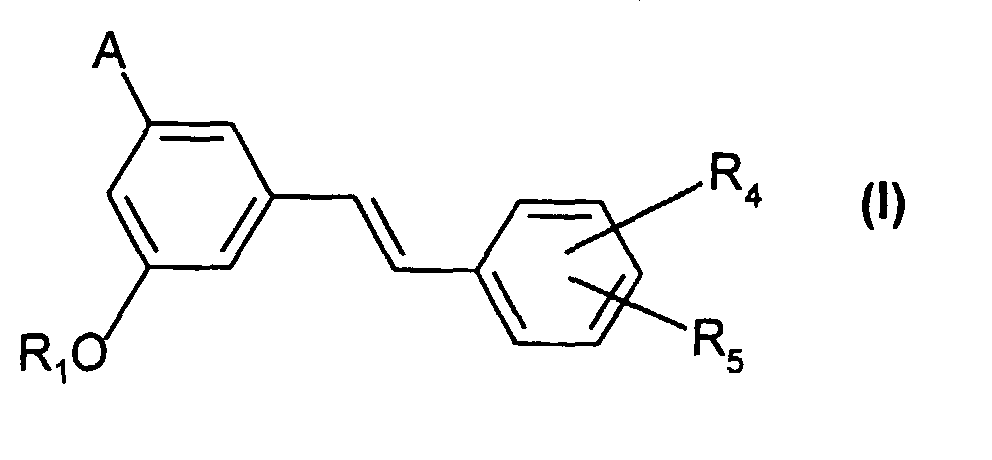
Dans la formule (I) décrite ci-dessus, le radical uronyle désigne plus particulièrement un radical mannuronyle ou glucuronyle.
On peut également citer le 3-hydroxystilbène, et son éther méthylique.
- Pinus et notamment Pinus montana mill., Pinus sylvestris L, Pinus contorta var. Latifolia S. Wats, Pinus ponderosa Dougl., Pinus Halpensis Mill. de la famille des Pinacées ;
- Alnus, et notamment Alnus sieboldiana de la famille des Bétulacées ;
- Polygonum, et notamment Polygonum nodosum, de la famille des Polygonacées ;
- Dalbergia, et notamment Dalbergia sissoo, de la famille des Légumineuses ;
- Scutellaria, et notamment Scutellaria scandens, de la famille des Lamiacées ;
- Lindera, et notamment Lindera reflexa, de la famille des Lauracées.
Le 3,5,3',4'-tétrahydroxystilbène (ou Piceatannol ou Astringenin) peut être extrait du bois des pins et épicéas et d'une légumineuse (Laburnum anagyroïdes).
Le 3,5-dihydroxystilbène, le 3-hydroxystilbène et le 3,5,3',4'-tétrahydroxystilbène peuvent provenir d'extraits végétaux, tels que décrits ci-dessus, et être obtenus par toute méthode d'extraction connue de l'homme du métier ou être obtenus par synthèse selon des méthodes généralement bien connues dans la littérature.
On peut en particulier citer les extraits alcooliques, notamment éthanoliques et les extraits hydroalcooliques.
des sels hydrosolubles de zinc, comme par exemple le pyrrolidone carboxylate de zinc (plus communément appelé pidolate de zinc), le sulfate de zinc, le chlorure de zinc, le lactate de zinc, le gluconate de zinc et le phénolsulfonate de zinc ; des actifs antitranspirants tels que les sels d'aluminium, comme par exemple le chlorure d'aluminium et les hydroxyhalogénures d'aluminium, les sels de zirconium, comme par exemple des sels d'oxyde de zirconium ou des sels d'hydroxyzirconyle, les complexes de métaux comme l'aluminium ou le zirconium avec un acide aminé comme par exemple la glycine comme décrit dans US-3,792,068 ; des bactéricides tels que le 2,4,4'-trichloro-2'-hydroxydiphényléther (Triclosan), le 3,7,11-triméthyldodéca-2,5,10-triénol (Farnesol).
Ces actifs déodorants additionnels peuvent être présents dans la composition selon l'invention à raison d'environ 0,001 à 20% en poids par rapport à la composition totale, et de préférence à raison d'environ 0,1 à 10% en poids.
Elle est plus particulièrement formulée dans un véhicule cosmétiquement acceptable qui peut être notamment essentiellement aqueux, ou contenir des solvants organiques et notamment des monoalcools en C1-C4, de préférence de l'éthanol pour accélérer l'évaporation du produit, ou du propylène glycol, du dipropylène glycol ou leurs éthers.
La composition cosmétique déodorante selon l'invention peut également être formulée en émulsion eau-dans-huile, huile-dans-eau, ou en émulsion triple eau-dans-huile-dans-eau, (de telles émulsions sont connues et décrites par exemple par C. FOX dans 〈〈 Cosmetics and Toiletries 〉〉 - november 1986 - Vol 101 - pages 101-112).
Bien entendu, l'homme de métier veillera à choisir ce ou ces éventuels composes complémentaires de manière telle que les propriétés avantageuses attachées intrinséquement à la composition cosmétique déodorante conforme à l'invention ne soient pas, ou sustantiellement pas, altérées par la ou les adjonctions envisagees.
Les corps gras peuvent être constitués par une huile ou une cire ou leur mélange, la vaseline, la paraffine, la lanoline, la lanoline hydrogénée, la lanoline acétylée ; ils comprennent également les acides gras, les alcools gras tels que l'alcool laurique, cétylique, myristique, stéarique, palmitique, oléique ainsi que le 2-octyldodécanol, les esters d'acides gras tels que le monostéarate de glycérol, le monostéarate de polyéthylèneglycol, le myristate d'isopropyle, l'adipate d'isopropyle, le palmitate d'isopropyle, le palmitate d'octyle, les benzoates d'alcools gras en C12-C15 (Finsolv TN de FINETEX), l'alcool myristique polyoxypropyléné à 3 moles d'oxyde de propylène (WITCONOL APM de WITCO), les triglycérides d'acides gras en C6-C18 tels que les triglycérides d'acide caprylique/caprique.
Les huiles sont choisies parmi les huiles animales, végétales, minérales ou de synthèse et notamment l'huile de palme hydrogénée, l'huile de ricin hydrogénée, l'huile de vaseline, l'huile de paraffine, l'huile de Purcellin (octanoate de stéaryle), les huiles de silicone et les isoparaffines.
Les cires sont choisies parmi les cires animales, fossiles, végétales, minérales ou de synthèse. On peut citer notamment les cires d'abeille, les cires de Carnauba, de Candelila, de canne à sucre, du Japon, les ozokérites, la cire de Montan, les cires microcristallines, les paraffines, les cires et résines de silicone.
Les silicones volatiles sont définies de façon connue comme des composés volatils à température ambiante. On peut citer parmi ces composés les silicones volatiles cycliques et linéaires du type diméthylsiloxane dont les chaínes comprennent de 3 à 9 résidus siliconés. De préférence on choisit les cyclométhicones D4 ou D5.
Les silicones non-volatiles sont définies de façon connue comme des composés de pression de vapeur faible à température ambiante. Parmi ces composés sont inclus: les polyalkylsiloxanes, en particulier les polyalkylsiloxanes linéaires comme par exemple les polydiméthylsiloxanes, ou diméthicones, linéaires, commercialisés par la société Dow Corning sous le nom de 〈〈 Dow Corning 200 Fluid 〉〉 ; les polyalkylarylsiloxanes comme par exemple les polyméthylphénylsiloxanes, commercialisés par la société Dow Corning sous le nom de 〈〈 Dow Corning 556 Fluid 〉〉 ; les copolymères polyéther et siloxane, comme par exemple les diméthicone copolyols.
Parmi les émollients non-volatils utilisables dans la présente invention, on peut citer par exemple : les dérivés hydrocarbonés, les huiles minérales, les alcools gras, les esters d'alcools en C3-C18 avec des acides en C3-C18, les esters de l'acide benzoïque avec des alcools en C12-C18 et leurs mélanges, des polyols en C2-C6 choisis de préférence parmi le glycérol, le propylèneglycol ou le sorbitol, les polymères de polalkylène glycol.
| 0 | 1 | 2 | 3 | 4 |
| nulle | légère | modérée | forte | très forte |
| 0 | 1 | 2 | 3 | 4 | 5 | 6 |
| très agréable | agréable | légèrement agréable | neutre | légèrement désagréable | désagréable | très désagréable |
On a répété ensuite l'évaluation d'odeur de chaque flacon comme précédemment.
Les résultats ont été donnés en pourcentages de variation (réduction) de l'odeur et de la note hédonique par rapport à la sueur témoin sans agent déodorant :
| Agent déodorant | Quantité M.A. mg/ml de sueur | % moyen de réduction d'intensité d'odeur (T18h, T24h) | % moyen de réduction du désagrément d'odeur (T18h, T24h) |
| Pinosylvine | 1 | -77 | -33 |
| 2 | -89 | -40 | |
| Triclosan | 1 | -64 | -26 |
| 2 | -64 | -29 | |
| Resvératrol | 1 | -21 | -14 |
| 2 | -25 | -12 | |
| 4-hydroxystilbène | 1 | -18 | -3 |
| 2 | -21 | -10 |
Deux puits témoin ont également été préparés : H2O 100 µl + 1,9 ml de milieu de culture (témoin de croissance), éthanol 100 µl + 1,9 ml de milieu de culture (témoin de non-toxicité de l'éthanol dilué au 1/20).
| CMI µg/ml | |||
| Pinosylvine | Triclosan | Resvératrol | |
| Staphylococcus aureus | 200 | 0,1 | 72 |
| Staphylococcus epidermis | 400 | 2,3 | 72 |
| Corynebacterium xerosis | 6 | 2,3 | 14 |
| Propionibacterium acnes | 200 | 2,3 | 29 |
| Pytirosporum ovale | >400 | >144 | >115 |
| Aspergillus niger | 400 | 18,1 | >115 |
| Behenoyl lactylate de sodium | 10,00 g |
| Glycérine | 73,10 g |
| Pinosylvine | 0,75 g |
| Ricinoléate de zinc | 1,00 g |
| Acide stéarique | 8,40 g |
| Hydroxyde de sodium | 1,20 g |
| Parfum, colorants | qs |
| Eau déminéralisée | qsp 100 g |
| Silicone DC 245 Fluid (DOW CORNING) | 6,60 g |
| Silicone DC 5225 C (DOW CORNING) | 9,40 g |
| Alcool éthylique | 11,00 g |
| Propyléne glycol | 37,00 g |
| Pinosylvine | 0,50 g |
| Parfum, conservateurs, colorants | qs |
| Eau déminéralisée | qsp 100 g |
| Stéarate de sodium | 6,20 g |
| Pinosylvine | 1,00 g |
| Glycérine | 15,00 g |
| Propyléne glycol | 20,00 g |
| Parfum, conservateurs | qs |
| Eau déminéralisée | qsp 100 g |
| Mélange d'alcools cétylstéarylique et cétylstéarylique oxyéthyléné à 30 OE (Empiwax CL de la société ALBRIGHT & WILSON) | 7,00 g |
| Mélange de monostéarate et de distéarate de glycérol (Cerasynt SD-V de la société ISP) | 2,00 g |
| Huile de vaseline | 15,00 g |
| Glycérine | 20,00 g |
| Pinosylvine | 1,50 g |
| Parfum, conservateurs | qs |
| Eau déminéralisée | qsp 100 g |
| Alcool éthylique 95% vol. dénaturé | 92,90 g |
| Ricinoléate de zinc | 2,00 g |
| Pinosylvine | 1,00 g |
| Parfum, colorant | qs |
| Alcool stéarylique | 22,00 g |
| Huile de ricin hydrogénée | 5,00 g |
| Palmitate d'isopropyle | 10,00 g |
| Chlorhydrate d'aluminium | 20,00 g |
| Pinosylvine | 3,00 g |
| Silicone D5 | 35,00 g |
| Talc | 5,00 g |
| Alcool éthylique 95% vol. dénaturé | 39,50 g |
| 3,5,3',4'-tétrahydroxystilbène | 0,50 g |
| Isobutane | 60,00 g |
Claims (28)
- Utilisation d'au moins un composé de formule (I) suivante :dans laquelle :
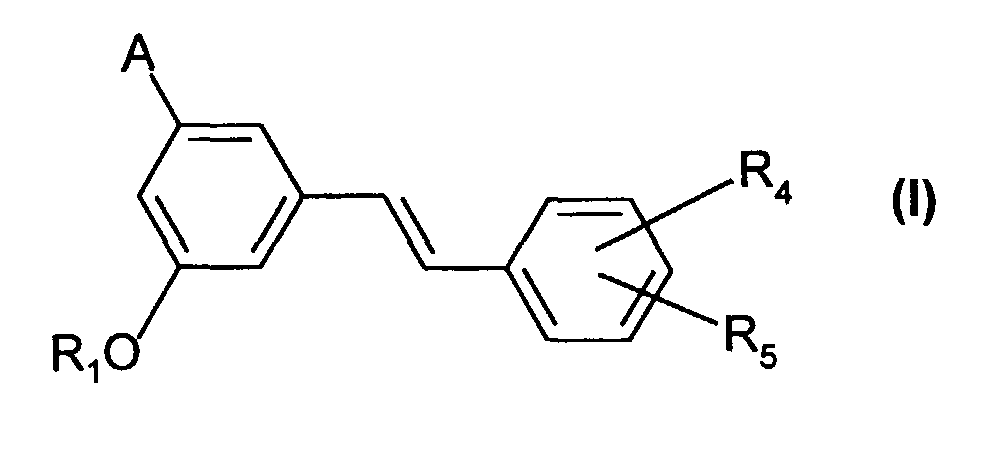 comme actif déodorant, dans une composition cosmétique.A désigne un atome d'hydrogène, ou un radical OR2,R1 et R2 , identiques ou différents, désignent un atome d'hydrogène ; un radical alkyle en C1-C4 ; un radical acyle R3CO dans lequel R3 désigne un radical hydrocarboné en C1-C30, linéaire ou ramifié, saturé ou non saturé, hydroxylé ou non hydroxylé, carboxylé ou non carboxylé ;un radical PO (OX1) (OX2) ou un radical SO2 (OX3) dans lesquels, X1, X2, X3, identiques ou différents, désignent un atome d'hydrogène ou un cation monovalent de métal alcalin ou d'NH4+ , X1 et/ou X2 pouvant également désigner un cation de métal divalent ;un radical glycosyle ; un radical uronyle ;R4 et R5 , identiques, désignent un atome d'hydrogène ou un radical hydroxyle,
 - Utilisation selon la revendication 1, caractérisée par le fait que dans la formule (I) le radical alkyle en C1-C4 désigne le radical méthyle.
- Utilisation selon la revendication 1 ou 2, caractérisée par le fait que dans la formule (I) le radical glycosyle désigne le radical glucosyle.
- Utilisation selon la revendication 1 ou 2, caractérisée par le fait que dans la formule (I) le radical uronyle est un radical mannuronyle ou glucuronyle.
- Utilisation selon la revendication 1, caractérisée par le fait que le composé (I) est le 3,5-dihydroxystilbène (ou Pinosylvine).
- Utilisation selon la revendication 1, caractérisée par le fait que le composé (I) est le 3-hydroxystilbène.
- Utilisation selon la revendication 5, caractérisée par le fait que la Pinosylvine est un produit de synthèse.
- Utilisation selon la revendication 5, caractérisée par le fait que la Pinosylvine est issue d'un extrait végétal la contenant.
- Utilisation selon la revendication 8, caractérisée par le fait que l'extrait végétal est du genre :Pinus et notamment Pinus montana mill., Pinus sylvestris L, Pinus contorta var. Latifolia S. Wats, Pinus ponderosa Dougl., Pinus Halpensis Mill. de la famille des Pinacées ;Alnus, et notamment Alnus sieboldiana de la famille des Bétulacées ;Polygonum, et notamment Polygonum nodosum, de la famille des Polygonacées ;Dalbergia, et notamment Dalbergia sissoo, de la famille des Légumineuses ;Scutellaria, et notamment Scutellaria scandens, de la famille des Lamiacées ;Lindera, et notamment Lindera reflexa, de la famille des Lauracées.
- Utilisation selon la revendication 1, caractérisée par le fait que le composé (I) est le 3,5,3',4'-tétrahydroxystilbène.
- Composition cosmétique déodorante caractérisée par le fait qu'elle comprend, dans un véhicule cosmétiquement acceptable, au moins un composé de formule (I) tel que défini à l'une quelconque des revendications 1 à 10.
- Composition selon la revendication 11, caractérisée par le ou les composés de formule (I), à titre d'actif déodorant, représentent de 0,001 à 10% de Matière Active en poids par rapport au poids total de la composition.
- Composition selon la revendication 12, caractérisée par le fait que le ou les composés de formule (I) représentent de 0,01 à 5% de Matière Active en poids par rapport au poids total de la composition.
- Composition selon la revendication 13, caractérisée par le fait que le ou les composés de formule (I) représentent de 0,1 à 5% de Matière Active en poids par rapport au poids total de la composition.
- Composition selon l'une quelconque des revendications 11 à 14, caractérisée par le fait qu'elle comprend en outre au moins un actif déodorant ou antitranspirant additionnel différant du ou des composés de formule (I).
- Composition selon l'une quelconque des revendications 11 à 15, caractérisée par le fait que le véhicule est essentiellement aqueux.
- Composition selon la revendication 16, caractérisée par le fait que le véhicule contient en outre des solvants organiques.
- Composition selon l'une quelconque des revendications 11 à 17, caractérisée par le fait qu'elle contient en outre des adjuvants cosmétiques choisis parmi les corps gras, les gélifiants, les émollients, les adoucissants, les antioxydants, les opacifiants, les stabilisants, les agents anti-mousse, les agents hydratants, les vitamines, les parfums, les conservateurs, les tensioactifs, les charges, les séquestrants, les polymères, les propulseurs, les agents alcalinisants ou acidifiants, les parfums, les colorants, les pigments, les agents épaississants, ou tout autre ingrédient habituellement utilisé en cosmétique.
- Composition selon l'une quelconque des revendications 11 à 18, caractérisée par le fait qu'elle est formulée en émulsion eau-dans-huile, huile-dans-eau, ou en émulsion triple eau-dans-huile-dans-eau.
- Composition selon l'une quelconque des revendications 11 à 19, caractérisée par le fait qu'elle se présente sous la forme de lotion, de crème ou de gel fluide distribué en spray aérosol, en flacon pompe ou en roll-on, sous forme de crème épaisse distribuée en tube et sous forme de stick ou de poudre.
- Utilisation d'une composition selon l'une quelconque des revendications 11 à 20, comme, ou pour la fabrication de, produits cosmétiques déodorants destinés à l'application topique humaine.
- Utilisation du 3,5-dihydroxystilbène sous forme synthétique ou d'extrait végétal le contenant comme agent inhibiteur sélectif de certaines espèces bactériennes constitutives de la flore cutanée humaine.
- Utilisation du 3,5-dihydroxystilbène sous forme synthétique ou d'extrait végétal le contenant comme agent inhibiteur sélectif de l'espèce bactérienne Corynebacterium xerosis.
- Procédé pour traiter les odeurs axillaires humaines, consistant à appliquer sur la surface axillaire une quantité efficace d'une composition selon l'une quelconque des revendications 11 à 20.
- Composés de formule (I) telle que définie selon la revendication 1, et dans laquelle, A désigne un atome d'hydrogène, ou un radical OR2, R, et R2, identiques ou différents, désignent un radical acyle R3CO dans lequel R3 désigne un radical hydrocarboné en C4-C30, linéaire ou ramifié, saturé ou non saturé, hydroxylé ou non hydroxylé, carboxylé ou non carboxylé ; un radical PO (OX1) (OX2) ou un radical SO2 (OX3) dans lesquels, X1, X2, X3, identiques ou différents, désignent un atome d'hydrogène ou un cation monovalent de métal alcalin ou d'NH4+ , X1 et/ou X2 pouvant également désigner un cation de métal divalent; un radical uronyle.
- Composés selon la revendication 25, pour lesquels le radical uronyle est un radical mannuronyle ou glucuronyle.
- Composition cosmétique comprenant au moins un composé de formule (I) telle que définie selon la revendication 1, et dans laquelle, A désigne un atome d'hydrogène, ou un radical OR2,R1 et R2 , identiques ou différents, désignent un atome d'hydrogène ; un radical alkyle en C1-C4 ; un radical acyle R3CO dans lequel R3 désigne un radical hydrocarboné en C1-C30, linéaire ou ramifié, saturé ou non saturé, hydroxylé ou non hydroxylé, carboxylé ou non carboxylé ;un radical PO (OX1) (OX2) ou un radical SO2 (OX3) dans lesquels, X1, X2, X3, identiques ou différents, désignent un atome d'hydrogène ou un cation monovalent de métal alcalin ou d'NH4+ , X1 et/ou X2 pouvant également désigner un cation de métal divalent ;un radical glycosyle ; un radical uronyle ;R4 et R5, identiques, désignent un atome d'hydrogène ou un radical hydroxyle.
- Composition cosmétique selon la revendication 27, caractérisé par le fait que le radical uronyle est un radical mannuronyle ou glucuronyle.
Applications Claiming Priority (2)
| Application Number | Priority Date | Filing Date | Title |
|---|---|---|---|
| FR9901931A FR2789577B1 (fr) | 1999-02-17 | 1999-02-17 | Utilisation de derives substitues en 3 du stilbene comme actifs deodorants dans les compositions cosmetiques |
| FR9901931 | 1999-02-17 |
Publications (1)
| Publication Number | Publication Date |
|---|---|
| EP1029530A1 true EP1029530A1 (fr) | 2000-08-23 |
Family
ID=9542141
Family Applications (1)
| Application Number | Title | Priority Date | Filing Date |
|---|---|---|---|
| EP00400269A Withdrawn EP1029530A1 (fr) | 1999-02-17 | 2000-02-01 | Utilisation de dérivés substitués en 3 du stilbene comme actifs déodorants dans les compositions cosmétiques |
Country Status (13)
| Country | Link |
|---|---|
| US (2) | US6407142B1 (fr) |
| EP (1) | EP1029530A1 (fr) |
| JP (1) | JP2000247853A (fr) |
| KR (1) | KR20000058089A (fr) |
| CN (1) | CN1270804A (fr) |
| AR (1) | AR019503A1 (fr) |
| AU (1) | AU1494100A (fr) |
| BR (1) | BR0001925A (fr) |
| CA (1) | CA2298352A1 (fr) |
| FR (1) | FR2789577B1 (fr) |
| HU (1) | HUP0000697A2 (fr) |
| PL (1) | PL338437A1 (fr) |
| ZA (1) | ZA200000603B (fr) |
Cited By (8)
| Publication number | Priority date | Publication date | Assignee | Title |
|---|---|---|---|---|
| FR2802420A1 (fr) * | 1999-12-21 | 2001-06-22 | Oreal | Utilisation du 3,3', 5,5'-tetrahydroxystilbene comme agent anti-glycation |
| WO2003049713A1 (fr) * | 2001-12-13 | 2003-06-19 | Symrise Gmbh & Co. Kg | Utilisation de dihydropinosylvine et de ses derives en tant qu'inhibiteurs de la tyrosinase pour eclaircir la peau ou en tant que substances antimicrobiennes a des fins de conservation ou pour traiter l'acne, les pellicules ou les odeurs corporelles |
| WO2003092642A1 (fr) * | 2002-04-29 | 2003-11-13 | Beiersdorf Ag | Formulation antitranspirante anhydre sous forme semi-solide a solide |
| FR2848844A1 (fr) * | 2002-12-18 | 2004-06-25 | Oreal | Utilisation d'un alkylether d'hydroxystilbene pour le traitement des peaux seches |
| WO2004054533A1 (fr) * | 2002-12-18 | 2004-07-01 | L'oreal | Utilisation d'un ether d'alkyle d'hydroxystilbene pour le traitement des peaux seches |
| FR2862533A1 (fr) * | 2003-11-21 | 2005-05-27 | Oreal | Utilisation cosmetique d'au moins un activateur de la production d'une interleukine 11, comme agent amincissant topique |
| WO2005067882A1 (fr) * | 2004-01-15 | 2005-07-28 | Beiersdorf Ag | Visualisation d'agents de protection solaire sur la peau |
| EP2295114A1 (fr) | 2009-09-10 | 2011-03-16 | Dalli-Werke GmbH & Co. KG | Composition cosmétique dotée d'un effet antimicrobien |
Families Citing this family (23)
| Publication number | Priority date | Publication date | Assignee | Title |
|---|---|---|---|---|
| AU7596100A (en) * | 1999-09-21 | 2001-04-24 | Rutgers, The State University | Resveratrol analogs for prevention of disease |
| WO2003009807A2 (fr) * | 2001-07-23 | 2003-02-06 | Galileo Laboratories, Inc. | Composes cytoprotecteurs, procedes et formulations pharmaceutiques et cosmetiques |
| US7041278B2 (en) * | 2002-07-31 | 2006-05-09 | Coty Inc | Cosmetic compositions with improved thermal stability and wear |
| KR100580858B1 (ko) | 2004-08-27 | 2006-05-17 | 로제화장품 주식회사 | 십장생(十長生) 관련 천연물(솔싹, 영지버섯, 월귤나무,녹용, 자라, 게르마늄, 로얄제리, 홍삼, 연어알 및레몬)을 함유한 화장료 조성물 및 그의 제조방법 |
| FR2887251B1 (fr) * | 2005-06-17 | 2008-02-01 | Rhodia Chimie Sa | Bioprecurseur a base de polyphenol |
| FR2904311B1 (fr) * | 2006-07-28 | 2013-01-11 | Clariant Specialty Fine Chem F | Nouveau procede de synthese de derives (e) stilbeniques perm permettant d'obtenir le resveratrol et le piceatannol |
| US20090035236A1 (en) * | 2007-07-31 | 2009-02-05 | Maes Daniel H | Emulsion Cosmetic Compositions Containing Resveratrol Derivatives And An Oil Phase Structuring Agent |
| US20090035240A1 (en) * | 2007-07-31 | 2009-02-05 | Maes Daniel H | Aqueous Based Cosmetic Compositions Containing Resveratrol Derivatives And An Aqueous Phase Structuring Agent |
| US9295621B2 (en) * | 2007-07-31 | 2016-03-29 | Elc Management Llc | Emulsion cosmetic compositions containing resveratrol derivatives and silicone surfactant |
| US8080583B2 (en) | 2007-07-31 | 2011-12-20 | Elc Management Llc | Emulsion cosmetic compositions containing resveratrol derivatives and linear or branched silicone |
| US8344024B2 (en) * | 2007-07-31 | 2013-01-01 | Elc Management Llc | Anhydrous cosmetic compositions containing resveratrol derivatives |
| JP5281645B2 (ja) * | 2007-09-08 | 2013-09-04 | イーエルシー マネージメント エルエルシー | フェルラ酸レスベラトロール化合物、それらの化合物を含有する組成物およびそれらの使用方法。 |
| FR2921921B1 (fr) * | 2007-10-03 | 2011-08-19 | Clariant Specialty Fine Chem F | Procede de synthese de composes polyhydroxystilbeniques. |
| FI125590B (en) * | 2008-04-10 | 2015-12-15 | Neste Oyj | A process for the preparation of a composition for the preparation of pinosylvine and its compounds, a composition for the preparation of stilbene compounds, a process for the recovery of stilbene compounds, and fatty acid and resin acid esters of pinosylvine and its monomethyl ether |
| DE102008024084A1 (de) * | 2008-05-17 | 2009-11-19 | Clariant International Ltd. | Wasch- und Reinigungsmittel |
| CN101781173B (zh) * | 2009-01-21 | 2014-03-26 | 北京三有利科技发展有限公司 | 二苯乙烯类化合物及其在制备用于治疗和预防前列腺肥大有关疾病的药物中的用途 |
| WO2011078230A1 (fr) * | 2009-12-25 | 2011-06-30 | ライオン株式会社 | 3,5-dihydroxy-2-menthényl-stilbène, extrait végétal le contenant, procédé pour le collecter, et application associée |
| JP5529353B1 (ja) * | 2012-06-07 | 2014-06-25 | 一郎 山田 | ニンニク卵黄組成物 |
| JP6026257B2 (ja) * | 2012-12-11 | 2016-11-16 | 花王株式会社 | セラミド産生促進剤 |
| CN102988190B (zh) * | 2012-12-28 | 2014-09-17 | 广州市白云区新东方日用化工品厂 | 美白组合物及其应用 |
| KR101564485B1 (ko) * | 2013-02-15 | 2015-10-30 | 단국대학교 산학협력단 | 피노실빈의 신규한 혈관신생촉진 용도 |
| GB201817785D0 (en) * | 2018-10-31 | 2018-12-19 | Givaudan Sa | Organic compounds |
| CN109534528B (zh) * | 2018-11-20 | 2021-11-12 | 新昌县泰如科技有限公司 | 一种环丙贝特工艺废水的处理方法 |
Citations (6)
| Publication number | Priority date | Publication date | Assignee | Title |
|---|---|---|---|---|
| US2776986A (en) * | 1952-12-20 | 1957-01-08 | Hercules Powder Co Ltd | Oxidation of unsymmetrical stilbenes |
| FR2275193A1 (fr) * | 1974-05-31 | 1976-01-16 | Oreal | Nouvelles compositions cosmetiques desodorisantes |
| JPS6438009A (en) * | 1987-07-31 | 1989-02-08 | Pola Chem Ind Inc | Beautifying cosmetic |
| JPH08175960A (ja) * | 1994-12-27 | 1996-07-09 | Kao Corp | シワ予防用化粧料 |
| EP0953345A1 (fr) * | 1998-04-10 | 1999-11-03 | L'oreal | Utilisation d'au moins un hydroxystilbène en tant qu'agent diminuant l'adhésion des micro-organismes |
| WO2000021368A1 (fr) * | 1998-10-09 | 2000-04-20 | Ciba Specialty Chemicals Holding Inc. | Composes hydroxystilbene utilises comme principes actifs microbicides |
-
1999
- 1999-02-17 FR FR9901931A patent/FR2789577B1/fr not_active Expired - Fee Related
-
2000
- 2000-02-01 EP EP00400269A patent/EP1029530A1/fr not_active Withdrawn
- 2000-02-07 AU AU14941/00A patent/AU1494100A/en not_active Abandoned
- 2000-02-09 ZA ZA200000603A patent/ZA200000603B/xx unknown
- 2000-02-15 BR BR0001925-9A patent/BR0001925A/pt not_active IP Right Cessation
- 2000-02-15 PL PL00338437A patent/PL338437A1/xx not_active Application Discontinuation
- 2000-02-15 AR ARP000100631A patent/AR019503A1/es not_active Application Discontinuation
- 2000-02-16 US US09/504,724 patent/US6407142B1/en not_active Expired - Fee Related
- 2000-02-16 HU HU0000697A patent/HUP0000697A2/hu unknown
- 2000-02-16 CN CN00106406A patent/CN1270804A/zh active Pending
- 2000-02-16 CA CA002298352A patent/CA2298352A1/fr not_active Abandoned
- 2000-02-17 JP JP2000040328A patent/JP2000247853A/ja active Pending
- 2000-02-17 KR KR1020000007616A patent/KR20000058089A/ko not_active Ceased
-
2002
- 2002-05-03 US US10/137,365 patent/US20020198159A1/en not_active Abandoned
Patent Citations (6)
| Publication number | Priority date | Publication date | Assignee | Title |
|---|---|---|---|---|
| US2776986A (en) * | 1952-12-20 | 1957-01-08 | Hercules Powder Co Ltd | Oxidation of unsymmetrical stilbenes |
| FR2275193A1 (fr) * | 1974-05-31 | 1976-01-16 | Oreal | Nouvelles compositions cosmetiques desodorisantes |
| JPS6438009A (en) * | 1987-07-31 | 1989-02-08 | Pola Chem Ind Inc | Beautifying cosmetic |
| JPH08175960A (ja) * | 1994-12-27 | 1996-07-09 | Kao Corp | シワ予防用化粧料 |
| EP0953345A1 (fr) * | 1998-04-10 | 1999-11-03 | L'oreal | Utilisation d'au moins un hydroxystilbène en tant qu'agent diminuant l'adhésion des micro-organismes |
| WO2000021368A1 (fr) * | 1998-10-09 | 2000-04-20 | Ciba Specialty Chemicals Holding Inc. | Composes hydroxystilbene utilises comme principes actifs microbicides |
Non-Patent Citations (8)
| Title |
|---|
| CHEMICAL ABSTRACTS, vol. 111, no. 14, 2 October 1989, Columbus, Ohio, US; abstract no. 120645, XP002138218 * |
| CHEMICAL ABSTRACTS, vol. 125, no. 14, 30 September 1996, Columbus, Ohio, US; abstract no. 177025, XP002138217 * |
| DATABASE CHEMABS CHEMICAL ABSTRACTS SERVICE, COLUMBUS, OHIO, US; XP002122811 * |
| DATABASE CHEMABS CHEMICAL ABSTRACTS SERVICE, COLUMBUS, OHIO, US; XP002138219 * |
| DATABASE CHEMABS CHEMICAL ABSTRACTS SERVICE, COLUMBUS, OHIO, US; XP002138220 * |
| I.S. PAVLUTSKAYA ET AL, KHIM. DREV., no. 3, 1987, pages 102 - 109 * |
| K.O. FRYKHOLM, NATURE, vol. 155, 1945, pages 454 - 455, XP002122809 * |
| M. TAKAHASHI ET AL, YAKUGAKU ZASSHI, vol. 80, 1960, pages 1488 - 1492, XP002122810 * |
Cited By (11)
| Publication number | Priority date | Publication date | Assignee | Title |
|---|---|---|---|---|
| FR2802420A1 (fr) * | 1999-12-21 | 2001-06-22 | Oreal | Utilisation du 3,3', 5,5'-tetrahydroxystilbene comme agent anti-glycation |
| EP1110539A1 (fr) * | 1999-12-21 | 2001-06-27 | L'oreal | Utilisation du 3,3', 5,5'-tétrahydroxystilbène comme agent anti-glycation |
| US6414038B2 (en) | 1999-12-21 | 2002-07-02 | Societe L'oreal | Hydroxystilbenes for reducing/inhibiting protein glycation and combating skin aging |
| WO2003049713A1 (fr) * | 2001-12-13 | 2003-06-19 | Symrise Gmbh & Co. Kg | Utilisation de dihydropinosylvine et de ses derives en tant qu'inhibiteurs de la tyrosinase pour eclaircir la peau ou en tant que substances antimicrobiennes a des fins de conservation ou pour traiter l'acne, les pellicules ou les odeurs corporelles |
| WO2003092642A1 (fr) * | 2002-04-29 | 2003-11-13 | Beiersdorf Ag | Formulation antitranspirante anhydre sous forme semi-solide a solide |
| FR2848844A1 (fr) * | 2002-12-18 | 2004-06-25 | Oreal | Utilisation d'un alkylether d'hydroxystilbene pour le traitement des peaux seches |
| WO2004054533A1 (fr) * | 2002-12-18 | 2004-07-01 | L'oreal | Utilisation d'un ether d'alkyle d'hydroxystilbene pour le traitement des peaux seches |
| FR2862533A1 (fr) * | 2003-11-21 | 2005-05-27 | Oreal | Utilisation cosmetique d'au moins un activateur de la production d'une interleukine 11, comme agent amincissant topique |
| WO2005067882A1 (fr) * | 2004-01-15 | 2005-07-28 | Beiersdorf Ag | Visualisation d'agents de protection solaire sur la peau |
| EP2295114A1 (fr) | 2009-09-10 | 2011-03-16 | Dalli-Werke GmbH & Co. KG | Composition cosmétique dotée d'un effet antimicrobien |
| WO2011029516A2 (fr) | 2009-09-10 | 2011-03-17 | Dalli-Werke Gmbh & Co. Kg | Composition cosmétique à action antimicrobienne |
Also Published As
| Publication number | Publication date |
|---|---|
| FR2789577A1 (fr) | 2000-08-18 |
| ZA200000603B (en) | 2000-09-05 |
| AU1494100A (en) | 2000-09-14 |
| FR2789577B1 (fr) | 2002-04-05 |
| HU0000697D0 (en) | 2000-04-28 |
| BR0001925A (pt) | 2001-08-14 |
| PL338437A1 (en) | 2000-08-28 |
| HUP0000697A2 (hu) | 2001-02-28 |
| US6407142B1 (en) | 2002-06-18 |
| AR019503A1 (es) | 2002-02-20 |
| CA2298352A1 (fr) | 2000-08-17 |
| KR20000058089A (ko) | 2000-09-25 |
| US20020198159A1 (en) | 2002-12-26 |
| CN1270804A (zh) | 2000-10-25 |
| JP2000247853A (ja) | 2000-09-12 |
Similar Documents
| Publication | Publication Date | Title |
|---|---|---|
| CA2298352A1 (fr) | Utilisation de derives substitues en 3 du stilbene comme actifs deodorants dans les compositions cosmetiques | |
| EP2821386A1 (fr) | Composition cosmétique, dermatologique ou pharmaceutique comprenant au moins un dérivé de vanilline comme conservateur | |
| FR2781149A1 (fr) | Composition deodorante contenant un sel d'alun | |
| FR2999924A1 (fr) | Association d'actifs comprenant au moins une huile essentielle, une cyclodextrine et un corps gras liquide et composition la contenant. | |
| JP2000247864A (ja) | 化粧料組成物 | |
| JP2010013373A (ja) | 角層細胞強化に好適な化粧料。 | |
| KR101780836B1 (ko) | 3,5-디히드록시-2-멘텐일스틸벤, 그것을 포함하는 식물 추출물, 및 그 채취 방법과 그 응용 | |
| EP1486199B1 (fr) | Composition déodorante aérosol alcoolique contenant le salicylate de zinc | |
| WO2000033787A2 (fr) | Composition cosmetique deodorante | |
| WO2002034222A1 (fr) | Utilisation de derives du 1,3-diphenylpropane comme actifs inhibant le developpement des odeurs corporelles dans les compositions cosmetiques | |
| EP1541122B1 (fr) | Composition cosmétique déodorante comprenant l'association du pidolate de zinc et d'un sel d'aluminium anti-transpirant | |
| JP2010018545A (ja) | 活性酸素消去剤、皮膚外用剤、口腔用組成物及び食品 | |
| JP2002114660A (ja) | 臭気発生抑制組成物 | |
| FR2826574A1 (fr) | Compositions contenant un derive d'hydroxydiphenyl ether inhibant le developpement des odeurs corporelles | |
| FR2807655A1 (fr) | Utilisation de sels de manganese divalent comme actifs deodorants dans les compositions cosmetiques | |
| EP0998909A1 (fr) | Composition déodorante | |
| FR2838644A1 (fr) | Utilisation de derives de la 1,7-bisphenyl heptane-3,5-dione comme actifs inhibant le developpement des odeurs corporelles dans les compositions cosmetiques | |
| WO2003002072A1 (fr) | Compositions contenant un derive d'hyroxydiphenyl ether inhibant le developpemment des odeurs corporelles | |
| FR2789899A1 (fr) | Extrait de metrosideros et son utilisation comme agent antimicrobien dans une composition dermatologique ou cosmetique | |
| FR2789897A1 (fr) | Extrait de cryptocarya et son utilisation comme agent antimicrobien dans une composition dermatologique ou cosmetique | |
| FR2789898A1 (fr) | Agent antimicrobien a base d'extrait de chlorophora et son utilisation dans une composition dermatologique ou cosmetique | |
| US20030165446A1 (en) | Divalent manganese salts for reducing odour resulting from bacterial decomposition of human perspiration | |
| MXPA00001600A (en) | Use of stilbene derivatives substituted in position 3, as deodrorant active agents in cosmetic compositions | |
| FR2789900A1 (fr) | Agent antimicrobien a base d'extrait d'asterostigma sp et son utilisation dans une composition dermatologique ou cosmetique | |
| FR2884415A1 (fr) | Composition deodorante aerosol alcoolique contenant le chlorure de zinc ; dispositif aerosol ; procede de traitement des odeurs corporelles |
Legal Events
| Date | Code | Title | Description |
|---|---|---|---|
| PUAI | Public reference made under article 153(3) epc to a published international application that has entered the european phase |
Free format text: ORIGINAL CODE: 0009012 |
|
| AK | Designated contracting states |
Kind code of ref document: A1 Designated state(s): AT BE CH CY DE DK ES FI FR GB GR IE IT LI LU MC NL PT SE |
|
| AX | Request for extension of the european patent |
Free format text: AL;LT;LV;MK;RO;SI |
|
| 17P | Request for examination filed |
Effective date: 20010223 |
|
| AKX | Designation fees paid |
Free format text: AT BE CH CY DE DK ES FI FR GB GR IE IT LI LU MC NL PT SE |
|
| 17Q | First examination report despatched |
Effective date: 20030729 |
|
| STAA | Information on the status of an ep patent application or granted ep patent |
Free format text: STATUS: THE APPLICATION IS DEEMED TO BE WITHDRAWN |
|
| 18D | Application deemed to be withdrawn |
Effective date: 20031209 |