EP1031008B1 - Verfahren und vorrichtung zum auslösen von lawinen - Google Patents
Verfahren und vorrichtung zum auslösen von lawinen Download PDFInfo
- Publication number
- EP1031008B1 EP1031008B1 EP98955667A EP98955667A EP1031008B1 EP 1031008 B1 EP1031008 B1 EP 1031008B1 EP 98955667 A EP98955667 A EP 98955667A EP 98955667 A EP98955667 A EP 98955667A EP 1031008 B1 EP1031008 B1 EP 1031008B1
- Authority
- EP
- European Patent Office
- Prior art keywords
- envelope
- fluid
- explosion
- filling
- container
- Prior art date
- Legal status (The legal status is an assumption and is not a legal conclusion. Google has not performed a legal analysis and makes no representation as to the accuracy of the status listed.)
- Expired - Lifetime
Links
Images


Classifications
-
- F—MECHANICAL ENGINEERING; LIGHTING; HEATING; WEAPONS; BLASTING
- F42—AMMUNITION; BLASTING
- F42D—BLASTING
- F42D3/00—Particular applications of blasting techniques
Definitions
- the invention relates to a method of artificial triggering of an avalanche and so more general to an artificial triggering process of a natural phenomenon in which one provokes one or several explosions of a fluid in a zone predetermined where we want to trigger this phenomenon.
- the invention can be applied in all areas where a phenomenon can be caused or put into movement by a local overpressure of the atmosphere above the area concerned by the phenomenon.
- the domain targeted by the invention is the artificial triggering of snow avalanches in winter sports resorts and on the sites presenting a potential risk to people, ski areas, ski lifts, roads and access roads, mountain railways and, from Generally, buildings and developments public and private.
- the invention also relates to a device for the implementation of this method comprising means to cause at least one explosion of a fluid in a predetermined area where it is desired trigger said phenomenon.
- one of these means is to place or to launch explosive charges such as TNT and to cause the explosion of these charges.
- the explosion causes a breath that sweeps the surface of the mantle snow in the avalanche zone, and a shock wave that shakes the coat of this coat and triggers a avalanche.
- a device comprising a gun, or metal tube, having a closed bottom, and a mouth frontal open towards the snowpack.
- This device also comprises a feed circuit of oxidizing gas from a first source and a fuel gas supply circuit from a second source.
- Nozzles for filling the barrel by these gases are arranged in various zones distributed on the length of this gun and an ignition device is mounted at the back of the barrel.
- a gas mixture is formed inside the barrel, for example a mixture of propane and oxygen, and the explosion of this mixture is caused in the barrel by the ignition device.
- the front mouth of the barrel diffuses the breath and the shock wave caused by the explosion at the surface of the snowpack thus triggering the avalanche.
- US-A-4,873,928 discloses a device to simulate a nuclear explosion but without the radiation. It is intended for the study of explosions of the power of nuclear explosions. These measures includes an expandable envelope, a device for filling the expansible envelope with a mixture gaseous and electrical wires to provoke the explosion.
- the present invention is specifically intended to overcome the aforementioned drawbacks by providing a method of artificially triggering an avalanche by at least one explosion of an explosive fluid in a predetermined area, said method comprising a first step of filling at least one envelope flexible with an explosive fluid and a second stage of triggering an explosion of said fluid to the bottom of each envelope, each envelope being destroyed by the explosion of the fluid it contains.
- the fluid can be introduced into the envelope at medium of a diffuser, the diffuser being connected to a source of gas by means of a gas supply line.
- the flexible envelope can be attached directly to the diffuser which can then serve as a fixed support for the flexible envelope during its filling.
- the fluid can be an explosive gas mixture of an oxidizer and a fuel.
- a combustible gas is used as a gaseous fuel.
- This combustible gas can be selected in the group of substances hydrogen, tétraine, acetylene, propane, butane, or a mixture of these substances, preferably hydrogen.
- the oxidant used may be oxygen or ozone, air, or air enriched with oxygen or ozone, preferably air.
- each envelope flexible used shall consist of a material destructible by the explosion of the fluid it contains.
- the material constituting the flexible envelope and the thickness of this material must indeed be chosen in order to release the wave of overpressure created by the explosion of the fluid it contains, without putting too much resistance to this explosion.
- This material must also be able to contain the fluid until the explosion of this last be realized and therefore present some seal.
- the flexible envelope can be in one light material in such a way that for a mixture gas forming a lighter fluid than air surrounding, for example an explosive mixture of hydrogen and air, the envelope is maintained vertical position above the snowpack.
- this envelope can be advantageously biodegradable so as not to pollute the environment.
- a flexible envelope presenting all the features mentioned above is a envelope made of a material chosen from group comprising butyl.
- the thickness of the material constituting the envelope can be for example about 100 to 200 ⁇ m.
- the envelope can be for example a balloon weather type.
- This flexible envelope must also present a volume such that it can contain a volume sufficient fluid, at atmospheric pressure or a little more pressure than this, so that the explosion of this fluid allows to trigger the avalanche.
- the minimum volume of the envelope can be determined by reasoning following, considering that the fluid in the enclosure at atmospheric pressure:
- Equation (I) is the chemical equation of the explosion of the H 2 / oxygen mixture of air: H 2 + 1 / 2O 2 ⁇ H 2 O
- This equation (I) shows that the stoichiometric mixture of the explosion under normal conditions of temperature and pressure (273 ° Kelvin, and 101,325 Pa) comprises two volumes of H 2 for a volume of O 2 .
- the fluid is a hydrogen / air mixture, this corresponds to 30% hydrogen by volume and 70% air by volume.
- 1 m 3 of hydrogen can provide equivalent energy to the explosion of 1.35 kg of TNT. It is therefore preferable to use a volume of hydrogen of 2.2 m 3 so that the detonation power is sufficient, that is to say equivalent to the explosion of 3 kg of TNT, to trigger the avalanche.
- This volume of hydrogen requires an air volume of 6.8 m 3 to obtain a detonating stoichiometric mixture.
- the preferable minimum volume of the chamber for an H 2 / air mixture is therefore 8.9 m 3 when the fluid filling the chamber is at atmospheric pressure.
- the volume of the envelope is chosen in accordance with a volume of explosive fluid sufficient to trigger a avalanche and so also depending on the nature of this fluid.
- This process is therefore evolutionary because it allows also to choose different envelopes volumes depending on climatic conditions and geographical.
- the second stage of the process is a step of triggering an explosion of fluid inside each envelope.
- This explosion can be triggered by means classic triggering an explosion allowing to generate in each enclosure a spark.
- These means can include for example a head of primer, a piezoelectric device, a stone lighter, etc ...
- each envelope causes destruction of it and a propagation of a spherical aerial wave of overpressure that will interest an optimal surface of the snowpack, depending on the volume of the explosive fluid in the enclosure before the explosion, and will shake said surface by triggering an avalanche.
- the flexible envelope (the flexible envelopes) is (are) placed by means of a support above the snowpack, in a predetermined zone, that is to say a zone from which the avalanche can be triggered by a local overpressure of the atmosphere. This area is called “avalanche departure zone” by professionals.
- This envelope (these envelopes) is (are) fixed (s) by means of a support not impeding the propagation of the breath and the shock wave created by the explosion of the fluid above said predetermined zone, for example at a distance of 2 to 3 m from the surface of the snowpack for an envelope (envelopes), having a volume of 10 m 3 , filled with an explosive mixture of hydrogen and air.
- each envelope flexible can be folded into a container corresponding, the filling step of this envelope then includes a deployment phase of said envelope out of said container.
- the container shall be of a material resistant to the explosion of the fluid contained in one of the envelopes when several envelopes folded in several corresponding containers are planned.
- each container can be closed by a cap, the filling step of the corresponding envelope then comprises a phase ejection of said cap so as to allow the deployment of the envelope.
- the cap can be ejected for example by the pressure exerted by the fluid inside the flexible envelope folded into the container during the first step of filling said envelope with the fluid.
- This cap can be biodegradable to not pollute the environment, or remain attached to container so as not to impede the deployment of the envelope outside said container.
- the filling step of each envelope can furthermore, include an air intake phase atmospheric and mixing this air with a suitable gas to form the explosive fluid.
- the correct gas can be selected from the group comprising hydrogen, helium, tétraine, acetylene, propane, methane, etc ... or a mixture of these gases.
- the air can for example be aspirated from the atmosphere and mixed with the gas using a vacuum system type Venturi called below venturi system to be introduced into the envelope, the suitable gas passing through the pressure venturi by causing depression of the ambient air.
- a vacuum system type Venturi called below venturi system to be introduced into the envelope, the suitable gas passing through the pressure venturi by causing depression of the ambient air.
- the venturi system can be chosen from way that for a given flow of gas passing through it, the air / gas mixture formed at the outlet of this venturi, an explosive mixture. In this way, the mixture is performed automatically by the venturi to be introduced into the enclosure.
- a single gas reserve for example hydrogen
- this process does not require a reservoir of gas mixture contrary to the method described page 2, lines 17 to 32 and includes hydraulic equipment reduced, a single gas line connecting the reserve to device being necessary.
- the optimized venturi system the effectiveness and reproducibility of the mixture explosive. This is more of a simple system, Static does not require sharp technology, having few components and therefore having a low cost.
- the fuel can be hydrogen, because the air / hydrogen mixture formed has a relatively explosive mixing range broad in hydrogen concentration, that is to say from 13.5% in volume to 59% in volume, with a maximum of 32.5% hydrogen detonation wave pressure in volume, allowing for an imprecise mix, therefore requiring no particular device for measure such as a flowmeter.
- the diffuser on which can be fixed the enclosure may include the venturi system.
- the introduction of fluid into one of the envelopes and the explosion of the fluid in said envelope can be controlled by a system automatic incrementation.
- This system automatic incrementation allows to control the first and second stages that are related, for each envelope, successively, until all the planned envelopes have been used.
- the invention also relates to a device for the implementation of the method of the invention.
- This artificial triggering device for an avalanche by at least one explosion of an explosive fluid in a predetermined zone comprises at least one envelope intended to contain the fluid, means of filling of each envelope with the fluid, means to trigger the explosion of this fluid in each envelope and control means of the filling each envelope and triggering each explosion, each envelope being constituted of a material such that it is destroyed by the explosion fluid it contains.
- the fluid can be an explosive mixture of atmospheric air and less a gas
- said filling means comprise then means for aspirating atmospheric air ambient.
- the suction means of ambient atmospheric air can be systems Venturi type depressors.
- the flexible envelope is made of a material selected from the group comprising butyl.
- a weather-type envelope with a volume of 10 m 3 .
- the triggering means of the explosion in the envelope may include a primer head placed in the envelope, in contact with the fluid it contains.
- the device may further comprise a container for each envelope, said envelope being folded into the corresponding container when it is empty, so that it can exit the container and deploy when the fluid is introduced into the envelope.
- each container can further include an ejector lid when the introduction of the fluid into the envelope.
- Ejectable containers and lid correspondingly advantageously consist of a material capable of withstanding the overpressure caused by the explosion of the fluid of one of the balloons.
- This material is for example chosen in the group comprising polypropylene, for the container, and for the ejectable lid.
- the device when the device comprises several containers they can be fixed on one support anchored to the ground.
- this support can include a first removable part on which are fixed the containers and a second fixed part anchored to the ground.
- the removable part must be able to be fixed on the fixed part so that its position on the fixed part is not affected by the explosion of envelopes.
- the part removable bracket can be replaced, when all the envelopes were used by a new removable part on which are fixed new envelopes and corresponding containers.
- a removable part comprising envelopes of a certain volume can be easily replaced by another removable part with envelopes of a different volume.
- the ground anchor does not require no solid concrete anchor, anchoring means such as anchorage by explosive piles are enough.
- the device according to the invention can therefore be easily transportable, because of the presence of a removable part and a part fixed to the ground by a fast anchoring, and can allow in some cases to avoid a helicopter to be moved.
- the fixed part and / or the part removable can be adjustable in height so as to able to respond to multiple locations of the device of the invention.
- the device must be the most compact possible for a good integration into the site, a good resistance to the winds and the crawling of the snow.
- the second fixed part may include a distributor for a gas distribution in each envelope, filling control means of each of the envelopes, and control means of the explosion of the fluid in each of these envelopes.
- the device can comprise an incrementation control system for the filling and the explosion of fluid in each of envelopes successively.
- the device can comprise preferably means for remote control of filling means of each of the envelopes and of explosion of the fluid in each of these envelopes.
- each container can be of cylindrical shape and can include a first end formed of a bottom and a second end formed by an ejectable cover, said cover being of conical shape.
- the bottom of the container can be crossed by a pipe for supplying a gas, said pipe that can pass through the cylindrical container substantially along its axis of symmetry, and end at the conical cover by a diffuser on which the envelope may be affixed, diffuser being intended to introduce the fluid into the envelope.
- the diffuser may comprise a venturi system, comprising a lateral suction port of the air atmospheric environment, said orifice being preferably located at the conical cover of to facilitate the aspiration of the air.
- support can support 10, 15, 20 or 25 containers depending on the avalanche trigger frequency envisaged in a winter season.
- the gas is preferably hydrogen.
- the device according to the invention comprising preferably several envelopes, is implanted in a predetermined zone corresponding to a departure zone an avalanche.
- the device of the invention can be connected to a command post placed preferably away from the device according to the invention, that is to say in a non-avalanche zone.
- This order item can understand for example the storage of gas, for example Hydrogen, an electronic control system of the device according to the invention, a transmitter / receiver of remote control of the control station, and a battery device and solar panels for ensure the power supply.
- the device according to the invention presents many benefits such as volume and weight reduced, high mobility, good integration in the landscape, a command and reserve station of reduced gas, reduced hydraulic equipment, stoichiometric explosive mixture obtained automatically, a minimal cost price, a large efficiency and a great respect for the environment.
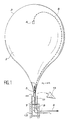
- the represented device consists essentially of a envelope 2, in the form of a balloon type meteorological system in butyl, deployed, filled with a fluid 3 consisting of a mixture of hydrogen and air.
- This envelope 2 is fixed, by means of a collar 6 of maintaining the envelope, on a diffuser 5 intended for introduce the fluid into the envelope.
- the diffuser 5 is fed with hydrogen under a pressure of 3 to 6 Bar by a pipe 7 of gas supply, the supply of the gas in this envelope being controlled by a solenoid valve 9.
- a container 11 in which the envelope was refolded before being filled by the fluid, and a ejection cover 13, which was ejected at the filling the envelope with the fluid.
- the container 11 is fixed on a support 15.
- An electric 4 primer head is placed in the envelope so that it is in contact with the explosive fluid introduced into this envelope.
- This leader is connected to control means triggering the explosion of fluid in envelope (not shown in this figure) by means of of 8 conductors of electricity.
- This head could also have been placed at the level of venturi system.
- FIG. 2 is a diagram of an enlargement of a cross section of the diffuser 5 on which is attached the envelope 2.
- the diffuser 5 includes a system venturi on which is provided a lateral orifice 17 ambient atmospheric air suction.
- This system venturi can inject atmospheric air ambient in the casing by suction, the flow hydrogen under pressure in this system by being the engine so as to form the explosive fluid.
- the Venturi system is chosen according to a pressure of hydrogen from 3 to 6 Bar at the entrance of this system.
- the conduit 7 supplying H 2 through the diffuser is a suitable tube for supplying a gas having a diameter of about 30 mm.
- the hydrogen / air mixture formed comprises from 25 to 35% hydrogen by volume and 75 to 65% of air in volume.
- the 8 conductors of electricity intended for feed the primer head 4 for triggering the explosion of fluid in the envelope are also represented in this figure.
- FIG. 3 is a cross-sectional view of a embodiment of a device 1 according to the present invention having several envelopes 2 folded in corresponding 11 containers, showing in cross section a container 11 in which a envelope 2 is folded so that it can get out of this container and deploy when the fluid is introduced into the envelope.
- Each container is from cylindrical shape and has a diameter of 60 to 80 mm.
- a lid 13, conical, ejectable closes each container 11 so as to protect the corresponding envelope until filled by the fluid.
- the orifice 17 side of each venturi system is located under the cover 13 ejectable so as to suck easily atmospheric air when hydrogen is injected through this system.
- the pressure exerted by the fluid in the envelope causes the ejection of the cover 13 so as to be able to leave the container and unfold.
- the containers are fixed on a support 15 forming a first removable part 19 of the device, said first removable part 19 being fixed on a fixed support 23, anchored to the ground 25, having a floor height of 1 to 2.5 m.
- the diet of each container is made by a solenoid valve 9 having a temperature resistance of -20 ° C fed in low voltage at 12 or 24 V. All solenoid valves are grouped on a single distributor 19 placed on the support 23 fixed.
- the fixed support 23 also includes a distributor 27 of electrical control of solenoid valves 9 and primer heads in each envelope (not shown) linked to each solenoid valve and each primer head by means of a electric multi-conductor cable 29.
- This distributor 27 is carefully shielded by means of a box metallic and grounded.
- the containers are factory assembled, this assembly includes setting up a leader head in each envelope, an assembly and a fixation of each envelope on a diffuser, a folding of each envelope in each corresponding container and a mounting a tapered ejector lid on each container.
- Device 1 is placed in a starting area avalanches.
- FIG. 4 is a sectional view from above of removable support 19 on which are distributed in a circle 17 containers 11 and corresponding envelopes 2. This number can be changed depending on the frequency triggering avalanches in a winter season.
- FIG. 5 is a general diagram of a device 1 according to the invention and its control station 31.
- the control station 31 is located at the top compared to the avalanche departure zone in which is placed the device 1.
- the control station 31 is composed of a shelter 32 Faradise heliportable in functional position.
- Each bottle has a volume of 50 1 and contains 9000 liters of hydrogen at a pressure of 180 Bar. This represents in total for 11 bottles a volume of 99,000 liters of hydrogen available at atmospheric pressure. Considering that the hydrogen is expanded at a pressure of 4 bar for filling the envelopes, the available volume will be 176 x 50 x 11 or 96800 liters of hydrogen.
- the shelter is placed on the ground on a wire mesh, the ground plane being grounded and anchored. Air vents high and low, protected from snow insects, are provided to prevent any accumulation hydrogen in the shelter.
- the shelter is protected against intrusions by a locked door not shown.
- Connections are planned between the control 31 and the device 1 according to the invention. These connections are a tube 33 for supplying hydrogen to the station 31 to the device 1, and a cable 39 of control transmission of solenoid valves 9 and primer heads of each envelope.
- the tube 33 is a medium pressure tube, sheathed by a metal tube of mechanical protection and shielded and anchored far and wide between the post of command and device 1 to prevent it from being snatched by creeping snow or scree.
- the shielding of this tube is connected to the mass of the shelter and to the mass of the device 1.
- the inner diameter of this tube is 8 to 10 mm in order to reduce the losses of loads on the length.
- the main solenoid valve 35 controls the supply of the hydrogen from the control station to the device 1 to through the tube 33, the 37 HP / BP monodetender, 180/10 Bar for adjusting a static pressure of hydrogen at the outlet of this monodetendeur, in the tube 33, at 4 to 6 Bar.
- the static pressure at the outlet of single regulator 37 is set according to the length of the tube 33 between the control station and the device 1.
- the static pressure of hydrogen in the tube 33 and the rolling diameter of each solenoid valve 9 are decisive for the filling time of each envelope.
- This filling time is preferably 1 to 2 minutes to take account in particular wind, friction of each envelope on roughness of the device, etc.
- the cable 39 is a multipair cable, shielded, with mechanical and electrical protection. he has a number of pairs in relation to the number of envelopes provided on the device 1. Each pair is shielded.
- This cable 39 makes the electrical connection between the control station 31 and the dispatcher 27 of electrical control of solenoid valves 9 and heads primer not shown, each envelope.
- the outputs of the faradised shelter that is to say the passages of the electrical cables 39 of the average tube 33 hydrogen transport pressure to the device 1, antenna 49, solar panel 51, through this shelter, are protected by coaxstop systems or equivalents.
- An electronic coding system allows a automatic incrementation, filling control and explosion, an envelope destroyed to a envelope folded into a container.
- the following example is an example of how of the device according to the invention.
- the transmitter / receiver 43 in the control station 31 is on standby thanks to the power supply electric battery and solar panel. he can be activated for example by radio control from a general command center in a runway service following the following block diagram:
Landscapes
- Engineering & Computer Science (AREA)
- General Engineering & Computer Science (AREA)
- Filling Or Discharging Of Gas Storage Vessels (AREA)
- Electrotherapy Devices (AREA)
- Manufacture, Treatment Of Glass Fibers (AREA)
- Eye Examination Apparatus (AREA)
- Liquid Deposition Of Substances Of Which Semiconductor Devices Are Composed (AREA)
- Medicines Containing Antibodies Or Antigens For Use As Internal Diagnostic Agents (AREA)
- Feeding, Discharge, Calcimining, Fusing, And Gas-Generation Devices (AREA)
- External Artificial Organs (AREA)
- Control And Safety Of Cranes (AREA)
- Examining Or Testing Airtightness (AREA)
- Surgical Instruments (AREA)
- Ropes Or Cables (AREA)
- Processing Of Terminals (AREA)
- Air Bags (AREA)
- Devices Affording Protection Of Roads Or Walls For Sound Insulation (AREA)
- Prostheses (AREA)
- Manipulator (AREA)
Claims (25)
- Verfahren zur künstlichen Auslösung einer Lawine durch wenigstens eine Explosion eines explosiven Fluids in einer vorher festgelegten Zone, wobei dieses Verfahren dadurch gekennzeichnet ist, dass es einen ersten Schritt des Füllens wenigstens einer elastischen Hülle mit einem explosiven Fluid und einen zweiten Schritt des Auslösens einer Explosion des genannten Fluids im Innern jeder Hülle umfasst, wobei jede Hülle durch die Explosion des Fluids, das sie enthält, zerstört wird.
- Verfahren nach Anspruch 1, bei dem jede elastische Hülle sich zusammengefaltet in einem entsprechenden Behälter befindet, wobei der Füllschritt dieser Hülle eins Phase der Entfaltung der genannten Hülle aus dem genannten Behälter heraus umfasst.
- Verfahren nach Anspruch 2, bei dem jeder Behälter durch eine Verschlusskappe verschlossen ist, wobei der Füllschritt der entsprechenden Hülle eine Phase des Ausstoßens der genannten Verschlusskappe umfasst, um so die Entfaltung der Hülle zu ermöglichen.
- Verfahren nach einem der Ansprüche 1 bis 3, bei dem der Füllschritt jeder Hülle eine Phase des Ansaugens von Umgebungsluft und des Mischens dieser Luft mit einem adäquaten Gas umfasst, um auf diese Weise ein explosives Fluid zu bilden.
- Verfahren nach einem der Ansprüche 1 bis 4, bei dem man, wobei mehrere Hüllen vorgesehen sind, in für jede Hülle unabhängiger Weise den ersten und den zweiten Schritt, die verbunden sind, steuert.
- Verfahren nach Anspruch 5, bei dem man aus der Feme nacheinander das Füllen der verschiedenen Hüllen und ihre Explosion steuert.
- Vorrichtung (1) zur künstlichen Auslösung einer Lawine durch wenigstens eine Explosion eines explosiven Fluids in einer festgelegten Zone, wobei die genannte Vorrichtung wenigstens eine Hülle (2) zur Aufnahme des explosiven Fluids (3) und Einrichtungen (5) zum Füllen jeder Hülle mit dem Fluid und Einrichtungen (4) zum Auslösen der Explosion dieses Fluids in jeder Hülle sowie Einrichtungen (31) zum Steuern des Füllens jeder Hülle und des Auslösens jeder Explosion umfasst, und jede Hülle (2) durch ein Material gebildet wird, das durch die Explosion des Fluids, das sie enthält, zerstört wird, wobei die genannte Vorrichtung außerdem einen Behälter (11) für jede Hülle (2) umfasst und dabei dadurch gekennzeichnet ist, dass die genannte Hülle, wenn sie leer ist, sich derart zusammengefaltet in dem entsprechenden Behälter befindet, dass sie diesen Behälter verlassen und sich entfalten kann, wenn das Fluid in die Hülle eingefüllt wird.
- Vorrichtung nach Anspruch 7, bei der das Fluid eine explosive Mischung aus atmosphärischer Umgebungsluft und wenigstens einem Gas ist, wobei die genannten Fülleinrichtungen (5) Einrichtungen (17) zum Ansaugen von atmosphärischer Umgebungsluft umfassen.
- Vorrichtung nach Anspruch 8, bei der die Einrichtungen zum Ansaugen von atmosphärischer Umgebungsluft Venturisysteme sind.
- Vorrichtung nach Anspruch 7, bei der die Einrichtungen (4) zum Auslösen der Explosion in der Hülle einen Zündkopf (4) umfassen.
- Vorrichtung nach Anspruch 7, bei der jeder Behälter (11) außerdem einen beim Einfüllen des Fluids (3) in die Hülle (2) abwerfbaren Deckel (13) umfasst.
- Vorrichtung nach Anspruch 7, die mehrere auf einem Träger (19) befestigte Behälter (11) umfasst, wobei dieser Träger im Boden (25) verankert ist.
- Vorrichtung nach Anspruch 12, bei der der Träger (19) einen ersten, lösbaren Teil (15), an dem die Behälter (11) befestigt sind, und einen zweiten, fest im Boden verankerten Teil (23) umfasst.
- Vorrichtung nach Anspruch 13, bei der der zweite, fest verankerte Teil (23) einen Gasverteilkopf (21) umfasst, um jeder Hülle Gas zuzuführen, und Füll- und Explosionssteuereinrichtungen (27) des Fluids in jeder der Hüllen umfasst.
- Vorrichtung nach Anspruch 12 mit einem Inkrementierungssteuersystem für das Füllen und die Explosion des Fluids in jeder der aufeinanderfolgenden Hüllen.
- Vorrichtung nach Anspruch 12, bei der der Behälter (11) von zylindrischer Form ist und ein erstes, mit einem Boden verschlossenes Ende und ein zweites, durch einen abwerfbaren Deckel (13) verschlossenes Ende umfasst, wobei dieser Deckel von konischer Form ist.
- Vorrichtung nach Anspruch 16, bei der der Boden des Behälters (11) von einer Zuführungsleitung eines Gases durchquert wird, wobei diese Leitung (7) den zylindrischen Behälter im Wesentlichen entsprechend seiner Symmetrieachse durchquert und in Höhe des konischen Deckels (13) durch einen Diffusor (5) endet, an dem die Hülle festgemacht ist, wobei dieser Diffusor dazu bestimmt ist, das Fluid in die Hülle (2) einzufüllen.
- Vorrichtung nach Anspruch 17, bei der der Diffusor (5) ein Venturisystem umfasst, das eine in Höhe des konischen Deckels (13) befindliche Öffnung (17) zum Ansaugen von atmosphärischer Umgebungsluft aufweist.
- Vorrichtung nach einem der Ansprüche 9 bis 18, bei der das Gas Wasserstoff ist.
- Vorrichtung nach Anspruch 19, bei der das Gas Wasserstoff ist und die verwendeten elastischen Hüllen (2) Hüllen des meteorologischen Typs mit einem Volumen von 10 m3 sind.
- Vorrichtung nach einem der Ansprüche 7 bis 20, bei dem das Material der Hülle aus der Gruppe ausgewählt wird, die Butyl enthält.
- Einsatz einer Vorrichtung mit wenigstens einer Hülle (2) zur Aufnahme eines explosiven Fluids (3), Einrichtungen (5) zum Füllen jeder Hülle mit dem Fluid, Einrichtungen (4) zum Auslösen der Explosion dieses Fluids in jeder Hülle und Einrichtungen (31) zum Steuern des Füllens jeder Hülle und des Auslösens jeder Explosion, wobei jede Hülle durch ein Material gebildet wird, das durch die Explosion des Fluids, das sie enthält, zerstört wird, dadurch gekennzeichnet, dass die genannte Vorrichtung für die Anwendung des Verfahrens nach Anspruch 1 benutzt wird.
- Einsatz einer Vorrichtung nach Anspruch 22, bei dem das Fluid eine explosive Mischung aus atmosphärischer Umgebungsluft und wenigstens einem Gas ist, wobei die genannten Fülleinrichtungen (5) Einrichtungen (17) zum Ansaugen von atmosphärischer Umgebungsluft sind.
- Einsatz einer Vorrichtung nach Anspruch 23, bei dem die Einrichtungen zum Ansaugen von atmosphärischer Umgebungsluft Venturisysteme sind.
- Einsatz einer Vorrichtung nach Anspruch 22, bei dem die Einrichtungen zum Auslösen einer Explosion in der Hülle (2) einen Zündkopf (4) umfassen.
Applications Claiming Priority (3)
| Application Number | Priority Date | Filing Date | Title |
|---|---|---|---|
| FR9714366 | 1997-11-17 | ||
| FR9714366A FR2771168B1 (fr) | 1997-11-17 | 1997-11-17 | Procede de declenchement artificiel d'une avalanche et dispositif pour la mise en oeuvre de ce procede |
| PCT/FR1998/002441 WO1999026039A1 (fr) | 1997-11-17 | 1998-11-16 | Procede de declenchement artificiel d'une avalanche et dispositif pour la mise en oeuvre de ce procede |
Publications (2)
| Publication Number | Publication Date |
|---|---|
| EP1031008A1 EP1031008A1 (de) | 2000-08-30 |
| EP1031008B1 true EP1031008B1 (de) | 2003-03-12 |
Family
ID=9513431
Family Applications (1)
| Application Number | Title | Priority Date | Filing Date |
|---|---|---|---|
| EP98955667A Expired - Lifetime EP1031008B1 (de) | 1997-11-17 | 1998-11-16 | Verfahren und vorrichtung zum auslösen von lawinen |
Country Status (12)
| Country | Link |
|---|---|
| US (1) | US6324982B1 (de) |
| EP (1) | EP1031008B1 (de) |
| JP (1) | JP4180794B2 (de) |
| AT (1) | ATE234457T1 (de) |
| CA (1) | CA2310113C (de) |
| DE (1) | DE69812150T2 (de) |
| ES (1) | ES2194364T3 (de) |
| FR (1) | FR2771168B1 (de) |
| IS (1) | IS5474A (de) |
| NO (1) | NO318333B1 (de) |
| TR (1) | TR200001359T2 (de) |
| WO (1) | WO1999026039A1 (de) |
Cited By (2)
| Publication number | Priority date | Publication date | Assignee | Title |
|---|---|---|---|---|
| WO2007096524A1 (fr) * | 2006-02-24 | 2007-08-30 | Technologie Alpine De Securite - Tas | Dispositif de declenchement d’avalanche |
| DE102009037705A1 (de) | 2009-08-18 | 2011-03-03 | Geräte- und Vorrichtungsbau Spitzner OHG | Verfahren und Vorrichtung zum Auslösen von Lawinenabgängen |
Families Citing this family (20)
| Publication number | Priority date | Publication date | Assignee | Title |
|---|---|---|---|---|
| FR2811420B1 (fr) | 2000-07-05 | 2003-01-17 | Giat Ind Sa | Projectile pour le declenchement d'avalanches |
| DK1362213T3 (da) * | 2001-04-12 | 2005-04-11 | Bang & Clean Gmbh | Fremgangsmåde og apparat til rensning af forbrændingsindretninger |
| US7707938B2 (en) * | 2005-05-16 | 2010-05-04 | Hisel Stanley D | Apparatus and method for avalanche control |
| US7819063B1 (en) * | 2007-06-21 | 2010-10-26 | Matthew D. Lehman | Inflatable explosive breaching device |
| FR2925152B1 (fr) | 2007-12-14 | 2013-06-28 | Technologie Alpine De Securite T A S | Dispositif de declenchement d'avalanches |
| US8065959B1 (en) * | 2009-06-22 | 2011-11-29 | Shulte David J | Explosive device |
| US8104406B1 (en) | 2009-06-22 | 2012-01-31 | Shulte David J | Explosive device |
| FR2953922B1 (fr) * | 2009-12-10 | 2011-12-09 | Technologie Alpine De Securite Tas | Dispositif de declenchement d'avalanches |
| FR2958739B1 (fr) * | 2010-04-09 | 2012-05-11 | Technologie Alpine De Securite Tas | Dispositif de declenchement d'avalanche |
| FR2964732B1 (fr) | 2010-09-14 | 2013-06-14 | Alp Artifices | Projectile pour declenchement d'avalanche |
| RU2458201C2 (ru) * | 2010-10-18 | 2012-08-10 | Федеральное государственное унитарное предприятие "Летно-исследовательский институт имени М.М. Громова" | Способ вызова сброса снежных лавин |
| CN102636085A (zh) * | 2011-02-10 | 2012-08-15 | 吴德滨 | 空雷 |
| FR2988389A1 (fr) * | 2012-03-22 | 2013-09-27 | Alp Artifices | Composition deflagrante pour le declanchement d'avalanche et procede de declenchement d'avalanche |
| CN104863065B (zh) * | 2015-04-28 | 2017-02-01 | 同济大学 | 一种用于防治落石的阻力缓冲装置 |
| US9568918B1 (en) | 2015-08-27 | 2017-02-14 | Southwest Research Institute | Balloon system |
| US11333474B2 (en) * | 2016-08-07 | 2022-05-17 | Explosive Alternatives, Inc. | Apparatus and method for blasting |
| US10968579B2 (en) * | 2018-07-26 | 2021-04-06 | Avy Blasters, LLC | Avalanche control device |
| FR3101940B1 (fr) * | 2019-10-10 | 2021-10-15 | Tech Alpine De Securite Tas | Système de déclenchement d’avalanches |
| CN113513955A (zh) * | 2021-06-17 | 2021-10-19 | 中国葛洲坝集团国际工程有限公司 | 一种竖井疏通爆破方法 |
| AT527413B1 (de) * | 2023-12-27 | 2025-02-15 | Singer Manfred | Versorgungsmodul, Lawinenauslösesystem, Verfahren zum Auslösen von Lawinen und Verfahren zum Austausch eines Versorgungsmoduls |
Family Cites Families (9)
| Publication number | Priority date | Publication date | Assignee | Title |
|---|---|---|---|---|
| US3658005A (en) * | 1970-04-08 | 1972-04-25 | Thiokol Chemical Corp | Fuel-air explosive device |
| DE2021646A1 (de) * | 1970-05-02 | 1971-11-11 | Comet Appbau Gmbh | Vorrichtung zum Raeumen von Minenfeldern |
| CA1140809A (en) * | 1979-10-24 | 1983-02-08 | Ici Canada Inc. | Explosive package including a rectangular bag of heat sealable thermoplastic film |
| GB2199289A (en) * | 1986-12-30 | 1988-07-06 | Nash Frazer Ltd | Minefield clearing systems |
| US4873928A (en) * | 1987-06-15 | 1989-10-17 | Apti, Inc. | Nuclear-sized explosions without radiation |
| FR2636729B1 (fr) | 1988-09-19 | 1990-12-07 | Schippers Jacob | Procede et dispositif pour declencher une avalanche |
| AR245818A1 (es) * | 1988-03-03 | 1994-02-28 | Schippers Jacob | Dispositivo para desencadenar un alud. |
| FR2628197B1 (fr) * | 1988-03-03 | 1990-08-03 | Schippers Jacob | Procede et dispositif pour declencher une avalanche |
| AT407576B (de) * | 1996-04-10 | 2001-04-25 | Innova Patent Gmbh | Vorrichtung zum auslösen einer lawine od.dgl. |
-
1997
- 1997-11-17 FR FR9714366A patent/FR2771168B1/fr not_active Expired - Fee Related
-
1998
- 1998-11-16 JP JP2000521358A patent/JP4180794B2/ja not_active Expired - Fee Related
- 1998-11-16 AT AT98955667T patent/ATE234457T1/de active
- 1998-11-16 DE DE69812150T patent/DE69812150T2/de not_active Expired - Lifetime
- 1998-11-16 ES ES98955667T patent/ES2194364T3/es not_active Expired - Lifetime
- 1998-11-16 EP EP98955667A patent/EP1031008B1/de not_active Expired - Lifetime
- 1998-11-16 CA CA002310113A patent/CA2310113C/fr not_active Expired - Fee Related
- 1998-11-16 TR TR2000/01359T patent/TR200001359T2/xx unknown
- 1998-11-16 WO PCT/FR1998/002441 patent/WO1999026039A1/fr not_active Ceased
- 1998-11-16 US US09/554,218 patent/US6324982B1/en not_active Expired - Lifetime
-
2000
- 2000-04-27 IS IS5474A patent/IS5474A/is unknown
- 2000-05-08 NO NO20002393A patent/NO318333B1/no not_active IP Right Cessation
Cited By (4)
| Publication number | Priority date | Publication date | Assignee | Title |
|---|---|---|---|---|
| WO2007096524A1 (fr) * | 2006-02-24 | 2007-08-30 | Technologie Alpine De Securite - Tas | Dispositif de declenchement d’avalanche |
| FR2897931A1 (fr) * | 2006-02-24 | 2007-08-31 | Technologie Alpine De Securite | Dispositif de declenchement d'avalanche |
| DE102009037705A1 (de) | 2009-08-18 | 2011-03-03 | Geräte- und Vorrichtungsbau Spitzner OHG | Verfahren und Vorrichtung zum Auslösen von Lawinenabgängen |
| DE102009037705B4 (de) * | 2009-08-18 | 2014-03-27 | Geräte- und Vorrichtungsbau Spitzner OHG | Verfahren und Vorrichtung zum Auslösen von Lawinenabgängen |
Also Published As
| Publication number | Publication date |
|---|---|
| FR2771168B1 (fr) | 1999-12-10 |
| IS5474A (is) | 2000-04-27 |
| NO318333B1 (no) | 2005-03-07 |
| JP2001523809A (ja) | 2001-11-27 |
| EP1031008A1 (de) | 2000-08-30 |
| CA2310113A1 (fr) | 1999-05-27 |
| NO20002393L (no) | 2000-07-17 |
| WO1999026039A1 (fr) | 1999-05-27 |
| JP4180794B2 (ja) | 2008-11-12 |
| DE69812150T2 (de) | 2003-12-04 |
| US6324982B1 (en) | 2001-12-04 |
| CA2310113C (fr) | 2006-11-14 |
| DE69812150D1 (de) | 2003-04-17 |
| ATE234457T1 (de) | 2003-03-15 |
| FR2771168A1 (fr) | 1999-05-21 |
| TR200001359T2 (tr) | 2001-02-21 |
| ES2194364T3 (es) | 2003-11-16 |
| NO20002393D0 (no) | 2000-05-08 |
Similar Documents
| Publication | Publication Date | Title |
|---|---|---|
| CA2310113C (fr) | Procede de declenchement artificiel d'une avalanche et dispositif pour la mise en oeuvre de ce procede | |
| EP2556330B1 (de) | Vorrichtung zur auslösung einer lawine | |
| CA1331314C (fr) | Procede et dispositif pour declencher une avalanche | |
| CA2707034C (fr) | Dispositif de declenchement d'avalanches | |
| EP1987290B1 (de) | Lawinenauslösesystem | |
| EP4165363B1 (de) | Vorrichtung für lawinenauslösesystem und system mit einer solchen vorrichtung und strahlkammer | |
| EP4696977A1 (de) | Lawinenauslösevorrichtung | |
| FR2636729A1 (fr) | Procede et dispositif pour declencher une avalanche | |
| EP0991911B1 (de) | Vorrichtung die das einstürzen einer schneeplatte einleitet | |
| US7530532B2 (en) | Counterweight based rocket launch platform | |
| EP4627394A1 (de) | Aerostatische vorrichtung mit mitteln zur handhabung des abstiegs mit aktivem drehsteifen flügel | |
| FR2653217A1 (fr) | Procede et installation de tir d'engins pyrotechniques, et engins pyrotechniques utilises pour leur mise en óoeuvre. | |
| EP2084056A1 (de) | Sichere vorrichtung zum transport und zur speicherung von wasserstoff | |
| WO2003100194A2 (fr) | Station de telecommunication pour zones isolees | |
| FR3027283A1 (fr) | Ballon ionospherique et systeme d'emport de ballons ionospheriques | |
| FR2628197A1 (fr) | Procede et dispositif pour declencher une avalanche | |
| Roth | Une première dans la magnétosphère... Expériences actives dans un plasma cosmique: le projet AMPTE | |
| FR2897749A1 (fr) | Canon atomique |
Legal Events
| Date | Code | Title | Description |
|---|---|---|---|
| PUAI | Public reference made under article 153(3) epc to a published international application that has entered the european phase |
Free format text: ORIGINAL CODE: 0009012 |
|
| 17P | Request for examination filed |
Effective date: 20000428 |
|
| AK | Designated contracting states |
Kind code of ref document: A1 Designated state(s): AT DE ES FR IT Kind code of ref document: A1 Designated state(s): AT CH DE ES FR IT LI |
|
| 17Q | First examination report despatched |
Effective date: 20010705 |
|
| GRAG | Despatch of communication of intention to grant |
Free format text: ORIGINAL CODE: EPIDOS AGRA |
|
| RBV | Designated contracting states (corrected) |
Designated state(s): AT CH DE ES FR IT LI |
|
| GRAG | Despatch of communication of intention to grant |
Free format text: ORIGINAL CODE: EPIDOS AGRA |
|
| GRAH | Despatch of communication of intention to grant a patent |
Free format text: ORIGINAL CODE: EPIDOS IGRA |
|
| GRAH | Despatch of communication of intention to grant a patent |
Free format text: ORIGINAL CODE: EPIDOS IGRA |
|
| GRAA | (expected) grant |
Free format text: ORIGINAL CODE: 0009210 |
|
| AK | Designated contracting states |
Designated state(s): AT CH DE ES FR IT LI |
|
| REG | Reference to a national code |
Ref country code: CH Ref legal event code: EP |
|
| REF | Corresponds to: |
Ref document number: 69812150 Country of ref document: DE Date of ref document: 20030417 Kind code of ref document: P |
|
| REG | Reference to a national code |
Ref country code: ES Ref legal event code: FG2A Ref document number: 2194364 Country of ref document: ES Kind code of ref document: T3 |
|
| PLBE | No opposition filed within time limit |
Free format text: ORIGINAL CODE: 0009261 |
|
| STAA | Information on the status of an ep patent application or granted ep patent |
Free format text: STATUS: NO OPPOSITION FILED WITHIN TIME LIMIT |
|
| 26N | No opposition filed |
Effective date: 20031215 |
|
| REG | Reference to a national code |
Ref country code: FR Ref legal event code: CL |
|
| REG | Reference to a national code |
Ref country code: FR Ref legal event code: CL |
|
| REG | Reference to a national code |
Ref country code: FR Ref legal event code: TP |
|
| PGFP | Annual fee paid to national office [announced via postgrant information from national office to epo] |
Ref country code: CH Payment date: 20131015 Year of fee payment: 16 Ref country code: DE Payment date: 20130927 Year of fee payment: 16 Ref country code: AT Payment date: 20131016 Year of fee payment: 16 |
|
| REG | Reference to a national code |
Ref country code: DE Ref legal event code: R082 Ref document number: 69812150 Country of ref document: DE Representative=s name: WITTE, WELLER & PARTNER PATENTANWAELTE MBB, DE |
|
| REG | Reference to a national code |
Ref country code: DE Ref legal event code: R082 Ref document number: 69812150 Country of ref document: DE Representative=s name: WITTE, WELLER & PARTNER PATENTANWAELTE MBB, DE Effective date: 20140318 Ref country code: DE Ref legal event code: R081 Ref document number: 69812150 Country of ref document: DE Owner name: TECHNOLOGIE ALPINE DE SECURITE S.A.S., FR Free format text: FORMER OWNERS: COMMISSARIAT A L'ENERGIE ATOMIQUE, PARIS, FR; CENTRE NATIONAL DU MECHINISME AGRICOLE ET DU GENIE RURAL DES EAUX ET FORETS, ANTONY, FR Effective date: 20140318 Ref country code: DE Ref legal event code: R081 Ref document number: 69812150 Country of ref document: DE Owner name: TECHNOLOGIE ALPINE DE SECURITE S.A.S., FR Free format text: FORMER OWNER: COMMISSARIAT A L'ENERGIE ATOMIQ, CENTRE NATIONAL DU MECHINISME A, , FR Effective date: 20140318 |
|
| PGFP | Annual fee paid to national office [announced via postgrant information from national office to epo] |
Ref country code: ES Payment date: 20141124 Year of fee payment: 17 Ref country code: FR Payment date: 20140930 Year of fee payment: 17 |
|
| PGFP | Annual fee paid to national office [announced via postgrant information from national office to epo] |
Ref country code: IT Payment date: 20141113 Year of fee payment: 17 |
|
| REG | Reference to a national code |
Ref country code: DE Ref legal event code: R119 Ref document number: 69812150 Country of ref document: DE |
|
| REG | Reference to a national code |
Ref country code: CH Ref legal event code: PL |
|
| REG | Reference to a national code |
Ref country code: AT Ref legal event code: MM01 Ref document number: 234457 Country of ref document: AT Kind code of ref document: T Effective date: 20141116 |
|
| PG25 | Lapsed in a contracting state [announced via postgrant information from national office to epo] |
Ref country code: CH Free format text: LAPSE BECAUSE OF NON-PAYMENT OF DUE FEES Effective date: 20141130 Ref country code: LI Free format text: LAPSE BECAUSE OF NON-PAYMENT OF DUE FEES Effective date: 20141130 |
|
| PG25 | Lapsed in a contracting state [announced via postgrant information from national office to epo] |
Ref country code: AT Free format text: LAPSE BECAUSE OF NON-PAYMENT OF DUE FEES Effective date: 20141116 |
|
| PG25 | Lapsed in a contracting state [announced via postgrant information from national office to epo] |
Ref country code: DE Free format text: LAPSE BECAUSE OF NON-PAYMENT OF DUE FEES Effective date: 20150602 |
|
| PG25 | Lapsed in a contracting state [announced via postgrant information from national office to epo] |
Ref country code: IT Free format text: LAPSE BECAUSE OF NON-PAYMENT OF DUE FEES Effective date: 20151116 |
|
| REG | Reference to a national code |
Ref country code: FR Ref legal event code: ST Effective date: 20160729 |
|
| PG25 | Lapsed in a contracting state [announced via postgrant information from national office to epo] |
Ref country code: FR Free format text: LAPSE BECAUSE OF NON-PAYMENT OF DUE FEES Effective date: 20151130 |
|
| REG | Reference to a national code |
Ref country code: ES Ref legal event code: FD2A Effective date: 20161229 |
|
| PG25 | Lapsed in a contracting state [announced via postgrant information from national office to epo] |
Ref country code: ES Free format text: LAPSE BECAUSE OF NON-PAYMENT OF DUE FEES Effective date: 20151117 |