EP1031342B1 - Wachs, filmbildendes Polymer und Silikon enthaltende Maskara Zusammensetzung - Google Patents
Wachs, filmbildendes Polymer und Silikon enthaltende Maskara Zusammensetzung Download PDFInfo
- Publication number
- EP1031342B1 EP1031342B1 EP00400062A EP00400062A EP1031342B1 EP 1031342 B1 EP1031342 B1 EP 1031342B1 EP 00400062 A EP00400062 A EP 00400062A EP 00400062 A EP00400062 A EP 00400062A EP 1031342 B1 EP1031342 B1 EP 1031342B1
- Authority
- EP
- European Patent Office
- Prior art keywords
- composition according
- radical
- acid
- les
- weight
- Prior art date
- Legal status (The legal status is an assumption and is not a legal conclusion. Google has not performed a legal analysis and makes no representation as to the accuracy of the status listed.)
- Expired - Lifetime
Links
- 0 CCC(CC)(C(CC)(CC)OC)N(C)* Chemical compound CCC(CC)(C(CC)(CC)OC)N(C)* 0.000 description 1
- PDQDZBLKGOQBLL-UHFFFAOYSA-N CCC(CC)(N(C)C)OC Chemical compound CCC(CC)(N(C)C)OC PDQDZBLKGOQBLL-UHFFFAOYSA-N 0.000 description 1
Classifications
-
- A—HUMAN NECESSITIES
- A61—MEDICAL OR VETERINARY SCIENCE; HYGIENE
- A61K—PREPARATIONS FOR MEDICAL, DENTAL OR TOILETRY PURPOSES
- A61K8/00—Cosmetics or similar toiletry preparations
- A61K8/18—Cosmetics or similar toiletry preparations characterised by the composition
- A61K8/92—Oils, fats or waxes; Derivatives thereof, e.g. hydrogenation products thereof
-
- A—HUMAN NECESSITIES
- A61—MEDICAL OR VETERINARY SCIENCE; HYGIENE
- A61K—PREPARATIONS FOR MEDICAL, DENTAL OR TOILETRY PURPOSES
- A61K8/00—Cosmetics or similar toiletry preparations
- A61K8/18—Cosmetics or similar toiletry preparations characterised by the composition
- A61K8/72—Cosmetics or similar toiletry preparations characterised by the composition containing organic macromolecular compounds
- A61K8/84—Cosmetics or similar toiletry preparations characterised by the composition containing organic macromolecular compounds obtained by reactions otherwise than those involving only carbon-carbon unsaturated bonds
- A61K8/89—Polysiloxanes
- A61K8/891—Polysiloxanes saturated, e.g. dimethicone, phenyl trimethicone, C24-C28 methicone or stearyl dimethicone
- A61K8/894—Polysiloxanes saturated, e.g. dimethicone, phenyl trimethicone, C24-C28 methicone or stearyl dimethicone modified by a polyoxyalkylene group, e.g. cetyl dimethicone copolyol
-
- A—HUMAN NECESSITIES
- A61—MEDICAL OR VETERINARY SCIENCE; HYGIENE
- A61K—PREPARATIONS FOR MEDICAL, DENTAL OR TOILETRY PURPOSES
- A61K8/00—Cosmetics or similar toiletry preparations
- A61K8/18—Cosmetics or similar toiletry preparations characterised by the composition
- A61K8/30—Cosmetics or similar toiletry preparations characterised by the composition containing organic compounds
- A61K8/64—Proteins; Peptides; Derivatives or degradation products thereof
- A61K8/645—Proteins of vegetable origin; Derivatives or degradation products thereof
-
- A—HUMAN NECESSITIES
- A61—MEDICAL OR VETERINARY SCIENCE; HYGIENE
- A61K—PREPARATIONS FOR MEDICAL, DENTAL OR TOILETRY PURPOSES
- A61K8/00—Cosmetics or similar toiletry preparations
- A61K8/18—Cosmetics or similar toiletry preparations characterised by the composition
- A61K8/72—Cosmetics or similar toiletry preparations characterised by the composition containing organic macromolecular compounds
- A61K8/81—Cosmetics or similar toiletry preparations characterised by the composition containing organic macromolecular compounds obtained by reactions involving only carbon-to-carbon unsaturated bonds
- A61K8/8141—Compositions of homopolymers or copolymers of compounds having one or more unsaturated aliphatic radicals, each having only one carbon-to-carbon double bond, and at least one being terminated by only one carboxyl radical, or of salts, anhydrides, esters, amides, imides or nitriles thereof; Compositions of derivatives of such polymers
- A61K8/8152—Homopolymers or copolymers of esters, e.g. (meth)acrylic acid esters; Compositions of derivatives of such polymers
-
- A—HUMAN NECESSITIES
- A61—MEDICAL OR VETERINARY SCIENCE; HYGIENE
- A61K—PREPARATIONS FOR MEDICAL, DENTAL OR TOILETRY PURPOSES
- A61K8/00—Cosmetics or similar toiletry preparations
- A61K8/18—Cosmetics or similar toiletry preparations characterised by the composition
- A61K8/72—Cosmetics or similar toiletry preparations characterised by the composition containing organic macromolecular compounds
- A61K8/84—Cosmetics or similar toiletry preparations characterised by the composition containing organic macromolecular compounds obtained by reactions otherwise than those involving only carbon-carbon unsaturated bonds
- A61K8/89—Polysiloxanes
-
- A—HUMAN NECESSITIES
- A61—MEDICAL OR VETERINARY SCIENCE; HYGIENE
- A61K—PREPARATIONS FOR MEDICAL, DENTAL OR TOILETRY PURPOSES
- A61K8/00—Cosmetics or similar toiletry preparations
- A61K8/18—Cosmetics or similar toiletry preparations characterised by the composition
- A61K8/92—Oils, fats or waxes; Derivatives thereof, e.g. hydrogenation products thereof
- A61K8/922—Oils, fats or waxes; Derivatives thereof, e.g. hydrogenation products thereof of vegetable origin
-
- A—HUMAN NECESSITIES
- A61—MEDICAL OR VETERINARY SCIENCE; HYGIENE
- A61Q—SPECIFIC USE OF COSMETICS OR SIMILAR TOILETRY PREPARATIONS
- A61Q1/00—Make-up preparations; Body powders; Preparations for removing make-up
-
- A—HUMAN NECESSITIES
- A61—MEDICAL OR VETERINARY SCIENCE; HYGIENE
- A61Q—SPECIFIC USE OF COSMETICS OR SIMILAR TOILETRY PREPARATIONS
- A61Q1/00—Make-up preparations; Body powders; Preparations for removing make-up
- A61Q1/02—Preparations containing skin colorants, e.g. pigments
- A61Q1/10—Preparations containing skin colorants, e.g. pigments for eyes, e.g. eyeliner, mascara
-
- A—HUMAN NECESSITIES
- A61—MEDICAL OR VETERINARY SCIENCE; HYGIENE
- A61K—PREPARATIONS FOR MEDICAL, DENTAL OR TOILETRY PURPOSES
- A61K2800/00—Properties of cosmetic compositions or active ingredients thereof or formulation aids used therein and process related aspects
- A61K2800/40—Chemical, physico-chemical or functional or structural properties of particular ingredients
- A61K2800/54—Polymers characterized by specific structures/properties
- A61K2800/542—Polymers characterized by specific structures/properties characterized by the charge
- A61K2800/5424—Polymers characterized by specific structures/properties characterized by the charge anionic
-
- A—HUMAN NECESSITIES
- A61—MEDICAL OR VETERINARY SCIENCE; HYGIENE
- A61K—PREPARATIONS FOR MEDICAL, DENTAL OR TOILETRY PURPOSES
- A61K2800/00—Properties of cosmetic compositions or active ingredients thereof or formulation aids used therein and process related aspects
- A61K2800/40—Chemical, physico-chemical or functional or structural properties of particular ingredients
- A61K2800/54—Polymers characterized by specific structures/properties
- A61K2800/542—Polymers characterized by specific structures/properties characterized by the charge
- A61K2800/5426—Polymers characterized by specific structures/properties characterized by the charge cationic
-
- A—HUMAN NECESSITIES
- A61—MEDICAL OR VETERINARY SCIENCE; HYGIENE
- A61K—PREPARATIONS FOR MEDICAL, DENTAL OR TOILETRY PURPOSES
- A61K2800/00—Properties of cosmetic compositions or active ingredients thereof or formulation aids used therein and process related aspects
- A61K2800/40—Chemical, physico-chemical or functional or structural properties of particular ingredients
- A61K2800/59—Mixtures
- A61K2800/594—Mixtures of polymers
Definitions
- the present invention relates to a composition for coating keratin fibers, in particular human eyelashes and hair, comprising a wax, a film-forming polymer and a silicone agent.
- the invention also relates to the use of this composition for making up keratin fibers, as well than a makeup process for the latter.
- the composition and process of make-up according to the invention are more particularly intended for keratin fibers substantially longitudinal such as eyelashes, eyebrows and hair, including including false eyelashes and hairpieces.
- the composition can be a composition make-up, a make-up base, a composition to be applied to make-up, also called a top coat, or even a cosmetic treatment composition keratin fibers. More specifically, the invention relates to a mascara.
- the eyelash coating compositions called mascara, generally include, in known manner, at least one wax and at least one film-forming polymer to deposit a make-up film on the eyelashes and to cover them, like the describes for example the document WO-A-95/15741. Users wait for these products with good cosmetic properties such as adhesion to the eyelashes, eyelash lengthening or curling, or even good hold of the mascara over time, in particular good resistance to friction by example of fingers or tissues (handkerchiefs, towels).
- the document FR-A-2528699 proposes a mascara comprising waxes and a combination of anionic polymer and cationic polymer.
- EP-A-832637 describes mascara compositions comprising waxes, a film-forming polymer and a silicone agent, in particular a dimethicone copolyol, having good adhesion to the eyelashes, conferring eyelash lengthening and shaping and having good resistance, in particular good resistance to finger rubbing. It is also described in document WO 96/36323 mascara compositions comprising waxes, an aqueous dispersion of polymer particles and an alkyl- or alkoxy-dimethicone copolyol with good resistance and removable with water and soap.
- the makeup properties such as the sheathing, eyelash lengthening or curling is obtained when a significant amount of product is deposited on the eyelashes using an applicator, such as a mascara brush.
- an applicator such as a mascara brush.
- the user must therefore apply the impregnated brush several times of product on the eyelashes, which requires taking some time to apply makeup and obtain the desired makeup results. Now this time can be perceived as far too long by busy users.
- the mascara has tendency to form bundles and makeup is not homogeneous, which affects the desired aesthetic effect.
- these packages also do not promote good separation of the eyelashes: the latter then tend to stick together.
- the makeup is not homogeneous, it leaves a feeling of discomfort and discomfort to the user.
- the object of the present invention is to have a makeup composition keratin fibers, and in particular fibers such as the eyelashes, easily applied and quickly leading to uniform makeup, comfortable to wear and having good makeup and hold qualities.
- composition can be obtained by using a particular combination of wax, film-forming polymers and agent silicone.
- the subject of the invention is a composition for making up the fibers.
- keratin comprising at least one wax, at least one film-forming polymer and at least one polyoxyalkylenated silicone, characterized in that the polymer film-forming agent comprises at least one cationic polymer and at least one polymer anionic and that the wax comprises at least one hydrogenated vegetable oil.
- composition according to the invention is easily applied and hangs well on keratin fibers such as the eyelashes.
- the makeup results as the sheathing, the elongation and the curling of the eyelashes are obtained quickly and easily after application to the eyelashes of the brush impregnated with product.
- a uniform makeup is obtained in particular without the presence of a pack of product on the eyelashes.
- the makeup is comfortable for the user.
- the makeup exhibits good resistance over time, in particular good resistance rubbing, especially of fingers or fabrics; the film deposited does not crumble over time. Make-up removes easily with makeup removers classics.
- the invention also relates to a process for coating keratin fibers, in particular eyelashes, consisting in applying to the keratin fibers a composition as defined above.
- the invention also relates to the use of a composition as defined previously to obtain a homogeneous and / or rapid and / or easy makeup to apply and / or having good hold.
- composition according to the invention comprises at least one hydrogenated vegetable oil wax.
- These waxes generally have a melting point ranging from 40 ° C to 95 ° C, and preferably from 50 ° C to 90 ° C.
- hydrogenated vegetable oil wax mention may be made of hydrogenated oils which are obtained by catalytic hydrogenation of fatty substances composed of linear or non-C 8 -C 32 fatty chain, hydrogenated sunflower oil, hydrogenated castor oil , hydrogenated coconut oil, hydrogenated jojoba oil, hydrogenated cottonseed oil, and hydrogenated palm oils.
- hydrogenated oils which are obtained by catalytic hydrogenation of fatty substances composed of linear or non-C 8 -C 32 fatty chain, hydrogenated sunflower oil, hydrogenated castor oil , hydrogenated coconut oil, hydrogenated jojoba oil, hydrogenated cottonseed oil, and hydrogenated palm oils.
- waxes from hydrogenated jojoba oil, hydrogenated cottonseed oil, and hydrogenated palm oil can be used, and mixtures thereof.
- the hydrogenated vegetable oil waxes may be present in the composition according to the invention in a content ranging from 0.1 to 20% by weight, relative to the weight total of the composition, and preferably from 0.1 to 10% by weight.
- composition can also comprise other waxes, called additional waxes, different from hydrogenated vegetable oil waxes.
- additional waxes can be chosen from animal waxes, plant waxes or synthetic waxes.
- Additional waxes can have a melting point ranging from 40 ° C to 110 ° C; these waxes preferably have a needle penetration ranging from 1 to 217.
- the penetration with a wax needle is determined according to French standard NF T 60-123 or the American standard ASTM D 1321, at a temperature of 25 ° C. According to these standards, needle penetration is the measure of depth, expressed in tenths of a millimeter, to which a standard needle, weighing 2.5 g arranged in a mobile unit weighing 97.5 g and placed on the test wax, for 5 seconds, gets into the wax.
- waxes of animal origin there may be mentioned beeswaxes, lanolin waxes and Chinese insect waxes.
- waxes of vegetable origin mention may be made of rice waxes, Carnauba, Candellila, Ouricurry waxes, cork fiber waxes, sugar cane waxes, Japanese waxes, sumac.
- waxes of mineral origin there may be mentioned paraffins, microcrystalline waxes, Montan waxes and ozokerites.
- waxes of synthetic origin it is possible to use in particular polyolefin waxes and in particular polyethylene waxes, waxes obtained by the synthesis of Fischer and Tropsch, waxy copolymers as well as their esters, silicone waxes.
- the waxes which can be used according to the present invention are preferably solid and rigid at a temperature below 50 ° C.
- composition according to the invention can comprise from 0% to 40% (in particular of 0.1% to 40%) by weight of additional wax, by weight relative to the total weight of the composition, preferably from 0.5% to 30% by weight.
- the first additional (wax I) and the second additional wax (wax II) can be present in the composition according to a weight ratio wax I / wax II which can range from 1.5 to 5, and preferably from 2 to 3.5.
- film-forming polymer is understood to mean a polymer which alone leads to an isolable film.
- the composition according to the invention can contain any anionic, preferably non-crosslinked, or cationic polymer known per se. These polymers can be used in dissolved form or in the form of aqueous dispersions of solid polymer particles.
- a family of silicone polymers with a polysiloxane backbone grafted with non-silicone organic monomers which are particularly suitable for the implementation of the present invention consists of silicone polymers comprising in their structure the following formula of formula (III): in which the radicals G 1 , which are identical or different, represent hydrogen or a C 1 -C 10 alkyl radical or also a phenyl radical; the radicals G 2 , which may be identical or different, represent a C 1 -C 10 alkylene group; G 3 represents a polymer residue resulting from the (homo) polymerization of at least one anionic monomer containing ethylenic unsaturation; G 4 represents a polymer residue resulting from the (homo) polymerization of at least one hydrophobic ethylenically unsaturated monomer; m and n are 0 or 1; a is an integer ranging from 0 and 50; b is an integer which can be between 10 and 350, c is an integer ranging from 0 to
- grafted silicone polymers are in particular polydimethylsiloxanes (PDMS) onto which are grafted, via a thiopropylene-type connection chain, mixed polymer units of the poly (meth) acrylic acid type and of the poly (meth) type. ) alkyl acrylate such as isobutyl poly (meth) acrylate.
- PDMS polydimethylsiloxanes
- Particularly used are the grafted silicone polymers of formula (III) of polymethyl / methylsiloxane structure with propyl thio-3 polymethacrylic acid groups and methyl propyl thio-3 polymethacrylate groups and the grafted silicone polymers of formula (III) of polymethyl / methylsiloxane structure with propyl thio-3 polyacrylic acid groups.
- the anionic polymer (s) may be present in a content ranging from 0.01% to 20% by weight, preferably from 0.05% to 15% by weight, and even more preferably from 0.1% to 7% by weight, of the total weight of the composition.
- the cationic polymers which can be used in accordance with the present invention can be chosen from all those already known per se, in particular those described in patent application EP-A- 0 337 354 and in French patent applications FR-A- 2 270 846, 2 383 660, 2 598 611, 2 470 596 and 2 519 863.
- cationic polymer means any polymer containing cationic groups or groups which can be ionized into cationic groups.
- the preferred cationic polymers are chosen from those which contain units comprising primary, secondary, tertiary and / or amine groups quaternaries can either be part of the main polymer chain, or be carried by a lateral substituent directly connected to it.
- the cationic polymers used generally have a number average molecular mass of between 500 and 5.10 6 approximately, and preferably between 10 3 and 3.10 6 approximately.
- cationic polymers mention may be made more particularly of the polymers of the polyamine, polyaminoamide and quaternary polyammonium type. Those are known products.
- a polymer belonging to this class is the polymer marketed by the Company Union Carbide under the name "Ucar Silicone ALE 56.
- a particularly advantageous embodiment is their joint use with cationic and / or nonionic surfactants.
- a cationic surfactant comprising a mixture of products corresponding to formula (VIII): in which R 12 denotes alkenyl and / or alkyl radicals having from 14 to 22 carbon atoms, derived from tallow fatty acids, in combination with a nonionic surfactant of formula: C 9 H 19 -C 6 H 4 - (OC 2 H 4 ) 10 -OH known under the name "Nonoxynol 10".
- cationic polymers which can be used in the context of the invention are polyalkyleneimines, in particular polyethyleneimines, polymers containing vinylpyridine or vinylpyridinium units, polyamine condensates and epichlorohydrin, quaternary polyuretylenes and chitin derivatives.
- cationic polymers capable of being used in the context of the present invention, it is preferred to use the cyclopolymers, in particular copolymers of dimethyldiallylammonium chloride and acrylamide having a molecular weight greater than 500,000, marketed under the names "MERQUAT® 550" and “MERQUAT® S” by MERCK, the cationic polysaccharides and more particularly the polymer marketed under the name "JAGUAR® C13S" by the company MEYHALL, and the polyaminoamides of the family (6) described above.
- cationic polymers can also be used in the form latex or pseudolatex, i.e. in the form of a dispersion of particles insoluble polymers.
- the cationic polymer (s) can be present in a content ranging from 0.01% to 20% by weight, preferably from 0.01% to 15% by weight, and even more preferably from 0.1% to 5% by weight, of the total weight of the composition.
- the ratio of cationic charge of the cationic polymer (s) / anionic charge anionic polymer (s) expressed in meq./g is generally included between 0.25 and 5, preferably between 0.5 and 2 and even more preferably between 0.75 and 1.25.
- the cationic charge is the number of atom of quaternary, tertiary, secondary amine or primary per gram of polymer.
- composition according to the invention can comprise the association at least one hydroxyalkyl (C1-C4) cellulose containing ammonium groups quaternaries, in particular a hydroxyethylcellulose crosslinked with epichlorohydrin quaternized by trimethylamine, and at least one polymethacrylate sodium.
- C1-C4 hydroxyalkyl
- cellulose containing ammonium groups quaternaries in particular a hydroxyethylcellulose crosslinked with epichlorohydrin quaternized by trimethylamine
- polymethacrylate sodium at least one polymethacrylate sodium.
- the composition may also contain at least one nonionic film-forming polymer in a content which can range from 0% to 15% by weight (in particular 0.1% to 15% by weight), relative to the total weight of the composition, and preferably 0.1% to 10% by weight.
- the polyoxyalkylenated silicone of the composition according to the invention can be chosen among the silicones comprising a pendant or terminal polyoxyalkylenated chain, or alternatively a polyoxyalkylenated block.
- a chain or polyoxyalkylenated block mention may especially be made of polyoxyethylenated or polyoxypropylenated chains or blocks.
- the polyoxyalkylenated silicone can be a (di) methicone copolyol.
- Polyoxyalkylenated silicones were in particular presented by the company DOW CORNING at the 17th international congress of the IFSCC in October 1992 and reported in the article "Water-soluble dimethicone copolyol waxes for personal care industry" by Linda Madore et al. , pages 1 to 3. It is also possible to use those described in application EP-A-331833.
- These polyoxyalkylenated silicones are polydimethylsiloxanes (PDMS) comprising one or more ether functions, soluble in water (oxyalkylene, in particular oxyethylene and / or oxypropylene).
- Such polyoxyalkylenated silicones are sold in particular by the company GOLDSCHMIDT under the name ABIL B8851, ABIL B88183, ABIL WE09, ABIL EM90, ABIL EM97. Mention may also be made of the compounds KF 351 to 354 and KF 615 A sold by the company SHIN ETSU or the DMC 6038 from the company WACKER.
- the dimethicone copolyol derivatives which can be used may in particular be the dimethicone copolyols containing a phosphate, sulphate, myristamide propyldimethylammonium chloride, stearate, amine, glycomodified group, etc.
- dimethicone copolyol derivatives in particular the compounds sold by the company SILTECH under the name Silphos A100, Siltech amine 65, Silwax WDIS, myristamido silicone quat, or by the company PHOENIX under the name Pecosil PS 100.
- the polyoxyalkylenated silicone can be nonionic.
- the most particularly preferred polyoxyalkylenated silicones are for example those sold by DOW CORNING under the trade name Q2-5220 and by RHONE POULENC under the name MIRASIL DMCO.
- the anionic polymer is a silicone
- the polyoxyalkylenated silicone according to the invention will be different from said anionic polymer and for example a silicone non-ionic.
- the anionic polymer can be a dimethicone phosphate group copolyol such as Pecosil PS100 and silicone polyoxyethylenated, a nonionic dimethicone copolyol such as ABIL EM 90 or EM 97.
- the radicals R and R ' are more preferably chosen from the group comprising alkyl radicals such as, for example, methyl, ethyl, propyl, butyl, pentyl, hexyl, octyl, decyl, dodecyl; aryl radicals like by example phenyl, naphthyl; aralkyl radicals such as, for example, benzyl, phenylethyl; tolyl, xylyl and cyclohexyl radicals.
- alkyl radicals such as, for example, methyl, ethyl, propyl, butyl, pentyl, hexyl, octyl, decyl, dodecyl
- aryl radicals like by example phenyl, naphthyl
- aralkyl radicals such as, for example, benzyl, phenylethyl
- tolyl xyly
- the divalent radical Y is preferably -R "-, -R" -CO-, -R "-NHCO-, -R" -NH-CO-NH-R "'- NHCO or -R" -OCONH-R “'-NHCO-, where R "is a divalent alkylene group such as ethylene, propylene or butylene and R"' is a divalent alkylene group or a divalent arylene group such as -C 6 H 4 -, -C 6 H 4 -C 6 H 4 -, -C 6 H 4 -CH 2 -C 6 H 4 - or -C 6 H 4 -CH (CH 3 ) 2 -C 6 H 4 -. Even more preferably Y represents a divalent alkylene radical, more particularly the radical -CH 2 -CH 2 -CH 2 -.
- the silicone agents used in the compositions of the invention can be water-soluble or fat-soluble.
- the polyoxyalkylenated silicone can be present in a content ranging from 0.01 to 5% by weight, relative to the total weight of the composition, and preferably from 0.1 to 1.5% by weight.
- composition can comprise from 10 to 30% of polyoxyalkylenated silicone in weight relative to the total weight of film-forming polymer.
- composition according to the invention may comprise water and be presented under the wax-in-water, water-in-wax, water-in-oil and oil-in-water dispersion form.
- the water content in the composition can range from 1 to 95% by weight, per relative to the total weight of the composition, and better still from 10 to 80% by weight.
- composition according to the invention can also comprise at least one oil volatile.
- “Volatile oil” means an oil capable of evaporating at temperature ambient of a support on which it was applied, in other words a oil with a measurable vapor pressure at room temperature.
- volatile oils are favorable for obtaining a film with total "transfer-free" properties and good performance.
- volatile oils also facilitate the application of the composition to the skin, the mucous membranes, the integuments.
- These oils can be hydrocarbon oils, silicone oils, fluorinated oils, or mixtures thereof.
- Hydrocarbon oil means an oil mainly containing hydrogen and carbon atoms and possibly oxygen atoms, nitrogen, sulfur, phosphorus.
- Preferred volatile hydrocarbon oils suitable for the composition according to the invention are in particular hydrocarbon oils having from 8 to 16 carbon atoms, and in particular the isoalkanes in C8-C16 (or isoparaffins) and the branched esters in C8-C16 as isododecane (also called 2,2,4,4,6-pentamethylheptane), isodecane, isohexadecane, iso-hexyl neo pentanoate, and mixtures thereof.
- Other oils volatile hydrocarbons such as petroleum distillates, especially those sold under the name Shell Solt by the company SHELL, can also be used.
- volatile silicones can also be used, such as for example cyclic and volatile silicone oils, in particular those having a viscosity ⁇ 8 centistokes (8 10 -6 m 2 / s), such as octamethylcyclotetrasiloxane, decamethylcyclopentasiloxane , hexadecamethylcyclohexasiloxane, volatile linear silicones such as octamethyltrisiloxane, heptamethylhexyltrisiloxane, heptamethyloctyltrisiloxane, decamethyltetrasiloxane, or alternatively volatile fluorinated oils such as nonafluoromethorbutane.
- cyclic and volatile silicone oils in particular those having a viscosity ⁇ 8 centistokes (8 10 -6 m 2 / s), such as octamethylcyclotetrasiloxane, decamethylcyclopentasiloxane ,
- the volatile oil may be present in the composition according to the invention in a content ranging from 0% to 80% by weight (in particular from 1% to 80%), relative to the total weight of the composition, preferably from 0% to 65% by weight (in particular from 1% to 65%).
- Non-volatile silicone oils which can be used in the composition according to the invention can be oils of low viscosity such as linear polysiloxanes the degree of polymerization of which is preferably from 6 to 2000 approximately.
- oils of low viscosity such as linear polysiloxanes the degree of polymerization of which is preferably from 6 to 2000 approximately.
- PDMS polydimethylsiloxanes
- phenyl dimethicones phenyl trimethicones
- fluorinated oils which can be used in the invention are in particular fluorosilicone oils, fluorinated polyethers, fluorinated silicones as described in the document EP-A-847752.
- Non-volatile oils can be present in the composition according to the invention in a content ranging from 0% to 50% by weight (in particular 0.1 to 50%), by relative to the total weight of the composition, preferably from 0% to 20% by weight (especially 0.1% to 20%).
- composition according to the invention may contain emulsifying surfactants present in particular in a proportion ranging from 2 to 30% by weight relative to to the total weight of the composition, and better from 5% to 15%.
- surfactants can be chosen from anionic or nonionic surfactants.
- anionic or nonionic surfactants we can refer to the document "Encyclopedia of Chemical Technology, KIRK-OTHMER ", volume 22, p.333-432, 3rd edition, 1979, WILEY, for the definition properties and functions (emulsifier) of surfactants, in particular p.347-377 of this reference, for anionic and nonionic surfactants.
- Surfactants are preferably used which make it possible to obtain an oil-in-water emulsion. or wax-in-water.
- the composition can also comprise at least one coloring matter like powdery compounds, for example at 0.01 to 25% by weight total of the composition.
- the pulverulent compounds can be chosen from pigments and / or nacres and / or fillers usually used in mascaras.
- the pigments can be white or colored, mineral and / or organic.
- mineral pigments titanium dioxide, optionally treated in surface, zirconium or cerium oxides, as well as iron or chromium, manganese violet, ultramarine blue, chromium hydrate and blue ferric.
- organic pigments mention may be made of carbon black, pigments type D & C, and lacquers based on cochineal carmine, barium, strontium, calcium, aluminum.
- the pearlescent pigments can be chosen from white pearlescent pigments such as than mica coated with titanium, or bismuth oxychloride, pearlescent pigments colored such as titanium mica with iron oxides, titanium mica with in particular ferric blue or chromium oxide, titanium mica with an organic pigment of the aforementioned type as well as pearlescent pigments based on oxychloride of bismuth.
- the fillers can be chosen from those well known to those skilled in the art and commonly used in cosmetic compositions.
- composition according to the invention may also contain ingredients commonly used in cosmetics, such as trace elements, softeners, sequestrants, perfumes, oils, silicones, thickeners, vitamins, proteins, ceramides, plasticizers, cohesion agents as well as basifying or acidifying agents usually used in the cosmetic field, emollients, preservatives.
- ingredients commonly used in cosmetics such as trace elements, softeners, sequestrants, perfumes, oils, silicones, thickeners, vitamins, proteins, ceramides, plasticizers, cohesion agents as well as basifying or acidifying agents usually used in the cosmetic field, emollients, preservatives.
- composition according to the invention can be prepared according to the usual methods of the areas considered.
- composition 1 of mascara according to the invention was prepared and a composition 2 of mascara not forming part of the invention:
- Composition 1
- Composition 2
- compositions 1 and 2 were evaluated by a panel of 30 women.
- composition 1 makes it possible to obtain a more homogeneous makeup (fewer packs) and faster than for the composition 2: the eyelashes are better sheathed, better elongated and better curled.
- the makeup obtained with composition 1 is more comfortable than that of composition 2 and has better resistance over time (less crumbling); the eyelashes are also better separated and thickened; makeup is more filling ; it also removes makeup more easily.
Landscapes
- Health & Medical Sciences (AREA)
- Life Sciences & Earth Sciences (AREA)
- Public Health (AREA)
- Veterinary Medicine (AREA)
- Animal Behavior & Ethology (AREA)
- General Health & Medical Sciences (AREA)
- Epidemiology (AREA)
- Birds (AREA)
- Chemical & Material Sciences (AREA)
- Oil, Petroleum & Natural Gas (AREA)
- Cosmetics (AREA)
- Compositions Of Macromolecular Compounds (AREA)
- Paints Or Removers (AREA)
Claims (35)
- Kosmetische Zusammensetzung zum Umhüllen von Keratinfasern, die mindestens ein Wachs, mindestens ein filmbildendes Polymer und mindestens ein polyalkoxyliertes Silicon enthält, dadurch gekennzeichnet, dass das filmbildende Polymer mindestens ein kationisches Polymer und mindestens ein anionisches Polymer, das vorteilhaft nicht vernetzt ist, umfasst und dass das Wachs aus mindestens einem hydrierten pflanzlichen Öl besteht.
- Zusammensetzung nach Anspruch 1, dadurch gekennzeichnet, dass das hydrierte pflanzliche Öl einen Schmelzpunkt im Bereich von 40 bis 95 °C und vorzugsweise von 50 bis 90 °C aufweist.
- Zusammensetzung nach Anspruch 1 oder 2, dadurch gekennzeichnet, dass das hydrierte Öl unter hydriertem Sonnenblumenöl, hydriertem Ricinusöl, hydriertem Kopraöl, hydriertem Jojobaöl, hydriertem Baumwollsamenöl, hydrierten Palmölen und deren Gemischen ausgewählt ist.
- Zusammensetzung nach einem der vorhergehenden Ansprüche, dadurch gekennzeichnet, dass das hydrierte Öl in einem Mengenanteil von 0,1 bis 20 Gew.-%, bezogen auf das Gesamtgewicht der Zusammensetzung, vorliegt.
- Zusammensetzung nach einem der vorhergehenden Ansprüche, dadurch gekennzeichnet, dass sie ferner ein zusätzliches Wachs enthält, das von dem hydrierten pflanzlichen Öl verschieden ist.
- Zusammensetzung nach Anspruch 5, dadurch gekennzeichnet, dass das zusätzliche Wachs einen Schmelzpunkt im Bereich von 40 bis 110 °C aufweist.
- Zusammensetzung nach Anspruch 5 oder 6, dadurch gekennzeichnet, dass das zusätzliche Wachs einen Index der Penetration von 1 bis 217 aufweist.
- Zusammensetzung nach Anspruch 6 oder 7, dadurch gekennzeichnet, dass sie mindestens ein erstes zusätzliches Wachs mit einem Index der Penetration von 1 bis 7,5 und mindestens ein zweites zusätzliches Wachs mit einem Index der Penetration größer 7,5 und kleiner oder gleich 217 enthält.
- Zusammensetzung nach einem der Ansprüche 6 bis 8, dadurch gekennzeichnet, dass das zusätzliche Wachs in einem Mengenanteil von 0 bis 40. Gew.-% und besser noch von 0,5 bis 30 Gew.-%, bezogen auf das Gesamtgewicht der Zusammensetzung, vorliegt.
- Zusammensetzung nach einem der vorhergehenden Ansprüche, dadurch gekennzeichnet, dass das anionische Polymer ausgewählt ist unter:Polymeren mit Carboxygruppen, die von ungesättigten Mono- oder Dicarbonsäuremonomeren der Formel (I) abgeleitet sind:worin bedeuten:
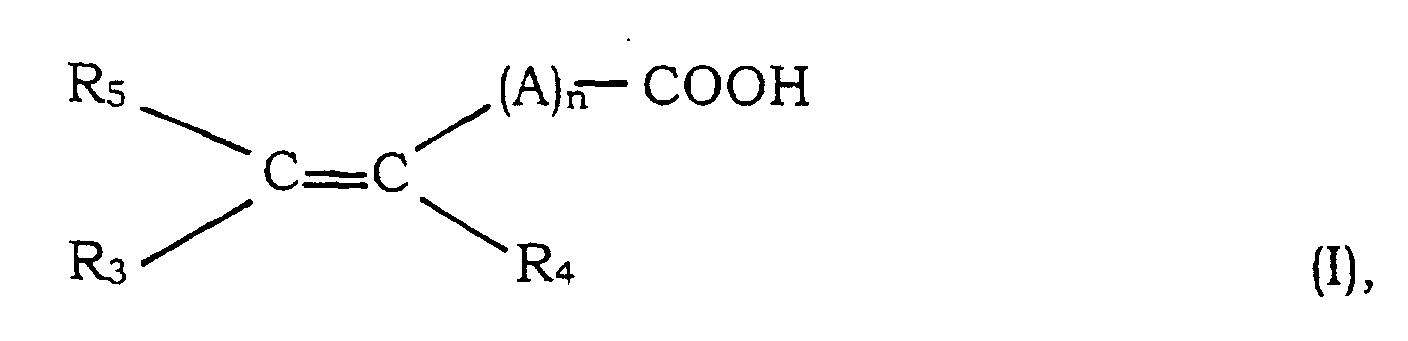 n Null oder eine ganze Zahl von 1 bis 10,A eine Methylengruppe, die gegebenenfalls an das Kohlenstoffatom der ungesättigten Gruppe oder, falls n größer 1 ist, an die benachbarte Methylengruppe über ein Heteroatom, wie Sauerstoff oder Schwefel, gebunden ist,R5 ein Wasserstoffatom, eine Phenylgruppe oder eine Benzylgruppe,R3 ein Wasserstoffatom, eine niedere Alkylgruppe oder eine Carboxygruppe undR4 ein Wasserstoffatom, eine niedere Alkylgruppe, eine Gruppe -CH2-COOH, eine Phenylgruppe oder eine Benzylgruppe,Polymeren mit Einheiten, die von einer Sulfonsäure abgeleitet sind, wie Vinylsulfonsäure-, Styrolsulfonsäure- oder Acrylamidoalkylsulfonsäure-Einheiten, und Sulfopolyestern sowieden Gemischen dieser Verbindungen.
 - Zusammensetzung nach einem der vorhergehenden Ansprüche, dadurch gekennzeichnet, dass das anionische Polymer ausgewählt ist unter:A) Homo- oder Copolymeren von Acrylsäure oder Methacrylsäure oder deren Salzen, Copolymeren von Acrylsäure und Acrylamid und deren Salzen und den Natriumsalzen von Polyhydroxycarbonsäuren,B) Copolymeren von Acrylsäure oder Methacrylsäure mit einem monoethylenisch ungesättigten Monomer, wie Ethylen, Styrol, Vinylestern, Acrylsäure- oder Methacrylsäureestern, die gegebenenfalls auf ein Polyalkylenglykol, wie Polyethylenglykol, gepfropft sind; Copolymeren dieses Typs, die in ihrer Kette eine Acrylamideinheit aufweisen, die gegebenenfalls N-alkyliert und/oder hydroxyalkyliert ist; Copolymeren von Acrylsäure und C1-4-Alkylmethacrylat und Terpolymeren von Vinylpyrrolidon, Acrylsäure und C1-20-Alkylmethacrylat,C) Copolymeren, die von Crotonsäure abgeleitet sind, wie Copolymeren, die in ihrer Kette Vinylacetat- oder Vinylpropionat-Einheiten und gegebenenfalls weitere Monomere aufweisen, wie Allylester oder Methallylester, Vinylether oder Vinylester einer gesättigten, geradkettigen oder verzweigten Carbonsäure mit langer Kohlenwasserstoffkette, wie Carbonsäuren mit mindestens 5 Kohlenstoffatomen, wobei diese Polymere gegebenenfalls gepfropft sein können,D) Polymeren, die von Maleinsäure, Fumarsäure, Itaconsäure oder deren Anhydriden mit Vinylestern, Vinylethern, Vinylhalogeniden, Phenylvinylderivaten oder Acrylsäure und ihren Estern abgeleitet sind; Copolymeren von Maleinsäureanhydrid, Citraconsäureanhydrid oder Itaconsäureanhydrid mit einem Allylester oder einem Methallylester, die in ihrer Kette gegebenenfalls eine der folgenden Gruppen enthalten: Acrylamid, Methacrylamid, α-Olefin, Acrylester, Methacrylester, Acrylsäure, Methacrylsäure oder Vinylpyrrolidon, wobei die Anhydridgruppen einfach verestert sind oder als einfaches Amid vorliegen,E) Polyacrylamiden mit Carboxylatgruppen,F) Desoxyribonucleinsäure,G) Copolymeren von mindestens einer Dicarbonsäure, mindestens einem Diol und mindestens einem bifunktionellen aromatischen Monomer mit einer Gruppe -SO3M, worin M ein Wasserstoffatom, ein Ammoniumion NH4 + oder ein Metallion bedeutet, undH) den Gemischen dieser Verbindungen.
- Zusammensetzung nach einem der vorhergehenden Ansprüche, dadurch gekennzeichnet, dass das anionische Polymer ausgewählt ist unter:Homopolymeren von Acrylsäure oder Methacrylsäure,Copolymeren von Acrylsäure, wie dem Acrylsäure/Ethylacrylat/Ntert.-Butylacrylamid-Terpolymer,Copolymeren, die von Crotonsäure abgeleitet sind, wie Vinylacetat/Vinyl-tert.-butylbenzoat/Crotonsäure-Terpolymeren und Crotonsäure /Vinylacetat/Vinylneododecanoat-Terpolymeren,Polymeren, die von Maleinsäure, Fumarsäure, Itaconsäure oder deren Anhydriden mit Vinylestern, Vinylethern, Vinylhalogeniden, Phenylvinylderivaten, Acrylsäure und ihren Estern abgeleitet sind, wie den Copolymeren von Methylvinylether und einfach verestertem Maleinsäureanhydrid,Copolymeren von Methacrylsäure und Methylmethacrylat,Copolymeren von Methacrylsäure und Ethylacrylat,Vinylpyrrolidon/Acrylsäure/Laurylmethacrylat-Terpolymeren,Vinylacetat/Crotonsäure-Copolymeren,Vinylacetat/Crotonsäure/Polyethylenglykol-Terpolymeren,Sulfopolyestern, die durch Kondensation von Diethylenglykol, Cyclohexandimethanol, Isophthalsäure und Sulfoisophthalsäure erhalten werden, undden Gemischen dieser Verbindungen.
- Zusammensetzung nach einem der vorhergehenden Ansprüche, dadurch gekennzeichnet, dass das anionische Polymer unter anionischen Polymeren vom Typ gepfropfter Siliconpolymere ausgewählt ist, die einen Polysiloxan-Bestandteil und einen Bestandteil aufweisen, der aus einer nicht siliconhaltigen organischen Kette besteht, wobei ein Bestandteil die Hauptkette des Polymers bildet und der andere Bestandteil auf die Hauptkette gepfropft ist.
- Zusammensetzung nach Anspruch 13, dadurch gekennzeichnet, dass das gepfropfte Siliconpolymer unter Siliconpolymeren ausgewählt ist, die in ihrer Struktur die Einheit der folgenden Formel (III) aufweisen:worin bedeuten:
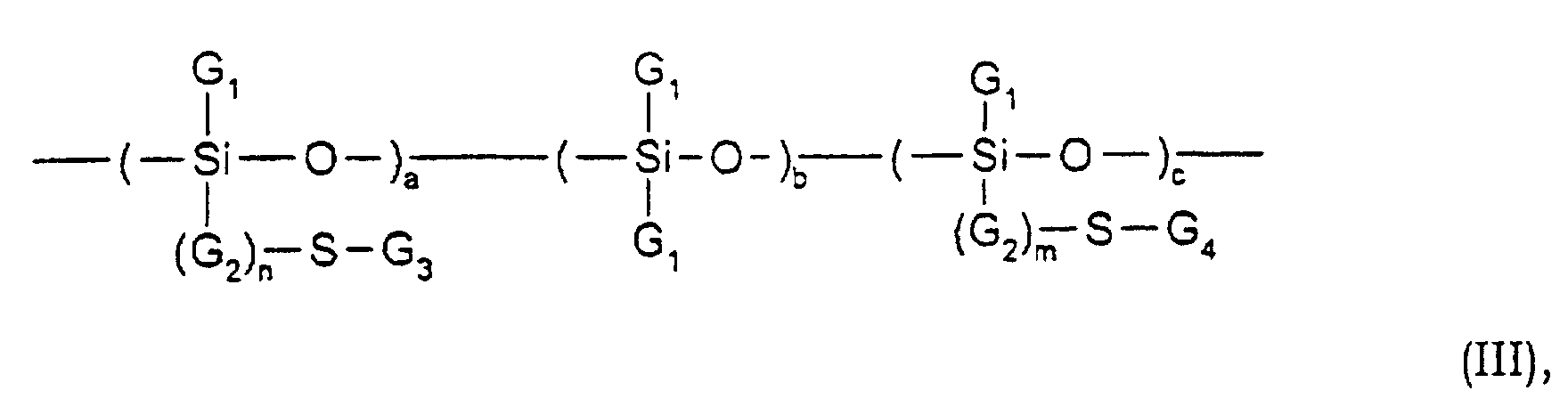 mit der Maßgabe, dass einer der Parameter a und c von Null verschieden ist.die Gruppen G1, die identisch oder voneinander verschieden sind, Wasserstoff oder eine Alkylgruppe mit 1 bis 10 Kohlenstoffatomen oder auch eine Phenylgruppe,die Gruppen G2, die identisch oder voneinander verschieden sind, eine Alkylengruppe mit 1 bis 10 Kohlenstoffatomen,G3 eine Polymergruppe, die das Ergebnis der (Homo)polymerisation mindestens eines anionischen Monomers mit ethylenischer Doppelbindung ist,G4 eine Polymergruppe, die das Ergebnis der (Homo)polymerisation mindestens eines hydrophoben Monomers mit ethylenischer Doppelbindung ist,m und n Null oder 1,a Null oder eine ganze Zahl von 1 bis 50,b eine ganze Zahl, die im Bereich von 10 bis 350 liegen kann, undc Null oder eine ganze Zahl von 1 bis 50,
 - Zusammensetzung nach Anspruch 14, dadurch gekennzeichnet, dass die Einheit der Formel (III) mindestens eine der folgenden Eigenschaften aufweist:Die Gruppen G1 bedeuten eine Alkylgruppe mit 1 bis 10 Kohlenstoffatomen.n ist nicht Null und die Gruppen G2 bedeuten eine zweiwertige Gruppe mit 1 bis 3 Kohlenstoffatomen.G3 bedeutet eine Polymergruppe, die das Ergebnis der (Homo)polymerisation mindestens eines Monomers vom Typ einer Carbonsäure mit ethylenischer Doppelbindung ist.G4 bedeutet eine Polymergruppe, die das Ergebnis der (Homo)polymerisation mindestens eines Monomers vom Typ C1-10-Alkyl-(meth)acrylat ist.
- Zusammensetzung nach Anspruch 14 oder 15, dadurch gekennzeichnet, dass die Einheit der Formel (III) gleichzeitig die folgenden Eigenschaften aufweist:Die Gruppen G1 bedeuten eine Methylgruppe.n ist nicht Null und die Gruppen G2 bedeuten eine Propylengruppe.G3 bedeutet eine Polymergruppe, die das Ergebnis der (Homo)polymerisation von mindestens Acrylsäure und/oder Methacrylsäure ist.G4 bedeutet eine Polymergruppe, die das Ergebnis der (Homo)polymerisation von mindestens Isobutyl(meth)acrylat oder Methyl-(meth)acrylat ist.
- Zusammensetzung nach einem der vorhergehenden Ansprüche, dadurch gekennzeichnet, dass das kationische Polymer ausgewählt ist unter Derivaten von Celluloseether, die quartäre Ammoniumgruppen enthalten, Cellulosecopolymeren mit einem wasserlöslichen quartären Ammoniummonomer, Cyclopolymeren, kationischen Polysacchariden, kationischen Siliconpolymeren, quaternisierten oder nicht quaternisierten Copolymeren von Vinylpyrrolidon und Dialkylaminoalkylacrylat oder Dialkylaminoalkylmethacrylat, quartären Polymeren von Vinylpyrrolidon und von Vinylimidazol, Polyaminoamiden und den Gemischen dieser Verbindungen.
- Zusammensetzung nach einem der vorhergehenden Ansprüche, dadurch gekennzeichnet, dass sie mindestens ein Natriumpolymethacrylat und mindestens eine C1-4-Hydroxyalkylcellulose, die quartäre Ammoniumgruppen aufweist, enthält.
- Zusammensetzung nach einem der vorhergehenden Ansprüche, dadurch gekennzeichnet, dass das kationische Polymer in einem Mengenanteil von 0,01 bis 20 Gew.-%, vorzugsweise von 0,01 bis 15 Gew.-% und noch bevorzugter von 0,1 bis 5 Gew.-% des Gesamtgewichts der Zusammensetzung vorliegt.
- Zusammensetzung nach einem der vorhergehenden Ansprüche, dadurch gekennzeichnet, dass das anionische Polymer in einer Menge von 0,01 bis 20 Gew.-%, vorzugsweise 0,05 bis 15 Gew.-% und noch bevorzugter 0,1 bis 7 Gew.-% des Gesamtgewichts der Zusammensetzung verwendet wird.
- Zusammensetzung nach einem der vorhergehenden Ansprüche, dadurch gekennzeichnet, dass das polyalkoxylierte Silicon unter den Verbindungen der allgemeinen Formel (XV) ausgewählt ist:wobei in der Formel:
 die Gruppen R1, die identisch oder voneinander verschieden sind, ein Wasserstoffatom, eine geradkettige oder verzweigte Alkylgruppe mit 1 bis 30 Kohlenstoffatomen oder eine Phenylgruppe bedeuten,die Gruppen R2, die identisch oder voneinander verschieden sind, R1 oder A = -(CxH2x)-(OC2H4)a-(OC3H6)b-OR4 bedeuten,die Gruppen R3, die identisch oder voneinander verschieden sind, R1 oder A bedeuten, wobei R2 von R3 verschieden ist, wenn R2 = A oder R3 = A,die Gruppen R4, die identisch oder voneinander verschieden sind, unter einem Wasserstoffatom, einer geradkettigen oder verzweigten Alkylgruppe, die 1 bis 12 Kohlenstoffatome aufweist, und einer geradkettigen oder verzweigten Acylgruppe mit 2 bis 6 Kohlenstoffatomen ausgewählt sind,n im Bereich von Null bis 1 000 liegt,p im Bereich von 1 bis 50 liegt,a im Bereich von Null bis 50 liegt,b im Bereich von Null bis 50 liegt,a + b größer oder gleich 1 ist,x im Bereich von 1 bis 5 liegt unddas Zahlenmittel des Molekulargewichts größer oder gleich 900 ist und vorzugsweise im Bereich von 2 000 bis 75 000 liegt.
 - Kosmetische Zusammensetzung nach dem vorhergehenden Anspruch, dadurch gekennzeichnet, dass das polyalkoxylierte Silicon der allgemeinen Formel (XV) mindestens eine und vorzugsweise sämtliche der folgenden Bedingungen erfüllt:R1 bedeutet Methyl,R2 = A,R3 = R1,R4 bedeutet Wasserstoff, Methyl oder Acetyl und vorzugsweise Wasserstoff,p liegt im Bereich von 8 bis 20,a liegt im Bereich von 5 bis 40 und vorzugsweise von 15 bis 30,b liegt im Bereich von 5 bis 40 und vorzugsweise von 15 bis 30,x ist gleich 2 oder 3 undn liegt im Bereich von 20 bis 600, vorzugsweise von 50 bis 500 und insbesondere von 100 bis 300.
- Kosmetische Zusammensetzung nach einem der vorhergehenden Ansprüche, dadurch gekennzeichnet, dass das polyalkoxylierte Silicon ein geradkettiges Polysiloxan-Polyoxyalkylen-Blockcopolymer ist, das der folgenden Formel (XVI) entspricht:R und R', die identisch oder voneinander verschieden sind, eine einwertige kohlenwasserstoffhaltige Gruppe bedeuten, die keine aliphatisch ungesättigte Doppelbindung enthält,n' eine ganze Zahl im Bereich von 2 bis 4 bedeutet,a' eine ganze Zahl bedeutet, die größer oder gleich 5 ist,b' eine ganze Zahl bedeutet, die größer oder gleich 4 ist,c' eine ganze Zahl bedeutet, die größer oder gleich 4 ist,Y eine zweiwertige organische Gruppe bedeutet, die über eine Kohlenstoff-Silicium-Bindung an das angrenzende Siliciumatom und über ein Sauerstoffatom an einen Polyoxyalkylen-Block gebunden ist,das mittlere Molekulargewicht der einzelnen Siloxan-Blöcke im Bereich von etwa 400 bis etwa 10 000 und das mittlere Molekulargewicht der einzelnen Polyoxyalkylen-Blöcke im Bereich von etwa 300 bis etwa 10 000 liegt,die Siloxan-Blöcke etwa 10 bis etwa 90 Gew.-% des Blockcopolymers ausmachen unddas mittlere Molekulargewicht des Blockcopolymers mindestens 3 000 beträgt.
- Zusammensetzung nach einem der vorhergehenden Ansprüche, dadurch gekennzeichnet, dass das polyalkoxylierte Silicon in einem Mengenanteil im Bereich von 0,01 bis 5 Gew.-% und vorzugsweise von 0,1 bis 1,5 Gew.-%, bezogen auf das Gesamtgewicht der Zusammensetzung, vorliegt.
- Zusammensetzung nach einem der vorhergehenden Ansprüche, dadurch gekennzeichnet, dass sie 10 bis 30 Gew.-% polyalkoxyliertes Silicon, bezogen auf das Gesamtgewicht des filmbildenden Polymers, enthält.
- Zusammensetzung nach einem der vorhergehenden Ansprüche, dadurch gekennzeichnet, dass sie ferner mindestens ein nichtionisches filmbildendes Polymer enthält.
- Zusammensetzung nach einem der vorhergehenden Ansprüche, dadurch gekennzeichnet, dass sie Wasser in einem Mengenanteil von 1 bis 95 Gew.-% und besser noch von 10 bis 80 Gew.-%, bezogen auf das Gesamtgewicht der Zusammensetzung, enthält.
- Zusammensetzung nach einem der vorhergehenden Ansprüche, dadurch gekennzeichnet, dass sie in Form einer Wachs-in-Wasser-Emulsion, einer Wasser-in-Wachs-Emulsion, einer Öl-in-Wasser-Emulsion oder einer Wasser-in-Öl-Emulsion vorliegt.
- Zusammensetzung nach einem der vorhergehenden Ansprüche, dadurch gekennzeichnet, dass sie ferner mindestens ein flüchtiges Öl enthält.
- Zusammensetzung nach einem der vorhergehenden Ansprüche, dadurch gekennzeichnet, dass sie mindestens einen emulgierenden grenzflächenaktiven Stoff enthält.
- Zusammensetzung nach Anspruch 30, dadurch gekennzeichnet, dass der emulgierende grenzflächenaktive Stoff in einem Mengenanteil von 2 bis 30 Gew.-%, bezogen auf das Gesamtgewicht der Zusammensetzung, vorliegt.
- Zusammensetzung nach einem der vorhergehenden Ansprüche, dadurch gekennzeichnet, dass die Zusammensetzung mindestens einen Zusatzstoff enthält, der unter Vitaminen, Spurenelementen, reizlindernden Mitteln, Maskierungsmitteln, Parfums, Ölen, Verdickungsmitteln, Proteinen, Ceramiden, Weichmachern, Kohäsionsmitteln, Mitteln zum Alkalischmachen oder zum Ansäuern, Füllstoffen, Pigmenten, Emollentien und Konservierungsstoffen ausgewählt ist.
- Zusammensetzung nach einem der vorhergehenden Ansprüche, dadurch gekennzeichnet, dass es sich bei der Zusammensetzung um eine Zusammensetzung zum Schminken, eine Grundmasse zum Schminken, eine Zusammensetzung zum Auftragen auf eine Schminke oder um eine Zusammensetzung zur kosmetischen Behandlung von Keratinfasern handelt.
- Verfahren zum Umhüllen von Keratinfasern und insbesondere der Wimpern, dadurch gekennzeichnet, dass eine Zusammensetzung nach einem der Ansprüche 1 bis 33 auf die Keratinfasern aufgebracht wird.
- Verwendung einer in einem der Ansprüche 1 bis 33 definierten Zusammensetzung, um eine Schminke zu erhalten, die homogen und/oder rasch und/oder leicht aufzutragen ist und/oder gut hält.
Applications Claiming Priority (2)
| Application Number | Priority Date | Filing Date | Title |
|---|---|---|---|
| FR9902301A FR2789894B1 (fr) | 1999-02-24 | 1999-02-24 | Mascara comprenant une cire, un polymere filmogene et une silicone |
| FR9902301 | 1999-02-24 |
Publications (2)
| Publication Number | Publication Date |
|---|---|
| EP1031342A1 EP1031342A1 (de) | 2000-08-30 |
| EP1031342B1 true EP1031342B1 (de) | 2002-04-10 |
Family
ID=9542480
Family Applications (1)
| Application Number | Title | Priority Date | Filing Date |
|---|---|---|---|
| EP00400062A Expired - Lifetime EP1031342B1 (de) | 1999-02-24 | 2000-01-12 | Wachs, filmbildendes Polymer und Silikon enthaltende Maskara Zusammensetzung |
Country Status (9)
| Country | Link |
|---|---|
| EP (1) | EP1031342B1 (de) |
| JP (1) | JP2000247840A (de) |
| KR (1) | KR20010006690A (de) |
| CN (1) | CN1267508A (de) |
| AT (1) | ATE215808T1 (de) |
| BR (1) | BR0000507A (de) |
| DE (1) | DE60000116T2 (de) |
| ES (1) | ES2179007T3 (de) |
| FR (1) | FR2789894B1 (de) |
Cited By (2)
| Publication number | Priority date | Publication date | Assignee | Title |
|---|---|---|---|---|
| US8333956B2 (en) | 2002-06-11 | 2012-12-18 | Color Access, Inc. | Stable cosmetic emulsion with polyamide gelling agent |
| US8449870B2 (en) | 2002-06-11 | 2013-05-28 | Color Access, Inc. | Stable cosmetic emulsion with polyamide gelling agent |
Families Citing this family (28)
| Publication number | Priority date | Publication date | Assignee | Title |
|---|---|---|---|---|
| FR2796272B1 (fr) | 1999-07-15 | 2003-09-19 | Oreal | Composition sans cire structuree sous forme rigide par un polymere |
| FR2796271B1 (fr) | 1999-07-15 | 2002-01-11 | Oreal | Composition sans cire structuree sous forme rigide par un polymere |
| FR2815847B1 (fr) * | 2000-10-27 | 2002-12-13 | Oreal | Composition cosmetique comprenant des fibres et une cire |
| FR2815850B1 (fr) * | 2000-10-27 | 2003-02-14 | Oreal | Composition cosmetique filmogene |
| US8080257B2 (en) * | 2000-12-12 | 2011-12-20 | L'oreal S.A. | Cosmetic compositions containing at least one hetero polymer and at least one film-forming silicone resin and methods of using |
| FR2817739B1 (fr) | 2000-12-12 | 2005-01-07 | Oreal | Composition cosmetique coloree transparente ou translucide |
| AU2002256544A1 (en) | 2000-12-12 | 2002-06-24 | L'oreal Sa | Cosmetic compositions containing at least one heteropolymer and at least one gelling agent and methods of using the same |
| AU2001220877A1 (en) | 2000-12-12 | 2002-06-24 | L'oreal S.A. | Cosmetic composition comprising heteropolymers and a solid substance and method of using same |
| US7276547B2 (en) | 2000-12-12 | 2007-10-02 | L'oreal S.A. | Compositions comprising heteropolymers and at least one oil-soluble polymers chosen from alkyl celluloses and alkylated guar gums |
| WO2002047623A1 (en) | 2000-12-12 | 2002-06-20 | L'oreal Sa | Composition comprising at least one heteropolymer and at least one inert filler and methods for use |
| WO2002047630A1 (fr) | 2000-12-12 | 2002-06-20 | L'oreal | Composition cosmetique comprenant un melange de polymeres |
| US6835399B2 (en) | 2000-12-12 | 2004-12-28 | L'ORéAL S.A. | Cosmetic composition comprising a polymer blend |
| US7025953B2 (en) | 2001-01-17 | 2006-04-11 | L'oreal S.A. | Nail polish composition comprising a polymer |
| FR2819399B1 (fr) | 2001-01-17 | 2003-02-21 | Oreal | Composition cosmetique contenant un polymere et une huile fluoree |
| JP4860067B2 (ja) * | 2001-08-23 | 2012-01-25 | 株式会社日本色材工業研究所 | 固形状油中水系化粧料 |
| US6716420B2 (en) | 2001-10-05 | 2004-04-06 | L′Oreal | Methods of use and of making a mascara comprising at least one coloring agent and at least one heteropolymer |
| FR2833163A1 (fr) * | 2001-12-07 | 2003-06-13 | Oreal | Mascara solide |
| US7311899B2 (en) * | 2002-02-04 | 2007-12-25 | L'oreal S.A. | Compositions comprising at least one silicone, at least one compound comprising at least one ester group, and at least one copolymer, and methods for using the same |
| US20050008598A1 (en) | 2003-07-11 | 2005-01-13 | Shaoxiang Lu | Cosmetic compositions comprising a structuring agent, silicone powder and swelling agent |
| US7008629B2 (en) | 2002-07-22 | 2006-03-07 | L'ORéAL S.A. | Compositions comprising at least one heteropolymer and fibers, and methods of using the same |
| FR2844191A1 (fr) * | 2002-09-06 | 2004-03-12 | Oreal | Composition cosmetique de maquillage pour les fibres keratiniques, chargeantes et/ou separantes |
| US20070166257A1 (en) * | 2003-01-17 | 2007-07-19 | Balanda Atis | Long wear cosmetic composition |
| JP5016198B2 (ja) * | 2004-03-19 | 2012-09-05 | 花王株式会社 | まつ毛用化粧料 |
| DE102005005486A1 (de) * | 2005-02-04 | 2006-08-17 | Schwan-Stabilo Cosmetics Gmbh & Co. Kg | Zubereitung, insbesondere kosmetische Zubereitung sowie ihre Herstellung und Verwendung |
| FR2887886B1 (fr) † | 2005-07-01 | 2010-01-08 | Oreal | Polymere cationique neutralise, composition le comprenant et procede de traitement cosmetique |
| CN102245163A (zh) * | 2008-12-11 | 2011-11-16 | 莱雅公司 | 具有防水性和耐污性的可洗的眼部化妆组合物 |
| FR2954696A1 (fr) * | 2009-12-24 | 2011-07-01 | Bcm Cosmetique | Composition cosmetique de revetement des fibres keratiniques |
| WO2016160399A1 (en) * | 2015-04-03 | 2016-10-06 | Elc Management Llc | Hair treatment compositions |
Family Cites Families (4)
| Publication number | Priority date | Publication date | Assignee | Title |
|---|---|---|---|---|
| LU84210A1 (fr) * | 1982-06-17 | 1984-03-07 | Oreal | Composition a base de polymeres cationiques,de polymeres anioniques et de cires destinee a etre utilisee en cosmetique |
| FR2712805B1 (fr) * | 1993-11-24 | 1996-01-19 | Oreal | Composition cosmétique pour le maquillage sous forme d'un mascara contenant au moins une cire et un pseudo-latex. |
| GB9510230D0 (en) * | 1995-05-20 | 1995-07-19 | Procter & Gamble | Cosmetic make-up compositions |
| FR2753900B1 (fr) * | 1996-09-30 | 1998-10-30 | Oreal | Compositions pour le maquillage des yeux |
-
1999
- 1999-02-24 FR FR9902301A patent/FR2789894B1/fr not_active Expired - Fee Related
-
2000
- 2000-01-12 AT AT00400062T patent/ATE215808T1/de not_active IP Right Cessation
- 2000-01-12 ES ES00400062T patent/ES2179007T3/es not_active Expired - Lifetime
- 2000-01-12 DE DE60000116T patent/DE60000116T2/de not_active Expired - Fee Related
- 2000-01-12 EP EP00400062A patent/EP1031342B1/de not_active Expired - Lifetime
- 2000-02-04 JP JP2000028353A patent/JP2000247840A/ja not_active Withdrawn
- 2000-02-14 BR BR0000507-0A patent/BR0000507A/pt not_active IP Right Cessation
- 2000-02-23 CN CN00102629A patent/CN1267508A/zh active Pending
- 2000-02-24 KR KR1020000009138A patent/KR20010006690A/ko not_active Ceased
Cited By (2)
| Publication number | Priority date | Publication date | Assignee | Title |
|---|---|---|---|---|
| US8333956B2 (en) | 2002-06-11 | 2012-12-18 | Color Access, Inc. | Stable cosmetic emulsion with polyamide gelling agent |
| US8449870B2 (en) | 2002-06-11 | 2013-05-28 | Color Access, Inc. | Stable cosmetic emulsion with polyamide gelling agent |
Also Published As
| Publication number | Publication date |
|---|---|
| DE60000116D1 (de) | 2002-05-16 |
| DE60000116T2 (de) | 2002-08-22 |
| KR20010006690A (ko) | 2001-01-26 |
| CN1267508A (zh) | 2000-09-27 |
| FR2789894B1 (fr) | 2001-04-20 |
| ES2179007T3 (es) | 2003-01-16 |
| BR0000507A (pt) | 2001-05-02 |
| FR2789894A1 (fr) | 2000-08-25 |
| JP2000247840A (ja) | 2000-09-12 |
| ATE215808T1 (de) | 2002-04-15 |
| EP1031342A1 (de) | 2000-08-30 |
Similar Documents
| Publication | Publication Date | Title |
|---|---|---|
| EP1064919B1 (de) | Mascara enthaltend filmbildende Polymere | |
| EP1064920B1 (de) | Maskara enthaltend filmbildende Polymere | |
| EP1353630B1 (de) | Kosmetische zusammensetzung enthaltend ein polymergemisch | |
| EP1031342A1 (de) | Wachs, filmbildendes Polymer und Silikon enthaltende Maskara Zusammensetzung | |
| EP0853470B1 (de) | Kosmetische zusammensetzung, die mindestens ein gepropftes siliconpolymer und mindestens eine kombination eines anionischen und eines kationischen polymers enthält | |
| FR2773069A1 (fr) | Composition cosmetique comprenant au moins un tensioactif acide amidoethercarboxylique et au moins une association d'un polymere anionique et d'un polymere cationique | |
| EP1604634A1 (de) | Kosmetische Zusammensetzung enthaltend einen Ester und ein filmbildendes Mittel | |
| FR2798061A1 (fr) | Composition cosmetique comprenant des dispersions de particules de polymeres dans une phase grasse liquide | |
| FR3104980A1 (fr) | Composition comprenant une dispersion de particules de polymère dans un milieu non aqueux, un polymère cationique et un polymère anionique | |
| FR3090367A1 (fr) | Dispositif aérosol contenant une composition cosmétique comprenant un polymère fixant, une silicone hydroxylée et une poudre | |
| FR2864895A1 (fr) | Composition de revetement des fibres keratiniques comprenant un polymere sequence, un polymere cationique et un polymere anionique | |
| EP1800657B1 (de) | Verfahren zur dauerhaften Verformung von Haaren unter Verwendung eines gefällten fixierenden Polymers. | |
| FR3124079A1 (fr) | Composition comprenant une dispersion huileuse de particules de polymère, un polymère cationique et un polymère anionique | |
| EP1669054A2 (de) | Kosmetische Zusammensetzung enthaltend ein oder mehrere Wirkstoffe enthaltende Kapseln, und ihre Verwendung |
Legal Events
| Date | Code | Title | Description |
|---|---|---|---|
| PUAI | Public reference made under article 153(3) epc to a published international application that has entered the european phase |
Free format text: ORIGINAL CODE: 0009012 |
|
| AK | Designated contracting states |
Kind code of ref document: A1 Designated state(s): AT BE CH CY DE DK ES FI FR GB GR IE IT LI LU MC NL PT SE |
|
| AX | Request for extension of the european patent |
Free format text: AL;LT;LV;MK;RO;SI |
|
| 17P | Request for examination filed |
Effective date: 20000728 |
|
| 17Q | First examination report despatched |
Effective date: 20001228 |
|
| AKX | Designation fees paid |
Free format text: AT BE CH CY DE DK ES FI FR GB GR IE IT LI LU MC NL PT SE |
|
| GRAG | Despatch of communication of intention to grant |
Free format text: ORIGINAL CODE: EPIDOS AGRA |
|
| REG | Reference to a national code |
Ref country code: GB Ref legal event code: IF02 |
|
| GRAG | Despatch of communication of intention to grant |
Free format text: ORIGINAL CODE: EPIDOS AGRA |
|
| GRAG | Despatch of communication of intention to grant |
Free format text: ORIGINAL CODE: EPIDOS AGRA |
|
| GRAH | Despatch of communication of intention to grant a patent |
Free format text: ORIGINAL CODE: EPIDOS IGRA |
|
| GRAH | Despatch of communication of intention to grant a patent |
Free format text: ORIGINAL CODE: EPIDOS IGRA |
|
| GRAA | (expected) grant |
Free format text: ORIGINAL CODE: 0009210 |
|
| AK | Designated contracting states |
Kind code of ref document: B1 Designated state(s): AT BE CH CY DE DK ES FI FR GB GR IE IT LI LU MC NL PT SE |
|
| PG25 | Lapsed in a contracting state [announced via postgrant information from national office to epo] |
Ref country code: IE Free format text: LAPSE BECAUSE OF FAILURE TO SUBMIT A TRANSLATION OF THE DESCRIPTION OR TO PAY THE FEE WITHIN THE PRESCRIBED TIME-LIMIT Effective date: 20020410 Ref country code: NL Free format text: LAPSE BECAUSE OF FAILURE TO SUBMIT A TRANSLATION OF THE DESCRIPTION OR TO PAY THE FEE WITHIN THE PRESCRIBED TIME-LIMIT Effective date: 20020410 Ref country code: GR Free format text: LAPSE BECAUSE OF FAILURE TO SUBMIT A TRANSLATION OF THE DESCRIPTION OR TO PAY THE FEE WITHIN THE PRESCRIBED TIME-LIMIT Effective date: 20020410 Ref country code: AT Free format text: LAPSE BECAUSE OF FAILURE TO SUBMIT A TRANSLATION OF THE DESCRIPTION OR TO PAY THE FEE WITHIN THE PRESCRIBED TIME-LIMIT Effective date: 20020410 Ref country code: FI Free format text: LAPSE BECAUSE OF FAILURE TO SUBMIT A TRANSLATION OF THE DESCRIPTION OR TO PAY THE FEE WITHIN THE PRESCRIBED TIME-LIMIT Effective date: 20020410 |
|
| REF | Corresponds to: |
Ref document number: 215808 Country of ref document: AT Date of ref document: 20020415 Kind code of ref document: T |
|
| REG | Reference to a national code |
Ref country code: CH Ref legal event code: EP |
|
| REG | Reference to a national code |
Ref country code: IE Ref legal event code: FG4D Free format text: FRENCH |
|
| REF | Corresponds to: |
Ref document number: 60000116 Country of ref document: DE Date of ref document: 20020516 |
|
| PG25 | Lapsed in a contracting state [announced via postgrant information from national office to epo] |
Ref country code: DK Free format text: LAPSE BECAUSE OF FAILURE TO SUBMIT A TRANSLATION OF THE DESCRIPTION OR TO PAY THE FEE WITHIN THE PRESCRIBED TIME-LIMIT Effective date: 20020710 Ref country code: SE Free format text: LAPSE BECAUSE OF FAILURE TO SUBMIT A TRANSLATION OF THE DESCRIPTION OR TO PAY THE FEE WITHIN THE PRESCRIBED TIME-LIMIT Effective date: 20020710 Ref country code: PT Free format text: LAPSE BECAUSE OF FAILURE TO SUBMIT A TRANSLATION OF THE DESCRIPTION OR TO PAY THE FEE WITHIN THE PRESCRIBED TIME-LIMIT Effective date: 20020710 |
|
| GBT | Gb: translation of ep patent filed (gb section 77(6)(a)/1977) |
Effective date: 20020705 |
|
| NLV1 | Nl: lapsed or annulled due to failure to fulfill the requirements of art. 29p and 29m of the patents act | ||
| REG | Reference to a national code |
Ref country code: IE Ref legal event code: FD4D Ref document number: 1031342E Country of ref document: IE |
|
| PG25 | Lapsed in a contracting state [announced via postgrant information from national office to epo] |
Ref country code: LU Free format text: LAPSE BECAUSE OF NON-PAYMENT OF DUE FEES Effective date: 20030112 Ref country code: CY Free format text: LAPSE BECAUSE OF FAILURE TO SUBMIT A TRANSLATION OF THE DESCRIPTION OR TO PAY THE FEE WITHIN THE PRESCRIBED TIME-LIMIT Effective date: 20030112 |
|
| REG | Reference to a national code |
Ref country code: ES Ref legal event code: FG2A Ref document number: 2179007 Country of ref document: ES Kind code of ref document: T3 |
|
| PG25 | Lapsed in a contracting state [announced via postgrant information from national office to epo] |
Ref country code: MC Free format text: LAPSE BECAUSE OF NON-PAYMENT OF DUE FEES Effective date: 20030131 Ref country code: BE Free format text: LAPSE BECAUSE OF NON-PAYMENT OF DUE FEES Effective date: 20030131 |
|
| PLBE | No opposition filed within time limit |
Free format text: ORIGINAL CODE: 0009261 |
|
| STAA | Information on the status of an ep patent application or granted ep patent |
Free format text: STATUS: NO OPPOSITION FILED WITHIN TIME LIMIT |
|
| 26N | No opposition filed |
Effective date: 20030113 |
|
| PG25 | Lapsed in a contracting state [announced via postgrant information from national office to epo] |
Ref country code: CH Free format text: LAPSE BECAUSE OF NON-PAYMENT OF DUE FEES Effective date: 20040131 Ref country code: LI Free format text: LAPSE BECAUSE OF NON-PAYMENT OF DUE FEES Effective date: 20040131 |
|
| REG | Reference to a national code |
Ref country code: CH Ref legal event code: PL |
|
| PGFP | Annual fee paid to national office [announced via postgrant information from national office to epo] |
Ref country code: DE Payment date: 20070104 Year of fee payment: 8 |
|
| PGFP | Annual fee paid to national office [announced via postgrant information from national office to epo] |
Ref country code: GB Payment date: 20070110 Year of fee payment: 8 |
|
| PGFP | Annual fee paid to national office [announced via postgrant information from national office to epo] |
Ref country code: ES Payment date: 20070220 Year of fee payment: 8 |
|
| PGFP | Annual fee paid to national office [announced via postgrant information from national office to epo] |
Ref country code: IT Payment date: 20070519 Year of fee payment: 8 |
|
| GBPC | Gb: european patent ceased through non-payment of renewal fee |
Effective date: 20080112 |
|
| PG25 | Lapsed in a contracting state [announced via postgrant information from national office to epo] |
Ref country code: DE Free format text: LAPSE BECAUSE OF NON-PAYMENT OF DUE FEES Effective date: 20080801 |
|
| PG25 | Lapsed in a contracting state [announced via postgrant information from national office to epo] |
Ref country code: GB Free format text: LAPSE BECAUSE OF NON-PAYMENT OF DUE FEES Effective date: 20080112 |
|
| REG | Reference to a national code |
Ref country code: ES Ref legal event code: FD2A Effective date: 20080114 |
|
| PG25 | Lapsed in a contracting state [announced via postgrant information from national office to epo] |
Ref country code: ES Free format text: LAPSE BECAUSE OF NON-PAYMENT OF DUE FEES Effective date: 20080114 |
|
| PG25 | Lapsed in a contracting state [announced via postgrant information from national office to epo] |
Ref country code: IT Free format text: LAPSE BECAUSE OF NON-PAYMENT OF DUE FEES Effective date: 20080112 |
|
| REG | Reference to a national code |
Ref country code: FR Ref legal event code: PLFP Year of fee payment: 17 |
|
| REG | Reference to a national code |
Ref country code: FR Ref legal event code: PLFP Year of fee payment: 18 |
|
| REG | Reference to a national code |
Ref country code: FR Ref legal event code: PLFP Year of fee payment: 19 |
|
| PGFP | Annual fee paid to national office [announced via postgrant information from national office to epo] |
Ref country code: FR Payment date: 20181213 Year of fee payment: 20 |