EP1031441B1 - Bandage pneumatique pour véhicule - Google Patents
Bandage pneumatique pour véhicule Download PDFInfo
- Publication number
- EP1031441B1 EP1031441B1 EP99123387A EP99123387A EP1031441B1 EP 1031441 B1 EP1031441 B1 EP 1031441B1 EP 99123387 A EP99123387 A EP 99123387A EP 99123387 A EP99123387 A EP 99123387A EP 1031441 B1 EP1031441 B1 EP 1031441B1
- Authority
- EP
- European Patent Office
- Prior art keywords
- rubber mixture
- tread
- pneumatic vehicle
- thermally
- vehicle tyre
- Prior art date
- Legal status (The legal status is an assumption and is not a legal conclusion. Google has not performed a legal analysis and makes no representation as to the accuracy of the status listed.)
- Expired - Lifetime
Links
- 229920001971 elastomer Polymers 0.000 claims abstract description 103
- 239000000203 mixture Substances 0.000 claims abstract description 103
- 239000005060 rubber Substances 0.000 claims abstract description 103
- 230000002787 reinforcement Effects 0.000 claims abstract description 25
- XLOMVQKBTHCTTD-UHFFFAOYSA-N Zinc monoxide Chemical compound [Zn]=O XLOMVQKBTHCTTD-UHFFFAOYSA-N 0.000 claims description 20
- 239000011324 bead Substances 0.000 claims description 10
- 239000011787 zinc oxide Substances 0.000 claims description 10
- 239000006229 carbon black Substances 0.000 claims description 8
- 239000000945 filler Substances 0.000 claims description 8
- 229910052751 metal Inorganic materials 0.000 claims description 7
- 239000002184 metal Substances 0.000 claims description 7
- 239000000470 constituent Substances 0.000 claims description 3
- 150000002739 metals Chemical class 0.000 claims description 3
- 239000000126 substance Substances 0.000 claims description 3
- 229910052580 B4C Inorganic materials 0.000 claims description 2
- 229910052582 BN Inorganic materials 0.000 claims description 2
- PZNSFCLAULLKQX-UHFFFAOYSA-N Boron nitride Chemical compound N#B PZNSFCLAULLKQX-UHFFFAOYSA-N 0.000 claims description 2
- INAHAJYZKVIDIZ-UHFFFAOYSA-N boron carbide Chemical compound B12B3B4C32B41 INAHAJYZKVIDIZ-UHFFFAOYSA-N 0.000 claims description 2
- HBMJWWWQQXIZIP-UHFFFAOYSA-N silicon carbide Chemical compound [Si+]#[C-] HBMJWWWQQXIZIP-UHFFFAOYSA-N 0.000 claims description 2
- 229910010271 silicon carbide Inorganic materials 0.000 claims description 2
- 230000003014 reinforcing effect Effects 0.000 claims 2
- 239000003963 antioxidant agent Substances 0.000 claims 1
- 230000003078 antioxidant effect Effects 0.000 claims 1
- 235000006708 antioxidants Nutrition 0.000 claims 1
- 230000027455 binding Effects 0.000 claims 1
- 238000009739 binding Methods 0.000 claims 1
- 150000001875 compounds Chemical class 0.000 description 47
- 239000010410 layer Substances 0.000 description 28
- 238000004073 vulcanization Methods 0.000 description 10
- 239000004071 soot Substances 0.000 description 9
- 238000011161 development Methods 0.000 description 8
- 239000000463 material Substances 0.000 description 8
- 230000008901 benefit Effects 0.000 description 7
- 230000017525 heat dissipation Effects 0.000 description 7
- 238000005299 abrasion Methods 0.000 description 6
- 239000012080 ambient air Substances 0.000 description 6
- 239000003795 chemical substances by application Substances 0.000 description 6
- 230000006378 damage Effects 0.000 description 6
- 230000000694 effects Effects 0.000 description 6
- 230000003712 anti-aging effect Effects 0.000 description 5
- OKTJSMMVPCPJKN-UHFFFAOYSA-N Carbon Chemical compound [C] OKTJSMMVPCPJKN-UHFFFAOYSA-N 0.000 description 4
- 244000043261 Hevea brasiliensis Species 0.000 description 4
- VYPSYNLAJGMNEJ-UHFFFAOYSA-N Silicium dioxide Chemical compound O=[Si]=O VYPSYNLAJGMNEJ-UHFFFAOYSA-N 0.000 description 4
- 239000010692 aromatic oil Substances 0.000 description 4
- 229910002804 graphite Inorganic materials 0.000 description 4
- 239000010439 graphite Substances 0.000 description 4
- 229920003052 natural elastomer Polymers 0.000 description 4
- 229920001194 natural rubber Polymers 0.000 description 4
- 238000005096 rolling process Methods 0.000 description 4
- 235000021355 Stearic acid Nutrition 0.000 description 3
- NINIDFKCEFEMDL-UHFFFAOYSA-N Sulfur Chemical compound [S] NINIDFKCEFEMDL-UHFFFAOYSA-N 0.000 description 3
- 208000027418 Wounds and injury Diseases 0.000 description 3
- WNROFYMDJYEPJX-UHFFFAOYSA-K aluminium hydroxide Chemical compound [OH-].[OH-].[OH-].[Al+3] WNROFYMDJYEPJX-UHFFFAOYSA-K 0.000 description 3
- 238000010276 construction Methods 0.000 description 3
- 238000001816 cooling Methods 0.000 description 3
- 208000014674 injury Diseases 0.000 description 3
- 238000004519 manufacturing process Methods 0.000 description 3
- QIQXTHQIDYTFRH-UHFFFAOYSA-N octadecanoic acid Chemical compound CCCCCCCCCCCCCCCCCC(O)=O QIQXTHQIDYTFRH-UHFFFAOYSA-N 0.000 description 3
- OQCDKBAXFALNLD-UHFFFAOYSA-N octadecanoic acid Natural products CCCCCCCC(C)CCCCCCCCC(O)=O OQCDKBAXFALNLD-UHFFFAOYSA-N 0.000 description 3
- TWNQGVIAIRXVLR-UHFFFAOYSA-N oxo(oxoalumanyloxy)alumane Chemical compound O=[Al]O[Al]=O TWNQGVIAIRXVLR-UHFFFAOYSA-N 0.000 description 3
- 239000008117 stearic acid Substances 0.000 description 3
- 239000011593 sulfur Substances 0.000 description 3
- 229910052717 sulfur Inorganic materials 0.000 description 3
- PXHVJJICTQNCMI-UHFFFAOYSA-N Nickel Chemical compound [Ni] PXHVJJICTQNCMI-UHFFFAOYSA-N 0.000 description 2
- 239000005062 Polybutadiene Substances 0.000 description 2
- 239000004760 aramid Substances 0.000 description 2
- 229920003235 aromatic polyamide Polymers 0.000 description 2
- 230000008859 change Effects 0.000 description 2
- 238000004132 cross linking Methods 0.000 description 2
- 239000004744 fabric Substances 0.000 description 2
- 230000006872 improvement Effects 0.000 description 2
- 230000003993 interaction Effects 0.000 description 2
- 238000000034 method Methods 0.000 description 2
- 229920002857 polybutadiene Polymers 0.000 description 2
- 230000008092 positive effect Effects 0.000 description 2
- 230000008569 process Effects 0.000 description 2
- 238000004904 shortening Methods 0.000 description 2
- 229910000077 silane Inorganic materials 0.000 description 2
- 239000000377 silicon dioxide Substances 0.000 description 2
- 230000008093 supporting effect Effects 0.000 description 2
- 230000007306 turnover Effects 0.000 description 2
- PIBIAJQNHWMGTD-UHFFFAOYSA-N 1-n,3-n-bis(4-methylphenyl)benzene-1,3-diamine Chemical compound C1=CC(C)=CC=C1NC1=CC=CC(NC=2C=CC(C)=CC=2)=C1 PIBIAJQNHWMGTD-UHFFFAOYSA-N 0.000 description 1
- MDZBMZIJIUEQJS-UHFFFAOYSA-N 1-n,4-n-bis(2-methylphenyl)benzene-1,4-diamine Chemical compound CC1=CC=CC=C1NC(C=C1)=CC=C1NC1=CC=CC=C1C MDZBMZIJIUEQJS-UHFFFAOYSA-N 0.000 description 1
- ZZMVLMVFYMGSMY-UHFFFAOYSA-N 4-n-(4-methylpentan-2-yl)-1-n-phenylbenzene-1,4-diamine Chemical compound C1=CC(NC(C)CC(C)C)=CC=C1NC1=CC=CC=C1 ZZMVLMVFYMGSMY-UHFFFAOYSA-N 0.000 description 1
- RYGMFSIKBFXOCR-UHFFFAOYSA-N Copper Chemical compound [Cu] RYGMFSIKBFXOCR-UHFFFAOYSA-N 0.000 description 1
- FYYHWMGAXLPEAU-UHFFFAOYSA-N Magnesium Chemical compound [Mg] FYYHWMGAXLPEAU-UHFFFAOYSA-N 0.000 description 1
- CBENFWSGALASAD-UHFFFAOYSA-N Ozone Chemical compound [O-][O+]=O CBENFWSGALASAD-UHFFFAOYSA-N 0.000 description 1
- BLRPTPMANUNPDV-UHFFFAOYSA-N Silane Chemical compound [SiH4] BLRPTPMANUNPDV-UHFFFAOYSA-N 0.000 description 1
- 239000006087 Silane Coupling Agent Substances 0.000 description 1
- 229910000831 Steel Inorganic materials 0.000 description 1
- 208000013201 Stress fracture Diseases 0.000 description 1
- GWEVSGVZZGPLCZ-UHFFFAOYSA-N Titan oxide Chemical compound O=[Ti]=O GWEVSGVZZGPLCZ-UHFFFAOYSA-N 0.000 description 1
- WGLPBDUCMAPZCE-UHFFFAOYSA-N Trioxochromium Chemical compound O=[Cr](=O)=O WGLPBDUCMAPZCE-UHFFFAOYSA-N 0.000 description 1
- HCHKCACWOHOZIP-UHFFFAOYSA-N Zinc Chemical compound [Zn] HCHKCACWOHOZIP-UHFFFAOYSA-N 0.000 description 1
- YAIQCYZCSGLAAN-UHFFFAOYSA-N [Si+4].[O-2].[Al+3] Chemical compound [Si+4].[O-2].[Al+3] YAIQCYZCSGLAAN-UHFFFAOYSA-N 0.000 description 1
- 230000009471 action Effects 0.000 description 1
- 239000000654 additive Substances 0.000 description 1
- 229910052782 aluminium Inorganic materials 0.000 description 1
- XAGFODPZIPBFFR-UHFFFAOYSA-N aluminium Chemical compound [Al] XAGFODPZIPBFFR-UHFFFAOYSA-N 0.000 description 1
- PNEYBMLMFCGWSK-UHFFFAOYSA-N aluminium oxide Inorganic materials [O-2].[O-2].[O-2].[Al+3].[Al+3] PNEYBMLMFCGWSK-UHFFFAOYSA-N 0.000 description 1
- 230000015572 biosynthetic process Effects 0.000 description 1
- 230000015556 catabolic process Effects 0.000 description 1
- 229910000423 chromium oxide Inorganic materials 0.000 description 1
- 229940125898 compound 5 Drugs 0.000 description 1
- 229910052802 copper Inorganic materials 0.000 description 1
- 239000010949 copper Substances 0.000 description 1
- PMHQVHHXPFUNSP-UHFFFAOYSA-M copper(1+);methylsulfanylmethane;bromide Chemical compound Br[Cu].CSC PMHQVHHXPFUNSP-UHFFFAOYSA-M 0.000 description 1
- 238000005520 cutting process Methods 0.000 description 1
- 238000006731 degradation reaction Methods 0.000 description 1
- 230000001934 delay Effects 0.000 description 1
- 238000009795 derivation Methods 0.000 description 1
- 229920003244 diene elastomer Polymers 0.000 description 1
- 238000009826 distribution Methods 0.000 description 1
- 238000001125 extrusion Methods 0.000 description 1
- 206010016256 fatigue Diseases 0.000 description 1
- 230000020169 heat generation Effects 0.000 description 1
- 239000004615 ingredient Substances 0.000 description 1
- 238000003780 insertion Methods 0.000 description 1
- 230000037431 insertion Effects 0.000 description 1
- 230000001788 irregular Effects 0.000 description 1
- 229910052749 magnesium Inorganic materials 0.000 description 1
- 239000011777 magnesium Substances 0.000 description 1
- 239000000395 magnesium oxide Substances 0.000 description 1
- CPLXHLVBOLITMK-UHFFFAOYSA-N magnesium oxide Inorganic materials [Mg]=O CPLXHLVBOLITMK-UHFFFAOYSA-N 0.000 description 1
- AXZKOIWUVFPNLO-UHFFFAOYSA-N magnesium;oxygen(2-) Chemical compound [O-2].[Mg+2] AXZKOIWUVFPNLO-UHFFFAOYSA-N 0.000 description 1
- 238000000691 measurement method Methods 0.000 description 1
- 230000006855 networking Effects 0.000 description 1
- 229910052759 nickel Inorganic materials 0.000 description 1
- 238000013021 overheating Methods 0.000 description 1
- 229920000642 polymer Polymers 0.000 description 1
- 229920002959 polymer blend Polymers 0.000 description 1
- 239000010734 process oil Substances 0.000 description 1
- 239000011241 protective layer Substances 0.000 description 1
- 238000000926 separation method Methods 0.000 description 1
- 150000004756 silanes Chemical class 0.000 description 1
- 239000012798 spherical particle Substances 0.000 description 1
- 239000010959 steel Substances 0.000 description 1
- 229920003048 styrene butadiene rubber Polymers 0.000 description 1
- 239000000725 suspension Substances 0.000 description 1
- 238000012360 testing method Methods 0.000 description 1
- OGIDPMRJRNCKJF-UHFFFAOYSA-N titanium oxide Inorganic materials [Ti]=O OGIDPMRJRNCKJF-UHFFFAOYSA-N 0.000 description 1
- 238000012549 training Methods 0.000 description 1
- 238000012546 transfer Methods 0.000 description 1
- MTPVUVINMAGMJL-UHFFFAOYSA-N trimethyl(1,1,2,2,2-pentafluoroethyl)silane Chemical compound C[Si](C)(C)C(F)(F)C(F)(F)F MTPVUVINMAGMJL-UHFFFAOYSA-N 0.000 description 1
- 239000011701 zinc Substances 0.000 description 1
- 229910052725 zinc Inorganic materials 0.000 description 1
Images

Classifications
-
- B—PERFORMING OPERATIONS; TRANSPORTING
- B60—VEHICLES IN GENERAL
- B60C—VEHICLE TYRES; TYRE INFLATION; TYRE CHANGING; CONNECTING VALVES TO INFLATABLE ELASTIC BODIES IN GENERAL; DEVICES OR ARRANGEMENTS RELATED TO TYRES
- B60C9/00—Reinforcements or ply arrangement of pneumatic tyres
- B60C9/18—Structure or arrangement of belts or breakers, crown-reinforcing or cushioning layers
-
- B—PERFORMING OPERATIONS; TRANSPORTING
- B60—VEHICLES IN GENERAL
- B60C—VEHICLE TYRES; TYRE INFLATION; TYRE CHANGING; CONNECTING VALVES TO INFLATABLE ELASTIC BODIES IN GENERAL; DEVICES OR ARRANGEMENTS RELATED TO TYRES
- B60C1/00—Tyres characterised by the chemical composition or the physical arrangement or mixture of the composition
- B60C1/0016—Compositions of the tread
-
- B—PERFORMING OPERATIONS; TRANSPORTING
- B60—VEHICLES IN GENERAL
- B60C—VEHICLE TYRES; TYRE INFLATION; TYRE CHANGING; CONNECTING VALVES TO INFLATABLE ELASTIC BODIES IN GENERAL; DEVICES OR ARRANGEMENTS RELATED TO TYRES
- B60C11/00—Tyre tread bands; Tread patterns; Anti-skid inserts
-
- B—PERFORMING OPERATIONS; TRANSPORTING
- B60—VEHICLES IN GENERAL
- B60C—VEHICLE TYRES; TYRE INFLATION; TYRE CHANGING; CONNECTING VALVES TO INFLATABLE ELASTIC BODIES IN GENERAL; DEVICES OR ARRANGEMENTS RELATED TO TYRES
- B60C11/00—Tyre tread bands; Tread patterns; Anti-skid inserts
- B60C11/0041—Tyre tread bands; Tread patterns; Anti-skid inserts comprising different tread rubber layers
- B60C11/005—Tyre tread bands; Tread patterns; Anti-skid inserts comprising different tread rubber layers with cap and base layers
- B60C11/0058—Tyre tread bands; Tread patterns; Anti-skid inserts comprising different tread rubber layers with cap and base layers with different cap rubber layers in the axial direction
-
- B—PERFORMING OPERATIONS; TRANSPORTING
- B60—VEHICLES IN GENERAL
- B60C—VEHICLE TYRES; TYRE INFLATION; TYRE CHANGING; CONNECTING VALVES TO INFLATABLE ELASTIC BODIES IN GENERAL; DEVICES OR ARRANGEMENTS RELATED TO TYRES
- B60C11/00—Tyre tread bands; Tread patterns; Anti-skid inserts
- B60C11/0041—Tyre tread bands; Tread patterns; Anti-skid inserts comprising different tread rubber layers
- B60C11/005—Tyre tread bands; Tread patterns; Anti-skid inserts comprising different tread rubber layers with cap and base layers
- B60C11/0075—Tyre tread bands; Tread patterns; Anti-skid inserts comprising different tread rubber layers with cap and base layers with different base rubber layers in the axial direction
-
- B—PERFORMING OPERATIONS; TRANSPORTING
- B60—VEHICLES IN GENERAL
- B60C—VEHICLE TYRES; TYRE INFLATION; TYRE CHANGING; CONNECTING VALVES TO INFLATABLE ELASTIC BODIES IN GENERAL; DEVICES OR ARRANGEMENTS RELATED TO TYRES
- B60C11/00—Tyre tread bands; Tread patterns; Anti-skid inserts
- B60C11/01—Shape of the shoulders between tread and sidewall, e.g. rounded, stepped or cantilevered
-
- B—PERFORMING OPERATIONS; TRANSPORTING
- B60—VEHICLES IN GENERAL
- B60C—VEHICLE TYRES; TYRE INFLATION; TYRE CHANGING; CONNECTING VALVES TO INFLATABLE ELASTIC BODIES IN GENERAL; DEVICES OR ARRANGEMENTS RELATED TO TYRES
- B60C11/00—Tyre tread bands; Tread patterns; Anti-skid inserts
- B60C11/03—Tread patterns
- B60C11/0306—Patterns comprising block rows or discontinuous ribs
-
- B—PERFORMING OPERATIONS; TRANSPORTING
- B60—VEHICLES IN GENERAL
- B60C—VEHICLE TYRES; TYRE INFLATION; TYRE CHANGING; CONNECTING VALVES TO INFLATABLE ELASTIC BODIES IN GENERAL; DEVICES OR ARRANGEMENTS RELATED TO TYRES
- B60C11/00—Tyre tread bands; Tread patterns; Anti-skid inserts
- B60C11/03—Tread patterns
- B60C11/13—Tread patterns characterised by the groove cross-section, e.g. for buttressing or preventing stone-trapping
- B60C11/1307—Tread patterns characterised by the groove cross-section, e.g. for buttressing or preventing stone-trapping with special features of the groove walls
- B60C11/1346—Tread patterns characterised by the groove cross-section, e.g. for buttressing or preventing stone-trapping with special features of the groove walls covered by a rubber different from the tread rubber
-
- B—PERFORMING OPERATIONS; TRANSPORTING
- B60—VEHICLES IN GENERAL
- B60C—VEHICLE TYRES; TYRE INFLATION; TYRE CHANGING; CONNECTING VALVES TO INFLATABLE ELASTIC BODIES IN GENERAL; DEVICES OR ARRANGEMENTS RELATED TO TYRES
- B60C11/00—Tyre tread bands; Tread patterns; Anti-skid inserts
- B60C11/0008—Tyre tread bands; Tread patterns; Anti-skid inserts characterised by the tread rubber
- B60C2011/0016—Physical properties or dimensions
-
- B—PERFORMING OPERATIONS; TRANSPORTING
- B60—VEHICLES IN GENERAL
- B60C—VEHICLE TYRES; TYRE INFLATION; TYRE CHANGING; CONNECTING VALVES TO INFLATABLE ELASTIC BODIES IN GENERAL; DEVICES OR ARRANGEMENTS RELATED TO TYRES
- B60C11/00—Tyre tread bands; Tread patterns; Anti-skid inserts
- B60C11/0008—Tyre tread bands; Tread patterns; Anti-skid inserts characterised by the tread rubber
- B60C2011/0016—Physical properties or dimensions
- B60C2011/0025—Modulus or tan delta
Definitions
- the invention relates to a pneumatic vehicle tire with at least one airtight Inner layer, a gummed carcass containing reinforcement, by the The zenith area of the pneumatic vehicle tire extends over the side walls to the bead area and is anchored there by looping tensile bead cores, one radially outside rubber treads with tread grooves, a belt reinforcement with at least one between the rubber tread and the carcass Belt layer, which contains rubberized reinforcement, and other common components of pneumatic vehicle tires such.
- B. bandages are used to a pneumatic vehicle tire with at least one airtight Inner layer, a gummed carcass containing reinforcement, by the The zenith area of the pneumatic vehicle tire extends over the side walls to the bead area and is anchored there by looping tensile bead cores, one radially outside rubber treads with tread grooves, a belt reinforcement with at least one between the rubber tread and the carcass Belt layer, which contains rubberized reinforcement, and other common components of pneumatic vehicle tires such.
- the rubber compounds of treads have conventional pneumatic tires due to their desired properties with regard to optimal driving characteristics such as rolling resistance and wet slipping behavior specially tailored to this Compositions. These used for the optimal driving characteristics Rubber compounds generally have poor thermal conductivity, so that the thermal generated by centrifugal and flexing forces when using the tire Energy is very poorly distributed and can be dissipated to the environment. Along with it there is a build up of heat in the tire, which mainly affects the Tire durability leads. It is known to the person skilled in the art that the use of Mixture compositions containing silica and silane, the Can reduce heat generation. However, such rubber compounds have Silica-silane system has even poorer thermal conductivities than conventional ones Mixtures with carbon black as a filler.
- the tire also depends on the thickness of the tire area and of the difference in the stiffness of the contiguous areas.
- Materials are reinforced in the bead and Sidewall area in interaction with the rim on strong flexing forces caused by the different stiffnesses used in the bead and side wall area
- Materials are reinforced.
- the Belt reinforcement consists of the actual belt layers and, if necessary bandage layers arranged radially outside thereof.
- the belt layers are usually by at least two layers of rubberized metallic reinforcement where the individual cords of different layers are crossed.
- the metallic strength members themselves have the very usual for metals high thermal conductivity. But they are also belt packs made up of one or more Belt layers made of other types of fabric such as B. aramid fabric can be used. Due to the Different stiffness of steel cord or aramid and rubber occur in the area of Belt reinforcement and especially the belt edges particularly high forces. That too known use of rubber compounds with high Tension values in the belt area can change the deformation path and thus only slightly influence the forces that occur. Caused by the great It can generate heat via loosening of the belt edges, which the Reduce retreadability, down to belt edge detachments and one complete destruction of the tire.
- DE-OS 1755301 discloses the temperature development in pneumatic vehicle tires and especially to decrease in the tread by the pneumatic vehicle tire homogeneously incorporated into the rubber and especially in the tire tread Contains graphite.
- a tread which in its entirety consists of a graphite containing Rubber compound is made possible by its improved Thermal conductivity in the case of diagonal tires that used to be a lowering of the temperature in the shoulder of the tread. The danger of tread separations could thus be reduced can be reduced.
- the present invention is based on the object of a pneumatic vehicle tire To provide, in which the temperature of the Rubber compounds in the area close to the belt can be effectively lowered and as a result the durability and life of the tire can be improved without sacrificing Losses regarding the desired driving characteristics have to be accepted.
- a rubber mixture is arranged essentially only in the immediate vicinity of the profile groove base and the adjacent parts of the groove flanks of at least one profile groove, which at least essentially the space between the base of the profile groove and the radially outer position of the belt reinforcement fills out, the rubber compound has no contact with the road when the vehicle tire is new, and its thermal conductivity is at least 5% higher than the thermal conductivity of the surrounding rubber compound of the tread, and / or a rubber compound is arranged in the area of at least one tire shoulder, which is at least partially connected to the belt reinforcement located below the tread, does not come into contact with the roadway and extends in the axial direction, possibly up to the axially outer boundary of the tire body, extends, the thermal conductivity of the rubber mixture being at least 5% higher than the thermal conductivity of the rubber mixtures surrounding it.
- the basic idea of the invention is that the heat flow between Tire outer surface and the belt reinforcement by a thermal conductivity bridge a rubber compound with significantly improved thermal conductivity is increased.
- the at Use of the tire in the area of the belt reinforcement resulting thermal Energy is gained through the belt reinforcement and the more thermally conductive rubber compound quickly dissipated into outer areas, where they are released into the ambient air can. In this way, very high temperatures in the belt area can be prevented and the risk of heat damage or detachment of the belt can be reduced.
- the rubber compounds of the reinforcement layers (belt and Bandage layers) are generally more thermally conductive than the surrounding ones Rubber compounds and very thin, so that heat generated by this Layers can be derived very quickly.
- the use of the described thermal conductivity bridge offers advantages in the vulcanization process, because it also causes rapid heat transfer in relative thick areas of the tire so that the tire vulcanizes more evenly and more quickly is and the over-vulcanization of thinner components, which with an increase in the Rolling resistance is connected, can be reduced.
- the more thermally conductive rubber mixture in the range of at least
- the more thermally conductive mixture is in the immediate vicinity of a tire shoulder to the location of the greatest heat development in the belt area, namely the belt edges, and from there, the heat can be effectively dissipated to external areas.
- the thermally conductive rubber compound below the tread both to the outer Limits of the tire body are sufficient, i.e. directly in connection with the ambient air standing, as well as occupying only a partial area up to the outer wall. In the latter case a protective layer of a conventional sidewall mixture can still be applied the more thermally conductive mixture.
- Tire body in which the more thermally conductive mixture is located can compromise in terms of material properties due to the lower mechanical Stress rather accepted.
- Tread compounds e.g. regarding hardness and tear resistance
- Sidewall mixtures e.g. with regard to tear resistance, heat build-up and Resistance to ozone
- the introduction of the more thermally conductive mixture can be useful in the conventional tire building process, for example by Applying a mixture strip, can be integrated. This also offers Arrangement of the advantage that the more thermally conductive mixture when retreading which only grinds the tread, remains almost completely intact and also in retreaded tires again ensure significantly improved heat dissipation.
- a particularly great effect in terms of heat dissipation from the belt area can be achieved if the more thermally conductive mixtures in both immediate At least the proximity of the profile groove base and the adjacent parts of the groove flanks a tread groove as well as in the area of at least one tire shoulder axially are arranged extending outside.
- the Profile groove in which essentially only in the immediate vicinity of the base of the profile groove and the more thermally conductive mixture is arranged in the adjacent parts of the groove flanks, around a circumferential groove.
- This embodiment has the advantage that it is simple is producible and well in the process of tire construction, e.g. B. by extrusion or Laying rubber strips on the belt, can be integrated.
- heat dissipation if these are Circumferential grooves are the grooves closest to the tire shoulders, as in the area shoulders, d. H. in the area of the belt edges, the heat development is particularly great and there specifically the problem of belt edge detachments can be effectively combated can.
- the thermally conductive mixture in the vicinity of the profile grooves proved to be useful the rubber compound with increased thermal conductivity over 5% to 95% of the total depth the tread groove extends from the bottom of the tread groove when new tires are used.
- the the more thermally conductive rubber compound closes the profile groove base and the radially lower one Part of the flanks of profile grooves or recesses. This way you get one sufficiently large exchange area with the ambient air.
- the distance between the bottom of the profile groove and the radially outer belt layer or bandage layer (Basic thickness) 2 to 6 mm, so that the basic thickness lies in an area that is on the one hand is thin enough to ensure good heat dissipation and secondly thick enough can be chosen to both adequately prevent injury to the belt protect, as well as the desired re-cutting of the tread grooves in truck tires enable.
- the more thermally conductive rubber compound has in the vicinity of Profile grooves and / or in the area of the tire shoulders about 20% higher Thermal conductivity than the thermal conductivity of the rubber compound surrounding it.
- the effectiveness of the thermal conductivity bridge can be increased in this way.
- the more thermally conductive Rubber compound also has a higher hardness than the surrounding one Rubber compound.
- the harder mixture does that according to the invention can extend into the groove flanks, supporting the surrounding ones Tread compound in the tread blocks, which with an improvement in Abrasion behavior is connected.
- the irregular abrasion of the tread blocks can be reduced in this way.
- the invention leads Arrangement of a harder mixture in the groove flanks to an improved one Lateral guidance in handling.
- fillers in addition to soot, especially metals such as B: aluminum, magnesium, copper, zinc and Nickel or metal containing substances such.
- These fillers can be used in Form of spherical particles, platelets or needles can be used. at Using platelets or needles there is also the option of putting them in to follow certain preferred directions.
- Some of these fillers can To give the rubber compound a different color than the typical black of conventional tire compounds, so that the functionality of the more thermally conductive Area of the tire also towards the outside, e.g. B. the customer can.
- soot it is possible to provide a rubber compound with higher thermal conductivity by adding more soot to the rubber mixture either as a filler (advantageously at least about 10 phr more) than the surrounding rubber compound or by the proportion of zinc oxide by more than 5 phr compared to the surrounding Rubber mixture increased, the increase in the amount of soot in addition to an increase in hardness has a shortening effect on the vulcanization time of the mixture, while the Increasing the zinc oxide content in addition to increasing the hardness Improved resistance to reversion of the rubber compound.
- the increase in the amount of soot in the mixture also has the advantage that such a mixture in the bottom of the groove offers high protection against slot injuries; Stones or other hard and sharp-edged Objects cannot pass through this rubber compound. The danger that the belt is exposed in places and can start to corrode is reduced. Due to the relatively good protection against injuries with the soot-containing mixture it is it is also possible to make the profile grooves wider and thus the effective one Surface area for heat exchange to
- Rubber compound an anti-aging agent with good heat protection properties add.
- 6PPD N-phenyl-N '- (1,3-dimethylbutyl) -p-phenylenediamine
- DTPD N, N'-ditoluyl-p-phenylenediamine
- This can e.g. B. by a wavy Training of this area happen, with Wellenberg and Wellental preferred Alternate in the radial direction so that it is equivalent to the effect of cooling fins.
- the Surface can, for. B. can also be enlarged by the circumferential direction alternating radial ribs and grooves can be arranged.
- the pneumatic vehicle tire 1 shown schematically in FIG. 1 has one for Typical construction of commercial vehicle tires from an air-impermeable inner layer, one Gummed carcass 2 containing reinforcement, which from the zenith of Pneumatic vehicle 1 extends over the side walls to the bead area and through there Looping tensile bead cores 3 is anchored, a radially outer, Profile grooves 4 having tread 5 and a belt structure 6 of four layers consisting of rubberized metallic reinforcements.
- the rubber compound 8 whose thermal conductivity is at least 5% higher lies than that of the rubber mixture of the tread 5 surrounding it, and that in contact stands with the radially outer belt layer 9 and in this way a good derivation of the im Belt generated heat to the bottom 7 of the profile grooves 4 and thus to the Ambient air guaranteed. Then there are no strong ones in the belt area Overheating, which can loosen or loosen the belt.
- the profile grooves 4 shown in the example are longitudinal grooves that according to a development of the invention offer the advantage of easy manufacture. Also the profile grooves closest to the shoulder are with the arrangement of the invention provided thermally conductive rubber mixture 8, since there the thermal Energy caused by flexing work is particularly large and particularly large there There is a need to discharge them.
- Fig. 2 the vicinity of a tread groove 4 of the tread 5 is schematically as enlarged section shown.
- the more thermally conductive rubber mixture 8 is located essentially only in the immediate vicinity of the profile groove base 7 and adjacent parts of the groove flanks 10 and fills the space between the groove 7 and the radially outer belt layer 9 substantially, the distance between Profile groove base 7 and radially outer belt layer 9 should be 2 to 6 mm.
- the part of the tread 5, which comes into contact with the road, is in the properties, caused by the tread rubber compound, hardly in this way is influenced and nevertheless a good dissipation of heat by the Thermal conductivity bridge between radially outer belt layer 9 and profile groove base 7 causes.
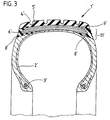
- FIG. 3 also schematically shows a pneumatic vehicle tire 1 ′ with the one in FIG. 1 described typical structure.
- this pneumatic vehicle tire 1 ' are the thermally conductive rubber compounds 8 'below the tread 5' in the area of Tire shoulders.
- the rubber compounds 8 ' are in contact with the axially outer ones Ends of the belt structure 6 'made of four layers of rubberized metallic strength members and extend to the axially outer boundary of the tire body. Through this structure can heat from the belt edges in the side area to the outer wall of the tire derived and released into the ambient air there.
- Natural rubber was used as the rubber component in all the mixture examples. Instead of natural rubber, it is also possible to use all of the polymers and polymer blends known to the person skilled in the art for the production of pneumatic vehicle tires, for example one or more rubbers from the group of the diene rubbers, such as polybutadiene. It is advantageous if, in the case of greater hardness, a rubber or rubber blend with good fatigue resistance is used for the mixture according to the invention in order to reduce the risk of fatigue fractures. Polybutadiene and special solution- or emulsion-polymerized styrene-butadiene rubbers are particularly suitable for this.
- the vulcanizates have mixtures according to the invention have a thermal conductivity which is at least 5% higher lies than the thermal conductivity of the base mixture.
- the higher thermal conductivity was in the example mixtures in Table 1 achieved that the proportion of the more thermally conductive components of the Rubber mixtures carbon black and / or zinc oxide increased compared to the base mixture has been.
- the rubber mixture 8 according to the invention the amount of soot at least 10 phr and / or the zinc oxide content by at least 5 phr compared to the surrounding rubber compound 5 can be increased. With large amounts of soot better processability process oil (aromatic oil) added. The latter However, action is not absolutely necessary.
Landscapes
- Engineering & Computer Science (AREA)
- Mechanical Engineering (AREA)
- Tires In General (AREA)
- Pulleys (AREA)
- Turning (AREA)
- Compositions Of Macromolecular Compounds (AREA)
Claims (12)
- Pneumatique de véhicule, en particulier pour des véhicules utilitaires, comprenant :caractérisé en ce qu'un mélange de caoutchouc (8) est disposé pratiquement seulement à proximité immédiate du fond (7) de la rainure de sculpture et des parties voisines des flancs de rainure (10) d'au moins une rainure de sculpture (4), lequel mélange de caoutchouc remplit pratiquement au moins l'espace compris entre le fond (7) de la rainure de sculpture (4) et la couche extérieure (9), dans le sens radial, du renfort de ceinture (6), où le mélange de caoutchouc (8), lorsque le pneumatique (1) du véhicule est à l'état neuf, n'est pas en contact avec la chaussée, mélange de caoutchouc dont la conductivité thermique est d'au moins 5 % supérieure à la conductivité thermique du mélange de caoutchouc de la bande de roulement (5) entourant ce mélange de caoutchouc à conductivité thermique supérieure,une couche intérieure imperméable à l'air,une carcasse caoutchoutée contenant des nappes de renfort, laquelle carcasse s'étend de la zone du sommet d'un pneumatique de véhicule jusqu'à la zone du talon, via les flancs, et est ancrée dans la zone du talon par enroulement de tringles résistant à la traction,une bande de roulement en caoutchouc présentant des rainures de sculpture se trouvant à l'extérieur dans le sens radial,un renfort de ceinture comprenant au moins une nappe d'armature se trouvant entre la bande de roulement en caoutchouc et la carcasse, laquelle nappe d'armature comprend des nappes de renfort caoutchoutées,et d'autres parties constitutives habituelles telles que, par exemple, des bandages,
et / ou un mélange de caoutchouc (8') est disposé dans la zone d'au moins un épaulement du pneumatique, lequel mélange de caoutchouc est en liaison, au moins partiellement, avec le renfort de ceinture (6') se trouvant au-dessous de la bande de roulement (5'), n'est pas en contact avec la chaussée et s'étend dans le sens axial, le cas échéant jusqu'à la délimitation extérieure - dans le sens axial - du corps du pneumatique, où la conductivité thermique du mélange de caoutchouc (8') est supérieure d'au moins 5 % à la conductivité thermique des mélanges de caoutchouc de base entourant le mélange de caoutchouc à conductivité thermique supérieure. - Pneumatique de véhicule selon la revendication 1, caractérisé en ce que le mélange de caoutchouc (8) à conductivité thermique supérieure est disposé au moins pratiquement seulement à proximité immédiate du fond (7) de la rainure de sculpture et des parties voisines des flancs de rainure (10) d'au moins une rainure de sculpture (4), et la rainure de sculpture (4), à proximité de laquelle est placé le mélange de caoutchouc (8) à conductivité thermique supérieure, est une rainure circonférentielle.
- Pneumatique de véhicule selon la revendication 1 et / ou 2, caractérisé en ce que les mélanges de caoutchouc (8) à conductivité thermique supérieure sont disposés à proximité des deux rainures circonférentielles les plus proches de l'épaulement.
- Pneumatique de véhicule selon au moins l'une quelconque des revendications précédentes, caractérisé en ce que le mélange de caoutchouc (8) à conductivité thermique supérieure s'étend vers l'extérieur dans le sens radial, sur une étendue comprise entre 5 % et 95 % de la profondeur totale de la rainure de sculpture (4), en partant du fond (7) de la rainure de sculpture, lorsque le pneumatique est neuf.
- Pneumatique de véhicule selon au moins l'une quelconque des revendications précédentes, caractérisé en ce que l'espacement entre le fond (7) de la rainure de sculpture (4) et la nappe d'armature extérieure (9), dans le sens radial, est compris entre 2 mm et 6 mm.
- Pneumatique de véhicule selon au moins l'une quelconque des revendications précédentes, caractérisé en ce que le mélange de caoutchouc (8, 8') à conductivité thermique supérieure présente une conductivité thermique environ de 20 % supérieure à la conductivité thermique du mélange de caoutchouc de base entourant ce mélange de caoutchouc à conductivité thermique supérieure.
- Pneumatique de véhicule selon au moins l'une quelconque des revendications précédentes, caractérisé en ce que le mélange de caoutchouc (8, 8') à conductivité thermique supérieure présente une dureté supérieure à la dureté du mélange de caoutchouc de base entourant ce mélange de caoutchouc à conductivité thermique supérieure.
- Pneumatique de véhicule selon au moins l'une quelconque des revendications précédentes, caractérisé en ce que le mélange de caoutchouc (8, 8') à conductivité thermique supérieure contient, comme charges, du noir de carbone, des métaux, des substances contenant un métal, du nitrure de bore, du carbure de bore et / ou du carbure de silicium.
- Pneumatique de véhicule selon au moins l'une quelconque des revendications précédentes, caractérisé en ce que le mélange de caoutchouc (8, 8') à conductivité thermique supérieure contient, comme charge, plus de noir de carbone que le mélange de caoutchouc de base entourant ce mélange de caoutchouc à conductivité thermique supérieure.
- Pneumatique de véhicule selon au moins l'une quelconque des revendications précédentes, caractérisé en ce que le mélange de caoutchouc (8, 8') à conductivité thermique supérieure contient au moins 5 phr d'oxyde de zinc en plus que le mélange de caoutchouc de base entourant ce mélange de caoutchouc à conductivité thermique supérieure.
- Pneumatique de véhicule selon au moins l'une quelconque des revendications précédentes, caractérisé en ce que le mélange de caoutchouc (8, 8') à conductivité thermique supérieure contient un agent de protection contre le vieillissement assurant une bonne protection contre la chaleur.
- Pneumatique de véhicule selon la revendication 1, caractérisé en ce que le mélange de caoutchouc (8') à conductivité thermique supérieure est disposé au moins dans la zone d'au moins un épaulement du pneumatique, est en relation au moins partiellement avec le renfort de ceinture (6') se trouvant au-dessous de la bande roulement (5'), ne vient pas en contact avec la chaussée et s'étend dans le sens axial, le cas échéant jusqu'à la délimitation extérieure - dans le sens axial - du corps du pneumatique, et en ce que la surface extérieure - dans le sens axial - du corps du pneumatique, dans laquelle le mélange de caoutchouc (8') à conductivité thermique supérieure s'étend dans le sens axial, est augmentée.
Priority Applications (2)
| Application Number | Priority Date | Filing Date | Title |
|---|---|---|---|
| US09/512,305 US6591879B1 (en) | 1999-02-25 | 2000-02-24 | Vehicle tire composition and method for dissipating heat from vehicle tire |
| JP2000047062A JP2000247109A (ja) | 1999-02-25 | 2000-02-24 | 車両用空気タイヤ |
Applications Claiming Priority (2)
| Application Number | Priority Date | Filing Date | Title |
|---|---|---|---|
| DE19908122 | 1999-02-25 | ||
| DE19908122A DE19908122C2 (de) | 1999-02-25 | 1999-02-25 | Fahrzeugluftreifen |
Publications (3)
| Publication Number | Publication Date |
|---|---|
| EP1031441A2 EP1031441A2 (fr) | 2000-08-30 |
| EP1031441A3 EP1031441A3 (fr) | 2001-10-04 |
| EP1031441B1 true EP1031441B1 (fr) | 2004-08-04 |
Family
ID=7898812
Family Applications (1)
| Application Number | Title | Priority Date | Filing Date |
|---|---|---|---|
| EP99123387A Expired - Lifetime EP1031441B1 (fr) | 1999-02-25 | 1999-11-24 | Bandage pneumatique pour véhicule |
Country Status (3)
| Country | Link |
|---|---|
| EP (1) | EP1031441B1 (fr) |
| AT (1) | ATE272506T1 (fr) |
| DE (2) | DE19908122C2 (fr) |
Families Citing this family (15)
| Publication number | Priority date | Publication date | Assignee | Title |
|---|---|---|---|---|
| EP1582559B1 (fr) * | 2004-03-20 | 2011-05-11 | Continental Reifen Deutschland GmbH | Composition de caoutchouc pour bande de roulement pneumatique |
| DE102004036517B4 (de) | 2004-07-28 | 2020-06-04 | Continental Reifen Deutschland Gmbh | Fahrzeugluftreifen |
| DE102007018181A1 (de) | 2007-04-18 | 2008-10-23 | Continental Aktiengesellschaft | Kautschukmischung, vorzugsweise für Laufstreifen von Reifen |
| DE102007049872A1 (de) * | 2007-10-18 | 2009-04-23 | Continental Aktiengesellschaft | Fahrzeugluftreifen |
| DE102009059218A1 (de) | 2009-12-18 | 2011-06-22 | Continental Reifen Deutschland GmbH, 30165 | Schwefelvernetzbare Kautschukmischung |
| FR2962369B1 (fr) | 2010-07-07 | 2014-03-21 | Michelin Soc Tech | Armature de sommet pour pneumatique d'avion |
| FR2962371B1 (fr) | 2010-07-07 | 2014-03-21 | Michelin Soc Tech | Armature de sommet pour pneumatique d'avion |
| DE102011000966A1 (de) * | 2011-02-28 | 2012-08-30 | Continental Reifen Deutschland Gmbh | Fahrzeugluftreifen |
| DE102014215540B4 (de) | 2014-08-06 | 2025-05-08 | Continental Reifen Deutschland Gmbh | Fahrzeugluftreifen |
| JP6809099B2 (ja) * | 2016-09-30 | 2021-01-06 | 横浜ゴム株式会社 | 空気入りタイヤ |
| CN111038183A (zh) * | 2018-10-11 | 2020-04-21 | 石强 | 一种输送车及胶轮 |
| CN114872497B (zh) * | 2022-06-01 | 2023-08-04 | 天津万达轮胎有限公司 | 一种半钢utv轮胎 |
| CN115635805A (zh) * | 2022-11-16 | 2023-01-24 | 北京玲珑蒲公英科技发展有限公司 | 一种具有吸声组件的轮胎 |
| DE102023201962A1 (de) | 2023-03-03 | 2024-09-05 | Continental Reifen Deutschland Gmbh | Gummiband aufweisend ein Alterungsschutzmittel, Fahrzeugreifen und Verfahren |
| DE102024210766A1 (de) | 2024-11-08 | 2026-05-13 | Continental Reifen Deutschland Gmbh | Kautschukmischung zum Alterungsschutz |
Family Cites Families (6)
| Publication number | Priority date | Publication date | Assignee | Title |
|---|---|---|---|---|
| DE1755301C3 (de) * | 1968-04-24 | 1979-11-15 | Uniroyal Gmbh, 5100 Aachen | Fahrzeugluftreifen mit verbesserter Wärmeleitfähigkeit |
| GB1385704A (en) * | 1971-02-23 | 1975-02-26 | Dulop Ltd | Pneumatic tyres |
| AT309920B (de) * | 1971-11-22 | 1973-09-10 | Semperit Ag | Ringförmiger Körper |
| JPS6218304A (ja) * | 1985-07-17 | 1987-01-27 | Bridgestone Corp | 空気入りタイヤ |
| AT387190B (de) * | 1986-02-05 | 1988-12-12 | Semperit Ag | Fahrzeugluftreifen |
| DE19652893A1 (de) * | 1996-12-19 | 1998-06-25 | Continental Ag | Fahrzeugluftreifen |
-
1999
- 1999-02-25 DE DE19908122A patent/DE19908122C2/de not_active Expired - Fee Related
- 1999-11-24 EP EP99123387A patent/EP1031441B1/fr not_active Expired - Lifetime
- 1999-11-24 AT AT99123387T patent/ATE272506T1/de not_active IP Right Cessation
- 1999-11-24 DE DE59910129T patent/DE59910129D1/de not_active Expired - Fee Related
Also Published As
| Publication number | Publication date |
|---|---|
| ATE272506T1 (de) | 2004-08-15 |
| DE19908122C2 (de) | 2002-07-18 |
| EP1031441A2 (fr) | 2000-08-30 |
| EP1031441A3 (fr) | 2001-10-04 |
| DE19908122A1 (de) | 2000-09-07 |
| DE59910129D1 (de) | 2004-09-09 |
Similar Documents
| Publication | Publication Date | Title |
|---|---|---|
| DE69921894T2 (de) | Kautschukmischung für Lauffläche und Luftreifen mit dieser Mischung | |
| DE19908122C2 (de) | Fahrzeugluftreifen | |
| DE3628844C2 (fr) | ||
| EP2477824B1 (fr) | Pneumatique de véhicule | |
| DE102011001133A1 (de) | Fahrzeugluftreifen | |
| EP2268493B1 (fr) | Pneumatique de véhicule | |
| DE2710446A1 (de) | Hochbelastbarer stahlkord-guertelreifen, insbesondere fuer lastwagen und andere schwer- oder grossfahrzeuge | |
| DE102005049183A1 (de) | Fahrzeugluftreifen | |
| DE69116468T2 (de) | Luftreifen | |
| DE60200479T2 (de) | Lauffläche bestehend aus zwei Schichten mit jeweils unterschiedlicher Konzentration an Antioxidantien | |
| DE69913083T2 (de) | Kautschukmischung für Reifenlauffläche | |
| EP2594413A1 (fr) | Pneu de véhicule | |
| DE112022001029B4 (de) | Kautschukzusammensetzung für Reifen, Reifen sowie Verfahren zu dessen Herstellung | |
| DE69312451T2 (de) | Kautschukmischung für Reifen mit hohem Elastizitätsmodul und geringer Hysterese | |
| WO2007042119A1 (fr) | Pneumatique ayant une structure de talon thermoconductrice | |
| DE69219207T2 (de) | Luftreifen | |
| EP1582559B1 (fr) | Composition de caoutchouc pour bande de roulement pneumatique | |
| WO2007042120A1 (fr) | Pneumatique de vehicule ayant un rembourrage destine aux bords de la nappe d'armature | |
| DE60206463T2 (de) | Gummizusammensetzung und ihre Verwendung für Reifen | |
| DE102018213472A1 (de) | Fahrzeugluftreifen und Kautschukmischung für einen Laufstreifen | |
| DE102011111339A1 (de) | Kautschukzusammensetzung für einen Reifen, ein Herstellungsverfahren hierfür und Winterreifen | |
| DE102016222061A1 (de) | Fahrzeugluftreifen | |
| DE102004036517B4 (de) | Fahrzeugluftreifen | |
| EP1614711A1 (fr) | Composition caoutchouteuse pour pneumatiques | |
| EP1983021B1 (fr) | Mélange de caoutchouc, de préférence pour bandes de roulement de pneus |
Legal Events
| Date | Code | Title | Description |
|---|---|---|---|
| PUAI | Public reference made under article 153(3) epc to a published international application that has entered the european phase |
Free format text: ORIGINAL CODE: 0009012 |
|
| AK | Designated contracting states |
Kind code of ref document: A2 Designated state(s): AT BE CH CY DE DK ES FI FR GB GR IE IT LI LU MC NL PT SE |
|
| AX | Request for extension of the european patent |
Free format text: AL;LT;LV;MK;RO;SI |
|
| PUAL | Search report despatched |
Free format text: ORIGINAL CODE: 0009013 |
|
| AK | Designated contracting states |
Kind code of ref document: A3 Designated state(s): AT BE CH CY DE DK ES FI FR GB GR IE IT LI LU MC NL PT SE |
|
| AX | Request for extension of the european patent |
Free format text: AL;LT;LV;MK;RO;SI |
|
| RIC1 | Information provided on ipc code assigned before grant |
Free format text: 7B 60C 11/04 A, 7B 60C 11/00 B, 7B 60C 9/18 B, 7B 60C 1/00 B, 7B 60C 11/01 B |
|
| 17P | Request for examination filed |
Effective date: 20020404 |
|
| AKX | Designation fees paid |
Free format text: AT BE CH CY DE DK ES FI FR GB GR IE IT LI LU MC NL PT SE |
|
| GRAP | Despatch of communication of intention to grant a patent |
Free format text: ORIGINAL CODE: EPIDOSNIGR1 |
|
| GRAA | (expected) grant |
Free format text: ORIGINAL CODE: 0009210 |
|
| GRAS | Grant fee paid |
Free format text: ORIGINAL CODE: EPIDOSNIGR3 |
|
| AK | Designated contracting states |
Kind code of ref document: B1 Designated state(s): AT BE CH CY DE DK ES FI FR GB GR IE IT LI LU MC NL PT SE |
|
| PG25 | Lapsed in a contracting state [announced via postgrant information from national office to epo] |
Ref country code: NL Free format text: LAPSE BECAUSE OF FAILURE TO SUBMIT A TRANSLATION OF THE DESCRIPTION OR TO PAY THE FEE WITHIN THE PRESCRIBED TIME-LIMIT Effective date: 20040804 Ref country code: IE Free format text: LAPSE BECAUSE OF FAILURE TO SUBMIT A TRANSLATION OF THE DESCRIPTION OR TO PAY THE FEE WITHIN THE PRESCRIBED TIME-LIMIT Effective date: 20040804 Ref country code: GB Free format text: LAPSE BECAUSE OF FAILURE TO SUBMIT A TRANSLATION OF THE DESCRIPTION OR TO PAY THE FEE WITHIN THE PRESCRIBED TIME-LIMIT Effective date: 20040804 Ref country code: FI Free format text: LAPSE BECAUSE OF FAILURE TO SUBMIT A TRANSLATION OF THE DESCRIPTION OR TO PAY THE FEE WITHIN THE PRESCRIBED TIME-LIMIT Effective date: 20040804 Ref country code: CY Free format text: LAPSE BECAUSE OF FAILURE TO SUBMIT A TRANSLATION OF THE DESCRIPTION OR TO PAY THE FEE WITHIN THE PRESCRIBED TIME-LIMIT Effective date: 20040804 |
|
| REG | Reference to a national code |
Ref country code: GB Ref legal event code: FG4D Free format text: NOT ENGLISH |
|
| REG | Reference to a national code |
Ref country code: CH Ref legal event code: EP |
|
| REG | Reference to a national code |
Ref country code: IE Ref legal event code: FG4D Free format text: GERMAN |
|
| REF | Corresponds to: |
Ref document number: 59910129 Country of ref document: DE Date of ref document: 20040909 Kind code of ref document: P |
|
| PG25 | Lapsed in a contracting state [announced via postgrant information from national office to epo] |
Ref country code: SE Free format text: LAPSE BECAUSE OF FAILURE TO SUBMIT A TRANSLATION OF THE DESCRIPTION OR TO PAY THE FEE WITHIN THE PRESCRIBED TIME-LIMIT Effective date: 20041104 Ref country code: GR Free format text: LAPSE BECAUSE OF FAILURE TO SUBMIT A TRANSLATION OF THE DESCRIPTION OR TO PAY THE FEE WITHIN THE PRESCRIBED TIME-LIMIT Effective date: 20041104 Ref country code: DK Free format text: LAPSE BECAUSE OF FAILURE TO SUBMIT A TRANSLATION OF THE DESCRIPTION OR TO PAY THE FEE WITHIN THE PRESCRIBED TIME-LIMIT Effective date: 20041104 |
|
| PG25 | Lapsed in a contracting state [announced via postgrant information from national office to epo] |
Ref country code: ES Free format text: LAPSE BECAUSE OF FAILURE TO SUBMIT A TRANSLATION OF THE DESCRIPTION OR TO PAY THE FEE WITHIN THE PRESCRIBED TIME-LIMIT Effective date: 20041115 |
|
| PG25 | Lapsed in a contracting state [announced via postgrant information from national office to epo] |
Ref country code: AT Free format text: LAPSE BECAUSE OF NON-PAYMENT OF DUE FEES Effective date: 20041124 |
|
| PG25 | Lapsed in a contracting state [announced via postgrant information from national office to epo] |
Ref country code: MC Free format text: LAPSE BECAUSE OF NON-PAYMENT OF DUE FEES Effective date: 20041130 Ref country code: LI Free format text: LAPSE BECAUSE OF NON-PAYMENT OF DUE FEES Effective date: 20041130 Ref country code: CH Free format text: LAPSE BECAUSE OF NON-PAYMENT OF DUE FEES Effective date: 20041130 Ref country code: BE Free format text: LAPSE BECAUSE OF NON-PAYMENT OF DUE FEES Effective date: 20041130 |
|
| NLV1 | Nl: lapsed or annulled due to failure to fulfill the requirements of art. 29p and 29m of the patents act | ||
| GBV | Gb: ep patent (uk) treated as always having been void in accordance with gb section 77(7)/1977 [no translation filed] |
Effective date: 20040804 |
|
| REG | Reference to a national code |
Ref country code: IE Ref legal event code: FD4D |
|
| BERE | Be: lapsed |
Owner name: CONTINENTAL A.G. Effective date: 20041130 |
|
| PLBE | No opposition filed within time limit |
Free format text: ORIGINAL CODE: 0009261 |
|
| STAA | Information on the status of an ep patent application or granted ep patent |
Free format text: STATUS: NO OPPOSITION FILED WITHIN TIME LIMIT |
|
| ET | Fr: translation filed | ||
| REG | Reference to a national code |
Ref country code: CH Ref legal event code: PL |
|
| 26N | No opposition filed |
Effective date: 20050506 |
|
| PGFP | Annual fee paid to national office [announced via postgrant information from national office to epo] |
Ref country code: LU Payment date: 20051115 Year of fee payment: 7 |
|
| BERE | Be: lapsed |
Owner name: *CONTINENTAL A.G. Effective date: 20041130 |
|
| PG25 | Lapsed in a contracting state [announced via postgrant information from national office to epo] |
Ref country code: PT Free format text: LAPSE BECAUSE OF NON-PAYMENT OF DUE FEES Effective date: 20050104 |
|
| PG25 | Lapsed in a contracting state [announced via postgrant information from national office to epo] |
Ref country code: LU Free format text: LAPSE BECAUSE OF NON-PAYMENT OF DUE FEES Effective date: 20061124 |
|
| PGFP | Annual fee paid to national office [announced via postgrant information from national office to epo] |
Ref country code: DE Payment date: 20081121 Year of fee payment: 10 |
|
| PGFP | Annual fee paid to national office [announced via postgrant information from national office to epo] |
Ref country code: IT Payment date: 20081122 Year of fee payment: 10 |
|
| PGFP | Annual fee paid to national office [announced via postgrant information from national office to epo] |
Ref country code: FR Payment date: 20081113 Year of fee payment: 10 |
|
| REG | Reference to a national code |
Ref country code: FR Ref legal event code: ST Effective date: 20100730 |
|
| PG25 | Lapsed in a contracting state [announced via postgrant information from national office to epo] |
Ref country code: FR Free format text: LAPSE BECAUSE OF NON-PAYMENT OF DUE FEES Effective date: 20091130 |
|
| PG25 | Lapsed in a contracting state [announced via postgrant information from national office to epo] |
Ref country code: DE Free format text: LAPSE BECAUSE OF NON-PAYMENT OF DUE FEES Effective date: 20100601 |
|
| PG25 | Lapsed in a contracting state [announced via postgrant information from national office to epo] |
Ref country code: IT Free format text: LAPSE BECAUSE OF NON-PAYMENT OF DUE FEES Effective date: 20091124 |