EP1031673A2 - Joints étanches entre pièces en bois - Google Patents
Joints étanches entre pièces en bois Download PDFInfo
- Publication number
- EP1031673A2 EP1031673A2 EP00301568A EP00301568A EP1031673A2 EP 1031673 A2 EP1031673 A2 EP 1031673A2 EP 00301568 A EP00301568 A EP 00301568A EP 00301568 A EP00301568 A EP 00301568A EP 1031673 A2 EP1031673 A2 EP 1031673A2
- Authority
- EP
- European Patent Office
- Prior art keywords
- planks
- logs
- grooves
- log
- plank
- Prior art date
- Legal status (The legal status is an assumption and is not a legal conclusion. Google has not performed a legal analysis and makes no representation as to the accuracy of the status listed.)
- Withdrawn
Links
Images







Classifications
-
- E—FIXED CONSTRUCTIONS
- E04—BUILDING
- E04B—GENERAL BUILDING CONSTRUCTIONS; WALLS, e.g. PARTITIONS; ROOFS; FLOORS; CEILINGS; INSULATION OR OTHER PROTECTION OF BUILDINGS
- E04B2/00—Walls, e.g. partitions, for buildings; Wall construction with regard to insulation; Connections specially adapted to walls
- E04B2/56—Load-bearing walls of framework or pillarwork; Walls incorporating load-bearing elongated members
- E04B2/70—Load-bearing walls of framework or pillarwork; Walls incorporating load-bearing elongated members with elongated members of wood
- E04B2/701—Load-bearing walls of framework or pillarwork; Walls incorporating load-bearing elongated members with elongated members of wood with integrated supporting and obturation function
- E04B2/702—Load-bearing walls of framework or pillarwork; Walls incorporating load-bearing elongated members with elongated members of wood with integrated supporting and obturation function with longitudinal horizontal elements
Definitions
- My patent application 08/640,181 filed April 30, 1996 contained a broad application including various building panels that have waterproof joints where silicone caulking was projected. This application was divided into three divisions and was abandoned. Division I of '181 was filed September 28, 1998 and covers waterproof planks and waterproof panels of multiple planks that called for waterproof joints between the planks and between the panels without specifically stating how the waterproof joints were designed. This application follows many years of experimenting to solve the problem of waterproof joints including individual joints between planks in a panel and also a means to provide waterproof joints between panels.
- Prefabricated building panels and logs whose tongue and groove wood components are almost free of splits and checks and whose joints between the components are so tight that they are (virtually) waterproof.
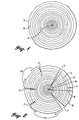
- Very small logs only are used to make panels so that when the logs are sawn longitudinally into two, each half either has half the heart or one has the heart and the other is very close to the heart.
- Each half is made into a green tongue and groove plank being machined to a tight fit between planks.
- the planks are immediately made into building panels and left to slowly dry out. As they dry, the wood shrinks in such a way that the joints become tighter and tighter until the wood is almost crushed within the joints which becomes waterproof.
- This invention also applies to log homes or solid timber houses whose timbers encase the heart of the log they were sawn from.
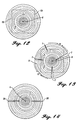
- the resulting shape after drying has the line of the diameter bent out at the heart forming an obtuse angle.
- Tangential shrinkage is about 5% so the first 180° line of the half green log becomes approximately a 171° obtuse angle when the half log dries.
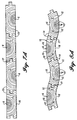
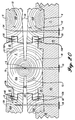
- a piece of tongue and groove lumber that is machined from the small green half log will use the flat edge of the half log as one side and will usually show the heart. When it dries, this tongue and groove plank will bend at the heart to have an angular side of up to 171°, the same as the half log. If a plurality of these green planks are attached together by edge tongue and grooves with all the hearts on one side, the combination, as they dry, will actually form a curved configuration like the side of a large wood barrel.
- the nailing should hit the center of each plank and there should be at least four cross ties in a 2.5 M high wall section.
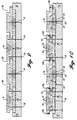
- the individual planks will then be somewhat constrained from bowing and will hang on their nails. Shrinkage will occur and the tongues will need to be long enough and the grooves deep enough that the shrinkage on the edge of each plank will be about a fourth of the length of the tongues. If the plank is 60 mm wide the maximum shrinkage will only be about 2 mm which would call for 8 mm long tongues. In very damp weather the planks will expand some and there will always be movement in the grooves according to humidity.
- planks are grooved vertically with the shoulder of the outside tongue being set back 6 mm further than the inside shoulder, forming a permanent groove between planks. If the groove between planks is widened 2 mm more by shrinkage it can hardly be noticed.
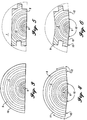
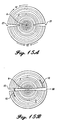
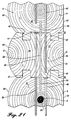
- Logs that have tops 75 mm or smaller cannot be made into two useful planks. However, they can be made into single planks with enough depth to be useful. Here it is necessary to cut two longitudinal shrinkage relief slits on opposite sides of the log and to a depth on each side of the log of one third of the log's diameter and close to being in line with the log's heart. Now the logs can dry out and shrink without splits and checks appearing on the surface. As the logs dry, the slits will become vee shaped when the circumference diminishes.
- the squares have their side slits cut by the same machine that saws them into squares and are planed so that there are tongue and grooves cut out into their edges above and below the slits. They are then cross-grooved and battens are nailed into the cross grooves making man-load sized sections.
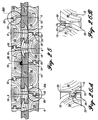
- the upper and lower tongue and grooves will act the same way as the single tongues and grooves in the first example, they will cup outwardly away from the heart on each side of the saw slits, but there will be double the resistance to air or water passage through the doubled tongue and groove joints.
- the square, center heart double-tongue and groove configuration has another good application. Juvenile, or young trees, can have soft pith centers. Some species such as Lodgepole Pine have black unsightly hearts and some logs will actually have dried out non-progressive rot in their hearts.
- the square configuration will encase these usually only pencil thick defects and there will be no loss of strength (being pipe-like). Even larger logs that should be split in half can be made useful this way if the defected logs show the defect at their ends and are sorted out to be milled as square, center heart shapes (not split lengthwise into two half planks).
- the 75 mm, topped logs can produce double tongue and groove planks that are approximately 60 mm square producing very sturdy wall, roof or floor sections. These sections can also be used to produce stand-alone partitions and ceiling panels. Studding can be set against outside wall sections which would allow for insulation and a drywall finish.
- planks or logs
- the cross ties are essential to resist shear forces.
- cross ties can be served by the use of the long nails or screws that cross two timbers being approximately half threaded and half smooth and are spaced to give the desired resistance to shear.
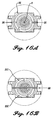
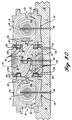
- accumulated shrinkage or settlement can be avoided using screws that pass down through an upper log and down through 80% of a lower log. The lower log will shrink on the screw threads and maintain their respective relationships, but the crack between the logs will widen slightly. However, the two logs won't settle because they will be held up in place by the heads of screws fastening the two logs below them together.
- Such screws can take 700 kilograms of weight before the wood on the side of the screw threads is stripped and the point of the screw is forced deeper into the 20% of the lower log remaining.
- Second floor platforms, partitions and walls are supported by posts and beams along with the roof.
- the weight on the screw heads in a upper wall is negligible and the spacing of the screws for shear will govern though each building will need to have engineering calculations made to confirm the spacing of the screws particularly in the lower quarter of the log walls of each floor.
- the studs will carry the weight of the floors, walls of second and third stories and roofs above.
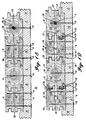
- the green planks are interlocked together to form a wall or roof panel so that the heart side of the planks alternate from one side of the panel to the other. They are tied together by a series of cross ties nailed to each plank. Held tightly together the tongues will be forcefully squeezed against the sides of the grooves as the planks cup, producing a watertight joint.
- the cross ties will prevent the logs from settling, or newly designed long wood screws can be used as cross ties, which will also prevent settling and, unlike the cross ties, will be hidden in the wall.
Landscapes
- Engineering & Computer Science (AREA)
- Architecture (AREA)
- Physics & Mathematics (AREA)
- Electromagnetism (AREA)
- Civil Engineering (AREA)
- Structural Engineering (AREA)
- Load-Bearing And Curtain Walls (AREA)
Priority Applications (1)
| Application Number | Priority Date | Filing Date | Title |
|---|---|---|---|
| EP00301568A EP1031673A3 (fr) | 2000-02-28 | 2000-02-28 | Joints étanches entre pièces en bois |
Applications Claiming Priority (2)
| Application Number | Priority Date | Filing Date | Title |
|---|---|---|---|
| EP00301568A EP1031673A3 (fr) | 2000-02-28 | 2000-02-28 | Joints étanches entre pièces en bois |
| 2001-02-02 |
Publications (2)
| Publication Number | Publication Date |
|---|---|
| EP1031673A2 true EP1031673A2 (fr) | 2000-08-30 |
| EP1031673A3 EP1031673A3 (fr) | 2002-10-23 |
Family
ID=8172745
Family Applications (1)
| Application Number | Title | Priority Date | Filing Date |
|---|---|---|---|
| EP00301568A Withdrawn EP1031673A3 (fr) | 2000-02-28 | 2000-02-28 | Joints étanches entre pièces en bois |
Country Status (1)
| Country | Link |
|---|---|
| EP (1) | EP1031673A3 (fr) |
Cited By (4)
| Publication number | Priority date | Publication date | Assignee | Title |
|---|---|---|---|---|
| WO2001071114A1 (fr) * | 2000-03-17 | 2001-09-27 | Georg Ganaus | Element de paroi ou de plafond |
| AT510524B1 (de) * | 2010-10-11 | 2013-02-15 | Ganaus Georg | Schubdichtleiste |
| AT13952U1 (de) * | 2013-05-29 | 2015-01-15 | Zainzinger Karl | Wandelement |
| RU2663854C1 (ru) * | 2017-11-29 | 2018-08-10 | Общество с ограниченной ответственностью "ВСС" | Стеновая деревянная конструкция |
Family Cites Families (5)
| Publication number | Priority date | Publication date | Assignee | Title |
|---|---|---|---|---|
| GB1316557A (en) * | 1971-02-26 | 1973-05-09 | Lindal S W | Saw log slabwood structural member |
| FR2337018A1 (fr) * | 1976-01-02 | 1977-07-29 | Olivier Henri | Panneau prefabrique |
| FR2546439B1 (fr) * | 1983-05-25 | 1987-08-21 | Cougnaud Fils Sa | Procede d'assemblage de lames planes et panneau ainsi obtenu |
| WO1993004826A1 (fr) * | 1991-09-03 | 1993-03-18 | Knoerr Andrew | Production de bois scie en tagente a partir de morceaux en forme des coins scies de maniere radiale |
| GB2334729B (en) * | 1998-02-26 | 2002-08-21 | Walter Lindal | Wooden frame building construction |
-
2000
- 2000-02-28 EP EP00301568A patent/EP1031673A3/fr not_active Withdrawn
Cited By (4)
| Publication number | Priority date | Publication date | Assignee | Title |
|---|---|---|---|---|
| WO2001071114A1 (fr) * | 2000-03-17 | 2001-09-27 | Georg Ganaus | Element de paroi ou de plafond |
| AT510524B1 (de) * | 2010-10-11 | 2013-02-15 | Ganaus Georg | Schubdichtleiste |
| AT13952U1 (de) * | 2013-05-29 | 2015-01-15 | Zainzinger Karl | Wandelement |
| RU2663854C1 (ru) * | 2017-11-29 | 2018-08-10 | Общество с ограниченной ответственностью "ВСС" | Стеновая деревянная конструкция |
Also Published As
| Publication number | Publication date |
|---|---|
| EP1031673A3 (fr) | 2002-10-23 |
Similar Documents
| Publication | Publication Date | Title |
|---|---|---|
| CA2299129C (fr) | Joints etanches entre pieces de bois | |
| CA2107465C (fr) | Element de construction pour charpente en bois | |
| US8601761B2 (en) | Techniques for building construction using fabricated timbers | |
| US8950130B2 (en) | Techniques for building construction using fabricated timbers | |
| JP2002502470A (ja) | ベニヤ仕上げされた建物用の通気ストリップ | |
| US7441378B2 (en) | Deck plank cover | |
| CA2019924C (fr) | Modules constitues de rondins et methodes de construction connexes | |
| US3119153A (en) | Demountable building | |
| US4443990A (en) | Method of producing crack free logs | |
| US5060432A (en) | Modular panel | |
| KR101014591B1 (ko) | 휘어진 원목으로 형성한 기둥과 들보로 축조하는 이동식 목조건축물 및 축조방법 | |
| EP0939174A2 (fr) | Construction de bâtiment à ossature en bois | |
| EP1031673A2 (fr) | Joints étanches entre pièces en bois | |
| JP2002371635A (ja) | 木材間の防水継手及び製造方法 | |
| JP3132560U (ja) | ログ壁 | |
| US6311447B1 (en) | Wooden frame building construction | |
| Kidder | Building construction and superintendence | |
| Connor | Log cabins in Texas | |
| GB2279380A (en) | Metal-clad wooden cladding boards | |
| US20260028827A1 (en) | Method of Making Log Cabin Structure Using Landscape Timbers | |
| US5664381A (en) | Construction nailing method and structures | |
| CA2233583A1 (fr) | Construction de batiments a ossature de bois | |
| USRE27574E (en) | Blowback seal for building panels | |
| US1416821A (en) | Building structure | |
| Hodgson | Light and Heavy Timber Framing Made Easy: Balloon Framing, Mixed Framing, Heavy Timber Framing, Houses, Factories, Bridges, Barns, Rinks, Timber-roofs, and All Other Kinds of Timber Buildings |
Legal Events
| Date | Code | Title | Description |
|---|---|---|---|
| PUAI | Public reference made under article 153(3) epc to a published international application that has entered the european phase |
Free format text: ORIGINAL CODE: 0009012 |
|
| AK | Designated contracting states |
Kind code of ref document: A2 Designated state(s): AT BE CH CY DE DK ES FI FR GB GR IE IT LI LU MC NL PT SE |
|
| AX | Request for extension of the european patent |
Free format text: AL;LT;LV;MK;RO;SI |
|
| PUAL | Search report despatched |
Free format text: ORIGINAL CODE: 0009013 |
|
| AK | Designated contracting states |
Kind code of ref document: A3 Designated state(s): AT BE CH CY DE DK ES FI FR GB GR IE IT LI LU MC NL PT SE |
|
| AX | Request for extension of the european patent |
Free format text: AL;LT;LV;MK;RO;SI |
|
| 17P | Request for examination filed |
Effective date: 20030410 |
|
| AKX | Designation fees paid |
Designated state(s): AT BE CH CY DE DK ES FI FR GB GR IE IT LI LU MC NL PT SE |
|
| 17Q | First examination report despatched |
Effective date: 20030826 |
|
| STAA | Information on the status of an ep patent application or granted ep patent |
Free format text: STATUS: THE APPLICATION IS DEEMED TO BE WITHDRAWN |
|
| 18D | Application deemed to be withdrawn |
Effective date: 20040305 |