EP1032228A2 - Une méthode et un appareil de télécommunication cellulaire pour convertir des monnaies - Google Patents
Une méthode et un appareil de télécommunication cellulaire pour convertir des monnaies Download PDFInfo
- Publication number
- EP1032228A2 EP1032228A2 EP00301077A EP00301077A EP1032228A2 EP 1032228 A2 EP1032228 A2 EP 1032228A2 EP 00301077 A EP00301077 A EP 00301077A EP 00301077 A EP00301077 A EP 00301077A EP 1032228 A2 EP1032228 A2 EP 1032228A2
- Authority
- EP
- European Patent Office
- Prior art keywords
- currency
- request
- exchange rate
- transceiver
- input
- Prior art date
- Legal status (The legal status is an assumption and is not a legal conclusion. Google has not performed a legal analysis and makes no representation as to the accuracy of the status listed.)
- Withdrawn
Links
Images


Classifications
-
- H—ELECTRICITY
- H04—ELECTRIC COMMUNICATION TECHNIQUE
- H04M—TELEPHONIC COMMUNICATION
- H04M1/00—Substation equipment, e.g. for use by subscribers
- H04M1/72—Mobile telephones; Cordless telephones, i.e. devices for establishing wireless links to base stations without route selection
- H04M1/724—User interfaces specially adapted for cordless or mobile telephones
- H04M1/72403—User interfaces specially adapted for cordless or mobile telephones with means for local support of applications that increase the functionality
-
- G—PHYSICS
- G06—COMPUTING OR CALCULATING; COUNTING
- G06Q—INFORMATION AND COMMUNICATION TECHNOLOGY [ICT] SPECIALLY ADAPTED FOR ADMINISTRATIVE, COMMERCIAL, FINANCIAL, MANAGERIAL OR SUPERVISORY PURPOSES; SYSTEMS OR METHODS SPECIALLY ADAPTED FOR ADMINISTRATIVE, COMMERCIAL, FINANCIAL, MANAGERIAL OR SUPERVISORY PURPOSES, NOT OTHERWISE PROVIDED FOR
- G06Q20/00—Payment architectures, schemes or protocols
- G06Q20/38—Payment protocols; Details thereof
- G06Q20/381—Currency conversion
-
- H—ELECTRICITY
- H04—ELECTRIC COMMUNICATION TECHNIQUE
- H04M—TELEPHONIC COMMUNICATION
- H04M1/00—Substation equipment, e.g. for use by subscribers
- H04M1/72—Mobile telephones; Cordless telephones, i.e. devices for establishing wireless links to base stations without route selection
- H04M1/724—User interfaces specially adapted for cordless or mobile telephones
- H04M1/72469—User interfaces specially adapted for cordless or mobile telephones for operating the device by selecting functions from two or more displayed items, e.g. menus or icons
Definitions
- the present invention relates to a cellular telecommunication apparatus and to a method for converting currencies, according to the preamble of claims 1, 6, 11 and 15, respectively.
- One solution for the travellers, who need to convert currencies could be to use a cellular phone, provided with a feature to store an exchange rate in a memory provided in the phone. After the user has stored the preferred exchange rate, it can be possible for the user to either choose to convert from a domestic value to a foreign, or vice versa.
- This feature is implemented in e.g. a cellular phone called Nokia 8810TM. Even if this feature works very well on Nokia 8810, the user has to update the currencies herself/himself when a change of the value occurs. Therefore, it would be very useful to facilitate the use of a currency converter in a cellular phone, so the user does not have to be concerned about any changes in the exchange rate of a currency outside his/hers knowledge. Thus, it is a problem that you cannot update a currency automatically.
- US-A-5,077,804 discloses a facsimile telecommunications system for automatically converting monetary amounts in a document from one currency to a second currency.
- the system is an apparatus which transfers financial types of documents and transactions. Even if the system provides the possibility to convert amounts automatically, the system seems to be to complex and would most likely not be suitable for travellers, who would like to have a rapid answer about a currency.
- the main object of the present invention is to provide a cellular telecommunication apparatus, which is able to update the exchange rate of different currencies automatically.
- One particular advantage of the invention is that it is possible to provide an update of different currencies, by sending a request to a network, which can provide information about exchange rates in different currencies as a respond to the sent request.
- a network which can provide information about exchange rates in different currencies as a respond to the sent request.
- the user receives a respond automatically when the request has been sent to the network, which facilitates the use of a currency converter.
- FIG. 1 shows a preferred embodiment of a cellular communication apparatus, hereafter also referred to as a phone, according to the present invention.
- the phone which is generally designated by 1, comprises a user interface having a keypad 2, a display 3, an on/off button 4, a speaker 5, and a microphone 6.
- the phone 1 according to the preferred embodiment is adapted for communication via a wireless telecommunication network, e.g. a cellular network.
- a wireless telecommunication network e.g. a cellular network.
- the phone could also have been designed for a cordless network.
- the keypad 2 has a first group 7 of keys as alphanumeric keys, by means of which the user can enter a telephone number, write a text message (SMS), write a name (associated with the phone number), etc.
- SMS text message
- Each of the twelve alphanumeric keys 7 is provided with a figure “0-9” or a sign "#” or “*", respectively. In alpha mode each key is associated with a number of letters and special signs used in text editing.
- the keypad 2 additionally comprises two soft keys 8, two call handling keys 9, and a navigation key 10.
- the two soft keys 8 have a functionality corresponding to what is known from the phones Nokia 2110TM, Nokia 8110TM and Nokia 3810TM.
- the functionality of the soft key depends on the state of the phone and the navigation in the menu by using a navigation key.
- the present functionality of the soft keys 8 is shown in separate fields in the display 3 just above the keys 8.
- the two call handling keys 9 are used for establishing a call or a conference call, terminating a call or rejecting an incoming call.
- the navigation key 10 is an up/down key and is placed centrally on the front surface of the phone between the display 3 and the group of alphanumeric keys 7.
- the user will be able to control this key by simply pressing the up/down key using his/her thumb. Since many experienced phone users are used to one-hand control, it is a very good solution to place an input key, requiring precise motor movements. Thus, the user may place the phone in the hand between the finger tips and the palm of the hand. Hereby, the thumb is free for inputting information.
- FIG. 2 schematically shows the most essential parts of a preferred embodiment of the phone. These parts being essential to understand the invention.
- the preferred embodiment of the phone of the invention is adapted for use in connection with a GSM network, but, of course, the invention may also be applied in connection with other phone networks, such as other kinds of cellular networks and various forms of cordless phone systems or in dual band phones accessing sets of these systems/networks.
- the microphone 6 records the user's speech, and the analogue signals formed thereby are A/D converted in an A/D converter (not shown) before the speech is encoded in an audio part 14.
- the encoded speech signal is transferred to control means 18.
- the control means 18 comprises a processor, which may support software in the phone.
- the control means 18 also forms the interface to the peripheral units of the apparatus, wherein the peripheral units can comprise a RAM memory 17a and a Flash ROM memory 17b, a SIM card 16, the display 3 and the keypad 2 (as well as data, power supply, etc.).
- the control means 18 communicates with a transmitter/receiver means 19, e.g. a circuit which is adopted to send/receive a request/respond to/from a telecommunication network.
- the audio part 14 speech-decodes the signal, which is transferred from the control means 18 to the earpiece 5 via a D/A converter (not shown).
- the control means 18 is connected to the user interface. Thus, it is the control means 18 which monitors the activity in the phone and controls the display 3 in response thereto. Therefore, it is the control means 18 which detects the occurrence of a state change event and changes the state of the phone and thus the display text.
- a state change event may be caused by the user when he activates the keypad including the navigation key 10, and these type of events are called entry events or user events.
- the network communicating with the phone may also cause a state change event. This type of event and other events beyond the user's control are called non user events.
- Non user events comprise status change during call set-up, change in battery voltage, change in antenna conditions, message on reception of SMS, etc.
- the user interface The user interface
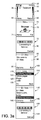
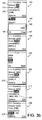
- FIG. 3a, 3b and 3c an example is shown on how the display in a user interface can act when arranged to a currency converter according to the present invention.
- the user interface may comprise the same elements as shown in Figure 1, i.e. a keypad 2, a display 3, an on/off button 4, a speaker 5 and a microphone 6.
- the control means 18 in Figure 2 which controls the user interface.
- FIG. 3a there is a layout 30 presented on a display in a phone, as shown in Figure 1 and 2, which indicates signal strength 35 from the wireless telecommunication network "D1 Weg" 40, the battery power 45 and a clock showing the time 50 in hours and minutes.
- the display in the phone is an LCD (Liquid Crystal Display) display.
- the display can be controlled by the control means 18 as shown in Figure 2.
- the layout 30 presents an example of the phone in idle mode, i.e. when the phone is activated and awaiting an action, e.g. an incoming or outgoing call.
- In the bottom of the display there are two items which are denoted as "Menu” 55 and "Names" 60. If the user selects "Names" 60 he/she can e.g. access a built in phone book. If the user selects "Menu” 55, he/she can select among several different menus.
- the actual selection of features in the bottom of the display like “Menu” and "Names", can be selected by means of the soft keys disclosed with reference to Figure 1.
- One of the menus can be the next layout 65 called "Browser" 70. If the user chooses to use this menu, he/she can access different telecom related information services, e.g. Internet.
- WAP Wireless Application Protocol
- the Wireless Application Protocol (WAP) is a result of continuous work to define an industry wide standard for developing applications over wireless communication networks. WAP is disclosed in the Wireless Application Protocol Architecture Specification; Version 30-Apr-1998; by Wireless Application Protocol Architecture Working Group; http://www.wapforum.org/docs/technical.htm/arch-30-apr-98.pdf.
- the user selects to use the currency converter 115, and browses further to this application in the next layout 135.
- this layout 135 a browser display is shown with the selected item, which is indicated as a link to a service which provides a currency conversion.
- the user can select to send a request for the chosen item, by using the "Options" 140.
- layout 150 As shown in layout 75, which graphically indicates, "Connecting to Service” 155.
- the following reference numbers refers to Figure 3b: 160-230.
- the layout can be provided with different editable fields and selection list placeholders, which in this example are shown in square brackets ([ ]). The selection which is highlighted can indicate a default state of the selection.
- the user can input an amount, "Amount:[ ]” 165, in one currency, “From:[DKK]” 170, converted into another currency, “converted to:[DKK]” 175.
- amount 185 e.g. 200
- the layout may e.g. change its outlook like it does in layout 180.
- the user may press Ok 190, whenever he/she is done, or clear the amount by selecting "Clear" 191.
- the steps for choosing a first currency to convert from 170, and choosing a second currency to convert to 175, are repeated in the layouts 195-205. Thereafter, the user may select "Options" 210, in layout 205, which in this example activates the calculation of the currency conversion and displays the result 220 in the next layout 215.
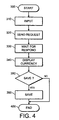
- FIG 4 shows a flow chart, in accordance with the present invention, describing a way of converting currencies in a cellular communication apparatus.
- the cellular telecommunication apparatus in this example is of the same type as described in Figures 1 and 2, and the apparatus is hereafter also referred to as a phone.
- the phone can be provided with a feature which enables the user to convert different currencies, but can also be accessed from a service provider which provides this service over the telecommunication network.
- a wireless connection to a cellular network e.g. when the phone roams to a new network, "START" 300
- WAP related services i.e. a service which can be accessed from a server to the phone.
- WAP related services i.e. a service which can be accessed from a server to the phone.
- SMS Short Message Service
- the user may select a menu which allows conversion for different currencies.
- This menu can be a standard feature in the phone, or accessible from a service provider. If the feature is accessible from a service provider, the user can establish a connection to the provider and select a suitable service. If it is a standard feature in the phone, i.e. a built-in feature, it might offer a possibility to send a request for information, if the user wants that.
- the user gives an input 310 to the phone by using input means to give an input of a representation of a first currency, i.e. by pressing the alphanumeric keys shown in Figure 1.
- the input means is operatively arranged to control means, as disclosed earlier with reference to Figure 2.
- the input 310 can be e.g. a monetary amount of a first currency, which should be converted into a second currency, i.e. what exchange rate for the first currency is corresponding to in the second currency.
- SMS message Short Message Service
- the phone with memory means, comprising a representation of a first currency and the identity of a first telecommunication network.
- the memory means can for example be a SIM (Subscriber Identity Module) card, a RAM memory and/or a Flash ROM memory, as shown in Figure 2.
- SIM Subscriber Identity Module
- the first telecommunication network is identified by the control means. If the transceiver means the identifies a second telecommunication network, which is different to the first network, this can be detected by the control means. Then, the transceiver means sends the request, "SEND REQUEST" 320, as described earlier. Thus, in this situation the user does not have to do anything, since this procedure is done automatically.
- the transceiver means will wait to receive a respond from the network, "WAIT FOR RESPOND” 330, and finally receive an answer to the given input.
- the respond can also be received as an SMS.
- the transceiver means is operatively arranged to the control means, as shown in Figure 2.
- the control means e.g. a display, "DISPLAY CURRENCY" 340, by means of the control means.
- the output means is preferably an LCD display, and is also operatively arranged to the control means, as shown in Figure 2.
- the user might like to store/store the exchange rate for the first currency corresponding to the second currency, and use it again without being connected to the service provider. Therefore, it is possible to have an option to be displayed on the output means, asking the user if he/she would like to "SAVE?" 350 the received representation of the second currency to be used later. If the user chooses not to save the representation of the received second currency, the procedure can be completed, "END" 400, else the control means in the phone saves, "SAVE" 360, the received representation of the second currency in memory means, and ends the procedure.
- the received exchange rate for the first currency corresponding to the second currency can be automatically to stored in the memory means. Naturally, this can also be done manually, which is only a question of designing the user interface.
- the representation of the second currency can stored in a list, provided in the memory means, wherein the list comprises at least two different representations of currencies.
- the list can e.g. be stored in the phone list of the phone. This allows e.g. the frequent flyer to have a lot different currencies available to be converted in an easy manner.
- the update of the different currencies can also be done automatically, if the input step 310, as disclosed in Figure 4, is jumped over.
Landscapes
- Engineering & Computer Science (AREA)
- Business, Economics & Management (AREA)
- Accounting & Taxation (AREA)
- Human Computer Interaction (AREA)
- Computer Networks & Wireless Communication (AREA)
- Finance (AREA)
- Signal Processing (AREA)
- Economics (AREA)
- General Physics & Mathematics (AREA)
- General Business, Economics & Management (AREA)
- Theoretical Computer Science (AREA)
- Strategic Management (AREA)
- Development Economics (AREA)
- Physics & Mathematics (AREA)
- Telephonic Communication Services (AREA)
- Mobile Radio Communication Systems (AREA)
- Financial Or Insurance-Related Operations Such As Payment And Settlement (AREA)
- Calculators And Similar Devices (AREA)
Applications Claiming Priority (2)
| Application Number | Priority Date | Filing Date | Title |
|---|---|---|---|
| GB9904009 | 1999-02-22 | ||
| GB9904009A GB2347314A (en) | 1999-02-22 | 1999-02-22 | Cellular telephone having means for converting currencies |
Publications (2)
| Publication Number | Publication Date |
|---|---|
| EP1032228A2 true EP1032228A2 (fr) | 2000-08-30 |
| EP1032228A3 EP1032228A3 (fr) | 2003-10-29 |
Family
ID=10848246
Family Applications (1)
| Application Number | Title | Priority Date | Filing Date |
|---|---|---|---|
| EP00301077A Withdrawn EP1032228A3 (fr) | 1999-02-22 | 2000-02-11 | Une méthode et un appareil de télécommunication cellulaire pour convertir des monnaies |
Country Status (3)
| Country | Link |
|---|---|
| US (1) | US20040043761A1 (fr) |
| EP (1) | EP1032228A3 (fr) |
| GB (1) | GB2347314A (fr) |
Cited By (4)
| Publication number | Priority date | Publication date | Assignee | Title |
|---|---|---|---|---|
| GB2374759A (en) * | 2001-04-17 | 2002-10-23 | David J Brooks | Voice activated mobile telephone etc having language translator |
| WO2005025189A1 (fr) * | 2003-09-04 | 2005-03-17 | Koninklijke Philips Electronics, N.V. | Mise a jour en ligne de taux de change de devises pour telephones mobiles |
| RU2326438C2 (ru) * | 2001-07-25 | 2008-06-10 | Ска Хайджин Продактс Аб | Графический пользовательский интерфейс для контроля расходов на продукты |
| EP2579194A1 (fr) * | 2011-10-04 | 2013-04-10 | Research In Motion Limited | Fourniture d'une capacité améliorée pour réaliser une transaction basée sur un paramètre régional |
Families Citing this family (4)
| Publication number | Priority date | Publication date | Assignee | Title |
|---|---|---|---|---|
| KR100730874B1 (ko) * | 2000-07-28 | 2007-06-20 | 주식회사 케이티 | 차세대이동통신(imt-2000)망에서 화폐 서비스 장치 및그 방법 |
| WO2007025246A2 (fr) * | 2005-08-26 | 2007-03-01 | Leul, Daniel, Kokeb | Systeme et procede destines a faciliter une transaction d'echange de valeurs |
| CN105868678B (zh) * | 2015-01-19 | 2019-09-17 | 阿里巴巴集团控股有限公司 | 人脸识别模型的训练方法及装置 |
| CN107886428B (zh) * | 2017-11-08 | 2021-08-20 | 中国银行股份有限公司 | 一种确定支付清算汇率的方法及支付清算系统 |
Family Cites Families (5)
| Publication number | Priority date | Publication date | Assignee | Title |
|---|---|---|---|---|
| JP2928172B2 (ja) * | 1996-09-06 | 1999-08-03 | 日本電気移動通信株式会社 | 携帯電話システム |
| FI111895B (fi) * | 1996-12-18 | 2003-09-30 | Ericsson Telefon Ab L M | Menetelmä ja laite laskemista varten |
| US6199046B1 (en) * | 1997-07-29 | 2001-03-06 | Adsura Pty Ltd. | Method system and article of manufacture for performing real time currency conversion |
| US5969974A (en) * | 1997-11-05 | 1999-10-19 | Headwaters Research & Development, Inc. | Currency converter |
| US6304746B1 (en) * | 1998-11-17 | 2001-10-16 | Aether Systems, Inc. | Method and system for providing formatted information via a two-way communications system |
-
1999
- 1999-02-22 GB GB9904009A patent/GB2347314A/en not_active Withdrawn
-
2000
- 2000-02-11 EP EP00301077A patent/EP1032228A3/fr not_active Withdrawn
-
2003
- 2003-09-04 US US10/653,905 patent/US20040043761A1/en not_active Abandoned
Cited By (4)
| Publication number | Priority date | Publication date | Assignee | Title |
|---|---|---|---|---|
| GB2374759A (en) * | 2001-04-17 | 2002-10-23 | David J Brooks | Voice activated mobile telephone etc having language translator |
| RU2326438C2 (ru) * | 2001-07-25 | 2008-06-10 | Ска Хайджин Продактс Аб | Графический пользовательский интерфейс для контроля расходов на продукты |
| WO2005025189A1 (fr) * | 2003-09-04 | 2005-03-17 | Koninklijke Philips Electronics, N.V. | Mise a jour en ligne de taux de change de devises pour telephones mobiles |
| EP2579194A1 (fr) * | 2011-10-04 | 2013-04-10 | Research In Motion Limited | Fourniture d'une capacité améliorée pour réaliser une transaction basée sur un paramètre régional |
Also Published As
| Publication number | Publication date |
|---|---|
| GB2347314A (en) | 2000-08-30 |
| EP1032228A3 (fr) | 2003-10-29 |
| US20040043761A1 (en) | 2004-03-04 |
| GB9904009D0 (en) | 1999-04-14 |
Similar Documents
| Publication | Publication Date | Title |
|---|---|---|
| US7286821B2 (en) | Communication terminal having personalisation means | |
| US6865404B1 (en) | Handset | |
| EP1241905A1 (fr) | Contrôle d'un téléphone mobile multi-bandes et multi-modes par une interface homme-machine (MMI) commune | |
| EP1032183A2 (fr) | Un radiotéléphone muni d'une touche de commande à fonctionalité multiple pour fournir l'accés à une structure de menu | |
| US6771990B1 (en) | Method and a cellular telecommunication apparatus for displaying the local time | |
| EP0542900A1 (fr) | Telephone sans fil portatif de bureau | |
| KR20020019076A (ko) | 셀룰러 통신 시스템에서 서버로부터 내용을 페치하는 방법및 시스템 | |
| US20030109247A1 (en) | System and method for wireless team-oriented voice messages of the invention | |
| EP1032228A2 (fr) | Une méthode et un appareil de télécommunication cellulaire pour convertir des monnaies | |
| US6975886B2 (en) | Telecommunication terminal and a method for communicating with a server by means of a telecommunication terminal | |
| US7877704B2 (en) | Radio terminal | |
| JP2002208993A (ja) | 携帯電話機 | |
| EP1843261B1 (fr) | Contrôle d'affichages | |
| KR100602711B1 (ko) | 무선통신 단말기에서의 폰트 줌 기능에 따른 화면 표시장치 및 그 방법 | |
| KR101063530B1 (ko) | 폰북 기능이 구비된 이동통신 단말기 | |
| JP2002244986A (ja) | 通信システム、通信端末およびプログラム | |
| Matsuo et al. | Personal telephone services using IC-cards | |
| KR101009214B1 (ko) | 이동 통신 단말기의 메일 전송 방법 | |
| KR20000059719A (ko) | 데이터 베이스를 이용한 전화번호 선택방법 및 그 방법에 의한통신용 단말기 시스템 | |
| JP2001245350A (ja) | 携帯電話機におけるurlの呼出方法及び該呼出方法を用いた携帯電話機 | |
| HK1110405B (en) | Controlling displays | |
| JP2002016719A (ja) | 通信端末装置およびこの装置に用いられる表示制御プログラムを記憶する記憶媒体 | |
| HK1110405A (en) | Controlling displays |
Legal Events
| Date | Code | Title | Description |
|---|---|---|---|
| PUAI | Public reference made under article 153(3) epc to a published international application that has entered the european phase |
Free format text: ORIGINAL CODE: 0009012 |
|
| AK | Designated contracting states |
Kind code of ref document: A2 Designated state(s): AT BE CH CY DE DK ES FI FR GB GR IE IT LI LU MC NL PT SE |
|
| AX | Request for extension of the european patent |
Free format text: AL;LT;LV;MK;RO;SI |
|
| RAP1 | Party data changed (applicant data changed or rights of an application transferred) |
Owner name: NOKIA CORPORATION |
|
| PUAL | Search report despatched |
Free format text: ORIGINAL CODE: 0009013 |
|
| AK | Designated contracting states |
Kind code of ref document: A3 Designated state(s): AT BE CH CY DE DK ES FI FR GB GR IE IT LI LU MC NL PT SE |
|
| AX | Request for extension of the european patent |
Extension state: AL LT LV MK RO SI |
|
| RIC1 | Information provided on ipc code assigned before grant |
Ipc: 7G 06F 15/02 B Ipc: 7H 04M 1/725 B Ipc: 7H 04Q 7/32 A |
|
| 17P | Request for examination filed |
Effective date: 20040429 |
|
| 17Q | First examination report despatched |
Effective date: 20040524 |
|
| AKX | Designation fees paid |
Designated state(s): DE FR IT NL |
|
| 17Q | First examination report despatched |
Effective date: 20040524 |
|
| STAA | Information on the status of an ep patent application or granted ep patent |
Free format text: STATUS: THE APPLICATION IS DEEMED TO BE WITHDRAWN |
|
| 18D | Application deemed to be withdrawn |
Effective date: 20061228 |