EP1033078A1 - Procédé de traitement hydrothermique de produits alimentaires pour animaux - Google Patents
Procédé de traitement hydrothermique de produits alimentaires pour animaux Download PDFInfo
- Publication number
- EP1033078A1 EP1033078A1 EP00104100A EP00104100A EP1033078A1 EP 1033078 A1 EP1033078 A1 EP 1033078A1 EP 00104100 A EP00104100 A EP 00104100A EP 00104100 A EP00104100 A EP 00104100A EP 1033078 A1 EP1033078 A1 EP 1033078A1
- Authority
- EP
- European Patent Office
- Prior art keywords
- raw material
- bar
- temperatures
- treatment
- feed
- Prior art date
- Legal status (The legal status is an assumption and is not a legal conclusion. Google has not performed a legal analysis and makes no representation as to the accuracy of the status listed.)
- Withdrawn
Links
- 238000000034 method Methods 0.000 title claims description 50
- 238000010335 hydrothermal treatment Methods 0.000 title claims description 11
- 241001465754 Metazoa Species 0.000 title description 8
- 229920002472 Starch Polymers 0.000 claims abstract description 38
- 235000019698 starch Nutrition 0.000 claims abstract description 36
- 239000008107 starch Substances 0.000 claims abstract description 33
- 210000004767 rumen Anatomy 0.000 claims abstract description 26
- 150000001720 carbohydrates Chemical class 0.000 claims abstract description 9
- 235000014633 carbohydrates Nutrition 0.000 claims abstract description 9
- XLYOFNOQVPJJNP-UHFFFAOYSA-N water Substances O XLYOFNOQVPJJNP-UHFFFAOYSA-N 0.000 claims abstract description 4
- 239000002245 particle Substances 0.000 claims abstract 3
- 239000002994 raw material Substances 0.000 claims description 15
- 239000008188 pellet Substances 0.000 claims description 13
- 241000283690 Bos taurus Species 0.000 claims description 11
- 239000000463 material Substances 0.000 claims description 9
- 241000282849 Ruminantia Species 0.000 claims description 7
- 239000000203 mixture Substances 0.000 claims description 6
- 238000010411 cooking Methods 0.000 claims description 4
- 235000013365 dairy product Nutrition 0.000 claims description 4
- 239000011159 matrix material Substances 0.000 claims description 4
- 235000015278 beef Nutrition 0.000 claims description 3
- 210000000813 small intestine Anatomy 0.000 abstract description 20
- 235000013336 milk Nutrition 0.000 abstract description 12
- 239000008267 milk Substances 0.000 abstract description 12
- 210000004080 milk Anatomy 0.000 abstract description 12
- WQZGKKKJIJFFOK-GASJEMHNSA-N Glucose Natural products OC[C@H]1OC(O)[C@H](O)[C@@H](O)[C@@H]1O WQZGKKKJIJFFOK-GASJEMHNSA-N 0.000 abstract description 8
- 239000008103 glucose Substances 0.000 abstract description 8
- 238000004519 manufacturing process Methods 0.000 abstract description 7
- 108090000623 proteins and genes Proteins 0.000 abstract description 7
- 102000004169 proteins and genes Human genes 0.000 abstract description 7
- 230000003750 conditioning effect Effects 0.000 abstract description 5
- 102000004190 Enzymes Human genes 0.000 abstract description 3
- 108090000790 Enzymes Proteins 0.000 abstract description 3
- 238000006243 chemical reaction Methods 0.000 abstract description 3
- 238000001125 extrusion Methods 0.000 abstract 1
- 210000000936 intestine Anatomy 0.000 abstract 1
- 230000015556 catabolic process Effects 0.000 description 18
- 238000006731 degradation reaction Methods 0.000 description 13
- 230000029087 digestion Effects 0.000 description 12
- 235000013339 cereals Nutrition 0.000 description 11
- 240000005979 Hordeum vulgare Species 0.000 description 9
- 235000007340 Hordeum vulgare Nutrition 0.000 description 9
- 238000010438 heat treatment Methods 0.000 description 9
- 240000008042 Zea mays Species 0.000 description 7
- 235000002017 Zea mays subsp mays Nutrition 0.000 description 6
- 235000019621 digestibility Nutrition 0.000 description 6
- 241000209140 Triticum Species 0.000 description 5
- 235000021307 Triticum Nutrition 0.000 description 5
- 235000007319 Avena orientalis Nutrition 0.000 description 4
- 244000075850 Avena orientalis Species 0.000 description 4
- 229920002261 Corn starch Polymers 0.000 description 4
- 235000005824 Zea mays ssp. parviglumis Nutrition 0.000 description 4
- 230000008901 benefit Effects 0.000 description 4
- 235000005822 corn Nutrition 0.000 description 4
- 239000008120 corn starch Substances 0.000 description 4
- 229940099112 cornstarch Drugs 0.000 description 4
- 230000000593 degrading effect Effects 0.000 description 4
- 230000000813 microbial effect Effects 0.000 description 4
- 235000021050 feed intake Nutrition 0.000 description 3
- 239000008187 granular material Substances 0.000 description 3
- 239000000126 substance Substances 0.000 description 3
- 240000006394 Sorghum bicolor Species 0.000 description 2
- 235000011684 Sorghum saccharatum Nutrition 0.000 description 2
- 235000016383 Zea mays subsp huehuetenangensis Nutrition 0.000 description 2
- 230000003247 decreasing effect Effects 0.000 description 2
- 230000003111 delayed effect Effects 0.000 description 2
- 238000010586 diagram Methods 0.000 description 2
- 230000001079 digestive effect Effects 0.000 description 2
- 230000002255 enzymatic effect Effects 0.000 description 2
- 239000000835 fiber Substances 0.000 description 2
- 239000012530 fluid Substances 0.000 description 2
- 235000021374 legumes Nutrition 0.000 description 2
- 235000009973 maize Nutrition 0.000 description 2
- VNWKTOKETHGBQD-UHFFFAOYSA-N methane Chemical compound C VNWKTOKETHGBQD-UHFFFAOYSA-N 0.000 description 2
- 239000005416 organic matter Substances 0.000 description 2
- 238000001243 protein synthesis Methods 0.000 description 2
- 230000014616 translation Effects 0.000 description 2
- 229940100445 wheat starch Drugs 0.000 description 2
- 108010077805 Bacterial Proteins Proteins 0.000 description 1
- 241000196324 Embryophyta Species 0.000 description 1
- 241000219745 Lupinus Species 0.000 description 1
- 240000003183 Manihot esculenta Species 0.000 description 1
- 235000016735 Manihot esculenta subsp esculenta Nutrition 0.000 description 1
- 229910019142 PO4 Inorganic materials 0.000 description 1
- 244000046052 Phaseolus vulgaris Species 0.000 description 1
- 235000010627 Phaseolus vulgaris Nutrition 0.000 description 1
- 240000004713 Pisum sativum Species 0.000 description 1
- 235000010582 Pisum sativum Nutrition 0.000 description 1
- 244000046127 Sorghum vulgare var. technicum Species 0.000 description 1
- 241000282887 Suidae Species 0.000 description 1
- 150000001413 amino acids Chemical class 0.000 description 1
- 230000001580 bacterial effect Effects 0.000 description 1
- 244000052616 bacterial pathogen Species 0.000 description 1
- 238000003776 cleavage reaction Methods 0.000 description 1
- 230000001419 dependent effect Effects 0.000 description 1
- 102000038379 digestive enzymes Human genes 0.000 description 1
- 108091007734 digestive enzymes Proteins 0.000 description 1
- 210000002249 digestive system Anatomy 0.000 description 1
- 230000000694 effects Effects 0.000 description 1
- 230000007515 enzymatic degradation Effects 0.000 description 1
- 230000006862 enzymatic digestion Effects 0.000 description 1
- 238000000855 fermentation Methods 0.000 description 1
- 230000004151 fermentation Effects 0.000 description 1
- 235000013305 food Nutrition 0.000 description 1
- 235000011389 fruit/vegetable juice Nutrition 0.000 description 1
- 238000011835 investigation Methods 0.000 description 1
- 210000002429 large intestine Anatomy 0.000 description 1
- 230000007774 longterm Effects 0.000 description 1
- 238000005259 measurement Methods 0.000 description 1
- 230000002503 metabolic effect Effects 0.000 description 1
- 230000004060 metabolic process Effects 0.000 description 1
- 238000005065 mining Methods 0.000 description 1
- 150000002823 nitrates Chemical class 0.000 description 1
- 235000021140 nondigestible carbohydrates Nutrition 0.000 description 1
- 238000005457 optimization Methods 0.000 description 1
- 235000021317 phosphate Nutrition 0.000 description 1
- 150000003013 phosphoric acid derivatives Chemical class 0.000 description 1
- 229920001184 polypeptide Polymers 0.000 description 1
- 244000144977 poultry Species 0.000 description 1
- 102000004196 processed proteins & peptides Human genes 0.000 description 1
- 108090000765 processed proteins & peptides Proteins 0.000 description 1
- 230000017854 proteolysis Effects 0.000 description 1
- 238000011084 recovery Methods 0.000 description 1
- 229940100486 rice starch Drugs 0.000 description 1
- 230000007017 scission Effects 0.000 description 1
- 210000002784 stomach Anatomy 0.000 description 1
- 238000003860 storage Methods 0.000 description 1
- 230000001360 synchronised effect Effects 0.000 description 1
Images



Classifications
-
- A—HUMAN NECESSITIES
- A23—FOODS OR FOODSTUFFS; TREATMENT THEREOF, NOT COVERED BY OTHER CLASSES
- A23K—FODDER
- A23K30/00—Processes specially adapted for preservation of materials in order to produce animal feeding-stuffs
-
- A—HUMAN NECESSITIES
- A23—FOODS OR FOODSTUFFS; TREATMENT THEREOF, NOT COVERED BY OTHER CLASSES
- A23K—FODDER
- A23K10/00—Animal feeding-stuffs
- A23K10/30—Animal feeding-stuffs from material of plant origin, e.g. roots, seeds or hay; from material of fungal origin, e.g. mushrooms
-
- A—HUMAN NECESSITIES
- A23—FOODS OR FOODSTUFFS; TREATMENT THEREOF, NOT COVERED BY OTHER CLASSES
- A23K—FODDER
- A23K40/00—Shaping or working-up of animal feeding-stuffs
-
- A—HUMAN NECESSITIES
- A23—FOODS OR FOODSTUFFS; TREATMENT THEREOF, NOT COVERED BY OTHER CLASSES
- A23K—FODDER
- A23K50/00—Feeding-stuffs specially adapted for particular animals
- A23K50/10—Feeding-stuffs specially adapted for particular animals for ruminants
Definitions
- the invention relates to a method for hydrothermal treatment of feed materials and feed mixtures for ruminants, especially dairy cows and beef cattle.
- the object of the invention is to create a method with which the proportion of carbohydrates, in particular Strength that can be increased without digestion in the rumen reaches the small intestine. This applies to easily degradable starches from z. B. barley, wheat, oats or legumes. Difficult to degrade Strengths from z. B. corn or sorghum, however, must be modified so that overall the digestion in the rumen and is increased in the small intestine.
- the solution according to the invention is that the damp or moistened raw material to increase the rumen in the Cow non-digestible carbohydrate content, especially starch content, an elevated temperature of at least 80 ° C and at most 180 ° C and a pressure between 1 bar and approx. 50 bar is exposed.
- the invention has recognized that by heating or heating of the moist raw material among those according to the invention Conditions, at least in terms of strength, in contrast to what is known so far, not digestibility is generally increased, but on the contrary digestibility the strength and other carbohydrates in the rumen decreased becomes. So it is at least by the inventive method achieved in this respect exactly the opposite of what you would normally do with similar procedures Wants to achieve state of the art.
- the decisive factor is probably the surprising one Result that the invention achieves that proteins, that surround the starch granules coagulate and so the Starch grains mechanically before digestion during passage protected by the rumen.
- the proteins will then in the small intestine by digestive enzymes in polypeptides and amino acids disassembled so that they are also metabolic of the ruminant can be picked up and processed.
- the carbohydrates, especially starch become enzymatic in the small intestine converted into glucose so that they can also be used for metabolism and ultimately available for milk production stand.
- the invention therefore makes it possible to partially pre-starch to protect the digestive system in the rumen so that it is in the small intestine converted into glucose and thus available for milk production stands, which increases the overall milk yield of the cow can be.
- the details and parameters of the process are derived from the raw material or feed depend.
- the starch grains are in different plants of different sizes and also have different ones chemical compositions. For example, that is Starch in corn very stable, so that treatment after The method according to the invention is necessary for another reason is. Corn, sorghum or rice starch are so stable that these starches are more difficult to break down in the rumen than barley or Wheat starch. However, the enzymatic digestion is also in the small intestine worse, so that the digestibility of starch in the animal is about 10% worse than z. B. with wheat starch.
- the corn starch digestion can be influenced so that a delayed breakdown in the rumen, but an almost complete one Degradation in the small and large intestine is achieved.
- the method according to the invention also very successful, especially with legumes (Peas, beans, lupins) barley, oats, wheat and tapioca.
- legumes Peas, beans, lupins
- the feed or the raw material is expedient Steam supplied, which not only provides the necessary moisture is supplied, but also a heating takes place. In particular then if the heating is done in another way water can also be added.
- preconditioning is carried out by placing the raw material on a for 10 to 30 seconds Temperature from 60 ° C to 100 ° C, especially 70 ° C to 90 ° C in is kept in a humid atmosphere.
- Short-term conditioning can also be long-term conditioning be useful in many cases, which during 5 up to 10 minutes at temperatures from 90 ° C to 100 ° C becomes.
- This preconditioning will then usually take place connect another hydrothermal step, in particular in an expander.
- an expander it will Material by a conveyor element, in particular a screw conveyor, against an outlet end provided with a narrow opening pressed. This not only increases the pressure, but also a temperature increase due to the friction causes that can be increased by adding steam can. It is expedient in the expander at temperatures worked up to about 170 ° C, in particular up to about 150 ° C. In other embodiments of the method one will depending on the raw material or feed at temperatures up to about 125 ° C or work at temperatures around 100 ° C or a little above 100 ° C.
- hydrothermal Treatment in that the material advantageously up up to 30 minutes, in other embodiments up to approximately 60 minutes at temperatures of 100 ° C.
- the time and temperature parameters above are for particularly useful combinations. In many cases one near the upper limit of the specified temperatures and work accordingly less time. The above Temperatures can even be exceeded for a short time. Overall, it essentially comes down to one product from time and temperature. The higher the temperature, the more the treatment time can also be chosen shorter, which not only enables a higher material throughput, but also in many cases also leads to better results.
- the crushing of the grains can be done in a hammer mill occur. Has been particularly useful for this task but proved a roller mill. But in general be taken into account that the starch grains as little as possible be harmed.
- the invention a procedure is created that is essential Similarities with already known treatment methods for Has feed, which mostly affects digestion Obtain single animals. Through special choice of parameters but the effect is achieved that the digestibility of carbohydrates in the rumen is reduced so that these carbohydrates are available for recovery in the small intestine, whereby the milk yield increases with the same amount of feed becomes. This is diametrically opposed to what the One of ordinary skill in the art would expect processes of this type namely an increase in the digestibility of feed.
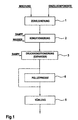
- Feed mixture or a single component first a crushing step 1 in a roller mill or Subjected to hammer mill.
- Short-term conditioning then takes place at 2 for about 10 to 30 seconds at temperatures from about 60 ° C to 100 ° C, especially about 70 ° C to 90 ° C.
- a further treatment then follows in the method of Figure 1 in an expander in step 3.
- the material is conveyed by a conveying element, in particular a screw conveyor is compressed towards the discharge end, which generates heat and the material with Pressures of up to 50 bar is applied.
- a conveying element in particular a screw conveyor is compressed towards the discharge end, which generates heat and the material with Pressures of up to 50 bar is applied.
- Steam can be added so that the temperature not only increased by the frictional heat, but also by the steam.
- the material is then passed through a narrow opening, in particular relaxed an annular gap or other narrow slits.
- a perforated die can also be used for the annular gap.
- the product emerges from the die as a shaped pellet off, so that the pelleting can be omitted.
- no crushing occurs between Koller and Matrix, so that the grain structure is preserved.
- the treated feed is cooled in step 5 and is then ready for storage or transportation.
- the material can be processed in the Step 3 be fed to a pellet press 6 where it passes through Bollard roll is pressed through die holes to the To give feed a form that is more acceptable to the animal. This can be done both in a pellet press with a flat die also happen with ring matrix.
- hydrothermal treatment in an expander provided in step 4.
- This can be done in one hydrothermal reactor for about 5 to about 30 or even up to about 60 minutes at temperatures of 80 ° C up to 100 ° C.
- the hydrothermal Treatment in step 4 also in a hydrothermal Pressure reactor (pressure toaster) during times of about 1 minute to about 5 minutes at temperatures of about 100 ° C to about 150 ° C and pressures of about 1 bar to about 5 bar.
- Feed produced according to the process was used with the Hohenheim feed value test (handbook of agricultural Test and investigation methodology (method book), Verlag J. Neumann-Neudamm, Melsungen, Berlin, Basel, Vienna, method book III 4. Supplementary delivery 1997) examined.
- This national and internationally approved method simulates mining and the rate of degradation of the organic matter of feed in the rumen of ruminants. Since about 60% of organic Substance consists of starch, you also get one pretty good statement about the rate of degradation of the starch.
- a prepared feed sample is included rumen fluid added to defined temperatures live animal is taken.
- Rumen fluid is due to microbial and bacterial Reactions gas released and measured.
- the released Amount of gas after 24 h measured in milliliters per milligram Dry matter of the feed, flows in as a factor the estimation equation for energy assessment of cattle feed on.
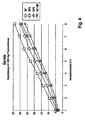
- a degradation curve which the Amount and rate of degradation of the organic matter shows.
- Corn starch is difficult to degrade, i.e. rumen-stable. Cornstarch is also poorly degradable in the small intestine, making it untreated Corn is only digested to a total of 85%. Aim of a heat treatment is the breakdown in the rumen and to increase digestibility in the small intestine so that total digestion of 95% is reached. So it finds one Starch digestion instead. It can be seen from the curves in FIG. that both with the SP method and with the method EP 3 essentially doubles the rate of degradation compared to pressure toasts (PT). The Curves only show the measured values up to 8 h, since this is approximately the Feed time in the rumen of 6 to 8 hours corresponds.
- the strengths of these cereals break down very quickly in the rumen, and starch digestion would accelerate this process. So less starch gets into the small intestine. Target one It is suitable heat treatment here, the starch is not unlock, but to protect against rumen degradation, so that more starch gets into the small intestine.
- the curve of the figure 4 shows that compared to the SP method by the method HC HM the degradation rate after 8 h from 30 to 26 milliliters per 200 milligrams of dry matter is reduced, the rate of degradation is reduced and more strength flows into the small intestine.
- the degradability can be reduced by different treatment methods of starch from corn or barley / wheat / oats in the rumen to be influenced. It doesn't just matter how much starch flows into the small intestine. Is determining value rather the rate of breakdown of starch in the rumen. This is intended to supply energy to microbial protein synthesis as synchronous as possible with protein degradation and in agreement run to fiber fermentation. It can therefore be used for feed be a win if from a rapidly degrading Starch from barley has a slowly degrading effect, or if from a slowly degrading corn starch a rapidly degrading one becomes. Through targeted technical treatment of the grain are therefore tailor-made degradation rates and thus an optimization microbial protein synthesis possible. Through synchronization the degradation rate then also becomes the feed intake increased, which also contributes to the increase in milk yield.
- a hydrothermal treatment always leads to one Protein change in cereals, d. that is, the proportion of rumen-stable Protein is increased. This is due to the fact that appropriate treatment the denatured protein the starch granules in wheat and barley and thus the microbial Breakdown delayed.
Landscapes
- Life Sciences & Earth Sciences (AREA)
- Chemical & Material Sciences (AREA)
- Polymers & Plastics (AREA)
- Engineering & Computer Science (AREA)
- Zoology (AREA)
- Food Science & Technology (AREA)
- Animal Husbandry (AREA)
- Health & Medical Sciences (AREA)
- Botany (AREA)
- Molecular Biology (AREA)
- Mycology (AREA)
- Physiology (AREA)
- Biotechnology (AREA)
- Birds (AREA)
- Fodder In General (AREA)
Applications Claiming Priority (2)
| Application Number | Priority Date | Filing Date | Title |
|---|---|---|---|
| DE19909078A DE19909078A1 (de) | 1999-03-02 | 1999-03-02 | Verfahren zur hydrothermischen Behandlung von Futtermitteln für Milchkühe und Mastrinder |
| DE19909078 | 1999-03-02 |
Publications (1)
| Publication Number | Publication Date |
|---|---|
| EP1033078A1 true EP1033078A1 (fr) | 2000-09-06 |
Family
ID=7899419
Family Applications (1)
| Application Number | Title | Priority Date | Filing Date |
|---|---|---|---|
| EP00104100A Withdrawn EP1033078A1 (fr) | 1999-03-02 | 2000-02-28 | Procédé de traitement hydrothermique de produits alimentaires pour animaux |
Country Status (2)
| Country | Link |
|---|---|
| EP (1) | EP1033078A1 (fr) |
| DE (1) | DE19909078A1 (fr) |
Cited By (8)
| Publication number | Priority date | Publication date | Assignee | Title |
|---|---|---|---|---|
| EP1417894A1 (fr) * | 2002-11-06 | 2004-05-12 | Amandus Kahl GmbH & Co. | Procédé de traitement de fourrage et méthode de l'alimentation des ruminants |
| EP1417893A1 (fr) * | 2002-11-06 | 2004-05-12 | Amandus Kahl GmbH & Co. | Procédé thermique pour traiter le fourrage des ruminants |
| WO2007048369A1 (fr) * | 2005-10-26 | 2007-05-03 | Berg & Schmidt Gmbh & Co. Kg | Complement et son procede de fabrication |
| WO2007140629A1 (fr) * | 2006-06-06 | 2007-12-13 | Bühler AG | Composition fourragère pour bovins |
| US7521076B1 (en) | 2008-09-11 | 2009-04-21 | Wenger Manufacturing, Inc. | Method and apparatus for producing fully cooked extrudates with significantly reduced specific mechanical energy inputs |
| DE102008017179A1 (de) | 2008-04-02 | 2009-10-08 | Agrar Gmbh "Steinerne Heide" | Verfahren zur Herstellung von Rapsschrot |
| WO2015063149A1 (fr) * | 2013-10-30 | 2015-05-07 | Universität Rostock | Procédé et dispositif de traitement d'aliments pour animaux |
| WO2024211589A1 (fr) * | 2023-04-04 | 2024-10-10 | Prototype Garage, LLC | Procédés et systèmes pour améliorer la biodisponibilité dans des aliments et des aliments pour animaux |
Families Citing this family (2)
| Publication number | Priority date | Publication date | Assignee | Title |
|---|---|---|---|---|
| DE10117421B4 (de) * | 2001-04-06 | 2008-04-30 | Ulrich Walter | Verfahren und Anlage zur Aufbereitung von Extraktionsschrot aus Sonnenblumensaat für die Tierernährung |
| DE102006026511A1 (de) * | 2006-06-06 | 2007-12-13 | Bühler AG | Verfahren zur Herstellung einer Futterzusammensetzung für Rinder |
Citations (7)
| Publication number | Priority date | Publication date | Assignee | Title |
|---|---|---|---|---|
| US3667961A (en) * | 1967-09-22 | 1972-06-06 | Santa Ynez Research Farm | Process for improving digestibility of feedstuffs for ruminant animals |
| US3817786A (en) * | 1967-09-22 | 1974-06-18 | Santa Ynez Res Farm | Equipment for converting the physical and complex molecular bond structures of natural feedstuffs for ruminant animals to different and less complex molecular bond structures thereof |
| EP0331207A1 (fr) * | 1988-04-27 | 1989-09-06 | Amandus Kahl Nachf. (GmbH & Co.) | Procédé pour la production de boulettes |
| JPH0372861A (ja) * | 1989-08-09 | 1991-03-28 | Hitachi Metals Ltd | 穀物圧扁フレークの製造方法 |
| EP0479555A2 (fr) * | 1990-10-05 | 1992-04-08 | Purina Mills Inc. | Nourriture pour animaux extrudée, à haute teneur en graisse et sous forme de morceaux |
| EP0534573A1 (fr) * | 1991-09-27 | 1993-03-31 | Schouten Group N.V. | Procédé et installation pour réduire la teneur en facteurs anti-nutritionnels dans un mélange de matières alimentaires brutes pour animaux |
| FR2731589A1 (fr) * | 1995-03-16 | 1996-09-20 | Noelle Services Sa | Installation de preparation d'aliments pour animaux en particulier, procede de mise en oeuvre et produits issus du procede |
-
1999
- 1999-03-02 DE DE19909078A patent/DE19909078A1/de not_active Withdrawn
-
2000
- 2000-02-28 EP EP00104100A patent/EP1033078A1/fr not_active Withdrawn
Patent Citations (7)
| Publication number | Priority date | Publication date | Assignee | Title |
|---|---|---|---|---|
| US3667961A (en) * | 1967-09-22 | 1972-06-06 | Santa Ynez Research Farm | Process for improving digestibility of feedstuffs for ruminant animals |
| US3817786A (en) * | 1967-09-22 | 1974-06-18 | Santa Ynez Res Farm | Equipment for converting the physical and complex molecular bond structures of natural feedstuffs for ruminant animals to different and less complex molecular bond structures thereof |
| EP0331207A1 (fr) * | 1988-04-27 | 1989-09-06 | Amandus Kahl Nachf. (GmbH & Co.) | Procédé pour la production de boulettes |
| JPH0372861A (ja) * | 1989-08-09 | 1991-03-28 | Hitachi Metals Ltd | 穀物圧扁フレークの製造方法 |
| EP0479555A2 (fr) * | 1990-10-05 | 1992-04-08 | Purina Mills Inc. | Nourriture pour animaux extrudée, à haute teneur en graisse et sous forme de morceaux |
| EP0534573A1 (fr) * | 1991-09-27 | 1993-03-31 | Schouten Group N.V. | Procédé et installation pour réduire la teneur en facteurs anti-nutritionnels dans un mélange de matières alimentaires brutes pour animaux |
| FR2731589A1 (fr) * | 1995-03-16 | 1996-09-20 | Noelle Services Sa | Installation de preparation d'aliments pour animaux en particulier, procede de mise en oeuvre et produits issus du procede |
Non-Patent Citations (1)
| Title |
|---|
| PATENT ABSTRACTS OF JAPAN vol. 015, no. 231 (C - 0840) 12 June 1991 (1991-06-12) * |
Cited By (8)
| Publication number | Priority date | Publication date | Assignee | Title |
|---|---|---|---|---|
| EP1417894A1 (fr) * | 2002-11-06 | 2004-05-12 | Amandus Kahl GmbH & Co. | Procédé de traitement de fourrage et méthode de l'alimentation des ruminants |
| EP1417893A1 (fr) * | 2002-11-06 | 2004-05-12 | Amandus Kahl GmbH & Co. | Procédé thermique pour traiter le fourrage des ruminants |
| WO2007048369A1 (fr) * | 2005-10-26 | 2007-05-03 | Berg & Schmidt Gmbh & Co. Kg | Complement et son procede de fabrication |
| WO2007140629A1 (fr) * | 2006-06-06 | 2007-12-13 | Bühler AG | Composition fourragère pour bovins |
| DE102008017179A1 (de) | 2008-04-02 | 2009-10-08 | Agrar Gmbh "Steinerne Heide" | Verfahren zur Herstellung von Rapsschrot |
| US7521076B1 (en) | 2008-09-11 | 2009-04-21 | Wenger Manufacturing, Inc. | Method and apparatus for producing fully cooked extrudates with significantly reduced specific mechanical energy inputs |
| WO2015063149A1 (fr) * | 2013-10-30 | 2015-05-07 | Universität Rostock | Procédé et dispositif de traitement d'aliments pour animaux |
| WO2024211589A1 (fr) * | 2023-04-04 | 2024-10-10 | Prototype Garage, LLC | Procédés et systèmes pour améliorer la biodisponibilité dans des aliments et des aliments pour animaux |
Also Published As
| Publication number | Publication date |
|---|---|
| DE19909078A1 (de) | 2000-09-07 |
Similar Documents
| Publication | Publication Date | Title |
|---|---|---|
| DE3887366T2 (de) | Fütterung von Vieh. | |
| DE60318304T2 (de) | Eiweiss-enthaltendes lebensmittel und verfahren für seine herstellung | |
| DE2934675A1 (de) | Verfahren zur herstellung eines aus einer stabilen fluessigen staerkeemulsion bestehenden tiernahrungsprodukts | |
| DE2342183A1 (de) | Verfahren zur behandlung von pflanzenprotein | |
| EP1033078A1 (fr) | Procédé de traitement hydrothermique de produits alimentaires pour animaux | |
| DE69019230T2 (de) | Herstellung von stabilisierten, lebensfähigen, sporenbildenden Mikroorganismen, ihre Produktion und deren Gravulatform. | |
| DE69621146T2 (de) | Verwendung von Galactanase in Tierfutter | |
| Lounglawan et al. | Silage production from cassava peel and cassava pulp as energy source in cattle diets | |
| EP0231825A2 (fr) | Procédé et installation de préparation de nourriture pour animaux ou de produits alimentaires | |
| DE2643093C3 (de) | Herstellung von Futtermitteln oder Futtermittelzusätzen | |
| DE3886799T3 (de) | Verfahren zum Behandeln von rohem Futtermaterial, rohes Futtermaterial und Futtermischung. | |
| DE102016104159B4 (de) | Verfahren zur Aufbereitung von Silage | |
| DE60123517T2 (de) | Verfahren zur Entgiftung von Leinsamen | |
| WO2007140629A1 (fr) | Composition fourragère pour bovins | |
| DE102022129942A1 (de) | Verfahren zur Enzyminaktivierung von Saaten | |
| EP0326622A1 (fr) | Procédé et installation pour modifier la valeur nutritive et la tolérance de produits alimentaires pour les animaux, les personnes, contenant des protéines ou de l'amidon | |
| DE2606826A1 (de) | Verfahren zur herstellung eines extrudierten wiederkaeuerfutters auf der basis von staerke und einer nicht- proteinartigen, stickstoffhaltigen substanz | |
| DE60104296T2 (de) | Entphytinisierung von produkten auf pflanzenbasis in mischungen mit nebenprodukten tierischen, pflanzlichen oder mikrobiellen ursprungs | |
| DE3539231A1 (de) | Verfahren zur herstellung von futterzusatz und futter aus keratinhaltigen abfaellen | |
| EP1417894B1 (fr) | Procédé de traitement de fourrage et méthode de l'alimentation des ruminants | |
| JPH0759516A (ja) | 羽毛を含有する飼料の製造方法 | |
| DE3885132T2 (de) | Fütterung von Vieh. | |
| EP1417893A1 (fr) | Procédé thermique pour traiter le fourrage des ruminants | |
| DE69713207T2 (de) | Hühnerfutter und Verfahren zur Herstellung | |
| EP4164405B1 (fr) | Augmentation de l'énergie métabolique dans l'alimentation animale |
Legal Events
| Date | Code | Title | Description |
|---|---|---|---|
| PUAI | Public reference made under article 153(3) epc to a published international application that has entered the european phase |
Free format text: ORIGINAL CODE: 0009012 |
|
| AK | Designated contracting states |
Kind code of ref document: A1 Designated state(s): AT BE CH CY DE DK ES FI FR GB GR IE IT LI LU MC NL PT SE |
|
| AX | Request for extension of the european patent |
Free format text: AL;LT;LV;MK;RO;SI |
|
| 17P | Request for examination filed |
Effective date: 20010301 |
|
| AKX | Designation fees paid |
Free format text: AT BE CH CY DE DK ES FI FR GB GR IE IT LI LU MC NL PT SE |
|
| 17Q | First examination report despatched |
Effective date: 20030122 |
|
| STAA | Information on the status of an ep patent application or granted ep patent |
Free format text: STATUS: THE APPLICATION IS DEEMED TO BE WITHDRAWN |
|
| 18D | Application deemed to be withdrawn |
Effective date: 20030603 |