EP1033081A2 - Verfahren und Vorrichtung zur Expansion von Nahrungs- und Genussmitteln - Google Patents
Verfahren und Vorrichtung zur Expansion von Nahrungs- und Genussmitteln Download PDFInfo
- Publication number
- EP1033081A2 EP1033081A2 EP00102159A EP00102159A EP1033081A2 EP 1033081 A2 EP1033081 A2 EP 1033081A2 EP 00102159 A EP00102159 A EP 00102159A EP 00102159 A EP00102159 A EP 00102159A EP 1033081 A2 EP1033081 A2 EP 1033081A2
- Authority
- EP
- European Patent Office
- Prior art keywords
- tobacco
- carrier flow
- tobacco material
- bar
- food
- Prior art date
- Legal status (The legal status is an assumption and is not a legal conclusion. Google has not performed a legal analysis and makes no representation as to the accuracy of the status listed.)
- Granted
Links
Images




Classifications
-
- A—HUMAN NECESSITIES
- A24—TOBACCO; CIGARS; CIGARETTES; SIMULATED SMOKING DEVICES; SMOKERS' REQUISITES
- A24B—MANUFACTURE OR PREPARATION OF TOBACCO FOR SMOKING OR CHEWING; TOBACCO; SNUFF
- A24B3/00—Preparing tobacco in the factory
- A24B3/18—Other treatment of leaves, e.g. puffing, crimpling, cleaning
- A24B3/182—Puffing
Definitions
- the invention relates to a method and a device for expanding food or Consumable items.
- the inventive method and the inventive Device for increasing the filling capacity of tobacco material or crushed Serve smoking materials.
- tobacco material or shredded Tobacco leaf, tobacco rib, tobacco stem, each cut or stripped from smoking materials shredded, reprocessed tobacco and tobacco by-products such as TV and ZHV winnowings be understood.
- the water content is defined as the mass loss of tobacco based on the Moisture content in mass% in a drying cabinet due to a drying time of 3 Hours at 80 ° C (so-called Salvis moisture).
- This tobacco is processed as raw material, called raw tobacco, to the factories producing e.g. Cigarettes or other luxury goods based on tobacco.
- the processing chain from green leaf to raw tobacco leads to severe shrinkage. This volume reduction adversely affects the so-called filling capacity.
- the tobacco industry describes filling ability as the property with as little mass use as possible nevertheless produce physically stable, solid or hard end products (e.g. cigarettes) to be able to.
- the filling capacity is also defined as the residual volume in relation to the weighing in in ml / g, which after compression with a 3kg weight in a cylindrical Vessel after an exposure time of 30 seconds).
- phase change after gaseous heat supply differ essentially by the impregnation / propellant and thus by the phase change. Examples are impregnation with CO 2 (phase change from solid to gaseous), impregnation with fron / liquid gas (phase change from liquid to gaseous) and impregnation with high-tension N 2 (phase change from gaseous)
- the variants of the chemical processes differ essentially in the type of gas generation reaction such as decomposition of additives by supplying heat in the dryer or by adding another additive to trigger a reaction.
- Examples include impregnation with NH 3 / CO 2 (thermal decomposition solid to gaseous), impregnation with H 2 O 2 (thermal decomposition liquid to gaseous) and impregnation with N 2 H 4 / H 2 O 2 (exothermic reaction liquid after gaseous).
- a disadvantage of these processes is the introduction of additional additives and the The need for a pressurized stage in the tobacco treatment process.
- the impregnation process is usually a complex batch process.
- DE 195 21 243 describes a method and an apparatus in which batch operation a closed container is pressurized and the material inside is heated. The the upper, well-free area is briefly put under increased pressure. By opening suddenly of the container, the material is ejected into an expansion chamber with atmospheric pressure. The increased pressure acts as a propellant. The water in the good evaporates and the good expands.
- DE 195 21168 describes the device and method analogous to DE 195 21 243, however the inner container has no holes in the upper, good-free area.
- DE 195 21167 describes a device analogous to DE 195 21243 and DE 195 21 168 wherein the expansion chamber is rotatable and the expanded material by rotating the drum is carried out in the longitudinal direction.
- the one used Heating device comprises a fluidized bed chamber in which the material is heated in batches becomes. The material is transferred to the puffing reactor using a branch circuit.
- An expansion chamber is described in DE 198 06 950, which is designed in two parts is.
- the first part starts directly at the discharge of the expansion chamber and has a long, slim and conical shape. It is calculated so that there is a laminar flow formed. It flows into the second part, in which normal pressure is reached at the latest. There the flow becomes turbulent.
- the object of this invention is to overcome the disadvantages of the state set out above overcoming technology.
- optimal expansion should be possible effectively and with regard to the tobacco material, the mentioned reduction in filling capacity / shrinkage be reversed as far as possible.
- the invention advantageously enables increases in filling capacity not previously achieved with post-expansion fill capabilities that are up to about ten percent above the values for customary expansion processes, which were previously generally regarded as optimized lie.
- the positive effects on the economy of smoking article production are enormous with the quantities of tobacco material used in industry. In the area of others There are corresponding advantages to expandable food and beverages.
- the material continuously passes through an area higher Pressure, then an area of reduced pressure and finally an area atmospheric pressure.
- the core principle of the process uses the property of gases and vapors to pressure energy to be able to convert it completely into kinetic energy using a nozzle (extreme case: Pressure reduction up to 0 bar). This extreme pressure reduction only succeeds when at the narrowest point the nozzle reaches the speed of sound or equivalent to the critical pressure ratio becomes. Under these conditions there is a further decrease in pressure and thus an increase in speed in the expanded section of the nozzle.
- the classically operated nozzle produces one in the extended part under the same conditions Pressure increase and thus speed reduction. These ratios are in the attached Fig. 6, which in the upper representation of a basic nozzle structure and below it shows the speed and pressure curves for different operating modes.
- the course marked with a circled 1 applies to a subcritical nozzle Operation, while the courses marked with the circled 2 for one Laval nozzle in critical operation apply (at supersonic speed), as in the present Invention is used.
- the invention enables one continuous process, can be integrated in e.g. a tobacco preparation process without special steps (In particular, there is an integration without previous tobacco removal in one Airflow dryer possible). There is only a small additional outlay on equipment and additional tobacco preparation process steps such as casing / flavor are without further integrable.
- the carrier flow can have a steam content of 10 to 100% saturated steam and in particular have superheated steam.
- the pressure of the carrier flow is in front of the Laval nozzle in a range from less than 1 bar to about 30 bar, preferably 1 bar to 30 bar and in particular 1 bar to 10 bar, and the temperature of the carrier flow in front of the Laval nozzle is in a range from 50 ° C to 450 ° C, preferably in a range from 100 ° C to 300 ° C.
- the pressure at the outlet of the Laval nozzle can be from 0 bar to 2 bar, preferably from 0.2 bar to 1 in cash.
- the carrier flow is preferably overheated before the material / tobacco material is introduced.
- the Carrier flow an inlet path, a nozzle antechamber, the Laval nozzle, an inlet diffuser and a spout diffuser.
- the tobacco material can be the carrier flow on the one hand in the inlet section before Laval nozzle, preferably via a rotary valve with one attached to the inlet section Headpiece, are fed.
- Tobacco material after passing through the outlet diffuser of a tobacco separator in particular to supply a traction force separator, the negative pressure of which is preferably by means of a vacuum compressor is maintained.
- the tobacco material can also after the passage through the outlet diffuser first an airflow dryer and then a tobacco separator, in particular a centrifugal separator.
- the gas flow which passes the components connected to the outlet diffuser by means of a Air circulation system collected, compressed and used again as a carrier flow component.
- the device according to the invention is preferably characterized in that it comprises a device in particular has a heat exchanger which the carrier flow before introduction of the tobacco material overheats.
- the flow guidance devices comprise a Inlet section, a nozzle pre-chamber, the Laval nozzle, an inlet diffuser and an outlet diffuser.
- a rotary valve with a head piece attached to the inlet section can be provided be, by means of which the tobacco material of the carrier flow in the inlet section in front of the Laval nozzle is fed.
- the device can be a cellular wheel sluice with one attached to the Laval nozzle Have headpiece, by means of which the tobacco material of the carrier flow at the Laval nozzle in Area of the minimum pressure.
- the device preferably has a tobacco separator, in particular a centrifugal separator, on which the tobacco material is fed after passing through the outlet diffuser , and its negative pressure is preferably maintained by means of a vacuum compressor becomes.
- a tobacco separator in particular a centrifugal separator, on which the tobacco material is fed after passing through the outlet diffuser , and its negative pressure is preferably maintained by means of a vacuum compressor becomes.
- the device has and on an airflow dryer then a tobacco separator, in particular a centrifugal separator, on which the Tobacco material is fed after passing through the outlet diffuser.
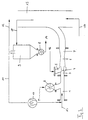
- the reference numerals designate: 1 an inlet section, 2 a rotary valve, 3 a nozzle prechamber, 4 a Laval nozzle (also referred to as a driving nozzle), 5 a Head piece on the Laval nozzle, 6 an inlet diffuser, 7 an outlet diffuser, 8 an outlet lock, 9 a cyclone separator, 10 a compressor, 11 a recirculation system, 12 a Exhaust system, 13 a carrier flow, 14 a tobacco discharge from the cyclone separator, 15 a drying tower, 16 an optional casing / flavor feed, 17 an air supply to the drying tower and 18 the discharge from the drying tower.
- T indicates tobacco material.
- the same reference symbols indicate similar components.
- Figures 1 and 2 show those embodiments of the invention in which the tobacco material in the inlet section, i.e. on the pressure side of the Laval nozzle into the carrier flow 13 is fed.
- the tobacco is passed through a lock, preferably through a Rotary valve 2, which is suitable for larger differential and absolute pressures, into the inlet section 1 funded.
- a Rotary valve 2 which is suitable for larger differential and absolute pressures
- There the tobacco is mixed with the carrier flow 13, prewarned and dampened when using steam.
- the mass flow ratio of carrier flow Tobacco material can be made simply by choosing the narrowest cross section in the Laval nozzle 4 (driving nozzle) can be set for a given mass flow of the tobacco material. For example, at 2 bar saturated steam admission pressure (approx.
- This method variant according to FIG. 1 is preferably the one following the expansion Displayed tobacco drying process, which the carrier flow 13 is not a drying or Use the transport medium.
- These are e.g. B. the drum, vibro / fluidized or Belt drying.
- These drying processes require the prior separation of tobacco material and carrier flow by means of a tobacco separator, preferably one Centrifugal separator 9, such as. B. cyclone or tangential separator.
- a tobacco separator preferably one Centrifugal separator 9, such as. B. cyclone or tangential separator.
- the tobacco discharge 14 from negative pressure to atmospheric pressure.
- the negative pressure in the tobacco separator 9 can be maintained, for example, by a vacuum pump, not shown become.
- the tobacco material is deposited after a pass through an airflow dryer, here a drying tower 15.
- the tobacco is produced directly without separating the carrier flow 13 after passing through the diffuser 6/7 passed into the drying tower 15 and after wetting over the tobacco separator 9, preferably a centrifugal separator, such as. B. cyclone or tangential separator, by means of a discharge lock 8 discharged (arrow 14).
- a centrifugal separator such as. B. cyclone or tangential separator
- an expansion mode of operation is preferred, in which in the outlet diffuser 7 pressures are present, which are between 0.9-1.1 bar.
- the two variants according to FIGS. 1 and 2 have in common the option of recirculation / partial recirculation mode by means of a circulating air system 11 for reusing the carrier flow 13, preferably with air as the carrier flow 13, which, when considering the economy as particularly inexpensive solution can be used.
- both variants optionally allow the introduction of liquid / solid additives (casing, Flavor) in the head area 5 on the Laval nozzle 4, as shown in Fig.2 with the reference drawing 16 is indicated.
- Figures 3 and 4 show variants according to the invention, in which the tobacco material supply takes place on the suction side of the nozzle 4.
- the apparatus (nozzle 4, inlet diffuser 6,) and the pre-pressure in front of the nozzle 4 should be for this Process variant be designed so that the minimum achievable at the outlet of the nozzle 4 Pressure. This can increase the pressure caused by the lock 2 leaking air occurs, can be compensated.
- the tobacco material should be on a before entering the nozzle 4 Preheated to a temperature above 90 ° C (e.g. through a steam tunnel) the tobacco material in the vacuum region of the nozzle 4 ( ⁇ 1 bar) suddenly into that described above Area of a thermodynamic imbalance and thereby water Cooling is evaporated. As already described, it depends on the desired process pressure in the tobacco separator 9, the steam is compressed accordingly with the aid of the outlet diffuser 7.
- This variant of the method is in turn preferred for those following the expansion Tobacco drying process displayed that the carrier flow 13 is not a drying or Use the transport medium.
- These are e.g. B. drum, vibro / fluidized bed or belt drying.
- These drying processes require the prior separation of tobacco and Carrier flow, which by means of a tobacco separator 9, preferably a centrifugal separator, such as B. cyclone or tangential separator.
- the Tobacco discharge 14 takes place from the vacuum to the atmospheric pressure range.
- FIG. 4 again shows an embodiment with a separation after passing through an air flow dryer.
- the Tobacco material in the head area 5 introduced into the device.
- the further for the Fig. 3 described method is also used (except for the separation in the separator directly after the expansion nozzle). The difference lies in the combination of the contribution of the tobacco material on the suction side of the nozzle with the separation of the tobacco after passing through an air dryer.
- the tobacco material is directly after again without separating the carrier flow Passing the diffuser 6/7 into the drying tower 15 and after wetting / drying over a tobacco separator 9, preferably a centrifugal separator such.
- a tobacco separator 9 preferably a centrifugal separator such.
- the blowing agent is necessary to adapt to the conditions in the drying tower 15 with regard to speeds and pressure.
- an expansion mode of operation is preferred in which Outlet diffuser 7 pressures are present, which are between 0.9 to 1.1 bar.
- Both variants (Fig. 3 and 4) is again the option of recirculation / partial recirculation mode (Reference number 11) for reusing the carrier flow together, preferably with air as the carrier flow.
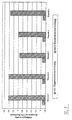
- FIG. 5 shows a bar diagram which shows the increase in filling capacity in the case of the invention Process and in comparison processes according to the prior art.
- the Test parameters are shown below:
- parameter total area Preferred area Carrier flow pressure in front of the nozzle 1-30 bar 1-10 bar Carrier flow temperature in front of the nozzle 50-450 ° C 100-250 ° C Carrier flow pressure in the nozzle > 0-2 bar 0.2-1.0 bar Carrier flow pressure in outlet diffuser (item 7) > 0-2 bar 0.2-1.1 bar Tobacco moisture in front of the rotary valve 10-60% (wet basis) 17-45% (wet basis) Tobacco temperature in front of the rotary valve 10-100 ° C 20-95 ° C Ratio of carrier flow mass flow / tobacco mass flow 0.1-10 (kg / h) / (kg / h) 0.2-1 (kg / h) / (kg / h) Vapor content carrier flow 10-100% (mass percentage wet basis) 50-100% (mass percentage wet basis)
Landscapes
- Manufacture Of Tobacco Products (AREA)
- Seasonings (AREA)
- Drying Of Solid Materials (AREA)
- Confectionery (AREA)
- Formation And Processing Of Food Products (AREA)
- Supplying Of Containers To The Packaging Station (AREA)
Abstract
Description
- Fig. 1
- eine Schemadarstellung einer Expansionsvorrichtung für Tabakmaterial mit einem anschließenden Zyklonabscheider gemäß einer ersten Ausführungsform der Erfindung;
- Fig. 2
- eine Schemadarstellung einer Expansionsvorrichtung für Tabakmaterial mit einem anschließenden Trockenturm gemäß einer zweiten Ausführungsform der Erfindung;
- Fig. 3
- eine Schemadarstellung einer Expansionsvorrichtung für Tabakmaterial mit einem anschließenden Zyklonabscheider und einer Tabakmaterialzuführung an einer Lavaldüse gemäß einer dritten Ausführungsform der Erfindung;
- Fig. 4
- eine Schemadarstellung einer Expansionsvorrichtung für Tabakmaterial mit einem anschließenden Trockenturm und einer Tabakmaterialzuführung an einer Lavaldüse gemäß einer vierten Ausführungsform der Erfindung;
- Fig.5
- ein Balkendiagramm, das die Füllfähigkeitssteigerung bei erfindungsgemäßen Verfahren und bei Vergleichsverfahren nach dem Stand der Technik gegenüberstellt; und
- Fig. 6
- eine schematische Darstellung eines Düsenquerschnittes mit Druck- und Geschwindigkeitsverläufen für den kritischen und nicht kritischen Betrieb.
- Tabakmaterial:
- Standard-Rippenmischung,
- Anlagenaufbau:
- siehe Fig. 1 (ohne Verdichter 10, ohne Umluft, ohne optionales Casing,
Flavour)
Düsen-Durchmesser: 15 mm - Trägerströmung:
- Sattdampf
- Parameter:
- 2,2 bar Vordruck (Pos. 3), Druck in Düse 0,6 bar (Pos. 6), Dampftemperatur
ca. 123°C in Pos. 3, Dampftemperatur in Zyklon (Pos. 9) ca. 100°C,
Dampfdruck in Zyklon (Pos. 9) ca. 1 bar
Trägerströmungsmassenstrom-/Tabakmassenstromverhältnis 0.67,
Tabakfeuchte vor Expansionsvorrichtung (vor Schleuse Pos. 2) ca. 40 % (Feuchtbasis),
Tabakfeuchte nach Expansionsvorrichtung (nach Zyklon Pos. 9) ca. 43,5 % (Feuchtbasis)
- Tabakmaterial:
- Standard-Rippenmischung,
- Anlagenaufbau:
- siehe Fig. 1 (ohne Verdichter 10, ohne Umluft, ohne optional Casing,
Flavour)
Düsen-Durchmesser: 15 mm - Trägerströmung:
- Sattdampf
- Parameter:
- 2,2 bar Vordruck (Pos. 3), Druck in Düse 0,65 bar (Pos. 6), Dampftemperatur
ca. 123°C in Pos. 3, Dampftemperatur in Zyklon (Pos. 9) ca. 100°C,
Dampfdruck in Zyklon (Pos. 9) ca. 1 bar
Trägerströmungsmassenstrom-/Tabakmassenstromverhältnis 0.43,
Tabakfeuchte vor Expansionsvorrichtung (vor Schleuse Pos. 2) ca. 40 % (Feuchtbasis),
Tabakfeuchte nach Expansionsvorrichtung (nach Zyklon Pos. 9) ca. 43 % (Feuchtbasis)
- Tabakmaterial:
- Standard-Rippenmischung,
- Anlagenaufbau:
- Handelsübliche STS-Vorrichtung
- Trägerströmung:
- Sattdampf
- Parameter:
- Trägerströmungsmassenstrom-/Tabakmassenstromverhältnis 0.67,
Tabakfeuchte vor Expansionsvorrichtung ca. 40 % (Feuchtbasis),
Tabakfeuchte nach Expansionsvorrichtung ca. 44 % (Feuchtbasis)
- Tabakmaterial:
- Standard-Rippenmischung,
- Anlagenaufbau:
- Handelsübliche STS-Vorrichtung
- Trägerströmung:
- Sattdampf
- Parameter:
- Trägerströmungsmassenstrom-/Tabakmassenstromverhältnis 0.47,
Tabakfeuchte vor Expansionsvorrichtung ca. 40,7 % (Feuchtbasis),
Tabakfeuchte nach Expansionsvorrichtung ca. 44,3 % (Feuchtbasis)
- Tabakmaterial:
- Standard-Rippenmischung,
- Anlagenaufbau:
- siehe Fig. 1 (ohne Verdichter 10, ohne Umluft, mit Casing in Saugstutzen
(Pos. 5),
Düsen-Durchmesser: 15 mm - Trägerströmung:
- Sattdampf
- Parameter:
- 2,2 bar Vordruck (Pos. 3), Druck in Düse 0,6 bar (Pos. 6), Dampftemperatur
ca. 123°C in Pos. 3, Dampftemperatur in Zyklon (Pos. 9) ca. 100°C,
Dampfdruck in Zyklon (Pos. 9) ca. 1 bar
Trägerströmungsmassenstrom-/Tabakmassenstromverhältnis 0.67,
Tabakfeuchte vor Expansionsvorrichtung (vor Schleuse Pos. 2) ca. 40 % (Feuchtbasis),
Tabakfeuchte nach Expansionsvorrichtung (nach Zyklon Pos. 9) ca. 46 % (Feuchtbasis)
| Parameter | Gesamtbereich | Bevorzugter Bereich |
| Trägerströmungs-Druck vor Düse | 1-30 bar | 1-10 bar |
| Trägerströmungs-Temperatur vor Düse | 50-450°C | 100-250°C |
| Trägerströmungs-Druck in Düse | >0-2 bar | 0,2-1,0 bar |
| Trägerströmungs-Druck in Auslaufdiffusor (Pos. 7) | >0-2 bar | 0,2-1,1 bar |
| Tabakfeuchte vor Einlass-Zellradschleuse | 10-60% (Feuchtbasis) | 17-45% (Feuchtbasis) |
| Tabaktemperatur vor Einlass-Zellradschleuse | 10-100°C | 20-95°C |
| Verhältnis Trägerströmungsmassenstrom/Tabakmassenstrom | 0,1-10 (kg/h)/(kg/h) | 0,2-1 (kg/h)/(kg/h) |
| Dampfgehalt Trägerströmung | 10-100% (Massenprozent Feuchtbasis) | 50-100% (Massenprozent Feuchtbasis) |
Claims (24)
- Verfahren zur Expansion von expansionsfähigen Nahrungs- bzw. Genussmitteln, bei dem die Nahrungs- bzw. Genussmittel in einer Dampf enthaltenden Trägerströmung (13) eine Expansionszone durchlaufen, die eine Lavaldüse (4) umfasst, bei der im engsten Querschnitt Schallgeschwindigkeit erreicht wird.
- Verfahren nach Anspruch 1, dadurch gekennzeichnet, dass Tabakmaterial, insbesondere feuchtes Tabakmaterial (T) expandiert wird.
- Verfahren nach Anspruch 1, dadurch gekennzeichnet, dass feste, faser-, korn- bzw. bohnenförmige, oder blattförmige Nahrungs- bzw. Genussmittel expandiert werden.
- Verfahren nach Anspruch 3, dadurch gekennzeichnet, dass eines oder mehrere der folgenden Nahrungs- bzw. Genussmittel expandiert werden: Getreide und Hülsenfrüchte, Cerealien, Gerste, Mais, Bohnen, Weizen, Reis, Erbsen.
- Verfahren nach einem der Ansprüche 1 bis 4, dadurch gekennzeichnet, dass die Trägerströmung (13) einen Dampfgehalt von 10 bis 100 % aufweist, und/oder die Tabakeingangsfeuchte 10 bis 60 % (Feuchtbasis) vorzugsweise 17 bis 45 % (Feuchtbasis) beträgt.
- Verfahren nach einem der Ansprüche 1 bis 5, dadurch gekennzeichnet, dass die Trägerströmung (13) Sattdampf aufweist.
- Verfahren nach einem der Ansprüche 1 bis 6, dadurch gekennzeichnet, dass die Trägerströmung (13) überhitzten Dampf aufweist.
- Verfahren nach einem der Ansprüche 1 bis 7, dadurch gekennzeichnet, dass der Druck der Trägerströmung (13) vor der Lavaldüse in einem Bereich von weniger als 1 bar bis etwa 30 bar, vorzugsweise 1 bar bis 30 bar und insbesondere 1 bar bis 10 bar liegt, und dass die Temperatur der Trägerströmung (13) vor der Lavaldüse (4) in einem Bereich von 50°C bis 450°C, vorzugsweise in einem Bereich von 100°C bis 300°C liegt.
- Verfahren nach einem der Ansprüche 1 bis 8, dadurch gekennzeichnet, dass der Druck am Ausgang der Lavaldüse (4) bei 0 bar bis 2 bar, vorzugsweise bei 0,2 bar bis 1 bar liegt.
- Verfahren nach einem der Ansprüche 1 bis 9, dadurch gekennzeichnet, dass die Trägerströmung (13) vor dem Einbringen der Nahrungs- bzw. Genussmittel, insbesondere des Tabakmaterials überhitzt wird.
- Verfahren nach einem der Ansprüche 1 bis 10, dadurch gekennzeichnet, dass die Trägerströmung eine Einlaufstrecke (1), eine Düsenvorkammer (3), die Lavaldüse (4), einen Einlaufdiffusor (6), und einen Auslaufdiffusor (7) durchläuft.
- Verfahren nach Anspruch 11, dadurch gekennzeichnet, dass die Nahrungs- bzw. Genussmittel, insbesondere das Tabakmaterial der Trägerströmung (13) in der Einlaufstrecke (1) vor der Lavaldüse (4), vorzugsweise über eine Zellradschleuse (2) mit einem an die Einlaufstrecke (1) ansetzenden Kopfstück (5), zugeführt werden.
- Verfahren nach Anspruch 11, dadurch gekennzeichnet, dass die Nahrungs- bzw. Genussmittel, insbesondere das Tabakmaterial der Trägerströmung (13) an der Lavaldüse (4) im Bereich des minimalen Druckes, vorzugsweise über eine Zellradschleuse (2) mit einem an die Lavaldüse (4) angesetzten Kopfstück (5), zugeführt werden.
- Verfahren nach einem der Ansprüche 11 bis 13, dadurch gekennzeichnet, dass die Nahrungs- bzw. Genussmittel, insbesondere das Tabakmaterial nach dem Durchgang durch den Auslaufdiffusor (7) einem Abscheider, insbesondere einem Tabakabscheider (9), speziell einem Fliehkraftabscheider zugeführt werden, dessen Unterdruck vorzugsweise mittels einer Unterdruckpumpe aufrechterhalten wird.
- Verfahren nach einem der Ansprüche 11 bis 13, dadurch gekennzeichnet, dass die Nahrungs- bzw. Genussmittel, insbesondere das Tabakmaterial nach dem Durchgang durch den Auslaufdiffusor (7) zunächst einem Luftstromtrockner (15) und danach einem Abscheider, insbesondere einem Tabakabscheider (9), speziell einem Fliehkraftabscheider zugeführt wird.
- Verfahren nach einem der Ansprüche 14 oder 15, dadurch gekennzeichnet, dass die Gasströmung, welche die an den Auslaufdiffusor (7) anschließenden Bauteile passiert, mittels eines Umluftsystems (11) gesammelt, verdichtet und wieder als Trägerströmungsanteil verwendet wird.
- Vorrichtung zur Expansion von Nahrungs- bzw. Genussmitteln, insbesondere feuchtem Tabakmaterial (T) mit Strömungsführungseinrichtungen (1, 3, 4, 6, 7), in denen die Nahrungs- bzw. Genussmittel, insbesondere das Tabakmaterial (T) in einer Dampf enthaltenden Trägerströmung (13) eine Expansionszone durchlaufen, dadurch gekennzeichnet, dass die Strömungsführungseinrichtungen eine Lavaldüse (4) umfassen, die so betrieben wird, dass in ihrem engsten Querschnitt Schallgeschwindigkeit erreicht wird.
- Vorrichtung nach Anspruch 17, dadurch gekennzeichnet, dass sie eine Einrichtung, insbesondere einem Wärmetauscher aufweist, der die Trägerströmung (13) vor dem Einbringen des Tabakmaterials überhitzt.
- Verfahren nach Ansprüche 17 oder 18, dadurch gekennzeichnet, dass die Strömungsführungseinrichtungen eine Einlaufstrecke (1), eine Düsenvorkammer (3), die Lavaldüse (4), einen Einlaufdiffusor (6), und einen Auslaufdiffusor (7) umfassen.
- Vorrichtung nach Anspruch 19, dadurch gekennzeichnet, dass sie eine Zellradschleuse (2) mit einem an die Einlaufstrecke (1) ansetzenden Kopfstück (5) aufweist, mittels der die Nahrungs- bzw. Genussmittel, insbesondere das Tabakmaterial der Trägerströmung (13) in der Einlaufstrecke (1) vor der Lavaldüse (4) zugeführt werden.
- Vorrichtung nach Anspruch 19, dadurch gekennzeichnet, dass sie eine Zellradschleuse (2) mit einem an die Lavaldüse (4) ansetzenden Kopfstück (5) aufweist, mittels der die Nahrungs- bzw. Genussmittel, insbesondere das Tabakmaterial der Trägerströmung (13) an der Lavaldüse (4) im Bereich des minimalsten Druckes, zugeführt werden.
- Vorrichtung nach einem der Ansprüche 19 bis 21, dadurch gekennzeichnet, dass sie einen Abscheider, insbesondere einen Tabakabscheider (9), speziell einem Fliehkraftabscheider, aufweist, dem die Nahrungs- bzw. Genussmittel, insbesondere das Tabakmaterial nach dem Durchgang durch den Auslaufdiffusor (7) zugeführt werden, und dessen Unterdruck vorzugsweise mittels einer Unterdruckpumpe aufrechterhalten wird.
- Vorrichtung nach einem der Ansprüche 19 bis 21, dadurch gekennzeichnet, dass sie einen Luftstromtrockner (15) und an diesen anschließend einen Abscheider, insbesondere einen Tabakabscheider (9), speziell einem Fliehkraftabscheider, aufweist, denen die Nahrungs- bzw. Genussmittel, insbesondere das Tabakmaterial nach dem Durchgang durch den Auslaufdiffusor (7) zugeführt werden.
- Vorrichtung nach einem der Ansprüche 22 oder 23, dadurch gekennzeichnet, dass sie ein Umluftsystem (11) aufweist, mittels dem die Gasströmung, welche die an den Auslaufdiffusor (7) anschließenden Bauteile passiert, gesammelt, verdichtet und wieder der Trägerströmung zugeführt wird.
Applications Claiming Priority (2)
| Application Number | Priority Date | Filing Date | Title |
|---|---|---|---|
| DE19909318 | 1999-03-03 | ||
| DE19909318A DE19909318C2 (de) | 1999-03-03 | 1999-03-03 | Verfahren und Vorrichtung zur Expansion von Tabakmaterial |
Publications (3)
| Publication Number | Publication Date |
|---|---|
| EP1033081A2 true EP1033081A2 (de) | 2000-09-06 |
| EP1033081A3 EP1033081A3 (de) | 2001-02-07 |
| EP1033081B1 EP1033081B1 (de) | 2005-12-21 |
Family
ID=7899573
Family Applications (1)
| Application Number | Title | Priority Date | Filing Date |
|---|---|---|---|
| EP00102159A Expired - Lifetime EP1033081B1 (de) | 1999-03-03 | 2000-02-08 | Verfahren und Vorrichtung zur Expansion von Nahrungs- und Genussmitteln |
Country Status (8)
| Country | Link |
|---|---|
| US (2) | US6397851B1 (de) |
| EP (1) | EP1033081B1 (de) |
| AT (1) | ATE313276T1 (de) |
| AU (1) | AU758500B2 (de) |
| BR (1) | BR0000725B1 (de) |
| CA (1) | CA2300022C (de) |
| DE (2) | DE19909318C2 (de) |
| PL (1) | PL192942B1 (de) |
Cited By (2)
| Publication number | Priority date | Publication date | Assignee | Title |
|---|---|---|---|---|
| WO2007134879A1 (de) * | 2006-05-23 | 2007-11-29 | Hauni Maschinenbau Ag | Stromtrockner zum trocknen eines faserförmigen tabakprodukts |
| CN109090686A (zh) * | 2018-09-14 | 2018-12-28 | 厦门烟草工业有限责任公司 | 一种烟草处理系统和处理方法 |
Families Citing this family (14)
| Publication number | Priority date | Publication date | Assignee | Title |
|---|---|---|---|---|
| GB9922746D0 (en) * | 1999-09-24 | 1999-11-24 | Rothmans International Ltd | Tobacco processing |
| DE10117783A1 (de) * | 2001-04-10 | 2002-10-24 | Bat Cigarettenfab Gmbh | Prozessgasaufbereitung für Tabaktrockner |
| US7556047B2 (en) * | 2003-03-20 | 2009-07-07 | R.J. Reynolds Tobacco Company | Method of expanding tobacco using steam |
| EP1729602A1 (de) | 2003-12-22 | 2006-12-13 | U.S. Smokeless Tobacco Company | Konditionierungsverfahren für tabak- und/oder schnupftabakzusammensetzung |
| DE102004017596A1 (de) * | 2004-04-07 | 2005-11-03 | Hauni Primary Gmbh | Vorrichtung zum Konditionieren eines Tabakprodukts |
| PL211481B1 (pl) * | 2007-05-30 | 2012-05-31 | Int Tobacco Machinery Poland | Sposób zwiększenia sprawności suszarki, zwłaszcza suszarki strumieniowej |
| IT1400928B1 (it) * | 2010-07-05 | 2013-07-02 | Comas Costruzioni Macchine Speciali S P A | Impianto di espansione del trinciato di lamina/costola di tabacco. |
| GB2511331A (en) * | 2013-02-28 | 2014-09-03 | Dickinson Legg Ltd | Drying Apparatus |
| US9518779B2 (en) * | 2014-04-04 | 2016-12-13 | Garbuio S.P.A. | Drying plant for particulate materials |
| CN110238053B (zh) * | 2019-05-30 | 2024-06-21 | 广州励美环保科技有限公司 | 负压吸附捕集器 |
| EP3771349B1 (de) | 2019-07-30 | 2024-04-17 | Muzer Makina Sanayi Ve Ticaret Ltd. Sti. | Tabakexpansionssystem (tes) |
| JP7422392B2 (ja) * | 2020-03-03 | 2024-01-26 | フロイント産業株式会社 | 乾燥装置 |
| EP4155639A1 (de) * | 2021-09-22 | 2023-03-29 | Proxipel SA | Verfahren und vorrichtung zum trocknen von biomasse |
| CN118177408B (zh) * | 2024-05-15 | 2024-09-06 | 河北白沙烟草有限责任公司保定卷烟厂 | 一种烟丝增湿及分离装置 |
Family Cites Families (13)
| Publication number | Priority date | Publication date | Assignee | Title |
|---|---|---|---|---|
| US4377173A (en) * | 1979-02-16 | 1983-03-22 | Airco, Inc. | Methods and apparatus for expanding tobacco |
| US4248253A (en) * | 1979-06-11 | 1981-02-03 | Brown & Williamson Tobacco Corp. | Method for separating veins from lamina of tobacco leaf |
| DE3147846C2 (de) * | 1981-09-05 | 1984-07-19 | B.A.T. Cigaretten-Fabriken Gmbh, 2000 Hamburg | Verfahren zur Verbesserung der Füllfähigkeit von Tabakmaterial |
| US4418706A (en) * | 1981-09-21 | 1983-12-06 | Office Of Monopoly | Method for expanding tobacco and apparatus therefor |
| US4407306A (en) * | 1981-12-17 | 1983-10-04 | American Brands, Inc. | Method for expanding tobacco with steam at high temperature and velocity |
| CH658367A5 (de) * | 1982-05-11 | 1986-11-14 | Hauni Werke Koerber & Co Kg | Verfahren und vorrichtung zum volumenvergroessern von tabak. |
| DE3315274A1 (de) * | 1982-05-11 | 1983-11-17 | Hauni-Werke Körber & Co KG, 2050 Hamburg | Verfahren und vorrichtung zum volumenvergroessern von tabak |
| US4528995A (en) * | 1983-10-13 | 1985-07-16 | Brown & Williamson Tobacco Corporation | Sealed pneumatic tobacco conveying and treating apparatus |
| GB8530019D0 (en) * | 1985-12-05 | 1986-01-15 | British American Tobacco Co | Expansion of vegetable material |
| AU644736B2 (en) * | 1991-05-20 | 1993-12-16 | Japan Tobacco Inc. | Expanding apparatus for agricultural product or the like |
| CH683226A5 (de) * | 1991-12-09 | 1994-02-15 | Egri Laszlo | Expandieren und Trocknen von Tabak. |
| JPH07294371A (ja) * | 1994-04-28 | 1995-11-10 | Mitsubishi Heavy Ind Ltd | 超音速風洞 |
| DE19734364A1 (de) * | 1997-08-08 | 1999-02-11 | Hauni Maschinenbau Ag | Verfahren und Vorrichtung zum Aufbringen eines Konditionierungsmediums auf Tabakmaterial |
-
1999
- 1999-03-03 DE DE19909318A patent/DE19909318C2/de not_active Expired - Lifetime
-
2000
- 2000-02-08 DE DE50011878T patent/DE50011878D1/de not_active Expired - Lifetime
- 2000-02-08 AT AT00102159T patent/ATE313276T1/de not_active IP Right Cessation
- 2000-02-08 EP EP00102159A patent/EP1033081B1/de not_active Expired - Lifetime
- 2000-02-25 CA CA002300022A patent/CA2300022C/en not_active Expired - Lifetime
- 2000-03-02 BR BRPI0000725-0A patent/BR0000725B1/pt not_active IP Right Cessation
- 2000-03-02 US US09/517,397 patent/US6397851B1/en not_active Expired - Lifetime
- 2000-03-02 PL PL338751A patent/PL192942B1/pl unknown
- 2000-03-03 AU AU20631/00A patent/AU758500B2/en not_active Expired
-
2002
- 2002-06-03 US US10/160,913 patent/US6834653B2/en not_active Expired - Lifetime
Cited By (3)
| Publication number | Priority date | Publication date | Assignee | Title |
|---|---|---|---|---|
| WO2007134879A1 (de) * | 2006-05-23 | 2007-11-29 | Hauni Maschinenbau Ag | Stromtrockner zum trocknen eines faserförmigen tabakprodukts |
| CN109090686A (zh) * | 2018-09-14 | 2018-12-28 | 厦门烟草工业有限责任公司 | 一种烟草处理系统和处理方法 |
| CN109090686B (zh) * | 2018-09-14 | 2021-06-04 | 厦门烟草工业有限责任公司 | 一种烟草处理系统和处理方法 |
Also Published As
| Publication number | Publication date |
|---|---|
| US6834653B2 (en) | 2004-12-28 |
| DE50011878D1 (de) | 2006-01-26 |
| BR0000725B1 (pt) | 2010-12-28 |
| PL192942B1 (pl) | 2006-12-29 |
| CA2300022A1 (en) | 2000-09-03 |
| EP1033081A3 (de) | 2001-02-07 |
| DE19909318A1 (de) | 2000-09-14 |
| PL338751A1 (en) | 2000-09-11 |
| BR0000725A (pt) | 2000-10-31 |
| AU2063100A (en) | 2000-09-07 |
| EP1033081B1 (de) | 2005-12-21 |
| ATE313276T1 (de) | 2006-01-15 |
| DE19909318C2 (de) | 2001-06-28 |
| CA2300022C (en) | 2007-09-18 |
| US20020189624A1 (en) | 2002-12-19 |
| US6397851B1 (en) | 2002-06-04 |
| AU758500B2 (en) | 2003-03-20 |
Similar Documents
| Publication | Publication Date | Title |
|---|---|---|
| EP1033081B1 (de) | Verfahren und Vorrichtung zur Expansion von Nahrungs- und Genussmitteln | |
| EP1353572B1 (de) | Verfahren zum behandeln von tabak | |
| DE69310546T2 (de) | Verfahren und vorrichtung zur trocknung und kalzinierung von natriumbicarbonat | |
| EP0074059A2 (de) | Verfahren zur Verbesserung der Füllfähigkeit von Tabakmaterial | |
| DE2125945A1 (de) | Verfahren und Vorrichtung zur Sprüh trocknung | |
| DD247834A5 (de) | Verfahren und vorrichtung zur behandlung von teilchenfoermigem material | |
| DE1604900A1 (de) | Verfahren und Vorrichtung zur Schnelltrocknung | |
| EP1177730A1 (de) | Verfahren und Vorrichtung zur Konditionierung von zerkleinerten Tabakmaterialien | |
| EP0065222B1 (de) | Verfahren zum Trocknen von durch Hochdruckextraktion hergestellten Naturstoffextrakten aus Pflanzen und Pflanzenteilen | |
| WO2007104389A1 (de) | Trocknungsvorrichtung für tabak | |
| EP0713412A1 (de) | Verwendung von überhitztem wasserdampf zur praktisch abgasfreien trocknung von wertstoffen und temperatursensitiven wertstoffgemischen und damit hergestellte trockenprodukte mit verbesserten eigenschaften | |
| EP0123116B1 (de) | Verfahren zur Verbesserung der Füllfähigkeit von Tabak | |
| EP0049534B1 (de) | Verfahren zur Volumenänderung von zerkleinerten Tabakrippen und Vorrichtung zur Durchführung des Verfahrens | |
| DE10046124C1 (de) | Verfahren zur Verbesserung der Füllfähigkeit von Tabak | |
| DE3818915A1 (de) | Verfahren zur explosionszerkleinerung von zellmaterial | |
| DE3705879C2 (de) | ||
| DE2231722A1 (de) | Verfahren und vorrichtung zum entfernen von fluessigkeit von nassen oder feuchten teilchen | |
| DE3602098A1 (de) | Verbessertes tabak-expansionsverfahren | |
| DE4142631A1 (de) | Verfahren und anordnung zum trennen von tabakrippenfasern und zusammengeklebten tabakblattfasern | |
| DE2731931C2 (de) | ||
| DE3780849T2 (de) | Rueckgewinnung und uebertragung von aroma. | |
| DE2147878A1 (de) | Verfahren zum Herstellen von gefrier getrockneten Kaffee oder Tee Extrakten und Vorrichtung zur Durchfuhrung des Verfahrens | |
| DE2834501A1 (de) | Verfahren zum expandieren von tabak | |
| WO1990006695A1 (de) | Verfahren und vorrichtung zum expandieren von tabak | |
| DE3841915C1 (en) | Tobacco heat treatment plant - incorporates drums with wetting jets and revolving blades |
Legal Events
| Date | Code | Title | Description |
|---|---|---|---|
| PUAI | Public reference made under article 153(3) epc to a published international application that has entered the european phase |
Free format text: ORIGINAL CODE: 0009012 |
|
| AK | Designated contracting states |
Kind code of ref document: A2 Designated state(s): AT BE CH CY DE DK ES FI FR GB GR IE IT LI LU MC NL PT SE |
|
| AX | Request for extension of the european patent |
Free format text: AL;LT;LV;MK;RO;SI |
|
| PUAL | Search report despatched |
Free format text: ORIGINAL CODE: 0009013 |
|
| AK | Designated contracting states |
Kind code of ref document: A3 Designated state(s): AT BE CH CY DE DK ES FI FR GB GR IE IT LI LU MC NL PT SE |
|
| AX | Request for extension of the european patent |
Free format text: AL;LT;LV;MK;RO;SI |
|
| 17P | Request for examination filed |
Effective date: 20010301 |
|
| AKX | Designation fees paid |
Free format text: AT BE CH CY DE DK ES FI FR GB GR IE IT LI LU MC NL PT SE |
|
| 17Q | First examination report despatched |
Effective date: 20030415 |
|
| GRAP | Despatch of communication of intention to grant a patent |
Free format text: ORIGINAL CODE: EPIDOSNIGR1 |
|
| GRAS | Grant fee paid |
Free format text: ORIGINAL CODE: EPIDOSNIGR3 |
|
| GRAA | (expected) grant |
Free format text: ORIGINAL CODE: 0009210 |
|
| AK | Designated contracting states |
Kind code of ref document: B1 Designated state(s): AT BE CH CY DE DK ES FI FR GB GR IE IT LI LU MC NL PT SE |
|
| PG25 | Lapsed in a contracting state [announced via postgrant information from national office to epo] |
Ref country code: IE Free format text: LAPSE BECAUSE OF FAILURE TO SUBMIT A TRANSLATION OF THE DESCRIPTION OR TO PAY THE FEE WITHIN THE PRESCRIBED TIME-LIMIT Effective date: 20051221 Ref country code: FI Free format text: LAPSE BECAUSE OF FAILURE TO SUBMIT A TRANSLATION OF THE DESCRIPTION OR TO PAY THE FEE WITHIN THE PRESCRIBED TIME-LIMIT Effective date: 20051221 |
|
| REG | Reference to a national code |
Ref country code: GB Ref legal event code: FG4D Free format text: NOT ENGLISH |
|
| REG | Reference to a national code |
Ref country code: CH Ref legal event code: NV Representative=s name: KIRKER & CIE SA Ref country code: CH Ref legal event code: EP |
|
| REG | Reference to a national code |
Ref country code: IE Ref legal event code: FG4D Free format text: LANGUAGE OF EP DOCUMENT: GERMAN |
|
| REF | Corresponds to: |
Ref document number: 50011878 Country of ref document: DE Date of ref document: 20060126 Kind code of ref document: P |
|
| PG25 | Lapsed in a contracting state [announced via postgrant information from national office to epo] |
Ref country code: AT Free format text: LAPSE BECAUSE OF NON-PAYMENT OF DUE FEES Effective date: 20060208 |
|
| PG25 | Lapsed in a contracting state [announced via postgrant information from national office to epo] |
Ref country code: MC Free format text: LAPSE BECAUSE OF NON-PAYMENT OF DUE FEES Effective date: 20060228 Ref country code: BE Free format text: LAPSE BECAUSE OF NON-PAYMENT OF DUE FEES Effective date: 20060228 Ref country code: LU Free format text: LAPSE BECAUSE OF NON-PAYMENT OF DUE FEES Effective date: 20060228 |
|
| PG25 | Lapsed in a contracting state [announced via postgrant information from national office to epo] |
Ref country code: DK Free format text: LAPSE BECAUSE OF FAILURE TO SUBMIT A TRANSLATION OF THE DESCRIPTION OR TO PAY THE FEE WITHIN THE PRESCRIBED TIME-LIMIT Effective date: 20060321 Ref country code: GR Free format text: LAPSE BECAUSE OF FAILURE TO SUBMIT A TRANSLATION OF THE DESCRIPTION OR TO PAY THE FEE WITHIN THE PRESCRIBED TIME-LIMIT Effective date: 20060321 Ref country code: SE Free format text: LAPSE BECAUSE OF FAILURE TO SUBMIT A TRANSLATION OF THE DESCRIPTION OR TO PAY THE FEE WITHIN THE PRESCRIBED TIME-LIMIT Effective date: 20060321 |
|
| GBT | Gb: translation of ep patent filed (gb section 77(6)(a)/1977) |
Effective date: 20060227 |
|
| PG25 | Lapsed in a contracting state [announced via postgrant information from national office to epo] |
Ref country code: ES Free format text: LAPSE BECAUSE OF FAILURE TO SUBMIT A TRANSLATION OF THE DESCRIPTION OR TO PAY THE FEE WITHIN THE PRESCRIBED TIME-LIMIT Effective date: 20060401 |
|
| PG25 | Lapsed in a contracting state [announced via postgrant information from national office to epo] |
Ref country code: PT Free format text: LAPSE BECAUSE OF FAILURE TO SUBMIT A TRANSLATION OF THE DESCRIPTION OR TO PAY THE FEE WITHIN THE PRESCRIBED TIME-LIMIT Effective date: 20060522 |
|
| ET | Fr: translation filed | ||
| REG | Reference to a national code |
Ref country code: IE Ref legal event code: FD4D |
|
| PLBE | No opposition filed within time limit |
Free format text: ORIGINAL CODE: 0009261 |
|
| 26N | No opposition filed |
Effective date: 20060922 |
|
| BERE | Be: lapsed |
Owner name: BRITISH-AMERICAN TOBACCO (GERMANY) G.M.B.H. Effective date: 20060228 |
|
| PG25 | Lapsed in a contracting state [announced via postgrant information from national office to epo] |
Ref country code: CY Free format text: LAPSE BECAUSE OF FAILURE TO SUBMIT A TRANSLATION OF THE DESCRIPTION OR TO PAY THE FEE WITHIN THE PRESCRIBED TIME-LIMIT Effective date: 20051221 |
|
| PLAA | Information modified related to event that no opposition was filed |
Free format text: ORIGINAL CODE: 0009299DELT |
|
| PLBE | No opposition filed within time limit |
Free format text: ORIGINAL CODE: 0009261 |
|
| STAA | Information on the status of an ep patent application or granted ep patent |
Free format text: STATUS: NO OPPOSITION FILED WITHIN TIME LIMIT |
|
| R26N | No opposition filed (corrected) |
Effective date: 20060922 |
|
| RIN2 | Information on inventor provided after grant (corrected) |
Inventor name: WEISS, ARNO, DR. Inventor name: SCHMEKEL, GERALD Inventor name: PLUECKHAHN, FRANK |
|
| REG | Reference to a national code |
Ref country code: FR Ref legal event code: PLFP Year of fee payment: 17 |
|
| REG | Reference to a national code |
Ref country code: FR Ref legal event code: PLFP Year of fee payment: 18 |
|
| REG | Reference to a national code |
Ref country code: FR Ref legal event code: PLFP Year of fee payment: 19 |
|
| PGFP | Annual fee paid to national office [announced via postgrant information from national office to epo] |
Ref country code: NL Payment date: 20190218 Year of fee payment: 20 |
|
| PGFP | Annual fee paid to national office [announced via postgrant information from national office to epo] |
Ref country code: CH Payment date: 20190218 Year of fee payment: 20 Ref country code: DE Payment date: 20190219 Year of fee payment: 20 Ref country code: IT Payment date: 20190219 Year of fee payment: 20 Ref country code: GB Payment date: 20190218 Year of fee payment: 20 |
|
| PGFP | Annual fee paid to national office [announced via postgrant information from national office to epo] |
Ref country code: FR Payment date: 20190219 Year of fee payment: 20 |
|
| REG | Reference to a national code |
Ref country code: DE Ref legal event code: R071 Ref document number: 50011878 Country of ref document: DE |
|
| REG | Reference to a national code |
Ref country code: NL Ref legal event code: MK Effective date: 20200207 |
|
| REG | Reference to a national code |
Ref country code: CH Ref legal event code: PL |
|
| REG | Reference to a national code |
Ref country code: GB Ref legal event code: PE20 Expiry date: 20200207 |
|
| PG25 | Lapsed in a contracting state [announced via postgrant information from national office to epo] |
Ref country code: GB Free format text: LAPSE BECAUSE OF EXPIRATION OF PROTECTION Effective date: 20200207 |