EP1033577A2 - Support d'échantillon et dispositif pour éliminer un excess d'analyte incorporant un tel support - Google Patents
Support d'échantillon et dispositif pour éliminer un excess d'analyte incorporant un tel support Download PDFInfo
- Publication number
- EP1033577A2 EP1033577A2 EP00301778A EP00301778A EP1033577A2 EP 1033577 A2 EP1033577 A2 EP 1033577A2 EP 00301778 A EP00301778 A EP 00301778A EP 00301778 A EP00301778 A EP 00301778A EP 1033577 A2 EP1033577 A2 EP 1033577A2
- Authority
- EP
- European Patent Office
- Prior art keywords
- test piece
- piece holder
- capillary
- capillary grooves
- excess
- Prior art date
- Legal status (The legal status is an assumption and is not a legal conclusion. Google has not performed a legal analysis and makes no representation as to the accuracy of the status listed.)
- Granted
Links
- 238000012360 testing method Methods 0.000 title claims abstract description 118
- 239000012491 analyte Substances 0.000 title claims description 44
- 239000011148 porous material Substances 0.000 claims abstract description 30
- 238000004891 communication Methods 0.000 claims abstract description 8
- 230000000630 rising effect Effects 0.000 claims abstract description 7
- 210000002700 urine Anatomy 0.000 description 34
- 238000005259 measurement Methods 0.000 description 17
- 239000000126 substance Substances 0.000 description 15
- 238000006243 chemical reaction Methods 0.000 description 8
- WQZGKKKJIJFFOK-GASJEMHNSA-N Glucose Natural products OC[C@H]1OC(O)[C@H](O)[C@@H](O)[C@@H]1O WQZGKKKJIJFFOK-GASJEMHNSA-N 0.000 description 7
- 230000009471 action Effects 0.000 description 7
- 238000004458 analytical method Methods 0.000 description 7
- 239000008103 glucose Substances 0.000 description 7
- 238000009535 clinical urine test Methods 0.000 description 6
- 238000000465 moulding Methods 0.000 description 6
- 230000007246 mechanism Effects 0.000 description 5
- 230000003287 optical effect Effects 0.000 description 5
- 239000011347 resin Substances 0.000 description 5
- 229920005989 resin Polymers 0.000 description 5
- 238000012546 transfer Methods 0.000 description 5
- 229920000122 acrylonitrile butadiene styrene Polymers 0.000 description 4
- QVGXLLKOCUKJST-UHFFFAOYSA-N atomic oxygen Chemical compound [O] QVGXLLKOCUKJST-UHFFFAOYSA-N 0.000 description 3
- 229910052760 oxygen Inorganic materials 0.000 description 3
- 239000001301 oxygen Substances 0.000 description 3
- XLYOFNOQVPJJNP-UHFFFAOYSA-N water Substances O XLYOFNOQVPJJNP-UHFFFAOYSA-N 0.000 description 3
- 239000008280 blood Substances 0.000 description 2
- 210000004369 blood Anatomy 0.000 description 2
- 238000007599 discharging Methods 0.000 description 2
- 150000002576 ketones Chemical class 0.000 description 2
- 239000007788 liquid Substances 0.000 description 2
- 239000000463 material Substances 0.000 description 2
- 102000004169 proteins and genes Human genes 0.000 description 2
- 108090000623 proteins and genes Proteins 0.000 description 2
- 229910006069 SO3H Inorganic materials 0.000 description 1
- 230000002411 adverse Effects 0.000 description 1
- 125000003178 carboxy group Chemical group [H]OC(*)=O 0.000 description 1
- 238000001514 detection method Methods 0.000 description 1
- 238000005265 energy consumption Methods 0.000 description 1
- 230000002708 enhancing effect Effects 0.000 description 1
- 238000006911 enzymatic reaction Methods 0.000 description 1
- 230000005484 gravity Effects 0.000 description 1
- 238000012423 maintenance Methods 0.000 description 1
- 238000000034 method Methods 0.000 description 1
- 238000012986 modification Methods 0.000 description 1
- 230000004048 modification Effects 0.000 description 1
- 229920003023 plastic Polymers 0.000 description 1
- 229920000642 polymer Polymers 0.000 description 1
- 230000008569 process Effects 0.000 description 1
- 238000005086 pumping Methods 0.000 description 1
- 238000002310 reflectometry Methods 0.000 description 1
- 238000005353 urine analysis Methods 0.000 description 1
Images



Classifications
-
- G—PHYSICS
- G01—MEASURING; TESTING
- G01N—INVESTIGATING OR ANALYSING MATERIALS BY DETERMINING THEIR CHEMICAL OR PHYSICAL PROPERTIES
- G01N35/00—Automatic analysis not limited to methods or materials provided for in any single one of groups G01N1/00 - G01N33/00; Handling materials therefor
- G01N35/00029—Automatic analysis not limited to methods or materials provided for in any single one of groups G01N1/00 - G01N33/00; Handling materials therefor provided with flat sample substrates, e.g. slides
-
- G—PHYSICS
- G01—MEASURING; TESTING
- G01N—INVESTIGATING OR ANALYSING MATERIALS BY DETERMINING THEIR CHEMICAL OR PHYSICAL PROPERTIES
- G01N35/00—Automatic analysis not limited to methods or materials provided for in any single one of groups G01N1/00 - G01N33/00; Handling materials therefor
- G01N35/00029—Automatic analysis not limited to methods or materials provided for in any single one of groups G01N1/00 - G01N33/00; Handling materials therefor provided with flat sample substrates, e.g. slides
- G01N2035/00099—Characterised by type of test elements
- G01N2035/00108—Test strips, e.g. paper
- G01N2035/00118—Test strips, e.g. paper for multiple tests
-
- G—PHYSICS
- G01—MEASURING; TESTING
- G01N—INVESTIGATING OR ANALYSING MATERIALS BY DETERMINING THEIR CHEMICAL OR PHYSICAL PROPERTIES
- G01N35/00—Automatic analysis not limited to methods or materials provided for in any single one of groups G01N1/00 - G01N33/00; Handling materials therefor
- G01N35/00029—Automatic analysis not limited to methods or materials provided for in any single one of groups G01N1/00 - G01N33/00; Handling materials therefor provided with flat sample substrates, e.g. slides
- G01N2035/00099—Characterised by type of test elements
- G01N2035/00108—Test strips, e.g. paper
- G01N2035/00128—Test strips, e.g. paper with pressing or squeezing devices
Definitions
- This invention relates generally to analysis of a liquid analyte using a test piece. More particularly, it relates to a test piece holder which is capable of removing an analyte excess. It also relates to an analyte excess removing device incorporating such a test piece holder.
- test piece In urine analysis, use is typically made of a strip-like test piece which carries a series of chemical pads each. For analysis, the test piece is immersed in an urine analyte for reaction with the chemical pads to determine, for example, the concentration of glucose, protein, occult blood or ketone body contained in an urine analyte, or the pH of the analyte, respectively.
- a known automatic or semi-automatic urine test apparatus utilizing such an analysis process includes a test piece holder for placing a test piece (which has been previously immersed in an urine analyte), and a transfer mechanism for moving the test piece holder together with the test piece to a measurement position where the chemical pads are successively detected by an optical sensor for determining the degree of color reaction at the pads.
- a transfer mechanism for moving the test piece holder together with the test piece to a measurement position where the chemical pads are successively detected by an optical sensor for determining the degree of color reaction at the pads.
- the speed of reaction at a relevant chemical pad is influenced by the amount of urine deposited or absorbed by that pad.
- the measurement of urine glucose concentration is greatly affected by the amount of urine excess because supply of oxygen needed for color reaction is blocked by the water content of the urine excess.
- a prior art analyte excess removing device designated by reference sign (a) includes a test piece holder (b) which is designed to have a pump-sucking function. More specifically, the test piece holder (b) has a top surface provided with an elongate holding groove (c) which is defined by a bottom wall (ci) corresponding in configuration to a test piece (S) for reception thereof, and a pair of ridges (c2) each rising from a respective longitudinal edge of the bottom wall (c 1 ). Each of the ridges (c2) serves to guide the test piece (S) into the holding groove (c) while preventing lateral deviation of the test piece (S).
- the bottom wall (c 1 ) of the holding groove (c) is penetrated by a plurality of pores (d) each of which is connected to a flexible tube (e) which is, in turn, connected to a suction pump (not shown).
- the prior art analyte excess removing device (a) described above requires a suction pump and its related accessories such as flexible tubes (e) for excess removal, which results in added cost. Further, the suction pump and the flexible tubes (e) must be washed periodically, so that maintenance of these components is not considered easy.
- test piece holder which is capable of removing an analyte excess with relying on a suction pump and its related accessories.
- Another object of the present invention is provide an analyte excess removing device which incorporates such a test piece holder.
- a test piece holder comprising an elongate top surface, and a pair of side surfaces located below the top surface, the top surface being provided with a test piece holding groove defined by an elongate bottom wall and a pair of ridges each rising from a respective longitudinal edge of the bottom wall, characterized that each of the ridges is formed with a plurality of upper capillary grooves extending vertically to open into the test piece holding groove, the bottom wall being formed with a plurality of capillary pores in corresponding relationship to and in communication with the upper capillary grooves, the capillary pores being open toward a respective one of the side surfaces.
- test piece holder structured as above will be specifically described hereinafter on the basis of a preferred embodiment.
- each of the side surfaces may be formed with a plurality of lower capillary grooves in corresponding relationship to and in communication with the upper capillary grooves and the capillary pores.
- the upper capillary grooves, the capillary pores and the lower capillary grooves, respectively may be arranged in a row at a constant interval.
- the upper capillary grooves, the capillary pores and the lower capillary grooves may be equal in width.
- the width of the upper capillary grooves, the capillary pores and the lower capillary grooves may be 0.4-1.0 mm, particularly 0.6-0.8 mm.
- each of the upper capillary grooves may have a depth which is larger than its width.
- each of the lower capillary grooves may have a depth which is larger than its width.
- each of the upper capillary grooves may penetrate horizontally through a respective one of the ridges.
- each of the side surfaces may be configured to taper downward.
- a test piece holder comprising an elongate top surface, and a pair of side surfaces located below the top surface, the top surface being provided with a test piece holding groove defined by an elongate bottom wall and a pair of ridges each rising from a respective longitudinal edge of the bottom wall, characterized that the bottom wall is formed with a plurality of capillary pores communicating with the test piece holding groove, each of the side surfaces being formed with a plurality of lower capillary grooves in corresponding relationship to and in communication with the capillary pores.
- an analyte excess removing device comprising the test piece holder as defined above, and a receptacle for receiving the test piece holder with the test piece holding groove exposed upwardly.
- the receptacle may have a bottom discharge opening for effectively discharging the analyte excess which collects at the bottom of the receptacle.
- the receptacle tapers downward when each side surface of the test piece holder also tapers downward.
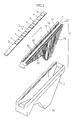
- Fig. 1 is a perspective view, in an exploded state, of an analyte excess removing device embodying the present invention.
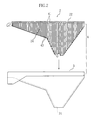
- Fig. 2 is an exploded side view of the same excess removing device.
- Fig. 3 is a plan view showing the same excess removing device.
- Fig. 4 is an enlarged fragmentary plan view showing the same excess removing device.
- Fig. 5 is a sectional view taken along lines V-V in Fig. 4.
- Fig. 6 is a sectional view taken along lines VI-VI in Fig. 4.
- Fig. 7 is a schematic side view showing a test apparatus incorporating the excess removing device.
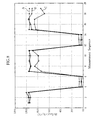
- Fig. 8 is a graph showing comparison in excess removing ability between the analyte excess removing device of the present invention and that of the prior art.
- Fig. 9 is a sectional view showing a prior art suction type excess removing device.
- an analyte excess removing device embodying the present invention is generally designated by reference numeral 1 (see Figs. 1 and 2).
- the analyte excess removing device 1 comprises a test piece holder 2 and a receptacle 3 in which the holder 2 is received.
- the test piece holder 2 is a shaped plate which has a top surface provided with a holding groove 20.
- the test piece holder 2 may be formed by molding ABS resin for example.
- the test piece holder 2 is received in the receptacle 3 in such a manner that the holding groove 20 is upwardly exposed.
- a test piece S comprises a strip S b made of a plastic material.
- the strip S b has an upper surface carrying a series of chemical pads s 1 -s 8 each for determining, forexample, the concentration of glucose, protein, occult blood or ketone body contained in an urine analyte, or the pH of the analyte, respectively.
- the holding groove 20 of the test piece holder 2 is configured to suitably receive the test piece S. More specifically, as shown in Figs. 1, 4 and 6, the holding groove 20 is defined by a bottom wall 21 corresponding in configuration to the test piece S, and a pair of ridges 22 each rising from a respective longitudinal edge of the bottom wall 21. In the illustrated embodiment, each of the ridges 22 is inclined toward the bottom wall 21 for gravitationally guiding the test piece S into the holding groove 20 (see Figs. 5 and 6).
- Each ridge 22 is formed with a plurality of upper capillary grooves 41 which extend vertically to the bottom wall 21 of the holding groove 20, as shown in Figs. 3-5.
- the upper capillary grooves 41 are spaced from each other at a constant interval.
- the width of the upper capillary grooves 41 may be 0.4-1.0 mm, preferably 0.6-0.8 mm, for example. If the groove width is smaller than 0.4 mm, difficulty arises in forming the upper capillary grooves 41 by molding. If the groove width is larger than 1.0 mm, the upper capillary grooves 41 may fail to provide a sufficient capillary action needed for sucking an excess of the analyte.
- each upper capillary groove 41 The interval between the upper capillary grooves 41 is constant and may be rendered as small as possible, provided that the molding of the test piece holder 2 can be performed without problem.
- the depth of each upper capillary groove 41 should be preferably larger than the width of that groove for increasing the amount of the analyte excess sucked per groove.
- each upper capillary groove 41 penetrates horizontally or laterally through the ridge 22 for increasing the capacity of sucking the analyte excess.
- the bottom wall 21 of the holding groove 20 is provided with a plurality of capillary pores 42 in corresponding relationship to the upper capillary grooves 41 for communicating therewith. These capillary pores 42 penetrate vertically through the bottom wall 21 and correspond in width to the upper capillary grooves 41.
- the test piece holder 2 has, under the holding groove 20, a pair of side surfaces 24 each of which is formed with lower capillary grooves 43 in corresponding relationship to the upper capillary grooves 41 and the capillary pores 42.
- the lower capillary grooves 43 extend vertically downward from the bottom wall 21 of the holding groove 20 in communication with the upper capillary grooves 41 through the capillary pores 42.
- the lower capillary grooves 43 correspond in width to the upper capillary grooves 41 and the capillary pores 42.
- the depth of the lower capillary grooves 43 which is larger than their width, may be suitably determined in consideration of technical feasibility of molding the test piece holder 2.
- the test piece holder 2 is shaped to taper downward.
- the receptacle 3 for receiving the test piece holder 2 is correspondingly configured. More specifically, the receptacle 3 is a container which is open upwardly and which tapers downward in corresponding relationship to the test piece holder 2 for snugly receiving the latter.
- the bottom tapering end of the receptacle 3 is formed with a discharge opening 31 for discharging the analyte excess sucked downward by capillary action, as described hereinafter.
- the receptacle 3 may be made of ABS resin, for example, by molding.
- the analyte excess removing device 1 including the test piece holder 2 and the receptacle 3 is mounted at a transfer mechanism 51 of an urine test apparatus 5, as schematically illustrated in Fig. 7.
- the transfer mechanism 51 reciprocates between a standby position outside the housing of the test apparatus 5 and a measuring position inside the housing. At the standby position (indicated by solid lines in Fig. 7), the holding groove 20 of the test piece holder 2 is exposed for replacing an analyzed test piece with a new one.
- the test apparatus 5 is internally provided with an optical sensor 52 for optically detecting the degree of color reaction at the respective chemical pads s 1 -s 8 of the test piece S.
- the chemical pads s 1 -s 8 successively pass under the optical sensor 52.
- the analyte excess removing device 1 and the urine test apparatus 5 incorporating it operate in the following manner.
- the transfer mechanism 51 of the urine test apparatus 5 causes the analyte excess removing device 1 or the test piece holder 2 to assume the standby position.
- a test piece S which has been previously immersed in an urine analyte is placed in the holding groove 20 of the test piece holder 2 with a predetermined timing.
- Such placement of the test piece may be performed manually or automatically by a loader (not shown).
- the inclined guide surfaces 22a of the respective ridges 22 serve to smoothly guide the test piece S into the holding groove.
- the test piece S When the test piece S is placed in the holding groove 20 of the test piece holder 2, it is wet with an excessive amount of urine than is necessary for causing intended color reaction at the respective chemical pads s1-s8.
- the upper capillary grooves 41 are formed at the respective ridges 22 to extend vertically, they suck the urine excess immediately by capillary action. The urine thus sucked falls down onto the side surfaces 24 of the test piece holder 2 through the capillary pores 42 which also provide additional capillary action for assisting suction of the urine excess.
- the lower capillary grooves 43 on the respective side surfaces 24 of the test piece holder 2 also provides capillary action for additionally assisting downward pull of the urine excess.
- the combination of the upper capillary grooves 21, the capillary pores 22 and the lower capillary grooves serves to rapidly remove the urine excess from the test piece S and the holding groove 20.
- the lower capillary grooves 43 are much longer than the upper capillary grooves 41 and the capillary pores 42, they can provide a large capacity for repetitively performing urine excess removal (i.e., urine test).
- the urine excess moving downward in the lower capillary groove ultimately collects at the tapered bottom end of the test piece holder 2 primarily due to capillary action and partially due to gravity after flowing along the tapering edges.
- the test piece holder 2 is received substantially entirely in the receptacle 3, it is possible to prevent the urine excess from scattering to contaminate the various portions of the test apparatus 5 while moving downward on the test piece holder.
- the urine excess thus collected at the tapered bottom end of the test piece holder 2 is discharged through the discharge opening 31 into a collecting pan (not shown) provided at the bottom of the test apparatus 5.
- test piece S held by the test piece holder 2 is moved progressively to the measurement position by the transfer mechanism 51. During such movement, the chemical pads s 1 -s 8 on the test piece S are successively subjected to detection by the optical sensor 52 for determination as to the degree of color reaction. After optical measurement, the test piece holder 2 is then moved to the standby position where the analyzed test piece S is replaced with a new one.
- the test piece holder 2 may be made of ABS resin by molding.
- the test piece holder 2 may be made of any resin, provided that the selected resin has good affinity with water for enhancing the capillary action of the upper capillary grooves 41, the capillary pores 42 and the lower capillary grooves 43.
- the selected resin may preferably contain a polymer component or components having a hydrophilic group or groups such as -OH, -SO 3 H, -COOH, -NH 2 and -CO.
- the receptacle 3 which may be also made of ABS resin as in the illustrated embodiment, does not need to have good affinity with water. For this reason, the receptacle 3 may be made of any other resin.
- Fig. 8 is a graph showing comparison in excess removing ability between the analyte excess removing device of the present invention and that of the prior art (Fig. 9).
- the graph of Fig. 8 is based on the results of tests wherein, for determination of urine glucose concentration, a series of low-concentration samples (negative samples) and a series of high-concentration samples (positive samples) were alternately analyzed.
- the curve A represents the results obtained for the overall series of 1st-19th samples when the analyte excess removing device 1 of the present invention was used for placing each test piece.
- the curve B represents the results obtained for the overall series of 1st-19th samples when the analyte excess removing device (a) of the prior (Fig. 9) was used for placing each test piece.
- the curve C represents the results obtained for the overall series of 1st-19th samples when the analyte excess removing device (a) of theprior art was used without applying pump (vacuum) suction.
- the curve C of the graph indicates that the results of glucose concentration measurement shift clearly to the positive side from the expected value when measurement was performed for a series of negative samples after performing measurement for a series of positive samples. This means that the excess of the positive samples remaining on the test piece holder gave adverse influences on the subsequent analysis of the negative samples. By contrast, no remarkable shift or deviation was observed with respect to the curves A and B even when measurement was performed for a series of negative samples after performing measurement for a series of positive samples. Thus, it can be concluded that the analyte excess removing device of the present invention is as effective as the prior art pumping type excess removing device and is therefore more advantageous than it in that no pump (i.e., energy consumption) is needed.
- Tables 1 and 2 represent the results of measurement of urine glucose concentration which were performed for respective sets of known-concentration samples, each set including 10 samples of a given glucose concentration (Omg/dl, 30mg/dl, 60mg/dl, 250mg/dl, 1,500mg/dl, respectively).
- Table 1 shows the results of concentration measurement (as determined by reflectivity) performedwith the use of the excess removing device 1 of the present invention
- Table 2 illustrates the results of concentration measurement performed with the use of the prior art excess removing device (a) illustrated in Fig. 9.
- the notation "S.D.” represents "Standard Deviation".
- the analyte excess removing device 1 (consisting of the test piece holder 2 and the receptacle) according to the illustrated embodiment is entirely made of a resin material and requires no suction pump or its related accessories.
- the analyte excess removing device 1 is economically advantageous.
- the test piece holder 2 and the receptacle 3 can be washed or flushed whole and therefore maintained very easily.
- the present invention may be applied to any kind of test piece holder for holding a test piece which is immersed in or impregnated with a liquid analyte (not limited to urine) for chemical reaction.
- a liquid analyte not limited to urine
Landscapes
- Physics & Mathematics (AREA)
- Health & Medical Sciences (AREA)
- Life Sciences & Earth Sciences (AREA)
- Chemical & Material Sciences (AREA)
- Analytical Chemistry (AREA)
- Biochemistry (AREA)
- General Health & Medical Sciences (AREA)
- General Physics & Mathematics (AREA)
- Immunology (AREA)
- Pathology (AREA)
- Investigating Or Analysing Biological Materials (AREA)
- Sampling And Sample Adjustment (AREA)
Applications Claiming Priority (2)
| Application Number | Priority Date | Filing Date | Title |
|---|---|---|---|
| JP05658099A JP4104770B2 (ja) | 1999-03-04 | 1999-03-04 | 試験片保持部材およびこれを用いた余剰試料液除去装置 |
| JP5658099 | 1999-03-04 |
Publications (3)
| Publication Number | Publication Date |
|---|---|
| EP1033577A2 true EP1033577A2 (fr) | 2000-09-06 |
| EP1033577A3 EP1033577A3 (fr) | 2001-01-31 |
| EP1033577B1 EP1033577B1 (fr) | 2004-06-02 |
Family
ID=13031115
Family Applications (1)
| Application Number | Title | Priority Date | Filing Date |
|---|---|---|---|
| EP20000301778 Expired - Lifetime EP1033577B1 (fr) | 1999-03-04 | 2000-03-03 | Support d'échantillon et dispositif pour éliminer un excess d'analyte incorporant un tel support |
Country Status (4)
| Country | Link |
|---|---|
| EP (1) | EP1033577B1 (fr) |
| JP (1) | JP4104770B2 (fr) |
| CN (1) | CN1184464C (fr) |
| DE (1) | DE60011164T2 (fr) |
Cited By (1)
| Publication number | Priority date | Publication date | Assignee | Title |
|---|---|---|---|---|
| WO2004002625A1 (fr) * | 2002-06-26 | 2004-01-08 | Amersham Biosciences Ab | Support de puce a adn et methode de collecte de fluide |
Families Citing this family (8)
| Publication number | Priority date | Publication date | Assignee | Title |
|---|---|---|---|---|
| WO2005109008A1 (fr) * | 2004-05-10 | 2005-11-17 | Arkray, Inc. | Appareil d’analyse |
| JP4662308B2 (ja) * | 2005-11-02 | 2011-03-30 | 和光純薬工業株式会社 | 試験紙搬送装置 |
| US8198090B2 (en) * | 2006-10-10 | 2012-06-12 | Arkray, Inc. | Cartridge, residual liquid removing method, and automatic analyzer |
| JP5632168B2 (ja) * | 2009-06-12 | 2014-11-26 | ロート製薬株式会社 | 尿検査具及び容器 |
| CN101923015B (zh) * | 2009-06-12 | 2014-10-08 | 日本乐敦制药株式会社 | 尿检查器具以及棒状容器 |
| US10890593B2 (en) * | 2015-10-09 | 2021-01-12 | Sysmex Corporation | Test piece mounting body, transport unit, and test piece analyzer |
| CN106338599B (zh) * | 2016-09-29 | 2018-01-30 | 厦门科牧智能技术有限公司 | 一种尿检试纸结构和尿检方法 |
| US20260042092A1 (en) * | 2022-08-08 | 2026-02-12 | Siemens Healthcare Diagnostics Inc. | Tray insert for use in sample analysis apparatus |
Family Cites Families (5)
| Publication number | Priority date | Publication date | Assignee | Title |
|---|---|---|---|---|
| US4943416A (en) * | 1987-09-23 | 1990-07-24 | Kabushiki Kaisha Marukomu | Automatic urinalysis system |
| WO1996019565A1 (fr) * | 1994-12-22 | 1996-06-27 | Showa Yakuhin Co., Ltd. | Dispositif pour essais chimiques et microbiologiques |
| US5698162A (en) * | 1996-02-27 | 1997-12-16 | Johnson & Johnson Clinical Diagnostics | Apparatus for staining of cells and tissues |
| NL1008782C1 (nl) * | 1998-04-01 | 1999-10-04 | Menno Contant | Werkwijze en inrichting om overtollige c.q. ongewenste vloeistoffen te verwijderen van microscoopglaasjes. |
| US6337490B1 (en) * | 1998-08-06 | 2002-01-08 | Kyoto Daiichi Kagaku Co., Ltd. | Test piece analyzing apparatus having an excessive portion removal |
-
1999
- 1999-03-04 JP JP05658099A patent/JP4104770B2/ja not_active Expired - Fee Related
-
2000
- 2000-03-03 DE DE2000611164 patent/DE60011164T2/de not_active Expired - Lifetime
- 2000-03-03 EP EP20000301778 patent/EP1033577B1/fr not_active Expired - Lifetime
- 2000-03-06 CN CNB001028650A patent/CN1184464C/zh not_active Expired - Fee Related
Cited By (3)
| Publication number | Priority date | Publication date | Assignee | Title |
|---|---|---|---|---|
| WO2004002625A1 (fr) * | 2002-06-26 | 2004-01-08 | Amersham Biosciences Ab | Support de puce a adn et methode de collecte de fluide |
| US7442342B2 (en) | 2002-06-26 | 2008-10-28 | Ge Healthcare Bio-Sciences Ab | Biochip holder and method of collecting fluid |
| US8431092B2 (en) | 2002-06-26 | 2013-04-30 | Ge Healthcare Bio-Science Ab | Biochip holder and method of collecting fluid |
Also Published As
| Publication number | Publication date |
|---|---|
| EP1033577B1 (fr) | 2004-06-02 |
| JP2000258413A (ja) | 2000-09-22 |
| CN1184464C (zh) | 2005-01-12 |
| CN1266187A (zh) | 2000-09-13 |
| DE60011164T2 (de) | 2004-11-04 |
| EP1033577A3 (fr) | 2001-01-31 |
| DE60011164D1 (de) | 2004-07-08 |
| JP4104770B2 (ja) | 2008-06-18 |
Similar Documents
| Publication | Publication Date | Title |
|---|---|---|
| JP2601075B2 (ja) | 試験片を用いる分析方法および分析装置 | |
| EP1033577B1 (fr) | Support d'échantillon et dispositif pour éliminer un excess d'analyte incorporant un tel support | |
| EP0103268A2 (fr) | Dispositif de prise d'échantillons | |
| JP4251627B2 (ja) | 化学分析装置及びその分注方法 | |
| JP5575410B2 (ja) | 自動分析装置 | |
| US9329195B2 (en) | Container cleaning device, discharge member for container cleaning device, and analyzer | |
| JP2017021030A (ja) | 自動分析装置で液体をピペッティングする方法 | |
| DE69732970D1 (de) | Aliquotieverfahren zur automatischen probenanalyse | |
| JP2002517748A (ja) | 自動オンライン槽分析システムのための採集器 | |
| JP2002040035A (ja) | 生化学自動分析装置 | |
| JPH09325154A (ja) | 検診用サンプル容器、サンプリングノズル、及び穿刺サンプリング方法並びにサンプル供給方法 | |
| US4539182A (en) | Automated reagent blotter | |
| US7569183B2 (en) | Fecal assay method and analyzer | |
| JP2000121650A (ja) | 自動化学分析装置 | |
| JP3694755B2 (ja) | ピペッティング方法、ピペッティング装置、および記憶媒体 | |
| KR102857662B1 (ko) | 시료 자동 분석장치 | |
| JP2007309739A (ja) | 洗浄装置 | |
| JPS6319520A (ja) | 液面検出装置 | |
| JPH10148634A (ja) | 余剰試料液除去装置 | |
| JPS5912601Y2 (ja) | 液体分析装置 | |
| JPS63195572A (ja) | 分注装置 | |
| JP3331254B2 (ja) | 試験片の過剰液体試料吸引装置 | |
| JPH04138368A (ja) | 分析用容器およびその使用方法 | |
| JPH0353173Y2 (fr) | ||
| JPH06289033A (ja) | 生化学分析方法 |
Legal Events
| Date | Code | Title | Description |
|---|---|---|---|
| PUAI | Public reference made under article 153(3) epc to a published international application that has entered the european phase |
Free format text: ORIGINAL CODE: 0009012 |
|
| AK | Designated contracting states |
Kind code of ref document: A2 Designated state(s): DE FR GB IT |
|
| AX | Request for extension of the european patent |
Free format text: AL;LT;LV;MK;RO;SI |
|
| PUAL | Search report despatched |
Free format text: ORIGINAL CODE: 0009013 |
|
| AK | Designated contracting states |
Kind code of ref document: A3 Designated state(s): AT BE CH CY DE DK ES FI FR GB GR IE IT LI LU MC NL PT SE |
|
| AX | Request for extension of the european patent |
Free format text: AL;LT;LV;MK;RO;SI |
|
| RIC1 | Information provided on ipc code assigned before grant |
Free format text: 7G 01N 35/00 A, 7G 01N 1/28 B |
|
| 17P | Request for examination filed |
Effective date: 20010531 |
|
| AKX | Designation fees paid |
Free format text: DE FR GB IT |
|
| 17Q | First examination report despatched |
Effective date: 20021018 |
|
| GRAP | Despatch of communication of intention to grant a patent |
Free format text: ORIGINAL CODE: EPIDOSNIGR1 |
|
| GRAS | Grant fee paid |
Free format text: ORIGINAL CODE: EPIDOSNIGR3 |
|
| GRAA | (expected) grant |
Free format text: ORIGINAL CODE: 0009210 |
|
| AK | Designated contracting states |
Kind code of ref document: B1 Designated state(s): DE FR GB IT |
|
| REG | Reference to a national code |
Ref country code: GB Ref legal event code: FG4D |
|
| REF | Corresponds to: |
Ref document number: 60011164 Country of ref document: DE Date of ref document: 20040708 Kind code of ref document: P |
|
| ET | Fr: translation filed | ||
| PLBE | No opposition filed within time limit |
Free format text: ORIGINAL CODE: 0009261 |
|
| STAA | Information on the status of an ep patent application or granted ep patent |
Free format text: STATUS: NO OPPOSITION FILED WITHIN TIME LIMIT |
|
| 26N | No opposition filed |
Effective date: 20050303 |
|
| REG | Reference to a national code |
Ref country code: FR Ref legal event code: PLFP Year of fee payment: 17 |
|
| PGFP | Annual fee paid to national office [announced via postgrant information from national office to epo] |
Ref country code: GB Payment date: 20160321 Year of fee payment: 17 Ref country code: FR Payment date: 20160321 Year of fee payment: 17 |
|
| PGFP | Annual fee paid to national office [announced via postgrant information from national office to epo] |
Ref country code: DE Payment date: 20160330 Year of fee payment: 17 |
|
| PGFP | Annual fee paid to national office [announced via postgrant information from national office to epo] |
Ref country code: IT Payment date: 20160324 Year of fee payment: 17 |
|
| REG | Reference to a national code |
Ref country code: DE Ref legal event code: R119 Ref document number: 60011164 Country of ref document: DE |
|
| GBPC | Gb: european patent ceased through non-payment of renewal fee |
Effective date: 20170303 |
|
| REG | Reference to a national code |
Ref country code: FR Ref legal event code: ST Effective date: 20171130 |
|
| PG25 | Lapsed in a contracting state [announced via postgrant information from national office to epo] |
Ref country code: DE Free format text: LAPSE BECAUSE OF NON-PAYMENT OF DUE FEES Effective date: 20171003 Ref country code: FR Free format text: LAPSE BECAUSE OF NON-PAYMENT OF DUE FEES Effective date: 20170331 |
|
| PG25 | Lapsed in a contracting state [announced via postgrant information from national office to epo] |
Ref country code: GB Free format text: LAPSE BECAUSE OF NON-PAYMENT OF DUE FEES Effective date: 20170303 Ref country code: IT Free format text: LAPSE BECAUSE OF NON-PAYMENT OF DUE FEES Effective date: 20170303 |