EP1037045B1 - Test rapide pour la détermination de l'ammoniac dans des échantillons aqueux - Google Patents
Test rapide pour la détermination de l'ammoniac dans des échantillons aqueux Download PDFInfo
- Publication number
- EP1037045B1 EP1037045B1 EP00302073A EP00302073A EP1037045B1 EP 1037045 B1 EP1037045 B1 EP 1037045B1 EP 00302073 A EP00302073 A EP 00302073A EP 00302073 A EP00302073 A EP 00302073A EP 1037045 B1 EP1037045 B1 EP 1037045B1
- Authority
- EP
- European Patent Office
- Prior art keywords
- ammonia
- membrane
- indicator
- test
- pad
- Prior art date
- Legal status (The legal status is an assumption and is not a legal conclusion. Google has not performed a legal analysis and makes no representation as to the accuracy of the status listed.)
- Expired - Lifetime
Links
Images

Classifications
-
- G—PHYSICS
- G01—MEASURING; TESTING
- G01N—INVESTIGATING OR ANALYSING MATERIALS BY DETERMINING THEIR CHEMICAL OR PHYSICAL PROPERTIES
- G01N31/00—Investigating or analysing non-biological materials by the use of the chemical methods specified in the subgroup; Apparatus specially adapted for such methods
- G01N31/22—Investigating or analysing non-biological materials by the use of the chemical methods specified in the subgroup; Apparatus specially adapted for such methods using chemical indicators
- G01N31/223—Investigating or analysing non-biological materials by the use of the chemical methods specified in the subgroup; Apparatus specially adapted for such methods using chemical indicators for investigating presence of specific gases or aerosols
- G01N31/224—Investigating or analysing non-biological materials by the use of the chemical methods specified in the subgroup; Apparatus specially adapted for such methods using chemical indicators for investigating presence of specific gases or aerosols for investigating presence of dangerous gases
-
- G—PHYSICS
- G01—MEASURING; TESTING
- G01N—INVESTIGATING OR ANALYSING MATERIALS BY DETERMINING THEIR CHEMICAL OR PHYSICAL PROPERTIES
- G01N33/00—Investigating or analysing materials by specific methods not covered by groups G01N1/00 - G01N31/00
- G01N33/0004—Gaseous mixtures, e.g. polluted air
- G01N33/0009—General constructional details of gas analysers, e.g. portable test equipment
- G01N33/0027—General constructional details of gas analysers, e.g. portable test equipment concerning the detector
- G01N33/0036—General constructional details of gas analysers, e.g. portable test equipment concerning the detector specially adapted to detect a particular component
- G01N33/0054—Ammonia
-
- Y—GENERAL TAGGING OF NEW TECHNOLOGICAL DEVELOPMENTS; GENERAL TAGGING OF CROSS-SECTIONAL TECHNOLOGIES SPANNING OVER SEVERAL SECTIONS OF THE IPC; TECHNICAL SUBJECTS COVERED BY FORMER USPC CROSS-REFERENCE ART COLLECTIONS [XRACs] AND DIGESTS
- Y02—TECHNOLOGIES OR APPLICATIONS FOR MITIGATION OR ADAPTATION AGAINST CLIMATE CHANGE
- Y02A—TECHNOLOGIES FOR ADAPTATION TO CLIMATE CHANGE
- Y02A50/00—TECHNOLOGIES FOR ADAPTATION TO CLIMATE CHANGE in human health protection, e.g. against extreme weather
- Y02A50/20—Air quality improvement or preservation, e.g. vehicle emission control or emission reduction by using catalytic converters
-
- Y—GENERAL TAGGING OF NEW TECHNOLOGICAL DEVELOPMENTS; GENERAL TAGGING OF CROSS-SECTIONAL TECHNOLOGIES SPANNING OVER SEVERAL SECTIONS OF THE IPC; TECHNICAL SUBJECTS COVERED BY FORMER USPC CROSS-REFERENCE ART COLLECTIONS [XRACs] AND DIGESTS
- Y10—TECHNICAL SUBJECTS COVERED BY FORMER USPC
- Y10T—TECHNICAL SUBJECTS COVERED BY FORMER US CLASSIFICATION
- Y10T436/00—Chemistry: analytical and immunological testing
- Y10T436/17—Nitrogen containing
- Y10T436/173845—Amine and quaternary ammonium
- Y10T436/175383—Ammonia
Definitions
- This invention relates to a method, reagent and test device suitable for testing the levels of toxic ammonia potential for water, in particular in aquariums.
- Aquariums represent one type of closed environment in which production of ammonia naturally occurs. Those natural occurrences are the decomposition of plants, dead fish, uneaten food and waste excreted by the fish. In nature, the problems of ammonia accumulation are often solved by a biological process called the nitrogen cycle. That is, the ammonia is converted through nitrite to nitrate, which can then be used by the plants in the water. While this cycle does occur in aquariums, ponds or septic tanks, the equilibrium is heavily shifted in favor of ammonia production because of the limited, confined environment. As a result, ammonia levels rise.
- Toxic ammonia at levels of from as low as 0.01 ppm to 0.02 ppm for sustained periods can kill fish! As a result, more often than not when an unsuspecting aquarium owner finds dead or dying fish, it is a result of production of high levels of ammonia within the aquarium tank.
- aquarium owners have several options available to them in order to avoid a rise in dissolved ammonia gas level in the tank. For example, frequent water changes, and efficient chemical and biological filtration often can be used to keep ammonia in check. However, unless one can measure the amount of ammonia potential in a given tank, the owner is literally in the dark as to whether or not there is an increased risk of a fish kill by toxic ammonia. For this reason, ammonia has sometimes been referred to as the invisible killer of aquarium fish.
- Liquid test kits have the benefit of being easy to mix.
- liquid reagents are, in general, unstable and lose their accuracy rapidly over time.
- some of the liquids used are toxic, and the opportunity for spills and accidental ingestion is possible.
- Powder test kits are more stable and have an improved shelf life. They are easy to use but involve many steps, and accidental spills of dangerous chemicals can result when opening the sachets.
- the safest to handle are probably those that involve the use of tablets. They are simple to use and have good chemical stability. It does, however, take time and effort to dissolve the tablets in the water sample, and a lengthy wait is still required before a reading can be taken.
- Another object of the present invention is to provide a quick-acting test which is especially adapted for use with test strips, as opposed to loose powder, tablets, or liquid chemicals.
- a yet further object of the present invention is to provide a test strip which can be used to test ammonia potential of aquariums or other water samples within one minute or less.
- Another object of the present invention is to provide a quick-acting test which uses a chromogenic indicator which responsively and discriminatingly changes color upon contact with dissolved ammonia gas, and as such can be compared with standard color intensity charts to determine the potential for toxic ammonia of any given water sample.
- Another example is to provide reagent strips which can be conveniently packaged in a simple container to increase shelf life and which are easy to use by consumers.
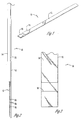
- Figure 1 shows a perspective view of a test strip of this invention.
- Figure 2 shows a side view of a test strip of this invention.
- Figure 3 shows a rear view of a test strip of this invention.
- Figure 4 shows a test strip of this invention placed inside of a small selected sample in the process of being dipped and swished to allow materials to escape from the soda lime reagent pad into the test sample, which can then be tested for ammonia gas that passes through the membrane to the indicator material.
- Figure 5 shows a comparison chart using one responsive and discriminating indicator mix to correlate with parts per million of toxic ammonia.
- a method, test reagent and device usable as a test strip for detecting toxic ammonia levels in water samples such as aquarium water are disclosed.
- the volume of the water to be tested is contacted with a soda lime reagent to raise the pH to at least 10, and simultaneously contacted with a hydrophobic barrier membrane capable of allowing ammonia gas to pass through.
- the membrane is coated with a pH chromogenic indicator mixture which responsively and discriminatingly changes color if ammonia gas passes through.
- the color response of the sample is compared with standard color charts to determine the toxic ammonia potential.
- Test strip 10 has a handle portion 12 and two pads 14 and 16.
- Pad 14 is a soda lime pad used to adjust the pH of a confined test sample (see Figure 4 ), and indicator pad 16, which provides the color change in a high pH environment (at least 10).
- Alkalizing pad 14 and indicator pad 16 are bound to the handle portion 12 by adhesive 22.
- Indicator pad 16 is comprised of a hydrophobic membrane 24 with a coating 26. Hydrophobic membrane 24 as explained below is porous and allows ammonia gas to pass through the membrane. When the gas passes through the membrane, it contacts indicator on indicator pad 16 and changes color.
- the change in color, if it occurs, is known therefor to selectively occur because of the presence of ammonia gas, which is the only gas that passes through that is responsive to the indicator.
- the color change can then be compared to a standard comparative chart (see Figure 5 ) for a determination of the parts per million of total ammonia.
- the toxic ammonia potential risk of an aquarium can be at least semi quantitatively assessed as to whether it is safe (light yellow color), or at high risk (light green) or somewhere in between.
- the handle 12 must be made of a clear, semi-rigid and inert plastic material. It must be clear so that an indicator change can be viewed from its back side ( Figure 3 ). The handle must be semi-rigid to provide sufficient rigidity so that the test strip can be dipped and swished with a confined sample (see Figure 4 ). Many suitable polymeric substantially inert plastic materials could be used and will be apparent to one of ordinary skill in the art. However, one suitable material is clear polystyrene which can be purchased from American National Can Company. Soda lime pad 14 is made of a carrier paper matrix of high absorbency quality.
- a preferred embodiment of the present invention involves the use of a carrier paper matrix for the soda lime pad 14.
- a carrier matrix such as bibulous paper to contain and carry to the test reaction sample 20 the pH adjusting system, it has been found that the pH of even highly buffered samples can be raised above 10.
- a piece of bibulous filter paper of sufficient porosity and capillary affinity to cause the fluid being tested to migrate into the paper is coated or otherwise incorporated with the soda lime pad 14.
- the test sample 20 contacts the pad 14, and the soda lime dissolves into the test sample 20 to adjust pH.
- the net result of using such a strip is that the volume of the ammonium ion present is deprotonated to ammonia gas and made available to contact porous hydrophobic barrier membrane 24.
- the ammonia gas passes through membrane 24 to contact the indicator.
- the paper of pad 14 and membrane of pad 16 can be affixed to an inert handle 12.
- a variety of papers can be used for soda lime pad 14.
- a preferred paper is Ahlstrom 939, which is a thick paper with high absorbency. This is preferred to deliver the maximum amount of base from soda lime pad 14 to test sample 20. During the impregnation, in fact the paper decreases in width, and this also aids in delivering the maximum amount of base by concentrating the amount of chemicals in the pad.
- soda lime pad 14 is to provide pH adjustment of the confined sample 20 selected from the test water and placed into test tube 28.
- the precise material used in the soda lime pad is not critical, except that it must be a water soluble base system to provide a pH in test sample 20 upon dipping and swishing for approximately 30 seconds, that is, at least 10.
- a pH of at least 10 in the defined sample 20 is required in order to provide deprotonation of ammonium ion in the test sample 20 to ammonia gas sufficiently to give an accurate result.
- a suitable reagent mix for the soda lime pad 14 is a saturated solution of calcium carbonate with added sodium hydroxide which effectively impregnates pad 14 with a mix of calcium and sodium hydroxides and carbonates.
- Preferred amounts of sodium hydroxide to calcium carbonate are 2 molar sodium hydroxide (80 gram/1) and 1.0 gram/liter of calcium carbonate.
- Hydrophobic membrane 24 can be purchased from a variety of sources. Hydrophobic membranes which would absorb the pH indicators include but are not limited to: Versapore-H (Pall-Gelman) (a hydrophilic acrylic copolymer with a hydrophobic surface treatment); PVDF (polyvinylidene fluoride) membranes; Fluorotrans (Pall-Gelman) Immobilon (Millipore) Nylon; Hydrolon (Pall-Gelman) PTFE - supported on polypropylene or polyester; Tetratex (BHA-Tex); and Polypropylene from CUNO.
- Versapore-H Pall-Gelman
- PVDF polyvinylidene fluoride
- Such a membrane is fibrous, and has a high degree of porosity.
- One suitable membrane is a polypropylene membrane available from Cuno which is naturally hydrophobic, has high air permeability, low extractables, and a broad range of chemical resistance. Pore sizes for the membrane are available from a nominal 0.6 microns to 10 microns. Preferred pore size is from 0.2 microns to 2.5 microns, preferably 0.6 microns to 1.2 microns, and most preferably about 0.6 microns.
- Cuno Filter Systems from which such membranes are obtainable, is located at 400 Research Parkway, Meridian, Connecticut 06450 USA.
- alpha olefin polymeric inert hydrophobic barrier materials also can work for the present invention.
- This porous membrane which is hydrophobic by nature of its property, is preferably about 5 mm thick. The criteria to be remembered is that it must be sufficiently thin to allow enough ammonia to diffuse to the back side of the membrane 24 so that an indicator color change is detectable through the handle of test strip 10. The test is read through the back side to avoid any interference from the highly alkaline water coming in contact with the indicators.
- the membrane 24 is coated on both sides with an excess of a composition which will adhere an indicator system to membrane 24 of indicator pad 16.
- Any indicator system that will responsively and discriminatingly change color in the presence of contact with ammonia and has some hydrophobicity can be used.
- the terms responsively and discriminatingly mean that a color change in fact occurs, and that depending upon the concentration of ammonia, gradients of color intensity can be achieved to indicate concentrations on a parts per million level of ammonia (see Figure 5 ).
- One suitable indicator mixture is bromophenol blue (free acid), bromocresol green, sodium salt, and bromocresol purple (free acid) as pH indicators.
- Each indicator undergoes a color change from yellow to green at differing pH intervals, except for bromocresol purple, which changes from yellow to purple.
- Bromophenol blue and bromocresol green, and the sodium salts of each are balanced to give the needed sensitivity, while addition of the bromocresol purple aids resolution at the higher ammonia concentration levels.
- Possible indicators include but are not limited to Bromophenol Blue, Xylenol Blue, Bromocresol Purple, Tetrabromophenolphthalein Ethyl Ester, Bromocresol Green, Ethyl Red, Chlorophenol Red, Congo Red, Thymol Blue, Tetraiodophenolsulfonephthalein, Tetrabromophenol Blue, and Methyl Red.
- 4-(Tert-Octyl) phenol facilitates penetration of the membrane by the indicators and also coats the membrane.
- Brij® 76 is a surfactant which assists in coating the membrane and transporting the ammonia through the membrane.
- Ethyl cellulose acts as a stabilizer for both the indicators and the (tert-octyl) phenol. The addition of ethyl cellulose also helps to control the water breakthrough interference by enhancing the hydrophobicity of the matrix.
- test strips in accordance with the above description were prepared and then tested against known concentrations of ammonia in order to validate the testing.
- the polystyrene material used for the handle was purchased from American National Can.
- Soda lime pad 14 was a 0.2 inch by 0.4 inch reagent pad having a weight percent of sodium hydroxide of 9.54%, and it was a weight percent of calcium carbonate at 0.12%.
- the hydrophobic membrane of indicator pad 16 was a polypropylene membrane, naturally hydrophobic obtained from Cuno Filter Systems with a pore size of 0.6 microns. It was coated with a pH indicator dye/adhesive mixture with ethyl cellulose of reagent solution having the following concentrations: TABLE I DESCRIPTION 1X MASTER (tert-octyl) phenol 130 g bromophenol blue (free acid) 0.65 g bromocresol green.
- Test strips 12 were then used in the testing.
- Test tube 28 was filled with ammonia standard solutions to the level of approximately 3 ml.
- Test strip 12 was vigorously moved up and down in the water sample for 30 seconds, making sure that all pads were submerged.
- the test strip was removed, and excess water shaken off. 30 seconds was allowed to pass for color to fully develop.
- the test strip was then held with the pads facing away from the person conducting the test and read on the small end pad 22 through the back of the plastic strip 12. It was then compared to a color chart (see Figure 5 ) and the results recorded. Accuracy comparisons are shown in the table below indicating good correlation, and that the test worked and performed all the stated objectives of the present invention.
Landscapes
- Life Sciences & Earth Sciences (AREA)
- Health & Medical Sciences (AREA)
- Analytical Chemistry (AREA)
- Molecular Biology (AREA)
- Physics & Mathematics (AREA)
- Chemical & Material Sciences (AREA)
- Biophysics (AREA)
- Biochemistry (AREA)
- General Health & Medical Sciences (AREA)
- General Physics & Mathematics (AREA)
- Immunology (AREA)
- Pathology (AREA)
- Investigating Or Analyzing Non-Biological Materials By The Use Of Chemical Means (AREA)
Claims (13)
- Dispositif d'essai pour la détection du potentiel de production d'ammoniac de systèmes aqueux comprenant
une bande d'essai (10) avec une partie de préhension (12),
un tampon alkalisant (14) collé à la bande d'essai, le tampon alkalisant comprenant un agent alcalin sans ammoniac pour élever le pH d'un échantillon d'essai confiné à au moins 10 ;
et
un tampon indicateur (16) collé à la bande d'essai, le tampon indicateur comprenant un mélange indicateur chromogène de pH, dont la couleur change lors d'un contact avec l'ammoniac,
caractérisé en ce que
la partie de préhension de la bande d'essai est formée d'un matériau semi-rigide transparent ; et
le tampon indicateur comprend une membrane de barrière hydrophobe poreuse qui permet le passage du gaz ammoniac, la membrane de barrière hydrophobe poreuse ayant un côté avant qui entre en contact avec l'échantillon de test et un côté opposé enduit d'un excédent dudit mélange chromogène de pH, le côté opposé étant protégé d'un contact avec l'échantillon d'essai par le matériau semi-rigide transparent,
dans lequel les changements de couleur du mélange chromogène de pH sur le côté opposé de la membrane peuvent être visualisés à travers le matériau semi-rigide transparent. - Dispositif selon la revendication 1, dans lequel la membrane est fixée à une zone de préhension semi-rigide, le côté opposé de la membrane étant en juxtaposition avec la zone de préhension.
- Dispositif selon la revendication 2, dans lequel l'excès d'indicateur forme une couche qui se trouve sur au moins le côté opposé de la membrane.
- Dispositif selon la revendication 2, dans lequel l'excès d'indicateur forme des couches sur les deux côtés avant et opposé de la membrane.
- Dispositif selon la revendication 1, dans lequel l'agent alcalin sans ammoniac est un mélange d'hydroxyde de calcium, d'hydroxyde de sodium et de carbonates d'hydroxyde de calcium et d'hydroxyde de sodium.
- Dispositif selon la revendication 1, dans lequel la membrane de barrière hydrophobe est une matrice de polypropylène poreux inerte.
- Dispositif selon la revendication 7, dans lequel la membrane de barrière hydrophobe a une porosité de 0,2 micron à 2,5 microns.
- Dispositif selon la revendication 8, dans lequel la membrane hydrophobe a une porosité de 0,6 micron à 1,2 micron.
- Dispositif selon la revendication 7, dans lequel la membrane est enduite d'un indicateur mixte qui est à la fois sensible et discriminateur par degrés d'intensité quant aux niveaux d'augmentation de la concentration en ammoniac.
- Dispositif selon la revendication 1, dans lequel l'indicateur est un mélange de bleu de bromophénol, vert de bromocrésol, sel de sodium et pourpre de bromocrésol, avec un indicateur total subissant un changement de couleur de jaune à vert à différents niveaux de pH.
- Dispositif selon la revendication 10, dans lequel le tampon indicateur est imprégné d'une cellulose d'éthyle, d'un agent tensioactif et d'un phénol octyle tertiaire pour faciliter le transport de l'ammoniac à travers la membrane et pour stabiliser les indicateurs.
- Procédé de détection d'ammoniac dans un système aqueux, le procédé comprenant les étapes suivantes :obtenir un volume d'échantillon défini du système aqueux devant être testé ;mettre en contact le volume d'échantillon avec un dispositif d'essai selon l'une quelconque des revendications 1 à 10 ;observer la réponse chromatique de l'indicateur sur le côté arrière dudit dispositif d'essai.
- Procédé de détection d'ammoniac dans un système aqueux selon la revendication 12, consistant en outre à comparer l'intensité observée de la réponse chromatique à une carte de couleurs standard pour déterminer la concentration en ammoniac dudit échantillon.
Applications Claiming Priority (2)
| Application Number | Priority Date | Filing Date | Title |
|---|---|---|---|
| US09/268,930 US7033839B1 (en) | 1999-03-16 | 1999-03-16 | Quick acting toxic ammonia test for aqueous samples |
| US268930 | 1999-03-16 |
Publications (3)
| Publication Number | Publication Date |
|---|---|
| EP1037045A2 EP1037045A2 (fr) | 2000-09-20 |
| EP1037045A3 EP1037045A3 (fr) | 2002-03-13 |
| EP1037045B1 true EP1037045B1 (fr) | 2008-11-19 |
Family
ID=23025122
Family Applications (1)
| Application Number | Title | Priority Date | Filing Date |
|---|---|---|---|
| EP00302073A Expired - Lifetime EP1037045B1 (fr) | 1999-03-16 | 2000-03-15 | Test rapide pour la détermination de l'ammoniac dans des échantillons aqueux |
Country Status (6)
| Country | Link |
|---|---|
| US (1) | US7033839B1 (fr) |
| EP (1) | EP1037045B1 (fr) |
| JP (1) | JP2000314734A (fr) |
| AU (1) | AU2237600A (fr) |
| CA (1) | CA2300785A1 (fr) |
| DE (1) | DE60040815D1 (fr) |
Families Citing this family (27)
| Publication number | Priority date | Publication date | Assignee | Title |
|---|---|---|---|---|
| AU2924001A (en) * | 1999-11-09 | 2001-06-06 | Photonic Biosystems, Inc. | Ammonia detection and measurement device |
| US20030113932A1 (en) * | 2001-12-14 | 2003-06-19 | Shmuel Sternberg | Hydrophobic ammonia sensing membrane |
| US7582485B2 (en) * | 2003-10-16 | 2009-09-01 | Kimberly-Clark Worldride, Inc. | Method and device for detecting ammonia odors and helicobacter pylori urease infection |
| US20050180879A1 (en) * | 2004-02-03 | 2005-08-18 | Eva Hrboticka | One step tester for ammonia |
| WO2005106457A1 (fr) * | 2004-04-21 | 2005-11-10 | Merck Patent Gmbh | Necessaire d'analyse et procede pour detecter les composants nitriques dans le vin |
| US8231839B2 (en) | 2004-10-08 | 2012-07-31 | Life Safety Distribution Ag | Gas detection system |
| US20080041136A1 (en) * | 2006-01-25 | 2008-02-21 | Virbac Corporation | Ammonia detection device and related methods |
| EP1840566B1 (fr) * | 2006-03-30 | 2012-12-05 | Hach Lange GmbH | Dispositif destiné à la détermination d'ammonium dans un échantillon de liquide |
| WO2007115321A2 (fr) * | 2006-04-04 | 2007-10-11 | Photonic Biosystems, Inc. | Mesure visuelle, continue et simultanée de la concentration d'ammoniac en solution et des ions hydrogène |
| AU2007272297A1 (en) * | 2006-07-11 | 2008-01-17 | Paul Nigel Brockwell | Indicator system for determining analyte concentration |
| US9134251B2 (en) * | 2010-09-23 | 2015-09-15 | 3M Innovative Properties Company | Porous chemical indicator for gaseous media |
| WO2013112898A1 (fr) * | 2012-01-25 | 2013-08-01 | The Regents Of The University Of California | Micro-analyseur ayant un dispositif d'agrégation passif |
| US9579532B2 (en) | 2013-03-12 | 2017-02-28 | Ansell Limited | Breach or contamination indicating article |
| US9341608B2 (en) * | 2014-04-14 | 2016-05-17 | Frank Fish | Method for determining expected shelf life of seafood |
| CN105300968A (zh) * | 2014-05-28 | 2016-02-03 | 恒源祥(集团)有限公司 | 一种测定纺织品对氨的吸收能力的方法 |
| USD865992S1 (en) * | 2015-11-02 | 2019-11-05 | Jon A. Petty | Fluid test strip |
| JP6782458B2 (ja) * | 2017-02-17 | 2020-11-11 | パナソニックIpマネジメント株式会社 | 配管部材、水質検査方法及び水処理装置 |
| KR101880903B1 (ko) * | 2017-03-15 | 2018-07-23 | 상명대학교산학협력단 | 중화 확인을 가능하게 하는 고형지시약 및 그 제조방법 |
| CN108535247B (zh) * | 2018-04-18 | 2021-01-08 | 沈阳理工大学 | 一种测量空气中氨的灵敏试纸及其制备和测定方法 |
| CN108508008B (zh) * | 2018-04-18 | 2021-01-08 | 沈阳理工大学 | 一种定量测定空气中氨的试纸及其制备和测定方法 |
| CN108802022B (zh) * | 2018-04-18 | 2021-01-08 | 沈阳理工大学 | 一种空气中氨的简易测定试纸及其制备和测定方法 |
| CN108535246B (zh) * | 2018-04-18 | 2021-01-08 | 沈阳理工大学 | 半定量测定空气中氨浓度的试纸及其制备和测定方法 |
| CN108535248B (zh) * | 2018-04-18 | 2021-01-08 | 沈阳理工大学 | 一种检测空气中氨浓度的试纸及其制备和检测方法 |
| CN108776132B (zh) * | 2018-04-18 | 2021-01-08 | 沈阳理工大学 | 一种测定空气中氨的简易试纸及其制备和测定方法 |
| CN110412023A (zh) * | 2018-04-27 | 2019-11-05 | 大连理工大学 | 一种快速评价堆肥腐熟度的试剂盒及其使用方法 |
| CN110412022A (zh) * | 2018-04-27 | 2019-11-05 | 大连理工大学 | 一种快速检测有机固体废弃物nh3挥发率的凝胶试纸及其使用方法 |
| EP4372377A1 (fr) * | 2022-11-15 | 2024-05-22 | Fernando Javier Palacin Urquijo | Kit de test simple et à faible coût pour détecter et mesurer l'ammoniac dans l'air |
Family Cites Families (12)
| Publication number | Priority date | Publication date | Assignee | Title |
|---|---|---|---|---|
| GB902884A (en) | 1959-08-12 | 1962-08-09 | Arthur Thomas Palin | Improvements relating to the testing of water by the use of reagents in tablet form |
| US3787184A (en) * | 1970-03-23 | 1974-01-22 | Us Army | A method and composition for detecting amine compounds |
| JPS5392195A (en) * | 1977-01-25 | 1978-08-12 | Dojindo Lab | Simple rapid determination method and apparatus for volatile matter in aqueous solution |
| DE2821469A1 (de) | 1978-05-17 | 1979-11-22 | Boehringer Mannheim Gmbh | Diagnostisches mittel zur bestimmung von harnstoff |
| JPS5877661A (ja) * | 1981-11-02 | 1983-05-11 | Fuji Photo Film Co Ltd | アンモニアまたはアンモニア生成基質分析用一体型多層分析材料および検出法 |
| JP2552199B2 (ja) | 1990-10-19 | 1996-11-06 | 富士写真フイルム株式会社 | アンモニア又はアンモニア生成物質定量用一体型多層分析要素 |
| US5314804A (en) | 1992-03-24 | 1994-05-24 | Serim Research Corporation | Test for Helicobacter pylori |
| US5290704A (en) * | 1993-03-19 | 1994-03-01 | Valence Technology, Inc. | Method of detecting organic solvent vapors |
| AU2335497A (en) | 1996-03-20 | 1997-10-10 | Applied Spectrometry Associates, Inc. | Method for analyzing ammonia in water |
| US5710372A (en) | 1996-12-17 | 1998-01-20 | Cincinnati Milacron Inc. | Method of analysis for aqueous fluids |
| US5989840A (en) * | 1997-05-29 | 1999-11-23 | Americare International Diagnostics, Inc. | Estimation of active infection by heliobacter pylori |
| US5882937A (en) | 1997-07-09 | 1999-03-16 | The United States Of America As Represented By The Administrator Of The National Aeronautics And Space Administration | Ammonia monitor |
-
1999
- 1999-03-16 US US09/268,930 patent/US7033839B1/en not_active Expired - Fee Related
-
2000
- 2000-03-15 JP JP2000071700A patent/JP2000314734A/ja active Pending
- 2000-03-15 DE DE60040815T patent/DE60040815D1/de not_active Expired - Lifetime
- 2000-03-15 EP EP00302073A patent/EP1037045B1/fr not_active Expired - Lifetime
- 2000-03-16 CA CA002300785A patent/CA2300785A1/fr not_active Abandoned
- 2000-03-16 AU AU22376/00A patent/AU2237600A/en not_active Abandoned
Also Published As
| Publication number | Publication date |
|---|---|
| EP1037045A3 (fr) | 2002-03-13 |
| AU2237600A (en) | 2000-09-21 |
| US7033839B1 (en) | 2006-04-25 |
| EP1037045A2 (fr) | 2000-09-20 |
| JP2000314734A (ja) | 2000-11-14 |
| DE60040815D1 (de) | 2009-01-02 |
| CA2300785A1 (fr) | 2000-09-16 |
Similar Documents
| Publication | Publication Date | Title |
|---|---|---|
| US7033839B1 (en) | Quick acting toxic ammonia test for aqueous samples | |
| CA2210652C (fr) | Dispositif porte-test pour diagnostic independant du volume et methodes d'utilisation pour doser un analyte | |
| CA1340389C (fr) | Dispositif d'analyse a volume defini | |
| EP0475692B1 (fr) | Bandelette d'essai pour la détermination visuelle de la concentration de glucose dans le sang | |
| US6162397A (en) | Visual blood glucose test strip | |
| CA2210770C (fr) | Dispositif porte-test pour diagnostic avec zone d'essai multi-couches et methode d'utilisation pour doser un analyte | |
| US5565363A (en) | Reagent composition for measuring ionic strength or specific gravity of aqueous solution samples | |
| EP2462441B1 (fr) | Procédé de détection d'oxydes d'azote | |
| GB2353860A (en) | Monitoring pollutants present in aqueous environments | |
| JPH04157363A (ja) | アンモニア又はアンモニア生成物質定量用一体型多層分析要素 | |
| JP2002536637A (ja) | 液体試料を分析するのに有用な多成分テストシステム、およびそのための使用 | |
| CA1341135C (fr) | Procede et reactif permettant de determiner la force ionique ou le poids specifique de liquides aqueux | |
| JP3621209B2 (ja) | 尿中タンパク質を検出するための試験片 | |
| US6537496B1 (en) | Functional overlay for flexible objects in particular for diagnostic test strips | |
| AU687396B2 (en) | Method and device for the determination of polymeric biguanides in aqueous fluids | |
| JPH05196616A (ja) | 水性液体試料のイオン強度又は比重測定用試薬組成物 | |
| EP3036541B1 (fr) | Élément de test analytique du chlore et solution stabilisée de n,n-diéthyl-p-phénylènediamine et procédée de préparation du élément de test | |
| US6638480B2 (en) | High sensitivity test system for the colorimetric determination of specific gravity or total dissolved solids in aqueous samples | |
| CA2160233C (fr) | Methode et dispositif pour l'analyse de biguanides polymeriques dans des fluides aqueux | |
| JPS58167963A (ja) | 潜血の測定方法およびその方法を実施するのに適した多層材料 | |
| HK1148071A (en) | Film sensors for detecting free chlorine |
Legal Events
| Date | Code | Title | Description |
|---|---|---|---|
| PUAI | Public reference made under article 153(3) epc to a published international application that has entered the european phase |
Free format text: ORIGINAL CODE: 0009012 |
|
| AK | Designated contracting states |
Kind code of ref document: A2 Designated state(s): AT BE CH CY DE DK ES FI FR GB GR IE IT LI LU MC NL PT SE Kind code of ref document: A2 Designated state(s): DE ES FR GB IT |
|
| AX | Request for extension of the european patent |
Free format text: AL;LT;LV;MK;RO;SI |
|
| PUAL | Search report despatched |
Free format text: ORIGINAL CODE: 0009013 |
|
| AK | Designated contracting states |
Kind code of ref document: A3 Designated state(s): AT BE CH CY DE DK ES FI FR GB GR IE IT LI LU MC NL PT SE |
|
| AX | Request for extension of the european patent |
Free format text: AL;LT;LV;MK;RO;SI |
|
| 17P | Request for examination filed |
Effective date: 20020910 |
|
| AKX | Designation fees paid |
Free format text: DE ES FR GB IT |
|
| RAP1 | Party data changed (applicant data changed or rights of an application transferred) |
Owner name: HACH COMPANY |
|
| 17Q | First examination report despatched |
Effective date: 20060808 |
|
| GRAP | Despatch of communication of intention to grant a patent |
Free format text: ORIGINAL CODE: EPIDOSNIGR1 |
|
| GRAS | Grant fee paid |
Free format text: ORIGINAL CODE: EPIDOSNIGR3 |
|
| GRAA | (expected) grant |
Free format text: ORIGINAL CODE: 0009210 |
|
| AK | Designated contracting states |
Kind code of ref document: B1 Designated state(s): DE ES FR GB IT |
|
| REG | Reference to a national code |
Ref country code: GB Ref legal event code: FG4D |
|
| REF | Corresponds to: |
Ref document number: 60040815 Country of ref document: DE Date of ref document: 20090102 Kind code of ref document: P |
|
| PG25 | Lapsed in a contracting state [announced via postgrant information from national office to epo] |
Ref country code: ES Free format text: LAPSE BECAUSE OF FAILURE TO SUBMIT A TRANSLATION OF THE DESCRIPTION OR TO PAY THE FEE WITHIN THE PRESCRIBED TIME-LIMIT Effective date: 20090301 |
|
| PLBE | No opposition filed within time limit |
Free format text: ORIGINAL CODE: 0009261 |
|
| STAA | Information on the status of an ep patent application or granted ep patent |
Free format text: STATUS: NO OPPOSITION FILED WITHIN TIME LIMIT |
|
| 26N | No opposition filed |
Effective date: 20090820 |
|
| GBPC | Gb: european patent ceased through non-payment of renewal fee |
Effective date: 20090315 |
|
| PG25 | Lapsed in a contracting state [announced via postgrant information from national office to epo] |
Ref country code: GB Free format text: LAPSE BECAUSE OF NON-PAYMENT OF DUE FEES Effective date: 20090315 |
|
| PG25 | Lapsed in a contracting state [announced via postgrant information from national office to epo] |
Ref country code: IT Free format text: LAPSE BECAUSE OF FAILURE TO SUBMIT A TRANSLATION OF THE DESCRIPTION OR TO PAY THE FEE WITHIN THE PRESCRIBED TIME-LIMIT Effective date: 20081119 |
|
| PGFP | Annual fee paid to national office [announced via postgrant information from national office to epo] |
Ref country code: FR Payment date: 20130405 Year of fee payment: 14 Ref country code: DE Payment date: 20130327 Year of fee payment: 14 |
|
| REG | Reference to a national code |
Ref country code: DE Ref legal event code: R119 Ref document number: 60040815 Country of ref document: DE |
|
| REG | Reference to a national code |
Ref country code: FR Ref legal event code: ST Effective date: 20141128 |
|
| REG | Reference to a national code |
Ref country code: DE Ref legal event code: R119 Ref document number: 60040815 Country of ref document: DE Effective date: 20141001 |
|
| PG25 | Lapsed in a contracting state [announced via postgrant information from national office to epo] |
Ref country code: FR Free format text: LAPSE BECAUSE OF NON-PAYMENT OF DUE FEES Effective date: 20140331 Ref country code: DE Free format text: LAPSE BECAUSE OF NON-PAYMENT OF DUE FEES Effective date: 20141001 |