EP1037509A2 - Keramisches Geschirr bei einem Induktionbeheizten Keramik-Kochfeld und das Verfahren der Herstellung dasselbe - Google Patents
Keramisches Geschirr bei einem Induktionbeheizten Keramik-Kochfeld und das Verfahren der Herstellung dasselbe Download PDFInfo
- Publication number
- EP1037509A2 EP1037509A2 EP99305893A EP99305893A EP1037509A2 EP 1037509 A2 EP1037509 A2 EP 1037509A2 EP 99305893 A EP99305893 A EP 99305893A EP 99305893 A EP99305893 A EP 99305893A EP 1037509 A2 EP1037509 A2 EP 1037509A2
- Authority
- EP
- European Patent Office
- Prior art keywords
- ceramic
- bowl
- vessel
- induction
- cooker
- Prior art date
- Legal status (The legal status is an assumption and is not a legal conclusion. Google has not performed a legal analysis and makes no representation as to the accuracy of the status listed.)
- Withdrawn
Links
Images



Classifications
-
- A—HUMAN NECESSITIES
- A47—FURNITURE; DOMESTIC ARTICLES OR APPLIANCES; COFFEE MILLS; SPICE MILLS; SUCTION CLEANERS IN GENERAL
- A47J—KITCHEN EQUIPMENT; COFFEE MILLS; SPICE MILLS; APPARATUS FOR MAKING BEVERAGES
- A47J36/00—Parts, details or accessories of cooking-vessels
- A47J36/02—Selection of specific materials, e.g. heavy bottoms with copper inlay or with insulating inlay
- A47J36/04—Selection of specific materials, e.g. heavy bottoms with copper inlay or with insulating inlay the materials being non-metallic
-
- H—ELECTRICITY
- H05—ELECTRIC TECHNIQUES NOT OTHERWISE PROVIDED FOR
- H05B—ELECTRIC HEATING; ELECTRIC LIGHT SOURCES NOT OTHERWISE PROVIDED FOR; CIRCUIT ARRANGEMENTS FOR ELECTRIC LIGHT SOURCES, IN GENERAL
- H05B6/00—Heating by electric, magnetic or electromagnetic fields
- H05B6/02—Induction heating
- H05B6/10—Induction heating apparatus, other than furnaces, for specific applications
- H05B6/12—Cooking devices
Definitions
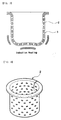
- Fig. 1 is a sectional view of the bowl in Example 1 of the induction-heating ceramic cooker by the present invention.
- Fig. 2 is a sectional view of the bowl in Example 2 of the induction-heating ceramic cooker by the present invention.
- Fig. 3 is a sectional view of the bowl in Example 3 of the induction-heating ceramic cooker by the present invention.
- Fig. 4 is a preferable example of the metallic bowl in Fig. 3.
- Fig. 5 is a block diagram showing the process of producing the induction-heating ceramic bowl of the present invention.
- Fig. 6 a block diagram showing another process of producing the induction-heating ceramic bowl of the present invention.
- Fig. 7 is a block diagram showing still another process of producing the induction-heating ceramic bowl of the present invention.
- Fig. 8 is a sectional view showing the process of heating the induction-heating ceramic bowl of the present invention.
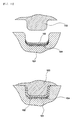
- Fig. 9 is a sectional view showing the use of a ceramic bowl.
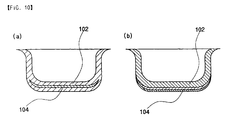
- Fig. 10 is a sectional view of a conventional fireproof cooker bowl.
- the present invention relates to the bowl of a ceramic cooker of induction-heating type and a method for production thereof. More particularly, it relates to a ceramic cooker bowl for cooking food by both the conventional way of heating with the use of things like a gas range and a way of induction of heating as is done for electric pressure cooker, as well as to a method for producing such a cooker bowl.
- the present invention is related to a ceramic cooker bowl and a method for production of one, which excels in anti-corrosion resistance and durability and, furthermore, can make the food cooked in it more delicious, than otherwise, due to the far infrared rays emitted by the ceramic material.
- Fig. 8 is to illustrate the process of heating an induction-heating cooker bowl, which belongs to the technical field of the present invention.
- such induction-heating cooker bowls are made of metallic material like steel, aluminum, stainless steel, etc.
- the 'skin effect means the phenomenon that the part where the electric current flows of the surface of a metallic plate (section where high frequency magnetic field is generated) concentrates on a certain area, and when this phenomenon occurs the resistance of the steel plate becomes even regardless of its thickness, while at the same time no magnetic flux penetrates the steel plate.
- a cooker bowl is made of aluminum, the cooker gets lighter in weight than one of steel-made is, and, not merely is its heat-conduction excellent, but it has an advantage of non-corrosion owing to the oxides layer formed by its reaction with the air. But this also has its problem in that the heating coil inside the bowl must be lengthened to increase its first resistance, because the resistance of aluminum is smaller than that of steel. That the skin effects occur only in a high frequency magnetic field of 50 kHz or more, poses another problem.
- a cooker bowl made of stainless steel undergoes so small of electric resistance as to preclude induction heating. It needed an adhesion to its bottom of an alloyed metallic plate, like steel, of larger resistance to help induction of heat. Because it is poor of heat conduction it has to use a material of excellent heat conduction like aluminum together with it, and then, however, the cooker gets heavy and unwieldy. Adhesion of plates, for instance, often risks flaking, too.
- Fig. 9 of the attached drawings is a sectional view of ordinary ceramic cooker in use. An enameled cooker looks the same.
- cookers of direct heating types are in a trend of getting improved or refashioned into those of induction-heating types.
- the inside of the lower plate 101 of the mold is filled with fireproof ceramic material 102 by about half, a metallic foil 104 is mounted on it, ceramic material 102 is again poured thereon, and all is heat-pressed with an upper plate 103 (Example 1); the reverse side surface of the metallic foil 104 is adhered by adhesives to an already baked fireproof pottery, then the obverse side surface of that metallic foil is coated fireproof, and then all is baked for the second time (Example 2).
- the fireproof bowl, produced by Example 1 not merely can have an aesthetic beauty in appearance like conventional cookers, not of induction-heating type, because the metallic foil 104 is evenly embedded inside, but has solved the most serious problem with conventional induction-heating cookers, that is, the decrease in durability, while making it possible to induce occurrence of the skin effects even in a magnetic field of lower intensity, let alone the saving on unit production costs through simplification of the production processes.
- Example 2 In the fireproof bowl, produced in Example 2, it is described that oxygen is blocked off the metallic foil 104, thereby improving the cooker's anti-corrosion resistance, and by means of placing a metal plate of good heat conductivity at the bottom of the cooker it is made possible to cook not only by induction-heating but by direct heating also.
- the present invention has been made with an objective to solve the aforesaid problems, and it is to provide a ceramic cooker, which excels in processibility, anti-corrosion resistance, and durability, and can cook the more tasty food due to the far infrared rays being emitted from the ceramic material, together with a method for its best effective production.
- the ceramic cooker bowl of the present invention has been so devised at the time of designing, in consideration of both the possible transformation of the two heterogeneous materials at the time of expansion under heat and the amount of heat generated by the skin effects, that the severance by flaking of the two materials of different nature can be prevented and sufficient heat for satisfactory cooking of food can also be secured.
- the induction-heating ceramic cooker bowl in Claim 1 of the present invention is produced by first evenly mixing particles of metal and ceramic and later heat-pressing the mixture in a mold.
- the induction-heating ceramic cooker bowl, disclosed in Claim 2 of the present invention is characterized in that the surface of the bowl, formed in advance with the use of powder of such a mineral as germanium emitting far infrared rays, is coated with a metallic layer which can produce the skin effects.
- the metallic layer which is formed first sticks to the surface of the ceramic bowl with an adhesion almost like that of molecular bonding, and as it is coated with more metallic particles in repetition for increase of the thickness, the total metallic layer becomes one almost like something made by fusion of similar materials, with a result that there will be no flaking, that is, the ceramic and the metallic layers will not sever from each other when they expand by heating.
- the induction-heating ceramic cooker bowl described in Claim 3 of the present invention, is characterized in that it is produced by forming a ceramic layer in a unitary structure on both surfaces of a metallic bowl, which has many holes bored through in advance.
- the strength of the metallic bowl decreases as much as the areas these holes occupy, and from this cause the ceramic layer can squarely withstand the expansion of the metallic bowl under heat, resulting in no severance between metallic and ceramic layers by flaking.
- Fig. 1 is a sectional view of the induction-heating ceramic bowl in Example 1.
- the cooker bowl is produced by the heat-pressing, in a mold, of a mixture of the powder of such metallic particles 6 as of steel, aluminum, copper, stainless steel, and tungsten and such powder of the glass or earthenware, or mineral germanium and ceramic particles 5.
- the induction-heating ceramic cooker bowl produced this way gets evenly heated thanks to the skin effects all over when high frequency magnetic field is generated, because the metallic particles 6 are distributed over the surfaces of, and in the layers of, the walls alike. Accordingly, it becomes possible to provide heat evenly all over the cooker bowl and the food can be cooked completely, leaving no portion less well cooked nor portion scorched.
- Fig. 2 is the sectional view of an induction-heating ceramic cooker bowl of the present invention, Example 2.
- This bowl is produced by coating the outer surface of a ceramic cooker bowl 1, prepared in advance, with a metallic layer 4 of a certain thickness, the thickness of the said metal layer, however, demanding control because it has direct relevance to the quantity of the heat generated for the cooker, the cooker's durability, and the possible flaking of materials under heat.
- Fig. 5 is a block diagram showing the production process in the case of producing the induction-heating ceramic cooker by a sputtering or ion-plating method.
- a ceramic cooker bowl 1 of a desired shape and size is produced.
- Step 2 Cleaning of the surface (19)
- the surface of the ceramic cooker bowl 1 is dried.
- Step 4 Sputtering (21) or ion-plating (21A)
- a metallic layer 4 of even thickness is provided to the ceramic cooker bowl 1 on its surface.
- this metallic layer 4 varies, depending upon the kinds of the metal, but it is preferable to be limited, in consideration of the specific natures of the product, to 0.5mm ⁇ 3.00mm.
- Step 4 can be performed in a single process, it still can be divided into several processes, increasing the thickness of the metallic layer 4 in graduation, at will.
- This is a step for cooling the temperature of the product to room temperature, and the crystallization structure of the metallic layer 4 is adjusted during this step.
- the crystallization structure of the metallic layer 4 has to do with both the durability and anti-corrosion resistance of the product, also affecting the electric efficiency.
- Fig. 6 is a block diagram to show the process in production of the induction-heating ceramic cooker bowl of the present invention by an injection method, divided in the following several steps.
- the ceramic cooker bowl 1 of a desired shape and size is produced.
- the surface of the ceramic cooker bowl 1 is, by means of shotting, rendered rugged, full of minute prominences and depressions. This step has to do with the adherence of the molten metal to be injected and the ceramic cooker bowl 1.
- Step 3 Cleaning of the surface (19)
- Dust and filth stuck on the surface of the ceramic cooker bowl 1 are removed. When desired, acid cleaning is performed.
- the outer surface of the ceramic cooker bowl 1 is dried.
- the outer surface of the ceramic cooker bowl 1 is evenly sprayed with molten metal of high temperature by injection, whereby a metallic layer 4 of even thickness is formed thereon.
- the thickness of the metallic layer 4 can vary, depending upon the kinds of the metal, but it is preferred to be limited, in consideration of the specific natures of the product, to 0.5mm ⁇ 3.00mm.
- This step is for lowering the temperature of the product to room temperature, and during this step the crystallization structure of the metallic layer 4 is also adjusted.
- the crystallization structure of the metallic layer 4 has to do with the product's durability and anti-corrosion resistance, seriously affecting the efficiency of electricity.
- the ways of depositing materials of different natures include the mechanical, physical, and chemical methods.
- Example 2 of the present invention the chemical method which requires supply of electric energy can not be made use of, because the ceramic cooker bowl 1 is of an insulated object.
- Fig. 7 is a production process chart for the induction-heating ceramic cooker bowl of the present invention when produced by spraying or dipping, whose order being as follows:
- the cooker bowl 1 of a desired shape and size is produced.
- Step 3 Cleaning of the surface (19)
- the surface of the cooker 1 is cleaned of dust or filth. When necessary acid cleaning is preformed.
- Step 4 Dipping (19A) or spraying (19B)
- the outer surface of the cooker bowl 1 is dried.
- the quality of the ceramic cooker bowl 1 is inspected, and the uneven portion, if any, is scraped and polished.
- Heat is applied to the ceramic cooker bowl 1 and the metallic layer 4 is fixed.
- Figs. 3 and 4 are respectively a sectional view of Example 3 of the induction-heating ceramic cooker bowl of the present invention and an illustration of a preferable example of the metallic bowl made use of therefor.
- Example 3 of embodiment of the present invention is produced by coating both the surfaces of the metallic bowl 2, with many holes bored in the surfaces, with a ceramic layer 3.
- the strength of the metallic bowl gets weakened in proportion to the numerous holes, and by this reason the ceramic layer can sufficiently resist the expansion of the metallic bowl under heating, resulting in no severance of the metallic bowl and ceramic layer from each other.
- the bowl of the induction-heating ceramic cooker in Example 1 of embodiment is produced by formation by heat-pressing of ceramic particles 5 and metallic particles 6 in a mold, the cooker bowl has the merit of being used either by induction-heating or conventional direct heating means 7. Moreover, the food cooked in the cooker tastes more delicious thanks to the far infrared rays emitted from the ceramic particles 5.
- the metallic particles 6 are evenly distributed over both surfaces of the bowl, the skin effects occur all over, when the high frequency magnetic field is provided, thus generating sufficient heat for cooking the food satisfactorily.
- the ceramic 5 and metallic 6 particles of minute size are placed side by side in close contact, the elongation of the said metallic particles 6 can be restrained by the ceramic 5particles when the former expand under heat, not to say of the advantage that the two heterogeneous materials behave as if they were in continuum, precluding that undesirable phenomenon of their severance from each other, flaking or peeling off, otherwise.
- Example 2 of embodiment of the induction-heating ceramic cooker bowl the first metallic layer adheres to the outer surface of the ceramic bowl 1 nearly as tightly as if it did by molecular bonding, and as the layer gets thickened gradually by repeated coating it becomes in fine as if rendered by fusion of an identical material, with a result that it will not sever from the ceramic bowl by flaking even when the metallic layer 4 of the ceramic bowl 1 is expanded under heating.
- the inner surface of the bowl is slippery, its cleaning is easy, and the surface which comes in contact with the food is of ceramic material, it has another advantage that there is no danger on the part of diners to take in metallic elements. Moreover, the cooker's external appearance can be fine and made beautiful.
- Example 3 of embodiment of the induction-heating ceramic cooker bowl of the present invention both the inner and outer surfaces of the metallic bowl 2 are each coated with a ceramic layer 3, and so it is possible to heat the bowl by conventional direct heating means 7 as well as by induction-heating, a further advantage being that thanks to the emission of far infrared rays from the ceramic layer 3 the taste of the food cooked therein is more delicious than when cooked in other sorts of cookers.
- the strength of the metallic bowl 2 gets decreased in proportion to the sizes of the numerous holes bored in its surface it is possible for the ceramic layer 3 to sufficiently withstand the expansion of the metallic bowl 2, and, as a result, there does not occur the undesirable phenomenon of severance of the ceramic layer 3 and the bowl 2 from each other under heat.
Landscapes
- Physics & Mathematics (AREA)
- Electromagnetism (AREA)
- Engineering & Computer Science (AREA)
- Food Science & Technology (AREA)
- Cookers (AREA)
- Devices For Post-Treatments, Processing, Supply, Discharge, And Other Processes (AREA)
Applications Claiming Priority (8)
| Application Number | Priority Date | Filing Date | Title |
|---|---|---|---|
| KR20-1999-0003589U KR200300250Y1 (ko) | 1999-03-08 | 1999-03-08 | 세라믹 조리용기 |
| KR9903589 | 1999-03-08 | ||
| KR1019990009150A KR20000060651A (ko) | 1999-03-18 | 1999-03-18 | 세라믹 조리용기 및 그 제조방법 |
| KR9909150 | 1999-03-18 | ||
| KR2019990004620U KR20000018564U (ko) | 1999-03-23 | 1999-03-23 | 세라믹 조리용기 |
| KR9904620 | 1999-03-23 | ||
| KR1019990010900A KR20000061679A (ko) | 1999-03-30 | 1999-03-30 | 세라믹 조리용기의 제조방법 |
| KR9910900 | 1999-03-30 |
Publications (2)
| Publication Number | Publication Date |
|---|---|
| EP1037509A2 true EP1037509A2 (de) | 2000-09-20 |
| EP1037509A3 EP1037509A3 (de) | 2002-05-15 |
Family
ID=27483339
Family Applications (1)
| Application Number | Title | Priority Date | Filing Date |
|---|---|---|---|
| EP99305893A Withdrawn EP1037509A3 (de) | 1999-03-08 | 1999-07-26 | Keramisches Geschirr bei einem Induktionbeheizten Keramik-Kochfeld und das Verfahren der Herstellung dasselbe |
Country Status (3)
| Country | Link |
|---|---|
| EP (1) | EP1037509A3 (de) |
| JP (1) | JP2000253991A (de) |
| CN (1) | CN1265866A (de) |
Cited By (1)
| Publication number | Priority date | Publication date | Assignee | Title |
|---|---|---|---|---|
| CN113208281A (zh) * | 2021-05-21 | 2021-08-06 | 重庆大学 | 基于感应式加热的智能保温餐桌系统 |
Families Citing this family (9)
| Publication number | Priority date | Publication date | Assignee | Title |
|---|---|---|---|---|
| CN102793465B (zh) * | 2012-08-28 | 2015-02-25 | 中国联合网络通信集团有限公司 | 远程自动炒菜系统和方法 |
| GB201217067D0 (en) * | 2012-09-25 | 2012-11-07 | British American Tobacco Co | Heating smokable material |
| CN205624467U (zh) * | 2016-03-21 | 2016-10-12 | 深圳市合元科技有限公司 | 一种烟油加热组件及包括该烟油加热组件的电子烟和雾化器 |
| CN107260002B (zh) * | 2016-04-08 | 2023-10-13 | 佛山市顺德区美的电热电器制造有限公司 | 一种烹饪器皿、电磁加热设备及导磁板 |
| CN206543122U (zh) * | 2016-05-20 | 2017-10-10 | 佛山市顺德区美的电热电器制造有限公司 | 一种双层结构的均温锅 |
| CN107397422B (zh) * | 2016-05-20 | 2020-11-17 | 佛山市顺德区美的电热电器制造有限公司 | 一种双层均热锅的制备方法 |
| CN105852650A (zh) * | 2016-05-31 | 2016-08-17 | 汕头大学 | 一种导磁陶瓷胆及其制备 |
| CN107755644A (zh) * | 2017-10-19 | 2018-03-06 | 南阳飞龙汽车零部件有限公司 | 一种铸造砂型型腔表面硬化处理装置及其制备方法 |
| WO2024001527A1 (zh) * | 2022-06-29 | 2024-01-04 | 九阳股份有限公司 | 一种烹饪器具及其内胆 |
Family Cites Families (3)
| Publication number | Priority date | Publication date | Assignee | Title |
|---|---|---|---|---|
| US3777094A (en) * | 1971-09-09 | 1973-12-04 | Environment One Corp | Thermally insulated cookware for dynamic induction field heating and cooking apparatus |
| US5320879A (en) * | 1992-07-20 | 1994-06-14 | Hughes Missile Systems Co. | Method of forming coatings by plasma spraying magnetic-cerment dielectric composite particles |
| FR2716099B1 (fr) * | 1994-02-11 | 1996-04-19 | Deshoulieres F | Procédé de fabrication d'un récipient culinaire pouvant être chauffé par induction et récipient obtenu selon ce procédé. |
-
1999
- 1999-07-26 EP EP99305893A patent/EP1037509A3/de not_active Withdrawn
- 1999-09-15 CN CN 99118856 patent/CN1265866A/zh active Pending
- 1999-09-28 JP JP27366499A patent/JP2000253991A/ja active Pending
Cited By (2)
| Publication number | Priority date | Publication date | Assignee | Title |
|---|---|---|---|---|
| CN113208281A (zh) * | 2021-05-21 | 2021-08-06 | 重庆大学 | 基于感应式加热的智能保温餐桌系统 |
| CN113208281B (zh) * | 2021-05-21 | 2023-02-28 | 重庆大学 | 基于感应式加热的智能保温餐桌系统 |
Also Published As
| Publication number | Publication date |
|---|---|
| JP2000253991A (ja) | 2000-09-19 |
| EP1037509A3 (de) | 2002-05-15 |
| CN1265866A (zh) | 2000-09-13 |
Similar Documents
| Publication | Publication Date | Title |
|---|---|---|
| JPS6127108Y2 (de) | ||
| US3064112A (en) | Cooking vessel and method of making the same | |
| CN101880850A (zh) | 一种热喷涂电磁炉铝锅复合底层的方法 | |
| EP1037509A2 (de) | Keramisches Geschirr bei einem Induktionbeheizten Keramik-Kochfeld und das Verfahren der Herstellung dasselbe | |
| US20060117539A1 (en) | Multi clad cookware | |
| CN106167419A (zh) | 具有金属导磁膜的耐热陶瓷砂锅及制备方法 | |
| US20040229079A1 (en) | Composite cookware having decorative outer surface and improved induction heating characteristics | |
| CN111319324B (zh) | 一种炊具用复合材料、不锈钢炊具及其制备方法 | |
| CN105455614B (zh) | 一种烹饪器具内锅的制造方法 | |
| KR100524524B1 (ko) | 조리용기 및 그의 제조방법 | |
| KR101751320B1 (ko) | 인덕션 렌지용 조리용기의 제조방법 | |
| CN114309943B (zh) | 一种铝合金炊具激光焊覆电磁感应锅的制作工艺 | |
| CN209996038U (zh) | 一种陶瓷锅 | |
| JPS5911436Y2 (ja) | 電磁調理器用非金属製容器 | |
| CN107536450A (zh) | 用于烹饪器具的内锅、烹饪器具和制造内锅的方法 | |
| CN111772462A (zh) | 锅具及其制造方法 | |
| DE4134740C1 (en) | Cooking pot mfr. - comprises applying heat distribution coating of aluminium@ or copper@ on base of deep-drawn stainless steel body, then surface coating by plasma spraying | |
| KR20000060651A (ko) | 세라믹 조리용기 및 그 제조방법 | |
| CN111772463B (zh) | 一种复底锅具及其制造方法 | |
| JP2005537088A (ja) | フライパンの製造方法 | |
| JPH0234436B2 (de) | ||
| CN207666429U (zh) | 用于烹饪器具的内锅和烹饪器具 | |
| KR20250026448A (ko) | 주방용기 내면의 용사처리방법 | |
| KR101710475B1 (ko) | 가열조리기구용 법랑 및 넌스틱 코팅 방법 및 가열조리기구 | |
| JP3094907U (ja) | 電磁誘導加熱調理器用調理器具 |
Legal Events
| Date | Code | Title | Description |
|---|---|---|---|
| PUAI | Public reference made under article 153(3) epc to a published international application that has entered the european phase |
Free format text: ORIGINAL CODE: 0009012 |
|
| AK | Designated contracting states |
Kind code of ref document: A2 Designated state(s): AT BE CH CY DE DK ES FI FR GB GR IE IT LI LU MC NL PT SE |
|
| AX | Request for extension of the european patent |
Free format text: AL;LT;LV;MK;RO;SI |
|
| RIC1 | Information provided on ipc code assigned before grant |
Free format text: 7H 05B 6/12 A, 7C 23C 4/04 B |
|
| PUAL | Search report despatched |
Free format text: ORIGINAL CODE: 0009013 |
|
| AK | Designated contracting states |
Kind code of ref document: A3 Designated state(s): AT BE CH CY DE DK ES FI FR GB GR IE IT LI LU MC NL PT SE |
|
| AX | Request for extension of the european patent |
Free format text: AL;LT;LV;MK;RO;SI |
|
| STAA | Information on the status of an ep patent application or granted ep patent |
Free format text: STATUS: THE APPLICATION IS DEEMED TO BE WITHDRAWN |
|
| 18D | Application deemed to be withdrawn |
Effective date: 20020201 |