EP1040331B1 - Gerät zum messen einer dehnungskraft - Google Patents
Gerät zum messen einer dehnungskraft Download PDFInfo
- Publication number
- EP1040331B1 EP1040331B1 EP98967075A EP98967075A EP1040331B1 EP 1040331 B1 EP1040331 B1 EP 1040331B1 EP 98967075 A EP98967075 A EP 98967075A EP 98967075 A EP98967075 A EP 98967075A EP 1040331 B1 EP1040331 B1 EP 1040331B1
- Authority
- EP
- European Patent Office
- Prior art keywords
- fibre
- sensor
- bending
- housing
- tube
- Prior art date
- Legal status (The legal status is an assumption and is not a legal conclusion. Google has not performed a legal analysis and makes no representation as to the accuracy of the status listed.)
- Expired - Lifetime
Links
Images



Classifications
-
- G—PHYSICS
- G01—MEASURING; TESTING
- G01B—MEASURING LENGTH, THICKNESS OR SIMILAR LINEAR DIMENSIONS; MEASURING ANGLES; MEASURING AREAS; MEASURING IRREGULARITIES OF SURFACES OR CONTOURS
- G01B11/00—Measuring arrangements characterised by the use of optical techniques
- G01B11/16—Measuring arrangements characterised by the use of optical techniques for measuring the deformation in a solid, e.g. optical strain gauge
- G01B11/18—Measuring arrangements characterised by the use of optical techniques for measuring the deformation in a solid, e.g. optical strain gauge using photoelastic elements
-
- G—PHYSICS
- G01—MEASURING; TESTING
- G01D—MEASURING NOT SPECIALLY ADAPTED FOR A SPECIFIC VARIABLE; ARRANGEMENTS FOR MEASURING TWO OR MORE VARIABLES NOT COVERED IN A SINGLE OTHER SUBCLASS; TARIFF METERING APPARATUS; MEASURING OR TESTING NOT OTHERWISE PROVIDED FOR
- G01D5/00—Mechanical means for transferring the output of a sensing member; Means for converting the output of a sensing member to another variable where the form or nature of the sensing member does not constrain the means for converting; Transducers not specially adapted for a specific variable
- G01D5/26—Mechanical means for transferring the output of a sensing member; Means for converting the output of a sensing member to another variable where the form or nature of the sensing member does not constrain the means for converting; Transducers not specially adapted for a specific variable characterised by optical transfer means, i.e. using infrared, visible, or ultraviolet light
- G01D5/32—Mechanical means for transferring the output of a sensing member; Means for converting the output of a sensing member to another variable where the form or nature of the sensing member does not constrain the means for converting; Transducers not specially adapted for a specific variable characterised by optical transfer means, i.e. using infrared, visible, or ultraviolet light with attenuation or whole or partial obturation of beams of light
- G01D5/34—Mechanical means for transferring the output of a sensing member; Means for converting the output of a sensing member to another variable where the form or nature of the sensing member does not constrain the means for converting; Transducers not specially adapted for a specific variable characterised by optical transfer means, i.e. using infrared, visible, or ultraviolet light with attenuation or whole or partial obturation of beams of light the beams of light being detected by photocells
- G01D5/353—Mechanical means for transferring the output of a sensing member; Means for converting the output of a sensing member to another variable where the form or nature of the sensing member does not constrain the means for converting; Transducers not specially adapted for a specific variable characterised by optical transfer means, i.e. using infrared, visible, or ultraviolet light with attenuation or whole or partial obturation of beams of light the beams of light being detected by photocells influencing the transmission properties of an optical fibre
- G01D5/35383—Mechanical means for transferring the output of a sensing member; Means for converting the output of a sensing member to another variable where the form or nature of the sensing member does not constrain the means for converting; Transducers not specially adapted for a specific variable characterised by optical transfer means, i.e. using infrared, visible, or ultraviolet light with attenuation or whole or partial obturation of beams of light the beams of light being detected by photocells influencing the transmission properties of an optical fibre using multiple sensor devices using multiplexing techniques
-
- G—PHYSICS
- G01—MEASURING; TESTING
- G01L—MEASURING FORCE, STRESS, TORQUE, WORK, MECHANICAL POWER, MECHANICAL EFFICIENCY, OR FLUID PRESSURE
- G01L1/00—Measuring force or stress, in general
- G01L1/24—Measuring force or stress, in general by measuring variations of optical properties of material when it is stressed, e.g. by photoelastic stress analysis using infrared, visible light, ultraviolet
- G01L1/242—Measuring force or stress, in general by measuring variations of optical properties of material when it is stressed, e.g. by photoelastic stress analysis using infrared, visible light, ultraviolet the material being an optical fibre
- G01L1/246—Measuring force or stress, in general by measuring variations of optical properties of material when it is stressed, e.g. by photoelastic stress analysis using infrared, visible light, ultraviolet the material being an optical fibre using integrated gratings, e.g. Bragg gratings
Definitions
- the present invention concerns a device for measuring a bending load in constructions, according to the introductory part of Claim 1.
- a Bragg grating is a single mode fibre having permanent periodical variation in the refraction index over a fibre length of for example 0.1 to 10 cm. Variation in the refraction index is established by illuminating the fibre with an UV-laser.
- a bragg grating reflects light at a wave length given by the refraction index and the period related to space for the variation in refraction index (grating period), while light outside this wave period will pass the grating more or less unhindered.
- the light reflected by the Bragg grating will give a wave length which varies as a function of a measuring dimension changing the refraction index of the fibre material in the grating and/or by the fibre length in the grating zone (the grating period). Tension in the fibre or temperature will thus give a change in wavelength for the light reflected in the Bragg grating.
- temperature can be measured in the range -100 °C to +250 °C at approximately 20 points along a fibre having a length of 50-100 km. Using various multiplexing techniques, the number of measurement points can be increased. Examples of areas of application are temperature surveillance of power cables, pipelines, electrical transformers, engines and temperature monitoring of industrial processes.
- US4,761,073 discloses a distributed, spatially resolving optical fibre strain gauge.
- US5,684,297 discloses a distributed optical sensor for detecting and/or measuring changes in physical magnitudes such as temperature, pressure and mechanical reformation.
- the objective of the present invention is to provide a device for measuring bending in and on mechanical constructions.
- a device for measuring bending in mechanical constructions comprising:
- the Bragg-grating in the first sensor will be influenced by bending, tension and thermal effects.
- the Bragg-grating in the second sensor will mainly is only influenced by tension and thermal effects (for example expansion in the second sensor), while the Bragg-grating in the third sensor only is influenced by thermal effects.
- the principal design of a bend measuring sensor according to the present invention renders it possible to produce bend measuring sensors with very small dimensions capable of measuring both small and large bending radii from distant positions.
- the device also has the capability of measuring bending in different positions along the same optical fibre.
- FIG. 1 shows a first embodiment of a first sensor according to the present invention.
- This first sensor includes a generally cylindrical housing 101 with an inner cylindrical bore 102. Inside the bore is arranged an optical fibre 120 prestressed between a first and second anchoring point 110, 111.
- a first Bragg grating 121 which in reality is integrated into the optical fibre 120, is in the figure, for ease of reference, indicated as a hatched rectangle, located on the freely prestressed fibre section.
- Fig. 1a shows the bending sensor and location of the fibre 120 and grating 121 when the housing 101 is being strongly bent.
- the bore 102 has an inner diameter which is sufficiently large for the grating so that it is not exposed to tension load during strong bending. The length and diameter of the housing will vary with the particular area of use.
- the Bragg grating 121 will be relaxed, where as the light reflected from the Bragg grating 121 will be influenced by bending, tension and thermal effects from the surrounding atmosphere and from the next construction, which is to be measured.
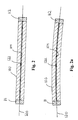
- Fig. 2 shows an embodiment of a second sensor for use in a device according to the present invention, and comprises a generally cylindrical housing 103 having an inner cylindrical bore 104.
- the housing 103 can, for the second sensor, be attached to the first housing 101 at the anchoring point 111.
- Inside the bore 104 in the second sensor is located an optical fibre 120 prestressed between the anchoring points 111 and 112.
- the bore 104 has an inner diameter slightly larger then the external diameter of the fibre 120. which then forces the fibre 120 with the grating 122 to follow the axis in the housing 103 in bending the same.
- Fig. 2a shows this second sensor during strong bending.
- the Bragg grating will be curved in step with the housing 103, and thus not relaxed as a result of the bending. Light reflected from this Bragg grating 122 will then only be influenced by tension and thermal effects from the surrounding atmosphere and from the next construction which is to be measured.
- Fig. 3 shows an embodiment of a third sensor for use in a device according to the present invention.
- the third sensor comprises a generally cylindrical housing 105 having an inner cylindrical bore 106.
- the housing 105 can be attached to the second sensor at anchoring point 112.
- Inside the bore 106 in the third sensor is located an optical fibre 120 mounted unstressed between a first and second anchoring point 112 and 113 located at respective ends of the housing 105.
- the third Bragg grating is located in the fibre section which is suspended between the anchoring points 112 and 113.
- the bore 106 has (like bore 102 of the first sensor) an inner diameter which is sufficiently large enough not to expose the grating to a tension load during bending that is too large. Since the fibre 120 of the third sensor is not prestressed, it will not be relaxed at the initial bending. Length and diameter of the housing will vary with the particular area of use.
- the Bragg grating 123 in the optical fibre section that is not prestressed will only to a small degree be exposed to load from bending and tension of the housing.
- Bragg grating 123 will be substantially effected from changes in temperature caused by the surrounding atmosphere or the next construction which is to be measured. In this way, the device can be compensated for temperature-caused displacement in the wave length in light reflected from the Bragg grating 123.
- the device according to present invention is calibrated at different temperatures in order to achieve a best possible temperature dependent measurement of wavelength-shift as a function of bending.
- An alternative for avoiding mechanical influence of the grating 123 in the third sensor used for temperature compensation is to connect it to, for example, a tube 107 by means of a glue joint, as shown in Fig. 4.
- the tube 107 (not connected to the housing 105) will then isolate the grating 123 from bending and tension as shown in Fig. 4a.
- the tube 107 can be a metallic tube or alternatively a glass rod with grooves for the optical fibre.
- Fig. 5 shows a device according to the present invention with first, second and third sensors each with different responses to bending integrated in the device.
- the device comprises a longitudinal housing 150, for example in the shape of a tube, with the respective sensors distributed along the length of the housing 150 and situated next to each other.
- the housing 150 accomodated the respective sensors 101, 102 and 103.
- the housing 150 is connected externally to a surrounding mechanical construction (to be measured for bending) over the entire length (for example by gluing) or at the anchoring points 110, 111, 112 and 113.
- first Bragg grating 121 When the housing 101 is bent, first Bragg grating 121 will shorten because the fibre is situated in a straight length between the anchoring points 110 and 111.
- the second Bragg grating 122 in the bore 104 will experience a substantially smaller change in length because it is forced to follow the axis of the housing.
- the third grating will not be influenced by bending of the construction.
- the housing for all sensor means in this embodiment is carried out as a common tube.
- the second sensor means is carried out by locating a cannula tube 103 with support rings 131 and 132 along the axis.
- the fibre can also be protected on both sides of the bending sensor with cannula tubes 130 and 131, whichhen consitutes a small and solid cable.
- the second grating 122 will not experience the longitudinal force due to bending.
- the housing 101, 102 and 103 is glued to the surrounding construction over the entire length and is exposed to tension in addition to bending, the relative prolongation of the housings ⁇ H will be the same as in the surrounding construction. This will give the same contribution to all of the housings.
- the entire device in made of metal, except for, of course, the optical fibre.
- both housing 101, 103, 105 and inner tube 107 arc made from cannula tubes.
- the bending sensor can be constructed with a housing and tubes diameter of mere millimeters.
- the various components do not necessarily have the geometry showed by the drawings.
- the member to be exposed to bending may have a cross-section that deviates from a circular shape; it may be oval, square etc. The same applies to the other components.
- the central issue with the invention is, however, that the member to be exposed to bending shall be able to transmit length change further to the connected Bragg grating.
- the invention thus provides a device for measuring bending in mechanical constructions, which enables measurement over a broad range of stresses, with high precision and which simultanously compensates for deviations caused by temperature fluctuations.
- the device according to the present invention can be designed to be very small and can therefore be installed in places where bending measurement usually has not been possible.
- Another advantage with the device according to the invention is that the fibre is not exposed to external hydrostatic pressure, and will therefore exhibit a high reliability. Finally, this design does not require pressure tight connections for the fibre.
Landscapes
- Physics & Mathematics (AREA)
- General Physics & Mathematics (AREA)
- Optical Transform (AREA)
Claims (17)
- Vorrichtung zum Messen von Biegelasten, dadurch gekennzeichnet, dass die Vorrichtung einen ersten Sensor für das Messen einer Biegelast umfasst, wobei der erste Sensor aufweist:ein erstes Element (101), das einer Biegung ausgesetzt werden kann; undeine Lichtleitfaser (120), die in Bezug auf das erste Element (101) an einem ersten und zweiten Verankerungspunkt (110, 111) so angeordnet ist, dass die Faser (120) vorgespannt ist,wobei die Faser (120) ein erstes Bragg-Gitter (121) umfasst, das in der vorgespannten Faser (120) angeordnet ist und wobei das erste Element (101) so angeordnet ist, dass sich bei Biegung des ersten Elements (101) die Spannung in der Faser (120) verringert.
- Vorrichtung nach Anspruch 1, wobei das erste Element (101) ein erstes Gehäuse (101) umfasst, und die Faser (120) mit dem Gehäuse (101) an dem ersten und zweiten Verankerungspunkt (110, 111) verbunden ist.
- Vorrichtung nach Anspruch 2, wobei das erste Gehäuse (101) so angeordnet ist, dass die Faser (120) nicht damit in Kontakt gebracht und einer Biegelast ausgesetzt wird.
- Vorrichtung nach Anspruch 2 oder 3, wobei das erste Gehäuse (101) eine im Allgemeinen zylindrische Form aufweist.
- Vorrichtung nach einem der vorangehenden Ansprüche, wobei die Vorrichtung des weiteren einen zweiten Sensor für das Messen von Zuglast umfasst, wobei der Sensor ein zweites Element (103) umfasst, das einer Biegung ausgesetzt werden kann, eine Lichtleitfaser (120), die in Bezug auf das erste Element (103) an einem ersten und zweiten Verankerungspunkt (111, 112) so angeordnet ist, dass die Faser (120) vorgespannt ist, worin die Faser (120) mit einem zweiten Braggschen Gitter (122) versehen ist, angeordnet in der vorgespannten Faser, wobei das zweite Element (103) so angeordnet ist, dass die Faser (120) zusammen mit dem zweiten Element (103) gebogen wird, wenn das zweite Element (103) gebogen wird.
- Vorrichtung nach Anspruch 5, wobei das zweite Element (103) mit einem weiteren Element (103, 104) angeordnet ist, welches die Faser (120) zwingt, sich mit dem zweiten Element (103) zu biegen.
- Vorrichtung nach Anspruch 6, wobei das weitere Element (103, 104) ein Röhrchen (103) mit einem Durchmesser von wenigen Millimetern ist, das zwischen zwei Verankerungspunkten (111, 112) angeordnet ist, so dass die Biegeeigenschaften über die Länge des Röhrchens (103) annähernd gleich sind.
- Vorrichtung nach einem der vorangehenden Ansprüche, des weiteren umfassend einen dritten Sensor für das Messen von Temperatur, wobei der dritte Sensor ein drittes Element (105) umfasst, das einer Biegung ausgesetzt werden kann, eine Lichtleitfaser (120), die in einem ersten und einem zweiten Verankerungspunkt (112, 113) in Bezug auf das dritte Element ohne Vorspannung der Faser hängend angeordnet ist, worin die Faser (120) ein drittes Braggsches Gitter (123) umfasst, angeordnet in der hängenden Faser, wobei das dritte Element (105) so angeordnet ist, dass durch ein Biegen oder eine Zugspannung des dritten Elements (105) die Faser (120) nicht in Kontakt mit dem dritten Element (105) gebracht oder der Zuglast ausgesetzt wird.
- Vorrichtung nach Anspruch 8, wobei das dritte Braggsche Gitter (123), angeordnet im dritten Sensor, in einem frei aufgehängten Röhrchen (107) für das Verringern des Einflusses einer Biegung oder Zugspannung auf das Gitter (123) angeordnet ist.
- Vorrichtung nach einem der Ansprüche 5 bis 9, wobei, wenn vorgesehen, das zweite und/oder dritte Element (103, 105) jeweils ein zweites und/oder drittes Gehäuse (103, 105) umfassen.
- Vorrichtung nach einem der vorangehenden Ansprüche, wobei das erste Element, und/oder, wenn vorgesehen, eines des zweiten und dritten Elementes (103, 105) oder das weitere Element (103, 104) eine Röhre umfasst, vorzugsweise eine Röhre mit einem Durchmesser von wenigen Millimetern.
- Vorrichtung nach einem der vorangehenden Ansprüche, wobei beliebige der Verankerungspunkte (110, 111, 112, 113) des ersten Sensors und/oder, wenn vorgesehen, des zweiten oder dritten Sensors, Klebeverbindungen sind.
- Vorrichtung nach einem der vorangehenden Ansprüche, umfassend ein allgemeines Gehäuse (150) in welchem der erste Sensor angeordnet ist und, wenn vorgesehen, wenigstens einer der zweiten und dritten Sensoren.
- Vorrichtung nach Anspruch 13, wenn direkt oder indirekt von Anspruch 7 abhängig, wobei das Rohr (103) in dem allgemeinen Gehäuse angeordnet ist, und von einem oder mehreren ringförmigen Elementen (132, 133) gegen die Innenseite des allgemeinen Gehäuses abgestützt wird.
- Vorrichtung nach Anspruch 13 oder 14, des weiteren umfassend Röhrchen (130, 131), die mit den jeweiligen Enden des allgemeinen Gehäuses (150) zum Tragen der Lichtleitfaser (120) verbunden sind, und die Faser (120) und das Innere der Vorrichtung gegen die Umgebung schützen.
- Vorrichtung nach einem der Ansprüche 13 bis 15, wobei der erste Sensor und, wenn vorgesehen, einer oder beide des zweiten und dritten Sensors aufeinanderfolgend in dem allgemeinen Gehäuse angeordnet sind.
- Vorrichtung nach einem der vorangehenden Ansprüche, wobei die Lichtleitfasern des ersten Sensors, und, wenn vorgesehen, wenigstens eines des zweiten Sensors und des dritten Sensors, Abschnitte einer gemeinsamen Lichtleitfaser (120) sind.
Applications Claiming Priority (3)
| Application Number | Priority Date | Filing Date | Title |
|---|---|---|---|
| WOPCT/NO97/05657 | 1997-12-05 | ||
| NO19975657A NO307314B1 (no) | 1997-12-05 | 1997-12-05 | Anordning for registrering av boyebelastning |
| PCT/NO1998/000359 WO1999032862A1 (en) | 1997-12-05 | 1998-12-03 | Device for measuring a bending load |
Publications (2)
| Publication Number | Publication Date |
|---|---|
| EP1040331A1 EP1040331A1 (de) | 2000-10-04 |
| EP1040331B1 true EP1040331B1 (de) | 2007-11-28 |
Family
ID=19901415
Family Applications (1)
| Application Number | Title | Priority Date | Filing Date |
|---|---|---|---|
| EP98967075A Expired - Lifetime EP1040331B1 (de) | 1997-12-05 | 1998-12-03 | Gerät zum messen einer dehnungskraft |
Country Status (6)
| Country | Link |
|---|---|
| US (1) | US6384404B1 (de) |
| EP (1) | EP1040331B1 (de) |
| DE (1) | DE69838799D1 (de) |
| DK (1) | DK1040331T3 (de) |
| NO (1) | NO307314B1 (de) |
| WO (1) | WO1999032862A1 (de) |
Families Citing this family (31)
| Publication number | Priority date | Publication date | Assignee | Title |
|---|---|---|---|---|
| NO310125B1 (no) * | 1999-05-06 | 2001-05-21 | Leiv Eiriksson Nyfotek As | System for overvåking av höyspentkabler i luftstrekk |
| AU6639900A (en) | 1999-08-13 | 2001-03-13 | Advanced Sensor Technologies Llc | Probe position sensing system for use in a coordinate measuring machine |
| US6600149B2 (en) * | 1999-12-27 | 2003-07-29 | Whitten L. Schulz | Fiber grating environmental sensing system |
| JP3519333B2 (ja) * | 2000-02-10 | 2004-04-12 | エヌ・ティ・ティ・アドバンステクノロジ株式会社 | 光ファイバセンサ |
| EP1340061A4 (de) * | 2000-12-07 | 2005-01-19 | Univ Nanyang | Faseroptischer kraftsensor |
| BE1013983A3 (nl) * | 2001-02-27 | 2003-01-14 | Voet Marc | Optische kabel voor het meten van temperatuur en/of rek. |
| FR2823299B1 (fr) | 2001-04-04 | 2003-09-19 | Commissariat Energie Atomique | Extensometre a longue base, a fibre optique tendue et reseau de bragg, et procede de fabrication de cet extensometre |
| GB0127497D0 (en) * | 2001-11-15 | 2002-01-09 | Secr Defence | Strain sensor |
| FR2844576B1 (fr) | 2002-09-18 | 2004-11-12 | Coflexip | Procede et dispositif de surveillance de la tenu d'une conduite flexible au niveau d'un embout terminal |
| US6840114B2 (en) * | 2003-05-19 | 2005-01-11 | Weatherford/Lamb, Inc. | Housing on the exterior of a well casing for optical fiber sensors |
| CA2443876C (en) * | 2003-10-02 | 2007-08-21 | Fulgor Greek Electric Cables S.A. | Flexible factory joint for metallic tubes which enclose loosely inside them optical fibers and its method of construction |
| ES2672789T3 (es) * | 2004-01-23 | 2018-06-18 | Lm Wind Power International Technology Ii Aps | Dispositivo que incluye un sistema adaptado para uso en compensación de temperatura de mediciones de tensión de estructuras reforzadas con fibra |
| KR100666379B1 (ko) | 2004-04-08 | 2007-01-10 | 박현수 | 광섬유격자 구조체 및 이를 적용한 구조물 변형 측정 장치 및 방법 |
| US7411176B2 (en) * | 2005-01-26 | 2008-08-12 | National Central University | Method and apparatus for examining corrosion of tendon embedded in concrete |
| JP2007108325A (ja) * | 2005-10-12 | 2007-04-26 | Oki Electric Ind Co Ltd | 波長調整装置および波長調整方法 |
| GB2440954B (en) * | 2006-08-18 | 2008-12-17 | Insensys Ltd | Structural monitoring |
| US8290315B2 (en) * | 2007-01-24 | 2012-10-16 | Gkn Aerospace Services Limited | Temperature sensing |
| KR101267261B1 (ko) | 2008-10-09 | 2013-05-23 | (주)카이센 | 에프비지 광섬유센서 온도 케이블 |
| DE102009007142A1 (de) | 2009-02-02 | 2010-08-05 | Draka Industrial Cable Gmbh | Faseroptische Messvorrichtung |
| US9109883B2 (en) * | 2009-05-29 | 2015-08-18 | The Board Of Trustees Of The University Of Illinois | High resolution large displacement/crack sensor |
| GB201018538D0 (en) | 2010-11-03 | 2010-12-15 | Wellstream Int Ltd | Parameter sensing |
| FR2998662B1 (fr) * | 2012-11-23 | 2019-10-25 | Airbus Operations | Dispositif de mesure de deformation et implantation d'un tel dispositif dans un element |
| ITBO20130135A1 (it) * | 2013-03-28 | 2014-09-29 | Filippo Bastianini | Sensore di deformazione con reticolo di bragg in fibra ottica termocompensato, resistenze agli urti, con sensibilita¿ registrabile e flangie orientabili |
| AU2014256932B2 (en) * | 2013-04-26 | 2017-01-05 | Wicor Holding Ag | Fiber-grating sensors having longitudinal-strain-inducing jackets and sensor systems and structures including such sensors |
| CN103389176B (zh) * | 2013-07-25 | 2015-08-12 | 国家电网公司 | 一种变压器绕组幅向应力测量装置和测量方法 |
| CN103528950B (zh) * | 2013-10-31 | 2016-03-02 | 闫楠 | 一种锚杆锚固体与风化岩体间粘结强度测试方法 |
| US9370458B2 (en) | 2014-11-06 | 2016-06-21 | Donald Wem | Personal lifting assembly |
| US10422637B1 (en) * | 2016-06-10 | 2019-09-24 | Facebook Technologies, Llc | Wave reflection deformation sensing apparatus |
| DE102018214195A1 (de) * | 2018-08-22 | 2020-03-19 | Aktiebolaget Skf | Verfahren zum Befestigen einer Faser mit einem Faser-Bragg-Sensorsegment an eine Komponente oder Lagervorrichtung mit einer derartigen Faser |
| CN110836643B (zh) * | 2019-11-08 | 2021-07-30 | 中国人民解放军海军七0一工厂 | 一种曲面压电复合材料的温度弯曲形变的测量 |
| CN116025827A (zh) * | 2023-01-03 | 2023-04-28 | 江苏法尔胜光电科技有限公司 | 一种光纤光栅应力传感器的预张机构 |
Family Cites Families (8)
| Publication number | Priority date | Publication date | Assignee | Title |
|---|---|---|---|---|
| US4761073A (en) * | 1984-08-13 | 1988-08-02 | United Technologies Corporation | Distributed, spatially resolving optical fiber strain gauge |
| US5399854A (en) * | 1994-03-08 | 1995-03-21 | United Technologies Corporation | Embedded optical sensor capable of strain and temperature measurement using a single diffraction grating |
| FI955511A7 (fi) * | 1994-11-17 | 1996-05-18 | Alcatel Cable | Menetelmä fysikaalisten suureiden havaitsemiseksi ja/tai mittaamiseksi käyttäen hajautettua tunnistinta |
| FR2727203B1 (fr) * | 1994-11-18 | 1996-12-13 | Commissariat Energie Atomique | Micro-systeme optique de type rosette de jauges de contraintes a guides dielectriques pour la mesure d'une contrainte longitudinale en structure plane |
| US5591965A (en) * | 1995-05-08 | 1997-01-07 | Udd; Eric | Multiparameter sensor system using a multiple grating fiber optic birefringent fiber |
| US5563967A (en) * | 1995-06-07 | 1996-10-08 | Mcdonnell Douglas Corporation | Fiber optic sensor having a multicore optical fiber and an associated sensing method |
| US6246048B1 (en) * | 1999-05-18 | 2001-06-12 | Schlumberger Technology Corporation | Methods and apparatus for mechanically enhancing the sensitivity of longitudinally loaded fiber optic sensors |
| US6337737B1 (en) * | 2001-03-09 | 2002-01-08 | Ciena Corporation | Fiber-Bragg-grating-based strain measuring apparatus, system and method |
-
1997
- 1997-12-05 NO NO19975657A patent/NO307314B1/no not_active IP Right Cessation
-
1998
- 1998-12-03 WO PCT/NO1998/000359 patent/WO1999032862A1/en not_active Ceased
- 1998-12-03 EP EP98967075A patent/EP1040331B1/de not_active Expired - Lifetime
- 1998-12-03 US US09/555,504 patent/US6384404B1/en not_active Expired - Lifetime
- 1998-12-03 DK DK98967075T patent/DK1040331T3/da active
- 1998-12-03 DE DE69838799T patent/DE69838799D1/de not_active Expired - Lifetime
Also Published As
| Publication number | Publication date |
|---|---|
| DE69838799D1 (de) | 2008-01-10 |
| WO1999032862A1 (en) | 1999-07-01 |
| US6384404B1 (en) | 2002-05-07 |
| DK1040331T3 (da) | 2008-03-31 |
| NO307314B1 (no) | 2000-03-13 |
| NO975657D0 (no) | 1997-12-05 |
| NO975657L (no) | 1999-06-07 |
| EP1040331A1 (de) | 2000-10-04 |
Similar Documents
| Publication | Publication Date | Title |
|---|---|---|
| US6384404B1 (en) | Device for measuring a bending load | |
| EP1036345B1 (de) | Sensor zur messung von dehnungen | |
| EP1635034B1 (de) | Sensor und Vermessungsvorrichtung zur Bestimmung des Biegeradius und der Form eines Rohrleitungs | |
| US6563970B1 (en) | Pressure sensor with fibre-integrated bragg grating, comprising an integrated temperature sensor with fibre-integrated bragg grating | |
| JP2983018B1 (ja) | 光ファイバセンサ | |
| CA2830281C (en) | Multi-point pressure sensor and uses thereof | |
| US5594819A (en) | Field-mountable fiber optic sensors for long term strain monitoring in hostile environments | |
| Mizunami et al. | High-sensitivity cryogenic fibre-Bragg-grating temperature sensors using Teflon substrates | |
| EP1012553B1 (de) | Hochempfindlicher faseroptischer drucksensor für rauhe umgebungen | |
| EP3137867B1 (de) | Glasfasersensoranordnung | |
| US20090217769A1 (en) | Structural monitoring | |
| GB2125572A (en) | Optical fibre sensors | |
| EP1451544A1 (de) | Messen einer schubspannung an einer schnittstelle mit zwei wänden und zwei sich kreuzenden sensorelementen | |
| ES2372167T3 (es) | Sistema para mediciones remotas. | |
| US20150226622A1 (en) | Pressure sensing assembly | |
| US7200292B2 (en) | Optical fiber inclinometer | |
| US7050662B2 (en) | Fiber Bragg grating compression sensor system | |
| EP3425343B1 (de) | Faseroptischer sensor | |
| JP3755601B2 (ja) | Fbg式温度センサ | |
| JP3903186B2 (ja) | Fbg光ファイバセンサを用いた地すべり計 | |
| JP4954687B2 (ja) | 光ファイバセンサケーブル | |
| KR100301775B1 (ko) | 광변형센서 | |
| Ivanov | Multi-parameter fiber optic sensors for structural health monitoring | |
| JPH06341814A (ja) | 光ファイバセンサ | |
| Fender et al. | Dynamic two-axis curvature measurement using multicore fiber Bragg gratings |
Legal Events
| Date | Code | Title | Description |
|---|---|---|---|
| PUAI | Public reference made under article 153(3) epc to a published international application that has entered the european phase |
Free format text: ORIGINAL CODE: 0009012 |
|
| 17P | Request for examination filed |
Effective date: 20000525 |
|
| AK | Designated contracting states |
Kind code of ref document: A1 Designated state(s): CH DE DK FR GB LI NL |
|
| GRAP | Despatch of communication of intention to grant a patent |
Free format text: ORIGINAL CODE: EPIDOSNIGR1 |
|
| GRAS | Grant fee paid |
Free format text: ORIGINAL CODE: EPIDOSNIGR3 |
|
| GRAA | (expected) grant |
Free format text: ORIGINAL CODE: 0009210 |
|
| AK | Designated contracting states |
Kind code of ref document: B1 Designated state(s): CH DE DK FR GB LI NL |
|
| REG | Reference to a national code |
Ref country code: GB Ref legal event code: FG4D |
|
| REG | Reference to a national code |
Ref country code: CH Ref legal event code: EP |
|
| REF | Corresponds to: |
Ref document number: 69838799 Country of ref document: DE Date of ref document: 20080110 Kind code of ref document: P |
|
| REG | Reference to a national code |
Ref country code: DK Ref legal event code: T3 |
|
| PG25 | Lapsed in a contracting state [announced via postgrant information from national office to epo] |
Ref country code: NL Free format text: LAPSE BECAUSE OF FAILURE TO SUBMIT A TRANSLATION OF THE DESCRIPTION OR TO PAY THE FEE WITHIN THE PRESCRIBED TIME-LIMIT Effective date: 20071128 Ref country code: LI Free format text: LAPSE BECAUSE OF FAILURE TO SUBMIT A TRANSLATION OF THE DESCRIPTION OR TO PAY THE FEE WITHIN THE PRESCRIBED TIME-LIMIT Effective date: 20071128 Ref country code: CH Free format text: LAPSE BECAUSE OF FAILURE TO SUBMIT A TRANSLATION OF THE DESCRIPTION OR TO PAY THE FEE WITHIN THE PRESCRIBED TIME-LIMIT Effective date: 20071128 |
|
| NLV1 | Nl: lapsed or annulled due to failure to fulfill the requirements of art. 29p and 29m of the patents act | ||
| REG | Reference to a national code |
Ref country code: CH Ref legal event code: PL |
|
| PG25 | Lapsed in a contracting state [announced via postgrant information from national office to epo] |
Ref country code: DE Free format text: LAPSE BECAUSE OF FAILURE TO SUBMIT A TRANSLATION OF THE DESCRIPTION OR TO PAY THE FEE WITHIN THE PRESCRIBED TIME-LIMIT Effective date: 20080229 |
|
| ET | Fr: translation filed | ||
| PLBE | No opposition filed within time limit |
Free format text: ORIGINAL CODE: 0009261 |
|
| STAA | Information on the status of an ep patent application or granted ep patent |
Free format text: STATUS: NO OPPOSITION FILED WITHIN TIME LIMIT |
|
| 26N | No opposition filed |
Effective date: 20080829 |
|
| REG | Reference to a national code |
Ref country code: FR Ref legal event code: PLFP Year of fee payment: 18 |
|
| REG | Reference to a national code |
Ref country code: FR Ref legal event code: PLFP Year of fee payment: 19 |
|
| REG | Reference to a national code |
Ref country code: FR Ref legal event code: PLFP Year of fee payment: 20 |
|
| PGFP | Annual fee paid to national office [announced via postgrant information from national office to epo] |
Ref country code: FR Payment date: 20171221 Year of fee payment: 20 Ref country code: DK Payment date: 20171215 Year of fee payment: 20 |
|
| PGFP | Annual fee paid to national office [announced via postgrant information from national office to epo] |
Ref country code: GB Payment date: 20171221 Year of fee payment: 20 |
|
| REG | Reference to a national code |
Ref country code: DK Ref legal event code: EUP Effective date: 20181203 |
|
| REG | Reference to a national code |
Ref country code: GB Ref legal event code: PE20 Expiry date: 20181202 |
|
| PG25 | Lapsed in a contracting state [announced via postgrant information from national office to epo] |
Ref country code: GB Free format text: LAPSE BECAUSE OF EXPIRATION OF PROTECTION Effective date: 20181202 |