EP1046823A2 - Ventilanordnung zur Einstellung paralleler Ströme, Verfahren zur Herstellung eines Ventilglieds eines derartigen Apparats, Verfahren zur Einstellung derartiger Ströme, sowie Verfahren zum Waschen eines derartigen Apparats - Google Patents
Ventilanordnung zur Einstellung paralleler Ströme, Verfahren zur Herstellung eines Ventilglieds eines derartigen Apparats, Verfahren zur Einstellung derartiger Ströme, sowie Verfahren zum Waschen eines derartigen Apparats Download PDFInfo
- Publication number
- EP1046823A2 EP1046823A2 EP20000660040 EP00660040A EP1046823A2 EP 1046823 A2 EP1046823 A2 EP 1046823A2 EP 20000660040 EP20000660040 EP 20000660040 EP 00660040 A EP00660040 A EP 00660040A EP 1046823 A2 EP1046823 A2 EP 1046823A2
- Authority
- EP
- European Patent Office
- Prior art keywords
- valve
- sliding surfaces
- members
- washing
- grooves
- Prior art date
- Legal status (The legal status is an assumption and is not a legal conclusion. Google has not performed a legal analysis and makes no representation as to the accuracy of the status listed.)
- Withdrawn
Links
- 238000005406 washing Methods 0.000 title claims abstract description 52
- 238000000034 method Methods 0.000 title claims abstract description 26
- 238000004519 manufacturing process Methods 0.000 title claims abstract description 10
- 239000007788 liquid Substances 0.000 claims abstract description 32
- 239000012530 fluid Substances 0.000 claims abstract description 25
- 238000000227 grinding Methods 0.000 claims abstract description 17
- 238000011109 contamination Methods 0.000 claims abstract description 10
- 238000005086 pumping Methods 0.000 claims description 21
- 230000004087 circulation Effects 0.000 claims description 15
- 239000011159 matrix material Substances 0.000 claims description 7
- 229910003460 diamond Inorganic materials 0.000 claims description 5
- 239000010432 diamond Substances 0.000 claims description 5
- 239000000428 dust Substances 0.000 abstract description 3
- 239000003153 chemical reaction reagent Substances 0.000 description 19
- 230000033001 locomotion Effects 0.000 description 11
- PNEYBMLMFCGWSK-UHFFFAOYSA-N Alumina Chemical compound [O-2].[O-2].[O-2].[Al+3].[Al+3] PNEYBMLMFCGWSK-UHFFFAOYSA-N 0.000 description 9
- 239000000919 ceramic Substances 0.000 description 5
- 229910000831 Steel Inorganic materials 0.000 description 4
- 239000011248 coating agent Substances 0.000 description 4
- 238000000576 coating method Methods 0.000 description 4
- 238000012856 packing Methods 0.000 description 4
- 239000010959 steel Substances 0.000 description 4
- 239000000243 solution Substances 0.000 description 3
- 238000002347 injection Methods 0.000 description 2
- 239000007924 injection Substances 0.000 description 2
- 239000000463 material Substances 0.000 description 2
- 229910052751 metal Inorganic materials 0.000 description 2
- 239000002184 metal Substances 0.000 description 2
- 238000012360 testing method Methods 0.000 description 2
- 238000007664 blowing Methods 0.000 description 1
- 238000001035 drying Methods 0.000 description 1
- 230000000149 penetrating effect Effects 0.000 description 1
- 230000002265 prevention Effects 0.000 description 1
- 238000004804 winding Methods 0.000 description 1
Images



Classifications
-
- F—MECHANICAL ENGINEERING; LIGHTING; HEATING; WEAPONS; BLASTING
- F16—ENGINEERING ELEMENTS AND UNITS; GENERAL MEASURES FOR PRODUCING AND MAINTAINING EFFECTIVE FUNCTIONING OF MACHINES OR INSTALLATIONS; THERMAL INSULATION IN GENERAL
- F16K—VALVES; TAPS; COCKS; ACTUATING-FLOATS; DEVICES FOR VENTING OR AERATING
- F16K99/00—Subject matter not provided for in other groups of this subclass
- F16K99/0001—Microvalves
- F16K99/0003—Constructional types of microvalves; Details of the cutting-off member
- F16K99/0011—Gate valves or sliding valves
-
- B—PERFORMING OPERATIONS; TRANSPORTING
- B01—PHYSICAL OR CHEMICAL PROCESSES OR APPARATUS IN GENERAL
- B01J—CHEMICAL OR PHYSICAL PROCESSES, e.g. CATALYSIS OR COLLOID CHEMISTRY; THEIR RELEVANT APPARATUS
- B01J19/00—Chemical, physical or physico-chemical processes in general; Their relevant apparatus
- B01J19/0046—Sequential or parallel reactions, e.g. for the synthesis of polypeptides or polynucleotides; Apparatus and devices for combinatorial chemistry or for making molecular arrays
-
- B—PERFORMING OPERATIONS; TRANSPORTING
- B01—PHYSICAL OR CHEMICAL PROCESSES OR APPARATUS IN GENERAL
- B01L—CHEMICAL OR PHYSICAL LABORATORY APPARATUS FOR GENERAL USE
- B01L13/00—Cleaning or rinsing apparatus
- B01L13/02—Cleaning or rinsing apparatus for receptacle or instruments
-
- B—PERFORMING OPERATIONS; TRANSPORTING
- B01—PHYSICAL OR CHEMICAL PROCESSES OR APPARATUS IN GENERAL
- B01L—CHEMICAL OR PHYSICAL LABORATORY APPARATUS FOR GENERAL USE
- B01L3/00—Containers or dishes for laboratory use, e.g. laboratory glassware; Droppers
- B01L3/02—Burettes; Pipettes
- B01L3/0241—Drop counters; Drop formers
-
- F—MECHANICAL ENGINEERING; LIGHTING; HEATING; WEAPONS; BLASTING
- F16—ENGINEERING ELEMENTS AND UNITS; GENERAL MEASURES FOR PRODUCING AND MAINTAINING EFFECTIVE FUNCTIONING OF MACHINES OR INSTALLATIONS; THERMAL INSULATION IN GENERAL
- F16K—VALVES; TAPS; COCKS; ACTUATING-FLOATS; DEVICES FOR VENTING OR AERATING
- F16K99/00—Subject matter not provided for in other groups of this subclass
- F16K99/0001—Microvalves
-
- B—PERFORMING OPERATIONS; TRANSPORTING
- B01—PHYSICAL OR CHEMICAL PROCESSES OR APPARATUS IN GENERAL
- B01J—CHEMICAL OR PHYSICAL PROCESSES, e.g. CATALYSIS OR COLLOID CHEMISTRY; THEIR RELEVANT APPARATUS
- B01J2219/00—Chemical, physical or physico-chemical processes in general; Their relevant apparatus
- B01J2219/00274—Sequential or parallel reactions; Apparatus and devices for combinatorial chemistry or for making arrays; Chemical library technology
- B01J2219/00277—Apparatus
- B01J2219/00279—Features relating to reactor vessels
- B01J2219/00306—Reactor vessels in a multiple arrangement
- B01J2219/00313—Reactor vessels in a multiple arrangement the reactor vessels being formed by arrays of wells in blocks
- B01J2219/00315—Microtiter plates
-
- B—PERFORMING OPERATIONS; TRANSPORTING
- B01—PHYSICAL OR CHEMICAL PROCESSES OR APPARATUS IN GENERAL
- B01J—CHEMICAL OR PHYSICAL PROCESSES, e.g. CATALYSIS OR COLLOID CHEMISTRY; THEIR RELEVANT APPARATUS
- B01J2219/00—Chemical, physical or physico-chemical processes in general; Their relevant apparatus
- B01J2219/00274—Sequential or parallel reactions; Apparatus and devices for combinatorial chemistry or for making arrays; Chemical library technology
- B01J2219/00277—Apparatus
- B01J2219/00279—Features relating to reactor vessels
- B01J2219/00306—Reactor vessels in a multiple arrangement
- B01J2219/00313—Reactor vessels in a multiple arrangement the reactor vessels being formed by arrays of wells in blocks
- B01J2219/00319—Reactor vessels in a multiple arrangement the reactor vessels being formed by arrays of wells in blocks the blocks being mounted in stacked arrangements
-
- B—PERFORMING OPERATIONS; TRANSPORTING
- B01—PHYSICAL OR CHEMICAL PROCESSES OR APPARATUS IN GENERAL
- B01J—CHEMICAL OR PHYSICAL PROCESSES, e.g. CATALYSIS OR COLLOID CHEMISTRY; THEIR RELEVANT APPARATUS
- B01J2219/00—Chemical, physical or physico-chemical processes in general; Their relevant apparatus
- B01J2219/00274—Sequential or parallel reactions; Apparatus and devices for combinatorial chemistry or for making arrays; Chemical library technology
- B01J2219/00277—Apparatus
- B01J2219/00279—Features relating to reactor vessels
- B01J2219/00306—Reactor vessels in a multiple arrangement
- B01J2219/00324—Reactor vessels in a multiple arrangement the reactor vessels or wells being arranged in plates moving in parallel to each other
- B01J2219/00328—Movement by linear translation
-
- B—PERFORMING OPERATIONS; TRANSPORTING
- B01—PHYSICAL OR CHEMICAL PROCESSES OR APPARATUS IN GENERAL
- B01J—CHEMICAL OR PHYSICAL PROCESSES, e.g. CATALYSIS OR COLLOID CHEMISTRY; THEIR RELEVANT APPARATUS
- B01J2219/00—Chemical, physical or physico-chemical processes in general; Their relevant apparatus
- B01J2219/00274—Sequential or parallel reactions; Apparatus and devices for combinatorial chemistry or for making arrays; Chemical library technology
- B01J2219/00277—Apparatus
- B01J2219/00351—Means for dispensing and evacuation of reagents
- B01J2219/00389—Feeding through valves
-
- B—PERFORMING OPERATIONS; TRANSPORTING
- B01—PHYSICAL OR CHEMICAL PROCESSES OR APPARATUS IN GENERAL
- B01J—CHEMICAL OR PHYSICAL PROCESSES, e.g. CATALYSIS OR COLLOID CHEMISTRY; THEIR RELEVANT APPARATUS
- B01J2219/00—Chemical, physical or physico-chemical processes in general; Their relevant apparatus
- B01J2219/00274—Sequential or parallel reactions; Apparatus and devices for combinatorial chemistry or for making arrays; Chemical library technology
- B01J2219/00277—Apparatus
- B01J2219/00351—Means for dispensing and evacuation of reagents
- B01J2219/00389—Feeding through valves
- B01J2219/00405—Sliding valves
- B01J2219/00407—In multiple arrangements
-
- B—PERFORMING OPERATIONS; TRANSPORTING
- B01—PHYSICAL OR CHEMICAL PROCESSES OR APPARATUS IN GENERAL
- B01L—CHEMICAL OR PHYSICAL LABORATORY APPARATUS FOR GENERAL USE
- B01L2300/00—Additional constructional details
- B01L2300/08—Geometry, shape and general structure
- B01L2300/0809—Geometry, shape and general structure rectangular shaped
- B01L2300/0829—Multi-well plates; Microtitration plates
-
- B—PERFORMING OPERATIONS; TRANSPORTING
- B01—PHYSICAL OR CHEMICAL PROCESSES OR APPARATUS IN GENERAL
- B01L—CHEMICAL OR PHYSICAL LABORATORY APPARATUS FOR GENERAL USE
- B01L2400/00—Moving or stopping fluids
- B01L2400/06—Valves, specific forms thereof
- B01L2400/0622—Valves, specific forms thereof distribution valves, valves having multiple inlets and/or outlets, e.g. metering valves, multi-way valves
-
- B—PERFORMING OPERATIONS; TRANSPORTING
- B01—PHYSICAL OR CHEMICAL PROCESSES OR APPARATUS IN GENERAL
- B01L—CHEMICAL OR PHYSICAL LABORATORY APPARATUS FOR GENERAL USE
- B01L2400/00—Moving or stopping fluids
- B01L2400/06—Valves, specific forms thereof
- B01L2400/0633—Valves, specific forms thereof with moving parts
- B01L2400/065—Valves, specific forms thereof with moving parts sliding valves
-
- C—CHEMISTRY; METALLURGY
- C40—COMBINATORIAL TECHNOLOGY
- C40B—COMBINATORIAL CHEMISTRY; LIBRARIES, e.g. CHEMICAL LIBRARIES
- C40B60/00—Apparatus specially adapted for use in combinatorial chemistry or with libraries
- C40B60/14—Apparatus specially adapted for use in combinatorial chemistry or with libraries for creating libraries
-
- F—MECHANICAL ENGINEERING; LIGHTING; HEATING; WEAPONS; BLASTING
- F16—ENGINEERING ELEMENTS AND UNITS; GENERAL MEASURES FOR PRODUCING AND MAINTAINING EFFECTIVE FUNCTIONING OF MACHINES OR INSTALLATIONS; THERMAL INSULATION IN GENERAL
- F16K—VALVES; TAPS; COCKS; ACTUATING-FLOATS; DEVICES FOR VENTING OR AERATING
- F16K99/00—Subject matter not provided for in other groups of this subclass
- F16K2099/0073—Fabrication methods specifically adapted for microvalves
- F16K2099/0076—Fabrication methods specifically adapted for microvalves using electrical discharge machining [EDM], milling or drilling
-
- F—MECHANICAL ENGINEERING; LIGHTING; HEATING; WEAPONS; BLASTING
- F16—ENGINEERING ELEMENTS AND UNITS; GENERAL MEASURES FOR PRODUCING AND MAINTAINING EFFECTIVE FUNCTIONING OF MACHINES OR INSTALLATIONS; THERMAL INSULATION IN GENERAL
- F16K—VALVES; TAPS; COCKS; ACTUATING-FLOATS; DEVICES FOR VENTING OR AERATING
- F16K99/00—Subject matter not provided for in other groups of this subclass
- F16K2099/0082—Microvalves adapted for a particular use
- F16K2099/0084—Chemistry or biology, e.g. "lab-on-a-chip" technology
-
- G—PHYSICS
- G01—MEASURING; TESTING
- G01N—INVESTIGATING OR ANALYSING MATERIALS BY DETERMINING THEIR CHEMICAL OR PHYSICAL PROPERTIES
- G01N35/00—Automatic analysis not limited to methods or materials provided for in any single one of groups G01N1/00 - G01N33/00; Handling materials therefor
- G01N2035/00178—Special arrangements of analysers
- G01N2035/00237—Handling microquantities of analyte, e.g. microvalves, capillary networks
- G01N2035/00247—Microvalves
-
- G—PHYSICS
- G01—MEASURING; TESTING
- G01N—INVESTIGATING OR ANALYSING MATERIALS BY DETERMINING THEIR CHEMICAL OR PHYSICAL PROPERTIES
- G01N35/00—Automatic analysis not limited to methods or materials provided for in any single one of groups G01N1/00 - G01N33/00; Handling materials therefor
- G01N35/10—Devices for transferring samples or any liquids to, in, or from, the analysis apparatus, e.g. suction devices, injection devices
- G01N35/1004—Cleaning sample transfer devices
-
- G—PHYSICS
- G01—MEASURING; TESTING
- G01N—INVESTIGATING OR ANALYSING MATERIALS BY DETERMINING THEIR CHEMICAL OR PHYSICAL PROPERTIES
- G01N35/00—Automatic analysis not limited to methods or materials provided for in any single one of groups G01N1/00 - G01N33/00; Handling materials therefor
- G01N35/10—Devices for transferring samples or any liquids to, in, or from, the analysis apparatus, e.g. suction devices, injection devices
- G01N35/1065—Multiple transfer devices
- G01N35/1074—Multiple transfer devices arranged in a two-dimensional array
Definitions
- the invention relates to adjusting parallel flows by means of valve members.
- the objects of the invention are a valve apparatus, a method for manufacturing the valve member forming part of said apparatus, a method for adjusting parallel flows that utilises said apparatus, a method for washing the apparatus and, as a special embodiment of the apparatus, an apparatus for feeding small quantities of liquid.
- the adjusting of parallel flows comprising the simultaneous opening and closing of parallel flow channels, is needed in the treatment of small quantities of liquid.
- biomedical testing there are used microtiter plates with adjacent fluid positions arranged in a matrix-like fashion in vertical and horizontal rows, said fluid positions being filled simultaneously in the plate production.
- a common number of fluid positions on a plate is 96 positions in a 8 x 12 matrix, in a 9 mm square chart.
- a growing tendency is a plate with the same area but 384 fluid positions in a 16 x 24 matrix, the intervals between the fluid positions being 4.5 mm; further, a new plate with 1536 fluid positions at 2.25 mm intervals, still within the same area, is being adopted. Consequently, the high - and still growing - packing density of fluid positions requires an extremely small size of the valve members used in the dosing process. Apart from filling fluid positions, such valves are also needed in tests and other practical applications utilising the fluid batches packed on the plate.
- a typical production-scale dosing device used for filling microtiter plates is based on a ceramic rotating pump, where the valve functions are realised by a complicated series of movements of the piston.
- This type of device is sufficiently accurate for dosing fluid batches of the order of tens of microlitres, but in practice it cannot be reduced to a size where the dosing of fluid batches measured in nanolitres would be possible.
- the input and output apertures and channels required by each piston take up so much space, that in comparison with the smallest batches of liquid, a manifold amount of liquid would be lost in the pipework. Consequently, the need for a new valve apparatus that enables an increased packing density is obvious.
- microtiter plates Another thing to be observed as regards the use of microtiter plates is the fact that in the various fluid positions of the plate, there are typically fed different reagents. Moreover, it is possible that in production, different reagents are fed on different plates. This means that in a simultaneous feeding of the reagents, contamination between different reagents must be prevented, and that when changing reagents, it must be possible to wash the plates clean of the remnants of the previous reagents prior to feeding the next batch. Thus an important additional requirement for the new arrangement is that the valve structure must be realised so that contamination is prevented and the fluid channels are made easily washable.
- the object of the invention is to realise a new arrangement for adjusting parallel flows, said arrangement enabling an increased packing density of the flow channels, and also providing means for preventing contamination between flows and for washing the valve members while the circulation is interrupted.
- the valve apparatus is characterised in that it comprises at least two mutually movable valve members containing channels as parts of adjacent flow paths, the ends of said channels being located at opposite sliding surfaces belonging to the valve members, so that in a mutual position of said surfaces where the channel ends are matched, the flow paths are open, and in a position where the channel ends do not match, the flow paths are closed, and that at least in one of said opposite sliding surfaces of the valve members, there are provided grooves in between the channel ends.
- each of the parallel flow paths thus comprises channels as continuations of each other, of which channels, one is located in one the other in the other of said opposite valve members.
- a characteristic feature of the apparatus is that all flow paths are opened and closed simultaneously; on the lowest level, the adjustment is based on two mutually movable parts only, and therefore it is possible to fit an extremely large amount of narrow channels on a small area, in accordance with the packing density of the most advanced microtiter plates.
- the apparatus only comprises one grindable pair of sliding surfaces, and the prevention of transversal leaks from the channels depends on the smoothness of said surfaces.
- the grooves that are formed in the sliding surface according to the invention have two tasks, of which at least one, depending on the embodiment in question, is essential for the invention; in most cases both tasks are important.
- the grooves can be used as washing channels in order to prevent contamination between adjacent flows.
- the washing circulation collects possible leaks taking place in between the sliding surfaces and thus prevents the adjacent flows from being mixed.
- the grooves are important when manufacturing the apparatus, because during the grinding of the sliding surfaces of the valve members, the grinding dust and extra grinding paste are accumulated in said grooves, which makes the grinding easier and helps to achieve a smoother result. This is a remarkable advantage even in a case where the grooves are not used for washing, for instance when the parallel flows consist of one and the same liquid, in which case they cannot contaminate each other.
- the grooves are provided only in one of the opposite sliding surfaces of the valve members. For instance from the point of view of a washing circulation for preventing contamination, this is a perfectly adequate solution. However, said smoothness in the grinding of the sliding surfaces favours a solution where both of the opposite sliding surfaces are provided with grooves.
- the opposite sliding surfaces of the valve members according to the invention are planar surfaces.
- a rectangular surface may comprise the ends of the channels contained by the valve members, as arranged in a matrix made of vertical and horizontal rows at regular intervals, the measures of said matrix corresponding to the number of fluid positions on the microtiter plate, for the filling of which microtiter plate the valve apparatus in question can be applied.
- the washing grooves can advantageously be arranged as a regular lattice covering the sliding surface in between the channel ends, i.e. in between said vertical and horizontal rows of the matrix.
- Each of the opposite sliding surfaces can be provided with a lattice-like washing channel network, in which case the channels are positioned against each other when the flow paths are open, but it also is possible that each of the surfaces is provided with mutually parallel washing grooves only, in which case the lattice is created when the surfaces are placed against each other, or that the lattice is only provided in one of the surfaces.
- a simple form for a valve member is a mainly homogeneous plate, through which the flow channels are conducted at right angles with respect to the planar sliding surface of the plate.
- this kind of a valve plate can be the middlemost of three valve plates or the like placed against each other, in an apparatus where the opening and closing of the flow paths is carried out by shifting the middlemost plate in a linear fashion with respect to the two plates on both sides.
- the valve members are charged against each other by means of a pressure spring.
- This embodiment facilitates a solution where the washing liquid fed at a sufficiently high pressure in between the sliding surfaces via the washing grooves overcomes the spring force and pushes the surfaces apart, so that the washing liquid is spread along the whole area of the sliding surfaces.
- the valve members used for dosing are sterilised at a temperature of about 120 - 130° C and thereafter dried in an autoclave, the sliding surfaces must be clean of all previously fed liquids in order to prevent the surfaces from sticking together during the drying process.
- the materials employed in the sliding surfaces of the valve members can be ceramics generally used in valves, such as aluminium oxide, which can be ground smooth and is wear-resistant.
- An even harder and more durable surface can, however, be achieved by diamond coating, in which case the valve member can, apart from the coating, be made of metal, such as steel.
- steel as compared with aluminium oxide, are its non-breakability and better workability; unlike ceramics, a plate-like valve member made of steel does not require a separate protecting frame around it. As regards the higher wear resistance of diamond, it is an advantage in continuously operated production processes.
- the method according to the invention for manufacturing a valve member for the above described valve apparatus is characterised in that in the valve member, there are formed flow channels, and on the member surface, in between the channel ends, there are formed grooves, and that thereafter said surface is ground as a smooth sliding surface by using grinding paste, which during the grinding process is collected and removed from between the surfaces via the grooves.
- the method according to the invention for adjusting parallel flows in which method the above described valve apparatus according to the invention is applied, is characterised in that when the flow paths included in the apparatus are open, through them there is conducted, at a lower pressure, a washing circulation via grooves provided at least in one of the facing surfaces of the valve members, in order to prevent the separate flows from being contaminated.
- the adjustable flows are liquid flows, and a washing liquid is used for preventing contamination.
- said flows can also be gas flows; the only essential feature is that the washing circulation washes away all possible leaks, and that owing to a pressure difference, the leak always proceeds towards the washing circulation and not vice versa.
- the invention comprises a dosing apparatus that includes a source for the liquids to be fed, pumping members for creating parallel liquid flows and at least one valve apparatus of the above described type according to the invention.
- the valve apparatus for opening and closing flow paths is placed both on the suction and discharge sides of the pumping members.
- a suitable pumping member is for example a piston that is provided with a hole and moves back and forth in the cylinder, or a bellows that moves back and forth.
- the reagents to be fed in can be sucked from the reagent containers into the bellows when the suction-side flow paths are open and the discharge-side flow paths are closed, whereafter the suction-side valves are closed and the discharge-side valves are opened, so that the reagent batches to be dosed can be fed by means of the pumping members onto the microtiter plate through the flow channels.
- the pumping members are coupled to common frame parts, whereby they are manipulated, the simultaneous filling of all fluid positions on the microtiter plate can be controlled simply by means of a back and forth motion of a few structural parts that are common for the parallel flow paths.
- valve plate 1 belonging to the valve apparatus according to the invention, the top surface of said plate 1 being made a sliding surface 2 as smooth as possible.
- the valve plate 1 is penetrated by 96 flow channels 3 perpendicular to the sliding surface 2, and the ends 4 of said flow channels 3 form a 8 x 12 matrix made of vertical and horizontal rows at regular intervals.
- a lattice made of washing grooves 5, which isolates the channel ends from each other.
- Said grooves can distribute the washing liquid in the washing grooves 5 along the whole area of the lattice, or collect the washing liquid discharged from the grooves from the whole area of the lattice, as will be explained in more detail below.
- the valve plate 1 according to figures 1 and 2 can be made of steel, the surface 2 whereof is coated with a thin diamond coating.
- the diamond coating renders the best possible wear resistance for the sliding surface 2.
- Alternative materials for the valve plate 1 are ceramics, such as aluminium oxide.
- a ceramic valve plate 1 is advantageously made by first providing the plate-like object with flow channels 3 and washing grooves 5, 7, and by thereafter grinding the sliding surface 2 by using grinding paste as a medium. By following this procedure, the grinding dust and extra grinding paste are during the grinding process conducted to the washing grooves, which makes grinding easier and helps in achieving a smoother result.
- the smoothness of the sliding surface 2 lowers friction, improves the wear resistance of the surface and above all reduces possible leaks taking place from the flow channels 3 along the sliding surface to the washing grooves 5.
- valve apparatus In order to operate, the valve apparatus requires two or more valve members, the sliding surfaces whereof are located against each other in a sliding contact.
- a valve plate la which for the major part corresponds to the one illustrated in figures 1 and 2.
- both the top and bottom surfaces of this valve plate are made as a sliding surface 2 provided with washing grooves 5, 7.
- the washing circulation conduit 6 seen in figure 1 in the valve plate la there are provided, at the distributing or collecting grooves 7, apertures 8 for the washing liquid to flow through.
- the valve plate 1 is provided with an actuator 9 in order to achieve a linear back and forth movement for the plate 9.
- valve plates 1, la according to figures 1 - 3 are meant for a valve apparatus where a back and forth moving plate la according to figure 3 is placed in between two stationarily installed plates 1 according to figure 1.
- valve apparatuses composed of three valve plates 1, la, and said valve apparatuses are seen in the drawings in both of their two functional positions, i.e. when the flow paths formed by the channels 3 are open and when they are closed.
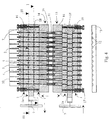
- Higher in figure 4 there is illustrated an open valve apparatus above the back and forth movable pumping members, and lower in figure 4 there is seen a closed valve apparatus underneath the pumping members, whereas the situation in figure 5 is the opposite.
- the dosing carried out according to figures 4 and 5 will be discussed further below.
- valve apparatus When the valve apparatus is open for the liquid to flow through, the opposite valve plates 1, la are positioned so that their flow channels 3 are matched. Thus all 96 parallel flow paths of the arrangement are open simultaneously. By means of the washing liquid flowing in the washing grooves 5 provided in between the sliding surfaces 2 of the valve plates, contamination between adjacent flows is prevented.
- the washing circulation is conducted to the valve apparatus through the flow conduit 6 serving as the feed conduit in the first of the stationary valve plates 1, wherefrom it is distributed to the washing grooves 5 placed in between the channels 3, at matching locations in the sliding surfaces 2; thereafter the washing circulation proceeds, via the flow apertures 8, to the opposite side of the middlemost movable valve plate 1a, is there distributed to the washing grooves 5 in between the sliding surfaces and is finally discharged to the flow conduit 6 serving as a discharge conduit in the second of the stationary plates 1.
- the pressure of the washing circulation is lower than the pressure of the liquid flow in the flow channels 3, the possible leaks in between the sliding surfaces 2 are directed to the washing grooves 5, where the slowly circulating washing liquid carries the leaked liquid out of the arrangement.
- the valve apparatus is closed by means of a linear motion of the middlemost valve plate 1a, generated by an actuator 9, which motion shifts the flow channels of said plate from a matching position with the flow channels of the other two flow plates 1 so much that the flow paths are cut. Thus all parallel flow paths of the valve apparatus are closed simultaneously.
- the valve apparatus is reopened by means of a shift of the actuator 9 in the opposite direction.
- the dosing apparatus illustrated in figures 4 and 5 feeds small quantities of liquid from reagent tanks 10, by means of pistons 11 provided with holes and moving in cylinders serving as the pumping members, onto a microtiter plate 13 comprising 8 x 12 fluid positions 12.
- the dosing arrangement is composed of two structural units 14, 15, and by means of a mutual back and forth movement of said units, there are operated the pistons 11 which serve as a connecting member between said structural units.
- the structural unit 14 located on the suction side of the pumping members 11 comprises reagent tanks 10, a valve apparatus complete with valve plates 1, la, as well as a frame 16 to which the pistons are attached.
- the structural unit 15 respectively comprises a frame 16 supporting a bellows, a valve apparatus complete with valve plates 1, la as well as nozzle members 17 for injecting fluid batches onto the microtiter plate 13.
- the stacked three valve plates 1, la are interconnected by means of bars 18 located at the plate corners and lightly pressed against each other by springs 19.
- the bars 18 allow the valve plates to move with respect to each other in the direction of the bars against the springs 19, as well as the middlemost valve plate la to move sideways in order to open and close the flow paths 3, as is described in the specification above.
- the dosing arrangement is at the suction stage, where the valve apparatus of the suction side of the pumping members 11 is open, i.e. the flow paths from the reagent tank 10 to the bellows are open.
- the valve apparatus On the discharge side of the pumping members, the valve apparatus is now closed.
- the structural units 14, 15 of the arrangement are drawn apart in order to increase the spaces bordered by the pistons and cylinders, whereby the fluid batches to be dosed are sucked from the reagent tanks 10 to said spaces.
- the valve apparatus of the suction side of the pumping members 11 is closed, and the valve apparatus of the discharge side is opened in order to open the flow paths from said spaces to the nozzles 17.
- the structural units 14 and 15 are positioned to face each other in order to reduce said spaces and in order to inject the fluid batches to be dosed onto the microtiter plate 13. By means of a few simple motions of the dosing arrangement, all fluid positions 12 of the microtiter plate 13 are filled simultaneously.
- the dosing can be continued, in accordance with the procedure described above, as long as the same reagents are being dosed onto the microtiter plate 13. However, if the liquids to be dosed are changed, in between the dosing operations the whole arrangement must be washed in order to prevent contamination. This is carried out by conducting, from the washing circulation conduits 6, washing liquid to between the sliding surfaces 2 of the valve plates 11 at an increased pressure, which surpasses the spring force of the springs 19 and pushes the valve plates 1, la apart, so that the washing liquid can easily be distributed on the whole area of the sliding surfaces 2.
- the flow channels 3 and the pumping members 11 are also washed by the same washing liquid. After washing, the flow channels 3 can be dried by air blowing.
- the sliding surfaces of the valve members can be curved instead of planar; they can be for instance cylindrical surfaces, so that the opening and closing thereof is carried out by means of a rotary motion between the surfaces.
- the piston-cylinder combinations performing the suction and injection of reagents can also be replaced by any other pumping members operated in a similar fashion, such as bellows.
Landscapes
- Chemical & Material Sciences (AREA)
- Engineering & Computer Science (AREA)
- General Engineering & Computer Science (AREA)
- Chemical Kinetics & Catalysis (AREA)
- Health & Medical Sciences (AREA)
- Clinical Laboratory Science (AREA)
- Dispersion Chemistry (AREA)
- Mechanical Engineering (AREA)
- Organic Chemistry (AREA)
- Sliding Valves (AREA)
Applications Claiming Priority (2)
| Application Number | Priority Date | Filing Date | Title |
|---|---|---|---|
| FI990904A FI990904A7 (fi) | 1999-04-22 | 1999-04-22 | Venttiililaitteisto rinnakkaisten virtausten säätämiseksi, laitteiston venttiilielimen valmistus, virtausten säätämismenetelmä sekä laitteis ton huuhtelu |
| FI990904 | 1999-04-22 |
Publications (2)
| Publication Number | Publication Date |
|---|---|
| EP1046823A2 true EP1046823A2 (de) | 2000-10-25 |
| EP1046823A3 EP1046823A3 (de) | 2001-11-21 |
Family
ID=8554490
Family Applications (1)
| Application Number | Title | Priority Date | Filing Date |
|---|---|---|---|
| EP00660040A Withdrawn EP1046823A3 (de) | 1999-04-22 | 2000-03-03 | Ventilanordnung zur Einstellung paralleler Ströme, Verfahren zur Herstellung eines Ventilglieds eines derartigen Apparats, Verfahren zur Einstellung derartiger Ströme, sowie Verfahren zum Waschen eines derartigen Apparats |
Country Status (2)
| Country | Link |
|---|---|
| EP (1) | EP1046823A3 (de) |
| FI (1) | FI990904A7 (de) |
Cited By (6)
| Publication number | Priority date | Publication date | Assignee | Title |
|---|---|---|---|---|
| WO2003027508A1 (en) * | 2001-09-21 | 2003-04-03 | The Regents Of The University Of California | Low power integrated pumping and valving arrays for microfluidic systems |
| FR2837726A1 (fr) * | 2002-03-26 | 2003-10-03 | Centre Nat Rech Scient | Dispositif et couvercle permettant l'acces aux echantillons d'une "plaque" d'echantillonage |
| US7608464B2 (en) * | 2001-02-01 | 2009-10-27 | Niilo Kaartinen | Method for use in testing of liquid samples, a test unit utilizing the method and a system comprising such test units |
| JP2013047625A (ja) * | 2011-08-29 | 2013-03-07 | Sumitomo Bakelite Co Ltd | マルチウェルプレート |
| EP2687856A3 (de) * | 2012-07-20 | 2015-05-06 | Medicatec Inc. | Spülvorrichtung für Mikroplatte |
| WO2022221176A1 (en) * | 2021-04-12 | 2022-10-20 | Octane Biotech Inc. | Combinatorial fluid switch for use in automated cell engineering systems |
Family Cites Families (3)
| Publication number | Priority date | Publication date | Assignee | Title |
|---|---|---|---|---|
| FR1528810A (fr) * | 1967-04-27 | 1968-06-14 | Martonair | Distributeur à tiroir plan pour fluides |
| DE4041579A1 (de) * | 1990-12-22 | 1992-06-25 | Bosch Gmbh Robert | Mikroventil |
| CA2129929C (en) * | 1993-09-24 | 1999-07-20 | Michael R. Harstad | In-line incrementally manually adjustable rotary expansion valve |
-
1999
- 1999-04-22 FI FI990904A patent/FI990904A7/fi unknown
-
2000
- 2000-03-03 EP EP00660040A patent/EP1046823A3/de not_active Withdrawn
Non-Patent Citations (1)
| Title |
|---|
| None |
Cited By (9)
| Publication number | Priority date | Publication date | Assignee | Title |
|---|---|---|---|---|
| US7608464B2 (en) * | 2001-02-01 | 2009-10-27 | Niilo Kaartinen | Method for use in testing of liquid samples, a test unit utilizing the method and a system comprising such test units |
| WO2003027508A1 (en) * | 2001-09-21 | 2003-04-03 | The Regents Of The University Of California | Low power integrated pumping and valving arrays for microfluidic systems |
| US7025323B2 (en) * | 2001-09-21 | 2006-04-11 | The Regents Of The University Of California | Low power integrated pumping and valving arrays for microfluidic systems |
| FR2837726A1 (fr) * | 2002-03-26 | 2003-10-03 | Centre Nat Rech Scient | Dispositif et couvercle permettant l'acces aux echantillons d'une "plaque" d'echantillonage |
| JP2013047625A (ja) * | 2011-08-29 | 2013-03-07 | Sumitomo Bakelite Co Ltd | マルチウェルプレート |
| EP2687856A3 (de) * | 2012-07-20 | 2015-05-06 | Medicatec Inc. | Spülvorrichtung für Mikroplatte |
| US9517497B2 (en) | 2012-07-20 | 2016-12-13 | Medicatec Inc. | Rinsing device for microplate |
| WO2022221176A1 (en) * | 2021-04-12 | 2022-10-20 | Octane Biotech Inc. | Combinatorial fluid switch for use in automated cell engineering systems |
| JP2024513249A (ja) * | 2021-04-12 | 2024-03-22 | オクタン バイオテック インコーポレーテッド | 自動化細胞工学システムにおける使用のための組み合わせ流体スイッチ |
Also Published As
| Publication number | Publication date |
|---|---|
| EP1046823A3 (de) | 2001-11-21 |
| FI990904A0 (fi) | 1999-04-22 |
| FI990904A7 (fi) | 2000-10-23 |
Similar Documents
| Publication | Publication Date | Title |
|---|---|---|
| DE60128955T2 (de) | Mikrofluidische geräte und verfahren für chemische probe | |
| US10781809B2 (en) | Peristaltic micropump and related systems and methods | |
| US4018367A (en) | Manifold dispensing apparatus having releasable subassembly | |
| EP0086813B1 (de) | Wasch- bzw. spülautomat für titerplatten od. dgl. | |
| EP1046823A2 (de) | Ventilanordnung zur Einstellung paralleler Ströme, Verfahren zur Herstellung eines Ventilglieds eines derartigen Apparats, Verfahren zur Einstellung derartiger Ströme, sowie Verfahren zum Waschen eines derartigen Apparats | |
| EP2270490B1 (de) | Vorrichtung zur Hochdruckproportionierung, Injektion und/oder zum Routing von Analytprobenlösungen | |
| EP1134586A1 (de) | Verfahen zur Abgabe von Flüssigkeiten in einer Vielzahl von Probengefässen | |
| JPS6044032A (ja) | 主物質と少なくとも1種類の添加物質とを配合するための、特に高粘性物質を配合するための配合装置 | |
| DE102008001371A1 (de) | Giessmaschine und Giessmaschinen-Module | |
| US5193403A (en) | Pipetting device | |
| JPH0998758A (ja) | 成形材料を成形する成形装置及び成形法 | |
| US7207780B2 (en) | Multiple port dual diameter pumps | |
| US20100183482A1 (en) | Microfluidics System for Mixing at Least Two Starting Materials | |
| US20010055533A1 (en) | Metering device for especially viscous liquids | |
| US4880365A (en) | Cement pump with removable discharge chamber cartridge | |
| EP1611355B9 (de) | Membranpumpe | |
| KR100387104B1 (ko) | 액상 혼합 토출 장치 | |
| DE19922612C2 (de) | Mikromechanische Pumpe | |
| CN110893354B (zh) | 一种多模块的乳液微滴生成控制装置 | |
| EP0486556A1 (de) | Impulsfreie kolbenpumpe. | |
| US4161262A (en) | Multiple dosing device | |
| US4283497A (en) | Microbiological systems | |
| JP6894132B2 (ja) | 液体噴射機構及び液体噴射機構に用いられるピストン | |
| GB2134487A (en) | Dosing of fluids | |
| CN222921811U (zh) | 一种自清洗的多泵精密计量灌装设备 |
Legal Events
| Date | Code | Title | Description |
|---|---|---|---|
| PUAI | Public reference made under article 153(3) epc to a published international application that has entered the european phase |
Free format text: ORIGINAL CODE: 0009012 |
|
| AK | Designated contracting states |
Kind code of ref document: A2 Designated state(s): AT BE CH CY DE DK ES FI FR GB GR IE IT LI LU MC NL PT SE |
|
| AX | Request for extension of the european patent |
Free format text: AL;LT;LV;MK;RO;SI |
|
| PUAL | Search report despatched |
Free format text: ORIGINAL CODE: 0009013 |
|
| AK | Designated contracting states |
Kind code of ref document: A3 Designated state(s): AT BE CH CY DE DK ES FI FR GB GR IE IT LI LU MC NL PT SE |
|
| AX | Request for extension of the european patent |
Free format text: AL;LT;LV;MK;RO;SI |
|
| AKX | Designation fees paid | ||
| REG | Reference to a national code |
Ref country code: DE Ref legal event code: 8566 |
|
| STAA | Information on the status of an ep patent application or granted ep patent |
Free format text: STATUS: THE APPLICATION IS DEEMED TO BE WITHDRAWN |
|
| 18D | Application deemed to be withdrawn |
Effective date: 20020522 |