EP1046905A1 - Procédé et dispositif de mesure de la composition et de la concentration de la biomasse - Google Patents
Procédé et dispositif de mesure de la composition et de la concentration de la biomasse Download PDFInfo
- Publication number
- EP1046905A1 EP1046905A1 EP19990500057 EP99500057A EP1046905A1 EP 1046905 A1 EP1046905 A1 EP 1046905A1 EP 19990500057 EP19990500057 EP 19990500057 EP 99500057 A EP99500057 A EP 99500057A EP 1046905 A1 EP1046905 A1 EP 1046905A1
- Authority
- EP
- European Patent Office
- Prior art keywords
- biomass
- electrodes
- concentration
- impedance
- growth
- Prior art date
- Legal status (The legal status is an assumption and is not a legal conclusion. Google has not performed a legal analysis and makes no representation as to the accuracy of the status listed.)
- Ceased
Links
- 239000002028 Biomass Substances 0.000 title claims abstract description 39
- 238000000034 method Methods 0.000 title claims abstract description 18
- 239000000203 mixture Substances 0.000 title claims abstract description 11
- 239000000523 sample Substances 0.000 claims abstract description 27
- 238000005259 measurement Methods 0.000 claims description 30
- 230000012010 growth Effects 0.000 claims description 18
- 239000006185 dispersion Substances 0.000 claims description 4
- 230000015572 biosynthetic process Effects 0.000 claims description 3
- 238000004891 communication Methods 0.000 claims description 3
- 230000003750 conditioning effect Effects 0.000 claims description 3
- 244000005700 microbiome Species 0.000 claims description 3
- 238000003786 synthesis reaction Methods 0.000 claims description 3
- 239000010409 thin film Substances 0.000 claims description 2
- 210000004027 cell Anatomy 0.000 description 23
- 239000002609 medium Substances 0.000 description 19
- 230000005684 electric field Effects 0.000 description 8
- 230000000694 effects Effects 0.000 description 3
- 238000010521 absorption reaction Methods 0.000 description 2
- 210000004102 animal cell Anatomy 0.000 description 2
- 235000013405 beer Nutrition 0.000 description 2
- 230000001413 cellular effect Effects 0.000 description 2
- 238000002347 injection Methods 0.000 description 2
- 239000007924 injection Substances 0.000 description 2
- 239000000463 material Substances 0.000 description 2
- 238000012545 processing Methods 0.000 description 2
- 238000012552 review Methods 0.000 description 2
- 229910000619 316 stainless steel Inorganic materials 0.000 description 1
- 241000894006 Bacteria Species 0.000 description 1
- 229930182556 Polyacetal Natural products 0.000 description 1
- 240000004808 Saccharomyces cerevisiae Species 0.000 description 1
- 239000004809 Teflon Substances 0.000 description 1
- 229920006362 Teflon® Polymers 0.000 description 1
- 239000012620 biological material Substances 0.000 description 1
- 238000004364 calculation method Methods 0.000 description 1
- 239000003990 capacitor Substances 0.000 description 1
- 239000002775 capsule Substances 0.000 description 1
- 230000010261 cell growth Effects 0.000 description 1
- 210000000170 cell membrane Anatomy 0.000 description 1
- 238000010586 diagram Methods 0.000 description 1
- 238000000605 extraction Methods 0.000 description 1
- 238000000855 fermentation Methods 0.000 description 1
- 230000004151 fermentation Effects 0.000 description 1
- 239000010408 film Substances 0.000 description 1
- 230000002068 genetic effect Effects 0.000 description 1
- 239000001963 growth medium Substances 0.000 description 1
- 230000003834 intracellular effect Effects 0.000 description 1
- 238000004519 manufacturing process Methods 0.000 description 1
- 238000013178 mathematical model Methods 0.000 description 1
- 239000012528 membrane Substances 0.000 description 1
- 230000002503 metabolic effect Effects 0.000 description 1
- 230000003071 parasitic effect Effects 0.000 description 1
- 230000000704 physical effect Effects 0.000 description 1
- 229920006324 polyoxymethylene Polymers 0.000 description 1
- 229920001296 polysiloxane Polymers 0.000 description 1
- 239000012088 reference solution Substances 0.000 description 1
- 230000000284 resting effect Effects 0.000 description 1
- 238000001228 spectrum Methods 0.000 description 1
- 230000009897 systematic effect Effects 0.000 description 1
- 238000002560 therapeutic procedure Methods 0.000 description 1
Images

Classifications
-
- C—CHEMISTRY; METALLURGY
- C12—BIOCHEMISTRY; BEER; SPIRITS; WINE; VINEGAR; MICROBIOLOGY; ENZYMOLOGY; MUTATION OR GENETIC ENGINEERING
- C12M—APPARATUS FOR ENZYMOLOGY OR MICROBIOLOGY; APPARATUS FOR CULTURING MICROORGANISMS FOR PRODUCING BIOMASS, FOR GROWING CELLS OR FOR OBTAINING FERMENTATION OR METABOLIC PRODUCTS, i.e. BIOREACTORS OR FERMENTERS
- C12M41/00—Means for regulation, monitoring, measurement or control, e.g. flow regulation
- C12M41/30—Means for regulation, monitoring, measurement or control, e.g. flow regulation of concentration
-
- C—CHEMISTRY; METALLURGY
- C12—BIOCHEMISTRY; BEER; SPIRITS; WINE; VINEGAR; MICROBIOLOGY; ENZYMOLOGY; MUTATION OR GENETIC ENGINEERING
- C12M—APPARATUS FOR ENZYMOLOGY OR MICROBIOLOGY; APPARATUS FOR CULTURING MICROORGANISMS FOR PRODUCING BIOMASS, FOR GROWING CELLS OR FOR OBTAINING FERMENTATION OR METABOLIC PRODUCTS, i.e. BIOREACTORS OR FERMENTERS
- C12M41/00—Means for regulation, monitoring, measurement or control, e.g. flow regulation
- C12M41/30—Means for regulation, monitoring, measurement or control, e.g. flow regulation of concentration
- C12M41/36—Means for regulation, monitoring, measurement or control, e.g. flow regulation of concentration of biomass, e.g. colony counters or by turbidity measurements
Definitions
- the present invention relates to a method and an device for measuring the concentration and composition of biomass which determines said characteristics by measurements of the impedance of the biomass.
- Biomass measuring devices existing in the market have the disadvantage of not being reliable or precise enough, as concluded from the information presented in "Biomass Determination”, Bernhard Sonnleitner, Georg Locher and Armin Fiechter, Journal of Biotechnology 26, 5-22 (1992). Normally, these devices rely on conditions which cannot be completely controlled (cell activity, existence of bubbles, etc.).
- the biomass measuring device required by industry must be reliable, it must depend on a physical parameter which directly provides the information on cell concentration, cannot interfere with the process undergone by the cells and must take direct readings without requiring extraction of samples from the bioreactor at certain intervals.
- Another inconvenient of the existing systems for determining the composition of biomass is that the readings depend on the temperature and conductivity of the medium and also on the presence of bubbles in the medium.
- Non-electrical known devices are disadvantageous because they measure parameters which do not have a direct relationship with the number of cells in the growth For example, measurement of the fluorescence in a growth is directly related to the metabolic activity of the cells, which under certain conditions is not directly related to cell concentration.
- the object of the resent invention is therefore to provide a method and a device for measuring reliably, precisely and quickly the concentration and composition of biomass, even in low concentrations, avoiding existing problems.
- the present invention also provides a device for measuring concentration and composition of biomass by readings of impedance , capable of performing the aforementioned process, consisting of a main electronics box, reading probes which are connected through frontal stages to the electronics of the box, preferably by coaxial cables, means for determining the temperature of the biomass to be investigated and electronics placed in each probe.
- the main electronics box is connected to a computer which generates the signal with a direct digital synthesis (DDS) circuit and consists of a demodulator, an analog-digital converter and a control and communication device.
- DDS direct digital synthesis
- Each of the reading probes has at least four electrodes, said frontal stages containing the circuits for conditioning the measurement of injected current and the differential voltage detected.
- the probes which are preferably bar-shaped, are provided with a transverse oblong orifice on whose longitudinal edges are placed four electrodes which are aligned by twos on opposite edges with one ring-shaped electrode and one circular electrode on each side, the electrodes on either side being placed coaxial to each other.
- the electrodes are formed by strips of metallic deposits resting on said supports, with the ends of the electrodes forming a rectangle, preferably a square.
- An advantage of the present invention is that it offers greater precision in the measurement of the composition and concentration of the biomass since it determines a set of parameters resulting from an adjustment and directly related to the properties of the biomass under study.
- the electrode configuration is especially adequate since on one side it limits the electrical field in a defined way, which makes it possible to measure biomass even in low concentrations, under 1 g. dry weight /l, and on the other hand it considerably reduces the probability of bubbles present in the biomass affecting the measurement.
- a further advantage of the device is that it corrects the measurement of the impedance with respect to temperature and conductivity of the biomass, thus obtaining a result independent of external conditions.
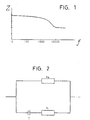
- Figure 1 shows a spectrum of the modulus of the electrical impedance as a function of the frequency f;
- Figure 2 shows a circuit diagram corresponding to the electrical model of a biological tissue
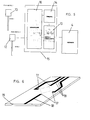
- Figure 3 shows an example of an embodiment of the device according to the present invention
- Figure 4 shows a form of embodiment of the reading probes
- Figure 5 shows a sketch of the electronic components of the device
- Figure 6 shows an example of an embodiment of the electrodes adequate for measuring biomass in film form
- the biomass measurer is based on a physical effect known as relaxation of the electrical impedance. This effect is explained in great detail in "Dielectric Properties of Tissues and Biological Materials; A Critical Review", Foster K. and Schwan H., Critical Reviews in Biomedical Engineering, volume 17, book 1 (1989).
- This relaxation consists of a drop in the value of the electrical impedance with the frequency used to measure it in any given medium.
- the electrical impedance of a medium can be divided into a real part and an imaginary part.
- the real part is what is commonly known as electrical resistance and the imaginary part, for biological tissues, corresponds to the medium's electrical capacitance.
- the relaxation effect can be explained by the absorption of electromagnetic energy.
- the frequency at which the fall in impedance occurs depends on the type of cell measured in the medium. Animal cells have a lower relaxation frequency than bacteria. Therefore, the measurement of the electrical impedance at several frequencies by the device of the present invention allows determination of the type of cell present in the medium.
- the device consists of three different elements (figure 3): the main electronics box (1), electronics in probes (2) and reading probes (3).
- the main box may be connected to a computer (4) although a microprocessor can be included in the electronics to replace the computer.
- the growth container can have any shape, although the probes will have to be different for each container shape.
- the device measures the electrical impedance at several frequencies in a range which can go from 1 kHz to 10 MHz, enough for all applications with biological cells, although it can be used in a wider range for general applications. In addition, it measures the temperature of the medium and the conductivity of the extracellular medium at low frequency.
- Probes (3) provided for the measurer can, for example, be as shown in figure 4, designed to adapt to two standard connectors of an industrial bioreactor and include a temperature gauge (6) in each probe (3), a set of four electrodes (8) in each probe contained in a capsule to avoid the entry of biological cells in the space between electrodes in the probe (3) which measures the low frequency conductivity of the medium, measurement electronics (2) which must be as close to the electrodes as possible and a standard thread(5) for an industrial bioreactor.
- the electrodes employed are mixed. These are characterised by injecting current through the outer rings of the electrode set (8) and measuring the voltage across the two central discs of the set. This measurement is performed independently in each probe.
- the electrodes on each probe are placed by pairs on the longitudinal edges of an oblong transversal orifice.
- probes described above and shown in figure 4 are a specific application for a certain type of bioreactor.
- the type of probes to be employed must be studied for each container where measurements must be performed.
- the probes shown in figure 4 allow confining the electric field between the electrodes very effectively. This type of electrode is resistant to measurement artifacts caused by bubbles outside the probe groove.
- FIG. 6 A different example of an embodiment of the probes of the present invention adequate for measurement in thin layers of growth on plates is shown in figure 6.
- metallic strips are deposited on a flat support (19) on which the growth layer is to be deposited, said metallic strips (18) being the four electrodes of the probe.
- the ends (17) of the electrodes form a rectangle, preferably a square, in order to limit the electric field in the area between the electrodes.
- the arrangement of the electrodes in a square for planar measurements is known as "Van der Pow" as has the advantage of perfectly defining the electric field.
- the temperature of the medium and conductivity of the extracellular medium affect the value of the electrical impedance in a linear and calibrated manner. Therefore, measuring these values gives the measurer information on the influences other than cell growth and allows taking these into account when giving the cell concentration value.
- Temperature gauge (6) which may for example consist of a thermocouple, is connected to a computer (4) which measures and performs the entire data processing before estimating the cell concentration.
- the computer may be replaced by a specific controller designed especially for this and placed in the electronics box (1) ( Figure 3).
- Probes (3) are materials approved for biological use (such as Teflon, silicone or polyacetal and AISI 316 stainless steel) and must be sterilisable in order not to contaminate the growth.
- the measurement process begins with the digital generation of the electrical current, although it may also be done analogically, and its injection into the growth medium by two electrodes.
- the other two electrodes measure the voltage drop in the medium.
- the signal amplifiers are placed very near the probe to prevent parasitic capacitances from affecting the signal, since very high frequencies are used at times.
- the relation between the voltage signal and the electrical current signal is the electrical impedance.
- the process is repeated for several frequencies between 1 kHz and 20 MHz. The frequencies can be selected, the selection depending on the type of biological growth.
- the electrical impedance is constantly corrected with the temperature and conductivity measurement previously mentioned according to known linear coefficients.
- the impedance measured can be modeled after the circuit shown in figure 2 described above.
- the relationship: E (%) R 0 - R ⁇ R 0 .100 gives an estimation of the biomass (cell) concentration. This relationship is the same one as option 1 of the data processing but with values resulting from an adjustment to the model.
- the two options allow obtaining a good estimate of the biomass with the relationship between impedance at high and low frequencies.
- One of the options used directly employs the values measured at high and low frequency and the other uses two values resulting from adjusting the impedance data from a frequency sweep to a model.
- two additional parameters are obtained which give information on the cells in the system, allowing to determine the type of cell in question as well as the size dispersion.
- the system could also decide whether the growth is contaminated by cells of a different type.
- the final data obtained by the measurer are processed by a computer or specifically designed processor and present the user with continuous data on the cell concentration in the medium.
- electrodes (18) are formed by strip-shaped metallic deposits on said flat support (19). Ends (17) of said electrodes form a rectangle, preferably a square. In this way the electric field is limited to inside this square.
- the biomass to be measured is placed on said support (19) and on the aforementioned electrodes (18) to thus establish electrical contact between them.
- the method and apparatus of the present invention may for example be used in the beer industry, where controlling yeast concentration during fermentation affects the final quality of the beer obtained.
- Another field of application is growth of animal cells, essential to genetic therapy. Here growth control is crucial in order to optimise treatment time and its cost.
Landscapes
- Chemical & Material Sciences (AREA)
- Organic Chemistry (AREA)
- Health & Medical Sciences (AREA)
- Life Sciences & Earth Sciences (AREA)
- Engineering & Computer Science (AREA)
- Bioinformatics & Cheminformatics (AREA)
- Zoology (AREA)
- Wood Science & Technology (AREA)
- Microbiology (AREA)
- Sustainable Development (AREA)
- Biotechnology (AREA)
- Biomedical Technology (AREA)
- Biochemistry (AREA)
- General Engineering & Computer Science (AREA)
- General Health & Medical Sciences (AREA)
- Genetics & Genomics (AREA)
- Analytical Chemistry (AREA)
- Investigating Or Analyzing Materials By The Use Of Electric Means (AREA)
Priority Applications (2)
| Application Number | Priority Date | Filing Date | Title |
|---|---|---|---|
| ES009700500A ES2143911B1 (es) | 1997-03-06 | 1997-03-06 | Metodo y aparato para medir la concentracion y composicion de biomasa. |
| EP19990500057 EP1046905A1 (fr) | 1997-03-06 | 1999-04-14 | Procédé et dispositif de mesure de la composition et de la concentration de la biomasse |
Applications Claiming Priority (2)
| Application Number | Priority Date | Filing Date | Title |
|---|---|---|---|
| ES009700500A ES2143911B1 (es) | 1997-03-06 | 1997-03-06 | Metodo y aparato para medir la concentracion y composicion de biomasa. |
| EP19990500057 EP1046905A1 (fr) | 1997-03-06 | 1999-04-14 | Procédé et dispositif de mesure de la composition et de la concentration de la biomasse |
Publications (1)
| Publication Number | Publication Date |
|---|---|
| EP1046905A1 true EP1046905A1 (fr) | 2000-10-25 |
Family
ID=26153725
Family Applications (1)
| Application Number | Title | Priority Date | Filing Date |
|---|---|---|---|
| EP19990500057 Ceased EP1046905A1 (fr) | 1997-03-06 | 1999-04-14 | Procédé et dispositif de mesure de la composition et de la concentration de la biomasse |
Country Status (2)
| Country | Link |
|---|---|
| EP (1) | EP1046905A1 (fr) |
| ES (1) | ES2143911B1 (fr) |
Cited By (3)
| Publication number | Priority date | Publication date | Assignee | Title |
|---|---|---|---|---|
| EP1138758A1 (fr) * | 2000-03-27 | 2001-10-04 | Nte, S.A. | Sonde, cellule et procédé de mesure de la concentration et de la composition d'une biomasse |
| GB2479783A (en) * | 2010-04-23 | 2011-10-26 | Aber Instr Ltd | A bioreactor with an impedance or biomass measuring probe. |
| WO2018051135A1 (fr) * | 2016-09-16 | 2018-03-22 | Aber Instruments Limited | Procédé de surveillance de biomasse et sonde de surveillance de biomasse appropriée pour exécuter ledit procédé |
Families Citing this family (2)
| Publication number | Priority date | Publication date | Assignee | Title |
|---|---|---|---|---|
| ES2184609B1 (es) * | 2001-04-27 | 2004-06-16 | Nte S.A. | Metodo y aparato de obtencion de caracteristicas fisicas y/o quimicas de un medio biologico. |
| ES2340118B1 (es) | 2008-01-16 | 2011-04-04 | Consejo Superior De Investigaciones Cientificas (50%) | Dispositivo y procedimiento para medir concentracion de biomasa, y uso de un elemento electronico chip para medir dicha concentracion de biomasa. |
Citations (8)
| Publication number | Priority date | Publication date | Assignee | Title |
|---|---|---|---|---|
| WO1988002115A1 (fr) * | 1986-09-22 | 1988-03-24 | Douglas Bruce Kell | Determination de la biomasse |
| EP0277789A2 (fr) * | 1987-02-04 | 1988-08-10 | Kabushiki Kaisha Kobe Seiko Sho | Procédé pour déterminer la biomasse |
| WO1992016835A1 (fr) * | 1991-03-15 | 1992-10-01 | Trappl, Helmut | Dispositif pour la determination des criteres de qualite d'une biomasse |
| WO1993014402A1 (fr) * | 1992-01-07 | 1993-07-22 | Aber Instruments Limited | Procede de determination de retention de gaz |
| EP0689051A2 (fr) * | 1994-06-13 | 1995-12-27 | Matsushita Electric Industrial Co., Ltd. | Appareil de mesure du potentiel cellulaire avec plusieurs microélectrodes |
| EP0865763A2 (fr) * | 1997-03-06 | 1998-09-23 | Nte, S.A. | Dispositif de mesure du volume et de la composition globale et segmentaire du corps humain |
| EP0869360A2 (fr) * | 1997-03-06 | 1998-10-07 | Nte, S.A. | Procédé pour déterminer la composition et la qualité de substances de nature carnée |
| GB2329711A (en) * | 1997-09-27 | 1999-03-31 | Univ Wales Aberystwyth The | Capacitance measurement of a dielectric medium |
Family Cites Families (7)
| Publication number | Priority date | Publication date | Assignee | Title |
|---|---|---|---|---|
| NL296001A (fr) * | 1962-07-30 | |||
| US3566233A (en) * | 1968-10-21 | 1971-02-23 | Hoffmann La Roche | Method and apparatus for measuring impedance of a conducting medium with a calibrated probe |
| GB1262749A (en) * | 1969-02-24 | 1972-02-02 | Nat Res Dev | Methods and apparatus for determining the condition of food |
| JP2665806B2 (ja) * | 1989-09-13 | 1997-10-22 | 株式会社豊田中央研究所 | ヘマトクリット測定装置 |
| US5280429A (en) * | 1991-04-30 | 1994-01-18 | Xitron Technologies | Method and apparatus for displaying multi-frequency bio-impedance |
| GB9222888D0 (en) * | 1992-10-30 | 1992-12-16 | British Tech Group | Tomography |
| AU5383796A (en) * | 1995-04-20 | 1996-11-07 | Microcor, Inc. | Method and apparatus for noninvasively determining hematocri t |
-
1997
- 1997-03-06 ES ES009700500A patent/ES2143911B1/es not_active Expired - Fee Related
-
1999
- 1999-04-14 EP EP19990500057 patent/EP1046905A1/fr not_active Ceased
Patent Citations (8)
| Publication number | Priority date | Publication date | Assignee | Title |
|---|---|---|---|---|
| WO1988002115A1 (fr) * | 1986-09-22 | 1988-03-24 | Douglas Bruce Kell | Determination de la biomasse |
| EP0277789A2 (fr) * | 1987-02-04 | 1988-08-10 | Kabushiki Kaisha Kobe Seiko Sho | Procédé pour déterminer la biomasse |
| WO1992016835A1 (fr) * | 1991-03-15 | 1992-10-01 | Trappl, Helmut | Dispositif pour la determination des criteres de qualite d'une biomasse |
| WO1993014402A1 (fr) * | 1992-01-07 | 1993-07-22 | Aber Instruments Limited | Procede de determination de retention de gaz |
| EP0689051A2 (fr) * | 1994-06-13 | 1995-12-27 | Matsushita Electric Industrial Co., Ltd. | Appareil de mesure du potentiel cellulaire avec plusieurs microélectrodes |
| EP0865763A2 (fr) * | 1997-03-06 | 1998-09-23 | Nte, S.A. | Dispositif de mesure du volume et de la composition globale et segmentaire du corps humain |
| EP0869360A2 (fr) * | 1997-03-06 | 1998-10-07 | Nte, S.A. | Procédé pour déterminer la composition et la qualité de substances de nature carnée |
| GB2329711A (en) * | 1997-09-27 | 1999-03-31 | Univ Wales Aberystwyth The | Capacitance measurement of a dielectric medium |
Cited By (7)
| Publication number | Priority date | Publication date | Assignee | Title |
|---|---|---|---|---|
| EP1138758A1 (fr) * | 2000-03-27 | 2001-10-04 | Nte, S.A. | Sonde, cellule et procédé de mesure de la concentration et de la composition d'une biomasse |
| GB2479783A (en) * | 2010-04-23 | 2011-10-26 | Aber Instr Ltd | A bioreactor with an impedance or biomass measuring probe. |
| US8988082B2 (en) | 2010-04-23 | 2015-03-24 | Aber Instruments Limited | Biomass monitor probes and bioreactors incorporating such probes |
| WO2018051135A1 (fr) * | 2016-09-16 | 2018-03-22 | Aber Instruments Limited | Procédé de surveillance de biomasse et sonde de surveillance de biomasse appropriée pour exécuter ledit procédé |
| CN109844527A (zh) * | 2016-09-16 | 2019-06-04 | 阿伯仪器有限公司 | 生物量监测方法和适于进行该方法的生物量监测探针 |
| GB2553895B (en) * | 2016-09-16 | 2019-08-14 | Aber Instruments Ltd | Obtaining multiple biomass measurements from one or more biological media using a probe which can be sterilised and re-used |
| CN109844527B (zh) * | 2016-09-16 | 2020-10-02 | 阿伯仪器有限公司 | 生物量监测方法和适于进行该方法的生物量监测探针 |
Also Published As
| Publication number | Publication date |
|---|---|
| ES2143911B1 (es) | 2000-12-01 |
| ES2143911A1 (es) | 2000-05-16 |
Similar Documents
| Publication | Publication Date | Title |
|---|---|---|
| Thirstrup et al. | Review on electrolytic conductivity sensors | |
| CN101038284B (zh) | 一种提高电阻抗检测装置的电阻抗检测灵敏度的方法 | |
| Pliquett | Bioimpedance: a review for food processing | |
| US4547735A (en) | Instrument for measuring the hematocrit value of blood | |
| CA2947000C (fr) | Procede et systeme de detection d'hemolyse | |
| USRE30007E (en) | Hematocrit measurements by electrical conductivity | |
| EP2405263B1 (fr) | Analyse d'un médium diélectrique | |
| US20060004269A9 (en) | Impedance spectroscopy based systems and methods | |
| EP1138758B1 (fr) | Sonde, cellule et procédé de mesure de la concentration et de la composition d'une biomasse | |
| US3982177A (en) | Soil sample conductivity measurement utilizing a bridge circuit and plural electrode cell | |
| WO2017068157A1 (fr) | Procédé pour déterminer au moins un type et/ou un état de cellules, et système | |
| Paszkowski et al. | A low-frequency sensor for determination of honey electrical properties in varying temperature conditions | |
| US5489849A (en) | High accuracy calibration-free electrical parameter measurements using differential measurement with respect to immersion depth | |
| US20080262748A1 (en) | Method And Device For Biomass Determination In A Medium, In Particular A Medium Containing Biological Cells, And Mesurement Apparatus Implementing Same | |
| EP0883693B1 (fr) | Procede de determination quantitative d'un acide nucleique en solution par mesure de sa conductivite electrique, et appareil pour sa mise en oeuvre | |
| EP1046905A1 (fr) | Procédé et dispositif de mesure de la composition et de la concentration de la biomasse | |
| CN100578208C (zh) | 被干燥物含水率的无损伤测量方法 | |
| Kalinowski et al. | A four-electrode system for measurement of bilayer lipid membrane capacitance | |
| Prodan et al. | Correcting the polarization effect in very low frequency dielectric spectroscopy | |
| CN113063833B (zh) | 一种血细胞压积的测量方法 | |
| Jonsson et al. | Investigations of the low-and high-frequency response of-sensors used in dynamic heat capacity measurements | |
| EP1473359A1 (fr) | Mesure non-invasive et rapide de la présence de bactéries dans le sang et les produits sanguins | |
| Thirstrup et al. | Addressing the challenges of traceable electrolytic conductivity measurements in water | |
| GB2354588A (en) | Detecting changes in parameters or condition of cells in a suapension | |
| Zahran et al. | Compact Complementary Split Ring Resonator Based Sensor for Non-Invasive Glucose monitoring |
Legal Events
| Date | Code | Title | Description |
|---|---|---|---|
| PUAI | Public reference made under article 153(3) epc to a published international application that has entered the european phase |
Free format text: ORIGINAL CODE: 0009012 |
|
| AK | Designated contracting states |
Kind code of ref document: A1 Designated state(s): DE FR GB IT NL PT |
|
| AX | Request for extension of the european patent |
Free format text: AL;LT;LV;MK;RO;SI |
|
| 17P | Request for examination filed |
Effective date: 20010420 |
|
| AKX | Designation fees paid |
Free format text: DE FR GB IT NL PT |
|
| 17Q | First examination report despatched |
Effective date: 20060515 |
|
| STAA | Information on the status of an ep patent application or granted ep patent |
Free format text: STATUS: THE APPLICATION HAS BEEN REFUSED |
|
| 18R | Application refused |
Effective date: 20091022 |