EP1047019A2 - Verfahren zur Schätzung eines Bewegungsvektorfeldes - Google Patents
Verfahren zur Schätzung eines Bewegungsvektorfeldes Download PDFInfo
- Publication number
- EP1047019A2 EP1047019A2 EP00101283A EP00101283A EP1047019A2 EP 1047019 A2 EP1047019 A2 EP 1047019A2 EP 00101283 A EP00101283 A EP 00101283A EP 00101283 A EP00101283 A EP 00101283A EP 1047019 A2 EP1047019 A2 EP 1047019A2
- Authority
- EP
- European Patent Office
- Prior art keywords
- flow
- motion
- graph
- magnitude
- orientation
- Prior art date
- Legal status (The legal status is an assumption and is not a legal conclusion. Google has not performed a legal analysis and makes no representation as to the accuracy of the status listed.)
- Withdrawn
Links
Images




Classifications
-
- G—PHYSICS
- G06—COMPUTING OR CALCULATING; COUNTING
- G06T—IMAGE DATA PROCESSING OR GENERATION, IN GENERAL
- G06T7/00—Image analysis
- G06T7/20—Analysis of motion
- G06T7/269—Analysis of motion using gradient-based methods
Definitions
- the present invention relates to generally to the field of machine vision, and in particular to a method for efficiently estimating the optical flow between two or more images.
- Motion estimation is an important issue which rises in many different machine vision tasks, such as robotics (including navigation and obstacle avoidance), autonomous vehicles, medical image analysis (including nonrigid motion such as angiography), etc.
- robotics including navigation and obstacle avoidance
- autonomous vehicles including medical image analysis (including nonrigid motion such as angiography), etc.
- medical image analysis including nonrigid motion such as angiography
- optical flow defined as the two-dimensional motion field between two different views.
- the optical flow indicates objects in the image which are moving, where they are moving to and how fast.
- the method of the present invention overcomes the above limitations by formulating the problem of flow estimation as a labeling problem in a Markov Random Field ("MRF") framework.
- MRF Markov Random Field
- MAP Maximum A Posteriori
- What is needed is a method for estimating optical flow that properly models the errors in the measurement of image derivatives while enforcing the brightness constraint, and which also efficiently provides a globally optimal solution to the optical flow in the context of said model.
- a method for estimating the optical flow between a plurality of images includes obtaining a motion orientation component and a motion magnitude component.
- Determining the motion orientation component includes creating, a first graph using spatio-temporal derivatives of the plurality of images, solving for a first maximum-flow in the first graph to thereby obtain a first minimum-cut therefrom, and computing the motion orientation component from the first minimum-cut.
- Determining the motion magnitude component includes creating a second graph using spatio-temporal derivatives of the plurality of images and the motion orientation component, solving for a second maximum-flow in the second graph to thereby obtain a second minimum-cut therefrom, and computing the motion magnitude component from the second minimum-cut.
- the motion orientation component and the motion magnitude component together comprise the estimate of the optical flow between the plurality of images.
- the method properly models errors in the measurement of image derivatives while enforcing a brightness constraint, and efficiently provides a globally optimal solution to the optical flow in the context of the model.
- an object of the invention is to provide a method for estimating optical flow which efficiently and accurately estimates the optical flow between a plurality of images.
- Another object of the invention is to provide a method for estimating optical flow which properly models errors in the measurement of image derivative while enforcing a constant brightness assumption constraint.
- a further object of the invention is to provide a method for estimating optical flow which efficiently provides a globally optimal solution to the optical flow in the context of its model.
- the brightness constraint is derived assuming the constancy of image brightness of a pixel. As a result, the total derivative of the intensity of a pixel with respect to the spatio-temporal coordinates is zero.
- I x , I y and I t are the spatio-temporal image derivatives
- v x , v y are the components of flow along the x and y directions.
- the spatial derivatives I x , I y are denoted as ⁇ I and the spatio-temporal derivatives I x , I y , I t h are denoted as I d .
- These image derivatives can be determined in any manner, and many algorithms for doing so are well-known in the art.
- I d ) is defined as the probability of flow conditioned on the noisy image derivatives I d .
- I d ) Bayes rule is used to obtain: P ( v
- I d ) P ( v
- I d ) is a Gaussian distribution with mean I d and covariance ⁇ .
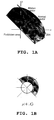
- the unknown component of the flow vector v lies on the CBA line and can be parameterized by an angle ⁇ . This separates the space of possible values of ⁇ into an acceptable (shaded) and an unacceptable zone.
- the acceptable zone is the half circle centered on the normal flow vector v n associated with I d 0 .
- I d 0 ) can now be described as the conditional prior of ⁇ .
- the prior on ⁇ simply assumes that flow orientations in the acceptable zone are equally likely (see P ( ⁇
- the prior "kernel” is: where ⁇ n is the orientation of the normal flow vector v n . If desired, any specific knowledge of flow can be used to change the conditional distribution of flow orientations. As an example, for strictly bounded flow magnitude the range of acceptable angular deviations from ⁇ n can be reduced.
- Each pixel yields an image derivative I d .
- a series of realizations is generated drawn from the distribution P ( I d 0
- the prior kernel is accumulated on the desired distribution, P ( v
- I d ) is the weighted average of different orientation kernels where the weights are determined by the conditional distribution P ( I d 0
- FIG. 2 shows the normal flow and conditional flow distributions P ( v
- the error in image derivatives is modeled by a Gaussian distribution with a standard deviation of 1 in each of the spatio-temporal dimensions.
- I d [20, 20, 10]
- the brightness constraint and the normal flow vector are reliable.
- the resulting normal flow distribution is very compact and the full flow distribution is uncertain only along the brightness constraint line.
- FIG. 3 shows the distributions obtained for the flow orientation and magnitude using the same values of I d as in FIG. 2.
- the distribution of flow orientations is essentially invariant to the amount of texture available.
- the amount of texture significantly affects the probabilities of flow magnitudes.
- the normal flow is reliable, hence the full flow magnitude has to be greater than the normal flow magnitude (indicated by the vertical line).
- the normal flow magnitude is less reliable, and the probability of flow magnitudes that are less than the normal flow magnitude increases.
- the resulting cost functions are minimized using iterative schemes for non-linear optimizations and are not guaranteed to converge to the global minimum.
- iterative methods can be avoided and a globally optimal solution is guaranteed.
- the exact Maximum A Posteriori (MAP) estimate of this labeling problem can be obtained by a transformation into a maximum-flow problem on a graph. This global minimum tends to preserve large discontinuities.
- the maximum-flow solution to the MAP estimate of the MRF requires the labels to be one-dimensional. Unfortunately, the flow at every pixel is described by a two dimensional vector. This forces us to parameterize the flow into two one-dimensional spaces.
- the two dimensional flow field [ v x , v y ] is parameterized into a corresponding angle-magnitude representation [ ⁇ , m]. The preferred choice of this parameterization will be discussed in more detail below.
- the Markovian property of an MRF is defined to be such that the probability of a site taking on a certain label f i is dependent only on its neighborhood.
- F i f i ) where the product is over all sites (i.e. all pixels).
- F i f i )) which contains a contribution from the label configuration and a contribution from the resulting clique potentials.
- the clique potentials reflect prior knowledge of the problem and in the case of optical flow they are used to impose smoothness on the estimated flow field.
- the present invention solves the labeling problem using a non-iterative, global minimization method. This is achieved by expressing E ( f ) as a flow graph on which a maximum-flow computation is performed.
- the average computational complexity was experimentally measured to be O( n 1.15 d 1.31 ) where n is the image size and d the number of labels.
- the parameterization of the flow field in the present invention is the ( ⁇ , m ) representation.
- I d ) are computed as described in Section B above by simply factorizing the flow velocity distribution P ( v
- Equation 11 In order to solve for the orientation flow field ⁇ (denoting the configuration of orientation for all pixels), Equation 11 now takes the form:
- the magnitude m may be solved in the same way as the flow orientation was solved. However, in practice, computing the magnitude is much more difficult than the orientation of the flow.
- I d ) is modified by taking advantage of the extra information provided by the computed orientation estimate. This results in P ( m
- Equations 12 and 13 are represented as ⁇ 1 and ⁇ 2 , respectively, to indicate that the particular value of ⁇ is arbitrary and may be the same in both equations for both motion orientation and motion magnitude or the values of may be different in the two equations for motion orientation and motion magnitude.
- Image sequence 400 is provided as an input to the method.
- Image sequence 400 is typically a video sequence of at least seven images, but can be any plurality of images sufficiently temporally dense to allow computation of image derivatives.
- Image sequence 400 is used as an input to two phases of the method of the present invention: a first phase in which the motion orientation is estimated (402, 404, 406, and 408) and a second phase in which the motion magnitude is estimated (410, 412, 414, and 416).
- the motion orientation phase is typically performed first because the motion orientation result is also provided as an input the motion magnitude phase.
- a first flow graph G 1 is created in step 402.
- First flow graph G 1 is created using spatio-temporal derivatives (Equation 1) of the images, and a cost function is created (Equation 12) whose minimum yields the orientation component of the motion.
- the method solves for the maximum-flow in first graph G 1 and extracts the minimum-cut from the first graph G 1 in the same manner as set forth in the '834 Application.
- step 406 the motion orientation is computed from the minimum-cut.
- the orientations ⁇ i (for all pixels i ⁇ S ) are given directly by the "label" edges in the minimum-cut.
- the result is the motion orientation 408, which is the direction of motion and thus represents one component of the optical flow.
- Second flow graph G 2 is created in step 410.
- Second flow graph G 2 is created using spatio-temporal derivatives (Equation 1) of the images as well as the previously computed pixel motion orientation 408.
- a cost function is created (Equation 13) whose minimum yields the magnitude component of the motion when applied to P ( m
- step 412 the method solves for the maximum-flow in second graph G 2 and extracts the minimum-cut from the second graph G 2 in the same manner as set forth in the '834 Application.
- step 414 the motion magnitude is computed from the minimum-cut.
- the magnitudes m i (for all pixels i ⁇ S ) are given directly by the "label" edges in the minimum-cut.
- the result is the motion magnitude 416, which is the magnitude of motion and thus represents another component of the optical flow.
- the optical flow 418 is the combination of the motion orientation component 408 and the motion magnitude component 416, resulting in the full optical flow field.
- the optical flow is parameterized into two one-dimensional representations. It is desirable that these two parameters are as independent of each other as possible (i.e. P ( v
- I d ) P ( a ( v )
- Two alternatives have been considered: the angle-magnitude representation ( ⁇ , m ), and the velocity components ( v x , v y ). To determine the best representation, the cross-correlation coefficient was experimentally measured.
- the modified Horn and Schunk algorithm in Barron et al., supra uses the same derivative computation. Run time for most experiments range between a few seconds for small images and up to ten minutes on large images on a fast workstation. These run times can be easily reduced by using a coarser discretization of the motion parameters without significantly affecting the solutions. All results presented in this section are the raw flow fields obtained by the method of the present invention without applying any post-processing.
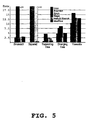
- the optical flow estimation method of the present invention was run on 5 synthetic sequences of Barron et al., for which ground truth was provided. Results were compared with those of the five algorithms in Barron et al. that yield 100% flow field density. Non-dense methods are not directly compared since the present invention is specifically designed to estimate dense flow fields and cannot be readily modified to yield sparse fields.
- the error measure is the same as the one used in Barron et al.. For two motions [ u 0 , v 0 ] and [ u 1 , v 1 ], the error measure is defined as the angle between the two vectors [ u 0 , v 0 , 1] and [ u 1 , v 1 , 1]. The results are summarized in FIG. 5.
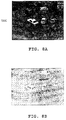
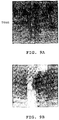
- FIGS. 6A, 7A, 8A and 9A To demonstrate the performance of the present invention under realistic conditions, the flow for four real images (see FIGS. 6A, 7A, 8A and 9A). These are the familiar Rubic Cube (FIG. 6A), NASA Sequence (FIG. 7A), Hamburg Taxi (FIG. 8A), SRI-Trees (FIG. 9A), and are also discussed in the Barron et al. article, supra . Since no ground truth is available, only qualitative results are displayed.
- the estimated flow field for the Rubic Cube is displayed in FIG. 6B.
- This data set features a cube rotating on a turntable. It will be observed that the flow closely follows the motion of the turntable and the cube in both orientation and magnitude. The flow is well propagated over textureless regions like the top of the turn table. Moreover, motion discontinuities are well preserved. A closer look at the flow field is provided in FIG. 6C.
- the NASA Sequence features a divergent flow field induced by a camera zoom.
- the magnitudes of the motion are very small, typically much less than one pixel.
- FIG. 7B the divergence of the flow is well recovered. Notice errors in the middle of the soda can are mostly induced by specularities coupled with low motion.
- the Hamburg Taxi sequence is an example of multiple independent motions. Three vehicles are moving independently across the sequence. The resulting flow is shown in FIG. 8B. The motions of the vehicles are well recovered and well localized, making it possible to segment the motions by using a simple thresholding of the motion magnitudes. This is an example where accurate recovery of motion discontinuities is critical.
- the SRI-Tree sequence features a horizontally translating camera. It features large amounts of occlusions and low contrast. Because of the unusual camera motion, the magnitude of the motion is equivalent to the scene depth. Therefore, the result in FIG. 9B is displayed as a depth map. Dark regions represent small motions (large depths) and light regions represent large motions (small depths). The result is very close to those obtained by dedicated stereo algorithms that utilize the knowledge of camera motion and hence are expected to perform well. Depth discontinuities are well recovered as can be seen along the tree trunks in the middle of the image. On the other hand, notice that the planarity of the ground surface is well preserved. This demonstrates that it is possible to both enforce high degrees of smoothness and recover sharp discontinuities.
- a new method for estimating optical flow in a probabilistic framework is provided.
- the inherent inaccuracy of image derivatives is explicitly accounted for using a simple noise model which in turn results in a probabilistic model of the full flow.
- the full flow is computed in two steps, each based on a MAP estimate of an MRF with linear clique potentials. These estimates are optimal and obtained efficiently through a maximum-flow computation over a graph.
- the recovered flow fields are dense and retains sharp motion discontinuities. It is believed that careful probabilistic modeling can achieve high levels of robustness to the significant errors inherent to the problem of optical flow estimation.
Landscapes
- Engineering & Computer Science (AREA)
- Multimedia (AREA)
- Computer Vision & Pattern Recognition (AREA)
- Physics & Mathematics (AREA)
- General Physics & Mathematics (AREA)
- Theoretical Computer Science (AREA)
- Image Analysis (AREA)
Applications Claiming Priority (4)
| Application Number | Priority Date | Filing Date | Title |
|---|---|---|---|
| US13016899P | 1999-04-20 | 1999-04-20 | |
| US130168P | 1999-04-20 | ||
| US09/391,732 US6507661B1 (en) | 1999-04-20 | 1999-09-08 | Method for estimating optical flow |
| US391732 | 1999-09-08 |
Publications (2)
| Publication Number | Publication Date |
|---|---|
| EP1047019A2 true EP1047019A2 (de) | 2000-10-25 |
| EP1047019A3 EP1047019A3 (de) | 2003-10-29 |
Family
ID=26828229
Family Applications (1)
| Application Number | Title | Priority Date | Filing Date |
|---|---|---|---|
| EP00101283A Withdrawn EP1047019A3 (de) | 1999-04-20 | 2000-01-27 | Verfahren zur Schätzung eines Bewegungsvektorfeldes |
Country Status (4)
| Country | Link |
|---|---|
| US (1) | US6507661B1 (de) |
| EP (1) | EP1047019A3 (de) |
| JP (1) | JP3557982B2 (de) |
| CA (1) | CA2297233C (de) |
Cited By (2)
| Publication number | Priority date | Publication date | Assignee | Title |
|---|---|---|---|---|
| DE10109921A1 (de) * | 2001-03-01 | 2002-09-05 | Ruediger Schrott | Computeranimation von Rennfahrzeugen für Fernsehübertragungen |
| WO2007144250A1 (de) | 2006-06-12 | 2007-12-21 | Robert Bosch Gmbh | Verfahren für die erfassung eines verkehrsraums |
Families Citing this family (22)
| Publication number | Priority date | Publication date | Assignee | Title |
|---|---|---|---|---|
| GB9920256D0 (en) * | 1999-08-26 | 1999-10-27 | Wave Limited M | Motion estimation and compensation in video compression |
| US6744923B1 (en) * | 1999-08-30 | 2004-06-01 | Cornell Research Foundation, Inc. | System and method for fast approximate energy minimization via graph cuts |
| KR100415313B1 (ko) * | 2001-12-24 | 2004-01-16 | 한국전자통신연구원 | 동영상에서 상관 정합과 시스템 모델을 이용한 광류와카메라 움직임 산출 장치 |
| US7164800B2 (en) * | 2003-02-19 | 2007-01-16 | Eastman Kodak Company | Method and system for constraint-consistent motion estimation |
| CA2464569A1 (en) * | 2003-04-16 | 2004-10-16 | Universite De Montreal | Single or multi-projector for arbitrary surfaces without calibration nor reconstruction |
| WO2005050560A1 (en) * | 2003-11-20 | 2005-06-02 | Yissum Research Development Company Of The Hebrew University Of Jerusalem | Image mosaicing responsive to camera ego motion |
| US20060020562A1 (en) * | 2004-07-21 | 2006-01-26 | University Of Southern Mississippi | Apparatus and method for estimating optical flow |
| US7558755B2 (en) * | 2005-07-13 | 2009-07-07 | Mott Antony R | Methods and systems for valuing investments, budgets and decisions |
| TWI287103B (en) * | 2005-11-04 | 2007-09-21 | Univ Nat Chiao Tung | Embedded network controlled optical flow image positioning omni-direction motion system |
| US20070280507A1 (en) * | 2006-06-01 | 2007-12-06 | Beddhu Murali | Apparatus and Upwind Methods for Optical Flow Velocity Estimation |
| US8340349B2 (en) * | 2006-06-20 | 2012-12-25 | Sri International | Moving target detection in the presence of parallax |
| US7974460B2 (en) * | 2007-02-06 | 2011-07-05 | Honeywell International Inc. | Method and system for three-dimensional obstacle mapping for navigation of autonomous vehicles |
| US7925089B2 (en) * | 2007-09-18 | 2011-04-12 | Microsoft Corporation | Optimization of multi-label problems in computer vision |
| FR2931277B1 (fr) * | 2008-05-19 | 2010-12-31 | Ecole Polytech | Procede et dispositif de reconnaissance invariante-affine de formes |
| US8060271B2 (en) * | 2008-06-06 | 2011-11-15 | Toyota Motor Engineering & Manufacturing North America, Inc. | Detecting principal directions of unknown environments |
| KR100955044B1 (ko) * | 2008-07-11 | 2010-04-28 | 포항공과대학교 산학협력단 | 서브 픽셀 해상도의 옵티컬 플로우 추정 장치 및 방법 |
| JP5278776B2 (ja) * | 2008-12-09 | 2013-09-04 | トヨタ自動車株式会社 | 物体検出装置および物体検出方法 |
| US8553943B2 (en) | 2011-06-14 | 2013-10-08 | Qualcomm Incorporated | Content-adaptive systems, methods and apparatus for determining optical flow |
| EP3570132B1 (de) | 2014-09-30 | 2022-03-02 | SZ DJI Technology Co., Ltd. | System und methode zur datenaufzeichnung und -analyse |
| EP3429186B1 (de) | 2016-03-30 | 2022-08-24 | Huawei Technologies Co., Ltd. | Bildaufzeichnungsverfahren und vorrichtung für ein endgerät |
| US20240144490A1 (en) * | 2022-10-13 | 2024-05-02 | The Hong Kong University Of Science And Technology | Joint count and flow analysis for video crowd scenes |
| US12541930B2 (en) * | 2023-12-28 | 2026-02-03 | Snap Inc. | Pixel-based multi-view garment transfer |
Family Cites Families (4)
| Publication number | Priority date | Publication date | Assignee | Title |
|---|---|---|---|---|
| US5680487A (en) * | 1991-12-23 | 1997-10-21 | Texas Instruments Incorporated | System and method for determining optical flow |
| DE69433074D1 (de) * | 1993-07-02 | 2003-10-02 | Siemens Corp Res Inc | Hintergrundrückgewinnung in monokularer Bildverarbeitung |
| US5751838A (en) * | 1996-01-26 | 1998-05-12 | Nec Research Institute, Inc. | Correction of camera motion between two image frames |
| US6046763A (en) * | 1997-04-11 | 2000-04-04 | Nec Research Institute, Inc. | Maximum flow method for stereo correspondence |
-
1999
- 1999-09-08 US US09/391,732 patent/US6507661B1/en not_active Expired - Lifetime
-
2000
- 2000-01-26 CA CA002297233A patent/CA2297233C/en not_active Expired - Fee Related
- 2000-01-27 EP EP00101283A patent/EP1047019A3/de not_active Withdrawn
- 2000-01-31 JP JP2000022967A patent/JP3557982B2/ja not_active Expired - Fee Related
Cited By (2)
| Publication number | Priority date | Publication date | Assignee | Title |
|---|---|---|---|---|
| DE10109921A1 (de) * | 2001-03-01 | 2002-09-05 | Ruediger Schrott | Computeranimation von Rennfahrzeugen für Fernsehübertragungen |
| WO2007144250A1 (de) | 2006-06-12 | 2007-12-21 | Robert Bosch Gmbh | Verfahren für die erfassung eines verkehrsraums |
Also Published As
| Publication number | Publication date |
|---|---|
| EP1047019A3 (de) | 2003-10-29 |
| JP3557982B2 (ja) | 2004-08-25 |
| CA2297233C (en) | 2006-07-18 |
| US6507661B1 (en) | 2003-01-14 |
| JP2000306108A (ja) | 2000-11-02 |
| CA2297233A1 (en) | 2000-10-20 |
Similar Documents
| Publication | Publication Date | Title |
|---|---|---|
| US6507661B1 (en) | Method for estimating optical flow | |
| Brown et al. | Advances in computational stereo | |
| Heitz et al. | Multimodal estimation of discontinuous optical flow using Markov random fields | |
| US10217234B2 (en) | Modeling method and apparatus using three-dimensional (3D) point cloud | |
| Bouthemy | A maximum likelihood framework for determining moving edges | |
| Bab-Hadiashar et al. | Robust segmentation of visual data using ranked unbiased scale estimate | |
| US6301370B1 (en) | Face recognition from video images | |
| Leotta et al. | Vehicle surveillance with a generic, adaptive, 3d vehicle model | |
| US20070253618A1 (en) | Camera calibration method and medium and 3D object reconstruction method and medium using the same | |
| Reed et al. | 3-d modeling from range imagery: An incremental method with a planning component | |
| O’Donovan | Optical flow: Techniques and applications | |
| Cord et al. | Accurate building structure recovery from high resolution aerial imagery | |
| Roy et al. | MRF solutions for probabilistic optical flow formulations | |
| Ozanian | Approaches for stereo matching | |
| EP1580684B1 (de) | Gesichtserkennung aus Videobildern | |
| Fehr et al. | Reshaping our model of the world over time | |
| Lehmann et al. | Correspondence-free determination of the affine fundamental matrix | |
| Pankanti et al. | On integration of vision modules | |
| Fleet et al. | Bayesian inference of visual motion boundaries | |
| Banks | Reliability analysis of transform-based stereo matching techniques, and a new matching constraint | |
| Huynh | Feature-based stereo vision on a mobile platform | |
| AU2004212509B2 (en) | Face recognition from video images | |
| Worby | Multi-resolution graph cuts for stereo-motion estimation | |
| Kender et al. | Image understanding and robotics research at Columbia University | |
| Clement | On Learning Models of Appearance for Robust Long-Term Visual Navigation |
Legal Events
| Date | Code | Title | Description |
|---|---|---|---|
| PUAI | Public reference made under article 153(3) epc to a published international application that has entered the european phase |
Free format text: ORIGINAL CODE: 0009012 |
|
| AK | Designated contracting states |
Kind code of ref document: A2 Designated state(s): AT BE CH CY DE DK ES FI FR GB GR IE IT LI LU MC NL PT SE |
|
| AX | Request for extension of the european patent |
Free format text: AL;LT;LV;MK;RO;SI |
|
| PUAL | Search report despatched |
Free format text: ORIGINAL CODE: 0009013 |
|
| AK | Designated contracting states |
Kind code of ref document: A3 Designated state(s): AT BE CH CY DE DK ES FI FR GB GR IE IT LI LU MC NL PT SE |
|
| AX | Request for extension of the european patent |
Extension state: AL LT LV MK RO SI |
|
| 17P | Request for examination filed |
Effective date: 20030924 |
|
| 17Q | First examination report despatched |
Effective date: 20040210 |
|
| AKX | Designation fees paid |
Designated state(s): DE FR GB |
|
| STAA | Information on the status of an ep patent application or granted ep patent |
Free format text: STATUS: THE APPLICATION IS DEEMED TO BE WITHDRAWN |
|
| 18D | Application deemed to be withdrawn |
Effective date: 20150801 |