EP1047403B1 - Kosmetische zusammensetzungen enthaltend einen anionischen tensid vom typ alkylpoyglykosidester und ein kationisches polymer sowie deren verwendungen - Google Patents
Kosmetische zusammensetzungen enthaltend einen anionischen tensid vom typ alkylpoyglykosidester und ein kationisches polymer sowie deren verwendungen Download PDFInfo
- Publication number
- EP1047403B1 EP1047403B1 EP99947531A EP99947531A EP1047403B1 EP 1047403 B1 EP1047403 B1 EP 1047403B1 EP 99947531 A EP99947531 A EP 99947531A EP 99947531 A EP99947531 A EP 99947531A EP 1047403 B1 EP1047403 B1 EP 1047403B1
- Authority
- EP
- European Patent Office
- Prior art keywords
- radical
- denotes
- composition according
- carbon atoms
- polymers
- Prior art date
- Legal status (The legal status is an assumption and is not a legal conclusion. Google has not performed a legal analysis and makes no representation as to the accuracy of the status listed.)
- Expired - Lifetime
Links
- 0 C**(C)(*)*NC Chemical compound C**(C)(*)*NC 0.000 description 2
Classifications
-
- A—HUMAN NECESSITIES
- A61—MEDICAL OR VETERINARY SCIENCE; HYGIENE
- A61K—PREPARATIONS FOR MEDICAL, DENTAL OR TOILETRY PURPOSES
- A61K8/00—Cosmetics or similar toiletry preparations
- A61K8/18—Cosmetics or similar toiletry preparations characterised by the composition
- A61K8/30—Cosmetics or similar toiletry preparations characterised by the composition containing organic compounds
- A61K8/60—Sugars; Derivatives thereof
- A61K8/604—Alkylpolyglycosides; Derivatives thereof, e.g. esters
-
- A—HUMAN NECESSITIES
- A61—MEDICAL OR VETERINARY SCIENCE; HYGIENE
- A61K—PREPARATIONS FOR MEDICAL, DENTAL OR TOILETRY PURPOSES
- A61K8/00—Cosmetics or similar toiletry preparations
- A61K8/18—Cosmetics or similar toiletry preparations characterised by the composition
- A61K8/72—Cosmetics or similar toiletry preparations characterised by the composition containing organic macromolecular compounds
- A61K8/81—Cosmetics or similar toiletry preparations characterised by the composition containing organic macromolecular compounds obtained by reactions involving only carbon-to-carbon unsaturated bonds
- A61K8/817—Compositions of homopolymers or copolymers of compounds having one or more unsaturated aliphatic radicals, each having only one carbon-to-carbon double bond, and at least one being terminated by a single or double bond to nitrogen or by a heterocyclic ring containing nitrogen; Compositions or derivatives of such polymers, e.g. vinylimidazol, vinylcaprolactame, allylamines (Polyquaternium 6)
-
- A—HUMAN NECESSITIES
- A61—MEDICAL OR VETERINARY SCIENCE; HYGIENE
- A61Q—SPECIFIC USE OF COSMETICS OR SIMILAR TOILETRY PREPARATIONS
- A61Q5/00—Preparations for care of the hair
- A61Q5/02—Preparations for cleaning the hair
-
- A—HUMAN NECESSITIES
- A61—MEDICAL OR VETERINARY SCIENCE; HYGIENE
- A61Q—SPECIFIC USE OF COSMETICS OR SIMILAR TOILETRY PREPARATIONS
- A61Q19/00—Preparations for care of the skin
- A61Q19/10—Washing or bathing preparations
-
- A—HUMAN NECESSITIES
- A61—MEDICAL OR VETERINARY SCIENCE; HYGIENE
- A61Q—SPECIFIC USE OF COSMETICS OR SIMILAR TOILETRY PREPARATIONS
- A61Q5/00—Preparations for care of the hair
- A61Q5/04—Preparations for permanent waving or straightening the hair
-
- A—HUMAN NECESSITIES
- A61—MEDICAL OR VETERINARY SCIENCE; HYGIENE
- A61Q—SPECIFIC USE OF COSMETICS OR SIMILAR TOILETRY PREPARATIONS
- A61Q5/00—Preparations for care of the hair
- A61Q5/12—Preparations containing hair conditioners
Definitions
- the present invention relates to new cosmetic compositions comprising in a cosmetically acceptable medium at least one surfactant anionic type of alkylpolyglycoside carboxylic ester and at least one cationic polymer having a cationic charge density greater than or equal at 2 meq / g.
- detergent compositions for cleaning and / or washing hair and / or skin, the use of detergent compositions (shampoo or shower gel) based essentially conventional surfactants of the type in particular anionic, nonionic and / or amphoteric, but more particularly of the anionic type, is common.
- These compositions are applied to wet hair or skin and the mousse generated by massage or friction with the hands allows, after rinsing with water, the elimination of the various soils initially present on the hair or the skin.
- conditioning agents to date in shampoos are cationic polymers, silicones and / or derivatives silicone, which in fact gives washed, dry or wet hair ease detangling, smoothness and smoothness increased compared to what can be obtained with the corresponding cleaning compositions produced therefrom free.
- compositions have detergent properties and unsatisfactory foaming.
- keratin materials treated with these compositions most often have a crippling charged feel.
- Anionic surfactants of the alkylpolyglycoside carboxylic ester type have already recommended in detergent cosmetic compositions. They were described for example in patent applications EP510565 and EP510564.
- the invention therefore aims to provide cosmetic compositions having improved cosmetic properties, in particular detangling and the softness of the hair.
- compositions make it possible to deposit a larger quantity cationic polymers on keratin materials (especially hair) than with a composition containing conventional anionic surfactants such as than the salts of laurylethersulfates, but without touching or oily visual appearance.
- compositions in accordance with the invention give keratin materials especially the hair, a remarkable treatment effect which manifests itself in particular by ease of disentangling, as well as an addition of volume, lightness, smoothness, softness and flexibility and discipline without any feeling of touch charged.
- the subject of the invention is therefore a cosmetic composition, characterized in that that it comprises, in a cosmetically acceptable medium, at least one non-cellulosic cationic polymer with a cationic charge density greater than or equal to 2 meq / g. and at least one anionic surfactant of the ester type of alkylpolyglycoside carboxylic acid and its salts.
- Another subject of the invention relates to a method for processing materials keratin, such as the hair, characterized in that it consists in applying on said materials, cosmetic compositions according to the invention.
- the hair is understood, eyelashes, eyebrows, skin, nails, mucous membranes or scalp and more especially the hair.
- the anionic surfactants of the alkylpolyglycoside carboxylic ester type can have the following structure: R 1 - (OR 2 ) t O- (G) v X in which R 1 represents a linear or branched, saturated or unsaturated C 6 -C 30 hydrocarbon-based radical, preferably a linear or branched, saturated or unsaturated alkyl radical, containing approximately from 8 to 24 carbon atoms, an alkylphenyl radical of which the linear or branched alkyl radical contains from approximately 8 to 24 carbon atoms, R 2 represents an alkylene radical comprising from 2 to 4 carbon atoms, G represents a reduced sugar comprising from 5 to 6 carbon atoms, t denotes a value ranging from 0 to 10 and v denotes a value ranging from 1 to 15.
- X denotes a radical comprising at least one carboxylic acid function or its salts. X forms an ester bond with a hydroxyl of the sugar, preferably in position
- Z and Z ' denote a hydrogen atom, an inorganic or organic cation such as: an alkali metal (for example Na + , K + ), NH 4 + , ammoniums derived from basic amino acids such as lysine, arginine, sarcosine, ornithine, citrulline or even amino alcohols such as monoethanolamine, diethanolamine, triethanolamine, glucamine, N-methyl glucamine, 3-amino-1,2-propanediol.
- an alkali metal for example Na + , K +
- NH 4 + ammoniums derived from basic amino acids such as lysine, arginine, sarcosine, ornithine, citrulline or even amino alcohols such as monoethanolamine, diethanolamine, triethanolamine, glucamine, N-methyl glucamine, 3-amino-1,2-propanediol.
- Preferred alkylpolyglycoside esters according to the present invention are compounds of formula (I) in which R 1 more particularly denotes a saturated or unsaturated, linear or branched alkyl radical containing from 8 to 18 carbon atoms, t denotes a value ranging from 0 to 3 and more particularly still equal to 0, G can denote glucose, fructose or galactose, preferably glucose.
- the degree of polymerization of the saccharide, ie the value of v in formula (I), can range from 1 to 15. According to the invention, reduced sugars containing 80% or more of sugars are preferred whose degree of polymerization (S) takes a value ranging from 1 to 4. The average degree of polymerization is more particularly between 1 and 2.
- the glycosidic bonds are of the 1-6 or 1-4 type and preferably 1-4.
- the anionic surfactant of the alkylpolyglycoside ester type carboxylic acid can represent from 0.5% to 30% by weight, preferably from 1% to 25% by weight, and even more preferably from 2.5% to 15% by weight per relative to the total weight of the final composition.
- the cationic polymers which can be used according to the invention have a charge density cationic greater than or equal to 2 meq./g, preferably between 2 and 8 meq./g.
- the charge density can be determined according to the Kjeldahl method. She generally corresponds to a pH of the order of 3 to 9.
- Cationic polymers with a higher cationic charge density or equal to 2 meq / g usable in accordance with the present invention can be chosen from among all those already known per se as improving the properties hair cosmetics treated with detergent compositions, namely in particular those described in patent application EP-A- 0 337 354 and in the French patent applications FR-A- 2 270 846, 2 383 660, 2 598 611, 2 470 596 and 2,519,863.
- cationic polymer means any polymer containing groups cationic and / or ionizable groups into cationic groups.
- the preferred cationic polymers are chosen from those which contain units comprising primary, secondary, tertiary and / or amino groups quaternaries can either be part of the main polymer chain, or be carried by a lateral substituent directly connected to it.
- the cationic polymers used generally have a number-average molecular mass of between 500 and 5.10 6 approximately, and preferably between 10 3 and 3.10 6 approximately.
- cationic polymers there may be mentioned more particularly the polymers of the polyamine, polyaminoamide and quaternary polyammonium type. This are known products.
- cationic polymers which can be used in the context of the invention are polyalkyleneimines, in particular polyethyleneimines.
- the cationic polymer can represent from 0.001% to 10% by weight, preferably from 0.005% to 5% by weight, and even more preferably from 0.01% to 3% by weight, of the total weight of the composition final.
- compositions of the invention also advantageously contain at least another surfactant which is generally present in an amount included between 0.1% and 60% by weight approximately, preferably between 3% and 40% and more more preferably between 5% and 30%, relative to the total weight of the composition.
- This surfactant can be chosen from anionic surfactants, amphoteric, non-ionic, cationic or mixtures thereof.
- Additional surfactants suitable for carrying out the present Invention include:
- anionic surfactants which can be used, alone or in mixtures, in the context of the present invention, mention may be made in particular (non-limiting list) of the salts (in particular alkali salts, in particular sodium salts, ammonium salts, amine salts, amino alcohol salts or magnesium salts) of the following compounds: alkylsulphates, alkylethersulphates, alkylamidoethersulphates, alkylarylpolyethersulphates, monoglycerides sulphates; alkylsulfonates, alkylphosphates, alkylamidesulfonates, alkylarylsulfonates, ⁇ -olefin-sulfonates, paraffin-sulfonates; alkylsulfosuccinates, alkylethersulfosuccinates, alkylamidesulfosuccinates; alkyl sulfosuccinamates; alkyl sulfoacetate
- anionic surfactants which can still be used, mention may also be made of the salts of fatty acids such as the salts of oleic, ricinoleic, palmitic, stearic acids, coconut oil or hydrogenated coconut oil acids; acyl-lactylates whose acyl radical contains 8 to 20 carbon atoms.
- Weakly anionic surfactants can also be used, such as alkyl D galactoside uronic acids and their salts as well as polyoxyalkylenated (C 6 -C 24 ) alkyl ether acids, (C 6 -C 24 ) aryl ether carboxylic acids. polyoxyalkylenated, polyoxyalkylenated (C 6 -C 24 ) alkyl amido ether carboxylic acids and their salts, in particular those comprising from 2 to 50 ethylene oxide groups, and mixtures thereof.
- anionic surfactants it is preferred to use, according to the invention, the salts of alkyl sulfates and alkyl ether sulfates and mixtures thereof.
- Non-ionic surfactants are also well known compounds per se (see in particular in this regard "Handbook of Surfactants” by MR PORTER, Blackie & Son editions (Glasgow and London), 1991, pp 116-178) and their nature is not, in the context of the present invention, critical.
- alcohols can be chosen in particular from (nonlimiting list) alcohols, alpha-diols, alkylphenols or polyethoxylated, polypropoxylated or polyglycerolated fatty acids, having a fatty chain comprising for example 8 to 18 carbon atoms, the number of ethylene oxide or propylene oxide groups which can range in particular from 2 to 50 and the number of glycerol groups which can range in particular from 2 to 30.
- copolymers of ethylene oxide and of propylene the condensates d ethylene and propylene oxide on fatty alcohols; polyethoxylated fatty amides preferably having from 2 to 30 moles of ethylene oxide, polyglycerolated fatty amides comprising on average 1 to 5 glycerol groups and in particular 1.5 to 4; polyethoxylated fatty amines preferably having 2 to 30 moles of ethylene oxide; esters of oxyethylenated sorbitan fatty acids having from 2 to 30 moles of ethylene oxide; sucrose fatty acid esters, polyethylene glycol fatty acid esters, alkylpolyglycosides, N-alkyl glucamine derivatives, amine oxides such as (C 10 -C 14 ) alkyl oxides or N-acylaminopropylmorpholine oxides.
- alkylpolyglycosides constitute nonionic surfactants which fall particularly well
- Additional amphoteric surfactants can be in particular (non-limiting list) derivatives of aliphatic secondary or tertiary amines, in which the aliphatic radical is a linear chain or branched having 8 to 22 carbon atoms and containing at least one water-soluble anionic group (for example carboxylate, sulfonate, sulfate, phosphate or phosphonate); Mention may also be made of (C 8 -C 20 ) alkyl betaines, sulfobetaines, (C 8 -C 20 ) alkyl amidoalkyl (C 1 -C 6 ) betaines or (C 8 -C 20 ) alkyl amidoalkyl (C 1 -C 6 ) sulfobetaines.
- aliphatic secondary or tertiary amines in which the aliphatic radical is a linear chain or branched having 8 to 22 carbon atoms and containing at least one water-soluble anionic group (
- compositions according to the invention use is preferably made of mixtures of surfactants and in particular mixtures of agents anionic surfactants and mixtures of anionic surfactants and amphoteric or nonionic surfactants.
- a particularly mixture preferred is a mixture consisting of at least one anionic surfactant and at least one amphoteric surfactant.
- Cationic surfactants can also be used, among which in particular (non-exhaustive list): the salts of primary fatty amines, secondary or tertiary, possibly polyoxyalkylenated; the salts quaternary ammonium such as chlorides or bromides of tetraalkylammonium, alkylamidoalkyltrialkylammonium, trialkylbenzylammonium, trialkylhydroxyalkyl-ammonium or alkylpyridinium; imidazoline derivatives; or cationic amine oxides.
- the salts of primary fatty amines, secondary or tertiary, possibly polyoxyalkylenated the salts quaternary ammonium such as chlorides or bromides of tetraalkylammonium, alkylamidoalkyltrialkylammonium, trialkylbenzylammonium, trialkylhydroxyalkyl-ammonium or alkylpyridinium
- composition of the invention may also contain at least one additive chosen from thickeners, surfactants, perfumes, pearlescent agents, preservatives, sunscreens, cationic surfactants, anionic or nonionic or amphoteric polymers , proteins, protein hydrolysates, ceramides, pseudoceramides, fatty acids with linear or branched C 16 -C 40 chains such as 18-methyl eicosanoic acid, hydroxy acids, vitamins, panthenol, silicones , vegetable oils, mineral oils and synthetic oils and any other additive conventionally used in the cosmetic field which does not affect the stability and the properties of the compositions according to the invention.
- additives chosen from thickeners, surfactants, perfumes, pearlescent agents, preservatives, sunscreens, cationic surfactants, anionic or nonionic or amphoteric polymers , proteins, protein hydrolysates, ceramides, pseudoceramides, fatty acids with linear or branched C 16 -C 40 chains such as 18-methyl eicosa
- additives are present in the composition according to the invention in proportions ranging from 0 to 50% by weight relative to the total weight of the composition.
- the precise quantity of each additive is easily determined by the skilled person according to his nature and his function.
- the cosmetically acceptable medium can consist solely of water or of a mixture of water and a cosmetically acceptable solvent such as a lower C 1 -C 4 alcohol, such as ethanol, isopropanol, tertiobutanol, n-butanol; alkylene glycols such as propylene glycol, glycol ethers.
- a cosmetically acceptable solvent such as a lower C 1 -C 4 alcohol, such as ethanol, isopropanol, tertiobutanol, n-butanol; alkylene glycols such as propylene glycol, glycol ethers.
- the composition comprises from 50 to 95% by weight of water relative to the total weight of the composition.
- the detergent compositions according to the invention have a final pH generally between 3 and 10. Preferably, this pH is between 4 and 8.
- the adjustment of the pH to the desired value can be done conventionally by adding of a base (organic or mineral) in the composition, for example of ammonia or a primary, secondary or tertiary (poly) amine such as monoethanolamine, diethanolamine, triethanolamine, isopropanolamine or 1,3-propanediamine, or by addition of an acid, preferably an acid carboxylic such as for example citric acid.
- a base organic or mineral
- a primary, secondary or tertiary (poly) amine such as monoethanolamine, diethanolamine, triethanolamine, isopropanolamine or 1,3-propanediamine
- an acid preferably an acid carboxylic such as for example citric acid.
- compositions in accordance with the invention may contain, in addition to the combination defined above, viscosity regulating agents such as electrolytes, or thickening agents.
- viscosity regulating agents such as electrolytes, or thickening agents.
- Mention may in particular be made of sodium chloride, sodium xylene sulfonate, scleroglucans, xanthan gums, fatty acid alkanolamides, alkyl ether carboxylic acid alkanolamides optionally oxyethylenated with up to 5 moles of oxide ethylene such as the product sold under the name "AMINOL A15" by the company CHEM Y, crosslinked polyacrylic acids and acrylic acid / crosslinked C 10 -C 30 alkyl acrylate copolymers.
- These viscosity regulating agents are used in the compositions according to the invention in proportions which can range up to 10% by weight relative to the total weight of the composition.
- compositions according to the invention can also contain up to 5% pearlescent or opacifying agents well known in the art such as for example sodium or magnesium palmitates, stearates and sodium or magnesium hydroxystearates, acylated chain derivatives fatty substances such as ethylene glycol monostearates or distearates or polyethylene glycol, fatty chain ethers such as for example distearyl ether or 1- (hexadecyloxy) -2-octadecanol.
- pearlescent or opacifying agents well known in the art such as for example sodium or magnesium palmitates, stearates and sodium or magnesium hydroxystearates, acylated chain derivatives fatty substances such as ethylene glycol monostearates or distearates or polyethylene glycol, fatty chain ethers such as for example distearyl ether or 1- (hexadecyloxy) -2-octadecanol.
- compositions according to the invention may also contain foam synergists such as C 10 -C 18 1,2-alkanediols or fatty alkanolamides derived from mono or diethanolamine.
- foam synergists such as C 10 -C 18 1,2-alkanediols or fatty alkanolamides derived from mono or diethanolamine.
- compositions according to the invention can be used for washing or the treatment of keratinous materials such as hair, skin, eyelashes, eyebrows, nails, lips, scalp and more particularly hair.
- compositions according to the invention are detergent compositions such as shampoos, shower gels and bubble baths.
- the compositions comprise a washing base, generally aqueous.
- the washing base can comprise only the anionic surfactant of the alkylpolyglycoside carboxylic ester type or comprise other additional surfactants.
- the additional surfactant (s) can be chosen either alone or in mixtures, within anionic, amphoteric, nonionic surfactants and cationic as defined above.
- the quantity and the quality of the washing base are sufficient to give the final composition has a satisfactory foaming and / or detergent power.
- detergent compositions are preferably foaming and the foaming power of the compositions according to the invention, characterized by a height of foam, is generally greater than 75 mm; preferably greater than 100 mm measured according to the ROSS-MILES method (NF T 73-404 / ISO696) modified.
- the method changes are as follows: The measurement is made at a temperature of 22 ° C with osmosis water. The concentration of the solution is 2g / l. The height of the fall is 1m. The amount of composition that drops is 200 ml. These 200 ml of composition fall into a test tube having a diameter of 50 mm and containing 50 ml of the composition to be tested. The measurement is made 5 minutes after the flow of the composition has stopped.
- the washing base can represent from 4% to 50% by weight, preferably from 6% to 35% by weight, and even more preferably from 8% at 25% by weight, of the total weight of the final composition.
- Another subject of the invention is a method for treating materials keratin such as the skin or the hair, characterized in that it consists of applying a cosmetic composition to keratin materials such as previously defined, then optionally rinse with water.
- this method according to the invention allows the hairstyle to be maintained, the treatment, care, washing or removing make-up from the skin. hair or any other keratinous matter.
- compositions of the invention can also be presented in the form conditioner to rinse off or not, compositions for perm, straightening, coloring or discoloration, or in the form of compositions with rinse, apply before or after coloring, discoloration, perm or straightening or between the two stages of a perm or straightening.
- compositions of the invention may also be in the form of washing compositions for the skin, and in particular in the form of solutions or bath or shower gels or make-up removers.
- compositions according to the invention can also be presented in the form aqueous or hydroalcoholic lotions, gel, milk, cream, emulsion, thickened lotion or foam and be used for skin, nails, eyelashes, the lips and more particularly the hair.
- MA means active material
- a shampoo composition in accordance with the invention was produced:
- One of the radicals X denotes hydrogen and the other:
- R is a radical derived from copra alcohol
- MERQUAT 100 Homopolymer of diallyidimethylammonium chloride marketed by CALGON (cationic charge density around 6.8 meq / g)
- Shampooing is carried out by applying approximately 12 g of composition A or composition B on bleached hair previously wet. We do lather the shampoo and then rinse thoroughly with water.
- composition A Hair washed with composition A is softer and easier to untangle than those treated with composition B.
Landscapes
- Life Sciences & Earth Sciences (AREA)
- Health & Medical Sciences (AREA)
- Animal Behavior & Ethology (AREA)
- General Health & Medical Sciences (AREA)
- Public Health (AREA)
- Veterinary Medicine (AREA)
- Birds (AREA)
- Epidemiology (AREA)
- Cosmetics (AREA)
- Detergent Compositions (AREA)
Claims (19)
- Kosmetische Zusammensetzung, dadurch gekennzeichnet, daß sie in einem kosmetisch akzeptablen Medium mindestens ein kationisches Polymer, das keine Cellulose umfaßt und eine kationische Ladungsdichte von 2 meq/g oder darüber aufweist, und mindestens einen anionischen grenzflächenaktiven Stoff vom Typ der Alkylpolyglykosid-carbonsäureester und ihrer Salze enthält.
- Zusammensetzung nach Anspruch 1, dadurch gekennzeichnet, daß der anionische grenzflächenaktive Stoff vom Typ der Alkylpolyglykosid-carbonsäureester der folgenden Formel (I) entspricht:
- Zusammensetzung nach Anspruch 2, dadurch gekennzeichnet, daß die Gruppe X unter den folgenden Gruppen ausgewählt ist:


 wobei Z und Z', die identisch oder voneinander verschieden sind, Wasserstoff oder ein organisches oder anorganisches Kation bedeuten.
- Zusammensetzung nach einem der Ansprüche 2 oder 3, dadurch gekennzeichnet, daß die Gruppe R1 eine geradkettige oder verzweigte, gesättigte oder ungesättigte Alkylgruppe mit 8 bis 24 Kohlenstoffatomen oder eine Alkylphenylgruppe bedeutet, deren geradkettige oder verzweigte Alkylgruppe 8 bis 24 Kohlenstoffatome aufweist.
- Zusammensetzung nach einem der Ansprüche 2 bis 4, dadurch gekennzeichnet, daß die Gruppe R1 eine Oleylgruppe oder eine von Kopra abgeleitete Gruppe ist.
- Zusammensetzung nach einem der Ansprüche 2 bis 5, dadurch gekennzeichnet, daß t eine Zahl von 0 bis 3 und insbesondere 0 bedeutet.
- Zusammensetzung nach einem der Ansprüche 2 bis 6, dadurch gekennzeichnet, daß G Glucose, Fructose oder Galactose und vorzugsweise Glucose bedeutet.
- Zusammensetzung nach einem der Ansprüche 2 bis 7, dadurch gekennzeichnet, daß v im Bereich von 1 bis 15 und vorzugsweise 1 bis 4 liegt.
- Zusammensetzung nach einem der Ansprüche 1 bis 8, dadurch gekennzeichnet, daß die kationischen Polymere eine kationische Ladungsdichte von 2 bis 8 meq/g aufweisen.
- Zusammensetzung nach einem der Ansprüche 1 bis 9, dadurch gekennzeichnet, daß die kationischen Polymere ausgewählt sind unter:(1) Copolymeren von Vinylpyrrolidon und Dialkylaminoalkylacrylat oder -methacrylat, die gegebenenfalls quaternisiert sind;(2) Polymeren, die aus Piperazinyleinheiten und zweiwertigen Alkylen- oder Hydroxyalkylengruppen mit linearen oder verzweigten Ketten bestehen, die gegebenenfalls durch Sauerstoffatome, Schwefelatome oder Stickstoffatome oder aromatische oder heterocyclische Ringe unterbrochen sind, sowie den Oxidationsprodukten und/oder Quaternisierungsprodukten dieser Polymere;(3) Wasserlöslichen Polyaminoamiden, die insbesondere durch Polykondensation einer Säure mit einem Polyamin hergestellt werden; die Polyaminoamide können mit einem Epihalohydrin, Diepoxid, Dianhydrid, ungesättigten Dianhydrid, zweifach ungesättigten Derivat, Bis-halohydrin, Bis-azetidinium, Bis-haloacyldiamin, Alkyl-bishalogenid oder einem Oligomer vernetzt sein, das aus der Reaktion einer bifunktionellen Verbindung resultiert, die gegenüber einem Bis-halohydrin, Bis-azetidinium, Bis-haloacyldiamin, Alkyl-bishalogenid, Epihalohydrin, Diepoxid oder zweifach ungesättigten Derivat reaktiv ist, wobei das Vernetzungsmittel in Mengenanteilen von 0,025 bis 0,35 mol pro Aminogruppe des Polyaminoamids verwendet wird; diese Polyaminoamide können alkyliert sein und eine oder mehrere tertiäre oder quartäre Aminogruppen enthalten;(4) Polyaminoamidderivaten, die bei der Kondensation von Polyalkylenpolyaminen mit Polycarbonsäuren und anschließender Alkylierung mit bifunktionellen Mitteln resultieren;(5) Polymeren, die durch Umsetzung eines Polyalkylenpolyamins, das zwei primäre Aminogruppen und mindestens eine sekundäre Aminogruppe aufweist, mit einer Dicarbonsäure hergestellt werden, welche unter Diglykolsäure und den gesättigten aliphatischen Dicarbonsäuren mit 3 bis 8 Kohlenstoffatomen ausgewählt ist, wobei das Molverhältnis von Polyalkylenpolyamin und Dicarbonsäure im Bereich von 0,8 : 1 bis 1,4 : 1 liegt und wobei das resultierende Polyaminoamid mit Epichlorhydrin in einem Molverhältnis Epichlorhydrin / sekundäre Aminogruppe des Polyaminoamids im Bereich von 0,5 : 1 bis 1,8 : 1 umgesetzt wird;(6) Homopolymeren oder Copolymeren mit Einheiten der Formel (VI) oder (VI'):worin k und t 0 oder 1 bedeuten, wobei die Summe k + t 1 ist; R12 Wasserstoff oder Methyl bedeutet; R10 und R11 unabhängig voneinander eine Alkylgruppe mit 1 bis 22 Kohlenstoffatomen, eine Hydroxyalkylgruppe, deren Alkylgruppe vorzugsweise 1 bis 5 Kohlenstoffatome aufweist, oder eine niedere Amidoalkylgruppe bedeuten oder R10 und R11 gemeinsam mit dem Stickstoffatom, an das sie gebunden sind, heterocyclische Gruppen bilden können, wie Piperidinyl oder Morpholinyl; und Y- ein Anion ist, beispielsweise Bromid. Chlorid, Acetat, Borat, Citrat, Tartrat, Bisulfat, Bisulfit, Sulfat oder Phosphat;
 (7) Quartären Diammoniumpolymeren mit wiederkehrenden Einheiten der folgenden Formel;wobei in der Formel (VII) bedeuten:
 die Gruppen R13, R14, R15 und R16, die identisch oder voneinander verschieden sind, aliphatische, alicyclische oder arylaliphatische Gruppen mit 1 bis 20 Kohlenstoffatomen oder niedere hydroxyalkylaliphatische Gruppen, oder R13, R14, R15 und R16 bilden gemeinsam oder unabhängig voneinander mit den Stickstoffatomen, an die sie gebunden sind, Heterocylen, die gegebenenfalls ein weiteres Heteroatom, das von Stickstoff verschieden ist, enthalten, oder R13, R14, R15 und R16 bedeuten eine geradkettige oder verzweigte C1-6-Alkylgruppe, die substituiert ist mit einer Gruppe Nitril, Ester, Acyl, Amid oder -CO-O-R17-D oder -CO-NH-R17D, worin R17 eine Alkylengruppe bedeutet und D eine quartäre Ammonimgruppe ist;A1 und B1 Polymethylengruppen mit 2 bis 20 Kohlenstoffatomen, die geradkettig oder verzweigt, gesättigt oder ungesättigt vorliegen können und an die Hauptkette gebunden oder in der Hauptkette einen oder mehrere aromatische Ringe oder ein oder mehrere Sauerstoffatome oder Schwefelatome oder die folgenden Gruppen enthalten können: Sulfoxid, Sulfon, Disulfid, Amino, Alkylamino, Hydroxy, quartäre Ammoniumgruppen, Ureido, Amid oder Ester undX- ein Anion, das von einer anorganischen oder organischen Säure abgeleitet ist;wobei A1, R13 und R15 gemeinsam mit den beiden Stickstoffatomen, an die sie gebunden sind, einen Piperazinring bilden können;wenn A1 eine geradkettige oder verzweigte, gesättigte oder ungesättigte Alkylen- oder Hydroxyalkylengruppe bedeutet, kann B1 ferner eine (CH2)n-CO-D-OC-(CH2)n-Gruppe bedeuten, worin D bedeutet;a) einen Glykolrest der Formel: -O-Z-O-, worin Z eine geradkettige oder verzweigte Kohlenwasserstoffgruppe oder eine Gruppe der folgenden beiden Formeln bedeutet:b) einen bis-sekundären Diaminrest, beispielsweise ein Piperazinderivat;c) einen bis-primären Diaminrest der Formel: -NH-Y-NH, worin Y eine geradkettige oder verzweigte Kohlenwasserstoffgruppe oder die zweiwertige Gruppe -CH2-CH2-S-S-CH2-CH2- bedeutet; oderd) eine Ureylengruppe der Formel: -NH-CO-NH-;(8) Quartären Polyammoniumpolymeren, die aus Einheiten der Formel (VIII) bestehen:worm bedeuten:
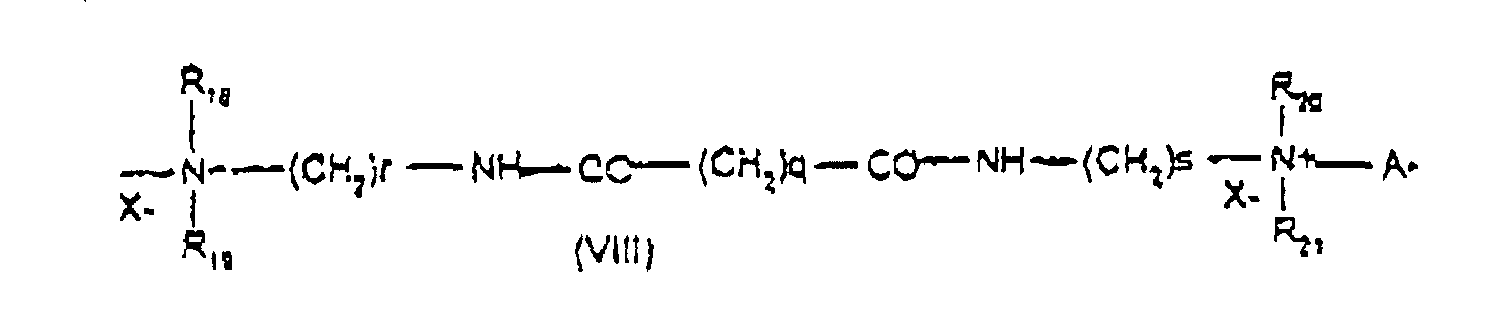 R18, R19, R20 und R21, die identisch oder voneinander verschieden sind, Wasserstoff, Methyl, Ethyl, Propyl, β-Hydroxyethyl, β-Hydroxypropyl oder -CH2CH2(OCH2CH2)pOH, wobei p 0 oder eine ganze Zahl von 1 bis 6 bedeutet, mit der Maßgabe, daß R18, R19, R20 und R21 nicht gleichzeitig Wasserstoff bedeuten,r und s, die identisch oder voneinander verschieden sind, ganze Zahlen von 1 bis 6,q 0 oder eine ganze Zahl von 1 bis 34,X ein Halogenatom,A eine Dihalogenidgruppe oder vorzugsweise die Gruppe(9) Homopolymeren oder Copolymeren, die von Acryl- oder Methacrylsäure abgeleitet sind und die folgenden Einheiten enthalten:worin;
 die Gruppen R22 unabhängig voneinander H oder CH3 bedeuten,die Gruppen A2 unabhängig cine geradkettige oder verzweigte Alkylgruppe mit 1 bis 6 Kohlenstoffatomen oder eine Hydroxyalkylgruppe mit 1 bis 4 Kohlenstoffatomen bedeuten,die Gruppen R23, R24 und R25, die identisch oder voneinander verschieden sind, unabhängig voneinander eine Alkylgruppe mit 1 bis 18 Kohlenstoffatomen oder eine Benzylgruppe bedeuten,die Gruppen R26 und R27 ein Wasserstoffatom oder eine Alkylgruppe mit 1 bis 6 Kohlenstoffatomen bedeuten,X2 - ein Anion bedeutet, beispielsweise Methosulfat oder ein Halogenid, wie Chlorid oder Bromid;(10) quartären Polymeren von Vinylpyrrolidon und Vinylimidazol;(11) Vernetzten Polymeren von Methacryloyloxy(C1-4)alkyltri(C1-4)alkyl-ammoniumsalzen; und(12) Polyalkyleniminen, Polymeren, die Vinylpyridin- oder Vinylpyridinium-Einheiten enthalten, Kondensaten von Polyaminen und Epichlorhydrin, quartären Polyureylenen und Chitinderivaten.
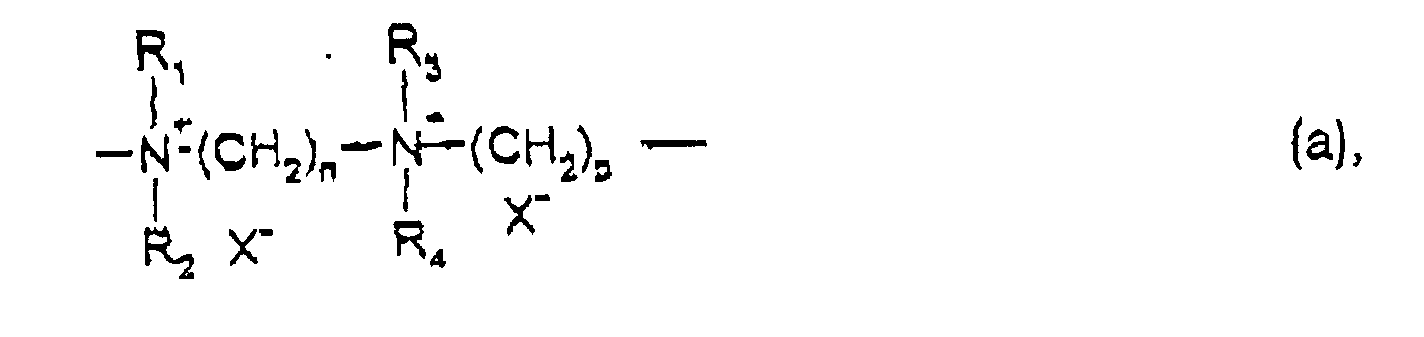
 - Zusammensetzung nach Anspruch 10, dadurch gekennzeichnet, daß die kationischen Polymere ausgewählt sind unter:worin die Gruppen R1, R2, R3 und R4, die identisch oder voneinander verschieden sind, eine Alkyl- oder Hydroxyalkylgruppe mit etwa 1 bis 4 Kohlenstoffatomen sind, n und p ganze Zahlen im Bereich von etwa 2 bis 20 bedeuten und X- ein Anion ist, das von einer anorganischen oder organischen Säure abgeleitet ist.Homopolymeren von Dimethyldiallylammoniumchlorid oder Copolymeren von Dimethyldiallylammoniumchlorid und Acrylamid;Polymeren, die aus wiederkehrenden Einheiten der folgenden Formel bestehen:
- Zusammensetzung nach einem der Ansprüche 1 bis 11, dadurch gekennzeichnet, daß der anionische grenzflächenaktive Stoff vom Typ Alkylpolyglykosid-carbonsäureester in den Zusammensetzungen in einer Konzentration von 0,5 bis 30 Gew.-%, vorzugsweise 1 bis 25 Gew.-% und insbesondere 2,5 bis 15 Gew.-%, bezogen auf das Gesamtgewicht der Zusammensetzung, vorliegt.
- Zusammensetzung nach einem der Ansprüche 1 bis 12, dadurch gekennzeichnet, daß das kationische Polymer in einer Konzentration von 0,001 bis 10 Gew.-%, bezogen auf das Gesamtgewicht der Zusammensetzung, vorzugsweise 0,005 bis 5 Gew.-% und insbesondere 0,01 bis 3 Gew.-% vorliegt.
- Zusammensetzung nach einem der Ansprüche 1 bis 13, dadurch gekennzeichnet, daß sie ferner mindestens einen zusätzlichen grenzflächenaktiven Stoff enthält, der unter den anionischen, kationischen, nichtionischen oder amphoteren grenzflächenaktiven Stoffen und deren Gemischen ausgewählt ist.
- Zusammensetzung nach Anspruch 14, dadurch gekennzeichnet, daß der oder die zusätzlichen grenzflächenaktiven Stoffe in einer Konzentration von 0,5 bis 60 Gew.-%, vorzugsweise 3 bis 40 Gew.-% und noch bevorzugter 5 bis 30 Gew.-%, bezogen auf das Gesamtgewicht der Zusammensetzung, vorliegt.
- Zusammensetzung nach einem der Ansprüche 1 bis 15, dadurch gekennzeichnet, daß sie ferner mindestens einen Zusatzstoff enthält, der unter den Verdickungsmitteln, Parfums, Perlglanzpigmenten, Konservierungsmitteln, Sonnenschutzfiltern, kationischen grenzflächenaktiven Stoffen, anionischen oder nichtionischen Polymeren, Proteinen, Proteinhydrolysaten, Ceramiden, Pseudoceramiden, Fettsäuren mit geraden oder verzweigten C16-40-Ketten, beispielsweise 18-Methyleicosansäure, Hydroxysäuren, Vitaminen, Panthenol, Siliconen, pflanzlichen Ölen, Mineralölen und synthetischen Ölen ausgewählt ist.
- Zusammensetzung nach einem der Ansprüche 1 bis 16, dadurch gekennzeichnet, daß sie als Haarwaschmittel, Haarpflegemittel, Zusammensetzung für Dauerwellen, Entkräuselungen, Färbungen oder Entfärbungen der Haare, Zusammensetzung, die ausgespült wird und zwischen den beiden Schritten einer Dauerwelle oder Entkräuselung aufgetragen wird, oder reinige Zusammensetzung für die Haut vorliegt.
- Verwendung einer Zusammensetzung nach einem der vorhergehenden Ansprüche zum Waschen von Keratinsubstanzen, wie dem Haar.
- Verfahren zur Behandlung von Keratinsubstanzen, wie dem Haar, dadurch gekennzeichnet, daß auf die Keratinsubstanzen eine kosmetische Zusammensetzung nach einem der Ansprüche 1 bis 17 aufgetragen und gegebenenfalls anschließend mit Wasser gespült wird.
Applications Claiming Priority (3)
| Application Number | Priority Date | Filing Date | Title |
|---|---|---|---|
| FR9814213 | 1998-11-12 | ||
| FR9814213A FR2785794B1 (fr) | 1998-11-12 | 1998-11-12 | Compositions cosmetiques contenant un tensioactif ester d'alkylpolyglycoside anionique et un polymere cationique et leurs utilisations |
| PCT/FR1999/002437 WO2000028965A1 (fr) | 1998-11-12 | 1999-10-11 | Compositions cosmetiques contenant un tensioactif ester d'alkylpolyglycoside anionique et un polymere cationique et leurs utilisations |
Publications (2)
| Publication Number | Publication Date |
|---|---|
| EP1047403A1 EP1047403A1 (de) | 2000-11-02 |
| EP1047403B1 true EP1047403B1 (de) | 2002-04-10 |
Family
ID=9532640
Family Applications (1)
| Application Number | Title | Priority Date | Filing Date |
|---|---|---|---|
| EP99947531A Expired - Lifetime EP1047403B1 (de) | 1998-11-12 | 1999-10-11 | Kosmetische zusammensetzungen enthaltend einen anionischen tensid vom typ alkylpoyglykosidester und ein kationisches polymer sowie deren verwendungen |
Country Status (7)
| Country | Link |
|---|---|
| EP (1) | EP1047403B1 (de) |
| AT (1) | ATE215813T1 (de) |
| AU (1) | AU6094399A (de) |
| DE (1) | DE69901228T2 (de) |
| ES (1) | ES2176028T3 (de) |
| FR (1) | FR2785794B1 (de) |
| WO (1) | WO2000028965A1 (de) |
Families Citing this family (6)
| Publication number | Priority date | Publication date | Assignee | Title |
|---|---|---|---|---|
| DE19916209C2 (de) * | 1999-04-10 | 2001-08-09 | Cognis Deutschland Gmbh | Kosmetische Zubereitungen |
| DE19916211C2 (de) * | 1999-04-10 | 2001-06-07 | Cognis Deutschland Gmbh | Kosmetische und/oder pharmazeutische Zubereitungen |
| DE10350425A1 (de) * | 2003-10-29 | 2005-07-14 | Beiersdorf Ag | Zähflüssiges Duschöl |
| EP2177206A1 (de) * | 2008-10-20 | 2010-04-21 | KPSS-Kao Professional Salon Services GmbH | Zusammensetzung zur dauerhaften Verformung des menschlichen Haares |
| EP2960246A1 (de) * | 2014-06-23 | 2015-12-30 | Basf Se | Di(alkylglykosid)sulfomethylsuccinate tenside |
| CN106459121A (zh) * | 2014-06-23 | 2017-02-22 | 巴斯夫欧洲公司 | 烷基糖苷磺基甲基琥珀酸酯表面活性剂 |
Family Cites Families (5)
| Publication number | Priority date | Publication date | Assignee | Title |
|---|---|---|---|---|
| IT1247517B (it) * | 1991-04-24 | 1994-12-17 | Auschem Spa | Procedimento per la preparazione di tensioattivi derivati da acidi di- o tri-carbossilici |
| IT1247516B (it) * | 1991-04-24 | 1994-12-17 | Auschem Spa | Tensioattivi derivati da esteri solfosuccinici |
| FR2682679B1 (fr) * | 1991-10-17 | 1995-06-16 | Seppic Sa | Nouveaux derives d'alkylpolyosides, leurs procedes de preparation et applications comme agents de surface. |
| DE4302315A1 (de) * | 1993-01-28 | 1994-08-04 | Henkel Kgaa | Oberflächenaktive Mischungen |
| FR2705890B1 (fr) * | 1993-06-01 | 1995-08-18 | Oreal | Compositions cosmétiques contenant au moins un tensio-actif anionique du type alkylgalactoside uronate et au moins un polymère cationique, et leurs utilisations pour le traitement des matières kératiniques. |
-
1998
- 1998-11-12 FR FR9814213A patent/FR2785794B1/fr not_active Expired - Fee Related
-
1999
- 1999-10-11 ES ES99947531T patent/ES2176028T3/es not_active Expired - Lifetime
- 1999-10-11 WO PCT/FR1999/002437 patent/WO2000028965A1/fr not_active Ceased
- 1999-10-11 DE DE69901228T patent/DE69901228T2/de not_active Expired - Fee Related
- 1999-10-11 EP EP99947531A patent/EP1047403B1/de not_active Expired - Lifetime
- 1999-10-11 AT AT99947531T patent/ATE215813T1/de not_active IP Right Cessation
- 1999-10-11 AU AU60943/99A patent/AU6094399A/en not_active Abandoned
Also Published As
| Publication number | Publication date |
|---|---|
| DE69901228D1 (de) | 2002-05-16 |
| ES2176028T3 (es) | 2002-11-16 |
| DE69901228T2 (de) | 2002-10-02 |
| FR2785794A1 (fr) | 2000-05-19 |
| EP1047403A1 (de) | 2000-11-02 |
| AU6094399A (en) | 2000-06-05 |
| FR2785794B1 (fr) | 2002-11-29 |
| ATE215813T1 (de) | 2002-04-15 |
| WO2000028965A1 (fr) | 2000-05-25 |
Similar Documents
| Publication | Publication Date | Title |
|---|---|---|
| EP1029533B1 (de) | Kosmetische Zusammensetzungen enthaltend ein Hydroxyalkylether-Aniontensid und ein kationisches Polymer, und ihre Verwendungen | |
| EP0974335B1 (de) | Kosmetische Tensid Zusammensetzung sowie ihre Verwendung | |
| EP1291001B2 (de) | Ein Copolymer aus Methacrylsäure und ein Öl enthaltende kosmetische Zusammensetzungen und deren Verwendungen | |
| EP1025839B1 (de) | Kosmetische Zusammensetzung enthaltend ein anionisches und amphoteres Tensid, ein Polyolefin, ein kationisches Polymer und ein Salz oder einen wasserlöslichen Alkohol, Verwendung und Verfahren | |
| EP1093808B1 (de) | Kosmetische Zusammensetzungen enthaltend ein Vinyldimethicon/Dimethicon Copolymer und ein kationisches Polymer, und ihre Anwendungen | |
| CA2321276A1 (fr) | Composition de lavage des matieres keratiniques, a base d'un agent tensio-actif detergent, d'un agent nacrant et/ou opacifiant et d'un terpolymere acrylique | |
| EP1353646A2 (de) | Kosmetische reinigungsmittel die ein amphoteres polysaccharid und ein unlösliches konditionierungsmittel enthalten und deren verwendung | |
| EP0966945A1 (de) | Reinigende kosmetische Zusammensetzungen und ihre Anwendung | |
| EP1126817B1 (de) | Kosmetische waschmittelzusammensetzungen und deren verwendung | |
| EP1093787B1 (de) | Zusammensetzung zur Behandlung der Haarschuppen basiert auf einem Salz von Pyridinethione, einem unlöslichen Konditionierungsmittel und einem Acrylterpolymer | |
| EP1029534A1 (de) | Reinigende kosmetische Zusammensetzungen enthaltend anionaktiven Hydroxyalkylethertenside und Guargummi und ihre Anwendung | |
| EP1380284A1 (de) | Kosmetische Reinigungszusammensetzungen, die ein anionisches, ein amphoterisches oder nichtionischesTensid und ein Polysaccharid enthalten, und deren Verwendung | |
| EP1291002A2 (de) | Ein Copolymer aus Methacrylsäure, ein Silikon und ein kationisches Polymer enthaltende kosmetische Zusammensetzungen und deren Verwendungen | |
| EP1064927A1 (de) | Reinigende kosmetische Zusammensetzung enthaltend ein silikon und amphoteren Polymeren mit Fettketten, sowie ihren verwendung | |
| WO2005092275A1 (fr) | Composition cosmetique comprenant un dendrimere a chaînes grasses peripheriques, un tensioactif et un agent cosmetique, et ses utilisations | |
| WO2000028965A1 (fr) | Compositions cosmetiques contenant un tensioactif ester d'alkylpolyglycoside anionique et un polymere cationique et leurs utilisations | |
| EP1047373B1 (de) | Kosmetische zusammensetzungen enthaltend einen anionischen tensid vom typ alkylpolyglykosidester und ein galaktomannangummi sowie deren verwendungen | |
| EP1029535B1 (de) | Kosmetische tensidische Zusammensetzungen, enthaltend ein anionisches Hydroxyalkylehter-Tensid und ein Silicon und deren Verwendungen | |
| FR2822681A1 (fr) | Compositions cosmetiques detergentes contenant un tensioactif anionique derive d'acides amines et une silicone et leurs utilisations | |
| EP1064917A1 (de) | Kosmetische Zubereitungen enthaltend ein amphoteres Polymer mit Fettketten und ein Ester und deren Verwendung | |
| EP1726295B1 (de) | Kosmetische Waschmittelzusammensetzungen enthaltend ein Amino Piperidin Silikon und drei Tenside und ihre Verwendung | |
| EP1047401B1 (de) | Kosmetische zusammensetzungen enthaltend einen anionischen tensid vom typ alkylpolyglykosidester und ein flüssiges wasserunlösliches konditionierungsmittel sowie deren verwendungen | |
| EP1430871A1 (de) | Kosmetische Zusammensetzungen enthaltend ein amphoteres Tensid und ein Ceramid sowie ihre Verwedung | |
| EP1047402B1 (de) | Kosmetische zusammensetzungen enthaltend ein anionisches tensid vom typ alkylpolyglycosidester und ein organomodifiziertes silikon | |
| EP1047400B1 (de) | Kosmetische zusammensetzungen enthaltend einen anionischen tensid vom typ alkylpolyglykosid-ester und ein silikon, sowie deren verwendungen |
Legal Events
| Date | Code | Title | Description |
|---|---|---|---|
| PUAI | Public reference made under article 153(3) epc to a published international application that has entered the european phase |
Free format text: ORIGINAL CODE: 0009012 |
|
| AK | Designated contracting states |
Kind code of ref document: A1 Designated state(s): AT BE CH CY DE DK ES FI FR GB GR IE IT LI LU MC NL PT SE |
|
| AX | Request for extension of the european patent |
Free format text: AL;LT;LV;MK;RO;SI |
|
| 17P | Request for examination filed |
Effective date: 20001127 |
|
| 17Q | First examination report despatched |
Effective date: 20010420 |
|
| GRAG | Despatch of communication of intention to grant |
Free format text: ORIGINAL CODE: EPIDOS AGRA |
|
| REG | Reference to a national code |
Ref country code: GB Ref legal event code: IF02 |
|
| GRAG | Despatch of communication of intention to grant |
Free format text: ORIGINAL CODE: EPIDOS AGRA |
|
| GRAG | Despatch of communication of intention to grant |
Free format text: ORIGINAL CODE: EPIDOS AGRA |
|
| GRAH | Despatch of communication of intention to grant a patent |
Free format text: ORIGINAL CODE: EPIDOS IGRA |
|
| GRAH | Despatch of communication of intention to grant a patent |
Free format text: ORIGINAL CODE: EPIDOS IGRA |
|
| GRAA | (expected) grant |
Free format text: ORIGINAL CODE: 0009210 |
|
| AK | Designated contracting states |
Kind code of ref document: B1 Designated state(s): AT BE CH CY DE DK ES FI FR GB GR IE IT LI LU MC NL PT SE |
|
| AX | Request for extension of the european patent |
Free format text: AL;LT;LV;MK;RO;SI |
|
| PG25 | Lapsed in a contracting state [announced via postgrant information from national office to epo] |
Ref country code: NL Free format text: LAPSE BECAUSE OF FAILURE TO SUBMIT A TRANSLATION OF THE DESCRIPTION OR TO PAY THE FEE WITHIN THE PRESCRIBED TIME-LIMIT Effective date: 20020410 Ref country code: IE Free format text: LAPSE BECAUSE OF FAILURE TO SUBMIT A TRANSLATION OF THE DESCRIPTION OR TO PAY THE FEE WITHIN THE PRESCRIBED TIME-LIMIT Effective date: 20020410 Ref country code: GR Free format text: LAPSE BECAUSE OF FAILURE TO SUBMIT A TRANSLATION OF THE DESCRIPTION OR TO PAY THE FEE WITHIN THE PRESCRIBED TIME-LIMIT Effective date: 20020410 Ref country code: FI Free format text: LAPSE BECAUSE OF FAILURE TO SUBMIT A TRANSLATION OF THE DESCRIPTION OR TO PAY THE FEE WITHIN THE PRESCRIBED TIME-LIMIT Effective date: 20020410 Ref country code: AT Free format text: LAPSE BECAUSE OF FAILURE TO SUBMIT A TRANSLATION OF THE DESCRIPTION OR TO PAY THE FEE WITHIN THE PRESCRIBED TIME-LIMIT Effective date: 20020410 |
|
| REF | Corresponds to: |
Ref document number: 215813 Country of ref document: AT Date of ref document: 20020415 Kind code of ref document: T |
|
| REG | Reference to a national code |
Ref country code: CH Ref legal event code: EP |
|
| REG | Reference to a national code |
Ref country code: IE Ref legal event code: FG4D Free format text: FRENCH |
|
| REF | Corresponds to: |
Ref document number: 69901228 Country of ref document: DE Date of ref document: 20020516 |
|
| PG25 | Lapsed in a contracting state [announced via postgrant information from national office to epo] |
Ref country code: SE Free format text: LAPSE BECAUSE OF FAILURE TO SUBMIT A TRANSLATION OF THE DESCRIPTION OR TO PAY THE FEE WITHIN THE PRESCRIBED TIME-LIMIT Effective date: 20020710 Ref country code: PT Free format text: LAPSE BECAUSE OF FAILURE TO SUBMIT A TRANSLATION OF THE DESCRIPTION OR TO PAY THE FEE WITHIN THE PRESCRIBED TIME-LIMIT Effective date: 20020710 Ref country code: DK Free format text: LAPSE BECAUSE OF FAILURE TO SUBMIT A TRANSLATION OF THE DESCRIPTION OR TO PAY THE FEE WITHIN THE PRESCRIBED TIME-LIMIT Effective date: 20020710 |
|
| GBT | Gb: translation of ep patent filed (gb section 77(6)(a)/1977) |
Effective date: 20020705 |
|
| NLV1 | Nl: lapsed or annulled due to failure to fulfill the requirements of art. 29p and 29m of the patents act | ||
| PG25 | Lapsed in a contracting state [announced via postgrant information from national office to epo] |
Ref country code: LU Free format text: LAPSE BECAUSE OF NON-PAYMENT OF DUE FEES Effective date: 20021011 |
|
| PG25 | Lapsed in a contracting state [announced via postgrant information from national office to epo] |
Ref country code: CY Free format text: LAPSE BECAUSE OF FAILURE TO SUBMIT A TRANSLATION OF THE DESCRIPTION OR TO PAY THE FEE WITHIN THE PRESCRIBED TIME-LIMIT Effective date: 20021031 Ref country code: BE Free format text: LAPSE BECAUSE OF NON-PAYMENT OF DUE FEES Effective date: 20021031 |
|
| PGFP | Annual fee paid to national office [announced via postgrant information from national office to epo] |
Ref country code: ES Payment date: 20021031 Year of fee payment: 4 |
|
| REG | Reference to a national code |
Ref country code: ES Ref legal event code: FG2A Ref document number: 2176028 Country of ref document: ES Kind code of ref document: T3 |
|
| REG | Reference to a national code |
Ref country code: IE Ref legal event code: FD4D Ref document number: 1047403E Country of ref document: IE |
|
| PLBE | No opposition filed within time limit |
Free format text: ORIGINAL CODE: 0009261 |
|
| STAA | Information on the status of an ep patent application or granted ep patent |
Free format text: STATUS: NO OPPOSITION FILED WITHIN TIME LIMIT |
|
| 26N | No opposition filed |
Effective date: 20030113 |
|
| BERE | Be: lapsed |
Owner name: L'*OREAL Effective date: 20021031 |
|
| PG25 | Lapsed in a contracting state [announced via postgrant information from national office to epo] |
Ref country code: MC Free format text: LAPSE BECAUSE OF NON-PAYMENT OF DUE FEES Effective date: 20030501 |
|
| PGFP | Annual fee paid to national office [announced via postgrant information from national office to epo] |
Ref country code: FR Payment date: 20031003 Year of fee payment: 5 |
|
| PGFP | Annual fee paid to national office [announced via postgrant information from national office to epo] |
Ref country code: GB Payment date: 20031008 Year of fee payment: 5 |
|
| PG25 | Lapsed in a contracting state [announced via postgrant information from national office to epo] |
Ref country code: ES Free format text: LAPSE BECAUSE OF NON-PAYMENT OF DUE FEES Effective date: 20031013 |
|
| PGFP | Annual fee paid to national office [announced via postgrant information from national office to epo] |
Ref country code: DE Payment date: 20031023 Year of fee payment: 5 |
|
| PG25 | Lapsed in a contracting state [announced via postgrant information from national office to epo] |
Ref country code: LI Free format text: LAPSE BECAUSE OF NON-PAYMENT OF DUE FEES Effective date: 20031031 Ref country code: CH Free format text: LAPSE BECAUSE OF NON-PAYMENT OF DUE FEES Effective date: 20031031 |
|
| REG | Reference to a national code |
Ref country code: CH Ref legal event code: PL |
|
| PG25 | Lapsed in a contracting state [announced via postgrant information from national office to epo] |
Ref country code: GB Free format text: LAPSE BECAUSE OF NON-PAYMENT OF DUE FEES Effective date: 20041011 |
|
| REG | Reference to a national code |
Ref country code: ES Ref legal event code: FD2A Effective date: 20031013 |
|
| PG25 | Lapsed in a contracting state [announced via postgrant information from national office to epo] |
Ref country code: DE Free format text: LAPSE BECAUSE OF NON-PAYMENT OF DUE FEES Effective date: 20050503 |
|
| GBPC | Gb: european patent ceased through non-payment of renewal fee |
Effective date: 20041011 |
|
| PG25 | Lapsed in a contracting state [announced via postgrant information from national office to epo] |
Ref country code: FR Free format text: LAPSE BECAUSE OF NON-PAYMENT OF DUE FEES Effective date: 20050630 |
|
| REG | Reference to a national code |
Ref country code: FR Ref legal event code: ST |
|
| PG25 | Lapsed in a contracting state [announced via postgrant information from national office to epo] |
Ref country code: IT Free format text: LAPSE BECAUSE OF NON-PAYMENT OF DUE FEES;WARNING: LAPSES OF ITALIAN PATENTS WITH EFFECTIVE DATE BEFORE 2007 MAY HAVE OCCURRED AT ANY TIME BEFORE 2007. THE CORRECT EFFECTIVE DATE MAY BE DIFFERENT FROM THE ONE RECORDED. Effective date: 20051011 |