EP1048574A1 - Versiegelter behälter - Google Patents
Versiegelter behälter Download PDFInfo
- Publication number
- EP1048574A1 EP1048574A1 EP97924272A EP97924272A EP1048574A1 EP 1048574 A1 EP1048574 A1 EP 1048574A1 EP 97924272 A EP97924272 A EP 97924272A EP 97924272 A EP97924272 A EP 97924272A EP 1048574 A1 EP1048574 A1 EP 1048574A1
- Authority
- EP
- European Patent Office
- Prior art keywords
- container
- sealed
- cap
- layer
- main
- Prior art date
- Legal status (The legal status is an assumption and is not a legal conclusion. Google has not performed a legal analysis and makes no representation as to the accuracy of the status listed.)
- Withdrawn
Links
Images




Classifications
-
- B—PERFORMING OPERATIONS; TRANSPORTING
- B65—CONVEYING; PACKING; STORING; HANDLING THIN OR FILAMENTARY MATERIAL
- B65D—CONTAINERS FOR STORAGE OR TRANSPORT OF ARTICLES OR MATERIALS, e.g. BAGS, BARRELS, BOTTLES, BOXES, CANS, CARTONS, CRATES, DRUMS, JARS, TANKS, HOPPERS, FORWARDING CONTAINERS; ACCESSORIES, CLOSURES, OR FITTINGS THEREFOR; PACKAGING ELEMENTS; PACKAGES
- B65D1/00—Rigid or semi-rigid containers having bodies formed in one piece, e.g. by casting metallic material, by moulding plastics, by blowing vitreous material, by throwing ceramic material, by moulding pulped fibrous material or by deep-drawing operations performed on sheet material
-
- B—PERFORMING OPERATIONS; TRANSPORTING
- B65—CONVEYING; PACKING; STORING; HANDLING THIN OR FILAMENTARY MATERIAL
- B65D—CONTAINERS FOR STORAGE OR TRANSPORT OF ARTICLES OR MATERIALS, e.g. BAGS, BARRELS, BOTTLES, BOXES, CANS, CARTONS, CRATES, DRUMS, JARS, TANKS, HOPPERS, FORWARDING CONTAINERS; ACCESSORIES, CLOSURES, OR FITTINGS THEREFOR; PACKAGING ELEMENTS; PACKAGES
- B65D77/00—Packages formed by enclosing articles or materials in preformed containers, e.g. boxes, cartons, sacks or bags
- B65D77/10—Container closures formed after filling
- B65D77/20—Container closures formed after filling by applying separate lids or covers, i.e. flexible membrane or foil-like covers
- B65D77/2024—Container closures formed after filling by applying separate lids or covers, i.e. flexible membrane or foil-like covers the cover being welded or adhered to the container
Definitions
- the present invention relates to a sealed container. More particularly, the present invention relates to a sealed container which comprises a cap container having a convex portion and a main container heat sealed to each other and is advantageously used for packaging of foods.
- cooked foods placed into containers are widely used in ordinary families. Cooked foods pasteurized under pressure and heat can be preserved at the ordinary temperature for about one year without adverse effects on taste and can be made into the condition suitable for eating by heating using a microwave oven or hot water. When this type of foods first appeared, these foods were placed into bags. However, as variety of foods such as curried rice, meat balls, Hamburg steaks, boiled vegetables, mixed cooked vegetables, cabbage rolls, pot-steamed hotchpotches, soup and cooked rice and red beans are served, a sealed container which can be easily opened and enables serving foods for eating without using other table wares is desired.
- Figure 1 shows a diagram exhibiting the structure of a conventional sealed container.
- the sealed container shown in this figure is composed of a cap container 3 having a flange portion 1 and a concave portion 2 and a main container 5 having a flange portion 4.
- the cap container is formed from a multi-layer sheet composed of two or more layers having the innermost layer made of a resin which can be heat sealed to the innermost layer of the main container.
- the concave portion of the cap container fits into the main container. After foods 6 are placed into the main container, the cap container is fitted into the main container.
- the cap container is fixed to a prescribed position when the cap container is fitted into the main container and the cap container is surely placed at the right position.
- the cap container and the main container can be tightly sealed to each other at the flange portions by placing the containers on a receiving plate for heat sealing 7, followed by pressing the flange portions by a heating plate for heat sealing 8 in a prescribed condition. It is even possible that, when the materials for the flange portions and the conditions of heat sealing are suitably selected, the sealed portion is provided with the property of easy opening so that the heat sealed flange portions can be opened by hands.
- conventional sealed containers which can be easily opened have a structure in which the cap container has a concave portion so that the cap container and the main container fit to each other.
- the container having this structure has a drawback in that the main container has a smaller volume available for contents than the entire volume of the main container and more bulky foods which are more popular recently cannot be sufficiently contained.
- FIG. 2 shows a diagram exhibiting an embodiment of a conventional container which is not sealed.
- the container shown in Figure 2 is composed of a cap container 3 and a main container 5 having a flange portion 4.
- the cap container has a flange portion 1, a convex portion 9 and, in the peripheral portion, a fitting portion 10 which covers and fits to the flange portion of the main container.
- This type of container has been used without heat sealing and used for foods which are not preserved such as lunches, sushi and Japanese cakes for take-out.
- materials having a single layer such as sheets of stretched polystyrene resins and vinyl chloride resins are used.
- the present invention has an object to provide a sealed container which contains contents larger than a main container, is tightly closed by heat sealing a cap container to a main container and can be opened easily.
- a heat sealed container which can be easily opened can be obtained by forming a cap container from a multi-layer sheet having an innermost layer made of a resin which can be heat sealed to a main container and heat sealing the cap container to the main container at flange portions and the present invention has been completed on the basis of this knowledge.
- the present invention provides:
- Figure 1 shows a diagram exhibiting a conventional sealed container.
- Figure 2 shows a diagram exhibiting an embodiment of a conventional container which is not sealed.
- Figure 3 shows a diagram exhibiting an embodiment of the sealed container of the present invention.
- Figure 4 shows a cross section exhibiting the sealed container of the present invention in a partially opened condition.
- Figure 5 shows a diagram exhibiting sealed containers of the present invention having a raised portion on a cap container.
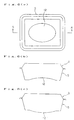
- Figure 6(a) shows a plan view of a main container of the sealed container of the present invention having a concave portion at the bottom portion.
- Figures 6(b) and 6(c) show cross sections of the sealed containers of the present invention having a concave portion at the bottom portion of a main container.
- Figure 7(a) shows a plan view of the sealed container of the present invention having a tab for opening on a cap container.
- Figure 7(b) shows a cross section of the sealed container of the present invention having a tab for opening on the cap container.
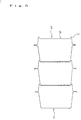
- Figure 8 shows a diagram exhibiting a sealed container of the present invention which is packed with boiled vegetables.
- Numbers in the figures indicate parts and portions as follows: 1: a flange portion; 2: a concave portion; 3: a cap container; 4: a flange portion; 5: a main container; 6: foods; 7: a receiving plate for heat sealing; 8: a heating plate for heat sealing; 9: a convex portion; 10: a fitting portion; 11: a raised portion; 12: a concave portion; and 13: a tab for opening.
- the cap container of the sealed container of the present invention is formed from a multi-layer sheet composed of two or more layers comprising an outermost layer made of polycarbonate and an innermost layer made of a resin which can be heat sealed to the main container.
- Polycarbonate has a glass transition temperature of about 150°C and changes into a fluid condition at a temperature of about 240°C. Therefore, polycarbonate has excellent heat resistance and is durable at the temperature in the range of 150 to 190°C which is the ordinary temperature of a heating plate for heat sealing in a heat sealing condition.
- Polycarbonate shows excellent transparency and contents placed inside a container made of polycarbonate can be seen from the outside. Thus, polycarbonate is suitable as a material of food containers.
- any resin can be used without any particular restriction so long as the innermost layer formed can be heat sealed with the innermost layer of the main container. It is preferable that a resin is selected so that a suitable peeling strength between the innermost layer of the cap container and the innermost layer of the main container is provided in an ordinary heat sealing condition and the sealed portion is easily opened.
- Examples of such a resin include polypropylene, low density polyethylene, linear low density polyethylene, high density polyethylene, copolymers of ethylene and vinyl acetate, polystyrene, polyethylene modified with an acid, copolymers of ethylene and methacrylic acid and copolymers of ethylene and methacrylic acid crosslinked with metals.
- a single type or a blend of two or more types of resin may be used for the innermost layer.
- Examples of the blend of two or more types of resin for the innermost layer of the multi-layer sheet forming the cap container include blends of polypropylene and low density polyethylene, blends of polypropylene and high density polyethylene, blends of polypropylene and a copolymer of ethylene and vinyl acetate and blends of polypropylene and polystyrene.
- a layer of a saponified copolymer of ethylene and vinyl acetate or a vinylidene chloride resin may be disposed to improve the property to shield gases such as oxygen, nitrogen and carbon dioxide and a layer of vinylidene chloride resin, polypropylene or polychlorotrifloroethylene may be disposed to improve the property to shield water vapor.
- Examples of the multi-layer sheet used for forming the cap container include a four-layer sheet comprising a layer of polycarbonate, a layer of polypropylene, a layer or saponified copolymer of ethylene and vinyl acetate and a layer of a blended resin of polypropylene and high density polyethylene and a four-layer sheet comprising a layer of polycarbonate, a layer of polypropylene, a layer of polyvinylidene chloride and a blended resin of polypropylene and high density polyethylene.
- the main container of the sealed container of the present invention can be formed with a single layer sheet which can be sealed with the innermost layer of the multi-layer sheet used for forming the cap container and provides the property of easy opening or with a multi-layer sheet having an innermost layer made of a resin which can be sealed with the innermost layer of the multi-layer sheet used for forming the cap container and provides the property of easy opening.
- the single layer sheet include single layer sheets of polystyrene, polypropylene and polyvinyl chloride.
- the multi-layer sheet include a multi-layer sheet having a layer of polypropylene, a layer of a saponified copolymer of ethylene and vinyl acetate and a layer of polypropylene.
- the innermost layer is formed from a blended resin of polypropylene and low density polyethylene, a blended resin of polypropylene, low density polyethylene and high density polyethylene, a blended resin of polypropylene and a copolymer of ethylene and methacrylic acid crosslinked with metals, a blended resin of polypropylene and a copolymer of ethylene and methacrylic acid or linear low density polyethylene.
- the materials for the cap container and the main container be durable in the condition of the pasteurization under pressure and heat.
- the material suitable for the pouched foods for easy cooking include a combination of a two-layer sheet having a layer of polycarbonate and a layer of a blended resin of polypropylene and high density polyethylene for the cap container and a single sheet of polypropylene for the main container and a combination of a four-layer sheet having a layer of polycarbonate, a layer of polypropylene, a layer of a saponified copolymer of ethylene and vinyl acetate and a layer of a blended resin of polypropylene and high density polyethylene for the cap container and a three-layer sheet having a layer of polypropylene, a layer of a saponified copolymer of ethylene and vinyl acetate and a layer of polypropylene for the main container.
- the process for preparing the multi-layer sheet used for the sealed container of the present invention is not particularly limited and the sheet can be prepared in accordance with a conventional process of lamination such as dry lamination, coating, extrusion lamination and coextrusion. Where necessary, an adhesive layer may be disposed between layers.
- the process for molding the cap container and the main container of the sealed container of the present invention is not particularly limited and the containers can be prepared in accordance with a conventional process of molding such as vacuum molding, air pressure molding and vacuum air pressure molding.
- FIG. 3 shows a diagram exhibiting an embodiment of the sealed container of the present invention.
- the sealed container shown in this figure is composed of a cap container 3 having a flange portion 1 and a convex portion 9 and a main container 5 having a flange portion 4.
- the cap container has, in the peripheral portion of the flange portion, a fitting portion 10 which covers and fits to the flange portion of the main container.
- the cap container is formed from a multi-layer sheet having two or more layers and the innermost layer of the multi-layer sheet is made of a resin which can be heat sealed with the innermost layer of the main container.
- the fitting portion in the peripheral portion of the flange portion of the cap container is placed over the flange portion of the main container and the cap container is fitted to the main container.
- the cap container is fixed to a prescribed position by fitting the fitting portion at the peripheral portion of the flange portion of the cap container to the flange portion of the main container and the cap container is surely placed at the right position.
- the combined containers are placed on the receiving plate for heat sealing 7 in this condition.
- a heating plate for heat sealing 8 is pressed to heat the flange portion of the cap container in a prescribed condition and the cap container and the main container can be tightly sealed to each other by the heat sealing at the flange portions.
- FIG. 4 shows a cross section exhibiting the sealed container of the present invention in a partially opened condition.
- the temperature of the heating plate for heat sealing is in the range of 150 to 190°C.
- the outermost layer of the cap container has a melting point higher than that of the resin of the innermost layer which is heat sealed by at least 10°C or more and more preferably 20°C or more.
- Polycarbonate has excellent heat resistance and satisfies the above condition.
- a raised portion fitting to the bottom portion of the main container may be formed at a peripheral portion of the cap container.
- Figure 5 shows a diagram exhibiting the sealed containers of the present invention having a raised portion on the cap container.
- Figure 6(a) shows a plan view of the main container of the sealed container of the present invention having a concave portion at the bottom portion.
- Figure 6(b) shows a cross section, cut along the line A-A, of the sealed container which has a concave portion at the bottom portion of the main container and is sealed at the flange portions of the cap container and the main container.
- Figure 6(c) shows a cross section, cut along the line A-A, of the sealed container having a concave portion at the bottom portion of the main container, wherein the container is heated and the concave portion has a convex shape by the inner pressure.
- a concave portion 12 having an elliptical shape is formed at the bottom portion of the main container 5.
- the concave portion has the original concave shape as shown in Figure 6(b).
- a pressure is formed at the inside of the sealed container.
- the concave portion is deformed to have a convex shape. This deformation increases the inner volume of the sealed container to reduce the inner pressure and separation of the heat sealed portions and damage of the heat sealed container can be prevented.
- the sealed container of the present invention may have a tab for opening to facilitate opening the container.
- Figure 7(a) shows a plan view of the sealed container of the present invention having a tab for opening on the cap container.
- Figure 7(b) shows a cross section, cut along the line B-B, of the sealed container in which the cap container and the main container are heat sealed at the flange portions.
- one corner portion of the flange portion of the cap container is extended and the extended portion of the cap container is left without being heat sealed to the flange portion of the main container to form a tab for opening 13.
- the sealed container can be easily opened by placing a finger at the opening tab and pushing the cap container in the upward direction.
- the position of the tab for opening is not limited to the corner portion and the tab for opening may be formed at any desired position.
- the sealed container of the present invention After the sealed container of the present invention has been opened and the cap container has been removed, it is not necessary that the contained foods are transferred to a separate table ware.
- the foods may be kept in the main container and served for eating.
- the cap container which has been removed after the sealed container has been opened can be placed on the main container again in a manner such that the fitting portion of the cap container is placed over the flange portion of the main container.
- the foods in the container can then be heated by a microwave oven and served for eating.
- a cap container which had a shape of a truncated cone having a diameter of 70 mm, a convex portion having a height of 10 mm and a flange portion having a width of 6 mm with a fitting portion was prepared in accordance with the vacuum molding from a two-layer sheet having an outer layer of polycarbonate having a thickness of 0.25 mm and an inner layer of a blended resin of polypropylene and polystyrene having a thickness of 0.05 mm.
- a main container having a shape of a truncated cone having a depth of 50 mm and a diameter of 70 mm, a volume of 200 ml and a flange portion having a width of 5 mm was molded from a polypropylene sheet having a thickness of 0.8 mm.
- the top of the boiled vegetables placed in the container was higher than the peripheral edge of the main container and could be seen well from the outside through the cap container.
- the flange portions of the container were then placed on a receiving plate for heat sealing as shown in Figure 8 and pressed by a cylindrical heating plate for heat sealing having an outer diameter of 90 mm and an inner diameter of 73 mm at 190°C under a pressure of 3.0 kg/cm 2 for 2.5 seconds using a sealing machine having a cylinder diameter of 100 mm.
- the container could be tightly closed by heat sealing without any deformation of the convex portion of the cap container.
- the sealed container containing the boiled vegetables was pasteurized at 98°C for 30 minutes at a constant difference in the pressure of 1.3 kg/cm 2 using a shower type pasteurizing apparatus and then kept for two weeks in a refrigerated condition.
- the sealed container could be opened easily by peeling the fitting portion of the cap container by fingers before the content was served for eating.
- the cap container was fitted to the main container again and heated in a microwave oven to obtain hot boiled vegetables.
- the container containing the boiled vegetables was placed on a table after removing the cap container. The container was comfortably used on the table.
- the boiled vegetables tasted as good as those immediately after being cooked.
- a multi-layer sheet which was composed of a layer of polycarbonate having a thickness of 0.06 mm, a layer of polypropylene having a thickness of 0.1 mm, a layer of polyvinylidene chloride having a thickness of 0.015 mm and a layer of a blended resin of polypropylene and high density polyethylene having a thickness of 0.05 mm laminated in this order from the outermost layer to the innermost layer and had a thickness of 0.18 mm, a cap container which had a flange portion having a width of 7 mm with a fitting portion and a convex portion having a length of 80 mm, a width of 100 mm and a height of 10 mm was prepared in accordance with the vacuum molding.
- a coextruded multi-layer sheet which was composed of a layer of polypropylene having a thickness of 0.38 mm, a layer of a saponified copolymer of ethylene and vinyl acetate having a thickness of 0.04 mm and a layer of polypropylene having a thickness of 0.38 mm laminated in this order from the outermost layer to the innermost layer and had a thickness of 0.8 mm, a main container having a flange portion having a width of 5 mm, a volume of 200 ml, a length of 80 mm, a width of 100 mm and a depth of 25 mm was prepared in accordance with the vacuum molding.
- the cap container was fitted to the main container, similarly to Example 1, in a manner such that the fitting portion at the peripheral portion of the flange portion of the cap container was fitted to the flange portion of the main container.
- the flange portions of the container were then placed on the receiving plate for heat sealing and pressed by a heating plate for heat sealing at 190°C under a pressure of 3.0 kg/cm 2 for 3 seconds using a sealing machine having a cylinder diameter of 100 mm.
- the container could be tightly closed by heat sealing without any deformation of the convex portion of the cap container.
- the sealed container containing the boiled vegetables was pasteurized at 120°C for 30 minutes at a constant difference in the pressure of 2.4 kg/cm 2 using a retort type pasteurizing apparatus. After the sealed container was kept for two weeks at the room temperature, the sealed container could be opened easily by peeling the fitted portion of the cap container by fingers. The boiled vegetables tasted as good as that immediately after being cooked.
- a cap container having the same shape as that prepared in Example 2 was prepared in accordance with the vacuum molding from the same two-layer sheet as that used in Example 1, which was the two-layer sheet having an outer layer of polycarbonate having a thickness of 0.25 mm and an inner layer of a blended resin of polypropylene and polystyrene having a thickness of 0.05 mm.
- a main container which had the same flange portion, the same length, the same width and the same depth as those in Example 2 and had a concave portion of an elliptical shape having a major axis of 70 mm and a minor axis of 50 mm and a depth of 7 mm in the bottom portion as shown in Figure 6(a) was prepared in accordance with the vacuum molding from the same sheet as that used in Example 1, which was the polypropylene sheet having a thickness of 0.8 mm.
- the cap container was fitted to the main container in a manner such that the fitting portion at the peripheral portion of the flange portion of the cap container was fitted to the flange portion of the main container.
- the flange portions of the container were then placed on the receiving plate for heat sealing and pressed by a cylindrical heating plate for heat sealing at 190°C under a pressure of 3.0 kg/cm 2 for 2.5 seconds using a sealing machine having a cylinder diameter of 100 mm.
- the container could be tightly closed by heat sealing without any deformation of the convex portion of the cap container and a sealed container having the shape shown in Figure 6(b) was prepared.
- the sealed container containing the boiled vegetables was pasteurized at 98°C for 10 minutes at a constant difference in the pressure of 1.0 kg/cm 2 using a shower type pasteurizing apparatus.
- the convex portion formed in the bottom portion deformed into the convex shape shown in Figure 6(c) and the container could be pasteurized while the container was kept in the sealed condition.
- Example 3 The same procedures as those conducted in Example 3 were conducted except that no concave portion was formed in the bottom portion.
- the sealed container was pasteurized at 98°C for 10 minutes at a constant difference in the pressure of 1.0 kg/cm 2 using a shower type pasteurizing apparatus. A portion of the heat sealed portion in the flange portion was separated and the container could not be kept in the sealed condition.
- the sealed container of the present invention has a large inner volume to contain a large amount of contents, is kept in the excellent sealed condition and can be easily opened by hands.
Landscapes
- Engineering & Computer Science (AREA)
- Mechanical Engineering (AREA)
- Ceramic Engineering (AREA)
- Packages (AREA)
Applications Claiming Priority (1)
| Application Number | Priority Date | Filing Date | Title |
|---|---|---|---|
| PCT/JP1997/001848 WO1998054056A1 (en) | 1997-05-30 | 1997-05-30 | Sealed container |
Publications (1)
| Publication Number | Publication Date |
|---|---|
| EP1048574A1 true EP1048574A1 (de) | 2000-11-02 |
Family
ID=14180610
Family Applications (1)
| Application Number | Title | Priority Date | Filing Date |
|---|---|---|---|
| EP97924272A Withdrawn EP1048574A1 (de) | 1997-05-30 | 1997-05-30 | Versiegelter behälter |
Country Status (3)
| Country | Link |
|---|---|
| EP (1) | EP1048574A1 (de) |
| KR (1) | KR100430516B1 (de) |
| WO (1) | WO1998054056A1 (de) |
Cited By (2)
| Publication number | Priority date | Publication date | Assignee | Title |
|---|---|---|---|---|
| EP1674407A1 (de) * | 2004-12-22 | 2006-06-28 | Nestec S.A. | Nahrungsmittelbehälter und Verfahren zur Heizung |
| CN103386775B (zh) * | 2012-05-08 | 2016-06-15 | 山东龙大粮油有限公司 | 一种高阻隔性容器及其制备方法 |
Families Citing this family (1)
| Publication number | Priority date | Publication date | Assignee | Title |
|---|---|---|---|---|
| KR200466845Y1 (ko) | 2012-01-26 | 2013-05-09 | 장인순 | 포장용기 고정트레이 |
Family Cites Families (7)
| Publication number | Priority date | Publication date | Assignee | Title |
|---|---|---|---|---|
| JPS53100399U (de) * | 1977-01-18 | 1978-08-14 | ||
| JPH0211010U (de) * | 1988-07-06 | 1990-01-24 | ||
| JP2724355B2 (ja) * | 1990-06-15 | 1998-03-09 | 出光石油化学株式会社 | 易開封性容器及びその製造方法 |
| JPH0552605U (ja) * | 1991-12-17 | 1993-07-13 | 宗三郎 足立 | 電子レンジ用の皿形密閉容器 |
| JP2597593Y2 (ja) * | 1992-07-06 | 1999-07-05 | 三甲株式会社 | 容 器 |
| JP2594559Y2 (ja) * | 1993-04-20 | 1999-04-26 | 三甲株式会社 | 運搬用容器 |
| JPH0728877U (ja) * | 1993-11-17 | 1995-05-30 | 丸東産業株式会社 | 食品包装用容器 |
-
1997
- 1997-05-30 EP EP97924272A patent/EP1048574A1/de not_active Withdrawn
- 1997-05-30 WO PCT/JP1997/001848 patent/WO1998054056A1/ja not_active Ceased
- 1997-05-30 KR KR10-1999-7011062A patent/KR100430516B1/ko not_active Expired - Fee Related
Non-Patent Citations (1)
| Title |
|---|
| See references of WO9854056A1 * |
Cited By (3)
| Publication number | Priority date | Publication date | Assignee | Title |
|---|---|---|---|---|
| EP1674407A1 (de) * | 2004-12-22 | 2006-06-28 | Nestec S.A. | Nahrungsmittelbehälter und Verfahren zur Heizung |
| WO2006066729A1 (fr) * | 2004-12-22 | 2006-06-29 | Nestec S.A. | Ensemble pour produit alimentaire et procede de chauffage pour ledit ensemble |
| CN103386775B (zh) * | 2012-05-08 | 2016-06-15 | 山东龙大粮油有限公司 | 一种高阻隔性容器及其制备方法 |
Also Published As
| Publication number | Publication date |
|---|---|
| WO1998054056A1 (en) | 1998-12-03 |
| KR20010013083A (ko) | 2001-02-26 |
| KR100430516B1 (ko) | 2004-05-10 |
Similar Documents
| Publication | Publication Date | Title |
|---|---|---|
| EP0449643B1 (de) | Nahrungsmittelpackung | |
| EP0240571B1 (de) | Mikrowellen gewärmte nährmittel | |
| US4756917A (en) | Packaging sheet and containers and pouches using the sheet | |
| US20090041912A1 (en) | Microwaveable vacuum skin package | |
| US20250313400A1 (en) | Cooking method and apparatus | |
| JP4220044B2 (ja) | 電子レンジ用射出成形容器 | |
| JPH10129742A (ja) | 蓋付き容器 | |
| EP0728678B1 (de) | Mikrowellenfeste Lebensmittelverpackung sowie Verfahren zur Herstellen derselben | |
| AU2002325877A1 (en) | Microwaveable vacuum skin package | |
| JPS63131926A (ja) | 電子レンジを用いた蒸気加温方法 | |
| JP3130793B2 (ja) | 密封容器 | |
| KR100430516B1 (ko) | 밀봉용기 | |
| JP4624506B2 (ja) | 易開封性多層容器 | |
| CN1085602C (zh) | 密封容器 | |
| JPH10175680A (ja) | マイクロ波エネルギー透過量調整機能を有するシート及びそれからなるパッケージ | |
| JPH02162039A (ja) | 容器 | |
| CA2033643A1 (en) | Ovenable container | |
| JPH1143182A (ja) | 電子レンジ加熱調理用包装体 | |
| NO171956B (no) | Flerlags-laminat | |
| JPH0224785Y2 (de) | ||
| KR20260061818A (ko) | 용기용 캡 및 이를 포함하는 식품 용기 | |
| JPH02282075A (ja) | 密封容器 | |
| JP2005126130A (ja) | 包装容器の製造方法及び包装容器 | |
| JPH0430287B2 (de) | ||
| JPH09323762A (ja) | 密封容器 |
Legal Events
| Date | Code | Title | Description |
|---|---|---|---|
| PUAI | Public reference made under article 153(3) epc to a published international application that has entered the european phase |
Free format text: ORIGINAL CODE: 0009012 |
|
| 17P | Request for examination filed |
Effective date: 19991130 |
|
| AK | Designated contracting states |
Kind code of ref document: A1 Designated state(s): DE FR GB |
|
| STAA | Information on the status of an ep patent application or granted ep patent |
Free format text: STATUS: THE APPLICATION IS DEEMED TO BE WITHDRAWN |
|
| 18D | Application deemed to be withdrawn |
Effective date: 20021203 |