EP1048694B1 - Azoverbindungen sowie verfahren zur herstellung derselben - Google Patents
Azoverbindungen sowie verfahren zur herstellung derselben Download PDFInfo
- Publication number
- EP1048694B1 EP1048694B1 EP19990947885 EP99947885A EP1048694B1 EP 1048694 B1 EP1048694 B1 EP 1048694B1 EP 19990947885 EP19990947885 EP 19990947885 EP 99947885 A EP99947885 A EP 99947885A EP 1048694 B1 EP1048694 B1 EP 1048694B1
- Authority
- EP
- European Patent Office
- Prior art keywords
- group
- groups
- optionally
- halogen atom
- substituent selected
- Prior art date
- Legal status (The legal status is an assumption and is not a legal conclusion. Google has not performed a legal analysis and makes no representation as to the accuracy of the status listed.)
- Expired - Lifetime
Links
- 0 CC(C(B1)O)C(*)=CC2=C1CCC(*)=C2 Chemical compound CC(C(B1)O)C(*)=CC2=C1CCC(*)=C2 0.000 description 42
Images




Classifications
-
- G—PHYSICS
- G03—PHOTOGRAPHY; CINEMATOGRAPHY; ANALOGOUS TECHNIQUES USING WAVES OTHER THAN OPTICAL WAVES; ELECTROGRAPHY; HOLOGRAPHY
- G03G—ELECTROGRAPHY; ELECTROPHOTOGRAPHY; MAGNETOGRAPHY
- G03G9/00—Developers
- G03G9/08—Developers with toner particles
- G03G9/09—Colouring agents for toner particles
- G03G9/0906—Organic dyes
- G03G9/091—Azo dyes
-
- C—CHEMISTRY; METALLURGY
- C07—ORGANIC CHEMISTRY
- C07D—HETEROCYCLIC COMPOUNDS
- C07D215/00—Heterocyclic compounds containing quinoline or hydrogenated quinoline ring systems
- C07D215/02—Heterocyclic compounds containing quinoline or hydrogenated quinoline ring systems having no bond between the ring nitrogen atom and a non-ring member or having only hydrogen atoms or carbon atoms directly attached to the ring nitrogen atom
- C07D215/16—Heterocyclic compounds containing quinoline or hydrogenated quinoline ring systems having no bond between the ring nitrogen atom and a non-ring member or having only hydrogen atoms or carbon atoms directly attached to the ring nitrogen atom with hetero atoms or with carbon atoms having three bonds to hetero atoms with at the most one bond to halogen, e.g. ester or nitrile radicals, directly attached to ring carbon atoms
- C07D215/38—Nitrogen atoms
- C07D215/42—Nitrogen atoms attached in position 4
- C07D215/44—Nitrogen atoms attached in position 4 with aryl radicals attached to said nitrogen atoms
-
- C—CHEMISTRY; METALLURGY
- C07—ORGANIC CHEMISTRY
- C07D—HETEROCYCLIC COMPOUNDS
- C07D233/00—Heterocyclic compounds containing 1,3-diazole or hydrogenated 1,3-diazole rings, not condensed with other rings
- C07D233/04—Heterocyclic compounds containing 1,3-diazole or hydrogenated 1,3-diazole rings, not condensed with other rings having one double bond between ring members or between a ring member and a non-ring member
- C07D233/20—Heterocyclic compounds containing 1,3-diazole or hydrogenated 1,3-diazole rings, not condensed with other rings having one double bond between ring members or between a ring member and a non-ring member with substituted hydrocarbon radicals, directly attached to ring carbon atoms
- C07D233/26—Radicals substituted by carbon atoms having three bonds to hetero atoms
-
- C—CHEMISTRY; METALLURGY
- C09—DYES; PAINTS; POLISHES; NATURAL RESINS; ADHESIVES; COMPOSITIONS NOT OTHERWISE PROVIDED FOR; APPLICATIONS OF MATERIALS NOT OTHERWISE PROVIDED FOR
- C09B—ORGANIC DYES OR CLOSELY-RELATED COMPOUNDS FOR PRODUCING DYES, e.g. PIGMENTS; MORDANTS; LAKES
- C09B29/00—Monoazo dyes prepared by diazotising and coupling
- C09B29/10—Monoazo dyes prepared by diazotising and coupling from coupling components containing hydroxy as the only directing group
- C09B29/18—Monoazo dyes prepared by diazotising and coupling from coupling components containing hydroxy as the only directing group ortho-Hydroxy carbonamides
- C09B29/20—Monoazo dyes prepared by diazotising and coupling from coupling components containing hydroxy as the only directing group ortho-Hydroxy carbonamides of the naphthalene series
-
- C—CHEMISTRY; METALLURGY
- C09—DYES; PAINTS; POLISHES; NATURAL RESINS; ADHESIVES; COMPOSITIONS NOT OTHERWISE PROVIDED FOR; APPLICATIONS OF MATERIALS NOT OTHERWISE PROVIDED FOR
- C09B—ORGANIC DYES OR CLOSELY-RELATED COMPOUNDS FOR PRODUCING DYES, e.g. PIGMENTS; MORDANTS; LAKES
- C09B62/00—Reactive dyes, i.e. dyes which form covalent bonds with the substrates or which polymerise with themselves
- C09B62/002—Reactive dyes, i.e. dyes which form covalent bonds with the substrates or which polymerise with themselves with the linkage of the reactive group being alternatively specified
- C09B62/006—Azodyes
- C09B62/008—Monoazo dyes
- C09B62/0083—Monoazo dyes with coupling components containing a hydroxyl directing group
-
- C—CHEMISTRY; METALLURGY
- C09—DYES; PAINTS; POLISHES; NATURAL RESINS; ADHESIVES; COMPOSITIONS NOT OTHERWISE PROVIDED FOR; APPLICATIONS OF MATERIALS NOT OTHERWISE PROVIDED FOR
- C09B—ORGANIC DYES OR CLOSELY-RELATED COMPOUNDS FOR PRODUCING DYES, e.g. PIGMENTS; MORDANTS; LAKES
- C09B62/00—Reactive dyes, i.e. dyes which form covalent bonds with the substrates or which polymerise with themselves
- C09B62/02—Reactive dyes, i.e. dyes which form covalent bonds with the substrates or which polymerise with themselves with the reactive group directly attached to a heterocyclic ring
- C09B62/04—Reactive dyes, i.e. dyes which form covalent bonds with the substrates or which polymerise with themselves with the reactive group directly attached to a heterocyclic ring to a triazine ring
- C09B62/08—Azo dyes
- C09B62/085—Monoazo dyes
-
- C—CHEMISTRY; METALLURGY
- C09—DYES; PAINTS; POLISHES; NATURAL RESINS; ADHESIVES; COMPOSITIONS NOT OTHERWISE PROVIDED FOR; APPLICATIONS OF MATERIALS NOT OTHERWISE PROVIDED FOR
- C09B—ORGANIC DYES OR CLOSELY-RELATED COMPOUNDS FOR PRODUCING DYES, e.g. PIGMENTS; MORDANTS; LAKES
- C09B62/00—Reactive dyes, i.e. dyes which form covalent bonds with the substrates or which polymerise with themselves
- C09B62/44—Reactive dyes, i.e. dyes which form covalent bonds with the substrates or which polymerise with themselves with the reactive group not directly attached to a heterocyclic ring
- C09B62/503—Reactive dyes, i.e. dyes which form covalent bonds with the substrates or which polymerise with themselves with the reactive group not directly attached to a heterocyclic ring the reactive group being an esterified or non-esterified hydroxyalkyl sulfonyl or mercaptoalkyl sulfonyl group, a quaternised or non-quaternised aminoalkyl sulfonyl group, a heterylmercapto alkyl sulfonyl group, a vinyl sulfonyl or a substituted vinyl sulfonyl group, or a thiophene-dioxide group
- C09B62/507—Azo dyes
- C09B62/51—Monoazo dyes
-
- G—PHYSICS
- G03—PHOTOGRAPHY; CINEMATOGRAPHY; ANALOGOUS TECHNIQUES USING WAVES OTHER THAN OPTICAL WAVES; ELECTROGRAPHY; HOLOGRAPHY
- G03G—ELECTROGRAPHY; ELECTROPHOTOGRAPHY; MAGNETOGRAPHY
- G03G5/00—Recording-members for original recording by exposure, e.g. to light, to heat or to electrons; Manufacture thereof; Selection of materials therefor
- G03G5/02—Charge-receiving layers
- G03G5/04—Photoconductive layers; Charge-generation layers or charge-transporting layers; Additives therefor; Binders therefor
- G03G5/06—Photoconductive layers; Charge-generation layers or charge-transporting layers; Additives therefor; Binders therefor characterised by the photoconductive material being organic
- G03G5/0664—Dyes
- G03G5/0675—Azo dyes
- G03G5/0677—Monoazo dyes
Definitions
- the present invention relates to a novel azo compound, a process for producing the same and use of the same.
- the present invention also relates to a novel naphthol derivative, which can be a starting material for synthesis of the novel azo compound of the present invention.
- the present invention provides an azo compound, which exhibits outstanding water resistance, chemical resistance, thermal resistance, and especially light resistance, good dispersion property and coloring power and can provide wide range of bright color from orange to purple with excellent transparency.
- the present invention provides a novel azo type coloring agent obtained by modifying 3- and/or 6- carboxy group of 2-hydroxynaphthalene-3, 6-dicarboxylic acid with an alkylamide derivative.
- the azo compound of the present invention exhibits an excellent light resistance:
- the present invention also provides a novel naphthol derivative having the general formula (IV): wherein Y is -(CONH)n-X or an optionally esterified carboxyl group, Y' is -(CONH)n-X' or an optionally esterified carboxyl group, wherein X and X' are saturated or unsaturated aliphatic hydrocarbon groups, which are optionally substituted by a substituent selected from the group consisting of halogen atom, cycloaliphatic, aromatic, furyl, piperidyl, pyridyl, morpholino, thienyl, indolyle, carbazolyle, alkoxy, cycloalkylamino, alkylamino, nitro, hydroxy and carboxyl groups and/or branched;, aromatic groups, which are optionally substituted by a substituent selected from the group consisting of halogen atom, nitro, methyl, methoxy, ethoxy, cyano, phenyl,
- the coupler used in this invention i.e. the compound represented by the general formula [IV] may be synthesized from 2-hydroxynaphthalene-3,6-dicarboxyamide, or ureide or carboxylic acid derivative thereof.
- the starting material, 2-hydroxynaphthalene-3,6-dicarboxylic acid may be obtained by means of Kolbe-Schmitt reaction, i.e. by reacting potassium 2-hydroxynaphthalene with carbon dioxide in the presence of a potassium salt such as potassium phenoxide under high pressure and high temperature.
- the amide or ureide derivative may be prepared by obtaining acid chloride of the starting compound by means of thionyl chloride or the like in a solvent such as xylene or sulfolane in a conventional manner, and then reacting the acid chloride with amine or urea.
- they can be prepared by reacting the starting compound directly with amine or urea in the presence of phosphorous trichloride, dicyclohexylcarbodiimide or the like.
- Examples of the amines or ureas, starting materials which constitutes the group X or X' in the Y or Y' may include optionally substituted and/or branched saturated or unsaturated aliphatic amines, optionally substituted aromatic amino compounds such as aniline (X or X' is a phenyl group), amino naphthalene (X or X' is a naphthyl group), aminoanthracene (X or X' is a anthryl group), aminopyrene (X or X' is a pyrenyl group), amino fluorene (X or X' is a fluorenyl group) or aminoanthraquinone (X or X' is an anthraquinonyl group); and optionally substituted heterocyclic compounds having conjugated double bond(s) such as aminobenzimidazolone (X or X' is a benzimidazolonyl group), aminocarbazole (X or X' is
- substituents include halogen atoms, nitro group, cyano groups, phenyl groups, morpholino groups, phenoxy groups, sulfo groups, carboxyl groups, amide groups (for example, phenylaminocarbonyl group) and the like, and the phenoxy and amide groups may also have another substituent such as halogen atom, alkylaminosulfonyl group, nitrile group or the like.
- At least one of Y and Y' in the compound of the formulae [I] and [IV] represents a group wherein X or X' is an optionally substituted and/or branched saturated or unsaturated aliphatic hydrocarbon group.
- Ureas may be prepared by reacting the above-described amino compound with potassium cyanate. That is, for example, phenylurea may be obtained from aniline.
- Y or Y' may represent an optionally esterified carboxyl group, for example those represent by the general formula of -COR or -COR'. When either R or R' is a hydroxy group, it may form an acceptable salt.
- an acceptable salt represents a salt, which does not impair diazotizing reaction and does not have any adverse effect on the coloring and light resistance properties of the compound.
- the salts include alkaline metal salts and alkaline earth metal salts, and alkaline metal salts are preferable.
- the alkaline metals include sodium, potassium, lithium and the like.
- R or R' may be an optionally branched alkoxy group having 1-6, preferably 1-4 carbon atoms, a phenyloxy group, a benzyloxy group, or a phenacyloxy group, each of the groups may be substituted.
- R 2 is a hydrogen atom, an optionally branched alkyl group having 1-6, preferably 1-4 carbon atoms, especially, methyl or ethyl group; an acyl group having 1-6, preferably 1-4 carbon atoms, especially acetyl group; or a phenylalkyl group.
- At least one of X and X' is an optionally substituted and/or branched saturated or unsaturated aliphatic hydrocarbon group.
- Said aliphatic hydrocarbon group preferably has 1-30, more preferably 1-20 carbon atoms.
- the aliphatic hydrocarbon group may be a straight or branched chain, or may form a ring, and preferably, be a straight chain.
- the group may optionally have an unsaturated bond or a substituent.
- substituents examples include cycloaliphatic groups, such as cyclopentyl and cyclohexyl groups, aromatic groups, such as phenyl and naphthyl groups, heterocyclic groups such as furyl, piperidyl, pyridyl, morpholino, thienyl, indolyl, carbazolyl groups and the like, halogen atoms such as fluorine, chlorine, bromine, iodine and the like, alkoxy groups, cycloalkylamino groups, alkylamino groups, nitro group, hydroxy group, and carboxyl groups and the like.
- cycloaliphatic groups such as cyclopentyl and cyclohexyl groups
- aromatic groups such as phenyl and naphthyl groups
- heterocyclic groups such as furyl, piperidyl, pyridyl, morpholino, thienyl, indolyl, carbazolyl groups and the like
- the number of the carbon atoms defined above represents those of the alkyl moiety.
- the alkyl moiety has a branch, the above defined carbon number includes the carbon atoms of the branch.
- Examples of the optionally substituted alkyl groups include methyl, ethyl, propyl, isopropyl, butyl, isobutyl, tert-butyl, ethylhexyl, pentyl, hexyl, octyl, dimethylhexyl, octyl, dodecyl, hexadecyl, octadecyl, eicosyl, triacontyl, octadecenyl, benzyl, phenylethyl, phenylbutyl, cyclohexylaminopropyl, morpholino propyl, pyridyl methyl, furfuryl, trimethoxysilylpropyl amino ethyl, and triethoxysilyipropyl. They may have another substituent, for example, a halogen atom, nitro group and amino group.
- the most preferable azo compound is that of the formula wherein X (i.e. the substituent at the position 3 of the formula IV) is an aromatic group, especially a naphthyl group, and X' (at the position 6 of the formula IV) is a saturated or unsaturated aliphatic hydrocarbon group which may optionally have a substituent and/or a branch.
- the above-described aromatic amines may have a substituent.
- substituents include halogen atoms, methyl group, halogenated methyl group, cyano group, nitro group, methoxy group, ethoxy group, amide groups, sulfo groups, alkylamino sulfonyl groups, aminocarbonyl groups, phenylaminocarbonyl groups, phenoxy groups, alkoxycarbonyl groups, hydroxy group, benzoylamino group, toluidinylamino group, triazinylamino group, pyrimidinylamino group, and sulfato ethyl sulfonyl group.
- the substituent comprises an aromatic or a heterocyclic group
- said group may have further substituent selected from naphthyl amino and phenyl amino groups which may have further substituent such as sulfo group or sulfato loweralkylsulfonyl group.
- the aromatic amine, which constitutes the group Z may preferably be aniline or naphthylamine.
- the azo compound of the present invention can be obtained by coupling a diazonium compound, which can be obtained by diazotizing of an aromatic compound by means of sodium nitrite or the like, with a naphthol compound of formula (IV).
- This coupling reaction procedure is not limited and may be conducted under any conventional condition employed in a conventional method for synthesizing an azo compound. Generally, the reaction may be conducted at about 0-100 °C for about 1-24 hours.
- the azo pigment obtained by the present invention may be used for preparing a lake pigment.
- Agents which is used to make the lake pigment may include Ca salt, Ba salt, Sr salt and Mn salt.
- the lake pigment may be prepared in a conventional manner.
- the azo compound of the present invention may be those synthesized by means of a mixed coupler composition comprising a certain coupler of the present invention and one or more couplers selected from any other couplers including those of the present invention.
- the azo compound of the present invention may be applied for pigment, ink, paint, dye, and mass coloring agent for polymer material.
- the azo compound of the present invention can be milled in a solvent such as toluene, xylene, ethanol, n-butanol, iso butanol, benzylalcohol, butyl cellosolve, ethyl acetate, mineral terpene or petroleum naphtha, by means of ball mill or the like.
- a dispersing agent may be admixed.
- dispersing agents examples include aliphatic polyvalent carboxylic acids, amine salt of a high molecular weight polyester, polyether/ester type surfactants, long chain amine salt of a high molecular weight polycarboxylic acid, amideamine salt of a high molecular weight polyester acid, salt of a long chain polyaminoamide and a higher acid polyester, salt of a long chain polyamino amide and phosphoric acid, polyamide surfactants and phosphate surfactants.
- an ink composition may be prepared by dispersing the azo compound of the present invention into a vehicle, such as varnish, by means of a beads mill or a triple roll mill, and admixing an auxiliary agent therewith.
- a suitable vehicle based on the manner of printing, purpose, drying manner, printing material, and the like, a variety of inks, such as inks for offset printing, for photogravure, water-base ink and UV resistance ink, can be obtained.
- Examples for vehicle may include rosin-modified phenol resin, rosin-ester resin, petroleum resin, alkyd resin, calcium rhodinate, polyamide resin, nitro cellulose, acrylic resin, polyurethane resin, vinyl chloride, rubber resin, styrene maleate resin, polyol resin, epoxy resin, and urethane-acrylate resin.
- the ingredients as above may be admixed with a solvent or a diluent, and knead to provide a desired ink composition.
- the solvent or diluent may include vegetable oils, petroleum hydrocarbon solvents, aromatic hydrocarbons, alcohols, ketones, aromatic esters, water, and photopolymerizable acrylate monomers.
- Examples of the auxiliary agent include a dry controlling agent, a viscosity controlling agent, a dispersing agent, a color controlling agent, and reacting agent, as well as a defoaming agent.
- an well dispersed paint composition with a good dispersibility may be prepared by milling the azo composition of the present invention together with a thermosetting resin, such as melamine resin, alkyd resin, and epoxy resin in a volatile solvent, such as xylene.
- a thermosetting resin such as melamine resin, alkyd resin, and epoxy resin in a volatile solvent, such as xylene.
- the paint composition may be applied on the surface of a steel board and then baked to provide coatings with good gloss. In the milling process, following additives may be added to the mixture.
- additives examples include polymerized vegetable-oils, polyether/ester surfactants, phosphate ester surfactants, sulfate ester/anionic surfactants, hydrogenated castor oils, amides, fatty acid amide waxes, aliphatic polyvalent carboxylic acids, long chain amine salt of a high molecular weight polycarboxylic acid, salt of a long chain polyaminoamide and a higher acid polyester, salt of a long chain polyaminoamide and phosphoric acid, amine salt of polyester, and polyethylene oxides.
- the azo compound of the present invention exhibits a superior dispersing and coloring quality and also good transparency, which is an essential property required for metallic coating. Therefore, the compound of the present invention may preferably be applied for paint for car or buildings.
- a reactive dye composition can be obtained by treating the azo compound of the present invention having a functional group such as ethyl sulfone sulfate group in its structure in an alkaline solution to provide vinyl sulfone group.
- a functional group such as ethyl sulfone sulfate group
- vinyl sulfone group can react with the hydroxy group of the fiber to be dyed and add to the group.
- fibers to be dyed with the reaction dye may include cellulose fibers such as cotton, linen, rayon and bemberg.
- the azo compound of the present invention can be admixed with crushed polymer material by means of an extrude kneader or the like to provide a colored molten gel.
- the colored polymer material may be shapen in an appropriate manner.
- the polymer material may include thermoplastic resins such as soft and hard vinyl chloride resin, vinylidene chloride resin, low- and high-density polyethylenes, ethylene-vinylacetate copolymer, polypropylene, polybutene, moldable and foaming polystyrene, acrylonitrile-styrene copolymer, acrylonitrile-butadiene-styrene copolymer, petroleum resin, methacrylic resin, polyvinyl alcohol, polyamide resin, fluoride resin, polycarbonate, polyacetal, polyethylene terephthalate, polybutylene terephthalate, modified polyphenylene ether, and thermosetting resins such as phenol resin, urea resin, melamine resin, unsaturated polyester resin, alkyd resin, epoxy resin, silicone resin, and urethane foam.
- the polymer materials may also include synthesized gum and natural gum.
- the pigment comprising the azo compound of the present invention may be used as a coloring agent for ink composition for ink-jet printing systems, especially for magenta ink for full-color printing systems.
- the pigment of the present invention may be dispersed in a liquid medium. Suitable liquid medium is a mixture of water and a water-soluble organic solvent.
- water-soluble organic solvent examples include alcohols such as methanol, ethanol, propanol, butanol, isobutanol, sec-butanol, tert-butanol, pentanol, hexanol, cyclohexanol, and benzyl alcohol, polyalcohols such as ethylene glycol, diethylene glycol, triethylene glycol, polyethylene glycol, propylene glycol, dipropylene glycol, polypropylene glycol, butylene glycol, hexanediol, pentanediol, glycerin, hexanetriol and thiodiglycole, polyalcohol ethers such as ethylene glycol monomethyl eter, ethylene glycol monoethyl ether, ethylene glycol monobutyl ether, diethylene glycol monoethyl ether, diethylene glycol monobutyl ether, propylene glycol monomethyl ether, propylene glycol mono
- the proportion of the organic solvent to water may preferably be less than 30 weight %, preferably about 5-20 weight %.
- the pigment comprising the azo compound of the present invention may be used together with other pigments or water insoluble dyes such as oil-soluble dyes and dispersion dyes.
- water insoluble dyes such as oil-soluble dyes and dispersion dyes.
- the amount of the pigment in the ink composition is not limited but preferably about 1-15 %, especially about 3-10 % by weight of the whole weight of the ink composition.
- the content of the pigment is less than 1 % by weight, the coloring power of the ink could be poor to give printed image with insufficient image density.
- the amount of the pigment is more than 15 % by weight, it would be difficult to disperse the pigment in the ink composition uniformly.
- an oil-soluble dye is used with the pigment, the amount of the dye is preferably 5-50 parts by weight per 100 parts by weight of the pigment.
- the ink composition of the present invention comprising the above described ingredients can be obtained in a conventional manner.
- the pigment may be added to an aqueous solution of the dispersing agent, the mixture may be dispersed with a dispersing means such as ball mill, and then, the dispersed mixture may be subjected to centrifugation, if desired. Then the dispersed mixture may be added with additives and the like and diluted with an aqueous medium to provide a given concentration.
- a small amount of ink may be prepared by adding the given amounts of aqueous medium and the additives to the dispersing system, rather than preparing the same in the above sequential manner.
- the preferable viscosity of the flying ink particles is less than 40cps, more preferably, less than 30cps.
- the preferable surface tension of the frying ink particles is higher than 20 dyn/cm, more preferably, 25-80 dyn/cm.
- the ink for ink-jet printing of the present invention may further comprise a viscosity modifier, a surface tension modifier, a specific resistance modifier, a film-forming material, a dispersing agent, a surfactant, a UV absorbent, an antioxidant, a pH modifier, a fading resistant agent, an anti-grime agent, and an anticorrosive agent for the purpose of improving discharging stability, compatibility with the printer head or the ink cartridge, preservation stability, image stability, and other properties.
- the ink-jet printing ink of the present invention may be applied to any of conventional image recording system.
- the ink preferably comprises a electronic conductivity controlling agent.
- the electronic conductivity controlling agent is exemplified by potassium iodide, ammonium thiocyanate, sodium thiocyanate, potassium thiocyanate, lithium nitrate and lithium chloride, and the agent may preferably be contained in the ink composition at the amount of 0.1-2.0 % by weight of the composition.
- the pigment of the present invention exhibits excellent dispersion and coloring properties, and also an excellent transparency, which is an essential feature for reproducing a full color image
- the ink for ink-jet printing comprising the same as a coloring agent will provide a brilliant image.
- the pigment comprising the azo compound of the present invention may be applied as a coloring agent for toners used in an electrophotographic system such as an electrostatic copier, a laser beam printer, especially for a magenta toner used in a full color printing system.
- toners are prepared by dispersing additives such as coloring agent in a fixing resin.
- the fixing resins include olefinic polymers such as styrene polymers, acrylic polymers, styrene-acrylic polymers, chlorinated polystyrene, polypropylene and ionomers, polyvinyl chloride resin, polyester resin, polyamide resin, polyurethane resins, epoxy resins, diallylphthalate resins, silicone resins, ketone resins, polyvinyl butyral resins, phenolic resins, rosin modified phenolic resins, xylene resins, rosin modified maleate resins, and rosin ester, and especially, styrene-acrylic polymers and polyester resins are preferable.
- the pigment of the present invention may be preferably used and other pigments may be added to control the color.
- the other pigments which may be used in combination with the pigment of the present invention include phthalocyanine, azo, anthraquinone, perinone-perylene, indigo-thioindigo, dioxazine, quinacridone, isoindoline, aniline black, and carbon black pigments.
- the amount of the pigment may preferably be 1-20 parts by weight, more preferably 2-10 parts by weight per 100 parts by weight of the fixing resin.
- the representative additives for the toners other than colorant include charge control agent and offset preventive agent.
- the charge control agents are admixed to control the tribo-electricity, and there are two types of the agents based on the electricity of the toner, positive charge control agents and negative charge control agents.
- Examples of the positive charge control agents include an organic compound having a basic nitric atom, for example basic dyes, amino-pyrine or pyrimidine compounds, polynuclear polyamino compounds, and amino silanes.
- Examples of the negative charge control agents include azo dyes containing metal, metal naphthenate dyes, metal alkylsalicylates, fatty acid soaps and resin acid soaps.
- the amount of the charge controlling agent may preferably be 0.1-10 parts by weight, especially 0.5-8 parts by weight per 100 parts by weight of the fixing resin.
- the offset preventive agents are added to prevent the offset appearance of the toner at the fixation process.
- the agents include aliphatic hydrocarbons, metal aliphatic salts, higher fatty acids, fatty acid esters and their partial saponified compounds, silicone oils, and various waxes.
- aliphatic hydrocarbons having about 1000-10000 weight-average molecular weight are preferable.
- Embodiments may include low molecular weight polypropylenes, low molecular weight polyethylenes, paraffin wax, low molecular weight olefin polymers consisting of olefin units with having 4 or more carbon atoms, silicone oil, and a mixture thereof.
- the amount of the offset preventive agents is preferably 0.1 to 100 parts by weight, especially 0.5-8 parts by weight per 100 parts by weight of the fixing resin.
- the toners of the present invention for electrophotographic system may be used for two-component developing system together with a various known carriers. The ratio of the toner and the carrier may be the same as a conventional developing system.
- the developing system may be added with a fluidizing agent such as fine particles of hydrophobic silica or alumina.
- the toner of the present invention may be a magnetic toner for one-component developing system, and said magnetic toner may be added with magnetic fine particles.
- Typical magnetic materials include magnesium, ferrous oxides such as hematite and ferrite, metals such as iron, cobalt, nickel, and alloys or mixtures of said metals and aluminum, cobalt, copper, lead, magnesium, tin, zinc, antimony, beryllium, bismuth, cadmium, calcium, manganese, selenium, titanium, tungsten, and vanadium.
- the amount of the magnetic particles is preferably 20-300 parts by weight, especially. 50-150 parts by weight per 100 parts by weight of the fixing resin.
- the toner of the invention may also be prepared in a form suitable for pressure-fixing printing process and said toner may be added, if desired, with plasticizing components such as a plasticizing agent, an oil, a low melting point wax, a petroleum resin, a liquid oligomer resin, and the like.
- the particle size of the toner is not limited and preferably 3-35 ⁇ m, especially, 5-20 ⁇ m.
- the toner of the present invention for electrophotographic system may also be obtained by pre-kneading the above described ingredients by means of dry blender, Henschel mixer, ball mill or the like to provide an uniform mixture. Then the mixture may be molten and kneaded by means of a kneader such as Banbury mixer, roll, uniaxial or biaxial extrusion kneader. The kneaded mixture may be cooled and milled and, if desired, classified to give toner.
- the toner of the present invention can be prepared by a known process such as polymerizing method, microcapsule polymerization and spray-dry method.
- the toner of the present invention may be prepared as a liquid toner by dispersing a coloring composition consisting of the coloring agent and a resin, in a solvent.
- the solvent may be those having excellent insulating properties (more than 10 10 ⁇ cm of electrical resistance) and low dielectric constant (less than 3), for example, a petroleum aliphatic hydrocarbon, n-hexane, ligroine, n-heptane, isododecane and isooctane, and halogen derivatives thereof such as carbon tetrachloride, perchloroethylene. These respective solvent may be used by itself or in combination of two or more.
- the toner containing the pigment of the present invention as a colorant can provide a printing image with a high image density, an excellent color reproducibility, and a good transparency, and therefore, the toner is useful as a magenta toner for full-color printing to provide a clear image.
- the pigment containing the azo compound of the present invention may also be used as a red pigment for a color filter to provide a color filter having an excellent optical property, which is used in a devise with liquid-crystal display or the like.
- Said color filter may be prepared by patterning of a polymer resin composition in which the pigment is dispersed to give the primary color element, or by depositing the pigment and the polymer resin dispersed in a solvent on a patterned transparent electrode.
- the organic polymer resin used for the color filter is required being water-clear, and excellent in thermal and light resistance.
- the resins include epoxy resin, melamine resin, acrylic resin, polyimide resin and its precursor polyamic acid resin, polyester resin, unsaturated polyester resin, polycarbonate resin, photosensitive monomers and oligomers having (meth)acryloyl group, and the like.
- the organic polymer is a photopolymerizable compound which has at least one ethylenic unsaturated double bond in its structure.
- the pigment may be admixed with some other pigments.
- Examples of the pigment which may be used in combination with those of the present invention include perylene pigments, quinacridone pigments, anthraquinone pigments, bisazo pigments, pyrrolopyrrole pigments, isoindolinone pigments, phthalocyanine pigments, halogenated phthalocyanine pigments and dioxadine pigments.
- the amount of the pigment may be 10-50 parts by weight per 100 parts by weight of the polymer resin.
- the color filter may be prepared by a conventional method such as photolithographic method with internally added pigment, electrodepositing method, electric field micelle method or printing method.
- a resin composition comprising the pigment of the present invention, photosensitive resin, photopolymerization initiator, solvent and the other ingredients may be prepared and if desired, the composition may be subjected to sonication or dispersion, and then, filtered.
- the obtained composition may be applied on a substrate, such as a glass plate, by means of a coating device such as spinner, and dried, irradiated via photomask with light, such as supervoltage mercury lamp, and then, developed to give one primary color element(red).
- one color element may be obtained by applying an ink composition consisting of the pigment of the present invention, a thermosetting resin such as polyamide resin or epoxy resin, and a solvent on the a basement, such as a glass plate, by means of a printer and then heating the same.
- the other conventional method may be employed to prepare the color filter comprising the pigment of the present invention.
- the color filter prepared by using the pigment exhibits an excellent spectral properties and small anti-polarization effect.
- the pigment comprising the azo compound of the present invention exhibits an excellent charge generating ability, it may be used as a charge generating material of an organic photosensitive material used in an electrophotographic copier, a laser printer or the like.
- a photosensitive material function-divided organic photosensitive member composed of a charge generating material, which generates charge in response to light exposure and a charge transporting material, which transports the generated charge, both of them are dispersed in a binder resin.
- the pigment of the present invention may be applied for either type.
- the mono-layered type photosensitive member may be prepared by dissolving or dispersing a charge generating material and a charge transporting material in an appropriate solvent together with a binder resin and the like, applying the obtained solution or dispersion on an electrically conductive substrate and drying the same.
- the laminated type photosensitive member may be prepared by applying a solution or a dispersion comprising a charge generating material and a binder resin on an electrically conductive substrate to provide a charge generating layer containing the charge generating material, and then applying a solution or a dispersion comprising a charge transporting material and a binder resin on the surface of the charge generating layer and then, drying the same.
- the charge transporting layer may be prepared on the electronic conductive substrate and the charge generating layer may be prepared over the same.
- the charge generating material comprises the pigment comprising the azo compound of the present invention, and other organic and inorganic photoconductive materials may be used in combination.
- Said photoconductive materials may include, for example, particles of an inorganic photoconductive material such as selenium, selenium-tellurium, selenium-aresenic, cadmium sulfide and amorphous-silicone, metal-free phthalocyanines, titanium phthalocyanines, perylene pigments, bisazo pigments, dithioketo pyrrolopyrrole pigments, metal-free naphthalocyanine pigments, metal-naphthalocyanine pigments, squarilium pigments, trisazo pigments, indigo pigments, azulenium pigments, cyanine pigments, and further, anthanthrone pigments, triphenylmethane pigments, surene pigments, toluidine pigments, pyrazoline pigments and quinacridone pigments.
- charge transporting materials may include tetracyano ethylene; fluorenone compounds such as 2,4,7-trinitro-9-fluolenone, fluorene compounds such as 9-carbazorylimino fluorene; nitro compounds such as dinitro anthracene; succinic anhydride, maleic anhydride; dibromo maleic anhydride; triphenylmethane compounds; oxadiazole compounds such as 2,5-di(4-dimethylaminophenyl)-1,3,4-oxadiazole; styryl compounds such as 9-(4-diethylaminostyryl) anthracene; carbazole compounds such as poly-N-vinyl carbazole; pyrazoline compounds such as 1-phenyl-3-(p-dimethylaminophenyl)pyrazoline; 4,4',4'-tris(N,N-diphenylamino)triphenylamine, amine derivatives such as 3,3'--
- Each of the charge transporting materials may be used by itself or in combination of two or more.
- the binder resin is not always necessary to add.
- the binder resins include thermoplastic resins, such as styrene polymers, styrenebutadiene copolymers, styrene-acrylonitrile copolymers, styrene-maleate copolymers, acrylic polymers, styrene-acrylic copolymers, polyethylene, ethylene-vinylacetate copolymers, polyethylene chlorides, polyvinyl chlorides, polypropylenes, vinyl chloride-vinyl acetate copolymers, polyesters, alkyd resins, polyamides, polyurethanes, polycarbonates, polyarylates, polysulfones, diallylphthalate resins, ketone resins, polyvinyl butyral resins, and polyether resin
- the photosensitive member may be incorporated with a various additives, for example, sensitizers, antioxidants, ultraviolet absorber, plastitizer, surfaceactive agent, leveling agent, and the like.
- sensitizers may include terphenyl, halonaphtoquinones and acenaphthylene.
- antioxidants may include phenol antioxidants such as 2,6-di-tert-butyl-p-cresol, triethyleneglycol-bis[3-(3-tert-butyl-5-methyl-4-hydroxy phenyl)propionate], 1,6-hexanediol-bis[3-(3,5-di-tert-butyl-4-hydroxyphenyl)propionate], pentaerythrithyl-tetrakis[3-(3,5-di-tert-butyl-4-hydroxyphenyl)propionate], 2,2-thiodiethylene bis [3-(3,5-di-tert-butyl-4-hydroxyphenyl) propionate], 2,2-thiobis (4-methyl-6-tert-butylphenol), N,N'-hexamethylene bis (3,5-di-tert-butyl-4-hydroxyhydrocinnamide) and 1,3,5-trimethyl-2,4,6-tris (3,5-di-tert, tri
- the ratio of the charge generating material to the binder resin in the charge generating layer may vary and preferably be 5-1000 parts by weight, especially, 30-500 parts by weight of the charge generating material per 100 parts by weight of the binder resin.
- the ratio of the charge transporting material to the binder resin in the charge transporting layer may vary within the range wherein the electronic charge transportation is not inhibited and crystallization is not induced.
- the total amount of the charge transporting material may be 10-500 parts by weight, especially, 25-200 parts by weight are admixed with 100 parts by weight of the binder resin.
- the thickness of the charge generating layer may be about 0.01-5 ⁇ m, especially about 0.1-3 ⁇ m, and that of the charge transporting layer may be about 2-100 ⁇ m, especially about 5-50 ⁇ m.
- the amount of the charge generating material may suitably be 0.1-50 parts by weight, especially, 0.5-30 parts by weight and the total amount of the charge transporting material may be 20-500 parts by weight, especially, 30-200 parts by weight per 100 parts by weight of the binder resin.
- the thickness of the photosensitive layer of the mono layered type may preferably be about 5-100 ⁇ m, especially, about 10-50 ⁇ m.
- the photosensitive member may have a barrier layer between the electrically conductive substrate and the photosensitive layer of the mono-layered type photosensitive member: or between the electrically conductive substrate and the charge generating layer, the electrically conductive substrate and the charge transporting layer, or charge generating layer and the charge transporting layer of the laminated type photosensitive member, in so far as the barrier does not impair the characteristic of the photosensitive member.
- the surface of the photosensitive member may be coated with a protective layer.
- the electrically conductive substrate on which the above described layers are formed may be made from various materials having conductivity, for example, metals such as aluminum, copper, thin, platinum, silver, iron, vanadium, molybdenum, chromium, cadmium, titanium, nickel, palladium, indium, stainless steel, and brass, plastic materials on which surface is deposited or laminated with the above metals, and glass materials which is coated with aluminum iodide, tin oxide, indium oxide and the like.
- metals such as aluminum, copper, thin, platinum, silver, iron, vanadium, molybdenum, chromium, cadmium, titanium, nickel, palladium, indium, stainless steel, and brass
- plastic materials on which surface is deposited or laminated with the above metals
- glass materials which is coated with aluminum iodide, tin oxide, indium oxide and the like.
- the shape of the electrically conductive substrate may be any of sheet, drum and the like depending on the image forming devise in which the photosensitive member is applied.
- the substrate itself or the surface of the substrate is required to be electrically conductive.
- a substrate with a mechanical strength enough for use is preferable.
- the above described charge generating materials, charge transporting materials, binder resins and others may be dissolved or dispersed into an appropriate solvent by means of a known method such as those using roll mill, ball mill, attritor, paint shaker, or ultrasonic disperser to give an coating material and then, said material may be applied on the surface and dried by means of a known manner.
- a various organic solvents may be used for preparation of the coating material, for example, alcohols such as methanol, ethanol, isopropanol and butanol, aliphatic hydrocarbons such as n-hexane, octane and cyclohexane, aromatic hydrocarbons such as benzene, toluene and xylene, halogenated hydrocarbon such as dichloro methane, dichloro ethane, carbon tetrachloride and chlorobenzene, ethers such as dimethylether, diethylether, tetrahydrofuran, ethyleneglycoldimethylether, and diethyleneglycoldimethylether, ketones such as acetone, methylethyl ketone, and cyclohexanone, esters such as ethyl acetate and methyl acetate, dimethylformaldehyde, dimethylformamide, dimethylsulfoxide, and the like.
- alcohols such
- the photosensitive member comprising the pigment of the present invention as a charge generating material exhibits high sensitivity and excellent properties such as lower residual potential.
- 2-Hydroxy-3-hydroxycarbonyl-6-methoxy carbonyl naphthalene (36.9g) was dispersed in 300g of tetrahydrofuran, the mixture was added with 0.2g of N,N-dimethylformamide and then 16.0g of thionyl chloride, and reacted for two hours at 50°C. The residual thionyl chloride was removed together with the solvent by evaporation. To the remainder, 23.2g of ⁇ -naphthylamine in 100g of tetrahydrofuran, and then 25.2g of 1,8-diazabicyclo[5.4.0]undec-7-ene were added and reacted under reflux for about 15 hours.
- Example 1-1 According to the same manner as described in Example 1-1 with the exception that 4.4g of n-pentylamine was used instead of n-propylamine, 3.5g of white gray powder of the compound was obtained (decomposition point: 326°C).
- 2-Hydroxy-6-hydroxycarbonyl-3-methoxycarbonyl naphthalene (36.9g) was dispersed in 300g of tetrahydrofuran, the mixture was added with 0.2g of N,N-dimethylformamide and then 16.0g of thionyl chloride, and reacted for two hours at 50°C. After the reaction, the residual thionyl chloride was removed together with the solvent by evaporation. To the remainder, 26.4g of n-octylamine in 100g of tetrahydrofuran, and then 25.2g of 1,8-diazabicyclo[5.4.0]undec-7-ene were added and the mixture was reacted under reflux for about 15 hours.
- 2-hydroxy-3-hydroxycarbonyl-6-n-octylaminocarbonyl naphthalene (5.9g) was dispersed into 70g of tetrahydrofuran, the mixture was added with 0.2g of N,N-dimethylformamide and then 16.0g of thionyl chloride, and reacted for two hours at 50°C. After the reaction, the residual thionyl chloride was removed together with the solvent by evaporation, 5.8g of ⁇ -naphthylamine in 50g of tetrahydrofuran and 7.6g of 1,8-diazabicyclo[5.4.0]undec-7-ene were added to the remainder and reacted under reflux for about 15 hours.
- Example 1-1 According to the same manner as described in Example 1-1 with the exception that 9.5g of n-dodecyl amine was used instead of n-propylamine, 5.6g of white gray powder of the compound was obtained (decomposition point: 347°C).
- Example 1-1 According to the same manner as described in Example 1-1 with the exception that 15.1g of aniline was used instead of ⁇ -naphthylamine and 4.4g of n-pentylamine was used instead of n-propylamine, 4.5g of white powder of the compound was obtained (decomposition point: 255°C).
- Example 1-1 According to the same manner as described in Example 1-1 with the exception that 15.1g of aniline was used instead of ⁇ -naphthylamine and 7.4g of n-dodecylamine was used instead of n-propylamine, 4.1g of white powder of the compound was obtained (decomposition point: 264°C).
- Example 1-1 According to the same manner as described in Example 1-1 with the exception that 30.4g of 5-chrolo-2,4-dimethoxyaniline was used instead of ⁇ -naphthylamine and 7.4g of n-dodecylamine was used instead of n-propylamine, 6.5g of white powder of the compound was obtained (decomposition point: 247°C).
- Example 1-1 According to the same manner as described in Example 1-1 with the exception that 15.1g of aniline was used instead of ⁇ -naphthylamine and 9.2g of n-hexadecylamine was used instead of n-propylamine, 3.8g of white powder of the compound was obtained (decomposition point: 257°C).
- 2-Hydroxy-3,6-dihydroxycarbonyl naphthalene (18.6g) was dispersed in 200g of tetrahydrofuran, the mixture was added with 0.2g of N,N-dimethylformamide and then 38.0g of thionyl chloride, and reacted for about 15 hours at 50°C. After the reaction, the residual thionyl chloride was removed together with the solvent by evaporation. To the remainder, 8.7 g of n-pentylamine in 50g of tetrahydrofuran, and then 15.2g of 1,8-diazabicyclo[5.4.0]undec-7-ene were added and reacted under reflux for about 15 hours.
- Coupler compounds of the examples were synthesized according to the same manner as described in Example 1-1 with the exception that amines shown in the tables 1 and 2 were used instead of n-propylamine. Decomposition points of thus synthesized coupler compounds are shown in the tables 1 and 2.
- 2-Hydroxy-6-hydroxycarbonyl-3-methoxy carbonyl naphthalene (36.9g) was dispersed in 300g of tetrahydrofuran, the mixture was added with 0.2g of N,N-dimethylformamide and then 16.0g of thionyl chloride, and reacted for two hours at 50°C. The residual thionyl chloride was removed together with the solvent by evaporation. To the remainder, 33.4g of n-dodecylamine in 100g of tetrahydrofuran and the mixture was reacted under reflux for about 15 hours.
- Coupler compounds of the examples were synthesized according to the same manner as described in Example 1-35 with the exception that amines shown in the tables 3-5 were used instead of 4-nitro-1-naphthylamine. Decomposition points of thus synthesized coupler compounds are shown in the tables 3-5.
- Example 1-1 According to the same manner as described in Example 1-1 with the exception that 17.4g of o-toluidine was used instead of ⁇ -naphthylamine, and 2.3g of allylamine was used instead of n-propylamine, 4.8g of white powder of the compound was obtained (melting point: 234°C).
- Example 1-1 According to the same manner as described in Example 1-1 with the exception that 17.4g of o-toluidine was used instead of ⁇ -naphthylamine, and 10.8g of n-octadecylamine (stearyl amine) was used instead of n-propylamine, 5.1g of white powder of the compound was obtained (melting point: 186°C).
- amine component As an amine component, 2.9g of 2-methoxy-5-phenylaminocarbonylaniline was dispersed into 45g of water and added with 4.3g of 35% aqueous hydrochloride. Then 1.0g of sodium nitrite in 10g of water was added dropwise to the mixture at 0-5 °C to conduct diazotization. Then, 0.8g of acetic acid, 0.15g of filtration assistant, and 0.15g of charcoal were added and the mixture was filtrated. The temperature was kept below 10°C. After that, 6g of 42% aqueous tetrafluoroboric acid was added to the filtrate and the precipitated diazonium salt was obtained by filtration.
- Azo compounds of the examples were synthesized according to the same manner as Example 2-1 with the exception that amines shown in the tables 6-27 were used instead of 2-methoxy-5-phenylaminocarbonyl aniline, and couplers shown in the tables 6-27 were used instead of the compound obtained in the Example 1-1.
- Decomposition points of thus synthesized azo compounds are shown in the tables 6-27.
- the color was measured by means of COLOR-EYE 7000 (Gretag Macbeth Co) D65 illuminant, 10 degree of field, reflected light.
- diazonium compound was added dropwise to the coupler solution consisting of 30g of water, 60g of 10% aqueous NaOH, 40g of N-methyl-2-pyrrolidone and 2.94 g of 2-hydroxy-6-hydroxycarbonyl-3-n-pentylamino carbonyl naphthalene over 30 minutes at 0-5°C to conduct coupling reaction in a conventional manner.
- the mixture was stirred for few hours at 15°C until the reaction was completed.
- pH of the reaction mixture was kept within the range of 4-6 by means of 10% aqueous NaHCO 3 .
- the mixture was subjected to salting-out with sodium chloride and filtration to isolate 5.28g of red powdery crystal containing sodium chloride.
- This compound exhibits good properties as a reactive dye.
- a cellulose fiber material such as cotton fiber, was dyed with the compound in a conventional manner to provide a brownish orange color with good chloride resistance, light resistance, alkaline perspiration resistance, and rub resistance.
- This compound exhibits good properties as a reactive dye.
- a cellulose fiber material such as cotton fiber, was dyed with the compound in a conventional manner to provide a brownish orange color with good chloride resistance, light resistance, alkaline perspiration resistance, and rub resistance.
- This compound exhibits good properties as a reactive dye.
- a cellulose fiber material such as cotton fiber, was dyed with the compound in a conventional manner to provide a yellowish orange color with good chloride resistance, light resistance, alkaline perspiration resistance, and rub resistance.
- This compound exhibits good properties as a reactive dye.
- a cellulose fiber material such as cotton fiber, was dyed with the compound in a conventional manner to provide a yellowish orange color with good chloride resistance, light resistance, alkaline perspiration resistance, and rub resistance.
- the monoazo compositions synthesized with the novel naphthol derivatives of the present invention are novel and exhibit good fastness with excellent water resistance, chemical resistance, solvent resistance, thearmal resistance, and especially light resistance and also good dispersibility and coloring power.
- the pigments comprising the azo compounds of the present invention can provide a wide range of color and good transparency.
Landscapes
- Chemical & Material Sciences (AREA)
- Organic Chemistry (AREA)
- Physics & Mathematics (AREA)
- General Physics & Mathematics (AREA)
- Inks, Pencil-Leads, Or Crayons (AREA)
- Organic Low-Molecular-Weight Compounds And Preparation Thereof (AREA)
- Indole Compounds (AREA)
- Polymerization Catalysts (AREA)
- Surface Acoustic Wave Elements And Circuit Networks Thereof (AREA)
- Inorganic Compounds Of Heavy Metals (AREA)
Claims (15)
- Azoverbindung mit der allgemeinen Formel [I]:

Y gleich -(CONH)n-X oder eine gegebenenfalls veresterte Carboxylgruppe ist,
Y' gleich -(CONH)n-X' oder eine gegebenenfalls veresterte Carboxylgruppe ist,
worin X und X' gesättigte oder ungesättigte aliphatische Kohlenwasserstoffgruppen, die gegebenenfalls substituiert sind mit einem Substituenten, ausgewählt aus der Gruppe, bestehend aus Halogenatom, cycloaliphatischen Gruppen, aromatischen Gruppen, Furyl-, Piperidyl-, Pyridyl-, Morpholino-, Thienyl-, Indolyl-, Carbazolyl-, Alkoxy-, Cycloalkylamino-, Alkylamino-, Nitro-, Hydroxy- und Carboxylgruppen, und/oder verzweigt sind; aromatische Gruppen sind, die gegebenenfalls substituiert sind mit einem Substituenten, ausgewählt aus der Gruppe, bestehend aus Halogenatom, Nitro-, Methyl-, Methoxy-, Ethoxy-, Cyano-, Phenyl-, Morpholino-, Phenoxy-, Sulfo-, Carboxyl- und Amidgruppen, worin die Phenoxy- und Amidgruppen gegebenenfalls weitere Substituenten aufweisen, ausgewählt aus der Gruppe, bestehend aus Halogenatom, Alkylaminosulfonyl- und Nitrilgruppen; oder heterozyklische Gruppen sind mit konjugierten Doppelbindungen, ausgewählt aus der Gruppe, bestehend aus Benzimidazolonyl-, Carbazolyl-, Pyridyl-, Thiazolyl-, Benzothiazolyl-, Imidazolyl-, Indolyl-, Thienyl-, Phenothiazinyl-, Acridinyl- und Chinolinylgruppen, die gegebenenfalls substituiert sind mit einem Substituenten, ausgewählt aus der Gruppe bestehend aus Halogenatom, Nitro-, Methyl-, Methoxy-, Ethoxy-, Cyano-, Phenyl-, Morpholino-, Phenoxy-, Sulfo-, Carboxyl- und Amidgruppen, worin die Phenoxy- und Amidgruppen gegebenenfalls weitere Substituenten aufweisen, ausgewählt aus der Gruppe, bestehend aus Halogenatom, Alkylaminosulfonyl- und Nitrilgruppen;
n eine ganze Zahl von 1 oder 2 ist,
wenn entweder Y oder Y' eine Carboxylgruppe ist, kann die Carboxylgruppe gegebenenfalls ein Alkalimetallsalz oder Erdalkalimetallsalz davon bilden,
R2 ein Wasserstoffatom, eine gegebenenfalls verzweigtkettige Alkylgruppe mit 1-6 Kohlenstoffatomen, eine Acylgruppe mit 1-6 Kohlenstoffatomen oder eine Phenylalkylgruppe ist,
Q eine gegebenenfalls verzweigtkettige Alkylgruppe mit 1-6 Kohlenstoffatomen, eine gegebenenfalls verzweigtkettige Alkoxygruppe mit 1-6 Kohlenstoffatomen, ein Halogenatom, eine Sulfogruppe, eine Nitrogruppe, eine Nitrosogruppe oder eine Aminogruppe ist,
m eine ganze Zahl von 0-3 ist, unter der Maßgabe, dass wenn m 1 ist, Q kombiniert sein kann mit einem der zwei kondensierten Ringe, wenn m 2 oder 3 ist, die Reste Q kombiniert sein können mit einem oder beiden der kondensierten Ringe, und
Z eine monovalente aromatische Gruppe ist, die gegebenenfalls substituiert ist mit einem Substituenten, ausgewählt aus der Gruppe, bestehend aus Halogenatom, Methyl-, halogenierten Methyl-, Cyano-, Nitro-, Methoxy-, Ethoxy-, Amid-, Sulfo-, Alkylaminosulfonyl-, Aminocarbonyl-, Phenylaminocarbonyl-, Phenoxy-, Alkoxycarbonyl-, Hydroxy-, Benzoylamino-, Toluidinylamino-, Triazinylamino-, Pyrimidinylamino- und Sulfatoethylsulfonylgruppen, wobei, wenn die Gruppe einen aromatischen oder heterozyklischen Rest aufweist, dieser Rest gegebenenfalls einen weiteren Substituenten aufweist, ausgewählt aus der Gruppe, bestehend aus Naphthylamino- und Phenylaminogruppen, die gegebenenfalls weitere Substituenten aufweisen können, ausgewählt aus Halogen und einer Sulfogruppe,
unter der Maßgabe, dass mindestens einer von Y und Y' eine Gruppe -(CONH)n-X oder -(CONH)n-X' ist, worin X oder X' eine ungesättigte oder gesättigte aliphatische Kohlenwasserstoffgruppe ist, die gegebenenfalls substituiert ist mit einem Substituenten, ausgewählt aus der Gruppe, bestehend aus Halogenatom, cycloaliphatischen Gruppen, aromatischen Gruppen, Furyl-, Piperidyl-, Pyridyl-, Morpholino-, Thienyl-, Indolyl-, Carbazolyl-, Alkoxy-, Cycloalkylamino-, Alkylamino-, Nitro-, Hydroxy- und Carboxylgruppen, und/oder verzweigt ist. - Azoverbindung nach Anspruch 1, worin Y gleich -(CONH)n-X und Y' gleich -(CONH)n-X' ist,
worin n, X und X' wie in Anspruch 1 definiert sind,
unter der Maßgabe, dass X oder X' eine gegebenenfalls substituierte und/oder verzweigtkettige gesättigte oder ungesättigte aliphatische Kohlenwasserstoffgruppe ist. - Azoverbindung nach Anspruch 2, worin X oder X' eine gegebenenfalls substituierte und/oder verzweigtkettige gesättigte oder ungesättigte aliphatische Kohlenwasserstoffgruppe mit 1-20 Kohlenstoffatomen und die andere eine gegebenenfalls substituierte Naphthylgruppe ist.
- Azoverbindung nach Anspruch 1, worin Z eine gegebenenfalls substituierte Phenyl- oder Naphthylgruppe ist.
- Azopigment, umfassend die Azoverbindung nach Anspruch 1.
- Druckfarbenzusammensetzung, umfassend die Azoverbindung nach Anspruch 1.
- Anstrichfarbenzusammensetzung, umfassend die Azoverbindung nach Anspruch 1.
- Farbstoffzusammensetzung, umfassend die Azoverbindung nach Anspruch 1.
- Deckfarbmittel für ein Polymermaterial, umfassend die Azoverbindung nach Anspruch 1.
- Verfahren zur Herstellung der Azoverbindung des Anspruchs 1, umfassend die Schritte
Diazotieren eines aromatischen Amins mit der Formel [II]
Z-NH2 [II]
worin Z wie in Anspruch 1 definiert ist,
und Kuppeln der so erhaltenen Diazoniumverbindung mit einer Verbindung der allgemeinen Formel [III]: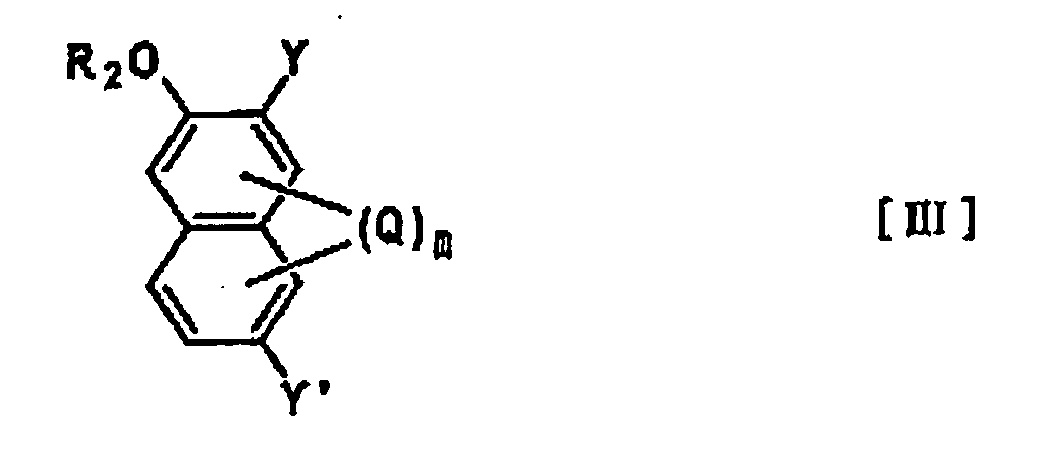
unter der Maßgabe, dass, wenn entweder Y oder Y' eine Carboxylgruppe ist, diese Gruppe eine Lackverbindung zusammen mit einem entsprechenden Metallsalz bilden kann. - Naphtholderivat der allgemeinen Formel [IV]:

Y' gleich -(CONH)n-X' oder eine gegebenenfalls veresterte Carboxylgruppe ist,
(worin X und X' gesättigte oder ungesättigte aliphatische Kohlenwasserstoffgruppen sind, die gegebenenfalls substituiert sind mit einem Substituenten, ausgewählt aus der Gruppe, bestehend aus Halogenatom, cycloaliphatischen Gruppen, aromatischen Gruppen, Furyl-, Piperidyl-, Pyridyl-, Morpholino-, Thienyl-, Indolyl-, Carbazolyl-, Alkoxy-, Cycloalkylamino-, Alkylamino-, Nitro-, Hydroxy- und Carboxylgruppen, und/oder verzweigt sind; aromatische Gruppen sind, die gegebenenfalls substituiert sind mit einem Substituenten, ausgewählt aus der Gruppe, bestehend aus Halogenatom, Nitro-, Methyl-, Methoxy-, Ethoxy-, Cyano-, Phenyl-, Morpholino-, Phenoxy-, Sulfo-, Carboxyl- und Amidgruppen, worin die Phenoxy- und Amidgruppen gegebenenfalls weitere Substituenten aufweisen, ausgewählt aus der Gruppe, bestehend aus Halogenatom, Alkylaminosulfonyl- und Nitrilgruppen; oder heterozyklische Gruppen sind mit konjugierten Doppelbindungen, ausgewählt aus der Gruppe, bestehend aus Benzimidazolonyl-, Carbazolyl-, Pyridyl-, Thiazolyl-, Benzothiazolyl-, Imidazolyl-, Indolyl-, Thienyl-, Phenothiazinyl-, Acridinyl- und Chinolinylgruppen, die gegebenenfalls substituiert sind mit einem Substituenten, ausgewählt aus der Gruppe, bestehend aus Halogenatom, Nitro-, Methyl-, Methoxy-, Ethoxy-, Cyano-, Phenyl-, Morpholino-, Phenoxy-, Sulfo-, Carboxyl- und Amidgruppen, worin die Phenoxy- und Amidgruppen gegebenenfalls weitere Substituenten aufweisen, ausgewählt aus der Gruppe, bestehend aus Halogenatom, Alkylaminosulfonyl- und Nitrilgruppen;
n eine ganze Zahl von 1 oder 2 ist,
unter der Maßgabe, dass, wenn entweder Y oder Y' eine Carboxylgruppe ist, diese Carboxylgruppe gegebenenfalls ein Alkalimetall- oder Erdalkalimetallsalz davon bilden kann),
R2 ein Wasserstoffatom, eine gegebenenfalls verzweigtkettige Alkylgruppe mit 1-6 Kohlenstoffatomen, eine Acylgruppe mit 1-6 Kohlenstoffatomen oder eine Phenylalkylgruppe ist,
Q eine gegebenenfalls verzweigtkettige Alkylgruppe mit 1-6 Kohlenstoffatomen, eine gegebenenfalls verzweigtkettige Alkoxygruppe mit 1-6 Kohlenstoffatomen, ein Halogenatom, eine Sulfogruppe, eine Nitrogruppe, eine Nitrosogruppe oder eine Aminogruppe ist,
m eine ganze Zahl von 0-3 ist, unter der Maßgabe, dass, wenn m gleich 1 ist, Q kombiniert sein kann mit einem der zwei kondensierten Ringe, wenn m gleich 2 oder 3 ist, die Reste Q kombiniert sein können mit einem oder beiden kondensierten Ringen, und
unter der Maßgabe, dass mindestens einer von Y und Y' eine Gruppe -(CONH)n-X oder -(CONH)n-X' ist, worin X oder X' eine ungesättigte oder gesättigte aliphatische Kohlenwasserstoffgruppe ist, die gegebenenfalls substituiert ist mit einem Substituenten, ausgewählt aus der Gruppe, bestehend aus Halogenatom, cycloaliphatischen Gruppen, aromatischen Gruppen, Furyl-, Piperidyl-, Pyridyl-, Morpholino-, Thienyl-, Indolyl-, Carbazolyl-, Alkoxy-, Cycloalkylamino-, Alkylamino-, Nitro-, Hydroxy- und Carboxylgruppen und/oder verzweigt ist. - Druckfarbenzusammensetzung für ein Tintenstrahldrucksystem, umfassend das Pigment nach Anspruch 5.
- Tonerzusammensetzung für ein elektrophotographisches System, umfassend das Pigment nach Anspruch 5.
- Farbfilter, umfassend das Pigment nach Anspruch 5.
- Organischer photoempfindlicher Bestandteil, umfassend das Pigment nach Anspruch 5.
Applications Claiming Priority (7)
| Application Number | Priority Date | Filing Date | Title |
|---|---|---|---|
| JP29521598 | 1998-10-16 | ||
| JP29521598 | 1998-10-16 | ||
| JP10520699 | 1999-04-13 | ||
| JP10520699 | 1999-04-13 | ||
| JP17662699 | 1999-06-23 | ||
| JP17662699 | 1999-06-23 | ||
| PCT/JP1999/005656 WO2000023525A1 (en) | 1998-10-16 | 1999-10-14 | Azo compounds and process for producing the same |
Publications (3)
| Publication Number | Publication Date |
|---|---|
| EP1048694A1 EP1048694A1 (de) | 2000-11-02 |
| EP1048694A4 EP1048694A4 (de) | 2003-03-05 |
| EP1048694B1 true EP1048694B1 (de) | 2006-06-07 |
Family
ID=27310427
Family Applications (1)
| Application Number | Title | Priority Date | Filing Date |
|---|---|---|---|
| EP19990947885 Expired - Lifetime EP1048694B1 (de) | 1998-10-16 | 1999-10-14 | Azoverbindungen sowie verfahren zur herstellung derselben |
Country Status (10)
| Country | Link |
|---|---|
| US (1) | US6409812B1 (de) |
| EP (1) | EP1048694B1 (de) |
| JP (1) | JP3672823B2 (de) |
| KR (1) | KR20010033117A (de) |
| CN (2) | CN1515547A (de) |
| AT (1) | ATE328965T1 (de) |
| CA (1) | CA2314117A1 (de) |
| DE (1) | DE69931753D1 (de) |
| TW (1) | TW562840B (de) |
| WO (1) | WO2000023525A1 (de) |
Families Citing this family (22)
| Publication number | Priority date | Publication date | Assignee | Title |
|---|---|---|---|---|
| WO2002018324A2 (en) | 2000-08-29 | 2002-03-07 | Nobex Corporation | Immunoregulatory compounds, derivatives thereof and their use |
| DE60131236T2 (de) * | 2000-09-29 | 2008-07-17 | Domino Printing Sciences Plc | Tintenstrahldruckzusammensetzungen und Verfahren |
| US8048924B2 (en) | 2001-08-29 | 2011-11-01 | Biocon Limited | Methods and compositions employing 4-aminophenylacetic acid compounds |
| JP3781699B2 (ja) * | 2002-04-26 | 2006-05-31 | 株式会社上野製薬応用研究所 | 電荷制御剤 |
| EP1724313B1 (de) * | 2003-06-12 | 2010-01-27 | Hitachi Maxell, Ltd. | Auf Öl basierende pigmenthaltige Tintenzusammensetzung |
| US20060205952A1 (en) * | 2003-07-31 | 2006-09-14 | Ryuzo Ueno | Aminocarbonyl naphthol derivative, cyanonaphthol derivative, and method for producing them |
| US20050072037A1 (en) * | 2003-10-02 | 2005-04-07 | Markley Duane C. | Fishing poles, counter-balancing apparatus for fishing poles and handles, and methods for balancing fishing poles |
| TW200526746A (en) * | 2003-11-28 | 2005-08-16 | Ueno Seiyaku Oyo Kenkyujo Kk | Red ink composition for color filter |
| DK1773767T3 (en) | 2004-07-07 | 2016-03-21 | Biocon Ltd | Synthesis of azo bound in immune regulatory relations |
| JP4948913B2 (ja) | 2006-06-16 | 2012-06-06 | 上野製薬株式会社 | ナフタレンカルボン酸アミドの製造方法 |
| JP4963882B2 (ja) * | 2006-07-05 | 2012-06-27 | 上野製薬株式会社 | 2−ナフトール誘導体およびモノアゾ化合物 |
| JP4495780B2 (ja) * | 2007-10-04 | 2010-07-07 | 株式会社メニコン | 眼用レンズ用着色剤、眼用レンズ用材料、眼用レンズの製造方法および眼用レンズ |
| US8226734B2 (en) | 2008-07-17 | 2012-07-24 | Fujifilm Corporation | Azo compound, azo pigment, pigment dispersion, coloring composition, ink for inkjet recording, coloring composition for color filter, color filter, and process for preparing a coloring composition for color filter |
| JP5544128B2 (ja) | 2008-09-02 | 2014-07-09 | 富士フイルム株式会社 | アゾ化合物、アゾ顔料、顔料分散物、着色組成物、及びインクジェット記録用インク |
| TW201134884A (en) * | 2010-01-15 | 2011-10-16 | Fujifilm Corp | Pigment composition, ink for inkjet recording, coloring composition for color filter, and color filter |
| JP2013040240A (ja) | 2011-08-11 | 2013-02-28 | Fujifilm Corp | アゾ化合物、アゾ顔料、顔料分散物、着色組成物、カラーフィルター用着色組成物、カラーフィルター、カラーフィルター用着色組成物の調製方法、インクジェット記録用インク、印刷インク、塗料、染料、及び、レジストインク |
| CN103305023A (zh) * | 2012-03-16 | 2013-09-18 | 上海汇友精密化学品有限公司 | 一种三嗪型偶氮染料及其制备方法 |
| EP2981591A4 (de) * | 2013-04-02 | 2016-12-21 | Empire Technology Dev Llc | Lichtempfindliche hydrophile beschichtung |
| CN104151860B (zh) * | 2014-08-30 | 2016-02-24 | 浙江花蝶化学股份有限公司 | 一种偶氮混合酚黄色染料的制备方法 |
| JP7156143B2 (ja) * | 2018-05-21 | 2022-10-19 | 東洋インキScホールディングス株式会社 | アゾ顔料、カラーフィルタ用着色剤、着色組成物およびカラーフィルタ |
| JP7054657B2 (ja) * | 2018-07-24 | 2022-04-14 | 日本化薬株式会社 | アゾ化合物、インク組成物、記録方法及び着色体 |
| JP7107198B2 (ja) * | 2018-12-07 | 2022-07-27 | 東洋インキScホールディングス株式会社 | 顔料分散剤およびそれを用いた顔料組成物、着色組成物、カラーフィルタ |
Family Cites Families (10)
| Publication number | Priority date | Publication date | Assignee | Title |
|---|---|---|---|---|
| US3877957A (en) * | 1970-06-26 | 1975-04-15 | Ciba Geigy Corp | Pigment composition |
| DE2059677C3 (de) * | 1970-12-04 | 1975-10-16 | Basf Ag, 6700 Ludwigshafen | Azopigmente der beta-Hydroxynaphthoesäurereihe, Verfahren zu deren Herstellung und ihre Verwendung |
| CH619584GA3 (de) * | 1975-03-26 | 1980-10-15 | ||
| US4737581A (en) * | 1984-04-25 | 1988-04-12 | Ciba-Geigy Corporation | Phenyl-azo-hydroxynaphthoic acid amide pigments containing at least one carbonamide group |
| DE4440928A1 (de) * | 1994-11-17 | 1996-05-23 | Hoechst Ag | Pigmentzubereitungen auf Basis von Monoazopigmenten |
| KR100472978B1 (ko) * | 1996-10-11 | 2005-09-02 | 가부시키가이샤 우에노 세이야꾸 오요 겡뀨조 | 아조화합물과그의제조방법 |
| ATE237660T1 (de) * | 1996-10-23 | 2003-05-15 | Ueno Seiyaku Oyo Kenkyujo Kk | Disazoverbindungen und ihre herstellungsverfahren |
| TW445284B (en) * | 1997-03-19 | 2001-07-11 | Ueno Seiyaku Oyo Kenkyujo Kk | Condensed azo compounds and their preparation |
| JPH10279823A (ja) * | 1997-04-01 | 1998-10-20 | Ricoh Co Ltd | 着色剤組成物及びその製造方法並びに電子写真用乾式及び湿式現像剤及びインクジェット用インキ着色剤 |
| KR100511483B1 (ko) * | 1997-08-28 | 2005-08-31 | 가부시키가이샤 우에노 세이야꾸 오요 겡뀨조 | 수용성 아조 화합물 및 이의 제조 방법 |
-
1999
- 1999-10-14 EP EP19990947885 patent/EP1048694B1/de not_active Expired - Lifetime
- 1999-10-14 CN CNA021432384A patent/CN1515547A/zh active Pending
- 1999-10-14 CN CN99802977A patent/CN1125144C/zh not_active Expired - Fee Related
- 1999-10-14 DE DE69931753T patent/DE69931753D1/de not_active Expired - Lifetime
- 1999-10-14 AT AT99947885T patent/ATE328965T1/de not_active IP Right Cessation
- 1999-10-14 JP JP2000577242A patent/JP3672823B2/ja not_active Expired - Fee Related
- 1999-10-14 CA CA 2314117 patent/CA2314117A1/en not_active Abandoned
- 1999-10-14 KR KR1020007006487A patent/KR20010033117A/ko not_active Abandoned
- 1999-10-14 US US09/581,704 patent/US6409812B1/en not_active Expired - Fee Related
- 1999-10-14 WO PCT/JP1999/005656 patent/WO2000023525A1/ja not_active Ceased
- 1999-10-15 TW TW88117836A patent/TW562840B/zh active
Also Published As
| Publication number | Publication date |
|---|---|
| TW562840B (en) | 2003-11-21 |
| CA2314117A1 (en) | 2000-04-27 |
| CN1125144C (zh) | 2003-10-22 |
| KR20010033117A (ko) | 2001-04-25 |
| CN1515547A (zh) | 2004-07-28 |
| DE69931753D1 (de) | 2006-07-20 |
| US6409812B1 (en) | 2002-06-25 |
| WO2000023525A1 (en) | 2000-04-27 |
| EP1048694A4 (de) | 2003-03-05 |
| JP3672823B2 (ja) | 2005-07-20 |
| CN1291216A (zh) | 2001-04-11 |
| EP1048694A1 (de) | 2000-11-02 |
| ATE328965T1 (de) | 2006-06-15 |
Similar Documents
| Publication | Publication Date | Title |
|---|---|---|
| EP1048694B1 (de) | Azoverbindungen sowie verfahren zur herstellung derselben | |
| US4566908A (en) | Azoic pigments having a silica core | |
| CN103097465B (zh) | 偶氮化合物以及包含该偶氮化合物的颜料分散剂、颜料组合物、颜料分散体和调色剂 | |
| EP2927285A1 (de) | Verfahren zur herstellung einer verbindung mit einer farbstoffstruktur und toner mit einer durch das herstellungsverfahren erhaltenen komponente | |
| JPWO2000023525A1 (ja) | アゾ化合物およびその製法 | |
| EP2609158B1 (de) | Azoverbindung und pigmentdispergiermittel, pigmentzusammensetzung, pigmentdisperson und toner mit der azoverbindung | |
| EP2927284A1 (de) | Verfahren zur herstellung einer verbindung mit farbstoffstruktur am hauptkettenende eines polymers und pigmentdispergiermittel, pigmentzusammensetzung, pigmentdispersion und toner mit durch das herstellungsverfahren erhaltener verbindung | |
| EP0093331A2 (de) | Elektrophotographisches Aufzeichnungsmaterial | |
| US5296325A (en) | Dicyanoimidazole compounds usable as colorants for magenta toners, colored resins, colored molded resin memers and color filters | |
| CN103293889B (zh) | 包含具有偶氮骨架的化合物的品红色调色剂 | |
| US8182598B2 (en) | Violet colorant for colour filters, inks for ink-jet electrophotographic toners and developers and e-inks | |
| WO1998041580A1 (en) | Condensed azo compound and process for producing the same | |
| US10782625B2 (en) | Use of novel naphthol AS-pigment-mixtures in printing-materials | |
| CN105531293B (zh) | 具有偶氮骨架的化合物、颜料分散剂、颜料组合物、颜料分散体和调色剂 | |
| KR20080012322A (ko) | C.i. 피그먼트 블루-80 계 청색 염료 | |
| JP5448553B2 (ja) | パーフルオロアルキル基を有するピラゾールアゾ色素化合物、及び前記色素化合物を含有するイエロートナー | |
| EP0094079B1 (de) | Lichtempfindliches Material für die Elektrophotographie | |
| JP6463040B2 (ja) | 新規化合物、該化合物を含有する顔料分散剤、顔料組成物、顔料分散体、およびトナー | |
| JPH03269068A (ja) | 画像記録用着色組成物 | |
| JP2007100061A (ja) | 着色組成物、インクジェット記録液、インクジェット記録方法、カラートナー、カラーフィルター、光情報記録媒体、光情報記録方法、色素及び金属キレート色素 | |
| JP4455747B2 (ja) | 画像記録用着色組成物及び画像記録剤 | |
| JP2007051123A (ja) | 金属含有化合物、金属キレート色素、着色組成物、インクジェット記録液、インクジェット記録方法、カラートナー、カラーフィルター、光情報記録媒体及び光情報記録方法 | |
| JP2632423C (de) | ||
| JP2007204623A (ja) | インクジェット記録液、インクジェット記録方法、カラートナー、カラーフィルター、光情報記録媒体、光情報記録方法、金属キレート色素の製造方法及び金属キレート色素 | |
| JP2007161852A (ja) | 着色組成物、インクジェット記録液、インクジェット記録方法、カラートナー、カラーフィルター、光情報記録媒体、光情報記録方法及び金属キレート色素 |
Legal Events
| Date | Code | Title | Description |
|---|---|---|---|
| PUAI | Public reference made under article 153(3) epc to a published international application that has entered the european phase |
Free format text: ORIGINAL CODE: 0009012 |
|
| 17P | Request for examination filed |
Effective date: 20000707 |
|
| AK | Designated contracting states |
Kind code of ref document: A1 Designated state(s): AT BE CH CY DE DK ES FI FR GB GR IE IT LI LU MC NL PT SE |
|
| A4 | Supplementary search report drawn up and despatched |
Effective date: 20030117 |
|
| RIC1 | Information provided on ipc code assigned before grant |
Ipc: 7G 03G 9/09 B Ipc: 7G 03G 5/06 B Ipc: 7C 07D 233/26 B Ipc: 7C 07D 215/44 B Ipc: 7C 09B 62/51 B Ipc: 7C 09B 62/085 B Ipc: 7C 09B 62/008 B Ipc: 7C 09D 11/00 B Ipc: 7C 09B 29/20 A |
|
| 17Q | First examination report despatched |
Effective date: 20040224 |
|
| GRAP | Despatch of communication of intention to grant a patent |
Free format text: ORIGINAL CODE: EPIDOSNIGR1 |
|
| GRAS | Grant fee paid |
Free format text: ORIGINAL CODE: EPIDOSNIGR3 |
|
| GRAA | (expected) grant |
Free format text: ORIGINAL CODE: 0009210 |
|
| AK | Designated contracting states |
Kind code of ref document: B1 Designated state(s): AT BE CH CY DE DK ES FI FR GB GR IE IT LI LU MC NL PT SE |
|
| PG25 | Lapsed in a contracting state [announced via postgrant information from national office to epo] |
Ref country code: NL Free format text: LAPSE BECAUSE OF FAILURE TO SUBMIT A TRANSLATION OF THE DESCRIPTION OR TO PAY THE FEE WITHIN THE PRESCRIBED TIME-LIMIT Effective date: 20060607 Ref country code: LI Free format text: LAPSE BECAUSE OF FAILURE TO SUBMIT A TRANSLATION OF THE DESCRIPTION OR TO PAY THE FEE WITHIN THE PRESCRIBED TIME-LIMIT Effective date: 20060607 Ref country code: IT Free format text: LAPSE BECAUSE OF FAILURE TO SUBMIT A TRANSLATION OF THE DESCRIPTION OR TO PAY THE FEE WITHIN THE PRESCRIBED TIME-LIMIT;WARNING: LAPSES OF ITALIAN PATENTS WITH EFFECTIVE DATE BEFORE 2007 MAY HAVE OCCURRED AT ANY TIME BEFORE 2007. THE CORRECT EFFECTIVE DATE MAY BE DIFFERENT FROM THE ONE RECORDED. Effective date: 20060607 Ref country code: FI Free format text: LAPSE BECAUSE OF FAILURE TO SUBMIT A TRANSLATION OF THE DESCRIPTION OR TO PAY THE FEE WITHIN THE PRESCRIBED TIME-LIMIT Effective date: 20060607 Ref country code: CH Free format text: LAPSE BECAUSE OF FAILURE TO SUBMIT A TRANSLATION OF THE DESCRIPTION OR TO PAY THE FEE WITHIN THE PRESCRIBED TIME-LIMIT Effective date: 20060607 Ref country code: BE Free format text: LAPSE BECAUSE OF FAILURE TO SUBMIT A TRANSLATION OF THE DESCRIPTION OR TO PAY THE FEE WITHIN THE PRESCRIBED TIME-LIMIT Effective date: 20060607 Ref country code: AT Free format text: LAPSE BECAUSE OF FAILURE TO SUBMIT A TRANSLATION OF THE DESCRIPTION OR TO PAY THE FEE WITHIN THE PRESCRIBED TIME-LIMIT Effective date: 20060607 |
|
| REG | Reference to a national code |
Ref country code: GB Ref legal event code: FG4D |
|
| REG | Reference to a national code |
Ref country code: CH Ref legal event code: EP |
|
| REG | Reference to a national code |
Ref country code: IE Ref legal event code: FG4D |
|
| REF | Corresponds to: |
Ref document number: 69931753 Country of ref document: DE Date of ref document: 20060720 Kind code of ref document: P |
|
| PG25 | Lapsed in a contracting state [announced via postgrant information from national office to epo] |
Ref country code: SE Free format text: LAPSE BECAUSE OF FAILURE TO SUBMIT A TRANSLATION OF THE DESCRIPTION OR TO PAY THE FEE WITHIN THE PRESCRIBED TIME-LIMIT Effective date: 20060907 Ref country code: DK Free format text: LAPSE BECAUSE OF FAILURE TO SUBMIT A TRANSLATION OF THE DESCRIPTION OR TO PAY THE FEE WITHIN THE PRESCRIBED TIME-LIMIT Effective date: 20060907 |
|
| PG25 | Lapsed in a contracting state [announced via postgrant information from national office to epo] |
Ref country code: DE Free format text: LAPSE BECAUSE OF FAILURE TO SUBMIT A TRANSLATION OF THE DESCRIPTION OR TO PAY THE FEE WITHIN THE PRESCRIBED TIME-LIMIT Effective date: 20060908 |
|
| PG25 | Lapsed in a contracting state [announced via postgrant information from national office to epo] |
Ref country code: ES Free format text: LAPSE BECAUSE OF FAILURE TO SUBMIT A TRANSLATION OF THE DESCRIPTION OR TO PAY THE FEE WITHIN THE PRESCRIBED TIME-LIMIT Effective date: 20060918 |
|
| PG25 | Lapsed in a contracting state [announced via postgrant information from national office to epo] |
Ref country code: IE Free format text: LAPSE BECAUSE OF NON-PAYMENT OF DUE FEES Effective date: 20061016 |
|
| PG25 | Lapsed in a contracting state [announced via postgrant information from national office to epo] |
Ref country code: MC Free format text: LAPSE BECAUSE OF NON-PAYMENT OF DUE FEES Effective date: 20061031 |
|
| PGFP | Annual fee paid to national office [announced via postgrant information from national office to epo] |
Ref country code: IT Payment date: 20061031 Year of fee payment: 8 |
|
| PG25 | Lapsed in a contracting state [announced via postgrant information from national office to epo] |
Ref country code: PT Free format text: LAPSE BECAUSE OF FAILURE TO SUBMIT A TRANSLATION OF THE DESCRIPTION OR TO PAY THE FEE WITHIN THE PRESCRIBED TIME-LIMIT Effective date: 20061107 |
|
| NLV1 | Nl: lapsed or annulled due to failure to fulfill the requirements of art. 29p and 29m of the patents act | ||
| REG | Reference to a national code |
Ref country code: CH Ref legal event code: PL |
|
| PLBE | No opposition filed within time limit |
Free format text: ORIGINAL CODE: 0009261 |
|
| STAA | Information on the status of an ep patent application or granted ep patent |
Free format text: STATUS: NO OPPOSITION FILED WITHIN TIME LIMIT |
|
| EN | Fr: translation not filed | ||
| 26N | No opposition filed |
Effective date: 20070308 |
|
| GBPC | Gb: european patent ceased through non-payment of renewal fee |
Effective date: 20061014 |
|
| PG25 | Lapsed in a contracting state [announced via postgrant information from national office to epo] |
Ref country code: GB Free format text: LAPSE BECAUSE OF NON-PAYMENT OF DUE FEES Effective date: 20061014 |
|
| PG25 | Lapsed in a contracting state [announced via postgrant information from national office to epo] |
Ref country code: GR Free format text: LAPSE BECAUSE OF FAILURE TO SUBMIT A TRANSLATION OF THE DESCRIPTION OR TO PAY THE FEE WITHIN THE PRESCRIBED TIME-LIMIT Effective date: 20060908 Ref country code: FR Free format text: LAPSE BECAUSE OF FAILURE TO SUBMIT A TRANSLATION OF THE DESCRIPTION OR TO PAY THE FEE WITHIN THE PRESCRIBED TIME-LIMIT Effective date: 20070309 |
|
| PG25 | Lapsed in a contracting state [announced via postgrant information from national office to epo] |
Ref country code: LU Free format text: LAPSE BECAUSE OF NON-PAYMENT OF DUE FEES Effective date: 20061014 |
|
| PG25 | Lapsed in a contracting state [announced via postgrant information from national office to epo] |
Ref country code: FR Free format text: LAPSE BECAUSE OF FAILURE TO SUBMIT A TRANSLATION OF THE DESCRIPTION OR TO PAY THE FEE WITHIN THE PRESCRIBED TIME-LIMIT Effective date: 20060607 Ref country code: CY Free format text: LAPSE BECAUSE OF FAILURE TO SUBMIT A TRANSLATION OF THE DESCRIPTION OR TO PAY THE FEE WITHIN THE PRESCRIBED TIME-LIMIT Effective date: 20060607 |
|
| PG25 | Lapsed in a contracting state [announced via postgrant information from national office to epo] |
Ref country code: IT Free format text: LAPSE BECAUSE OF NON-PAYMENT OF DUE FEES Effective date: 20071014 |