EP1049165A1 - Dispositif électronique intégré ayant un circuit de puissance et un circuit de contrôle, sans courants parasitiques - Google Patents
Dispositif électronique intégré ayant un circuit de puissance et un circuit de contrôle, sans courants parasitiques Download PDFInfo
- Publication number
- EP1049165A1 EP1049165A1 EP99830261A EP99830261A EP1049165A1 EP 1049165 A1 EP1049165 A1 EP 1049165A1 EP 99830261 A EP99830261 A EP 99830261A EP 99830261 A EP99830261 A EP 99830261A EP 1049165 A1 EP1049165 A1 EP 1049165A1
- Authority
- EP
- European Patent Office
- Prior art keywords
- well
- intermediate region
- integrated circuit
- type
- circuit
- Prior art date
- Legal status (The legal status is an assumption and is not a legal conclusion. Google has not performed a legal analysis and makes no representation as to the accuracy of the status listed.)
- Granted
Links
Images


Classifications
-
- H—ELECTRICITY
- H10—SEMICONDUCTOR DEVICES; ELECTRIC SOLID-STATE DEVICES NOT OTHERWISE PROVIDED FOR
- H10D—INORGANIC ELECTRIC SEMICONDUCTOR DEVICES
- H10D84/00—Integrated devices formed in or on semiconductor substrates that comprise only semiconducting layers, e.g. on Si wafers or on GaAs-on-Si wafers
- H10D84/60—Integrated devices formed in or on semiconductor substrates that comprise only semiconducting layers, e.g. on Si wafers or on GaAs-on-Si wafers characterised by the integration of at least one component covered by groups H10D10/00 or H10D18/00, e.g. integration of BJTs
- H10D84/645—Combinations of only lateral BJTs
-
- H—ELECTRICITY
- H10—SEMICONDUCTOR DEVICES; ELECTRIC SOLID-STATE DEVICES NOT OTHERWISE PROVIDED FOR
- H10D—INORGANIC ELECTRIC SEMICONDUCTOR DEVICES
- H10D84/00—Integrated devices formed in or on semiconductor substrates that comprise only semiconducting layers, e.g. on Si wafers or on GaAs-on-Si wafers
- H10D84/40—Integrated devices formed in or on semiconductor substrates that comprise only semiconducting layers, e.g. on Si wafers or on GaAs-on-Si wafers characterised by the integration of at least one component covered by groups H10D12/00 or H10D30/00 with at least one component covered by groups H10D10/00 or H10D18/00, e.g. integration of IGFETs with BJTs
- H10D84/401—Combinations of FETs or IGBTs with BJTs
-
- H—ELECTRICITY
- H10—SEMICONDUCTOR DEVICES; ELECTRIC SOLID-STATE DEVICES NOT OTHERWISE PROVIDED FOR
- H10D—INORGANIC ELECTRIC SEMICONDUCTOR DEVICES
- H10D89/00—Aspects of integrated devices not covered by groups H10D84/00 - H10D88/00
- H10D89/60—Integrated devices comprising arrangements for electrical or thermal protection, e.g. protection circuits against electrostatic discharge [ESD]
-
- H—ELECTRICITY
- H10—SEMICONDUCTOR DEVICES; ELECTRIC SOLID-STATE DEVICES NOT OTHERWISE PROVIDED FOR
- H10D—INORGANIC ELECTRIC SEMICONDUCTOR DEVICES
- H10D89/00—Aspects of integrated devices not covered by groups H10D84/00 - H10D88/00
- H10D89/60—Integrated devices comprising arrangements for electrical or thermal protection, e.g. protection circuits against electrostatic discharge [ESD]
- H10D89/601—Integrated devices comprising arrangements for electrical or thermal protection, e.g. protection circuits against electrostatic discharge [ESD] for devices having insulated gate electrodes, e.g. for IGFETs or IGBTs
- H10D89/711—Integrated devices comprising arrangements for electrical or thermal protection, e.g. protection circuits against electrostatic discharge [ESD] for devices having insulated gate electrodes, e.g. for IGFETs or IGBTs using bipolar transistors as protective elements
-
- H—ELECTRICITY
- H10—SEMICONDUCTOR DEVICES; ELECTRIC SOLID-STATE DEVICES NOT OTHERWISE PROVIDED FOR
- H10W—GENERIC PACKAGES, INTERCONNECTIONS, CONNECTORS OR OTHER CONSTRUCTIONAL DETAILS OF DEVICES COVERED BY CLASS H10
- H10W10/00—Isolation regions in semiconductor bodies between components of integrated devices
- H10W10/01—Manufacture or treatment
- H10W10/031—Manufacture or treatment of isolation regions comprising PN junctions
-
- H—ELECTRICITY
- H10—SEMICONDUCTOR DEVICES; ELECTRIC SOLID-STATE DEVICES NOT OTHERWISE PROVIDED FOR
- H10W—GENERIC PACKAGES, INTERCONNECTIONS, CONNECTORS OR OTHER CONSTRUCTIONAL DETAILS OF DEVICES COVERED BY CLASS H10
- H10W10/00—Isolation regions in semiconductor bodies between components of integrated devices
- H10W10/30—Isolation regions comprising PN junctions
Definitions
- This invention relates to an integrated circuit structure which comprises a power circuit portion and a control circuit portion and is free from parasitic currents.
- the invention specifically concerns an integrated circuit structure formed on a semiconductor substrate with conductivity of a first type, which structure comprises a first circuit portion incorporated to a first well and including at least one power transistor, and a second control circuit portion incorporated to a second well, and an intermediate region located between said first and second circuit portions, the conductivity of said first well, second well, and intermediate region being of a second type.
- the invention concerns, particularly but not exclusively, an integrated circuit structure, and the description which follows will cover that field of application for simplicity.
- a parasitic PNP transistor is created between the base of the power device and said P region.
- Figure 1 herewith shows, by way of example, a conventional integrated circuit 1' comprising a semiconductor substrate 2' of the N- type which is formed with a first well 3' of the P type provided for forming a power device, and a second well 4' -- also of the P type -- comprising the control region.
- a third well 5' of the N type is formed inside the first well 3', whereby the emitter terminal for the bipolar power transistor Power can be formed, which transistor will have its collector terminal in the semiconductor substrate 2' and its base terminal in the first well 3'.
- a fourth well 6' -- also of the N type -- is likewise formed inside the second well 4' and may be connected to a supply voltage reference Vcc, for example.
- the integrated circuit 1' will include a first parasitic transistor P1, whose emitter terminal is coincident with the base terminal of the bipolar transistor Power, i.e. with the first well 3'.
- the base terminal of this parasitic transistor is coincident with the collector terminal of the bipolar power transistor Power, i.e. with the semiconductor substrate 2', and its collector terminal is coincident with the second well 4' facing the bipolar power transistor Power.
- the value of the potential applied to its base terminal must be at least equal to, or higher than, the value of the potential applied to its emitter terminal.
- the second well 4' is essentially biased to a reference value Vbias through a resistive path which is represented by a resistive element R1.
- Vbias + R1*I - V(2) VbeP2
- a first known technical solution to the problem posed by the presence of parasitic transistors provides for that area of the semiconductor substrate 2' which lies intermediate between the first well 3' and the second 4' to be doped more heavily. In this way, the gain of the first parasitic transistor P1 is reduced.
- a second solution provides for increased spacing of the P-wells. Not even this solution is effective to suppress the flow of current brought about by the turning on of parasitic transistors.
- a third solution provides for an intermediate region 7', also of the P type, to be included between the aforementioned P-wells, as shown schematically in Figure 2.
- the underlying technical problem of this invention is to provide an integrated circuit, comprising a power device and a control region, with such structural and functional features as to eliminate the parasitic flow of current, thereby overcoming the drawbacks that still beset prior art integrated circuits.
- the concept behind this invention is one of having the intermediate region between the wells which accommodate the power device and the control region biased as a function of the potential of the well wherein the power device is formed.
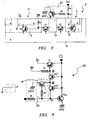
- an integrated electronic circuit is shown generally and schematically at 1 which includes a first power circuit portion comprising at least one power device 2, and a second control circuit portion 3.
- a region 4 is provided intermediate the first and second circuit portions.
- the integrated circuit 1 comprises a semiconductor substrate 5 of the N- type which has a first well 6 of the P type and a second well 7 of the P type formed therein for respectively accommodating the power device 2 and the control circuit portion or region 3.
- first 6 and second 7 wells Formed respectively inside the first 6 and second 7 wells are additional wells 8 and 9 of the N type.
- the well 9 inside the second well 7 will be connected, illustratively, to a supply voltage reference Vcc to create the control region 3.
- the second well 7 is essentially biased to a bias voltage reference Vbias through a resistive path represented by a resistive element R1.
- the bipolar power device PW is arranged to have its emitter terminal within the well 8, collector terminal in the semiconductor substrate 5, and base terminal within the first well 6.
- the integrated circuit 1 has a first parasitic transistor P2 whose emitter terminal is coincident with the semiconductor substrate 5, collector terminal is coincident with the well 9, and base terminal is coincident with the second well 7. Its base terminal will, therefore, be biased to the bias voltage reference Vbias via the resistive element R1.
- an intermediate region 4 also of the P type, is provided between the first well 6 and the second well 7 and substantially splits, between second P3' and third P3" parasitic transistors, the parasitic effect of the PNP junctions linked to said P-wells 6 and 7 associated with the semiconductor substrate 5 of the N type.
- the second parasitic transistor P3' has its emitter terminal coincident with the first well 6, collector terminal coincident with the intermediate region 4, and base terminal coincident with the semiconductor substrate 5.
- the third parasitic transistor P3" has its emitter terminal coincident with the intermediate region 4, collector terminal coincident with the second well 7, and base terminal coincident with the semiconductor substrate 5.
- a circuit means is arranged to bias the intermediate region 4 differently, according to the potential applied to the first well 6.
- This means comprises a biasing circuit 10 connected to said intermediate region 4 and said first well 6.
- the biasing circuit 10 comprises a bipolar transistor T having its emitter terminal connected to a voltage reference such as ground GND, collector terminal connected to the intermediate region 4, and base terminal connected to an output terminal OUT of the biasing circuit 10 through a series of first R2 and second R3 resistive elements.
- circuit node X intermediate the first R2 and second R3 resistive elements is connected to the first well 6.
- bipolar transistor T can be readily formed either inside the second well 7, i.e. in the control circuit portion of the integrated circuit, or in the intermediate region 4.
- the equivalent circuit 100 of Figure 4 comprises a power transistor PW which has its emitter terminal connected to the ground reference GND, base terminal connected to a first node 1 ⁇ , corresponding to the first well 6, and collector terminal connected to a second node 2 ⁇ , corresponding to the semiconductor substrate 5.
- the equivalent circuit 100 also includes a parasitic transistor P2 having its collector terminal connected to the supply voltage reference Vcc, emitter terminal connected to said second node 2 ⁇ , and base terminal connected to a third node 3 ⁇ corresponding to the second well 7.
- the third node 3 ⁇ is connected to a bias voltage reference Vbias through a resistive element R1.
- the equivalent circuit 100 includes a parasitic transistor P3' and a parasitic transistor P3", which are connected in series with each other between the first node 1 ⁇ and the third node 3 ⁇ and have their base terminals connected to the second node 2 ⁇ .
- the parasitic transistors P3' and P3'' are connected together at a fourth node 4 ⁇ , corresponding to the intermediate region 4 and itself connected to the collector terminal of the transistor T in the biasing circuit 10.
- the transistor T also has its emitter terminal connected to the ground reference GND, and its base terminal connected to the intermediate circuit node X via the resistive element R2.
- the intermediate circuit node X is connected to the first node 1 ⁇ , and connected to the output terminal OUT of the biasing circuit 10 via the resistive element R3.
- the combination of the transistor T and the resistive element R2 operates like a switch connected between the fourth node 4 ⁇ and ground GND and controlled by the potential at the first node 1 ⁇ , that is at the base terminal of the power device PW.
- the resistive element R2 functions as a decoupling element.
- the power device PW in the "on" state, its collector terminal may also go to a negative potential. In this case, a current would be caused to flow from the ground reference to the semiconductor substrate 5; therefore, the integrated circuit is normally provided with a diode which has its anode connected to the ground reference and its cathode connected to the semiconductor substrate 5.
- the transistor T of the biasing circuit 10 would be "on", and the intermediate region 4 biased all the same at the ground reference value.
- the transistor T of the biasing circuit 10 would be "on” all the same, and draw this current to the ground reference, thereby preventing the current from reaching the second well 7 through the parasitic transistor P3".
- the biasing circuit 10 keeps the potential applied to the intermediate region 4 at a lower value than, or the same value as, that of the semiconductor substrate 5, thereby ensuring that the parasitic transistor P3" is turned off.
- this parasitic transistor P3" has its base-emitter voltage Vbe near zero and, accordingly, will be "off” regardless of the value of potential at the second well 7.
- the value of the potential at the collector terminal would be normally clamped at 0.7V through a diode in parallel with the power device itself.
- the semiconductor substrate 5 When the semiconductor substrate 5 is at a value of potential equal to -0.7V, the first well 6, intermediate region 4, and second well 7 will all have a value of potential of approximately 0V, and the PN junctions (i.e., the diodes) formed by the above regions and the semiconductor substrate 5 will be forward biased.
- the PN junctions i.e., the diodes
- the transistor T of the biasing circuit 10 would be "off” in this case, since its base and collector terminals are at the same value of potential, which value is lower than, or equal to, the value of the potential at the emitter terminal (i.e., the ground reference value).
- the intermediate region 4 is “disjoined" from the biasing circuit 10, ensuring isolation of the voltage at the collector terminal of the power device from the regions 6 and 7.
- FIG. 5 Shown schematically in Figure 5 is a practical embodiment of the integrated circuit with biasing circuit 10 according to the invention, wherein the circuit 10 comprises a bipolar transistor T formed in the intermediate region 4.
- a first interior well 11 of the N type, providing the collector terminal for the bipolar transistor T, is formed in the intermediate region 4.
- a second interior well 12 of the P type providing the base terminal for the bipolar transistor T
- a third interior well 13 of the N type which provides the emitter terminal for the transistor T and is diffused inside the second interior well 12.
- the first interior well 11 is connected to the intermediate region 4 by an external short circuit.
- this external short circuit is produced in that area of the intermediate region which is facing the first well 6 accommodating the power device PW.
- the second interior well 12 is connected to the first well 6 through the resistive element R2, and connected to the output terminal OUT of the biasing circuit 10 through the additional resistive element R3.
Landscapes
- Semiconductor Integrated Circuits (AREA)
- Metal-Oxide And Bipolar Metal-Oxide Semiconductor Integrated Circuits (AREA)
Priority Applications (3)
| Application Number | Priority Date | Filing Date | Title |
|---|---|---|---|
| EP99830261A EP1049165B1 (fr) | 1999-04-30 | 1999-04-30 | Dispositif électronique intégré ayant un circuit de puissance et un circuit de contrôle, sans courants parasitiques |
| DE69902877T DE69902877D1 (de) | 1999-04-30 | 1999-04-30 | Integrierter Schaltkreis mit einer Leistungsschaltung und einer Steuerschaltung, ohne parasitäre Ströme |
| US09/560,195 US6337503B1 (en) | 1999-04-30 | 2000-04-28 | Integrated power circuit with reduced parasitic current flow |
Applications Claiming Priority (1)
| Application Number | Priority Date | Filing Date | Title |
|---|---|---|---|
| EP99830261A EP1049165B1 (fr) | 1999-04-30 | 1999-04-30 | Dispositif électronique intégré ayant un circuit de puissance et un circuit de contrôle, sans courants parasitiques |
Publications (2)
| Publication Number | Publication Date |
|---|---|
| EP1049165A1 true EP1049165A1 (fr) | 2000-11-02 |
| EP1049165B1 EP1049165B1 (fr) | 2002-09-11 |
Family
ID=8243387
Family Applications (1)
| Application Number | Title | Priority Date | Filing Date |
|---|---|---|---|
| EP99830261A Expired - Lifetime EP1049165B1 (fr) | 1999-04-30 | 1999-04-30 | Dispositif électronique intégré ayant un circuit de puissance et un circuit de contrôle, sans courants parasitiques |
Country Status (3)
| Country | Link |
|---|---|
| US (1) | US6337503B1 (fr) |
| EP (1) | EP1049165B1 (fr) |
| DE (1) | DE69902877D1 (fr) |
Cited By (1)
| Publication number | Priority date | Publication date | Assignee | Title |
|---|---|---|---|---|
| EP4274074A1 (fr) * | 2022-05-02 | 2023-11-08 | NXP USA, Inc. | Connexions d'isolation pour étage de puissance haute tension |
Families Citing this family (2)
| Publication number | Priority date | Publication date | Assignee | Title |
|---|---|---|---|---|
| JP4610199B2 (ja) * | 2004-01-14 | 2011-01-12 | ルネサスエレクトロニクス株式会社 | Dc−dcコンバータ用半導体集積回路及びdc−dcコンバータ |
| DE102017109264B3 (de) * | 2017-04-28 | 2018-08-23 | Infineon Technologies Ag | Leistungshalbleiterbauelemente und ein Verfahren zum Bilden eines Leistungshalbleiterbauelements |
Citations (4)
| Publication number | Priority date | Publication date | Assignee | Title |
|---|---|---|---|---|
| EP0512605A1 (fr) * | 1991-05-03 | 1992-11-11 | Koninklijke Philips Electronics N.V. | Dispositif de puissance ayant une protection contre des tensions inverses |
| EP0703620A1 (fr) * | 1994-09-21 | 1996-03-27 | STMicroelectronics S.r.l. | Circuit pour prévenir l'amorçage de composants parasites dans des circuits intégrés comprenant un étage de puissance et un circuit de commande basse tension |
| US5550701A (en) * | 1994-08-30 | 1996-08-27 | International Rectifier Corporation | Power MOSFET with overcurrent and over-temperature protection and control circuit decoupled from body diode |
| EP0847089A1 (fr) * | 1996-12-09 | 1998-06-10 | STMicroelectronics S.r.l. | Méthode et dispositif pour supprimer des effets parasites dans un circuit integré avec des jonctions d'isolation |
Family Cites Families (3)
| Publication number | Priority date | Publication date | Assignee | Title |
|---|---|---|---|---|
| FR2725307B1 (fr) * | 1994-09-30 | 1996-12-20 | Sgs Thomson Microelectronics | Composant semiconducteur d'alimentation, de recirculation et de demagnetisation d'une charge selfique |
| JPH0969572A (ja) * | 1995-09-01 | 1997-03-11 | Toshiba Microelectron Corp | 半導体装置及びその製造方法 |
| EP0782197B1 (fr) * | 1995-12-29 | 2001-06-06 | Co.Ri.M.Me. Consorzio Per La Ricerca Sulla Microelettronica Nel Mezzogiorno | Dispositif électronique intégré ayant des courants parasitiques réduits et procédé correspondant |
-
1999
- 1999-04-30 EP EP99830261A patent/EP1049165B1/fr not_active Expired - Lifetime
- 1999-04-30 DE DE69902877T patent/DE69902877D1/de not_active Expired - Lifetime
-
2000
- 2000-04-28 US US09/560,195 patent/US6337503B1/en not_active Expired - Lifetime
Patent Citations (4)
| Publication number | Priority date | Publication date | Assignee | Title |
|---|---|---|---|---|
| EP0512605A1 (fr) * | 1991-05-03 | 1992-11-11 | Koninklijke Philips Electronics N.V. | Dispositif de puissance ayant une protection contre des tensions inverses |
| US5550701A (en) * | 1994-08-30 | 1996-08-27 | International Rectifier Corporation | Power MOSFET with overcurrent and over-temperature protection and control circuit decoupled from body diode |
| EP0703620A1 (fr) * | 1994-09-21 | 1996-03-27 | STMicroelectronics S.r.l. | Circuit pour prévenir l'amorçage de composants parasites dans des circuits intégrés comprenant un étage de puissance et un circuit de commande basse tension |
| EP0847089A1 (fr) * | 1996-12-09 | 1998-06-10 | STMicroelectronics S.r.l. | Méthode et dispositif pour supprimer des effets parasites dans un circuit integré avec des jonctions d'isolation |
Cited By (2)
| Publication number | Priority date | Publication date | Assignee | Title |
|---|---|---|---|---|
| EP4274074A1 (fr) * | 2022-05-02 | 2023-11-08 | NXP USA, Inc. | Connexions d'isolation pour étage de puissance haute tension |
| US12231042B2 (en) | 2022-05-02 | 2025-02-18 | Nxp Usa, Inc. | Isolation connections for high-voltage power stage |
Also Published As
| Publication number | Publication date |
|---|---|
| EP1049165B1 (fr) | 2002-09-11 |
| US6337503B1 (en) | 2002-01-08 |
| DE69902877D1 (de) | 2002-10-17 |
Similar Documents
| Publication | Publication Date | Title |
|---|---|---|
| US4471237A (en) | Output protection circuit for preventing a reverse current | |
| JPH05335500A (ja) | Cmos出力回路 | |
| US4577211A (en) | Integrated circuit and method for biasing an epitaxial layer | |
| US5703520A (en) | Integrated inductive load snubbing device using a multi-collector transistor | |
| US5051612A (en) | Prevention of parasitic mechanisms in junction isolated devices | |
| EP1049165B1 (fr) | Dispositif électronique intégré ayant un circuit de puissance et un circuit de contrôle, sans courants parasitiques | |
| US6870417B2 (en) | Circuit for loss-less diode equivalent | |
| CA1097752A (fr) | Traduction non-disponible | |
| KR19980023935A (ko) | 반도체 집적회로 | |
| EP0313746A2 (fr) | Circuit d'entrée ECL pour dispositifs CMOS | |
| US5694075A (en) | Substrate clamp for non-isolated integrated circuits | |
| JP3179630B2 (ja) | エピタキシャル・タブ・バイアス構体及び集積回路 | |
| US5627715A (en) | Circuit construction for protective biasing | |
| US4301382A (en) | I2L With PNPN injector | |
| JP3610683B2 (ja) | アナログスイッチ回路 | |
| WO1981000924A1 (fr) | Source de courant possedant une protection contre la saturation | |
| US4185212A (en) | Level shifting circuit | |
| US6815779B1 (en) | Integrated circuit including protection against polarity inversion of the substrate potential | |
| US6034561A (en) | Integrated inductive load snubbing device | |
| JP3338738B2 (ja) | Pmos出力回路 | |
| US4096400A (en) | Inductive load driving amplifier | |
| US4689500A (en) | Comparator with substrate injection protection | |
| US6624502B2 (en) | Method and device for limiting the substrate potential in junction isolated integrated circuits | |
| JP3570338B2 (ja) | 電源逆接続保護回路 | |
| JPH10200056A (ja) | バイポーラic |
Legal Events
| Date | Code | Title | Description |
|---|---|---|---|
| PUAI | Public reference made under article 153(3) epc to a published international application that has entered the european phase |
Free format text: ORIGINAL CODE: 0009012 |
|
| AK | Designated contracting states |
Kind code of ref document: A1 Designated state(s): DE FR GB IT |
|
| AX | Request for extension of the european patent |
Free format text: AL;LT;LV;MK;RO;SI |
|
| 17P | Request for examination filed |
Effective date: 20010130 |
|
| AKX | Designation fees paid |
Free format text: DE FR GB IT |
|
| GRAG | Despatch of communication of intention to grant |
Free format text: ORIGINAL CODE: EPIDOS AGRA |
|
| 17Q | First examination report despatched |
Effective date: 20010910 |
|
| GRAG | Despatch of communication of intention to grant |
Free format text: ORIGINAL CODE: EPIDOS AGRA |
|
| GRAH | Despatch of communication of intention to grant a patent |
Free format text: ORIGINAL CODE: EPIDOS IGRA |
|
| GRAH | Despatch of communication of intention to grant a patent |
Free format text: ORIGINAL CODE: EPIDOS IGRA |
|
| GRAA | (expected) grant |
Free format text: ORIGINAL CODE: 0009210 |
|
| AK | Designated contracting states |
Kind code of ref document: B1 Designated state(s): DE FR GB IT |
|
| PG25 | Lapsed in a contracting state [announced via postgrant information from national office to epo] |
Ref country code: FR Free format text: LAPSE BECAUSE OF NON-PAYMENT OF DUE FEES Effective date: 20020911 |
|
| REG | Reference to a national code |
Ref country code: GB Ref legal event code: FG4D |
|
| REF | Corresponds to: |
Ref document number: 69902877 Country of ref document: DE Date of ref document: 20021017 |
|
| PG25 | Lapsed in a contracting state [announced via postgrant information from national office to epo] |
Ref country code: DE Free format text: LAPSE BECAUSE OF FAILURE TO SUBMIT A TRANSLATION OF THE DESCRIPTION OR TO PAY THE FEE WITHIN THE PRESCRIBED TIME-LIMIT Effective date: 20021212 |
|
| EN | Fr: translation not filed | ||
| PLBE | No opposition filed within time limit |
Free format text: ORIGINAL CODE: 0009261 |
|
| STAA | Information on the status of an ep patent application or granted ep patent |
Free format text: STATUS: NO OPPOSITION FILED WITHIN TIME LIMIT |
|
| 26N | No opposition filed |
Effective date: 20030612 |
|
| PGFP | Annual fee paid to national office [announced via postgrant information from national office to epo] |
Ref country code: IT Payment date: 20070608 Year of fee payment: 9 |
|
| PG25 | Lapsed in a contracting state [announced via postgrant information from national office to epo] |
Ref country code: IT Free format text: LAPSE BECAUSE OF NON-PAYMENT OF DUE FEES Effective date: 20080430 |
|
| PGFP | Annual fee paid to national office [announced via postgrant information from national office to epo] |
Ref country code: GB Payment date: 20110330 Year of fee payment: 13 |
|
| GBPC | Gb: european patent ceased through non-payment of renewal fee |
Effective date: 20120430 |
|
| PG25 | Lapsed in a contracting state [announced via postgrant information from national office to epo] |
Ref country code: GB Free format text: LAPSE BECAUSE OF NON-PAYMENT OF DUE FEES Effective date: 20120430 |