EP1050593B1 - Zweistufige Biolaugung von Arsen und Wertmetalle enthaltenden Sulfiderzen - Google Patents
Zweistufige Biolaugung von Arsen und Wertmetalle enthaltenden Sulfiderzen Download PDFInfo
- Publication number
- EP1050593B1 EP1050593B1 EP00850078A EP00850078A EP1050593B1 EP 1050593 B1 EP1050593 B1 EP 1050593B1 EP 00850078 A EP00850078 A EP 00850078A EP 00850078 A EP00850078 A EP 00850078A EP 1050593 B1 EP1050593 B1 EP 1050593B1
- Authority
- EP
- European Patent Office
- Prior art keywords
- leaching
- arsenic
- pulp
- stage
- temperature
- Prior art date
- Legal status (The legal status is an assumption and is not a legal conclusion. Google has not performed a legal analysis and makes no representation as to the accuracy of the status listed.)
- Expired - Lifetime
Links
- 229910052785 arsenic Inorganic materials 0.000 title claims abstract description 41
- RQNWIZPPADIBDY-UHFFFAOYSA-N arsenic atom Chemical compound [As] RQNWIZPPADIBDY-UHFFFAOYSA-N 0.000 title claims abstract description 41
- 239000000463 material Substances 0.000 title claims abstract description 40
- 229910052751 metal Inorganic materials 0.000 title claims abstract description 27
- 239000002184 metal Substances 0.000 title claims abstract description 27
- 238000002386 leaching Methods 0.000 claims abstract description 64
- 238000000034 method Methods 0.000 claims abstract description 33
- 244000005700 microbiome Species 0.000 claims abstract description 21
- 239000000243 solution Substances 0.000 claims abstract description 16
- DJHGAFSJWGLOIV-UHFFFAOYSA-K Arsenate3- Chemical compound [O-][As]([O-])([O-])=O DJHGAFSJWGLOIV-UHFFFAOYSA-K 0.000 claims abstract description 9
- 150000002739 metals Chemical class 0.000 claims abstract description 8
- 229940000489 arsenate Drugs 0.000 claims abstract description 5
- 239000002253 acid Substances 0.000 claims abstract description 4
- 239000007864 aqueous solution Substances 0.000 claims abstract description 4
- 239000012633 leachable Substances 0.000 claims abstract description 4
- 239000007787 solid Substances 0.000 claims abstract description 4
- 239000012141 concentrate Substances 0.000 claims description 9
- PCHJSUWPFVWCPO-UHFFFAOYSA-N gold Chemical compound [Au] PCHJSUWPFVWCPO-UHFFFAOYSA-N 0.000 claims description 7
- 229910052737 gold Inorganic materials 0.000 claims description 7
- 239000010931 gold Substances 0.000 claims description 7
- 239000010970 precious metal Substances 0.000 claims description 7
- 231100000331 toxic Toxicity 0.000 claims description 7
- 230000002588 toxic effect Effects 0.000 claims description 7
- XFXPMWWXUTWYJX-UHFFFAOYSA-N Cyanide Chemical compound N#[C-] XFXPMWWXUTWYJX-UHFFFAOYSA-N 0.000 claims description 5
- 230000002349 favourable effect Effects 0.000 claims description 4
- 241000216226 Sulfolobus metallicus Species 0.000 claims description 3
- 229910052683 pyrite Inorganic materials 0.000 claims description 3
- 230000001590 oxidative effect Effects 0.000 claims description 2
- VETKVGYBAMGARK-UHFFFAOYSA-N arsanylidyneiron Chemical compound [As]#[Fe] VETKVGYBAMGARK-UHFFFAOYSA-N 0.000 claims 1
- 241000894006 Bacteria Species 0.000 description 17
- XEEYBQQBJWHFJM-UHFFFAOYSA-N Iron Chemical compound [Fe] XEEYBQQBJWHFJM-UHFFFAOYSA-N 0.000 description 10
- 230000003647 oxidation Effects 0.000 description 9
- 238000007254 oxidation reaction Methods 0.000 description 9
- 231100000419 toxicity Toxicity 0.000 description 8
- 230000001988 toxicity Effects 0.000 description 8
- 229910052964 arsenopyrite Inorganic materials 0.000 description 7
- NINIDFKCEFEMDL-UHFFFAOYSA-N Sulfur Chemical compound [S] NINIDFKCEFEMDL-UHFFFAOYSA-N 0.000 description 6
- 239000005864 Sulphur Substances 0.000 description 6
- MJLGNAGLHAQFHV-UHFFFAOYSA-N arsenopyrite Chemical compound [S-2].[Fe+3].[As-] MJLGNAGLHAQFHV-UHFFFAOYSA-N 0.000 description 6
- UCKMPCXJQFINFW-UHFFFAOYSA-N Sulphide Chemical compound [S-2] UCKMPCXJQFINFW-UHFFFAOYSA-N 0.000 description 5
- 229910052500 inorganic mineral Inorganic materials 0.000 description 5
- 239000011707 mineral Substances 0.000 description 5
- 241000205101 Sulfolobus Species 0.000 description 4
- 230000001580 bacterial effect Effects 0.000 description 3
- 230000007423 decrease Effects 0.000 description 3
- 229910052742 iron Inorganic materials 0.000 description 3
- 229910000510 noble metal Inorganic materials 0.000 description 3
- 231100000252 nontoxic Toxicity 0.000 description 3
- 230000003000 nontoxic effect Effects 0.000 description 3
- 239000002244 precipitate Substances 0.000 description 3
- 238000001556 precipitation Methods 0.000 description 3
- CWYNVVGOOAEACU-UHFFFAOYSA-N Fe2+ Chemical compound [Fe+2] CWYNVVGOOAEACU-UHFFFAOYSA-N 0.000 description 2
- PXHVJJICTQNCMI-UHFFFAOYSA-N Nickel Chemical compound [Ni] PXHVJJICTQNCMI-UHFFFAOYSA-N 0.000 description 2
- QAOWNCQODCNURD-UHFFFAOYSA-L Sulfate Chemical compound [O-]S([O-])(=O)=O QAOWNCQODCNURD-UHFFFAOYSA-L 0.000 description 2
- 238000002474 experimental method Methods 0.000 description 2
- 238000009854 hydrometallurgy Methods 0.000 description 2
- -1 iron arsenates Chemical class 0.000 description 2
- 229910052976 metal sulfide Inorganic materials 0.000 description 2
- 239000000203 mixture Substances 0.000 description 2
- 229910021653 sulphate ion Inorganic materials 0.000 description 2
- XLYOFNOQVPJJNP-UHFFFAOYSA-N water Substances O XLYOFNOQVPJJNP-UHFFFAOYSA-N 0.000 description 2
- 241000605222 Acidithiobacillus ferrooxidans Species 0.000 description 1
- 235000008733 Citrus aurantifolia Nutrition 0.000 description 1
- RYGMFSIKBFXOCR-UHFFFAOYSA-N Copper Chemical compound [Cu] RYGMFSIKBFXOCR-UHFFFAOYSA-N 0.000 description 1
- 229910017518 Cu Zn Inorganic materials 0.000 description 1
- VTLYFUHAOXGGBS-UHFFFAOYSA-N Fe3+ Chemical compound [Fe+3] VTLYFUHAOXGGBS-UHFFFAOYSA-N 0.000 description 1
- QAOWNCQODCNURD-UHFFFAOYSA-N Sulfuric acid Chemical compound OS(O)(=O)=O QAOWNCQODCNURD-UHFFFAOYSA-N 0.000 description 1
- 235000011941 Tilia x europaea Nutrition 0.000 description 1
- 229910052770 Uranium Inorganic materials 0.000 description 1
- HCHKCACWOHOZIP-UHFFFAOYSA-N Zinc Chemical compound [Zn] HCHKCACWOHOZIP-UHFFFAOYSA-N 0.000 description 1
- LAISNASYKAIAIK-UHFFFAOYSA-N [S].[As] Chemical compound [S].[As] LAISNASYKAIAIK-UHFFFAOYSA-N 0.000 description 1
- QVGXLLKOCUKJST-UHFFFAOYSA-N atomic oxygen Chemical compound [O] QVGXLLKOCUKJST-UHFFFAOYSA-N 0.000 description 1
- 229910052951 chalcopyrite Inorganic materials 0.000 description 1
- DVRDHUBQLOKMHZ-UHFFFAOYSA-N chalcopyrite Chemical compound [S-2].[S-2].[Fe+2].[Cu+2] DVRDHUBQLOKMHZ-UHFFFAOYSA-N 0.000 description 1
- 229910017052 cobalt Inorganic materials 0.000 description 1
- 239000010941 cobalt Substances 0.000 description 1
- GUTLYIVDDKVIGB-UHFFFAOYSA-N cobalt atom Chemical compound [Co] GUTLYIVDDKVIGB-UHFFFAOYSA-N 0.000 description 1
- 238000001816 cooling Methods 0.000 description 1
- 239000000498 cooling water Substances 0.000 description 1
- 229910052802 copper Inorganic materials 0.000 description 1
- 239000010949 copper Substances 0.000 description 1
- 230000002939 deleterious effect Effects 0.000 description 1
- 230000000694 effects Effects 0.000 description 1
- 238000005868 electrolysis reaction Methods 0.000 description 1
- 230000007613 environmental effect Effects 0.000 description 1
- 238000005188 flotation Methods 0.000 description 1
- 229910052602 gypsum Inorganic materials 0.000 description 1
- 239000010440 gypsum Substances 0.000 description 1
- 238000010438 heat treatment Methods 0.000 description 1
- 238000011835 investigation Methods 0.000 description 1
- BMWMWYBEJWFCJI-UHFFFAOYSA-K iron(3+);trioxido(oxo)-$l^{5}-arsane Chemical compound [Fe+3].[O-][As]([O-])([O-])=O BMWMWYBEJWFCJI-UHFFFAOYSA-K 0.000 description 1
- 239000004571 lime Substances 0.000 description 1
- 229910052759 nickel Inorganic materials 0.000 description 1
- 229910052760 oxygen Inorganic materials 0.000 description 1
- 239000001301 oxygen Substances 0.000 description 1
- 238000005086 pumping Methods 0.000 description 1
- 229910052952 pyrrhotite Inorganic materials 0.000 description 1
- 238000011084 recovery Methods 0.000 description 1
- 239000011819 refractory material Substances 0.000 description 1
- 238000005070 sampling Methods 0.000 description 1
- 150000004763 sulfides Chemical class 0.000 description 1
- 235000011149 sulphuric acid Nutrition 0.000 description 1
- 239000001117 sulphuric acid Substances 0.000 description 1
- 239000000725 suspension Substances 0.000 description 1
- JFALSRSLKYAFGM-UHFFFAOYSA-N uranium(0) Chemical compound [U] JFALSRSLKYAFGM-UHFFFAOYSA-N 0.000 description 1
- 238000010626 work up procedure Methods 0.000 description 1
- 229910052725 zinc Inorganic materials 0.000 description 1
- 239000011701 zinc Substances 0.000 description 1
Images
Classifications
-
- C—CHEMISTRY; METALLURGY
- C22—METALLURGY; FERROUS OR NON-FERROUS ALLOYS; TREATMENT OF ALLOYS OR NON-FERROUS METALS
- C22B—PRODUCTION AND REFINING OF METALS; PRETREATMENT OF RAW MATERIALS
- C22B3/00—Extraction of metal compounds from ores or concentrates by wet processes
- C22B3/18—Extraction of metal compounds from ores or concentrates by wet processes with the aid of microorganisms or enzymes, e.g. bacteria or algae
-
- C—CHEMISTRY; METALLURGY
- C22—METALLURGY; FERROUS OR NON-FERROUS ALLOYS; TREATMENT OF ALLOYS OR NON-FERROUS METALS
- C22B—PRODUCTION AND REFINING OF METALS; PRETREATMENT OF RAW MATERIALS
- C22B11/00—Obtaining noble metals
- C22B11/08—Obtaining noble metals by cyaniding
-
- Y—GENERAL TAGGING OF NEW TECHNOLOGICAL DEVELOPMENTS; GENERAL TAGGING OF CROSS-SECTIONAL TECHNOLOGIES SPANNING OVER SEVERAL SECTIONS OF THE IPC; TECHNICAL SUBJECTS COVERED BY FORMER USPC CROSS-REFERENCE ART COLLECTIONS [XRACs] AND DIGESTS
- Y02—TECHNOLOGIES OR APPLICATIONS FOR MITIGATION OR ADAPTATION AGAINST CLIMATE CHANGE
- Y02P—CLIMATE CHANGE MITIGATION TECHNOLOGIES IN THE PRODUCTION OR PROCESSING OF GOODS
- Y02P10/00—Technologies related to metal processing
- Y02P10/20—Recycling
Definitions
- the present invention relates to a method of leaching sulphidic material that contains metals and arsenic under oxidising conditions and with the aid of microorganisms.
- valuable metals can be leached out and brought into solution which is then treated for selective winning of valuable metals, such as copper, nickel, cobalt, uranium and zinc.
- valuable metals such as copper, nickel, cobalt, uranium and zinc.
- the noble or precious metal content that cannot be recovered directly by leaching in this way for instance the precious metal or noble metal content of refractory materials such as iron pyrite and arsenopyrite, can be recovered by first dissolving surrounding metal sulphides so as to free the precious or noble metals, and thereafter treating the bioleaching residue hydrometallurgically in a conventional manner to leach out the precious or noble metals, for instance by treating with cyanide.
- Bioleaching processes afford certain advantages over other possible hydrometallurgical processes for working-up metal sulphide material, for instance pressure leaching, by virtue of the fact that bacteria favour oxidation of both sulphidic sulphur and elementary sulphur to form a sulphate. Oxidation of Fe(II) to Fe(III) as well as As(III) to As(V) is also favoured.
- the bacteria leached material can thus be further leached in subsequent stages, for instance in a precious metal recovery process, without risk of problems caused by the presence of elementary sulphur.
- one serious drawback with bioleaching is that very long leaching times are required at room temperature in order to achieve sufficiently high metal yields. Consequently, it is necessary to work at elevated temperatures and therewith accelerate the leaching process so that leaching can be effected within time periods of reasonable duration.
- thermotolerant bacteria cultures such as those proposed in WO 92/22673 which describes leaching of refractory sulphidic material.
- the bacteria cultures concerned can be divided into three groups, namely mesophilic bacteria, e.g. Thiobacillus ferrooxidans , which have a use range of up to 40°C at most, moderate thermophilic bacterial (thermotolerant) that have a use range of up to about 50-55°C, and extremely thermophilic bacteria of which some can be used up to a temperature of about 90°C, although the majority can only be used effectively at temperatures of 65-70°C.
- mesophilic bacteria e.g. Thiobacillus ferrooxidans
- moderate thermophilic bacterial thermotolerant
- extremely thermophilic bacteria of which some can be used up to a temperature of about 90°C, although the majority can only be used effectively at temperatures of 65-70°C.
- thermotolerant cultures have been used to bioleach different sulphide materials have been presented in the scientific literature in recent times.
- E.B. Lindström et al J. Ind Microbiol. (1990) 5 : 375-382
- O.H. Tuovinen et al Appl. Environ. Microbiol. (1994) 60 : 3268-3274
- Sandström et al Hydrometallurgy (1997) 46 : 181-190, which discuss bioleaching of sulphide ores with the same type of bacteria as the earlier reference, and K.B. Hallberg et al: Appl. Microbiol. Biotechnol. (1996) 45 : 212-216, which discuss the toxicity of arsenic in respect of high temperature bioleaching of gold-containing arsenopyrite.
- An object of the present invention is to eliminate the problems that the toxicity of arsenic creates with respect to extremely thermophilic bacterial cultures, so that an economically attractive process can be provided for bioleaching arsenic-containing sulphidic ores and concentrates of such ores.
- the material is first mixed with an acid aqueous solution to form a pulp, and the major part of the arsenic contained in the material is leached-out in a first leaching stage, possibly together with a part of the metal content of said material.
- Leaching is carried out under oxidative conditions at a pulp pH of below 2, in the presence of active quantities of microorganisms of the mesophilic and/or moderate thermophilic type and at a temperature that ranges from room temperature to 60°C.
- the arsenic leached from the material is therewith oxidised successively from a trivalent to a pentavalent state.
- the toxicity of the pulp will thus decrease successively at the rate at which the As(III) / As(V) ratio decreases with the increasing degree of oxidation of the pulp.
- the remaining leachable metal content of the material is leached therefrom in a following leaching stage, under conditions that are favourable to the growth of extremely thermophilic bacteria cultures, said leaching process thus being effected in the presence of an active quantity of an extremely thermophilic micro-organism, preferably of the Sulfolobus metallicus type, after raising the temperature to a level within the active range of the thermophilic micro-organism.
- As(V) will tend to precipitate out progressively in the form of different metal arsenates, for instance iron arsenates.
- the equilibrium that determines the residual content of As(III) in the solution will therewith be displaced to the right, i.e. in a direction towards the As(V), and the highly toxic As(III) content will decrease still further in keeping with the amount of arsenate that precipitates out, resulting in a significant reduction in the total toxicity of the pulp.
- the two-stage process according to the invention enables a higher pulp density, in practice a much higher pulp density, to be used from the very beginning of the process.
- the present invention is based, among other things, on the understanding that the extremely thermophilic microorganisms will survive the presence of mesophilic and moderate thermophilic microorganisms and hence can already be present, although inactive, in the first leaching stage and then caused to reproduce into an effective population during the second stage, in which conditions favourable to such growth are selected.
- the toxicity of the pulp can be further reduced in the second leaching stage, by appropriately raising the pH of the pulp to a level at which the earlier formed pentavalent arsenic present in solution is caused to transform to a solid state and precipitate out as a metallic arsenate, which is separated from the leaching solution together with unleached material upon completion of the leaching process.
- Elevation of the pH in the second leaching stage in addition to the aforesaid temperature increase, for instance a raise to pH >1.5, accelerates the precipitation of arsenates and consequently the equilibrium As(III) ⁇ As(V) will be displaced more to the right, so as to obtain a total arsenic content that can be tolerated by the extremely thermophilic culture in the second leaching stage.
- the first stage is preferably carried out at a temperature of 45-55°C and at a pH of 1.0-1.3, these ranges enabling an optimal arsenic leaching and oxidation rate to be maintained.
- the second stage of the leaching process is preferably carried out at a temperature of 65-70°C and at a pH of 1.5-2.0, therewith maintaining the highest possible rate of oxidation of other sulphide mineral in the material.
- the duration of the first stage is suitably chosen so that there will be obtained in the first stage an arsenic concentration that is non-toxic to the extremely thermophilic microorganism chosen.
- the volume of leaching solution is suitably adapted in the process so as to result in a pulp density within the range of 10 to 25%.
- the separated leaching residue may be conveniently treated with cyanide in a subsequent stage to recover gold and other precious metals therefrom, without deleterious effect to any elementary sulphur present.
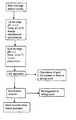
- the flowchart illustrates bioleaching of materials that have a high arsenic content, which includes different sulphide ores or concentrates of such ores that have winnable metal values either in the form of sulphides in a simple and/or complex form or precious metals in refractory ores, i.e. ores that are considered difficult to work-up with the intention of winning their valuable metal content, such as arsenopyrite (FeAsS) or pyrrhotite (Fe n-1 S).
- arsenopyrite FeAsS
- Fe n-1 S pyrrhotite
- the material is leached at a temperature of 45-50°C in the presence of active quantities of mesophilic or moderate thermophilic bacteria with an acid aqueous solution, for instance diluted sulphuric acid, to form a pulp having a pH of 1-1.3.
- an acid aqueous solution for instance diluted sulphuric acid
- the leaching process primarily arsenic is dissolved out from its sulphide mineral to form trivalent arsenic in solution, and is successively oxidised, by atmospheric oxygen supplied to the pulp, in coaction with the bacteria present in said pulp to pentavalent arsenic which begins to precipitate out in the form of different metal arsenates.
- Leaching of the material in the first stage is continued whilst the arsenic content of the pulp is higher than the value at which the arsenic is toxic to the extremely thermophilic bacteria that are already present in the first stage although in an inactive state but which can reproduce to active quantities in the second leaching stage provided that the arsenic content in this stage is non-toxic.
- Sampling is carried out continuously, to determine an appropriate time at which the second leaching stage can be commenced.
- the extremely thermophilic bacteria culture in the pulp is activated and caused to reproduce, by raising the temperature to 60-65°C and raising the pH to about 1.5 at the same time, therewith successively growing a bacterial culture population that is active in respect of the process.
- Other leachable metals present in the pulp are leached-out in this leaching stage, at the same time as oxidation of As(III) to As(V) continues and therewith causes the arsenic to precipitate out primarily as not-readily dissolved arsenates, such as iron arsenate and complex arsenate/iron compounds. Because the concentration of trivalent arsenic will quickly fall as a result of this process, the toxic effect of the pulp on the extremely thermophilic bacteria will also fall at the same rate.
- the pulp Upon completion of the second leaching stage, the pulp is separated into leaching residues and leaching solution, wherewith the leaching residues can be dumped when essentially all of its valuable metal content has been leached-out. With respect to refractory minerals that contain a precious metal, this metal can be won in a following cyanide leaching stage.
- the leaching solution is then cleansed of its remaining arsenic content by adding lime, therewith enabling the resultant gypsum precipitate that contains arsenic and any iron present to be dumped.
- the valuable metal content of the thus purified metal containing leaching solution can then be worked-up in some suitable manner depending on its composition, for instance by electrolysis or selective precipitation.
- a flotation concentrate originating from Petiknäs and containing arsenopyrite was leached in a first leaching series. Bioleaching was effected in a leaching vessel A with a moderate thermophilic culture at 45°C, while bioleaching was effected in a leaching vessel B with a Sulfolobus culture at 65°C.
- the concentrate had the following composition (w-%).
- the bioleaching process was started batch-wise in the two vessels, with a pulp consistency or density of 4% (w/v). Continuous operation was started after 13 calendar days, wherewith material was pumped from vessel B to a collecting vessel C, whereafter the same volume was pumped from vessel A to vessel B, and finally fresh mineral suspension was pumped from a mineral tank M to the leaching vessel A.
- Samples were taken one or two times per calendar day, for analysis of Fe(tot), Fe(sup), (i.e. Fe in solution), As(tot), As(sup) Fe(II), pH and redox.
- the tests were continued for a total of 45 calendar days.
- the test results could be interpreted and summed-up as showing that the Sulfolobus culture survived the presence of the moderate thermophilic culture.
- the arsenic content of the concentrate leached-out quantitatively already at 45°C.
- the arsenic-content was reduced to a level which was non-toxic to the Sulfolobus culture, as a result of arsenate precipitation achieved by adjusting the pH in the second stage, therewith increasing the leaching yield with respect to remaining metals.
- the results indicate that the pulp density could possibly be further increased and that the duration of the stage could be reduced while still achieving acceptable yields.
- the inventive bioleaching process affords the following advantages over a one-stage bioleaching process with mesophilic and moderate thermophilic cultures.
Landscapes
- Chemical & Material Sciences (AREA)
- Engineering & Computer Science (AREA)
- Manufacturing & Machinery (AREA)
- Organic Chemistry (AREA)
- Metallurgy (AREA)
- Mechanical Engineering (AREA)
- Life Sciences & Earth Sciences (AREA)
- Materials Engineering (AREA)
- Environmental & Geological Engineering (AREA)
- Geology (AREA)
- Geochemistry & Mineralogy (AREA)
- General Life Sciences & Earth Sciences (AREA)
- Microbiology (AREA)
- Biotechnology (AREA)
- Biochemistry (AREA)
- Manufacture And Refinement Of Metals (AREA)
- Paper (AREA)
- Preparation Of Compounds By Using Micro-Organisms (AREA)
- Purification Treatments By Anaerobic Or Anaerobic And Aerobic Bacteria Or Animals (AREA)
- Treatment Of Sludge (AREA)
- Processing Of Solid Wastes (AREA)
- Meat, Egg Or Seafood Products (AREA)
- Materials For Medical Uses (AREA)
- Detergent Compositions (AREA)
- Saccharide Compounds (AREA)
Claims (8)
- Verfahren zum Auslaugen Metalle und Arsen enthaltenden sulfidischen Materials unter oxidierenden Bedingungen und mit Hilfe von Mikroorganismen, gekennzeichnet durch die Stufen, in denen mana) das Material mit einer sauren wässrigen Lösung vermischt, um einen Brei zu erhalten,b) den Brei auslaugt, indem man ein Auslaugverfahren in einer ersten Auslaugstufe bei einem pH-Wert unter 2 und einer Temperatur im Bereich von Raumtemperatur bis zu 55 °C in Gegenwart einer aktiven Menge von Mikroorganismen, die mesophil und/oder mäßig thermophil sind, durchführt, wobei ein größerer Teil des in dem Material des Breies enthaltenen Arsens ausgelaugt und nach und nach zu einem fünfwertigen Zustand oxidiert wird, undc) die Temperatur des Breies auf wenigstens 60 °C steigert, womit eine extrem thermophile Mikroorganismenkultur, die in dem Brei vorliegt, aktiviert und dazu gebracht wird, die Bildung einer aktiven Menge zu reproduzieren, undd) in einer zweiten Auslaugstufe den restlichen auslaugbaren Inhalt des Materials des Breies in Gegenwart einer aktiven Menge des extrem thermophilen Mikroorganismus bei Bedingungen auslaugt, die günstig für das Wachstum des extrem thermophilen Mikroorganismus ist.
- Verfahren nach Anspruch 1, dadurch gekennzeichnet, dass man den pH-Wert in der zweiten Auslaugstufe auf einen Wert anhebt, bei welchem in Lösung vorliegendes fünfwertiges Arsen dazu gebracht wird, sich in einen festen Zustand umzuwandeln,und als metallhaltiges Arsenat ausgefällt wird, welches zusammen mit nichtausgelaugtem Material in dem Brei anschließend an die Beendigung der zweiten Auslaugstufe von der Auslauglösung abgetrennt wird.
- Verfahren nach Anspruch 1 oder 2, dadurch gekennzeichnet, dass man die erste Auslaugstufe bei einer Temperatur von 45 bis 55 °C und bei einem pH-Wert von 1,0 bis 1,3 durchführt.
- Verfahren nach einem der Ansprüche 1 bis 3, dadurch gekennzeichnet, dass man die zweite Auslaugstufe bei einer Temperatur von 65 bis 70 °C und bei einem pH-Wert von 1,5 bis 2,0 durchführt.
- Verfahren nach einem der Ansprüche 1 bis 4, dadurch gekennzeichnet, dass man Sulfolobus metallicus als den extrem thermophilen Mikroorganismus auswählt.
- Verfahren nach einem der Ansprüche 1 bis 5, dadurch gekennzeichnet, dass man die erste Auslaugstufe über eine solche Zeitdauer hinweg fortsetzt, dass die Arsenkonzentration in dem Brei für den extrem thermophilen Mikroorganismus nicht toxisch ist.
- Verfahren nach einem der Ansprüche 1 bis 6, dadurch gekennzeichnet, dass man das Volumen der Auslauglösung so anpasst, dass man eine Breidichte von 10 bis 25 % bekommt.
- Verfahren nach einem der Ansprüche 1 bis 6 zur biologischen Auslaugung von hitzebeständigen goldhaltigen Arsen-Eisen-Pyrit-Erzen oder Konzentraten solcher Erze, gekennzeichnet durch eine weitere Stufe, in welcher der Auslaugrückstand mit Cyanid behandelt wird, um seinen Goldgehalt und auch seinen Gehalt an anderen Edelmetallen zu gewinnen.
Applications Claiming Priority (2)
| Application Number | Priority Date | Filing Date | Title |
|---|---|---|---|
| SE9901613A SE518939C2 (sv) | 1999-05-05 | 1999-05-05 | Biolakning av sulfidiska material |
| SE9901613 | 1999-05-05 |
Publications (2)
| Publication Number | Publication Date |
|---|---|
| EP1050593A1 EP1050593A1 (de) | 2000-11-08 |
| EP1050593B1 true EP1050593B1 (de) | 2003-07-30 |
Family
ID=20415464
Family Applications (1)
| Application Number | Title | Priority Date | Filing Date |
|---|---|---|---|
| EP00850078A Expired - Lifetime EP1050593B1 (de) | 1999-05-05 | 2000-05-05 | Zweistufige Biolaugung von Arsen und Wertmetalle enthaltenden Sulfiderzen |
Country Status (12)
| Country | Link |
|---|---|
| US (1) | US6461577B1 (de) |
| EP (1) | EP1050593B1 (de) |
| AT (1) | ATE246262T1 (de) |
| AU (1) | AU756854B2 (de) |
| CA (1) | CA2305052C (de) |
| DE (1) | DE60004123T2 (de) |
| EA (1) | EA002342B1 (de) |
| ES (1) | ES2202033T3 (de) |
| PE (1) | PE20010142A1 (de) |
| PT (1) | PT1050593E (de) |
| SE (1) | SE518939C2 (de) |
| ZA (1) | ZA200001590B (de) |
Cited By (2)
| Publication number | Priority date | Publication date | Assignee | Title |
|---|---|---|---|---|
| CN100362116C (zh) * | 2003-03-05 | 2008-01-16 | 联邦科学及工业研究组织 | 浸取矿物硫化物的微生物和方法 |
| CN102312091A (zh) * | 2010-07-05 | 2012-01-11 | 湖南布鲁斯凯环保科技发展有限公司 | 一种微生物预氧化浸出硫精矿制酸高砷烧渣中低品位金的方法 |
Families Citing this family (63)
| Publication number | Priority date | Publication date | Assignee | Title |
|---|---|---|---|---|
| US7455715B2 (en) | 2001-07-13 | 2008-11-25 | Teck Cominco Metals Ltd. | Heap bioleaching process for the extraction of zinc |
| CA2353002C (en) | 2001-07-13 | 2009-12-01 | Teck Cominco Metals Ltd. | Heap bioleaching process for the extraction of zinc |
| RU2203336C1 (ru) * | 2002-03-05 | 2003-04-27 | Бирюков Валентин Васильевич | Способ переработки сульфидных медно-цинковых продуктов |
| CN1308467C (zh) * | 2002-08-15 | 2007-04-04 | 北京有色金属研究总院 | 生物冶金过程中加硫的酸平衡方法 |
| RU2234544C1 (ru) * | 2003-03-25 | 2004-08-20 | Совмен Хазрет Меджидович | Способ переработки упорных золото-мышьяковых руд и концентратов |
| PE20050453A1 (es) * | 2003-05-19 | 2005-06-23 | Bhp Billiton Sa Ltd | Tratamiento de un concentrado de metal base |
| RU2261928C1 (ru) * | 2004-04-02 | 2005-10-10 | Совмен Хазрет Меджидович | Способ переработки упорных золото-мышьяковых руд и концентратов |
| RU2262543C1 (ru) * | 2004-04-29 | 2005-10-20 | Общество с ограниченной ответственностью "НВП Центр-ЭСТАгео" | Способ переработки упорных золотосодержащих руд, концентратов, промпродуктов и реагент для его осуществления |
| RU2256712C1 (ru) * | 2004-12-29 | 2005-07-20 | Закрытое акционерное общество "Золотодобывающая компания "Полюс" | Способ переработки первичных золотосульфидных руд |
| FI118429B (fi) * | 2005-02-16 | 2007-11-15 | Outokumpu Oy | Menetelmä kullan talteenottamiseksi sulfidirikasteesta |
| RU2283358C1 (ru) * | 2005-04-18 | 2006-09-10 | Государственное образовательное учреждение высшего профессионального образования "Санкт-Петербургский государственный горный институт им. Г.В. Плеханова" (технический университет) | Способ переработки сульфидных золотосодержащих концентратов |
| RU2275437C1 (ru) * | 2005-04-19 | 2006-04-27 | Закрытое акционерное общество "Золотодобывающая компания "Полюс" | Способ извлечения золота из упорных золотосодержащих руд |
| RU2285733C1 (ru) * | 2005-05-04 | 2006-10-20 | Институт микробиологии им. С.Н. Виноградского Российской Академии Наук | Способ переработки сульфидных медно-цинковых продуктов |
| RU2291909C1 (ru) * | 2005-06-08 | 2007-01-20 | Хазрет Меджидович Совмен | Способ извлечения золота из упорных золотомышьяковых руд |
| GB0516912D0 (en) * | 2005-08-18 | 2005-09-28 | Fiset Gilles | Method and apparatus for the recovery of refractory mineral ores |
| EP1919831A4 (de) * | 2005-08-24 | 2009-12-23 | Applied Intellectual Capital | Elektrochemische rückgewinnung von arsen |
| RU2340691C2 (ru) * | 2005-12-05 | 2008-12-10 | Закрытое акционерное общество "Золотодобывающая компания "Полюс" | Способ извлечения золота из цианистой пульпы |
| RU2340692C2 (ru) * | 2005-12-05 | 2008-12-10 | Закрытое акционерное общество "Золотодобывающая компания "Полюс" | Способ извлечения золота из цианистой пульпы |
| RU2340690C2 (ru) * | 2005-12-26 | 2008-12-10 | Закрытое акционерное общество "Золотодобывающая компания "Полюс" | Способ извлечения золота из упорных сульфидных руд |
| RU2318887C1 (ru) * | 2006-09-12 | 2008-03-10 | Закрытое акционерное общество "Золотодобывающая компания "Полюс" | Способ извлечения золота из руд |
| RU2346063C1 (ru) * | 2007-06-28 | 2009-02-10 | Закрытое акционерное общество "Золотодобывающая компания "Полюс" | Способ бактериального окисления золотосодержащих сульфидных концентратов при получении золота |
| CA2705487A1 (en) * | 2007-11-28 | 2009-06-04 | Barrick Gold Corporation | Microbial pre-treatment of double refractory gold ores |
| RU2361937C1 (ru) * | 2007-12-06 | 2009-07-20 | Государственное образовательное учреждение высшего профессионального образования Читинский государственный университет (ЧитГУ) | Способ подготовки упорных сульфидных руд и концентратов к выщелачиванию |
| RU2386708C2 (ru) * | 2007-12-28 | 2010-04-20 | Владимир Витальевич Доценко | Способ извлечения золота |
| RU2387721C1 (ru) * | 2008-12-30 | 2010-04-27 | Татьяна Викторовна Башлыкова | Способ переработки техногенных железосодержащих шламов с ценными компонентами |
| RU2397260C1 (ru) * | 2009-03-10 | 2010-08-20 | Ильдар Хайдарович Мухаметшин | Способ глубокой переработки пиритных огарков |
| RU2418869C2 (ru) * | 2009-05-12 | 2011-05-20 | Федеральное государственное образовательное учреждение высшего профессионального образования "Государственный технологический университет "Московский институт стали и сплавов" | Способ извлечения металлов из минерального сырья |
| RU2410452C1 (ru) * | 2009-10-29 | 2011-01-27 | Закрытое акционерное общество "Золотодобывающая компания "Полюс" | Способ переработки сульфидных золотосодержащих концентратов |
| RU2410454C1 (ru) * | 2009-10-29 | 2011-01-27 | Закрытое акционерное общество "Золотодобывающая компания "Полюс" | Способ извлечения сурьмы и мышьяка из раствора биовыщелачивания золотосодержащих концентратов |
| RU2413019C1 (ru) * | 2009-11-06 | 2011-02-27 | Учреждение Российской академии наук Институт микробиологии им. С.Н. Виноградского РАН (ИНМИ РАН) | Способ извлечения золота из упорных золотосодержащих руд |
| RU2423537C1 (ru) * | 2010-03-26 | 2011-07-10 | Федеральное Государственное Автономное Образовательное Учреждение Высшего Профессионального Образования "Сибирский Федеральный Университет" | Способ бактериального окисления сульфидных золотосодержащих концентратов |
| RU2422544C1 (ru) * | 2010-03-26 | 2011-06-27 | Федеральное Государственное Автономное Образовательное Учреждение Высшего Профессионального Образования "Сибирский Федеральный Университет" | Способ бактериального окисления сульфидных золотоносных концентратов |
| RU2423538C1 (ru) * | 2010-03-26 | 2011-07-10 | Федеральное Государственное Автономное Образовательное Учреждение Высшего Профессионального Образования "Сибирский Федеральный Университет" | Способ подготовки сульфидных золотосодержащих концентратов к бактериальному окислению при извлечении золота |
| RU2425898C1 (ru) * | 2010-03-26 | 2011-08-10 | Федеральное Государственное Автономное Образовательное Учреждение Высшего Профессионального Образования "Сибирский Федеральный Университет" | Способ бактериального окисления сульфидных золотосодержащих концентратов для извлечения золота |
| RU2458161C1 (ru) * | 2010-12-27 | 2012-08-10 | Закрытое акционерное общество "Золотодобывающая компания "Полюс" | Способ переработки сульфидных золотосодержащих флотоконцентратов |
| RU2465353C1 (ru) * | 2011-06-16 | 2012-10-27 | Федеральное Государственное Автономное Образовательное Учреждение Высшего Профессионального Образования "Сибирский Федеральный Университет" | Способ извлечения золота из бедных малосульфидных руд |
| RU2490345C1 (ru) * | 2011-12-02 | 2013-08-20 | Федеральное государственное бюджетное образовательное учреждение высшего профессионального образования "Забайкальский государственный университет" (ФГБОУ ВПО "ЗабГУ") | Способ извлечения дисперсного золота из упорных руд и техногенного минерального сырья |
| RU2489508C1 (ru) * | 2011-12-16 | 2013-08-10 | Федеральное государственное бюджетное образовательное учреждение высшего профессионального образования "Иркутский государственный технический университет" | Линия извлечения благородных металлов из цианистых растворов и/или пульп по угольно-сорбционной технологии |
| RU2483127C1 (ru) * | 2012-01-26 | 2013-05-27 | Федеральное государственное автономное образовательное учреждение высшего профессионального образования "Национальный исследовательский технологический университет "МИСиС" | Способ переработки упорной золотосодержащей пирротин-арсенопиритной руды |
| RU2480290C1 (ru) * | 2012-02-10 | 2013-04-27 | Федеральное государственное автономное образовательное учреждение высшего профессионального образования "Национальный исследовательский технологический университет "МИСиС" | Способ обогащения техногенного минерального сырья цветных металлов |
| RU2502814C2 (ru) * | 2012-02-24 | 2013-12-27 | Общество с ограниченной ответственностью "Управляющая компания Ариэнт" | Комбинированный способ кучного выщелачивания золота из упорных сульфидных руд |
| RU2490344C1 (ru) * | 2012-06-14 | 2013-08-20 | Общество С Ограниченной Ответственностью "Семеновский Рудник" | Способ извлечения золота из руд и продуктов их переработки |
| CN103014336B (zh) * | 2013-01-16 | 2014-04-16 | 山东黄金归来庄矿业有限公司 | 一种处理高砷高硫金矿石的制剂及其方法 |
| CN103088222B (zh) * | 2013-01-29 | 2014-02-26 | 李兆营 | 一种处理难选金矿的工艺方法 |
| RU2509166C1 (ru) * | 2013-03-11 | 2014-03-10 | Федеральное государственное бюджетное образовательное учреждение высшего профессионального образования "Забайкальский государственный университет" (ФГБОУ ВПО "ЗабГУ") | Способ извлечения дисперсного золота из упорных руд и техногенного минерального сырья |
| RU2522921C1 (ru) * | 2013-03-14 | 2014-07-20 | Федеральное государственное автономное образовательное учреждение высшего профессионального образования "Национальный исследовательский технологический университет "МИСиС" | Способ извлечения золота из руд и концентратов |
| CN103205571B (zh) * | 2013-04-01 | 2014-05-07 | 山东黄金归来庄矿业有限公司 | 高碳高砷金矿的处理工艺 |
| RU2541236C2 (ru) * | 2013-04-23 | 2015-02-10 | Федеральное государственное автономное образовательное учреждение высшего профессионального образования "Уральский федеральный университет имени первого Президента России Б.Н. Ельцина" | Способ извлечения золота из теллуристых руд и концентратов |
| RU2542181C1 (ru) * | 2013-08-06 | 2015-02-20 | Федеральное государственное бюджетное учреждение науки Институт химии и технологии редких элементов и минерального сырья им. И.В. Тананаева Кольского научного центра Российской академии наук (ИХТРЭМС КНЦ РАН) | Способ извлечения золота из солянокислого раствора |
| RU2552207C1 (ru) * | 2013-12-20 | 2015-06-10 | Федеральное государственное автономное образовательное учреждение высшего профессионального образования "Национальный исследовательский технологический университет "МИСиС" | Способ управления процессом биоокисления сульфидных концентратов |
| RU2555280C1 (ru) * | 2014-01-21 | 2015-07-10 | Общество с ограниченной ответственностью "ПромГео" | Способ обогащения бедных и забалансовых серебросодержащих сульфидных руд и хвостов обогащения |
| EP3825424A1 (de) | 2014-01-31 | 2021-05-26 | Goldcorp Inc. | Verfahren zur stabilisierung einer arsenhaltigen lösung enthaltend thiosulfate |
| RU2566231C1 (ru) * | 2014-05-29 | 2015-10-20 | Федеральное государственное бюджетное образовательное учреждение высшего профессионального образования "Забайкальский государственный университет" (ФГБОУ ВПО "ЗабГУ") | Способ кучного выщелачивания дисперсного золота из упорных руд |
| RU2580356C1 (ru) * | 2014-12-08 | 2016-04-10 | Федеральное государственное бюджетное образовательное учреждение высшего профессионального образования "Забайкальский государственный университет" (ФГБОУ ВПО "ЗабГУ") | Способ кучного выщелачивания золота из упорных руд |
| RU2612860C2 (ru) * | 2015-01-12 | 2017-03-13 | Владимир Кушукович Совмен | Способ переработки продуктов окисления упорных сульфидных золотосодержащих флотоконцентратов (варианты) |
| RU2592656C1 (ru) * | 2015-03-20 | 2016-07-27 | Владимир Кушукович Совмен | Способ переработки упорных пирит-арсенопирит-пирротин-антимонитовых золотосодержащих руд (варианты) |
| RU2598726C1 (ru) * | 2015-05-12 | 2016-09-27 | Сергей Марциянович Совка | Способ комплексной переработки материала, содержащего драгметаллы |
| RU2621196C2 (ru) * | 2015-09-17 | 2017-06-01 | Открытое акционерное общество "Иркутский научно-исследовательский институт благородных и редких металлов и алмазов" ОАО "Иргиредмет" | Способ переработки упорных углисто-сульфидных золотосодержащих концентратов |
| RU2619428C1 (ru) * | 2015-12-31 | 2017-05-15 | Акционерное общество "Золотодобывающая компания "Полюс" | Способ переработки сульфидных золотосодержащих флотоконцентратов |
| RU2623948C1 (ru) * | 2016-04-06 | 2017-06-29 | Публичное акционерное общество Приаргунское производственное горно-химическое объединение (ПАО ППГХО) | Способ комплексной переработки пиритных огарков |
| CN108118147B (zh) * | 2016-11-30 | 2019-08-16 | 有研工程技术研究院有限公司 | 一种氧硫混合铜矿的两段浸出工艺 |
| RU2659505C1 (ru) * | 2017-09-06 | 2018-07-02 | Валерий Константинович Ларин | Способ предобработки пиритных огарков |
| CN111560519A (zh) * | 2020-06-16 | 2020-08-21 | 江西一元再生资源有限公司 | 含砷金精矿的整体利用方法 |
Family Cites Families (14)
| Publication number | Priority date | Publication date | Assignee | Title |
|---|---|---|---|---|
| US4729788A (en) * | 1987-01-23 | 1988-03-08 | Advanced Mineral Technologies, Inc. | Thermophilic microbial treatment of precious metal ores |
| SU1511287A1 (ru) | 1987-04-09 | 1989-09-30 | Всесоюзный научно-исследовательский институт биосинтеза белковых веществ | Способ переработки сульфидных медно-цинковых концентратов |
| US4888293A (en) | 1987-07-10 | 1989-12-19 | Giant Bay Biotech Inc. | Adapting bacteria to low pH and high arsenic concentration for use in oxidizing sulfide ores |
| US5162105A (en) | 1989-11-27 | 1992-11-10 | Geobiotics, Inc. | Processes to recover and reconcentrate gold from its ores with microorganisms |
| JPH0386253U (de) * | 1989-12-25 | 1991-08-30 | ||
| RU1767900C (ru) * | 1990-07-02 | 1995-02-27 | Иркутский государственный научно-исследовательский институт редких и цветных металлов | Способ подготовки сульфидных золотосодержащих концентратов к извлечению золота цианированием |
| US5127942A (en) * | 1990-09-21 | 1992-07-07 | Newmont Mining Corporation | Microbial consortium treatment of refractory precious metal ores |
| SE9101893L (sv) | 1991-06-19 | 1992-12-07 | Boliden Mineral Ab | Foerfarande foer behandling av komplexa metallsulfidmaterial |
| RU2089637C1 (ru) | 1995-01-30 | 1997-09-10 | Акционерное общество "Иргиредмет" | Способ переработки золотомышьяковистых концентратов |
| US5914441A (en) | 1996-06-12 | 1999-06-22 | Yellowstone Environmental Science, Inc. | Biocatalyzed anaerobic oxidation of metal sulfides for recovery of metal values |
| AR012179A1 (es) * | 1997-03-27 | 2000-09-27 | Billiton Sa Ltd | Un procedimiento para la recuperacion de cobre |
| US5873927A (en) * | 1997-05-16 | 1999-02-23 | Echo Bay Mines, Limited | Integrated, tank/heap biooxidation process |
| US6207443B1 (en) * | 1998-03-02 | 2001-03-27 | Placer Dome, Inc. | Method for initiating heap bioleaching of sulfidic ores |
| US6110253A (en) * | 1998-12-14 | 2000-08-29 | Geobiotics, Inc. | High temperature heap bioleaching process |
-
1999
- 1999-05-05 SE SE9901613A patent/SE518939C2/sv not_active IP Right Cessation
-
2000
- 2000-03-29 ZA ZA200001590A patent/ZA200001590B/xx unknown
- 2000-03-29 AU AU22669/00A patent/AU756854B2/en not_active Withdrawn - After Issue
- 2000-04-12 CA CA002305052A patent/CA2305052C/en not_active Expired - Lifetime
- 2000-04-18 US US09/551,575 patent/US6461577B1/en not_active Expired - Lifetime
- 2000-04-26 PE PE2000000393A patent/PE20010142A1/es active IP Right Grant
- 2000-05-04 EA EA200000387A patent/EA002342B1/ru not_active IP Right Cessation
- 2000-05-05 ES ES00850078T patent/ES2202033T3/es not_active Expired - Lifetime
- 2000-05-05 DE DE60004123T patent/DE60004123T2/de not_active Expired - Lifetime
- 2000-05-05 EP EP00850078A patent/EP1050593B1/de not_active Expired - Lifetime
- 2000-05-05 AT AT00850078T patent/ATE246262T1/de not_active IP Right Cessation
- 2000-05-05 PT PT00850078T patent/PT1050593E/pt unknown
Cited By (2)
| Publication number | Priority date | Publication date | Assignee | Title |
|---|---|---|---|---|
| CN100362116C (zh) * | 2003-03-05 | 2008-01-16 | 联邦科学及工业研究组织 | 浸取矿物硫化物的微生物和方法 |
| CN102312091A (zh) * | 2010-07-05 | 2012-01-11 | 湖南布鲁斯凯环保科技发展有限公司 | 一种微生物预氧化浸出硫精矿制酸高砷烧渣中低品位金的方法 |
Also Published As
| Publication number | Publication date |
|---|---|
| SE9901613L (sv) | 2000-11-06 |
| ZA200001590B (en) | 2000-10-25 |
| CA2305052A1 (en) | 2000-11-05 |
| ES2202033T3 (es) | 2004-04-01 |
| PE20010142A1 (es) | 2001-03-06 |
| DE60004123T2 (de) | 2004-05-27 |
| EA200000387A3 (ru) | 2001-02-26 |
| SE9901613D0 (sv) | 1999-05-05 |
| ATE246262T1 (de) | 2003-08-15 |
| AU2266900A (en) | 2000-11-09 |
| SE518939C2 (sv) | 2002-12-10 |
| EA002342B1 (ru) | 2002-04-25 |
| US6461577B1 (en) | 2002-10-08 |
| DE60004123D1 (de) | 2003-09-04 |
| CA2305052C (en) | 2003-07-08 |
| AU756854B2 (en) | 2003-01-23 |
| EP1050593A1 (de) | 2000-11-08 |
| EA200000387A2 (ru) | 2000-12-25 |
| PT1050593E (pt) | 2003-11-28 |
Similar Documents
| Publication | Publication Date | Title |
|---|---|---|
| EP1050593B1 (de) | Zweistufige Biolaugung von Arsen und Wertmetalle enthaltenden Sulfiderzen | |
| US4497778A (en) | Microbial leaching of sulphide-containing ores | |
| US5429659A (en) | Oxidation of metal sulfides using thermotolerant bacteria | |
| EP1644542B1 (de) | Oxidierendes auslaugungsverfahren | |
| US4752332A (en) | Treating manganese-containing ores with a metal sulfide | |
| Lindström et al. | A sequential two-step process using moderately and extremely thermophilic cultures for biooxidation of refractory gold concentrates | |
| WO2000037690A1 (en) | Silver-catalyzed bio-leaching process for copper extraction from chalcopyrite heap | |
| WO2000023629A1 (en) | Process for bioleaching of copper concentrates | |
| WO2002070758A1 (en) | Improved, high yield bioheap leaching of chalcopyrite copper ores | |
| GB2291869A (en) | Recovering nickel from sulphide ore | |
| Escobar et al. | Bioleaching of a copper concentrate with Sulfolobus BC | |
| CA2559243C (en) | Method for bioleaching metal containing sulphidic materials | |
| US6379919B1 (en) | Method for isolating thiocyanate resistant bacteria | |
| Natarajan | Bioprocessing for enhanced gold recovery | |
| MXPA00004288A (en) | Two-stage bioleaching of sulphidic materials containing metal values and arsenic | |
| AU2004239345B2 (en) | Treatment of base metal concentrate by a two-step bioleaching process | |
| AU1422792A (en) | Oxidation of metal sulfides using thermotolerant bacteria | |
| Bulaev et al. | BIOOXIDATION OF FERROUS IRON IONS IN A PREGNANT SOLUTION OF OXIDATIVE LEACHING | |
| AU736975B2 (en) | Oxidation of metal sulfides using thermotolerant bacteria | |
| Groudev et al. | Two-stage microbial leaching of copper and precious metals from a sulphide ore | |
| Brierley | Biooxidation pretreatment of refractory sulfidic and sulfidic-carbonaceous gold ores and concentrates | |
| COPPER et al. | Stojan Groudev Irena Spasova Rainer Schutte | |
| AU607523B2 (en) | Metal value recovery | |
| Spasova et al. | TWO-STAGE COMBINED BIOLOGICAL AND CHEMICAL LEACHING OF A REFRACTORY GOLD-BEARING SULPHIDE ORE | |
| Spasova et al. | COMPARATIVE VARIANTS OF BIOLOGICAL AND CHEMICAL LEACHING OF THREE DIFFERENT COPPER CONCENTRATES |
Legal Events
| Date | Code | Title | Description |
|---|---|---|---|
| PUAI | Public reference made under article 153(3) epc to a published international application that has entered the european phase |
Free format text: ORIGINAL CODE: 0009012 |
|
| AK | Designated contracting states |
Kind code of ref document: A1 Designated state(s): AT BE CH CY DE DK ES FI FR GB GR IE IT LI LU MC NL PT SE |
|
| AX | Request for extension of the european patent |
Free format text: AL;LT;LV;MK;RO;SI |
|
| 17P | Request for examination filed |
Effective date: 20010405 |
|
| AKX | Designation fees paid |
Free format text: AT BE CH CY DE DK ES FI FR GB GR IE IT LI LU MC NL PT SE |
|
| 17Q | First examination report despatched |
Effective date: 20020701 |
|
| GRAH | Despatch of communication of intention to grant a patent |
Free format text: ORIGINAL CODE: EPIDOS IGRA |
|
| RAP1 | Party data changed (applicant data changed or rights of an application transferred) |
Owner name: BOLIDEN MINERAL AB |
|
| GRAH | Despatch of communication of intention to grant a patent |
Free format text: ORIGINAL CODE: EPIDOS IGRA |
|
| RAP1 | Party data changed (applicant data changed or rights of an application transferred) |
Owner name: BOLIDEN CONTECH AB |
|
| GRAA | (expected) grant |
Free format text: ORIGINAL CODE: 0009210 |
|
| AK | Designated contracting states |
Designated state(s): AT BE CH CY DE DK ES FI FR GB GR IE IT LI LU MC NL PT SE |
|
| PG25 | Lapsed in a contracting state [announced via postgrant information from national office to epo] |
Ref country code: IT Free format text: LAPSE BECAUSE OF FAILURE TO SUBMIT A TRANSLATION OF THE DESCRIPTION OR TO PAY THE FEE WITHIN THE PRESCRIBED TIME-LIMIT;WARNING: LAPSES OF ITALIAN PATENTS WITH EFFECTIVE DATE BEFORE 2007 MAY HAVE OCCURRED AT ANY TIME BEFORE 2007. THE CORRECT EFFECTIVE DATE MAY BE DIFFERENT FROM THE ONE RECORDED. Effective date: 20030730 Ref country code: CY Free format text: LAPSE BECAUSE OF FAILURE TO SUBMIT A TRANSLATION OF THE DESCRIPTION OR TO PAY THE FEE WITHIN THE PRESCRIBED TIME-LIMIT Effective date: 20030730 Ref country code: AT Free format text: LAPSE BECAUSE OF FAILURE TO SUBMIT A TRANSLATION OF THE DESCRIPTION OR TO PAY THE FEE WITHIN THE PRESCRIBED TIME-LIMIT Effective date: 20030730 Ref country code: BE Free format text: LAPSE BECAUSE OF FAILURE TO SUBMIT A TRANSLATION OF THE DESCRIPTION OR TO PAY THE FEE WITHIN THE PRESCRIBED TIME-LIMIT Effective date: 20030730 Ref country code: LI Free format text: LAPSE BECAUSE OF FAILURE TO SUBMIT A TRANSLATION OF THE DESCRIPTION OR TO PAY THE FEE WITHIN THE PRESCRIBED TIME-LIMIT Effective date: 20030730 Ref country code: NL Free format text: LAPSE BECAUSE OF FAILURE TO SUBMIT A TRANSLATION OF THE DESCRIPTION OR TO PAY THE FEE WITHIN THE PRESCRIBED TIME-LIMIT Effective date: 20030730 Ref country code: CH Free format text: LAPSE BECAUSE OF FAILURE TO SUBMIT A TRANSLATION OF THE DESCRIPTION OR TO PAY THE FEE WITHIN THE PRESCRIBED TIME-LIMIT Effective date: 20030730 |
|
| REG | Reference to a national code |
Ref country code: GB Ref legal event code: FG4D |
|
| REG | Reference to a national code |
Ref country code: CH Ref legal event code: EP |
|
| REG | Reference to a national code |
Ref country code: IE Ref legal event code: FG4D |
|
| REF | Corresponds to: |
Ref document number: 60004123 Country of ref document: DE Date of ref document: 20030904 Kind code of ref document: P |
|
| REG | Reference to a national code |
Ref country code: GR Ref legal event code: EP Ref document number: 20030403889 Country of ref document: GR |
|
| PG25 | Lapsed in a contracting state [announced via postgrant information from national office to epo] |
Ref country code: SE Free format text: LAPSE BECAUSE OF FAILURE TO SUBMIT A TRANSLATION OF THE DESCRIPTION OR TO PAY THE FEE WITHIN THE PRESCRIBED TIME-LIMIT Effective date: 20031030 Ref country code: DK Free format text: LAPSE BECAUSE OF FAILURE TO SUBMIT A TRANSLATION OF THE DESCRIPTION OR TO PAY THE FEE WITHIN THE PRESCRIBED TIME-LIMIT Effective date: 20031030 |
|
| NLV1 | Nl: lapsed or annulled due to failure to fulfill the requirements of art. 29p and 29m of the patents act | ||
| RAP2 | Party data changed (patent owner data changed or rights of a patent transferred) |
Owner name: BOLIDEN MINERAL AB |
|
| REG | Reference to a national code |
Ref country code: CH Ref legal event code: PL |
|
| REG | Reference to a national code |
Ref country code: ES Ref legal event code: FG2A Ref document number: 2202033 Country of ref document: ES Kind code of ref document: T3 |
|
| PG25 | Lapsed in a contracting state [announced via postgrant information from national office to epo] |
Ref country code: LU Free format text: LAPSE BECAUSE OF NON-PAYMENT OF DUE FEES Effective date: 20040505 Ref country code: GB Free format text: LAPSE BECAUSE OF NON-PAYMENT OF DUE FEES Effective date: 20040505 |
|
| ET | Fr: translation filed | ||
| PG25 | Lapsed in a contracting state [announced via postgrant information from national office to epo] |
Ref country code: MC Free format text: LAPSE BECAUSE OF NON-PAYMENT OF DUE FEES Effective date: 20040531 |
|
| PLBE | No opposition filed within time limit |
Free format text: ORIGINAL CODE: 0009261 |
|
| STAA | Information on the status of an ep patent application or granted ep patent |
Free format text: STATUS: NO OPPOSITION FILED WITHIN TIME LIMIT |
|
| 26N | No opposition filed |
Effective date: 20040504 |
|
| GBPC | Gb: european patent ceased through non-payment of renewal fee |
Effective date: 20040505 |
|
| REG | Reference to a national code |
Ref country code: FR Ref legal event code: PLFP Year of fee payment: 17 |
|
| PGFP | Annual fee paid to national office [announced via postgrant information from national office to epo] |
Ref country code: DE Payment date: 20160426 Year of fee payment: 17 |
|
| PGFP | Annual fee paid to national office [announced via postgrant information from national office to epo] |
Ref country code: FR Payment date: 20160412 Year of fee payment: 17 |
|
| REG | Reference to a national code |
Ref country code: DE Ref legal event code: R119 Ref document number: 60004123 Country of ref document: DE |
|
| REG | Reference to a national code |
Ref country code: FR Ref legal event code: ST Effective date: 20180131 |
|
| PG25 | Lapsed in a contracting state [announced via postgrant information from national office to epo] |
Ref country code: DE Free format text: LAPSE BECAUSE OF NON-PAYMENT OF DUE FEES Effective date: 20171201 |
|
| PG25 | Lapsed in a contracting state [announced via postgrant information from national office to epo] |
Ref country code: FR Free format text: LAPSE BECAUSE OF NON-PAYMENT OF DUE FEES Effective date: 20170531 |
|
| PGFP | Annual fee paid to national office [announced via postgrant information from national office to epo] |
Ref country code: IE Payment date: 20190509 Year of fee payment: 20 Ref country code: FI Payment date: 20190509 Year of fee payment: 20 Ref country code: ES Payment date: 20190603 Year of fee payment: 20 Ref country code: PT Payment date: 20190503 Year of fee payment: 20 |
|
| PGFP | Annual fee paid to national office [announced via postgrant information from national office to epo] |
Ref country code: GR Payment date: 20190410 Year of fee payment: 20 |
|
| REG | Reference to a national code |
Ref country code: FI Ref legal event code: MAE |
|
| PG25 | Lapsed in a contracting state [announced via postgrant information from national office to epo] |
Ref country code: IE Free format text: LAPSE BECAUSE OF EXPIRATION OF PROTECTION Effective date: 20200505 Ref country code: PT Free format text: LAPSE BECAUSE OF EXPIRATION OF PROTECTION Effective date: 20200514 |
|
| REG | Reference to a national code |
Ref country code: ES Ref legal event code: FD2A Effective date: 20211229 |
|
| PG25 | Lapsed in a contracting state [announced via postgrant information from national office to epo] |
Ref country code: ES Free format text: LAPSE BECAUSE OF EXPIRATION OF PROTECTION Effective date: 20200506 |