EP1052000A2 - Videospielgerät, Markierungsdarstellungsverfahren für Videospiel und entsprechendes Aufzeichnungsmedium - Google Patents
Videospielgerät, Markierungsdarstellungsverfahren für Videospiel und entsprechendes Aufzeichnungsmedium Download PDFInfo
- Publication number
- EP1052000A2 EP1052000A2 EP00110174A EP00110174A EP1052000A2 EP 1052000 A2 EP1052000 A2 EP 1052000A2 EP 00110174 A EP00110174 A EP 00110174A EP 00110174 A EP00110174 A EP 00110174A EP 1052000 A2 EP1052000 A2 EP 1052000A2
- Authority
- EP
- European Patent Office
- Prior art keywords
- character
- game
- main character
- video game
- enemy character
- Prior art date
- Legal status (The legal status is an assumption and is not a legal conclusion. Google has not performed a legal analysis and makes no representation as to the accuracy of the status listed.)
- Ceased
Links
Images



















Classifications
-
- A63F13/10—
-
- A—HUMAN NECESSITIES
- A63—SPORTS; GAMES; AMUSEMENTS
- A63F—CARD, BOARD, OR ROULETTE GAMES; INDOOR GAMES USING SMALL MOVING PLAYING BODIES; VIDEO GAMES; GAMES NOT OTHERWISE PROVIDED FOR
- A63F13/00—Video games, i.e. games using an electronically generated display having two or more dimensions
- A63F13/50—Controlling the output signals based on the game progress
- A63F13/53—Controlling the output signals based on the game progress involving additional visual information provided to the game scene, e.g. by overlay to simulate a head-up display [HUD] or displaying a laser sight in a shooting game
- A63F13/537—Controlling the output signals based on the game progress involving additional visual information provided to the game scene, e.g. by overlay to simulate a head-up display [HUD] or displaying a laser sight in a shooting game using indicators, e.g. showing the condition of a game character on screen
- A63F13/5372—Controlling the output signals based on the game progress involving additional visual information provided to the game scene, e.g. by overlay to simulate a head-up display [HUD] or displaying a laser sight in a shooting game using indicators, e.g. showing the condition of a game character on screen for tagging characters, objects or locations in the game scene, e.g. displaying a circle under the character controlled by the player
-
- A—HUMAN NECESSITIES
- A63—SPORTS; GAMES; AMUSEMENTS
- A63F—CARD, BOARD, OR ROULETTE GAMES; INDOOR GAMES USING SMALL MOVING PLAYING BODIES; VIDEO GAMES; GAMES NOT OTHERWISE PROVIDED FOR
- A63F13/00—Video games, i.e. games using an electronically generated display having two or more dimensions
- A63F13/45—Controlling the progress of the video game
-
- A—HUMAN NECESSITIES
- A63—SPORTS; GAMES; AMUSEMENTS
- A63F—CARD, BOARD, OR ROULETTE GAMES; INDOOR GAMES USING SMALL MOVING PLAYING BODIES; VIDEO GAMES; GAMES NOT OTHERWISE PROVIDED FOR
- A63F13/00—Video games, i.e. games using an electronically generated display having two or more dimensions
- A63F13/80—Special adaptations for executing a specific game genre or game mode
- A63F13/828—Managing virtual sport teams
-
- A—HUMAN NECESSITIES
- A63—SPORTS; GAMES; AMUSEMENTS
- A63F—CARD, BOARD, OR ROULETTE GAMES; INDOOR GAMES USING SMALL MOVING PLAYING BODIES; VIDEO GAMES; GAMES NOT OTHERWISE PROVIDED FOR
- A63F13/00—Video games, i.e. games using an electronically generated display having two or more dimensions
- A63F13/80—Special adaptations for executing a specific game genre or game mode
- A63F13/812—Ball games, e.g. soccer or baseball
-
- A—HUMAN NECESSITIES
- A63—SPORTS; GAMES; AMUSEMENTS
- A63F—CARD, BOARD, OR ROULETTE GAMES; INDOOR GAMES USING SMALL MOVING PLAYING BODIES; VIDEO GAMES; GAMES NOT OTHERWISE PROVIDED FOR
- A63F13/00—Video games, i.e. games using an electronically generated display having two or more dimensions
- A63F13/80—Special adaptations for executing a specific game genre or game mode
- A63F13/822—Strategy games; Role-playing games
-
- A—HUMAN NECESSITIES
- A63—SPORTS; GAMES; AMUSEMENTS
- A63F—CARD, BOARD, OR ROULETTE GAMES; INDOOR GAMES USING SMALL MOVING PLAYING BODIES; VIDEO GAMES; GAMES NOT OTHERWISE PROVIDED FOR
- A63F2300/00—Features of games using an electronically generated display having two or more dimensions, e.g. on a television screen, showing representations related to the game
- A63F2300/30—Features of games using an electronically generated display having two or more dimensions, e.g. on a television screen, showing representations related to the game characterized by output arrangements for receiving control signals generated by the game device
- A63F2300/303—Features of games using an electronically generated display having two or more dimensions, e.g. on a television screen, showing representations related to the game characterized by output arrangements for receiving control signals generated by the game device for displaying additional data, e.g. simulating a Head Up Display
-
- A—HUMAN NECESSITIES
- A63—SPORTS; GAMES; AMUSEMENTS
- A63F—CARD, BOARD, OR ROULETTE GAMES; INDOOR GAMES USING SMALL MOVING PLAYING BODIES; VIDEO GAMES; GAMES NOT OTHERWISE PROVIDED FOR
- A63F2300/00—Features of games using an electronically generated display having two or more dimensions, e.g. on a television screen, showing representations related to the game
- A63F2300/30—Features of games using an electronically generated display having two or more dimensions, e.g. on a television screen, showing representations related to the game characterized by output arrangements for receiving control signals generated by the game device
- A63F2300/303—Features of games using an electronically generated display having two or more dimensions, e.g. on a television screen, showing representations related to the game characterized by output arrangements for receiving control signals generated by the game device for displaying additional data, e.g. simulating a Head Up Display
- A63F2300/306—Features of games using an electronically generated display having two or more dimensions, e.g. on a television screen, showing representations related to the game characterized by output arrangements for receiving control signals generated by the game device for displaying additional data, e.g. simulating a Head Up Display for displaying a marker associated to an object or location in the game field
-
- A—HUMAN NECESSITIES
- A63—SPORTS; GAMES; AMUSEMENTS
- A63F—CARD, BOARD, OR ROULETTE GAMES; INDOOR GAMES USING SMALL MOVING PLAYING BODIES; VIDEO GAMES; GAMES NOT OTHERWISE PROVIDED FOR
- A63F2300/00—Features of games using an electronically generated display having two or more dimensions, e.g. on a television screen, showing representations related to the game
- A63F2300/30—Features of games using an electronically generated display having two or more dimensions, e.g. on a television screen, showing representations related to the game characterized by output arrangements for receiving control signals generated by the game device
- A63F2300/308—Details of the user interface
-
- A—HUMAN NECESSITIES
- A63—SPORTS; GAMES; AMUSEMENTS
- A63F—CARD, BOARD, OR ROULETTE GAMES; INDOOR GAMES USING SMALL MOVING PLAYING BODIES; VIDEO GAMES; GAMES NOT OTHERWISE PROVIDED FOR
- A63F2300/00—Features of games using an electronically generated display having two or more dimensions, e.g. on a television screen, showing representations related to the game
- A63F2300/80—Features of games using an electronically generated display having two or more dimensions, e.g. on a television screen, showing representations related to the game specially adapted for executing a specific type of game
- A63F2300/8052—Ball team management
Definitions
- the present invention relates to a video game system (device) adopting a guide display suitably used to cause a main character on the video screen to perform a simulated experience (roll-playing) instead of a player using a cassette type storage medium including, for example, an optical disk, magnetic disk or semiconductor memory, also to a guide display method and a readable storage medium storing a guide display program.
- a guide display suitably used to cause a main character on the video screen to perform a simulated experience (roll-playing) instead of a player using a cassette type storage medium including, for example, an optical disk, magnetic disk or semiconductor memory, also to a guide display method and a readable storage medium storing a guide display program.
- the gaming medium may be a soccer ball, basket ball, or bamboo sword in a Kendo game.
- Fighting games using no gaming medium e.g. battle games are also known.
- the training mode can be carried out even without causing any gaming medium to appear on the video screen.
- the game player cannot necessarily clearly judge a contact and approach between the main character and the enemy character or between the main character and the gaming medium in the aforementioned games. Accordingly, the judgment of a program for judging a contact or approach on the game device and the judgment of the game player based on what he recognizes from the video screen may be different. Therefore, there is a certain limit in gaming operability, depending on the kind and contents of the game.
- an object of the present invention is to provide a video game device which adopts a specified guide display in order to enable a player to recognize an approach of a main character and an enemy character in the same way as the game device does, a guide display method for the video game and a readable storage medium storing a guide display program.
- a first aspect of the present invention is directed to a video game device (claim 1)
- the main character operated by the operation unit is instructed to move in the game space displayed on the display screen, a judgment is made as to whether the main character and the enemy character are located close to each other for the predetermined time, and the result of the completion is outputted if the two characters have continued to stay close to each other for the predetermined time.
- the area mark belonging to one of the main character and the enemy character and having the specified size is displayed, and whether the two character are close to each other is judged by judging whether the other character, i.e. the one to which the area mark is not affixed has continued to be inside the area mark for the predetermined time. Therefore, a game player can visually confirm that the two characters are close to each other based on a relationship with the area mark.
- the character processing means may be an enemy character processing means
- the game result output means may output a game result that the main character has won if he has continued to be inside the area mark for the predetermined time.
- a second aspect of the present invention is also directed to a guide display method for a video game for instructing a main character operated by an operation unit to move in a game space displayed on a display screen and deciding winning of the main character if he has continued to stay close to an enemy character for a predetermined time, the method comprising the steps of: displaying an area mark belonging to the enemy character and having a specified size, and judging whether the main character has continued to stay close to the enemy character by judging whether the main character has continued to be inside the area mark for the predetermined time.
- a third aspect of the present invention is directed to a readable storage medium storing a guide display program of a video game, enabling the video game to be played such that a main character operated by an operation unit is instructed to move in a game space displayed on a display screen and winning of the main character is decided by judging that he has continued to stay close to an enemy character for a predetermined time, said program comprising the step of: displaying an area mark belonging to the enemy character and having a specified size, and judging whether the main character has continued to stay closer to the enemy character by judging whether the main character has continued to be inside the area mark for the predetermined time.
- the inventive guide display method and readable storage means constructed as above, the area mark of the enemy character is displayed and whether the main character has continued to stay close to the enemy character is judged by judging whether he has continued to be inside the area mark. Accordingly, the inventive guide display method and readable storage means can be suitably applied to games of such a mode in which a main character chases and approaches an enemy character, for example, a "Defense Training Mode" of the main character in the soccer game or a so-called “Tag” game in which the main character is a pursuer.
- FIG. 1 is a construction diagram illustrating a video game device according to one embodiment of the invention.
- a video game device shown in FIG. 1 is comprised of a main game unit, a television (TV) monitor 13 for outputting images of a game, a pre-main amplifier 16 for outputting sounds of the game, a loudspeaker 17, and a storage medium 5 for storing a game data including image data, sound data and a program data.
- the storage medium 5 is, for example, a so-called ROM cassette in which a ROM or the like storing the game data, a program data of an operating system is contained in a plastic casing, an optical disk, or a flexible disk.
- the storage medium 5 may, of course, be directly mounted on a game circuit board.
- the main game unit is constructed by connecting a bus 2 comprised of addresses, data and a controller bus to a CPU 1, connecting a RAM 3, interface circuits 4 and 6, a signal processor 9, an image processor 10, and interface circuits 11 and 14 to the bus 2, respectively, connecting a controller 8 to the interface circuit 6 via an operational information interface circuit 7, and connecting a digital-to-analog (D/A) converter 15 to the interface circuit 14.
- a bus 2 comprised of addresses, data and a controller bus
- a RAM 3, interface circuits 4 and 6, a signal processor 9, an image processor 10, and interface circuits 11 and 14 to the bus 2
- D/A digital-to-analog
- This game device has different modes depending upon its application. More specifically, if the game device is constructed to be used at home, the TV monitor 13, the pre-main amplifier 16 and the loudspeaker 17 are separate from the main game unit. If the game device is constructed to be used on a commercial basis, all the parts shown in FIG. 1 are accommodated as a unit in a signal container.
- the TV monitor 13 corresponds to a display of the computer
- the image processor 10 corresponds a part of the game program data stored in the storage medium 5 or a hardware on an extension board mounted on an extension slot of the computer
- the interface circuits 4, 6, 11, 14, the D/A converter 12, 15 and the operational information interface circuit 7 correspond to the hardware on the extension board mounted on the extension slot of the computer.
- the RAM 3 corresponds to a main memory of the computer or the respective areas of an extension memory.
- the signal processor 9 is mainly adapted for the eye position calculation (the height, orientation and zooming of a camera as described later in this embodiment), the calculation of the eye position in a three-dimensional (3D) space, the calculation to transform a position in the 3D space into the one in a simulated 3D space, the light source calculation, and the generation and processing of sound data.
- the image processor 10 is adapted to write an image data in the RAM 3 in accordance with the calculation result of the signal processor 9: for example, to write (paste) a texture data in an area of the RAM 3 designated by a polygon.
- the operation unit 8 as a controller includes an A-button 8a, a B-button 8b, a start button 8c, a cross key 8d, a stick-shaped controller 8e, a left trigger button 8f, a right trigger button 8g, a C1-button 8h, a C2-button 8i, a C3-button 8j, a C4-button 8k, a connector 8m, a back (rear) trigger button 8n.
- a memory or the like for temporarily storing, e.g. the progress of the game is detachably mountable on the connector 8m.
- the stick-shaped controller 8e is operable not only to up, down left and right, but in any direction of 360°, and has substantially the same functions as a joystick. It should be noted that the C1-button 8i, C2-button 8i, C3-button 8j and C4-button 8k are collectively called C-buttons.
- buttons 8d and the A-button 8a are mainly used for the designation of positions and for the confirmation, respectively.
- the cross key 8d and the A-button 8a are mainly used for the designation of positions and for the confirmation, respectively.
- By operating these buttons a variety of menus and contents of speeches/actions displayed on the monitor 3 and described later are selected, and instructions are given to move the main character to front, back, left and right during a game and to cause him to perform various gaming movements such as kicking and dribbling of a soccer ball (in the case that the game is a soccer game).
- a power switch (not shown) is turned on to apply a power to the game device.
- the CPU 1 reads image data, sound data and game program data from the storage medium 5 in accordance with an operating system stored in the storage medium 5.
- a part or all of the read image data, sound data and game program data are stored in the RAM 3.
- the CPU 1 progresses a game based on the game program and data (image data such as polygons and textures of objects to be displayed including character images, and sound data) stored in the RAM 3 and contents of instructions given from a game player via the operation unit 8.
- the CPU 1 suitably generates commands as tasks to output images and sounds based on the contents of instructions given from the game player via the operation unit 8.
- the signal processor 9 performs the eye position calculation, the calculation of positions of characters in the 3D space (the same applies to the two-dimensional (2D) space) corresponding to the eye position, the light source calculation, the sound data generation and processing.
- the image processor 10 writes an image data to be displayed in a display area of the RAM 3.
- the image data written in the display area of the RAM 3 is fed to the D/A converter 12 via the interface circuit 11, where it is converted into an analog video signal and then fed to the TV monitor 13 to be displayed on its display surface as an image.
- the sound data outputted from the signal processor 9 is fed to the D/A converter 15 via the interface circuit 14, where it is converted into an analog sound signal and then outputted as sounds from the loudspeaker 17 via the pre-main amplifier 16.
- Imaging commands include an imaging command to form a 3D image using polygons and an imaging command to form a usual 2D image.
- polygons are polygonal 2D images.
- triangular or rectangular 2D images are used as polygons.
- the imaging command to form a 3D image using the polygons is comprised of polygon apex address data read from the storage medium 5 and stored in the RAM 3, texture address data representing stored positions of texture data to be pasted to the polygons in a buffer 11, color palette address data representing stored positions of color palette data indicating the colors of the texture data in the RAM 3, and luminance data representing the luminance of the textures.
- the polygon apex address data are obtained as follows.
- the image processor 10 applies a coordinate transformation to the polygon apex coordinate data in the 3D space from the CPU 1 based on a movement amount data and a rotation amount data of the video screen itself, thereby replacing them by polygon apex coordinate data in the 2D space.
- the image processor 10 writes the texture data corresponding to a range of the display area of the RAM 3 represented by three or four polygon apex address data.
- the CPU 1 causes the coordinate data of the respective polygons in the 3D space to be stored in the RAM 3.
- a player as a character on the video screen is moved by operating the operation unit 8, i.e. a movement of the player himself is expressed or a position of viewing the player (eye position) is changed, following processing is performed.
- the CPU 1 successively calculates the 3D coordinate data of the respective polygons after movement and rotation based on the 3D coordinate data of the apiece of the respective polygons stored in the RAM 3, and the movement amount data and rotation amount data of the respective polygons.
- the coordinate data in horizontal and vertical directions are given to the image processor 10 as the address data in the display area of the RAM 3, i.e. as the polygon apex address data;
- the image processor 10 writes texture data indicated by the texture address data allotted in advance in the triangular or rectangular display area of the buffer 11 indicated by the three or four polygon apex address data.
- objects soccer characters including the main character and enemy characters, and a soccer ball, a field, goal nets, stands, etc. (if the game is a soccer game)
- objects obtained by pasting the texture data to a multitude of polygons are displayed on the display surface of the monitor 13.
- the imaging command to form a usual 2D image is comprised of apex address data, texture address data, color palette address data representing stored positions of color palette data indicating the colors of the texture data in the RAM 3, and luminance data representing the luminance of the textures.
- the polygon apex address data are coordinate data obtained by the image processor 10 applying a coordinate conversion to the polygon apex coordinate data in the 2D space from the CPU 1 based on a movement amount data and a rotation amount data from the CPU 1.
- the above imaging processing is mentioned in a simplified manner such as "to issue an imaging command”.
- the signal processor 9 causes ADPCM data read from the storage medium 5 to be stored in the RAM 3, and uses it as a sound source.
- the signal processor 9 reads the ADPCM data by a clock having a frequency of, e.g. 44.1 KHz and applies pitch conversion, noise addition, envelope setting, level setting, reverb addition, and the like to the ADPCM data read from the RAM 3.
- the sound data read from the storage medium 5 are PCM data such as CD-DA (compact disk digital audio)
- they are converted into ADPCM data by the signal processor 9.
- the PCM data are directly processed by the program data in the RAM 3.
- the PCM data processed in the RAM 3 are fed to the signal processor 9, where they are outputted as sounds through the loudspeaker 17 after being converted into the ADPCM data and being subjected to the aforementioned various kinds of processing.
- the data in the storage medium 5 are read by a driver such as a hard disk driver, optical disk driver, flexible disk driver, silicone disk driver, or cassette medium reader.
- the storage medium 5 is, for example, a hard disk, optical disk, flexible disk, or semiconductor memory.
- the driver reads the image data, the sound data and the program data from the storage medium 5 and feeds the read data to the interface circuit 4.
- the interface circuit 4 applies an error correction to the reproduced data from the driver by an ECC (error correction code) and feeds the error-corrected data to the RAM 3 or the signal processor 9.
- ECC error correction code
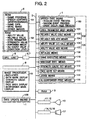
- FIG. 2 is a functional construction diagram mainly showing the functions of the CPU 1 shown in FIG. 1, and FIG. 3 is a diagram illustrating an example of the menu selection screen as a main screen.
- the video game to which the invention is applied is, for example, such that a rookie soccer player (main character) having joined a youth team of the J-league is reared and trained so as to be promoted to the first team of the same club of the J-league (or promoted from the second team to the first team depending upon the kind of the game) within a specified period on a time axis of the game.
- a game mode setting screen is displayed with icons.
- the modes include, for example, "J-league”, “Tournament”, “Tournament among National Teams” and others (e.g. "File Selection”.
- the game player can confirm (i.e. select) the content of instruction by pushing the A-button 8a while designating the position of a desired icon by the cross key 8d (by changing a display color of the designated icon or increasing the luminance thereof) or by movably displaying a cursor and clicking it at the designated position).
- the video screen is switched to a screen of the confirmed game mode.
- an initialization screen is displayed to register a player if the game is started "new".
- a next game screen is displayed.
- the generation of a main character is permitted as he joins the team, and his name is inputted, his face is selected from a plurality of already available faces, a name of his team is set (e.g. the name of the youth team), his position (e.g.
- FW forward
- MF midfield
- DF DF(defender)
- his height and his stronger leg are inputted, and how he calls himself is selected by an initializing means 108 according to the operation contents of the operation unit 8.
- the input and selection results are displayed in corresponding positions of the initialization screen of the monitor 3.
- a "scoring ability" of the main character as a rookie, “shooting ability”, “curving ability” to curve the shot ball, "speed”, “dashing ability”, “physical strength”, “jumping ability”, “ball-keeping ability”, “defense ability” and “passing ability' are set at random or fixed numerical values (of 1 to 99) and displayed. Further, a time information is set at the first week, April of the first year,, and displayed.
- the interrupted game When the interrupted game is resumed using the game data loaded immediately before the game was interrupted, it can be started by selecting the "File Selection” after selecting the aforementioned "Training of Player” in the game mode selection.
- Time passes by the week in the game by selecting various speeches/actions and practicing then accordingly by the week.
- the ability values, reliability degree, enthusiasm parameter value, etc. of the main character increase and decrease as described later according to the execution results of the selected speeches/actions.
- the game is over after a judgment as to whether the main character can be promoted to the first team of the club of the J-league is made upon the lapse of a predetermined period, e.g. two and half years in the time axis of the game.
- the storage medium 5 is provided with a ROM 51 and a backup battery RAM 52 which is a built-in battery.
- the ROM 51 has a memory area in which game programs (including a playing game and a mini-game to be described later) necessary to execute this game, the main character's speeches (sentences representing the contents of what he speaks (see FIG. 3, etc.), images of the main character, manager character as a leader of the main character, two coach characters, teammate characters and other characters (see FIG. 6) who appear if necessary, the menu screen, the respective basic screens while the speeches/actions are conducted, background screens and the like are stored, and another memory area in which various game data necessary to progress this game are stored.
- the RAM 52 is provided with a memory area in which various contents of the ability values, reliability degree, enthusiasm parameter value, physical strength value, gunpowder amount, injury count value and motivation degree are renewably loaded and another memory area in which the result of the mini-game is stored.
- the image processor 10 applies an imaging processing to an "enthusiasm mark” representing the main character's dedication to soccer, a “physical strength gauge” representing the main character's physical strength, a “face mark” showing a motivation degree in a distinguishable and simulated manner, and a “bomb mark” showing a physical trouble in a body part such as a waist or leg based on the numerical data sent from the CPU 1 in real time.
- FIG. 3 is a diagram illustrating a menu screen as a main screen of this game.
- a field is simulated in the middle of the screen of the monitor 13 and a face image 130 of the main character is superimposed in a specified position at the left side of the field.
- An icon display area 131 where icons representing selectable commands are arrayed in matrix as in a list is set at the right side of the field.
- a date display area 132 where a lapse of time from the enrollment of the main character as a time information of the game is displayed in date, month, year is set at the left end of a central part.
- a mark display area 133 where a part of the individual data of the main character: name, "face mark”, “physical strength gauge”, “enthusiasm mark” are displayed in a horizontal line is set in an upper part of the screen, and an ability value display area 134 where various ability values are displayed is set immediately below the mark display area 133.
- a face mark 133a In the mark display area 133, a face mark 133a, a physical strength gauge 133b and an enthusiasm mark 133c are displayed from the left.
- the face mark 133a shows an expression by the eyes and mouth in a circle or a circular mark.
- the enthusiasm mark 133c is expressed by a Chinese character "soul" and a flame mark, preferably in color.
- a speech progress guide display area 135 which appears in relation to the speech of the main character to display sentences so as to guide a progress of the contents of the speeches/actions is set in the lower half of the screen.
- sentences are displayed as a guide in a multiple-choice format according to the contents of the speech or the progress thereof.
- a desired sentence is selected by the operation unit 8.
- the respective icons in the icon area 131 represent commands “Training”, “Rest”, “Play,, , “Speak”, “Own Evaluation”, “Individual Status”, “Option” and “Next Page” from upper left to lower right. Out of these commands, "Training”, “Rest”, “Play”, “Speak” are prepared as speech commands. When these commands are selected, one week passes and specified processing is performed by a speech executing means 100 to be described later. In FIG. 3, “Training” (although unconfirmed) is instructed by the cross key 8d, a character guide “I will select training.” is displayed in the lower half of the screen. If “Rest” is instructed as shown in FIG. 15, a character guide “I can recover physical strength.” is displayed.
- the speech executing means 100 reads contents corresponding to a speech selected by the operation unit 8 from "Training”, “Rest,, , “Play”, “Speak” from the RAM 3 which are transferred from the ROM 51 and stored in the RAM 3 during the game, thereby executing a speech.
- the execution of the speech coming up by the week include regular events which always occur upon reaching a certain point of time if specified factors are satisfied, and random events which randomly occur from a plurality of factors prepared in advance according to the selected speech in view of various factors.
- the speech executing means 100 executes such regular events and random events as the contents of speech.
- An enthusiasm parameter calculating means 101 adds a specified value set in advance when the training-related command, i.e. "Training”, “Speak with a Rival” of the "Speak” menu, and “Participate in a Game” by the recommendation of the manager to be described later are executed, and conversely subtracts a specified value when "Rest”, "Play”, and “Speak with a Girl” and “Speak with a Girlfriend” of the "Speak” menu are selected.
- the enthusiasm parameter is an index of dedicated attitude to and enthusiasm for soccer and is expressed in, for example, up to maximum 256 points. If the enthusiasm parameter vale is extremely high, a benefit of tentatively increasing abilities during a game when the main character participates in a "Game” to be described later.
- the enthusiasm parameter calculating means 101 outputs the calculated enthusiasm parameter value to the image processor 10.
- the image processor 10 color-displays the enthusiasm mark 133c with the Chinese character "Soul” and the flame mark. Further, the display color or outline color of the Chinese character "Soul” is changed in a plurality of gradations from red to blue, for example, in 256 different gradations of color in the same way as the enthusiasm parameter so as to correspond or preferably be proportional to the inputted enthusiasm parameter value, and the flame mark is displayed in five different sizes according to the enthusiasm parameter value.
- a reliability degree calculating means 102 is comprised of an reliability degree addend calculating means 103 and a reliability degree adding means 104.
- the calculating means 103 determines a reliability degree addend according to the enthusiasm parameter value.
- the adding means 104 adds the determined reliability degree addend to the present reliability degree.
- the reliability degree is expressed, for example, in 0 to 99 points.
- the enthusiasm parameter value is high, such an event as to bring about a good result is selected from a plurality of events in the processing by the speech executing means 100. For example, if the enthusiasm parameter value is equal to or above Pa, such an event as to increase “Motivation” and considerably increase “Reliability Degree” between the main character and the teammates occurs. If the enthusiasm parameter value is equal to or above Pb, such an event as to increase “Motivation” and increase “Reliability Degree” between the main character and the teammates occurs. If the enthusiasm parameter value is equal to or above Pc, such an event as to increase "Motivation” but decrease "Reliability Degree” from the teammates occurs. In an area of the ROM 51 for storing the contents of speech, such events as to act negatively and positively are selectably stored.
- the CPU 1 forcibly ends the game in the middle by executing a forcible ending function assuming that the main character's enthusiasm for soccer has fallen to an unrecoverable level.
- the reliability degree is reflected on the determination of an ability value addend which is obtained by executing the speech influential to the ability values. This is also reflected whether or not the main character will be given a chance to participate in a specified event which occurs during the execution of the contents of speech, for example, in the "Game".
- An ability value renewing means 105 is comprised of an ability value addend calculating means 106 and an ability value adding means 107.
- the results of execution of speeches/actions influential to changes of the ability values and ability value addends corresponding to various abilities are stored in correspondence as game data.
- the calculating means 106 determines ability value addends corresponding to the respective abilities in relation to the result of speech executed based on such game data.
- the adding means 107 adds the obtained ability value addends to the ability values presently set for the main character.
- the calculating means 106 reads the reliability degrees of the manager, coach and teammates on the main character from the reliability degree calculating means 104 during the calculation to use them as factors determining the ability value addends.
- a weighted reliability degree of those of the manager, coach and teammates on the main character may be added or only the reliability degrees of the manager and coach on the main character may be added.
- the initializing means 108 causes the initialization screen of the main character to generate his individual data at the time when he joins the soccer club when this game is first started.
- the name of the main character is inputted, a face image is selected as his face from a plurality of faces prepared in advance, his club name (for example, a team name of the youth league, etc.) is inputted, his position such as FW, MF or DF is inputted, his height and stronger leg are inputted, and how he calls himself is selected according to the operation of the operation unit 8.
- a date renewing means 109 functions as a time renewing means for advancing time in the game. Every time the speech-related menu is operated by the operation unit 8, time is advanced by one week from the first week, April of the first year till the first week, September of the third year.
- a game executing means 110 randomly causes the manager character to permit the main character to participate in a "Game” when a specified condition, e.g. the reliability degree above a specified value, is satisfied, and executes processing concerning the "Game” when a game is decided.
- a specified condition e.g. the reliability degree above a specified value
- the game player moves the main character by operating the various buttons and keys of the operation unit 8. As described later, a mode in which the "Game” is actually executed and a mode in which the game result is displayed in digest form without executing the "Game” are selectable (see FIG. 18).
- a mini-game executing means 111 executes a mini-game when "Mini-Game” is selected from the "Training" menu, and is constructed by a function realizing means shown in FIG. 31 as described later.
- the function realizing means is shown in detail in FIGS. 32 to 42.
- a physical strength gauge setting means 112 subtracts values correspond to the respective contents of "Training” from the present physical strength value and adds values set for "Rest", "Play", “Speak” and the like to the present physical strength value, and outputs the calculated values to the image processor 10.
- the image processor 10 causes the physical strength gauge 133b in which a horizontal axis is gauged by 0 to 100 scales to be displayed, and makes the remaining physical strength visible to the player by displaying a gauge range from value 0 to the present physical strength value in relatively high luminance.
- a face mark setting means 113 calculates a "Motivation Index” set in conformity with “Rest”, "Play”, “Speak” and the like in real time.
- the calculated “Motivation Index” is outputted to the image processor 10.
- the image processor 10 suitably changes the states of the eyes and mouth of the face mark 133a so as to correspond to the inputted "Motivation Index” and further changes the display color of the circle mark if necessary, thereby making the present degree of the main character's "Motivation” visible to the player by replacing it by the facial expression of the face mark 133b.
- a judging means 114 operates in the first week, September of the third year to judge whether the main character can be promoted to the first team of the same club of the J-league.
- Determination factors include (1) whether the main character has ability values necessary for the set position, (2) whether the reliability degree of the manager on him is high, i.e. whether the reliability degree of the manager character is equal to or above a specified value (e.g. 200 points) (if necessary, it may be added as a condition that the reliability degrees of both Kitoh coach and Ohbayashi coach are equal to or above 120 points. Since the promotion conditions are stricter in this case, more difficult games can be provided), (3) whether the main character has already participated in one "game” regardless of whether the team has won or not.
- a specified value e.g. 200 points
- the judging means 114 judges a "successful growth” and promotes the main character to the first team of the same club of the J-league. Unless otherwise, the judging means 114 judges a "growth failure” and causes the "game over processing to be performed. Since whether the main character has been successfully reared is evaluated also with reference to the reliability degree of the manager and others on him in this way, the growth evaluation can be made in a more realistic manner.
- the ability values of the main character may be evaluated by comparing the respective ability values.
- an evaluation based only on the ability items set for each position is more preferable since such an evaluation conforms to an actual practice. For example, a center forward" may be evaluated based on his "scoring ability", “shooting ability”, “speed”, “dashing ability”, “physical strength”, “jumping ability” and “ball-keeping ability”, whereas a goalkeeper may be evaluated based on his “goal saving ability", “goal-kick ability”, “dashing ability” and “jumping ability”.
- the player's abilities may be evaluated by comparing them with the ability items regarded as important.
- the positions may be divided into “goalkeeper” and other positions.
- An injury/bomb processing means 115 counts the number of "injuries” occurred to the main character and sets and displays an amount of gunpowder set according to the content of injury as a "bomb mark".
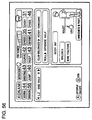
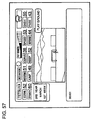
- the processing means 115 is described in detail with reference to FIGS. 43 and 56 to 58.
- FIG. 28 is a flowchart showing an entire flow of this game.
- Step ST1 when an unillustrated power supply is turned on to activate the game device, a specified main selection menu is displayed (Step ST1). If "Rearing Game” is selected at this stage, a specified “File Selection Screen,, is displayed (step ST3) to guide whether this game is new or not (Step ST5).
- Step ST7 a specified "opening" screen which creates a soccer game atmosphere is displayed with sound effects by selecting "New" (Step ST7), and the setting and input of the individual data of the main character are permitted (Step ST9).
- the game is started and the date is first set to "the first week, April of the first year" (Step ST11).
- Step ST13 the data of the game loaded immediately before the game was interrupted are transferred from the RAM 52 to the RAM 3 by selecting a guide "Not New” (Step ST13). Consequently, the main screen ("Training" is not instructed yet) as shown in FIG. 3 is displayed on the monitor 13 (Step ST15).
- Step ST17 speech selection is selected from the icon display area 131 by the operation unit 8 (Step ST17), and the speech executing means 100 executes the contents of the selected speech and issues a command to the date renewing means 109 to advance the date by one week (Step ST19). Whether the date has reached a point of time when the growth results are evaluated is judged (Step ST21). Unless the date has reached this point of time, this flow returns to Step ST15 to display the menu screen. On the other hand, if the growth result evaluation time has come, whether the growth results satisfy the promotion conditions is judged (Step ST23). If so, the growth is judged to be successful and the main character is promoted to the first team of the same club of the J-league (Step ST25).
- Step ST27 an arbitrary selection of a new face shot for the J-league from a plurality of those prepared in advance is permitted (Step ST27), and the main character is registered as a player newly generated for the J-league (Step ST29).
- the grown and promoted player is added to the members who can participate in the game.
- Step ST31 the game is over (Step ST31) assuming a growth failure.
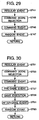
- Step ST19 a subroutine "Speech Execution" in Step ST19 is described with reference to flowcharts "Usual Period” and “Season” shown in FIGS. 29 and 30.
- Step ST41 a "regular event” is executed (Step ST41).
- This "regular event” occurs at a fixed point of time and always occurs when time in the game coincides with this fixed point of time. Basically, the “regular events” are set at most of times for the respective speeches/actions.
- the flow returns to the menu screen, and the date is advanced by one week by displaying, for example, a sentence "What shall I do this week" in the speech progress guide display area 135. In this state, an input of a new command is permitted (Step ST43). If a certain speech is selected, contents corresponding to this speech are executed (Step ST45), and a "random event", which can be positive or negative, randomly occurs at a certain probability (Step ST47).
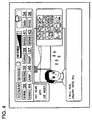
- a guide is displayed in characters as shown in FIG. 3. If “Training” is confirmed, various training menus are selectably displayed in the form of icons as shown in FIG. 4.
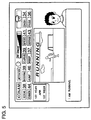
- the training menus include, for example, “Running”, “Dashing”, “Dribbling”, and “Mini-Game (Defense Training)”. If “Running” is selected, “I will run (injury rate: 3%)" is displayed in the speech progress guide display area 135 as shown in FIG. 4, and the execution of this speech is started.
- the speech executing means 100 calculates the "Injury Rate” in view of the main characters “Physical Strength Value”, “Enthusiasm Parameter Value”, “Reliability Degree”, “Motivation Index”, etc.
- FIG. 6 shows a part of the speech contents when Kitoh coach gives the main character a training guidance
- FIG. 7 shows a case where positive results are seen in the contents in the speech progress guide display area 135 and the "Reliability Degree” of the coach on the main character and the “Ability Values” increase. In this way, increases (ability value addends) of the "Ability Values” are set in view of the "Reliability Degree(s)”.
- the speech contents are set, for example, such that "Injury Event” or negative event randomly occurs during training.
- a negative event such as "Injury Event”, “Outpatient Event (event which causes the main character to go to hospital for treatment”, or “Inpatient Event (event which causes the main character to be hospitalized)"
- the "Ability Values” and the “Reliability Degrees” of the manager and coaches remain at the present levels or are decreased.
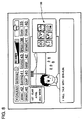
- a company icon area 136 for selectably displaying a conversation company is displayed, and a desired conversation company can be selected from those displayed in this area 136.
- the company icon area 136 shown in FIG. 8 is on a next page and that the previous page includes "Manager' as a leader character, "Kitoh coach", “Ohbayashi coach”, at least one "Rival” having the same position as the main character, "Girl", and "Next Page” from upper left as shown in FIG. 13.
- a teammate "Ishii-kun” in the next page is selected, a character guide “I will talk with Ishii-kun” is displayed.
- FIG. 8 a teammate "Ishii-kun” in the next page is selected, a character guide “I will talk with Ishii-kun” is displayed.
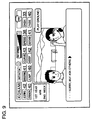
- FIG. 9 a conversion with "Ishii-kun” is guided in characters, for example, "Sorry, but ask others".
- FIG. 9 rather shows a randomly occurred negative event.
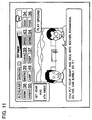
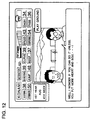
- FIGS. 10 to 12 also show a case where "Speak” is selected, specifically showing a part of the speech contents with the "Rival”.
- a good result (positive event) as a speech result: "You put your heart and soul into soccer, Konami-kun. So you can surely do it!!” occurs.
- FIG. 12 a bad result (negative event) as a speech result: "Well, I wonder whether you can do it unless you put more heart and soul ! occurs.
- the speech executing means 100 sets the direction of the speech result: whether the speech result is positive, or negative or neutral if necessary, based on the main character's "Enthusiasm Parameter Value". In other words, the higher the "Enthusiasm Parameter Value", the more likely positive events are to occur at a certain probability. Conversely, the lower the “Enthusiasm Parameter Value", the more likely negative events are to occur at a certain probability.
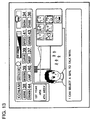
- FIG. 13 shows a case where "Girl” has been designated as a conversation company, and the speech content successively progress as shown in “I will talk with her” by confirming using the "A" button 8a.
- the contents of the conversation prepared in advance or the contents of conversation randomly selected from those prepared in a multiple choice format are displayed, and the "Motivation Index" calculated by the face mark setting means 113 increases.
- the expression of the face mark 133a changes to lighten up.
- FIG. 15 shows a case where "Rest” is selected. "I can recover physical strength” is displayed in the speech progress guide display area 135. This increases the “Motivation Index” and “Physical Strength Value” and conversely decreases the “Enthusiasm Parameter Value” although the “Ability Values” are not changed.
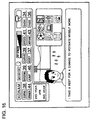
- FIG. 16 shows a case where "Rest” is selected. "I take a rest for a change to motivate myself more” is displayed in speech progress guide display area 135. This case also increases the “Motivation Index” and “Physical Strength Value” and conversely decreases the "Enthusiasm Parameter Value” although the “Ability Values” are not changed. If the "Enthusiasm Parameter Value” is lower when “Rest” is selected, the speech executing means 100 makes a negative event such as a "Traffic Accident" likely to occur.
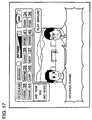
- FIG. 17 shows a screen when the "Manager” character permits the main character to participate in the "Game”.
- a face image of the "Manager” character is displayed and "Defender Konami” is displayed in the speech progress guide display area 135.
- Step ST51 the "regular event” in this week is executed.
- the "regular event” occurs at a fixed point of time and always occurs when time in the game coincide with this fixed point of time. Basically, the “regular events” are set at most of times for the respective speeches/actions.
- the flow returns to the menu screen upon the completion of the "regular event", and the date is advanced by one week by displaying, for example, "What shall I do this week?" in the speech progress guide display area 135. In this state, an input of a new command is permitted (Step ST53). When a certain speech is selected, the content corresponding to this speech is executed (Step ST55).
- the "Game” is executed after, for example, a conversation with a member of an enemy team is displayed on the screen as a "before-the-game event" (Steps ST57, ST59).
- a conversation with a supporter is, for example, displayed as a "after-the-game event” (Step ST61).
- a positive or negative event occurs at a certain probability as a "random event” (Step ST63).
- the time of the game passes by the specified time unit, i.e. one week in this embodiment by making simple speeches/actions. Altematively, speeches/actions may progress in such a manner that passage of one day (or several days) can be understood.
- FIG. 18 is a screen following the screen of FIG. 17, and "Play a Game” and “Look at the Result” are selectably displayed in the speech progress guide display area 135.
- the game executing means 110 displays a screen simulating an actual field, and the main character, teammate characters and enemy characters whose movements are controlled by the CPU 1 in accordance with the rules of the soccer game, and controls the progress of the game based on the contents of instructions given to the main character by operating the operation unit 8.
- FIG. 18 shows a state where the cross key 8d is positioned on "Look at the Result" to designate it. If the A-button 8a is operated in this state, the content of instruction is confirmed and "Look at the Result" is executed.
- the game executing means 110 displays a game showing an image in which the main character appears in a digest version game prepared in advance.
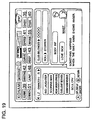
- a screen of FIG. 19 showing the ability table is displayed, so that the game player can know the contents of the game are reflected on the ability values of the main character, i.e. the ability values are increased or decreased depending upon the contents of the game.
- "Something happens when the smily mark shows anger” is displayed.
- This message means that the eyes and mouth of the face mark 133a are changed to express anger if such an event as a foul occurs during the "Game” when the flame of the enthusiasm mark 133c is at or near maximum, i.e. the main character's "Enthusiasm Parameter Value” is extremely high.
- the abilities of the main character are controlled to slightly increase during the "Game”. Specifically, even if the same instruction is given by the operation unit 8, the movement of the main character is speedier and quicker during the "Game”.
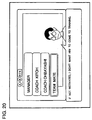
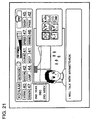
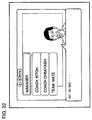
- FIGS. 20 and 22 show screens when "Own Evaluation" is selected.
- a negative event which occurs when the "Enthusiasm Parameter Value" of the main character is low is displayed as a speech of a teammate "Miyamoto-kun”: "If is not motivated, I don't want him to come to training".
- FIG. 21 shows a screen in which "I will talk with Miyamoto-kun” is executed by the game player selecting "Speak” and "Miyamoto-kun” to increase the "Reliability Degree” of this teammate on the main character.
- the manager character's thoughts "Not so bad" is displayed.
- FIG. 22 shows a negative event which occurs when the "Enthusiasm Parameter Value" of the main character is low.
- FIG. 21 shows a screen in which "I will talk with Miyamoto-kun” is executed by the game player selecting "Speak” and "Miyamoto-kun” to increase the "Reliability Degree” of
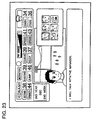
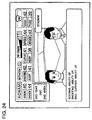
- FIGS. 19, 25, 26 show the enthusiasm mark 133c in different sizes.
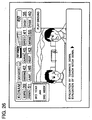
- the enthusiasm mark 133c is almost at maximum in FIG. 19, about medium-size in FIG. 25 and at or near minimum in FIG. 26. Accordingly, in FIG. 25, the result of the event is likely to be negative as can be seen from “Evaluation from teammates down”. In FIG. 26, the result of the event is even more negative as can be seen from "Evaluation from teammates down and evaluation from Kitoh coach down”. If the "Enthusiasm Parameter Value", i.e. the enthusiasm mark 133c falls to or below that of FIG. 26, the game is forcibly finished upon judgment that the main character has lost his enthusiasm for soccer.
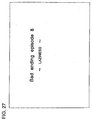
- FIG. 27 shows a screen at this time and "---Laziness---" is displayed on the screen.
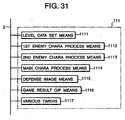
- FIG. 31 is a functional block diagram of the mini-game executing means 111 shown in FIG. 2.
- This mini-game (defense training) is executed by selecting "Mini-Game” from the "Training" screen of FIG. 3.
- the main character is operated using the operation unit 8 to do a one-on-one or two-on-one defense training with enemies (first and second enemy characters).
- the contents of training are prepared from level 1 to, for example, level 6 in the ROM 51 depending on difficulty.
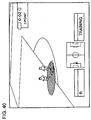
- This mini-game is schematically described with reference to FIGS. 39 and 40.
- a field as a gaming place is displayed on the screen, and a first enemy character E1 and a main character Pa are displayed in the one-on-one game.
- the main character Pa can be moved by operating the operation unit 8, and the first enemy character E1 has its movement controlled by a first enemy character processor 1112 of the CPU 1 to be described later.
- no soccer ball is displayed and, instead, a circle mark Ci centered on the feet of the first enemy character E1 is displayed.
- a ring mark Ri indicating the position of the main character Pa and an arrow mark Sp indicating a moving direction of the main character Pa are displayed at his feet.
- the defense training is made executable by operating the operation unit 8 such that the main character Pa enters and continues to stay inside the circle mark Ci set for the first enemy character E1, whose moving direction is constantly changed, for a predetermined time.
- the display color of the circle mark Ci is differed depending upon whether the main character Pa is inside the circle mark Ci (see FIG. 40) or not (see FIG. 39) so that the game player can visually confirm it.
- the display color of the ring mark Ri may be changed for the same purpose or a sound guide may be given instead of changing the display color. Any means may be adopted provided it will notify in such a manner easily recognizable to the game player.
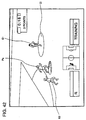
- the first and second enemy characters E1, E2 appear as shown in FIG. 42 and are switched by alternately setting the circle mark Ci for them.
- a level data setting means 1111 is stored in the ROM 51 and adapted to read various setting data for changing difficulty according to the level via the RAM 3 every time the mini-game of a corresponding level is executed. The execution of a mini-game of a next level is permitted by clearing specified conditions from level 1. Mini-game of up to level 6 is executable.
- the first enemy character processing means 1112 controls the respective movements of the first enemy character E1 based on the corresponding data set by the level data setting means 1111.
- a second character setting means 1113 determines a display position of the second character enemy E2 by setting a position of the first enemy character E1 in the field by coordinate values.
- a main character processing means 114 moves the main character Pa on the field screen in accordance with an operation signal received from the operation unit 8.
- a defense judging means 1115 judges within a specified game time whether the main character Pa has continued to stay inside the circle mark Ci of the first enemy character E1 for the predetermined time.
- a variety of timers 1117 are for monitoring the respective set times.
- a game result outputting means 1116 outputs an information on the judgment result and cleared level (only information on a failure to clear level 1 if level 1 could not be cleared) to the CPU 1.
- mini-game operation by the mini-game executing means 111 is described with reference to flowcharts shown in FIGS. 32 to 36 while referring to FIGS. 37 to 42 illustrating corresponding screens.
- a screen shown in FIG. 37 is displayed "You can play a defense training in mini-game” is displayed as a guide in the speech progress guide display area 135 on the screen. Subsequently, a screen shown in FIG. 38 is displayed “"Mark” is attached to the enemy's feet. Look at it carefully and try to stay near the "Mark”” is displayed in order to guide the game player how to operate (conduct the training). Thereafter, a screen of the mini-game, for example, as shown in FIG. 39 appears.
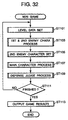
- FIG. 32 is a main flowchart of the mini-game.
- the level data are set according to the level (Step ST101)
- movement processing is executed for the first and second enemy characters E1, E2 based on the set data and position setting is executed for the second enemy character E2 (Steps ST103, ST105).
- movement processing is executed for the main character Pa (Step ST107).
- defense judgment is executed as to whether the main character Pa has continued to stay inside the circle mark Ci of the first enemy character E1 for the predetermined time (has cleared the condition) (Step ST109). If the condition was cleared within the specified game time, this flow returns to Step ST101 to newly set the level data of a next level one step above the previous level and the continuation of the mini-game is similarly permitted. On the other hand, if the condition was not cleared, the game result is outputted upon the judgment that the mini-game is over and this flow is completed.
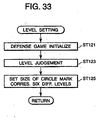
- FIG. 33 is a subroutine "Level Setting”. First, the set data of this game is initialized (Step ST121), and then a level of this time is discriminated (Step ST123) to set the corresponding level data, for example, the size (radius) of the circle mark Ci (Step ST125).
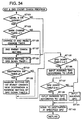
- FIG. 34 is a subroutine "First and Second Enemy Character Processing". Whether the level is not below “3" is first discriminated. The game is executed in one-on-one mode if the level is "1" or "2", while being executed in two-on-one mode if the level is "3" or higher.
- Step ST121 If the level is "1" or "2" (NO in Step ST121), this subroutine proceeds to Step ST129 to set a random value in a speed-down timer 1 and further proceeds to Step ST131.
- the speed-down timer 1 is set for the first enemy character E1.
- a moving speed is set to e.g. a walking speed and a higher speed corresponding to the level is set when time set in the speed-down timer 1 is up.
- Step ST131 Whether a destination switching timer is "0" is judged in Step ST131.
- This timer is for successively randomly setting a new destination of the main character Pa with respect to the first enemy character E1 to realize, for example, such an irregular movement of the main character Pa that the main character Pa facing to the right suddenly starts moving to the left as shown in FIGS. 39 and 40.
- the destination is switched every time a fixed period of several seconds or a randomly set period passes.
- Step ST133 If the destination switching timer is not "0", i.e. the set time is not up yet, the first enemy character E1 is caused to move toward the already set destination. Unless otherwise, a new destination is randomly set with respect to the first enemy character E1 and a random value is set in a speed-down timer 2 (Step ST133), and this flow proceeds to Step ST135 where whether the speed-down timer 1 is "0" is judged.
- the speed-down timer 2 remains set at "0" in the one-on-one game mode. Accordingly, this subroutine goes through Step ST137 in this case.
- the walking speed is inputted and designated as the moving speed of the first enemy character E1 if the speed-down timer 1 has not reached "0", whereas the running speed according to the level is inputted and designated when the speed-down timer 1 reaches "0" (Step ST139).
- the first enemy character E1 is moved to the destination at such a designated speed (Step ST143).
- Step ST121 If the level is "3" or higher (YES in Step ST121), the circle mark Ci is alternately given to the first and second enemy characters E1, E2 as shown in FIG. 42.
- Step ST123 whether a mark switching timer is "0" is judged in Step ST123.
- the mark switching timer is for alternately giving the circle mark Ci to the two enemy characters E1, E2.
- the circle mark Ci is given to the other enemy character when this timer reaches "0", i.e. the set time is up, thereby switching this enemy character to the first enemy character E1.
- the mark switching timer is "0" (YES in ST123)
- the circle mark Ci is switched to the other enemy character, and the mark switching timer is started by resetting (Step ST125).
- setting processing for the second enemy character E2 is executed (Step ST127) and a random number is set in the speed-down timer 1 (Step ST129).
- Step ST129 setting processing for the second enemy character E2 is executed.
- Step ST131 whether the destination switching timer is "0" is judged. If not, this subroutine proceeds to Step ST135. If the timer is "0", a new destination is randomly set for the first enemy character E1 and a random value is set in the speed-down timer 2.
- Step ST135, ST137 Whether the speed-down timers 1, 2 are "0" is judged respectively (Steps ST135, ST137). If neither the speed-down timer 1 nor 2 is “0”, the walking speed is designated as the moving speed of the first and second enemy characters E1, E2 (Step ST139), who further move to their destinations (Step ST143). When the speed-down timer 1 reaches "0", a running speed corresponding to the level is designated for the first enemy character E1 (Step ST136), and the two enemy characters E1, E2 further move to their respective destinations. When the speed-down timer 2 reaches "0", a running speed corresponding to the level is designated for the second enemy character E2, and the two enemy characters E1, E2 further move to their respective destinations.
- FIG. 35 shows a subroutine "Second Enemy Character Setting".
- Step ST151 is executed to set a destination of the second enemy character E2.
- (X-coordinate of the position of the first enemy character E1 -80) is set as an X-coordinate of the position of the second enemy character E2 when the first enemy character E1 is on the positive side
- (X-coordinate of the position of the first enemy character E1 +80) is set as an X-coordinate of the position of the second enemy character E2 when the first enemy character E1 is on the negative side
- the moving speed of the second enemy character E2 to his destination is set slower as he approaches the destination (after the speed-down timer 2 reaches "0").
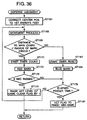
- FIG. 36 is a subroutine "Defense Judgment".
- a center position is corrected to the feet of the first enemy character E1, i.e. relative coordinate systems are set (Step ST161) in order to facilitate a judgment as to whether the main character Pa is inside the circle mark Ci.
- new coordinate systems corresponding to the operation by the operation unit 8 are obtained for the main character Pa (Step ST163).
- Step ST165 Whether the position (feet, for example, coordinates of the center of the ring mark Ri) of the main character Pa is inside the circle mark Ci set for the first enemy character E1 is the judged (Step ST165). If not, this subroutine proceeds to Step ST179 after the timer is started by resetting (Step ST167) and the circle mark Ci is displayed in a specified color, for example, in blue (Step ST169).
- Step ST171 if the position of the main character Pa is inside the circle mark Ci set for the first enemy character E1, counting by the timer is continued (Step ST171) and the circle Ci is displayed in a color different from the above specified color, for example, in red (Step ST173).
- Step ST175 whether the circle mark Ci has been displayed in red for three or more seconds is judged. Specifically, whether the approach of the main character Pa to the first enemy character E1 has been continued for three or more seconds is judged. If three seconds have not elapsed yet, this subroutine proceeds to Step ST179. If, on the other hand, three seconds have already elapsed, this subroutine returns after a game clear flag is set assuming a success and the level of the game is raised by one stage (Step ST177).
- FIG. 41 shows a game screen when the main character Pa cleared the condition. As shown at the upper right, a time required is 14 seconds and points are changed from 0 point to 2 points.
- Step ST179 whether a predetermined time, e.g. 20 seconds have elapsed is judged. If not, this subroutine returns to Step ST163. If the predetermined time has elapsed, a mini-game completion flag is set assuming that the main character could not clear the condition (Step ST181).
- a period as a clearing condition is not restricted to three seconds, but may be any suitable period. Alternatively, this period may be changeably set so as to be longer as the level increases.
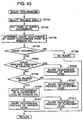
- FIG. 43 is a flowchart of a "Injury Occurrence/Bomb" routine.
- an injury occurrence rate is determined using the respective training items, i.e. the main character's "Motivation Index", “Physical Strength Value” and “Enthusiasm Parameter Value” (Step ST193).
- FIGS. 46 and 47 show screens when "Running” is selected from the "Training” menu. The injury occurrence rate is 3% in FIG. 46 while being 42% in FIG. 47. Subsequently, injury occurrence is actually determined using a random number for the determined occurrence rate (Step ST195).
- Step ST197 The injury occurrence is judged (Step ST197) and this flow returns without creating an injury occurrence event (Step ST199) if no occurrence is judged.
- Step ST199 On the other hand, if injury occurrence is judged, whether the injury is of outpatient level (level where the injured goes to hospital for treatment) is judged (Step ST201). If the injury is of outpatient level, a negative event is caused to occur so that the main character has an injury of inpatient level (level where the injured has to be hospitalized) (Step ST203), and the screens are changed to those in hospital for a specified number of weeks and the selection of "Training" is absolutely prohibited while the main character is in hospital.
- FIGS. 48 and 49 show screens when an injury of inpatient level occurs during “Running".
- FIG. 48 the screen in which one teammate appears and cries "Konami-kun, are you all right? Manager, Konami-kun got injured! is displayed.
- FIG. 49 the screen of the main character in hospital is displayed and the level of the injury is explained: "Result of diagnosis: Fracture of Bone, Four Weeks to Completely Heal”.
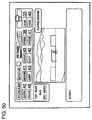
- FIGS. 50 and 51 show screens when an injury of inpatient level occurs during "Running". In FIG. 50, a mimicking sound "Guki! indicating an abnormality is displayed. Then, in FIG. 51, a conversation screen with a teammate is displayed, in which a conversation "I got a muscle strain. My ball-keeping ability is down” indicating the injury of outpatient level is displayed.
- Step ST209 a random number is generated to execute such a control as to cause an occurrence of injury of outpatient or inpatient level.
- the occurrence of injury of outpatient or inpatient level is determined using the random number such that the occurrence rate of the injury of outpatient level is 30% and that of inpatient level is 70%.
- this flow returns after the hospital image is displayed for a predetermined period and an inpatient level injury occurrence processing such as prohibition of the selection of the "Training" items is executed (Step ST211).
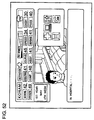
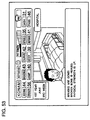
- FIGS. 52 and 53 show screens in which the main character is hospitalized due to the injury of inpatient level and is completely healed after the lapse of a specified time.
- FIG. 52 the in-hospital image and "In Hospital " are displayed.
- FIG. 53 "Bruises are gone. Broken bone is healed. Physical strength is up” indicating a complete healing is displayed. This indicates the main character's physical strength has been increased by being hospitalized.
- Step ST213 if the injury of outpatient level occurs, the flow returns after a message "Currently Outpatient" is displayed (Step ST213).
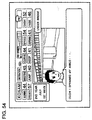
- the injury occurrence events are not restricted to during “Training”, but may occur during "Play” or the like "Ouch! I?ue sprained my ankle " as shown in FIG. 54. In the case that "Enthusiasm Parameter Value” is low, an injury is likely to randomly occur as a negative event.
- FIG. 44 shows a subroutine "Bomb Processing”.
- an injury occurrence is judged (Step ST221).
- This subroutine returns if no injury has occurred.
- an amount of gunpowder according to the level and kind of the injury is set (Step ST223).
- the gunpowder amount is calculated by adding a gunpowder amount this time to the one immediately before the occurrence of injury.
- whether the gunpowder amount has reached "40" in relation to a maximum amount "100” is judged (Step ST225).
- This subroutine proceeds to Step ST229 unless the gunpowder amount exceeds "40".
- FIG. 56 is a screen sowing "Own Evaluation”. After the occurrence of the bomb, "Body information: Bruises, Fracture of Bone” is displayed as body information at that time. Further, a display control is executed so that a bomb mark B appears on the side of "Legs" (the bomb mark B can also appear on the side of "Waist” of the main character image (Step ST227). Subsequently, an occurrence of a specific event is judged (Step ST229). This subroutine returns if no such event has occurred. A control is executed to clear the gunpowder amount and disappear the bomb mark B (Step ST231) if the specific event has occurred.
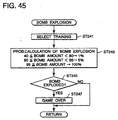
- FIG. 45 is a subroutine "Bomb Explosion".
- Step ST241 When "Training" is selected (Step ST241), whether the bomb will explode is determined using a random number (Step ST243).
- a bomb explosion rate is 1% when the gunpowder amount is 40 to 80 (exclusive) and 5 % when it is 80 to 95 (exclusive). The explosion of the bomb is determined using the random number with such rates.
- a determination method here is as follows. For example, in the case that the gunpowder amount is "85”, the bomb will explode if one number randomly selected from numbers 1 to 100 coincides with one of five numbers specified in advance. In the case that the gunpowder amount is "95”, the bomb will exploded 100%, i.e. without fail.
- Step ST245 If the explosion of the bomb is determined (YES in Step ST245), the game is forcibly finished (Step ST247) assuming that such a fatal injury as to make it impossible for the main character to play soccer again has occurred to the leg or waist of the main character.
- This subroutine returns unless otherwise (NO in Step ST245).
- FIGS. 57 and 58 show game-over occurrence screens. In FIG. 57, “Beki!!” showing an abnormality is displayed during “Training”. Upon receipt of the determination of the bomb explosion, "--Explosion--" is displayed in FIG. 58 to finish the game.
- the present invention may also be embodied as follows.
- the present invention also embraces the following embodiments.
- the video game device in which a competition is developed between a main character and an enemy character by giving instructions to move the main character operated by an operation unit in a game space displayed on a display screen, the video game device comprises an enemy character processing means for displaying an area mark belonging to the enemy character and having a specified size, a judging means for judging whether the main character has continued to be inside the area mark for a predetermined time, and a game result output means for deciding that the main character has won if he was continued to be inside the area mark for the predetermined time, wherein the area mark is preferably a circle set at the feet of the enemy character and having a specified radius.
- a judgment as to whether the main character has continued to be inside the area mark for the predetermined time may be made by judging whether the coordinates of the position of the main character have been included in the coordinates within the circle defined by the circle mark Ci.
- the origin of the coordinate systems is set at the center of the circle mark Ci in the foregoing embodiment. The above judgment may be made by an other method. If the main character is inside the circle mark Ci, the circle mark Ci may be displayed in a corresponding display color and counting of the counter may be started.
- the area mark may take any desired shape such as a polygon.
- the enemy character processing means may change the display color of the area mark when the main character is inside the area mark.
- the above video game device may further comprise a main character processing means for displaying a main character mark including at least a mark indicating a moving direction of the main character.
- the main character processing means may change the display color of the main character mark when the main character is inside the area mark.
- the above video game device may further comprise a level data setting means for selecting and setting a level data corresponding to difficulty relating to at least one of the enemy character and the judgment criteria from a plurality of level data prepared in advance and corresponding to the difficulty of the competition.
- the level data setting means may sets a moving speed corresponding to the difficulty for the enemy character.
- the level data setting means may set a size of the area mark corresponding to the difficulty.
- the level data setting means may set a predetermined judgment time of the judging means corresponding to the difficulty.
- the enemy character processing means may change the moving direction of the enemy character every time a set time elapses.
- the enemy character processing means may set the moving speed to a low speed during the first half of the set time.
- the enemy character processing means may display first and second enemy characters and alternately display the area mark at the first and second enemy characters.
- the enemy character processing means may display the first and second enemy characters when the difficult is above a specified level.
- the enemy character processing means may set the position of the second enemy character with respect to that of the first enemy character.
- the game space may be a field of the soccer game, and the main character and the enemy character may be simulated soccer players.
Landscapes
- Engineering & Computer Science (AREA)
- Multimedia (AREA)
- Physics & Mathematics (AREA)
- Optics & Photonics (AREA)
- Processing Or Creating Images (AREA)
Applications Claiming Priority (2)
| Application Number | Priority Date | Filing Date | Title |
|---|---|---|---|
| JP13335799 | 1999-05-13 | ||
| JP13335799A JP3777061B2 (ja) | 1999-05-13 | 1999-05-13 | ビデオゲーム装置 |
Publications (2)
| Publication Number | Publication Date |
|---|---|
| EP1052000A2 true EP1052000A2 (de) | 2000-11-15 |
| EP1052000A3 EP1052000A3 (de) | 2002-12-11 |
Family
ID=15102842
Family Applications (1)
| Application Number | Title | Priority Date | Filing Date |
|---|---|---|---|
| EP00110174A Ceased EP1052000A3 (de) | 1999-05-13 | 2000-05-15 | Videospielgerät, Markierungsdarstellungsverfahren für Videospiel und entsprechendes Aufzeichnungsmedium |
Country Status (3)
| Country | Link |
|---|---|
| US (1) | US6606104B1 (de) |
| EP (1) | EP1052000A3 (de) |
| JP (1) | JP3777061B2 (de) |
Cited By (6)
| Publication number | Priority date | Publication date | Assignee | Title |
|---|---|---|---|---|
| WO2002062440A1 (en) * | 2001-02-02 | 2002-08-15 | Sega Corporation | Card game device, card data reader, card game control method, recording medium, program, and card |
| EP1350545A3 (de) * | 2002-04-03 | 2005-01-05 | Nintendo Co., Limited | Spielvorrichtung und Spielprogramm |
| EP1964594A4 (de) * | 2005-12-19 | 2008-12-17 | Konami Digital Entertainment | Spielautomat, spielautomatsteuerverfahren und informationsspeichermedium |
| EP2208517A4 (de) * | 2007-11-02 | 2010-12-29 | Konami Digital Entertainment | Spielautomat und steuerverfahren, programm und informationsspeichermedium des spielautomaten |
| US11395954B2 (en) | 2020-05-08 | 2022-07-26 | Cheer Match Media, LLC | Methods and apparatus for emulating live performance routine competition conditions without live competition staging |
| WO2025180144A1 (zh) * | 2024-02-28 | 2025-09-04 | 网易(杭州)网络有限公司 | 游戏中的信息处理方法、装置、电子设备及存储介质 |
Families Citing this family (46)
| Publication number | Priority date | Publication date | Assignee | Title |
|---|---|---|---|---|
| GB2370236A (en) * | 2000-12-19 | 2002-06-26 | Nokia Mobile Phones Ltd | A method of modifying games content |
| US7224403B2 (en) * | 2001-04-17 | 2007-05-29 | Bowden Raymond E | Televised scoreboard or statistics presentation with colors corresponding to players' uniforms |
| US20020149698A1 (en) * | 2001-04-17 | 2002-10-17 | Bowden Raymond E. | Scoreboard tied to players |
| JP3927821B2 (ja) * | 2002-01-25 | 2007-06-13 | 株式会社バンダイナムコゲームス | プログラム、情報記憶媒体及びゲーム装置 |
| JP4688473B2 (ja) * | 2004-11-02 | 2011-05-25 | 株式会社バンダイナムコゲームス | プログラム、情報記憶媒体及びゲーム装置 |
| USD559264S1 (en) * | 2005-11-10 | 2008-01-08 | Sony Corporation | Computer generated image for a display panel or screen |
| JP5230901B2 (ja) * | 2005-11-14 | 2013-07-10 | 株式会社ハル研究所 | ゲームプログラム、ゲーム装置、ゲーム制御方法およびゲームシステム |
| JP5048271B2 (ja) * | 2006-05-02 | 2012-10-17 | 任天堂株式会社 | ゲームプログラムおよびゲーム装置 |
| JP4074321B2 (ja) * | 2006-06-15 | 2008-04-09 | 株式会社コナミデジタルエンタテインメント | ゲームプログラム、ゲーム装置及びゲーム制御方法 |
| JP4137151B2 (ja) * | 2006-09-21 | 2008-08-20 | 株式会社スクウェア・エニックス | ビデオゲーム制御システム、及びビデオゲーム制御サーバ |
| JP4171039B2 (ja) * | 2006-12-22 | 2008-10-22 | 株式会社コナミデジタルエンタテインメント | ゲーム装置、ゲーム装置の制御方法及びプログラム |
| US7791483B2 (en) * | 2007-05-29 | 2010-09-07 | Rcd Technology Inc. | Game system using RFID tags |
| US8128500B1 (en) * | 2007-07-13 | 2012-03-06 | Ganz | System and method for generating a virtual environment for land-based and underwater virtual characters |
| US20110271208A1 (en) * | 2010-04-30 | 2011-11-03 | American Teleconferencing Services Ltd. | Location-Aware Conferencing With Entertainment Options |
| US20110300930A1 (en) * | 2010-06-08 | 2011-12-08 | Hsu Kent T J | Video game controller with an auxiliary display |
| JP5564030B2 (ja) * | 2011-11-21 | 2014-07-30 | 株式会社コナミデジタルエンタテインメント | ゲーム装置、ゲームシステム、ゲーム装置の制御方法、及びプログラム |
| JP5118261B1 (ja) * | 2012-06-19 | 2013-01-16 | 株式会社 ディー・エヌ・エー | ゲームプログラム、及び、サーバー装置 |
| US9547316B2 (en) | 2012-09-07 | 2017-01-17 | Opower, Inc. | Thermostat classification method and system |
| US10067516B2 (en) | 2013-01-22 | 2018-09-04 | Opower, Inc. | Method and system to control thermostat using biofeedback |
| JP6441827B2 (ja) | 2013-03-07 | 2018-12-19 | スイッチ マテリアルズ インコーポレイテッドSwitch Materials Inc. | 封止されたスイッチング可能なフィルム、およびスイッチング可能なフィルムを封止するための方法 |
| US20150080075A1 (en) * | 2013-03-15 | 2015-03-19 | Susan Schlereth | Systems And Methods For Playing A Treasure Hunting Board And Video Game |
| US20140302928A1 (en) * | 2013-03-15 | 2014-10-09 | The Negative Image, L.L.C. | Systems And Methods For Playing A Treasure Hunting Board And Video Game |
| US10719797B2 (en) | 2013-05-10 | 2020-07-21 | Opower, Inc. | Method of tracking and reporting energy performance for businesses |
| US10001792B1 (en) | 2013-06-12 | 2018-06-19 | Opower, Inc. | System and method for determining occupancy schedule for controlling a thermostat |
| EP3084519A4 (de) | 2013-12-19 | 2017-08-16 | Switch Materials, Inc. | Schaltbare objekten und verfahren zur herstellung |
| USD755850S1 (en) * | 2013-12-30 | 2016-05-10 | Samsung Electronics Co., Ltd. | Display screen or portion thereof with icon |
| US9727063B1 (en) | 2014-04-01 | 2017-08-08 | Opower, Inc. | Thermostat set point identification |
| US10019739B1 (en) | 2014-04-25 | 2018-07-10 | Opower, Inc. | Energy usage alerts for a climate control device |
| JP5980266B2 (ja) | 2014-05-14 | 2016-08-31 | 任天堂株式会社 | 情報処理システム、情報処理プログラム、情報処理装置、及び情報処理方法 |
| USD760261S1 (en) * | 2014-06-27 | 2016-06-28 | Opower, Inc. | Display screen of a communications terminal with graphical user interface |
| USD753167S1 (en) * | 2014-06-27 | 2016-04-05 | Opower, Inc. | Display screen of a communications terminal with graphical user interface |
| US10410130B1 (en) | 2014-08-07 | 2019-09-10 | Opower, Inc. | Inferring residential home characteristics based on energy data |
| US10572889B2 (en) | 2014-08-07 | 2020-02-25 | Opower, Inc. | Advanced notification to enable usage reduction |
| US10033184B2 (en) | 2014-11-13 | 2018-07-24 | Opower, Inc. | Demand response device configured to provide comparative consumption information relating to proximate users or consumers |
| US10198483B2 (en) | 2015-02-02 | 2019-02-05 | Opower, Inc. | Classification engine for identifying business hours |
| US11093950B2 (en) | 2015-02-02 | 2021-08-17 | Opower, Inc. | Customer activity score |
| US10074097B2 (en) | 2015-02-03 | 2018-09-11 | Opower, Inc. | Classification engine for classifying businesses based on power consumption |
| US10371861B2 (en) | 2015-02-13 | 2019-08-06 | Opower, Inc. | Notification techniques for reducing energy usage |
| US10817789B2 (en) | 2015-06-09 | 2020-10-27 | Opower, Inc. | Determination of optimal energy storage methods at electric customer service points |
| US9958360B2 (en) | 2015-08-05 | 2018-05-01 | Opower, Inc. | Energy audit device |
| US9764239B2 (en) * | 2015-09-24 | 2017-09-19 | King.Com Ltd. | Controlling a user interface of a computer device |
| US10559044B2 (en) | 2015-11-20 | 2020-02-11 | Opower, Inc. | Identification of peak days |
| US10682572B2 (en) | 2018-07-25 | 2020-06-16 | Cameron Wilson | Video game reticle |
| JP6987807B2 (ja) | 2019-05-24 | 2022-01-05 | 株式会社Cygames | 情報処理プログラム、情報処理方法および情報処理装置 |
| JP2021020077A (ja) * | 2020-10-06 | 2021-02-18 | 株式会社スクウェア・エニックス | ビデオゲーム装置、ゲームの進行方法、サーバ装置及びビデオゲーム処理プログラム |
| CN115501586B (zh) * | 2022-08-29 | 2024-12-20 | 网易(杭州)网络有限公司 | 虚拟游戏角色的信息显示方法、装置和电子装置 |
Family Cites Families (7)
| Publication number | Priority date | Publication date | Assignee | Title |
|---|---|---|---|---|
| US5150899A (en) * | 1990-01-26 | 1992-09-29 | Konami Co., Ltd. | Hand held video game with simulated rescue |
| JP2765814B2 (ja) * | 1995-11-24 | 1998-06-18 | コナミ株式会社 | ビデオゲーム装置及びビデオゲームのプレイキャラクタ成長制御方法 |
| CN1154955C (zh) * | 1996-07-04 | 2004-06-23 | 世雅企业股份有限公司 | 图象处理装置、游戏机、图象显示方法 |
| US6149520A (en) | 1996-08-21 | 2000-11-21 | Konami Co., Ltd. | Video game method and apparatus for effecting character movement and ball control determination |
| US6280323B1 (en) | 1996-11-21 | 2001-08-28 | Konami Co., Ltd. | Device, method and storage medium for displaying penalty kick match cursors in a video soccer game |
| JPH10272258A (ja) | 1997-01-30 | 1998-10-13 | Sega Enterp Ltd | 画像処理装置 |
| JP3753349B2 (ja) | 1997-09-17 | 2006-03-08 | 株式会社ナムコ | 情報記憶媒体及び画像生成装置 |
-
1999
- 1999-05-13 JP JP13335799A patent/JP3777061B2/ja not_active Expired - Fee Related
-
2000
- 2000-05-12 US US09/569,953 patent/US6606104B1/en not_active Expired - Lifetime
- 2000-05-15 EP EP00110174A patent/EP1052000A3/de not_active Ceased
Cited By (15)
| Publication number | Priority date | Publication date | Assignee | Title |
|---|---|---|---|---|
| US8172229B2 (en) | 2001-02-02 | 2012-05-08 | Sega Corporation | Card game device, card data reader, card game control method, recording medium, program, and card |
| US7431297B2 (en) | 2001-02-02 | 2008-10-07 | Sega Corporation | Card game device, card data reader, card game control method, recording medium, program, and card |
| WO2002062440A1 (en) * | 2001-02-02 | 2002-08-15 | Sega Corporation | Card game device, card data reader, card game control method, recording medium, program, and card |
| US8191896B2 (en) | 2001-02-02 | 2012-06-05 | Sega Corporation | Card game device, card data reader, card game control method, recording medium, program, and card |
| US8020869B2 (en) | 2001-02-02 | 2011-09-20 | Sega Corporation | Card game device, card data reader, card game control method, recording medium, program, and card |
| EP1350545A3 (de) * | 2002-04-03 | 2005-01-05 | Nintendo Co., Limited | Spielvorrichtung und Spielprogramm |
| US7513829B2 (en) | 2002-04-03 | 2009-04-07 | Nintendo Co., Ltd. | Game machine and game program for rendering a mark image of a player character which may be hidden behind an object |
| EP1964594A4 (de) * | 2005-12-19 | 2008-12-17 | Konami Digital Entertainment | Spielautomat, spielautomatsteuerverfahren und informationsspeichermedium |
| US8226478B2 (en) | 2005-12-19 | 2012-07-24 | Konami Digital Entertainment Co., Ltd. | Game machine, game machine control method, and information storage medium |
| US8814684B2 (en) | 2005-12-19 | 2014-08-26 | Konami Digital Entertainment Co., Ltd. | Game machine, game machine control method, and information storage medium |
| EP2208517A4 (de) * | 2007-11-02 | 2010-12-29 | Konami Digital Entertainment | Spielautomat und steuerverfahren, programm und informationsspeichermedium des spielautomaten |
| US8597094B2 (en) | 2007-11-02 | 2013-12-03 | Konami Digital Entertainment Co., Ltd. | Game machine, controlling method, program and information storage medium of the game machine for improving operability for a user when a player character of an opponent team holds a moving object |
| US11395954B2 (en) | 2020-05-08 | 2022-07-26 | Cheer Match Media, LLC | Methods and apparatus for emulating live performance routine competition conditions without live competition staging |
| US11673037B2 (en) | 2020-05-08 | 2023-06-13 | Cheer Match Media, LLC | Emulation of live performance routine competition conditions without live competition staging methods and apparatus |
| WO2025180144A1 (zh) * | 2024-02-28 | 2025-09-04 | 网易(杭州)网络有限公司 | 游戏中的信息处理方法、装置、电子设备及存储介质 |
Also Published As
| Publication number | Publication date |
|---|---|
| EP1052000A3 (de) | 2002-12-11 |
| US6606104B1 (en) | 2003-08-12 |
| JP3777061B2 (ja) | 2006-05-24 |
| JP2000317139A (ja) | 2000-11-21 |
Similar Documents
| Publication | Publication Date | Title |
|---|---|---|
| US6606104B1 (en) | Video game device, guide display method for video game and readable storage medium storing guide display program | |
| EP1052001A2 (de) | Videospielvorrichtung, Charakterentwicklungskontrollverfahren für Videospiel und entsprechendes Aufzeichungsmedium | |
| US7300344B2 (en) | Video game apparatus, a character training controlling method, and a readable storage medium storing character training control programs | |
| JP3422752B2 (ja) | ビデオゲーム装置、新練習作成方法及び新練習作成プログラムが記録されたコンピュータ読み取り可能な記録媒体 | |
| EP1172131A2 (de) | Eine Videospielvorrichtung, ein Trainingskontrollverfahren für Charakter und ein entsprechendes lesbares Aufzeichnungsmedium | |
| US6530834B2 (en) | Training game device, control method thereof, and readable storage medium for storing training game programs | |
| EP1010447A1 (de) | Videospielvorrichtung, Kontrollverfahren zur Aufforderung von Videocharaktern, Teil einer simulierten Mannschaft zu werden und lesbares Aufzeichungsmedium für Kontrollprogramm zur Aufforderung von Videocharaktern, Teil einer simulierten Mannschaft zu werden | |
| JP5323881B2 (ja) | ゲーム装置及びゲーム制御プログラム | |
| EP1051999B1 (de) | Wettkampfvideospielvorrichtung, Ausführungsmethode für ein Wettkampfvideospiel, und rechnerlesbares Aufzeichnungsmedium mit abgespeichertem Videospiel | |
| US20090215542A1 (en) | Game program, game device, and game control method | |
| JP4962972B2 (ja) | ゲームプログラム、ゲーム装置、及びゲーム制御方法 | |
| EP1382371A2 (de) | Spielkontrollsystem und Verfahren | |
| US20030050105A1 (en) | Pitched battle type of rally game program and game machine | |
| US20050221879A1 (en) | Game information processing apparatus and game control program | |
| JP3736589B2 (ja) | 対戦ゲーム機における行動決定装置、行動決定方法及び対戦ゲーム機並びに媒体 | |
| US20050032562A1 (en) | Game machine and storage medium having game program stored therein | |
| JP4977117B2 (ja) | ネットワークゲームシステム及びネットワークゲーム管理方法 | |
| JP3466586B2 (ja) | ゲームシステム及びそのプログラム | |
| WO2025060643A1 (zh) | 虚拟场景中的战术确定方法、装置、设备、介质及产品 | |
| JP2003225463A (ja) | 育成ゲームプログラム、ビデオゲーム装置および育成ゲーム制御方法 | |
| JP7168870B2 (ja) | ゲームシステムおよびゲーム制御方法 | |
| JP7231842B2 (ja) | ゲームプログラムおよびゲームシステム | |
| JP2005000253A (ja) | ビデオゲームプログラム、ビデオゲーム装置及びビデオゲーム方法 | |
| JP2002224442A (ja) | 野球ビデオゲームのプログラムを記録したコンピュータ読み取り可能な記録媒体および野球ビデオゲームプログラムおよびビデオゲーム処理方法およびビデオゲーム機 | |
| JP2005000254A (ja) | ビデオゲームプログラム、ビデオゲーム装置及びビデオゲーム方法 |
Legal Events
| Date | Code | Title | Description |
|---|---|---|---|
| PUAI | Public reference made under article 153(3) epc to a published international application that has entered the european phase |
Free format text: ORIGINAL CODE: 0009012 |
|
| AK | Designated contracting states |
Kind code of ref document: A2 Designated state(s): AT BE CH CY DE DK ES FI FR GB GR IE IT LI LU MC NL PT SE |
|
| AX | Request for extension of the european patent |
Free format text: AL;LT;LV;MK;RO;SI |
|
| PUAL | Search report despatched |
Free format text: ORIGINAL CODE: 0009013 |
|
| AK | Designated contracting states |
Kind code of ref document: A3 Designated state(s): AT BE CH CY DE DK ES FI FR GB GR IE IT LI LU MC NL PT SE |
|
| AX | Request for extension of the european patent |
Free format text: AL;LT;LV;MK;RO;SI |
|
| 17P | Request for examination filed |
Effective date: 20030206 |
|
| AKX | Designation fees paid |
Designated state(s): DE FR GB |
|
| 17Q | First examination report despatched |
Effective date: 20050315 |
|
| APBN | Date of receipt of notice of appeal recorded |
Free format text: ORIGINAL CODE: EPIDOSNNOA2E |
|
| APBR | Date of receipt of statement of grounds of appeal recorded |
Free format text: ORIGINAL CODE: EPIDOSNNOA3E |
|
| APAF | Appeal reference modified |
Free format text: ORIGINAL CODE: EPIDOSCREFNE |
|
| RAP1 | Party data changed (applicant data changed or rights of an application transferred) |
Owner name: KONAMI DIGITAL ENTERTAINMENT CO., LTD. |
|
| APBT | Appeal procedure closed |
Free format text: ORIGINAL CODE: EPIDOSNNOA9E |
|
| STAA | Information on the status of an ep patent application or granted ep patent |
Free format text: STATUS: THE APPLICATION HAS BEEN REFUSED |
|
| 18R | Application refused |
Effective date: 20080702 |