EP1052119B1 - Procédé pour déterminer la position des roues dans un système de surveillance de pression des pneumatiques d'un véhicule - Google Patents
Procédé pour déterminer la position des roues dans un système de surveillance de pression des pneumatiques d'un véhicule Download PDFInfo
- Publication number
- EP1052119B1 EP1052119B1 EP00109579A EP00109579A EP1052119B1 EP 1052119 B1 EP1052119 B1 EP 1052119B1 EP 00109579 A EP00109579 A EP 00109579A EP 00109579 A EP00109579 A EP 00109579A EP 1052119 B1 EP1052119 B1 EP 1052119B1
- Authority
- EP
- European Patent Office
- Prior art keywords
- wheel
- pressure monitoring
- time
- tyre pressure
- frequency signal
- Prior art date
- Legal status (The legal status is an assumption and is not a legal conclusion. Google has not performed a legal analysis and makes no representation as to the accuracy of the status listed.)
- Expired - Lifetime
Links
Images


Classifications
-
- B—PERFORMING OPERATIONS; TRANSPORTING
- B60—VEHICLES IN GENERAL
- B60C—VEHICLE TYRES; TYRE INFLATION; TYRE CHANGING; CONNECTING VALVES TO INFLATABLE ELASTIC BODIES IN GENERAL; DEVICES OR ARRANGEMENTS RELATED TO TYRES
- B60C23/00—Devices for measuring, signalling, controlling, or distributing tyre pressure or temperature, specially adapted for mounting on vehicles; Arrangement of tyre inflating devices on vehicles, e.g. of pumps or of tanks; Tyre cooling arrangements
- B60C23/02—Signalling devices actuated by tyre pressure
- B60C23/04—Signalling devices actuated by tyre pressure mounted on the wheel or tyre
- B60C23/0408—Signalling devices actuated by tyre pressure mounted on the wheel or tyre transmitting the signals by non-mechanical means from the wheel or tyre to a vehicle body mounted receiver
- B60C23/0415—Automatically identifying wheel mounted units, e.g. after replacement or exchange of wheels
- B60C23/0416—Automatically identifying wheel mounted units, e.g. after replacement or exchange of wheels allocating a corresponding wheel position on vehicle, e.g. front/left or rear/right
Definitions
- the invention relates to a method for performing the assignment of Tire pressure control devices for wheel positions in one Tire pressure control system of a motor vehicle according to the preamble of Claim 1.
- Tire pressure monitoring systems have been developed that associate one with each wheel Tire pressure control device included, the tire pressure of the Automobile tires measure automatically and at least a critical one Report any deviation from a target tire pressure to the motor vehicle driver.
- the Tire pressure monitoring devices can e.g. B. vulcanized into the tire or be glued or attached to or in the valve or on or in the rim his. Appropriate training is known.
- a tire pressure control system is known in which a tire pressure control device for each tire of the motor vehicle assigned.
- Each tire pressure control device communicates at regular intervals Intervals a measured pressure signal together with an individual ID to a central unit.
- a central unit By submitting an individual Identifier is avoided that the data transmitted to the central unit For example, be confused with data from another Motor vehicle are sent out.
- value pairs are the Shape (identifier of the tire pressure control device / wheel position) for each wheel of the motor vehicle stored so that by appropriate comparison in the Central unit can be deduced which identifier with the associated pressure signal from which wheel position of the motor vehicle is sent.
- a deviation of the transmitted pressure signal from one predetermined value at a wheel position is the motor vehicle driver of the Central unit displayed so that it can take appropriate action.
- each tire pressure control device is assigned a rotation sensor which is switched on for a first time interval. During the first time interval, a first defined angular position of the wheel to which the rotation sensor is assigned is determined from the signal of the rotation sensor. The tire control device transmits the individual identifier to the central unit at a first point in time t 1 at which the wheel assumes this first defined angular position.
- the same revolution sensor is later switched on for a second time interval, while the signal defines the same defined angular position of the wheel as in the first time interval.
- the tire pressure control device transmits its individual identifier to the central unit at a second point in time t 2 , in which the wheel assumes this defined angular position, the central unit knowing that the wheel from which the individual identifier was transmitted, between the points in time t 1 and t 2 has made an integer number of revolutions.
- the central unit now checks which speed sensor (the speed sensors are fixed sensors of a slip control system) or which wheel position transmitted an integer number of revolutions between times t 1 and t 2 .
- the corresponding wheel position is assigned in the central unit to the individual identifier transmitted by the tire pressure control device.
- the remaining tire pressure monitoring devices of the motor vehicle are assigned to their wheel position in the same way.
- the method known from DE 197 34 323 is a reliable one Assignment of tire pressure control devices to the wheel positions in one Tire pressure control system of a motor vehicle possible.
- tire pressure monitoring system needed in everyone Tire pressure control device a rotation sensor, which reduces the cost of Systems drives up.
- the rotation sensors strain the batteries of the tire pressure monitoring devices, although they are only during short time intervals can be switched on. This shortens the Battery life, so that the desired high battery life only is difficult to implement.
- a new mapping is done by changing the intensity of each Tire pressure monitoring devices sent signals from receivers, from one of which is permanently assigned to a wheel position, is measured and each signal from a tire pressure control device Wheel position is assigned at which it generates the highest signal intensity (For example, the signal intensity of the tire pressure control device, the located in the tire on the left front, the largest on the receiver, the the wheel position is assigned to the front left, so that a corresponding Assignment can be determined).
- the corresponding assignments will be stored in the central unit.
- the invention has for its object a method for performing the Assignment of tire pressure control devices to wheel positions in one To create tire pressure control system of a motor vehicle that deals with a can carry out inexpensive tire pressure control system.
- each extended radio frequency signal from the Tire pressure control device emitted with constant maximum amplitude, the result of the rotation of the wheel from which the elongated High frequency signal is sent, one of the rotation angle of the wheel or time-dependent individual course, as it does in Claim 2 is claimed.
- the invention takes advantage of the observation that the constant Maximum amplitude of a transmitted radio frequency signal due to the rotation of the wheel depends on the angle of rotation of the wheel or on the time gets individual course, so that based on the signal course to a relative angular position of the wheel can be inferred.
- the individual course is likely due to the different geometric Conditions in the wheel arches of the motor vehicle and on the time Change the distance of a tire pressure control device to that Wheel housing, which it is guided past during rotation.
- each time interval is during which an extended radio frequency signal is sent from a wheel is at least so long that the wheel in the time interval at least one Turns.
- the advantage of this training is the fact that first and second transmitted by a tire pressure control device prolonged high-frequency signal inevitably the same in some areas have a temporal profile from which a matching angular position can be determined.
- the length is dependent on the specified number of revolutions at which the centrifugal force sensor generates a signal so that it is ensured that the wheel during the transmission of the extended radio frequency signal makes at least one complete revolution (the centrifugal force sensor creates this So signal at x revolutions per minute, so for the length of the prolonged high-frequency signals thus a time of at least 1 / x minutes ) Is predetermined.
- the advantage of the training according to claim 5 is therein see the first and second from a tire pressure control device emitted high-frequency signal with certain areas match.
- the central transmitter preferably also sends information about the Length of the tire pressure control devices to send out extended high-frequency signal to this, as in claim 7 is claimed.
- One of the vehicle speed is preferred dependent length transmitted, which is dimensioned so that it is ensured that the extended radio frequency signals are at least so long that each wheel, from from which an extended radio frequency signal is sent, at least one Turns during the broadcast.
- Assignment procedure started by pressing a switch.
- the switch should preferably be operated by the driver.
- the advantage This further training is to be seen in the fact that the assignment procedure only then is carried out when necessary, e.g. B. after a tire change.
- each extended radio frequency signal is a separate signal that is associated with constant maximum amplitude is sent.
- the signals transmitted by the tire pressure monitoring devices frequency modulated and are transmitted with constant maximum amplitude, the individual identifier in the extended radio frequency signal is included.
- the first and second extended radio frequency signal the first and second time in which the wheel assumes a corresponding relative angular position
- Cross correlation is a common mathematical method (for more details see figure description).
- the advantage of this training is the fact that there is a match relative angular position in the extended radio frequency signal in a simple manner and can be found reliably.
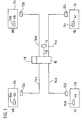
- FIG. 1 shows a highly schematic representation of a motor vehicle with wheels 2a to 2d, which has a tire pressure control system.
- the Tire pressure control system includes a. Tire pressure control devices 4a to 4d, one of which is contained in the tire of wheels 2a to 2d (e.g. in the tire rubber or in or on the valve), or one of each one Tire is assigned, e.g. B. by appropriate positioning and attachment on the rim.
- the tire pressure control devices 4a to 4d have one Transmitter, with the help of which they send data in the form of high-frequency signals to one Can transmit receiver 6 without contact.
- the receiver 6 transmits the data received from the tire pressure control devices 4a to 4d the transmission path 8 to a central unit 10.
- the Receiver 6 designed as a receiving antenna, with the help of the central unit 10 receives the transmitted data.
- the tire pressure monitoring system contains also speed sensors 12a to 12d, which are attached to the motor vehicle and are each assigned to a fixed wheel 2a to 2d of the motor vehicle. Each speed sensor 12a to 12d is via a transmission path 14a to 14d also in connection with the central unit. Based on the Central unit 10 can transmit the signal of a transmission path Assign speed sensor 12a to 12d to a wheel position.
- the tire pressure monitoring devices 4a to 4d transmit each an individual identifier and print data to the central unit 10. There the transmitted print data are evaluated and specified Compare print data. Soak the transmitted print data via certain extent from the specified print data, this will be the Motor vehicle driver displayed by the central unit 10.
- each tire pressure control device 4a to 4d transmits each tire pressure control device 4a to 4d at time intervals in addition to the individual identifier and possibly the print data extended high-frequency signal to the central unit 10.
- the extended high-frequency signals and that of the speed sensors 12a to 12d signals transmitted to the central unit 10 are stored in the central unit 10 an assignment of the tire pressure control devices 4a to 4d to the Wheel positions performed. This is detailed with the following Figures explained.
- Each transmitted high-frequency signal is preferably so long that the corresponding wheel 2a to 2d from which it is sent out during the duration of the signal makes at least one revolution. For example thereby be largely ensured that in the Tire pressure control devices 4a to 4d have a length of time for the extended ones High-frequency signals is specified, which is selected so that already at low speeds of the motor vehicle each wheel 2a to 2d during this length makes at least one turn.
- everyone Tire pressure control device 4a to 4d via a centrifugal force sensor 16a to 16d have the above a predetermined number of revolutions of the wheel 2a to 2d generates a signal, with a tire pressure monitoring device extending one High-frequency signal with the specified length only sends if that Centrifugal force sensor signal is present.
- the length of the lengthened High-frequency signal so on the number of revolutions at which the centrifugal force sensor 16a to 16d generates a signal, tuned that the wheel 2a to 2d at least one revolution during the transmission of the extended High frequency signal makes.
- the tire pressure monitoring system may have a central one Transmitter 18 and each tire pressure control device via a (not drawn) recipient.
- the central transmitter 18 sends a signal to all air pressure control devices 4a to 4d, which is an extended one immediately after receiving the signal Transmit high-frequency signal to the central unit 10.
- the central transmitter information about the length of the extended Transmit radio frequency signal from the tire pressure monitoring devices 4a to 4d to be transmitted. The length is determined by the central transmitter 18 preferably depending on the speed of the motor vehicle specified that it is ensured that each wheel 2a to 2d of the motor vehicle at least during the transmission of the extended high-frequency signal makes one turn.
- FIG. 2 shows a diagram in which the signal generated by the speed sensors 12a to 12d is plotted over time.
- the speed sensors 12a to 12d can be sensors of a slip control system, for example, which are known per se and have a gear wheel disk with a certain number of teeth. With a full revolution of the motor vehicle wheel 2a to 2d, each tooth of the gear wheel of the corresponding speed sensor 12a to 12d generates a pulse, so that in the central unit 10 (see FIG. 1) the number of revolutions between the times is calculated from the number of pulses between two times can. In the diagram shown in FIG. 2, it was assumed, for example, that the gear disk has 6 teeth. Since the diagram has 12 signals between the times t 0 and t 1 , the motor vehicle wheel 2a to 2d has therefore made two revolutions between these times.
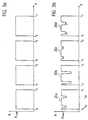
- FIG. 3a shows a diagram in which the magnitude of the amplitude of the extended high-frequency signals, which are generated by the tire pressure monitoring devices 4a to 4d, is plotted over time.
- the high frequency signal between the times t 0 and t 1 is from the tire pressure control device 4a
- the high frequency signal between the times t 2 and t 3 is from the tire pressure control device 4b
- the high frequency signal between the times t 4 and t 5 is from the tire pressure control device 4c
- the high frequency signal between times t 6 and t 7 is generated by the tire pressure control device 4d.
- the diagram shows that the amplitude amount of each generated high-frequency signal reaches the value A max over the entire length (in reality, the high-frequency signals are vibration signals, so that the maximum amplitude amount is reached twice during a vibration process; however, since it is a high-frequency signal is involved, the two maximum values are so close together during an oscillation period that, in a simplified manner, only the "enveloping curve" of the amplitude amount was drawn).
- the time intervals between the times t 0 and t 1 or between t 2 and t 3 , t 4 and t 5 , t 6 and t 7 are so long that the corresponding motor vehicle wheel 2a to 2d, whose tire pressure control device has generated the extended high-frequency signal, has made at least one revolution in the specified time intervals.
- FIG. 3b shows a diagram in which the amplitude amount of the extended high-frequency signals received by the central unit 10 is plotted over time.
- the diagram shows that in the time interval from t 0 to t 1 of the tire pressure control device 4a, the central unit 10 receives a high-frequency signal with the profile 20a, in the time interval from t 2 to t 3 from the tire pressure control device 4b a high-frequency signal with the profile 20b, im Time interval from t 4 to t 5 receives a high-frequency signal with the curve 20c from the tire pressure control device 4c and a high-frequency signal with the curve 20d in the time interval from t 6 to t 7 .
- the received maximum amplitude of the high-frequency signal 20a largely has the maximum amount A max over the entire time interval from t 0 to t 1 .
- the central unit 10 receives a significantly reduced maximum amplitude only in the range of times t 01 and t 02 .
- Such a course of the amplitude received by the central unit 10 over time is due to the following:
- the tire pressure control device 4a rotates with the motor vehicle wheel 2a during the transmission of the extended high-frequency signal. As a result, the tire pressure control device 4a always takes a different position with respect to the wheel housing or to the ground contact surface of the wheel 2a.
- Interference in the transmitted radio-frequency signal or other effects means that the amplitude of the radio-frequency signal no longer reaches the same maximum value in the entire time interval, but changes in certain relative angular positions of the tire pressure control device 4a. A change in the transmitted amplitude always takes place in the same angular position of the tire pressure control device 4a.
- the central unit 10 thus receives an extended high-frequency signal 20a from the tire pressure control device 4a, which has an individual profile that is dependent on the angle of rotation of the wheel and on time.
- the other high-frequency signals 20b, 20c and 20d also have an individual profile that is dependent on the angle of rotation of the corresponding wheel and on time.
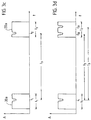
- the tire pressure control device 4a is assigned to the corresponding wheel position in which it is located: First, the tire pressure control device 4a sends its individual identifier to the central unit 10 Tire pressure control device 4a transmits a first extended high-frequency signal 20a to the central unit 10, which lasts for a first time interval I 1 . As a result of the rotation of the wheel, the extended high-frequency signal 20a has an individual profile which is dependent on the angle of rotation of the wheel or on the time, so that the high-frequency signal shown in FIG. 3c is received by the central unit 10.
- both extended high-frequency signals certainly have the reduction in the amplitude of the high-frequency signal explained in connection with FIGS. 3a and 3b, namely the first extended high-frequency signal 20a at the first time t 1 and the second extended high-frequency signal 20a at the second time t 2 .
- the wheel 2a which is associated with the tire pressure control device 4a, has made an integer number of revolutions in the third time interval I 3 from t 1 to t 2 .
- the central unit 10 now evaluates how many signals in the time interval I 3 have been transmitted to the speed sensors 12a to 12d via the transmission paths 14a to 14d.
- the number of transmitted signals is then used to calculate how many revolutions the wheels 2a to 2d assigned to the speed sensors 12a to 12d have made in the time interval I 3 .
- the individual identifier transmitted by the tire pressure control device 4a is assigned to that wheel position in which the wheel has made an integral number of revolutions in the time interval I 3 .
- the following number of revolutions is calculated in the central unit, if it is assumed that the toothed disc of the speed sensors has 6 teeth: number of revolutions of the wheel 2a - 100.1; Number of revolutions of the wheel 2b - 100.5; Number of revolutions of the wheel 2c - 100.5; Number of revolutions of the wheel 2d - 100.3.
- the wheel 2a has made an integer number of revolutions in the "front right" wheel position.
- the individual identifier transmitted by the tire pressure control device 4a is assigned to the wheel position "front right".
- the remaining tire pressure control devices 4b to 4d are assigned to the wheel positions in the same way.
- Figure 3d shows largely the same diagram as Figure 3c.
- the only difference can be seen in the fact that in the interval I 2 a reduction in the amplitude of the extended high-frequency signal occurs twice, the corresponding motor vehicle wheel in the interval I 2 , which is as long as the interval I 1 , the corresponding angular position in which the reduction takes place, takes twice.
- Such a case constellation can occur, for example, in that the motor vehicle wheel rotates at a greater speed in the time interval I 2 than in the time interval I 1 .
- the time interval 13, in which the corresponding motor vehicle wheel has made an integral number of revolutions can be selected either from t 1 to t 20 or from t 1 to t 21 and can be carried out correspondingly as explained in connection with FIG. 3c.
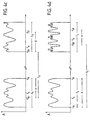
- FIG. 4a shows a diagram in which the magnitude of the amplitude of an extended high-frequency signal generated by the tire pressure control device 4a is plotted over time.
- the high frequency signal is sent from the tire control device 4a in the time interval from t 0 to t 1 .
- the diagram according to FIG. 4 is analogous to the diagram shown in FIG. 3a, so that reference is made to the corresponding description of the figures.
- FIG. 4b shows a diagram in which the amount of the amplitude received by the central unit 10 is plotted over time. Due to the rotation of the wheel and due to the changing angular position of the tire pressure control device 4a relative to the wheel housing, the central unit 10 receives an extended high-frequency signal, which has an individual profile that is dependent on the time or the angle of rotation of the wheel. Since the course of the high-frequency signal received by the central unit 10 depends on the angle of rotation of the wheel, it has a periodic course, the length of the period being determined by the duration of one revolution of the motor vehicle wheel.
- the tire pressure control device 4a first transmits its individual identifier at any point in time and immediately thereafter a first extended high-frequency signal that persists over a first time interval I 1 .
- the central unit 10 receives the individual identifier and the first extended high-frequency signal shown on the left in FIG. 4c.
- the same tire pressure control device 4a sends its individual identifier and immediately thereafter a second extended high-frequency signal that persists over a second time interval I 2 to the central unit 10.
- the central unit 10 receives the second extended high-frequency signal shown on the right in FIG. 4a.
- the two time intervals I 1 , I 2 are at least so long that the wheel 2a, from which the extended high-frequency signals are transmitted, makes at least one revolution in this time interval.
- the two time intervals I 1 and I 2 are preferably of the same length.
- the two received extended high-frequency signals are pushed one above the other in such a way that there is a maximum overlap of these signals.
- the maximum overlap area X extends from time t 10 to time t 11 in the first time interval I 1 and from time t 20 to time t 21 in time interval I 2 .
- the wheel 2a In the two overlap areas, the wheel 2a, from which the extended high-frequency signal was transmitted, takes the same angular position at corresponding times. For example, at time t 10, the wheel 2a assumes the same angular position as at time t 20 and at time t 11 the same angular position as at time t 21 . The same applies to all times between times t 10 and t 11 or t 20 and t 21 if the time between times t 20 and t 21 is at the same distance from t 20 as that between times t 10 and Time at t 11 at time t 10 .
- the wheel 2a from which the extended high-frequency signal was emitted, makes an integer number of revolutions between two appropriately selected points in time, that is to say for example between the points in time t 10 and t 20 (ie in the time interval I 3 ).
- the central unit 10 With the aid of the speed sensors 12a to 12d, the central unit 10 now checks which wheel of the motor vehicle has made an integral number of revolutions in the time interval I 3 . This takes place, as has already been explained in connection with FIG. 3, so that reference is made to the corresponding statements at this point.
- the individual identifier transmitted by the tire pressure control device 4a is assigned to the corresponding wheel position (in the example "front right").
- the remaining tire pressure control devices 4b to 4d are assigned to their wheel positions in the same way.
- the central unit 10 compresses or stretches one of the two signals before they are brought to cover. It is determined in the central unit 10 that the wheel has assumed the same angular position in the overlap region X between the times t 10 and t 11 or between times t 20 and t 21 corresponding to one another. For example, the same angular position is assumed at times t 10 and t 20 or t 11 and t 21 . The same applies correspondingly to the times lying between the times t 10 and t 11 or t 20 and t 21 .
- the wheel 2a has the same angular position at the times t a and t b , since the time t a from the time t 10 has the same relative distance as the time t b from the time t 20 .
Landscapes
- Engineering & Computer Science (AREA)
- Mechanical Engineering (AREA)
- Measuring Fluid Pressure (AREA)
Claims (12)
- Procédé pour effectuer l'affectation de dispositifs de contrôle de la pression des pneumatiques (4a - 4d) à des positions de roues, dans un système de contrôle de la pression des pneumatiques d'un véhicule automobile qui comprend, entre autres, les composants suivants :caractérisé en ce que le procédé est effectué Au cours des étapes suivantes du procédé :un nombre de roues (2a - 2d) où, à chaque roue (2a - 2d), est affecté un dispositif de contrôle de la pression des pneumatiques (4a - 4d) qui envoie à une unité centrale (10), suivant des intervalles de temps, un caractère individuel d'identification,des capteurs de vitesse (12a - 12d) dont l'un des capteurs est à chaque fois affecté à une roue (2a - 2d) du véhicule automobile, à un emplacement fixe, où l'affectation des capteurs de vitesse (12a - 12d), aux positions de roues, est connue de l'unité centrale (10),une unité centrale (10) dans laquelle l'affectation (caractère d'identification du dispositif de contrôle de la pression des pneumatiques / position des roues) pour chaque roue (2a - 2d) est stockée en mémoire, procédé dans lequel est effectuée l'affectation d'un dispositif de contrôle de la pression des pneumatiques (4a - 4d), à la position des roues, au cours du fonctionnement du véhicule automobile,un dispositif de contrôle de la pression des pneumatiques (4a - 4d), affecté à une roue (2a - 2d), envoie, à un moment quelconque, son caractère individuel d'identification et envoie à l'unité centrale (10), un premier signal continu prolongé à haute fréquence, via un premier intervalle de temps I1, lequel signal à haute fréqucnce présente, suite à la rotation de la roue, un profil individuel dépendant de l'angle de rotation de la roue ou du temps,le même dispositif de contrôle de la pression des pneumatiques (4a - 4d) envoie, à un moment ultérieur quelconque, son caractère individuel d'identification, et envoie à l'unité centrale (10), via un deuxième intervalle de temps I2, un second signal prolongé continu à haute fréquence qui présente, au moins par zones, le même profil individuel dépendant de l'angle de rotation de la roue ou du temps, que le premier signal prolongé à haute fréquence,dans l'unité centrale (10) est défini, à partir du profil du premier signal prolongé à haute fréquence, un premier moment au cours duquel la roue (2a - 2d) prend une position angulaire relative quelconque,dans l'unité centrale (10) est défini, à partir du profil du second signal prolongé à haute fréquence, un second moment au cours duquel la roue (2a - 2d) prend la même position angulaire relative que lors du premier moment,dans l'unité centrale (10) est déterminé, à l'aide des signaux des capteurs (12a - 12d), le nombre de tours qu'ont fait les roues (2a - 2d) dans un troisième intervalle de temps I3, depuis le premier moment jusqu'au second moment,dans l'unité centrale (10), on contrôle quelle roue (2a - 2d), dans quelle position de roue, a fait un nombre complet de tours au cours du troisième intervalle de temps I3,dans l'unité centrale (10), la position de roue correspondante est affectée au caractère individuel d'identification transmis par le dispositif de contrôle de la pression des pneumatiques (4a - 4d),
- Procédé selon la revendication 1, caractérisé en ce que chaque signal à haute fréquence est émis, à une amplitude maximale constante, par le dispositif de contrôle de la pression des pneumatiques (4a - 4d), laquelle amplitude maximale, suite à la rotation de la roue (2a - 2d), à partir de laquelle est émis le signal prolongé à haute fréquence, a un profil individuel dépendant de l'angle de rotation de la roue (2a - 2d) ou du temps.
- Procédé selon la revendication 1 ou 2, caractérisé en ce que chaque intervalle de temps, pendant lequel un signal prolongé à haute fréquence est émis par une roue (2a - 2d), est au moins d'une longueur telle, que la roue (2a - 2d) fait au moins un tour au cours de l'intervalle de temps.
- Procédé selon l'une quelconque des revendications 1 à 3, caractérisé en ce que, dans chaque dispositif de contrôle de la pression des pneumatiques (4a - 4d), est prédéterminée une certaine longueur qui est la même pour tous les signaux prolongés à haute fréquence émis par ce dispositif de contrôle de la pression des pneumatiques (4a - 4d).
- Procédé selon la revendication 4, caractériséen ce que chaque dispositif de contrôle de la pression des pneumatiques (4a - 4d) dispose d'un capteur de force centrifuge (16a - 16d) qui, au-dessus d'un nombre de tours prédéterminé de la roue à laquelle est affecté le dispositif de contrôle de la pression des pneumatiques (4a - 4d), produit un signal, eten ce qu'un dispositif de contrôle de la pression des pneumatiques (4a - 4d) n'émet alors un signal prolongé à haute fréquence d'une longueur prédéterminée que si le signal du capteur de force centrifuge (16a - 16d) est présent.
- Procédé selon l'une quelconque des revendications 1 à 3, caractérisé en ce que le système de contrôle de la pression des pneumatiques dispose d'un émetteur central (18) et chacun des dispositifs de contrôle de la pression des pneumatiques (4a - 4d) dispose d'un récepteur (6), et en ce que des étapes suivantes du procédé sont effectuées :l'émetteur central (18) envoie un signal à tous les dispositifs de contrôle de la pression des pneumatiques (4a - 4d),immédiatement après réception du signal, chaque dispositif de contrôle de la pression des pneumatiques (4a - 4d) envoie à l'unité centrale (10), un signal prolongé à haute fréquence.
- Procédé selon la revendication 6, caractérisé en ce que l'émetteur central (18) envoie aux dispositifs de contrôle de la pression des pneumatiques (4a - 4d), une information concernant la longueur du signal prolongé à haute fréquence devant être émis par les dispositifs de contrôle de la pression des pneumatiques (4a - 4d).
- Procédé selon l'une quelconque des revendications 1 à 7, caractérisé en ce que le procédé est lancé en actionnant un interrupteur.
- Procédé selon l'une quelconque des revendications 1 à 7, caractérisé en ce que le procédé est lancé automatiquement après mise en marche de l'allumage du véhicule automobile si l'allumage a été coupé précédemment pendant un laps de temps prédéterminé.
- Procédé selon l'une quelconque des revendications 1 à 9, caractérisé en ce que les signaux transmis par les dispositifs de contrôle de la pression des pneumatiques (4a - 4d) sont modulés en amplitude, et en ce que chaque signal prolongé à haute fréquence est un signal distinct qui est émis avec une amplitude maximale constante.
- Procédé selon l'une quelconque des revendications 1 à 9, caractérisé en ce que les signaux transmis par les dispositifs de contrôle de la pression des pneumatiques (4a - 4d) sont modulés en fréquence et sont émis avec une amplitude maximale constante, et en ce que le caractère individuel d'identification est contenu dans le signal prolongé à haute fréquence.
- Procédé selon l'une quelconque des revendications 1 à 11, caractérisé en ce que, dans les premier et second signaux prolongés à haute fréquence, les premier et second moments, au cours desquels la roue (2a - 2d) prend une position angulaire relative coïncidente, sont déterminés par corrélation croisée.
Applications Claiming Priority (2)
| Application Number | Priority Date | Filing Date | Title |
|---|---|---|---|
| DE19921413 | 1999-05-08 | ||
| DE19921413A DE19921413C1 (de) | 1999-05-08 | 1999-05-08 | Verfahren zur Durchführung der Zuordnung von Reifendruckkontrollvorrichtungen zu Radpositionen in einem Reifendruckkontrollsystem eines Kraftfahrzeuges |
Publications (2)
| Publication Number | Publication Date |
|---|---|
| EP1052119A1 EP1052119A1 (fr) | 2000-11-15 |
| EP1052119B1 true EP1052119B1 (fr) | 2002-10-09 |
Family
ID=7907519
Family Applications (1)
| Application Number | Title | Priority Date | Filing Date |
|---|---|---|---|
| EP00109579A Expired - Lifetime EP1052119B1 (fr) | 1999-05-08 | 2000-05-05 | Procédé pour déterminer la position des roues dans un système de surveillance de pression des pneumatiques d'un véhicule |
Country Status (2)
| Country | Link |
|---|---|
| EP (1) | EP1052119B1 (fr) |
| DE (2) | DE19921413C1 (fr) |
Cited By (2)
| Publication number | Priority date | Publication date | Assignee | Title |
|---|---|---|---|---|
| US7313953B2 (en) | 2001-12-18 | 2008-01-01 | Johnson Controls Automotive Electronics | System for controlling a vehicle wheel tyre pressure |
| CN104303015A (zh) * | 2012-03-16 | 2015-01-21 | 大陆汽车有限公司 | 用于确定汽车车轮的绝对角度位置的装置和方法 |
Families Citing this family (37)
| Publication number | Priority date | Publication date | Assignee | Title |
|---|---|---|---|---|
| AU5564999A (en) * | 1999-08-16 | 2001-03-13 | Goodyear Tire And Rubber Company, The | Monitoring a dynamic condition of a rotary element, particularly a pneumatic tire |
| US8266465B2 (en) | 2000-07-26 | 2012-09-11 | Bridgestone Americas Tire Operation, LLC | System for conserving battery life in a battery operated device |
| US7161476B2 (en) | 2000-07-26 | 2007-01-09 | Bridgestone Firestone North American Tire, Llc | Electronic tire management system |
| WO2002057097A2 (fr) * | 2001-01-17 | 2002-07-25 | Microchip Technology Incorporated | Procede et appareil permettant de mesurer la pression de gonflage des pneumatiques et de localiser les pneumatiques |
| US6571617B2 (en) | 2001-01-17 | 2003-06-03 | Microchip Technology Incorporated | Method and apparatus using directional antenna or learning modes for tire inflation pressure monitoring and location determination |
| DE10135936B4 (de) * | 2001-07-24 | 2005-01-05 | Siemens Ag | Einrichtung für das Überwachen mindestens eines Parameters für mehrere Fahrzeugräder |
| DE10144359A1 (de) | 2001-09-10 | 2003-04-03 | Siemens Ag | Vorrichtung zum Messen des Reifendrucks eines jeden Rades eines Kraftfahrzeug und Verfahren zum Betreiben der Vorrichtung |
| DE10144360B4 (de) | 2001-09-10 | 2018-12-27 | Continental Automotive Gmbh | Verfahren zum Zuordnen von Reifendruckmessvorrichtungen eines Kraftfahrzeugs zu Radpositionen und Vorrichtung zum Messen des Reifendrucks |
| US6693522B2 (en) * | 2001-10-12 | 2004-02-17 | Lear Corporation | System and method for tire pressure monitoring including automatic tire location recognition |
| DE10152338B4 (de) | 2001-10-24 | 2004-11-18 | Siemens Ag | Verfahren und System zur Überwachung der Räder eines Kraftfahrzeuges |
| JP2003175711A (ja) * | 2001-12-12 | 2003-06-24 | Pacific Ind Co Ltd | タイヤ状態監視装置 |
| DE10240159B3 (de) * | 2002-08-30 | 2004-07-15 | Nolex Ag | Reifenluftdruck-Kontrollvorrichtung |
| FR2844748B1 (fr) * | 2002-09-25 | 2004-11-26 | Johnson Contr Automotive Elect | Systeme de controle de la pression des pneumatiques des roues d'un vehicule automobile |
| US7116213B2 (en) | 2002-11-22 | 2006-10-03 | Michelin Recherche Et Technique S.A. | Acoustic wave device with modulation functionality |
| DE10259944A1 (de) | 2002-12-20 | 2004-07-01 | Continental Teves Ag & Co. Ohg | Verfahren zur automatischen Bestimmung der Einbaupositionen von Rädern in einem Kraftfahrzeug |
| DE10316074B4 (de) * | 2003-04-08 | 2006-01-26 | Global Dynamix Ag | Reifenluftdruck-Kontrollvorrichtung |
| DE10341785B4 (de) * | 2003-09-10 | 2006-04-27 | Global Dynamix Ag | Verfahren zur Zuordnung eines Radmoduls zu seiner Radposition und dafür geeignete Reifenluftdruck-Kontrollvorrichtung |
| DE10342297B4 (de) * | 2003-09-12 | 2014-08-21 | Continental Automotive Gmbh | Verfahren und Einrichtung zur Ermittlung der Radposition |
| JP4507729B2 (ja) | 2004-07-15 | 2010-07-21 | 日産自動車株式会社 | タイヤ空気圧モニター装置 |
| DE102004040790A1 (de) * | 2004-08-23 | 2006-03-16 | Global Dynamix Ag | Vorrichtung und Verfahren zur Reifenluftdruckkontrolle |
| DE102004053696A1 (de) * | 2004-11-06 | 2006-05-11 | Leopold Kostal Gmbh & Co. Kg | Reifendruckkontrollsystem für ein Kraftfahrzeug |
| DE102005004825B4 (de) * | 2005-02-02 | 2007-06-06 | Global Dynamix Ag | Radmodul, Reifenluftdruck-Kontrolleinrichtung und Verfahren zur Reifenluftdruckkontrolle |
| DE102005004833A1 (de) * | 2005-02-02 | 2006-08-10 | Global Dynamix Ag | Reifenluftdruck-Kontrolleinrichtung und Verfahren zur Reifenluftdruckkontrolle |
| DE102005018107B3 (de) * | 2005-04-19 | 2006-10-12 | Siemens Ag | Verfahren zur Bestimmung der Drehrichtung von rotierenden Körpern |
| DE102005026974A1 (de) | 2005-06-10 | 2007-01-04 | Global Dynamix Ag | Verfahren und System zur Bestimmung einer Radposition von Rädern an einem Fahrzeug |
| DE102010000919B4 (de) * | 2009-10-14 | 2025-12-11 | Maxim Integrated Gmbh | Verfahren zur Reifenluftdruckmessung und -auswertung mit einer Zuordnung von Radpositionen sowie Reifenluftdruckmesssystem |
| DE102009059788B4 (de) * | 2009-12-21 | 2014-03-13 | Continental Automotive Gmbh | Verfahren und Vorrichtung zum Lokalisieren der Verbaupositionen von Fahrzeugrädern in einem Kraftfahrzeug |
| DE102010021570A1 (de) | 2010-05-26 | 2011-12-01 | Gm Global Technology Operations Llc (N.D.Ges.D. Staates Delaware) | Verfahren zur Zuordnung von Reifendrucksensoren eines Reifendruckkontrollsystem zu Radpositionen |
| FR2969962B1 (fr) | 2010-12-30 | 2013-02-08 | Continental Automotive France | Procede de determination d'un angle de pivotement d'unite roue montee sur une valve de gonflage de type "snap-in" |
| FR2974033B1 (fr) | 2011-04-14 | 2013-05-10 | Continental Automotive France | Procede de localisation de la position de roues d'un vehicule |
| KR101351920B1 (ko) | 2012-08-21 | 2014-01-20 | 현대모비스 주식회사 | 타이어 압력 모니터링 장치 및 방법 |
| JP2015013637A (ja) * | 2013-06-03 | 2015-01-22 | 株式会社東海理化電機製作所 | タイヤ位置判定システム |
| DE102013220873A1 (de) * | 2013-10-15 | 2015-04-16 | Continental Automotive Gmbh | Verfahren und Anordnung zum Lokalisieren der Verbauposition von Rädern in einem Kraftfahrzeug |
| DE102015115731A1 (de) | 2015-09-17 | 2017-03-23 | Huf Hülsbeck & Fürst Gmbh & Co. Kg | Verfahren zur Zuordnung von Reifendruckkontrollvorrichtungen zu Radpositionen eines Fahrzeuges |
| FR3061084B1 (fr) * | 2016-12-22 | 2019-05-10 | Continental Automotive France | Procede d'appairage d'un module de mesure monte dans une roue de vehicule automobile |
| DE102020106754B4 (de) * | 2020-03-12 | 2025-04-17 | Zf Cv Systems Global Gmbh | Verfahren zur automatischen Zuordnung von Reifendrucksensoren |
| FR3113865B1 (fr) * | 2020-09-04 | 2022-07-29 | Continental Automotive | Procédé de détection d’un changement de localisation d’au moins une roue d’un véhicule automobile |
Family Cites Families (2)
| Publication number | Priority date | Publication date | Assignee | Title |
|---|---|---|---|---|
| DE4205911A1 (de) * | 1992-02-26 | 1993-09-02 | Uwatec Ag | Kontrollvorrichtung fuer den luftdruck von luftbereiften fahrzeugraedern |
| DE19734323B4 (de) * | 1997-08-08 | 2004-05-06 | Continental Aktiengesellschaft | Verfahren zur Durchführung der Zuordnung der Radposition zu Reifendruckkontrollvorrichtungen in einem Reifendruckkontrollsystem eines Kraftfahrzeugs |
-
1999
- 1999-05-08 DE DE19921413A patent/DE19921413C1/de not_active Expired - Fee Related
-
2000
- 2000-05-05 EP EP00109579A patent/EP1052119B1/fr not_active Expired - Lifetime
- 2000-05-05 DE DE50000610T patent/DE50000610D1/de not_active Expired - Lifetime
Cited By (2)
| Publication number | Priority date | Publication date | Assignee | Title |
|---|---|---|---|---|
| US7313953B2 (en) | 2001-12-18 | 2008-01-01 | Johnson Controls Automotive Electronics | System for controlling a vehicle wheel tyre pressure |
| CN104303015A (zh) * | 2012-03-16 | 2015-01-21 | 大陆汽车有限公司 | 用于确定汽车车轮的绝对角度位置的装置和方法 |
Also Published As
| Publication number | Publication date |
|---|---|
| EP1052119A1 (fr) | 2000-11-15 |
| DE50000610D1 (de) | 2002-11-14 |
| DE19921413C1 (de) | 2000-11-23 |
Similar Documents
| Publication | Publication Date | Title |
|---|---|---|
| EP1052119B1 (fr) | Procédé pour déterminer la position des roues dans un système de surveillance de pression des pneumatiques d'un véhicule | |
| EP0806306B1 (fr) | Système de surveillance de pression des pneumatiques d'un véhicule automobile et procédé de son adjonction à la position d'un pneumatique | |
| DE19734323B4 (de) | Verfahren zur Durchführung der Zuordnung der Radposition zu Reifendruckkontrollvorrichtungen in einem Reifendruckkontrollsystem eines Kraftfahrzeugs | |
| DE10144360B4 (de) | Verfahren zum Zuordnen von Reifendruckmessvorrichtungen eines Kraftfahrzeugs zu Radpositionen und Vorrichtung zum Messen des Reifendrucks | |
| EP0626911B1 (fr) | Dispositif de controle de la pression de gonflage de roues de vehicules equipees de pneus | |
| DE10247761B4 (de) | System und Verfahren zur Reifendrucküberwachung einschliesslich einer automatischen Reifenlagererkennung | |
| EP2435262B1 (fr) | Électronique de roue, roue et voiture | |
| EP0763437B1 (fr) | Dispositif de surveillance de pneumatiques et récepteur à plusieures voies | |
| DE10295892T5 (de) | Kombiniertes Reifendrucküberwachungssystem und schlüsselloses Türeinlassystem | |
| EP0806307B1 (fr) | Système de surveillance de pression des pneumatiques | |
| EP1053114A1 (fr) | Procede pour faire fonctionner une unite servant a surveiller et a signaler sans fil une variation de pression dans des pneus de vehicules | |
| DE10032936A1 (de) | Vorrichtung und Verfahren zum Steuern einer Zugangsberechtigung und/oder einer elektronischen Wegfahrsperre für ein Kraftfahrzeug | |
| WO1998005518A1 (fr) | Procede pour le traitement des signaux d'un systeme de surveillance de la pression des pneus | |
| DE19849390C2 (de) | Verfahren zur Durchführung der Zuordnung von Luftdruckkontrollvorrichtungen zu Radpositionen in einem Luftdruckkontrollsystem eines Kraftfahrzeuges | |
| DE10223214A1 (de) | Verfahren zum Zuordnen von Reifenmodulen zu Radpositionen eines Reifendrucküberwachungssytems für ein Kraftfahrzeug und Vorrichtung zum Überwachen des Reifendrucks | |
| DE102008022107A1 (de) | Raderkennungs-Vorrichtung und Reifendruckerfassungs-Vorrichtung mit der Funktion der Raderkennung | |
| EP2648926B1 (fr) | Procédé de transmission radio chiffrée de données | |
| DE10226995B4 (de) | Kraftfahrzeug mit einem funkfernbedienbaren Zentralverriegelungssystem und/oder Wegfahrsperrsystem und einem funkunterstützten Reifendruckkontrollsystem | |
| DE10296741B4 (de) | Kombinierter Empfänger für die Reifendrucküberwachung und den fernbedienbaren, schlüssellosen Türzutritt | |
| DE102009015567A1 (de) | Vorrichtung und Verfahren zum Überwachen eines Fahrzeugzustands | |
| DE10152337A1 (de) | Verfahren und System zur Ermittlung von Radpositionen | |
| DE102020106754B4 (de) | Verfahren zur automatischen Zuordnung von Reifendrucksensoren | |
| DE10229465B4 (de) | Anordnung zur Überwachung wenigstens eines Parameters für mehrere Fahrzeugräder | |
| EP1644206A1 (fr) | Procede et dispositif pour localiser la position d'au moins deux unites d'emission, destines en particulier a la surveillance d'au moins un parametre pour plusieurs roues d'un vehicule automobile | |
| DE102010042198A1 (de) | Verfahren und System zum Betreiben eines Fahrzeugs |
Legal Events
| Date | Code | Title | Description |
|---|---|---|---|
| PUAI | Public reference made under article 153(3) epc to a published international application that has entered the european phase |
Free format text: ORIGINAL CODE: 0009012 |
|
| AK | Designated contracting states |
Kind code of ref document: A1 Designated state(s): DE FR GB IT |
|
| AX | Request for extension of the european patent |
Free format text: AL;LT;LV;MK;RO;SI |
|
| 17P | Request for examination filed |
Effective date: 20010515 |
|
| AKX | Designation fees paid |
Free format text: DE FR GB IT |
|
| GRAG | Despatch of communication of intention to grant |
Free format text: ORIGINAL CODE: EPIDOS AGRA |
|
| GRAG | Despatch of communication of intention to grant |
Free format text: ORIGINAL CODE: EPIDOS AGRA |
|
| GRAH | Despatch of communication of intention to grant a patent |
Free format text: ORIGINAL CODE: EPIDOS IGRA |
|
| 17Q | First examination report despatched |
Effective date: 20020326 |
|
| GRAH | Despatch of communication of intention to grant a patent |
Free format text: ORIGINAL CODE: EPIDOS IGRA |
|
| GRAA | (expected) grant |
Free format text: ORIGINAL CODE: 0009210 |
|
| AK | Designated contracting states |
Kind code of ref document: B1 Designated state(s): DE FR GB IT |
|
| REG | Reference to a national code |
Ref country code: GB Ref legal event code: FG4D Free format text: NOT ENGLISH |
|
| REF | Corresponds to: |
Ref document number: 50000610 Country of ref document: DE Date of ref document: 20021114 |
|
| GBT | Gb: translation of ep patent filed (gb section 77(6)(a)/1977) |
Effective date: 20030206 |
|
| ET | Fr: translation filed | ||
| PLBE | No opposition filed within time limit |
Free format text: ORIGINAL CODE: 0009261 |
|
| STAA | Information on the status of an ep patent application or granted ep patent |
Free format text: STATUS: NO OPPOSITION FILED WITHIN TIME LIMIT |
|
| 26N | No opposition filed |
Effective date: 20030710 |
|
| PGFP | Annual fee paid to national office [announced via postgrant information from national office to epo] |
Ref country code: GB Payment date: 20140521 Year of fee payment: 15 |
|
| PGFP | Annual fee paid to national office [announced via postgrant information from national office to epo] |
Ref country code: FR Payment date: 20140527 Year of fee payment: 15 Ref country code: IT Payment date: 20140528 Year of fee payment: 15 |
|
| GBPC | Gb: european patent ceased through non-payment of renewal fee |
Effective date: 20150505 |
|
| PG25 | Lapsed in a contracting state [announced via postgrant information from national office to epo] |
Ref country code: IT Free format text: LAPSE BECAUSE OF NON-PAYMENT OF DUE FEES Effective date: 20150505 |
|
| REG | Reference to a national code |
Ref country code: FR Ref legal event code: ST Effective date: 20160129 |
|
| PG25 | Lapsed in a contracting state [announced via postgrant information from national office to epo] |
Ref country code: GB Free format text: LAPSE BECAUSE OF NON-PAYMENT OF DUE FEES Effective date: 20150505 |
|
| PG25 | Lapsed in a contracting state [announced via postgrant information from national office to epo] |
Ref country code: FR Free format text: LAPSE BECAUSE OF NON-PAYMENT OF DUE FEES Effective date: 20150601 |
|
| PGFP | Annual fee paid to national office [announced via postgrant information from national office to epo] |
Ref country code: DE Payment date: 20180531 Year of fee payment: 19 |
|
| REG | Reference to a national code |
Ref country code: DE Ref legal event code: R119 Ref document number: 50000610 Country of ref document: DE |
|
| PG25 | Lapsed in a contracting state [announced via postgrant information from national office to epo] |
Ref country code: DE Free format text: LAPSE BECAUSE OF NON-PAYMENT OF DUE FEES Effective date: 20191203 |