EP1053210B1 - Verfahren zur herstellung von anionischen tonerden unter verwendung von magnesiumacetat - Google Patents
Verfahren zur herstellung von anionischen tonerden unter verwendung von magnesiumacetat Download PDFInfo
- Publication number
- EP1053210B1 EP1053210B1 EP99910223A EP99910223A EP1053210B1 EP 1053210 B1 EP1053210 B1 EP 1053210B1 EP 99910223 A EP99910223 A EP 99910223A EP 99910223 A EP99910223 A EP 99910223A EP 1053210 B1 EP1053210 B1 EP 1053210B1
- Authority
- EP
- European Patent Office
- Prior art keywords
- acetate
- magnesium
- anionic
- slurry
- anionic clay
- Prior art date
- Legal status (The legal status is an assumption and is not a legal conclusion. Google has not performed a legal analysis and makes no representation as to the accuracy of the status listed.)
- Expired - Lifetime
Links
Images



Classifications
-
- C—CHEMISTRY; METALLURGY
- C01—INORGANIC CHEMISTRY
- C01F—COMPOUNDS OF THE METALS BERYLLIUM, MAGNESIUM, ALUMINIUM, CALCIUM, STRONTIUM, BARIUM, RADIUM, THORIUM, OR OF THE RARE-EARTH METALS
- C01F7/00—Compounds of aluminium
- C01F7/78—Compounds containing aluminium, with or without oxygen or hydrogen, and containing two or more other elements
- C01F7/784—Layered double hydroxide, e.g. comprising nitrate, sulfate or carbonate ions as intercalating anions
- C01F7/785—Hydrotalcite
-
- C—CHEMISTRY; METALLURGY
- C01—INORGANIC CHEMISTRY
- C01P—INDEXING SCHEME RELATING TO STRUCTURAL AND PHYSICAL ASPECTS OF SOLID INORGANIC COMPOUNDS
- C01P2002/00—Crystal-structural characteristics
- C01P2002/20—Two-dimensional structures
- C01P2002/22—Two-dimensional structures layered hydroxide-type, e.g. of the hydrotalcite-type
-
- C—CHEMISTRY; METALLURGY
- C01—INORGANIC CHEMISTRY
- C01P—INDEXING SCHEME RELATING TO STRUCTURAL AND PHYSICAL ASPECTS OF SOLID INORGANIC COMPOUNDS
- C01P2002/00—Crystal-structural characteristics
- C01P2002/50—Solid solutions
-
- C—CHEMISTRY; METALLURGY
- C01—INORGANIC CHEMISTRY
- C01P—INDEXING SCHEME RELATING TO STRUCTURAL AND PHYSICAL ASPECTS OF SOLID INORGANIC COMPOUNDS
- C01P2002/00—Crystal-structural characteristics
- C01P2002/70—Crystal-structural characteristics defined by measured X-ray, neutron or electron diffraction data
- C01P2002/72—Crystal-structural characteristics defined by measured X-ray, neutron or electron diffraction data by d-values or two theta-values, e.g. as X-ray diagram
Definitions
- This invention involves the preparation of anionic clays, more in particular, anionic clays with acetate as a charge balancing anion and the preparation of Mg-Al solid solutions by heat-treatment of the anionic clay.
- Anionic clays have a crystal structure which consists of positively charged layers built up of specific combinations of metal hydroxides between which there are anions and water molecules. Hydrotalcite is an example of a naturally occurring anionic clay.
- the brucite-like main layers are built up of octahedra alternating with interlayers in which water molecules and anions, more particularly carbonate ions, are distributed.
- the interlayers contain anions such as NO 3 - , OH, Cl - , Br - , I - , SO 4 2- , SiO 3 2- , CrO 4 2- , BO 3 2- , MnO 4 - , HGaO 3 2- , HVO 4 2- , ClO 4 - , BO 3 2- monocarboxylates such as acetate, dicarboxylates such as oxalate, alkyl sulphonates such as laurylsulphonate.
- anionic clays The preparation of anionic clays has been described in many prior art publications. Recently, two major reviews of anionic clay chemistry were published in which the synthesis methods available for anionic clay synthesis have been summarized, F. Cavani et al "Hydrotalcite-type anionic clays: Preparation, Properties and Applications," Catalysis Today” , 11 (1991) Elsevier Science Publishers B. V. Amsterdam. J P Besse et al. " Anionic clays:trends in pillaring chemistry, in :"Synthesis of Microporous Materials” (1992), 2,108 editors: M.I. Ocelli and H.E. Robson, Van Nostrand Reinhold, N.Y.
- European Patent Application 0 536 979 describes a method for introducing pH-dependent anions into the clay.
- the clay is prepared by the addition of a solution of Al(NO 3 ) 3 and Mg(NO 3 ) 2 to a basic solution containing borate anions.
- the product is then filtered, washed repeatedly with water, and dried overnight. Additionally mixtures of Zn/Mg are used.
- DE 1 592 126 discloses the preparation of Mg-Al anionic clays with carbonate anions in the interlayer from an aluminium and a magnesium source.
- One of the disclosed aluminium sources is aluminium hydroxide; the disclosed magnesium sources are magnesium oxide, magnesium hydroxide, magnesium carbonate, and water-soluble magnesium salts.
- the hydrotalcite is made by reacting activated MgO (prepared by activating a magnesium compound such as magnesium carbonate or magnesium hydroxide) with aqueous solutions containing aluminate, carbonate and hydroxyl ions.
- activated MgO prepared by activating a magnesium compound such as magnesium carbonate or magnesium hydroxide
- aqueous solutions containing aluminate, carbonate and hydroxyl ions As an example the solution is made from NaOH, Na 2 CO 3 and Al 2 O 3 .
- the synthesis involves the use of industrial Bayer liquor as the source of Al. The resulting products are washed and filtered before drying at 105 °C.
- a catalyst for removing sulphur oxides or nitrogen oxides from a gaseous mixture is made by calcining an anionic clay, said anionic clay having been prepared by co-precipitation of a solution of Mg(NO 3 ) 2 , Al(NO 3 ) 3 and Ce(NO 3 ) 3 .
- the product again is filtered and repeatedly washed with de-ionized water.
- anionic clays include but are not restricted to: catalysts, adsorbents, drilling muds, catalyst supports and carriers, extenders and applications in the medical field.
- van Broekhoven has described their use in SO x abatement chemistry.
- Our invention includes a process for producing anionic clays using novel raw materials which are inexpensive and utilizing such raw materials in a simple process which is extremely suitable to be carried out in continuous mode.
- Said process involves reacting mixtures in water at ambient or elevated temperature at atmospheric or elevated pressure.
- Such processes can be operated in standard laboratory/industrial equipment More specifically, there is no need for washing or filtering, and a wide range of ratios of Mg/Al is possible.
- one of the preferred embodiments of this invention involves the use of a calcined alumina trihydrate (gibbsite) in a slurry.
- magnesium acetate and another magnesium source can be added at ambient or elevated temperature at atmosheric or levated pressure, and the reaction mixture results in the formation of an anionic clay with hydrotalcite-like structure, with acetate anions incorporated directly into the interlayer region.
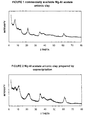
- the powder X-ray diffraction pattern (PXRD) suggests that the quality of the product is comparable to acetate-containing anionic clays made by other standard methods.
- the physical and chemical properties of the product also are equal if not superior to those anionic clays made by the other conventional methods.
- the overall process of this invention is very flexible, enabling a wide variety of anionic clay compositions and anionic clay-like materials to be prepared in an economically and environmental-friendly manner.
- the present invention pertains to a process for the preparation of an anionic clay by reacting a slurry comprising aluminium trihydrate or its thermally treated form with magnesium acetate and another magnesium source
- the reaction results in the direct formation of an anionic clay with acetate anions as the interlayer charge-balancing species.
- Said reaction takes place at ambient temperature or higher. At temperatures higher than 100 °C, the reaction is preferably carried out under autogeneous conditions.
- acetate anions are provided in the reaction medium as a soluble magnesium acetate salt and incorporated into the interlayer as the necessary charge balancing anion.
- Anionic clays prepared by this method exhibit the well known properties and characteristics (e.g. chemical analysis, powder X-ray diffraction pattern, FRIR, thermal decomposition characteristics, surface area, pore volume, and pore size distribution) usually associated with acetate-containing anionic clays prepared by the customary and previously disclosed methods.
- anionic clays Upon being heated, anionic clays generally decompose to Mg-Al solid solutions ,and at higher temperatures spinels.
- an adsorbent for instance a SO x adsorbent for catalytic cracking reactions
- the anionic clay according to the invention is usually heated during preparation and is thus in the Mg-Al solid solution form.
- the catalyst or adsorbent is converted from an anionic clay into Mg-Al solid solutions.
- the present invention is also directed to a process wherein an anionic clay prepared by reacting a slurry comprising aluminium trihydrate or its thermally treated form and magnesium acetate and another magnesium source, is heat-treated at a temperature between 300 and 1200 °C to form a Mg-Al solid solution.
- the anionic clay according to the invention has a layered structure corresponding to the general formula [Mg m 2+ Al n 3+ (OH) 2m + 2n - ](OAc - ) m - bH 2 O
- OAc acetate
- the product can be spray dried directly to form microspheres or can be extruded to form shaped bodies.
- the present invention includes the use of crystalline aluminium trihydrate (ATH), for example gibbsites provided by Reynolds Aluminium Company RH-20® or JM Huber Micral ® grades. Also BOC (Bauxite Ore Concentrate), bayerite and nordstrandite are suitable aluminium trihydrates. BOC is the cheapest alumina source. The alumina trihydrate is preferred to have a small particle size. In another embodiment of the invention thermally treated forms of gibbsite are used. Combinations of aluminium trihydrate and thermally treated forms of aluminium trihydrate can also be used. The calcined aluminium trihydrate is readily obtained by thermally treating aluminium trihydrate (gibbsite) at a temperature ranging from 100 to 800 °C for 15 minutes to 24 hours.
- gibbsite aluminium trihydrate
- the calcining temperature and time for obtaining calcined aluminium trihydrate should be sufficient to cause a measurable increase of the surface area in view of the surface area of the gibbsite as produced by the Bayer process which is generally between 30 and 50 m 2 /g.
- flash calcined alumina is also considered to be a thermally treated form of aluminium trihydrate, although generally it is considered a very specific alumina. Flash calcined alumina is obtained by treating aluminium trihydrate at temperatures between 800-1000 °C for very short periods of time in special industrial equipment, as is described in US 4,051,072 and US 3,222,129. Combinations of various thermally treated forms of aluminium trihydrate can also be used.
- the aluminium source is added to the reactor in the form of a slurry.
- a peptizable alumina source gibbsite is not peptizable
- other aluminium sources beside aluminium trihydrate or its thermally treated forms may be added to the slurry such as oxides and hydroxides of aluminium, (e.g. sols, flash calcined alumina, gels, pseudo-boehmite, boehmite) aluminium salts such as aluminium nitrate, aluminium chloride, aluminium chlorohydrate and sodium aluminate.
- Said other aluminium sources may be soluble or insoluble in water and may be added to the aluminium trihydrate and/or its thermally treated form or it may be added to the slurry separately as a solid, a solution or as a suspension.
- Mg sources other than magnesium acetate which may be used include MgO, Mg(OH) 2 , magnesium formate, magnesium hydroxy acetate, hydromagnesite (Mg 5 (CO 3 ) 4 (OH) 2 ), magnesium carbonate, magnesium bicarbonate, magnesium nitrate, magnesium chloride, dolomite and sepiolite. Both solid Mg sources and soluble Mg salts are suitable. Also combinations of Mg sources may be used.
- the magnesium source may be added to the reactor as a solid, a solution, or, preferably, as a slurry. The magnesium source may also be combined with the aluminium source before it is added to the reactor.
- the magnesium acetate may be added to the slurry containing aluminium (space) trihydrate or its thermally treated form and/or the other magnesium source or vice versa.
- Acetic acid may also be added to the slurry to increase the acetate concentration and/or control pH.
- other metal acetate salts may be added e.g. zinc acetate provided it is acceptable that divalent cations other than Mg may enter the anionic clay structure.
- this process is particularly suitable to be carried out in a continuous mode.
- aluminium trihydrate or its thermally treated form magnesium acetate and another magnesium source are fed to a reactor and reacted in aqueous suspension to obtain an anionic clay-containing composition.
- magnesium acetate and another magnesium source are added to a reactor and reacted in aqueous suspension to obtain an anionic clay-containing composition.
- a reactor is considered to be any confined zone in which the reaction between the aluminium source and the magnesium sources takes place.
- the reactor may be equipped with stirrers, baffles etcetera to ensure homogeneous mixing of the reactants.
- the reaction can take place with or without stirring, at ambient or at elevated temperature and at atmospheric or elevated pressure. Usually, a temperature between 0 and 100 °C is used at or above atmospheric pressure. It is preferred to carry out the process at temperatures above 50 °C rather than at room temperature, because this results in anionic clays with sharper peaks in the x-ray diffraction pattern than anionic clay-containing compositions obtained at room temperature.
- the reactor may be heated by any heating source such as a furnace, microwave, infrared sources, heating jackets (either electrical or with a heating fluid), lamps, etcetera.
- Said aqueous suspension in the reactor may be obtained by either adding slurries of the starting materials, either combined or separate, to the reactor or adding magnesium source to a slurry of alumina trihydrate and/or its thermally treated form or vice versa and adding the resulting slurry to the reactor. It is possible to treat, for instance the aluminium trihydrate slurry at elevated temperature and then add either the Mg sources per se , or add the Mg sources in a slurry or solution either to the reactor or the aluminium source slurry. Given particular facilities which might be available, the continuous process can be conducted hydrothermally. This is particularly advantageous, because it is faster and a higher conversion is obtained. There is no need to wash or filter the product, as unwanted ions (e.g.
- the process is conducted in a multi-step process, e.g. a slurry of ATH and Mg sources is treated thermally in a first reactor at a mild temperature, followed by a hydrothermal treatment in a second reactor. If desired a preformed anionic day may be added to the reactor. Said preformed clay may be recycled anionic clay from the reaction mixture or anionic clay made separately by the process according to the invention or any other process.
- organic or inorganic acids and bases may be fed to the reactor or added to either the magnesium source or the aluminium source before they are fed to the reactor.
- An example of a preferred pH modifier is an ammonium base, because upon drying no deleterious cations remain in the anionic clay.
- the anionic clay prepared by the process according to the invention may be subjected to ion exchange.
- ion exchange the interlayer charge-balancing acetate ion is replaced with other anions.
- Said other anions are the ones commonly present in anionic clays and include pillaring anions such as V 10 O 28 6- , Mo 7 O 24 6- , PW 12 O 40 3- , B(OH) 4 - , B 4 O 5 (OH) 4 2 -, HBO 4 2- , HGaO 3 2-, CrO 4 2- .
- suitable pillaring anions are given in US 4774212 which is included by reference for this purpose.
- Said ion exchange can be conducted before or after drying the anionic clay formed in the slurry.
- the process of the invention provides wide flexibility in preparing products with a wide range of Mg:Al ratios.
- the Mg:Al ratio can vary from 1 to 10, preferably from 1 to 6, more preferred from 2 to 4, and especially preferred to close to 3.
- both metals and non-metals such as rare earth metals, Si, P, B, group VI, group VIII, alkaline earth (for instance Ca and Ba) and/or transition metals (for example Mn, Fe, Ti, Zr, Cu, Ni, Zn, Mo, Sn), present Said metals and non-metals can easily be deposited on the anionic clay or the solid solution according to the invention or they can be added either to the alumina source or magnesium sources which are added to the reactor or added the reactor separately. Suitable sources of metals or non-metals are oxides, halides or any other salt such as chlorides, nitrates etcetera. In the case of a multi-step process the metals and non-metals may be added in any of the steps. It can be especially advantageous for controlling the distribution of the metals and non-metals In the anionic clay.
- rare earth metals Si, P, B, group VI, group VIII, alkaline earth (for instance Ca and Ba) and/or transition metals (for example Mn, Fe
- the following example illustrates the preparation of an acetate anionic clay by co-precipitation.
- Example 5 The product of Example 5 was subjected to after calcination at 735 °C for 1 h.
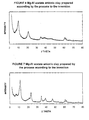
- the PXRD pattern showed that a Mg-Al solid solution was formed. (See Figure 8).
Landscapes
- Chemical & Material Sciences (AREA)
- Organic Chemistry (AREA)
- Life Sciences & Earth Sciences (AREA)
- Geology (AREA)
- Inorganic Chemistry (AREA)
- Compounds Of Alkaline-Earth Elements, Aluminum Or Rare-Earth Metals (AREA)
- Catalysts (AREA)
- Organic Low-Molecular-Weight Compounds And Preparation Thereof (AREA)
- Solid-Sorbent Or Filter-Aiding Compositions (AREA)
- Silicates, Zeolites, And Molecular Sieves (AREA)
Claims (8)
- Verfahren zur Herstellung anionischer Tone, wobei eine Aufschlämmung, die Aluminiumtrihydrat oder dessen wärmebehandelte Form umfasst, mit Magnesiumacetat und einer anderen Magnesiumquelle umgesetzt wird, um einen anionischen Ton mit Acetat als ladungsausgleichendem Anion zu erhalten.
- Verfahren gemäß Anspruch 1, wobei Essigsäure zu der Aufschlämmung gegegeben wird.
- Verfahren gemäß Anspruch 1, wobei die Umsetzung bei Raumtemperatur und atmosphärischem Druck stattfindet.
- Verfahren gemäß den Ansprüchen 1 oder 2, wobei die Magnesiumquelle MgO umfasst.
- Verfahren gemäß irgendeinem der Ansprüche 1 bis 4, wobei eine erste Aufschlämmung, die wärmebehandeltes Aluminiumtrihydat umfasst, mit einer zweiten Aufschlämmung vereinigt wird, die Magnesiumacetat und eine andere Magnesiumquelle umfasst.
- Verfahren gemäß Anspruch 4, wobei das Verfahren auf kontinuierliche Weise durchgeführt wird.
- Verfahren gemäß Anspruch 1, wobei der anionische Ton einer Ionenaustausch-Behandlung unterzogen wird.
- Verfahren zur Herstellung einer festen Al-Mg-Lösung, wobei eine Aufschlämmung, die wärmebehandeltes Aluminiumtrihydat oder dessen wärmebehandelte Form umfasst, mit Magnesiumacetat und einer anderen Magnesiumquelle umgesetzt wird, um einen anionischen Ton zu erhalten, und der anionische Ton einer Wärmebehandlung bei einer Temperatur zwischen 300 °C und 1200 °C unterzogen wird.
Applications Claiming Priority (3)
| Application Number | Priority Date | Filing Date | Title |
|---|---|---|---|
| US21840 | 1993-02-24 | ||
| US2184098A | 1998-02-11 | 1998-02-11 | |
| PCT/EP1999/000936 WO1999041196A1 (en) | 1998-02-11 | 1999-02-11 | Process for producing anionic clays using magnesium acetate |
Publications (2)
| Publication Number | Publication Date |
|---|---|
| EP1053210A1 EP1053210A1 (de) | 2000-11-22 |
| EP1053210B1 true EP1053210B1 (de) | 2004-07-21 |
Family
ID=21806445
Family Applications (1)
| Application Number | Title | Priority Date | Filing Date |
|---|---|---|---|
| EP99910223A Expired - Lifetime EP1053210B1 (de) | 1998-02-11 | 1999-02-11 | Verfahren zur herstellung von anionischen tonerden unter verwendung von magnesiumacetat |
Country Status (7)
| Country | Link |
|---|---|
| US (1) | US6333290B1 (de) |
| EP (1) | EP1053210B1 (de) |
| JP (1) | JP4307717B2 (de) |
| CN (1) | CN1166564C (de) |
| CA (1) | CA2320099C (de) |
| DE (1) | DE69918801T2 (de) |
| WO (1) | WO1999041196A1 (de) |
Families Citing this family (21)
| Publication number | Priority date | Publication date | Assignee | Title |
|---|---|---|---|---|
| US6028023A (en) | 1997-10-20 | 2000-02-22 | Bulldog Technologies U.S.A., Inc. | Process for making, and use of, anionic clay materials |
| US6376405B1 (en) * | 1998-02-11 | 2002-04-23 | Akzo Nobel N.V. | Process for producing anionic clay using two types of alumina compounds |
| DE60007533T2 (de) * | 1999-08-11 | 2004-11-11 | Akzo Nobel N.V. | Polytypisches magnesiumaluminiumhydrotalcit |
| WO2002068329A1 (en) * | 2001-02-09 | 2002-09-06 | Akzo Nobel N.V. | Process for the preparation of anionic clay |
| CN1304351C (zh) * | 2001-02-09 | 2007-03-14 | 阿克佐诺贝尔股份有限公司 | 准晶体水合羟基羧酸镁铝、其制备和用途 |
| CA2437609C (en) | 2001-02-09 | 2010-06-22 | Akzo Nobel Nv | Doped anionic clays |
| KR100796101B1 (ko) | 2001-02-09 | 2008-01-21 | 아크조 노벨 엔.브이. | 음이온 클레이와 베마이트-함유 조성물의 제조 방법 |
| US7303654B2 (en) | 2002-11-19 | 2007-12-04 | Akzo Nobel N.V. | Cellulosic product and process for its production |
| BRPI0407455B1 (pt) | 2003-02-13 | 2020-01-07 | Albemarle Netherlands B.V. | Composição que contém um ou mais hidróxi-sais metálicos, um material de matriz, ligante ou veículo, uso da dita composição e uso de uma forma calcinada da composição |
| KR100912041B1 (ko) | 2003-12-05 | 2009-08-12 | 인터캣, 인코포레이티드 | 혼합 금속 산화물 흡수체 |
| US7431825B2 (en) * | 2003-12-05 | 2008-10-07 | Intercat, Inc. | Gasoline sulfur reduction using hydrotalcite like compounds |
| TWI342335B (en) | 2004-06-02 | 2011-05-21 | Intercat Inc | Mixed metal oxide additives |
| EP1840113B1 (de) * | 2004-12-22 | 2017-05-31 | Tayca Corporation | Schichtenförmiges, in wasser abziehbares doppelhydroxid und verfahren zu dessen herstellung und dessen verwendung |
| JP5155568B2 (ja) * | 2007-01-29 | 2013-03-06 | テイカ株式会社 | 水中で剥離する層状複水酸化物、その製造方法および用途 |
| WO2009072488A2 (ja) * | 2007-12-05 | 2009-06-11 | National Institute For Materials Science | 陰イオン交換性層状複水酸化物の製造方法 |
| JP2009173482A (ja) * | 2008-01-23 | 2009-08-06 | National Institute For Materials Science | 膨潤性層状複水酸化物およびその製造方法とそれを用いたゲル状物質、ゾル状物質ならびにナノシート |
| EP2263976A1 (de) | 2009-06-03 | 2010-12-22 | Akzo Nobel Chemicals International B.V. | Schichtdoppelhydroxid mit spezifischer Morphologie, dessen Herstellung und Verwendung |
| EP2261177A1 (de) | 2009-06-11 | 2010-12-15 | Akzo Nobel Chemicals International B.V. | Geschichtetes Doppelhydroxid, Herstellung und Verwendung |
| FR2977580B1 (fr) * | 2011-07-07 | 2013-08-16 | Centre Nat Rech Scient | Procede de preparation d'une composition comprenant des particules minerales synthetiques et composition |
| JP5834794B2 (ja) * | 2011-11-11 | 2015-12-24 | 堺化学工業株式会社 | ハイドロタルサイトとその製造方法 |
| CN105366751B (zh) * | 2015-12-09 | 2017-10-03 | 王文领 | 一种煤化工气化洗涤黑水高温闪蒸气的节能环保型综合回收利用方法 |
Family Cites Families (39)
| Publication number | Priority date | Publication date | Assignee | Title |
|---|---|---|---|---|
| US3222129A (en) | 1962-02-26 | 1965-12-07 | Kaiser Aluminium Chem Corp | Method for producing active alumina nodules |
| US3539306A (en) * | 1966-07-25 | 1970-11-10 | Kyowa Chem Ind Co Ltd | Process for the preparation of hydrotalcite |
| US3796792A (en) | 1969-12-12 | 1974-03-12 | Kyowa Chem Ind Co Ltd | Composite metal hydroxides |
| US3844979A (en) * | 1972-12-01 | 1974-10-29 | Chevron Res | Layered clay minerals, catalysts, and processes for using |
| US3844978A (en) * | 1972-12-01 | 1974-10-29 | Chevron Res | Layered clay minerals and processes for using |
| US4904457A (en) | 1974-03-30 | 1990-02-27 | Aluminum Company Of America | Synthetic hydrotalcite |
| US4051072A (en) | 1976-04-05 | 1977-09-27 | General Motors Corporation | Method for making pellet type catalyst |
| US4351814A (en) | 1980-12-18 | 1982-09-28 | Kyowa Chemical Industry Co., Ltd. | Hydrotalcites having a hexagonal needle-like crystal structure and process for production thereof |
| US4458026A (en) | 1982-06-02 | 1984-07-03 | Union Carbide Corporation | Catalysts for aldol condensations |
| JPS606619A (ja) * | 1983-06-27 | 1985-01-14 | Kyowa Chem Ind Co Ltd | 鉄分欠乏症処置剤及びその製法 |
| US4656156A (en) | 1986-01-21 | 1987-04-07 | Aluminum Company Of America | Adsorbent and substrate products and method of producing same |
| US4866019A (en) | 1987-01-13 | 1989-09-12 | Akzo N.V. | Catalyst composition and absorbent which contain an anionic clay |
| EP0318099A3 (de) * | 1987-11-25 | 1989-11-15 | Union Carbide Corporation | Herstellung von Monoalkylenglycol unter Anwendung von gemischten Metallnetzwerkkompositionen |
| US4774212A (en) * | 1987-12-22 | 1988-09-27 | Amoco Corporation | Pillared hydrotalcites |
| US4970191A (en) * | 1989-04-18 | 1990-11-13 | Aristech Chemical Corporation | Basic mixed oxide |
| US5153156A (en) * | 1989-04-18 | 1992-10-06 | Aristech Chemical Corporation | Process for making efficient anionic clay catalyst, catalysts made thereby, and method of making isophorone |
| US5202496A (en) * | 1989-04-18 | 1993-04-13 | Aristech Chemical Corporation | Method of making isophorne |
| GB8922359D0 (en) * | 1989-10-04 | 1989-11-22 | British Petroleum Co Plc | Process for the preparation of catalysts |
| US5116587A (en) | 1990-01-18 | 1992-05-26 | Board Of Trustees Operating Michigan State University | Layered double hydroxide sorbents for the removal of sox from flue gas resulting from coal combustion |
| US5114898A (en) | 1990-01-18 | 1992-05-19 | Board Of Trustees Operating Michigan State University | Layered double hydroxide sorbents for the removal of SOx from flue gas and other gas streams |
| US5079203A (en) | 1990-05-25 | 1992-01-07 | Board Of Trustees Operating Michigan State University | Polyoxometalate intercalated layered double hydroxides |
| US5104987A (en) * | 1990-09-20 | 1992-04-14 | Union Carbide Chemicals & Plastics Technology Corporation | Alkoxylation of active hydrogen-containing compounds |
| US5214142A (en) * | 1990-09-20 | 1993-05-25 | Union Carbide Chemicals & Plastics Technology Corporation | Processes for the preparation of aminoethers |
| US5247103A (en) * | 1990-09-20 | 1993-09-21 | Union Carbide Chemicals & Plastics Technology Corporation | Processes for the preparation of cyclic ethers |
| US5474602A (en) * | 1990-09-26 | 1995-12-12 | Alcan International Limited | Treatment of magnesium hydroxide and its use as plastics filler |
| US5439861A (en) | 1991-08-16 | 1995-08-08 | Amoco Corporation | Catalyzed vapor phase process for making synthesis gas |
| US5246899A (en) | 1991-08-16 | 1993-09-21 | Amoco Corporation | Simplified preparation of hydrotalcite-type clays |
| US5260495A (en) * | 1991-08-23 | 1993-11-09 | Union Carbide Chemicals & Plastics Technology Corporation | Monoalkylene glycol production using highly selective monoalkylene glycol catalysts |
| JP2649630B2 (ja) | 1992-05-29 | 1997-09-03 | 東陶機器株式会社 | 陶磁器の鋳込み成形方法 |
| US5399537A (en) | 1992-12-21 | 1995-03-21 | Amoco Corporation | Method for preparing synthesis gas using nickel catalysts |
| US5939353A (en) * | 1992-12-21 | 1999-08-17 | Bp Amoco Corporation | Method for preparing and using nickel catalysts |
| US5507980A (en) | 1993-07-06 | 1996-04-16 | Aristech Chemical Corporation | Basic inorganic binders |
| US5407652A (en) * | 1993-08-27 | 1995-04-18 | Engelhard Corporation | Method for decomposing N20 utilizing catalysts comprising calcined anionic clay minerals |
| US5578286A (en) | 1994-04-29 | 1996-11-26 | Aluminum Company Of America | Two powder synthesis of hydrotalcite-like compounds with divalent or polyvalent organic anions |
| US5426083A (en) | 1994-06-01 | 1995-06-20 | Amoco Corporation | Absorbent and process for removing sulfur oxides from a gaseous mixture |
| BR9508872A (pt) * | 1994-08-15 | 1998-01-06 | Aluminum Co Of America | Sintese de dois hidrotalcita e compostos similares à hidrotalcita |
| DE19511016A1 (de) * | 1995-03-25 | 1996-09-26 | Henkel Kgaa | Kationische Schichtverbindungen, deren Herstellung und deren Verwendung als PVC-Stabilisatoren |
| US6028023A (en) * | 1997-10-20 | 2000-02-22 | Bulldog Technologies U.S.A., Inc. | Process for making, and use of, anionic clay materials |
| US6171991B1 (en) * | 1998-02-11 | 2001-01-09 | Akzo Nobel Nv | Process for producing an anionic clay-containing composition |
-
1999
- 1999-02-10 US US09/247,532 patent/US6333290B1/en not_active Expired - Fee Related
- 1999-02-11 EP EP99910223A patent/EP1053210B1/de not_active Expired - Lifetime
- 1999-02-11 JP JP2000531400A patent/JP4307717B2/ja not_active Expired - Fee Related
- 1999-02-11 DE DE69918801T patent/DE69918801T2/de not_active Expired - Lifetime
- 1999-02-11 WO PCT/EP1999/000936 patent/WO1999041196A1/en not_active Ceased
- 1999-02-11 CA CA002320099A patent/CA2320099C/en not_active Expired - Fee Related
- 1999-02-11 CN CNB998029246A patent/CN1166564C/zh not_active Expired - Fee Related
Also Published As
| Publication number | Publication date |
|---|---|
| CN1166564C (zh) | 2004-09-15 |
| CN1305437A (zh) | 2001-07-25 |
| JP4307717B2 (ja) | 2009-08-05 |
| CA2320099C (en) | 2008-01-22 |
| JP2002503619A (ja) | 2002-02-05 |
| WO1999041196A1 (en) | 1999-08-19 |
| DE69918801T2 (de) | 2005-07-21 |
| DE69918801D1 (de) | 2004-08-26 |
| CA2320099A1 (en) | 1999-08-19 |
| EP1053210A1 (de) | 2000-11-22 |
| US6333290B1 (en) | 2001-12-25 |
Similar Documents
| Publication | Publication Date | Title |
|---|---|---|
| EP1204595B1 (de) | Polytypisches magnesiumaluminiumhydrotalcit | |
| EP1053210B1 (de) | Verfahren zur herstellung von anionischen tonerden unter verwendung von magnesiumacetat | |
| US6440887B1 (en) | Continuous process for producing anionic clay | |
| US6171991B1 (en) | Process for producing an anionic clay-containing composition | |
| US6815389B2 (en) | Process for producing anionic clay using two types of alumina compounds | |
| US6440888B1 (en) | Process for producing Al-containing non-Mg-anionic clay | |
| CA2361235C (en) | Process for producing anionic clay using boehmite | |
| US6800578B2 (en) | Process for producing anionic clay using boehmite which has been peptized with an acid | |
| WO1999041197A1 (en) | Process for producing an anionic clay-containing composition | |
| WO2000044672A1 (en) | Process for hydrothermally producing anionic clay using boehmite which has been peptized with inorganic acid | |
| EP1054839B1 (de) | Herstellungsverfahren zur darstellung von zusammensetzungen, die anionische tonerden enthalten | |
| EP1054838B1 (de) | Verfahren zur herstellung anionischer tonerden unter verwendung zwei verschiedener aluminiumhydroxid verbindungen |
Legal Events
| Date | Code | Title | Description |
|---|---|---|---|
| PUAI | Public reference made under article 153(3) epc to a published international application that has entered the european phase |
Free format text: ORIGINAL CODE: 0009012 |
|
| 17P | Request for examination filed |
Effective date: 20000712 |
|
| AK | Designated contracting states |
Kind code of ref document: A1 Designated state(s): DE FR GB IT NL |
|
| 17Q | First examination report despatched |
Effective date: 20010509 |
|
| GRAP | Despatch of communication of intention to grant a patent |
Free format text: ORIGINAL CODE: EPIDOSNIGR1 |
|
| GRAS | Grant fee paid |
Free format text: ORIGINAL CODE: EPIDOSNIGR3 |
|
| GRAA | (expected) grant |
Free format text: ORIGINAL CODE: 0009210 |
|
| AK | Designated contracting states |
Kind code of ref document: B1 Designated state(s): DE FR GB IT NL |
|
| REG | Reference to a national code |
Ref country code: GB Ref legal event code: FG4D |
|
| REF | Corresponds to: |
Ref document number: 69918801 Country of ref document: DE Date of ref document: 20040826 Kind code of ref document: P |
|
| ET | Fr: translation filed | ||
| PLBE | No opposition filed within time limit |
Free format text: ORIGINAL CODE: 0009261 |
|
| STAA | Information on the status of an ep patent application or granted ep patent |
Free format text: STATUS: NO OPPOSITION FILED WITHIN TIME LIMIT |
|
| 26N | No opposition filed |
Effective date: 20050422 |
|
| REG | Reference to a national code |
Ref country code: GB Ref legal event code: 732E |
|
| NLS | Nl: assignments of ep-patents |
Owner name: ALBEMARLE NETHERLANDS B.V. Effective date: 20050908 Owner name: AKZO NOBEL N.V. Effective date: 20050908 |
|
| REG | Reference to a national code |
Ref country code: FR Ref legal event code: TQ |
|
| REG | Reference to a national code |
Ref country code: FR Ref legal event code: RM |
|
| PGFP | Annual fee paid to national office [announced via postgrant information from national office to epo] |
Ref country code: IT Payment date: 20100224 Year of fee payment: 12 Ref country code: FR Payment date: 20100303 Year of fee payment: 12 |
|
| PGFP | Annual fee paid to national office [announced via postgrant information from national office to epo] |
Ref country code: GB Payment date: 20100224 Year of fee payment: 12 Ref country code: DE Payment date: 20100226 Year of fee payment: 12 |
|
| PGFP | Annual fee paid to national office [announced via postgrant information from national office to epo] |
Ref country code: NL Payment date: 20100223 Year of fee payment: 12 |
|
| REG | Reference to a national code |
Ref country code: NL Ref legal event code: V1 Effective date: 20110901 |
|
| GBPC | Gb: european patent ceased through non-payment of renewal fee |
Effective date: 20110211 |
|
| REG | Reference to a national code |
Ref country code: FR Ref legal event code: ST Effective date: 20111102 |
|
| PG25 | Lapsed in a contracting state [announced via postgrant information from national office to epo] |
Ref country code: IT Free format text: LAPSE BECAUSE OF NON-PAYMENT OF DUE FEES Effective date: 20110211 Ref country code: NL Free format text: LAPSE BECAUSE OF NON-PAYMENT OF DUE FEES Effective date: 20110901 |
|
| REG | Reference to a national code |
Ref country code: DE Ref legal event code: R119 Ref document number: 69918801 Country of ref document: DE Effective date: 20110901 |
|
| PG25 | Lapsed in a contracting state [announced via postgrant information from national office to epo] |
Ref country code: FR Free format text: LAPSE BECAUSE OF NON-PAYMENT OF DUE FEES Effective date: 20110228 |
|
| PG25 | Lapsed in a contracting state [announced via postgrant information from national office to epo] |
Ref country code: GB Free format text: LAPSE BECAUSE OF NON-PAYMENT OF DUE FEES Effective date: 20110211 |
|
| PG25 | Lapsed in a contracting state [announced via postgrant information from national office to epo] |
Ref country code: DE Free format text: LAPSE BECAUSE OF NON-PAYMENT OF DUE FEES Effective date: 20110901 |