EP1053963B1 - Sytème et procédé pour fournir des lots d'accumulation de documents à un système d'insertion - Google Patents
Sytème et procédé pour fournir des lots d'accumulation de documents à un système d'insertion Download PDFInfo
- Publication number
- EP1053963B1 EP1053963B1 EP00110152A EP00110152A EP1053963B1 EP 1053963 B1 EP1053963 B1 EP 1053963B1 EP 00110152 A EP00110152 A EP 00110152A EP 00110152 A EP00110152 A EP 00110152A EP 1053963 B1 EP1053963 B1 EP 1053963B1
- Authority
- EP
- European Patent Office
- Prior art keywords
- sheets
- sheet
- supplying
- accumulation
- collation
- Prior art date
- Legal status (The legal status is an assumption and is not a legal conclusion. Google has not performed a legal analysis and makes no representation as to the accuracy of the status listed.)
- Expired - Lifetime
Links
- 238000009825 accumulation Methods 0.000 title claims description 56
- 238000000034 method Methods 0.000 title claims description 20
- 238000004891 communication Methods 0.000 claims description 6
- 238000011144 upstream manufacturing Methods 0.000 claims 2
- 230000035508 accumulation Effects 0.000 description 24
- 230000035611 feeding Effects 0.000 description 22
- 210000000006 pectoral fin Anatomy 0.000 description 16
- 230000008901 benefit Effects 0.000 description 7
- 238000010586 diagram Methods 0.000 description 6
- 239000002184 metal Substances 0.000 description 6
- 238000012545 processing Methods 0.000 description 5
- 230000001351 cycling effect Effects 0.000 description 4
- 230000007246 mechanism Effects 0.000 description 4
- 230000006870 function Effects 0.000 description 3
- 238000003780 insertion Methods 0.000 description 3
- 230000037431 insertion Effects 0.000 description 3
- 238000012423 maintenance Methods 0.000 description 3
- 230000003287 optical effect Effects 0.000 description 3
- 230000008569 process Effects 0.000 description 3
- 230000015572 biosynthetic process Effects 0.000 description 2
- 230000009172 bursting Effects 0.000 description 2
- 238000011143 downstream manufacturing Methods 0.000 description 2
- 238000012015 optical character recognition Methods 0.000 description 2
- 238000000926 separation method Methods 0.000 description 2
- 230000009471 action Effects 0.000 description 1
- 230000004913 activation Effects 0.000 description 1
- 230000004888 barrier function Effects 0.000 description 1
- 230000000903 blocking effect Effects 0.000 description 1
- 230000003139 buffering effect Effects 0.000 description 1
- 230000008859 change Effects 0.000 description 1
- 238000010276 construction Methods 0.000 description 1
- 238000001514 detection method Methods 0.000 description 1
- 238000009434 installation Methods 0.000 description 1
- 230000003993 interaction Effects 0.000 description 1
- 238000004519 manufacturing process Methods 0.000 description 1
- 239000000463 material Substances 0.000 description 1
- 238000012986 modification Methods 0.000 description 1
- 230000004048 modification Effects 0.000 description 1
- 239000002994 raw material Substances 0.000 description 1
- 230000004044 response Effects 0.000 description 1
- 238000012546 transfer Methods 0.000 description 1
- 230000001131 transforming effect Effects 0.000 description 1
Images










Classifications
-
- B—PERFORMING OPERATIONS; TRANSPORTING
- B65—CONVEYING; PACKING; STORING; HANDLING THIN OR FILAMENTARY MATERIAL
- B65H—HANDLING THIN OR FILAMENTARY MATERIAL, e.g. SHEETS, WEBS, CABLES
- B65H29/00—Delivering or advancing articles from machines; Advancing articles to or into piles
- B65H29/66—Advancing articles in overlapping streams
- B65H29/6609—Advancing articles in overlapping streams forming an overlapping stream
-
- B—PERFORMING OPERATIONS; TRANSPORTING
- B43—WRITING OR DRAWING IMPLEMENTS; BUREAU ACCESSORIES
- B43M—BUREAU ACCESSORIES NOT OTHERWISE PROVIDED FOR
- B43M3/00—Devices for inserting documents into envelopes
- B43M3/04—Devices for inserting documents into envelopes automatic
-
- B—PERFORMING OPERATIONS; TRANSPORTING
- B65—CONVEYING; PACKING; STORING; HANDLING THIN OR FILAMENTARY MATERIAL
- B65H—HANDLING THIN OR FILAMENTARY MATERIAL, e.g. SHEETS, WEBS, CABLES
- B65H29/00—Delivering or advancing articles from machines; Advancing articles to or into piles
- B65H29/58—Article switches or diverters
- B65H29/60—Article switches or diverters diverting the stream into alternative paths
-
- B—PERFORMING OPERATIONS; TRANSPORTING
- B65—CONVEYING; PACKING; STORING; HANDLING THIN OR FILAMENTARY MATERIAL
- B65H—HANDLING THIN OR FILAMENTARY MATERIAL, e.g. SHEETS, WEBS, CABLES
- B65H3/00—Separating articles from piles
- B65H3/08—Separating articles from piles using pneumatic force
- B65H3/10—Suction rollers
-
- B—PERFORMING OPERATIONS; TRANSPORTING
- B65—CONVEYING; PACKING; STORING; HANDLING THIN OR FILAMENTARY MATERIAL
- B65H—HANDLING THIN OR FILAMENTARY MATERIAL, e.g. SHEETS, WEBS, CABLES
- B65H33/00—Forming counted batches in delivery pile or stream of articles
- B65H33/12—Forming counted batches in delivery pile or stream of articles by creating gaps in the stream
-
- B—PERFORMING OPERATIONS; TRANSPORTING
- B65—CONVEYING; PACKING; STORING; HANDLING THIN OR FILAMENTARY MATERIAL
- B65H—HANDLING THIN OR FILAMENTARY MATERIAL, e.g. SHEETS, WEBS, CABLES
- B65H39/00—Associating, collating, or gathering articles or webs
- B65H39/10—Associating articles from a single source, to form, e.g. a writing-pad
-
- B—PERFORMING OPERATIONS; TRANSPORTING
- B65—CONVEYING; PACKING; STORING; HANDLING THIN OR FILAMENTARY MATERIAL
- B65H—HANDLING THIN OR FILAMENTARY MATERIAL, e.g. SHEETS, WEBS, CABLES
- B65H83/00—Combinations of piling and depiling operations, e.g. performed simultaneously, of interest apart from the single operation of piling or depiling as such
- B65H83/02—Combinations of piling and depiling operations, e.g. performed simultaneously, of interest apart from the single operation of piling or depiling as such performed on the same pile or stack
-
- B—PERFORMING OPERATIONS; TRANSPORTING
- B65—CONVEYING; PACKING; STORING; HANDLING THIN OR FILAMENTARY MATERIAL
- B65H—HANDLING THIN OR FILAMENTARY MATERIAL, e.g. SHEETS, WEBS, CABLES
- B65H2301/00—Handling processes for sheets or webs
- B65H2301/40—Type of handling process
- B65H2301/42—Piling, depiling, handling piles
- B65H2301/423—Depiling; Separating articles from a pile
- B65H2301/4232—Depiling; Separating articles from a pile of horizontal or inclined articles, i.e. wherein articles support fully or in part the mass of other articles in the piles
- B65H2301/42322—Depiling; Separating articles from a pile of horizontal or inclined articles, i.e. wherein articles support fully or in part the mass of other articles in the piles from bottom of the pile
-
- B—PERFORMING OPERATIONS; TRANSPORTING
- B65—CONVEYING; PACKING; STORING; HANDLING THIN OR FILAMENTARY MATERIAL
- B65H—HANDLING THIN OR FILAMENTARY MATERIAL, e.g. SHEETS, WEBS, CABLES
- B65H2301/00—Handling processes for sheets or webs
- B65H2301/40—Type of handling process
- B65H2301/43—Gathering; Associating; Assembling
- B65H2301/431—Features with regard to the collection, nature, sequence and/or the making thereof
- B65H2301/4311—Making personalised books or mail packets according to personal, geographic or demographic data
-
- B—PERFORMING OPERATIONS; TRANSPORTING
- B65—CONVEYING; PACKING; STORING; HANDLING THIN OR FILAMENTARY MATERIAL
- B65H—HANDLING THIN OR FILAMENTARY MATERIAL, e.g. SHEETS, WEBS, CABLES
- B65H2301/00—Handling processes for sheets or webs
- B65H2301/40—Type of handling process
- B65H2301/44—Moving, forwarding, guiding material
- B65H2301/445—Moving, forwarding, guiding material stream of articles separated from each other
- B65H2301/4452—Regulating space between separated articles
- B65H2301/44522—Varying space between separated articles
-
- B—PERFORMING OPERATIONS; TRANSPORTING
- B65—CONVEYING; PACKING; STORING; HANDLING THIN OR FILAMENTARY MATERIAL
- B65H—HANDLING THIN OR FILAMENTARY MATERIAL, e.g. SHEETS, WEBS, CABLES
- B65H2513/00—Dynamic entities; Timing aspects
- B65H2513/40—Movement
- B65H2513/42—Route, path
Definitions
- the present invention relates generally to multi-station document inserting systems, which assemble batches of documents for insertion into envelopes. More particularly, the present invention is directed towards the input system for providing documents at a high speed to such multi-station document inserting systems.
- Multi-station document inserting systems generally include a plurality of various stations that are configured for specific applications.
- inserting systems also known as console inserting machines, are manufactured to perform operations customized for a particular customer.
- console inserting machines are known in the art and are generally used by organizations, which produce a large volume of mailings where the content of each mail piece may vary.
- inserter systems are used by organizations such as banks, insurance companies and utility companies for producing a large volume of specific mailings where the contents of each mail item are directed to a particular addressee.
- other organizations such as direct mailers, use inserts for producing a large volume of generic mailings where the contents of each mail item are substantially identical for each addressee. Examples of such inserter systems are the 8 series and 9 series inserter systems available from Pitney Bowes, Inc. of Stamford, Connecticut, USA.
- EP-A-0 899 129 describes a high speed document input system comprising a cutting and feed device which cuts a "two-up" web into separated “two-up” individual sheets which are then fed to a stacking and re-feed device at which the "two-up" sheet collations are separated into individual sheets which are stacked and individually fed from the stack to an accumulation device. The collation assembled at the accumulation device is then advanced to an inserter system.
- the typical inserter system resembles a manufacturing assembly line. Sheets and other raw materials (other sheets, enclosures, and envelopes) enter the inserter system as inputs. Then, a plurality of different modules or workstations in the inserter system work cooperatively to process the sheets until a finished mailpiece is produced. The exact configuration of each inserter system depends upon the needs of each particular customer or installation.
- a typical inserter system includes a plurality of serially arranged stations including an envelope feeder, a plurality of insert feeder stations and a burster-folder station.
- a control scanner is typically located in the cutting or bursting station for sensing the control marks on the control documents. According to the control marks, these individual documents are accumulated in an accumulating station and then folded in a folding station.
- serially arranged insert feeder stations sequentially feed the necessary documents onto a transport deck at each insert station as the control document arrives at the respective station to form a precisely collated stack of documents which is transported to the envelope feeder-insert station where the stack is inserted into the envelope.
- a typical modern inserter system also includes a control system to synchronize the operation of the overall inserter system to ensure that the collations are properly assembled.
- the present invention provides a system and method for inputting documents in a high speed inserter system to achieve high page count collations. More particularly, the present invention provides for collecting, stacking and re-feeding individual documents after they are fed from a web supply and separated in a cutting station, preparatory to collation and accumulation of the individual documents.
- a method for supplying document accumulation sets to an inserter system comprising the steps of: supplying sheets to a sheet stacking device; stacking the sheets in a stacking pile; feeding from the stacking pile individual sheets; collating a predetermined number of the individual cut sheets including the step of providing a shingled collation set wherein the sheets belonging to a collation set are at least partial overlapping with respect to each succeeding sheet in the collation set; forming an accumulation set comprising at least one collation set; and feeding the accumulation set to the inserter system.
- a system for supplying document accumulation sets to an inserter system comprising: a sheet supplying device operative to supply sheets; a sheet stacking device operative to receive the sheets from the sheet supplying device and stack the sheets into a sheet pile and subsequently feed individual sheets from the sheet pile; a collating device operative to receive the individual sheets from the sheet stacking device and collate a predetermined number of sheets to form a shingled collation set wherein the sheets belonging to a collation set are at least partial overlapping with respect to each succeeding sheet in the collation set; and an accumulating device operative to receive at least one collation set from the collating device to provide an accumulation set consisting of the at least one collation set and feed the accumulation set to an inserter system.
- the following describes an inserter system which includes a feeding module for supplying a paper web having the two web portions in side-by-side relationship.
- a merging module is located downstream in the path of travel from the feeding module and is operational to feed the two web portions in upper-lower relationship so as to reorient the paper web from the side-by-side relationship to an upper-lower relationship.
- a separating module is located downstream in the path of travel from the merging module and is operational to receive the paper web in the upper-lower relationship and separate the paper web into individual two-up sheets.
- a stacking module is located downstream in the path of travel from the separating module and is configured to receive the two-up sheets, stack the two-up sheets in a sheet pile and individually feed one-up sheets from the stack.
- FIG. 1 a schematic of a typical document inserting system, generally designated 10, which implements the present invention input system 100.
- FIG. 1 a schematic of a typical document inserting system, generally designated 10, which implements the present invention input system 100.
- numerous paper handling stations implemented in inserter system 10 are set forth to provide a thorough understanding of the operating environment of the present invention. However it will become apparent to one skilled in the art that the present invention may be practiced without the specific details in regards to each of these paper-handling stations.
- system 10 preferably includes an input system 100 that feeds paper sheets from a paper web to an accumulating station that accumulates the sheets of paper in collation packets.
- the control document Preferably, only a single sheet of a collation is coded (the control document), which coded information enables the control system 15 of inserter system 10 to control the processing of documents in the various stations of the mass mailing inserter system.
- the code can comprise a bar code, UPC code or the like.
- input system 100 feeds sheets in a paper path, as indicated by arrow "a,” along what is commonly termed the “main deck” of inserter system 10.
- the collations are folded in folding station 12 and the folded collations are then conveyed to a transport station 14, preferably operative to perform buffering operations for maintaining a proper timing scheme for the processing of documents in inserting system 10.
- Insert feeder station 16 is operational to convey an insert (e.g., an advertisement) from a supply tray to the main deck of inserter system 10 so as to be nested with the aforesaid sheet collation being conveyed along the main deck.
- the sheet collation, along with the nested insert(s) are next conveyed into an envelope insertion station 18 that is operative to insert the collation into an envelope.
- the envelope is then preferably conveyed to postage station 20 that applies appropriate postage thereto.
- the envelope is preferably conveyed to sorting station 22 that sorts the envelopes in accordance with postal discount requirements.
- inserter system 10 includes a control system 15 coupled to each modular component of inserter system 10, which control system 15 controls and harmonizes operation of the various modular components implemented in inserter system 10.
- control system 15 uses an Optical Character Reader (OCR) for reading the code from each coded document.
- OCR Optical Character Reader
- Such a control system is well known in the art and since it forms no part of the present invention, it is not described in detail in order not to obscure the present invention.
- OCR Optical Character Reader
- inserter system 10 implementing the present invention input system 100 is only to be understood as an example configuration of such an inserter system 10. It is of course to be understood that such an inserter system may have many other configurations in accordance with a specific user's needs.
- insert system 100 consists of a paper supply 102, a center-slitting device 106, a merging device 110, a web separating device 114, a stacking and re-feed device 118, a collating device 600 and an accumulating device 700.
- paper supply device 102 it is to be understood to encompass any known device for supplying side-by-side sheets from a paper web 104 to input system 100 (i.e., enabling a two-up format). Paper supply device 102 may feed the side-by-side web 104 from a web roll, which is well known in the art.
- paper supply device 102 may feed the side-by-side web 104 from a fan-fold format, also well known in the art.
- web 104 is preferably provided with apertures (not shown) along its side margins for enabling feeding into paper supply station 102, which apertures are subsequently trimmed and discarded.
- separating device 114 may include any type of device capable of separating a web into individual sheets, such as a burster or cutting device.
- a center-slit device 106 is coupled to paper supply station 102 and provides a center slitting blade operative to center slit the web 104 into side-by-side uncut sheets 108 (A and B). Coupled to center-slit device 106 is a merging device 110 operative to transfer the center-slit web 108 into an upper-lower relationship, commonly referred to as a "two-up" format 112. That is, merging device 110 merges the two uncut streams of sheets A and B on top of one another, wherein as shown in Fig. 2, the left stream of uncut sheets A are positioned atop the right stream of sheets B producing a "two-up" (A/B) web 112. It is to be appreciated that even though the merging device 110 of Fig.
- FIG. 2 depicts the left side uncut sheets A being positioned atop the right side uncut sheets B (A/B), one skilled in the art could easily adapt merging device to position the right side uncut sheets B atop the left side A uncut sheets (B/A).
- An example of such a merging device for transforming an uncut web from a side-by-side relationship to an upper-lower relationship can be found in commonly assigned U.S. Patent No. 5,104,104.
- a web separating device 114 is coupled to merging device 110 and is operative to preferably cut the "two-up" A/B web 112 into separated “two-up” (A/B) individual sheets A1/B1, A2/B2, A3/B3, etc.
- web separating device 114 includes either a rotary or guillotine type cutting blade, which cuts the two sheets A and B atop one another 116 every cutter cycle.
- the "two-up" (A/B) sheets 116 are fed from the separating device 114 with a predetermined gap G1 between each succession of "two-up" (A/B) collations 116 conveying downstream from the separating device 114. It is to be appreciated that in order to maintain a high cycle speed for inserter system 10, the aforesaid "two-up" (A/B) web 112 is continually transported into separating device 114 at a constant velocity.
- a stacking and re-feed device 118 is coupled in proximity and downstream to separating device 114 and is operative to separate the "two-up" (A/B) sheet collations 116 into individual sheets (A) and (B).
- Stacking and re-feed device 118 is needed since the "two-up" (A/B) web 112 is merged before being cut into individual sheets and it is necessary to separate the two-up sheets 116 into individual sheets (A) and (B) prior to further downstream processing in inserter system 10.
- the two-up sheets 116 (A and B) are separated from one another by stacking the aforesaid "two-up" (A/B) sheet collations 116 atop of one another in a stacking pile 120.
- Stacking and re-feed device 118 is configured to individually (e.g., in seriatim) feed one-up sheets 122, (A, B) from sheet stack 120. Sheet and re-feed device 118 is further configured to individually re-feed the sheets from the bottom of stack 120 with a predetermined gap G2 between each successive sheet 122 (A) and (B). This gap G2 may be varied by stacking and re-feed device 118 under instruction from control system 15, which gap G2 provides break-points for enabling proper accumulation in downstream accumulating device 700.
- stacking and re-feed device 118 enables inserter system 10 to maintain a high cycle speed. That is, in order for inserter system 10 to maintain a high cycle speed (e.g., approximately 18,000 mailpieces per hour) it is essential for the input 100 of inserter system 10 to have a considerably greater cycle speed (e.g., approximately 72,000 sheets per hour) due to resulting time requirements needed for subsequent downstream processing (e.g., collating, accumulating, folding, etc).
- stacking and re-feed device 118 enables sheets to be fed in the aforesaid two-up format 116 from a web roll at an approximately constant speed (e.g., 36,000 cuts per hour) which is also advantageous in that it is difficult to control to the rotational speed of a large web roll (especially at high speeds) for feeding sheets therefrom due to the large inertia forces present upon the web roll.
- the individual sheets 122, (A, B) are then individually fed from stack 120 at a second speed (e.g., over 6.3 metres per second (250 inches per second)), which second speed is greater than the input speed (e.g., approximately 3 metres per second (117 inches per second)).
- Coupled to the output of the stacking and re-feed device 118 is a collating device 600 for shingulating 129 the individually sheets 122 being fed from the stacking/refeed device 118 wherein the individual sheets 122 are fed in seriatim into the collating device 600 and are output therefrom preferably in an shingled formed wherein the individual fed sheets are at least partial overlapped with respect to one another, as shown at 129.
- the collating device 600 and its method of operation will be described further below.
- Coupled downstream of the shingulator device 600 is preferably an accumulator 700 for accumulating the shingled collations 129 fed from the collating device 600.
- the accumulator 700 is operational to collect one or more shingled collations 129 from the collating device 600 into an accumulation 131, which accumulation is preferably edge aligned (i.e., it forms a sheet stack wherein all the sheets of the collected accumulation have their respective edged alighted with one another).
- the collected sheet accumulation 131 is then fed from the accumulation device 700 to a downstream device (i.e., folder 12) for further processing.
- Each collation packet 128 may then be folded, stitched or subsequently combined with other output from document feedings devices located downstream thereof and ultimately inserted into an envelope.
- the collating device 600 described further below is the interoperability of the collating device 600 with the accumulation device 700.
- an advantage of the present invention mass mailing input system 100 is that it: 1) center slits a web before cutting the web 108 into individual sheets 116; 2) feeds individual sheets 116 at a high speed in a two-up format to a stacking pile 120; feeds individual sheets 122 (A, B) in seriatim in a one-up format from the stacking pile 120 and 4) forms and feeds a controlled shingled sheet collation to an accumulator for enabling high speed sheet accumulations for subsequent processing in the high speed inserter system 10.
- this system arrangement is particularly advantageous in high-speed inserter systems where it is imperative to provide input sheets at high cycle speeds.
- the present invention input system 100 is advantageous in that it eliminates the need for a merging device downstream of the cutting device that results in an additional operation and time.
- the stacking of individual sheets in stacking and re-feed device 118 acts as a buffer between the accumulating devices 600 and 700 and the paper supply 102 and provides quick response times to a feed and gap request from the control system 15 while enabling the paper supply 102 to provide a constant feed of documents.
- FIG. 3 there is shown an input system designated generally by reference numeral 200 that is substantial similar to the above described input system 100, wherein like reference numerals identify like objects.
- stacking and re-feed device 218 of input system 200 is also configured as a "right-angle-turner.” That is, stacking and re-feed device 218 changes the direction of travel for sheets 216 feeding from separating device 114 by 90° relative to sheets feeding from stacking and re-feed device 218.
- two-up sheets are fed from separating device 114 into stacking device 218 along a first direction of travel (represented by arrow "A").
- stacking device 218 stacks atop one another the two-up sheets in a sheet pile.
- stacking device 218 individually feeds, in seriatim, one-up sheets along a second direction of travel (represented by arrow "B") oriented 90° relative to the aforesaid first direction of travel (represented by arrow "A").
- An advantage of this arrangement is that sheets 216 can be fed from a paper supply 102 in a landscape orientation, whereby stacking device 218 changes the sheet orientation to a portrait orientation when sheets are fed downstream from stacking device 218.
- the input system depicted in Fig. 3 is not to be understood to be limited to changing a sheets orientation of travel from landscape to portrait, as input system 200 may be adapted by one skilled in the art to change a sheets orientation of travel from portrait to landscape.
- An additionally advantage of input system 200 is that it changes the overall footprint of an inserter system, which is often required so as to suit a customers designated area that is to accommodate the inserter system.
- stacking and re-feed device 118 e.g., the "sheet feeder” in coupled relationship to the collating device 600.
- the sheet feeder 118 shown in Fig. 4 includes a base frame having opposing side portions 302 and 304.
- a planar deck surface 306 is positioned and supported intermediate the base side portions 302 and 304.
- On the deck surface 306 are positioned two sheet guide rails 308, 310 that extend parallel to each other and are preferably displaceable transversely relative to each other by known means.
- An open slot 312 is formed on the deck 306 in which a pneumatic cylinder assembly 314 is mounted for rotation within and below a stripper plate 316 extending generally parallel with the cylinder assembly 314.
- the pneumatic cylinder assembly 314 includes an outer feed drum 402 that is mounted so that its top outer surface portion is substantially tangential to the top surface of the feed deck 306 and takeaway deck 307, which takeaway deck 307 is located downstream of the feed drum 402 (as best shown in Fig. 7). A more detailed description of the pneumatic cylinder assembly 314 and its operation will be provided further below.
- the outer circumference of the feed drum 402 extends between the open slot 312 formed between the angled ends of the two decks 306 and 307.
- the respective facing ends of the feed deck 306 and takeaway deck 307 are dimensioned (e.g., angled) so as to accommodate the outer circumference of the feed drum 402.
- the top portion of the outer circumference of the feed drum 402 extends above the top surfaces of both decks 306 and 307, wherein the top surface of the takeaway deck 307 resides in a plane slightly below the plane of the top surface of the feed deck 306.
- the takeaway deck 307 resides in a plane approximately 0. 25 cm (one tenth of an inch) below the top planar surface of the feed deck 306.
- This difference in deck heights is chosen so as to minimize the angular distance the sheets have to travel around the feed drum 402 when feeding from the feed deck 306. By reducing this angular distance, the amount of "tail kick” associated with sheets being fed by the feed drum 402 is reduced.
- "Tail kick” can best be defined as the amount the trail edge of a sheet raises off the feed deck 306 as it leaves the feed drum 402. It is to be understood that “tail kick” is a function of sheet stiffness and the angle of takeaway as determined by the respective heights of the feed drum 402 and takeaway deck 307.
- the stripper plate 316 is adjustably fixed between two mounting extensions 318, 320 extending from a mounting block 322.
- a first set screw 315a is received in a threaded opening in the top of the mounting block 322 for providing vertical adjustment of the stripper blade 316 relative to the deck 306 of the sheet feeder 318.
- a second set screw 315b is received in a threaded opening in the back of the mounting block 322 for providing lateral adjustment of the stripper blade 316 relative to the feed deck 306 of the sheet feeder 118.
- the stripper blade 316 allows only one sheet to be fed at a time by creating a feed gap relative to the outer circumference of the feed drum 402, which feed gap is approximately equal to the thickness of a sheet to be fed from a sheet stack.
- the lower geometry of the stripper blade 316 is triangular wherein the lower triangular vertex 317 of the stripper blade 316 is approximately located at the center portion of the sheets disposed on the deck 306 as well as the center of the rotating feed drum 402.
- An advantage of the triangular configuration of the lower vertex 317 of the stripper blade 316 is that the linear decrease in the surface area of stripper blade 316 at its lower vertex 317 provides for reduced friction which in turn facilitates the feeding of sheets beneath the lower vertex 317 of the stripper blade 316.
- it is at this region just beneath the lower vertex 317 of the stripper blade 316 in which resides a metal band 410 positioned around the outer circumference of the feed drum 402 (Fig. 5), (and preferably in the center portion of the feed drum 402) which metal band 410 acts as a reference surface for the position of the lower vertex of the stripper blade 316 to be set in regards to the feed drum 402.
- This is particularly advantageous because with the hard surface of the metal band 410 acts as a reference, a constant feed gap between the lower vertex 317 of the stripper blade 316 and the feed drum 402 is maintained.
- the center portion of the feed drum 402 is provided with a recessed portion 471 preferably in a triangular configuration dimensioned to accommodate the lower triangular vertex 317 of the stripper blade 316.
- the stripper blade 316 is positioned such that its lower triangular vertex 317 resides slightly above the recessed portion 471 of the feed drum 402 and is preferably separated therefrom at a distance substantially equal to the thickness of a sheet to be fed from a sheet stack residing on the feed deck 306 of the sheet feeder 118.
- the metal band 410 is preferably located in the lower vertex of the recessed portion 471 formed in the outer circumference of the feed drum 402.
- an advantage of this formation of the recessed portion 471 in the feed drum 402 is that it facilitates the separation of the lower most sheets (by causing deformation in the center portion of a lowermost sheet) from the sheet stack 600 residing on the deck 306 of the sheet feeder 118.
- each takeaway nip 338 is preferably biased against the other circumference of the feed drum 402 at a position that is preferably downstream of the stripper blade 316 relative to the sheet flow direction as indicted by arrow "a" on the feed deck 306 of Fig. 4. It is to be appreciated that when sheets are being fed from the feed deck 306, each individual sheet is firmly held against the rotating feed drum 402 (as will be further discussed below).
- the end portion of the takeaway deck 307 is provided with a plurality of projections or "stripper fingers" that fit closely within corresponding radial grooves 335 formed around the outer circumference of the feed drum 402 so as to remove individual sheets from the vacuum of the feed drum 402 as the sheets are conveyed onto the takeaway deck 307. That is, when the leading edge of a sheet is caused to adhere downward onto the feed drum 402 (due to an applied vacuum, as discussed further below), the sheet is advanced by the rotation of the feed drum 402 from the feed deck 306 until the leading edge of the sheet rides over the stripper fingers.
- the stripper fingers then remove (e.g., "peel") the sheet from the outer vacuum surface of the feed drum 402. Thereafter, immediately after each sheet passes over the stripper fingers so as to cause that portion of the sheet conveying over the stripper fingers to be removed from the vacuum force effected by outer surface of the feed drum 402, that portion of the sheet then next enters into the drive nip formed between the takeaway nips 338 and the outer surface of the feed drum 402, which nip provides drive to the sheet so as to ensure no loss of drive upon the sheets after its vacuum connection to the feed drum is terminated.
- peel the sheet from the outer vacuum surface of the feed drum 402.
- the takeaway nips 338 collectively provide positive drive to each sheet that has advanced beyond the stripper fingers. It is noted that when sheets are advanced beyond the stripper fingers, the vacuum of the feed drum 402 is no longer effective for providing drive to those sheets. As such, the takeaway nips 338 are positioned slightly beyond the feed drum 402 and in close proximity to the downstream portion of the stripper fingers as possible. It is noted that due to the limited space in the region near the stripper fingers and the takeaway deck 307, it is thus advantageous for the takeaway nips 338 to have a small profile. Preferably, the takeaway nips 338 are radial bearings having a 3/8" diameter.
- the mounting block 322 extends from upper and lower mounting shafts 324 and 326, wherein the lower shaft 326 extends through the mounting block 322 and has it opposing ends affixed respectively in pivoting arm members 328 and 330 (Fig. 4).
- Each pivoting arm member 328 and 330 has a respective end mounted to each side portion 302 and 304 of feeder 118 about a pivoting shaft 342.
- the other end of each pivoting arm member 328 and 330 has a respective swing arm 344, 346 pivotally connected thereto, wherein the pivot point of each swing arm 344, 346 is about the respective ends of upper shaft 324, which shaft 324 also extends through the mounting bock 322.
- a handle shaft 348 extends between the upper ends of the swing arms 344 and 346, wherein a handle member 350 is mounted on an intermediate portion of the handle shaft 348.
- each swing arm 344, 346 is provided with a locking shaft 345, 347 that slideably extends through a grooved cutout portion (not shown) formed in the lower end portion of each pivoting arm member 328 and 330, wherein each locking shaft 345, 346 slideably receives in a grooved latch 251, 353 provided on each side 302, 304 of the sheet feeder 118 adjacent each pivoting arm member 328, 330.
- each locking shaft 345, 347 is received in each respective grooved latch 351, 353 the mounting block 322 is positioned in a closed or locked positioned as shown in Figs. 4 and 8.
- the mounting block 322 is caused to pivot upward and away from the deck 306 as is shown in Fig. 8a.
- the stripper blade 316 moves along a radial path (as indicated by arrow "z") so as not to intersect with the sheet stack 600 disposed on the deck 306 of the sheet feeder 118. This is particularly advantageous because when the mounting block 322 is caused to be moved to its open position (Fig. 8a), the sheet stack disposed on the feed deck need not be interrupted.
- Providing an upward biasing force upon preferably one of the pivoting arm members 328, 330 (and in turn the mounting block 322) is an elongated spring bar 359 mounted on the outside surface of one of the side portions 304 of the sheet feeder 118.
- one of the ends of the spring bar 359 is affixed to a mounting projection 355 extending from the side 304 of the sheet feeder 118 wherein the other end of the spring bar 359 is caused to upwardly bias against an end portion of a spring shaft 357 extending from one of the swing arms 328 when the mounting block 322 is positioned in its closed position (Fig. 4) as mentioned above.
- the spring shaft 357 extends through a grooved cutout 361 formed in a side portion 304 of the sheet feeder 118 wherein the other end of the spring shaft 357 extends from one of the pivoting arm members 328.
- the upwardly biasing force of the spring bar 359 causes the swing arms 328 to move upward, which in turn causes the mounting block 322 to pivot upward and away from the deck 306 as is shown in Fig. 8a due to the biasing force of the spring bar 359.
- the mounting block 322 pivots upward and away from the deck 306, and in particular the vacuum drum assembly 314 so as to provide access to the outer surface portion of the outer drum 338 for maintenance and jam access clearance purposes.
- this is effected by having the operator pivot the handle portion 350, about shaft 324, towards the deck 306 (in the direction of arrow b" in Fig. 8a), which in turn causes the pivoting arm members 328 and 330 to pivot upward about respective shafts 342, which in turn causes corresponding upward pivoting movement of the mounting block 322 away from the deck 306 of the sheet feeder 118.
- an electronic sensor switch 360 in the form of a light barrier having a light source 362 and a photoelectric 364.
- the electronic sensor switch 360 is coupled to the inserter control system 15 (Fig. 1) and as will be discussed further below detects the presence of sheets being fed from the sheet feeder 118 so as to control its operation thereof in accordance with a "mail run job" as prescribed in the inserter control system 15.
- Also provided downstream of the dive nips 338 is preferably a double detect sensor (not shown) coupled to the control system 15 and being operative to detect for the presence of fed overlapped sheets for indicating an improper feed by the sheet feeder 118.
- sheet feeder 118 is provided with a positive drive nip assembly 451 located downstream of the takeaway nips 338 and preferably in-line with the center axis of the takeaway deck 307 (which corresponds to the center of the feed drum 402).
- the drive nip assembly 451 includes an idler roller 453 extending from the bottom portion of the mounting block 322 which provides a normal force against a continuously running drive belt 455 extending from a cutout provided in the takeaway deck 307.
- the drive belt 455 wraps around a first pulley 457 rotatably mounted below the takeaway deck 307 and a second pulley 459 mounted within the sheet feeder 118.
- the second pulley 459 is provided with a gear that intermeshes with a gear provided on motor 413 (Fig. 6) for providing drive to the drive belt 455.
- motor 413 provides constant drive to the drive belt 455 wherein the drive nip 451 formed between the idler roller 453 and drive belt 455 on the surface of takeaway deck 307 rotates at a speed substantially equal to the rotational speed of the feed drum 402 (due to the feed drums 402 connection to motor 413).
- the drive nip assembly 451 is operational to provide positive drive to a sheet when it is downstream of the takeaway nips 338 at a speed equal, or preferably slightly greater (due to gearing), than the rotational speed of the feed drum 402.
- each side guide rail 308 and 310 are preferably spaced apart from one another at a distance approximately equal to the width of sheets to be fed from the deck 306 of the sheet feeder 118.
- Each side guide rail 308, 310 is provided with a plurality spaced apart air nozzles 366, each nozzle 366 preferably having its orifice positioned slightly above thin strips 368 extending along rails 308 and 310 on the top surface of the feed deck 306.
- the air nozzles 366 are arranged on the inside surfaces of the guide rails 308 and 310 facing each other of rails 308 and 310, which are provided with valves (not shown) that can be closed completely or partly through manually actuated knobs 337. It is to be understood that each rail 308 and 310 is connected to an air source (not shown), via hose 301, configured to provide blown air to each air nozzle 366.
- the pneumatic cylinder assembly 314 includes the feed drum 402 having opposing end caps 404, 406.
- Each end cap 404, 406 is preferably threadingly engaged to the end portions of the feed drum 402 wherein the end of one of the end caps 404 is provided with a gear arrangement 408 for providing drive to the feed drum 402.
- the gear 408 of the end cap 404 inter-meshes with a gear 411 associated with an electric motor 413 mounted on the side 304 of the sheet feeder 118 for providing drive to the feed drum 402.
- a metal band 410 Positioned between the end caps 404, 406 and the outer surface of the feed drum 402 is a metal band 410 wherein the outer surface of the metal band 410 is substantially planar with the outer surface, preferably in the recessed portion 471, of the feed drum 402, the functionality of which was described above in reference to the setting of the stripper plate 316 relative to the feed drum 402.
- the feed drum 402 it is preferably provided with a plurality of radial aligned suction openings 416 arranged in rows.
- the outer surface of the feed drum 402 is preferably coated with a material suitable for gripping sheets of paper such as Mearthane.
- the outer surface of the feed drum 402 is mounted in manner so as to be spaced from the lower vertex 317 of the stripper plate 316 by a thickness corresponding to the individual thickness of the sheets.
- the feed drum 402 is continuously rotating in a clockwise direction relative to the stripper blade 316.
- the feed drum 402 rotates at a speed sufficient to feed at least twenty (20) sheets a second from a sheet stack disposed on the deck 306 of feeder 118.
- the vacuum drum vane 418 is fixedly mounted relative to the feed drum 402 and is provided with an elongate cutout 420 formed along its longitudinal axis.
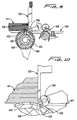
- the drum vane 418 is fixedly mounted such that its elongate cutout 420 faces the suction openings 416 provided on the feed drum 402 preferably at a region below the lower vertex 317 of the stripper blade 316 (Fig. 7) so as to draw air downward (as indicated by arrow "c" in Figs. 11 and 12) through the suction openings 416 when a vacuum is applied to the elongate cutout 420 as discussed further below.
- the vacuum drum vane 418 is adjustably (e.g., rotatable) relative to the feed drum 402 whereby the elongate cutout 420 is positionable relative to the suction openings 416 of the feed drum 402.
- an elongate vane adjuster 422 having a circular opening 426 at one of its ends is received about the circular end 424 of the drum vane 418.
- a key 428 is formed within the circular end 426 of the elongate vane adjuster, which receives within a corresponding key slot 430 formed in the end 424 of the drum vane 418 so as to prevent movement of the drum vane 418 when the vane adjuster 422 is held stationary.
- the vane adjuster 422 also is provided with a protrusion 423 extending from its side portion, which protrusion 423 is received within a guide slot 425 formed in a side portion 302 of the sheet feeder 318 for facilitating controlled movement of the vane adjuster 422 so as to adjust the drum vane 418.
- movement of the vane adjuster 422 affects corresponding rotational movement of the drum vane 418 so as to adjust the position of the elongate opening 420 relative to the suction openings 416 of the feed drum 402.
- the vane adjuster 422 is caused to be moved along the direction of arrow "e" in Fig. 13a, the elongate opening 420 of the drum vane 418 rotates a corresponding distance.
- the vane adjuster 422 is held stationary in the sheet feeder 118 by any known locking means.
- valve drum 430 Slideably received within the fixed drum vane 418 is a hollowed valve drum 430, which is provided with an elongate cutout portion 432 along its outer surface. Valve drum 430 also has an open end 434.
- the valve drum 430 is mounted for rotation within the fixed drum vane 418, which controlled rotation is caused by its connection to an electric motor 414 mounted on a side portion 304 of the sheet feeder 118.
- Electric motor 414 is connected to the control system 15 of the inserter system 10, which control system 15 controls activation of the electric motor 414 in accordance with a "mail run job" as programmed in the control system 15 as will be further discussed below.
- the open end 434 of the valve drum 430 is connected to an outside vacuum source (not shown), via vacuum hose 436, so as to draw air downward through the elongate opening 432 of the valve drum 430.
- an outside vacuum source not shown
- vacuum hose 436 preferably a constant vacuum is being applied to the valve drum 430, via vacuum hose 436 (Fig. 6), such that when the valve drum 430 is rotated to have its elongate opening 432 in communication with the elongate opening 420 of the fixed drum vane 418 air is caused to be drawn downward through the suction openings 416 of the feed drum 402 and through the elongate openings 420, 432 of the fixed vane 418 and valve drum 430 (as indicated by arrows "c" in Fig.
- this downward motion of air through the suction openings 416 facilitates the feeding of a sheet by the rotating feed drum 402 from the bottom of a stack of sheets disposed on the deck 306 of the feeder 118, which stack of sheets is disposed intermediate the two guide rails 308, 310.
- the valve drum 430 is caused to rotate such that its elongate cutout portion 432 breaks its communication with the elongate cutout 420 of the fixed vane 418, no air is caused to move downward through the suction openings 416 even though a constant vacuum is being applied to the valve drum 430.
- a stack of paper sheets 601 is disposed on the feed deck 306 intermediate the two guide rails 308, 310 such that the leading edges of the sheets forming the stack 601 apply against the stopping surface of the stripper plate 316 and that the spacing of the two guide rails 308, 310 from each other is adjusted to a distance corresponding, with a slight tolerance, to the width of the sheets.
- compressed air being supplied to the spaced apart air nozzles 366 provided on each guide rail 308, 310, thin air cushions are formed between the lowermost sheets of the stack, through which the separation of the sheets from one another is facilitated and ensured.
- valve drum 430 When in its default position, the valve drum 430 is maintained at a position such that its elongate cutout 432 is not in communication with the elongate cutout 420 of the drum vane 418 which is fixed relative to the constant rotating feed drum 402.
- valve drum 430 when it is desired to feed individual sheets from the feed deck 306, the valve drum 430 is rotated, via motor 413, such that the elongate cutout 432 of the valve drum 430 is in communication with the elongate cutout 420 of the drum vane 418 such that air is instantly caused to be drawn downward through the suction openings 416 on the rotating feed drum 402 and through the respective elongate cutouts 420, 432 provided on the fixed drum vane 418 and the valve drum 430.
- This downward motion of air on the surface of the rotating feed drum 402, beneath the lower vertex 317 of the stripper plate 316 creates a suction force which draws downward the leading edge of the lowermost sheet onto the feed drum 402.
- the lowermost sheet of the stack 601 is caused to adhere onto the rotating feed drum 402, convey underneath the lower vertex 317 of the stripper plate 316, into the takeaway nips 438 and then positive drive nip assembly 451, and past the sensor 360, so as to be individual feed from the sheet feeder 118 and preferably into a coupled downstream device, such as an accumulator and/or folder 12.
- a coupled downstream device such as an accumulator and/or folder 12.
- the valve drum 430 is caused to be rotated to its default position (Figs. 9 and 10)
- the feeding of sheets from the stack 601 is immediately ceased until once again the valve drum 430 is caused to be rotated to its actuated position (Figs. 11 and 12).
- the interaction between the sensor switch 360 with the control system 15 that enables the control of the sheet feeder 118. That is, when motor 414 is caused to be energized so as to rotate the valve drum 430 to its actuated position to facilitate the feeding of sheets, as mentioned above. Since the "mail run job" of the control system 15 knows the sheet collation number of every mailpiece to be processed by the inserter system 10, it is thus enabled to control the sheet feeder 118 to feed precisely the number of individual sheets for each collation corresponding to each mailpiece to be processed.
- the motor 414 is then caused to be energized, via control system 15, so as to rotate the valve drum to its actuated position (Fig. 11) for an amount of time to cause the feeding of two sheets from the sheet feeder 118, after which the motor 414 is actuated again, via control system 15, so as to rotate the valve drum 430 to its default position (Figs. 9 and 10) preventing the feeding of sheets.
- the sensor switch 360 detects when sheets are fed from the sheet feeder 118, which detection is transmitted to the control system 15 to facilitate its control of the sheet feeder 118.
- the sheet collation number for each mailpiece can vary whereby a first mailpiece may consist of a two page collation while a succeeding mailpiece may consist of a four page collation.
- the control system 15 causes the valve drum 430 to be maintained in its actuated position (Fig. 11) for an amount of time to enable the feeding of two sheets immediately afterwards the control system 15 then causes the valve drum 430 to be maintained in its default position (Figs. 9 and 10) for a predefined amount of time.
- control system 15 causes to valve drum 430 to be again maintained in its actuated position for an amount of time to enable the feeding of four sheets, after which the above process is repeated with respect to each succeeding sheet collation number for each succeeding mailpiece to be processed in the inserter system 10.
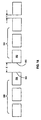
- a predefined space (as indicated by arrow "x") is caused to be present between the trailing edge 500 of the last sheet 502 of a proceeding collation 504 and the lead edge 506 of the first sheet 508 of a succeeding collation 510. It is also noted that there is a predefined space (as indicated by arrow "y") between the trailing and leading edges of the sheets comprising each collation. It is to be appreciated that after the sheets are fed from the sheet feeder 118, they are then preferably conveyed to the collating device 600 as will be described below.
- the spacing between the trailing edge 500 of the last sheet 502 of a proceeding collation 504 and the lead edge 506 of the first sheet 508 of a succeeding collation 510 is significant in that the shingulating device 600 facilitates the operation of providing it with sufficient time to enable the formation and feeding of a shingled document collation made up of a predetermined number of sheets, as will be described further below.
- a sheet feeder 118 having a high-speed pneumatic vacuum assembly for feeding sheets from a stack disposed on a feed deck has been described.
- the collating device 600 coupled to the output of the stacking/refeed device 118.
- FIG. 15 there is shown a block diagram of collating device 600 depicting three sheets S1, S2 and S3 being fed in seriatim thereinto at an entry point 612.
- the individual sheets (S1, S2 and S3) are supplied to the collating device 600 via preferably the aforesaid stacking/refeed device 118.
- the sheets exit the exiting point 614, they are preferably piled up in a shingled stack ST such that S3 is positioned on top of S2, which, in turn is positioned on top of S1.
- overlapping of a sheet on top of another can be partial as shown (e.g., like shingles on a roof-top) or rather can be stacked up atop one another such that the edge of each sheet aligns evenly with the respective edges of the other sheets in the stack.
- Fig. 16 illustrates the principle of shingled sheet accumulation, according to collating device 600.
- the first three paths are denoted by P1, P2 and P3, with the path length of path P1 being shorter than P2, P2 being shorter than P3, and so on.
- a controlling means for opening and closing the path so that only one sheet in a stack in an impending accumulation is allowed to travel through the path. For example, in accumulating three sheets, the first sheet entering the entry point 612 will be caused to travel path P3 by keeping C1 and C2 in the closing position while C3 is in the opening position, as shown in Fig. 16.
- the next entering sheet will be caused to travel path P2 by keeping C1 in the closing position and C2 in the opening position. It is followed that C1 is kept in the opening position to allow the last sheet to travel along path P1.
- the path length difference between two adjacent paths shown in Fig. 16 is given by 2Y. If the length of the sheets is L, then the path length difference 2Y should be smaller than L so that the sheets are only partially overlapped with each other. But 2Y can also be equal to the sheet length L so as to allow the sheets in the impending accumulation to exit the accumulator concurrently. Moreover, it is also plausible that 2Y is greater than the sheet length L.
- the number of provided path in an accumulator is fixed, but the number of sheets in each stack can be varied.
- the accumulator includes a sensing device 613 to determine the number of sheets in an impending accumulation. The sensing device can be located behind or in front of the entry point 612.
- Fig. 17 illustrates the preferred accumulation method of collating device 600.
- collating device 600 includes a number of turn-bars 620 which are positioned one above another, leaving gaps therebetween to define traveling paths.
- Shown in Fig. 17 are three traveling paths P1, P2 and P3, each of which is associated with a flipper 630 for opening or closing the path.
- the flippers 630 associated with path P1 and path P2 are in the closed position so as to block a sheet from entering either path P1 or P2.
- the flipper associated with path P3 is in the open position to allow a sheet entering the entry point 612 to travel along path P3 to reach the exiting point 614.
- the path traveled by that particular sheet is denoted by a dashed line.
- the collating device 600 also includes power driven rollers 618 and 638, belts 622 and 634, a number of other rollers 624, 626 and 632 to guide the sheets through the collating device 600. It should be noted that the gaps between the turn-bars 620 and the belts 622 and 624 are greatly exaggerated to show the traveling paths.
- Figs. 18a and 18b show the preferred mechanism for controlling the flipper 630 associated with each path.
- the opening and closing of flipper 630 is caused by the action of a push rod 642 which is linked to the flipper by a lever 640.
- flipper 630 is in a closed position, blocking a sheet from passing through the path associated with the flipper.
- push rod 642 is shown to be pushed upward to cause flipper 630 to move inward (its open position), allowing a sheet to pass through the path.
- the movement of push rod 642 is preferably caused by a pneumatic solenoid 644, an electrical solenoid, an electric rotary actuator or another actuator type mechanism.
- Fig. 19 illustrates a cross sectional view of collating device 600, according to a preferred embodiment.
- a group of five turn-bars 620 being positioned one atop another to define five different paths, P1 to P5.
- the longest path, or P5 is defined by the lowest turn-bar and a terminating bar 646.
- Each of the top four turn-bars has a flipper 630 to open or close the path associated with the turn-bar.
- Shingulating device 600 also preferably includes a number of optical sensors, each to a turn-bar to sense the passage of the sheets. Only two optical sensors are shown in Fig. 19, denoted by reference numeral 648.
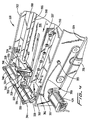
- Fig. 20 illustrates another view of collating device 600, according to a preferred embodiment.
- the collating device 600 has two pivotable wings 650 and 652 for installing guiding rollers and belts.
- the wings 650 and 652 can be opened and separated from the turn-bars 620.
- wing 650 is closed, a plurality of rollers 624 will push the belt 622 against each of the turn-bars 620 to create a paper path substantially conforming to the surface of the turn-bar 620 as shown.
- a flipper 630 is caused to move inward to open a path, a sheet encountering an opened path will be guided through the path under the respective turn-bar 620.
- wing 652 As wing 652 is in the open position, the mechanism that controls the flippers 630 can be seen. As shown in Fig. 20, a number of solenoids 644, push rods 642 and levers 640 are used to control the movement of flippers 630.
- reference numeral 654 denotes a plurality of connectors to the optical sensors 648 shown in Fig. 19.
- Reference numeral 656 denotes a plurality of holding shafts which are part of each wing 650 and 652 construction.
- Fig. 21 illustrates another view of the preferred embodiment, showing the pneumatic manifold connecting solenoids 644 to a pneumatic controller unit 660. Also shown in Fig. 21 are a motor 662, a pulley system 664 and driving belts 666, 668 to drive rollers 618 and 638. With rollers 618 and 638 being driven by the same motor, sheets enter and exit the shingulating device 600 at the same speed. However, it is preferred that roller 638 runs slightly faster than roller 618 to increase the operational efficiency. Moreover, solenoids 644 can be replaced by electric rotary actuators to control the flippers 630.
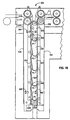
- Fig. 22 illustrates an alternative embodiment of the collating device.
- the collating device 601 in Fig. 22 is constructed as a vertical "tower" to achieve a small footprint.
- a plurality of rollers 670 and 672 are used to guide a plurality of cut sheets, serially and separately entering an entry point 612, to move through different paths P1, P2, P3, ... and to exit at an exiting point 614.
- the opening and closing of the paths are controlled by flippers F1, F2, F3, ... If flipper F1 is in an opening position, a sheet entering the entry point will travel along path P1 to the exiting point.
- the path length difference between two adjacent paths is determined by the spacings Y1, Y2 between rollers, and the radius R of rollers 670 as shown. It is understood that while it is shown in Fig. 22 that all rollers 670 are of the same size, it is not necessarily so.
Landscapes
- Engineering & Computer Science (AREA)
- Mechanical Engineering (AREA)
- Collation Of Sheets And Webs (AREA)
- Forming Counted Batches (AREA)
Claims (19)
- Procédé pour fournir des lots d'accumulation de documents à un système d'insertion, comprenant les étapes consistant à :fournir des feuilles coupées à un dispositif d'empilement de feuilles (118) ;empiler les feuilles en une pile (120) ;prélever dans la pile (120) des feuilles individuelles ;assembler un nombre prédéterminé desdites feuilles individuelles, ladite étape comprenant l'étape consistant à fournir un lot d'assemblage en chevauchement, dans lequel les feuilles appartenant à un lot d'assemblage sont en chevauchement au moins partiel par rapport à chaque feuille suivante du lot d'assemblage ;former un lot d'accumulation (131) comprenant au moins un lot d'assemblage ; etintroduire le lot d'accumulation dans le système d'insertion.
- Procédé pour fournir des lots d'accumulation de documents à un système d'insertion selon la revendication 1, dans lequel l'étape consistant à fournir des feuilles comprend l'étape consistant à fournir des feuilles séparées d'une bande continue (104).
- Procédé pour fournir des lots d'accumulation de documents à un système d'insertion selon la revendication 1 ou 2, dans lequel l'étape consistant à prélever dans la pile (120) comprend l'étape consistant à commander la vitesse à laquelle les feuilles individuelles sont prélevées dans la pile, moyennant quoi les feuilles qui doivent former un desdits lots d'assemblage sont séparées d'une première distance prédéterminée les unes des autres et une dernière feuille dudit lot d'assemblage est séparée d'une deuxième distance prédéterminée d'une feuille suivante appartenant à un lot d'assemblage suivant.
- Procédé pour fournir des lots d'accumulation de documents à un système d'insertion selon l'une quelconque des revendications 1 à 3, dans lequel l'étape consistant à prélever dans la pile comprend l'étape consistant à fournir les feuilles situées à la base de la pile.
- Procédé pour fournir des lots d'accumulation de documents à un système d'insertion selon l'une quelconque des revendications 1 à 4, dans lequel l'étape consistant à accumuler au moins un lot d'assemblage comprend l'étape consistant à fournir un lot d'accumulation dans lequel les bords respectifs des feuilles appartenant à un lot d'accumulation sont alignés les uns par rapport aux autres.
- Procédé pour fournir des lots d'accumulation de documents à un système d'insertion selon l'une quelconque des revendications 1 à 5, dans lequel l'étape consistant à introduire le lot d'accumulation comprend l'étape consistant à introduire le lot d'accumulation dans un dispositif de pliage de documents.
- Procédé pour fournir des lots d'accumulation de documents à un système d'insertion selon la revendication 1, dans lequel l'étape consistant à assembler un nombre prédéterminé de feuilles coupées individuelles comprend les étapes consistant à :fournir une pluralité de trajets connectant un point d'entrée à un trajet de sortie, chaque trajet ayant une longueur de trajet distincte ; etcommander les trajets pour permettre à chaque feuille individuelle prélevée dans la pile qui doit appartenir à un lot d'assemblage de circuler sur un trajet distinct de telle sorte qu'une feuille qui suit une feuille précédente du lot d'assemblage entrant dans le point d'entrée circule sur un trajet de longueur distincte de celle de la feuille précédente de telle sorte qu'un lot d'assemblage d'un nombre prédéterminé de feuilles soit entraíné depuis le point de sortie.
- Procédé pour fournir des lots d'accumulation de documents à un système d'insertion selon la revendication 7, dans lequel l'étape de fourniture comprend les étapes consistant à :fournir une bande de papier ayant au moins deux parties en relation côte à côte ; fusionner ces au moins deux parties de la bande pour les faire passer d'une relation côte à côte à une relation sensiblement dessus-dessous ; etséparer la bande de papier en relation dessus-dessous en feuilles individuelles disposées les unes au dessus des autres.
- Procédé pour fournir des lots d'accumulation de documents à un système d'insertion selon la revendication 8, dans lequel l'étape de fourniture comprend les étapes consistant à prélever des feuilles individuelles dans la pile les unes à la suite des autres, ces feuilles étant séparées les unes des autres d'une première distance prédéterminée.
- Procédé pour fournir des lots d'accumulation de documents à un système d'insertion selon la revendication 9, dans lequel l'étape de commande des trajets comprend l'étape consistant à assembler un nombre prédéterminé de feuilles individuelles pour fournir un lot d'assemblage en chevauchement, dans lequel les feuilles appartenant à un lot d'assemblage sont en chevauchement au moins partiel par rapport à chaque feuille suivante du lot d'assemblage.
- Procédé pour fournir des lots d'accumulation de documents à un système d'insertion selon la revendication 10, dans lequel l'étape consistant à accumuler au moins un lot d'assemblage comprend l'étape consistant à fournir un lot d'accumulation dans lequel les bords respectifs des feuilles coupées appartenant à un lot d'accumulation sont alignés les uns par rapport aux autres.
- Système pour fournir des lots d'accumulation de documents à un système d'insertion, comprenant :un dispositif de fourniture de feuilles (100) fonctionnant pour fournir des feuilles ;un dispositif d'empilement de feuilles (118) fonctionnant pour recevoir les feuilles provenant du dispositif de fourniture de feuilles et empiler les feuilles en une pile de feuilles et prélever ensuite des feuilles individuelles dans la pile ;un dispositif d'assemblage (600) fonctionnant pour recevoir les feuilles individuelles provenant du dispositif d'empilement de feuilles (118) et assembler un nombre prédéterminé de feuilles pour former un lot d'assemblage en chevauchement, dans lequel les feuilles appartenant à un lot d'assemblage sont en chevauchement au moins partiel par rapport à chaque feuille suivante du lot d'assemblage ; etun dispositif d'accumulation (700) fonctionnant pour recevoir au moins un lot d'assemblage (129) du dispositif d'assemblage (600) pour fournir un lot d'accumulation consistant en au moins un lot d'assemblage et introduire le lot d'accumulation (131) dans un système d'insertion.
- Système pour fournir des lots d'accumulation de documents à un système d'insertion selon la revendication 12, dans lequel le dispositif d'assemblage comprend en outre une pluralité de trajets connectant un point d'entrée à un trajet de sortie, dans lequel chaque trajet a une longueur de trajet distincte et les trajets sont commandés pour permettre à chaque feuille individuelle prélevée dans la pile qui doit appartenir à un lot d'assemblage de circuler sur un trajet distinct de telle sorte qu'une feuille qui suit une feuille précédente du lot d'assemblage entrant dans le point d'entrée circule sur un trajet de longueur distincte de celle de la feuille précédente de telle sorte qu'un lot d'assemblage d'un nombre prédéterminé de feuilles soit entraíné depuis le point de sortie.
- Système pour fournir des lots d'accumulation de documents à un système d'insertion selon la revendication 13, dans lequel chacun des trajets du dispositif d'assemblage est configuré pour fournir au point de sortie un lot d'assemblage en chevauchement, dans lequel les feuilles appartenant à un lot d'assemblage sont en chevauchement au moins partiel par rapport à chaque feuille suivante du lot d'assemblage.
- Système pour fournir des lots d'accumulation de documents à un système d'insertion selon la revendication 14, dans lequel le dispositif d'accumulation est configuré pour fournir un lot d'accumulation, dans lequel chaque feuille de chaque lot d'accumulation comprise dans le lot d'accumulation a ses bords alignés les uns par rapport aux autres.
- Système pour fournir des lots d'accumulation de documents à un système d'insertion selon la revendication 12, dans lequel le dispositif de fourniture de feuilles comprend :un module d'entraínement pour fournir une bande de papier ayant deux parties de bande dans une relation côte à côte ;un module de fusionnement (110) situé en.aval sur le trajet de déplacement partant du module d'entraínement pour entraíner les deux parties de bande en relation dessus-dessous de façon à réorienter la bande de papier en la faisant passer d'une relation côte à côte à une relation dessus-dessous ; etun module de séparation (114) situé en aval sur le trajet de déplacement partant du module de fusionnement (110) pour recevoir la bande de papier en relation dessus-dessous et séparer la bande de papier en feuilles individuelles disposées en relation dessus-dessous.
- Système pour fournir des lots d'accumulation de documents à un système d'insertion selon la revendication 16, dans lequel le dispositif d'empilement de feuilles comprend en outre un côté amont et un côté aval et est configuré pour recevoir du côté amont les feuilles séparées individuelles en relation dessus-dessous, empiler les feuilles individuelles et prélever les feuilles une à une dans la pile par le côté aval, le module d'empilement comprenant :un ensemble pneumatique (314) monté à proximité d'une extrémité de prélèvement de feuille du module d'empilement, fonctionnant pour prélever des feuilles individuelles dans la pile, l'ensemble pneumatique comprenant :un tambour de prélèvement extérieur monté en rotation (402) ayant une circonférence extérieure et une circonférence intérieure et une pluralité d'ouvertures d'aspiration s'étendant entre les circonférences intérieure et extérieure ;un cylindre à aubes intérieur (418) ayant une circonférence extérieure et une circonférence intérieure avec une partie découpée en aubes s'étendant entre sa circonférence extérieure et sa circonférence intérieure, dans lequel le cylindre à aubes intérieur est reçu à l'intérieur de la circonférence intérieure du tambour de prélèvement de telle sorte que la partie découpée en aubes soit en communication avec les ouvertures d'aspiration du tambour de prélèvement ; etun cylindre à aubes intérieur rotatif (430) ayant une circonférence extérieure et une circonférence intérieure avec une partie découpée en aubes s'étendant entre sa circonférence extérieure et sa circonférence intérieure, reçue en rotation à l'intérieur du tambour à aubes intérieur, moyennant quoi, lorsque le cylindre à aubes tourne de telle façon que sa partie découpée en aubes soit en communication avec la partie découpée en aubes, et qu'une aspiration est appliquée à la circonférence intérieure du cylindre à aubes, de l'air est aspiré vers le bas à travers les ouvertures d'aspiration du tambour de prélèvement pour faire en sorte qu'une feuille au bas de la pile de feuilles adhère contre le tambour de prélèvement en rotation et soit prélevée de la pile de feuilles.
- Système pour fournir des lots d'accumulation de documents à un système d'insertion selon la revendication 17, dans lequel le dispositif d'empilement de feuilles comprend en outre un détecteur situé entre le tambour de prélèvement et l'extrémité de prélèvement de feuille du dispositif d'empilement de feuilles, pour détecter le passage des feuilles prélevées dans la pile de feuilles.
- Système d'insertion comprenant un système pour fournir des lots d'accumulation de documents selon l'une quelconque des revendications précédentes 12 à 18.
Applications Claiming Priority (2)
| Application Number | Priority Date | Filing Date | Title |
|---|---|---|---|
| US310218 | 1999-05-12 | ||
| US09/310,218 US6305680B1 (en) | 1999-05-12 | 1999-05-12 | System and method for providing document accumulation sets to an inserter system |
Publications (3)
| Publication Number | Publication Date |
|---|---|
| EP1053963A2 EP1053963A2 (fr) | 2000-11-22 |
| EP1053963A3 EP1053963A3 (fr) | 2002-04-10 |
| EP1053963B1 true EP1053963B1 (fr) | 2004-09-22 |
Family
ID=23201490
Family Applications (1)
| Application Number | Title | Priority Date | Filing Date |
|---|---|---|---|
| EP00110152A Expired - Lifetime EP1053963B1 (fr) | 1999-05-12 | 2000-05-12 | Sytème et procédé pour fournir des lots d'accumulation de documents à un système d'insertion |
Country Status (4)
| Country | Link |
|---|---|
| US (1) | US6305680B1 (fr) |
| EP (1) | EP1053963B1 (fr) |
| CA (1) | CA2307822C (fr) |
| DE (1) | DE60013955T2 (fr) |
Families Citing this family (15)
| Publication number | Priority date | Publication date | Assignee | Title |
|---|---|---|---|---|
| EP1227053A3 (fr) * | 2001-01-29 | 2004-02-18 | MBO MASCHINENBAU OPPENWEILER BINDER GMBH & CO. | Méthode et dispositif pour former une pile correctement triée de feuilles pliées |
| US6592114B2 (en) * | 2001-02-06 | 2003-07-15 | Kenneth A. Stevens | Streak free apparatus for processing and stacking printed forms |
| US6615105B2 (en) * | 2001-10-18 | 2003-09-02 | Pitney Bowes Inc. | System and method for adjusting sheet input to an inserter system |
| US6612571B2 (en) | 2001-12-06 | 2003-09-02 | Xerox Corporation | Sheet conveying device having multiple outputs |
| US6817518B2 (en) * | 2002-12-06 | 2004-11-16 | First Data Corporation | Systems for preparing presentation instruments for distribution |
| US7344062B2 (en) * | 2002-12-06 | 2008-03-18 | First Data Corporation | Systems for preparing presentation instruments for distribution |
| US20040156064A1 (en) * | 2003-02-07 | 2004-08-12 | Kevin Owen | Printing methods and apparatus |
| JP3862084B2 (ja) * | 2003-10-30 | 2006-12-27 | ホリゾン・インターナショナル株式会社 | 冊子反転装置 |
| US20050097866A1 (en) * | 2003-11-12 | 2005-05-12 | Solar Communications, Inc. | System and method for producing personalized imaged material |
| US20050099657A1 (en) * | 2003-11-12 | 2005-05-12 | Solar Communications, Inc. | System and method for producing personalized imaged material |
| WO2006014933A2 (fr) * | 2004-07-27 | 2006-02-09 | Neopost Industrie Sa | Impression serie a grande vitesse au moyen de compteurs |
| US20100042252A1 (en) * | 2008-08-13 | 2010-02-18 | Xerox Corporation | Disk type apparatus and corresponding methods |
| WO2010118020A1 (fr) * | 2009-04-06 | 2010-10-14 | Kern Global Llc | Appareil et procédé de commande de conversion de matériau et de remplissage d'enveloppe |
| US8123223B1 (en) | 2010-10-04 | 2012-02-28 | Andersen & Associates | Document printer and inserter |
| JP2023142960A (ja) * | 2022-03-25 | 2023-10-06 | デュプロ精工株式会社 | 用紙区分け装置 |
Citations (1)
| Publication number | Priority date | Publication date | Assignee | Title |
|---|---|---|---|---|
| EP0679539A2 (fr) * | 1992-02-18 | 1995-11-02 | Hadewe B.V. | Balayage de documents dans une méthode et dans des systèmes pour rassembler des plis postaux |
Family Cites Families (26)
| Publication number | Priority date | Publication date | Assignee | Title |
|---|---|---|---|---|
| US3983679A (en) * | 1975-05-30 | 1976-10-05 | Bell & Howell Company | Apparatus and method of processing mail |
| US4190241A (en) | 1978-05-01 | 1980-02-26 | Kimberly-Clark Corporation | Apparatus for converting paper rolls into stacks of individual folded paper sheets |
| DE2902068C2 (de) | 1979-01-19 | 1980-12-11 | G.A.O. Gesellschaft Fuer Automation Und Organisation Mbh, 8000 Muenchen | Vereinzelungsvorrichtung für flaches Fördergut |
| CH639623A5 (de) | 1979-06-23 | 1983-11-30 | Winkler Duennebier Kg Masch | Einrichtung zum transportieren von flaechenhaften teilen, insbesondere papierblaettern, karten, brief- oder versandhuellen. |
| JPS5670886A (en) * | 1979-11-14 | 1981-06-13 | Nippon Electric Co | Sorter |
| US4355795A (en) | 1980-03-04 | 1982-10-26 | Bobst Champlain, Inc. | Sheet handling device |
| US4585113A (en) | 1983-10-05 | 1986-04-29 | R. A. Jones & Co. Inc. | Apparatus for transferring articles |
| DE3447331A1 (de) | 1984-12-24 | 1986-06-26 | Mathias Bäuerle GmbH, 7742 ST. Georgen | Pneumatischer bogenanleger |
| GB8505759D0 (en) | 1985-03-06 | 1985-04-11 | De La Rue Syst | Assembling sheets into stack |
| DE3614623C1 (de) | 1986-04-30 | 1987-10-22 | Baeuerle Gmbh Mathias | Bogenanlegetisch mit Blasduesen |
| US4905044A (en) | 1986-11-19 | 1990-02-27 | Minolta Camera Kabushiki Kaisha | Document conveying apparatus |
| DE3723259C2 (de) * | 1987-07-14 | 1995-04-13 | Licentia Gmbh | Stapeleinrichtung für Briefe |
| US4989853A (en) | 1988-11-28 | 1991-02-05 | Xerox Corporation | Apparatus for offsetting sheets |
| US4989852A (en) * | 1989-02-23 | 1991-02-05 | Gunther International, Ltd. | Electronic publishing system |
| US4939888A (en) * | 1990-07-06 | 1990-07-10 | Webcraft Technologies, Inc. | Method for producing a mass distributable printed packet |
| US5087805A (en) * | 1990-07-06 | 1992-02-11 | Webcraft Technologies, Inc. | Printed and encoded mass distributable response piece and method of making the same |
| US5088717A (en) * | 1989-08-12 | 1992-02-18 | Konica Corporation | Paper feeding apparatus having a three cylinder vacuum member |
| US5072922A (en) | 1991-02-25 | 1991-12-17 | Paulson Harold E | Vacuum drum for printing press feeder |
| US5156384A (en) * | 1991-11-04 | 1992-10-20 | Webcraft Technologies, Inc. | Collect tab stacking method with transverse cutting stage forming inserts and indexing inserts |
| JPH05286619A (ja) * | 1992-04-07 | 1993-11-02 | Ricoh Co Ltd | 画像形成装置の排紙装置 |
| US5258817A (en) | 1992-07-01 | 1993-11-02 | Xerox Corporation | Document handling system having a shunt path |
| SE501944C2 (sv) * | 1994-03-15 | 1995-06-26 | Straalfors Ab | Förfarande och anordning för hantering av ark som förses med information i en laserskrivare |
| US5642878A (en) | 1995-05-04 | 1997-07-01 | F. L. Smithe Machine Company, Inc. | Method and apparatus for separating sheets fed from the bottom of a stack |
| US5689795A (en) * | 1996-09-24 | 1997-11-18 | Xerox Corporation | Sheet transfer apparatus with adaptive speed-up delay |
| US5947461A (en) * | 1997-08-25 | 1999-09-07 | Pitney Bowes Inc. | Apparatus and method for collating documents cut from a continuous web |
| US6095513A (en) * | 1998-12-16 | 2000-08-01 | Pitney Bowes Inc. | Hi-speed sheet feeder |
-
1999
- 1999-05-12 US US09/310,218 patent/US6305680B1/en not_active Expired - Fee Related
-
2000
- 2000-05-09 CA CA002307822A patent/CA2307822C/fr not_active Expired - Fee Related
- 2000-05-12 DE DE60013955T patent/DE60013955T2/de not_active Expired - Lifetime
- 2000-05-12 EP EP00110152A patent/EP1053963B1/fr not_active Expired - Lifetime
Patent Citations (1)
| Publication number | Priority date | Publication date | Assignee | Title |
|---|---|---|---|---|
| EP0679539A2 (fr) * | 1992-02-18 | 1995-11-02 | Hadewe B.V. | Balayage de documents dans une méthode et dans des systèmes pour rassembler des plis postaux |
Also Published As
| Publication number | Publication date |
|---|---|
| DE60013955D1 (de) | 2004-10-28 |
| DE60013955T2 (de) | 2005-10-06 |
| US6305680B1 (en) | 2001-10-23 |
| CA2307822C (fr) | 2007-03-27 |
| EP1053963A2 (fr) | 2000-11-22 |
| CA2307822A1 (fr) | 2000-11-12 |
| EP1053963A3 (fr) | 2002-04-10 |
Similar Documents
| Publication | Publication Date | Title |
|---|---|---|
| CA2292066C (fr) | Systeme d'entree pneumatique a haute vitesse de documents | |
| US6615105B2 (en) | System and method for adjusting sheet input to an inserter system | |
| EP1053963B1 (fr) | Sytème et procédé pour fournir des lots d'accumulation de documents à un système d'insertion | |
| US6161828A (en) | Sheet collation device and method | |
| US6364305B1 (en) | System and method for providing sheets to an inserter system | |
| CA2246011C (fr) | Systeme d'alimentation de documents a grande vitesse | |
| CA2468210C (fr) | Systeme et methode d'alimentation en feuilles d'un systeme d'insertion au moyen d'une derouleuse | |
| EP1108563B1 (fr) | Méthode d'amenée d'enveloppes à un dispositif d'insertion | |
| EP1112866B1 (fr) | Système et méthode pour le contrôle d'arrivée des documents | |
| EP1016604B1 (fr) | Dispositif d'alimentation de feuilles à grande vitesse | |
| CA2292061C (fr) | Distributeur pneumatique de feuilles a haute vitesse | |
| US7427059B2 (en) | Paper handling system materials exit path arrangement | |
| EP1795473B1 (fr) | Module de transfert à débit élevé pour tourner à angle droit | |
| EP1067077B1 (fr) | Procédé et dispositif pour assembler des feuilles | |
| EP1577242A1 (fr) | Système et procédé pour fournir des feuilles à un système d'insertion utilisant un dispositif de coupe à haute vitesse et une rotation à angle droit | |
| CA2472870C (fr) | Appareil et methode pour accumuler les feuilles | |
| EP1334935B1 (fr) | Dispositif de manipulation de document avec mécanisme d'introduction dynamique et méthode correspondante | |
| CA2558631A1 (fr) | Appareil et methode pour accumuler les feuilles |
Legal Events
| Date | Code | Title | Description |
|---|---|---|---|
| PUAI | Public reference made under article 153(3) epc to a published international application that has entered the european phase |
Free format text: ORIGINAL CODE: 0009012 |
|
| AK | Designated contracting states |
Kind code of ref document: A2 Designated state(s): AT BE CH CY DE DK ES FI FR GB GR IE IT LI LU MC NL PT SE Kind code of ref document: A2 Designated state(s): DE FR GB |
|
| AX | Request for extension of the european patent |
Free format text: AL;LT;LV;MK;RO;SI |
|
| PUAL | Search report despatched |
Free format text: ORIGINAL CODE: 0009013 |
|
| AK | Designated contracting states |
Kind code of ref document: A3 Designated state(s): AT BE CH CY DE DK ES FI FR GB GR IE IT LI LU MC NL PT SE |
|
| AX | Request for extension of the european patent |
Free format text: AL;LT;LV;MK;RO;SI |
|
| 17P | Request for examination filed |
Effective date: 20021002 |
|
| AKX | Designation fees paid |
Free format text: DE FR GB |
|
| 17Q | First examination report despatched |
Effective date: 20030410 |
|
| GRAP | Despatch of communication of intention to grant a patent |
Free format text: ORIGINAL CODE: EPIDOSNIGR1 |
|
| GRAS | Grant fee paid |
Free format text: ORIGINAL CODE: EPIDOSNIGR3 |
|
| GRAA | (expected) grant |
Free format text: ORIGINAL CODE: 0009210 |
|
| AK | Designated contracting states |
Kind code of ref document: B1 Designated state(s): DE FR GB |
|
| REG | Reference to a national code |
Ref country code: GB Ref legal event code: FG4D |
|
| REG | Reference to a national code |
Ref country code: IE Ref legal event code: FG4D |
|
| REF | Corresponds to: |
Ref document number: 60013955 Country of ref document: DE Date of ref document: 20041028 Kind code of ref document: P |
|
| ET | Fr: translation filed | ||
| PLBE | No opposition filed within time limit |
Free format text: ORIGINAL CODE: 0009261 |
|
| STAA | Information on the status of an ep patent application or granted ep patent |
Free format text: STATUS: NO OPPOSITION FILED WITHIN TIME LIMIT |
|
| 26N | No opposition filed |
Effective date: 20050623 |
|
| PGFP | Annual fee paid to national office [announced via postgrant information from national office to epo] |
Ref country code: FR Payment date: 20090518 Year of fee payment: 10 |
|
| REG | Reference to a national code |
Ref country code: FR Ref legal event code: ST Effective date: 20110131 |
|
| PG25 | Lapsed in a contracting state [announced via postgrant information from national office to epo] |
Ref country code: FR Free format text: LAPSE BECAUSE OF NON-PAYMENT OF DUE FEES Effective date: 20100531 |
|
| PGFP | Annual fee paid to national office [announced via postgrant information from national office to epo] |
Ref country code: GB Payment date: 20140527 Year of fee payment: 15 |
|
| PGFP | Annual fee paid to national office [announced via postgrant information from national office to epo] |
Ref country code: DE Payment date: 20140529 Year of fee payment: 15 |
|
| REG | Reference to a national code |
Ref country code: DE Ref legal event code: R119 Ref document number: 60013955 Country of ref document: DE |
|
| GBPC | Gb: european patent ceased through non-payment of renewal fee |
Effective date: 20150512 |
|
| PG25 | Lapsed in a contracting state [announced via postgrant information from national office to epo] |
Ref country code: GB Free format text: LAPSE BECAUSE OF NON-PAYMENT OF DUE FEES Effective date: 20150512 Ref country code: DE Free format text: LAPSE BECAUSE OF NON-PAYMENT OF DUE FEES Effective date: 20151201 |