EP1053983A2 - Transluzente polykristalline Keramik und Verfahren zu ihrer Herstellung - Google Patents
Transluzente polykristalline Keramik und Verfahren zu ihrer Herstellung Download PDFInfo
- Publication number
- EP1053983A2 EP1053983A2 EP00304268A EP00304268A EP1053983A2 EP 1053983 A2 EP1053983 A2 EP 1053983A2 EP 00304268 A EP00304268 A EP 00304268A EP 00304268 A EP00304268 A EP 00304268A EP 1053983 A2 EP1053983 A2 EP 1053983A2
- Authority
- EP
- European Patent Office
- Prior art keywords
- ceramic
- translucent polycrystalline
- polycrystalline ceramic
- translucent
- light
- Prior art date
- Legal status (The legal status is an assumption and is not a legal conclusion. Google has not performed a legal analysis and makes no representation as to the accuracy of the status listed.)
- Granted
Links
Images


Classifications
-
- C—CHEMISTRY; METALLURGY
- C04—CEMENTS; CONCRETE; ARTIFICIAL STONE; CERAMICS; REFRACTORIES
- C04B—LIME, MAGNESIA; SLAG; CEMENTS; COMPOSITIONS THEREOF, e.g. MORTARS, CONCRETE OR LIKE BUILDING MATERIALS; ARTIFICIAL STONE; CERAMICS; REFRACTORIES; TREATMENT OF NATURAL STONE
- C04B35/00—Shaped ceramic products characterised by their composition; Ceramics compositions; Processing powders of inorganic compounds preparatory to the manufacturing of ceramic products
- C04B35/01—Shaped ceramic products characterised by their composition; Ceramics compositions; Processing powders of inorganic compounds preparatory to the manufacturing of ceramic products based on oxide ceramics
- C04B35/10—Shaped ceramic products characterised by their composition; Ceramics compositions; Processing powders of inorganic compounds preparatory to the manufacturing of ceramic products based on oxide ceramics based on aluminium oxide
- C04B35/111—Fine ceramics
- C04B35/115—Translucent or transparent products
-
- C—CHEMISTRY; METALLURGY
- C04—CEMENTS; CONCRETE; ARTIFICIAL STONE; CERAMICS; REFRACTORIES
- C04B—LIME, MAGNESIA; SLAG; CEMENTS; COMPOSITIONS THEREOF, e.g. MORTARS, CONCRETE OR LIKE BUILDING MATERIALS; ARTIFICIAL STONE; CERAMICS; REFRACTORIES; TREATMENT OF NATURAL STONE
- C04B35/00—Shaped ceramic products characterised by their composition; Ceramics compositions; Processing powders of inorganic compounds preparatory to the manufacturing of ceramic products
- C04B35/622—Forming processes; Processing powders of inorganic compounds preparatory to the manufacturing of ceramic products
- C04B35/64—Burning or sintering processes
- C04B35/645—Pressure sintering
- C04B35/6455—Hot isostatic pressing
-
- H—ELECTRICITY
- H01—ELECTRIC ELEMENTS
- H01J—ELECTRIC DISCHARGE TUBES OR DISCHARGE LAMPS
- H01J5/00—Details relating to vessels or to leading-in conductors common to two or more basic types of discharge tubes or lamps
- H01J5/02—Vessels; Containers; Shields associated therewith; Vacuum locks
- H01J5/04—Vessels or containers characterised by the material thereof
-
- H—ELECTRICITY
- H01—ELECTRIC ELEMENTS
- H01J—ELECTRIC DISCHARGE TUBES OR DISCHARGE LAMPS
- H01J61/00—Gas-discharge or vapour-discharge lamps
- H01J61/02—Details
- H01J61/30—Vessels; Containers
- H01J61/302—Vessels; Containers characterised by the material of the vessel
-
- C—CHEMISTRY; METALLURGY
- C04—CEMENTS; CONCRETE; ARTIFICIAL STONE; CERAMICS; REFRACTORIES
- C04B—LIME, MAGNESIA; SLAG; CEMENTS; COMPOSITIONS THEREOF, e.g. MORTARS, CONCRETE OR LIKE BUILDING MATERIALS; ARTIFICIAL STONE; CERAMICS; REFRACTORIES; TREATMENT OF NATURAL STONE
- C04B2235/00—Aspects relating to ceramic starting mixtures or sintered ceramic products
- C04B2235/02—Composition of constituents of the starting material or of secondary phases of the final product
- C04B2235/30—Constituents and secondary phases not being of a fibrous nature
- C04B2235/32—Metal oxides, mixed metal oxides, or oxide-forming salts thereof, e.g. carbonates, nitrates, (oxy)hydroxides, chlorides
- C04B2235/3224—Rare earth oxide or oxide forming salts thereof, e.g. scandium oxide
-
- C—CHEMISTRY; METALLURGY
- C04—CEMENTS; CONCRETE; ARTIFICIAL STONE; CERAMICS; REFRACTORIES
- C04B—LIME, MAGNESIA; SLAG; CEMENTS; COMPOSITIONS THEREOF, e.g. MORTARS, CONCRETE OR LIKE BUILDING MATERIALS; ARTIFICIAL STONE; CERAMICS; REFRACTORIES; TREATMENT OF NATURAL STONE
- C04B2235/00—Aspects relating to ceramic starting mixtures or sintered ceramic products
- C04B2235/02—Composition of constituents of the starting material or of secondary phases of the final product
- C04B2235/30—Constituents and secondary phases not being of a fibrous nature
- C04B2235/32—Metal oxides, mixed metal oxides, or oxide-forming salts thereof, e.g. carbonates, nitrates, (oxy)hydroxides, chlorides
- C04B2235/3224—Rare earth oxide or oxide forming salts thereof, e.g. scandium oxide
- C04B2235/3225—Yttrium oxide or oxide-forming salts thereof
-
- C—CHEMISTRY; METALLURGY
- C04—CEMENTS; CONCRETE; ARTIFICIAL STONE; CERAMICS; REFRACTORIES
- C04B—LIME, MAGNESIA; SLAG; CEMENTS; COMPOSITIONS THEREOF, e.g. MORTARS, CONCRETE OR LIKE BUILDING MATERIALS; ARTIFICIAL STONE; CERAMICS; REFRACTORIES; TREATMENT OF NATURAL STONE
- C04B2235/00—Aspects relating to ceramic starting mixtures or sintered ceramic products
- C04B2235/02—Composition of constituents of the starting material or of secondary phases of the final product
- C04B2235/30—Constituents and secondary phases not being of a fibrous nature
- C04B2235/32—Metal oxides, mixed metal oxides, or oxide-forming salts thereof, e.g. carbonates, nitrates, (oxy)hydroxides, chlorides
- C04B2235/3224—Rare earth oxide or oxide forming salts thereof, e.g. scandium oxide
- C04B2235/3227—Lanthanum oxide or oxide-forming salts thereof
-
- C—CHEMISTRY; METALLURGY
- C04—CEMENTS; CONCRETE; ARTIFICIAL STONE; CERAMICS; REFRACTORIES
- C04B—LIME, MAGNESIA; SLAG; CEMENTS; COMPOSITIONS THEREOF, e.g. MORTARS, CONCRETE OR LIKE BUILDING MATERIALS; ARTIFICIAL STONE; CERAMICS; REFRACTORIES; TREATMENT OF NATURAL STONE
- C04B2235/00—Aspects relating to ceramic starting mixtures or sintered ceramic products
- C04B2235/02—Composition of constituents of the starting material or of secondary phases of the final product
- C04B2235/30—Constituents and secondary phases not being of a fibrous nature
- C04B2235/32—Metal oxides, mixed metal oxides, or oxide-forming salts thereof, e.g. carbonates, nitrates, (oxy)hydroxides, chlorides
- C04B2235/3231—Refractory metal oxides, their mixed metal oxides, or oxide-forming salts thereof
- C04B2235/3244—Zirconium oxides, zirconates, hafnium oxides, hafnates, or oxide-forming salts thereof
-
- C—CHEMISTRY; METALLURGY
- C04—CEMENTS; CONCRETE; ARTIFICIAL STONE; CERAMICS; REFRACTORIES
- C04B—LIME, MAGNESIA; SLAG; CEMENTS; COMPOSITIONS THEREOF, e.g. MORTARS, CONCRETE OR LIKE BUILDING MATERIALS; ARTIFICIAL STONE; CERAMICS; REFRACTORIES; TREATMENT OF NATURAL STONE
- C04B2235/00—Aspects relating to ceramic starting mixtures or sintered ceramic products
- C04B2235/02—Composition of constituents of the starting material or of secondary phases of the final product
- C04B2235/30—Constituents and secondary phases not being of a fibrous nature
- C04B2235/32—Metal oxides, mixed metal oxides, or oxide-forming salts thereof, e.g. carbonates, nitrates, (oxy)hydroxides, chlorides
- C04B2235/3231—Refractory metal oxides, their mixed metal oxides, or oxide-forming salts thereof
- C04B2235/3251—Niobium oxides, niobates, tantalum oxides, tantalates, or oxide-forming salts thereof
-
- C—CHEMISTRY; METALLURGY
- C04—CEMENTS; CONCRETE; ARTIFICIAL STONE; CERAMICS; REFRACTORIES
- C04B—LIME, MAGNESIA; SLAG; CEMENTS; COMPOSITIONS THEREOF, e.g. MORTARS, CONCRETE OR LIKE BUILDING MATERIALS; ARTIFICIAL STONE; CERAMICS; REFRACTORIES; TREATMENT OF NATURAL STONE
- C04B2235/00—Aspects relating to ceramic starting mixtures or sintered ceramic products
- C04B2235/02—Composition of constituents of the starting material or of secondary phases of the final product
- C04B2235/30—Constituents and secondary phases not being of a fibrous nature
- C04B2235/32—Metal oxides, mixed metal oxides, or oxide-forming salts thereof, e.g. carbonates, nitrates, (oxy)hydroxides, chlorides
- C04B2235/327—Iron group oxides, their mixed metal oxides, or oxide-forming salts thereof
- C04B2235/3272—Iron oxides or oxide forming salts thereof, e.g. hematite, magnetite
-
- C—CHEMISTRY; METALLURGY
- C04—CEMENTS; CONCRETE; ARTIFICIAL STONE; CERAMICS; REFRACTORIES
- C04B—LIME, MAGNESIA; SLAG; CEMENTS; COMPOSITIONS THEREOF, e.g. MORTARS, CONCRETE OR LIKE BUILDING MATERIALS; ARTIFICIAL STONE; CERAMICS; REFRACTORIES; TREATMENT OF NATURAL STONE
- C04B2235/00—Aspects relating to ceramic starting mixtures or sintered ceramic products
- C04B2235/02—Composition of constituents of the starting material or of secondary phases of the final product
- C04B2235/30—Constituents and secondary phases not being of a fibrous nature
- C04B2235/34—Non-metal oxides, non-metal mixed oxides, or salts thereof that form the non-metal oxides upon heating, e.g. carbonates, nitrates, (oxy)hydroxides, chlorides
- C04B2235/3418—Silicon oxide, silicic acids or oxide forming salts thereof, e.g. silica sol, fused silica, silica fume, cristobalite, quartz or flint
-
- C—CHEMISTRY; METALLURGY
- C04—CEMENTS; CONCRETE; ARTIFICIAL STONE; CERAMICS; REFRACTORIES
- C04B—LIME, MAGNESIA; SLAG; CEMENTS; COMPOSITIONS THEREOF, e.g. MORTARS, CONCRETE OR LIKE BUILDING MATERIALS; ARTIFICIAL STONE; CERAMICS; REFRACTORIES; TREATMENT OF NATURAL STONE
- C04B2235/00—Aspects relating to ceramic starting mixtures or sintered ceramic products
- C04B2235/02—Composition of constituents of the starting material or of secondary phases of the final product
- C04B2235/50—Constituents or additives of the starting mixture chosen for their shape or used because of their shape or their physical appearance
- C04B2235/54—Particle size related information
- C04B2235/5418—Particle size related information expressed by the size of the particles or aggregates thereof
- C04B2235/5436—Particle size related information expressed by the size of the particles or aggregates thereof micrometer sized, i.e. from 1 to 100 micron
-
- C—CHEMISTRY; METALLURGY
- C04—CEMENTS; CONCRETE; ARTIFICIAL STONE; CERAMICS; REFRACTORIES
- C04B—LIME, MAGNESIA; SLAG; CEMENTS; COMPOSITIONS THEREOF, e.g. MORTARS, CONCRETE OR LIKE BUILDING MATERIALS; ARTIFICIAL STONE; CERAMICS; REFRACTORIES; TREATMENT OF NATURAL STONE
- C04B2235/00—Aspects relating to ceramic starting mixtures or sintered ceramic products
- C04B2235/65—Aspects relating to heat treatments of ceramic bodies such as green ceramics or pre-sintered ceramics, e.g. burning, sintering or melting processes
- C04B2235/656—Aspects relating to heat treatments of ceramic bodies such as green ceramics or pre-sintered ceramics, e.g. burning, sintering or melting processes characterised by specific heating conditions during heat treatment
-
- C—CHEMISTRY; METALLURGY
- C04—CEMENTS; CONCRETE; ARTIFICIAL STONE; CERAMICS; REFRACTORIES
- C04B—LIME, MAGNESIA; SLAG; CEMENTS; COMPOSITIONS THEREOF, e.g. MORTARS, CONCRETE OR LIKE BUILDING MATERIALS; ARTIFICIAL STONE; CERAMICS; REFRACTORIES; TREATMENT OF NATURAL STONE
- C04B2235/00—Aspects relating to ceramic starting mixtures or sintered ceramic products
- C04B2235/70—Aspects relating to sintered or melt-casted ceramic products
- C04B2235/74—Physical characteristics
- C04B2235/77—Density
-
- C—CHEMISTRY; METALLURGY
- C04—CEMENTS; CONCRETE; ARTIFICIAL STONE; CERAMICS; REFRACTORIES
- C04B—LIME, MAGNESIA; SLAG; CEMENTS; COMPOSITIONS THEREOF, e.g. MORTARS, CONCRETE OR LIKE BUILDING MATERIALS; ARTIFICIAL STONE; CERAMICS; REFRACTORIES; TREATMENT OF NATURAL STONE
- C04B2235/00—Aspects relating to ceramic starting mixtures or sintered ceramic products
- C04B2235/70—Aspects relating to sintered or melt-casted ceramic products
- C04B2235/74—Physical characteristics
- C04B2235/78—Grain sizes and shapes, product microstructures, e.g. acicular grains, equiaxed grains, platelet-structures
- C04B2235/785—Submicron sized grains, i.e. from 0,1 to 1 micron
-
- C—CHEMISTRY; METALLURGY
- C04—CEMENTS; CONCRETE; ARTIFICIAL STONE; CERAMICS; REFRACTORIES
- C04B—LIME, MAGNESIA; SLAG; CEMENTS; COMPOSITIONS THEREOF, e.g. MORTARS, CONCRETE OR LIKE BUILDING MATERIALS; ARTIFICIAL STONE; CERAMICS; REFRACTORIES; TREATMENT OF NATURAL STONE
- C04B2235/00—Aspects relating to ceramic starting mixtures or sintered ceramic products
- C04B2235/70—Aspects relating to sintered or melt-casted ceramic products
- C04B2235/74—Physical characteristics
- C04B2235/78—Grain sizes and shapes, product microstructures, e.g. acicular grains, equiaxed grains, platelet-structures
- C04B2235/788—Aspect ratio of the grains
-
- C—CHEMISTRY; METALLURGY
- C04—CEMENTS; CONCRETE; ARTIFICIAL STONE; CERAMICS; REFRACTORIES
- C04B—LIME, MAGNESIA; SLAG; CEMENTS; COMPOSITIONS THEREOF, e.g. MORTARS, CONCRETE OR LIKE BUILDING MATERIALS; ARTIFICIAL STONE; CERAMICS; REFRACTORIES; TREATMENT OF NATURAL STONE
- C04B2235/00—Aspects relating to ceramic starting mixtures or sintered ceramic products
- C04B2235/70—Aspects relating to sintered or melt-casted ceramic products
- C04B2235/96—Properties of ceramic products, e.g. mechanical properties such as strength, toughness, wear resistance
-
- C—CHEMISTRY; METALLURGY
- C04—CEMENTS; CONCRETE; ARTIFICIAL STONE; CERAMICS; REFRACTORIES
- C04B—LIME, MAGNESIA; SLAG; CEMENTS; COMPOSITIONS THEREOF, e.g. MORTARS, CONCRETE OR LIKE BUILDING MATERIALS; ARTIFICIAL STONE; CERAMICS; REFRACTORIES; TREATMENT OF NATURAL STONE
- C04B2235/00—Aspects relating to ceramic starting mixtures or sintered ceramic products
- C04B2235/70—Aspects relating to sintered or melt-casted ceramic products
- C04B2235/96—Properties of ceramic products, e.g. mechanical properties such as strength, toughness, wear resistance
- C04B2235/963—Surface properties, e.g. surface roughness
-
- H—ELECTRICITY
- H01—ELECTRIC ELEMENTS
- H01J—ELECTRIC DISCHARGE TUBES OR DISCHARGE LAMPS
- H01J61/00—Gas-discharge or vapour-discharge lamps
- H01J61/82—Lamps with high-pressure unconstricted discharge having a cold pressure > 400 Torr
- H01J61/825—High-pressure sodium lamps
Definitions
- the present invention relates to a translucent polycrystalline ceramic and a method of making the same and in particular relates to a translucent polycrystalline Al 2 O 3 ceramic and a method of making the same.
- an outer tube for a metal halide or sodium lamp, a light emitting tube and a window plate for high-temperature furnace are made of translucent alumina ceramic, wherein not only an electrical resistance and/or chemical corrosion resistance, but also a high strength and hardness from low temperature (ambient) up to as high as 1000-1200°C are often required. This is required partly because the translucent alumina ceramic may be thinned to gain more light transmittance therethrough.
- some applications need a fine texture and high abrasion resistance (namely ceramic particles should not fall off from its surface so that it maintains a smooth surface with less surface roughness).
- Such applications include optical connectors, optical filters, medical articular heads in medical use, cutting tools, bearings, high-Q dielectrics for some electronic components.
- alumina ceramics polycrystalline
- the translucent alumina ceramic that satisfies both transparency and high mechanical strength has not been reported.
- a translucent alumina ceramic made by using alumina grains of high- purity (99.99% purity) and a small amount of MgO is disclosed, however, its bending strength is insufficiently low, such as about 500 MPa.
- the translucent alumina ceramic having high strength and hardness made by controlling a mean particle size under HIP is disclosed, however, a straight-line transmission of light propagating through a thickness of 1 mm thereof is insufficiently lower than 50%.
- the conventional translucent alumina ceramic In the conventional translucent alumina ceramic, alumina particles constituting the polycrystalline alumina ceramic are liable to fall off from its surface. In other words, it has been difficult to attain a precisely or rather extremely mirror-polished surface of the translucent alumina ceramic.
- the conventional translucent alumina ceramic When the conventional translucent alumina ceramic is subjected under a large contact-stress as in use for bearings or cutting tools or even in a surface polishing process thereof, such a stress-concentrated site thereof tends to break, probably due to large size crystals which are formed with magnesia (MgO) binding the crystals inside the conventional translucent alumina ceramic.
- MgO magnesia
- An object of the invention is therefore to provide a translucent polycrystalline ceramic having a good strength and hardness, capable of transmitting light through the ceramic.
- the term "light” is not necessary limited only to visible light, but may include other electromagnetic radiation, such as infrared light and/or ultraviolet light.
- Another object of the invention is to provide a translucent polycrystalline alumina ceramic having excellent strength and hardness or abrasion resistance, capable of light transmittance and/or straight-line light transmission therethrough and withstanding a high temperature.
- Still another object of the invention is to provide a method of making a translucent polycrystalline alumina ceramic.
- This method enables manufacture of an excellent translucent alumina ceramic having high temperature bending strength and hardness and/or abrasion resistance, wherein particles/grains constituting the ceramic are resistant to falling off from its surface and the surface can be ground and polished into a smooth surface with less surface roughness and can be mechanically less damaged for instance under a high contact stress applied to the ceramic in use whilst maintaining its translucency.
- a translucent polycrystalline ceramic capable of transmitting a light that enters the ceramic, comprising crystal particles, wherein a mean facet length of the crystal particles is not longer than a maximum wave length of the light that transmits through the polycrystalline ceramic product; the mean facet length being defined as an average of lengths of sides forming polygons that appear in cross sections of the crystal particles constituting the ceramic.
- a characteristic feature of the translucent polycrystalline ceramic according to the invention is that the mean facet length as defined above is shorter than a maximum wave length of the light that transmits through the translucent polycrystalline ceramic.
- a visible light that has a wave length of about 380-780 nm if all of the facet lengths (meaning facet side lengths of the alumina crystal particles) are less than 380 nm, highest translucency of the polycrystalline ceramic transmitting most of the visible light is attained with the translucent polycrystalline ceramic. Even when the mean facet length(meaning an average of the facet side lengths of the crystal particles) is less than 700 nm, the translucent polycrystalline ceramic with thickness of 1 mm can transmit more than 50 % of the visible light therethrough, as will be later described in detail.
- the best translucency is attained when all the facet lengths are shorter than all wave lengths of the lights to be transmitted through the ceramic.
- the better light translucency as high as 70% is attained with the mean facet length of less than 500 nm and the best one (more than 75%) is attained with that of less than 400nm.
- the polycrystalline ceramic should is substantially poreless.
- a relative density of the fired ceramic should be at least 99.8% or substantially 100% with a minimum binder connecting the transparent crystal particles (or grains) formed inside the translucent ceramic. This is because the pores decrease translucency and/or transparency of the polycrystalline ceramic, and in addition decreases strength and hardness thereof.
- the density thereof should be at least 3.98 g/cm 3 (substantially 100% in relative density).
- a material candidate for the crystal particles is Al 2 O 3 , AIN ,ZrO 2 , spinel and so on, so long as large optical anisotropy or crystal anisotropy is not formed with the crystal particles.
- a mean aspect ratio of the crystal particles is 1-1.5 (preferably 1-1.3) and a mean particle size of the crystal particles formed inside the ceramic is not larger than about 1 ⁇ m, the mean facet length becomes less than the maximum wave length or most of wave lengths of the visible light.
- Al 2 O 3 alumina or sapphire
- a crystal structure of the alumina belongs to a hexagonal system, difference of refractive index for the light between its crystal facets formed along a-axis and c-axis in crystallography is theoretically only about 0.008, which renders the reason why majority of the visible light can transmit through the translucent polycrystalline ceramic comprising crystal particles having the mean aspect ratio of 1-1.5 and the mean crystal particle size of not larger than 1 ⁇ m.
- the translucency of Al 2 O 3 ceramic namely, alumina including sapphire
- strength and hardness of the ceramic at high temperature are maintained as will be described later in detail, if a metal oxide is selected from oxides of metals belonging to groups IIIA and IVA of the Periodic Table (IUPAC alt) excepting Ti and is added as a binder for binding or rather a sintering aid for sintering the crystal particles inside the ceramic.
- Ti is substantially excluded since a colorless or non-pigmented translucency is not obtained with the alumina ceramic containing Ti at its boundary.
- Other pigmenting element such as Cr and Co (although not belonging to groups IIIA and IVA of the Periodic Table) is substantially also avoided for the binder or sintering aid.
- the translucent polycrystalline alumina is a sintered product that is made without such a sintering aid or binder.
- the ratio of alumina occupying the translucent alumina ceramic (meaning a relative content of alumina in the sintered ceramic product) is made preferably to at least 99 % or more preferably at least 99.95% in volume.
- a starting material powder of alumina is selected preferably from those having the purity of not less than 99.99 % or not less than 99.995% (best).
- colored translucent polycrystalline alumina ceramic is required in an application such as an optical filter, a very small amount of the pigmenting elements should be selectively added.
- a soft metal oxide such as magnesia(MgO) that is conventionally used as a colorless sintering aid or binder for sintering the Al 2 O 3 crystal particle is not recommended to be used, in the case that the strength and hardness of the translucent alumina ceramic at high temperature as high as 1000 °C is required. This is because the MgO binder can rapidly reduce the strength and hardness at such an elevated temperature. In addition, use of the MgO binder causes the crystal particles to come off from the translucent alumina ceramic surface, rendering difficulty in attaining a smoothly polished surface of the ceramic. If in an aspect, a fine or smooth surface finish of the ceramic is not attained by polishing, the translucency of the ceramic is affected simply because of a correlation existing between a surface smoothness and translucency of the ceramic.
- MgO magnesia
- the mean particle size of the crystal particles in the translucent polycrystalline ceramic should be controlled to be small such as not exceeding 1 ⁇ m, a strong and hard binder for binding the crystal particles is necessary; and that is one of the reasons why the oxide of metals belonging to groups IIIA and/or IVA of the Periodic Table is used for the translucent polycrystalline alumina (including sapphire) according to the invention.
- the oxide of metals belonging to groups IIIA and/or IVA of the Periodic Table is used for the translucent polycrystalline alumina (including sapphire) according to the invention.
- Y 2 O 3 , Yb 2 O 3 , ZrO 2 , Sc 2 O 3 ,La 2 O 3 ,Dy 2 O 3 and Lu 2 O 3 are recommended; and among them Y 2 O 3 and/or Yb 2 O 3 perform best.
- an amount of the metal oxide(s) included in the transparent polycrystalline ceramic is in an amount of less than 2 % in molarity (2 mol%).
- the ceramic is sintered under HIP (hot isostatic pressure) so that the crystal facet and the crystal particles are controlled in length and size respectively during firing (sintering) at comparatively low temperature.
- a translucent polycrystalline ceramic capable of transmitting a visible light that enters the ceramic, comprising Al 2 O 3 crystal particles and a metal oxide between the crystal particles, wherein a relative density of the translucent polycrystalline ceramic is not less than 3.98 g/cm 3 (or preferably 3.99 g/cm 3 that is very close to its theoretical density); a bending strength of the translucent polycrystalline ceramic is more than 750 MPa;
- a better performance of the translucent polycrystalline alumina ceramic is attained if the metal oxide contained therein is 0.02 - 2.0 % in molarity and a mean particle size of the crystal particles is 0.3 - 1.0 ⁇ m, according to an aspect of the invention. Namely a bending strength and a Vickers Hardness thereof becomes at least 500 MPa and at least 850, respectively, measured at a temperature of 1000°C.
- This translucent polycrystalline ceramic according to the invention is capable of transmitting more than 50 % of the light having a wave length of from 380-780 nm when the thickness of the ceramic is 1 mm.
- the translucent polycrystalline ceramic has a feature of a straight-line light transmission ratio of at least 3 (or 30% in pecentage), which straight-line light transmission ratio is determined by dividing the light intensity transmitted through the ceramic in less than 0.5 degree angle by a total light intensity originally entering the ceramic when the ceramic is 0.5 mm in thickness and the light has a wave length of 380-780 nm.
- a surface of the above translucent polycrystalline alumina ceramic according to the invention is so hard that the surface can be polished to an extent that a center line mean surface roughness (Ra) is from 0.002 to 0.020 ⁇ m and a maximum height (Rmax) of the surface roughness is less than 0.30 ⁇ m and/or to the extent that an empty surface area caused by the alumina particles fallen off from the surface to the total polished surface area is not higher than 1%.
- the translucent polycrystalline alumina according to the invention has a high corrosion-resistance, it can be used for e.g. an outer tube of a sodium lamp wherein a high sodium vapor pressure is confined.
- This translucent polycrystalline alumina ceramic has a very high strength and hardness, it can be used for a cutting tool having an edge formed by a rake face and a flank face, or for a abrasion resistance field including bearings. Since an electrical performance is expected similar to sapphire, this polycrystalline ceramic may be used as a dielectric material in various electronic components, especially in a high frequency field.
- a preferable mean particle size of alumina crystal particles constituting the translucent alumina ceramic is from 0.3 to 0.7 ⁇ m.
- the mean particle size of the alumina crystal particles exceeds 1.0 ⁇ m, the strength and hardness of the sintered alumina particle reduces rapidly, possibly resulting in a comparatively low abrasion resistance ceramic and causing crystal particles to fall off during a surface polishing, which will injure the surface or weaken the ceramic under e.g. a continuous contact stress.
- the translucent polycrystalline ceramic according to the invention satisfy such requirements for cutting tools.
- the alumina crystal particles are preferably made to have a small aspect ratio of from 1.0 to 1.5, the sintered product containing the crystal particles is excellent in the abrasion resistance as well as the high strength and the high hardness. If the aspect ratio is controlled to 1.0 to 1.35, not only the abrasion resistance but also straight-line light transmittance relating to transparency of the ceramic are highly maintained.
- the light transmittance or transmission through the ceramic is measured by, for example, a method described later in Example 1.
- the polycrystalline alumina ceramic according to the invention is characterized in that the mean facet length of the alumina crystal particles constituting the sintered product is not longer than 700 nm.
- the mean facet length is preferably not longer than 500 nm, and more preferably not larger than 400 nm, which depends on how much translucency/transparency is required for the ceramic in actual use.
- the mean facet length is preferably as small as possible from the view point of the transparency (:non scattering of the light).
- the translucent alumina ceramic shows excellency in the transparency (namely, light-transmittable with less scattering) and can be usable for a lamp tube having a point light source inside, since it is preferred that the ratio of the scattered light to the linearly transmitted light is preferably small for the point light source.
- the translucent polycrystalline alumina ceramic according to the invention shows a total light-transmittance (namely, a rate of out-transmitted light intensity (I) divided by the intensity (Io) of the light originally entering to the ceramic) shows at least 60%, 70% or in some ceramic at least 75%, in the case that the thickness of the ceramic is 0.5-1 mm.
- a linear light-transmittance namely, transmission rate of a light scattering through the ceramic in an angle of less than 0.5 degree from its straight line axis of the light originally entering the ceramic
- is at least 0.15 (15% in percentage) is at least 0.15 (15% in percentage), 0.15-2 (20-30%) under a better measurement condition or at least 0.4 (40%) under a best measurement condition, depending on a measurement apparatus available in the market.
- a ratio of the linear light-transmittance to the total light-transmittance is at least 0.30, at least 0.4 under the better measurement condition or at least 0.5 under a best condition depending on a measurement apparatus available in the market.
- the linear light-transmittance means the same as the straight line light-transmission.
- a facet length of a crystal particle is herein defined as a length of side of each plane constituting a polyhedron of the crystal particle that is surrounded by grain boundaries in the sintered product as shown in Fig. 6(a) and 6(b).
- the length of the side can be measured by for example, a SEM photograph.
- a mean facet length is a mean value of the lengths of the sides measured in plural crystal particles( preferably based on at least 100 particles).
- facet means a plane constituting a polyhedron.
- the "linear light-transmittance” means a rate of the linearly transmitted light in a less scattered angle ⁇ of 0.5° or less through the translucent ceramic, compared to the light originally propagating in parallel with its axis. In other words, it means a light having intensity (IL) transmitted through the ceramic and detected in an aperture angle ⁇ of 1 ° or lower by a light detector, divided by the light intensity (Io) originally entering the translucent ceramic.
- the linear light transmittance may be also defined herein as the intensity (IL) of the light not scattering more than 0.5° from a straight-line axis of the light, out from the total light intensity (Io) originally entering the translucent ceramic that scatters in an angle ⁇ of up to 90°
- the translucent alumina ceramic of the invention there are no particular restrictions on the porosity or purity so long as the porosity or purity does not cause the grain boundary to form a second boundary layer that varies refractive index at the boundary. If the sintered product satisfies the factors, namely the facet length, the total transmittance and the ratio of the linear transmittance/ total transmittance, the translucent alumina ceramic may contain other additives including MgO.
- a translucent polycrystalline ceramic capable of transmitting at least 50 % of a light that enters the ceramic when a thickness of the ceramic is 0.5-1 mm, comprising the steps of:
- An important feature of the above method is control of the mean particle size particles size of the crystal powders as having less than 1 ⁇ m by applying the HIP (hot isostatic pressure) so as to have the mean facet length of less than 700 nm in the secondary sintered product and to minimize the refraction index at boundaries of the facets bonded firmly together.
- HIP hot isostatic pressure
- a translucent polycrystalline ceramic capable of transmitting a visible light through the ceramic, comprising the steps of:
- the alumina crystal powder in a starting mixture powder is advantageously controlled as having the mean particle size of less than 0.5 ⁇ m and the purity of at least 99.99% so that the mean facet length becomes less than 700 nm.
- the resultant primary sintered product shows its relative density of from 94.5 to 98.0% and the resultant secondary sintered product has its relative density of at least 99.8% or substantially 100%.
- the firing temperature applied to the unfired ceramic body is from 1225 to 1275°C
- the temperature during the hot isostatic pressure is from 1100 to 1250°C
- the hot isostatic pressure is from 500 to 2000 kg/cm 2 .
- the firing temperature applied to the unfired ceramic body is from 1225 to 1360°C
- a temperature of the hot isostatic press is from 1100 to 1350°C
- a pressure of the hot isostatic pressure is from 500 to 2000 kg/cm 2 .
- the temperature in the HIP treatment is an important factor in controlling the facet length to be less than 700 nm.
- An amount range of the metal oxide contained in the translucent polycrystalline alumina ceramic becomes critical when the strength and hardness from low temperature to high temperature are required in practical use.
- the amount when the amount is less than 0.02 mol%, the strength and/or the hardness at a high temperature of higher than 1000°C become insufficient in use for e.g. cutting tolls and high temperature plasma windows.
- the amount exceeds 2.0 mol%, the metal oxide per se and/or a compound made of the oxide and alumina, may segregate at the grain boundary so as to lower the strength and hardness.
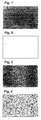
- Fig. 1 is an enlarged optical microphotograph of a polished surface of a translucent polycrystalline ceramic of a test piece 4 in Example 2, the ceramic embodying the invention.
- Fig. 2 is a view explaining an image emphasizing particles- fallen off portions shown in Fig 1. with emphasis of two-dradated contrast by using an image processing analyzer.
- Fig. 3 is an enlarged optical microphotograph of a polished surface of a translucent polycrystalline ceramic of a test piece 7 in Example 2, the ceramic not so satisfying an object of the invention.
- Fig. 4 is a view explaining an image emphasizing article- fallen off portions shown in Fig. 3 with emphasis of two-dradated contrast by using an image processing analyzer.
- Fig. 5 is a schematic cross-sectional view showing a measurement method for light transmittance through a translucent ceramic as explained in Example 1.
- Fig. 6(a) and Fig.6(b) are schematic cross-sectional views showing that a mean facet length of crystal particles formed in the polycrystalline ceramic is an important factor for translucency/transparency of the polycrystalline ceramic, wherein Fig.6(a) shows that when the mean facet length is longer than a wavelength of light being transmitted there is scattering (reflection/refraction), while Fig.6(b) shows that when the mean facet length is below the wavelength of the light being transmitted there is less light-scattering compared to Fig. 6(a).
- Fig. 7 is a schematic cross-sectional view showing the measurement method for light transmittance including a straight line light transmission as explained in Example 5.
- Example 1 a correlation between the mean particle size and the mean aspect ratio of alumina crystal particles, and also the correlation between the density of the translucent polycrystalline alumina ceramic and the strength/ hardness/light-transmittance were investigated.
- alumina powder having a mean particle size of 0.22 ⁇ m and a purity of 99.997% was ground with water by a wet grinding system having high-purity alumina pebbles of 99.5% purity to form a slurry. After spray-drying the slurry, the dried powder was molded to a unfired ceramic body which was then burned (or fired) at the temperature described as in Table 1 to form a primary sintered product. A HIP treatment was then applied to the primary sintered product at the temperature and under the pressure described in Table 1. The pebbles used therein did not substantially supply any impurities to the slurry according to an analysis conducted later.
- the firing of the unfired ceramic body was carried out in an air atmosphere and maintained at the firing temperature for 2 hours.
- the HIP treatment was maintained in an argon atmosphere for one hour.
- the alumina powder was compounded with 0.1 mol% Nb 2 O 3 and 0.07 mol% SiO 2 to 100 mol% alumina powder, to form a mixture which was then fired and sintered in the same process described as above.
- the density (hereafter referred to as "primary density”) of the primary sintered product after firing, the density (hereafter referred to as “density after HIP”) of the secondary sintered product, the mean particle size and the mean aspect ratio of the alumina crystal particles formed inside the ceramic, and the bending strength, the Vickers hardness, and the light-transmittance of the translucent alumina ceramic at room temperature were measured in the following ways. The results are shown in Table 1 and Table 2.
- the value of light transmittance in Table 2 means a rate in percentage of the total light (I) transmitted through the translucent ceramic of 1 mm in thickness, by comparing (dividing) the total light (Io) entered into the translucent ceramic, and measured without any interference of the sample 3, being determined with the illuminance meter (5) as shown in Fig.5.
- test pieces 2-5 having the mean particle sizes of from 0.5 to 0.6 ⁇ m, the mean aspect ratios of from 1.3 to 1.4, and the densities of 3.99 g/cm 3 , the translucent alumina ceramic product having a high bending strength and hardness are obtained. Furthermore, high values of from 60 to 70% in the light-transmittance were obtained.
- a surface of test pieces made a dimension of 6 (width) ⁇ 20 (length) ⁇ 4 (height) mm from the sintered procucts 4, 5, 7, and 8 of Table 1 and Table 2 was polished by the condition (1) below. Then after polishing by the condition (2) below, the optical microphotographs on the polished surface were taken at 100-400 magnifications from at least three visual scopes, and then the areas of the particle- fallen off portions in the visual scopes were measured. The area ratio to the total polished area was calculated. For measurement of the area of the particles fallen off, an image analyzer can be used. The results are shown in Table 3.
- the optical microphotograph (100 magnifications) of the polished surface of test piece 4 is shown in Fig. 1.
- the black portions of the photograph are particle- fallen off portions.
- the image emphasizing the particle- fallen off portions by an image processing with emphasis of two-dradated contrast is shown in Fig. 2.
- the optical microphotograph (100 magnifications) of the polished surface of Test piece 7 is shown in Fig. 3 and its image emphasizing the particle- fallen off portions by the image processing with emphasis of two-dradated contrast is shown in Fig. 4.
- the surface roughness of each sintered product after polishing was measured by a surface roughness measurement apparatus (using a trace-system surface roughness meter regulated by JIS B 0651) and Ra and Rmax according to JIS B 0601 were obtained. At the measurement, a stylus having a tip radius of 5 ⁇ m was used. The results are shown in Table 3. Test piece Area ratio (%) of particle-fallen off portion Surface roughness after polishing Ra ( ⁇ m Rmax ( ⁇ m) 4 0.02 0.004 0.077 5 0.04 0.005 0.079 *7 20.56 0.033 0.749 *8 4.27 0.021 0.504 Mark(*)indicates test pieces still embodying the invention, but not having all optional features of some preferred aspects of the invention.
- test pieces (4)and(5) have a very smooth surfaces.
- the area ratio of the particle- fallen off portions was about 20% and in test piece 8 the particles was considerably fallen off to be as about 4% of the area ratio.
- Ra was at least 0.02 ⁇ m and Rmax was at least 0.50 ⁇ m.
- Example 3 the abrasion resistance of each secondary sintered ceramic product of Example 2 was evaluated.
- the abrasion resistance was evaluated by an abrasion loss (expressed as "abraded depth” in Table 4).
- the abrasion loss was measured by pushing the sintered ceramic product to a diamond wheel plale (SD D45 J 100 B) having a particle size of 45 ⁇ m with a plane pressure of 1 kg/cm 2 for 5 minutes. This abrasion test was carried out with water. The size of the test piece was 6 (width) ⁇ 20 (length) ⁇ 4 (height) mm. The test results are shown in Table 4.
- Example 4 the durability to a contact stress, of each secondary sintered ceramic product of Example 2 was evaluated.
- a surface injury caused by pushing a steel ball having a diameter of 3.8 inch to the polished surface of the sintered ceramic product was checked so as to determine the minimum load that causes the injury such as a crack, with the load increasing.
- the results are shown in Table 4.
- the load was increased to 500 kgf and when any injury does not occur at the surface, the case was determined as more than 500 as shown in Table 4.
- the translucent alumina ceramic according to the invention finds various uses such as bearing (including balls), sliding members and cutting tools to which is applied a large contact stress.
- Example 2 An alumina powder having the same mean particle size and purity as described in Example 1 was mixed with each of additives of metal oxides as shown in Table 5, so as to form a molded (or unfired) body. Then the unfired body was burned (or fired) at a temperature described in Table 5, so as to make a primary sintered product to which thereafter was applied the HIP at the temperature and under the pressure respectively described in Table 5. Other conditions were the same as in Example 1.
- Example 2 On each translucent alumina ceramic thus obtained, the primary density and the density after the HIP treatment were measured as in Example 1, and further, the mean facet length of the alumina crystal particles formed inside the ceramic, the total light-transmittance, the linear light-transmittance of the translucent alumina ceramic and the ratio (linear light-transmittance/total light-transmittance) were measured, by the way as also described in Example 1 except for the measuring condition below.
- Each of the sintered products was mirror-polished and, after applying thermal etching on surfaces thereof, a scanning electron microphotograph was taken on the surface. From the photograph, the mean particle size and the mean aspect ratio of the sintered Al 2 O 3 crystal particles formed therein were calculated by the intercept method, based on at least 100 pieces of the particles. The results are shown in Table 5 and Table 6.
- Halogen lamp emitting white light with color temperature of 3100K
- a infrared cut filter cutting wavelengths of more than 800 nm
- Thickness of test piece 0.5 mm.
- Test piece Mean Particle Size ( ⁇ m) Mean facet length (nm) Total Transmittance (%) Linear Transmittance (%) Linear transmittance/ total transmittance (%) 4 0.54 330 72 23 32 9 0.50 300 75 40 53 10 0.52 270 78 42 54 11 0.50 250 78 27 35 12 0.48 220 73 25 34 *13 4.00 2200 79 4 5 (Thickness of test piece: 0.5 mm) Mark(*)indicates test pieces still embodying the invention, but not having all optional features of some preferred aspects of the invention.
- Example 6 a correlation of the kind and amount of the metal oxide contained in the translucent alumina ceramic with the strength and the hardness thereof at each temperature was investigated.
- alumina powder having a mean particle size of 0.22 ⁇ m and a purity of at least 99.99% was mixed with a variety of raw material powder as shown in Table 7 was prepared as in the Example 1 to form unfired ceramic bodies, and the bodies were fired at the temperature described in Table 7.
- To the primary sintered product was applied the HIP at the temperature with the pressure described in Table 7.
- Other conditions for the firing and the HIP treatment were the same as in Example 1.
- the primary density, the density after the HIP, and the bending strength and the Vickers hardness of the translucent alumina ceramic at room temperature were measured in a similar way as explained in Example 1, and further, the bending strength and the Vickers hardness at a high temperature were measured by the method described below.
- the sintered product was mirror polished, and after applying thereto thermal etching, a scanning electron microphotograph was taken on the surface. From the photograph, the mean particle size of the alumina crystal particles was computed by the intercept-method. The results are shown in Tables 7 and 8.
- test pieces (10) to (12) and (14) to(23) in Tables 7 and 8 are high and excellent in the strength and the hardness not only at room temperature but also at 1000°C - 1200°C.
- the cutting tool tips were made from the translucent alumina ceramic products that were prepared in a similar way as described in previous Examples so as to have the sintered ceramic made from the alumina particles and metal oxide as shown in Table 9.
- the sintered products were shaped to cutting tool tips (SNN434-TNF) which were tested under the following cutting condition. Test results are shown in Table 10.
- the total light-transmittance of the translucent polycrystalline alumina ceramic products was checked by the same way as described in Example 1.
- the checked ceramic products were 0.5 mm in thickness and mirror-polished (Ra ⁇ 0.02 ⁇ m). The data are shown in Table 10.
- the translucent polycrystalline Al 2 O 3 ceramic containing the additive oxide of metal according to the invention can perform excellently when it is used as a cutting tool material.
Landscapes
- Engineering & Computer Science (AREA)
- Chemical & Material Sciences (AREA)
- Ceramic Engineering (AREA)
- Manufacturing & Machinery (AREA)
- Materials Engineering (AREA)
- Structural Engineering (AREA)
- Organic Chemistry (AREA)
- Inorganic Chemistry (AREA)
- Compositions Of Oxide Ceramics (AREA)
- Vessels And Coating Films For Discharge Lamps (AREA)
Applications Claiming Priority (6)
| Application Number | Priority Date | Filing Date | Title |
|---|---|---|---|
| JP13868399 | 1999-05-19 | ||
| JP13868399 | 1999-05-19 | ||
| JP37479799 | 1999-12-28 | ||
| JP37479799 | 1999-12-28 | ||
| JP2000062627 | 2000-03-07 | ||
| JP2000062627 | 2000-03-07 |
Publications (3)
| Publication Number | Publication Date |
|---|---|
| EP1053983A2 true EP1053983A2 (de) | 2000-11-22 |
| EP1053983A3 EP1053983A3 (de) | 2001-07-04 |
| EP1053983B1 EP1053983B1 (de) | 2007-09-12 |
Family
ID=27317719
Family Applications (1)
| Application Number | Title | Priority Date | Filing Date |
|---|---|---|---|
| EP00304268A Expired - Lifetime EP1053983B1 (de) | 1999-05-19 | 2000-05-19 | Transluzente polykristalline Keramik und Verfahren zu ihrer Herstellung |
Country Status (6)
| Country | Link |
|---|---|
| US (1) | US6417127B1 (de) |
| EP (1) | EP1053983B1 (de) |
| CA (1) | CA2308933C (de) |
| DE (1) | DE60036323T2 (de) |
| ES (1) | ES2291174T3 (de) |
| TW (1) | TWI229061B (de) |
Cited By (25)
| Publication number | Priority date | Publication date | Assignee | Title |
|---|---|---|---|---|
| DE10101169A1 (de) * | 2001-01-12 | 2001-12-20 | Georg Grathwohl | Transparenter alpha-Aluminiumoxidkörper mit sub-mum Gefüge und Verfahren zur Herstellung desselben |
| EP1279650A1 (de) * | 2001-07-23 | 2003-01-29 | NGK Spark Plug Company Limited | Gesintertes Aluminiumoxid Keramik, Verfahren zur Herstellung desselben, und ein Schneidewerkzeug |
| WO2004007397A1 (en) * | 2002-07-10 | 2004-01-22 | Koninklijke Philips Electronics N.V. | Transparent polycrystalline aluminium oxide |
| WO2004007398A1 (en) * | 2002-07-10 | 2004-01-22 | Koninklijke Philips Electronics N.V. | Transparent ploycrystalline aluminium oxide |
| WO2005068392A1 (de) * | 2004-01-19 | 2005-07-28 | Fraunhofer-Gesellschaft zur Förderung der angewandten Forschung e.V. | FARBIGES TRANSPARENTES KORUNDMATERIAL MIT POLYKRISTALLINEM SUB-µM GEFÜGE UND VERFAHREN ZUR HERSTELLUNG VON FORMKÖRPERN AUS DIESEM MATERIAL |
| WO2005119798A3 (en) * | 2004-06-01 | 2006-03-16 | Koninkl Philips Electronics Nv | Light- emitting diode |
| EP1585168A4 (de) * | 2003-09-22 | 2006-07-05 | Matsushita Electric Industrial Co Ltd | Metallhalogenidlampe |
| WO2006125900A1 (fr) | 2005-05-26 | 2006-11-30 | Saint-Gobain Centre De Recherches Et D'etudes Europeen | Produit d'alumine frittee transparent au rayonnement infrarouge |
| WO2007065914A1 (de) * | 2005-12-08 | 2007-06-14 | Ceramtec Ag | Feinkristalline al2o3-keramik |
| FR2895399A1 (fr) * | 2005-12-22 | 2007-06-29 | Saint Gobain Ct Recherches | Produit d'alumine frittee transparent au rayonnement infrarouge et dans le domaine du visible |
| US7247591B2 (en) | 2005-05-26 | 2007-07-24 | Osram Sylvania Inc. | Translucent PCA ceramic, ceramic discharge vessel, and method of making |
| EP1787601A4 (de) * | 2004-08-27 | 2008-10-01 | Tosoh Corp | Orthodontische klammer und herstellungsverfahren dafür |
| EP1703534A3 (de) * | 2005-03-16 | 2009-07-15 | Osram-Sylvania Inc. | Hochdurchlässige Entladungsgefässe aus Aluminiumoxid von Submikron-Korngrösse |
| WO2011012125A1 (de) | 2009-07-30 | 2011-02-03 | Fraunhofer Gesellschaft Zur Förderung Der Angewandten Forschung E. V. | α-Al2O3-SINTERMATERIAL UND VERFAHREN ZUR HERSTELLUNG EINES HOCHDICHTEN UND FEINSTKRISTALLINEN FORMKÖRPERS AUS DIESEM MATERIAL SOWIE DEREN VERWENDUNG |
| CN102627450A (zh) * | 2012-04-20 | 2012-08-08 | 苏州珂玛材料技术有限公司 | 一种细晶透明氧化铝陶瓷材料及制备方法 |
| US20130256957A1 (en) * | 2012-03-27 | 2013-10-03 | Seiko Epson Corporation | Translucent alumina and method for producing translucent alumina |
| EP2305621A3 (de) * | 2009-09-09 | 2013-12-04 | NGK Insulators, Ltd. | Durchscheinender gesinterter Polykristallinkörper, Verfahren zu dessen Herstellung und Lichtbogen für Entladungslampe mit hoher Intensität |
| EP1458304B1 (de) * | 2001-12-28 | 2014-01-22 | 3M Innovative Properties Company | Polykristallines, lichtdurchlässiges keramikmaterial auf basis von aluminiumoxid |
| EP2747222B1 (de) | 2006-06-23 | 2015-05-27 | Federal-Mogul Corporation | Zündkerzenisolator |
| EP2949633A1 (de) | 2014-05-27 | 2015-12-02 | Fraunhofer-Gesellschaft zur Förderung der angewandten Forschung e.V. | Transparente Spinellkeramiken und Verfahren zu ihrer Herstellung |
| DE102014210071A1 (de) | 2014-05-27 | 2015-12-03 | Fraunhofer-Gesellschaft zur Förderung der angewandten Forschung e.V. | Transparente Spinellkeramiken und Verfahren zu ihrer Herstellung |
| WO2015181066A1 (de) | 2014-05-27 | 2015-12-03 | Fraunhofer-Gesellschaft zur Förderung der angewandten Forschung e.V. | Transparente spinellkeramiken und verfahren zu ihrer herstellung |
| US9309156B2 (en) | 2014-05-27 | 2016-04-12 | Fraunhofer-Gesellschaft Zur Foerderung Der Angewandten Forschung E.V. | Transparent spinel ceramics and method for the production thereof |
| EP2978009A4 (de) * | 2013-12-25 | 2016-12-28 | Ngk Insulators Ltd | Griffsubstrat, verbundsubstrat für halbleiter und halbleiterschaltungssubstrat und verfahren zur herstellung davon |
| CN107244908A (zh) * | 2017-06-02 | 2017-10-13 | 佛山石湾华鹏陶瓷有限公司 | 一种高白仿玉石抛光砖砖坯及其瓷砖制备方法 |
Families Citing this family (32)
| Publication number | Priority date | Publication date | Assignee | Title |
|---|---|---|---|---|
| US6933331B2 (en) | 1998-05-22 | 2005-08-23 | Nanoproducts Corporation | Nanotechnology for drug delivery, contrast agents and biomedical implants |
| US6741033B2 (en) * | 2001-03-20 | 2004-05-25 | General Electric Company | High transmittance alumina for ceramic metal halide lamps |
| US6855426B2 (en) | 2001-08-08 | 2005-02-15 | Nanoproducts Corporation | Methods for producing composite nanoparticles |
| US7253122B2 (en) | 2002-08-28 | 2007-08-07 | Micron Technology, Inc. | Systems and methods for forming metal oxides using metal diketonates and/or ketoimines |
| US7087481B2 (en) | 2002-08-28 | 2006-08-08 | Micron Technology, Inc. | Systems and methods for forming metal oxides using metal compounds containing aminosilane ligands |
| US6984592B2 (en) * | 2002-08-28 | 2006-01-10 | Micron Technology, Inc. | Systems and methods for forming metal-doped alumina |
| US7708974B2 (en) | 2002-12-10 | 2010-05-04 | Ppg Industries Ohio, Inc. | Tungsten comprising nanomaterials and related nanotechnology |
| DE102004024017A1 (de) * | 2004-05-13 | 2005-12-01 | Schott Ag | Verfahren zur Herstellung einer Leuchtvorrichtung umfassend eine Glaskeramik |
| DE102004004259B3 (de) * | 2004-01-23 | 2005-11-24 | Fraunhofer-Gesellschaft zur Förderung der angewandten Forschung e.V. | Transparente polykristalline Sinterkeramik kubischer Kristallstruktur |
| EP1805119B1 (de) * | 2004-10-01 | 2015-07-01 | Ceranova Corporation | Polykristalline aluminiumartikel und herstellungsverfahren |
| US20060100088A1 (en) * | 2004-11-09 | 2006-05-11 | General Electric Company | Transparent multi-cation ceramic and method of making |
| JP4983545B2 (ja) * | 2007-10-30 | 2012-07-25 | 東ソー株式会社 | 高靭性透光性アルミナ焼結体及びその製造方法並びに用途 |
| CN101468915A (zh) * | 2007-12-26 | 2009-07-01 | 中国科学院上海硅酸盐研究所 | 一种具有择优取向的多晶氧化铝透明陶瓷及其制备方法 |
| DE102008036381B3 (de) * | 2008-08-05 | 2010-04-22 | Endress + Hauser Gmbh + Co. Kg | Membran aus Al2O3- Keramik für einen Drucksensor und Drucksensor mit einer solchen Messmembran |
| US8485042B2 (en) | 2008-08-05 | 2013-07-16 | Endress + Hauser Gmbh + Co. Kg | Method for manufacturing an elastic body of Al2O3 ceramic, measuring membrane for a pressure sensor and pressure sensor with such a membrane |
| EP2366675B1 (de) * | 2008-11-18 | 2015-05-27 | Tosoh Corporation | Gesintertes gefärbtes aluminiumoxid mit hoher zähigkeit und hoher transluzenz und herstellungsverfahren und verwendungen dafür |
| MY187208A (en) * | 2011-03-11 | 2021-09-10 | Saint Gobain Ceramics | Refractory object, glass overflow forming block, and process for glass object manufacture |
| RU2570213C2 (ru) | 2011-03-30 | 2015-12-10 | Сэнт-Гобэн Керамикс Энд Пластикс, Инк. | Огнеупорное изделие и способ его формования и использования |
| TWI597254B (zh) | 2012-01-11 | 2017-09-01 | 聖高拜陶器塑膠公司 | 耐火物件 |
| JP6058562B2 (ja) | 2012-01-30 | 2017-01-11 | 日本碍子株式会社 | 酸化亜鉛スパッタリングターゲット及びその製造方法 |
| US20150299044A1 (en) * | 2012-12-19 | 2015-10-22 | Ceramtec-Etec Gmbh | Ceramic material |
| US20160039717A1 (en) * | 2014-08-11 | 2016-02-11 | Jen Long Vacuum Industrial Co., Ltd. | Polycrystalline transparent ceramics laminate |
| US9527774B2 (en) | 2014-08-27 | 2016-12-27 | King Abdulaziz City For Science And Technology | High strength transparent ceramic using corundum powder and methods of manufacture |
| EP3262011A4 (de) | 2015-02-24 | 2018-08-01 | Saint-Gobain Ceramics&Plastics, Inc. | Feuerfester artikel und verfahren zur herstellung |
| US11358241B2 (en) * | 2015-04-23 | 2022-06-14 | Kennametal Inc. | Cutting tools having microstructured and nanostructured refractory surfaces |
| CN106064935B (zh) * | 2016-04-07 | 2018-10-26 | 深圳市天宇华瑞科技开发有限公司 | 一种复合式氧化铝陶瓷玻璃 |
| US10580666B2 (en) | 2016-07-01 | 2020-03-03 | Corning Incorporated | Carrier substrates for semiconductor processing |
| EP3553153B1 (de) * | 2016-12-07 | 2023-02-08 | Konoshima Chemical Co., Ltd. | Keramikzusammensetzung |
| JP7120745B2 (ja) * | 2017-09-29 | 2022-08-17 | 日本特殊陶業株式会社 | 光波長変換装置及び光複合装置 |
| JP6725774B2 (ja) * | 2018-07-11 | 2020-07-22 | 日本特殊陶業株式会社 | 光波長変換部材及び発光装置 |
| US11945987B2 (en) * | 2018-07-31 | 2024-04-02 | Niterra Co., Ltd. | Light wavelength conversion member and light-emitting device |
| US11008260B2 (en) * | 2019-03-26 | 2021-05-18 | Ngk Spark Plug Co., Ltd. | Corrosion resistant materials |
Family Cites Families (6)
| Publication number | Priority date | Publication date | Assignee | Title |
|---|---|---|---|---|
| US3905845A (en) * | 1969-08-27 | 1975-09-16 | Ngk Insulators Ltd | Translucent alumina containing magnesia yttria and lanthium oxide |
| KR910009894B1 (ko) | 1987-03-26 | 1991-12-03 | 도도 기끼 가부시끼가이샤 | 세라믹스 제품 및 그 제조방법 |
| JP2663191B2 (ja) | 1990-03-09 | 1997-10-15 | 通商産業省工業技術院長 | 多結晶アルミナ焼結体の製造方法 |
| JPH03285865A (ja) | 1990-03-30 | 1991-12-17 | Kyocera Corp | 透光性アルミナセラミックスおよびその製造方法 |
| EP0583534B1 (de) | 1992-08-14 | 1997-03-05 | The Procter & Gamble Company | Peptidaldehydhaltige flüssige Waschmittel |
| JP3261648B2 (ja) | 1996-11-19 | 2002-03-04 | 株式会社名機製作所 | 真空多段積層装置 |
-
2000
- 2000-05-18 CA CA002308933A patent/CA2308933C/en not_active Expired - Fee Related
- 2000-05-19 US US09/574,202 patent/US6417127B1/en not_active Expired - Lifetime
- 2000-05-19 ES ES00304268T patent/ES2291174T3/es not_active Expired - Lifetime
- 2000-05-19 TW TW089109661A patent/TWI229061B/zh not_active IP Right Cessation
- 2000-05-19 DE DE60036323T patent/DE60036323T2/de not_active Expired - Lifetime
- 2000-05-19 EP EP00304268A patent/EP1053983B1/de not_active Expired - Lifetime
Cited By (36)
| Publication number | Priority date | Publication date | Assignee | Title |
|---|---|---|---|---|
| DE10101169A1 (de) * | 2001-01-12 | 2001-12-20 | Georg Grathwohl | Transparenter alpha-Aluminiumoxidkörper mit sub-mum Gefüge und Verfahren zur Herstellung desselben |
| DE10101169C2 (de) * | 2001-01-12 | 2002-11-07 | Georg Grathwohl | Verfahren zur Herstellung eines transparenten alpha-Aluminiumoxidkörpers mit sub-mum Gefüge |
| EP1279650A1 (de) * | 2001-07-23 | 2003-01-29 | NGK Spark Plug Company Limited | Gesintertes Aluminiumoxid Keramik, Verfahren zur Herstellung desselben, und ein Schneidewerkzeug |
| US6753284B2 (en) | 2001-07-23 | 2004-06-22 | Ngk Spark Plug Co., Ltd. | Sintered alumina ceramic, method for producing the same, and cutting tool |
| KR100882392B1 (ko) * | 2001-07-23 | 2009-02-05 | 니혼도꾸슈도교 가부시키가이샤 | 알루미나계 절삭공구 |
| EP1458304B1 (de) * | 2001-12-28 | 2014-01-22 | 3M Innovative Properties Company | Polykristallines, lichtdurchlässiges keramikmaterial auf basis von aluminiumoxid |
| WO2004007397A1 (en) * | 2002-07-10 | 2004-01-22 | Koninklijke Philips Electronics N.V. | Transparent polycrystalline aluminium oxide |
| WO2004007398A1 (en) * | 2002-07-10 | 2004-01-22 | Koninklijke Philips Electronics N.V. | Transparent ploycrystalline aluminium oxide |
| US7396792B2 (en) | 2002-07-10 | 2008-07-08 | Koninklijke Philips Electronics, N.V. | Transparent polycrystalline aluminium oxide |
| EP1585168A4 (de) * | 2003-09-22 | 2006-07-05 | Matsushita Electric Industrial Co Ltd | Metallhalogenidlampe |
| WO2005068392A1 (de) * | 2004-01-19 | 2005-07-28 | Fraunhofer-Gesellschaft zur Förderung der angewandten Forschung e.V. | FARBIGES TRANSPARENTES KORUNDMATERIAL MIT POLYKRISTALLINEM SUB-µM GEFÜGE UND VERFAHREN ZUR HERSTELLUNG VON FORMKÖRPERN AUS DIESEM MATERIAL |
| WO2005119798A3 (en) * | 2004-06-01 | 2006-03-16 | Koninkl Philips Electronics Nv | Light- emitting diode |
| EP1787601A4 (de) * | 2004-08-27 | 2008-10-01 | Tosoh Corp | Orthodontische klammer und herstellungsverfahren dafür |
| US8215019B2 (en) | 2004-08-27 | 2012-07-10 | Tosoh Corporation | Process for producing an orthodontic bracket |
| US8133051B2 (en) | 2004-08-27 | 2012-03-13 | Tosoh Corporation | Orthodontic bracket and process for producing the same |
| US7897098B2 (en) | 2005-03-16 | 2011-03-01 | Osram Sylvania Inc. | High total transmittance alumina discharge vessels having submicron grain size |
| EP1703534A3 (de) * | 2005-03-16 | 2009-07-15 | Osram-Sylvania Inc. | Hochdurchlässige Entladungsgefässe aus Aluminiumoxid von Submikron-Korngrösse |
| WO2006125900A1 (fr) | 2005-05-26 | 2006-11-30 | Saint-Gobain Centre De Recherches Et D'etudes Europeen | Produit d'alumine frittee transparent au rayonnement infrarouge |
| FR2886289A1 (fr) * | 2005-05-26 | 2006-12-01 | Saint Gobain Ct Recherches | Produit d'alumine frittee transparent au rayonnement infrarouge |
| US7247591B2 (en) | 2005-05-26 | 2007-07-24 | Osram Sylvania Inc. | Translucent PCA ceramic, ceramic discharge vessel, and method of making |
| WO2007065914A1 (de) * | 2005-12-08 | 2007-06-14 | Ceramtec Ag | Feinkristalline al2o3-keramik |
| WO2007074298A2 (fr) | 2005-12-22 | 2007-07-05 | Saint-Gobain Centre De Recherches Et D'etudes Europeen | Produit d'alumine frittee transparent au rayonnement infrarouge et dans le domaine du visible |
| FR2895399A1 (fr) * | 2005-12-22 | 2007-06-29 | Saint Gobain Ct Recherches | Produit d'alumine frittee transparent au rayonnement infrarouge et dans le domaine du visible |
| WO2007074298A3 (fr) * | 2005-12-22 | 2007-08-16 | Saint Gobain Ct Recherches | Produit d'alumine frittee transparent au rayonnement infrarouge et dans le domaine du visible |
| EP2747222B1 (de) | 2006-06-23 | 2015-05-27 | Federal-Mogul Corporation | Zündkerzenisolator |
| WO2011012125A1 (de) | 2009-07-30 | 2011-02-03 | Fraunhofer Gesellschaft Zur Förderung Der Angewandten Forschung E. V. | α-Al2O3-SINTERMATERIAL UND VERFAHREN ZUR HERSTELLUNG EINES HOCHDICHTEN UND FEINSTKRISTALLINEN FORMKÖRPERS AUS DIESEM MATERIAL SOWIE DEREN VERWENDUNG |
| DE102009035501A1 (de) | 2009-07-30 | 2011-02-10 | Fraunhofer-Gesellschaft zur Förderung der angewandten Forschung e.V. | α-Al2O3-Sintermaterial und Verfahren zur Herstellung eines hochdichten und feinstkristallinen Formkörpers aus diesem Material sowie deren Verwendung |
| EP2305621A3 (de) * | 2009-09-09 | 2013-12-04 | NGK Insulators, Ltd. | Durchscheinender gesinterter Polykristallinkörper, Verfahren zu dessen Herstellung und Lichtbogen für Entladungslampe mit hoher Intensität |
| US20130256957A1 (en) * | 2012-03-27 | 2013-10-03 | Seiko Epson Corporation | Translucent alumina and method for producing translucent alumina |
| CN102627450A (zh) * | 2012-04-20 | 2012-08-08 | 苏州珂玛材料技术有限公司 | 一种细晶透明氧化铝陶瓷材料及制备方法 |
| EP2978009A4 (de) * | 2013-12-25 | 2016-12-28 | Ngk Insulators Ltd | Griffsubstrat, verbundsubstrat für halbleiter und halbleiterschaltungssubstrat und verfahren zur herstellung davon |
| EP2949633A1 (de) | 2014-05-27 | 2015-12-02 | Fraunhofer-Gesellschaft zur Förderung der angewandten Forschung e.V. | Transparente Spinellkeramiken und Verfahren zu ihrer Herstellung |
| DE102014210071A1 (de) | 2014-05-27 | 2015-12-03 | Fraunhofer-Gesellschaft zur Förderung der angewandten Forschung e.V. | Transparente Spinellkeramiken und Verfahren zu ihrer Herstellung |
| WO2015181066A1 (de) | 2014-05-27 | 2015-12-03 | Fraunhofer-Gesellschaft zur Förderung der angewandten Forschung e.V. | Transparente spinellkeramiken und verfahren zu ihrer herstellung |
| US9309156B2 (en) | 2014-05-27 | 2016-04-12 | Fraunhofer-Gesellschaft Zur Foerderung Der Angewandten Forschung E.V. | Transparent spinel ceramics and method for the production thereof |
| CN107244908A (zh) * | 2017-06-02 | 2017-10-13 | 佛山石湾华鹏陶瓷有限公司 | 一种高白仿玉石抛光砖砖坯及其瓷砖制备方法 |
Also Published As
| Publication number | Publication date |
|---|---|
| TWI229061B (en) | 2005-03-11 |
| EP1053983B1 (de) | 2007-09-12 |
| DE60036323D1 (de) | 2007-10-25 |
| CA2308933C (en) | 2008-07-22 |
| CA2308933A1 (en) | 2000-11-19 |
| ES2291174T3 (es) | 2008-03-01 |
| DE60036323T2 (de) | 2009-01-29 |
| US6417127B1 (en) | 2002-07-09 |
| EP1053983A3 (de) | 2001-07-04 |
Similar Documents
| Publication | Publication Date | Title |
|---|---|---|
| US6417127B1 (en) | Translucent polycrystalline ceramic and method for making same | |
| JP4723055B2 (ja) | アルミナ焼結体及びその製造方法並びに焼結アルミナ部材及び発光管 | |
| Yamashita et al. | Light scattering by residual pores in transparent zirconia ceramics | |
| US20070278960A1 (en) | Transparent polycrystalline aluminum oxide | |
| KR101502601B1 (ko) | 입방 구조를 가진 소결 제품 | |
| US7247589B2 (en) | Transparent polycrystalline sintered ceramic of cubic crystal structure | |
| EP1521729B1 (de) | Transparentes polykristallines aluminiumoxid | |
| GB2071073A (en) | Alumina ceramic | |
| Yamashita et al. | Development of highly transparent zirconia ceramics | |
| EP4480936A1 (de) | Zirkoniumlaminat | |
| JP6885021B2 (ja) | オレンジ色ジルコニア焼結体及びその製造方法 | |
| EP2634156A1 (de) | Cordieritkeramik und element für halbleiterherstellungsvorrichtungen damit | |
| KR101122929B1 (ko) | 투명한 다결정 산질화알루미늄의 제조방법 | |
| CN108430950B (zh) | 陶瓷烧结体 | |
| CN121620498A (zh) | 陶瓷材料、光学部件、头戴式显示器以及制造方法 | |
| JP2025083366A (ja) | ジルコニア質メディア及びそれらの製造方法 | |
| KR100694949B1 (ko) | 반투명 다결정 세라믹 및 그 제조방법 | |
| US20250049547A1 (en) | Dental ceramic oxide pre-sintered body having excellent machinability and production method for same | |
| KR20240113801A (ko) | 고투광성 알루미나 소결체가 되는 치과용 알루미나 가소체 | |
| WO2007107954A2 (en) | A sintered and doped yttrium oxide product | |
| WO2024127664A1 (ja) | 高透光性アルミナ焼結体となる歯科用アルミナ仮焼体 | |
| Dericioglu et al. | Fail-safe light transmitting SiC fiber-reinforced spinel matrix optomechanical composite | |
| JP3873621B2 (ja) | ロッドレンズ | |
| JP7526359B2 (ja) | 有底筒状体 | |
| EP4431080A1 (de) | Kalzinierter dentaler keramikoxidkörper mit hervorragender bearbeitbarkeit und herstellungsverfahren dafür |
Legal Events
| Date | Code | Title | Description |
|---|---|---|---|
| PUAI | Public reference made under article 153(3) epc to a published international application that has entered the european phase |
Free format text: ORIGINAL CODE: 0009012 |
|
| AK | Designated contracting states |
Kind code of ref document: A2 Designated state(s): DE ES FR GB IT SE |
|
| AX | Request for extension of the european patent |
Free format text: AL;LT;LV;MK;RO;SI |
|
| PUAL | Search report despatched |
Free format text: ORIGINAL CODE: 0009013 |
|
| RIC1 | Information provided on ipc code assigned before grant |
Free format text: 7C 04B 35/115 A, 7H 01J 5/04 B |
|
| AK | Designated contracting states |
Kind code of ref document: A3 Designated state(s): AT BE CH CY DE DK ES FI FR GB GR IE IT LI LU MC NL PT SE |
|
| AX | Request for extension of the european patent |
Free format text: AL;LT;LV;MK;RO;SI |
|
| 17P | Request for examination filed |
Effective date: 20011220 |
|
| AKX | Designation fees paid |
Free format text: DE ES FR GB IT SE |
|
| 17Q | First examination report despatched |
Effective date: 20030924 |
|
| GRAP | Despatch of communication of intention to grant a patent |
Free format text: ORIGINAL CODE: EPIDOSNIGR1 |
|
| GRAS | Grant fee paid |
Free format text: ORIGINAL CODE: EPIDOSNIGR3 |
|
| GRAA | (expected) grant |
Free format text: ORIGINAL CODE: 0009210 |
|
| AK | Designated contracting states |
Kind code of ref document: B1 Designated state(s): DE ES FR GB IT SE |
|
| REG | Reference to a national code |
Ref country code: GB Ref legal event code: FG4D |
|
| REF | Corresponds to: |
Ref document number: 60036323 Country of ref document: DE Date of ref document: 20071025 Kind code of ref document: P |
|
| REG | Reference to a national code |
Ref country code: SE Ref legal event code: TRGR |
|
| REG | Reference to a national code |
Ref country code: ES Ref legal event code: FG2A Ref document number: 2291174 Country of ref document: ES Kind code of ref document: T3 |
|
| ET | Fr: translation filed | ||
| PLBE | No opposition filed within time limit |
Free format text: ORIGINAL CODE: 0009261 |
|
| STAA | Information on the status of an ep patent application or granted ep patent |
Free format text: STATUS: NO OPPOSITION FILED WITHIN TIME LIMIT |
|
| 26N | No opposition filed |
Effective date: 20080613 |
|
| REG | Reference to a national code |
Ref country code: FR Ref legal event code: PLFP Year of fee payment: 17 |
|
| PGFP | Annual fee paid to national office [announced via postgrant information from national office to epo] |
Ref country code: ES Payment date: 20160412 Year of fee payment: 17 Ref country code: GB Payment date: 20160518 Year of fee payment: 17 Ref country code: DE Payment date: 20160510 Year of fee payment: 17 |
|
| PGFP | Annual fee paid to national office [announced via postgrant information from national office to epo] |
Ref country code: FR Payment date: 20160412 Year of fee payment: 17 Ref country code: IT Payment date: 20160524 Year of fee payment: 17 Ref country code: SE Payment date: 20160511 Year of fee payment: 17 |
|
| REG | Reference to a national code |
Ref country code: DE Ref legal event code: R082 Ref document number: 60036323 Country of ref document: DE Representative=s name: KLUNKER IP PATENTANWAELTE PARTG MBB, DE |
|
| REG | Reference to a national code |
Ref country code: DE Ref legal event code: R119 Ref document number: 60036323 Country of ref document: DE |
|
| REG | Reference to a national code |
Ref country code: SE Ref legal event code: EUG |
|
| GBPC | Gb: european patent ceased through non-payment of renewal fee |
Effective date: 20170519 |
|
| PG25 | Lapsed in a contracting state [announced via postgrant information from national office to epo] |
Ref country code: SE Free format text: LAPSE BECAUSE OF NON-PAYMENT OF DUE FEES Effective date: 20170520 |
|
| REG | Reference to a national code |
Ref country code: FR Ref legal event code: ST Effective date: 20180131 |
|
| PG25 | Lapsed in a contracting state [announced via postgrant information from national office to epo] |
Ref country code: DE Free format text: LAPSE BECAUSE OF NON-PAYMENT OF DUE FEES Effective date: 20171201 Ref country code: GB Free format text: LAPSE BECAUSE OF NON-PAYMENT OF DUE FEES Effective date: 20170519 |
|
| PG25 | Lapsed in a contracting state [announced via postgrant information from national office to epo] |
Ref country code: IT Free format text: LAPSE BECAUSE OF NON-PAYMENT OF DUE FEES Effective date: 20170519 Ref country code: FR Free format text: LAPSE BECAUSE OF NON-PAYMENT OF DUE FEES Effective date: 20170531 |
|
| REG | Reference to a national code |
Ref country code: ES Ref legal event code: FD2A Effective date: 20180608 |
|
| PG25 | Lapsed in a contracting state [announced via postgrant information from national office to epo] |
Ref country code: ES Free format text: LAPSE BECAUSE OF NON-PAYMENT OF DUE FEES Effective date: 20170520 |