EP1055725A2 - Verfahren zur fermentativen Herstellung von L-Aminosäuren und für das accDA Gen codierende Nukleotidsequenzen - Google Patents
Verfahren zur fermentativen Herstellung von L-Aminosäuren und für das accDA Gen codierende Nukleotidsequenzen Download PDFInfo
- Publication number
- EP1055725A2 EP1055725A2 EP00109842A EP00109842A EP1055725A2 EP 1055725 A2 EP1055725 A2 EP 1055725A2 EP 00109842 A EP00109842 A EP 00109842A EP 00109842 A EP00109842 A EP 00109842A EP 1055725 A2 EP1055725 A2 EP 1055725A2
- Authority
- EP
- European Patent Office
- Prior art keywords
- gene
- bacteria
- sequence
- accda
- amino acid
- Prior art date
- Legal status (The legal status is an assumption and is not a legal conclusion. Google has not performed a legal analysis and makes no representation as to the accuracy of the status listed.)
- Granted
Links
Images
Classifications
-
- C—CHEMISTRY; METALLURGY
- C12—BIOCHEMISTRY; BEER; SPIRITS; WINE; VINEGAR; MICROBIOLOGY; ENZYMOLOGY; MUTATION OR GENETIC ENGINEERING
- C12N—MICROORGANISMS OR ENZYMES; COMPOSITIONS THEREOF; PROPAGATING, PRESERVING, OR MAINTAINING MICROORGANISMS; MUTATION OR GENETIC ENGINEERING; CULTURE MEDIA
- C12N15/00—Mutation or genetic engineering; DNA or RNA concerning genetic engineering, vectors, e.g. plasmids, or their isolation, preparation or purification; Use of hosts therefor
- C12N15/09—Recombinant DNA-technology
-
- C—CHEMISTRY; METALLURGY
- C12—BIOCHEMISTRY; BEER; SPIRITS; WINE; VINEGAR; MICROBIOLOGY; ENZYMOLOGY; MUTATION OR GENETIC ENGINEERING
- C12P—FERMENTATION OR ENZYME-USING PROCESSES TO SYNTHESISE A DESIRED CHEMICAL COMPOUND OR COMPOSITION OR TO SEPARATE OPTICAL ISOMERS FROM A RACEMIC MIXTURE
- C12P13/00—Preparation of nitrogen-containing organic compounds
- C12P13/04—Alpha- or beta- amino acids
- C12P13/08—Lysine; Diaminopimelic acid; Threonine; Valine
-
- C—CHEMISTRY; METALLURGY
- C12—BIOCHEMISTRY; BEER; SPIRITS; WINE; VINEGAR; MICROBIOLOGY; ENZYMOLOGY; MUTATION OR GENETIC ENGINEERING
- C12N—MICROORGANISMS OR ENZYMES; COMPOSITIONS THEREOF; PROPAGATING, PRESERVING, OR MAINTAINING MICROORGANISMS; MUTATION OR GENETIC ENGINEERING; CULTURE MEDIA
- C12N9/00—Enzymes; Proenzymes; Compositions thereof; Processes for preparing, activating, inhibiting, separating or purifying enzymes
- C12N9/10—Transferases (2.)
- C12N9/1003—Transferases (2.) transferring one-carbon groups (2.1)
- C12N9/1018—Carboxy- and carbamoyl transferases (2.1.3)
-
- C—CHEMISTRY; METALLURGY
- C12—BIOCHEMISTRY; BEER; SPIRITS; WINE; VINEGAR; MICROBIOLOGY; ENZYMOLOGY; MUTATION OR GENETIC ENGINEERING
- C12Y—ENZYMES
- C12Y201/00—Transferases transferring one-carbon groups (2.1)
- C12Y201/03—Carboxy- and carbamoyltransferases (2.1.3)
- C12Y201/03001—Methylmalonyl-CoA carboxytransferase (2.1.3.1)
Definitions
- the invention relates to the coding for the accDA gene Nucleotide sequences and methods for fermentative Production of L-amino acids, especially L-lysine under Use of coryneform bacteria in which the gene accDA is strengthened.
- L-amino acids especially L-lysine
- L-lysine can be found in the Animal nutrition, in human medicine and in pharmaceutical industry application.
- the enzyme acetyl-CoA carboxylase catalyzes the Carboxylation of acetyl-CoA to malonyl-CoA.
- the enzyme from Escherichia coli consists of four subunits.
- the accB gene encodes the biotin carboxyl carrier protein, the accC gene for the biotin carboxylase and the genes accA and accD for the transcarboxylase (Cronan and Rock, Biosynthesis of membrane lipids. In: Escherichia coli and Salmonella typhimurium (ed F.C. Neidhardt), 1996, pp 612-636, American Society for Microbiology). Because of the property of the enzyme It will carboxylate acyl groups in the form of acyl-CoA also referred to as acyl-CoA carboxylase.
- the nucleotide sequence of the Corynebacterium accBC gene glutamicum was developed by Jäger et al. (Archives of Microbiology 166, 76-82 (1996)) and is in the database of European Molecular Biologies Laboratories (EMBL, Heidelberg, Germany) under Accession Number U35023 generally available.
- the accBC gene codes for one Subunit of acetyl-CoA carboxylase, which is a biotin carboxyl carrier protein domain and a biotin carboxylase domain wearing.
- the inventors set themselves the task of creating new ones Measures to improve the fermentative production of L-amino acids, in particular to provide L-lysine.
- L-amino acids are found in animal nutrition, in the Human medicine and in the pharmaceutical industry Application. There is therefore a general interest in it new improved processes for the production of L-amino acids to provide.
- L-lysine or lysine are so that not only the base but also the salts such as.
- B. Lysine monohydrochloride or lysine sulfate is meant.
- the invention relates to a coryneform Microorganisms replicable, preferably recombinant DNA with the origin Corynebacterium, which at least the Contains nucleotide sequence necessary for the accDA gene, shown in SEQ-ID-No. 1, coded.
- coryneform microorganisms especially the Genus Corynebacterium, transformed by the introduction said replicable DNA object of the invention.
- the invention further relates to a method for fermentative production of L-amino acids under Use of coryneform bacteria, in particular already produce the L-amino acids and in those for amplifies the nucleotide sequences encoding the accDA gene, especially overexpressed.
- the invention also relates to a method to enhance acyl-CoA carboxylase in coryne forms Bacteria through joint overexpression of the new accDA gene according to the invention and the known accBC gene.
- Reinforcement describes in this context the increase in the intracellular activity of one or more enzymes in a microorganism which are encoded by the corresponding DNA, for example by increasing the copy number of the gene or genes, using a strong promoter or using a gene which is responsible for a the corresponding enzyme with a high activity is encoded and, if necessary, these measures are combined.
- the microorganisms that are the subject of the present L-amino acids from glucose, Sucrose, lactose, fructose, maltose, molasses, starch, Produce cellulose or from glycerin and ethanol. It can are representatives of coryneform bacteria, in particular the Act genus Corynebacterium. In the genus Corynebacterium is especially the species Corynebacterium to call glutamicum, which is known in the professional world for their Ability to produce L-amino acids is known.
- the inventors succeeded in the new accDA gene from C. isolate glutamicum.
- To isolate the accDA gene or other genes from C. glutamicum also become one Genbank created this microorganism in E. coli.
- the Creating gene banks is well known Textbooks and manuals written down. As an an example be the textbook by Winnacker: Genes and Clones, One Introduction to genetic engineering (Verlag Chemie, Weinheim, Germany, 1990) or the manual by Sambrook et al .: Molecular Cloning, A Laboratory Manual (Cold Spring Harbor Laboratory Press, 1989).
- a very well-known gene bank is that of E. coli K-12 strain W3110 by Kohara et al. (Cell 50, 495-508 (1987)) in ⁇ vectors has been.
- coli can also use plasmids such as pBR322 (Bolivar, Life Sciences, 25, 807-818 (1979)) or pUC9 (Viera et al., 1982, Gene, 19: 259-268) can be used. Suitable as hosts especially those E. coli strains that are restricted and recombination defect. An example of this is the Strain DH5 ⁇ mcr, which was described by Grant et al. (Proceedings of the National Academy of Sciences USA, 87 (1990) 4645-4649) has been described. The cloned with the help of cosmids long DNA fragments can then turn into common vectors suitable for sequencing subcloned and then sequenced as it is e.g. in Sanger et al. (Proceedings of the National of Sciences of the United States of America USA, 74: 5463-5467, 1977).
- pBR322 Bolivar, Life Sciences, 25, 807-818 (1979)
- pUC9 Viera
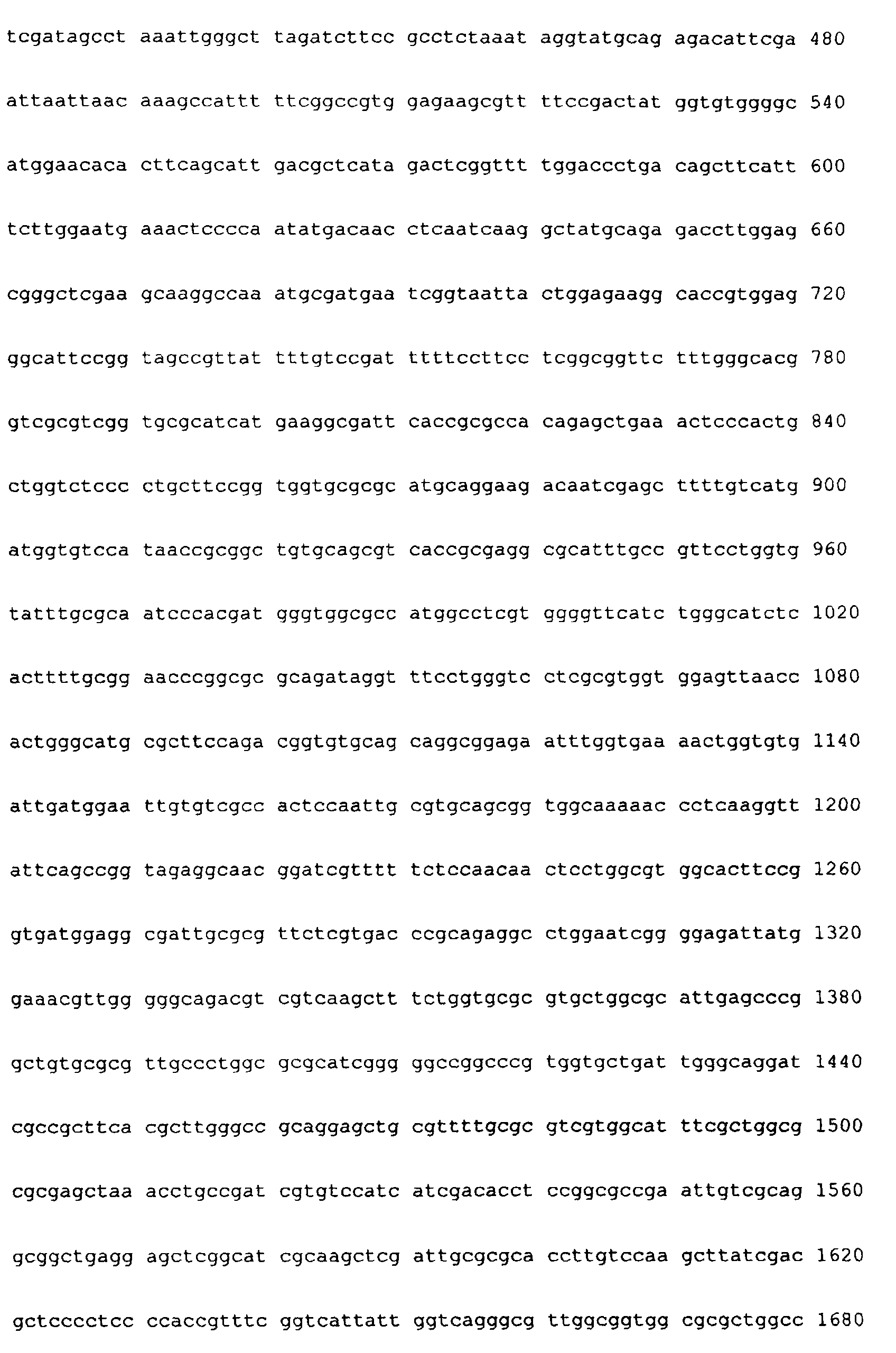
- the new gene coding for the accDA DNA sequence obtained from C. glutamicum as SEQ ID NO 1 Is part of the present invention.
- SEQ ID NO 2 the coding region (cds) of the accDA gene is reproduced.
- the present DNA sequence with the the methods described above the amino acid sequence of the corresponding protein derived.
- SEQ ID NO 3 that is resulting amino acid sequence of the accDA gene product shown.
- Coding DNA sequences which result from SEQ ID NO 1 due to the degeneracy of the genetic code are also part of the invention.
- DNA sequences which hybridize with SEQ ID NO 1 or parts of SEQ ID NO 1 are part of the invention.
- Conservative amino acid exchanges such as, for example, the exchange of glycine for alanine or of aspartic acid for glutamic acid in proteins are also considered in the professional world Meaning mutations (sense mutations) are known which do not lead to a fundamental change in the activity of the protein, ie are function-neutral. It is also known that changes to the N- and / or C-terminus of a protein cannot significantly impair or even stabilize its function.
- the number of copies of the corresponding genes can be increased, or it can Promoter and regulatory region or the Ribosome binding site located upstream of the Structural gene located to be mutated.
- expression cassettes act upstream of the Structural gene can be installed.
- promoters By inducible It is also possible for promoters to express in Increase the course of fermentative L-lysine production. Through measures to extend the lifespan of m-RNA expression is also improved. Will continue by preventing the breakdown of the enzyme protein as well increases enzyme activity.
- the genes or gene constructs can either in plasmids with different Number of copies are available or integrated in the chromosome and be amplified. Alternatively, a Overexpression of the relevant genes by changing the Media composition and cultural management can be achieved.
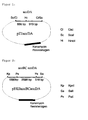
- Plasmid pZ1accDA is based on plasmid pZ1 (Menkel et al., Applied and Environmental Microbiology 55 (3), 684-688 (1989)) based E. coli - C. glutamicum pendulum vector, which the accDA gene carries. Others replicable in C.
- Plasmid vectors such as pEKEx1 (Eikmanns et al., Gene 102: 93-98 (1991)) or pZ8-1 (European Patent 0 375 889) can be used in the same way.
- pEK0accBCaccDA is a on plasmid pEK0 (Eikmanns et al., Gene 102, 93-98, (1991)) based E. coli - C. glutamicum pendulum vector, that carries the accBC and accDA genes.
- Others in C. replicable plasmid vectors such as e.g. pEKEx1 (Eikmanns et al., Gene 102: 93-98 (1991)) or pZ8-1 (European Patent 0 375 889) can be used in the same Way.
- L-amino acids in particular L-lysine
- L-lysine it may be advantageous for the production of L-amino acids, in particular L-lysine, to switch off undesired side reactions in addition to overexpressing the accDA gene
- the microorganisms produced according to the invention can continuously or discontinuously in a batch process (Set cultivation) or in fed batch (feed process) or repeated fed batch process (repetitive feed process) be cultivated for the purpose of producing L-lysine.
- Set cultivation or in fed batch (feed process) or repeated fed batch process (repetitive feed process) be cultivated for the purpose of producing L-lysine.
- the culture medium to be used must meet the requirements of the respective strains in a suitable manner. Descriptions of culture media of various microorganisms are in the manual Manual of Methods for General Bacteriology the American Society for Bacteriology (Washington DC, USA, 1981). Sugar and carbohydrates such as glucose, sucrose, lactose, fructose, maltose, molasses, starch and cellulose, oils and fats such as e.g. B. soybean oil, sunflower oil, peanut oil and coconut fat, fatty acids such as. As palmitic acid, stearic acid and linoleic acid, alcohols such as. B. glycerol and ethanol and organic acids such as. B. acetic acid can be used.
- Sugar and carbohydrates such as glucose, sucrose, lactose, fructose, maltose, molasses, starch and cellulose
- oils and fats such as e.g. B. soybean oil, sunflower oil, peanut oil and coconut fat, fatty acids such as. As palmi
- Organic nitrogen-containing compounds such as peptones, yeast extract, meat extract, malt extract, corn steep liquor, soybean meal and urea or inorganic compounds such as ammonium sulfate, ammonium chloride, ammonium phosphate, ammonium carbonate and ammonium nitrate can be used as the nitrogen source.
- the nitrogen sources can be used individually or as a mixture.
- Phosphoric acid, potassium dihydrogen phosphate or dipotassium hydrogen phosphate or the corresponding sodium-containing salts can be used as the source of phosphorus.
- the culture medium must also contain salts of metals, such as magnesium sulfate or iron sulfate, which are necessary for growth.
- essential growth substances such as amino acids and vitamins can be used in addition to the substances mentioned above.
- Suitable precursors can also be added to the culture medium.
- the feedstocks mentioned can be added to the culture in the form of a single batch or can be added in a suitable manner during the cultivation.
- Basic compounds are used to control the pH of the culture such as sodium hydroxide, potassium hydroxide, ammonia or Ammonia water or acidic compounds such as phosphoric acid or sulfuric acid used in a suitable manner.
- Antifoam agents such as e.g. Fatty acid polyglycol esters are used.
- For Maintaining the stability of plasmids can do that Medium-suitable selective substances e.g. Antibiotics to be added.
- oxygen or oxygen are maintained containing gas mixtures such as Air into the culture registered.
- the temperature of the culture is usually at 20 ° C to 45 ° C and preferably at 25 ° C to 40 ° C.
- the Culture continues until a maximum of desired L-amino acid has formed. That goal will usually within 10 hours to 160 hours reached.
- the method according to the invention is used for fermentative purposes Production of L-amino acids, in particular L-aspartic acid, L-asparagine, L-homoserine, L-threonine, L-isoleucine and L-methionine with coryneform bacteria, especially the production of L-lysine.
- L-amino acids in particular L-aspartic acid, L-asparagine, L-homoserine, L-threonine, L-isoleucine and L-methionine with coryneform bacteria, especially the production of L-lysine.
- a C. glutamicum ATCC13032 gene library was created under Use of the cosmid pHC79 (Hohn and Collins, Gene 11, 291-298 (1980)), as in Börmann et al. (Molecular Microbiology 6 (3), 317-326)).
- a selected cosmid was used with the restriction enzymes EcoRI and XhoI according to the manufacturer of this Restriction enzymes (Boehringer Mannheim) digested.
- the DNA fragments were generated with the vector pUC18 (Norrander et al. (1983) Gene 26: 101-106) who also were treated with the restriction enzymes EcoRI and XhoI was mixed and after treatment with T4 DNA ligase in the E. coli strain DH5 ⁇ mcr (Grant et al. (1990) Proceedings of the National Academy of Sciences, USA, 87: 4645-4645) cloned, as in Sambrook et al. (Molecular cloning a Laboratory Manual (1989) Cold Spring Harbor Laboratories) described.
- the transformants were selected by selection on LB agar containing 50 ⁇ g / ml ampicillin as in Sambrook et al. (Molecular cloning a Laboratory Manual (1989) Cold Spring Harbor Laboratories) described. A transformant became plasmid DNA isolated and referred to as pUCaccDA. Then were with that from Promega (Heidelberg, Germany) for provided for this purpose kit (Erase-a-Base) Exonuclease III digest subclones produced. These were using the dideoxy chain termination method of Sanger et al. sequenced (Proceedings of the National Academy of Sciences USA (1977) 74: 5463-5467).
- the auto-read Sequencing kit used (Amersham Pharmacia Biotech, Uppsala, Sweden). Gel electrophoretic analysis was done with the automatic laser fluorescence Sequencer (A.L.F.) from Amersham Pharmacia Biotech (Uppsala, Sweden). The nucleotide sequence obtained was with the HUSAR program package (Release 4.0, EMBL, Heidelberg, Germany) analyzed. The nucleotide sequence is in SEQ ID NO 1 reproduced. Analysis of the nucleotide sequence showed an open reading frame of 1473 base pairs, which as accDA gene was designated. The accDA gene from C. glutamicum encodes a polypeptide of 484 amino acids.
- the gene accDA was used for expression in C. glutamicum in the Vector pZ1 (Menkel et al. (1989) Applied and Environmental Microbiology 55: 684-688) subcloned. That was what Plasmid pUCaccDA (see example 1) with the Restriction enzyme ClaI cut. The resulting 1.6 The kb-sized fragment was described as in Example 1 isolated, with Klenow polymerase and alkaline phosphatase treated and used for ligation with pZ1. This Vector had previously been linearized with ScaI. With the Ligation approach was E. coli DH5 ⁇ mcr (Grant et al.
- the strain DSM5715 / pZ1accDA was cultivated in after Medium CgIII (Keilhauer et al. 1993, Journal of Bacteriology 175: 5595-5603), in the production medium CgXII (Keilhauer et al. 1993, Journal of Bacteriology 175: 5595-5603) cultured. There were 4% glucose and 50 mg / l Kanamycin sulfate added.
Landscapes
- Chemical & Material Sciences (AREA)
- Organic Chemistry (AREA)
- Life Sciences & Earth Sciences (AREA)
- Engineering & Computer Science (AREA)
- Health & Medical Sciences (AREA)
- Zoology (AREA)
- Wood Science & Technology (AREA)
- Genetics & Genomics (AREA)
- Bioinformatics & Cheminformatics (AREA)
- General Engineering & Computer Science (AREA)
- General Health & Medical Sciences (AREA)
- Biochemistry (AREA)
- Biotechnology (AREA)
- Microbiology (AREA)
- Biomedical Technology (AREA)
- Molecular Biology (AREA)
- General Chemical & Material Sciences (AREA)
- Chemical Kinetics & Catalysis (AREA)
- Medicinal Chemistry (AREA)
- Physics & Mathematics (AREA)
- Biophysics (AREA)
- Plant Pathology (AREA)
- Preparation Of Compounds By Using Micro-Organisms (AREA)
- Micro-Organisms Or Cultivation Processes Thereof (AREA)
- Enzymes And Modification Thereof (AREA)
Abstract
Description

- Corynebacterium glutamicum FERM-P 1709
- Brevibacterium flavum FERM-P 1708
- Brevibacterium lactofermentum FERM-P 1712
- Corynebacterium glutamicum FERM-P 6463 und
- Corynebacterium glutamicum FERM-P 6464
- gleichzeitig das für die Dihydrodipicolinat-Synthase kodierende dapA-Gen überexprimiert werden (EP-B 0 197 335), oder
- gleichzeitig ein S-(2-Aminoethyl)-Cystein-Resistenz vermittelndes DNA-Fragment amplifiziert werden (EP-A 0 088 166).
- Corynebacterium glutamicum Stamm DSM5715/pZ1accDA als DSM 12785
- Corynebacterium glutamicum Stamm DSM5715/pEK0accBCaccDA als DSM 12787

| Spezifische Acyl-CoA Carboxylase Aktivität (µmol/min und mg Protein) in C. glutamicum | ||
| Acyl-CoA Carboxylase-Aktivität mit dem Substrat | ||
| Stamm | Acetyl-CoA | Propionyl-CoA |
| ATCC13032/pEK0accBCaccDA | 0,048 | 0,124 |
| ATCC13032/pEK0 | 0,011 | 0,018 |
- Figur 1: Karte des Plasmids pZ1accDA.
- Figur 2: Karte des Plasmids pEK0accBCaccDA



Claims (16)
- In coryneformen Mikroorganismen replizierbare, bevorzugt rekombinante DNA mit der Herkunft Corynebacterium, die zumindest die Nukleotidsequenz enthält, die für das accDA-Gen, dargestellt in der SEQ-ID-No. 1, codiert.
- Replizierbare DNA gemäß Anspruch 1 mit(i) der Nukleotidsequenz, gezeigt in SEQ-ID-No. 1,(ii) mindestens einer Sequenz, die der Sequenz (i) innerhalb des Bereichs der Degeneration des genetischen Codes entspricht, oder(iii) mindestens einer Sequenz, die mit der zur Sequenz (i) oder (ii) komplementären Sequenz hybridisiert, und gegebenenfalls(vi) funktionsneutralen Sinnmutationen in (i).
- Aminosäuresequenz des Proteins, abgeleitet aus den Nukleotidsequenzen gemäß den Ansprüchen 1 oder 2, dargestellt in der SEQ-ID-No. 3.
- Coryneforme Mikroorganismen, insbesondere der Gattung Corynebacterium, transformiert durch die Einführung einer oder mehrerer der replizierbaren DNA gemäß einem der Ansprüche 1 oder 2.
- Pendelvektor (shuttle vector) pZ1accDA,
gekennzeichnet
durch die in der Abb.1 wiedergegebene Restriktionskarte hinterlegt in Corynebacterium glutamicum unter der Bezeichnung DSM 12785. - Verfahren zur Herstellung von L-Aminosäuren, insbesondere L-Lysin, durch Fermentation coryneformer Bakterien,
dadurch gekennzeichnet,
daß man Bakterien einsetzt, in denen man das accDA-Gen oder dafür codierende Nukleotidsequenzen verstärkt, insbesondere überexprimiert. - Verfahren gemäß Anspruch 5,
dadurch gekennzeichnet,
daß man Bakterien einsetzt, in denen man zusätzlich weitere Gene des Biosyntheseweges der gewünschten L-Aminosäure verstärkt. - Verfahren gemäß Anspruch 5,
dadurch gekennzeichnet,
daß man Bakterien einsetzt, in denen die Stoffwechselwege zumindest teilweise ausgeschaltet sind, die die Bildung der gewünschten L-Aminosäure verringern. - Verfahren gemäß den Ansprüchen 5 bis 7,
dadurch gekennzeichnet,
daß man einen Plasmidvektor transformierten Stamm einsetzt und der Plasmidvektor die für das accDA-Gen codierende Nukleotidsequenz trägt. - Verfahren gemäß Anspruch 8,
dadurch gekennzeichnet,
daß man mit dem Plasmidvektor pZ1accDA, hinterlegt in Corynebacterium glutamicum unter der Nummer DSM 12785, transformierte Bakterien einsetzt. - Verfahren gemäß einem oder mehreren der vorhergehenden Ansprüche,
dadurch gekennzeichnet,
daß man coryneforme Bakterien verwendet, die L-Asparaginsäure, L-Asparagin, L-Homoserin, L-Threonin, L-Isoleucin und L-Methionin herstellen. - Verfahren gemäß einem oder mehreren der Ansprüche 5 bis 10,
dadurch gekennzeichnet,
daß man coryneforme Bakterien verwendet, die L-Lysin herstellen. - Verfahren gemäß einem oder mehreren der Ansprüche 5 bis 11,
dadurch gekennzeichnet,
daß man das accBC-Gen zusätzlich zum accDA-Gen überexprimiert. - Verfahren gemäß Anspruch 5,
dadurch gekennzeichnet,
daß gleichzeitig das für die Dihydrodipicolinat-Synthase kodierende dapA-Gen überexprimiert wird. - Verfahren gemäß Anspruch 5,
dadurch gekennzeichnet,
daß gleichzeitig ein S-(2-Aminoethyl)-Cystein-Resistenz vermittelndes DNA-Fragment amplifiziert wird. - Verfahren zur fermentativen Herstellung von L-Aminosäuren gemäß einem oder mehreren der vorhergehenden Ansprüche,
dadurch gekennzeichnet,
daß man folgende Schritte durchführt:a) Fermentation der die gewünschten L-Aminosäure produzierenden coryneformen Bakterien, in denen zumindest das accDA-Gen verstärkt wird.b) Anreicherung der gewünschten L-Aminosäure im Medium oder in den Zellen der Bakterien undc) Isolieren der gewünschten L-Aminosäure.
Applications Claiming Priority (2)
| Application Number | Priority Date | Filing Date | Title |
|---|---|---|---|
| DE19924365A DE19924365A1 (de) | 1999-05-27 | 1999-05-27 | Verfahren zur fermentativen Herstellung von L-Aminosäuren und für das accDA Gen codierende Nukleotidsequenzen |
| DE19924365 | 1999-05-27 |
Publications (3)
| Publication Number | Publication Date |
|---|---|
| EP1055725A2 true EP1055725A2 (de) | 2000-11-29 |
| EP1055725A3 EP1055725A3 (de) | 2000-12-20 |
| EP1055725B1 EP1055725B1 (de) | 2003-10-22 |
Family
ID=7909396
Family Applications (1)
| Application Number | Title | Priority Date | Filing Date |
|---|---|---|---|
| EP00109842A Expired - Lifetime EP1055725B1 (de) | 1999-05-27 | 2000-05-10 | Verfahren zur fermentativen Herstellung von L-Aminosäuren und für das accDA Gen codierende Nukleotidsequenzen |
Country Status (15)
| Country | Link |
|---|---|
| US (2) | US6361986B1 (de) |
| EP (1) | EP1055725B1 (de) |
| JP (1) | JP2001008693A (de) |
| KR (1) | KR20010049429A (de) |
| CN (1) | CN1275620A (de) |
| AT (1) | ATE252635T1 (de) |
| AU (1) | AU3644900A (de) |
| BR (1) | BR0002493A (de) |
| CA (1) | CA2307327A1 (de) |
| DE (2) | DE19924365A1 (de) |
| ES (1) | ES2208178T3 (de) |
| HU (1) | HUP0002022A2 (de) |
| ID (1) | ID26143A (de) |
| SK (1) | SK7442000A3 (de) |
| ZA (1) | ZA200002658B (de) |
Cited By (2)
| Publication number | Priority date | Publication date | Assignee | Title |
|---|---|---|---|---|
| EP1239040A2 (de) * | 2001-02-16 | 2002-09-11 | Degussa AG | Mutationen im rpoB-Gen L-Lysin produzierender Corynebacterium glutamicum-Stämme und Verfahren zur Herstellung von L-Lysin |
| EP2082044A1 (de) | 2006-10-24 | 2009-07-29 | Basf Se | Verfahren zur erhöhung der genexpression mittels modifizierter codonverwendung |
Families Citing this family (6)
| Publication number | Priority date | Publication date | Assignee | Title |
|---|---|---|---|---|
| DE19958159A1 (de) * | 1999-12-02 | 2001-06-07 | Degussa | Neue für das glk-Gen codierende Nukleotidsequenzen |
| EP1174520A3 (de) * | 2000-07-18 | 2004-02-18 | Degussa AG | Verfahren zur Uberwachung einer Gärung mit hilfe eines expressions Array |
| JP2002209596A (ja) * | 2001-01-19 | 2002-07-30 | Ajinomoto Co Inc | L−アミノ酸の製造法 |
| WO2003012445A1 (en) * | 2001-07-30 | 2003-02-13 | Quest Diagnostics Investments Incorporated | Methods and kits for detecting ita in a biological sample |
| WO2005007862A2 (en) * | 2003-07-08 | 2005-01-27 | Novus Internation, Inc | Methionine recovery processes |
| EP2082045B1 (de) * | 2006-10-24 | 2015-03-18 | Basf Se | Verfahren zur reduzierung der genexpression mittels modifizierter codonverwendung |
Family Cites Families (3)
| Publication number | Priority date | Publication date | Assignee | Title |
|---|---|---|---|---|
| JPH0655149B2 (ja) | 1985-03-12 | 1994-07-27 | 協和醗酵工業株式会社 | L―リジンの製造法 |
| GB2223754B (en) | 1988-09-12 | 1992-07-22 | Degussa | Dna encoding phosphoenolpyruvate carboxylase |
| MY113040A (en) | 1994-02-24 | 2001-11-30 | Ajinomoto Kk | Novel gene derived from coryneform bacteria and use thereof |
-
1999
- 1999-05-27 DE DE19924365A patent/DE19924365A1/de not_active Withdrawn
- 1999-07-29 US US09/362,899 patent/US6361986B1/en not_active Expired - Fee Related
-
2000
- 2000-05-10 DE DE50004129T patent/DE50004129D1/de not_active Expired - Lifetime
- 2000-05-10 EP EP00109842A patent/EP1055725B1/de not_active Expired - Lifetime
- 2000-05-10 ES ES00109842T patent/ES2208178T3/es not_active Expired - Lifetime
- 2000-05-10 AT AT00109842T patent/ATE252635T1/de not_active IP Right Cessation
- 2000-05-16 ID IDP20000411A patent/ID26143A/id unknown
- 2000-05-19 SK SK744-2000A patent/SK7442000A3/sk unknown
- 2000-05-19 CN CN00109310A patent/CN1275620A/zh active Pending
- 2000-05-24 JP JP2000153547A patent/JP2001008693A/ja active Pending
- 2000-05-25 BR BR0002493-7A patent/BR0002493A/pt not_active Application Discontinuation
- 2000-05-26 HU HU0002022A patent/HUP0002022A2/hu unknown
- 2000-05-26 AU AU36449/00A patent/AU3644900A/en not_active Abandoned
- 2000-05-26 ZA ZA200002658A patent/ZA200002658B/xx unknown
- 2000-05-26 CA CA002307327A patent/CA2307327A1/en not_active Abandoned
- 2000-05-26 KR KR1020000028677A patent/KR20010049429A/ko not_active Withdrawn
-
2001
- 2001-12-21 US US10/024,370 patent/US6808914B2/en not_active Expired - Fee Related
Cited By (3)
| Publication number | Priority date | Publication date | Assignee | Title |
|---|---|---|---|---|
| EP1239040A2 (de) * | 2001-02-16 | 2002-09-11 | Degussa AG | Mutationen im rpoB-Gen L-Lysin produzierender Corynebacterium glutamicum-Stämme und Verfahren zur Herstellung von L-Lysin |
| EP2082044A1 (de) | 2006-10-24 | 2009-07-29 | Basf Se | Verfahren zur erhöhung der genexpression mittels modifizierter codonverwendung |
| EP2082044B1 (de) * | 2006-10-24 | 2016-06-01 | Basf Se | Verfahren zur erhöhung der genexpression mittels modifizierter codonverwendung |
Also Published As
| Publication number | Publication date |
|---|---|
| AU3644900A (en) | 2001-02-01 |
| SK7442000A3 (en) | 2000-12-11 |
| US6808914B2 (en) | 2004-10-26 |
| US6361986B1 (en) | 2002-03-26 |
| BR0002493A (pt) | 2001-05-08 |
| CA2307327A1 (en) | 2000-11-27 |
| CN1275620A (zh) | 2000-12-06 |
| ID26143A (id) | 2000-11-30 |
| HUP0002022A2 (hu) | 2003-02-28 |
| ES2208178T3 (es) | 2004-06-16 |
| EP1055725B1 (de) | 2003-10-22 |
| ZA200002658B (en) | 2000-11-29 |
| DE50004129D1 (de) | 2003-11-27 |
| KR20010049429A (ko) | 2001-06-15 |
| DE19924365A1 (de) | 2000-11-30 |
| HU0002022D0 (en) | 2000-08-28 |
| EP1055725A3 (de) | 2000-12-20 |
| US20020142405A1 (en) | 2002-10-03 |
| JP2001008693A (ja) | 2001-01-16 |
| ATE252635T1 (de) | 2003-11-15 |
Similar Documents
| Publication | Publication Date | Title |
|---|---|---|
| EP1085091B1 (de) | Für das thrE-Gen kodierende Nukleotidsequenzen und Verfahren zur fermentativen Herstellung von L-Threonin mit coryneformen Bakterien | |
| EP1111062B1 (de) | Für das zwa1-Gen codierende Nukleotidsequenzen | |
| EP1619252A1 (de) | L-Lysin produzierende coryneforme Bakterien und Verfahren zur Herstellung von Lysin | |
| DE60015042T3 (de) | Nukleotidsequenzen, welche für das dapF-Gen kodieren | |
| DE19947791A1 (de) | Neue für das eno-Gen codierende Nukleotidsequenzen | |
| EP1136559B1 (de) | Für das dapC-Gen kodierende Nukleotidsequenzen und Verfahren zur Herstellung von L-Lysin | |
| EP1055725B1 (de) | Verfahren zur fermentativen Herstellung von L-Aminosäuren und für das accDA Gen codierende Nukleotidsequenzen | |
| DE19912384A1 (de) | Verfahren zur fermentativen Herstellung von L-Aminosäuren unter Verwendung coryneformer Bakterien | |
| DE60132341T2 (de) | Isolierung und sequenzierung vom gen ptsi aus c. glutamicum | |
| EP1055730B1 (de) | Verfahren zur fermentativen Herstellung von L-Aminosäuren unter Verwendung coryneformer Bakterien | |
| DE60127116T2 (de) | Für das glbo-gen kodierende nukleotidsequenzen aus corynebacterium glutamicum | |
| EP1118666A2 (de) | Für das ptsH-Gen codierende Nukleotidsequenzen aus Corynebacterium glutamicum | |
| EP1106694A1 (de) | Für das glk-Gen codierende Nukleotidsequenzen | |
| EP1106622A2 (de) | Neue für das pfkA-Gen codierende Nukleotidsequenzen | |
| EP1103613A1 (de) | Für das pfk-Gen codierende Nukleotidsequenzen | |
| DE10055869A1 (de) | Neue für das nadA-Gen kodierende Nukleotidsequenzen | |
| DE10023400A1 (de) | Neue für das acp-Gen kodierende Nukleotidsequenzen | |
| DE10037612A1 (de) | Neue für das rpi-Gen kodierende Nukleotidsequenzen | |
| EP1104812A1 (de) | Für das gpm-Gen kodierende Nukleotidsequenzen | |
| DE10037611A1 (de) | Neue für das rpe-Gen kodierende Nuleotidsequenzen | |
| DE10032173A1 (de) | Neue für das plsC-Gen kodierende Nukleotidsequenzen | |
| DE10021828A1 (de) | Neue für das cdsA-Gen kodierende Nukleotidsequenzen | |
| DE10021832A1 (de) | Neue für das cma-Gen kodierende Nukleotidsequenzen | |
| DE10011922A1 (de) | Neue für das pfkA-Gen codierende Nukleotidsequenzen | |
| DE10021831A1 (de) | Neue für das fadD15-Gen kodierende Nukleotidsequenzen |
Legal Events
| Date | Code | Title | Description |
|---|---|---|---|
| PUAI | Public reference made under article 153(3) epc to a published international application that has entered the european phase |
Free format text: ORIGINAL CODE: 0009012 |
|
| PUAL | Search report despatched |
Free format text: ORIGINAL CODE: 0009013 |
|
| 17P | Request for examination filed |
Effective date: 20000510 |
|
| AK | Designated contracting states |
Kind code of ref document: A2 Designated state(s): AT BE CH CY DE DK ES FI FR GB GR IE IT LI LU MC NL PT SE |
|
| AX | Request for extension of the european patent |
Free format text: AL;LT;LV;MK;RO;SI |
|
| AK | Designated contracting states |
Kind code of ref document: A3 Designated state(s): AT BE CH CY DE DK ES FI FR GB GR IE IT LI LU MC NL PT SE |
|
| AX | Request for extension of the european patent |
Free format text: AL;LT;LV;MK;RO;SI |
|
| RAP1 | Party data changed (applicant data changed or rights of an application transferred) |
Owner name: FORSCHUNGSZENTRUM JUELICH GMBH Owner name: DEGUSSA AG |
|
| 17Q | First examination report despatched |
Effective date: 20010612 |
|
| AKX | Designation fees paid |
Free format text: AT BE CH CY DE DK ES FI FR GB GR IE IT LI LU MC NL PT SE |
|
| GRAH | Despatch of communication of intention to grant a patent |
Free format text: ORIGINAL CODE: EPIDOS IGRA |
|
| GRAH | Despatch of communication of intention to grant a patent |
Free format text: ORIGINAL CODE: EPIDOS IGRA |
|
| GRAA | (expected) grant |
Free format text: ORIGINAL CODE: 0009210 |
|
| AK | Designated contracting states |
Kind code of ref document: B1 Designated state(s): AT BE CH CY DE DK ES FI FR GB GR IE IT LI LU MC NL PT SE |
|
| PG25 | Lapsed in a contracting state [announced via postgrant information from national office to epo] |
Ref country code: NL Free format text: LAPSE BECAUSE OF FAILURE TO SUBMIT A TRANSLATION OF THE DESCRIPTION OR TO PAY THE FEE WITHIN THE PRESCRIBED TIME-LIMIT Effective date: 20031022 Ref country code: CY Free format text: LAPSE BECAUSE OF FAILURE TO SUBMIT A TRANSLATION OF THE DESCRIPTION OR TO PAY THE FEE WITHIN THE PRESCRIBED TIME-LIMIT Effective date: 20031022 Ref country code: FI Free format text: LAPSE BECAUSE OF FAILURE TO SUBMIT A TRANSLATION OF THE DESCRIPTION OR TO PAY THE FEE WITHIN THE PRESCRIBED TIME-LIMIT Effective date: 20031022 Ref country code: IE Free format text: LAPSE BECAUSE OF FAILURE TO SUBMIT A TRANSLATION OF THE DESCRIPTION OR TO PAY THE FEE WITHIN THE PRESCRIBED TIME-LIMIT Effective date: 20031022 |
|
| REG | Reference to a national code |
Ref country code: GB Ref legal event code: FG4D Free format text: NOT ENGLISH |
|
| REG | Reference to a national code |
Ref country code: CH Ref legal event code: EP |
|
| REG | Reference to a national code |
Ref country code: IE Ref legal event code: FG4D Free format text: GERMAN |
|
| REF | Corresponds to: |
Ref document number: 50004129 Country of ref document: DE Date of ref document: 20031127 Kind code of ref document: P |
|
| PG25 | Lapsed in a contracting state [announced via postgrant information from national office to epo] |
Ref country code: SE Free format text: LAPSE BECAUSE OF FAILURE TO SUBMIT A TRANSLATION OF THE DESCRIPTION OR TO PAY THE FEE WITHIN THE PRESCRIBED TIME-LIMIT Effective date: 20040122 Ref country code: GR Free format text: LAPSE BECAUSE OF FAILURE TO SUBMIT A TRANSLATION OF THE DESCRIPTION OR TO PAY THE FEE WITHIN THE PRESCRIBED TIME-LIMIT Effective date: 20040122 Ref country code: DK Free format text: LAPSE BECAUSE OF FAILURE TO SUBMIT A TRANSLATION OF THE DESCRIPTION OR TO PAY THE FEE WITHIN THE PRESCRIBED TIME-LIMIT Effective date: 20040122 |
|
| GBT | Gb: translation of ep patent filed (gb section 77(6)(a)/1977) |
Effective date: 20040106 |
|
| NLV1 | Nl: lapsed or annulled due to failure to fulfill the requirements of art. 29p and 29m of the patents act | ||
| PGFP | Annual fee paid to national office [announced via postgrant information from national office to epo] |
Ref country code: GB Payment date: 20040427 Year of fee payment: 5 |
|
| PG25 | Lapsed in a contracting state [announced via postgrant information from national office to epo] |
Ref country code: AT Free format text: LAPSE BECAUSE OF NON-PAYMENT OF DUE FEES Effective date: 20040510 Ref country code: LU Free format text: LAPSE BECAUSE OF NON-PAYMENT OF DUE FEES Effective date: 20040510 |
|
| PG25 | Lapsed in a contracting state [announced via postgrant information from national office to epo] |
Ref country code: BE Free format text: LAPSE BECAUSE OF NON-PAYMENT OF DUE FEES Effective date: 20040531 Ref country code: CH Free format text: LAPSE BECAUSE OF NON-PAYMENT OF DUE FEES Effective date: 20040531 Ref country code: LI Free format text: LAPSE BECAUSE OF NON-PAYMENT OF DUE FEES Effective date: 20040531 Ref country code: MC Free format text: LAPSE BECAUSE OF NON-PAYMENT OF DUE FEES Effective date: 20040531 |
|
| REG | Reference to a national code |
Ref country code: ES Ref legal event code: FG2A Ref document number: 2208178 Country of ref document: ES Kind code of ref document: T3 |
|
| REG | Reference to a national code |
Ref country code: IE Ref legal event code: FD4D |
|
| ET | Fr: translation filed | ||
| PLBE | No opposition filed within time limit |
Free format text: ORIGINAL CODE: 0009261 |
|
| STAA | Information on the status of an ep patent application or granted ep patent |
Free format text: STATUS: NO OPPOSITION FILED WITHIN TIME LIMIT |
|
| 26N | No opposition filed |
Effective date: 20040723 |
|
| BERE | Be: lapsed |
Owner name: *DEGUSSA A.G. Effective date: 20040531 Owner name: FORSCHUNGSZENTRUM *JULICH G.M.B.H. Effective date: 20040531 |
|
| REG | Reference to a national code |
Ref country code: CH Ref legal event code: PL |
|
| PG25 | Lapsed in a contracting state [announced via postgrant information from national office to epo] |
Ref country code: GB Free format text: LAPSE BECAUSE OF NON-PAYMENT OF DUE FEES Effective date: 20050510 Ref country code: IT Free format text: LAPSE BECAUSE OF NON-PAYMENT OF DUE FEES;WARNING: LAPSES OF ITALIAN PATENTS WITH EFFECTIVE DATE BEFORE 2007 MAY HAVE OCCURRED AT ANY TIME BEFORE 2007. THE CORRECT EFFECTIVE DATE MAY BE DIFFERENT FROM THE ONE RECORDED. Effective date: 20050510 |
|
| GBPC | Gb: european patent ceased through non-payment of renewal fee |
Effective date: 20050510 |
|
| PG25 | Lapsed in a contracting state [announced via postgrant information from national office to epo] |
Ref country code: PT Free format text: LAPSE BECAUSE OF NON-PAYMENT OF DUE FEES Effective date: 20040322 |
|
| REG | Reference to a national code |
Ref country code: FR Ref legal event code: CD Ref country code: FR Ref legal event code: CJ Ref country code: FR Ref legal event code: CA |
|
| PGFP | Annual fee paid to national office [announced via postgrant information from national office to epo] |
Ref country code: DE Payment date: 20140521 Year of fee payment: 15 Ref country code: ES Payment date: 20140528 Year of fee payment: 15 Ref country code: FR Payment date: 20140527 Year of fee payment: 15 |
|
| REG | Reference to a national code |
Ref country code: DE Ref legal event code: R119 Ref document number: 50004129 Country of ref document: DE |
|
| REG | Reference to a national code |
Ref country code: FR Ref legal event code: ST Effective date: 20160129 |
|
| PG25 | Lapsed in a contracting state [announced via postgrant information from national office to epo] |
Ref country code: DE Free format text: LAPSE BECAUSE OF NON-PAYMENT OF DUE FEES Effective date: 20151201 |
|
| PG25 | Lapsed in a contracting state [announced via postgrant information from national office to epo] |
Ref country code: FR Free format text: LAPSE BECAUSE OF NON-PAYMENT OF DUE FEES Effective date: 20150601 |
|
| REG | Reference to a national code |
Ref country code: ES Ref legal event code: FD2A Effective date: 20160629 |
|
| PG25 | Lapsed in a contracting state [announced via postgrant information from national office to epo] |
Ref country code: ES Free format text: LAPSE BECAUSE OF NON-PAYMENT OF DUE FEES Effective date: 20150511 |