EP1056091A2 - Procédé de préparation d'un disque audio dans lequel une table des matières spécifique est premièrement enregistré dans la zone de départ - Google Patents
Procédé de préparation d'un disque audio dans lequel une table des matières spécifique est premièrement enregistré dans la zone de départ Download PDFInfo
- Publication number
- EP1056091A2 EP1056091A2 EP00304457A EP00304457A EP1056091A2 EP 1056091 A2 EP1056091 A2 EP 1056091A2 EP 00304457 A EP00304457 A EP 00304457A EP 00304457 A EP00304457 A EP 00304457A EP 1056091 A2 EP1056091 A2 EP 1056091A2
- Authority
- EP
- European Patent Office
- Prior art keywords
- disc
- optical disc
- recordable optical
- additionally
- music
- Prior art date
- Legal status (The legal status is an assumption and is not a legal conclusion. Google has not performed a legal analysis and makes no representation as to the accuracy of the status listed.)
- Withdrawn
Links
Images


Classifications
-
- G—PHYSICS
- G11—INFORMATION STORAGE
- G11B—INFORMATION STORAGE BASED ON RELATIVE MOVEMENT BETWEEN RECORD CARRIER AND TRANSDUCER
- G11B27/00—Editing; Indexing; Addressing; Timing or synchronising; Monitoring; Measuring tape travel
- G11B27/10—Indexing; Addressing; Timing or synchronising; Measuring tape travel
- G11B27/19—Indexing; Addressing; Timing or synchronising; Measuring tape travel by using information detectable on the record carrier
- G11B27/28—Indexing; Addressing; Timing or synchronising; Measuring tape travel by using information detectable on the record carrier by using information signals recorded by the same method as the main recording
- G11B27/32—Indexing; Addressing; Timing or synchronising; Measuring tape travel by using information detectable on the record carrier by using information signals recorded by the same method as the main recording on separate auxiliary tracks of the same or an auxiliary record carrier
- G11B27/327—Table of contents
- G11B27/329—Table of contents on a disc [VTOC]
-
- G—PHYSICS
- G11—INFORMATION STORAGE
- G11B—INFORMATION STORAGE BASED ON RELATIVE MOVEMENT BETWEEN RECORD CARRIER AND TRANSDUCER
- G11B20/00—Signal processing not specific to the method of recording or reproducing; Circuits therefor
- G11B20/10—Digital recording or reproducing
- G11B20/12—Formatting, e.g. arrangement of data block or words on the record carriers
- G11B20/1217—Formatting, e.g. arrangement of data block or words on the record carriers on discs
-
- G—PHYSICS
- G11—INFORMATION STORAGE
- G11B—INFORMATION STORAGE BASED ON RELATIVE MOVEMENT BETWEEN RECORD CARRIER AND TRANSDUCER
- G11B27/00—Editing; Indexing; Addressing; Timing or synchronising; Monitoring; Measuring tape travel
- G11B27/02—Editing, e.g. varying the order of information signals recorded on, or reproduced from, record carriers
- G11B27/031—Electronic editing of digitised analogue information signals, e.g. audio or video signals
- G11B27/034—Electronic editing of digitised analogue information signals, e.g. audio or video signals on discs
-
- G—PHYSICS
- G11—INFORMATION STORAGE
- G11B—INFORMATION STORAGE BASED ON RELATIVE MOVEMENT BETWEEN RECORD CARRIER AND TRANSDUCER
- G11B20/00—Signal processing not specific to the method of recording or reproducing; Circuits therefor
- G11B20/10—Digital recording or reproducing
- G11B20/12—Formatting, e.g. arrangement of data block or words on the record carriers
- G11B20/1217—Formatting, e.g. arrangement of data block or words on the record carriers on discs
- G11B2020/1218—Formatting, e.g. arrangement of data block or words on the record carriers on discs wherein the formatting concerns a specific area of the disc
- G11B2020/1229—Formatting, e.g. arrangement of data block or words on the record carriers on discs wherein the formatting concerns a specific area of the disc lead-in area
-
- G—PHYSICS
- G11—INFORMATION STORAGE
- G11B—INFORMATION STORAGE BASED ON RELATIVE MOVEMENT BETWEEN RECORD CARRIER AND TRANSDUCER
- G11B20/00—Signal processing not specific to the method of recording or reproducing; Circuits therefor
- G11B20/10—Digital recording or reproducing
- G11B20/12—Formatting, e.g. arrangement of data block or words on the record carriers
- G11B20/1217—Formatting, e.g. arrangement of data block or words on the record carriers on discs
- G11B2020/1218—Formatting, e.g. arrangement of data block or words on the record carriers on discs wherein the formatting concerns a specific area of the disc
- G11B2020/1231—Formatting, e.g. arrangement of data block or words on the record carriers on discs wherein the formatting concerns a specific area of the disc lead-out area
-
- G—PHYSICS
- G11—INFORMATION STORAGE
- G11B—INFORMATION STORAGE BASED ON RELATIVE MOVEMENT BETWEEN RECORD CARRIER AND TRANSDUCER
- G11B2220/00—Record carriers by type
- G11B2220/20—Disc-shaped record carriers
- G11B2220/21—Disc-shaped record carriers characterised in that the disc is of read-only, rewritable, or recordable type
- G11B2220/213—Read-only discs
-
- G—PHYSICS
- G11—INFORMATION STORAGE
- G11B—INFORMATION STORAGE BASED ON RELATIVE MOVEMENT BETWEEN RECORD CARRIER AND TRANSDUCER
- G11B2220/00—Record carriers by type
- G11B2220/20—Disc-shaped record carriers
- G11B2220/21—Disc-shaped record carriers characterised in that the disc is of read-only, rewritable, or recordable type
- G11B2220/215—Recordable discs
- G11B2220/216—Rewritable discs
-
- G—PHYSICS
- G11—INFORMATION STORAGE
- G11B—INFORMATION STORAGE BASED ON RELATIVE MOVEMENT BETWEEN RECORD CARRIER AND TRANSDUCER
- G11B2220/00—Record carriers by type
- G11B2220/20—Disc-shaped record carriers
- G11B2220/21—Disc-shaped record carriers characterised in that the disc is of read-only, rewritable, or recordable type
- G11B2220/215—Recordable discs
- G11B2220/218—Write-once discs
-
- G—PHYSICS
- G11—INFORMATION STORAGE
- G11B—INFORMATION STORAGE BASED ON RELATIVE MOVEMENT BETWEEN RECORD CARRIER AND TRANSDUCER
- G11B2220/00—Record carriers by type
- G11B2220/20—Disc-shaped record carriers
- G11B2220/25—Disc-shaped record carriers characterised in that the disc is based on a specific recording technology
- G11B2220/2537—Optical discs
- G11B2220/2545—CDs
-
- G—PHYSICS
- G11—INFORMATION STORAGE
- G11B—INFORMATION STORAGE BASED ON RELATIVE MOVEMENT BETWEEN RECORD CARRIER AND TRANSDUCER
- G11B7/00—Recording or reproducing by optical means, e.g. recording using a thermal beam of optical radiation by modifying optical properties or the physical structure, reproducing using an optical beam at lower power by sensing optical properties; Record carriers therefor
- G11B7/007—Arrangement of the information on the record carrier, e.g. form of tracks, actual track shape, e.g. wobbled, or cross-section, e.g. v-shaped; Sequential information structures, e.g. sectoring or header formats within a track
Definitions
- This invention relates to a method of recording audio and other material in a recordable optical disc.
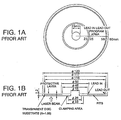
- a compact disc has a diameter of 120mm and a center hole of 15mm.
- a music program may be recorded in the compact disc at a program area between an inner diameter of 50mm and an outer diameter of 116mm.
- a lead in area LIA
- LOA lead out area
- a CD player can carry out an automatic musical performance by detecting the zones.
- a signal is recorded in the compact disc as a spiral track which is called a physical track.
- An interval between the adjacent physical tracks is equal to 1.6 ⁇ m (about 625 per mm). Accordingly, the compact disc has about 20,000 physical tracks and has a total length of about 5km.
- any book has first a table of contents (TOC). If there is no table of contents, it is impossible to easily search where and what is written. In a similar manner in the compact disc, a table of contents is recorded in the compact disc at the most inner circumference thereof. This is called TOC for short. Since the CD player reads contents of the TOC from the compact disc, it is possible to quickly search the compact disc for a target position in response to a command for reproducing a particular movement and to shift or move an optical pickup of the CD player to the target position. The contents of the TOC are recorded in the lead in area (LIA).
- LIA lead in area
- an electric equipment such as a personal computer is connected to various peripheral units one of which comprises a memory device or a recording medium.
- various types of memory devices (recording media).
- the memory devices are classified into removable media and non-removable media.
- One of the removable media comprises a compact disc-recordable (CD-R) disc.
- the CD-R disc is an additionally recordable medium which is compatible with a compact disc read only memory (CD-ROM) disc or a compact disc-digital audio (CD-DA) disc.
- the additionally recordable medium (optical disc) such as the CD-R disc and a compact disc-rewritable (CD-RW) disc is herein called an additionally recordable optical disc.
- a recording/reproducing optical pickup (which is hereunder merely referred to a pickup) is required for irradiating a laser beam on the CD-R disc.
- the pickup of the type described comprises a laser optical source for outputting the laser beam and an optical system for guiding the outputted laser beam to a recording medium such as an optical disc.
- a laser optical source for outputting the laser beam
- an optical system for guiding the outputted laser beam to a recording medium such as an optical disc.
- the CD-R disc it is possible for the CD-R disc to carry out not only reading of information but also writing of information.
- a conventional preparing method for an audio disc comprises the steps of writing all pieces of music on a program area of the additionally recordable optical disc and of writing the LOA and the TOC in the manner which will become clear as the description proceeds in conjunction with Figs. 2 and 3.
- the conventional preparing method for the audio disc it is impossible for the conventional preparing method for the audio disc to add any piece of music to the additionally recordable optical disc once the TOC is written on the LIA of the additionally recordable optical disc in the manner which will become clear as the description proceeds in conjunction with Fig. 4.
- the present inventors studied how to add one or more pieces of music to the additionally recordable optical disc on which the TOC is previously written. As a studied result, the present inventors came to a conclusion that such a problem occurs in prior art because a "decided" TOC is written in the LIA after all pieces of music are written in a program area of the additionally recordable optical disc.
- the present inventors reached an idea that it may be possible to add one or more pieces of music to the additionally recordable optical disc many times if a "specific" TOC is written in the LIA.
- the "specific" TOC means that information indicative of contents of music written in the program area is indefinite or undecided, and only information for deciding a "frame" defining the program area is decided.
- the invention is as set out in claim 1.
- a preferred method of this invention is for preparing an audio disc by writing music in an additionally-recordable optical disc having a lead-in area (LIA) and a program area.
- the above-understood method comprises the steps of writing a specific table of contents in the LIA and of writing music to be recorded in the program area.
- a compact disc (CD) will be described at first in order to facilitate an understanding of the present invention.
- the compact disc has a diameter of 120mm and a center hole of 15mm.
- the compact disc has a program area between an inner diameter of 50mm and an outer diameter of 116mm, a lead in area (LIA) between an inner diameter of 46mm and an outer diameter of 50mm, and a lead out area (LOA) between an inner diameter of 116mm and an outer diameter of 117mm. That is, the lead in area (LIA) and the lead out area (LOA) are located or lie inside and outside the program area, respectively.
- a music program may be recorded in the program area.
- a CD player can carry out an automatic musical performance by detecting the LIA and the LOA.
- a program memory area (PMA)
- PMA program memory area
- CD-R compact disc-recordable
- a dot-dash line denotes a center line of the additionally recordable optical disc.
- n-th piece of the music is written on the program area of the additionally recordable optical disc at a first step S'1, where n represents a positive integer.
- the first step S'1 is followed by a second step S'2 at which a piece number, a start time instant and an end time instant (which are hereunder called time instants) for the n-th piece of the music are memorized on the PMA of the additionally recordable optical disc.
- the first and the second steps S'1 and S'2 repeat until a final piece of the music (a third step S'3).
- the third step S'3 proceeds to a fourth step S'4 at which an LOA is written on the additionally recordable optical disc.
- the fourth step S'4 is succeeded by a fifth step S'5 at which a TOC is exactly written on an LIA of the additionally recordable optical disc.
- the TOC is written after writing of the LOA in the example being illustrated, one of the TOC and the LOA may be written prior to the other. That is, the LOA may be written after writing of the TOC.
- the conventional preparing method for the audio disc comprises the steps of writing all pieces of the music on the program area of the additionally recordable optical disc and of writing the LOA and the TOC in the additionally recordable optical disc.
- the conventional preparing method for the audio disc all pieces of the music are written within the program area of the additionally recordable optical disc and the LOA is written in an outer circumferential area adjacent to an area where the final piece of the music is written.
- the piece numbers and the time instants are recorded in the LIA as the TOC. Accordingly, once the TOC is written on the LIA, an audio player or a CD player only can reproduce the pieces of music written in the program area between the LIA and the LOA.
- the personal computer may comprise a computer body and peripheral devices.
- the computer body comprises a central processing unit (CPU) and a memory.
- the personal computer may comprise, as the peripheral devices, an input unit such as a keyboard or a mouse, a display device such as a cathode ray tube (CRT), a hard disc, and a compact disc read only memory (CD-ROM) drive for reading data.
- the personal computer is connected to a compact disc-rewritable (CD-RW) drive for writing data.
- CD-R compact disc-rewritable
- a compact disc-recordable (CD-R) drive may be used in lieu of the CD-RW drive.
- the preparing method for the audio disc according to this invention is a method in which music is read out of a predetermined music source and the read music is written in an additionally recordable optical disc such as the CD-R disc by using the CD-RW drive.
- the music source may be an audio CD, a raw sound, the Internet, or the like.
- the read music may be or may not be temporarily recorded or memorized in the hard disc.
- an application program (Fig. 5) for realizing the preparing method according to this invention and an application program (Fig. 3) for realizing the conventional preparing method are installed in the hard disc.
- the preparing method according to this invention is realized by selecting the application program (Fig. 5) by means of the mouse.
- a specific TOC having a set value is written on the LIA of the additionally recordable optical disc at a first step S1.
- an audio single session and an LOA start time matched with an absolute time in progroove (ATIP) are defined in the TOC.
- a disc catalogue number indicative of an effect that this additionally recordable optical disc is an optical disc prepared by the preparing method according to this invention is defined in Mode 2, ADR2 (Q channel of a subcode).
- Logical tracks matched with a disc capacity are defined in the TOC at intervals of one minute.
- the additionally recordable optical disc has the disc capacity corresponding to seventy-four minutes as shown in Fig. 6.
- seventy-four logical tracks are defined in the TOC.
- the additionally recordable optical disc has the program area which is divided into the seventy-four logical tracks.
- the number of the logical tracks is different for each disc capacity. For instance, in a case of the additionally recordable optical disc having the disc capacity corresponding to sixty-three minutes, sixty-three logical tracks are defined in the TOC.
- the disc capacity may be defined as first through ninety-ninth logical tracks which are equally divided.
- a user may freely define a length of the logical track and the number of the logical tracks.
- the LOA automatically lies in the most outer circumference of the additionally recordable optical disc. Accordingly, the LOA may be written in the most outer circumference of the additionally recordable optical disc or may be written following an end logical track.
- a logical track outside adjacent to the LIA is called a "head logical track” while a logical track inside adjacent to the LOA is called the "end logical track”.
- the "specific" TOC is written on the LIA of the additionally recordable optical disc.
- the first step S1 is followed by a second step S2 at which a length (time interval) S of a particular piece of the music to be recorded (written) is calculated.
- the second step S2 proceeds to a third step S3 at which the length S of the particular piece of music is compared with a time interval Tr corresponding to necessary logical tracks. If the time interval Tr is longer than the length S, padding having a difference (Tr - S) between the time interval Tr and the length S is added to the program area of the additionally recordable optical disc at a fourth step S4.
- the fourth step S4 is succeeded by a fifth step S5 at which it is determined whether or not the length of the particular piece of music lies within the LOA.
- the fifth step S5 is followed by a sixth step S6 at which an n-th piece of the music is written in the program area of the additionally recordable optical disc, where n represents a positive integer.
- the sixth step S6 proceeds to a seventh step S7 at which track numbers and time instants (a start time instant and an end time instant) are memorized in the PMA of the additionally-recordable optical disc.
- An operation 1 ⁇ between the second and the seventh steps S2 and S7 is repeated for a portion corresponding to pieces of the music to be written.
- the fifth step S5 proceeds to an eighth step S8 at which it is determined that another piece of the music is selected. If determination is positive (YES in the eighth step S8), the eighth step S8 is turned back to the second step S2. If determination is negative (NO in the eighth step S8), the eighth step S8 is succeeded by a ninth step S9 at which padding is carried out (namely, audio silence of null data is written), the end logical track comes to end in accordance with the above-mentioned TOC, and the LOA is subsequently written in the additionally-recordable optical disc at the most outer circumference thereof.
- a ninth step S9 at which padding is carried out (namely, audio silence of null data is written)
- a specific table of contents is first written in a lead-in area of the additionally-recordable optical disc. Thereafter, the music to be recorded is written in a program area of the additionally-recordable optical disc.
Landscapes
- Engineering & Computer Science (AREA)
- Signal Processing (AREA)
- Multimedia (AREA)
- Management Or Editing Of Information On Record Carriers (AREA)
- Optical Recording Or Reproduction (AREA)
- Signal Processing For Digital Recording And Reproducing (AREA)
- Indexing, Searching, Synchronizing, And The Amount Of Synchronization Travel Of Record Carriers (AREA)
- Manufacturing Optical Record Carriers (AREA)
Applications Claiming Priority (2)
| Application Number | Priority Date | Filing Date | Title |
|---|---|---|---|
| JP11145274A JP2000339922A (ja) | 1999-05-25 | 1999-05-25 | オーディオディスクの作成方法 |
| JP14527499 | 1999-05-25 |
Publications (2)
| Publication Number | Publication Date |
|---|---|
| EP1056091A2 true EP1056091A2 (fr) | 2000-11-29 |
| EP1056091A3 EP1056091A3 (fr) | 2001-12-05 |
Family
ID=15381356
Family Applications (1)
| Application Number | Title | Priority Date | Filing Date |
|---|---|---|---|
| EP00304457A Withdrawn EP1056091A3 (fr) | 1999-05-25 | 2000-05-25 | Procédé de préparation d'un disque audio dans lequel une table des matières spécifique est premièrement enregistré dans la zone de départ |
Country Status (4)
| Country | Link |
|---|---|
| US (1) | US6456577B1 (fr) |
| EP (1) | EP1056091A3 (fr) |
| JP (1) | JP2000339922A (fr) |
| CA (1) | CA2309292A1 (fr) |
Cited By (1)
| Publication number | Priority date | Publication date | Assignee | Title |
|---|---|---|---|---|
| RU2260861C2 (ru) * | 2001-05-02 | 2005-09-20 | Самсунг Электроникс Ко., Лтд | Оптический диск, имеющий однородную структуру (варианты), способ записи и/или воспроизведения (варианты) |
Family Cites Families (6)
| Publication number | Priority date | Publication date | Assignee | Title |
|---|---|---|---|---|
| JP3158556B2 (ja) | 1991-09-27 | 2001-04-23 | ソニー株式会社 | ディスク記録装置及びディスク再生装置 |
| US5471441A (en) | 1992-01-24 | 1995-11-28 | Pioneer Electronic Corporation | CD player capable of playing back partially recorded CD |
| US5940853A (en) * | 1996-02-23 | 1999-08-17 | Matsushita Electric Industrial Co., Ltd. | Recording and reproducing apparatus enabling modification of data recorded on a non-erasable recording medium |
| US6118753A (en) | 1996-08-13 | 2000-09-12 | Hewlett-Packard Company | Erasable digital video disk with reference clock track |
| JP3861417B2 (ja) * | 1997-11-28 | 2006-12-20 | ヤマハ株式会社 | 光ディスク再生システム |
| US6310854B1 (en) * | 1997-11-28 | 2001-10-30 | Yamaha Corporation | Optical disk having areas of different recording densities or functions |
-
1999
- 1999-05-25 JP JP11145274A patent/JP2000339922A/ja not_active Withdrawn
-
2000
- 2000-05-24 CA CA002309292A patent/CA2309292A1/fr not_active Abandoned
- 2000-05-24 US US09/577,863 patent/US6456577B1/en not_active Expired - Fee Related
- 2000-05-25 EP EP00304457A patent/EP1056091A3/fr not_active Withdrawn
Cited By (1)
| Publication number | Priority date | Publication date | Assignee | Title |
|---|---|---|---|---|
| RU2260861C2 (ru) * | 2001-05-02 | 2005-09-20 | Самсунг Электроникс Ко., Лтд | Оптический диск, имеющий однородную структуру (варианты), способ записи и/или воспроизведения (варианты) |
Also Published As
| Publication number | Publication date |
|---|---|
| US6456577B1 (en) | 2002-09-24 |
| JP2000339922A (ja) | 2000-12-08 |
| EP1056091A3 (fr) | 2001-12-05 |
| CA2309292A1 (fr) | 2000-11-25 |
Similar Documents
| Publication | Publication Date | Title |
|---|---|---|
| KR920000432B1 (ko) | 디스크 기록 장치 | |
| EP1187111B1 (fr) | Procédé pour la discrimination des différents types de disque optiques et appareil pour ceci | |
| JP2771153B2 (ja) | マルチセッションディスク及び高速アクセス方法 | |
| JP2945569B2 (ja) | 情報記録再生方法 | |
| US7952970B2 (en) | Apparatus and method for detecting an optimal writing power | |
| JPH08329468A (ja) | 光情報記録再生方法 | |
| US6473380B1 (en) | Information recording and reproducing apparatus for formatting a rewritable recording medium by an easy formatting method | |
| JPH0773474A (ja) | 追記型光ディスク | |
| AU768082B2 (en) | Method for recording and/or reproducing data on/from recording/recorded medium, reproducing apparatus, recording medium, method for recognizing recording/recorded medium, and method for recording and/or reproducing data for apparatus using recording/recorded medium | |
| EP0920021B9 (fr) | Milieu d'enregistrement d'information audio et appareil de reproduction d'information audio | |
| US6876615B2 (en) | Data recording apparatus, data recording method, and optical recording medium including psuedo-erasing features | |
| EP1039464B1 (fr) | Appareil et méthode d'enregistrement et/ou reproduction pour disque multisession ayant une session d' application de type DVD | |
| JPH0773470A (ja) | 追記型光ディスク及びその記録装置 | |
| JP3915228B2 (ja) | 再生方法および記録媒体 | |
| EP1039450A2 (fr) | Support d'enregistrement optique ayant différents formats de données et appareil d'enregistrement/reproduction correspondant | |
| EP1056091A2 (fr) | Procédé de préparation d'un disque audio dans lequel une table des matières spécifique est premièrement enregistré dans la zone de départ | |
| US7187627B2 (en) | System for controlling recording and reproducing data using management information on the medium | |
| JP3693742B2 (ja) | 情報記録媒体 | |
| JP4651603B2 (ja) | 情報記録再生装置 | |
| JPH05325404A (ja) | ディスク再生装置 | |
| JPH08161754A (ja) | 情報記録円盤及びその再生装置 | |
| JP2005071506A (ja) | 再生装置及びその記録フォーマット判別方法 | |
| JPH10269750A (ja) | 光ディスク及び光ディスク再生装置 | |
| JPH06103737A (ja) | オーディオ信号の再生装置 | |
| JP2006127754A (ja) | 情報記録再生装置と情報記録再生方法 |
Legal Events
| Date | Code | Title | Description |
|---|---|---|---|
| PUAI | Public reference made under article 153(3) epc to a published international application that has entered the european phase |
Free format text: ORIGINAL CODE: 0009012 |
|
| AK | Designated contracting states |
Kind code of ref document: A2 Designated state(s): BE DE FR GB NL Kind code of ref document: A2 Designated state(s): AT BE CH CY DE DK ES FI FR GB GR IE IT LI LU MC NL PT SE |
|
| AX | Request for extension of the european patent |
Free format text: AL;LT;LV;MK;RO;SI |
|
| PUAL | Search report despatched |
Free format text: ORIGINAL CODE: 0009013 |
|
| AK | Designated contracting states |
Kind code of ref document: A3 Designated state(s): AT BE CH CY DE DK ES FI FR GB GR IE IT LI LU MC NL PT SE |
|
| AX | Request for extension of the european patent |
Free format text: AL;LT;LV;MK;RO;SI |
|
| 17P | Request for examination filed |
Effective date: 20020605 |
|
| AKX | Designation fees paid |
Free format text: BE DE FR GB NL |
|
| 17Q | First examination report despatched |
Effective date: 20020910 |
|
| STAA | Information on the status of an ep patent application or granted ep patent |
Free format text: STATUS: THE APPLICATION IS DEEMED TO BE WITHDRAWN |
|
| 18D | Application deemed to be withdrawn |
Effective date: 20030821 |