EP1057525B1 - Verfahren zur katalytischen Vinylierung von Carbonsäuren - Google Patents
Verfahren zur katalytischen Vinylierung von Carbonsäuren Download PDFInfo
- Publication number
- EP1057525B1 EP1057525B1 EP00109784A EP00109784A EP1057525B1 EP 1057525 B1 EP1057525 B1 EP 1057525B1 EP 00109784 A EP00109784 A EP 00109784A EP 00109784 A EP00109784 A EP 00109784A EP 1057525 B1 EP1057525 B1 EP 1057525B1
- Authority
- EP
- European Patent Office
- Prior art keywords
- reactor
- acetylene
- catalyst
- phase
- carboxylic acid
- Prior art date
- Legal status (The legal status is an assumption and is not a legal conclusion. Google has not performed a legal analysis and makes no representation as to the accuracy of the status listed.)
- Expired - Lifetime
Links
- 238000000034 method Methods 0.000 title claims description 63
- 230000008569 process Effects 0.000 title claims description 35
- 150000001735 carboxylic acids Chemical class 0.000 title claims description 16
- 238000006886 vinylation reaction Methods 0.000 title description 14
- HSFWRNGVRCDJHI-UHFFFAOYSA-N alpha-acetylene Natural products C#C HSFWRNGVRCDJHI-UHFFFAOYSA-N 0.000 claims description 81
- 125000002534 ethynyl group Chemical group [H]C#C* 0.000 claims description 77
- 238000006243 chemical reaction Methods 0.000 claims description 66
- 239000003054 catalyst Substances 0.000 claims description 62
- 150000001732 carboxylic acid derivatives Chemical class 0.000 claims description 40
- 229920001567 vinyl ester resin Polymers 0.000 claims description 37
- 150000003751 zinc Chemical class 0.000 claims description 15
- 125000000391 vinyl group Chemical group [H]C([*])=C([H])[H] 0.000 claims description 12
- 102000003712 Complement factor B Human genes 0.000 claims description 9
- 108090000056 Complement factor B Proteins 0.000 claims description 9
- 238000011068 loading method Methods 0.000 claims description 8
- 239000007858 starting material Substances 0.000 claims description 8
- 230000003197 catalytic effect Effects 0.000 claims description 3
- 150000003839 salts Chemical class 0.000 claims description 3
- 238000011144 upstream manufacturing Methods 0.000 claims description 3
- 125000004432 carbon atom Chemical group C* 0.000 claims description 2
- 229910052751 metal Inorganic materials 0.000 claims description 2
- 239000002184 metal Substances 0.000 claims description 2
- 239000012071 phase Substances 0.000 description 67
- 239000007789 gas Substances 0.000 description 38
- 239000007788 liquid Substances 0.000 description 25
- 238000012856 packing Methods 0.000 description 24
- 238000002474 experimental method Methods 0.000 description 20
- 239000000047 product Substances 0.000 description 15
- 239000002253 acid Substances 0.000 description 11
- 238000004821 distillation Methods 0.000 description 11
- 238000012546 transfer Methods 0.000 description 11
- 230000015572 biosynthetic process Effects 0.000 description 9
- 239000007791 liquid phase Substances 0.000 description 9
- 238000000926 separation method Methods 0.000 description 9
- 238000004519 manufacturing process Methods 0.000 description 8
- 239000000203 mixture Substances 0.000 description 8
- 238000009835 boiling Methods 0.000 description 7
- 239000000945 filler Substances 0.000 description 7
- FERIUCNNQQJTOY-UHFFFAOYSA-N Butyric acid Chemical compound CCCC(O)=O FERIUCNNQQJTOY-UHFFFAOYSA-N 0.000 description 6
- 239000006227 byproduct Substances 0.000 description 6
- 238000002156 mixing Methods 0.000 description 6
- 239000000243 solution Substances 0.000 description 6
- 238000012360 testing method Methods 0.000 description 6
- XLYOFNOQVPJJNP-UHFFFAOYSA-N water Substances O XLYOFNOQVPJJNP-UHFFFAOYSA-N 0.000 description 6
- 230000006835 compression Effects 0.000 description 5
- 238000007906 compression Methods 0.000 description 5
- IKHGUXGNUITLKF-UHFFFAOYSA-N Acetaldehyde Chemical compound CC=O IKHGUXGNUITLKF-UHFFFAOYSA-N 0.000 description 4
- XTXRWKRVRITETP-UHFFFAOYSA-N Vinyl acetate Chemical compound CC(=O)OC=C XTXRWKRVRITETP-UHFFFAOYSA-N 0.000 description 4
- 150000007513 acids Chemical class 0.000 description 4
- POULHZVOKOAJMA-UHFFFAOYSA-N dodecanoic acid Chemical compound CCCCCCCCCCCC(O)=O POULHZVOKOAJMA-UHFFFAOYSA-N 0.000 description 4
- 238000011049 filling Methods 0.000 description 4
- 238000002360 preparation method Methods 0.000 description 4
- 230000003068 static effect Effects 0.000 description 4
- 239000011800 void material Substances 0.000 description 4
- QTBSBXVTEAMEQO-UHFFFAOYSA-N Acetic acid Chemical compound CC(O)=O QTBSBXVTEAMEQO-UHFFFAOYSA-N 0.000 description 3
- UHOVQNZJYSORNB-UHFFFAOYSA-N Benzene Chemical compound C1=CC=CC=C1 UHOVQNZJYSORNB-UHFFFAOYSA-N 0.000 description 3
- 238000013459 approach Methods 0.000 description 3
- 239000004744 fabric Substances 0.000 description 3
- 230000017525 heat dissipation Effects 0.000 description 3
- 230000036961 partial effect Effects 0.000 description 3
- 230000005514 two-phase flow Effects 0.000 description 3
- 229910052725 zinc Inorganic materials 0.000 description 3
- 239000011701 zinc Substances 0.000 description 3
- OBETXYAYXDNJHR-SSDOTTSWSA-M (2r)-2-ethylhexanoate Chemical compound CCCC[C@@H](CC)C([O-])=O OBETXYAYXDNJHR-SSDOTTSWSA-M 0.000 description 2
- JRQAAPYJURVMJK-UHFFFAOYSA-N 2-ethyl-2,3-dimethylpentanoic acid Chemical compound CCC(C)C(C)(CC)C(O)=O JRQAAPYJURVMJK-UHFFFAOYSA-N 0.000 description 2
- IJGRMHOSHXDMSA-UHFFFAOYSA-N Atomic nitrogen Chemical compound N#N IJGRMHOSHXDMSA-UHFFFAOYSA-N 0.000 description 2
- 239000005639 Lauric acid Substances 0.000 description 2
- HCHKCACWOHOZIP-UHFFFAOYSA-N Zinc Chemical compound [Zn] HCHKCACWOHOZIP-UHFFFAOYSA-N 0.000 description 2
- OBETXYAYXDNJHR-UHFFFAOYSA-N alpha-ethylcaproic acid Natural products CCCCC(CC)C(O)=O OBETXYAYXDNJHR-UHFFFAOYSA-N 0.000 description 2
- 238000004458 analytical method Methods 0.000 description 2
- 238000006555 catalytic reaction Methods 0.000 description 2
- 230000000052 comparative effect Effects 0.000 description 2
- 238000000354 decomposition reaction Methods 0.000 description 2
- 238000009826 distribution Methods 0.000 description 2
- 238000005265 energy consumption Methods 0.000 description 2
- 238000000605 extraction Methods 0.000 description 2
- 239000003925 fat Substances 0.000 description 2
- 230000002349 favourable effect Effects 0.000 description 2
- 238000005187 foaming Methods 0.000 description 2
- FBUKVWPVBMHYJY-UHFFFAOYSA-N nonanoic acid Chemical group CCCCCCCCC(O)=O FBUKVWPVBMHYJY-UHFFFAOYSA-N 0.000 description 2
- 150000002842 nonanoic acids Chemical group 0.000 description 2
- 238000006116 polymerization reaction Methods 0.000 description 2
- 238000000746 purification Methods 0.000 description 2
- 239000000376 reactant Substances 0.000 description 2
- 238000004064 recycling Methods 0.000 description 2
- 239000000344 soap Substances 0.000 description 2
- 239000002904 solvent Substances 0.000 description 2
- 239000000126 substance Substances 0.000 description 2
- SZHOJFHSIKHZHA-UHFFFAOYSA-N tridecanoic acid Chemical compound CCCCCCCCCCCCC(O)=O SZHOJFHSIKHZHA-UHFFFAOYSA-N 0.000 description 2
- 230000007306 turnover Effects 0.000 description 2
- ZDPHROOEEOARMN-UHFFFAOYSA-N undecanoic acid Chemical compound CCCCCCCCCCC(O)=O ZDPHROOEEOARMN-UHFFFAOYSA-N 0.000 description 2
- GYSCBCSGKXNZRH-UHFFFAOYSA-N 1-benzothiophene-2-carboxamide Chemical compound C1=CC=C2SC(C(=O)N)=CC2=C1 GYSCBCSGKXNZRH-UHFFFAOYSA-N 0.000 description 1
- URGYOSLMFPSHMT-UHFFFAOYSA-N 2,2-diethyl-3-methylbutanoic acid Chemical compound CCC(CC)(C(C)C)C(O)=O URGYOSLMFPSHMT-UHFFFAOYSA-N 0.000 description 1
- PWCBTXBCAGUKGX-UHFFFAOYSA-N 2,2-diethylpentanoic acid Chemical compound CCCC(CC)(CC)C(O)=O PWCBTXBCAGUKGX-UHFFFAOYSA-N 0.000 description 1
- MBHRUQBGWAJYDZ-UHFFFAOYSA-N 2-ethyl-2,4-dimethylpentanoic acid Chemical compound CCC(C)(C(O)=O)CC(C)C MBHRUQBGWAJYDZ-UHFFFAOYSA-N 0.000 description 1
- LYIMSMCQBKXQDK-UHFFFAOYSA-N 2-ethyl-2-methylhexanoic acid Chemical compound CCCCC(C)(CC)C(O)=O LYIMSMCQBKXQDK-UHFFFAOYSA-N 0.000 description 1
- JWZJWGCSMSGWPY-UHFFFAOYSA-N 2-methyl-2-propan-2-ylpentanoic acid Chemical compound CCCC(C)(C(C)C)C(O)=O JWZJWGCSMSGWPY-UHFFFAOYSA-N 0.000 description 1
- KTHXOYWHJBTQNC-UHFFFAOYSA-N 2-methyl-2-propylpentanoic acid Chemical compound CCCC(C)(C(O)=O)CCC KTHXOYWHJBTQNC-UHFFFAOYSA-N 0.000 description 1
- MCLMZMISZCYBBG-UHFFFAOYSA-N 3-ethylheptanoic acid Chemical compound CCCCC(CC)CC(O)=O MCLMZMISZCYBBG-UHFFFAOYSA-N 0.000 description 1
- XZOYHFBNQHPJRQ-UHFFFAOYSA-N 7-methyloctanoic acid Chemical compound CC(C)CCCCCC(O)=O XZOYHFBNQHPJRQ-UHFFFAOYSA-N 0.000 description 1
- AAOISIQFPPAFQO-UHFFFAOYSA-N 7:0(6Me,6Me) Chemical compound CC(C)(C)CCCCC(O)=O AAOISIQFPPAFQO-UHFFFAOYSA-N 0.000 description 1
- GHVNFZFCNZKVNT-UHFFFAOYSA-N Decanoic acid Natural products CCCCCCCCCC(O)=O GHVNFZFCNZKVNT-UHFFFAOYSA-N 0.000 description 1
- 241000196324 Embryophyta Species 0.000 description 1
- 241000282326 Felis catus Species 0.000 description 1
- 240000006829 Ficus sundaica Species 0.000 description 1
- 238000003109 Karl Fischer titration Methods 0.000 description 1
- 101150003085 Pdcl gene Proteins 0.000 description 1
- 244000089486 Phragmites australis subsp australis Species 0.000 description 1
- KJTLSVCANCCWHF-UHFFFAOYSA-N Ruthenium Chemical compound [Ru] KJTLSVCANCCWHF-UHFFFAOYSA-N 0.000 description 1
- 235000021355 Stearic acid Nutrition 0.000 description 1
- 238000009825 accumulation Methods 0.000 description 1
- 150000001242 acetic acid derivatives Chemical class 0.000 description 1
- 125000000218 acetic acid group Chemical group C(C)(=O)* 0.000 description 1
- 230000009471 action Effects 0.000 description 1
- 239000000853 adhesive Substances 0.000 description 1
- 230000001070 adhesive effect Effects 0.000 description 1
- 125000001931 aliphatic group Chemical group 0.000 description 1
- 150000001336 alkenes Chemical class 0.000 description 1
- 150000008064 anhydrides Chemical class 0.000 description 1
- QVGXLLKOCUKJST-UHFFFAOYSA-N atomic oxygen Chemical compound [O] QVGXLLKOCUKJST-UHFFFAOYSA-N 0.000 description 1
- 230000004888 barrier function Effects 0.000 description 1
- 230000033228 biological regulation Effects 0.000 description 1
- 208000002352 blister Diseases 0.000 description 1
- 238000009530 blood pressure measurement Methods 0.000 description 1
- -1 butenine Chemical compound 0.000 description 1
- 238000004364 calculation method Methods 0.000 description 1
- 125000003178 carboxy group Chemical group [H]OC(*)=O 0.000 description 1
- 150000001244 carboxylic acid anhydrides Chemical class 0.000 description 1
- 238000003889 chemical engineering Methods 0.000 description 1
- 229920001577 copolymer Polymers 0.000 description 1
- 238000007334 copolymerization reaction Methods 0.000 description 1
- MLUCVPSAIODCQM-NSCUHMNNSA-N crotonaldehyde Chemical compound C\C=C\C=O MLUCVPSAIODCQM-NSCUHMNNSA-N 0.000 description 1
- MLUCVPSAIODCQM-UHFFFAOYSA-N crotonaldehyde Natural products CC=CC=O MLUCVPSAIODCQM-UHFFFAOYSA-N 0.000 description 1
- 239000012043 crude product Substances 0.000 description 1
- 230000009849 deactivation Effects 0.000 description 1
- 238000011161 development Methods 0.000 description 1
- 238000010790 dilution Methods 0.000 description 1
- 239000012895 dilution Substances 0.000 description 1
- 238000007599 discharging Methods 0.000 description 1
- 230000000694 effects Effects 0.000 description 1
- 238000004945 emulsification Methods 0.000 description 1
- 238000005516 engineering process Methods 0.000 description 1
- 238000001704 evaporation Methods 0.000 description 1
- 230000008020 evaporation Effects 0.000 description 1
- 239000012530 fluid Substances 0.000 description 1
- 238000010438 heat treatment Methods 0.000 description 1
- 238000007037 hydroformylation reaction Methods 0.000 description 1
- 238000005984 hydrogenation reaction Methods 0.000 description 1
- 230000006872 improvement Effects 0.000 description 1
- 239000012535 impurity Substances 0.000 description 1
- 239000011261 inert gas Substances 0.000 description 1
- 239000012442 inert solvent Substances 0.000 description 1
- 238000009434 installation Methods 0.000 description 1
- 230000002452 interceptive effect Effects 0.000 description 1
- 238000002386 leaching Methods 0.000 description 1
- 239000000463 material Substances 0.000 description 1
- 238000005259 measurement Methods 0.000 description 1
- 150000002736 metal compounds Chemical class 0.000 description 1
- 238000010327 methods by industry Methods 0.000 description 1
- 229910052757 nitrogen Inorganic materials 0.000 description 1
- 229910000510 noble metal Inorganic materials 0.000 description 1
- QIQXTHQIDYTFRH-UHFFFAOYSA-N octadecanoic acid Chemical compound CCCCCCCCCCCCCCCCCC(O)=O QIQXTHQIDYTFRH-UHFFFAOYSA-N 0.000 description 1
- OQCDKBAXFALNLD-UHFFFAOYSA-N octadecanoic acid Natural products CCCCCCCC(C)CCCCCCCCC(O)=O OQCDKBAXFALNLD-UHFFFAOYSA-N 0.000 description 1
- 239000003921 oil Substances 0.000 description 1
- 238000005457 optimization Methods 0.000 description 1
- 239000012074 organic phase Substances 0.000 description 1
- 230000003647 oxidation Effects 0.000 description 1
- 238000007254 oxidation reaction Methods 0.000 description 1
- 239000001301 oxygen Substances 0.000 description 1
- 229910052760 oxygen Inorganic materials 0.000 description 1
- 239000003973 paint Substances 0.000 description 1
- 239000012188 paraffin wax Substances 0.000 description 1
- 238000005373 pervaporation Methods 0.000 description 1
- 230000005501 phase interface Effects 0.000 description 1
- IUGYQRQAERSCNH-UHFFFAOYSA-N pivalic acid Chemical compound CC(C)(C)C(O)=O IUGYQRQAERSCNH-UHFFFAOYSA-N 0.000 description 1
- BASFCYQUMIYNBI-UHFFFAOYSA-N platinum Chemical class [Pt] BASFCYQUMIYNBI-UHFFFAOYSA-N 0.000 description 1
- 239000010970 precious metal Substances 0.000 description 1
- 230000002829 reductive effect Effects 0.000 description 1
- 238000010992 reflux Methods 0.000 description 1
- 230000002441 reversible effect Effects 0.000 description 1
- 238000012552 review Methods 0.000 description 1
- 229910052707 ruthenium Inorganic materials 0.000 description 1
- 229920006395 saturated elastomer Polymers 0.000 description 1
- 239000003381 stabilizer Substances 0.000 description 1
- 239000008117 stearic acid Substances 0.000 description 1
- 238000003860 storage Methods 0.000 description 1
- 239000013589 supplement Substances 0.000 description 1
- 239000010409 thin film Substances 0.000 description 1
- 238000005303 weighing Methods 0.000 description 1
- 238000010626 work up procedure Methods 0.000 description 1
- WDHVIZKSFZNHJB-UHFFFAOYSA-L zinc;butanoate Chemical compound [Zn+2].CCCC([O-])=O.CCCC([O-])=O WDHVIZKSFZNHJB-UHFFFAOYSA-L 0.000 description 1
Images


Classifications
-
- B—PERFORMING OPERATIONS; TRANSPORTING
- B01—PHYSICAL OR CHEMICAL PROCESSES OR APPARATUS IN GENERAL
- B01J—CHEMICAL OR PHYSICAL PROCESSES, e.g. CATALYSIS OR COLLOID CHEMISTRY; THEIR RELEVANT APPARATUS
- B01J19/00—Chemical, physical or physico-chemical processes in general; Their relevant apparatus
- B01J19/24—Stationary reactors without moving elements inside
- B01J19/2415—Tubular reactors
-
- B—PERFORMING OPERATIONS; TRANSPORTING
- B01—PHYSICAL OR CHEMICAL PROCESSES OR APPARATUS IN GENERAL
- B01J—CHEMICAL OR PHYSICAL PROCESSES, e.g. CATALYSIS OR COLLOID CHEMISTRY; THEIR RELEVANT APPARATUS
- B01J10/00—Chemical processes in general for reacting liquid with gaseous media other than in the presence of solid particles, or apparatus specially adapted therefor
- B01J10/007—Chemical processes in general for reacting liquid with gaseous media other than in the presence of solid particles, or apparatus specially adapted therefor in the presence of catalytically active bodies, e.g. porous plates
-
- B—PERFORMING OPERATIONS; TRANSPORTING
- B01—PHYSICAL OR CHEMICAL PROCESSES OR APPARATUS IN GENERAL
- B01J—CHEMICAL OR PHYSICAL PROCESSES, e.g. CATALYSIS OR COLLOID CHEMISTRY; THEIR RELEVANT APPARATUS
- B01J8/00—Chemical or physical processes in general, conducted in the presence of fluids and solid particles; Apparatus for such processes
- B01J8/02—Chemical or physical processes in general, conducted in the presence of fluids and solid particles; Apparatus for such processes with stationary particles, e.g. in fixed beds
- B01J8/06—Chemical or physical processes in general, conducted in the presence of fluids and solid particles; Apparatus for such processes with stationary particles, e.g. in fixed beds in tube reactors; the solid particles being arranged in tubes
-
- C—CHEMISTRY; METALLURGY
- C07—ORGANIC CHEMISTRY
- C07C—ACYCLIC OR CARBOCYCLIC COMPOUNDS
- C07C67/00—Preparation of carboxylic acid esters
- C07C67/04—Preparation of carboxylic acid esters by reacting carboxylic acids or symmetrical anhydrides onto unsaturated carbon-to-carbon bonds
-
- C—CHEMISTRY; METALLURGY
- C07—ORGANIC CHEMISTRY
- C07C—ACYCLIC OR CARBOCYCLIC COMPOUNDS
- C07C67/00—Preparation of carboxylic acid esters
- C07C67/04—Preparation of carboxylic acid esters by reacting carboxylic acids or symmetrical anhydrides onto unsaturated carbon-to-carbon bonds
- C07C67/05—Preparation of carboxylic acid esters by reacting carboxylic acids or symmetrical anhydrides onto unsaturated carbon-to-carbon bonds with oxidation
- C07C67/055—Preparation of carboxylic acid esters by reacting carboxylic acids or symmetrical anhydrides onto unsaturated carbon-to-carbon bonds with oxidation in the presence of platinum group metals or their compounds
-
- B—PERFORMING OPERATIONS; TRANSPORTING
- B01—PHYSICAL OR CHEMICAL PROCESSES OR APPARATUS IN GENERAL
- B01J—CHEMICAL OR PHYSICAL PROCESSES, e.g. CATALYSIS OR COLLOID CHEMISTRY; THEIR RELEVANT APPARATUS
- B01J2219/00—Chemical, physical or physico-chemical processes in general; Their relevant apparatus
- B01J2219/00002—Chemical plants
- B01J2219/00004—Scale aspects
- B01J2219/00006—Large-scale industrial plants
-
- B—PERFORMING OPERATIONS; TRANSPORTING
- B01—PHYSICAL OR CHEMICAL PROCESSES OR APPARATUS IN GENERAL
- B01J—CHEMICAL OR PHYSICAL PROCESSES, e.g. CATALYSIS OR COLLOID CHEMISTRY; THEIR RELEVANT APPARATUS
- B01J2219/00—Chemical, physical or physico-chemical processes in general; Their relevant apparatus
- B01J2219/00049—Controlling or regulating processes
- B01J2219/00051—Controlling the temperature
- B01J2219/00074—Controlling the temperature by indirect heating or cooling employing heat exchange fluids
- B01J2219/00087—Controlling the temperature by indirect heating or cooling employing heat exchange fluids with heat exchange elements outside the reactor
- B01J2219/00103—Controlling the temperature by indirect heating or cooling employing heat exchange fluids with heat exchange elements outside the reactor in a heat exchanger separate from the reactor
-
- B—PERFORMING OPERATIONS; TRANSPORTING
- B01—PHYSICAL OR CHEMICAL PROCESSES OR APPARATUS IN GENERAL
- B01J—CHEMICAL OR PHYSICAL PROCESSES, e.g. CATALYSIS OR COLLOID CHEMISTRY; THEIR RELEVANT APPARATUS
- B01J2219/00—Chemical, physical or physico-chemical processes in general; Their relevant apparatus
- B01J2219/00049—Controlling or regulating processes
- B01J2219/00051—Controlling the temperature
- B01J2219/00074—Controlling the temperature by indirect heating or cooling employing heat exchange fluids
- B01J2219/00105—Controlling the temperature by indirect heating or cooling employing heat exchange fluids part or all of the reactants being heated or cooled outside the reactor while recycling
- B01J2219/0011—Controlling the temperature by indirect heating or cooling employing heat exchange fluids part or all of the reactants being heated or cooled outside the reactor while recycling involving reactant liquids
-
- B—PERFORMING OPERATIONS; TRANSPORTING
- B01—PHYSICAL OR CHEMICAL PROCESSES OR APPARATUS IN GENERAL
- B01J—CHEMICAL OR PHYSICAL PROCESSES, e.g. CATALYSIS OR COLLOID CHEMISTRY; THEIR RELEVANT APPARATUS
- B01J2219/00—Chemical, physical or physico-chemical processes in general; Their relevant apparatus
- B01J2219/00049—Controlling or regulating processes
- B01J2219/00243—Mathematical modelling
Definitions
- the invention relates to a process for the catalytic preparation of vinyl esters by reaction of carboxylic acids with acetyl in a tubular reactor.
- Vinyl esters are building blocks for the preparation of copolymers. Of particular industrial importance are vinyl esters of tertiary C 10 acids, and also of tertiary C 9 acids. These vinyl esters can be copolymerized with vinyl acetate and then serve as a component for paints. Also of importance are the vinyl esters of 2-ethylhexanoic acid, isononanoic acid, but also of lauric and stearic acid, for example in the production of adhesives.
- the reaction is carried out in a paraffinic solvent which boils higher than the reaction temperature to be used (eg paraffin oils), the concentration of carboxylic acid being less than 5% by weight and the zinc content being 0.5 to 5% by weight to keep on the reaction solution.
- the temperatures used are usually above 200 ° C, typically 220-295 ° C. It must with a considerable molar excess of acetylene relative to the vinylated Carboxylic acid are worked, typical values of 5 - 20 moles of acetylene per mole of carboxylic acid to be reacted. This causes a high Acetylenniklauf, wherein the vinyl ester and unreacted carboxylic acid discharged according to their partial vapor pressure with the exhaust gas, then condensed and separated by distillation from each other.
- the vinyl ester production is a two-phase reaction in which the acetylene is the gas phase and the catalyst phase, the carboxylic acid to be reacted, the vinyl ester and optionally an inert solvent form the liquid phase.
- measures must therefore be taken in order to bring the phases into contact with each other as well as possible.
- gas-liquid reactions are carried out in bubble columns or stirred reactors.
- Rieselreaktoren are mentioned in the literature.
- High pressures are not desirable, especially in reactions with acetylene, since acetylene tends to self-decomposition and in pure acetylene, an overpressure of 300 mbar (absolute pressure 1.3 bar) must not be exceeded This narrows the scope in the reactor selection considerably.
- multiphase reactions are understood as meaning reactions which take place with the participation of two or more immiscible or only partially miscible fluid phases. This concerns z.
- B Reactions between a gas and a liquid phase (gl) as in the reaction of acetylene with a carboxylic acid, but also reactions between two liquid phases which are immiscible or have a miscibility gap under the respective reaction conditions (II) and reactions in which both two liquid phases which are not or only partially miscible and one gas phase are involved (gll).
- Examples of technically important gas-liquid reactions are, in addition to the considered reaction of acetylene with carboxylic acids, for example hydrogenations with homogeneously dissolved catalysts, oxidations with air or oxygen and the hydroformylation of olefins.
- Multiphase reactions are generally associated with a number of problems that make their engineering much more difficult than simple homogeneous reactions. The following are some typical problems:
- the object of the present invention is thus the development of a process for carrying out multiphase reactions, which is suitable for the preparation of vinyl esters by catalyzed reaction of carboxylic acids with acetylene.
- the process according to the invention has found a surprisingly simple process for carrying out multiphase reactions which can be carried out in a tubular reactor, optionally filled with random packings or internals, and which is suitable for vinylating carboxylic acids with acetylene under high space-time yields and selectivities.
- the present invention therefore provides a process for the catalytic performance of multiphase reactions in a tubular reactor, wherein the catalyst is contained in the continuous phase and at least one educt in a dispersed phase and the loading factor B of the reactor is equal to or greater than 0.8.
- the polyphase reaction converts carboxylic acids with acetylene to the corresponding vinyl esters.
- the inventive method is suitable for vinylation of carboxylic acids; these may contain 2 to 16, preferably 4 to 13 carbon atoms. Particular preference is given to using pivalic acid (C 5 ), 2-ethylhexanecarboxylic acid (C 8 ), neononanoic acid (C 9 ), decanoic acid (C 10 ), undecanoic acid (C 11 ), lauric acid (C 12 ) or tridecanoic acid (C 13 ).
- the tubular reactor may contain fillers or internals.
- Packing bodies in the sense of the present invention are, for example: Raschig rings, saddles, pall rings, plate chains, wire mesh rings, wire mesh fabrics.
- Examples of installations are filter plates, baffles, column trays, perforated plates or other mixing devices.
- PD [Pa / m] is a length-related pressure drop across the reactor under operating conditions
- PS would be the static pressure per meter of a multiphase mixture in a vertical tube, if all phases were flowing at the same rate.
- PS is a pure arithmetic variable, which results from the flow rates supplied to the reactor and which can be specified independently of the flow direction of the reactor, the flow rate of all phases or the liquid state of the reactor.
- the pressure drop PD [Pa / m] is used as the arithmetic variable to determine the process conditions and can be calculated according to the common methods for single-phase or multi-phase flows.
- Common methods for calculating the pressure loss PD in pipes, internals or packed beds, etc. can, for. B. in VDI heat Atlas 7. Extended edition, VDI-Verlag GmbH, Dusseldorf 1994 , Sections La1 to Lgb7, as well as in the Standard work Heinz Brauer, Basics of single-phase and multi-phase flows, Verlag Sauerators, Aarau and Frankfurt am Main, 1971 to be looked up.
- the filler-specific data d H and ⁇ are often part of the delivery specifications of packing.
- data is given in the VDI Heat Atlas mentioned above.
- the empty-tube fraction ⁇ can also be determined experimentally, for example by leaching the reactor before and after filling with the packing.
- the resistance coefficient of pipes, internals and packing is usually described as a function of the Reynolds number Re, which gives information about the flow state under the selected conditions.
- Re Reynolds number
- K 1 , K 2 are filler-specific constants which are known from delivery data or from the literature (examples can be found in the VDI-Wärmeatlas and in Brauer et al.). However, they can also be determined experimentally by operating the tubular reactor with fillers with a liquid at different speeds and determined from the known data and the measured pressure loss Cw as a function of Re.
- ⁇ [Pa * s] denotes the viscosity and ⁇ [kg / m 3 ] the density of the flowing medium.
- the pressure loss in two-phase flows increases disproportionately.
- the pressure loss of the two-phase flow P lg is related to the pressure loss of one of the two phases, for example to the pressure loss of the pure flowing liquid phase P l , and to the ratio of the pressure loss set both as flowing alone imaginary phases P l and P g .
- Lockart-Martinelli This context, named after Lockart-Martinelli, has been graphically depicted in many works, detailed reviews of which can be found in many textbooks of process engineering and publications, as also in Brauer et al.
- the pressure loss of a multiphase flow is thus calculable by conventional means of chemical engineering.
- the size of the dimensionless load factor B represents a necessary basic condition of the method according to the invention; B should be greater than or equal to 0.8, preferably greater than or equal to 0.9 or particularly preferably greater than or equal to 1.
- the hydraulic diameter of the filling bodies will be small or their specific surface area large, so that the required conditions for B are achieved even at low flow velocities. This gives sufficient residence times over the length of a technically reasonably dimensioned reactor. For very fast reactions, a reverse procedure is recommended.
- Another criterion in carrying out the method according to the invention is the ratio of the mass flow of the liquid, the catalyst-containing phase M 1 to the mass flow of the disperse phase or phases M 2 .
- the mass flow of the catalyst phase M 1 is substantially greater than the mass flow of the disperse phase, ie the acetylene phase M 2 .
- the mass ratio M 1 / M 2 of the continuous phase (M 1 ) to the disperse phases (M 2 ) can be greater than 2, preferably M 1 / M 2 > 10. Flow conditions with M 1 / M 2 > 100 are quite possible and often even advantageous.
- the catalyst phase is the continuous phase, while the disperse phase is divided into fine bubbles or fine droplets.
- at least one educt it is possible for at least one educt to be dispersed by the energy introduced into the tubular reactor from the continuous phase. This leads to a distribution of at least one starting material in bubbles or drops within the continuous catalyst phase.
- d S / d H ⁇ 1 . preferably ⁇ 0 . 9th
- phase fraction ⁇ g of the disperse phase in the case of vinylation, the gas phase or the acetylene is dispersed
- the residence time ⁇ of the phases flowing through the reactor can be approximated to ⁇ ⁇ L * ⁇ / w lg. to calculate.
- the residence time ⁇ in the process according to the invention is generally well below one hour and may be in the range of minutes or even lower. Nevertheless, surprisingly high space-time yields are achieved in this completely unusual mode of operation-high catalyst throughput in the reactor, comparatively very low proportion of starting material on the reaction mass, again resulting in a very short residence time in many multiphase reactions. Alternatively, at the same space-time yields at significantly lower temperatures than usual, since the increase in the reaction rate, which may, for example, the minimization of subsequent reactions and thus improved selectivity, this economically allows.
- the method according to the invention can be adapted very flexibly to the most diverse requirements.
- the following embodiments of the method according to the invention are suitable:
- reactors can be provided with multiple feed of gas over the reactor length when the gas consumption is so high that unfavorable gas to liquid phase ratios result in the merging of the two phases before the reactor.
- the particular conditions of the process according to the invention allow for further embodiments of the process.
- the high necessary cycle of the catalyst phase or the continuous phase in addition to the operation of a jet nozzle, which is arranged as a liquid jet gas compressor before the actual tubular reactor can be exploited.
- This can be used for thorough pre-mixing of the two phases and for the compression of the gas phase, which allows the driving at higher pressures in the reactor used.
- the suction effect is exploited, even a circulation of gas with simultaneous premixing of the phases becomes possible.
- the energy introduced into the tubular reactor by the continuous phase containing the catalyst can thus be used to disperse the educt phase or at least one educt.
- the heat dissipation in strongly exothermic reactions such as in vinylation is not critical in the process of the invention.
- the high throughput of the catalyst circuit acts as a heat transfer medium, so that even with adiabatic operation of the reactor only small temperature differences occur and a homogeneous temperature distribution in the reactor results without temperature peaks.
- the heat generated can then be conveniently dissipated by any conventional heat exchanger arranged in the outer catalyst circuit or utilized for energy production.
- the specific residence time and the loading factor are to be selected according to the method according to the invention.
- a mass ratio between catalyst phase and gas phase at the reactor inlet in the range 1000/1 to 2/1, preferably in the range 200/1 to 50/1.
- the reactants can be preheated, i. H. be fed in the range of the reaction temperature, or cold. Due to the high phase ratio with the catalyst phase, the preheating can also be done by the process heat.
- the heat of reaction can be removed via various heat exchangers.
- the heat exchangers need not be in the vicinity of the reaction space, but may also be located anywhere outside the reactor.
- the individual heat flows depend on the specific heat of reaction as well as the desired temperatures in the reactor and in the workup devices.
- the dissipated heat of reaction can be used very easily, for example in the process itself, for heating a distillation device or for generating steam.
- Fig. 1 shows a possible embodiment of the method according to the invention, wherein it is assumed that a gaseous reactant A reacts with a liquid starting material B in the presence of a liquid catalyst phase K.
- the catalyst phase K is pumped in the catalyst circuit stream 3 directly to the top of the reactor R, the reactor optionally a liquid jet gas compressor G, ie a jet nozzle may be connected upstream.
- the feed gas in stream 1 is supplied via the suction side of the liquid gas jet compressor (or the jet nozzle) G. If this is not present, the two streams are simply merged without further action.
- excess gas is separated by conventional means (stream 5), z. B. by a degasser or a residence time P.
- the organic phase goes to the actual product separation in the container D.
- the crude product VE can be from the catalyst phase z.
- Example be separated by distillation or flashing of the reactor effluent, when the catalyst and the solvent optionally used boil higher than the product.
- Other technical methods suitable for the particular problem, such as extraction, pervaporation, etc., are also possible, it is crucial that the catalyst can be recovered and circulated (stream 3).
- the circulation pump H is shown with the heat exchanger W, the possibility to heat the reactor mixture in endothermic reactions or to cool in exothermic reactions or the heat of reaction, for. B. by steam generation otherwise.
- the residual gas can be passed through the connection 4 between stream 5 and stream 1 in a circle.
- the reactor can also be operated from bottom to top or in any other position.
- the outlet unit is arranged at the top of the reactor. After separation of the product and catalyst phases, the catalyst is recycled to the bottom of the reactor.
- the process of the present invention is suitable for vinylation of carboxylic acids with acetylene.
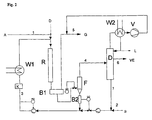
- Fig. 2 be sketched.
- starting material A is acetylene
- starting material B stream 2 is the carboxylic acid to be vinylated.
- the catalyst cycle (stream 3) consists of a solution of the zinc salt of the acid to be vinylated in excess carboxylic acid B.
- the catalyst used may be a metal salt, preferably the zinc salt of the carboxylic acid to be vinylated.
- the catalyst is dissolved in excess carboxylic acid, so that in the present case the continuous phase is formed by the catalyst solution and the disperse phase by acetylene.
- a residence time B1 As a degasser behind the actual reactor R is a residence time B1, which can be interpreted as a buffer volume and working container at the same time.
- the separation from the catalyst can be carried out thermally, for example by distillation.
- a flash F As special favorable, because gentle on the product, has a pre-separation of the catalyst of products by a flash F proved, wherein the resulting vapors in Flash (ie gaseous product) are passed directly to a distillation column D, in which the separation of the vinyl ester VE (stream 6) of residual carboxylic acid (stream 7) takes place, which is discharged in the one-step separation in the flash tank on the partial vapor pressure with.
- the carboxylic acid obtained at the bottom can be recycled by stream 7 into the reaction together with fresh carboxylic acid to supplement the spent portion.
- Flash F and column D are operated in vinyl esters with higher molecular weight and thus higher boiling point in vacuo, the vacuum is suitably adjusted so that the boiling point is just below the desired reaction temperature. As a result, the heat of reaction can be used directly for the distillation.
- a steam feed D can still be provided.
- small amounts of steam may be metered in so that the catalyst will constantly receive a small amount of water, e.g. 0.1-0.5 wt .-%, contains. Although this somewhat slows down the reaction, but prevents the formation of anhydrides of the carboxylic acid, which would no longer be accessible to the reaction and would have to be discharged as an inert.
- the catalyst circuit 3 is preferably run at a constant rate (FC in Fig. 2 ), which results in a very quiet and stable behavior of the reactor.
- the raw product obtained in the degasser B1 is transferred to the flash F in a position-controlled manner, the liquid catalyst-carboxylic acid mixture separated off here passes to a feed tank B2 for the catalyst circulation pump.
- the volume is constant, except in the reservoir B2. Its stand-off is a direct measure of the withdrawn vapor in the distillation column D product content, so that the state measurement of the container B2 is directly the reference variable for the carboxylic acid to be supplemented.
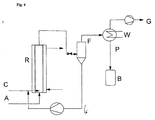
- the vinylation was carried out in a test apparatus (s. Fig. 3 ), as described similarly in the literature ( G. Hübner, fats, soaps, Anstrichm. 68, 290 (1966 ) DE 1210810 . DE 1238010 ).
- the reactor R had a height of 20 cm, a diameter of 10 cm and was filled with Raschig rings to improve the mass transfer.
- a jacketed jacket allowed the reactor to be thermostated.
- Acetylene A and the carboxylic acid C to be reacted were fed to the bottom of the reactor R via a frit.
- the catalyst consisted of the zinc salt of the acid to be vinylated, dissolved in an excess of acid.
- the reaction was carried out at a content of 55 to 80% by weight of zinc salt in excess acid.
- the reactor charge was 1.35 liters.
- the acetylene used was in amendment of the patent specification DE 1238010 saturated with water at 40 ° C instead of 20 ° C, otherwise the catalyst gelled too fast.
- the product P was discharged with unreacted carboxylic acid with the exhaust gas and condensed in the heat exchanger W.
- the exhaust gas G was discharged into an exhaust pipe.
- the carboxylic acid used was tertiary nonanoic acids having a purity of 99.73%, based on the content of tertiary nonanoic acids, having the following composition (data in% by weight): 2,2-dimethyl-heptanoic 7.31 2-methyl-2-ethyl-hexanoic acid 54,30 2-methyl-2-propyl-pentanoic acid 7.09 2,2-diethyl-pentanoic acid 3.40 2,2,5-trimethyl-hexanoic 0.83 2,2,4-trimethyl-hexanoic 0.81 2,4-dimethyl-2-ethyl-pentanoic acid 1.76 2,2,3-trimethyl-hexanoic 2.54 2-Methyl-2-Isopropyl-pentanoic acid 5.44 2,3-dimethyl-2-ethyl-pentanoic acid A 7.27 2,3-dimethyl-2-ethyl-pentanoic acid B 7.59 2-ethyl-2-
- the residual gas G was disposed of, the product phase P was collected in the container B.
- the influence of the water content in the catalyst was additionally investigated. This was adjusted by feeding a small amount of water vapor into the supplied acetylene and determined in samples of the catalyst solution by Karl Fischer titration.
- Example 1 There is still a low turnover of acetylene, although the disadvantage of Example 1 that the product must be discharged with the exhaust gas is eliminated by the operation of flash separation. However, in a large-scale solution, this still requires an acetylene cycle gas in the order of 2-4 mol / mol, based on the vinyl ester formed. In addition, the necessary form is in a similar range as in Example 1, so that technically a maximum reactor height of about 3 m is possible.
- the inventive method was in a pilot plant according to FIG. 2 tested, the same tertiary nonanoic acid was used as in Examples 1 and 2.
- reactor R was a tube DN 40, which was filled with a knitted wire from the company VFF (United packed factories, type T-20-M), as it is used for the production of demisters, so-called demister packs (experiments 14, 15, 16 ).
- VFF United packed factories, type T-20-M
- demister packs so-called demister packs (experiments 14, 15, 16 ).
- the knitted wire was rolled closer than usual and so in packed the reactor, that a greater packing density and thus a smaller hydraulic diameter and a smaller Leerohranteil resulted.
- the package length was 2000 mm.
- the empty tube fraction was determined by measuring the empty and the filled reactor, the packing density by weighing the built-in packing. The resulting packing characteristics are given in the individual experiments.
- the reactor was preceded by a liquid jet compressor in experiments 14, 15 and 16. At the foot of the reactor, a ring orifice could be installed, which allowed an increase in the pressure at the reactor outlet. The pressure drop across the packing length was detected by
- the knitted fabric was removed and replaced by a mixer from Sulzer (type SMV 8 DN 40). In addition, was dispensed with the liquid jet gas compressor.
- the catalyst stream was fed, which consisted of 65 wt .-% zinc salt of the carboxylic acid to be vinylated, dissolved in excess acid.
- the acetylene was metered in via the suction side of the liquid jet compressor (Experiments 14, 15, 16).
- experiment 17 the acetylene was added directly via a tube immediately in front of the reactor head without further mixing aids into the catalyst circulation.
- this experiment was dispensed with any regulation of Acetylenzuschreib. Only the consumption was measured, which self-adjusts itself for the pending acetylene pre-pressure from the line (about 200 mbar).
- the reactor effluent was degassed in the residence time vessel B 1 and fed to the evaporator F in a controlled manner (flash evaporation in vacuo).
- the vapors arrived at a distillation column D and were discharged into low boilers L, which from time to time were stripped off the column reflux, high boilers (according to the partial vapor pressure with carboxylic acid) incurred at the bottom, and the vinyl ester of the carboxylic acid used, which was withdrawn in the side stream 6, separated.
- Column and flash were kept at a vacuum of 80-100 mbar with the aid of a vacuum compressor.
- the liquid discharge of the evaporator went via the intermediate tank B2 and a circulation pump LC back to the reactor.
- the level control B2 was used to control the supply of carboxylic acid which consisted of the bottoms of the distillation column, supplemented by fresh carboxylic acid.
- the Acetylenüberschuß was minimal, so that could be dispensed with a Acetylenniklauf.
- the exhaust gas was no longer measurable.
- Carboxylic acids with relatively small aliphatic chains such.
- butyric acid are generally inaccessible to vinylation by the zinc salt method, since the necessary reaction temperatures of usually> 200 ° C can not be achieved because of the high vapor pressure of the acids.
- butyric acid at normal pressure of 1013 mbar has a boiling point of 165.5 ° C.
Landscapes
- Chemical & Material Sciences (AREA)
- Organic Chemistry (AREA)
- Chemical Kinetics & Catalysis (AREA)
- Organic Low-Molecular-Weight Compounds And Preparation Thereof (AREA)
- Low-Molecular Organic Synthesis Reactions Using Catalysts (AREA)
- Addition Polymer Or Copolymer, Post-Treatments, Or Chemical Modifications (AREA)
Applications Claiming Priority (2)
| Application Number | Priority Date | Filing Date | Title |
|---|---|---|---|
| DE19925385A DE19925385A1 (de) | 1999-06-02 | 1999-06-02 | Verfahren zur katalytischen Durchführung von Mehrphasenreaktionen, insbesondere Vinylierungen von Carbonsäuren |
| DE19925385 | 1999-06-02 |
Publications (3)
| Publication Number | Publication Date |
|---|---|
| EP1057525A2 EP1057525A2 (de) | 2000-12-06 |
| EP1057525A3 EP1057525A3 (de) | 2002-04-17 |
| EP1057525B1 true EP1057525B1 (de) | 2008-03-05 |
Family
ID=7910095
Family Applications (1)
| Application Number | Title | Priority Date | Filing Date |
|---|---|---|---|
| EP00109784A Expired - Lifetime EP1057525B1 (de) | 1999-06-02 | 2000-05-09 | Verfahren zur katalytischen Vinylierung von Carbonsäuren |
Country Status (17)
| Country | Link |
|---|---|
| US (1) | US6500979B1 (pl) |
| EP (1) | EP1057525B1 (pl) |
| JP (1) | JP2001019660A (pl) |
| KR (1) | KR100648848B1 (pl) |
| CN (1) | CN1183093C (pl) |
| AR (1) | AR024267A1 (pl) |
| AT (1) | ATE387955T1 (pl) |
| BR (1) | BR0002555A (pl) |
| CA (1) | CA2310512A1 (pl) |
| DE (2) | DE19925385A1 (pl) |
| ES (1) | ES2301459T3 (pl) |
| MX (1) | MXPA00005432A (pl) |
| MY (1) | MY123679A (pl) |
| PL (1) | PL200925B1 (pl) |
| SG (1) | SG85706A1 (pl) |
| TW (1) | TW523423B (pl) |
| ZA (1) | ZA200002739B (pl) |
Families Citing this family (16)
| Publication number | Priority date | Publication date | Assignee | Title |
|---|---|---|---|---|
| DE19957522A1 (de) * | 1999-11-30 | 2001-05-31 | Oxeno Olefinchemie Gmbh | Verfahren zur katalytischen Durchführung von Aldolkondensationen mittels Mehrphasenreaktion |
| DE10106186A1 (de) | 2001-02-10 | 2002-08-14 | Oxeno Olefinchemie Gmbh | Verfahren zur Kondensation von Aldehyden mit Ketonen mittels Mehrphasenreaktion |
| US20040000474A1 (en) * | 2002-02-22 | 2004-01-01 | Catalytic Distillation Technologies | Liquid-continuous column distillation |
| DE102004011081A1 (de) * | 2004-03-06 | 2005-09-22 | Oxeno Olefinchemie Gmbh | Verfahren zur Herstellung von tertiären Carbonsäuren |
| US7982065B2 (en) * | 2009-05-07 | 2011-07-19 | Celanese International Corporation | Vinyl ester production from acetylene and carboxylic acid utilizing heterogeneous catalyst |
| US8173830B2 (en) * | 2009-05-07 | 2012-05-08 | Celanese International Corporation | Vinyl ester production from acetylene and carboxylic acid utilizing homogeneous catalyst |
| WO2012174729A1 (en) * | 2011-06-24 | 2012-12-27 | The Southwest Research & Design Institute Of Chemical Industry | Process for preparing vinyl esters of tertiary carboxylic acids |
| DE102012002274A1 (de) | 2012-02-06 | 2013-08-08 | Oxea Gmbh | Verfahren zur Koppelproduktion von Vinylestern und Essigsäurefolgeprodukten oder Propionsäurefolgeprodukten |
| DE102012002282A1 (de) | 2012-02-06 | 2013-08-08 | Oxea Gmbh | Verfahren zur Herstellung von Vinylestern |
| CN102617344B (zh) * | 2012-03-09 | 2014-04-16 | 天津市沃克玛特科技有限公司 | 羧酸乙烯酯的制备方法 |
| US20140005352A1 (en) * | 2012-06-29 | 2014-01-02 | Invista North America S.A R.L. | Gas scrubber and related processes |
| DE102012105874A1 (de) | 2012-07-02 | 2014-01-02 | Oxea Gmbh | Verfahren zur Herstellung von Isononansäurevinylestern |
| DE102012013969B4 (de) | 2012-07-13 | 2017-09-14 | Oxea Gmbh | Verfahren zur Herstellung eines Gemisches stellungsisomerer aliphatischer Isononansäuren ausgehend von 2-Ethylhexanol |
| DE102012014396B4 (de) * | 2012-07-13 | 2018-01-11 | Oxea Gmbh | Verfahren zur Herstellung eines Vinylestergemisches aus einem Gemisch stellungsisomerer aliphatischer Isononansäuren ausgehend von 2-Ethylhexanol |
| CN102847492A (zh) * | 2012-10-16 | 2013-01-02 | 四川国光农化股份有限公司 | 一种适用于气液反应的制备装置 |
| CN118405735B (zh) * | 2024-04-17 | 2024-12-24 | 金沂蒙集团有限公司 | 一种乙醛废水的处理装置 |
Family Cites Families (9)
| Publication number | Priority date | Publication date | Assignee | Title |
|---|---|---|---|---|
| DE1237557B (de) | 1962-07-10 | 1967-03-30 | Shell Int Research | Verfahren zur Herstellung von Vinylestern gesaettigter aliphatischer Monocarbonsaeuren |
| DE1210810B (de) * | 1963-08-05 | 1966-02-17 | Wacker Chemie Gmbh | Verfahren zur kontinuierlichen Herstellung von Vinylestern |
| DE1238010B (de) * | 1964-03-09 | 1967-04-06 | Wacker Chemie Gmbh | Verfahren zur kontinuierlichen Herstellung von Vinylestern |
| GB1125055A (en) * | 1967-04-27 | 1968-08-28 | Shell Int Research | Improvements in or relating to the preparation of vinyl esters |
| DE4313922A1 (de) | 1993-04-28 | 1994-11-03 | Basf Ag | Verfahren zur Herstellung von Carbonsäurevinylestern |
| US5430179A (en) * | 1994-07-28 | 1995-07-04 | Union Carbide Chemicals & Plastics Technology | Homogeneous process for the ruthenium catalyzed addition of carboxylic acids to alkynes |
| EP0843708B1 (en) * | 1995-08-11 | 2000-08-02 | Minnesota Mining And Manufacturing Company | Initiator system and adhesive composition made therewith |
| ZA979132B (en) * | 1996-10-15 | 1998-07-17 | Shell Int Research | A process for the preparation of vinylesters |
| DE19925384A1 (de) * | 1999-06-02 | 2000-12-07 | Oxeno Olefinchemie Gmbh | Verfahren zur katalytischen Durchführung von Mehrphasenreaktionen, insbesondere Hydroformylierungen |
-
1999
- 1999-06-02 DE DE19925385A patent/DE19925385A1/de not_active Withdrawn
-
2000
- 2000-05-09 EP EP00109784A patent/EP1057525B1/de not_active Expired - Lifetime
- 2000-05-09 AT AT00109784T patent/ATE387955T1/de not_active IP Right Cessation
- 2000-05-09 DE DE50015006T patent/DE50015006D1/de not_active Expired - Lifetime
- 2000-05-09 ES ES00109784T patent/ES2301459T3/es not_active Expired - Lifetime
- 2000-05-30 JP JP2000160521A patent/JP2001019660A/ja active Pending
- 2000-05-31 CA CA002310512A patent/CA2310512A1/en not_active Abandoned
- 2000-05-31 US US09/583,776 patent/US6500979B1/en not_active Expired - Lifetime
- 2000-05-31 SG SG200002944A patent/SG85706A1/en unknown
- 2000-06-01 CN CNB001317415A patent/CN1183093C/zh not_active Expired - Fee Related
- 2000-06-01 BR BR0002555-0A patent/BR0002555A/pt not_active Application Discontinuation
- 2000-06-01 MY MYPI20002475A patent/MY123679A/en unknown
- 2000-06-01 KR KR1020000029966A patent/KR100648848B1/ko not_active Expired - Fee Related
- 2000-06-01 ZA ZA200002739A patent/ZA200002739B/xx unknown
- 2000-06-01 TW TW089110686A patent/TW523423B/zh not_active IP Right Cessation
- 2000-06-01 MX MXPA00005432A patent/MXPA00005432A/es unknown
- 2000-06-01 PL PL340447A patent/PL200925B1/pl unknown
- 2000-06-02 AR ARP000102743A patent/AR024267A1/es active IP Right Grant
Also Published As
| Publication number | Publication date |
|---|---|
| CN1290684A (zh) | 2001-04-11 |
| DE19925385A1 (de) | 2000-12-07 |
| CN1183093C (zh) | 2005-01-05 |
| JP2001019660A (ja) | 2001-01-23 |
| BR0002555A (pt) | 2001-01-02 |
| EP1057525A3 (de) | 2002-04-17 |
| DE50015006D1 (de) | 2008-04-17 |
| AR024267A1 (es) | 2002-09-25 |
| MY123679A (en) | 2006-05-31 |
| US6500979B1 (en) | 2002-12-31 |
| MXPA00005432A (es) | 2002-06-04 |
| CA2310512A1 (en) | 2000-12-02 |
| PL340447A1 (en) | 2000-12-04 |
| ES2301459T3 (es) | 2008-07-01 |
| EP1057525A2 (de) | 2000-12-06 |
| TW523423B (en) | 2003-03-11 |
| KR100648848B1 (ko) | 2006-11-24 |
| SG85706A1 (en) | 2002-01-15 |
| PL200925B1 (pl) | 2009-02-27 |
| ATE387955T1 (de) | 2008-03-15 |
| KR20010049468A (ko) | 2001-06-15 |
| ZA200002739B (en) | 2000-12-11 |
| HK1036051A1 (en) | 2001-12-21 |
Similar Documents
| Publication | Publication Date | Title |
|---|---|---|
| EP1057525B1 (de) | Verfahren zur katalytischen Vinylierung von Carbonsäuren | |
| EP1057524B1 (de) | Verfahren zur katalytischen Durchführung von Hydroformylierungen | |
| EP1106596B1 (de) | Verfahren zur katalytischen Durchführung von Aldolkonensationen mittels Mehrphasenreaktion | |
| EP1106594B1 (de) | Verfahren zur Hydroformylierung von Olefinen | |
| EP1923379B1 (de) | Verfahren zur Herstellung von chlorierten Carbonylverbindungen in Jet Loop Reaktoren | |
| EP1231199B1 (de) | Verfahren zur Kondensation von Aldehyden mit Ketonen mittels Mehrphasenreaktion | |
| EP1204624B1 (de) | Kontinuierliches verfahren zur hydroformylierung von olefinen mit 6 bis 20 kohlenstoffatomen | |
| WO2000030743A1 (de) | Reaktor zur kontinuierlichen durchführung von gas-flüssig-, flüssig-flüssig- oder gas-flüssig-fest-reaktionen | |
| DE102004021128A1 (de) | Vorrichtung und Verfahren für die kontinuierliche Umsetzung einer Flüssigkeit mit einem Gas an einem festen Katalysator | |
| DE69414361T2 (de) | Verfahren zur herstellung von acetanhydrid oder einer mischung von acetanhydrid und essigsäure | |
| EP1456158B1 (de) | Verfahren zur isomerisierung von allylalkoholen | |
| EP1231198B1 (de) | Hydroformylierung | |
| DE2537890C2 (de) | Verfahren zur Herstellung von Diacetoxybutan | |
| EP2925714B1 (de) | Verfahren zur katalytischen aldolkondensation von aldehyden | |
| EP0555697A1 (de) | Verfahren zur Herstellung von Dialkylcarbonaten | |
| DE4240311A1 (de) | Verfahren zur kontinuierlichen Herstellung von Alkylnitriten | |
| DE102004011081A1 (de) | Verfahren zur Herstellung von tertiären Carbonsäuren | |
| EP3847151B1 (de) | Kontinuierliche herstellung einer optisch aktiven carbonylverbindung durch asymmetrische hydrierung | |
| EP3846929B1 (de) | Reaktor zur durchführung einer gas/flüssig-zweiphasigen hochdruckreaktion mit einem schäumenden medium | |
| EP0494440B1 (de) | Kontinuierliches Verfahren zur Herstellung von Isobuttersäure durch Koch'sche Synthese | |
| CZ20002019A3 (cs) | Způsob katalytického provádění vícefázových reakcí, zejména vinylací karboxylových kyselin | |
| EP4477644A1 (de) | Verfahren zur herstellung einer carbonsäure oder deren salz durch alkoxycarbonylierung von di-isobuten mit vorheriger destillation und anschliessender hydrolyse | |
| EP4273119A1 (de) | Verfahren zur herstellung von c5-aldehyden | |
| DE1938102C (de) | Verfahren zur Herstellung von Aldehyden und Alkoholen nach dem Oxo Verfahren | |
| WO2020048998A1 (de) | Verfahren zur durchführung einer gas/flüssig-zweiphasigen hochdruckreaktion |
Legal Events
| Date | Code | Title | Description |
|---|---|---|---|
| PUAI | Public reference made under article 153(3) epc to a published international application that has entered the european phase |
Free format text: ORIGINAL CODE: 0009012 |
|
| 17P | Request for examination filed |
Effective date: 20000516 |
|
| AK | Designated contracting states |
Kind code of ref document: A2 Designated state(s): AT BE CH CY DE DK ES FI FR GB GR IE IT LI LU MC NL PT SE |
|
| AX | Request for extension of the european patent |
Free format text: AL;LT;LV;MK;RO;SI |
|
| PUAL | Search report despatched |
Free format text: ORIGINAL CODE: 0009013 |
|
| AK | Designated contracting states |
Kind code of ref document: A3 Designated state(s): AT BE CH CY DE DK ES FI FR GB GR IE IT LI LU MC NL PT SE |
|
| AX | Request for extension of the european patent |
Free format text: AL;LT;LV;MK;RO;SI |
|
| AKX | Designation fees paid |
Free format text: AT BE CH CY DE DK ES FI FR GB GR IE IT LI LU MC NL PT SE |
|
| 17Q | First examination report despatched |
Effective date: 20041027 |
|
| GRAP | Despatch of communication of intention to grant a patent |
Free format text: ORIGINAL CODE: EPIDOSNIGR1 |
|
| RTI1 | Title (correction) |
Free format text: PROCESS TO PERFORM CATALYSED VINYLATION OF CARBOXYLIC ACIDS |
|
| GRAS | Grant fee paid |
Free format text: ORIGINAL CODE: EPIDOSNIGR3 |
|
| GRAA | (expected) grant |
Free format text: ORIGINAL CODE: 0009210 |
|
| RAP1 | Party data changed (applicant data changed or rights of an application transferred) |
Owner name: EVONIK OXENO GMBH |
|
| AK | Designated contracting states |
Kind code of ref document: B1 Designated state(s): AT BE CH CY DE DK ES FI FR GB GR IE IT LI LU MC NL PT SE |
|
| REG | Reference to a national code |
Ref country code: GB Ref legal event code: FG4D Free format text: NOT ENGLISH |
|
| REG | Reference to a national code |
Ref country code: CH Ref legal event code: EP |
|
| REG | Reference to a national code |
Ref country code: IE Ref legal event code: FG4D Free format text: LANGUAGE OF EP DOCUMENT: GERMAN |
|
| REF | Corresponds to: |
Ref document number: 50015006 Country of ref document: DE Date of ref document: 20080417 Kind code of ref document: P |
|
| REG | Reference to a national code |
Ref country code: SE Ref legal event code: TRGR |
|
| REG | Reference to a national code |
Ref country code: ES Ref legal event code: FG2A Ref document number: 2301459 Country of ref document: ES Kind code of ref document: T3 |
|
| ET | Fr: translation filed | ||
| REG | Reference to a national code |
Ref country code: IE Ref legal event code: FD4D |
|
| PG25 | Lapsed in a contracting state [announced via postgrant information from national office to epo] |
Ref country code: PT Free format text: LAPSE BECAUSE OF FAILURE TO SUBMIT A TRANSLATION OF THE DESCRIPTION OR TO PAY THE FEE WITHIN THE PRESCRIBED TIME-LIMIT Effective date: 20080805 |
|
| PG25 | Lapsed in a contracting state [announced via postgrant information from national office to epo] |
Ref country code: MC Free format text: LAPSE BECAUSE OF NON-PAYMENT OF DUE FEES Effective date: 20080531 |
|
| REG | Reference to a national code |
Ref country code: CH Ref legal event code: PL |
|
| PLBE | No opposition filed within time limit |
Free format text: ORIGINAL CODE: 0009261 |
|
| STAA | Information on the status of an ep patent application or granted ep patent |
Free format text: STATUS: NO OPPOSITION FILED WITHIN TIME LIMIT |
|
| PG25 | Lapsed in a contracting state [announced via postgrant information from national office to epo] |
Ref country code: IE Free format text: LAPSE BECAUSE OF FAILURE TO SUBMIT A TRANSLATION OF THE DESCRIPTION OR TO PAY THE FEE WITHIN THE PRESCRIBED TIME-LIMIT Effective date: 20080305 Ref country code: CH Free format text: LAPSE BECAUSE OF NON-PAYMENT OF DUE FEES Effective date: 20080531 Ref country code: DK Free format text: LAPSE BECAUSE OF FAILURE TO SUBMIT A TRANSLATION OF THE DESCRIPTION OR TO PAY THE FEE WITHIN THE PRESCRIBED TIME-LIMIT Effective date: 20080305 Ref country code: LI Free format text: LAPSE BECAUSE OF NON-PAYMENT OF DUE FEES Effective date: 20080531 |
|
| 26N | No opposition filed |
Effective date: 20081208 |
|
| PG25 | Lapsed in a contracting state [announced via postgrant information from national office to epo] |
Ref country code: AT Free format text: LAPSE BECAUSE OF NON-PAYMENT OF DUE FEES Effective date: 20080509 |
|
| PG25 | Lapsed in a contracting state [announced via postgrant information from national office to epo] |
Ref country code: CY Free format text: LAPSE BECAUSE OF FAILURE TO SUBMIT A TRANSLATION OF THE DESCRIPTION OR TO PAY THE FEE WITHIN THE PRESCRIBED TIME-LIMIT Effective date: 20080305 |
|
| PG25 | Lapsed in a contracting state [announced via postgrant information from national office to epo] |
Ref country code: LU Free format text: LAPSE BECAUSE OF NON-PAYMENT OF DUE FEES Effective date: 20080509 |
|
| PG25 | Lapsed in a contracting state [announced via postgrant information from national office to epo] |
Ref country code: GR Free format text: LAPSE BECAUSE OF FAILURE TO SUBMIT A TRANSLATION OF THE DESCRIPTION OR TO PAY THE FEE WITHIN THE PRESCRIBED TIME-LIMIT Effective date: 20080606 |
|
| REG | Reference to a national code |
Ref country code: DE Ref legal event code: R081 Ref document number: 50015006 Country of ref document: DE Owner name: EVONIK DEGUSSA GMBH, DE Free format text: FORMER OWNER: EVONIK OXENO GMBH, 45772 MARL, DE Effective date: 20130905 |
|
| REG | Reference to a national code |
Ref country code: GB Ref legal event code: 732E Free format text: REGISTERED BETWEEN 20140327 AND 20140402 |
|
| REG | Reference to a national code |
Ref country code: ES Ref legal event code: PC2A Owner name: EVONIK DEGUSSA GMBH Effective date: 20140424 |
|
| REG | Reference to a national code |
Ref country code: NL Ref legal event code: SD Effective date: 20140502 |
|
| REG | Reference to a national code |
Ref country code: FR Ref legal event code: TP Owner name: EVONIK DEGUSSA GMBH, DE Effective date: 20140411 |
|
| PGFP | Annual fee paid to national office [announced via postgrant information from national office to epo] |
Ref country code: GB Payment date: 20140521 Year of fee payment: 15 |
|
| PGFP | Annual fee paid to national office [announced via postgrant information from national office to epo] |
Ref country code: FI Payment date: 20140513 Year of fee payment: 15 Ref country code: NL Payment date: 20140521 Year of fee payment: 15 Ref country code: DE Payment date: 20140521 Year of fee payment: 15 Ref country code: IT Payment date: 20140528 Year of fee payment: 15 Ref country code: SE Payment date: 20140520 Year of fee payment: 15 Ref country code: FR Payment date: 20140527 Year of fee payment: 15 Ref country code: ES Payment date: 20140528 Year of fee payment: 15 |
|
| PGFP | Annual fee paid to national office [announced via postgrant information from national office to epo] |
Ref country code: BE Payment date: 20140523 Year of fee payment: 15 |
|
| REG | Reference to a national code |
Ref country code: ES Ref legal event code: PC2A Owner name: EVONIK DEGUSSA GMBH. Effective date: 20141008 |
|
| REG | Reference to a national code |
Ref country code: DE Ref legal event code: R119 Ref document number: 50015006 Country of ref document: DE |
|
| GBPC | Gb: european patent ceased through non-payment of renewal fee |
Effective date: 20150509 |
|
| PG25 | Lapsed in a contracting state [announced via postgrant information from national office to epo] |
Ref country code: FI Free format text: LAPSE BECAUSE OF NON-PAYMENT OF DUE FEES Effective date: 20150509 Ref country code: IT Free format text: LAPSE BECAUSE OF NON-PAYMENT OF DUE FEES Effective date: 20150509 |
|
| REG | Reference to a national code |
Ref country code: NL Ref legal event code: MM Effective date: 20150601 |
|
| REG | Reference to a national code |
Ref country code: FR Ref legal event code: ST Effective date: 20160129 |
|
| PG25 | Lapsed in a contracting state [announced via postgrant information from national office to epo] |
Ref country code: SE Free format text: LAPSE BECAUSE OF NON-PAYMENT OF DUE FEES Effective date: 20150510 |
|
| PG25 | Lapsed in a contracting state [announced via postgrant information from national office to epo] |
Ref country code: GB Free format text: LAPSE BECAUSE OF NON-PAYMENT OF DUE FEES Effective date: 20150509 Ref country code: NL Free format text: LAPSE BECAUSE OF NON-PAYMENT OF DUE FEES Effective date: 20150601 Ref country code: DE Free format text: LAPSE BECAUSE OF NON-PAYMENT OF DUE FEES Effective date: 20151201 |
|
| PG25 | Lapsed in a contracting state [announced via postgrant information from national office to epo] |
Ref country code: FR Free format text: LAPSE BECAUSE OF NON-PAYMENT OF DUE FEES Effective date: 20150601 |
|
| REG | Reference to a national code |
Ref country code: ES Ref legal event code: FD2A Effective date: 20160627 |
|
| PG25 | Lapsed in a contracting state [announced via postgrant information from national office to epo] |
Ref country code: ES Free format text: LAPSE BECAUSE OF NON-PAYMENT OF DUE FEES Effective date: 20150510 |
|
| PG25 | Lapsed in a contracting state [announced via postgrant information from national office to epo] |
Ref country code: BE Free format text: LAPSE BECAUSE OF NON-PAYMENT OF DUE FEES Effective date: 20150531 |