EP1057571A1 - Procédé et dispositif de soudage par friction - Google Patents
Procédé et dispositif de soudage par friction Download PDFInfo
- Publication number
- EP1057571A1 EP1057571A1 EP20000110383 EP00110383A EP1057571A1 EP 1057571 A1 EP1057571 A1 EP 1057571A1 EP 20000110383 EP20000110383 EP 20000110383 EP 00110383 A EP00110383 A EP 00110383A EP 1057571 A1 EP1057571 A1 EP 1057571A1
- Authority
- EP
- European Patent Office
- Prior art keywords
- friction
- activation
- bodies
- friction element
- connecting surfaces
- Prior art date
- Legal status (The legal status is an assumption and is not a legal conclusion. Google has not performed a legal analysis and makes no representation as to the accuracy of the status listed.)
- Withdrawn
Links
Images


Classifications
-
- B—PERFORMING OPERATIONS; TRANSPORTING
- B29—WORKING OF PLASTICS; WORKING OF SUBSTANCES IN A PLASTIC STATE IN GENERAL
- B29C—SHAPING OR JOINING OF PLASTICS; SHAPING OF MATERIAL IN A PLASTIC STATE, NOT OTHERWISE PROVIDED FOR; AFTER-TREATMENT OF THE SHAPED PRODUCTS, e.g. REPAIRING
- B29C65/00—Joining or sealing of preformed parts, e.g. welding of plastics materials; Apparatus therefor
- B29C65/02—Joining or sealing of preformed parts, e.g. welding of plastics materials; Apparatus therefor by heating, with or without pressure
- B29C65/06—Joining or sealing of preformed parts, e.g. welding of plastics materials; Apparatus therefor by heating, with or without pressure using friction, e.g. spin welding
- B29C65/0681—Joining or sealing of preformed parts, e.g. welding of plastics materials; Apparatus therefor by heating, with or without pressure using friction, e.g. spin welding created by a tool
-
- B—PERFORMING OPERATIONS; TRANSPORTING
- B23—MACHINE TOOLS; METAL-WORKING NOT OTHERWISE PROVIDED FOR
- B23K—SOLDERING OR UNSOLDERING; WELDING; CLADDING OR PLATING BY SOLDERING OR WELDING; CUTTING BY APPLYING HEAT LOCALLY, e.g. FLAME CUTTING; WORKING BY LASER BEAM
- B23K20/00—Non-electric welding by applying impact or other pressure, with or without the application of heat, e.g. cladding or plating
- B23K20/12—Non-electric welding by applying impact or other pressure, with or without the application of heat, e.g. cladding or plating the heat being generated by friction; Friction welding
- B23K20/129—Non-electric welding by applying impact or other pressure, with or without the application of heat, e.g. cladding or plating the heat being generated by friction; Friction welding specially adapted for particular articles or work
-
- B—PERFORMING OPERATIONS; TRANSPORTING
- B29—WORKING OF PLASTICS; WORKING OF SUBSTANCES IN A PLASTIC STATE IN GENERAL
- B29C—SHAPING OR JOINING OF PLASTICS; SHAPING OF MATERIAL IN A PLASTIC STATE, NOT OTHERWISE PROVIDED FOR; AFTER-TREATMENT OF THE SHAPED PRODUCTS, e.g. REPAIRING
- B29C66/00—General aspects of processes or apparatus for joining preformed parts
- B29C66/01—General aspects dealing with the joint area or with the area to be joined
- B29C66/05—Particular design of joint configurations
- B29C66/10—Particular design of joint configurations particular design of the joint cross-sections
- B29C66/11—Joint cross-sections comprising a single joint-segment, i.e. one of the parts to be joined comprising a single joint-segment in the joint cross-section
- B29C66/112—Single lapped joints
- B29C66/1122—Single lap to lap joints, i.e. overlap joints
-
- B—PERFORMING OPERATIONS; TRANSPORTING
- B29—WORKING OF PLASTICS; WORKING OF SUBSTANCES IN A PLASTIC STATE IN GENERAL
- B29C—SHAPING OR JOINING OF PLASTICS; SHAPING OF MATERIAL IN A PLASTIC STATE, NOT OTHERWISE PROVIDED FOR; AFTER-TREATMENT OF THE SHAPED PRODUCTS, e.g. REPAIRING
- B29C66/00—General aspects of processes or apparatus for joining preformed parts
- B29C66/40—General aspects of joining substantially flat articles, e.g. plates, sheets or web-like materials; Making flat seams in tubular or hollow articles; Joining single elements to substantially flat surfaces
- B29C66/41—Joining substantially flat articles ; Making flat seams in tubular or hollow articles
-
- B—PERFORMING OPERATIONS; TRANSPORTING
- B29—WORKING OF PLASTICS; WORKING OF SUBSTANCES IN A PLASTIC STATE IN GENERAL
- B29C—SHAPING OR JOINING OF PLASTICS; SHAPING OF MATERIAL IN A PLASTIC STATE, NOT OTHERWISE PROVIDED FOR; AFTER-TREATMENT OF THE SHAPED PRODUCTS, e.g. REPAIRING
- B29C66/00—General aspects of processes or apparatus for joining preformed parts
- B29C66/40—General aspects of joining substantially flat articles, e.g. plates, sheets or web-like materials; Making flat seams in tubular or hollow articles; Joining single elements to substantially flat surfaces
- B29C66/41—Joining substantially flat articles ; Making flat seams in tubular or hollow articles
- B29C66/43—Joining a relatively small portion of the surface of said articles
-
- B—PERFORMING OPERATIONS; TRANSPORTING
- B29—WORKING OF PLASTICS; WORKING OF SUBSTANCES IN A PLASTIC STATE IN GENERAL
- B29C—SHAPING OR JOINING OF PLASTICS; SHAPING OF MATERIAL IN A PLASTIC STATE, NOT OTHERWISE PROVIDED FOR; AFTER-TREATMENT OF THE SHAPED PRODUCTS, e.g. REPAIRING
- B29C66/00—General aspects of processes or apparatus for joining preformed parts
- B29C66/40—General aspects of joining substantially flat articles, e.g. plates, sheets or web-like materials; Making flat seams in tubular or hollow articles; Joining single elements to substantially flat surfaces
- B29C66/47—Joining single elements to sheets, plates or other substantially flat surfaces
- B29C66/472—Joining single elements to sheets, plates or other substantially flat surfaces said single elements being substantially flat
-
- B—PERFORMING OPERATIONS; TRANSPORTING
- B29—WORKING OF PLASTICS; WORKING OF SUBSTANCES IN A PLASTIC STATE IN GENERAL
- B29C—SHAPING OR JOINING OF PLASTICS; SHAPING OF MATERIAL IN A PLASTIC STATE, NOT OTHERWISE PROVIDED FOR; AFTER-TREATMENT OF THE SHAPED PRODUCTS, e.g. REPAIRING
- B29C66/00—General aspects of processes or apparatus for joining preformed parts
- B29C66/70—General aspects of processes or apparatus for joining preformed parts characterised by the composition, physical properties or the structure of the material of the parts to be joined; Joining with non-plastics material
- B29C66/73—General aspects of processes or apparatus for joining preformed parts characterised by the composition, physical properties or the structure of the material of the parts to be joined; Joining with non-plastics material characterised by the intensive physical properties of the material of the parts to be joined, by the optical properties of the material of the parts to be joined, by the extensive physical properties of the parts to be joined, by the state of the material of the parts to be joined or by the material of the parts to be joined being a thermoplastic or a thermoset
- B29C66/737—General aspects of processes or apparatus for joining preformed parts characterised by the composition, physical properties or the structure of the material of the parts to be joined; Joining with non-plastics material characterised by the intensive physical properties of the material of the parts to be joined, by the optical properties of the material of the parts to be joined, by the extensive physical properties of the parts to be joined, by the state of the material of the parts to be joined or by the material of the parts to be joined being a thermoplastic or a thermoset characterised by the state of the material of the parts to be joined
- B29C66/7377—General aspects of processes or apparatus for joining preformed parts characterised by the composition, physical properties or the structure of the material of the parts to be joined; Joining with non-plastics material characterised by the intensive physical properties of the material of the parts to be joined, by the optical properties of the material of the parts to be joined, by the extensive physical properties of the parts to be joined, by the state of the material of the parts to be joined or by the material of the parts to be joined being a thermoplastic or a thermoset characterised by the state of the material of the parts to be joined amorphous, semi-crystalline or crystalline
- B29C66/73771—General aspects of processes or apparatus for joining preformed parts characterised by the composition, physical properties or the structure of the material of the parts to be joined; Joining with non-plastics material characterised by the intensive physical properties of the material of the parts to be joined, by the optical properties of the material of the parts to be joined, by the extensive physical properties of the parts to be joined, by the state of the material of the parts to be joined or by the material of the parts to be joined being a thermoplastic or a thermoset characterised by the state of the material of the parts to be joined amorphous, semi-crystalline or crystalline the to-be-joined area of at least one of the parts to be joined being amorphous
-
- B—PERFORMING OPERATIONS; TRANSPORTING
- B29—WORKING OF PLASTICS; WORKING OF SUBSTANCES IN A PLASTIC STATE IN GENERAL
- B29C—SHAPING OR JOINING OF PLASTICS; SHAPING OF MATERIAL IN A PLASTIC STATE, NOT OTHERWISE PROVIDED FOR; AFTER-TREATMENT OF THE SHAPED PRODUCTS, e.g. REPAIRING
- B29C66/00—General aspects of processes or apparatus for joining preformed parts
- B29C66/70—General aspects of processes or apparatus for joining preformed parts characterised by the composition, physical properties or the structure of the material of the parts to be joined; Joining with non-plastics material
- B29C66/73—General aspects of processes or apparatus for joining preformed parts characterised by the composition, physical properties or the structure of the material of the parts to be joined; Joining with non-plastics material characterised by the intensive physical properties of the material of the parts to be joined, by the optical properties of the material of the parts to be joined, by the extensive physical properties of the parts to be joined, by the state of the material of the parts to be joined or by the material of the parts to be joined being a thermoplastic or a thermoset
- B29C66/739—General aspects of processes or apparatus for joining preformed parts characterised by the composition, physical properties or the structure of the material of the parts to be joined; Joining with non-plastics material characterised by the intensive physical properties of the material of the parts to be joined, by the optical properties of the material of the parts to be joined, by the extensive physical properties of the parts to be joined, by the state of the material of the parts to be joined or by the material of the parts to be joined being a thermoplastic or a thermoset characterised by the material of the parts to be joined being a thermoplastic or a thermoset
- B29C66/7392—General aspects of processes or apparatus for joining preformed parts characterised by the composition, physical properties or the structure of the material of the parts to be joined; Joining with non-plastics material characterised by the intensive physical properties of the material of the parts to be joined, by the optical properties of the material of the parts to be joined, by the extensive physical properties of the parts to be joined, by the state of the material of the parts to be joined or by the material of the parts to be joined being a thermoplastic or a thermoset characterised by the material of the parts to be joined being a thermoplastic or a thermoset characterised by the material of at least one of the parts being a thermoplastic
-
- B—PERFORMING OPERATIONS; TRANSPORTING
- B29—WORKING OF PLASTICS; WORKING OF SUBSTANCES IN A PLASTIC STATE IN GENERAL
- B29C—SHAPING OR JOINING OF PLASTICS; SHAPING OF MATERIAL IN A PLASTIC STATE, NOT OTHERWISE PROVIDED FOR; AFTER-TREATMENT OF THE SHAPED PRODUCTS, e.g. REPAIRING
- B29C66/00—General aspects of processes or apparatus for joining preformed parts
- B29C66/70—General aspects of processes or apparatus for joining preformed parts characterised by the composition, physical properties or the structure of the material of the parts to be joined; Joining with non-plastics material
- B29C66/74—Joining plastics material to non-plastics material
- B29C66/742—Joining plastics material to non-plastics material to metals or their alloys
-
- B—PERFORMING OPERATIONS; TRANSPORTING
- B29—WORKING OF PLASTICS; WORKING OF SUBSTANCES IN A PLASTIC STATE IN GENERAL
- B29C—SHAPING OR JOINING OF PLASTICS; SHAPING OF MATERIAL IN A PLASTIC STATE, NOT OTHERWISE PROVIDED FOR; AFTER-TREATMENT OF THE SHAPED PRODUCTS, e.g. REPAIRING
- B29C66/00—General aspects of processes or apparatus for joining preformed parts
- B29C66/80—General aspects of machine operations or constructions and parts thereof
-
- B—PERFORMING OPERATIONS; TRANSPORTING
- B29—WORKING OF PLASTICS; WORKING OF SUBSTANCES IN A PLASTIC STATE IN GENERAL
- B29C—SHAPING OR JOINING OF PLASTICS; SHAPING OF MATERIAL IN A PLASTIC STATE, NOT OTHERWISE PROVIDED FOR; AFTER-TREATMENT OF THE SHAPED PRODUCTS, e.g. REPAIRING
- B29C66/00—General aspects of processes or apparatus for joining preformed parts
- B29C66/80—General aspects of machine operations or constructions and parts thereof
- B29C66/82—Pressure application arrangements, e.g. transmission or actuating mechanisms for joining tools or clamps
- B29C66/824—Actuating mechanisms
- B29C66/8242—Pneumatic or hydraulic drives
-
- B—PERFORMING OPERATIONS; TRANSPORTING
- B29—WORKING OF PLASTICS; WORKING OF SUBSTANCES IN A PLASTIC STATE IN GENERAL
- B29C—SHAPING OR JOINING OF PLASTICS; SHAPING OF MATERIAL IN A PLASTIC STATE, NOT OTHERWISE PROVIDED FOR; AFTER-TREATMENT OF THE SHAPED PRODUCTS, e.g. REPAIRING
- B29C66/00—General aspects of processes or apparatus for joining preformed parts
- B29C66/80—General aspects of machine operations or constructions and parts thereof
- B29C66/83—General aspects of machine operations or constructions and parts thereof characterised by the movement of the joining or pressing tools
- B29C66/836—Moving relative to and tangentially to the parts to be joined, e.g. transversely to the displacement of the parts to be joined, e.g. using a X-Y table
-
- B—PERFORMING OPERATIONS; TRANSPORTING
- B29—WORKING OF PLASTICS; WORKING OF SUBSTANCES IN A PLASTIC STATE IN GENERAL
- B29C—SHAPING OR JOINING OF PLASTICS; SHAPING OF MATERIAL IN A PLASTIC STATE, NOT OTHERWISE PROVIDED FOR; AFTER-TREATMENT OF THE SHAPED PRODUCTS, e.g. REPAIRING
- B29C66/00—General aspects of processes or apparatus for joining preformed parts
- B29C66/90—Measuring or controlling the joining process
- B29C66/91—Measuring or controlling the joining process by measuring or controlling the temperature, the heat or the thermal flux
- B29C66/912—Measuring or controlling the joining process by measuring or controlling the temperature, the heat or the thermal flux by measuring the temperature, the heat or the thermal flux
- B29C66/9121—Measuring or controlling the joining process by measuring or controlling the temperature, the heat or the thermal flux by measuring the temperature, the heat or the thermal flux by measuring the temperature
-
- B—PERFORMING OPERATIONS; TRANSPORTING
- B29—WORKING OF PLASTICS; WORKING OF SUBSTANCES IN A PLASTIC STATE IN GENERAL
- B29C—SHAPING OR JOINING OF PLASTICS; SHAPING OF MATERIAL IN A PLASTIC STATE, NOT OTHERWISE PROVIDED FOR; AFTER-TREATMENT OF THE SHAPED PRODUCTS, e.g. REPAIRING
- B29C66/00—General aspects of processes or apparatus for joining preformed parts
- B29C66/90—Measuring or controlling the joining process
- B29C66/91—Measuring or controlling the joining process by measuring or controlling the temperature, the heat or the thermal flux
- B29C66/912—Measuring or controlling the joining process by measuring or controlling the temperature, the heat or the thermal flux by measuring the temperature, the heat or the thermal flux
- B29C66/9121—Measuring or controlling the joining process by measuring or controlling the temperature, the heat or the thermal flux by measuring the temperature, the heat or the thermal flux by measuring the temperature
- B29C66/91211—Measuring or controlling the joining process by measuring or controlling the temperature, the heat or the thermal flux by measuring the temperature, the heat or the thermal flux by measuring the temperature with special temperature measurement means or methods
- B29C66/91212—Measuring or controlling the joining process by measuring or controlling the temperature, the heat or the thermal flux by measuring the temperature, the heat or the thermal flux by measuring the temperature with special temperature measurement means or methods involving measurement means being part of the welding jaws, e.g. integrated in the welding jaws
-
- B—PERFORMING OPERATIONS; TRANSPORTING
- B29—WORKING OF PLASTICS; WORKING OF SUBSTANCES IN A PLASTIC STATE IN GENERAL
- B29C—SHAPING OR JOINING OF PLASTICS; SHAPING OF MATERIAL IN A PLASTIC STATE, NOT OTHERWISE PROVIDED FOR; AFTER-TREATMENT OF THE SHAPED PRODUCTS, e.g. REPAIRING
- B29C66/00—General aspects of processes or apparatus for joining preformed parts
- B29C66/90—Measuring or controlling the joining process
- B29C66/91—Measuring or controlling the joining process by measuring or controlling the temperature, the heat or the thermal flux
- B29C66/912—Measuring or controlling the joining process by measuring or controlling the temperature, the heat or the thermal flux by measuring the temperature, the heat or the thermal flux
- B29C66/9121—Measuring or controlling the joining process by measuring or controlling the temperature, the heat or the thermal flux by measuring the temperature, the heat or the thermal flux by measuring the temperature
- B29C66/91221—Measuring or controlling the joining process by measuring or controlling the temperature, the heat or the thermal flux by measuring the temperature, the heat or the thermal flux by measuring the temperature of the parts to be joined
-
- B—PERFORMING OPERATIONS; TRANSPORTING
- B23—MACHINE TOOLS; METAL-WORKING NOT OTHERWISE PROVIDED FOR
- B23K—SOLDERING OR UNSOLDERING; WELDING; CLADDING OR PLATING BY SOLDERING OR WELDING; CUTTING BY APPLYING HEAT LOCALLY, e.g. FLAME CUTTING; WORKING BY LASER BEAM
- B23K2101/00—Articles made by soldering, welding or cutting
- B23K2101/16—Bands or sheets of indefinite length
-
- B—PERFORMING OPERATIONS; TRANSPORTING
- B29—WORKING OF PLASTICS; WORKING OF SUBSTANCES IN A PLASTIC STATE IN GENERAL
- B29C—SHAPING OR JOINING OF PLASTICS; SHAPING OF MATERIAL IN A PLASTIC STATE, NOT OTHERWISE PROVIDED FOR; AFTER-TREATMENT OF THE SHAPED PRODUCTS, e.g. REPAIRING
- B29C66/00—General aspects of processes or apparatus for joining preformed parts
- B29C66/70—General aspects of processes or apparatus for joining preformed parts characterised by the composition, physical properties or the structure of the material of the parts to be joined; Joining with non-plastics material
- B29C66/73—General aspects of processes or apparatus for joining preformed parts characterised by the composition, physical properties or the structure of the material of the parts to be joined; Joining with non-plastics material characterised by the intensive physical properties of the material of the parts to be joined, by the optical properties of the material of the parts to be joined, by the extensive physical properties of the parts to be joined, by the state of the material of the parts to be joined or by the material of the parts to be joined being a thermoplastic or a thermoset
- B29C66/731—General aspects of processes or apparatus for joining preformed parts characterised by the composition, physical properties or the structure of the material of the parts to be joined; Joining with non-plastics material characterised by the intensive physical properties of the material of the parts to be joined, by the optical properties of the material of the parts to be joined, by the extensive physical properties of the parts to be joined, by the state of the material of the parts to be joined or by the material of the parts to be joined being a thermoplastic or a thermoset characterised by the intensive physical properties of the material of the parts to be joined
- B29C66/7315—Mechanical properties
- B29C66/73151—Hardness
- B29C66/73152—Hardness of different hardness, i.e. the hardness of one of the parts to be joined being different from the hardness of the other part
-
- B—PERFORMING OPERATIONS; TRANSPORTING
- B29—WORKING OF PLASTICS; WORKING OF SUBSTANCES IN A PLASTIC STATE IN GENERAL
- B29C—SHAPING OR JOINING OF PLASTICS; SHAPING OF MATERIAL IN A PLASTIC STATE, NOT OTHERWISE PROVIDED FOR; AFTER-TREATMENT OF THE SHAPED PRODUCTS, e.g. REPAIRING
- B29C66/00—General aspects of processes or apparatus for joining preformed parts
- B29C66/70—General aspects of processes or apparatus for joining preformed parts characterised by the composition, physical properties or the structure of the material of the parts to be joined; Joining with non-plastics material
- B29C66/73—General aspects of processes or apparatus for joining preformed parts characterised by the composition, physical properties or the structure of the material of the parts to be joined; Joining with non-plastics material characterised by the intensive physical properties of the material of the parts to be joined, by the optical properties of the material of the parts to be joined, by the extensive physical properties of the parts to be joined, by the state of the material of the parts to be joined or by the material of the parts to be joined being a thermoplastic or a thermoset
- B29C66/731—General aspects of processes or apparatus for joining preformed parts characterised by the composition, physical properties or the structure of the material of the parts to be joined; Joining with non-plastics material characterised by the intensive physical properties of the material of the parts to be joined, by the optical properties of the material of the parts to be joined, by the extensive physical properties of the parts to be joined, by the state of the material of the parts to be joined or by the material of the parts to be joined being a thermoplastic or a thermoset characterised by the intensive physical properties of the material of the parts to be joined
- B29C66/7316—Surface properties
- B29C66/73161—Roughness or rugosity
-
- B—PERFORMING OPERATIONS; TRANSPORTING
- B29—WORKING OF PLASTICS; WORKING OF SUBSTANCES IN A PLASTIC STATE IN GENERAL
- B29C—SHAPING OR JOINING OF PLASTICS; SHAPING OF MATERIAL IN A PLASTIC STATE, NOT OTHERWISE PROVIDED FOR; AFTER-TREATMENT OF THE SHAPED PRODUCTS, e.g. REPAIRING
- B29C66/00—General aspects of processes or apparatus for joining preformed parts
- B29C66/70—General aspects of processes or apparatus for joining preformed parts characterised by the composition, physical properties or the structure of the material of the parts to be joined; Joining with non-plastics material
- B29C66/73—General aspects of processes or apparatus for joining preformed parts characterised by the composition, physical properties or the structure of the material of the parts to be joined; Joining with non-plastics material characterised by the intensive physical properties of the material of the parts to be joined, by the optical properties of the material of the parts to be joined, by the extensive physical properties of the parts to be joined, by the state of the material of the parts to be joined or by the material of the parts to be joined being a thermoplastic or a thermoset
- B29C66/731—General aspects of processes or apparatus for joining preformed parts characterised by the composition, physical properties or the structure of the material of the parts to be joined; Joining with non-plastics material characterised by the intensive physical properties of the material of the parts to be joined, by the optical properties of the material of the parts to be joined, by the extensive physical properties of the parts to be joined, by the state of the material of the parts to be joined or by the material of the parts to be joined being a thermoplastic or a thermoset characterised by the intensive physical properties of the material of the parts to be joined
- B29C66/7316—Surface properties
- B29C66/73161—Roughness or rugosity
- B29C66/73162—Roughness or rugosity of different roughness or rugosity, i.e. the roughness or rugosity of the surface of one of the parts to be joined being different from the roughness or rugosity of the surface of the other part
-
- B—PERFORMING OPERATIONS; TRANSPORTING
- B29—WORKING OF PLASTICS; WORKING OF SUBSTANCES IN A PLASTIC STATE IN GENERAL
- B29C—SHAPING OR JOINING OF PLASTICS; SHAPING OF MATERIAL IN A PLASTIC STATE, NOT OTHERWISE PROVIDED FOR; AFTER-TREATMENT OF THE SHAPED PRODUCTS, e.g. REPAIRING
- B29C66/00—General aspects of processes or apparatus for joining preformed parts
- B29C66/70—General aspects of processes or apparatus for joining preformed parts characterised by the composition, physical properties or the structure of the material of the parts to be joined; Joining with non-plastics material
- B29C66/73—General aspects of processes or apparatus for joining preformed parts characterised by the composition, physical properties or the structure of the material of the parts to be joined; Joining with non-plastics material characterised by the intensive physical properties of the material of the parts to be joined, by the optical properties of the material of the parts to be joined, by the extensive physical properties of the parts to be joined, by the state of the material of the parts to be joined or by the material of the parts to be joined being a thermoplastic or a thermoset
- B29C66/737—General aspects of processes or apparatus for joining preformed parts characterised by the composition, physical properties or the structure of the material of the parts to be joined; Joining with non-plastics material characterised by the intensive physical properties of the material of the parts to be joined, by the optical properties of the material of the parts to be joined, by the extensive physical properties of the parts to be joined, by the state of the material of the parts to be joined or by the material of the parts to be joined being a thermoplastic or a thermoset characterised by the state of the material of the parts to be joined
- B29C66/7377—General aspects of processes or apparatus for joining preformed parts characterised by the composition, physical properties or the structure of the material of the parts to be joined; Joining with non-plastics material characterised by the intensive physical properties of the material of the parts to be joined, by the optical properties of the material of the parts to be joined, by the extensive physical properties of the parts to be joined, by the state of the material of the parts to be joined or by the material of the parts to be joined being a thermoplastic or a thermoset characterised by the state of the material of the parts to be joined amorphous, semi-crystalline or crystalline
- B29C66/73771—General aspects of processes or apparatus for joining preformed parts characterised by the composition, physical properties or the structure of the material of the parts to be joined; Joining with non-plastics material characterised by the intensive physical properties of the material of the parts to be joined, by the optical properties of the material of the parts to be joined, by the extensive physical properties of the parts to be joined, by the state of the material of the parts to be joined or by the material of the parts to be joined being a thermoplastic or a thermoset characterised by the state of the material of the parts to be joined amorphous, semi-crystalline or crystalline the to-be-joined area of at least one of the parts to be joined being amorphous
- B29C66/73772—General aspects of processes or apparatus for joining preformed parts characterised by the composition, physical properties or the structure of the material of the parts to be joined; Joining with non-plastics material characterised by the intensive physical properties of the material of the parts to be joined, by the optical properties of the material of the parts to be joined, by the extensive physical properties of the parts to be joined, by the state of the material of the parts to be joined or by the material of the parts to be joined being a thermoplastic or a thermoset characterised by the state of the material of the parts to be joined amorphous, semi-crystalline or crystalline the to-be-joined area of at least one of the parts to be joined being amorphous the to-be-joined areas of both parts to be joined being amorphous
-
- B—PERFORMING OPERATIONS; TRANSPORTING
- B29—WORKING OF PLASTICS; WORKING OF SUBSTANCES IN A PLASTIC STATE IN GENERAL
- B29C—SHAPING OR JOINING OF PLASTICS; SHAPING OF MATERIAL IN A PLASTIC STATE, NOT OTHERWISE PROVIDED FOR; AFTER-TREATMENT OF THE SHAPED PRODUCTS, e.g. REPAIRING
- B29C66/00—General aspects of processes or apparatus for joining preformed parts
- B29C66/70—General aspects of processes or apparatus for joining preformed parts characterised by the composition, physical properties or the structure of the material of the parts to be joined; Joining with non-plastics material
- B29C66/73—General aspects of processes or apparatus for joining preformed parts characterised by the composition, physical properties or the structure of the material of the parts to be joined; Joining with non-plastics material characterised by the intensive physical properties of the material of the parts to be joined, by the optical properties of the material of the parts to be joined, by the extensive physical properties of the parts to be joined, by the state of the material of the parts to be joined or by the material of the parts to be joined being a thermoplastic or a thermoset
- B29C66/739—General aspects of processes or apparatus for joining preformed parts characterised by the composition, physical properties or the structure of the material of the parts to be joined; Joining with non-plastics material characterised by the intensive physical properties of the material of the parts to be joined, by the optical properties of the material of the parts to be joined, by the extensive physical properties of the parts to be joined, by the state of the material of the parts to be joined or by the material of the parts to be joined being a thermoplastic or a thermoset characterised by the material of the parts to be joined being a thermoplastic or a thermoset
- B29C66/7392—General aspects of processes or apparatus for joining preformed parts characterised by the composition, physical properties or the structure of the material of the parts to be joined; Joining with non-plastics material characterised by the intensive physical properties of the material of the parts to be joined, by the optical properties of the material of the parts to be joined, by the extensive physical properties of the parts to be joined, by the state of the material of the parts to be joined or by the material of the parts to be joined being a thermoplastic or a thermoset characterised by the material of the parts to be joined being a thermoplastic or a thermoset characterised by the material of at least one of the parts being a thermoplastic
- B29C66/73921—General aspects of processes or apparatus for joining preformed parts characterised by the composition, physical properties or the structure of the material of the parts to be joined; Joining with non-plastics material characterised by the intensive physical properties of the material of the parts to be joined, by the optical properties of the material of the parts to be joined, by the extensive physical properties of the parts to be joined, by the state of the material of the parts to be joined or by the material of the parts to be joined being a thermoplastic or a thermoset characterised by the material of the parts to be joined being a thermoplastic or a thermoset characterised by the material of at least one of the parts being a thermoplastic characterised by the materials of both parts being thermoplastics
-
- B—PERFORMING OPERATIONS; TRANSPORTING
- B29—WORKING OF PLASTICS; WORKING OF SUBSTANCES IN A PLASTIC STATE IN GENERAL
- B29C—SHAPING OR JOINING OF PLASTICS; SHAPING OF MATERIAL IN A PLASTIC STATE, NOT OTHERWISE PROVIDED FOR; AFTER-TREATMENT OF THE SHAPED PRODUCTS, e.g. REPAIRING
- B29C66/00—General aspects of processes or apparatus for joining preformed parts
- B29C66/80—General aspects of machine operations or constructions and parts thereof
- B29C66/81—General aspects of the pressing elements, i.e. the elements applying pressure on the parts to be joined in the area to be joined, e.g. the welding jaws or clamps
- B29C66/812—General aspects of the pressing elements, i.e. the elements applying pressure on the parts to be joined in the area to be joined, e.g. the welding jaws or clamps characterised by the composition, by the structure, by the intensive physical properties or by the optical properties of the material constituting the pressing elements, e.g. constituting the welding jaws or clamps
- B29C66/8126—General aspects of the pressing elements, i.e. the elements applying pressure on the parts to be joined in the area to be joined, e.g. the welding jaws or clamps characterised by the composition, by the structure, by the intensive physical properties or by the optical properties of the material constituting the pressing elements, e.g. constituting the welding jaws or clamps characterised by the intensive physical properties or by the optical properties of the material constituting the pressing elements, e.g. constituting the welding jaws or clamps
- B29C66/81264—Mechanical properties, e.g. hardness
-
- B—PERFORMING OPERATIONS; TRANSPORTING
- B29—WORKING OF PLASTICS; WORKING OF SUBSTANCES IN A PLASTIC STATE IN GENERAL
- B29C—SHAPING OR JOINING OF PLASTICS; SHAPING OF MATERIAL IN A PLASTIC STATE, NOT OTHERWISE PROVIDED FOR; AFTER-TREATMENT OF THE SHAPED PRODUCTS, e.g. REPAIRING
- B29C66/00—General aspects of processes or apparatus for joining preformed parts
- B29C66/80—General aspects of machine operations or constructions and parts thereof
- B29C66/81—General aspects of the pressing elements, i.e. the elements applying pressure on the parts to be joined in the area to be joined, e.g. the welding jaws or clamps
- B29C66/812—General aspects of the pressing elements, i.e. the elements applying pressure on the parts to be joined in the area to be joined, e.g. the welding jaws or clamps characterised by the composition, by the structure, by the intensive physical properties or by the optical properties of the material constituting the pressing elements, e.g. constituting the welding jaws or clamps
- B29C66/8126—General aspects of the pressing elements, i.e. the elements applying pressure on the parts to be joined in the area to be joined, e.g. the welding jaws or clamps characterised by the composition, by the structure, by the intensive physical properties or by the optical properties of the material constituting the pressing elements, e.g. constituting the welding jaws or clamps characterised by the intensive physical properties or by the optical properties of the material constituting the pressing elements, e.g. constituting the welding jaws or clamps
- B29C66/81265—Surface properties, e.g. surface roughness or rugosity
-
- B—PERFORMING OPERATIONS; TRANSPORTING
- B29—WORKING OF PLASTICS; WORKING OF SUBSTANCES IN A PLASTIC STATE IN GENERAL
- B29C—SHAPING OR JOINING OF PLASTICS; SHAPING OF MATERIAL IN A PLASTIC STATE, NOT OTHERWISE PROVIDED FOR; AFTER-TREATMENT OF THE SHAPED PRODUCTS, e.g. REPAIRING
- B29C66/00—General aspects of processes or apparatus for joining preformed parts
- B29C66/90—Measuring or controlling the joining process
- B29C66/92—Measuring or controlling the joining process by measuring or controlling the pressure, the force, the mechanical power or the displacement of the joining tools
- B29C66/922—Measuring or controlling the joining process by measuring or controlling the pressure, the force, the mechanical power or the displacement of the joining tools by measuring the pressure, the force, the mechanical power or the displacement of the joining tools
- B29C66/9221—Measuring or controlling the joining process by measuring or controlling the pressure, the force, the mechanical power or the displacement of the joining tools by measuring the pressure, the force, the mechanical power or the displacement of the joining tools by measuring the pressure, the force or the mechanical power
-
- B—PERFORMING OPERATIONS; TRANSPORTING
- B29—WORKING OF PLASTICS; WORKING OF SUBSTANCES IN A PLASTIC STATE IN GENERAL
- B29C—SHAPING OR JOINING OF PLASTICS; SHAPING OF MATERIAL IN A PLASTIC STATE, NOT OTHERWISE PROVIDED FOR; AFTER-TREATMENT OF THE SHAPED PRODUCTS, e.g. REPAIRING
- B29C66/00—General aspects of processes or apparatus for joining preformed parts
- B29C66/90—Measuring or controlling the joining process
- B29C66/92—Measuring or controlling the joining process by measuring or controlling the pressure, the force, the mechanical power or the displacement of the joining tools
- B29C66/924—Measuring or controlling the joining process by measuring or controlling the pressure, the force, the mechanical power or the displacement of the joining tools by controlling or regulating the pressure, the force, the mechanical power or the displacement of the joining tools
- B29C66/9241—Measuring or controlling the joining process by measuring or controlling the pressure, the force, the mechanical power or the displacement of the joining tools by controlling or regulating the pressure, the force, the mechanical power or the displacement of the joining tools by controlling or regulating the pressure, the force or the mechanical power
-
- B—PERFORMING OPERATIONS; TRANSPORTING
- B29—WORKING OF PLASTICS; WORKING OF SUBSTANCES IN A PLASTIC STATE IN GENERAL
- B29C—SHAPING OR JOINING OF PLASTICS; SHAPING OF MATERIAL IN A PLASTIC STATE, NOT OTHERWISE PROVIDED FOR; AFTER-TREATMENT OF THE SHAPED PRODUCTS, e.g. REPAIRING
- B29C66/00—General aspects of processes or apparatus for joining preformed parts
- B29C66/90—Measuring or controlling the joining process
- B29C66/96—Measuring or controlling the joining process characterised by the method for implementing the controlling of the joining process
- B29C66/961—Measuring or controlling the joining process characterised by the method for implementing the controlling of the joining process involving a feedback loop mechanism, e.g. comparison with a desired value
Definitions
- the invention relates to a method according to the preamble of claim 1 and a device according to the preamble of claim 7.
- plastics and metal production technology including bodies to be able to connect to one another by friction welding, which are not rotationally symmetrical Have connecting surfaces or are not themselves rotationally symmetrical.
- plastic and / or metal materials i.e. Materials, that differ in their weldability, through each other
- plastic bodies with metal bodies connect, regardless of whether they have rotationally symmetrical connection surfaces or not.
- the invention has for its object a method of the type mentioned and to provide a device for performing the method with which Plastic and / or metal body without rotationally symmetrical connecting surfaces or rotationally symmetrical shape are easily weldable, namely largely independent of the geometry of the connecting surfaces or the shape the grains, and to achieve a high quality and resilient connection.
- each connecting surface is made without direct Contact with the other activated for itself before the welding takes place. Before welding, the friction element is removed so that it is on the weld does not participate. This makes the process independent of the geometric one Shape of the connecting surfaces or the shape of the grains.
- Sandra can Activate the connection surface exactly to the point, so that a high quality of the Friction weld connection can be achieved regardless of the geometry and true to the angle is.
- the connecting surfaces can be almost linear or point-shaped, partial or be full-surface. Due to the relative movement between the connecting surface and the friction element activates every point of the connecting surface equally, which leads to a homogeneous friction weld connection.
- Frictional heat is caused by the frictional relationships between each connecting surface and the friction element, the relative speed, the contact pressure and the Exposure time can be precisely controlled, and these parameters can be selected over a wide range are. If necessary, the friction element can be additionally heated in order to save time shorten for activation.
- the friction element becomes continuous or oscillating, i.e. driven back and forth. Also egg movements of the friction element similar to the movement in an orbital orbital sander useful for an effective and uniform activation of the connecting surfaces his.
- a continuous movement is a movement of the friction element understood in one direction, either at constant speed or with a certain speed profile with acceleration and deceleration phases he follows.
- the bodies to be connected are positioned exactly relative to one another and pressed to the tape.
- This is a hard elastic Material existing tape that is pulled between the connecting surfaces becomes.
- the belt is moved relative to the connection surfaces until everyone Point of the connecting surfaces is sufficiently activated.
- At least one Band facing the connection surface is expediently frictionally active structured activation surface.
- the tape is removed and the Connection surfaces pressed against each other. This way it becomes a very homogeneous one and angled friction weld connection possible.
- the expenditure on equipment is low.
- the device is universal for different materials and / or different Geometric shapes of the bodies can be used.
- connection surface By amorphous plastic bodies to be joined together, or a body made from amorphous plastic with another plastic or metal body, it can be appropriate, the activation of the respective connection surface by from the outside to support supplied thermal energy at least temporarily. With bodies from different soft materials can activate the connection surface harder material can be supported by external heat energy.
- the activation surfaces of the friction element can be substantially the same.
- different materials or bodies are made with regard to the welding properties to connect different materials, then you can the activation surfaces of the friction element have different friction properties own, e.g. such that with the same relative movement of the friction element on both Connection surfaces in the connection surface from the less sweat-friendly Higher frictional power is provided.
- the activation surfaces can differ not only in their friction properties, but also through their structuring, which also determines the friction properties, accordingly the respective material characteristics.
- connection surfaces can be made for the two mutual connection surfaces
- Use friction elements each on the material or welding behavior the connecting surface acted upon by him can be coordinated.
- the two Friction elements can have the same or different friction properties on their activation surfaces own or with the same or different relative speeds or driven with the same or different contact pressures become. In this way, they can ultimately be used for the respective activation effect coordinate key parameters in a wide range so that Both connection surfaces are then activated exactly to the point when the friction elements removed and the bodies pressed against each other.
- sandwich-like friction welded products can be made from more than form two bodies in a process cycle. This multi-part sandwich connection can be performed on several such groups at the same time in order to to achieve higher output.
- connection surface It is either a separate band for each connection surface or for the two mutual ones Connection areas provided a common band. This makes possible the targeted activation of each connection surface while adapting to the welding behavior of the respective material. This allows bodies to be different Add sizes or friction properties or from different materials.
- the band is either endless or finite. It is preferably a Sheet steel strip with at least one structured or coated activation surface or around a sanding belt.
- the two activation surfaces of the tape or the two tapes can be used be structurally active in the same or different ways, so that in an activation cycle the mutual connection surfaces at exactly the same time are activated when they are pressed against each other.
- the two belts can be driven so that they are the same or different Have relative speeds relative to their connecting surfaces.
- the respective contact pressure can also be set the same or different, for example by means of the pressing device of the friction welding device. To this way, the parameters that are jointly decisive for the activation can be predetermine or set precisely.
- Heat source are used with the additional thermal energy in at least one Connection surface can be introduced.
- the oscillating movement of the band can be measured in frequency and amplitude Adjust for optimal activation of each connection surface.
- the finite tape with the tape reel drive is structurally simple over a certain one Distance and with a certain speed profile between the connecting surfaces pulled through. Only when the end of the tape has emerged are the Connection surfaces pressed against each other.
- Each band is expedient in terms of its material and / or its activation surface on the material that comes into contact with it Connection area coordinated such that both connection surfaces to the activated at the same time as weldable and pressed against each other can.
- the two tapes lying on top of each other can be separated Drive and drive individually if necessary. Since they are against each other by the contact pressure pressed, it should slide smoothly in the mutual contact area coated and / or lubricated.
- a body K1 with another body K2 in mutual, essentially flat connecting surfaces V1, V2 are connected by friction welding. At least the mutual connection surfaces V1, V2 are not rotationally symmetrical.
- the bodies K1, K2 also have different shapes and dimensions.
- Both Bodies K1, K2 can consist of plastic or metal or of different, however, weldable materials such as plastic or metal.
- the welding properties in the connecting surfaces V1, V2 can be approximately the same, but also be clearly different from each other.
- the two bodies K1, K2 are positioned relative to one another without their connecting surfaces Touch V1, V2. Rather, between the connecting surfaces V1, V2 a friction element R against which the connecting surfaces V1, V2 with a certain Contact pressure F1 are pressed.
- the friction element R is positioned relative to the Bodies K1, K2 in the direction of an arrow T, for example, essentially continuous speed and linearly driven, with an upper activation surface A1 of the friction element R the connecting surface V1 and a lower one Activation surface A2 of the friction element R applies friction to the other connecting surface V2.
- Special surface structuring can be carried out on the activation surfaces A1, A2 be provided, e.g. a certain, essentially uniform Roughness, a covering similar to an emery, or a serrated, corrugated or treated by plasma spraying or sandblasting and the like. Surface structure.
- the friction element R can be oscillated back and forth in accordance with the double arrow T1, either with constant amplitude and frequency or with variable frequency and / or amplitude of movement. With the relative movement the contact pressure F1 can be kept constant or reduced or increased or dying to be changed.
- the connecting surfaces V1, V2 up to Weldability activated, i.e. plasticized or melted in the contact area. If the two connecting surfaces V1, V2 are activated until they are weldable, what, for example, by controlling the exposure time of the friction and the other aforementioned parameter is caused, then the friction element R removed and the two grains, K1, K2 with their connecting surfaces V1, V2 pressed against each other, with a contact pressure F2. After that is one full-area, a punctiform or a linear form within the connecting areas V1, V2 Friction welded connection made.
- Dashed lines in Fig. 1 indicate that instead of a single friction element R two superimposed friction elements R1, R2 can be provided, either with the same movements T, T1 or with different movements T, T1 are driven and similar or different activation surfaces A1, Own A2.
- the connecting surfaces V1, V2 are approximately frame-like in FIG. 1. she could, however, be full-area or approximately linear or even approximate punctiform.
- FIG. 2 illustrates the method for connecting two grains K1, K2 by means of one single common friction elements R that either continuously in one direction or is driven oscillating back and forth. It is possible to use the friction element eager to drive. The two grains are pressed against each other as soon as the friction element is removed after activation of the connecting surfaces, or after which the two bodies have been moved away from the friction element R after activation are.
- FIG. 3 two pairs P1, P2 of bodies K1 to K4 are common and simultaneously processed, namely by means of a common friction element R.
- Fig. 2 or Fig. 3 could also dashed the two in Fig. 1 instead of a single friction element indicated friction elements R1, R2 are used.
- At least one group G1 is made up of more than two bodies K at the same time friction welded, in this case by means of two friction elements R, which between the respective opposite connecting surfaces are moved. It leaves to produce a sandwich-like end product from several bodies. Each friction element could be driven continuously or oscillating. It would be conceivable to use only a single friction element R, which between the is diverted on both working levels. Furthermore, it is indicated in FIG. 4 that at the same time also a second group G2 made of more than two bodies friction welded becomes.
- a heating device H is additionally provided with the external heat W can be brought into effect in at least one connecting surface is.
- This can be useful for a body K1 made of amorphous plastic, and another body made of a different plastic or metal. Further this process variant can be useful to differently soft materials the body K1, K2 to be able to connect, and the harder material through the additional heat W towards the same softness in the same treatment time activate like the other material.
- each friction element R1, R2 can be driven either continuously or in an oscillating manner.
- Friction element R1, R2 is provided only one activation surface A1, A2, wherein these can be the same or different.
- the mutual contact area B of the two friction elements R1, R2 should expediently slide surfaces or even lubrication may be provided.
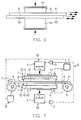
- FIG. 7 illustrates a specific embodiment of a device D for friction welding, for example two plate-shaped or foil-shaped bodies K1, K2.
- the device D has a machine frame, not shown, in which plate-shaped Positioning parts E1 and E2 are arranged so as to be adjustable relative to one another.
- the Positioning part E1 is acted upon by a pressing device G1, for example one Hydraulic cylinder 2, which has a valve device 3 in terms of pressure and Hubs is controllable.
- the positioning part E2 is similarly by a pressing device G2 acted upon, namely a hydraulic cylinder 2 and a control device 3.
- One of the two positioning parts E1, E2 could be stationary in the device D be stored.
- the positioning part E1, E2 positions a grain K1 or K2 such that the two connecting surfaces V1, V2 face each other, but face each other do not touch.
- the connecting surfaces V1, V2 provided as a hard, elastic or flexible band 4 friction element R.
- a drive M is used to move the friction element R in the direction of the arrow T. provided that e.g. interacts with a winding drive 5, 6 of the belt 4.
- the Volume 4 is finite and wound onto the two winding cores of the winding drive 5, 6.
- the friction element R has the activation surfaces A1, A1, which under the contact pressure generated by the cylinders 2 bear on the connecting surfaces V1, V2.
- the connecting surfaces V1, V2 can run flat or curved because the band 4 is also able to adapt to curvatures.
- sensors S can be provided which measure temperatures, pressures, strokes or the like and transmit to a control device C.
- To the control device C are also the control valves 3 and the drive M connected.
- the connecting surfaces V1, V2 are counteracted with the contact pressure F1 the activation surfaces A1, A2 pressed.
- the width of the band 4 can be considerable be larger than the width dimension of the connecting surfaces V1, V2. It can also Band 4 may be longer than it is to fully activate the connecting surfaces V1, V2 is required. In this case, only such a large tape length is used for activation used as needed.
- the method is particularly useful for plastic bodies, namely amorphous Plastics or thermoplastics. But metals can also be used as materials are welded or material combinations made of plastic and metal. If that Process with additional heat energy introduced from outside is to take place, could be the heater H in one of the positioning parts E1 or E2 or in both to be built in.
- the bodies can be solid or have cavities. Different materials or materials with different ones can be used Welding properties friction welding, especially in that the parameters that play a role in activating the respective connection surface, within a wide range can be individually varied.
Landscapes
- Engineering & Computer Science (AREA)
- Mechanical Engineering (AREA)
- Physics & Mathematics (AREA)
- Thermal Sciences (AREA)
- Fluid Mechanics (AREA)
- Lining Or Joining Of Plastics Or The Like (AREA)
- Pressure Welding/Diffusion-Bonding (AREA)
Applications Claiming Priority (2)
| Application Number | Priority Date | Filing Date | Title |
|---|---|---|---|
| DE1999124252 DE19924252A1 (de) | 1999-05-27 | 1999-05-27 | Verfahren und Vorrichtung zum Reibschweißverbinden |
| DE19924252 | 1999-05-27 |
Publications (1)
| Publication Number | Publication Date |
|---|---|
| EP1057571A1 true EP1057571A1 (fr) | 2000-12-06 |
Family
ID=7909327
Family Applications (1)
| Application Number | Title | Priority Date | Filing Date |
|---|---|---|---|
| EP20000110383 Withdrawn EP1057571A1 (fr) | 1999-05-27 | 2000-05-15 | Procédé et dispositif de soudage par friction |
Country Status (2)
| Country | Link |
|---|---|
| EP (1) | EP1057571A1 (fr) |
| DE (1) | DE19924252A1 (fr) |
Citations (2)
| Publication number | Priority date | Publication date | Assignee | Title |
|---|---|---|---|---|
| US3970491A (en) * | 1973-12-21 | 1976-07-20 | N.V. Technische Maatschappij Marchand-Andriessen | Method for mutually connecting two strips of a thermoplastic material |
| DE19731638A1 (de) * | 1997-07-23 | 1999-01-28 | Andreas Schaaf | Neuartiges Verfahren zur Herstellung punktförmiger Schweißverbindungen mittels eines Reibbolzens |
Family Cites Families (2)
| Publication number | Priority date | Publication date | Assignee | Title |
|---|---|---|---|---|
| DE19746812A1 (de) * | 1997-10-23 | 1999-04-29 | Burkhard Prof Dr Dr Suthoff | Preßreibschweißverfahren zur Herstellung von linienförmigen Schweißverbindungen mittels eines Reibkörpers |
| DE19747846A1 (de) * | 1997-10-30 | 1999-05-06 | Daimler Benz Ag | Bauelement und Verfahren zum Herstellen des Bauelements |
-
1999
- 1999-05-27 DE DE1999124252 patent/DE19924252A1/de not_active Withdrawn
-
2000
- 2000-05-15 EP EP20000110383 patent/EP1057571A1/fr not_active Withdrawn
Patent Citations (2)
| Publication number | Priority date | Publication date | Assignee | Title |
|---|---|---|---|---|
| US3970491A (en) * | 1973-12-21 | 1976-07-20 | N.V. Technische Maatschappij Marchand-Andriessen | Method for mutually connecting two strips of a thermoplastic material |
| DE19731638A1 (de) * | 1997-07-23 | 1999-01-28 | Andreas Schaaf | Neuartiges Verfahren zur Herstellung punktförmiger Schweißverbindungen mittels eines Reibbolzens |
Also Published As
| Publication number | Publication date |
|---|---|
| DE19924252A1 (de) | 2000-11-30 |
Similar Documents
| Publication | Publication Date | Title |
|---|---|---|
| DE60216550T2 (de) | Bahngeschwindigkeitsmodulator | |
| EP1492672B1 (fr) | Dispositif et procede de production de materiaux composites | |
| DE3818512A1 (de) | Verfahren zum beleimen und beloten eines metallischen katalysator-traegerkoerpers und zugehoerige vorrichtung | |
| DE60015303T2 (de) | Vorrichtung und verfahren zum herstellen von taschenfederanordnungen | |
| DE102004039684B4 (de) | Vorrichtung zur Aufbringung einer Leitpaste auf eine gekrümmte Harzglasscheibe | |
| EP2412501B1 (fr) | Dispositif destiné au revêtement de pièces à usiner | |
| EP0559610B1 (fr) | Dispositif automatique de soudage pour souder des éléments de grande surface en matière plastique | |
| DE69300198T2 (de) | Positioniervorrichtung für Blechtafeln in einer Schweisseinrichtung zum kontinuierlichen Stumpfschweissen dieser Blechtafeln. | |
| DE1479770B2 (de) | Vorrichtung zum waermeimpulsschweissen von uebereinander liegenden folien aus thermoplastischem kunststoff | |
| DE102007035780B4 (de) | Verfahren zum Herstellen einer faltbaren Platte | |
| EP2023750A1 (fr) | Dispositif pour coller l'enveloppe d'une ligne infinie de matériau de filtre | |
| WO2004076142A2 (fr) | Presse et procede de production de panneaux | |
| EP1199108B1 (fr) | Arrangement de buses, dispositif d'application et méthode d'application | |
| EP1057571A1 (fr) | Procédé et dispositif de soudage par friction | |
| EP1632347A1 (fr) | Méthode et appareil pour relier des matériaux plats | |
| DE19709864C2 (de) | Vorrichtung zum Vergüten von Kantenflächen an Werkstücken aus Spanplattenmaterial | |
| DE29912490U1 (de) | Rotative Ultraschall-Schweißvorrichtung | |
| EP4039474B1 (fr) | Bande de transport pour installation de contrecollage, procédé de fabrication d'une bande de transport et installation de contrecollage | |
| DE69523941T2 (de) | Verfahren und vorrichtung zum formen von blechmaterial | |
| EP0968771B1 (fr) | Procédé et appareil pour appliquer une force à un object sans le toucher | |
| DE102015206130B3 (de) | Verfahren, Vorrichtung und System zur Herstellung von Schichtholz | |
| DE19821482A1 (de) | Werkzeug zur Herstellung strukturierter dünner Bleche | |
| DE102007053217B4 (de) | Haftverschlussteil | |
| DE102019120273B4 (de) | Verfahren zur Herstellung eines verbindungsnahtfreien, umfangsgeschlossenen Ringbandes | |
| DE3020180A1 (de) | Verfahren zur herstellung eines reliefs auf der glasur einer fliese und vorrichtung zur durchfuehrung des verfahrens |
Legal Events
| Date | Code | Title | Description |
|---|---|---|---|
| PUAI | Public reference made under article 153(3) epc to a published international application that has entered the european phase |
Free format text: ORIGINAL CODE: 0009012 |
|
| AK | Designated contracting states |
Kind code of ref document: A1 Designated state(s): ES FR GB IT |
|
| AX | Request for extension of the european patent |
Free format text: AL;LT;LV;MK;RO;SI |
|
| 17P | Request for examination filed |
Effective date: 20010528 |
|
| AKX | Designation fees paid |
Free format text: ES FR GB IT |
|
| STAA | Information on the status of an ep patent application or granted ep patent |
Free format text: STATUS: THE APPLICATION IS DEEMED TO BE WITHDRAWN |
|
| 18D | Application deemed to be withdrawn |
Effective date: 20031202 |
|
| REG | Reference to a national code |
Ref country code: DE Ref legal event code: 8566 |