EP1058005A2 - Membrane de pompe en polymère fluoré avec tige de piston integrée - Google Patents
Membrane de pompe en polymère fluoré avec tige de piston integrée Download PDFInfo
- Publication number
- EP1058005A2 EP1058005A2 EP00111751A EP00111751A EP1058005A2 EP 1058005 A2 EP1058005 A2 EP 1058005A2 EP 00111751 A EP00111751 A EP 00111751A EP 00111751 A EP00111751 A EP 00111751A EP 1058005 A2 EP1058005 A2 EP 1058005A2
- Authority
- EP
- European Patent Office
- Prior art keywords
- layer
- stud
- diaphragm
- recess
- ptfe
- Prior art date
- Legal status (The legal status is an assumption and is not a legal conclusion. Google has not performed a legal analysis and makes no representation as to the accuracy of the status listed.)
- Withdrawn
Links
- 229920002313 fluoropolymer Polymers 0.000 title claims description 8
- 239000004811 fluoropolymer Substances 0.000 title claims description 8
- 229920001343 polytetrafluoroethylene Polymers 0.000 claims abstract description 131
- 238000000034 method Methods 0.000 claims abstract description 41
- 238000011065 in-situ storage Methods 0.000 claims abstract description 22
- 239000002131 composite material Substances 0.000 claims abstract description 20
- 239000000853 adhesive Substances 0.000 claims abstract description 18
- 230000001070 adhesive effect Effects 0.000 claims abstract description 18
- 238000003466 welding Methods 0.000 claims abstract description 17
- 238000003825 pressing Methods 0.000 claims abstract description 8
- 239000004810 polytetrafluoroethylene Substances 0.000 claims description 123
- 238000000465 moulding Methods 0.000 claims description 28
- -1 polytetrafluoroethylene Polymers 0.000 claims description 26
- 238000004519 manufacturing process Methods 0.000 claims description 23
- 229920002725 thermoplastic elastomer Polymers 0.000 claims description 18
- 238000010438 heat treatment Methods 0.000 claims description 16
- 229920001971 elastomer Polymers 0.000 claims description 15
- 238000000137 annealing Methods 0.000 claims description 12
- 238000010791 quenching Methods 0.000 claims description 12
- 239000012530 fluid Substances 0.000 claims description 10
- 230000000171 quenching effect Effects 0.000 claims description 10
- 239000000203 mixture Substances 0.000 claims description 9
- 230000013011 mating Effects 0.000 claims description 8
- 239000005060 rubber Substances 0.000 claims description 8
- 239000000806 elastomer Substances 0.000 claims description 7
- 229920001169 thermoplastic Polymers 0.000 claims description 7
- 239000004416 thermosoftening plastic Substances 0.000 claims description 7
- 238000005530 etching Methods 0.000 claims description 6
- 238000001746 injection moulding Methods 0.000 claims description 5
- 229920005989 resin Polymers 0.000 claims description 4
- 239000011347 resin Substances 0.000 claims description 4
- 239000012815 thermoplastic material Substances 0.000 claims description 4
- 229920001187 thermosetting polymer Polymers 0.000 claims description 4
- NTIZESTWPVYFNL-UHFFFAOYSA-N Methyl isobutyl ketone Chemical compound CC(C)CC(C)=O NTIZESTWPVYFNL-UHFFFAOYSA-N 0.000 claims description 3
- UIHCLUNTQKBZGK-UHFFFAOYSA-N Methyl isobutyl ketone Natural products CCC(C)C(C)=O UIHCLUNTQKBZGK-UHFFFAOYSA-N 0.000 claims description 3
- 229920001577 copolymer Polymers 0.000 claims description 3
- 229920002397 thermoplastic olefin Polymers 0.000 claims description 3
- 239000000178 monomer Substances 0.000 claims description 2
- 229920000642 polymer Polymers 0.000 claims description 2
- FZHAPNGMFPVSLP-UHFFFAOYSA-N silanamine Chemical compound [SiH3]N FZHAPNGMFPVSLP-UHFFFAOYSA-N 0.000 claims description 2
- 230000005484 gravity Effects 0.000 claims 1
- 239000010410 layer Substances 0.000 description 141
- 239000000463 material Substances 0.000 description 38
- 238000013459 approach Methods 0.000 description 13
- 238000005086 pumping Methods 0.000 description 11
- 229920003031 santoprene Polymers 0.000 description 10
- 238000003754 machining Methods 0.000 description 7
- 239000004744 fabric Substances 0.000 description 5
- PXHVJJICTQNCMI-UHFFFAOYSA-N Nickel Chemical compound [Ni] PXHVJJICTQNCMI-UHFFFAOYSA-N 0.000 description 4
- 238000010276 construction Methods 0.000 description 4
- 235000019589 hardness Nutrition 0.000 description 4
- 229910052751 metal Inorganic materials 0.000 description 4
- 239000002184 metal Substances 0.000 description 4
- 230000002787 reinforcement Effects 0.000 description 4
- XLYOFNOQVPJJNP-UHFFFAOYSA-N water Substances O XLYOFNOQVPJJNP-UHFFFAOYSA-N 0.000 description 4
- 229920002943 EPDM rubber Polymers 0.000 description 3
- DGAQECJNVWCQMB-PUAWFVPOSA-M Ilexoside XXIX Chemical compound C[C@@H]1CC[C@@]2(CC[C@@]3(C(=CC[C@H]4[C@]3(CC[C@@H]5[C@@]4(CC[C@@H](C5(C)C)OS(=O)(=O)[O-])C)C)[C@@H]2[C@]1(C)O)C)C(=O)O[C@H]6[C@@H]([C@H]([C@@H]([C@H](O6)CO)O)O)O.[Na+] DGAQECJNVWCQMB-PUAWFVPOSA-M 0.000 description 3
- 239000004743 Polypropylene Substances 0.000 description 3
- 239000007769 metal material Substances 0.000 description 3
- 229920001155 polypropylene Polymers 0.000 description 3
- 229910052708 sodium Inorganic materials 0.000 description 3
- 239000011734 sodium Substances 0.000 description 3
- 239000004962 Polyamide-imide Substances 0.000 description 2
- 229910000831 Steel Inorganic materials 0.000 description 2
- 239000007767 bonding agent Substances 0.000 description 2
- 239000000919 ceramic Substances 0.000 description 2
- 238000011109 contamination Methods 0.000 description 2
- 238000005260 corrosion Methods 0.000 description 2
- 230000007797 corrosion Effects 0.000 description 2
- 238000006073 displacement reaction Methods 0.000 description 2
- 230000002401 inhibitory effect Effects 0.000 description 2
- 238000010128 melt processing Methods 0.000 description 2
- 229910052759 nickel Inorganic materials 0.000 description 2
- 239000004033 plastic Substances 0.000 description 2
- 229920003023 plastic Polymers 0.000 description 2
- 238000007747 plating Methods 0.000 description 2
- 229920002312 polyamide-imide Polymers 0.000 description 2
- 238000012545 processing Methods 0.000 description 2
- 239000007787 solid Substances 0.000 description 2
- 239000010959 steel Substances 0.000 description 2
- 239000000126 substance Substances 0.000 description 2
- 239000002699 waste material Substances 0.000 description 2
- ROGIWVXWXZRRMZ-UHFFFAOYSA-N 2-methylbuta-1,3-diene;styrene Chemical compound CC(=C)C=C.C=CC1=CC=CC=C1 ROGIWVXWXZRRMZ-UHFFFAOYSA-N 0.000 description 1
- 229920000049 Carbon (fiber) Polymers 0.000 description 1
- 229920000271 Kevlar® Polymers 0.000 description 1
- UFWIBTONFRDIAS-UHFFFAOYSA-N Naphthalene Chemical compound C1=CC=CC2=CC=CC=C21 UFWIBTONFRDIAS-UHFFFAOYSA-N 0.000 description 1
- 239000004677 Nylon Substances 0.000 description 1
- 239000004696 Poly ether ether ketone Substances 0.000 description 1
- 239000004952 Polyamide Substances 0.000 description 1
- 239000004642 Polyimide Substances 0.000 description 1
- 238000005299 abrasion Methods 0.000 description 1
- 239000002253 acid Substances 0.000 description 1
- 150000007513 acids Chemical class 0.000 description 1
- 238000007792 addition Methods 0.000 description 1
- 239000003513 alkali Substances 0.000 description 1
- 239000000956 alloy Substances 0.000 description 1
- 229910045601 alloy Inorganic materials 0.000 description 1
- 229910052782 aluminium Inorganic materials 0.000 description 1
- XAGFODPZIPBFFR-UHFFFAOYSA-N aluminium Chemical compound [Al] XAGFODPZIPBFFR-UHFFFAOYSA-N 0.000 description 1
- 239000002585 base Substances 0.000 description 1
- JUPQTSLXMOCDHR-UHFFFAOYSA-N benzene-1,4-diol;bis(4-fluorophenyl)methanone Chemical compound OC1=CC=C(O)C=C1.C1=CC(F)=CC=C1C(=O)C1=CC=C(F)C=C1 JUPQTSLXMOCDHR-UHFFFAOYSA-N 0.000 description 1
- 238000005219 brazing Methods 0.000 description 1
- DQXBYHZEEUGOBF-UHFFFAOYSA-N but-3-enoic acid;ethene Chemical group C=C.OC(=O)CC=C DQXBYHZEEUGOBF-UHFFFAOYSA-N 0.000 description 1
- 239000004917 carbon fiber Substances 0.000 description 1
- 230000006835 compression Effects 0.000 description 1
- 238000007906 compression Methods 0.000 description 1
- 238000001816 cooling Methods 0.000 description 1
- 238000005336 cracking Methods 0.000 description 1
- 230000032798 delamination Effects 0.000 description 1
- 230000001419 dependent effect Effects 0.000 description 1
- 230000000694 effects Effects 0.000 description 1
- HQQADJVZYDDRJT-UHFFFAOYSA-N ethene;prop-1-ene Chemical group C=C.CC=C HQQADJVZYDDRJT-UHFFFAOYSA-N 0.000 description 1
- 229920001038 ethylene copolymer Polymers 0.000 description 1
- 239000000835 fiber Substances 0.000 description 1
- 230000035784 germination Effects 0.000 description 1
- 231100001261 hazardous Toxicity 0.000 description 1
- 238000002347 injection Methods 0.000 description 1
- 239000007924 injection Substances 0.000 description 1
- 238000009434 installation Methods 0.000 description 1
- 238000005495 investment casting Methods 0.000 description 1
- 229920003049 isoprene rubber Polymers 0.000 description 1
- 239000007788 liquid Substances 0.000 description 1
- 150000002739 metals Chemical class 0.000 description 1
- VNWKTOKETHGBQD-UHFFFAOYSA-N methane Chemical compound C VNWKTOKETHGBQD-UHFFFAOYSA-N 0.000 description 1
- 238000012986 modification Methods 0.000 description 1
- 230000004048 modification Effects 0.000 description 1
- 229920001778 nylon Polymers 0.000 description 1
- 230000002093 peripheral effect Effects 0.000 description 1
- 229920002647 polyamide Polymers 0.000 description 1
- 229920002530 polyetherether ketone Polymers 0.000 description 1
- 229920001721 polyimide Polymers 0.000 description 1
- 229920000098 polyolefin Polymers 0.000 description 1
- 239000002990 reinforced plastic Substances 0.000 description 1
- 230000003014 reinforcing effect Effects 0.000 description 1
- 239000002356 single layer Substances 0.000 description 1
- 239000002002 slurry Substances 0.000 description 1
- 229920003048 styrene butadiene rubber Polymers 0.000 description 1
- 229920001897 terpolymer Polymers 0.000 description 1
- 238000012546 transfer Methods 0.000 description 1
Images





Classifications
-
- F—MECHANICAL ENGINEERING; LIGHTING; HEATING; WEAPONS; BLASTING
- F04—POSITIVE - DISPLACEMENT MACHINES FOR LIQUIDS; PUMPS FOR LIQUIDS OR ELASTIC FLUIDS
- F04B—POSITIVE-DISPLACEMENT MACHINES FOR LIQUIDS; PUMPS
- F04B43/00—Machines, pumps, or pumping installations having flexible working members
- F04B43/0009—Special features
- F04B43/0054—Special features particularities of the flexible members
-
- F—MECHANICAL ENGINEERING; LIGHTING; HEATING; WEAPONS; BLASTING
- F05—INDEXING SCHEMES RELATING TO ENGINES OR PUMPS IN VARIOUS SUBCLASSES OF CLASSES F01-F04
- F05C—INDEXING SCHEME RELATING TO MATERIALS, MATERIAL PROPERTIES OR MATERIAL CHARACTERISTICS FOR MACHINES, ENGINES OR PUMPS OTHER THAN NON-POSITIVE-DISPLACEMENT MACHINES OR ENGINES
- F05C2225/00—Synthetic polymers, e.g. plastics; Rubber
- F05C2225/04—PTFE [PolyTetraFluorEthylene]
Definitions
- This invention relates to diaphragms for use in pumps and valves, a method of fabricating a diaphragm, a stud for use in a diaphragm, a composite diaphragm, and a mehtod of fabricating a composite diaphragm.
- Diaphragm pumps are used in pumping a wide variety of materials especially when the materials are abrasive, have high viscosity, or consist of slurries that might damage other pump designs. These pumps are often air driven which is advantageous in pumping flammable liquids or in environments where electrically driven equipment could otherwise be hazardous. However, electrically or otherwise mechanically driven designs also find wide utility. Due to the wide range of different materials these pumps are used to move, a correspondingly wide variety of materials are used in the pump construction. These include plastics and metals. For the same reason the critical driving member, i.e., the pump diaphragm, typically must be manufactured from a variety of materials.
- Chemically resistant layers such as those made of polytetrafluoroethylene (PTFE) are widely used in industry to protect sensitive parts of machinery or equipment from the corrosive effects of acids or other chemicals.
- PTFE polytetrafluoroethylene
- One such use is in two piece pump diaphragms commonly used with air or electrically driven diaphragm pumps.
- an outer PTFE overlay diaphragm is commonly used to protect an inner rubber diaphragm from materials that would cause rapid failure of the rubber part alone.
- the PTFE provides the sole material of construction of the diaphragm.
- a diaphragm having a centrally disposed stud instead of an aperture, for securing the diaphragm to the operative portion of the pump.
- These studs are generally fastened to the diaphragms mechanically, such as by passing the stud through a central aperture of the diaphragm and securing it by threaded fasteners, etc.
- This approach tends to provide a working face of the diaphragm that is uneven.
- the hole in the center of the diaphragm through which the shaft extends is a potential source of leakage and the fastener and/or washer presents a geometry which is difficult to clean for sanitary applications, such as food processing.
- this construction provides crevices and the like between the stud (and/or fastener) and the diaphragm which tend to collect the pumped material and also provides points of germination for corrosion and abrasion, etc.
- One technique for providing such an integrated stud has been to bond the stud directly to the PTFE diaphragm.
- Such techniques have generally been unsatisfactory due to the difficulty of forming a secure bond to PTFE.
- Another approach has been to mold the stud in-situ with the PTFE diaphragm, and subsequently use machining techniques to provide the diaphragm with the requisite physical dimensions. While this approach may be satisfactory when fabricating diaphragms of relatively small sizes, i.e. less than approximately 2 inches (5 cm) in diameter, this approach has generally been undesirable for use with larger sized diaphragms due to the amount of material waste and relatively high manufacturing costs associated with the machining techniques. Moreover, it is generally difficult to produce large thin molded shapes having relatively large surface area and desired material density without cracks.
- the invention provides a diaphragm including a solid polytetrafluoroethylene layer and an integral attachment stud.
- a diaphragm including a solid polytetrafluoroethylene layer and an integral attachment stud.
- a diaphragm includes:
- a method of fabricating a diaphragm includes the steps of:
- a method of fabricating a diaphragm includes the steps of
- a stud for use in a diaphragm having a layer of polytetrafluoroethylene with a face surface and a backing surface, the face surface being adapted to operatively engage a fluid.
- the stud includes:
- a composite diaphragm includes:
- a method of fabricating a composite diaphragm includes the steps of:
- an embodiment of the present invention includes a pump diaphragm 10 having a layer 12 fabricated from polytetrafluoroethylene (PTFE) and an integral stud 16.
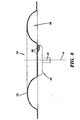
- a portion of the stud 16 is encapsulated within a hub 23 (see Fig. 5) fabricated from PTFE and fastened to the PTFE layer 12 with adhesive or welding, etc., as shown with respect to diaphragm 10 in Fig. 8.
- the stud i.e., 16 or 16'
- the stud may be molded in-situ with the PTFE layer using various methodology, such as shown, for example, with respect to diaphragm 110 in Fig.
- PTFE layer 12 then may be subjected to various additional operations to provide the diaphragm with desired dimensions and/or properties.
- an'additional layer or layers, such as an elastomeric layer 14 may be laminated onto an inside surface 17 of PTFE layer 12 to provide a composite pump diaphragm 110.
- axial shall refer to a direction substantially parallel to central axis a of the diaphragms 10, 110, 210 and 310 of the present invention and components thereof as shown in Figs. 1, 4, 8, 10, 15 and 18.
- diaphragms 10 and 110 are generally disk shaped devices which may be provided with substantially any geometry desired for a particular pump application.
- the diaphragm has a substantially circular perimeter 15 of predetermined diameter, with a central stud 16 adapted for engagement with a pump (not shown).
- the diaphragm may also include an annular, concavo-convex flexure or displacement portion 18. This flexure portion 18 of the diaphragm is that portion of the diaphragm which reciprocally flexes as the diaphragm is used.
- the surfaces of PTFE layer 12 are substantially smooth.
- layer 12 (and/or layer 14 if utilized) may be formed with annular or radial ribs as utilized in prior art diaphragms such as disclosed in U.S. Patent Nos. 4,238,992 (to Tuck, Jr.) and 5,349,896 (to Delaney III, et al.), both of which are fully incorporated by reference herein.
- layers 12 and 14 of diaphragm 110 are preferably bonded directly to one another in surface to surface engagement without the use of intermediate reinforcing layers such as fabric and the like.
- the present invention thus enables use of substantially smooth, unreinforced layers of PTFE and elastomer which are respectively bonded directly to one another in surface to surface engagement, as well as layers having reinforcements, as will be discussed in greater detail hereinbelow.
- smooth as used in conjunction with a layer of material, means a layer which is not provided with either annular or radially extending ribs.
- unreinforced refers to a layer of material which is neither reinforced by ribs, nor by a fabric or cloth material laminated thereto.
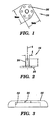
- stud 16 includes an elongated rod portion 24 having a disk or flange portion 26 disposed at one end thereof.
- Rod portion 24 may be provided with external threads 56 (Figs. 11-12), or may be formed as a hollow cylinder as shown, to facilitate use of threads (not shown) on an internal surface thereof, to fasten the stud 16 to a pump.
- Alternate configurations of rod portion 24, such as a solid cylinder and/or non cylindrical shapes may be utilized if desired.
- Rod portion 24 is fastened to disk or flange portion 26 using any convenient attachment means familiar to those skilled in the art, such as welding, brazing, and the like.
- stud 16 may be formed as an integral unit, such as by molding the rod portion 24 and flange portion 26 as a single unit, or by utilizing conventional flanging techniques to flange one end of rod portion 24 to form a suitable flange portion 26 disposed integrally thereon.
- Flange 26 may be circular, or as shown in Fig. 1, is preferably provided with a non-circular geometry such as the polygonal (hexagonal) shape as shown. This non-circular geometry helps secure stud 16 to hub 23 (Fig. 5) or to PTFE layer 12 (Fig. 10), to prevent stud 16 from rotating about its central axis a relative to the diaphragm during use and/or installation onto a pump.
- Stud 16 may be provided with any desired pre-determined dimensions.
- rod portion 24 is approximately 1.3 cm (approximately 0.5 inches) in diameter d, having a length of approximately 2.5 cm (approximately 1 inch), while disk portion 26 is provided with thickness t2 of approximately 0.5 cm (approximately 0.187 inches) and a transverse dimension w (orthogonal to axis a) within a range from a w min of approximately 4.5 cm (approximately 1.75 inches) to a w max of approximately 5 cm (approximately 2.0 inches).
- a stud 16 may be fabricated from any suitable material such as steel, aluminum, alloys, and various non-metallic materials such as carbon fiber, Kevlar®, nylon (polyamide), ceramics and reinforced and non-reinforced plastics such as PEEK, PAI (polyamideimide), PI (polyimide), composites and combinations thereof.
- suitable material such as steel, aluminum, alloys, and various non-metallic materials such as carbon fiber, Kevlar®, nylon (polyamide), ceramics and reinforced and non-reinforced plastics such as PEEK, PAI (polyamideimide), PI (polyimide), composites and combinations thereof.
- the present invention further comprises a hub housing 22 which is generally disk shaped with a central aperture 28 and recess 30 sized and shaped to receive rod portion 24 and disk portion 26, respectively, therein, with the rod portion 24 extending through aperture 28.
- Recess 30 is also sized and shaped to receive a backing plate 32 (Fig. 4), in superposed relation with disk portion 26 of the stud 16. This effectively encapsulates disk portion 26 within the hub 23 (Fig. 5).
- Hub 23, including housing 22 and backing plate 32 are fabricated from a fluoropolymer such as PTFE and/or modified PTFE to facilitate bonding or fastening to PTFE layer 12, as will be discussed hereinbelow. Housing 22 and backing plate 32 may be fabricated using any desirable manufacturing methods, including molding and/or machining techniques known to those skilled in the art.
- a peripheral lip 38 is formed in hub 23 to provide the hub with a slightly recessed concave surface 40 adapted to retain or capture adhesive therein to facilitate bonding to PTFE layer 12 as will be discussed in greater detail hereinbelow.
- Lip 38 may be formed by machining the cured stud/hub assembly 34 or alternatively, may be molded integrally with housing.22.
- stud/hub assembly 34 is fastened to inside (i.e., airside) surface 17 of PTFE diaphragm layer 12.
- PTFE diaphragm 12 may include a conventional diaphragm model number TF 63 available from Norton Performance Plastics Corporation of Elk Grove, Illinois.
- Assembly 34 may be fastened in any suitable manner to diaphragm 12.
- the stud/hub assembly 34 may be fastened to surface 17 of layer 12 by welding, i.e. by thermally fusing using heat and pressure.
- a layer of bonding material 36 such as PFA or similar adhesive material may be applied between recessed surface 40 of assembly 34 and surface 17 of the diaphragm 12, as shown in Fig. 6.
- the diaphragm and assembly 34 then may be clamped in a suitably sized and shaped mold assembly 42 under pre-determined heat and pressure as shown in Fig. 7.
- Upper and lower mold platens 44 and 46, respectively, are subsequently cooled to a pre-determined quench temperature to complete the bonding procedure to produce a completed diaphragm 10 as shown in Fig. 8.
- Both of the above-described fastening techniques, i.e. welding and bonding with adhesive 36 advantageously may be accomplished without etching surface 17 of the diaphragm layer 12.
- additional bonding materials such as MFA may be utilized, and a TFM assembly 34 may be welded to diaphragms 12 fabricated from PTFE or modified PTFE (i.e., TFM) or similar fluoropolymers.
- stud 16 may be molded in-situ within a PTFE or modified PTFE (TFM) diaphragm layer 12 such as shown in Fig. 10.
- TMF modified PTFE
- This approach may be utilized to form a diaphragm having a single layer 12 similar to diaphragm 10 of Fig. 8, or in the alternative, one or more additional layers such as layer 14 may be added to form a composite diaphragm 110 such as shown in Fig. 10, and as will be discussed in greater detail hereinbelow.
- Such PTFE diaphragms with molded-in-place studs may be fabricated by molding stud 16 in the PTFE or similar fluoropolymer material of layer 12, and subsequently machining the PTFE to form the desired diaphragm geometry.
- This approach is generally acceptable for relatively small diameter diaphragms (i.e., less than about 5cm), however, as discussed hereinabove, it may generate undesirable amounts of waste material when utilized with relatively larger diameter diaphragms.
- a preferred method of fabrication according to the present invention is to mold stud 16 in-situ with a sheet of PTFE to form a pre-mold. This pre-mold is then heat-treated or annealed in the manner set forth in commonly assigned U.S. Pat.
- the PTFE diaphragm with molded in-situ stud 16 may be provided with an additional layer 14 of a desired material.
- layer 14 may include a thermoplastic elastomer applied to inside surface 17 of PTFE layer 12 as shown in Fig. 10, in the manner described in the above-referenced '059 application.
- suitable etchants include alkali napthanates or ammonianates such as sodium ammonianate and sodium napthalene. The ammonianates are preferred etchants for use in the present invention as they have been shown to provide a better bond than the napthanates.
- a bonding agent is applied to the etched surface to the PTFE layer 12.
- a preferred bonding agent is a mixture of 2 weight percent of amino silane monomer in methyl isobutyl ketone (MIBK) such as sold under the trademark Chemlock® 487B by Lord Corporation of Erie, PA.
- Layer 14 may be substantially any thermoplastic elastomer, (thermoplastic rubber) such as styrene-butadiene -block copolymers (YSBR), styrene-isoprene rubber (YSIR), vinylacetate-ethylene copolymers (YEAM), polyolefins. (YEPM) and YAU, YEU and YACM.
- layer 14 is fabricated from a thermoplastic elastomeric blend of a thermoplastic material such as a thermoplastic polyolefin resin and a fully cured or vulcanized thermoset elastomer such as a vulcanized monoolefin co-polymer rubber.
- a thermoplastic material such as a thermoplastic polyolefin resin
- a fully cured or vulcanized thermoset elastomer such as a vulcanized monoolefin co-polymer rubber.
- the thermoplastic elastomer may include a blend of about 25 to 85 parts by weight of crystalline thermoplastic polyolefin resin and about 75 to about 15 parts by weight of vulcanized.monoolefin copolymer rubber.
- the resin is polypropylene and the rubber is EPDM rubber, in the proportions of about 25-75 parts by weight of polypropylene and about 75-25 parts by weight of EPDM rubber.
- thermoplastic rubber is a blend of EPDM (ethylene-propylene terpolymer) and a polypropylene sold under the trademark Santoprene® registered to Monsanto Company and exclusively licensed to Advanced Elastomer Systems, L.P., of St. Louis MO.
- Santoprene® thermoplastic rubber is available in several grades ranging from a durometer or hardness of 55 Shore A to 50 Shore D, having flexural moduli ranging from between 7 and 350 MPa as set forth in a technical bulletin entitled Santoprene® Thermoplastic Rubber, published by Advanced Elastomer Systems, L.P. and which is fully incorporated by reference herein.
- Preferred grades of Santoprene® thermoplastic rubber for use in the present invention range from a durometer of 73 Shore A to 40 Shore D, having flexural moduli ranging from 24 to 140 MPa, respectively.
- the thermoplastic layer 14 is mated in a superimposed manner with the etched and adhesive coated inside surface 17 of PTFE layer 12. Heat and pressure are then applied to the superimposed layers 12 and 14 to bond the layers to one another.
- the layers are preferably heated to a temperature which is near or within the conventional melt processing range of the layer 14 to facilitate forming and bonding of the material.
- a Santoprene® thermoplastic rubber having a melt processing temperature of about 193°C (about 380°F) is used
- the layers 12 and 14 are heated to a temperature of approximately 190°C to 196°C (approximately 375 to 385°F) under pressure of approximately 1.7-3.5 MPa (approximately 250-500 psi).
- the application of heat and pressure may be accomplished by clamping the layers between heated platens of a clamp or press such as shown as 44 and 46 in Fig. 7.
- the layers may be heated followed by compression in an unheated clamp or press.
- layer 14 may be formed by injection molding the thermoplastic rubber onto the etched and adhesive coated PTFE layer 12.
- This approach is particularly advantageous as it tends to provide a laminant of consistent quality nominally without air bubbles which are generally problematic in other heat/pressure formed laminates.
- the present invention facilitates use of this injection molding technique by its ability to provide adequate performance without fabric or similar reinforcements, since such reinforcement tends to complicate the injection molding process.
- the completed diaphragm 10 may be provided with any suitable physical dimensions, with PTFE layer 12 having a thickness t and thermoplastic layer 14 having a thickness t1 (Fig. 10).
- Diaphragms 10 formed as described hereinabove have been shown to be resistant to cracking and delamination. As discussed hereinabove and as shown, preferred embodiments of the present invention have substantially smooth surfaces. However, as discussed hereinabove, the diaphragms of the invention may be provided with radially, concentrically or otherwise oriented ribs or other reinforcement such as fabric, fibers, etc., as taught in the prior art.
- the composite or laminated diaphragm 110 of the present invention captures stud 16 within the PTFE layer 12 rather than within the elastomeric layer 14.
- This approach tends to transfer pumping force directly to the PTFE layer 12 and thus does not rely on the bonding and integrity of elastomeric layer 14 to retain the stud.
- This construction provides improved diaphragm life relative to studded diaphragms in which the studs are captured within the elastomeric portion of the laminate.
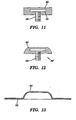
- a stud 16 may be insert molded within a block of modified PTFE (i.e., TFM) 48 as shown in Fig. 11.
- Block 48 then may be machined to provide a substantially convex surface 50 to form the stud/hub assembly 34' as shown in Fig. 12.
- block 48 may be molded with the convex surface 50 during the insert molding step, to effectively provide hub/stud assembly 34' in a single process step to nominally eliminate the need for a discreet machining operation.
- a layer 12' Fig.
- a sheet 52 of modified PTFE formed to have a central concavo-convex portion 54 sized and shaped to receivably engage convex surface 50 of hub/stud assembly 34' therein.
- Sheet 52 may include a skived sheet, a sheet sliced from a billet or a sheet formed in any other conventional manner.
- the concavo-convex portion 54 may be cold formed or formed by heating either the sheet 52 or by utilizing conventional heated tools, as will be familiar to those skilled in the art.
- hub/stud assembly 34' is receivably engaged by the concavo-convex portion 54 of sheet 52 and placed into a welding fixture 69 which serves to maintain the assembly 34' in axially compressive engagement with sheet 52.
- a hub pressure plate 58 sized and shaped to receivably engage the concavo-convex portion 54 of sheet 52 is releasably biased into engagement with the concavo-convex portion 54 by a spring 60.
- the spring 60 is in turn supported by a support 62 adjustably mounted to a frame member 64 such as by use of a threaded adjustment bolt 66.
- the upper frame rail 64 is removably fastened in any convenient manner to side and base members 67 and 68 to form the integrated welding fixture 69.
- Bolt 66 operates in a conventional manner to facilitate adjustment of the pressure exerted on pressure plate 58 by the spring 60.
- the spring 60 is utilized to maintain the concavo-convex portion 54 in axial, compressive contact with hub/stud assembly 34', while allowing for thermal expansion of the modified PTFE during welding.
- a rigid sheet 70 (preferably fabricated from a metallic material such as steel) is superimposed with the sheet 52 radially outward of the concavo-convex portion 54 to help prevent the sheet 52 from curling or becoming otherwise deformed during the welding process.
- the components in contact with the modified PTFE are preferably coated with a bond inhibiting material such as nickel plating, to substantially inhibit bonding between the modified PTFE and the metallic components.
- a bond inhibiting material such as nickel plating
- Those skilled in the art will recognize that various alternate bond inhibiting materials other than nickel plating and the like, may be utilized, particularly in the event pressure plate 58 and/or other PTFE-engaging components such as plate 70, etc. are fabricated from a non-metallic material such a ceramic or similar material.
- the sheet 52 and assembly 34' is heated, such as by placing the fixture 69 into an oven, to, or above, the gel point of the modified PTFE to weld the sheet to the assembly 34'.
- the welded modified PTFE components are then cured utilizing curing cycles common to those skilled in the art of PTFE molding.
- block 48 of assembly 34' is substantially homogeneous with the sheet 52, as shown in Fig. 15. Such homogeneity may provide substantially greater strength than adhesively fastened components.
- the assembly of Fig. 15 may be subsequently placed between mold platens 44' and 46' sized and shaped to provide sheet 52 with flexure portions 18 (Fig. 17) as discussed hereinabove.
- the assembly of Fig. 15 is then annealed by heating to about the gel point of the modified PTFE, and then molding the assembly with platens 44' and 46' to form the flexure portions 18, and then quenching. In this manner, the crystallinity of the modified PTFE is reduced to provide improved cycle life as discussed hereinabove with respect to Figs. 6 and 7.
- the resulting diaphragm 210 including layer 12' and integral stud 16 is shown in Fig. 17.
- additional layers 14 (Fig. 10) may be superposed with layer 12' in still further embodiments of the present invention.
- a studded diaphragm 310 is fabricated from a PTFE sheet 12', a stud (also referred to as an insert) 16' and optionally, a plug 90.
- Sheet 12' is substantially similar to sheet 12 described above.
- the stud 16' includes a rod portion 24' having a disk or flange portion 26' disposed at a proximal end thereof.
- Flange portion 26' includes a mating surface 72 adapted for surface to surface engagement with a portion of the sheet 12' as will be discussed hereinbelow.
- Stud 16' is preferably fabricated with a central bore 73 which extends therethrough froma distal end 76 to an aperture 78 disposed in mating surface 72.
- the bore 73 is preferably provided with interior threads 74 (shown schematically) which extend a predetermined distance from the distal end 76 thereof, for attachment to a pump (not shown).
- the portion of bore 73 disposed between the threaded portion and the aperture 78 is provided with a stepped diameter to form a recess or undercut 80 having an outer diameter dO greater than the diameter dI of the threaded portion of the bore 73 and greater than the diameter dA of aperture 78.
- diameter dA of the aperture 78 is also preferably greater than diameter dI of bore 73 to facilitate interlocked engagement with layer 12' as discussed hereinbelow.
- Stud 16' may be fabricated from any suitable material, such as metal, or preferably from a polymeric material (i.e., a thermoplastic), as also will be discussed in greater detail hereinbelow.
- Plug 90 may be fabricated from any suitable material, such as metal or a polymer.
- the plug 90 is sized and shaped for an interference fit within the bore 73, while extending axially into recess 80.
- the plug 90 is preferably sized and shaped to extend sufficiently into the recess 80 so that a surface of the plug '90 is disposed nominally flush with surface 72 of the insert 16' as shown. In this orientation, the plug 90 serves to effectively close a central portion of recess 80 to reduce the interior volume thereof to form an annular cavity 80'.
- the plug 90 is conveniently utilized to enable the stud/insert 16' to be fabricated by conventional machining processes.
- the stud 16' may be fabricated by various alternative methods, such as, for example, investment casting or molding, in which plug 90 is formed integrally therewith.
- the stud 16' is placed in a die on a platen of a press of a conventional press such as shown and described hereinabove with respect to Figs. 6 and/or 14.
- the platens of the press are preferably maintained at a predetermined temperature (i.e., the quench temperature) as discussed hereinabove, such as by conventional water cooling.
- the sheet 12' is heated to about its gel temperature and inserted into the die.
- the platens are then moved toward one another to close the die, to move the PTFE sheet into the annular recess 80'.
- the relatively cool temperature of the platens serves to solidify the PTFE to effectively form an interlocked or dovetailed arrangement to lock the stud 16' to the sheet 12' to form the diaphragm 310.
- the platens may be maintained at the quenching temperature, so that the layer 12' is effectively quenched during the attachment (i.e., molding) operation.
- the diaphragm 310 may be annealed and quenched during the process of the molding the stud in-situ with the layer 12'.
- plug 90 may be replaced with a similarly shaped, but smaller diameter pin (not shown).
- the pin may be integrated into the cavity of the die to extend axially through bore 73 and into recess 80 of the stud 16' (i.e., into the general position occupied by plug 90 as shown in Fig. 19).
- the pin may be replaced with plug 90.
- the relatively larger diameter of the plug 90 will tend to form a tight fit (i.e., an interference fit) with the sheet material formerly engaged with the pin, to provide an enhanced mechanical engagement between the sheet 12' and the stud 16'.
- the recess 80 and 80' is formed by walls which generally diverge from aperture 78, the skilled artisan should recognize that the recess may be provided with substantially any geometry capable of forming an interlocking engagement with a portion of the layer 12' disposed therein.
- the walls may be wavy or generally sinusoidal, or otherwise extend obliquely relative to the axial direction, such as may be provided by fabricating recess 80' as a plurality of bores extending divergently into the stud 16' from surface 72.
- the diaphragm 310 may be utilized as so formed, or may be subjected to further processing steps, such as to provide flexure portions 18, provide additional layers 14, or to further anneal the PTFE layer as discussed hereinabove.
- the stud 16' of this embodiment is maintained at relatively cool temperatures by the cooled platens and is exposed to the relatively high temperature gel-state PTFE for only a relatively short period of time.
- This approach thus effectively molds the stud 16' in-situ with the PTFE layer 12' without subjecting the the stud 16' to the relatively high temperatures associated with the gel state of PTFE.
- the stud 16' (and/or plug 90) to be fabricated from materials having relatively low temperature resistance, such as thermoplastics as mentioned hereinabove, for ease of manufacture and/or material cost savings.
- the use of the recessed stud 16' of this embodiment requires relatively little movement (flow) of the PTFE layer 12' during forming (molding) to provide the interlocked engagement.
- plug 90 further reduces the volume of PTFE required to flow into the recess to form the interlock.
- Such relatively little PTFE flow advantageously permits such engagement by heating only to the PTFE gel point (i.e., about 326 to 332° C), rather than to higher temperatures utilized for conventional molding operations.
- this embodiment enables standard PTFE sheet stock to be utilized to further simplify the manufacturing process.
- the pump diaphragms of the present invention are provided with a smooth fluid side surface without a through hole extending therethrough to substantially eliminate crevices associated therewith for improved leak, contamination and corrosion resistance relative to the prior art.
- a diaphragm 10 was fabricated substantially as shown in Figs. 1-8, with a perimeter 15 having a diameter of 25.4 cm (10 inches), a PTFE layer 12 having thickness t within a range of about 0.07 to 0.15 cm (about 0.030 to 0.60 inches) and a PTFE hub 22 having an outer diameter (OD) of 8.4 cm (3.3 inches), a recess 30 having a diameter d of 5 cm (2 inches) and a central aperture having a diameter of 1.3 cm (0.5 inches) and a backing plate 32 of 0.3 cm (1/8 inch) thickness sized to be press fit within recess 30.
- the hub clamps applied a pressure of approximately 3.45 MPa (approximately 500 pounds per square inch) to the hub assembly and co-terminus mating portion of the diaphragm 12, at a temperature of approximately 377° C (approximately 710° F).
- the remainder of the diaphragm 12 was maintained at an axial pressure of 0.35 MPa (50 pounds per square inch) at a temperature of approximately 22° C (approximately 72° F).
- the resulting diaphragm 10 was tested in a pumping application in which water was pumped at approximately 0.7 MPa (approximately 100 psi) inlet air pressure and 0.035 MPa (50 psi) water outlet backpressure at a cycle rate of approximately 100 cycles per minute.
- the diaphragm operated for at least 10 million cycles with no detachment of the stud from the diaphragm.
- a diaphragm is fabricated substantially as described in Example 1, utilizing a layer 12 fabricated from TFM. This diaphragm is tested substantially as described in Example 1 and is expected to complete at least 10 million cycles without detachment of stud 16 from the layer 12 and without rupture of the layer.
- a diaphragm is fabricated substantially as described in Example 1, with the exception that hub assembly 20 is fabricated from TFM and the hub assembly is fastened to layer 12 by welding. This diaphragm is tested in actual pumping conditions substantially as described in Example 1 and is expected to complete at least 10 million cycles without detachment of the stud from the diaphragm or rupture of the layer 12.
- a diaphragm is fabricated substantially as shown in Figs. 9 and 10, except for the omission of layer 14.
- the diaphragm has a diameter of 20 cm (7.75 inches), with PTFE layer 12 having a thickness t within a range of about 0.5-1.0 cm (about 0.2-0.4 inches) and a metallic stud 16 formed substantially as shown in Figs. 1 and 2, having a rod portion 24 of a diameter d of approximately 1.3 cm (approximately 0.5 inches) and a flange portion 26 having a thickness of about 0.5 cm (about 0.187 inches).
- the diaphragm is formed by molding the flange portion 26 of stud 16 in-situ with a sheet of PTFE.
- the PTFE sheet with the molded i n-situ stud 16 is heated to 371°C (700°F) until the PTFE is fully gelled.
- the PTFE is then quenched in a mold having desired geometry, at 18°C (65°F) and an axial pressure of about 2.0 MPa (about 300 psi).
- the diaphragm is then allowed to cure at an ambient temperature for 24 hours.
- the resulting diaphragm is tested in a pumping application substantially as described in Example 1, and is expected to operate for at least 10 million cycles with no rupture of the PTFE layer 12 or detachment of the stud 16 from layer 12.
- a diaphragm 10 was fabricated substantially as shown in Figs. 9 and 10, with a perimeter 15 having a diameter of 20 cm (7.75 inches) a PTFE layer 12 having a thickness t within a range of about 0.5 to 1.0 mm (about 0.03-0.04 inches) and a Santoprene® thermoplastic rubber layer 14 having a thickness t1 of 0.33 cm (.130 inches).
- a stud 16 substantially as described in Example 4 is molded in-situ in a sheet of PTFE which was subsequently heated and quenched in the manner described in Example 4 to provide a fully formed PTFE layer 12. The layer 12 was then etched and coated with Chemlock 487B and mated with layer 14.
- the layers 12 and 14 were heated from 176-204°C (350 to 400°F), maintained at this temperature for between 2 and 10 minutes and axially compressed at between 3.4 and 5.2 MPa (500-750 psi).
- the diaphragm was then allowed to cure at an ambient temperature for 24 hours.
- the resulting diaphragm 10 was tested in a pumping application in which water within a range of from 40.6 to 44.4°C (105 to 112°F) was pumped at between 0.66 and 0.70 MPa (96 and 102 psi) at a cycle rate of 340 to 375 cycles per minute.
- the diaphragm operated for 15 million cycles with no rupture of the PTFE layer or detachment of the stud 16 from layer 12.
- a diaphragm 10 was fabricated substantially as shown in Figs. 9 and 10, with perimeter 17 having a diameter of approximately 20. 6 cm (approximately 8.125 inches), PTFE layer 12 having a thickness t of 0.7 mm (0.030) inches), and Santoprene® layer 14 having a thickness of 0.28 cm (0.110 inches).
- a stud 16 substantially as described in Example 4 is molded in-situ in a sheet of PTFE which was subsequently heated and quenched in the manner described in Example 4, to provide a fully formed PTFE layer 12. The layer 12 was then etched with sodium ammonianate and coated with Chemlock 487B.
- a layer 14 was then injection molded onto layer 12 at a temperature within a range of about 190°C to 196°C (about 375 to 385°F)at a conventional injection molding pressure.
- the layers were cured at an ambient temperature for 24 hours. This diaphragm was tested in actual pumping conditions substantially as described in Example 1 and completed 15 million cycles without rupture of the PTFE layer.
- diaphragms were fabricated substantially as described in Example 6, utilizing black and naturally pigmented Santoprene®. materials of Shore 73A, 80A and 87A hardnesses (i.e. Santoprene® 101-73A, 101-80A, 101-87A, 201-73A, 201-80A and 201-87A, respectively). These diaphragms were tested in actual pumping conditions substantially as described in Example 1 and completed at least 15,000,000 cycles without rupture of the PTFE layer.
- Two diaphragms 10 were fabricated substantially as described in Example 6, with a layer 14 fabricated from Santoprene® 203-40D (naturally pigmented with a hardness of 40 Shore D) and 271-40D (food grade material with a hardness of 40 Shore D). These diaphragms were tested in actual pumping conditions substantially as described in Example 1 and completed at least 20,000,000 cycles with no rupture of the PTFE layer.
- a diaphragm 10 is fabricated substantially as described in Example 6 with a perimeter 17 having a diameter of approximately 30.5 cm (approximately 12 inches). This diaphragm is expected to complete at least 10,000,000 cycles in actual pumping conditions without rupture of the PTFE layer.
- a diaphragm 210 was fabricated substantially as shown in Figs. 11-17, utilizing a modified PTFE known as Dyneon TFM 1600 and having a perimeter 17 of approximately 20cm, a thickness t of about 1mm and a thickness t2 of approximately 5mm.
- a stud 16 was molded in-situ with a modified PTFE block 48 according to parameters substantially as described in example 4. The diaphragm was subsequently quenched substantially as described in example 4. This diaphragm operated successfully for over 5,000,000 cycles with no detachment of the stud from the diaphragm.
- a diaphragm 310 was fabricated substantially as shown in Figs. 18 and 19, utilizing a PTFE layer 12' and an insert 16'.
- the insert was machined from metal stock and provided with an axial dimension of 0.904 cm (0.356 in) in a bore diameter dI of 0.343 cm (0.135 in), an annular recess diameter dO of 0.701 cm (0.276 in).
- the axial distance between the recess and mating surface 72 was 0.063 cm (0.025 in) and the axial depth of the threads in the bore was 0.627 cm (0.247 in).
- the plug 90 had a diameter of 0.3442 cm (0.1355 in) and an axial dimension of 0.165 cm (0.065 in).
- the PTFE layer had a thickness t of about 1cm.
- the stud 16' was fastened to the PTFE layer using a press substantially as described with respect to Figs. 18 and 19. This diaphragm operated successfully for over 5,000,000 cycles with no detachment of the stud from the diaphragm.
Landscapes
- Engineering & Computer Science (AREA)
- Mechanical Engineering (AREA)
- General Engineering & Computer Science (AREA)
- Diaphragms And Bellows (AREA)
- Laminated Bodies (AREA)
- Reciprocating Pumps (AREA)
Applications Claiming Priority (2)
| Application Number | Priority Date | Filing Date | Title |
|---|---|---|---|
| US325114 | 1999-06-03 | ||
| US09/325,114 US6230609B1 (en) | 1999-06-03 | 1999-06-03 | Fluoropolymer diaphragm with integral attachment device |
Publications (2)
| Publication Number | Publication Date |
|---|---|
| EP1058005A2 true EP1058005A2 (fr) | 2000-12-06 |
| EP1058005A3 EP1058005A3 (fr) | 2001-10-17 |
Family
ID=23266507
Family Applications (1)
| Application Number | Title | Priority Date | Filing Date |
|---|---|---|---|
| EP00111751A Withdrawn EP1058005A3 (fr) | 1999-06-03 | 2000-06-02 | Membrane de pompe en polymère fluoré avec tige de piston integrée |
Country Status (3)
| Country | Link |
|---|---|
| US (1) | US6230609B1 (fr) |
| EP (1) | EP1058005A3 (fr) |
| CA (1) | CA2309567C (fr) |
Cited By (6)
| Publication number | Priority date | Publication date | Assignee | Title |
|---|---|---|---|---|
| EP1128065A3 (fr) * | 2000-02-22 | 2003-09-17 | Kabushiki Kaisha Toyota Jidoshokki | Application d'un revêtement lubrifiant sur un plateau en biais d'un compresseur |
| EP1518656A1 (fr) * | 2003-09-26 | 2005-03-30 | Edo Giardini | Procédé de fabrication d'une membrane pour dispositifs de contrôle d'un fluide, et membrane fabriquée selon ce procédé |
| WO2011103890A1 (fr) * | 2010-02-27 | 2011-09-01 | Knf Neuberger Gmbh | Pompe à membrane |
| EP3382238A1 (fr) * | 2017-03-31 | 2018-10-03 | Gemü Gebr. Müller Apparatebau Gmbh & Co. Kommanditgesellschaf | Membrane et son procédé de fabrication |
| CN109367145A (zh) * | 2018-08-16 | 2019-02-22 | 西安航天动力研究所 | 一种储能器用隔膜及其制造方法 |
| EP4714627A1 (fr) * | 2024-09-20 | 2026-03-25 | Chromalloy Gas Turbine LLC | Procédé de formation d'un composant |
Families Citing this family (33)
| Publication number | Priority date | Publication date | Assignee | Title |
|---|---|---|---|---|
| US6553988B1 (en) * | 2000-06-09 | 2003-04-29 | Norton Healthcare, Inc. | Medicament dispensing device with a multimaterial diaphragm bounding a pneumatic force chamber |
| US6901960B2 (en) * | 2002-09-06 | 2005-06-07 | Ingersoll-Rand Company | Double diaphragm pump including spool valve air motor |
| US6865981B2 (en) * | 2003-03-11 | 2005-03-15 | Ingersoll-Rand Company | Method of producing a pump |
| US6883417B2 (en) * | 2003-03-19 | 2005-04-26 | Ingersoll-Rand Company | Connecting configuration for a diaphragm in a diaphragm pump |
| US7267726B2 (en) * | 2003-04-22 | 2007-09-11 | Texas Instruments Incorporated | Method and apparatus for removing polymer residue from semiconductor wafer edge and back side |
| US7063304B2 (en) * | 2003-07-11 | 2006-06-20 | Entegris, Inc. | Extended stroke valve and diaphragm |
| DE102004042578A1 (de) * | 2004-09-02 | 2006-03-23 | Roche Diagnostics Gmbh | Mikropumpe zur Förderung von Flüssigkeiten mit niedrigen Förderraten im Druck/Saug-Betrieb |
| US7451690B2 (en) * | 2005-07-20 | 2008-11-18 | Wabco Gmbh | Spring-actuated air-brake cylinder for vehicle brake systems |
| US20070134112A1 (en) * | 2005-12-14 | 2007-06-14 | Hupp Evan L | Button diaphragm piston pump |
| DE102006013084B4 (de) * | 2006-03-20 | 2012-09-20 | Zf Friedrichshafen Ag | Hydraulisch dämpfendes Elastomerlager |
| CN104382691B (zh) | 2007-11-21 | 2018-08-31 | 史密夫及内修公开有限公司 | 伤口包敷物 |
| GB0723855D0 (en) | 2007-12-06 | 2008-01-16 | Smith & Nephew | Apparatus and method for wound volume measurement |
| CH699668A1 (de) * | 2008-10-09 | 2010-04-15 | Kistler Holding Ag | Sensormembrane. |
| US8496451B2 (en) * | 2010-06-21 | 2013-07-30 | Wilden Pump And Engineering Llc | Pump diaphragm |
| GB201015656D0 (en) | 2010-09-20 | 2010-10-27 | Smith & Nephew | Pressure control apparatus |
| EP2704767A1 (fr) * | 2011-05-06 | 2014-03-12 | Sanofi-Aventis Deutschland GmbH | Géométrie de robinet flexible pour l'utilisation de matériaux rigides |
| US9067003B2 (en) | 2011-05-26 | 2015-06-30 | Kalypto Medical, Inc. | Method for providing negative pressure to a negative pressure wound therapy bandage |
| FR2977508B1 (fr) * | 2011-07-06 | 2013-08-16 | Sames Technologies | Station de nettoyage-remplissage pour moyens de projection |
| US9084845B2 (en) | 2011-11-02 | 2015-07-21 | Smith & Nephew Plc | Reduced pressure therapy apparatuses and methods of using same |
| CN104507513B (zh) | 2012-03-20 | 2017-04-12 | 史密夫及内修公开有限公司 | 基于动态占空比阈值确定的减压治疗系统的控制操作 |
| US9004881B2 (en) | 2012-04-20 | 2015-04-14 | Simmons Development, Llc | Modular fluid-driven diaphragm pump and related methods |
| US9427505B2 (en) | 2012-05-15 | 2016-08-30 | Smith & Nephew Plc | Negative pressure wound therapy apparatus |
| US9366346B2 (en) | 2014-02-28 | 2016-06-14 | Itt Manufacturing Enterprises Llc. | Valve having at least one hourglass studs for coupling to diaphragm and compressor/spindle components |
| US9932831B2 (en) | 2014-05-09 | 2018-04-03 | United Technologies Corporation | High temperature compliant metallic elements for low contact stress ceramic support |
| US10737002B2 (en) | 2014-12-22 | 2020-08-11 | Smith & Nephew Plc | Pressure sampling systems and methods for negative pressure wound therapy |
| DE102015005692A1 (de) * | 2015-05-06 | 2016-11-10 | Mann + Hummel Gmbh | Druckregelventil |
| DE102016114975A1 (de) * | 2016-08-11 | 2018-02-15 | Sed Flow Control Gmbh | Membran für ein Membranventil und Verfahren zur Herstellung derselben |
| US10422331B2 (en) * | 2016-08-12 | 2019-09-24 | Ingersoll-Rand Company | One piece diaphragm |
| US10774936B2 (en) | 2017-12-07 | 2020-09-15 | Sed Flow Control Gmbh | Diaphragm for a diaphragm valve and method for the manufacture of the diaphragm |
| DE102018008036A1 (de) | 2018-10-11 | 2020-04-16 | Almatec Maschinenbau Gmbh | Membranpumpe |
| DE102019106370A1 (de) | 2019-03-13 | 2020-09-17 | Psg Germany Gmbh | Ventilanordnungen für eine Membranpumpe, Ventilkörper eines Ventils einer Membranpumpe, Ventilplatte einer Membranpumpe, Membranpumpe, Verfahren zum Betreiben einer Membranpumpe |
| DE102024119053A1 (de) * | 2024-07-04 | 2026-01-08 | Ulman Dichtungstechnik Gmbh | Verbundmembran insbesondere für Membranpumpen |
| DE102024122239A1 (de) | 2024-08-05 | 2026-02-05 | Ulman Dichtungstechnik Gmbh | Verbundmembran sowie Verfahren zur Herstellung |
Citations (1)
| Publication number | Priority date | Publication date | Assignee | Title |
|---|---|---|---|---|
| US4130535A (en) | 1975-07-21 | 1978-12-19 | Monsanto Company | Thermoplastic vulcanizates of olefin rubber and polyolefin resin |
Family Cites Families (35)
| Publication number | Priority date | Publication date | Assignee | Title |
|---|---|---|---|---|
| US1388123A (en) | 1917-10-26 | 1921-08-16 | Paramount Rubber Cons Inc | Method of making hollow rubber articles |
| GB696545A (en) * | 1950-02-03 | 1953-09-02 | Saunders Valve Co Ltd | Improvements in flexible diaphragms |
| US2781552A (en) | 1955-10-21 | 1957-02-19 | Us Ceramic Tile Company | Process for making thin articles of polytetrafluoroethylene |
| BE572774A (fr) * | 1957-11-08 | |||
| US2948223A (en) * | 1958-01-21 | 1960-08-09 | William H Mashinter | Diaphragm type pump |
| US3026909A (en) * | 1959-03-27 | 1962-03-27 | Grinnell Corp | Reinforced diaphragm |
| GB914586A (en) * | 1960-02-11 | 1963-01-02 | Girdlestone Pumps Ltd | Improvements in or relating to diaphragms for pumps |
| US3444018A (en) | 1966-02-25 | 1969-05-13 | Uniroyal Inc | Method of mounting fastening elements on thermoplastic materials by friction welding |
| US3577850A (en) | 1968-09-26 | 1971-05-11 | Precision Sampling Corp | Method of forming seals |
| DE2815212A1 (de) * | 1978-04-08 | 1979-10-11 | Brumme Kg Effbe Werk | Membrananordnung mit einer bewegungsmembran |
| US4238992A (en) | 1978-10-30 | 1980-12-16 | Wilden Pump & Engineering Co. | Pump diaphragm |
| US4334838A (en) * | 1980-01-29 | 1982-06-15 | The Coca-Cola Company | Diaphragm type fluid pump having a flexible diaphragm with an internal reinforcing plate |
| JPS6065082A (ja) | 1983-09-21 | 1985-04-13 | Nifco Inc | スタツドのワ−クに対する固定方法 |
| JPS61160666A (ja) * | 1984-12-29 | 1986-07-21 | Nippon Valqua Ind Ltd | ダイアフラムおよびその製造方法 |
| DE3500061A1 (de) | 1985-01-03 | 1986-07-10 | Norton Pampus GmbH, 4156 Willich | Verfahren zur herstellung eines werkstoffes |
| DE3512393A1 (de) | 1985-04-17 | 1986-10-09 | KIM Production Ltd., Haifa Bay | Membranventil |
| JPS61293830A (ja) | 1985-06-21 | 1986-12-24 | Nippon Valqua Ind Ltd | ポリテトラフルオロエチレン製多孔質膜の製造方法 |
| US4989497A (en) * | 1985-08-30 | 1991-02-05 | The United States Of America As Represented By The Administrator Of The National Aeronautics And Space Administration | Flexible diaphragm-extreme temperature usage |
| JPS6328632A (ja) | 1986-07-23 | 1988-02-06 | Nifco Inc | 樹脂製回転溶着部材 |
| US4950499A (en) | 1987-01-27 | 1990-08-21 | The Foxboro Company | Method of making a compliant fluid-impermeable element |
| US4773519A (en) * | 1987-03-06 | 1988-09-27 | The Goodyear Tire & Rubber Company | Fluid actuator for brakes and clutches and method of manufacturing |
| US4757974A (en) | 1987-04-13 | 1988-07-19 | Ward Erin C | Check valve |
| US5027693A (en) | 1989-11-24 | 1991-07-02 | Allied-Signal Inc. | Combination diaphragm and valve body |
| US5049232A (en) * | 1990-08-31 | 1991-09-17 | General Electric Company | Method of making diaphragm-type pressure transducers |
| US5217797A (en) * | 1992-02-19 | 1993-06-08 | W. L. Gore & Associates, Inc. | Chemically resistant diaphragm |
| US5374473A (en) * | 1992-08-19 | 1994-12-20 | W. L. Gore & Associates, Inc. | Dense polytetrafluoroethylene articles |
| US5349896A (en) | 1993-06-14 | 1994-09-27 | W. L. Gore & Associates, Inc. | Pump diaphragm |
| JP2922768B2 (ja) | 1993-11-11 | 1999-07-26 | 株式会社ミツバ | ダイヤフラム式アクチュエータ |
| US5542300A (en) | 1994-01-24 | 1996-08-06 | Setra Systems, Inc. | Low cost, center-mounted capacitive pressure sensor |
| DE4446304A1 (de) * | 1994-12-23 | 1996-06-27 | Norton Pampus Gmbh | Membran |
| JP2726014B2 (ja) | 1995-01-06 | 1998-03-11 | 株式会社ワイ・テイ・エス | ダイヤフラム組立体及びその製造方法 |
| US5560279A (en) * | 1995-03-16 | 1996-10-01 | W. L. Gore & Associates, Inc. | Pre-failure sensing diaphragm |
| CA2180413A1 (fr) * | 1996-05-06 | 1997-11-07 | Eldon S. Eady | Plastique resistant a l'abrasion colle a un diaphragme |
| US5634391A (en) | 1996-07-09 | 1997-06-03 | Westinghouse Air Brake Co. | Inert plastic coated flexible type diaphragm for application in a sanitary type pump |
| US5687633A (en) * | 1996-07-09 | 1997-11-18 | Westinghouse Air Brake Company | Insert type member for use in a flexible type pump diaphragm |
-
1999
- 1999-06-03 US US09/325,114 patent/US6230609B1/en not_active Expired - Fee Related
-
2000
- 2000-05-26 CA CA002309567A patent/CA2309567C/fr not_active Expired - Fee Related
- 2000-06-02 EP EP00111751A patent/EP1058005A3/fr not_active Withdrawn
Patent Citations (1)
| Publication number | Priority date | Publication date | Assignee | Title |
|---|---|---|---|---|
| US4130535A (en) | 1975-07-21 | 1978-12-19 | Monsanto Company | Thermoplastic vulcanizates of olefin rubber and polyolefin resin |
Cited By (8)
| Publication number | Priority date | Publication date | Assignee | Title |
|---|---|---|---|---|
| EP1128065A3 (fr) * | 2000-02-22 | 2003-09-17 | Kabushiki Kaisha Toyota Jidoshokki | Application d'un revêtement lubrifiant sur un plateau en biais d'un compresseur |
| EP1518656A1 (fr) * | 2003-09-26 | 2005-03-30 | Edo Giardini | Procédé de fabrication d'une membrane pour dispositifs de contrôle d'un fluide, et membrane fabriquée selon ce procédé |
| WO2011103890A1 (fr) * | 2010-02-27 | 2011-09-01 | Knf Neuberger Gmbh | Pompe à membrane |
| US9057366B2 (en) | 2010-02-27 | 2015-06-16 | Knf Neuberger Gmbh | Diaphragm pump |
| EP3382238A1 (fr) * | 2017-03-31 | 2018-10-03 | Gemü Gebr. Müller Apparatebau Gmbh & Co. Kommanditgesellschaf | Membrane et son procédé de fabrication |
| US10640621B2 (en) | 2017-03-31 | 2020-05-05 | Gemue Gebr. Mueller Apparatebau Gmbh & Co. Kommanditgesellschaft | Membrane and method for producing the membrane |
| CN109367145A (zh) * | 2018-08-16 | 2019-02-22 | 西安航天动力研究所 | 一种储能器用隔膜及其制造方法 |
| EP4714627A1 (fr) * | 2024-09-20 | 2026-03-25 | Chromalloy Gas Turbine LLC | Procédé de formation d'un composant |
Also Published As
| Publication number | Publication date |
|---|---|
| US6230609B1 (en) | 2001-05-15 |
| CA2309567C (fr) | 2004-04-06 |
| CA2309567A1 (fr) | 2000-12-03 |
| EP1058005A3 (fr) | 2001-10-17 |
Similar Documents
| Publication | Publication Date | Title |
|---|---|---|
| CA2309567C (fr) | Diaphragme contenant un polymere fluore et ayant un dispositif de fixation integre | |
| US6138550A (en) | Pump diaphragm and method for making the same | |
| US6746637B1 (en) | Process for making chemical resistant pump diaphragm | |
| JP2726014B2 (ja) | ダイヤフラム組立体及びその製造方法 | |
| EP0704024B1 (fr) | Membrane de pompe | |
| US20100296896A1 (en) | Composite Sealing Device | |
| US5867900A (en) | Plastic coated valve rotor and a method of manufacturing | |
| JP6602553B2 (ja) | ダイアフラム、流体制御装置、及びダイアフラムの製造方法 | |
| TWI909063B (zh) | 流量控制閥及流量控制閥之製造方法 | |
| EP2491284B1 (fr) | Ensemble d'étanchéité | |
| US20130049266A1 (en) | Methods and apparatus for molding and curing of composites | |
| JPH07195392A (ja) | フッ素樹脂を表面材とするインサート成形体の製造法 | |
| KR101065966B1 (ko) | 성형체, 다이어프램 밸브, 다이어프램 펌프 및 성형체의 제조 방법 | |
| CN101563207A (zh) | 全氟聚合物组合物部件的制备方法 | |
| JPH0648447A (ja) | 樹脂製容器の流体給排口の構造 | |
| US20260036123A1 (en) | Composite membrane for membrane pump | |
| CN222048509U (zh) | 一种生物膜干燥模具 | |
| CN111070750B (zh) | 一种组合密封件的生产方法 | |
| US6848354B2 (en) | Unitary rod/piston assembly | |
| JP3242978B2 (ja) | コマパッキンの製造方法 | |
| KR101780232B1 (ko) | 파이프 클램프 제조방법 | |
| JP2003336744A (ja) | 構造物の製造方法 | |
| JP2002031130A (ja) | 水中軸受の製造方法 |
Legal Events
| Date | Code | Title | Description |
|---|---|---|---|
| PUAI | Public reference made under article 153(3) epc to a published international application that has entered the european phase |
Free format text: ORIGINAL CODE: 0009012 |
|
| AK | Designated contracting states |
Kind code of ref document: A2 Designated state(s): AT BE CH CY DE DK ES FI FR GB GR IE IT LI LU MC NL PT SE Kind code of ref document: A2 Designated state(s): DE FR GB |
|
| AX | Request for extension of the european patent |
Free format text: AL;LT;LV;MK;RO;SI |
|
| PUAL | Search report despatched |
Free format text: ORIGINAL CODE: 0009013 |
|
| AK | Designated contracting states |
Kind code of ref document: A3 Designated state(s): AT BE CH CY DE DK ES FI FR GB GR IE IT LI LU MC NL PT SE |
|
| AX | Request for extension of the european patent |
Free format text: AL;LT;LV;MK;RO;SI |
|
| 17P | Request for examination filed |
Effective date: 20020318 |
|
| AKX | Designation fees paid |
Free format text: DE FR GB |
|
| STAA | Information on the status of an ep patent application or granted ep patent |
Free format text: STATUS: THE APPLICATION IS DEEMED TO BE WITHDRAWN |
|
| 18D | Application deemed to be withdrawn |
Effective date: 20060725 |