EP1059066A1 - Clou intramedullaire avec vis pressant le clou contre les os corticaux, utilise lors de fractures, de pseudarthroses et de deviations de l'axe mecanique, dans les os longs non soumis a la marche - Google Patents
Clou intramedullaire avec vis pressant le clou contre les os corticaux, utilise lors de fractures, de pseudarthroses et de deviations de l'axe mecanique, dans les os longs non soumis a la marche Download PDFInfo
- Publication number
- EP1059066A1 EP1059066A1 EP99905355A EP99905355A EP1059066A1 EP 1059066 A1 EP1059066 A1 EP 1059066A1 EP 99905355 A EP99905355 A EP 99905355A EP 99905355 A EP99905355 A EP 99905355A EP 1059066 A1 EP1059066 A1 EP 1059066A1
- Authority
- EP
- European Patent Office
- Prior art keywords
- nail
- manipulator
- bone
- screws
- bones
- Prior art date
- Legal status (The legal status is an assumption and is not a legal conclusion. Google has not performed a legal analysis and makes no representation as to the accuracy of the status listed.)
- Withdrawn
Links
- 210000000988 bone and bone Anatomy 0.000 title claims abstract description 36
- 206010017076 Fracture Diseases 0.000 title claims abstract description 13
- 230000001054 cortical effect Effects 0.000 title claims abstract description 12
- 208000002607 Pseudarthrosis Diseases 0.000 title claims abstract description 8
- 238000011282 treatment Methods 0.000 claims abstract description 13
- 208000027418 Wounds and injury Diseases 0.000 abstract description 10
- 210000004872 soft tissue Anatomy 0.000 abstract description 4
- 238000001356 surgical procedure Methods 0.000 abstract description 4
- 230000006378 damage Effects 0.000 abstract description 3
- 206010052428 Wound Diseases 0.000 description 8
- 208000010392 Bone Fractures Diseases 0.000 description 4
- 210000001519 tissue Anatomy 0.000 description 3
- 230000001771 impaired effect Effects 0.000 description 2
- 230000013011 mating Effects 0.000 description 2
- 238000000034 method Methods 0.000 description 2
- 230000004936 stimulating effect Effects 0.000 description 2
- 206010031252 Osteomyelitis Diseases 0.000 description 1
- 230000003213 activating effect Effects 0.000 description 1
- 239000008280 blood Substances 0.000 description 1
- 210000004369 blood Anatomy 0.000 description 1
- 210000001185 bone marrow Anatomy 0.000 description 1
- 238000007596 consolidation process Methods 0.000 description 1
- 238000006073 displacement reaction Methods 0.000 description 1
- 239000012634 fragment Substances 0.000 description 1
- 208000015181 infectious disease Diseases 0.000 description 1
- 208000014674 injury Diseases 0.000 description 1
- 210000003205 muscle Anatomy 0.000 description 1
- 230000003387 muscular Effects 0.000 description 1
- 230000000399 orthopedic effect Effects 0.000 description 1
- 210000003460 periosteum Anatomy 0.000 description 1
- 230000002093 peripheral effect Effects 0.000 description 1
- 230000002265 prevention Effects 0.000 description 1
- 239000007787 solid Substances 0.000 description 1
- 230000006641 stabilisation Effects 0.000 description 1
- 238000011105 stabilization Methods 0.000 description 1
Images
Classifications
-
- A—HUMAN NECESSITIES
- A61—MEDICAL OR VETERINARY SCIENCE; HYGIENE
- A61B—DIAGNOSIS; SURGERY; IDENTIFICATION
- A61B17/00—Surgical instruments, devices or methods
- A61B17/56—Surgical instruments or methods for treatment of bones or joints; Devices specially adapted therefor
- A61B17/58—Surgical instruments or methods for treatment of bones or joints; Devices specially adapted therefor for osteosynthesis, e.g. bone plates, screws or setting implements
- A61B17/68—Internal fixation devices, including fasteners and spinal fixators, even if a part thereof projects from the skin
- A61B17/72—Intramedullary devices, e.g. pins or nails
-
- A—HUMAN NECESSITIES
- A61—MEDICAL OR VETERINARY SCIENCE; HYGIENE
- A61B—DIAGNOSIS; SURGERY; IDENTIFICATION
- A61B17/00—Surgical instruments, devices or methods
- A61B17/56—Surgical instruments or methods for treatment of bones or joints; Devices specially adapted therefor
- A61B17/58—Surgical instruments or methods for treatment of bones or joints; Devices specially adapted therefor for osteosynthesis, e.g. bone plates, screws or setting implements
- A61B17/88—Osteosynthesis instruments; Methods or means for implanting or extracting internal or external fixation devices
- A61B17/8872—Instruments for putting said fixation devices against or away from the bone
-
- A—HUMAN NECESSITIES
- A61—MEDICAL OR VETERINARY SCIENCE; HYGIENE
- A61B—DIAGNOSIS; SURGERY; IDENTIFICATION
- A61B17/00—Surgical instruments, devices or methods
- A61B17/56—Surgical instruments or methods for treatment of bones or joints; Devices specially adapted therefor
- A61B17/58—Surgical instruments or methods for treatment of bones or joints; Devices specially adapted therefor for osteosynthesis, e.g. bone plates, screws or setting implements
- A61B17/88—Osteosynthesis instruments; Methods or means for implanting or extracting internal or external fixation devices
-
- A—HUMAN NECESSITIES
- A61—MEDICAL OR VETERINARY SCIENCE; HYGIENE
- A61B—DIAGNOSIS; SURGERY; IDENTIFICATION
- A61B17/00—Surgical instruments, devices or methods
- A61B17/56—Surgical instruments or methods for treatment of bones or joints; Devices specially adapted therefor
- A61B17/58—Surgical instruments or methods for treatment of bones or joints; Devices specially adapted therefor for osteosynthesis, e.g. bone plates, screws or setting implements
- A61B17/88—Osteosynthesis instruments; Methods or means for implanting or extracting internal or external fixation devices
- A61B17/92—Impactors or extractors, e.g. for removing intramedullary devices
- A61B17/921—Impactors or extractors, e.g. for removing intramedullary devices for intramedullary devices
Definitions
- This invention relates to the so-called by orthopedists intramedular nails, usable in the reduction of fractures, and in the treatment of pseudoarthrosis, osteotomies and mechanical axis deviations, mainly with long, non subject to march, bones.
- plasters, non-fastening intramedular nails and plates with screws positioned on the bone surface have been used in the treatment of fractures, pseudoarthrosis, osteotomies, non-consolidated fractures, mechanical axis deviations, and the like. These procedures are prone to result in a lack of union in fractures, pseudoarthrosis or in deviations of the bone thus requiring additional surgery.
- bone infections appear due to the injury produced on the bone periosteum (blood donor for the cortical). Said infections are feared by surgeons due to sequelae and the treatment difficulties.
- the present invention has as its first object to make possible an intramedular nail that allows for the treatment of fractures, pseudoarthrosis, etc., by maintaining free of macro-movements the ends of the bone to be connected to each other, but admitting those micro-movements capable of stimulating said connection.
- Nails of the present invention are part of a system constituted by orthopedic nails and screws. Nails penetrate the medular cavity comprised by the types of bones already mentioned in the title of the invention. The stabilization of said wounds are obtained when said intramedular nail is pushed by said screws against the inner wall of the bone medular channel (corticals). Upon the pin being tightened by the screws against the corticals the movements (macro-movements) that prevent the fracture consolidation are impaired, but the micro-movements capable of activating the wounds, are permitted.
- Nails of this invention are semi-cylindrical, with a plane surface where one of the ends of each screw will be fastened. Due to the shape and special characteristics of every bone, said nails and screws are to be adapted thereto with different thicknesses, lengths and even curvatures in one or both ends.
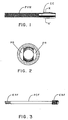
- FIGURE 1 a manipulator is shown with one end to be attached to a nail having an outer conical profile "EC” and a beveled end at the opposite end.
- the conical outer profile allows that this manipulator penetrates the soft tissues surrounding the bone at the zone where said manipulator is to be fastened to the nail. Due to the shape of this profile, upon said manipulator entering the tissues, opens them, without crushing nor cutting the same.
- Said manipulator beveled end "PVM” provides a better, slipping-free grip for the surgeon.
- Said manipulator comprises an interior longitudinal channel, of circular shape, through which a substantially elongated fastener as illustrated in FIGURE 3 is passed.
- Said fastener has an externally threaded end, with a thread tip having a diameter same as the central portion of said fastener "PCF" which is completely flat.
- the outer diameter of the central portion and the threaded end of the fastener is slightly lower than the inner diameter of the longitudinal inner channel of the manipulator, in order the threaded end and the central portion of said fastener can easily slide within the inner channel of said manipulator.
- said fastener has an outer stepped diameter, greater than the rest of said fastener, and with the surface thereof beveled, so as the surgeon is able to rotate said fastener to screw it on and out regarding said nail, without slippery risks.
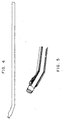
- FIGURE 4 said nail can be seen with its two straight portions at a different angle; the longer one is the portion to be housed in the medular channel of the bone under treatment, and the shorter one is that which will remain outside the bone, and to the end of which said manipulator is to be fastened.
- the transversal cross-section of said nail is generally semi-cylindrical, with a plane portion where the screws traversing the cortical of the bone under treatment, will contact; thus pushing said nail against the medular channel wall, on the portion contrary to the site where said nail enter.
- the protruding end of the nail is shorter and is at a predetermined angle.
- this end of the nail bears a central internal thread, where the fastener will be screwed to said manipulator.
- FIGURE 5 The details of the end of the nail protruding from the bone, can be seen in FIGURE 5; where both the recesses and the start of the interior thread are shown.
- said nail is fastened to the manipulator by means of the fastener.
- an incision is made distal to the wound in the bone region where said nail is to be introduced, making the incision profound down to the bone.
- An opening is carried out at the bone cortical in this point, down to the medular channel.
- the nail is introduced into said medular channel beyond the two fragments (with image magnifier when is made through closed focus, or by opening the focus of the fracture when is made through open focus) by pushing, rotating and pulling said nail, by means of said manipulator.
- Soft tissues are opened at the point where the screws that fix the nail in both bone segments are to be introduced.
- Said screws are introduced by rotating said nail so as the ends of said screws make contact with the plane portion of said nail.
- Said nail is fastened and the wounds are closed, both those of the open focus, as the case may be, and those of the screws, as well as the incision made in order to introduce said nail.
- the longitudinal dimensions of the longer portion of the nail will depend on the characteristics of the bone under treatment; when dealing with a long bone or one that requires greater support, a nail will be used with its longer portion of greater length than a nail for a shorter bone, or for one with no need to support substantial efforts.
- the angle between the longer portion of the nail and the shorter portion thereof, will depend, in every application, on the place where the fracture appears, where the incision is to be made in order to introduce said nail, and the like.
- the shorter portion will have also a variable length, depending on the thickness of the soft tissue surrounding the zone where said nail is to be introduced and on the region of the body where said zone is located.
- the fastening of the shorter end of the nail to said manipulator will be made by means of an inner fluting in said manipulator, mating outer flutings in said nail.
Landscapes
- Health & Medical Sciences (AREA)
- Orthopedic Medicine & Surgery (AREA)
- Life Sciences & Earth Sciences (AREA)
- Surgery (AREA)
- Medical Informatics (AREA)
- Engineering & Computer Science (AREA)
- Biomedical Technology (AREA)
- Heart & Thoracic Surgery (AREA)
- Nuclear Medicine, Radiotherapy & Molecular Imaging (AREA)
- Molecular Biology (AREA)
- Animal Behavior & Ethology (AREA)
- General Health & Medical Sciences (AREA)
- Public Health (AREA)
- Veterinary Medicine (AREA)
- Neurology (AREA)
- Surgical Instruments (AREA)
Applications Claiming Priority (3)
| Application Number | Priority Date | Filing Date | Title |
|---|---|---|---|
| MX9801405 | 1998-02-20 | ||
| MXPA/A/1998/001405A MXPA98001405A (en) | 1998-02-20 | Intramedular nail with screws, which press the nail against the bone corticals, used in fractures, seudoartrosis and deviations of the mechanical axis, in long bones not submitted to the sea | |
| PCT/MX1999/000005 WO1999042052A1 (fr) | 1998-02-20 | 1999-02-19 | Clou intramedullaire avec vis pressant le clou contre les os corticaux, utilise lors de fractures, de pseudarthroses et de deviations de l'axe mecanique, dans les os longs non soumis a la marche |
Publications (1)
| Publication Number | Publication Date |
|---|---|
| EP1059066A1 true EP1059066A1 (fr) | 2000-12-13 |
Family
ID=19745027
Family Applications (1)
| Application Number | Title | Priority Date | Filing Date |
|---|---|---|---|
| EP99905355A Withdrawn EP1059066A1 (fr) | 1998-02-20 | 1999-02-19 | Clou intramedullaire avec vis pressant le clou contre les os corticaux, utilise lors de fractures, de pseudarthroses et de deviations de l'axe mecanique, dans les os longs non soumis a la marche |
Country Status (3)
| Country | Link |
|---|---|
| EP (1) | EP1059066A1 (fr) |
| AU (1) | AU2551299A (fr) |
| WO (1) | WO1999042052A1 (fr) |
Family Cites Families (3)
| Publication number | Priority date | Publication date | Assignee | Title |
|---|---|---|---|---|
| DE9109883U1 (de) * | 1991-08-09 | 1991-09-26 | Howmedica GmbH, 2314 Schönkirchen | Verriegelungsnagel zur Versorgung von Femurfrakturen im mittleren und im trochanteren Bereich |
| US5429640A (en) * | 1992-11-27 | 1995-07-04 | Clemson University | Intramedullary rod for fracture fixation of femoral shaft independent of ipsilateral femoral neck fracture fixation |
| US5766174A (en) * | 1995-09-26 | 1998-06-16 | Orthologic Corporation | Intramedullary bone fixation device |
-
1999
- 1999-02-19 WO PCT/MX1999/000005 patent/WO1999042052A1/fr not_active Ceased
- 1999-02-19 AU AU25512/99A patent/AU2551299A/en not_active Abandoned
- 1999-02-19 EP EP99905355A patent/EP1059066A1/fr not_active Withdrawn
Non-Patent Citations (1)
| Title |
|---|
| See references of WO9942052A1 * |
Also Published As
| Publication number | Publication date |
|---|---|
| WO1999042052A1 (fr) | 1999-08-26 |
| AU2551299A (en) | 1999-09-06 |
Similar Documents
| Publication | Publication Date | Title |
|---|---|---|
| US6019762A (en) | Adjustable length orthopedic fixation device | |
| JP4945439B2 (ja) | 胸骨修復システム | |
| JP5878014B2 (ja) | 橈骨骨折部の骨片を内固定するための器具 | |
| US8133226B2 (en) | Intramedullary fixation device for fractures | |
| JP4468814B2 (ja) | 上腕骨の体幹近接骨折部の固定を改善するための釘とネジからなる固定システム | |
| US6273892B1 (en) | Fracture fixation system | |
| US3763855A (en) | Device for fixation of bone fractures | |
| US6660009B1 (en) | Fracture fixation system | |
| US8298273B2 (en) | Renew compression screw | |
| US7621913B2 (en) | Interlocking intramedullary nails with outer screw | |
| US4212294A (en) | Orthopedic fracture fixation device | |
| EP1175872A2 (fr) | Clou intramédullaire et vis pour le col du fémur | |
| US5683460A (en) | Intrafocal peg and method of repairing fracture | |
| US4823781A (en) | Method and apparatus for percutaneous fracture reduction and fixation | |
| JP3307805B2 (ja) | 髄内釘 | |
| JP3311660B2 (ja) | 髄内釘 | |
| US7101376B2 (en) | Interlocking IM Nails with threaded guidewire | |
| US5993450A (en) | Osteosynthesis ring usable in combination with a pin or a screw, and compressing device therefore | |
| JP3307804B2 (ja) | 髄内釘 | |
| EP1865865A1 (fr) | Broche de fixation chirurgicale | |
| WO2017166424A1 (fr) | Dispositif de fixation externe par microverrouillage destiné à traiter les fractures des os de la main ou du pied | |
| EP1059066A1 (fr) | Clou intramedullaire avec vis pressant le clou contre les os corticaux, utilise lors de fractures, de pseudarthroses et de deviations de l'axe mecanique, dans les os longs non soumis a la marche | |
| SU1710018A1 (ru) | Фиксатор дл остеосинтеза переломов шейки бедра | |
| JPH1052439A (ja) | アンカーネイル並びにアンカースクリュー及びその打ち 込み器 | |
| CN210727849U (zh) | 一种卯榫结构拼接式骨折复位加压内固定装置 |
Legal Events
| Date | Code | Title | Description |
|---|---|---|---|
| PUAI | Public reference made under article 153(3) epc to a published international application that has entered the european phase |
Free format text: ORIGINAL CODE: 0009012 |
|
| 17P | Request for examination filed |
Effective date: 20000915 |
|
| AK | Designated contracting states |
Kind code of ref document: A1 Designated state(s): CH DE ES FR GB IT LI PT |
|
| STAA | Information on the status of an ep patent application or granted ep patent |
Free format text: STATUS: THE APPLICATION IS DEEMED TO BE WITHDRAWN |
|
| 18D | Application deemed to be withdrawn |
Effective date: 20050715 |