EP1059079A2 - Stylingmittel auf Alkoholbasis mit Biochinonen - Google Patents
Stylingmittel auf Alkoholbasis mit Biochinonen Download PDFInfo
- Publication number
- EP1059079A2 EP1059079A2 EP00110941A EP00110941A EP1059079A2 EP 1059079 A2 EP1059079 A2 EP 1059079A2 EP 00110941 A EP00110941 A EP 00110941A EP 00110941 A EP00110941 A EP 00110941A EP 1059079 A2 EP1059079 A2 EP 1059079A2
- Authority
- EP
- European Patent Office
- Prior art keywords
- hair
- preparations
- acid
- derivatives
- weight
- Prior art date
- Legal status (The legal status is an assumption and is not a legal conclusion. Google has not performed a legal analysis and makes no representation as to the accuracy of the status listed.)
- Withdrawn
Links
- 0 CC(C)CC(C=C)=CCC(C)(C)C(C(C(*)=C1*)=O)=C(C)C1=O Chemical compound CC(C)CC(C=C)=CCC(C)(C)C(C(C(*)=C1*)=O)=C(C)C1=O 0.000 description 1
Classifications
-
- A—HUMAN NECESSITIES
- A61—MEDICAL OR VETERINARY SCIENCE; HYGIENE
- A61Q—SPECIFIC USE OF COSMETICS OR SIMILAR TOILETRY PREPARATIONS
- A61Q5/00—Preparations for care of the hair
-
- A—HUMAN NECESSITIES
- A61—MEDICAL OR VETERINARY SCIENCE; HYGIENE
- A61K—PREPARATIONS FOR MEDICAL, DENTAL OR TOILETRY PURPOSES
- A61K8/00—Cosmetics or similar toiletry preparations
- A61K8/18—Cosmetics or similar toiletry preparations characterised by the composition
- A61K8/30—Cosmetics or similar toiletry preparations characterised by the composition containing organic compounds
- A61K8/33—Cosmetics or similar toiletry preparations characterised by the composition containing organic compounds containing oxygen
- A61K8/35—Ketones, e.g. benzophenone
- A61K8/355—Quinones
-
- A—HUMAN NECESSITIES
- A61—MEDICAL OR VETERINARY SCIENCE; HYGIENE
- A61Q—SPECIFIC USE OF COSMETICS OR SIMILAR TOILETRY PREPARATIONS
- A61Q5/00—Preparations for care of the hair
- A61Q5/06—Preparations for styling the hair, e.g. by temporary shaping or colouring
Definitions
- the present invention relates to cosmetic active ingredients and preparations, such active ingredients containing.
- the present invention relates to styling preparations or styling agents containing substances that, in addition to the strengthening effect for the hair the scalp and / or the hair, but also the preparations themselves Protect unwanted oxidation processes.
- the present invention relates to active ingredient combinations and preparations therewith which serve to strengthen the hair and scalp in addition to the strengthening effect for the hair care for.
- Oxidative processes partially damage substances of all kinds (e.g. skin, hair and wool, but also varnishes and plastics, to name just a few) to a considerable extent.
- the substances change their physical and chemical properties: they aging ".
- So-called anti-aging agents are generally used to delay or even inhibit the aging of substances.
- the hair consists of the hair shaft protruding freely from the skin - the keratinized (dead) part, which represents the actually visible hair - and the part stuck in the skin Hair root - the living part in which the visible hair is constantly being regenerated.
- the hair shaft itself is made up of three layers: a central part - that so-called hair mark (medulla), which is however regressed in humans and often completely missing - furthermore the marrow (cortex) and the outer, up to ten layers strong cuticle layer that covers the whole hair.
- Both UV-A and UV-B radiation have a damaging effect on the hair, which is expressed, for example, in the fact that certain amino acids such as cystine and methionine degraded or sulfur-sulfur bonds of keratin are broken, which in in the worst case, the hair can be destroyed. Furthermore make hair and scalp represent parts of the body due to their position when staying outdoors are exposed to a significant amount of UV radiation.
- oxidative hair dyeing the dye chromophore is formed through reaction of precursors (phenols, aminophenols, less often diamines) and bases (mostly p-phenylenediamine) with the oxidizing agent, mostly hydrogen peroxide. Hydrogen peroxide concentrations around 6% are usually used.
- Oxidative influences such as chemical hair treatments or sunlight, reduce the strength and elasticity of the hair and lead to the destruction of melanin. This is particularly evident in dark-haired people whose hair is significantly lightened in summer by the intense sunlight.
- oxidative influence in the sense of the present invention is to be understood both as the influence of substances having an oxidizing effect and the oxidative effect of secondary products caused by radiation, in particular light, in particular UV light.
- One goal of hair care is to protect the scalp and hair from oxidative influences and the natural state of freshly regrown hair over a long as possible Period and to restore it in case of loss.
- Silky sheen, low porosity and a pleasant, smooth feeling are characteristics of natural, healthy hair.
- hair care cosmetics are used nowadays, which either are intended to be rinsed out of the hair after exposure, or which should remain on the hair.
- the latter can be formulated so that they do not serve only the care of the individual hair, but also the appearance of a hairstyle improve overall, for example by giving the hair more body, the Fix hairstyle over a longer period of time or improve the manageability.
- antioxidants i.e. substances that prevent oxidation processes
- Cosmetics are for example tocopherols, bile acid derivatives, sesamol and flavonoids. Antioxidants are mainly used as protective substances against the spoilage of those containing them Preparations used.
- Tocopherols especially vitamin E, are of course also suitable in principle, oxidation processes to prevent, and are accordingly often used in cosmetics.
- tocopherols have the disadvantage that they are generally very reactive and therefore partially react already in the preparation. This results in only a small one Part of the amount used reaches the part of the body to be protected, so that the achieved effect falls far short of the hoped for.
- An object of the present invention was to overcome the disadvantages of the prior art remove.
- cosmetic active ingredients or preparations such Containing active ingredients are provided, the use of which Damage to the scalp and / or hair reduced by oxidative influence if cannot be completely prevented.
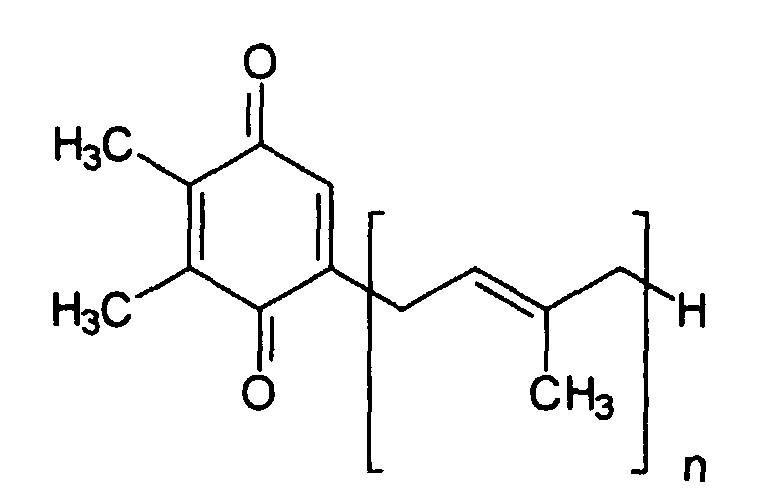
- the invention relates to styling agents based on alcohol, characterized in that that they have one or more bioquinones, in particular ubiquinones and / or plastoquinones, contain.
- the invention furthermore relates to the use of one or more bioquinones, in particular ubiquinones and / or plastoquinones for protecting hair cosmetic preparations alcohol-based and / or scalp and / or hair unwanted Oxidation processes.
- Preferred hair cosmetic preparations are styling agents or hair setting agents (Hair fixer) based on alcohol.
- bioquinones and preparations used according to the invention containing these bioquinones reduce oxidative damage to the scalp and / or hair Influences better than active substances, combinations of active substances and preparations of the state of the technique. In particular, they maintain or are damaged by oxidative stress damaged hair or prevent such damage.
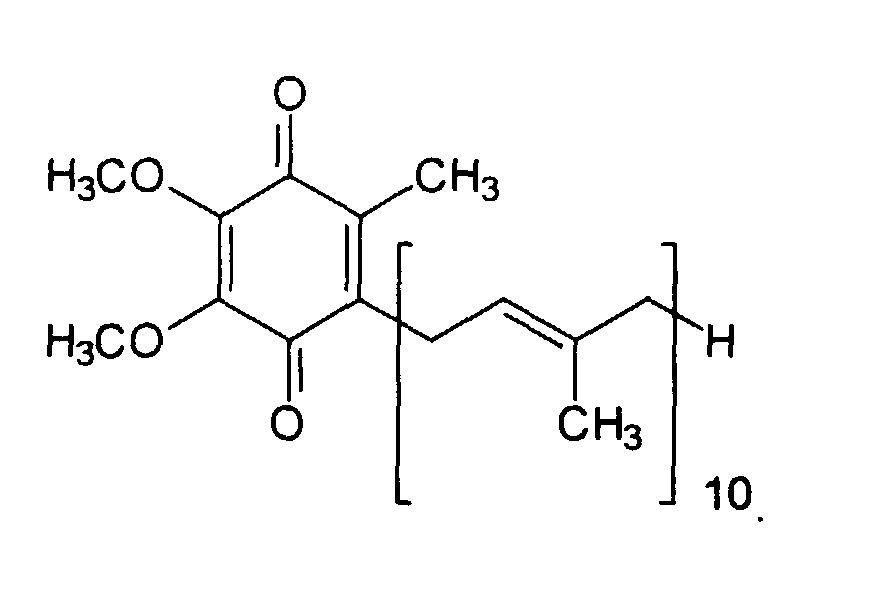
- Coenzyme Q-10 for example, is characterized by the following structural formula: Ubiquinones serve the organisms as electron carriers in the respiratory chain. They are located in the mitochondria where they enable the cyclic oxidation and reduction of the substrates of the citric acid cycle.
- Cosmetic preparations with coenzyme Q-10 from DE-A-33 09 850 are known, the for the treatment of skin diseases, for the prophylaxis of dystrophic and dysmetabolic Conditions of the skin and for use in chemical and physical Respiratory damage or delayed respiration associated with age and wear are suitable.
- coenzyme Q-10 for is in Japanese laid-open publication 58,180,410 Cosmetics described. It is said to activate skin cell metabolism and suppress oxidation. As a result, coenzyme Q10 has an important function in the prevention of Skin damage due to UV rays and the prevention of skin aging.
- the bioquinone preferred according to the invention is the coenzyme Q10. It is beneficial in the finished preparations concentrations of 0.000.001 - 5 wt .-% on one or more Bioquinones, preferably coenzyme Q10, to choose.
- the styling agents and preparations which contain the active compound combinations according to the invention are topical preparations. These can be composed as usual and for Treatment and care of the scalp and / or hair or as a sunscreen preparation serve.
- the preparations according to the invention are used in the Cosmetics and styling agents in the usual way on the scalp and hair sufficient amount applied.
- Preparations in the sense of the present invention can advantageously be used as hair sprays or Liquid strengthening agents or solutions are available.
- the agents according to the invention can, for example, be squeeze bottles from aerosol containers or preparations which can be sprayed by a pump-spray device are present, however also in the form of an agent that can be applied from normal bottles and containers.
- Preparations in the sense of the present invention are the usual known volatile, liquefied blowing agents, for example dimethyl ether, hydrocarbons (Propane, butane, isobutane) suitable, alone or in a mixture with each other can be used. Also compressed air, nitrogen, nitrogen dioxide or carbon dioxide or mixtures of these substances are to be used advantageously.
- volatile, liquefied blowing agents for example dimethyl ether, hydrocarbons (Propane, butane, isobutane) suitable, alone or in a mixture with each other can be used.
- compressed air, nitrogen, nitrogen dioxide or carbon dioxide or mixtures of these substances are to be used advantageously.
- Preparations according to the invention advantageously contain, in addition to an effective content of Active substance combinations according to the invention furthermore conventional active substances, contents, additives and / or Auxiliaries.
- Cosmetic preparations according to the invention for setting and styling the hair usually contain film formers, as normally found in such preparations are used, the total amount of the film-forming substances z. B. between 0.5 and is 20.0% by weight, based on the total weight of the preparations.
- film formers can all be used for cosmetic and / or dermatological Applications suitable or customary film formers can be used.
- the film-maker or film-makers are advantageously selected from the group of alcohol-soluble or alcohol-dispersible polyurethanes, polyureas, silicone resins and / or polyesters and the nonionic, anionic, amphoteric and / or cationic polymers.
- nonionic polymers that alone or in preparations according to the invention in a mixture, preferably also with anionic and / or amphoteric and / or zwitterionic Polymers can be included are vinyl pyrrolidone homopolymers or copolymers.
- polyvinyl pyrrolidone examples include, for example, polyvinyl pyrrolidone, copolymers of N-vinyl pyrrolidone and vinyl acetate and / or vinyl propionate in various concentration ratios, Polyvinylcaprolactam, polyvinylamides and their salts and copolymers Vinyl pyrrolidone and dimethylaminoethyl methacrylate, terpolymers of vinyl caprolactam, Vinyl pyrrolidone and dimethylaminoethyl methacrylate, polysiloxanes and the like.
- Advantageous anionic polymers are, for example, vinyl acetate / crotonic acid, vinyl acetate / acrylate and / or vinyl acetate / vinyl neodecanoate / crotonic acid copolymers, sodium acrylate / vinyl alcohol copolymers, Sodium polystyrene sulfonate, ethyl acrylate / N-tert-butylacrylamide / acrylic acid copolymers, Vinyl pyrrolidone / vinyl acetate / itaconic acid copolymers, acrylic acid / acrylamide copolymers and / or their sodium salts, homo- and / or copolymers of acrylic acid and / or methacrylic acid and / or their salts as well as acrylate / hydroxyacrylate, Octylacrylamide / acrylate or methacrylic acid ester and / or butyl acrylate / N-vinylpyrrolidone copolymers.
- anionic polymers are methyl vinyl ether / maleic acid copolymers, resulting from the hydrolysis of vinyl ether / maleic anhydride copolymers.
- This Polymers can also be partially esterified (ethyl, isopropyl or butyl ester).
- amphoteric polymers which may be contained in preparations according to the invention alone or in a mixture, preferably also with anionic and / or nonionic polymers, are copolymers of N-octylacrylamide, (meth) acrylic acid and tert-butylaminoethyl methacrylate of the type Amphomer ", copolymers of methacryloylethylbetaine and alkyl methacrylates of the type Yukaformer ", copolymers of monomers containing carboxyl groups or sulfone groups, for example (meth) acrylic acid and itaconic acid, with basic, in particular amino-containing monomers such as, for example, mono- or dialkylaminoalkyl (meth) acrylates and / or mono- or dialkylaminoalkyl (meth) acrylamides, Copolymers of N-octylacrylamide, methyl methacrylate, hydroxypropyl methacrylate, N-tert-but
- anionic and amphoteric polymers Improving their water solubility or propellant compatibility with suitable bases to neutralize.
- suitable bases for example, alkali or alkaline earth bases, ammonia and / or various amines, e.g. Triethanolamine, triisopropanolamine, aminomethylpropanol and / or aminomethyl propanediol.
- the neutralization can ever partially or completely depending on the application.
- Advantageous cationic polymers are, for example, vinyl pyrrolidone / vinyl imidazolium methochloride copolymers, quaternized vinyl pyrrolidone / dialkylaminoalkyl methacrylate copolymers, cationic cellulose derivatives, e.g. Hydroxyethyl cellulose / dimethyl alkyl ammonium chloride copolymers as well as terpolymers of vinyl caprolactam / vinyl pyrrolidone with Dimethylaminoethyl methacrylate or vinylimmidazolinium methochloride and acrylamido copolymers.
- vinyl pyrrolidone / vinyl imidazolium methochloride copolymers quaternized vinyl pyrrolidone / dialkylaminoalkyl methacrylate copolymers
- cationic cellulose derivatives e.g. Hydroxyethyl cellulose / dimethyl alkyl ammonium chloride copolymers
- film formers on a natural basis, e.g. Chitosan and its derivatives, use, especially in a mixture with synthetic polymers.
- the preparations according to the invention can contain cosmetic auxiliaries as they are commonly used in such preparations, e.g. Perfumes, substances for Prevent foaming, dyes, pigments that have a coloring effect, surface-active Substances, solubilizers, softening, moisturizing and / or moisturizing substances, refatting agents, alcohols, polyols and their toxicological compatible ethers and esters, branched and / or unbranched hydrocarbons, other antioxidants, stabilizers, pH regulators, consistency enhancers, Bactericides, deodorants, antimicrobial substances, antistatic agents, UV absorbers, polymers, Electrolytes, organic solvents, silicone derivatives, plant extracts, vitamins and / or other active ingredients or other usual components of a cosmetic or dermatological Formulation.
- cosmetic auxiliaries e.g. Perfumes, substances for Prevent foaming, dyes, pigments that have a coloring effect, surface-active Substances, solubilizers, softening, mois
- the total amount of auxiliaries is, for example, 0.001 to 15% by weight, preferably 0.01 to 10 wt .-%, each based on the total weight of the preparation.
- the alcohol-based preparations according to the invention advantageously contain alcohols, Diols or polyols of low C number, and their ethers, preferably ethanol, isopropanol, Propylene glycol, glycerin, ethylene glycol, ethylene glycol monoethyl or monobutyl ether, propylene glycol monomethyl, monoethyl or monobutyl ether, diethylene glycol monomethyl or monoethyl ether and analog products, furthermore low C number alcohols, e.g. Ethanol, Isopropanol, 1,2-propanediol, glycerin.
- alcohols Diols or polyols of low C number, and their ethers, preferably ethanol, isopropanol, Propylene glycol, glycerin, ethylene glycol, ethylene glycol monoethyl or monobutyl ether, propylene glycol monomethyl, monoethyl or monobutyl ether,
- the proportion of alcohols in the preparations is, for example, 10 to 99% by weight.
- the amount of alcohols in aerosol preparations is, for example, 20 to 60% by weight, preferably 30 to 60 wt .-%, each based on the total weight of the preparation.
- the amount of alcohols in non-aerosol preparations is, for example, 30 to 99 % By weight, preferably 60 to 99% by weight, in each case based on the total weight of the Preparation.
- the preparations according to the invention can contain water e.g. in the used by the Contain raw materials, for example or e.g. also in quantities of up to 30% by weight, based on the total weight of the preparations.
- the total amount of the antioxidants is, for example, 0.001 to 2% by weight, preferably 0.01 to 1 wt .-%, each based on the total weight of the preparation.
- antioxidants are advantageously selected from the group consisting of amino acids (eg glycine, histidine, tyrosine, tryptophan) and their derivatives, imidazoles (eg urocanic acid) and their derivatives, peptides such as D, L-camosin, D-camosin, L-camosin and their derivatives (e.g. anserine), carotenoids, carotenes (e.g. ⁇ -carotene, ⁇ -carotene, lycopene) and their derivatives, chlorogenic acid and their derivatives, lipoic acid and their derivatives (e.g.
- amino acids eg glycine, histidine, tyrosine, tryptophan
- imidazoles eg urocanic acid
- peptides such as D, L-camosin, D-camosin, L-camosin and their derivatives (e.g. anserine)
- carotenoids e.g.
- thiols e.g. thioredoxin, Glutathione, cysteine, cystine, cystamine and their glycosyl, N-acetyl, methyl, ethyl, propyl, amyl, butyl and lauryl, palmitoyl, oleyl, ⁇ -linoleyl, cholesteryl and glyceryl esters
- salts dilauryl thiodipropionate, distearyl thiodipropionate, thiodipropionic acid and their derivatives (esters, ethers, peptides, lipids, nucleotides, nucleosides and salts) as well as sulfoximine compounds (e.g.
- buthionine sulfoximines e.g. pmol to ⁇ mol / kg
- metal chelators e.g. ⁇ -hydroxy fatty acids, palmitic acid, phytic acid, lactoferrin
- ⁇ -hydroxy acids e.g.
- citric acid As citric acid, lactic acid, malic acid), humic acid, bile acid, bile extracts, bilirubin, biliverdin, EDTA, EGTA and their derivatives, unsaturated fatty acids and their derivatives (e.g. ⁇ -linolenic acid, linoleic acid, oleic acid), folic acid and its derivatives, vitamin C and Derivatives (e.g. ascorbyl palmitate, Mg ascorbyl phosphate, ascorbyl acetate), tocopherols and derivatives (e.g.
- vitamin E acetate
- vitamin A and derivatives vitamin A palmitate
- Preparations according to the invention can also advantageously contain substances which Absorb UV radiation in the UV-B range, taking the total amount of filter substances e.g. 0.001% by weight to 30% by weight, preferably 0.05 to 10% by weight, in particular 0.1 to 1.0% by weight, based on the total weight of the preparations, is cosmetic To provide preparations that cover the hair or skin before the whole Protect the area of ultraviolet radiation. You can also use it as a sunscreen Hair or skin, especially the scalp.
- substances which Absorb UV radiation in the UV-B range taking the total amount of filter substances e.g. 0.001% by weight to 30% by weight, preferably 0.05 to 10% by weight, in particular 0.1 to 1.0% by weight, based on the total weight of the preparations, is cosmetic To provide preparations that cover the hair or skin before the whole Protect the area of ultraviolet radiation. You can also use it as a sunscreen Hair or skin, especially the scalp.
- UV-A filters may also be advantageous to add UV-A filters to preparations according to the invention, which have so far usually been contained in cosmetic preparations. It can the quantities used for the UV-B combination are used.
- nonionic film formers can be used or amphoteric polymers can be used.
- Nonionic polymers e.g. PVP / VA copolymers, e.g. by the company BASF under the trade name Luviskol VA 37E or from the company International Specialty Products (ISP) are available under the designation PVP / VA E 335 doing e.g. in concentrations of 2 - 8% by weight of the total weight of the preparation (based on the active content of the polymer) used.
- PVP / VA copolymers e.g. by the company BASF under the trade name Luviskol VA 37E or from the company International Specialty Products (ISP) are available under the designation PVP / VA E 335 doing e.g. in concentrations of 2 - 8% by weight of the total weight of the preparation (based on the active content of the polymer) used.
- Amphoteric polymers of the type octylacrylamide / acrylates / butylaminoethyl methacrylate Copolymers are e.g. by the National Starch company among the Trade names Amphomer 28-4910 and LV-71 are available and will be used e.g. in Concentrations between 1 -6 wt .-% of the total weight of the preparation used.
- cyclic polydimethylsiloxanes cyclomethicones
- silicone surfactants polyether modified Siloxanes
- Cyclomethicones are among others under the trade name Abil K4 from the company Goldschmidt or e.g. DC 244, DC 245 or DC 345 from Dow Corning offered.
- Dimethicone copolyols are e.g. under the trade name DC 193 from the Dow Corning or Belsil DM 6031 offered by Wacker.
- Complexing agents are known auxiliaries in cosmetology and medical Galenics. By complexing interfering metals such as Mn, Fe, Cu and others for example undesirable chemical reactions in cosmetic or dermatological Preparations can be prevented.
- Chelates are compounds in which a single ligand has more than one Coordination point occupied at a central atom. In this case, normally stretched connections to form rings through complex formation via a metal atom or ion closed. The number of ligands bound depends on the coordination number of the central metal. The prerequisite for chelation is that the metal reacts Compound contains two or more atomic groups that act as electron donors Act.
- the complexing agent (s) can advantageously be selected from the group of the usual compounds can be selected, preferably consisting of at least one substance from the group from tartaric acid and its anions, citric acid and its anions, aminopolycarboxylic acids and their anions (such as, for example, ethylenediaminetetraacetic acid (EDTA) and their anions, nitrilotriacetic acid (NTA) and their anions, hydroxyethylenediamine triacetic acid (HOEDTA) and their anions, diethylene aminopentaacetic acid (DPTA) and their Anions, trans-1,2-diaminocyclohexanetetraacetic acid (CDTA) and their anions).
- EDTA ethylenediaminetetraacetic acid
- NTA nitrilotriacetic acid
- HOEDTA hydroxyethylenediamine triacetic acid
- DPTA diethylene aminopentaacetic acid
- CDTA trans-1,2-diaminocyclohe
- the complexing agent or complexing agents are advantageous in cosmetic or dermatological Preparations preferably at 0.01% by weight to 10% by weight, preferably at 0.05 % By weight to 5% by weight, particularly preferably 0.1-2.0% by weight, based on the total weight of the preparations.
- the preparations according to the invention can be prepared in the customary manner Mix the individual components.
- the active ingredients of the combinations according to the invention or the premixed components of the combinations according to the invention can be added in the mixing process.
- the pH of the preparations can be adjusted in a known manner by adding acids or Bases are adjusted, preferably by adding buffer mixtures, e.g. based of citric acid / citrate or phosphoric acid phosphate buffer mixtures.
- buffer mixtures e.g. based of citric acid / citrate or phosphoric acid phosphate buffer mixtures.
- the pH is below 10, e.g. in the range of 3 to 9.
- Luviskol VA 37 E (BASF) is used as the PVP / VA copolymer in the examples.
- Amphomer 28-4910 National Starch company
- the amounts in the examples are% by weight.
- Examples 1-4 Hairspray 1 2nd Octylacrylamides / acrylates / butylaminoethyl Methacrylate copolymer 2.5 2.5 Coenzyme Q10 0.005 0.008 Ethanol abs.
Landscapes
- Health & Medical Sciences (AREA)
- Life Sciences & Earth Sciences (AREA)
- Animal Behavior & Ethology (AREA)
- General Health & Medical Sciences (AREA)
- Public Health (AREA)
- Veterinary Medicine (AREA)
- Emergency Medicine (AREA)
- Birds (AREA)
- Epidemiology (AREA)
- Cosmetics (AREA)
Abstract
Description


- Salze der 2-Phenylbenzimidazol-5-sulfonsäure wie ihr Natrium-, Kalium- oder ihr Triethanolammonium-Salz, sowie die 2-Phenylbenzimidazol-5-sulfonsäure selbst;
- Sulfonsäure-Derivate von Benzophenonen, vorzugsweise 2-Hydroxy-4-methoxybenzophenon-5-sulfonsäure und ihre Salze;
- Sulfonsäure-Derivate des 3-Benzylidencamphers, wie z.B. 4-(2-Oxo-3-bornylidenmethyl)benzolsulfonsäure, 2-Methyl-5-(2-oxo-3-bornylidenmethyl)sulfonsäure und ihre Salze.
| Beispiele 1 - 4 Haarspray | ||
| 1 | 2 | |
| Octylacrylamide/Acrylates/ Butylaminoethyl | ||
| Methacrylate Copolymer | 2,5 | 2,5 |
| Coenzym Q10 | 0,005 | 0,008 |
| Ethanol abs. | 39,0 | 39,0 |
| Parfüm, Lösungsvermittler, | ||
| Neutralisationsmittel/pH-Einstellung, | ||
| Pflegestoffe | q.s. | q.s. |
| Dimethylether | ad 100 | ad 100 |
| 3 | 4 | |
| PVP/VA Copolymer | 8,0 | 8,0 |
| Coenzym Q10 | 0,01 | 0,05 |
| Ethanol abs. | 39,0 | 39,0 |
| Parfüm, Lösungsvermittler, | ||
| Pflegestoffe | q.s. | q.s. |
| Dimethylether | ad 100 | ad 100 |
| Beispiele 5 - 8 Pumphaarspray Non-Aerosol | ||
| 5 | 6 | |
| Octylacrylamide/Acrylates/ Butylaminoethyl | ||
| Methacrylate Copolymer | 2,5 | 2,5 |
| Coenzym Q10 | 0,0005 | 0,08 |
| Parfüm, Lösungsvermittler, | ||
| Neutralisationsmittel/pH-Einstellung, | ||
| Pflegestoffe | q.s. | q.s. |
| Ethanol abs. | ad 100 | ad 100 |
| 7 | 8 | |
| PVP/VA Copolymer | 8.0 | 8.0 |
| Coenzym Q10 | 0,01 | 0,0003 |
| Ethanol abs. | 39,0 | 39,0 |
| Parfüm, Lösungsvermittler, | ||
| Pflegestoffe | q.s. | q.s. |
Claims (5)
- Stylingmittel auf Alkoholbasis, dadurch gekennzeichnet, daß sie ein oder mehrere Biochinone, insbesondere Ubichinone und/oder Plastochinone, enthalten.
- Verwendung eines oder mehrerer Biochinone, insbesondere Ubichinone und/oder Plastochinone, in Stylingmitteln auf Alkoholbasis, zum Schutz haarkosmetischer Zubereitungen und/oder der Kopfhaut und/oder des Haares vor unerwünschten Oxidationsprozessen.
- Zubereitungen nach Anspruch 1 oder Verwendung nach Anspruch 2, dadurch gekennzeichnet, daß zusätzlich weitere Tenside und/oder kosmetische oder dermatologische Hilfs-, Zusatz- und/oder Wirkstoffe enthalten sind.
- Zubereitungen nach Anspruch 1 oder Verwendung nach Anspruch 2, dadurch gekennzeichnet, daß als Biochinon das Coenzym Q10 gewählt wird.
- Zubereitungen nach Anspruch 1 oder Verwendung nach Anspruch 2, dadurch gekennzeichnet, daß Konzentrationen von 0,000.001 - 5 Gew.-% an einem oder mehreren Biochinonen, bevorzugt Coenzym Q10, vorliegen.
Applications Claiming Priority (2)
| Application Number | Priority Date | Filing Date | Title |
|---|---|---|---|
| DE19926168 | 1999-06-09 | ||
| DE1999126168 DE19926168A1 (de) | 1999-06-09 | 1999-06-09 | Stylingmittel auf Alkoholbasis mit Biochinonen |
Publications (2)
| Publication Number | Publication Date |
|---|---|
| EP1059079A2 true EP1059079A2 (de) | 2000-12-13 |
| EP1059079A3 EP1059079A3 (de) | 2001-12-19 |
Family
ID=7910596
Family Applications (1)
| Application Number | Title | Priority Date | Filing Date |
|---|---|---|---|
| EP00110941A Withdrawn EP1059079A3 (de) | 1999-06-09 | 2000-05-25 | Stylingmittel auf Alkoholbasis mit Biochinonen |
Country Status (2)
| Country | Link |
|---|---|
| EP (1) | EP1059079A3 (de) |
| DE (1) | DE19926168A1 (de) |
Cited By (4)
| Publication number | Priority date | Publication date | Assignee | Title |
|---|---|---|---|---|
| DE10036798A1 (de) * | 2000-07-28 | 2002-02-07 | Beiersdorf Ag | Mittel zur Behandlung der Haare und der Kopfhaut |
| EP1232741A1 (de) * | 2001-02-14 | 2002-08-21 | GOLDWELL GmbH | Ubichinon-Haarfärbemittel |
| EP1269976A3 (de) * | 2001-06-29 | 2003-04-23 | KPSS-Kao Professional Salon Services GmbH | Mittel zum Blondieren von menschlichen Haaren |
| WO2010060730A1 (de) * | 2008-11-03 | 2010-06-03 | Henkel Ag & Co. Kgaa | Haarfärbeverfahren mit nachbehandlung |
Families Citing this family (5)
| Publication number | Priority date | Publication date | Assignee | Title |
|---|---|---|---|---|
| DE10111053A1 (de) * | 2001-03-06 | 2002-09-12 | Beiersdorf Ag | Wirkstoffkombinationen aus alpha-Liponsäure und Biochinonen |
| DE10230970A1 (de) * | 2002-07-10 | 2004-01-22 | Beiersdorf Ag | Schützender Haarfestiger |
| EP1797861A1 (de) | 2005-12-16 | 2007-06-20 | KPSS-Kao Professional Salon Services GmbH | Zusammensetzung zur dauerhaften Verformung des menschlichen Haares |
| EP2022535A1 (de) | 2007-08-07 | 2009-02-11 | KPSS-Kao Professional Salon Services GmbH | Zusammensetzung zur dauerhaften Verformung des menschlichen Haares |
| EP2191863A1 (de) | 2008-11-26 | 2010-06-02 | KPSS-Kao Professional Salon Services GmbH | Zusammensetzung zur dauerhaften Verformung des menschlichen Haares |
Family Cites Families (7)
| Publication number | Priority date | Publication date | Assignee | Title |
|---|---|---|---|---|
| JPS5913710A (ja) * | 1982-07-15 | 1984-01-24 | Shiseido Co Ltd | 養毛料 |
| JPS6127914A (ja) * | 1984-07-17 | 1986-02-07 | Shiseido Co Ltd | 化粧料 |
| DE4139921A1 (de) * | 1991-12-04 | 1993-06-09 | Wella Ag, 6100 Darmstadt, De | Verwendung von radikalfaengern und/oder zur deaktivierung nicht-radikalischer, reaktiver sauerstoffspezies geeigneter substanzen zur verhinderung oder verzoegerung des ergrauens von menschlichen haaren |
| DE4327063A1 (de) * | 1993-08-12 | 1995-02-16 | Kirsten Dr Westesen | Ubidecarenon-Partikel mit modifizierten physikochemischen Eigenschaften |
| DE4436270C1 (de) * | 1994-10-11 | 1996-03-07 | Beiersdorf Ag | Verwendung von Chlorogensäure als Antioxidans in haarkosmetischen Zubereitungen |
| WO1997002041A1 (en) * | 1995-07-03 | 1997-01-23 | Crandall Wilson T | Transdermal and oral treatment of androgenic alopecia |
| DE19802444A1 (de) * | 1998-01-23 | 1999-07-29 | Beiersdorf Ag | Haarkosmetische Zubereitungen enthaltend Sonnenblumenwachs und gewünschtenfalls Jojobawachs |
-
1999
- 1999-06-09 DE DE1999126168 patent/DE19926168A1/de not_active Ceased
-
2000
- 2000-05-25 EP EP00110941A patent/EP1059079A3/de not_active Withdrawn
Cited By (4)
| Publication number | Priority date | Publication date | Assignee | Title |
|---|---|---|---|---|
| DE10036798A1 (de) * | 2000-07-28 | 2002-02-07 | Beiersdorf Ag | Mittel zur Behandlung der Haare und der Kopfhaut |
| EP1232741A1 (de) * | 2001-02-14 | 2002-08-21 | GOLDWELL GmbH | Ubichinon-Haarfärbemittel |
| EP1269976A3 (de) * | 2001-06-29 | 2003-04-23 | KPSS-Kao Professional Salon Services GmbH | Mittel zum Blondieren von menschlichen Haaren |
| WO2010060730A1 (de) * | 2008-11-03 | 2010-06-03 | Henkel Ag & Co. Kgaa | Haarfärbeverfahren mit nachbehandlung |
Also Published As
| Publication number | Publication date |
|---|---|
| DE19926168A1 (de) | 2000-12-14 |
| EP1059079A3 (de) | 2001-12-19 |
Similar Documents
| Publication | Publication Date | Title |
|---|---|---|
| HUE034751T2 (en) | Procedure for conditioning hair and skin | |
| EP0795317A2 (de) | Wachskombination und diese enthaltende kosmetische Mittel | |
| DE19926177A1 (de) | Haarpflegemittel mit Ubichinonen | |
| EP0937450B1 (de) | Stylingmittel auf Alkoholbasis enthaltend Gamma-Oryzanol und Calciumsalzen | |
| DE19926167B4 (de) | Aerosol-Stylingmittel auf Wasserbasis mit Biochinonen | |
| EP1059079A2 (de) | Stylingmittel auf Alkoholbasis mit Biochinonen | |
| EP1059081A2 (de) | Haarkosmetische Mittel mit Ubichinonen | |
| EP1496842A1 (de) | Haarpflegemittel vorgelatinisierte, quervernetzte stärkederivate enthaltend | |
| EP1475073A2 (de) | Haarkosmetische Reinigungsmittel mit Wirkstoffkombinationen aus Gamma-Oryzanol und Calciumsalzen mit niedriger Metallionenkonzentration | |
| EP2606934B1 (de) | Verwendung von Octanohydroxamsäure in Haarstylingformulierungen | |
| EP1059080A2 (de) | Haarkosmetische Zubereitungen insbesondere solche zur Verbesserung der Kämmbarkeit der Haare auf der Grundlage von Ubichinonen | |
| EP1496847A1 (de) | Schaumförmige/schäumbare frisiermittel vorgelatinisierte, quervernetzte stärkederivate enthaltend | |
| WO2004058199A1 (de) | Zubereitung enthaltend carbamat-substituierte saccharide und kationische konditionierer | |
| DE10352470A1 (de) | Polymere Haarfixierungsmittel mit verbesserten Eigenschaften | |
| EP1557156B1 (de) | Kosmetische Zubereitung zur Pflege des Haares, enthaltend Lauroyl Lysin | |
| DE10216499A1 (de) | Frisiermittel | |
| WO2004022020A1 (de) | Verwendung von 2-(4-diethylamino-2-hydroxybenzoyl)-benzoesäure-n-hexylester in kosmetischen oder dermatologischen zubereitungen zur behandlung von haaren | |
| DE10356870A1 (de) | Frisiermittel mit Licochalcon A | |
| DE102012213938A1 (de) | Haarstylingformulierung zur Erstellung eines flexiblen Haltes durch Einsatz von einem Gehalt an Licochalcon A oder einem wäßrigen Extrakt aus Radix Glycyrrhizae inflatae, enthaltend Licochalcon A | |
| EP1537848A1 (de) | Haar- und/oder Kopfhautpflegemittel mit Licochalcon A | |
| DE102009049721A1 (de) | Selbstbräunende Formulierung mit Siloxanelastomeren | |
| DE10344668A1 (de) | Behandlungsmittel für keratinische Fasern | |
| DE102004010718A1 (de) | Haarpflegemittel mit Kreatin |
Legal Events
| Date | Code | Title | Description |
|---|---|---|---|
| PUAI | Public reference made under article 153(3) epc to a published international application that has entered the european phase |
Free format text: ORIGINAL CODE: 0009012 |
|
| AK | Designated contracting states |
Kind code of ref document: A2 Designated state(s): AT BE CH CY DE DK ES FI FR GB GR IE IT LI LU MC NL PT SE |
|
| AX | Request for extension of the european patent |
Free format text: AL;LT;LV;MK;RO;SI |
|
| PUAL | Search report despatched |
Free format text: ORIGINAL CODE: 0009013 |
|
| AK | Designated contracting states |
Kind code of ref document: A3 Designated state(s): AT BE CH CY DE DK ES FI FR GB GR IE IT LI LU MC NL PT SE |
|
| AX | Request for extension of the european patent |
Free format text: AL;LT;LV;MK;RO;SI |
|
| 17P | Request for examination filed |
Effective date: 20011115 |
|
| AKX | Designation fees paid |
Free format text: AT BE CH CY DE DK ES FI FR GB GR IE IT LI LU MC NL PT SE |
|
| 17Q | First examination report despatched |
Effective date: 20030523 |
|
| STAA | Information on the status of an ep patent application or granted ep patent |
Free format text: STATUS: THE APPLICATION IS DEEMED TO BE WITHDRAWN |
|
| 18D | Application deemed to be withdrawn |
Effective date: 20041104 |