EP1061459A2 - Système et procédé pour la génération d'interface automatique et dynamique - Google Patents
Système et procédé pour la génération d'interface automatique et dynamique Download PDFInfo
- Publication number
- EP1061459A2 EP1061459A2 EP00304793A EP00304793A EP1061459A2 EP 1061459 A2 EP1061459 A2 EP 1061459A2 EP 00304793 A EP00304793 A EP 00304793A EP 00304793 A EP00304793 A EP 00304793A EP 1061459 A2 EP1061459 A2 EP 1061459A2
- Authority
- EP
- European Patent Office
- Prior art keywords
- dialogue
- user
- information
- human
- documents
- Prior art date
- Legal status (The legal status is an assumption and is not a legal conclusion. Google has not performed a legal analysis and makes no representation as to the accuracy of the status listed.)
- Ceased
Links
Images


Classifications
-
- G—PHYSICS
- G06—COMPUTING OR CALCULATING; COUNTING
- G06F—ELECTRIC DIGITAL DATA PROCESSING
- G06F16/00—Information retrieval; Database structures therefor; File system structures therefor
- G06F16/30—Information retrieval; Database structures therefor; File system structures therefor of unstructured textual data
- G06F16/33—Querying
- G06F16/332—Query formulation
- G06F16/3329—Natural language query formulation
Definitions
- the present invention relates generally to interactive dialogue systems for human-machine communication, and more particularly to the automated generation of dialogues for such systems.
- the human or "user” interacts with the computer through one or more of the following mechanisms: typing responses and/or queries using a keyboard; speaking into an audio input device (in which case the system includes a "speech recognizer" for converting the user-supplied audio input into words, represented, for example, in the form of text); and using a mouse to select objects (such as, for example, words or phrases) on a computer screen.
- speech recognizer for converting the user-supplied audio input into words, represented, for example, in the form of text
- objects such as, for example, words or phrases
- Any such system requires a module commonly referred to as a dialogue manager that defines a means for the computer system to recognize the user's request and then respond through some appropriate action, such as, for example, providing a particular audio speech output or updating a database in a particular way.
- a dialogue manager that defines a means for the computer system to recognize the user's request and then respond through some appropriate action, such as, for example, providing a particular audio speech output or updating a database in a particular way.
- a system which generates a user-customized natural language menu interface from a user-supplied database and from inputs supplied interactively by the user. More specifically, the system generates a domain-dependent context-free grammar by combining a domain-independent grammar and lexicon with a domain specification for a predetermined application.
- the dialogue which is provided (whether “manually” generated by a skilled computer system design engineer, or “automatically” generated by a dialogue generation system based on a given user's input) is static. That is, once created, the dialogue is not responsive to the ever-changing external environment. For example, even when a dialogue is generated responsive to a user's desires and expectations, the available information upon which specifics of the dialogue may be based (e.g ., the set of available documents retrieved in response to an appropriate search query posed over the Internet's World Wide Web) is fixed at the time the dialogue is generated. Thus, as the available external information changes, the dialogues generated by these prior art systems become rapidly outdated.
- a customized method or algorithm for holding an interactive dialogue session between a (human) user and a machine (hereinafter referred to simply as a "dialogue") is generated, such that the resulting dialogue advantageously responds to the user's requests and wherein the system's capability (i.e., the dialogue) is automatically modified thereafter based on dynamically changing external databases.
- a computer system acts as a Dialogue Generator agent by creating such a customized dialogue consisting of services that are organized and presented in a form that is a combination of the user's expectations and the system's capabilities.
- the system's capabilities advantageously include the information content of database/service providers (such as, for example, a distributed information source such as the Internet's World Wide Web or a corporate file system), and the Dialogue Generator advantageously modifies the dialogue periodically in response to this dynamically changing external environment.
- database/service providers such as, for example, a distributed information source such as the Internet's World Wide Web or a corporate file system
- Dialogue Generator advantageously modifies the dialogue periodically in response to this dynamically changing external environment.
- the present invention consists of a method and apparatus for generating a human-machine dialogue comprising steps or modules for receiving a user request comprising at least one topic of interest; retrieving from an external database at a first point in time, a first set of documents comprising information relating to the at least one topic of interest; generating a human-machine dialogue based on the information comprised in said first set of documents; retrieving from the external database at a second point in time later than said first point in time, a second set of documents comprising information relating to the at least one topic of interest, the information comprised in said second set of documents having at least one difference from the information comprised in said first set of documents; and modifying the human-machine dialogue based on the information comprised in said second set of documents.
- a dialogue is formed by first determining the user's preferences in a question and answer session. Then, the resulting "user profile" is combined with the system's capabilities (e.g. , the state of an external database) to generate a customized application which provides a dialogue session, with associated services, that specifically meet the user's needs.
- the resulting application is thereby unique to the user, both in topical content as well as in presentation format. In the preferred embodiment of the present invention, this is accomplished through the use of four illustrative software modules: a Profile Manager, an Information Services Manager, an Auto Dialogue Generator, and a Dialogue Manager.
- a user wishes to access several services over a cell-phone from an automobile, including, for example, calling a friend by speaking his name; getting the latest sports reports on auto racing or sailing; listening to the user's most recent email messages; and finding out the weather forecast for several international cities.
- the user's preferences were previously obtained in an initial question and answer session with the Profile Manager.
- the Auto Dialogue Generator built an initial dialogue that was invoked by the Dialogue Manager when the user accessed the service.
- the Profile Manager then updated the profile so that future sports reports containing game scores are presented first.
- the Auto Dialogue Generator then created a new dialogue (which it may, for example, do automatically on a periodic basis), taking into account the latest changes in the various World Wide Web databases (such as, for example, an updated weather forecast, etc. ).
- the new dialogue includes a new organizational form that includes the latest services requested by the user, new information content downloaded from external databases, and new grammars that specifically address the altered messages and documents received from external databases.
- the user calls in and the subsequent human-machine dialogue is bandied by the Dialogue Manager, resulting in the delivery of information and services to the user in a format that the user prefers.
- the system advantageously generates a user profile for the particular user.
- the user profile encodes a model of the given user.
- a question and answer session is used to generate the initial user profile which includes such preferences as services, topics and attributes of interest, presentation formats, etc .
- the user profile may also encode other pieces of information about the user such as, for example, general interests and hobbies, preferences, goals, and current activities (such as, for example, trips that the user may be taking, etc. ) This allows the agent to collect and volunteer information for which the user may not have explicitly asked.
- the agent may also keep certain pieces of personal and/or sensitive information about the user (e.g ., a social security number for credit/loan applications) which is released to trusted agents under certain conditions.
- the personal agent uses its knowledge of the user, encoded in the user profile, to collect, prune, and organize the available information and services, creating a subset of services/information that the user wants.
- information potentially of interest to the user may be extracted from the World Wide Web and stored.
- information extraction can occur continually in the background, overnight, periodically, on notification by another computer agent, and/or at the specific request of the user for updated information.
- the data is advantageously organized and structured in a way that can be presented to the user through a natural dialogue.
- the structuring and the data presentation style are also tailored to fit the user's preferences.
- the system knows the user's preferences regarding the order of presentation, the amount of detail, options, etc ., and it may volunteer actions and other pieces of information to the user.
- the data is advantageously organized in such a way as to let the user get the essential information, but that also allows the user to ask for more information in a natural and efficient manner.
- the grammars are updated to include words of high information content in the latest downloaded documents.
- the advantageous tailoring of computer agents and machine-human interaction to each user is important.
- the goal is to match expectations of the user and the agent so that they dovetail and work together harmoniously.
- the machine "knows" the user by keeping track of a model of the user as encoded in the user profile.
- the user and the agent can advantageously inform each other of any misunderstanding.
- possible misunderstandings include the case where the agent delivers incorrect information and/or an inappropriate amount of information to the user, or the case where the user has incorrect or obsolete perceptions of the agent's capabilities.
- the agent advantageously monitors its interaction with the user, determining any changes in the user's behavior and thereby dynamically modifying the user profile.
- the agent can present alternative options to the user to make the dialogue interface more appropriately tuned to the user behavior.
- the agent can also routinely update the user with new services recently incorporated and request the user to modify the user profile if desired.
- the user may also request changes to the profile explicitly, such as, for example, deleting or adding a particular topic of interest or changing the presentation format.
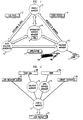
- Fig, 1 shows an illustrative system for performing automated dynamic dialogue generation in accordance with the preferred embodiment of the present invention.
- Profile Manager 12 generates and maintains User Profile 13, a model of the user's intent, both in types of services desired, as well as in preferences for service organization and presentation.
- Information Services Manager 14 keeps track of the services/capabilities of the system as well as the information contained in one or more accessible Databases 15. These databases may, for example, include internal library databases, as well as external databases such as the World Wide Web or other external information sources.
- Information Services Manager 14 is also responsible for downloading and organizing the information for presentation to the user.
- Auto Dialogue Generator 16 uses the user profile and the identified set of available services/information to generate Application 17 -- a user-customized set of Dialogue States that define possible dialogue flow between the user and the system. Note that the uniqueness of the application is manifested in the dialogue flow which includes both the types of services and data presented, as well as the manner in which the data are presented and the services are delivered.
- Dialogue Manager 18 manages the dialogue flow, using a generalized interface between the user and the computer system. In particular, the interface may enable communication via voice (represented by telephone set 11), keyboard (represented by keyboard 10a), mouse (represented by mouse 10b), etc.
- Dialogue Manager 18 also advantageously monitors the dialogue and user behavior, communicating such information via Log Files 19 to Profile Manager 12, which may, in turn, modify User Profile 13, and, as a result, future dialogue sessions, where appropriate.
- the Profile Manager generates and maintains a User Profile, which contains knowledge about the user's intent, both in types of services desired, as well as in preferences for service organization and presentation.
- the user profile advantageously encodes a model of the user, making it possible to customize an application for each user.
- a question and answer session may be used to generate the initial User Profile that includes such preferences as services, topics and attributes of interest, presentation formats, etc .
- the User Profile may also encode other pieces of information of the user such as general interests and hobbies, preferences, goals, and current activities (such as trips that the user may be taking, etc. ). This allows the agent to collect and volunteer information that the user may not have explicitly asked for.
- the agent may also keep certain pieces of sensitive/personal information of the user (e.g ., social security number for credit/loan application) which is released to trusted agents under certain conditions.
- the Profile Manager advantageously collects three main types of information about the user -- a set of topics, subtopics, and keywords, as well as the desired presentation format.
- Examples of services and topics the user may be interested in may include, for example, name dialing, e-mail reading, news headlines, sports news, stock quotes and weather.
- Examples of attributes that describe the way information and services are presented include "personal,” “statistical,” “historical,” “predictive” or “opinion.”
- Examples of possible presentation formats include the entire document, the most relevant paragraph, or a twenty second summary of the document.
- the Profile Manager advantageously monitors subsequent dialogue sessions, tracking the user behavior and modifying the user profile as needed.
- the Information Services Manager (see below) provides the Profile Manager with information about what capabilities/services and information are available.
- the Profile Manager may request the Information Services Manager to perform some action on the World Wide Web on the user's behalf, such as search for a new information service or register on a particular web site.
- the Profile Manager may then inform the user (through the Dialogue Manager - see below) of the choices and may allow the user to specify what services/information are desired.
- the user's application can then be advantageously modified in order to be more efficient, delivering the requested services and information more readily in an updated form, with a new dialogue flow.
- the system advantageously accepts requests from the user to update the profile explicitly.
- the system may also present alternative options to the user to make the dialogue interface tuned to the user's specific behavior. It may also routinely update the user with new services recently incorporated and may allow the user to modify the user profile if desired.
- Profile Manager 12 generates and updates User Profile 13, which allows for the customization of the application for each given user.
- Information Services Manager 14 provides the Profile Manager with information about what capabilities/services and information are available (e.g ., fax, email, voice-mail, World Wide Web information and transactions, etc. ), through reference, for example, to the World Wide Web (WWW 15a).
- Library Databases 15b are advantageously available to the Profile Manager.
- the Profile Manager informs the user (through Dialogue Manager 18) of the available choices and advantageously allows the user to specify what services and information are desired.
- the user may, by way of example, request the following desired services: name dialing, world weather reports, stock quote services, sports report retrieval and e-mail.
- the user may also specify various keywords within the selected information services such as, for example, "McGwire" for sports report retrieval.
- the interaction between the user and the Profile Manager is illustratively performed with the use of User Question and Answer Session 20.
- the Profile Manager may ask the user general questions about his or her interests and preferences, which may include the user's preferred presentation format(s). For example, the user may request that the system include top news stories, present lists of titles, or prune documents to provide a summary thereof.
- the Profile Manager may also request the Information Services Manager to perform some action(s) on the World Wide Web, such as, for example, retail transactions.
- the Profile Manager may make suggestions for particular profile modifications, based on (a) the input received from the user, (b) past user behavior, and/or (c) system capabilities.
- Some of the information which the Profile Manager advantageously stores in the user profile includes, inter alia,
- the system advantageously monitors, inter alia, the number of times sites and/or services are accessed, attributes of information requested by the user, dialogue history including flow between dialogue states, etc .
- This information results in User Behavior Log Files 19, which may be used to automatically update the user profile as the system learns more about the user's habits, and also as the various databases involved are updated.
- the user's application can then be advantageously modified in order to be more efficient, delivering the requested services and information more readily in an updated form, with a new dialogue flow.
- the system accepts requests from the user to update the profile explicitly, and may present alternative options to the user to make the dialogue interface better tuned to the user's specific behavior. Moreover, the system also may advantageously update the user routinely with new recently incorporated services, and may allow the user to modify the user profile if desired.
- the system may embody the User Profile as a customizable "web portal" on the World Wide Web. And in alternative illustrative embodiments, the system may advantageously use an existing web portal as a representation of either all, or just a portion of, the User Profile. (The creation and use of web portals is fully familiar to those of ordinary skill in the art.)
- the Information Services Manager advantageously uses its knowledge of the user, encoded in the User Profile, to collect, prune, and organize the available information and services, creating a subset of services/information that the user wants.
- information potentially of interest to the user may be extracted from the World Wide Web and stored.
- this information extraction may, for example, occur continually in the background, overnight, periodically, on notification by another computer agent, or at the request of the user for updated information.
- the Information Services Manager of the preferred embodiment of the present invention is also advantageously responsible for organizing the information for presentation to the user.
- the Information Services Manager may organize the requested services and information in a hierarchical format for easy access and retrieval, sending this information to the Auto Dialogue Generator (see below).
- any of the following criteria may be advantageously used -- type of service or topical content of information (e.g. , weather reports, e-mail messages, banking transactions, etc .), attributes the information/service must contain ( e.g ., "statistical,” “biographical,” “historical,” etc. ), order and priority of presentation, and/or quantity of information to be delivered ( e.g ., briefs, the first line of each paragraph, the full report, etc. ).
- Information Services Manager 14 retrieves documents, e-mail, etc. , from a dynamically changing external world.
- the illustrative Information Services Manager advantageously performs several major functions, which may include, inter alia,
- the Information Services Manager creates specific grammar components for each particular set of information which it has retrieved, organized, structured and formatted.
- these grammar components are advantageously supplied as the input to Auto Dialogue Generator 16, as described above.
- the Auto Dialogue Generator advantageously uses the user profile and set of available services/information to generate a user-customized set of Dialogue States (an "application") that defines the possible dialogue flow between the user and the system.
- the uniqueness of the application is manifested in a dialogue flow that incorporates both the types of services and data presented, as well as the manner in which the data are presented and the services are delivered.
- the illustrative Auto Dialogue Generator advantageously combines three sources of information -- the User Profile, information retrieved by the Information Services Manager, and a library that may contain, for example, tables of information such as sub-grammars, search word clusters, and URL (Universal Resource Locator) addresses, each of which is familiar to those skilled in the art. These three sources may then be used to generate the user specific dialogue flow, enabling the user to query and extract information from his or her desired collection of services.
- the dialogue flow specification is generated automatically and includes a connected graph of dialogue states that are organized according to some particular criteria.
- each of these states may consist of a set of tables that include information related to performing various actions.
- the dialogue-related parameters may include, for example, audio and/or textual prompts, help states, grammars with associated vocabularies, and syntactic structure.
- the application-related parameters may include, for example, URL addresses for information retrieval via the World Wide Web, rules for performing sets of possible actions (such as, for example, phone numbers associated with individual names), and system-specific parameters such as audio input and/or output options or language preferences.
- Auto Dialogue Generator 16 advantageously combines three sources of information:
- the Auto Dialogue Generator advantageously uses these three sources to generate Application 17, comprising the user specific dialogue flow, which, for example, enables the user to query and extract information from his or her desired set of services.
- the dialogue flow specification is generated automatically and includes a connected graph (such as a tree 'structure) of Dialogue States, each including dialogue-related parameters and application-related parameters, as described above.
- the Auto Dialogue Generator subsystem periodically creates a new, updated dialogue for the user, presenting the requested services and information in a customized format that matches the user's preferences with the available formats of the requested services and/or information.
- This update may occur at regular, defined intervals, or may be responsive to updated information in the referenced databases such as the World Wide Web.
- Application 17 may be embodied as a personalized "speech portal" to the information and services of the World Wide Web.
- web portals are familiar to those of ordinary skill in the art.
- the Application may itself reside on the World Wide Web, and it may comprise a set of one or more web pages. Additionally, Application 17 can provide an alternative, and parallel, access to information defined by existing, and customizable, web portals.
- Application 17 as generated by the Auto Dialogue Generator, may comprise a tree-based dialogue session, a form-based dialogue session, a connected graph-based dialogue session, or a dynamic stateless engine-based dialogue session, each of which is familiar to those of ordinary skill in the art.
- Auto Dialogue Generator 16 advantageously creates grammars for recognition of the user's specific requests, which may, in various alternative embodiments of the present invention, be made by text ( e.g. , as typed on a keyboard) and/or by speech. In the latter case, it may be assumed that the Dialogue Manager includes speech recognition capability, which may be conventional (see below).
- the Dialogue Manager provides a speech interface between the user and the system using the dialogue flow specification generated by the Auto Dialogue Generator.
- This speech interface may be conventional and will be familiar to those skilled in the art.
- the speech interface can be based on the system described in "A. Pargellis, Q. Zhou, A. Saad, C.-H. Lee, "A Language for Creating Speech Applications," ICSLP'98 (Sydney, Australia, Nov. 1998), which publication is hereby incorporated by reference as if fully set forth herein.
- the dialogue generated by the Auto Dialogue Generator advantageously allows, inter alia , the performance of functions such as querying the database, switching between services and databases, mixed initiative, accessing help routines, and an option to update the personal user's profile.
- this may be accomplished with the Speech Technology Integration Platform specifically described in "A Language for Creating Speech Applications" referenced above.
- this prototype platform integrates various speech technology components including speech recognizers (including multiple types --finite-state/context-free, n-gram natural language, and multi-lingual - each familiar to those skilled in the art), text-to-speech synthesizers (multi-lingual), an audio/telephony interface, grammar generation tools, and a web client interface.
- speech recognizers including multiple types --finite-state/context-free, n-gram natural language, and multi-lingual - each familiar to those skilled in the art
- text-to-speech synthesizers multi-lingual
- an audio/telephony interface e.g., a web client interface.
- the system described in "A Language for Creating Speech Applications” is based on a three-tier client-server architecture where the resource manager manages available service components and distributes these services to applications through a client application-programming interface.
- the resource manager manages available service components and distributes these services to applications through a client application-programming interface.
- a developer can advantageously create a speech user interface application without knowing the details of speech technology, audio or telecommunication interface hardware.
- each application may be interfaced to the aforementioned client application-programming interface through the Dialogue Manager and the Application Manager.
- the libraries consist of Voice Interface Language commands, each one of which is an encapsulation of a software routine that performs some set of dialogue and application related actions.
- These functions enable a developer to easily control the Dialogue flow between a human and computer at many different levels. For example, the developer can fine-tune the Speech Recognizer for a particular application, generate a multilingual dialogue flow, access web sites over the Internet, and log system and dialogue information in order to trace dialogue sessions. In all cases, the same set of domain independent Voice Interface Language commands is used, with application specific arguments customizing the system.
- Dialogue Manager 18 is, therefore, advantageously a part of a Voice User Interface platform, such as, for example, the Voice User Interface platform described in the above-referenced publication, "A Language for Creating Speech Applications.”
- Dialogue Manager 18 comprises an interface between the user and various application and dialogue functions such as, for example, database access and modification (e.g., internet, file servers, etc .), speech recognition (potentially in any one of several languages), speech synthesis (in some particular selected language), etc . (Note that speech recognition and speech synthesis, both familiar to those of ordinary skill in the art, may be realized by conventional means.)
- Dialogue Manager 18 uses the dialogue specification generated by Auto Dialogue Generator 16.
- the dialogue generated by the Auto Dialogue Generator will advantageously include capabilities including, inter alia, querying the database, switching between services and databases, mixed initiative, invoking help routines, updating personal profiles, etc.
- Some of the specific functions include, inter alia, flow between dialogue states, error detection and handling, dialogue history, and keeping a log of dialogue sessions (in Log Files 19).
- the Dialogue Manager may advantageously (a) provide help sessions, (b) make suggestions to the user if the dialogue becomes "stuck," and/or (c) go back to a previous part of the session.
- Aprocessors ⁇ may be provided through the use of dedicated hardware as well as hardware capable of executing software in association with appropriate software.
- the functions may be provided by a single dedicated processor, by a single shared processor, or by a plurality of individual processors, some of which may be shared.
- explicit use of the term Aprocessor ⁇ or Acontroller ⁇ should not be construed to refer exclusively to hardware capable of executing software, and may implicitly include, without limitation, digital signal processor (DSP) hardware, read-only memory (ROM) for storing software, random access memory (RAM), and non-volatile storage. Other hardware, conventional and/or custom, may also be included.
- DSP digital signal processor
- ROM read-only memory
- RAM random access memory
- non-volatile storage non-volatile storage
- any switches shown in the FIGS. are conceptual only. Their function may be carried out through the operation of program logic, through dedicated logic, through the interaction of program control and dedicated logic, or even manually, the particular technique being selectable by the implementor as more specifically understood from the context.
- any element expressed as a means for performing a specified function is intended to encompass any way of performing that function including, for example, a) a combination of circuit elements which performs that function or b) software in any form, including, therefore, firmware, microcode or the like, combined with appropriate circuitry for executing that software to perform the function.
- the invention as defined by such claims resides in the fact that the functionalities provided by the various recited means are combined and brought together in the manner which the claims call for.
Landscapes
- Engineering & Computer Science (AREA)
- Physics & Mathematics (AREA)
- Mathematical Physics (AREA)
- Theoretical Computer Science (AREA)
- General Engineering & Computer Science (AREA)
- Computational Linguistics (AREA)
- Data Mining & Analysis (AREA)
- Databases & Information Systems (AREA)
- Human Computer Interaction (AREA)
- General Physics & Mathematics (AREA)
- Artificial Intelligence (AREA)
- Information Transfer Between Computers (AREA)
- Computer And Data Communications (AREA)
- Information Retrieval, Db Structures And Fs Structures Therefor (AREA)
- User Interface Of Digital Computer (AREA)
- Digital Computer Display Output (AREA)
Applications Claiming Priority (2)
| Application Number | Priority Date | Filing Date | Title |
|---|---|---|---|
| US334000 | 1989-04-04 | ||
| US09/334,000 US6418440B1 (en) | 1999-06-15 | 1999-06-15 | System and method for performing automated dynamic dialogue generation |
Publications (2)
| Publication Number | Publication Date |
|---|---|
| EP1061459A2 true EP1061459A2 (fr) | 2000-12-20 |
| EP1061459A3 EP1061459A3 (fr) | 2001-02-21 |
Family
ID=23305123
Family Applications (1)
| Application Number | Title | Priority Date | Filing Date |
|---|---|---|---|
| EP00304793A Ceased EP1061459A3 (fr) | 1999-06-15 | 2000-06-06 | Système et procédé pour la génération d'interface automatique et dynamique |
Country Status (4)
| Country | Link |
|---|---|
| US (1) | US6418440B1 (fr) |
| EP (1) | EP1061459A3 (fr) |
| JP (1) | JP2001034451A (fr) |
| CA (1) | CA2311145A1 (fr) |
Cited By (8)
| Publication number | Priority date | Publication date | Assignee | Title |
|---|---|---|---|---|
| WO2003094508A1 (fr) * | 2002-05-01 | 2003-11-13 | Koninklijke Philips Electronics N.V. | Unite de recommandation conversationnelle |
| WO2005059770A1 (fr) * | 2003-12-19 | 2005-06-30 | Nokia Corporation | Dispositif electronique equipe d'une interface utilisateur vocale et procede d'execution, dans un dispositif electronique, de configurations de langue d'une interface utilisateur |
| US7343288B2 (en) | 2002-05-08 | 2008-03-11 | Sap Ag | Method and system for the processing and storing of voice information and corresponding timeline information |
| US7406413B2 (en) | 2002-05-08 | 2008-07-29 | Sap Aktiengesellschaft | Method and system for the processing of voice data and for the recognition of a language |
| CN101776993A (zh) * | 2009-01-09 | 2010-07-14 | 鸿富锦精密工业(深圳)有限公司 | 软件交互界面自动生成系统及方法 |
| EP2879062A2 (fr) | 2013-11-27 | 2015-06-03 | Akademia Gorniczo-Hutnicza im. Stanislawa Staszica w Krakowie | Système et procédé de délivrance d'un dialogue avec un utilisateur |
| US11416785B2 (en) | 2018-12-04 | 2022-08-16 | International Business Machines Corporation | Automated interactive support |
| WO2024242672A1 (fr) * | 2023-05-23 | 2024-11-28 | Google Llc | Agents de communication électroniques utilisant de grands modèles de langage |
Families Citing this family (86)
| Publication number | Priority date | Publication date | Assignee | Title |
|---|---|---|---|---|
| US20050261907A1 (en) * | 1999-04-12 | 2005-11-24 | Ben Franklin Patent Holding Llc | Voice integration platform |
| US20050091057A1 (en) * | 1999-04-12 | 2005-04-28 | General Magic, Inc. | Voice application development methodology |
| US6408272B1 (en) * | 1999-04-12 | 2002-06-18 | General Magic, Inc. | Distributed voice user interface |
| US7756967B1 (en) * | 1999-04-26 | 2010-07-13 | Mainstream Scientific, Llc | Apparatus and method of hosting internet content |
| US6505214B1 (en) * | 1999-09-28 | 2003-01-07 | Microsoft Corporation | Selective information synchronization based on implicit user designation |
| US6823313B1 (en) * | 1999-10-12 | 2004-11-23 | Unisys Corporation | Methodology for developing interactive systems |
| US6807574B1 (en) * | 1999-10-22 | 2004-10-19 | Tellme Networks, Inc. | Method and apparatus for content personalization over a telephone interface |
| US7941481B1 (en) | 1999-10-22 | 2011-05-10 | Tellme Networks, Inc. | Updating an electronic phonebook over electronic communication networks |
| US8086697B2 (en) | 2005-06-28 | 2011-12-27 | Claria Innovations, Llc | Techniques for displaying impressions in documents delivered over a computer network |
| US7475404B2 (en) | 2000-05-18 | 2009-01-06 | Maquis Techtrix Llc | System and method for implementing click-through for browser executed software including ad proxy and proxy cookie caching |
| US7058586B1 (en) * | 2000-06-06 | 2006-06-06 | Pitney Bowes Inc. | Information delivery system for providing senders with a recipient's messaging preferences |
| JP2002023783A (ja) * | 2000-07-13 | 2002-01-25 | Fujitsu Ltd | 対話処理システム |
| US7143039B1 (en) | 2000-08-11 | 2006-11-28 | Tellme Networks, Inc. | Providing menu and other services for an information processing system using a telephone or other audio interface |
| US6795808B1 (en) * | 2000-10-30 | 2004-09-21 | Koninklijke Philips Electronics N.V. | User interface/entertainment device that simulates personal interaction and charges external database with relevant data |
| US6941266B1 (en) * | 2000-11-15 | 2005-09-06 | At&T Corp. | Method and system for predicting problematic dialog situations in a task classification system |
| US7721310B2 (en) * | 2000-12-05 | 2010-05-18 | Koninklijke Philips Electronics N.V. | Method and apparatus for selective updating of a user profile |
| US6937986B2 (en) * | 2000-12-28 | 2005-08-30 | Comverse, Inc. | Automatic dynamic speech recognition vocabulary based on external sources of information |
| US20020156616A1 (en) * | 2001-02-16 | 2002-10-24 | Russell Dale W. | Interactive tool for semi-automatic creation of a natural language grammar from a domain model |
| GB2372864B (en) * | 2001-02-28 | 2005-09-07 | Vox Generation Ltd | Spoken language interface |
| US7574362B2 (en) * | 2001-03-14 | 2009-08-11 | At&T Intellectual Property Ii, L.P. | Method for automated sentence planning in a task classification system |
| US7729918B2 (en) * | 2001-03-14 | 2010-06-01 | At&T Intellectual Property Ii, Lp | Trainable sentence planning system |
| WO2002073598A1 (fr) | 2001-03-14 | 2002-09-19 | At & T Corp. | Procede de planification automatisee de phrases dans un systeme de classification de taches |
| US7181488B2 (en) * | 2001-06-29 | 2007-02-20 | Claria Corporation | System, method and computer program product for presenting information to a user utilizing historical information about the user |
| US7146409B1 (en) * | 2001-07-24 | 2006-12-05 | Brightplanet Corporation | System and method for efficient control and capture of dynamic database content |
| US7920682B2 (en) * | 2001-08-21 | 2011-04-05 | Byrne William J | Dynamic interactive voice interface |
| EP1291849B1 (fr) * | 2001-09-07 | 2006-07-12 | Sony Deutschland GmbH | Gestion de la mémoire pour les systèmes de dialogues vocaux |
| ITTO20011035A1 (it) * | 2001-10-30 | 2003-04-30 | Loquendo Spa | Metodo per la gestione di dialoghi persona-macchina ad iniziativa mista basato sull'interazione vocale. |
| US20030126301A1 (en) * | 2001-12-31 | 2003-07-03 | Jeff Mason | Machine, process and manufacture for synchronizing data across integrated applications |
| US20030144846A1 (en) * | 2002-01-31 | 2003-07-31 | Denenberg Lawrence A. | Method and system for modifying the behavior of an application based upon the application's grammar |
| US6999931B2 (en) * | 2002-02-01 | 2006-02-14 | Intel Corporation | Spoken dialog system using a best-fit language model and best-fit grammar |
| US6999930B1 (en) * | 2002-03-27 | 2006-02-14 | Extended Systems, Inc. | Voice dialog server method and system |
| US20030115062A1 (en) * | 2002-10-29 | 2003-06-19 | Walker Marilyn A. | Method for automated sentence planning |
| US7603341B2 (en) | 2002-11-05 | 2009-10-13 | Claria Corporation | Updating the content of a presentation vehicle in a computer network |
| US7890336B2 (en) | 2003-01-13 | 2011-02-15 | Northwestern University | Interactive task-sensitive assistant |
| JP4217957B2 (ja) * | 2003-05-14 | 2009-02-04 | ソニー株式会社 | 情報処理装置および方法、プログラム、並びに記録媒体 |
| US20050055216A1 (en) * | 2003-09-04 | 2005-03-10 | Sbc Knowledge Ventures, L.P. | System and method for the automated collection of data for grammar creation |
| US8150697B2 (en) * | 2003-09-30 | 2012-04-03 | Nuance Communications, Inc. | Autonomous systems and network management using speech |
| US20070021962A1 (en) * | 2003-10-10 | 2007-01-25 | Koninklijke Philips Electronics N.V. | Dialog control for dialog systems |
| US8170912B2 (en) | 2003-11-25 | 2012-05-01 | Carhamm Ltd., Llc | Database structure and front end |
| US7713127B1 (en) * | 2004-06-14 | 2010-05-11 | Ted De La Torre-Bueno | Simulating dialog in electronic games |
| US20060031071A1 (en) * | 2004-08-03 | 2006-02-09 | Sony Corporation | System and method for automatically implementing a finite state automaton for speech recognition |
| US8380484B2 (en) * | 2004-08-10 | 2013-02-19 | International Business Machines Corporation | Method and system of dynamically changing a sentence structure of a message |
| US8255413B2 (en) | 2004-08-19 | 2012-08-28 | Carhamm Ltd., Llc | Method and apparatus for responding to request for information-personalization |
| US8078602B2 (en) | 2004-12-17 | 2011-12-13 | Claria Innovations, Llc | Search engine for a computer network |
| US8086462B1 (en) * | 2004-09-09 | 2011-12-27 | At&T Intellectual Property Ii, L.P. | Automatic detection, summarization and reporting of business intelligence highlights from automated dialog systems |
| US20080154601A1 (en) * | 2004-09-29 | 2008-06-26 | Microsoft Corporation | Method and system for providing menu and other services for an information processing system using a telephone or other audio interface |
| US7693863B2 (en) | 2004-12-20 | 2010-04-06 | Claria Corporation | Method and device for publishing cross-network user behavioral data |
| US8340971B1 (en) * | 2005-01-05 | 2012-12-25 | At&T Intellectual Property Ii, L.P. | System and method of dialog trajectory analysis |
| US8645941B2 (en) | 2005-03-07 | 2014-02-04 | Carhamm Ltd., Llc | Method for attributing and allocating revenue related to embedded software |
| US8073866B2 (en) | 2005-03-17 | 2011-12-06 | Claria Innovations, Llc | Method for providing content to an internet user based on the user's demonstrated content preferences |
| JP4508917B2 (ja) * | 2005-03-24 | 2010-07-21 | 株式会社ケンウッド | 情報呈示装置、情報呈示方法、および、情報呈示用プログラム |
| JP2006339794A (ja) * | 2005-05-31 | 2006-12-14 | Sony Corp | 情報処理装置、情報処理方法、およびプログラム |
| US20070067172A1 (en) * | 2005-09-22 | 2007-03-22 | Minkyu Lee | Method and apparatus for performing conversational opinion tests using an automated agent |
| US7461033B1 (en) * | 2005-12-22 | 2008-12-02 | Sprint Communications Company L.P. | Computation linguistics engine |
| US7627536B2 (en) * | 2006-06-13 | 2009-12-01 | Microsoft Corporation | Dynamic interaction menus from natural language representations |
| US8285654B2 (en) * | 2006-06-29 | 2012-10-09 | Nathan Bajrach | Method and system of providing a personalized performance |
| JP4859642B2 (ja) * | 2006-11-30 | 2012-01-25 | 富士通株式会社 | 音声情報管理装置 |
| US7908260B1 (en) | 2006-12-29 | 2011-03-15 | BrightPlanet Corporation II, Inc. | Source editing, internationalization, advanced configuration wizard, and summary page selection for information automation systems |
| US8620952B2 (en) | 2007-01-03 | 2013-12-31 | Carhamm Ltd., Llc | System for database reporting |
| JP4781315B2 (ja) * | 2007-06-05 | 2011-09-28 | コニカミノルタホールディングス株式会社 | ユーザインターフェースが進化するデータベースシステム |
| US7885948B2 (en) * | 2007-06-28 | 2011-02-08 | Microsoft Corporation | Automatically managing incoming communications between sender and recipient, analyzing factors, selectively applying observed behavior, performing designated action |
| US7979321B2 (en) | 2007-07-25 | 2011-07-12 | Ebay Inc. | Merchandising items of topical interest |
| US20090259620A1 (en) * | 2008-04-11 | 2009-10-15 | Ahene Nii A | Method and system for real-time data searches |
| CA2665014C (fr) * | 2008-05-23 | 2020-05-26 | Accenture Global Services Gmbh | Traitement de reconnaissance de multiples signaux vocaux de diffusion en flux pour la determination de mesures a prendre |
| CA2665055C (fr) * | 2008-05-23 | 2018-03-06 | Accenture Global Services Gmbh | Traitement de multiples signaux vocaux de diffusion en flux pour la determination de mesures a prendre |
| CA2665009C (fr) * | 2008-05-23 | 2018-11-27 | Accenture Global Services Gmbh | Systeme de traitement de multiples signaux vocaux de diffusion en flux pour la determination de mesures a prendre |
| US8204180B1 (en) * | 2008-08-08 | 2012-06-19 | Intervoice Limited Partnership | Systems and methods for preventing sensitive information from being communicated into a non-secure environment |
| US9978365B2 (en) * | 2008-10-31 | 2018-05-22 | Nokia Technologies Oy | Method and system for providing a voice interface |
| EP2575064A1 (fr) * | 2011-09-30 | 2013-04-03 | General Electric Company | Procédé et système de communication de télétriage et/ou télésanté |
| US9299081B2 (en) * | 2012-09-10 | 2016-03-29 | Yahoo! Inc. | Deriving a user profile from questions |
| US9502030B2 (en) * | 2012-11-13 | 2016-11-22 | GM Global Technology Operations LLC | Methods and systems for adapting a speech system |
| US20170006161A9 (en) * | 2013-03-15 | 2017-01-05 | Genesys Telecommunications Laboratories, Inc. | Intelligent automated agent for a contact center |
| US9431008B2 (en) * | 2013-05-29 | 2016-08-30 | Nuance Communications, Inc. | Multiple parallel dialogs in smart phone applications |
| EP3195307B1 (fr) | 2014-09-14 | 2020-01-29 | Google LLC | Plate-forme pour créer des moteurs de système de dialogue personnalisables |
| US20160098994A1 (en) * | 2014-10-03 | 2016-04-07 | Speaktoit, Inc. | Cross-platform dialog system |
| US9908051B2 (en) | 2014-11-03 | 2018-03-06 | International Business Machines Corporation | Techniques for creating dynamic game activities for games |
| US10229431B1 (en) * | 2015-05-28 | 2019-03-12 | Sprint Communications Company L.P. | Explicit user history input |
| US20170161386A1 (en) * | 2015-12-02 | 2017-06-08 | International Business Machines Corporation | Adaptive product questionnaire |
| US10776838B2 (en) * | 2016-03-01 | 2020-09-15 | Mx Technologies, Inc. | Item level data aggregation |
| US9996532B2 (en) | 2016-06-17 | 2018-06-12 | Microsoft Technology Licensing, Llc | Systems and methods for building state specific multi-turn contextual language understanding systems |
| US10621978B2 (en) | 2017-11-22 | 2020-04-14 | International Business Machines Corporation | Dynamically generated dialog |
| WO2019161229A1 (fr) | 2018-02-15 | 2019-08-22 | DMAI, Inc. | Système et procédé de reconstruction d'espace 3d non occupé |
| WO2019161207A1 (fr) * | 2018-02-15 | 2019-08-22 | DMAI, Inc. | Système et procédé s'appliquant à un agent conversationnel via une mise en cache adaptative d'arbre de dialogue |
| US20230072511A1 (en) * | 2019-12-20 | 2023-03-09 | Arizona Board Of Regents On Behalf Of The University Of Arizona | A system to achieve digital immortality |
| US11870931B2 (en) | 2021-07-28 | 2024-01-09 | Zoom Video Communications, Inc. | Automated call queue agent conversation item selection |
| CN114268695B (zh) * | 2021-12-22 | 2024-07-12 | 驰必准科技(苏州)有限公司 | 自动对话流程的处理方法、设备及存储介质 |
Family Cites Families (16)
| Publication number | Priority date | Publication date | Assignee | Title |
|---|---|---|---|---|
| US4688195A (en) | 1983-01-28 | 1987-08-18 | Texas Instruments Incorporated | Natural-language interface generating system |
| US5748841A (en) | 1994-02-25 | 1998-05-05 | Morin; Philippe | Supervised contextual language acquisition system |
| US5694558A (en) | 1994-04-22 | 1997-12-02 | U S West Technologies, Inc. | Method and system for interactive object-oriented dialogue management |
| US5774860A (en) | 1994-06-27 | 1998-06-30 | U S West Technologies, Inc. | Adaptive knowledge base of complex information through interactive voice dialogue |
| US5740549A (en) | 1995-06-12 | 1998-04-14 | Pointcast, Inc. | Information and advertising distribution system and method |
| JPH11506239A (ja) * | 1996-03-05 | 1999-06-02 | フィリップス エレクトロニクス ネムローゼ フェンノートシャップ | トランザクションシステム |
| US5886643A (en) * | 1996-09-17 | 1999-03-23 | Concord Communications Incorporated | Method and apparatus for discovering network topology |
| EP0848338A1 (fr) | 1996-12-12 | 1998-06-17 | SONY DEUTSCHLAND GmbH | Serveur avec recouvrement de documents à partir des profils des usagers |
| US5937422A (en) * | 1997-04-15 | 1999-08-10 | The United States Of America As Represented By The National Security Agency | Automatically generating a topic description for text and searching and sorting text by topic using the same |
| US6065117A (en) * | 1997-07-16 | 2000-05-16 | International Business Machines Corporation | Systems, methods and computer program products for sharing state information between a stateless server and a stateful client |
| US6044347A (en) * | 1997-08-05 | 2000-03-28 | Lucent Technologies Inc. | Methods and apparatus object-oriented rule-based dialogue management |
| US6275225B1 (en) * | 1997-10-24 | 2001-08-14 | Sun Microsystems, Inc. | Method, apparatus, system and computer program product for a user-configurable graphical user interface |
| US6081780A (en) * | 1998-04-28 | 2000-06-27 | International Business Machines Corporation | TTS and prosody based authoring system |
| US6236968B1 (en) * | 1998-05-14 | 2001-05-22 | International Business Machines Corporation | Sleep prevention dialog based car system |
| US6219643B1 (en) * | 1998-06-26 | 2001-04-17 | Nuance Communications, Inc. | Method of analyzing dialogs in a natural language speech recognition system |
| US6246981B1 (en) * | 1998-11-25 | 2001-06-12 | International Business Machines Corporation | Natural language task-oriented dialog manager and method |
-
1999
- 1999-06-15 US US09/334,000 patent/US6418440B1/en not_active Expired - Lifetime
-
2000
- 2000-06-02 CA CA002311145A patent/CA2311145A1/fr not_active Abandoned
- 2000-06-06 EP EP00304793A patent/EP1061459A3/fr not_active Ceased
- 2000-06-14 JP JP2000178069A patent/JP2001034451A/ja active Pending
Non-Patent Citations (2)
| Title |
|---|
| PARGELLIS A. ET AL: "A Language for Creating Speech Applications", PROCEEDINGS 5TH INTERNATIONAL CONFERENCE ON SPOKEN LANGUAGE PROCESSING, November 1998 (1998-11-01) - December 1998 (1998-12-01), SYDNEY, AUSTRALIA, pages 1 - 4 * |
| ZHOU Q. ET AL: "SPEECH TECHNOLOGY INTEGRATION AND RESEARCH PLATFORM: A SYSTEM STUDY", 5TH EUROPEAN CONFERENCE ON SPEECH COMMUNICATION AND TECHNOLOG Y., vol. 2, 22 September 1997 (1997-09-22) - 15 September 1997 (1997-09-15), RHODES, GREECE, pages 621 - 624 * |
Cited By (12)
| Publication number | Priority date | Publication date | Assignee | Title |
|---|---|---|---|---|
| WO2003094508A1 (fr) * | 2002-05-01 | 2003-11-13 | Koninklijke Philips Electronics N.V. | Unite de recommandation conversationnelle |
| CN100397877C (zh) * | 2002-05-01 | 2008-06-25 | 皇家飞利浦电子股份有限公司 | 会话内容推荐器 |
| US7343288B2 (en) | 2002-05-08 | 2008-03-11 | Sap Ag | Method and system for the processing and storing of voice information and corresponding timeline information |
| US7406413B2 (en) | 2002-05-08 | 2008-07-29 | Sap Aktiengesellschaft | Method and system for the processing of voice data and for the recognition of a language |
| WO2005059770A1 (fr) * | 2003-12-19 | 2005-06-30 | Nokia Corporation | Dispositif electronique equipe d'une interface utilisateur vocale et procede d'execution, dans un dispositif electronique, de configurations de langue d'une interface utilisateur |
| KR100851629B1 (ko) | 2003-12-19 | 2008-08-13 | 노키아 코포레이션 | 음성 사용자 인터페이스를 구비한 전자 장치 및 사용자인터페이스를 위한 언어 설정을 수행하는 전자 장치의 방법 |
| US8069030B2 (en) | 2003-12-19 | 2011-11-29 | Nokia Corporation | Language configuration of a user interface |
| CN101776993A (zh) * | 2009-01-09 | 2010-07-14 | 鸿富锦精密工业(深圳)有限公司 | 软件交互界面自动生成系统及方法 |
| CN101776993B (zh) * | 2009-01-09 | 2013-07-03 | 鸿富锦精密工业(深圳)有限公司 | 软件交互界面自动生成系统及方法 |
| EP2879062A2 (fr) | 2013-11-27 | 2015-06-03 | Akademia Gorniczo-Hutnicza im. Stanislawa Staszica w Krakowie | Système et procédé de délivrance d'un dialogue avec un utilisateur |
| US11416785B2 (en) | 2018-12-04 | 2022-08-16 | International Business Machines Corporation | Automated interactive support |
| WO2024242672A1 (fr) * | 2023-05-23 | 2024-11-28 | Google Llc | Agents de communication électroniques utilisant de grands modèles de langage |
Also Published As
| Publication number | Publication date |
|---|---|
| CA2311145A1 (fr) | 2000-12-15 |
| US6418440B1 (en) | 2002-07-09 |
| EP1061459A3 (fr) | 2001-02-21 |
| JP2001034451A (ja) | 2001-02-09 |
Similar Documents
| Publication | Publication Date | Title |
|---|---|---|
| US6418440B1 (en) | System and method for performing automated dynamic dialogue generation | |
| US10534802B2 (en) | Nonstandard locality-based text entry | |
| US8645122B1 (en) | Method of handling frequently asked questions in a natural language dialog service | |
| US6745161B1 (en) | System and method for incorporating concept-based retrieval within boolean search engines | |
| US8392453B2 (en) | Nonstandard text entry | |
| US9978365B2 (en) | Method and system for providing a voice interface | |
| US9190052B2 (en) | Systems and methods for providing information discovery and retrieval | |
| US6804330B1 (en) | Method and system for accessing CRM data via voice | |
| US7116765B2 (en) | Mapping an internet document to be accessed over a telephone system | |
| US7869998B1 (en) | Voice-enabled dialog system | |
| US7039585B2 (en) | Method and system for searching recorded speech and retrieving relevant segments | |
| RU2360281C2 (ru) | Представление данных на основе введенных пользователем данных | |
| CN1708784B (zh) | 用于在手持电子设备中编辑文本的方法和系统 | |
| US20020052747A1 (en) | Method and system of interpreting and presenting web content using a voice browser | |
| US20060143007A1 (en) | User interaction with voice information services | |
| US7958131B2 (en) | Method for data management and data rendering for disparate data types | |
| US20020040297A1 (en) | Natural-language voice-activated personal assistant | |
| US20070078815A1 (en) | Method and apparatus for organizing and optimizing content in dialog systems | |
| JP2002259372A (ja) | 計画に基づくダイアログを実行する方法および装置 | |
| WO2007093483A1 (fr) | Procédé de synthèse de contenu de données de type disparate | |
| GB2407657A (en) | Automatic grammar generator comprising phase chunking and morphological variation | |
| Pargellis et al. | An automatic dialogue generation platform for personalized dialogue applications | |
| Anerousis et al. | Making voice knowledge pervasive | |
| Pargellis et al. | Automatic application generator matches user expectations to system capabilities | |
| Kuo | Automatic Application Generator Matches User Expectations to System Capabilities |
Legal Events
| Date | Code | Title | Description |
|---|---|---|---|
| PUAI | Public reference made under article 153(3) epc to a published international application that has entered the european phase |
Free format text: ORIGINAL CODE: 0009012 |
|
| 17P | Request for examination filed |
Effective date: 20000615 |
|
| AK | Designated contracting states |
Kind code of ref document: A2 Designated state(s): DE FR GB |
|
| AX | Request for extension of the european patent |
Free format text: AL;LT;LV;MK;RO;SI |
|
| PUAL | Search report despatched |
Free format text: ORIGINAL CODE: 0009013 |
|
| AK | Designated contracting states |
Kind code of ref document: A3 Designated state(s): AT BE CH CY DE DK ES FI FR GB GR IE IT LI LU MC NL PT SE |
|
| AX | Request for extension of the european patent |
Free format text: AL;LT;LV;MK;RO;SI |
|
| 17Q | First examination report despatched |
Effective date: 20010406 |
|
| AKX | Designation fees paid |
Free format text: DE FR GB |
|
| STAA | Information on the status of an ep patent application or granted ep patent |
Free format text: STATUS: THE APPLICATION HAS BEEN REFUSED |
|
| 18R | Application refused |
Effective date: 20031123 |