EP2879062A2 - Système et procédé de délivrance d'un dialogue avec un utilisateur - Google Patents
Système et procédé de délivrance d'un dialogue avec un utilisateur Download PDFInfo
- Publication number
- EP2879062A2 EP2879062A2 EP14003974.4A EP14003974A EP2879062A2 EP 2879062 A2 EP2879062 A2 EP 2879062A2 EP 14003974 A EP14003974 A EP 14003974A EP 2879062 A2 EP2879062 A2 EP 2879062A2
- Authority
- EP
- European Patent Office
- Prior art keywords
- dialog
- narrative
- transition
- graph
- coefficients
- Prior art date
- Legal status (The legal status is an assumption and is not a legal conclusion. Google has not performed a legal analysis and makes no representation as to the accuracy of the status listed.)
- Ceased
Links
Images



Classifications
-
- G—PHYSICS
- G10—MUSICAL INSTRUMENTS; ACOUSTICS
- G10L—SPEECH ANALYSIS TECHNIQUES OR SPEECH SYNTHESIS; SPEECH RECOGNITION; SPEECH OR VOICE PROCESSING TECHNIQUES; SPEECH OR AUDIO CODING OR DECODING
- G10L15/00—Speech recognition
- G10L15/22—Procedures used during a speech recognition process, e.g. man-machine dialogue
-
- G—PHYSICS
- G06—COMPUTING OR CALCULATING; COUNTING
- G06F—ELECTRIC DIGITAL DATA PROCESSING
- G06F40/00—Handling natural language data
- G06F40/30—Semantic analysis
- G06F40/35—Discourse or dialogue representation
-
- G—PHYSICS
- G10—MUSICAL INSTRUMENTS; ACOUSTICS
- G10L—SPEECH ANALYSIS TECHNIQUES OR SPEECH SYNTHESIS; SPEECH RECOGNITION; SPEECH OR VOICE PROCESSING TECHNIQUES; SPEECH OR AUDIO CODING OR DECODING
- G10L15/00—Speech recognition
- G10L15/08—Speech classification or search
- G10L15/18—Speech classification or search using natural language modelling
- G10L15/1822—Parsing for meaning understanding
-
- G—PHYSICS
- G10—MUSICAL INSTRUMENTS; ACOUSTICS
- G10L—SPEECH ANALYSIS TECHNIQUES OR SPEECH SYNTHESIS; SPEECH RECOGNITION; SPEECH OR VOICE PROCESSING TECHNIQUES; SPEECH OR AUDIO CODING OR DECODING
- G10L15/00—Speech recognition
- G10L15/22—Procedures used during a speech recognition process, e.g. man-machine dialogue
- G10L2015/226—Procedures used during a speech recognition process, e.g. man-machine dialogue using non-speech characteristics
- G10L2015/227—Procedures used during a speech recognition process, e.g. man-machine dialogue using non-speech characteristics of the speaker; Human-factor methodology
Definitions
- Embodiments of the invention generally relate to the field of computer - person dialog systems and methods and in particular to executing and managing such dialog in real time.
- dialog systems are old-fashioned. Dialogs in computer systems such as games are presently simulated by selection by a player of one of the specified keywords or sentences proposed in textual form, or one of the modes of emotional response.
- dialog systems that would enable development of simulation games with a possibility of dialog in a form of speech, thus removing the restriction of having a dialog in the form of predefined phrases.
- Such a system would have a form of a control program for conducting dialogs and linking them to the plot of the game (or other situational context such as call centers, online shopping, online banking etc) created by a dialog designer.
- a prior art publication EP 1061459 A2 entitled “System and method for automatically generating dynamic interfaces” discloses generating a customized method or algorithm for holding an interactive dialog session between a (human) user and a machine (hereinafter referred to simply as a "dialog"), such that the resulting dialog advantageously responds to the user's requests and wherein the system's capability (i.e., the dialog) is automatically modified thereafter based on dynamically changing external databases.
- a computer system acts as a Dialog Generator agent by creating such a customized dialog consisting of services that are organized and presented in a form that is a combination of the user's expectations and the system's capabilities.
- the system's capabilities advantageously include the information content of database/service providers (such as, for example, a distributed information source such as the World Wide Web or a corporate file system), and the Dialog Generator advantageously modifies the dialog periodically in response to this dynamically changing external environment.
- database/service providers such as, for example, a distributed information source such as the World Wide Web or a corporate file system
- Dialog Generator advantageously modifies the dialog periodically in response to this dynamically changing external environment.
- Another prior art publication EP 1927942 A1 entitled “Extending dialogue systems to process complex activities for applications” discloses a dialog system that includes a dialog manager to manage a conversation between the dialog system and a user, and to associate the conversation with a complex activity, and a plan engine to execute a plan script in connection with the complex activity, the plan script including a set of atomic dialog activities and logic to control a data and sequence flow of the atomic dialog activities, the set of atomic dialog activities being sub-activities of the complex activity, the complex activity being specified via a declarative activity specification language that connects the atomic dialog activities with a process.
- the aim of the present invention is a system and computer implemented method for providing a dialog with a user that would be recognized by the user as more real-life experience of a dialog with a person than with a machine.
- the object of the invention is a computer-implemented method for providing a dialog with a user, the method comprising the steps of: (a) creating dialog's plot scenario as a narrative graph structure containing the dialogs; (b) assigning coefficients of dialog transitions maps to narrative graph nodes; (c) providing speech input for recognition in a given context and dialog phase represented by current narrative graph node; (d) applying algorithm for updating dialog coefficients based on user's speech or user's other behavior; (e) applying at least one fuzzy logic algorithm which using user speech, and other coefficients on the transition map, determines transition to another narrative graph node (phase of a dialog or a plot), or updates a position on the transition map continuing the dialog in the same narrative graph node; (f) determining a response based on coefficients of the narrative graph; (g) repeating steps (c) to (f) for a particular narrative graph node until a transition is decided in step (e); (h) after a transition in step (e) repeating steps (c) to (f
- the step of determining emotional state of the user is executed prior to the step of determining of a response.
- the emotional state is recognized based on user's speech parameters and/or gesture and pose recognition based on external sensors.
- the coefficients of dialog transitions maps are defined partly automatically based on natural language processing methods.
- the step of applying at least one fuzzy logic algorithm takes into account user's behavior.
- responses are created based on dictionary of words of a given language, a graph of semantic similarity of statements, and a set of rules for their use.
- each graph node there is generated one map wherein the number of fields in the map depends on the number of possible exits from the given node.
- the decision about a transition is taken after a predetermined time.
- the decision about a transition is taken by a stop test.
- a transition for a node there is a transition for a node if a transition map does not give a clear answer about the transition is taken randomly.
- the speech generation uses speech synthesis.
- the speech generation uses prerecorded speech.
- Another object of the invention is a computer readable non-transitory storage medium storing computer-executable instructions performing all the steps of the computer-implemented method according to any of claims the invention when executed on a computer.
- a further object of the invention is a computer-implemented system for providing a dialog with a user, the system comprising means for: (a) creating dialog's plot scenario as a narrative graph structure containing the dialogs; (b) assigning coefficients of dialog transitions maps to narrative graph nodes; (c) providing speech input for recognition in a given context and dialog phase represented by current narrative graph node; (d) applying algorithm for updating dialog coefficients based on user's speech or user's other behavior; (e) applying at least one fuzzy logic algorithm which using user speech, and other coefficients on the transition map, determines transition to another narrative graph node (phase of a dialog or a plot), or updates a position on the transition map continuing the dialog in the same narrative graph node; (f) determining a response based on coefficients of the narrative graph; (g) repeating steps (c) to (f) for a particular narrative graph node until a transition is decided in step (e); (h) after a transition in step (e) repeating steps (c) to (f
- these quantities take the form of electrical or magnetic signals capable of being stored, transferred, combined, compared, and otherwise manipulated in a computer system.
- these signals are referred to as bits, packets, messages, values, elements, symbols, characters, terms, numbers, or the like.
- the invention relates to managing a dialog and maintaining a script (be it a script of a call center, a game-play or the like) involving behaviors of a user (be it a client or a player).
- a script be it a script of a call center, a game-play or the like
- the user must observe his influence on the dialog but the system may not allow the dialog to become more and more remote from the main topic. In case of games there are of course possible numerous narrative paths.
- dialog manager so that from a user's point of view, there is an impression that anything may be said and that the other side of the dialog will always react differently, based on the input expression.
- a dialog's scenario is stored in a graph structure containing the dialogs and a narrative.
- the graph structure was chosen herein for its ease of storage of nonlinearity of scenario events.
- the current state of the scenario is reflected in a set of coefficients for the different narrative of events arranged at the nodes of the graph.
- coefficients are for example NPC attitude toward player, weather, daytime, previous conversations, properties of a player character.
- a user by carrying on conversations with a computer (for example game's non-playable characters (NPCs) based on both content and intonation of the speech, receives back information in dependence of the current narrative, affects behavior (including attitudes towards the user), and also changes the current state in the narrative.
- a computer for example game's non-playable characters (NPCs) based on both content and intonation of the speech, receives back information in dependence of the current narrative, affects behavior (including attitudes towards the user), and also changes the current state in the narrative.
- NPCs non-playable characters
- An example of a speech recognition module which as a result of its data processing returns a probabilistic lattice of words is 'Sarmata', 'HTK', 'Dragon'.
- the player/user in his speech can discuss the entire spectrum of topics not necessarily related to the current line of a dialog and events, and may be able to leave the current topic comments, reference previous events, as well as skip certain points of narrative, which will provide impression that the stories are nonlinear.
- the algorithm for statements analysis and determination of how they affect the current narrative are taken into account herein.
- fuzzy logic algorithms allows for mapping the impact of user's speech (received from speech analysis module in the form of a probabilistic lattice of words) on update of the coefficients of the narrative graph (for example the way in which the user's statement modifies the behavior of NPCs and their attitude towards the main character) and the choice of the transition from the current to another node of the same graph (the development of the dialog based on events).
- fuzzy logic algorithms can also reduce errors in the output analysis, which are inevitable in the absence of precision in both the input (lattice of words representing the user's speech contains various errors) as well as the current state of the narrative (the ability to model certainty of the event's occurrence, from non existing to probable until certain).
- a condition for user's satisfaction with the dialog interaction is a skillful simulating of reaction of computer or NPCs and their response to the user's behavior by generating the appropriate paths of dialog for the computer side.
- the present invention is a hybrid approach that combines the advantages of both methods.
- attributes that describe their subject matter, the emotional attitude in which they can be used, moments in the narrative, in which they can be used, as well as a set of characters that can use the expression (the set may comprise only one character).
- part of a NPC responses is created based on a dictionary of words of a given language, a graph of semantic similarity of statements, and a set of rules for their use (simplified grammar) allowing to create other versions of the given speech statement.
- a dictionary of words of a given language a graph of semantic similarity of statements
- a set of rules for their use a set of rules for their use (simplified grammar) allowing to create other versions of the given speech statement.
- simple grammar for their use
- N-grams In order to better imitate real speech statements for the generation of speech output there are also used N-grams. The aforementioned methods are presented in details in the citations of - D. Jurafsky, J.H. Martin, "Speech and Language Processing"; Pearson, Prentice Hall, 2009.
- the possible topics of statements may include also questions unrelated to the narrative line (the question of time, location, weather, etc.).
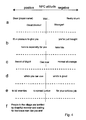
- a potential speech response of the computer is generated based on the selected parameters' values (the current state of the graph of the narrative, the current state of NPC, the attitude of the computer character towards the user). As exemplified in FIG 4 ., system response is generated based on NPC attitude (visible on left and right part of Fig. 4 ).
- a statement is prepared by selecting one by one fragment from each segment.
- the game may also take into account the emotional state of the user and influence it.
- the first state is negotiation.
- Negotiation is a state, in which the user is encouraged to communicate, focus on solving a specific problem, finding an appropriate solution. The user focuses on the goal, is involved in maximizing the profits.
- the second state is persuasion. Persuasion is used for creating a situation in which the user will try to resolve a conflict.
- the third state is submission.
- submission is a condition, in which the user will seek to comply without any objections in order to achieve the given benefits.
- Detection and appropriate classification of the current emotional state of the user provides feedback to the system regarding the attitude of the user. Examples of such detection are keywords. emotion recognition based on player speech (high pitch, speaking faster, etc.) and/or gesture and pose recognition based on external sensors (e.g. Microsoft Kinect).
- Each of the computer characters (such as NPCs) at a given time of narration is in a given attitude towards the user (e.g. a player). It is taken into account in the definition and selection of the subsequent line of a dialog. From the point of view of the algorithm for generation of a line of a dialog, this means a selection of texts from a specific, narrow pool of texts and words in dictionaries. Depending on the simulated emotional state of the computer character, there is also possible a change of the subject by the computer character, ignoring the user's statements and guidance of the user to a subject that is important for the narrative.
- Fig. 1 presents an example of graph structure for a simple scenario of a fragment of a game.
- it is a dialog with an NPC, from which the player wants to buy an item (1).
- the conversation starts with a neutral attitude of the NPC towards the player (a).
- the statements of the player in the beginning of the conversation, such as greeting or a small talk (2) can make the NPC change its attitude to a negative attitude towards the player (c) or to a positive attitude (d) or remain neutral (d).
- Both outputs make the dialog continue on with a different part of the paths of dialog - (3) in the case of a negative greeting, (4) in the case of a positive or neutral. From the state (3) one may by flattering return (b) to state (2), or to continue the conversation in a negative way (f) leading to a state of the dialog in which the NPC is the state of high irritation towards the player (5). Its at least partial decrease will lead to a finish of the conversation with the player (i), while further irritation will lead to an attack on the player (j).
- the player may start some dialog devoted to negotiating prices. Specifying too low price will make the seller angry (e) and enable option (3) of the dialog system.
- the player can also propose an average price (g) which will lead to the dialog system state (6) or a high price (h) which will lead to the dialog system state (7).
- the dialog system state (6) can complete the purchase of the item (k), and the system state (7) the finalized the purchase and offer the player an exciting new job (j).
- the transition between different parts of the dialog is dependent on the use of different keywords (and their variants collected in a graph of similar concepts/terms) and the current narrative factors such as characteristics of the characters and their attitude with respect to the player, or the overall situation in the game.
- the horizontal dotted lines indicate a separate narrative fragments after crossing the boundary of which, returning to the previous fragment is no longer possible. They are useful for the creation of the story, but are optional in the present invention.
- the conduct of the described conversation negotiating price means that it will not be possible to restart the conversation in the same manner - the seller will remember the player and the result of the first conversation. Further reactions will depend on those past events.
- the player will not use specific keywords, which result in changes in the dialog system state, for example, in (4) the player may not begin the conversation about the price. In such a case, for some time the dialog system will maintain the conversation, and eventually move to another part of the dialog system randomly, or according to a predefined default path. In the case of (4) it may be (e), which leads to finalizing of the conversation without a purchase.
- Fig. 2 is simplified due to the multidimensionality of the issue (in real applications tens or hundreds of dimensions). Each dimension corresponds either to a specific group of words, which is a collection of similar concepts/terms, or other parameters influencing the course of the dialog, such as the characteristics of the player's character, the earlier events in the game, or even the weather, time of day, or the state of the game world.
- the marked fields 1, 2, 3 in Fig. 2 influence the outcome of the dialog section.
- Fig. 2 For each node (1) to (7) of Fig. 1 , there is generated one map as shown in Fig. 2 .
- the number of fields depends on the number of possible exits from the given node (the dialog system). Therefore, the example of Fig. 2 having three exits refers to the node (4) in Fig. 1 .
- Field boundaries can be determined with a deterministic function or a probability according to the fuzzy logic ( L. Zadeh, "Fuzzy sets," Information and Control, vol 8, pp. 338-353, 1965 .) As a result, the fields may overlap. It is also possible that fragments of the dialog space are not covered by any of the fields.
- weights of words are taken directly from the lattice of speech recognition, therefore they are set with a certain probability. This follows directly from the imperfections of speech recognition systems. The assumption that the most likely hypothesis is correct and its use as characteristics often leads to a wrong decision.
- a solution of better quality is the explicit entering of the probabilities of many hypotheses. Thanks to this there is set up a point in space determining dialog's run, modified with other factors. There are three situations possible: a point in space does not overlap any of the areas, overlaps one or more areas. If it does not overlap any, then a decision on changing the current node of the narrative may be taken according to the decision of the designer of the game; the conversation is continued in the current node (dialog system) or the node is exit via the default exit. If exactly one area overlaps with the selected point in the map then a transition is made via the exit corresponding to the area. If the point overlaps with several areas, a selection function is executed for selecting one exit based on a value of an affiliation function to specific areas at a given point.
- the sets of words, that are dimensions of the map shown in Fig. 2 may be determined according to any of methods for words clustering. For example:
- the exit from a node may be forced in order to achieve a sufficiently high value of one area on the map (high confidence that this is the appropriate response).
- the value can be incremented on a regular basis, and the conversation may be continued until there are relatively large changes on the dialog map.
- a node may end its operation and exit when the location of the point stabilizes.
- the line connecting points a, b and c is a line along which a point moves that determines where in different stages of a conversation the context is placed. It defines the topic of the conversation and adherence to previously described coefficients.
- the above described structure has been shown for a specific dialog.
- the nodes will be for example dialogs with individual NPCs, and the maps will describe the results of the individual dialogs, NPCs attitude towards the player after the conversations, the characteristics of a player and any other parameters that may affect the fate of the user's character created by the game designer.
- dialog line The generation of a dialog line is executed with standard methods, known in the field, described for example in Jurafsky "Speech and Language Processing". Their execution is possible using speech synthesis or pre-recorded samples spoken by people.
- FIG. 3 presents a block diagram of a system according to the present invention.
- the dialog system employing speech recognition interacts with a person or a plurality of persons 301.
- a person 301 inputs a question, or a statement in general, by speaking to a microphone.
- the sound registered by the microphone is processed by a speech recognition module 302 and subsequently hypotheses of its recognition are delivered to a module for understanding of natural language 303.
- sound data are passed to a dialog manager 304, which in cooperation with a plot management module 306 and plot context coefficients 307, by querying a database of domain knowledge 305, determines a response to a user's statement.
- a natural language response is generated at module for generating natural language 308 and subsequently speech generation module 309 (speech synthesis or playing prerecorded phrases).
- the generated response speech is output to the person 301 via a loudspeaker installed in the system.
- the method according to the present invention may be summarized as presented in Fig. 5 .
- the process starts at step 501 from creating dialog's plot scenario as a narrative graph structure containing the dialogs.
- coefficients of dialog transitions maps are assigned to narrative graph nodes.
- Steps 501 and 502 are made during production of a game. The following steps are conducted while playing.
- step 503 there is provided speech input for recognition in a given context and dialog phase represented by the current narrative graph node.
- step 504 there is applied an algorithm for updating dialog coefficients based on user's speech or user's other behavior.
- step 505 at least one fuzzy logic algorithm is applied, which using user speech and other coefficients on the transition map, determines a transition to another narrative graph node (phase of a dialog or a plot) or updates a position on the transition map, continuing the dialog in the same narrative graph node.
- step 506 there is determined emotional state of the user and finally at step 507 there is executed determining of a response based on coefficients of the narrative and the user's emotional state.
- the steps 503-507 are repeated for a particular narrative graph node until a transition is decided in step 505.
- the steps 503-507 are repeated with new coefficients in a new narrative graph node, starting with a new position on a dialog graph structure and with new values of coefficients.
- the aforementioned computer implemented method for providing a dialog with a user may be performed and/or controlled by one or more computer programs.
- Such computer programs are typically executed by utilizing the computing resources in a computing device such as personal computers, personal digital assistants, cellular telephones, receivers and decoders of digital television or the like.
- Applications are stored on a non-transitory medium.
- An example of a non-transitory medium is a non-volatile memory, for example a flash memory or volatile memory, for example RAM.
- the computer instructions and are executed by a processor.
- These memories are exemplary recording media for storing computer programs comprising computer-executable instructions performing all the steps of the computer-implemented method according the technical concept presented herein.
Landscapes
- Engineering & Computer Science (AREA)
- Physics & Mathematics (AREA)
- Audiology, Speech & Language Pathology (AREA)
- Computational Linguistics (AREA)
- Health & Medical Sciences (AREA)
- Human Computer Interaction (AREA)
- Artificial Intelligence (AREA)
- Multimedia (AREA)
- Acoustics & Sound (AREA)
- Theoretical Computer Science (AREA)
- General Health & Medical Sciences (AREA)
- General Physics & Mathematics (AREA)
- General Engineering & Computer Science (AREA)
- Machine Translation (AREA)
- User Interface Of Digital Computer (AREA)
Applications Claiming Priority (1)
| Application Number | Priority Date | Filing Date | Title |
|---|---|---|---|
| CA2835368A CA2835368A1 (fr) | 2013-11-27 | 2013-11-27 | Systeme et procede permettant d'assurer un dialogue avec un utilisateur |
Publications (2)
| Publication Number | Publication Date |
|---|---|
| EP2879062A2 true EP2879062A2 (fr) | 2015-06-03 |
| EP2879062A3 EP2879062A3 (fr) | 2015-06-24 |
Family
ID=52002643
Family Applications (1)
| Application Number | Title | Priority Date | Filing Date |
|---|---|---|---|
| EP14003974.4A Ceased EP2879062A3 (fr) | 2013-11-27 | 2014-11-26 | Système et procédé de délivrance d'un dialogue avec un utilisateur |
Country Status (2)
| Country | Link |
|---|---|
| EP (1) | EP2879062A3 (fr) |
| CA (1) | CA2835368A1 (fr) |
Cited By (7)
| Publication number | Priority date | Publication date | Assignee | Title |
|---|---|---|---|---|
| CN108376543A (zh) * | 2018-02-11 | 2018-08-07 | 深圳创维-Rgb电子有限公司 | 一种电器设备的控制方法、装置、设备和存储介质 |
| US20190238487A1 (en) * | 2018-02-01 | 2019-08-01 | International Business Machines Corporation | Dynamically constructing and configuring a conversational agent learning model |
| US10621978B2 (en) | 2017-11-22 | 2020-04-14 | International Business Machines Corporation | Dynamically generated dialog |
| CN111563190A (zh) * | 2020-04-07 | 2020-08-21 | 中国电子科技集团公司第二十九研究所 | 一种区域网络用户行为的多维度分析与监管方法及系统 |
| CN112023391A (zh) * | 2020-09-02 | 2020-12-04 | 杭州瞳阳科技有限公司 | 一种用于游戏vr的控制系统及其方法 |
| CN112232071A (zh) * | 2020-10-22 | 2021-01-15 | 中国平安人寿保险股份有限公司 | 多轮对话剧本测试方法、装置、设备及存储介质 |
| CN113421651A (zh) * | 2021-06-21 | 2021-09-21 | 河南省人民医院 | 一种叙事护理过程的数据干预与自适应调节系统与方法 |
Citations (2)
| Publication number | Priority date | Publication date | Assignee | Title |
|---|---|---|---|---|
| EP1061459A2 (fr) | 1999-06-15 | 2000-12-20 | Lucent Technologies Inc. | Système et procédé pour la génération d'interface automatique et dynamique |
| EP1927942A1 (fr) | 2006-11-30 | 2008-06-04 | Robert Bosch Corporation | Amplifier les systemes de dialogue pour traiter des activites complexes pour des applications |
-
2013
- 2013-11-27 CA CA2835368A patent/CA2835368A1/fr not_active Abandoned
-
2014
- 2014-11-26 EP EP14003974.4A patent/EP2879062A3/fr not_active Ceased
Patent Citations (2)
| Publication number | Priority date | Publication date | Assignee | Title |
|---|---|---|---|---|
| EP1061459A2 (fr) | 1999-06-15 | 2000-12-20 | Lucent Technologies Inc. | Système et procédé pour la génération d'interface automatique et dynamique |
| EP1927942A1 (fr) | 2006-11-30 | 2008-06-04 | Robert Bosch Corporation | Amplifier les systemes de dialogue pour traiter des activites complexes pour des applications |
Non-Patent Citations (11)
| Title |
|---|
| AUSTERMANN A ET AL: "Fuzzy emotion recognition in natural speech dialogue", ROBOT AND HUMAN INTERACTIVE COMMUNICATION, 2005. ROMAN 2005. IEEE INTE RNATIONAL WORKSHOP ON NASHVILLE, TN, USA AUG. 13 - 15 2005, PISCATAWAY, NJ, USA,IEEE, 13 August 2005 (2005-08-13), pages 317 - 322, XP010839379, ISBN: 978-0-7803-9274-8 * |
| B. ZIÓTKO; S. MANANDHAR; R. WILSON: "Bag-of-words Modelling for Speech Recognition", INTERNATIONAL CONFERENCE ON FUTURE COMPUTER AND COMMUNICATION, 2009 |
| D. JURAFSKY; J.H. MARTIN: "Speech and Language Processing", 2009, PEARSON, PRENTICE HALL |
| D. JURAFSKY; J.H. MARTIN: "Speech and Language Processing", 2009, PRENTICE HALL |
| E. AGIRRE; E. ALFONSECA; O. L. DE LACALLE: "Approximating hierachy-based similarity for wordnet nominal synsets using topic signatures", PROCEEDINGS OF THE 2ND GLOBAL WORDNET CONFERENCE. BRNO, CZECH REPUBLIC, 2004 |
| G. GORRELL; B. WEBB: "Generalized Hebbian algorithm for incremental latent semantic analysis", PROCEEDINGS OF INTESPEECH, 2005 |
| J. R. BELLEGARDA: "A latent semantic analysis framework for large-span language modeling", PROCEEDINGS OF EUROSPEECH, vol. 3, 1997, pages 1451 - 1454, XP001045096 |
| J. R. BELLEGARDA: "Latent semantic mapping", IEEE. SIGNAL PROCESSING MAGAZINE, pages 70 - 80 |
| JOHN E. DENNIS; ROBERT B. SCHNABEL: "Numerical Methods for Unconstrained Optimization and Nonlinear Equations", 1983, SIAM |
| L. ZADEH: "Fuzzy sets", INFORMATION AND CONTROL, vol. 8, 1965, pages 338 - 353, XP024889529, DOI: doi:10.1016/S0019-9958(65)90241-X |
| Y. DENG; S. KHUDANPUR: "Latent semantic information in maximum entropy language models for conversational speech recognition", PROCEEDINGS OF THE HLT-NAACL 03, 2003, pages 56 - 63, XP058168326, DOI: doi:10.3115/1073445.1073453 |
Cited By (13)
| Publication number | Priority date | Publication date | Assignee | Title |
|---|---|---|---|---|
| US10923115B2 (en) | 2017-11-22 | 2021-02-16 | International Business Machines Corporation | Dynamically generated dialog |
| US10621978B2 (en) | 2017-11-22 | 2020-04-14 | International Business Machines Corporation | Dynamically generated dialog |
| US20190238487A1 (en) * | 2018-02-01 | 2019-08-01 | International Business Machines Corporation | Dynamically constructing and configuring a conversational agent learning model |
| US11886823B2 (en) * | 2018-02-01 | 2024-01-30 | International Business Machines Corporation | Dynamically constructing and configuring a conversational agent learning model |
| CN108376543A (zh) * | 2018-02-11 | 2018-08-07 | 深圳创维-Rgb电子有限公司 | 一种电器设备的控制方法、装置、设备和存储介质 |
| CN108376543B (zh) * | 2018-02-11 | 2021-07-13 | 深圳创维-Rgb电子有限公司 | 一种电器设备的控制方法、装置、设备和存储介质 |
| CN111563190A (zh) * | 2020-04-07 | 2020-08-21 | 中国电子科技集团公司第二十九研究所 | 一种区域网络用户行为的多维度分析与监管方法及系统 |
| CN112023391B (zh) * | 2020-09-02 | 2024-01-16 | 杭州瞳阳科技有限公司 | 一种用于游戏vr的控制系统及其方法 |
| CN112023391A (zh) * | 2020-09-02 | 2020-12-04 | 杭州瞳阳科技有限公司 | 一种用于游戏vr的控制系统及其方法 |
| CN112232071A (zh) * | 2020-10-22 | 2021-01-15 | 中国平安人寿保险股份有限公司 | 多轮对话剧本测试方法、装置、设备及存储介质 |
| CN112232071B (zh) * | 2020-10-22 | 2022-07-15 | 中国平安人寿保险股份有限公司 | 多轮对话剧本测试方法、装置、设备及存储介质 |
| CN113421651A (zh) * | 2021-06-21 | 2021-09-21 | 河南省人民医院 | 一种叙事护理过程的数据干预与自适应调节系统与方法 |
| CN113421651B (zh) * | 2021-06-21 | 2023-12-29 | 河南省人民医院 | 一种叙事护理过程的数据干预与自适应调节系统与方法 |
Also Published As
| Publication number | Publication date |
|---|---|
| EP2879062A3 (fr) | 2015-06-24 |
| CA2835368A1 (fr) | 2015-05-27 |
Similar Documents
| Publication | Publication Date | Title |
|---|---|---|
| US9361589B2 (en) | System and a method for providing a dialog with a user | |
| McTear | Conversational ai: Dialogue systems, conversational agents, and chatbots | |
| JP7524296B2 (ja) | 作成者が提供したコンテンツに基づいて対話型ダイアログアプリケーションを調整すること | |
| US11062270B2 (en) | Generating enriched action items | |
| CN108268587B (zh) | 场境感知人机对话 | |
| EP2879062A2 (fr) | Système et procédé de délivrance d'un dialogue avec un utilisateur | |
| McTear et al. | Conversational interfaces: Past and present | |
| Berg | Modelling of natural dialogues in the context of speech-based information and control systems | |
| McTear | Rule-based dialogue systems: Architecture, methods, and tools | |
| O’Shea et al. | Systems engineering and conversational agents | |
| KR20230016366A (ko) | 인공지능 캐릭터의 대화 엔진 자가 학습 방법 및 그 시스템 | |
| KR20190103951A (ko) | 학습 데이터 중 식별 가능하지만 학습 가능성이 없는 데이터의 레이블화를 통한, 대화형 ai 에이전트 시스템을 위한 지식베이스 모델의 구축 또는 갱신 방법, 컴퓨터 장치, 및 컴퓨터 판독 가능 기록 매체 | |
| Lee et al. | Hybrid approach to robust dialog management using agenda and dialog examples | |
| KR102448733B1 (ko) | 문맥 내 턴 구성을 고려하여 응답을 선택하는 대화 시스템 및 그 방법 | |
| CN119168059B (zh) | 基于智能体的模拟法庭实现方法、装置、设备和介质 | |
| JP2015155932A (ja) | ユーザとの対話システム及び方法 | |
| Griol et al. | Adaptive dialogue management using intent clustering and fuzzy rules | |
| McGraw et al. | How to Control and Utilize Crowd‐Collected Speech | |
| US12159628B1 (en) | Natural language interactions with interactive visual content | |
| Chakrabarti | Artificial conversations for chatter bots using knowledge representation, learning, and pragmatics | |
| Ahmed et al. | A comparative study of various approaches for dialogue management | |
| McGraw | Crowd-supervised training of spoken language systems | |
| CN115427993A (zh) | 更新计算机化助理操作的约束 | |
| Morzy | Conversational AI | |
| US12469494B1 (en) | Dialogue system and a dialogue method |
Legal Events
| Date | Code | Title | Description |
|---|---|---|---|
| PUAL | Search report despatched |
Free format text: ORIGINAL CODE: 0009013 |
|
| PUAI | Public reference made under article 153(3) epc to a published international application that has entered the european phase |
Free format text: ORIGINAL CODE: 0009012 |
|
| 17P | Request for examination filed |
Effective date: 20141126 |
|
| AK | Designated contracting states |
Kind code of ref document: A2 Designated state(s): AL AT BE BG CH CY CZ DE DK EE ES FI FR GB GR HR HU IE IS IT LI LT LU LV MC MK MT NL NO PL PT RO RS SE SI SK SM TR |
|
| AX | Request for extension of the european patent |
Extension state: BA ME |
|
| AK | Designated contracting states |
Kind code of ref document: A3 Designated state(s): AL AT BE BG CH CY CZ DE DK EE ES FI FR GB GR HR HU IE IS IT LI LT LU LV MC MK MT NL NO PL PT RO RS SE SI SK SM TR |
|
| AX | Request for extension of the european patent |
Extension state: BA ME |
|
| RIC1 | Information provided on ipc code assigned before grant |
Ipc: G10L 15/18 20130101ALI20150520BHEP Ipc: G10L 15/22 20060101ALI20150520BHEP Ipc: G06F 17/27 20060101AFI20150520BHEP |
|
| R17P | Request for examination filed (corrected) |
Effective date: 20141217 |
|
| STAA | Information on the status of an ep patent application or granted ep patent |
Free format text: STATUS: EXAMINATION IS IN PROGRESS |
|
| 17Q | First examination report despatched |
Effective date: 20170908 |
|
| STAA | Information on the status of an ep patent application or granted ep patent |
Free format text: STATUS: THE APPLICATION HAS BEEN REFUSED |
|
| 18R | Application refused |
Effective date: 20181006 |