EP1062904A1 - Machine miniature montée dans un évier - Google Patents
Machine miniature montée dans un évier Download PDFInfo
- Publication number
- EP1062904A1 EP1062904A1 EP99870126A EP99870126A EP1062904A1 EP 1062904 A1 EP1062904 A1 EP 1062904A1 EP 99870126 A EP99870126 A EP 99870126A EP 99870126 A EP99870126 A EP 99870126A EP 1062904 A1 EP1062904 A1 EP 1062904A1
- Authority
- EP
- European Patent Office
- Prior art keywords
- sink
- water
- wash
- wash water
- present
- Prior art date
- Legal status (The legal status is an assumption and is not a legal conclusion. Google has not performed a legal analysis and makes no representation as to the accuracy of the status listed.)
- Withdrawn
Links
Images
Classifications
-
- A—HUMAN NECESSITIES
- A47—FURNITURE; DOMESTIC ARTICLES OR APPLIANCES; COFFEE MILLS; SPICE MILLS; SUCTION CLEANERS IN GENERAL
- A47L—DOMESTIC WASHING OR CLEANING; SUCTION CLEANERS IN GENERAL
- A47L15/00—Washing or rinsing machines for crockery or tableware
- A47L15/02—Washing or rinsing machines for crockery or tableware with circulation and agitation of the cleaning liquid in the cleaning chamber containing a stationary basket
- A47L15/13—Washing or rinsing machines for crockery or tableware with circulation and agitation of the cleaning liquid in the cleaning chamber containing a stationary basket using sonic or ultrasonic waves
-
- A—HUMAN NECESSITIES
- A47—FURNITURE; DOMESTIC ARTICLES OR APPLIANCES; COFFEE MILLS; SPICE MILLS; SUCTION CLEANERS IN GENERAL
- A47L—DOMESTIC WASHING OR CLEANING; SUCTION CLEANERS IN GENERAL
- A47L15/00—Washing or rinsing machines for crockery or tableware
- A47L15/0086—In-sink dishwashers
-
- A—HUMAN NECESSITIES
- A47—FURNITURE; DOMESTIC ARTICLES OR APPLIANCES; COFFEE MILLS; SPICE MILLS; SUCTION CLEANERS IN GENERAL
- A47L—DOMESTIC WASHING OR CLEANING; SUCTION CLEANERS IN GENERAL
- A47L2601/00—Washing methods characterised by the use of a particular treatment
- A47L2601/17—Sonic or ultrasonic waves
Definitions
- the present invention relates to devices for semi-automatic washing of cutlery, dishes and the like.
- Some devices are known which are more generally related to semi-automatic or automatic washing or cleaning of items. These are well known in the art, and typically comprise, for example, a container for putting the items to wash with water, for example a tub or a tank, a means to circulate water in the container, for example a pump, preferably a means to filter the wash water or alternatively a means to evacuate said wash water from the container and replace it with fresh water, and a pipe system for connecting the different components of the device.
- some devices further comprise means to enhance the washing process, such as for example brushes, bubbling or agitating means, heaters to maintain the water temperature at a certain level, and means for adding a detergent or cleaning solution.
- some of the above described devices can comprise a means for automatically, or semi-automatically control the washing process, so as to reduce the number of steps in the process which require the user's intervention.
- D1 (US 5091095) is a US patent to Focus Enterprises. It discloses a system for automatic treatment of drains, which is provided by the controlled injection of a bio-active liquid at established intervals into the drain system.
- a container of the treatment liquid is provided with a pump coupled between the container and the drain.
- Fluid level sensing means is located in the container and fluid temperature sensing means is located in the drain system. When the temperature is within range and the fluid level is sensed, the pump is periodically operated to inject a quantity of fluid directly into the drain system without operator control.
- D2 (US 4859345) is a US patent to Jitsuo Inagaki. It discloses a bath water heater and purification apparatus.
- the system comprises a removable filter, a heater, sensors, and a pump.
- the system removes organic substances from the bath, and keeps the temperature at a certain level, using the sensors and the heater.
- D3 (EP 709120 A1) is a European patent application to Sugiura Eiichi. It discloses a washing device and oily water separator and filtration device which are optimal for use with the washing device.
- the device comprises a bubbling washing section to remove sludge and oils from an item such as a work which has been machined.
- the device further comprises a filtration unit for regenerating the oily water produced by the bubbling unit.
- D4 (US 5573677) is a US patent to Edward Dembrosky.
- D5 (US 4409119) is a US patent to Henkel. It discloses a process for regenerating cleaning solutions. More specifically, it discloses a process for regenerating alkaline and neutral phosphate and/or silicate degreasing solutions. The treatment uses calcium or magnesium ions.
- D6 (US 5268093) is a US patent to Recovery Eng. Inc. It discloses a portable water purification system.
- the system is manually operable and comprises a first container, a filter placed to filter dirty water of the first container, and a porous body of biocidally material for disinfecting the filtered water from the first container, a plunger sealably engaged with the first container for forcing the water from the first container through the filter and the disinfecting unit, and a passageway through the plunger with check valve for preventing creation of a vacuum in the container when the plunger is remover therefrom.
- D7 (US5409615) is a US patent to Wallman et Al. It discloses a temperature controlled grease trap. It allows to control and maintain the temperature of waste water entering a grease trap.
- the system is to prevent persons from washing waste water containing grease from a sink into the sewer, by using hot water.
- the systems mixes cold water to the waste water through a valve connected to the sewer pipes, whenever the water coming from the pipes is too hot.
- the present invention is directed to a device for semi-automatic washing of dishes and the like, to be removably plugged into the drain of a kitchen sink, characterized in that it comprises:
- the means for circulating the wash water in the sink is an electrically driven pump.
- the device further comprises a heating means for maintaining the temperature of the wash water at the same level, a means for automatically delivering a dish washing composition into the wash water, an ultrasonic wave generator for enhancing the wash process.
- the device also comprises in combination at least one sensor means and at least one chip to automatically control the sequence of the washing process.
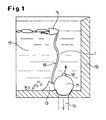
- a device (1) for semi-automatic washing of cutlery, dishes and the like is provided, which can be constructed for example as shown in figure 1. It is meant to be removably plugged into the drain hole (16) of a kitchen sink (10).
- semi-automatic is defined as a process of washing items which comprises manually plugging the device (1) into a sink (10), so as to close its drain, manually pouring water in the sink (10), manually putting items into the sink (10), manually activating the device (1) so as to initiate a wash cycle, manually removing the items from the sink (10) at the end of the wash cycle, and manually drying said items.
- Such a semi-automatic process is opposed to fully automatic washing process where the supply of water and the drying operation of items is ensured by the device (1) instead of being manual.
- the device (1) of the present invention comprises a housing (11), a means for circulating wash water (17) in the sink (10) which is preferably located into said housing (11), a means to supply the water circulating means with power, a set of filters for purifying the wash water (17) during the wash cycle, and a pipe system for connecting the different components of the device (1).
- the device (1) further comprises a power source - not shown - to operate the water circulating means, and/or a heating means for maintaining the temperature of the wash water (17) at the same level during the wash process.
- the device (1) comprises a supplying means for automatically delivering a cleaning - or dish washing - composition into the wash water (17), during the wash process.
- a ultrasonic wave generator which is coupled to the device (1) and activates/enhances the cleaning process during the wash cycle.
- the device (1) comprises at least one sensor and at least one chip to automatically and sequentially control the different steps of the washing process, as well as to monitor different parameters of the washing conditions, such as for example temperature, concentration of dish washing composition into the wash water (17), strength of the jet stream into the wash water (17)...etc.
- the device (1) further comprises a valve system, which is preferably located near the water circulating means in the housing (11).
- the valve system automatically monitors the flow of liquid inside the pipes (15) and through the different components of the device (1), depending on the wash conditions and/or wash cycle step.
- the water circulating means The water circulating means
- the device (1) of the present invention comprises a means for circulating the wash water (17) during the wash cycle.
- Said water circulating means comprises at least two inlet ports and two outlet ports.
- Said inlet and outlet ports are flow connections which connect the water circulating means to the other components of the device (1), preferably by the means of pipes (15).
- Inlet ports are defined as flow connections through which the water conducting means collects fluid, for example wash water (17).
- Outlet ports are defined as flow connections through which the water circulating means evacuates fluid, for example wash water (17).
- the water circulating means is located into the device (1) housing (11), and is constructed so that the consumer must plug one - protruding - portion of the device (1)'s housing (11) into the sink (10)'s drain hole (16), to install said device (1).
- This operation closes the sink (10) in a fluid-tight manner, and also directly connects the drain exhaust aperture (12) of the water circulating means, if any, to the drain, as shown in figure 1.
- the water circulating means is achieved by an electrically driven pump.
- the electrically driven pump may be, for example, a gear pump, an impeller pump, a piston pump, a screw pump, a peristaltic pump, a diaphragm pump, or any other miniature pump.
- the pump is a gear pump with a typical speed between 6000 and 12000 rpm.
- the electrically driven pump must be driven by a means such as an electric motor.
- the electric motor typically produces a torque between 1 and 20 mN.m.
- said water circulating means can also be used to create a mechanical washing/cleaning effect by creating spinning effects - such as whirlpools -, and/or jet-stream effects into said wash water (17) so as to enhance the chemical washing process achieved by the wash water (17).
- spinning effects - such as whirlpools -, and/or jet-stream effects into said wash water (17) so as to enhance the chemical washing process achieved by the wash water (17).
- the valve means The valve means
- the device (1) comprises a system to monitor and control the direction of the flow of liquid inside the device (1)'s pipes (15), towards the different components of said device (1) during the wash cycle.
- a system is more preferably achieved by a set of one-way valves which open/close to give way/block the flow of wash water (17).
- the valve set is located inside the housing (11), and comprises inlet valves connected to each inlet port of the water circulating means, and outlet valves connected to each outlet port of the water circulating means.
- the combination of the inlet and outlet valves allows several ways of fluid circulation once the device (1) is installed in the sink (10) and the water circulating means is switched on.
- the inlet valves are open, so as to establish a fluid connection between the filters and the water circulating means.
- the outlet valve to the drain is closed and the outlet valve to the exhaust aperture (12) of the water circulating means is open, so that said water circulating means recycles the wash water (17) of the sink (10) in a closed circuit.
- the outlet drain valve opens and the outlet valve to the exhaust aperture (12) of the water circulating means closes, so that the wash water (17) is directed to the drain and the sink (10) is emptied.
- the device (1) comprises at least one filter to recycle/purify the wash water (17) during the wash cycle. Said wash water (17) is brought to the filter by the water circulating means in a continuous or discontinuous manner.
- the device (1) comprises two filters.
- the first filter is intended for filtering the greasy portion of water, which is located at the surface of the wash water (17).
- Said grease filter (14) comprises a housing (11) and an inlet port.
- the housing (11) comprises at least one filtering means, such as for example a cellulose or synthetic mesh or porous material, with pores. The diameter of the pores is such as to retain the grease or oily particles.
- Said grease filter (14) is preferably constructed so that it floats at the surface of the wash water (17), as shown in figure 1. More preferably, it is constructed so that the level of wash water (17) is centered across the height of the inlet port. In a first and preferred embodiment of the invention, this position of the grease filter (14) is balanced by the weight of said grease filter (14), and the volume of the hollow portions.
- the grease filter (14) comprises at least one means for fixing it to the sink (10)'s wall.
- a means can be for example a magnet or a suction grip.
- This fixing means allows the user to attach the grease filter (14) at the right level once the sink (10) is filled with water, so that the level of wash water (17) is centered across the height of the inlet port, as shown in figure 1.
- the second filter is a filter to be used to remove food particles and the like from the bottom of the sink (10). Such particles are typically detached from the dishes and cutlery during the washing process, and most of them are heavy enough not to stay in suspension into the wash water (17). On the contrary, they form a deposit at the bottom of the sink (10), which limits the washing efficiency of the wash water (17).
- Said second filter needs to be constructed to be heavy enough to stay at the bottom of the sink (10), as shown in figure 1. Alternatively, it can be fixed at the bottom of the sink (10) by means of a magnet, a suction grip, or other similar fixing means.
- Said filter comprises an inlet port which must have such dimensions that it can absorb large food particles.
- the surface of the inlet port is preferably superior to 1 cm 2 , more preferably superior to 5 cm 2 and even more preferably superior to 10 cm 2 . It will also be appreciated that the surface of the inlet port has an impact on the suction force, and thus, on the efficiency of the water recycling system.
- the membrane of the particle filter (13) essentially operates to screen out particles like a trap in a sink (10) or bathtub drain.
- the outlet valve to the drain is closed and the pump is operating, the latter supplies the necessary force to draw a major portion of the wash water (17) flowing from the filter through the membrane and further back into the sink (10) via the exhaust aperture (12).
- the filter contains at least two media, at least one of which should be a hydrophobic material to screen out fats, greases and other lipid-based emulsions from the liquid cleaning composition.
- Other media suitable for use in the present invention can be chosen from known filter media materials. It may be desirable to have a media designed to trap particulate matter in situations were the device (1) does not include a membrane or to screen out particulate matter too small to be trapped by the membrane.
- a preferred particle filter (13) for use in the present invention is one that can be essentially used permanently without the need for consumer maintenance or intervention of any kind. Because the filter is intended to be used for extended periods without maintenance, it is preferred for there to be a process of cleaning the filter and removing the particulates and soils entrapped in the filter and filter media.
- a flow meter measures when the rate of flow of the wash water (17) has become substantially obstructed by food and soil particles entrapped in the filter or membrane or both.
- the rate of flow of the liquid cleaning composition past the flow meter falls below a certain flow setting (measured in volume divided by time)
- the pump is automatically stopped so that the user can take the filter out, clean it to remove the particles therefrom and replace back onto the device (1).
- the size of the particle filter (13) will be appropriately determined by those skilled in the art, so that removal of the particles from said particle filter (13) needs to be performed only after several wash cycles, preferably after 5 wash cycles.
- the present device (1) preferably comprises suitable means for effectuating the automation of the cleaning process described above.
- the opening of the valves and the direction of the pump is coordinated by connecting a solenoid or other electromechanical device (1) or device (1)s to both the outlet valve and the drain valve as well as the pump and then in turn connecting each of these electromechanical device (1)s to each other.
- a solenoid or other electromechanical device (1) or device (1)s to both the outlet valve and the drain valve as well as the pump and then in turn connecting each of these electromechanical device (1)s to each other.
- the filters of the present invention provide not only a filtering and screening function but also provide antimicrobial benefits as well.
- a variety of technologies are available to incorporate antimicrobial protection.
- One such technology is available from the MICROBAN® Corporation of Huntersville, North Carolina.
- the MICROBAN® process consists of incorporating the antimicrobial agent triclosan into the voids and spaces in a polymer or plastic. Once a surface is treated with triclosan according to the MICROBAN® process it provides essentially permanent antimicrobial protection for that surface.
- certain interior filter surfaces would be treated with the MICROBAN® process so that when the liquid cleaning composition enters the filter and passes over those treated surfaces then a significant amount of microbes present in the liquid cleaning composition would be eliminated.
- the present invention also encompasses filters that have a temporary, replaceable cartridge and require periodic consumer intervention to remove the used cartridge and replace it with a fresh filter cartridge, such cartridges usually themselves contain the filter media and may incorporate an antimicrobial agent as well.
- filters that have a temporary, replaceable cartridge and require periodic consumer intervention to remove the used cartridge and replace it with a fresh filter cartridge
- such cartridges usually themselves contain the filter media and may incorporate an antimicrobial agent as well.
- An acceptable filter design that utilizes a replaceable cartridge can be seen in U.S. Pat. No. 4,915,831, to Taylor, issued 10 April 1990.
- the device (1) of the present invention comprises pipes (15) to link one component to another.
- a pipe links the grease filter (14) to the water circulating means.
- Another pipe links the particle filter (13) located at the bottom of the sink (10) to the water circulating means.
- these pipes (15) are flexible, so that the filters are movably attached the device (1)'s housing (11). But they can also be rigid. They are most preferably made out of a synthetic material, such as polypropylene (PP), or polyvinylchloride (PVC).
- the electrically driven pump, and the heater, sensors and valves, if any, must be driven by a means such as an electric motor.
- the electric motor typically produces a torque between 1 and 20 mN.m.
- the electric motor must, in turn be provided with a power source.
- the power source may be either mains electricity, optionally via transformer to provide low voltage electricity. It may also be a throw-away battery, or rechargeable battery. Most preferred are one or more AA rechargeable or disposable batteries, the batteries being housed in the device (1)'s housing (11).
- the voltage output of the battery is typically between 1.5 and 12 Volts, with a preferred output between 3 and 6V.
- the heating means The heating means
- the present device (1) also include an in-line heater or heating element at any location in said device (1).
- Said heating means provides energy to warm up the wash water (17) during the wash process; indeed, it has been shown that warm or hot water enhances the washing/cleaning properties of detergent/dish washing compositions.
- said heating means is located inside the housing (11), near the water circulating means, and sufficiently near to the passage of water so that the transfer of calories form the heating means to the water is efficient.
- the heating means is an electric resistance.
- the heating means is connected to a chip with sensors, so that it maintains the temperature of the wash water (17) at a constant level during the wash cycle.
- the wash water (17) does not only comprise water, but it also comprise at least one detergent/ dish washing composition which is used to enhance the chemical washing effect, and reduce the time to wash.
- the dish detergent composition is contained within a detergent reservoir and automatically dispensed through a dispensing tube connected to the flow pipe or through a dispensing tube which discharges dish detergent solution directly into the sink (10) basin.
- a monitor connected to a metering system regulates the concentration of the dish detergent composition in the liquid cleaning composition in the sink (10) basin. If the concentration of the dish detergent composition falls below the desired level, more dish detergent solution can be dispensed.
- the dish detergent composition can be stored in the detergent reservoir in tablet, granular, liquid or gel form.
- the present invention encompasses the design and operation of a detergent reservoir and dispensing tubes which can accommodate a dish detergent composition in tablet, granular, gel or liquid form.
- the detergent reservoir of the present invention may be divided into multiple storage chambers wherein each storage chamber contains one or more of the components of the dish detergent composition.
- each storage chamber contains one or more of the components of the dish detergent composition.
- dish detergent components which are otherwise incompatible in the presence of another can be kept in separate storage areas until the time they are actually dispensed as part of the dish detergent composition into the sink (10) basin.
- detersive enzymes are not stable in detergent formulations that have a high pH or contain alkaline buffers.
- a high pH dish detergent composition can be used in combination with detersive enzymes if they are stored in separate detergent reservoirs or storage chambers and separately dispensed into the liquid cleaning composition. Many other such incompatible component pairs can be so combined by separately storing and releasing them.
- the use of multiple detergent reservoirs or storage chambers allows a consumer to select the time of the dispensing of certain components. For example, it may not be necessary or desirable to include suds suppressors in the dish detergent composition. However, near the end of a timed cleaning process, suds suppressors can be dispensed to reduce the amount of suds in the liquid cleaning composition and thus make it easier to rinse kitchen articles immersed therein.
- the liquid cleaning composition used in the present invention is a mixture of water and a dish detergent solution. While the water is supplied by a conventional above-sink faucet, the dish detergent solution may be provided in a number of ways. One suitable way is for the sink user to simply pour a typical LDL composition (such as DAWNTM or JOYTM) or a typical ADW composition (such as CASCADETM) into the sink basin 48 either before or after adding water. Alternatively, instead of using a standard LDL or ADW composition as the dish detergent solution, a modified ADW or LDL as described below can be used.
- LDL it is meant “Light Duty Liquid", that is to say any composition to be used to manually wash cutlery, dishes, or the like.
- ADW composition it is meant any composition intended for use into automatic dishwashing machines.
- the device (1) of the present invention includes a liquid cleaning composition which is a solution or mixture of water and a dish detergent composition.
- a liquid cleaning composition which is a solution or mixture of water and a dish detergent composition.
- Any typical LDL formulation can serve as a dish detergent composition in the present invention provided that it is sufficiently diluted with water to control the amount of suds generated.
- it is preferable to modify a typical LDL formula by reducing the levels of foaming surfactants as well as reducing or removing the levels of suds boosters meant to enhance foaming.
- a suitable ADW formula may be obtained by removing the suds suppressers, including higher levels of surfactants (particularly low-foaming surfactants) and including a system of components which are effective at grease cleaning.
- a modified ADw formula suitable for use in the present invention generally includes a bleaching agent, a bleach activator, a low-foaming nonionic surfactant, a pH-adjusting component and a source of divalent ions.
- the modified ADW formula is different from typical ADW formulas in the following ways: its source of alkalinity and the builder material used is only carbonate-based, rather than a mix the silicone suds suppressers have been removed, and higher levels of surfactants are desirable. If a dish detergent compositions is to be a modified ADW composition, it can be provided in liquid, granular, tablet or gel form.
- ADW compositions of the present invention can comprise low foaming nonionic surfactants (LFNIs).
- LFNI can be present in amounts from 0.1 % to about 10% by weight, preferably from about 1% to about 8%, more preferably from about 0.25% to about 4%.
- LFNIs are most typically used in ADWs on account of the improved water-sheeting action (especially from glass) which they confer to the ADW product.
- nonionic surfactants also work with calcium ions to provide grease-cleaning benefits. They also encompass non-silicone, nonphosphate polymeric materials further illustrated hereinafter which are known to defoam food soils encountered in automatic dishwashing.
- Preferred LFNIs include nonionic alkoxylated surfactants, especially ethoxylates derived from primary alcohols, and blends thereof with more sophisticated surfactants, such as the polyoxypropylene/polyoxyethylene/polyoxypropylene reverse block polymers.
- the PO/EO/PO polymer-type surfactants are well-known to have foam suppressing or defoaming action, especially in relation to common food soil ingredients such as egg. Where a formulator wishes to use an amine oxide surfactant it is preferable to use cleaning-effective amine oxides which are inherently much lower in foam-forming tendencies than the typical coco amine oxides.
- the LFNI is an ethoxylated surfactant derived from the reaction of a monohydroxy alcohol or alkylphenol containing from about 8 to about 20 carbon atoms, excluding cyclic carbon atoms, with from about 6 to about 15 moles of ethylene oxide per mole of alcohol or alkyl phenol on an average basis.
- the LFNI can optionally contain propylene oxide in an amount up to about 15% by weight.
- Other preferred LFNI surfactants can be prepared by the processes described in U.S. Patent 4,223,163, issued September 16, 1980, Builloty, incorporated herein by reference.
- Highly preferred ADWs herein wherein the LFNI is present make use of ethoxylated monohydroxy alcohol or alkyl phenol and additionally comprise a polyoxyethylene, polyoxypropylene block polymeric compound; the ethoxylated monohydroxy alcohol or alkyl phenol fraction of the LFNI comprising from about 20% to about 80%, preferably from about 30% to about 70%, of the total LFNI.
- Suitable block polyoxyethylene-polyoxypropylene polymeric compounds that meet the requirements described herein before include those based on ethylene glycol, propylene glycol, glycerol, trimethylolpropane and ethylenediamine as initiator reactive hydrogen compound.
- LFNI LFNI
- Cloud points of 1% solutions in water are typically below about 32°C and preferably lower, e.g., 0°C, for optimum control of sudsing throughout a full range of water temperatures.
- LFNIs which may also be used include a C 18 alcohol polyethoxylate, having a degree of ethoxylation of about 8, commercially available SLF18 from Olin Corp. and any biodegradable LFNI having the melting point properties discussed herein above.
- nonionic surfactants are the long chain amine oxide surfactants.
- the long chain amine oxide semi-polar nonionic surfactants of the present invention comprise compounds and mixtures of compounds having the formula:
- the above amine oxides are more fully described in U.S. Pat. No. 4,316,824, issued February 23, 1982, to Pancheri; U.S. Pat. No. 5,075,501; and U.S. Pat. No. 5,071,594, all of which are hereby incorporated herein by reference.
- the present invention may contain from about 0.1% to about 30 %, preferably from about 0.3% to about 18 %, more preferably from about 0.5% to about 12 %, by weight, of low-foaming nonionic surfactants.
- Preferred automatic dishwashing detergent compositions comprise from about 0.8 % to about 10 % of amine oxide.
- the automatic dishwashing detergent compositions herein can additionally contain an anionic co-surfactant.
- the anionic co-surfactant is typically in an amount from 0.1 % to about 10%, preferably from about 0.1% to about 8%, more preferably from about 0.5% to about 5%, by weight of the modified ADW composition.
- Suitable anionic co-surfactants include branched or linear alkyl sulfates and sulfonates. These may contain from about 8 to about 20 carbon atoms.
- Other anionic cosurfactants include the alkyl benzene sulfonates containing from about 6 to about 13 carbon atoms in the alkyl group, and mono- and/or dialkyl phenyl oxide mono- and/or di-sulfonates wherein the alkyl groups contain from about 6 to about 16 carbon atoms. All of these anionic co-surfactants are used as stable salts, preferably sodium and/or potassium.
- Preferred anionic co-surfactants include sulfobetaines, betaines, alkyl(polyethoxy)sulfates (AES) and alkyl (polyethoxy)carboxylates which are usually high sudsing, bromoled fatty acids, alkyl ether carboxylate and sodium laurate.
- Optional anionic co-surfactants are further illustrated in published British Patent Application No. 2,116,199A; U.S. Pat. No. 4,005,027, Hartman; U.S. Pat. No. 4,116,851, Rupe et al; and U.S. Pat. No. 4,116,849, Leikhim, all of which are incorporated herein by reference.
- Highly preferred anionic cosurfactants herein are sodium or potassium salt-forms for which the corresponding calcium salt form has a low Kraft temperature, e.g., 30°C or below, or, even better, 20°C or lower.
- Examples of such highly preferred anionic cosurfactants are the alkyl(polyethoxy)sulfates.
- the preferred anionic co-surfactants of the invention in combination with the other components of the composition provide excellent cleaning and outstanding performance from the standpoints of residual spotting and filming. However, many of these co-surfactants may also be high sudsing thereby requiring the addition of LFNI. Suds suppressers should not be used in the modified ADW compositions.
- the ratio of anionic surfactant to amine oxide is from about 1:15 to about 1:2, preferably from about 1:10 to about 1:4.
- a preferred modified ADW composition additionally includes surfactants classified as "specially selected secondary soaps". Such surfactants are described in greater detail in U.S. Pat. No. 5,726,141, issued March 10, 1998, to Ofosu-asante, incorporated herein by reference.
- divalent ions greatly improves the cleaning of greasy soils for compositions of the present invention. This is especially true when the compositions are used in softened water that contains few divalent ions. It is believed that divalent ions increase the packing of the present surfactants at the oil/water interface, thereby reducing interfacial tension and improving grease cleaning.
- the divalent ions are present in the compositions hereof at a level of from about 0.01% to 4.0%, preferably from about 0.05% to 3.5%, more preferably from about 0.1% to about 2.0%, by weight of the composition.
- Calcium ions in the amount of from about 0.01% to about 2.5%, preferably from about 0.1% to about 1.5%, by weight, may be added as calcium xylene sulfonate. If calcium ions are to be used, the compositions of the present invention preferably comprise from about 0.1% to about 40%, more preferably from about 0.5% to about 10.0%, most preferably from about 0.5% to about 5% calcium xylene sulfonate.
- a divalent ion like calcium may be incompatible with a detergent composition of a pH greater than about 9 or may be incompatible in a detergent composition which contains high levels of either carbonates or anionic surfactants; where it is desirable to add divalent ions to such compositions then it is necessary to include another species of divalent ion, in particular magnesium as well.
- Magnesium can be added as MgCl 2 , magnesium xylene sulfonate or as the magnesium salt of an anionic surfactant. It is preferable that if a particular detergent composition contains carbonates then the composition should not contain calcium ions.
- a divalent ion when incompatible with a particular detergent composition, particularly those compositions containing carbonate, then it may be added separately from the rest of the detergent composition through the use of multiple detergent reservoirs or storage chambers as discussed above.
- the divalent ions can also be added to the composition in the following forms chloride, acetate, formate or nitrate.
- the amount of divalent ions present in compositions of the invention will be dependent upon the total amount of nonionic surfactant.
- the molar ratio of divalent ions to total anionic and/or nonionic surfactant is from about 1:15 to about 1:2 for compositions of the invention.
- Organic diamines either alone or in combination with the above divalent ions can also be used to improve grease cleaning performance.
- the dish detergent compositions prepared according to the present invention have a pH of at least 7; therefore the compositions can comprise a pH-adjusting detergency builder component selected from water-soluble alkaline inorganic salts and water-soluble organic or inorganic builders.
- the active detersive ingredients must be combined with a pH-adjusting component which delivers a wash solution pH of from 7 to about 13, preferably from about 8 to about 12, more preferably from about 8 to about 11.
- the pH-adjusting component are selected so that when the ADw is dissolved in water at a concentration of 2000 - 6000 ppm, the pH remains in the ranges discussed above.
- the pH-adjusting components of the present invention be carbonate-based and selected from the group consisting of: sodium carbonate, potassium carbonate, sesquicarbonate, sodium bicarbonate or potassium bicarbonate or mixtures thereof. If the dish detergent composition is granular or in the form of a tablet, then carbonate pH-adjusting components are not suitable.
- the amount of the pH adjusting component in the instant ADW compositions is generally from about 0.9% to about 99%, preferably from about 5% to about 70%, more preferably from about 20% to about 60% by weight of the composition.
- the essential pH-adjusting system can be complemented (i.e. for improved sequestration in hard water) by other optional detergency builder salts selected from phosphate or nonphosphate detergency builders known in the art, which include the various water-soluble, alkali metal, ammonium or substituted ammonium borates, hydroxysulfonates, polyacetates, and polycarboxylates. Preferred are the alkali metal, especially sodium, salts of such materials. Alternate water-soluble, non-phosphorus organic builders can be used for their sequestering properties.
- polyacetate and polycarboxylate builders are the sodium, potassium, lithium, ammonium and substituted ammonium salts of ethylenediamine tetraacetic acid, ethylenediamine disuccinic acid (especially the S,S- form); nitrilotriacetic acid, tartrate monosuccinic acid, tartrate disuccinic acid, oxydiacetic acid, oxydisuccinic acid, carboxymethyloxysuccinic acid, mellitic acid, and sodium benzene polycarboxylate salts.
- compositions of the present invention may also include a detersive enzyme in the form of an enzyme particle.
- the enzyme particle comprises a composite particle suitable for incorporation in a detergent composition comprising an enzyme-containing core material and a barrier layer coated on the enzyme-containing core material.
- the enzyme containing core material includes the enzyme or enzymes which the composite particle of the present invention is to deliver.
- the enzyme to be delivered by the present invention is a detersive enzyme.
- "Detersive enzyme" means any enzyme having a cleaning, stain removing or otherwise beneficial effect in an automatic dishwashing composition.
- Preferred detersive enzymes are hydrolases such as proteases, amylases and lipases. Highly preferred for automatic dishwashing are amylases and/or proteases, including both current commercially available types and improved types which, though more and more bleach compatible though successive improvements, have a remaining degree of bleach deactivation susceptibility.
- Enzymes are normally incorporated into detergent or detergent additive compositions at levels sufficient to provide a "cleaning-effective amount".
- cleaning effective amount refers to any amount capable of producing a cleaning, stain removal, soil removal, whitening, deodorizing, or freshness improving effect on substrates such as dishware and the like. In practical terms for current commercial preparations, typical amounts are up to about 5 mg by weight, more typically 0.01 mg to 3 mg, of active enzyme per gram of the detergent composition. Stated otherwise, the compositions herein will typically comprise from about 0.001% to about 15%, preferably about 0.01% to about 10% by weight of a commercial enzyme preparation.
- Protease enzymes are usually present in such commercial preparations at levels sufficient to provide from 0.005 to 0.1 Anson units (AU) of activity per gram of composition. Suitable enzymes are further described in the copending provisional patent application of Peter R. Foley et al., entitled “Process for Promoting Sanitization of Washed and Sanitized Substrates during the Post-Wash Stage of Automatic Dishwashing", having P & G Case No. 7217P, filed on 15 Oct. 1998.
- Enzymes used in the present compositions must be stable in the high alkalinity environment (e.g. a pH of between 8 and 11) of these compositions and at the common wash temperatures (e.g. as high as about 60°C) of the liquid cleaning composition as used in the present invention.
- high alkalinity environment e.g. a pH of between 8 and 11
- common wash temperatures e.g. as high as about 60°C
- the dish detergent compositions of the present invention contain from about 0.01% to about 30%, preferably from about 0.1% to about 10%, more preferably from about 0.2% to about 2% of a bleaching agent. Any bleaching agent well-known in the art and commonly used in ADW compositions may be used in the present invention.
- bleaching agent is hydrogen peroxide.
- Hydrogen peroxide sources are illustrated in detail Kirk Othmer's Encyclopedia of Chemical Technology, 4th. Ed., 1992, John Wiley & Sons, Vol. 4, ppg. 271-300, "Bleaching Agents (Survey)", which is herein incorporated by reference. Bleaching and include the various forms of sodium perborate and sodium percarbonate, including various coated, encapsulated and modified forms.
- An "effective amount" of a source of hydrogen peroxide is any amount capable of measurably improving stain removal (especially of tea stains) from the soiled substrate compared to a hydrogen peroxide source-free composition when the soiled substrate is washed by the consumer in the presence of alkali.
- a source of hydrogen peroxide herein is any convenient compound or mixture which under consumer use conditions provides an effective amount of hydrogen peroxide.
- the preferred source of hydrogen peroxide used herein can be any convenient source, including hydrogen peroxide itself.
- perborate e.g., sodium perborate (any hydrate but preferably the mono- or tetra-hydrate), sodium carbonate peroxyhydrate or equivalent percarbonate salts, sodium pyrophosphate peroxyhydrate, urea peroxyhydrate, or sodium peroxide can be used herein.
- Sodium perborate monohydrate and sodium percarbonate are particularly preferred. Mixtures of any convenient hydrogen peroxide sources can also be used.
- a bleaching agent is diacyl peroxide of the general formula: RC(O)OO(O)CR 1 wherein R and R 1 can be the same or different, preferably no more than one is a hydrocarbyl chain of longer than ten carbon atoms, more preferably at least one has an aromatic nucleus.
- suitable diacyl peroxides are selected from the group consisting of dibenzoyl peroxide, benzoyl glutaryl peroxide, benzoyl succinyl peroxide, di-(2-methybenzoyl) peroxide, diphthaloyl peroxide and mixtures thereof, more preferably dibenzoyl peroxide, diphthaloyl peroxides and mixtures thereof.
- the preferred diacyl peroxide is dibenzoyl peroxide.
- a bleaching agent is a chlorine bleaching ingredient such as sodium hypochlorite and other alkali metal hypochlorites.
- the dish detergent compositions also contain other bleach species, such as diacyl peroxide bleaching species of the general formula: RC(O)OO(O)CR 1 wherein R and R 1 can be the same or different, preferably no more than one is a hydrocarbyl chain of longer than ten carbon atoms, more preferably at least one has an aromatic nucleus.
- other bleach species such as diacyl peroxide bleaching species of the general formula: RC(O)OO(O)CR 1 wherein R and R 1 can be the same or different, preferably no more than one is a hydrocarbyl chain of longer than ten carbon atoms, more preferably at least one has an aromatic nucleus.
- suitable diacyl peroxides are selected from the group consisting of dibenzoyl peroxide, benzoyl glutaryl peroxide, benzoyl succinyl peroxide, di-(2-methybenzoyl) peroxide, diphthaloyl peroxide and mixtures thereof, more preferably dibenzoyl peroxide, diphthaloyl peroxides and mixtures thereof.
- the preferred diacyl peroxide is dibenzoyl peroxide. If one wishes to use a bleaching agent that is incompatible with the desired detergent composition, then the bleaching agent may be added separately from the rest of the detergent composition through the use of multiple detergent reservoirs or storage chambers as was discussed above.
- the dish detergent compositions of the present invention contain additional bleach activators and catalysts.
- Suitable bleach catalysts may be based on Co, Mn or Fe, and most preferably, cobalt based catalysts.
- Suitable bleach activators include hydrophilic or hydrophobic bleach activator, preferably, tetraacetylethylenediamine (TAED) and cationic bleach activators, e.g., 6-trimethylammoniocaproyl caprolactum, tosylate.
- TAED tetraacetylethylenediamine
- cationic bleach activators e.g., 6-trimethylammoniocaproyl caprolactum, tosylate.
- the dish detergent compositions of the present invention may also include a Multiquaternary Bleach Activator.
- These activators comprise a peracid-forming portion and a leaving-group portion. Further, the peracid-forming portion comprises at least one quaternary nitrogen group, preferably from 1 to 4 quaternary nitrogen groups. Most preferably, the bleach activator will comprise a single peracid-forming moiety covalently connected to a single leaving-group moiety.
- Such activators are further discussed in U.S. Pat. No. 5,520,835, issued 28 May 1996, to Sivik et al., hereby incorporated by reference.
- the detergent compositions described herein may also contain the following conventional optional ingredients.
- a dispersant polymer may be included in an amount of from 0.001 to about 25%, preferably from about 0.5% to about 20%, more preferably from about 1% to about 7% by weight of the composition.
- Dispersant polymers suitable for use herein are described in U.S. Pat. No. 5,786,314, issued July 28, 1998, to Sadlowski, hereby incorporated by reference and Sivik et al., incorporated above. Dispersant polymers are useful for improving the filming performance of the present ADW compositions, especially in higher pH embodiments, and can also prevent food soils and particulates in the liquid cleaning composition from being redeposited onto kitchen articles immersed in the liquid cleaning composition. Furthermore, dispersant polymers, when used in combination with other builders, can enhance overall detergent builder performance and thus aid in calcium and magnesium hardness control.
- the present modified ADW compositions should include enzyme-stabilizing compositions, herein may comprise from about 0.001% to about 10%, preferably from about 0.005% to about 8%, most preferably from about 0.01% to about 6%, by weight of an enzyme stabilizing system.
- the enzyme stabilizing system can be any stabilizing system which is compatible with the detersive enzyme. Such a system may be inherently provided by other formulation actives, or be added separately, e.g., by the formulator or by a manufacturer of detergent-ready enzymes.
- Such stabilizing systems can, for example, comprise calcium ion, boric acid, propylene glycol, short chain carboxylic acids, boronic acids, and mixtures thereof, and are designed to address different stabilization problems depending on the type and physical form of the detergent composition.
- compositions may also contain corrosion inhibitor.
- corrosion inhibitors are preferred components of machine dishwashing compositions in accord with the invention, and are preferably incorporated at a level of from 0.05% to 10%, preferably from 0.1% to 5% by weight of the total composition.
- Suitable corrosion inhibitors include paraffin oil such as sold by Wintershall, Salzbergen, Germany, under the trade name WINOG 70.
- Other suitable corrosion inhibitor compounds include benzotriazole and any derivatives thereof, mercaptans and diols, especially mercaptans with 4 to 20 carbon atoms including lauryl mercaptan, thiophenol, thionapthol, thionalide and thioanthranol.
- the C 12 -C 20 hydroxy fatty acids, or their salts are also suitable.
- Phosphonated octa-decane and other anti-oxidants such as betahydroxytoluene (BHT) are also suitable.
- Hydrotrope materials such as sodium benzene sulfonate, sodium toluene sulfonate, sodium cumene sulfonate, etc., can be present in minor amounts.
- Bleach-stable perfumes (stable as to odor); and bleach-stable dyes can also be added to the present compositions in appropriate amounts.
- Preferred bleach-stable dyes are those disclosed in U.S. Patent 4,714,562, issued December 22, 1987, to Roselle et al.
- the dish detergent compositions of the present invention may be a modified LDL formula.
- LDL formulas contain special ingredients or particularly selected surfactants to enhance their foaming and grease-cutting characteristics. Strong foaming is desirable because it provides a visual signal that consumers invariably associate with cleansing activity and efficacy. In the present invention, however, a significant amount of foaming is provided through mechanical means by the agitation caused by the action of the liquid cleaning composition being forced into the wash basin 48 under pressure, thus reducing the need for chemical foam enhancing agents.
- the formula may be modified to include a higher percentage of low foaming surfactants such as low-foaming nonionic (LFNI) surfactants rather than the more common and higher foaming surfactants such as anionics.
- LFNI low-foaming nonionic
- suds suppressers an anathema in LDL compositions
- a common LDL ingredient such as suds boosters removed so that the combination of mechanical foaming from the agitation and the inherent and unavoidable chemical foaming of many common surfactants does not provide excessive overall foaming.
- higher-foaming detergent compositions are acceptable if the dish detergent composition is more slowly dispensed into the liquid cleaning composition so that the mixture of the liquid cleaning composition and loosened and solubilizeed soil (said soil acting as a suds suppressor) will maintain a constant level of suds in the sink basin 48.
- modified LDL compositions of this invention comprise from about 5 % to about 90 %, more preferably from about 25 % to about 70 %, most preferably from about 30 % to about 50 %, by weight surfactant.
- anionic surfactants that are useful in the present invention are the following classes:
- composition of this invention can contain betaine detergent surfactants having the general formula: R-N + (R 1 ) 2 ⁇ R 2 COO - wherein R is a hydrophobic group selected from the group consisting of alkyl groups containing from about 10 to about 22 carbon atoms, preferably from about 12 to about 18 carbon atoms, alkyl aryl and aryl alkyl groups containing a similar number of carbon atoms with a benzene ring being treated as equivalent to about 2 carbon atoms, and similar structures interrupted by amido or ether linkages; each R 1 is an alkyl group containing from 1 to about 3 carbon atoms; and R 2 is an alkylene group containing from 1 to about 6 carbon atoms.
- betaines dodecyl dimethyl betaine, cetyl dimethyl betaine, dodecyl amidopropyldimethyl betaine, tetradecyldimethyl betaine, tetradecylamidopropyldimethyl betaine, and dodecyldimethyldiamines hexanoate.
- Other suitable suds boosters are disclosed in U.S. Pat. Nos. 3,950,417; 4,137,191; 4,375,421; 5,415,814 and British Patent GB No. 2,103,236, all of which are incorporated herein by reference.
- alkyl (and acyl) groups for the above betaine surfactants can be derived from either natural or synthetic sources, e,g., they can be derived from naturally occurring fatty acids; olefins such as those prepared by Ziegler, or Oxo processes; or from olefins separated from petroleum either with or without "cracking".
- Nonionic surfactants may include any of those described above in reference to modified ADW formulas.
- further examples of nonionic surfactants suitable for use in the present invention are generally disclosed in U.S. Pat. No. 3,929,678, Laughlin et al., issued Dec. 30, 1975, at column 13, line 14 through column 16, line 6, incorporated herein by reference.
- Particularly preferred are the long chain amine oxide surfactants discussed above.
- suitable nonionic surfactants include C 12-14 amine oxide surfactants.
- Modified light duty liquid compositions may contain from about 0.1% to about 40 %, preferably from about 0.3% to about 25 %, more preferably from about 0.5% to about 18 %, by weight, of low-foaming nonionic surfactants.
- Preferred light duty liquid compositions comprise from about 0.8 % to about 10 % of amine oxide.
- Amphoteric detergent surfactants may also be included in the present modified LDL formulas.
- amphoteric surfactants suitable for use in the present invention are disclosed in the copending provisional patent application of Ofosu-Asante et al., entitled “Antimicrobial Detergent Compositions", having P & G Case No. 7277P, filed on 24 Oct. 1998, hereby incorporated by reference.
- Zwitterionic detergent surfactants that are useful in the present invention include derivatives of aliphatic quaternary diamines, phosphonium, and sulphonium compounds in which the aliphatic moiety can be straight or branched chain and wherein one of the aliphatic substituents contains from about 8 to 24 carbon atoms and one contains an anionic water-solubilizing group.
- Particularly preferred zwitterionic materials are the ethoxylated diamines sulfonates and sulfates disclosed in U.S. Pat. Nos. 3,925,262, Laughlin et al, issued Dec. 9, 1975 and 3,929,262, Laughlin et al, issued Dec. 30, 1975, said patents being incorporated herein by reference.
- the detergent compositions prepared according to the present invention contain divalent ions greatly improves the cleaning of greasy soils for compositions of the present invention. This is especially true when the compositions are used in softened water that contains few divalent ions.
- the manner and amount in which divalent ions may be added to the modified LDL formulas of the present invention is nearly identical to the methods and amounts described above for adding calcium ions to modified ADW formulas described above.
- Organic diamines either alone or in combination with the above divalent ions may also be used to improve grease cleaning performance.
- the LDLs of the invention can have one or more suds suppressors. If used, levels of suds suppressors in general are from about 0.001% to about 10 %, more preferably from about 0.001 % to about 5 %, most preferably, from about 0.001% to about 3 %.
- Levels of the suds suppressor depend to some extent on the sudsing tendency of the composition, for example, an LDL for use at 2000 ppm comprising 2% octadecyldimethylamine oxide may not require the presence of a suds suppressor. Indeed, it is an advantage of the present invention to select cleaning-effective amine oxides which are inherently much lower in foam-forming tendencies than the typical coco amine oxides. In contrast, formulations in which amine oxide is combined with a high-foaming anionic cosurfactant, e.g., alkyl ethoxy sulfate, benefit greatly from the presence of suds suppressors.
- a high-foaming anionic cosurfactant e.g., alkyl ethoxy sulfate
- the dish detergent compositions described herein may also contain conventional optional ingredients which are usually used in additive levels of below about 25% include opacifiers, antioxidants, dyes, perfumes, bleach, bleach activators, optical brighteners, and the like.
- opacifiers antioxidants, dyes, perfumes, bleach, bleach activators, optical brighteners, and the like.
- optical brighteners and the like.
- Optional enzymes such as protease, lipase and/or amylase may be added to the compositions of the present invention as described above and as described in U.S. Pat. No. 5,559,400, issued 6 June 1995, to Mao et al., hereby incorporated by reference.
- Such enzymes provide additional cleaning benefits as well as promote the health of the skin and to provide the consumer with a perceived mildness or skin feel/appearance advantage over other similar detergent compositions which do not contain enzymes.
- compositions herein will typically contain up to about 45%, preferably from about 20% to about 40%, most preferably from about 25% to about 35%, of water.
- a modified LDL detergent formula suitable for use in the device (1) of the present invention and having the following composition is prepared: % By Weight A B AE0.6S 21.0 26.0 Amine oxide 12.0 7.0 Suds 0.1 0.1 Suppressant Sodium xylene 5.0 5.0 Sulfonate C11E9 3.00 3.00 Diamine 0.50 0.50 Water and Misc. BAL. BAL. Builder 3.0 3.0 Ethanol 5.0 5.0 pH @ 10% 8.7 10
- a modified ADW detergent formula suitable for use in the device (1) of the present invention and having the following composition is prepared: % By Weight Alkyl ether carboxylate 3.0 Amine oxide 15.0 SLF 18 1.0 Hydrogel 0.50 Benzoic Acid 0.1 Amylase 0.2 Protease 0.01 Propylene glycol 2.0 Ca Formate 1.0 Adjuncts (water, NaOH, dye, perfume, etc.) BAL. pH @ 10% 9.5
- the ultrasonic wave generator The ultrasonic wave generator
- the device (1) of the present invention may optionally further comprise an ultrasonic wave generator.
- an ultrasonic wave generator will have a positive effect onto the washing effectiveness, by modifying the molecules of the washing composition, more specifically by creating molecular bonds between some molecules or, on the contrary, by breaking molecular bonds between some other molecules.
- Ultrasonic waves have also proved to mechanically enhance the washing process, especially by facilitating dissolution of the grease from the surface of the washed items.
- the present invention may include electronic sensors and a metering system - not shown -.
- a sensor can be utilized to monitor the temperature of the wash water in the sink while a monitor connected to a metering system regulates the concentration of the wash water in the sink.
- These sensors are both connected to a simple control panel which will be included with the device (1).
- the control panel can be designed and equipped in such a manner as to control the operation of the heater or heating element, the concentration the dish detergent solution in the liquid cleaning composition, and the degree of vigorousness with which the liquid cleaning composition in the sink basin is agitated. By varying the settings on the control panel, a consumer may regulate the temperature and detergent concentration of the liquid cleaning composition in the wash basin.
- the details of the control panel can be varied as desired by those skilled in the art and need not be described herein.
- the present invention further includes a process of washing cutlery, dishes, and the like inside a kitchen sink, by using a device (1) as described above.
- a process includes the steps of: (i) removably plugging an apparatus according to any of the preceding claims into the sink plug so as to close said sink, (ii) filling the sink with water, (iii) manually activating the apparatus to start a wash cycle, and (iv) removing the dishes from the sink at the end of the wash.
Landscapes
- Detergent Compositions (AREA)
- Sink And Installation For Waste Water (AREA)
Priority Applications (3)
| Application Number | Priority Date | Filing Date | Title |
|---|---|---|---|
| EP99870126A EP1062904A1 (fr) | 1999-06-21 | 1999-06-21 | Machine miniature montée dans un évier |
| AU57520/00A AU5752000A (en) | 1999-06-21 | 2000-06-16 | In-sink micro-machine |
| PCT/US2000/016957 WO2000078200A2 (fr) | 1999-06-21 | 2000-06-16 | Micro-machine integree a un evier |
Applications Claiming Priority (1)
| Application Number | Priority Date | Filing Date | Title |
|---|---|---|---|
| EP99870126A EP1062904A1 (fr) | 1999-06-21 | 1999-06-21 | Machine miniature montée dans un évier |
Publications (1)
| Publication Number | Publication Date |
|---|---|
| EP1062904A1 true EP1062904A1 (fr) | 2000-12-27 |
Family
ID=8243854
Family Applications (1)
| Application Number | Title | Priority Date | Filing Date |
|---|---|---|---|
| EP99870126A Withdrawn EP1062904A1 (fr) | 1999-06-21 | 1999-06-21 | Machine miniature montée dans un évier |
Country Status (3)
| Country | Link |
|---|---|
| EP (1) | EP1062904A1 (fr) |
| AU (1) | AU5752000A (fr) |
| WO (1) | WO2000078200A2 (fr) |
Cited By (2)
| Publication number | Priority date | Publication date | Assignee | Title |
|---|---|---|---|---|
| CN100563546C (zh) * | 2003-05-30 | 2009-12-02 | 黄鸣 | 洗碗机 |
| WO2014060738A1 (fr) * | 2012-10-15 | 2014-04-24 | Reckitt & Colman (Overseas) Limited | Procédé de nettoyage faisant intervenir des ultrasons |
Families Citing this family (7)
| Publication number | Priority date | Publication date | Assignee | Title |
|---|---|---|---|---|
| CN107898409A (zh) * | 2017-11-22 | 2018-04-13 | 宁波欧琳厨具有限公司 | 一种手持式清洗机及其清洗方法 |
| US12011132B2 (en) | 2021-09-30 | 2024-06-18 | Midea Group Co., Ltd. | High speed reusable beverage container washing system |
| US12082761B2 (en) | 2022-06-24 | 2024-09-10 | Midea Group Co., Ltd. | Heated wash fluid circulation system for high speed reusable beverage container washing system |
| US12285144B2 (en) | 2022-06-30 | 2025-04-29 | Midea Group Co., Ltd. | State machine and/or container-specific operational control of high speed reusable beverage container washing system |
| US12268346B2 (en) | 2022-06-30 | 2025-04-08 | Midea Group Co., Ltd. | High speed reusable beverage container washing system with themed lighting |
| US12329340B2 (en) | 2022-09-30 | 2025-06-17 | Midea Group Co., Ltd. | High speed reusable beverage container washing system with spinning beverage container holder |
| US12193626B2 (en) | 2022-09-30 | 2025-01-14 | Midea Group Co., Ltd. | Auto-opening holder for high speed reusable beverage container washing system |
Citations (5)
| Publication number | Priority date | Publication date | Assignee | Title |
|---|---|---|---|---|
| US4462415A (en) * | 1982-11-15 | 1984-07-31 | Safety-Kleen Corporation | Parts cleaner adapted for simplified service |
| GB2143724A (en) * | 1983-07-25 | 1985-02-20 | Samet | Sink with ultrasonic cleaning equipment |
| US4919162A (en) * | 1986-09-29 | 1990-04-24 | Mcilwraith Davey Pty. Ltd. | Dishwasher |
| EP0425286A2 (fr) * | 1989-10-25 | 1991-05-02 | McILWRAITH DAVEY PTY. LTD. | Lave-vaisselle |
| US5353448A (en) * | 1992-06-30 | 1994-10-11 | Lee Gary M | Water recycling system using spent recycled water with fresh water |
-
1999
- 1999-06-21 EP EP99870126A patent/EP1062904A1/fr not_active Withdrawn
-
2000
- 2000-06-16 AU AU57520/00A patent/AU5752000A/en not_active Abandoned
- 2000-06-16 WO PCT/US2000/016957 patent/WO2000078200A2/fr not_active Ceased
Patent Citations (5)
| Publication number | Priority date | Publication date | Assignee | Title |
|---|---|---|---|---|
| US4462415A (en) * | 1982-11-15 | 1984-07-31 | Safety-Kleen Corporation | Parts cleaner adapted for simplified service |
| GB2143724A (en) * | 1983-07-25 | 1985-02-20 | Samet | Sink with ultrasonic cleaning equipment |
| US4919162A (en) * | 1986-09-29 | 1990-04-24 | Mcilwraith Davey Pty. Ltd. | Dishwasher |
| EP0425286A2 (fr) * | 1989-10-25 | 1991-05-02 | McILWRAITH DAVEY PTY. LTD. | Lave-vaisselle |
| US5353448A (en) * | 1992-06-30 | 1994-10-11 | Lee Gary M | Water recycling system using spent recycled water with fresh water |
Cited By (3)
| Publication number | Priority date | Publication date | Assignee | Title |
|---|---|---|---|---|
| CN100563546C (zh) * | 2003-05-30 | 2009-12-02 | 黄鸣 | 洗碗机 |
| WO2014060738A1 (fr) * | 2012-10-15 | 2014-04-24 | Reckitt & Colman (Overseas) Limited | Procédé de nettoyage faisant intervenir des ultrasons |
| AU2013333632B2 (en) * | 2012-10-15 | 2018-06-21 | Reckitt & Colman (Overseas) Limited | Ultrasonic method of cleaning |
Also Published As
| Publication number | Publication date |
|---|---|
| WO2000078200A3 (fr) | 2001-07-05 |
| WO2000078200A2 (fr) | 2000-12-28 |
| AU5752000A (en) | 2001-01-09 |
Similar Documents
| Publication | Publication Date | Title |
|---|---|---|
| AU2014277247B2 (en) | Device for dispensing an active-substance preparation into a toilet bowl | |
| JP4621175B2 (ja) | 洗浄及び被覆機能を有する非イオン性界面活性剤を含有する食器洗浄システム並びに食器洗浄方法 | |
| US4619710A (en) | Disposer cleaner | |
| US20160338567A1 (en) | Industrial Dishwasher | |
| EP1506278A1 (fr) | Procedes electrochimiques a base de signaux pour le lavage de la vaisselle en machine | |
| AU2010343684A1 (en) | Method of removing/preventing redeposition of protein soils | |
| WO2000078200A2 (fr) | Micro-machine integree a un evier | |
| CN103110169A (zh) | 一种清洗装置 | |
| US20150099688A1 (en) | Peroxygen catalyst- containing fabric and use for in situ generation of alkalinity | |
| GB2348117A (en) | Sink apparatus for providing cleaning benefits by self agitation | |
| JPH11514037A (ja) | 漂白剤を活性化する方法 | |
| CA2205196C (fr) | Agitateur monte sur evier | |
| MXPA01008526A (es) | Composiciones para el lavado automatico de vajillas que comprenden agentes tensioactivos no ionicos seleccionados. | |
| CN1226204C (zh) | 家庭生活污水处理方法及其装置 | |
| JP2004516048A (ja) | バスタブ又はスイミングプール用静的洗浄装置 | |
| JP6188198B2 (ja) | 食器洗い機用洗浄剤 | |
| JPH07113100A (ja) | 洗浄液生成装置及びこれを用いた洗浄装置 | |
| CN216262520U (zh) | 一种超纯水机的内部系统清洗消毒装置 | |
| KR101796290B1 (ko) | 배수관 세정 용기 및 이를 이용한 세정 방법 | |
| KR102517756B1 (ko) | 세면대 배수관 세정 용기 및 이를 이용한 세정 방법 | |
| JP4455045B2 (ja) | 漂白活性化剤及び漂白剤組成物 | |
| CN113520257A (zh) | 具有节约用水功能的洗碗机 | |
| JP2004237189A (ja) | 洗浄方法と厨房汚水処理方法及びその装置 | |
| KR20170015272A (ko) | 배수관 세정 용기 및 이를 이용한 세정 방법 | |
| CN1140611A (zh) | 新型灭菌清洁擦净剂 |
Legal Events
| Date | Code | Title | Description |
|---|---|---|---|
| PUAI | Public reference made under article 153(3) epc to a published international application that has entered the european phase |
Free format text: ORIGINAL CODE: 0009012 |
|
| AK | Designated contracting states |
Kind code of ref document: A1 Designated state(s): AT BE CH DE DK ES FI FR GB GR IE IT LI LU MC NL PT SE |
|
| AX | Request for extension of the european patent |
Free format text: AL;LT;LV;MK;RO;SI |
|
| 17P | Request for examination filed |
Effective date: 20010601 |
|
| AKX | Designation fees paid |
Free format text: AT BE CH DE DK ES FI FR GB GR IE IT LI LU MC NL PT SE |
|
| 17Q | First examination report despatched |
Effective date: 20020712 |
|
| STAA | Information on the status of an ep patent application or granted ep patent |
Free format text: STATUS: THE APPLICATION IS DEEMED TO BE WITHDRAWN |
|
| 18D | Application deemed to be withdrawn |
Effective date: 20021125 |