EP1062928A1 - Verfahren zum Herstellen von absorbierenden Wegwerfartikeln, und Vorrichtung zur Durchführung des Verfahrens - Google Patents
Verfahren zum Herstellen von absorbierenden Wegwerfartikeln, und Vorrichtung zur Durchführung des Verfahrens Download PDFInfo
- Publication number
- EP1062928A1 EP1062928A1 EP99112228A EP99112228A EP1062928A1 EP 1062928 A1 EP1062928 A1 EP 1062928A1 EP 99112228 A EP99112228 A EP 99112228A EP 99112228 A EP99112228 A EP 99112228A EP 1062928 A1 EP1062928 A1 EP 1062928A1
- Authority
- EP
- European Patent Office
- Prior art keywords
- web
- panel
- panels
- receiving
- web panel
- Prior art date
- Legal status (The legal status is an assumption and is not a legal conclusion. Google has not performed a legal analysis and makes no representation as to the accuracy of the status listed.)
- Withdrawn
Links
Images
Classifications
-
- A—HUMAN NECESSITIES
- A61—MEDICAL OR VETERINARY SCIENCE; HYGIENE
- A61F—FILTERS IMPLANTABLE INTO BLOOD VESSELS; PROSTHESES; DEVICES PROVIDING PATENCY TO, OR PREVENTING COLLAPSING OF, TUBULAR STRUCTURES OF THE BODY, e.g. STENTS; ORTHOPAEDIC, NURSING OR CONTRACEPTIVE DEVICES; FOMENTATION; TREATMENT OR PROTECTION OF EYES OR EARS; BANDAGES, DRESSINGS OR ABSORBENT PADS; FIRST-AID KITS
- A61F13/00—Bandages or dressings; Absorbent pads
- A61F13/15—Absorbent pads, e.g. sanitary towels, swabs or tampons for external or internal application to the body; Supporting or fastening means therefor; Tampon applicators
- A61F13/15577—Apparatus or processes for manufacturing
- A61F13/15764—Transferring, feeding or handling devices; Drives
-
- A—HUMAN NECESSITIES
- A61—MEDICAL OR VETERINARY SCIENCE; HYGIENE
- A61F—FILTERS IMPLANTABLE INTO BLOOD VESSELS; PROSTHESES; DEVICES PROVIDING PATENCY TO, OR PREVENTING COLLAPSING OF, TUBULAR STRUCTURES OF THE BODY, e.g. STENTS; ORTHOPAEDIC, NURSING OR CONTRACEPTIVE DEVICES; FOMENTATION; TREATMENT OR PROTECTION OF EYES OR EARS; BANDAGES, DRESSINGS OR ABSORBENT PADS; FIRST-AID KITS
- A61F13/00—Bandages or dressings; Absorbent pads
- A61F13/15—Absorbent pads, e.g. sanitary towels, swabs or tampons for external or internal application to the body; Supporting or fastening means therefor; Tampon applicators
- A61F13/15577—Apparatus or processes for manufacturing
- A61F13/15699—Forming webs by bringing together several webs, e.g. by laminating or folding several webs, with or without additional treatment of the webs
Definitions
- the invention relates to a process for manufacturing profiled disposable absorbent articles, and to an apparatus for performing the process.
- the invention provides a process and apparatus for providing profiled side-panels, in particular elastic side-panels, without waste of the side-panel material.
- diapers or training pants may be made by the process of the invention having side "cut-outs" for better fit around the legs of the wearer, but the process may also be applied to feminine hygiene articles, adult incontinence articles, and other disposable absorbent articles.
- Disposable absorbent articles have become very popular in the market place today. Many of these articles include features such as side-panels that provide a variety of functions including improved containment characteristics and better, more comfortable fit.
- An overriding consideration in the construction of a disposable absorbent article is the cost of manufacturing the article, including the materials cost.
- the present invention provides methods for manufacturing side panels for absorbent articles with little or no wasted material.
- the side panels made by the process of the present invention can be provided at relatively lower cost than many of the side panels that are currently manufactured using techniques in which material is wasted. Processes which reduce or avoid material waste are disclosed in the following references.
- WO96/24319 published 15 th August 1996, discloses a method for manufacturing activated side-panels cutting in a "nested" pattern, and rotating all of the cut portions of the web through 180° about an axis lying in the plane of the web prior to attaching them to the diaper web (in particular this is illustrated in Figure 7).
- the invention provides a process and apparatus for the manufacture of disposable absorbent articles comprising the application of discrete web panels to a receiving web, wherein a plurality of first web panels and second web panels are cut from the same continuous web, and wherein the process comprises the steps of:
- the object of the invention is achieved by rotating the second web panel about an axis perpendicular to the plane of the second web panel.
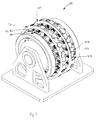
- Figure 1 shows a perspective view of an apparatus according to the present invention.
- the apparatus comprises two rotating drums 60, 70 which are essentially oriented symmetrically.
- the two drums 60, 70 apply discrete first and second web panels 40a, 40b to the left and right sides of the receiving web 1.
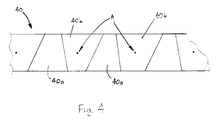
- a pair of incoming webs 40 are fed to the two sides of the apparatus and are cut in a nested pattern (see, for example, Figure 4), and the discrete first and second web panels 40a, 40b of the incoming webs are held on vacuum shells 80a, 80b which are arranged around the circumference of each of the rotating drums 60, 70.
- the receiving web 1, the incoming webs 40, and the cutting roll 39 are not shown in Figure 1 to simplify this illustration.
- the drums 60, 70 are rotated about a main axis of the apparatus.
- the main axis is oriented horizontally, but this main axis need not necessarily be horizontal in all cases.
- Most preferably the two drums 60, 70 are rotated synchronously, at the same speed.
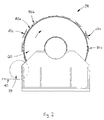
- alternate vacuum shells 80b are mounted on rotatable shafts 81 and are rotatable through 180° about an axis A which is radial with respect to the drum 60, 70.
- Each of the rotatable shafts 81 is connected, by means of a rack and pinion 82, 83, to a cam follower which runs around a shell turning cam 84.
- the shell turning cam 84 is shaped so that the rack and pinion 82, 83 operate to rotate the alternate vacuum shells 80b through 180° during a first part of the cycle, prior to transfer of the second web panels, 40b of the incoming web to the receiving web 1, and then return the vacuum shells 80b to their original orientation by rotating them back through minus 180° during a second part of the cycle after the transfer.
- a shell lifting cam acts to "lift” the vacuum shell 80b radially outwards from the drum 60, 70. This action helps to apply the second web panels 40b of the incoming web 40 to the receiving web 1 at a transfer step.
- the vacuum shells 80b are "withdrawn” radially inwards with respect to the drum 60, 70.
- the vacuum shells 80a i.e.
- those vacuum shells which have not been rotated during the first part of the cycle are "lifted” radially outwards from the drum 60, 70. This action helps to apply the first web panels 40a of the incoming web to the receiving web at a transfer step. Finally the vacuum shells 80a are “withdrawn” radially inwards with respect to the drum 60, 70, and the cycle is ready to repeat.
- the second web portion 40b is rotated through 180° in order to provide side panels, and preferably to provide alternately front and rear side panels for an absorbent article such as a diaper.
- the second web panel 40b is rotated though 90° in order to provide a component in the cross-machine direction, which is perpendicular to the first web panel 40a, preferably wherein the first and second web panels 40a, 40b are elastic.
- the cross-machine direction component may be a waist elastic for an absorbent article such as a diaper.
- the panels applied during the first part of the cycle of Figure 1 may be applied directly, without rotation, whilst the alternate panels which are subsequently applied in the second part of the cycle may be rotated (preferably through 180°) prior to application to the receiving web.
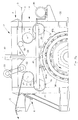
- Figure 3a shows a side elevation view of a continuous process for making an absorbent article 144.
- a continuous receiving web 1 is assembled from an absorbent pad element, or core 120, which is encased between a liquid-pervious topsheet 121 and a liquid impervious backsheet 123.
- the absorbent cores 120 are fed into the nip between a pair of laminating rolls 125, 126 at regularly spaced intervals by means of an infeed conveyor 127.
- the cores 120 are comprised of airfelt, within a cellulosic tissue envelope, to provide integrity to the core in use.
- the backsheet 123 is coated on its inner surface with beads or spirals of adhesive 128, for affixing the backsheet to the core 120.
- Continuous bands of elastic 130 are fed from metering rolls 131, 132 and 133 past a glue nozzle 135.
- the S-wrap arrangement of the rolls 131, 132 and 133 minimises deformation of the elastic band 130 and allows for accurate control of the speed of the elastic.
- the elastic bands are fed into the direction of transport, F, at a lower speed than the cores 120, the backsheet 123 and the topsheet 121, so that the elastic bands 130 are stretched.
- the web After passing through the combining nip, the web passes onto a perforated vacuum conveyor belt 137.
- a vacuum suction box 139 draws the web against the conveyor belt 137, to maintain a uniform tension in the receiving web 1.
- the web passes at a constant speed of transport to the infeed side 4 of the assembly 2 for periodically changing the speed of web.
- the receiving web 1 can be slowed down, or stopped and is contacted by the apparatus of the invention 38.
- the apparatus 38 comprises means for providing a web of material such as an elastic side panel, a waist cap or a strip of reinforcement material.
- the apparatus 38 can be located on the side of the topsheet 121 or on he side of the backsheet 123.
- the web 1 leaves the outfeed side 6 of the assembly 2 at the constant web speed.
- the speed of the receiving web portions located upstream and downstream from the assembly 2 along upstream trajectory 3 and downstream trajectory 5 is not affected by the change in speed of those parts of the receiving web 1 that are passing through the assembly 2.
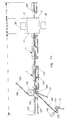
- Figure 3b shows the assembly 2 for changing the speed of a flexible receiving web 1 of relatively low tear strength.
- flexible it is meant that the receiving web 1 can be transported along a curvilinear trajectory and will adapt its shape so as to conform to the trajectory.
- the receiving web 1 is formed of flexible material, such as paper, airfelt, plastic etc. and can be comprised of the core 120, the topsheet 121, the backsheet 123 or any combination thereof.
- the receiving web 1 is transported along the upstream trajectory 3 with a constant velocity of transport V 0 , in the machine direction F.
- the upstream trajectory 3 is formed by the length of the receiving web 1 which extends to the right of the first guide roller 9 in Figure 3b, and which is moving towards the infeed side 4 of the assembly. After passing through the assembly, the receiving web 1 exits at the outfeed side 6 and is transported at constant velocity V 0 along the downstream trajectory 5, which extends to the left of the guide roller 11.
- the upstream and downstream trajectories need not correspond to the machine direction, and can be formed by straight-line or curvilinear paths.
- the guide rollers 9 and 11 are rotationally connected to the frame 35.
- the guide rollers 9, 11 have a fixed position.
- the receiving web 1 is looped around an upstream and a downstream transport roller 13, 15 which are mounted on a sled 41.
- the sled 41 is cyclically translated along the frame 35, generally parallel to the machine direction F, by drive motor 36.
- An intermediate trajectory 7a, 7b, 7c of the receiving web 1 is located between the upstream guide roller 9 and the downstream guide roller 11, and comprises a first section 7a and a third section 7c, of variable length, located between the upstream guide roller 9 and the upstream transport roller 13 and the downstream transport roller 15 and the downstream guide roller 11 respectively.
- the second section 7c of the intermediate trajectory 7 is located between the transport rollers 13 and 15 and is of constant length.
- the web 1 When the part of the receiving web that is located along the second section 7b of the intermediate trajectory 7a, 7b, 7c, is stationary (or at least it is slower than the speed of the web speed V 0 ) relative to the frame 35, the web 1 is contacted by the apparatus 38 which is positionally stationary (or at least slower) with respect to the frame 35. After the apparatus 38 has interacted with the receiving web 1, the web is accelerated along the section 7b of the intermediate trajectory towards the outfeed side 6 of the assembly 2, and is supplied to the downstream trajectory 5 with web speed V 0 .
- the guide rollers 9, 11 and the transport rollers 13, 15 are driven by a drive member in the form of a closed loop 50 and pulleys 52, 53 and 54.
- the loop 50 is partly parallel to the intermediate trajectory 7a, 7b, 7c.
- the loop 50 is driven at a constant speed which is equal to the speed of transport V 0 , of the web 1 by a single drive motor 51.
- Figure 4 shows a web 40 which has been cut into discrete portions 40a, 40b. Second we portions 40b are subsequently rotated about their axis A.
- the first and second web panels 40a, 40b are applied, and preferably affixed, to the receiving web 1 using any conventional method such as by gluing with adhesives, such as melt adhesives, or use of self-adhesive components, or by use of ultrasonic welding, heat sealing or the like.
Landscapes
- Health & Medical Sciences (AREA)
- Engineering & Computer Science (AREA)
- Vascular Medicine (AREA)
- Epidemiology (AREA)
- Biomedical Technology (AREA)
- Heart & Thoracic Surgery (AREA)
- Manufacturing & Machinery (AREA)
- Life Sciences & Earth Sciences (AREA)
- Animal Behavior & Ethology (AREA)
- General Health & Medical Sciences (AREA)
- Public Health (AREA)
- Veterinary Medicine (AREA)
- Absorbent Articles And Supports Therefor (AREA)
- Orthopedics, Nursing, And Contraception (AREA)
- Solid-Sorbent Or Filter-Aiding Compositions (AREA)
Priority Applications (10)
| Application Number | Priority Date | Filing Date | Title |
|---|---|---|---|
| EP99112228A EP1062928A1 (de) | 1999-06-25 | 1999-06-25 | Verfahren zum Herstellen von absorbierenden Wegwerfartikeln, und Vorrichtung zur Durchführung des Verfahrens |
| MXPA01013373A MXPA01013373A (es) | 1999-06-25 | 2000-06-23 | Proceso para fabricar articulos absorbentes desechables, y aparato para llevar a cabo el proceso. |
| AT00944871T ATE291403T1 (de) | 1999-06-25 | 2000-06-23 | Verfahren zum herstellen von absorbierenden wegwerfartikeln, und vorrichtung zur durchführung des verfahrens |
| JP2001505839A JP4583683B2 (ja) | 1999-06-25 | 2000-06-23 | 使い捨て吸収用品の製造方法及び装置 |
| AU58902/00A AU5890200A (en) | 1999-06-25 | 2000-06-23 | Process for manufacturing disposable absorbent articles, and an apparatus for performing the process |
| US09/979,494 US6730189B1 (en) | 1999-06-25 | 2000-06-23 | Process for manufacturing disposable absorbent articles, and an apparatus for performing the process |
| CA002375955A CA2375955A1 (en) | 1999-06-25 | 2000-06-23 | Process for manufacturing disposable absorbent articles, and an apparatus for performing the process |
| PCT/US2000/017489 WO2001000122A1 (en) | 1999-06-25 | 2000-06-23 | Process for manufacturing disposable absorbent articles, and an apparatus for performing the process |
| EP00944871A EP1189564B1 (de) | 1999-06-25 | 2000-06-23 | Verfahren zum herstellen von absorbierenden wegwerfartikeln, und vorrichtung zur durchführung des verfahrens |
| DE60018929T DE60018929T2 (de) | 1999-06-25 | 2000-06-23 | Verfahren zum herstellen von absorbierenden wegwerfartikeln, und vorrichtung zur durchführung des verfahrens |
Applications Claiming Priority (1)
| Application Number | Priority Date | Filing Date | Title |
|---|---|---|---|
| EP99112228A EP1062928A1 (de) | 1999-06-25 | 1999-06-25 | Verfahren zum Herstellen von absorbierenden Wegwerfartikeln, und Vorrichtung zur Durchführung des Verfahrens |
Publications (1)
| Publication Number | Publication Date |
|---|---|
| EP1062928A1 true EP1062928A1 (de) | 2000-12-27 |
Family
ID=8238421
Family Applications (2)
| Application Number | Title | Priority Date | Filing Date |
|---|---|---|---|
| EP99112228A Withdrawn EP1062928A1 (de) | 1999-06-25 | 1999-06-25 | Verfahren zum Herstellen von absorbierenden Wegwerfartikeln, und Vorrichtung zur Durchführung des Verfahrens |
| EP00944871A Expired - Lifetime EP1189564B1 (de) | 1999-06-25 | 2000-06-23 | Verfahren zum herstellen von absorbierenden wegwerfartikeln, und vorrichtung zur durchführung des verfahrens |
Family Applications After (1)
| Application Number | Title | Priority Date | Filing Date |
|---|---|---|---|
| EP00944871A Expired - Lifetime EP1189564B1 (de) | 1999-06-25 | 2000-06-23 | Verfahren zum herstellen von absorbierenden wegwerfartikeln, und vorrichtung zur durchführung des verfahrens |
Country Status (8)
| Country | Link |
|---|---|
| EP (2) | EP1062928A1 (de) |
| JP (1) | JP4583683B2 (de) |
| AT (1) | ATE291403T1 (de) |
| AU (1) | AU5890200A (de) |
| CA (1) | CA2375955A1 (de) |
| DE (1) | DE60018929T2 (de) |
| MX (1) | MXPA01013373A (de) |
| WO (1) | WO2001000122A1 (de) |
Cited By (6)
| Publication number | Priority date | Publication date | Assignee | Title |
|---|---|---|---|---|
| US6702917B1 (en) | 2002-08-30 | 2004-03-09 | Kimberly-Clark Worldwide, Inc. | Cross-machine-direction nested absorbent pads with minimal waste geometries |
| US7070672B2 (en) | 2004-02-24 | 2006-07-04 | Kimberly-Clark Worldwide, Inc. | Process for making a feminine sanitary napkin or other absorbent article having place and cut wings |
| US7163529B2 (en) | 2004-12-15 | 2007-01-16 | Kimberly-Clark Worldwide, Inc. | Absorbent article having disposal wings with odor absorbency |
| CN103479480A (zh) * | 2013-08-29 | 2014-01-01 | 安庆市恒昌机械制造有限责任公司 | 一次性卫生用品的线上腰围切断旋转变距总成 |
| ITBO20120655A1 (it) * | 2012-12-03 | 2014-06-04 | Gdm Spa | Macchina per la realizzazione di articoli assorbenti igienici. |
| CN108481433A (zh) * | 2018-04-20 | 2018-09-04 | 安庆市恒昌机械制造有限责任公司 | 一种片状材料的转移部件及工艺 |
Families Citing this family (7)
| Publication number | Priority date | Publication date | Assignee | Title |
|---|---|---|---|---|
| DE19937729A1 (de) * | 1999-08-10 | 2001-02-15 | Lurgi Zimmer Ag | Hochfeste Polyesterfäden und Verfahren zu deren Herstellung |
| JP4522342B2 (ja) * | 2005-08-11 | 2010-08-11 | 花王株式会社 | 吸収性物品の製造方法及び装置 |
| US8016972B2 (en) | 2007-05-09 | 2011-09-13 | Curt G. Joa, Inc. | Methods and apparatus for application of nested zero waste ear to traveling web |
| US9622918B2 (en) | 2006-05-18 | 2017-04-18 | Curt G. Joe, Inc. | Methods and apparatus for application of nested zero waste ear to traveling web |
| US10456302B2 (en) | 2006-05-18 | 2019-10-29 | Curt G. Joa, Inc. | Methods and apparatus for application of nested zero waste ear to traveling web |
| US9433538B2 (en) | 2006-05-18 | 2016-09-06 | Curt G. Joa, Inc. | Methods and apparatus for application of nested zero waste ear to traveling web and formation of articles using a dual cut slip unit |
| US9289329B1 (en) | 2013-12-05 | 2016-03-22 | Curt G. Joa, Inc. | Method for producing pant type diapers |
Citations (5)
| Publication number | Priority date | Publication date | Assignee | Title |
|---|---|---|---|---|
| EP0396050A2 (de) * | 1989-04-29 | 1990-11-07 | Uni-Charm Corporation | Verfahren zur Herstellung von Bekleidungselementen |
| US5034007A (en) * | 1990-02-23 | 1991-07-23 | Uni-Charm Corporation | Manufacturing method for disposable clothing items |
| WO1996024319A1 (en) * | 1995-02-10 | 1996-08-15 | The Procter & Gamble Company | Zero scrap method for manufacturing side panels for absorbent articles |
| US5584954A (en) * | 1993-08-09 | 1996-12-17 | Van Der Klugt; Walter P. H. L. | Apparatus and method for attaching elastic at an angle |
| US5660665A (en) * | 1995-12-15 | 1997-08-26 | Kimberly-Clark Corporation | Rotating transfer roll with rotating extensible platen |
Family Cites Families (7)
| Publication number | Priority date | Publication date | Assignee | Title |
|---|---|---|---|---|
| JPH0780610B2 (ja) * | 1987-08-04 | 1995-08-30 | 株式会社瑞光 | 使捨ておむつの製造方法 |
| CA1298818C (en) * | 1987-12-16 | 1992-04-14 | Paul Theodore Van Gompel | Method and apparatus for making a disposable incontinence garment or training pant |
| JPH0751143B2 (ja) * | 1988-04-19 | 1995-06-05 | 株式会社瑞光 | 弾性テープの製作および貼付け方法 |
| JPH04261655A (ja) * | 1990-12-31 | 1992-09-17 | Zuikou:Kk | 紙おむつの製造方法 |
| EP0652175B1 (de) * | 1993-11-04 | 1998-01-21 | The Procter & Gamble Company | Verfahren und Vorrichtung zur Herstellung eines absorbierenden Artikels |
| JPH08661A (ja) * | 1994-06-24 | 1996-01-09 | Honshu Paper Co Ltd | ポケット構造を持つおむつ用表面材とその製法及びおむつ |
| JP3131130B2 (ja) * | 1995-09-29 | 2001-01-31 | ユニ・チャーム株式会社 | 着用物品構成部材の製造方法 |
-
1999
- 1999-06-25 EP EP99112228A patent/EP1062928A1/de not_active Withdrawn
-
2000
- 2000-06-23 AT AT00944871T patent/ATE291403T1/de not_active IP Right Cessation
- 2000-06-23 EP EP00944871A patent/EP1189564B1/de not_active Expired - Lifetime
- 2000-06-23 DE DE60018929T patent/DE60018929T2/de not_active Expired - Lifetime
- 2000-06-23 JP JP2001505839A patent/JP4583683B2/ja not_active Expired - Fee Related
- 2000-06-23 AU AU58902/00A patent/AU5890200A/en not_active Abandoned
- 2000-06-23 CA CA002375955A patent/CA2375955A1/en not_active Abandoned
- 2000-06-23 WO PCT/US2000/017489 patent/WO2001000122A1/en not_active Ceased
- 2000-06-23 MX MXPA01013373A patent/MXPA01013373A/es unknown
Patent Citations (5)
| Publication number | Priority date | Publication date | Assignee | Title |
|---|---|---|---|---|
| EP0396050A2 (de) * | 1989-04-29 | 1990-11-07 | Uni-Charm Corporation | Verfahren zur Herstellung von Bekleidungselementen |
| US5034007A (en) * | 1990-02-23 | 1991-07-23 | Uni-Charm Corporation | Manufacturing method for disposable clothing items |
| US5584954A (en) * | 1993-08-09 | 1996-12-17 | Van Der Klugt; Walter P. H. L. | Apparatus and method for attaching elastic at an angle |
| WO1996024319A1 (en) * | 1995-02-10 | 1996-08-15 | The Procter & Gamble Company | Zero scrap method for manufacturing side panels for absorbent articles |
| US5660665A (en) * | 1995-12-15 | 1997-08-26 | Kimberly-Clark Corporation | Rotating transfer roll with rotating extensible platen |
Cited By (10)
| Publication number | Priority date | Publication date | Assignee | Title |
|---|---|---|---|---|
| US6702917B1 (en) | 2002-08-30 | 2004-03-09 | Kimberly-Clark Worldwide, Inc. | Cross-machine-direction nested absorbent pads with minimal waste geometries |
| WO2004019839A1 (en) * | 2002-08-30 | 2004-03-11 | Kimberly-Clark Worldwide, Inc. | Cross-machine-direction nested absorbent pads with minimal waste geometries |
| US7070672B2 (en) | 2004-02-24 | 2006-07-04 | Kimberly-Clark Worldwide, Inc. | Process for making a feminine sanitary napkin or other absorbent article having place and cut wings |
| US7163529B2 (en) | 2004-12-15 | 2007-01-16 | Kimberly-Clark Worldwide, Inc. | Absorbent article having disposal wings with odor absorbency |
| ITBO20120655A1 (it) * | 2012-12-03 | 2014-06-04 | Gdm Spa | Macchina per la realizzazione di articoli assorbenti igienici. |
| WO2014087293A1 (en) * | 2012-12-03 | 2014-06-12 | Gdm S.P.A. | Machine for making absorbent sanitary articles. |
| US9968491B2 (en) | 2012-12-03 | 2018-05-15 | Gdm S.P.A. | Machine for making absorbent sanitary articles |
| CN103479480A (zh) * | 2013-08-29 | 2014-01-01 | 安庆市恒昌机械制造有限责任公司 | 一次性卫生用品的线上腰围切断旋转变距总成 |
| CN108481433A (zh) * | 2018-04-20 | 2018-09-04 | 安庆市恒昌机械制造有限责任公司 | 一种片状材料的转移部件及工艺 |
| CN108481433B (zh) * | 2018-04-20 | 2024-04-12 | 安庆市恒昌机械制造有限责任公司 | 一种片状材料的转移部件及工艺 |
Also Published As
| Publication number | Publication date |
|---|---|
| WO2001000122A1 (en) | 2001-01-04 |
| EP1189564A1 (de) | 2002-03-27 |
| AU5890200A (en) | 2001-01-31 |
| EP1189564B1 (de) | 2005-03-23 |
| DE60018929D1 (de) | 2005-04-28 |
| ATE291403T1 (de) | 2005-04-15 |
| DE60018929T2 (de) | 2006-03-30 |
| CA2375955A1 (en) | 2001-01-04 |
| MXPA01013373A (es) | 2002-07-02 |
| JP2003503108A (ja) | 2003-01-28 |
| JP4583683B2 (ja) | 2010-11-17 |
Similar Documents
| Publication | Publication Date | Title |
|---|---|---|
| US6730189B1 (en) | Process for manufacturing disposable absorbent articles, and an apparatus for performing the process | |
| US11147720B2 (en) | Elastic composite for having cross-directional elasticity and a system and method for making the elastic composite | |
| JP2622414B2 (ja) | 着用物品用構成部材の製造方法 | |
| US4776911A (en) | Elasticized unit, apparatus for making the elasticized unit, garments incorporating the units, and method for making the garment | |
| EP1189564B1 (de) | Verfahren zum herstellen von absorbierenden wegwerfartikeln, und vorrichtung zur durchführung des verfahrens | |
| CN115154047B (zh) | 生产弹性复合材料的系统和方法 | |
| EP3638177B1 (de) | Verfahren zum transport einzelner artikel | |
| US7713371B2 (en) | Method and device for applying a flat material web section | |
| EP1189565B1 (de) | Verfahren zum herstellen von absorbierenden wegwerfkernen, und vorrichtung zur durchführung des verfahrens | |
| AU2003254826A1 (en) | Disposable wearing article continuous production method | |
| KR20020034097A (ko) | 기판 상의 재료의 스트립을 회전 및 배치시키기 위한조립체 및 방법 | |
| US8469869B2 (en) | Apparatus and method for folding article | |
| US6736923B1 (en) | Process for manufacturing disposable absorbent cores, and an apparatus for performing the process | |
| TWI556800B (zh) | Apparatus for manufacturing absorbent articles | |
| EP2856991B1 (de) | Vorrichtung zur herstellung eines saugfähigen artikels und verfahren zur herstellung eines säugfähigen artikels | |
| EP0443244A1 (de) | Verfahren und Apparat zum Befestigen eines elastischen Hüftbandes auf einer Wegwerfwindel | |
| JPH06209968A (ja) | 紙おむつのウエストバンド取付け方法 | |
| JP2001346825A (ja) | おむつの製造方法およびその装置ならびにおむつ | |
| AU2015203499B2 (en) | An elastic composite having cross-directional elasticity and a system and method for making the elastic composite | |
| HK1156834B (en) | An elastic composite having cross-directional elasticity and a system and method for making the elastic composite | |
| MXPA01007123A (en) | Apparatus and process for applying discrete portions of a web material onto a receiving web | |
| MXPA01000729A (en) | Apparatus for transporting a continuous web, and for manipulating the web |
Legal Events
| Date | Code | Title | Description |
|---|---|---|---|
| PUAI | Public reference made under article 153(3) epc to a published international application that has entered the european phase |
Free format text: ORIGINAL CODE: 0009012 |
|
| AK | Designated contracting states |
Kind code of ref document: A1 Designated state(s): AT BE CH CY DE DK ES FI FR GB GR IE IT LI LU MC NL PT SE |
|
| AX | Request for extension of the european patent |
Free format text: AL;LT;LV;MK;RO;SI |
|
| AKX | Designation fees paid | ||
| STAA | Information on the status of an ep patent application or granted ep patent |
Free format text: STATUS: THE APPLICATION IS DEEMED TO BE WITHDRAWN |
|
| 18D | Application deemed to be withdrawn |
Effective date: 20010628 |
|
| REG | Reference to a national code |
Ref country code: DE Ref legal event code: 8566 |