EP1062981A2 - Procédé de transmission de données dans la surveillance d'un implant - Google Patents
Procédé de transmission de données dans la surveillance d'un implant Download PDFInfo
- Publication number
- EP1062981A2 EP1062981A2 EP00250198A EP00250198A EP1062981A2 EP 1062981 A2 EP1062981 A2 EP 1062981A2 EP 00250198 A EP00250198 A EP 00250198A EP 00250198 A EP00250198 A EP 00250198A EP 1062981 A2 EP1062981 A2 EP 1062981A2
- Authority
- EP
- European Patent Office
- Prior art keywords
- external device
- data
- implant
- string
- central storage
- Prior art date
- Legal status (The legal status is an assumption and is not a legal conclusion. Google has not performed a legal analysis and makes no representation as to the accuracy of the status listed.)
- Granted
Links
- 239000007943 implant Substances 0.000 title claims abstract description 86
- 238000012544 monitoring process Methods 0.000 title claims abstract description 24
- 238000000034 method Methods 0.000 title claims description 40
- 230000005540 biological transmission Effects 0.000 claims abstract description 57
- 238000012546 transfer Methods 0.000 claims description 22
- 230000000747 cardiac effect Effects 0.000 claims 1
- 238000012360 testing method Methods 0.000 description 13
- 238000010586 diagram Methods 0.000 description 11
- 230000001413 cellular effect Effects 0.000 description 10
- 230000006870 function Effects 0.000 description 9
- 230000001960 triggered effect Effects 0.000 description 8
- 230000008569 process Effects 0.000 description 6
- 230000006854 communication Effects 0.000 description 5
- 238000004891 communication Methods 0.000 description 5
- 229910001416 lithium ion Inorganic materials 0.000 description 5
- 230000003287 optical effect Effects 0.000 description 4
- 230000008878 coupling Effects 0.000 description 3
- 238000010168 coupling process Methods 0.000 description 3
- 238000005859 coupling reaction Methods 0.000 description 3
- 238000012806 monitoring device Methods 0.000 description 3
- 238000000926 separation method Methods 0.000 description 3
- 230000008901 benefit Effects 0.000 description 2
- 230000002457 bidirectional effect Effects 0.000 description 2
- 230000004397 blinking Effects 0.000 description 2
- 230000007547 defect Effects 0.000 description 2
- 230000000694 effects Effects 0.000 description 2
- 238000005265 energy consumption Methods 0.000 description 2
- 238000004146 energy storage Methods 0.000 description 2
- 238000005516 engineering process Methods 0.000 description 2
- 230000002349 favourable effect Effects 0.000 description 2
- 238000011835 investigation Methods 0.000 description 2
- 230000008447 perception Effects 0.000 description 2
- 230000000737 periodic effect Effects 0.000 description 2
- 238000003825 pressing Methods 0.000 description 2
- 230000003068 static effect Effects 0.000 description 2
- 230000001360 synchronised effect Effects 0.000 description 2
- 101100366043 Caenorhabditis elegans sms-2 gene Proteins 0.000 description 1
- 230000009471 action Effects 0.000 description 1
- 230000001154 acute effect Effects 0.000 description 1
- 230000006978 adaptation Effects 0.000 description 1
- 238000004378 air conditioning Methods 0.000 description 1
- 230000003321 amplification Effects 0.000 description 1
- 235000013361 beverage Nutrition 0.000 description 1
- 230000007175 bidirectional communication Effects 0.000 description 1
- 239000008280 blood Substances 0.000 description 1
- 210000004369 blood Anatomy 0.000 description 1
- 230000015556 catabolic process Effects 0.000 description 1
- 230000009194 climbing Effects 0.000 description 1
- 230000003111 delayed effect Effects 0.000 description 1
- 238000013461 design Methods 0.000 description 1
- 238000001514 detection method Methods 0.000 description 1
- 238000011161 development Methods 0.000 description 1
- 230000018109 developmental process Effects 0.000 description 1
- 238000011156 evaluation Methods 0.000 description 1
- 239000011521 glass Substances 0.000 description 1
- 230000036541 health Effects 0.000 description 1
- 238000010438 heat treatment Methods 0.000 description 1
- 230000003993 interaction Effects 0.000 description 1
- 238000002955 isolation Methods 0.000 description 1
- 230000004807 localization Effects 0.000 description 1
- 238000012423 maintenance Methods 0.000 description 1
- 230000007257 malfunction Effects 0.000 description 1
- 238000012986 modification Methods 0.000 description 1
- 230000004048 modification Effects 0.000 description 1
- 238000003199 nucleic acid amplification method Methods 0.000 description 1
- 230000008520 organization Effects 0.000 description 1
- 230000009467 reduction Effects 0.000 description 1
- 230000001105 regulatory effect Effects 0.000 description 1
- 230000000717 retained effect Effects 0.000 description 1
- 238000012552 review Methods 0.000 description 1
- 238000004092 self-diagnosis Methods 0.000 description 1
- 230000035945 sensitivity Effects 0.000 description 1
- 230000035939 shock Effects 0.000 description 1
- 230000009897 systematic effect Effects 0.000 description 1
- 230000000007 visual effect Effects 0.000 description 1
Images



Classifications
-
- A—HUMAN NECESSITIES
- A61—MEDICAL OR VETERINARY SCIENCE; HYGIENE
- A61B—DIAGNOSIS; SURGERY; IDENTIFICATION
- A61B5/00—Measuring for diagnostic purposes; Identification of persons
- A61B5/0002—Remote monitoring of patients using telemetry, e.g. transmission of vital signals via a communication network
- A61B5/0031—Implanted circuitry
-
- A—HUMAN NECESSITIES
- A61—MEDICAL OR VETERINARY SCIENCE; HYGIENE
- A61N—ELECTROTHERAPY; MAGNETOTHERAPY; RADIATION THERAPY; ULTRASOUND THERAPY
- A61N1/00—Electrotherapy; Circuits therefor
- A61N1/18—Applying electric currents by contact electrodes
- A61N1/32—Applying electric currents by contact electrodes alternating or intermittent currents
- A61N1/36—Applying electric currents by contact electrodes alternating or intermittent currents for stimulation
- A61N1/372—Arrangements in connection with the implantation of stimulators
- A61N1/37211—Means for communicating with stimulators
- A61N1/37252—Details of algorithms or data aspects of communication system, e.g. handshaking, transmitting specific data or segmenting data
- A61N1/37254—Pacemaker or defibrillator security, e.g. to prevent or inhibit programming alterations by hackers or unauthorised individuals
-
- A—HUMAN NECESSITIES
- A61—MEDICAL OR VETERINARY SCIENCE; HYGIENE
- A61N—ELECTROTHERAPY; MAGNETOTHERAPY; RADIATION THERAPY; ULTRASOUND THERAPY
- A61N1/00—Electrotherapy; Circuits therefor
- A61N1/18—Applying electric currents by contact electrodes
- A61N1/32—Applying electric currents by contact electrodes alternating or intermittent currents
- A61N1/36—Applying electric currents by contact electrodes alternating or intermittent currents for stimulation
- A61N1/372—Arrangements in connection with the implantation of stimulators
- A61N1/37211—Means for communicating with stimulators
- A61N1/37252—Details of algorithms or data aspects of communication system, e.g. handshaking, transmitting specific data or segmenting data
- A61N1/37282—Details of algorithms or data aspects of communication system, e.g. handshaking, transmitting specific data or segmenting data characterised by communication with experts in remote locations using a network
-
- Y—GENERAL TAGGING OF NEW TECHNOLOGICAL DEVELOPMENTS; GENERAL TAGGING OF CROSS-SECTIONAL TECHNOLOGIES SPANNING OVER SEVERAL SECTIONS OF THE IPC; TECHNICAL SUBJECTS COVERED BY FORMER USPC CROSS-REFERENCE ART COLLECTIONS [XRACs] AND DIGESTS
- Y10—TECHNICAL SUBJECTS COVERED BY FORMER USPC
- Y10S—TECHNICAL SUBJECTS COVERED BY FORMER USPC CROSS-REFERENCE ART COLLECTIONS [XRACs] AND DIGESTS
- Y10S128/00—Surgery
- Y10S128/903—Radio telemetry
Definitions
- the invention relates to a method for monitoring patients with at least an electromedical implant according to the preamble of claim 1.
- telemetry devices For monitoring patients with an electromedical implant for Follow-up purposes, such as a pacemaker, defibrillator, a cardioverter or another electronically operated or controlled implant, telemetry devices are usually used.
- US Pat. No. 5,752,976 is a generic one Procedure for monitoring patients with an electro-medical implant known.
- a first data transfer takes place between the implant and an assigned external device, which is usually used as a patient device is referred to, with which at least data from the implant to the external device be transmitted.
- This second data exchange takes place by means of a telecommunication connection from the external device to the central storage device, which so far has a Cellular network is established as the external device data over the cellular network sends.
- a Cellular network is established as the external device data over the cellular network sends.
- the invention is therefore based on the object of a method of the beginning to provide the kind mentioned, which is a simple and inexpensive Allows monitoring of the patient.
- the task is based on a method according to the preamble of Claim 1, by the specified in the characterizing part of claim 1 Features resolved.
- the invention includes the technical teaching that one is particularly simple and can perform inexpensive patient monitoring when the Transfer of data to the central storage device via the by the Cellular network formed section of the telecommunication connection in the form one or more SM strings (via Short Message String).
- SMS Short Message Serviceses
- Time synchronization of the external device the time signature of one over the telecommunication connection used SM strings sent to the external device, whereby complex additional measures for time synchronization of the external device, for example the separate retrieval of the current time from a separate device, such as a radio clock, etc., unnecessary.
- the central storage unit is preferably used for at least one transfer a first SMS from the external device to the central storage unit a first acknowledgment SM strings sent back to the external device and the time signature of the acknowledgment SM string used for time synchronization. So can for example when the external device is switched on for the first time or when Switching on the external device after maintenance a time synchronization be made. However, the time synchronization can also be in any or Periodic intervals are made during operation to avoid too much To prevent the clock of the external device from drifting.
- the implant itself is an SMS-capable recipient contains, so that the time synchronization of the implant is independent of the external Device can be done via SM strings in the manner described.
- an internal clock of the implant can also be activated indirectly by means of the external Device can be synchronized.
- the external device uses time synchronization carried out a runtime control.
- the time synchronization is then performed when the transit time between triggering the transfer of the first SMS and the arrival of the associated first acknowledgment SMS within one predetermined runtime interval, which is preferably at most one minute is. This ensures sufficient time synchronization accuracy ensured.
- the location of the external device from the external device to the central storage device second SMS sent the location information sufficient for location via the mobile network contain.
- This makes it possible for the patient, for example in Emergency situations in which the patient is no longer able to act using the to locate any external device he has carried and the corresponding emergency measures initiate. It goes without saying that this location procedure also works for itself, i.e. not only in connection with the use of SMS, but also with the known data transmission technology, can be advantageously used.
- For Localization via the mobile network includes sufficient location information For example, the field strength information with the corresponding numbers of the current and adjoined cells and the bit error rate.
- Particularly favorable variants of the method according to the invention are distinguished characterized in that at least when the external device is switched on, a third SMS is transferred to a predetermined first central storage device and the first central storage device then a second acknowledgment SMS to the sends external device.
- the third SM string contains information about the Location of the external device.
- the second acknowledgment SM string contains one Control information for the external device with which, if necessary, a second central storage device as a receiver for second data transfers of the external device is specified. This makes it possible to find the cheapest one and / or select the fastest connection. Costly, cross-border Connections can be avoided in this way.
- the third SM string is also regular during operation automatically or at the instigation of the patient, for example can be. It is also possible for the third SM string to be sent out is triggered by a central storage device. Furthermore, it goes without saying that this process variant also for itself, i.e. not only in connection with the Use of SMS, but also with the known data transmission technology, is applicable in an advantageous manner.
- the data transmission at most for one predetermined second number of attempts via at least one further telecommunication connection, initiated.
- another mobile network be used. Data transmission over a fixed telecommunications network tried, then of course a corresponding data transmission device and a connection for establishing the telecommunication connection via the fixed telecommunications network is available. This makes it, for example possible, a malfunction in a cellular network or a defect in the cellular device of the external device to compensate.
- the present invention further relates to a patient monitoring system according to claim 12, which is characterized in that the external device for transferring the first data to the central storage device via the the section of the telecommunications connection formed in the mobile radio network Form of at least one short message string (SM string) is formed, whereby simple and inexpensive operation of the system is ensured.
- SM string short message string
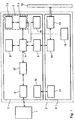
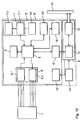
- Figure 1 shows an apparatus for performing the method according to the invention with an electromedical implant 1 using a telemetry device is provided and an external device 2, which consists of a handset 3 and a base station 4 exists.
- the handset 3 has a control device 5 and a first interface device 6, a mobile radio device 7, a second interface device 8, a man-machine interface 9 and a third interface device 16 on, which are each connected to the control device 5.
- the first interface device 6 is with the control device 5 indirectly via another Interface device 17 connected.
- the handset is powered via Li-ion batteries, which are accommodated in the power supply part 10.
- the first interface device 6 consists of a telemetry transmitter / receiver unit, so that the handset 3 contact via a bidirectional telemetry line can take up to the implant.
- Receiver and transmitter of the interface device 6 are integrated in an IC. Both circuit parts form a functional one Unit.
- the receiver and transmitter preferably work in the UHF range 403.55 MHz, 4, 8, 16 and 32 kbit / s are provided as baud rate levels. Possible but especially for the implant 1, the use of more energy-saving Frequencies in the VHF or LF range.
- the mobile radio device 7 can transmit data, for example, via the first interface device 6 were read out of the implant in the form of SMS messages send and from one as a monitoring device or central Storage facility serving service center can be called.
- a connection between the handset can be established via the second interface device 8 3 and base station 4 are manufactured. It is an infrared interface (IrDA) educated. It works bidirectionally and can process data in half-duplex mode transfer.
- IrDA infrared interface
- the man-machine interface 9 enables the handset 3 to be operated by a user.
- the third interface device 16 is used for recording external data or used for service. It is also designed as an IrDA interface.
- the serial interface for both IrDA interface devices 8 and 16 and the interface to the mobile radio device 7 are parallel, so that only one Unit can be operated.
- the IrDA interfaces 8 and 16 are parallel switched. Both interfaces are always ready to receive, so that at any time external request can be served. The software then only has to determine which IrDA interface the receive request is at.
- the power supply of the handset 3 is realized with Li-ion batteries. You can the handset 3 in the fully charged state for at least 20 hours (standby time + 16 SMS transmissions). The dimensions of the batteries apply at the end of their service life. A 1000 mAh Li-ion battery is therefore provided.
- the telemetry unit 6 for communication with the implant 1 including a transmit / receive antenna and control electronics for telemetry and an interface device 17 housed in a separate module.
- This separate module points an interface device 17 for electrical and possibly also mechanical Connect to a mobile phone.
- the separate module can, for example, instead of the battery pack in the mobile phone be used so that there is a mechanically stable unit from a mobile phone and separate housing, which may be the previous outer contour of the mobile phone is slightly overlooked.
- the separate module has a battery compartment in which the original battery pack of the mobile phone or another suitable battery or a suitable battery pack can be inserted. This battery then serves for powering the entire system from a mobile phone and a separate module and can be charged via the standard charging connections on the mobile phone.
- the second variant additionally requires the plug to be integrated in the battery compartment a mechanical and electrical modification of the mobile phone.
- this connector not only to the serial interface but also with other parts of the electronics of the cell phone can be direct Control of the mobile phone can be made possible by the telemetry unit.
- the electronics of the mobile phone can be controlled by the permanently on standby or optionally time-controlled Telemetry unit can be put into operation automatically if necessary (event control).
- the separate module can be integrated on a SIM card his.
- This SIM module is inserted in the SIM card slot instead of the standard SIM card inserted and uses the standard intended for this Interface.
- the transmitting / receiving antenna and the control electronics can, for example be designed for telemetry so that when inserted SIM module are arranged outside the housing of the mobile phone.
- Handset 3 man-machine interface
- a flashing LED indicates the low battery status as soon as the battery charge has dropped to 10%.
- the handset 3 then still has a minimum of about 2 hours Power reserve. Since the handset 3 is not always visible to the patient, the buzzer also indicates the occurrence of the low battery state by means of a short alarm on. The buzzer must be at a frequency of approximately 2 kHz or below work and be correspondingly loud, so that even limited perception Patients can hear the alarm sound safely. The buzzer should be about everyone 5 minutes again trigger alarm to let the patient charge the battery to remember.
- a recessed on / off switch is provided which does not operate unintentionally can be.
- the switch position is labeled so that you can see whether that Handset 3 is switched on. This switch is necessary because the handset 3 with the mobile radio device 7 can be switched off in some surrounding areas must, e.g. B. during a flight and in certain areas of hospitals.
- a button can be provided to send a short message for testing the SMS channel to be sent to the service center.
- the handset 3 shows a blinking LED indicates that such a test has been started.
- the service center recognizes that received short message as a test and sends an acknowledgment to the handset 3. Thereupon the blinking of the LED is stopped again, which means for the patient it can be seen that both the outward and return connection to the service center function.
- a button can be provided for diagnostic purposes, by means of which the Patient can trigger data transfers to the service center. Occur at the patient Complaints of any kind that may not be considered for the implant such are recognizable, this button can be pressed. Then a Data record transferred in addition to the information to be routinely transferred the time of triggering and the acquisition of the associated data by the Contains implant. The service center is transmitted by the short message also informed that this is a patient-triggered data transmission acts, which may have to be treated separately.
- a patient alarm button can be used, which is also available unintentional incorrect operation is protected.
- This emergency button can go to this Purpose sunk and additionally protected by a lid that must first be opened to trigger the patient alarm. Protection against incorrect operation can also be implemented as a timeout in the software that the Key function only accepts as valid if the key is longer (e.g. more than 3 s) is pressed.
- a successfully triggered patient alarm is signaled acoustically by the Buzzer acknowledged.
- the button can then be released. Still is a light emitting diode is switched on for 10s and then lights up again every minute for 2s as a reminder of a triggered patient alarm. The buzzer will always operated simultaneously with the light-emitting diode, so that also in the perception Restricted patients can see this receipt from the external device.
- a patient alarm is immediately forwarded to the service center via SMS. He is only deleted when the service center clears the patient alarm - also via SMS - acknowledged and so it is ensured that the alarm in the service center has arrived.
- the acknowledgment of the alarm by the service center is also indicated by LED and buzzer on handset 3.
- the handset 3 If an unacknowledged patient alarm is to be deleted, the handset 3 turned off. After the restart, the handset is back in normal condition. The handset automatically reports back to the service center via SMS. There it can then be recognized that the external device has been reset and the patient alarm is cleared.
- the successful execution of a patient alarm has compared to the low battery display a higher priority.
- the low battery display will only come back displayed when the service center has acknowledged the patient alarm. Should one The handset 3 is used to prevent interference with the surroundings from the buzzer turn off.
- the software is in a flash ROM via the IrDA interface 16 downloadable.
- the storage capacity of the internal flash ROM is 128 KB, that of the integrated EEPROM 4 KByte and that of the static, external SRAM 64 Kbyte.
- the program memory size is therefore based on the capacity of the built-in Flash ROMs limited and cannot be expanded (Harvard structure).
- the external static SRAM is expandable.
- a 128 bit DES encryption method is used for the SMS transmission, which is based on a private-public key system.
- the encryption will implemented in software, i.e. no encryption IC is used.
- a watchdog circuit is provided that is in regular use Processor 5 checked distance and back to a safe status transferred if the program execution does not run correctly.
- the field strength information via SMS with the corresponding numbers of the current and adjoined cells and the Bit error rate is transmitted. Based on this location information is a location of the mobile device 3 in emergencies in which the patient is unable to act.
- the mobile radio device 7 comprises a mobile radio module 7.1 and a SIM (subscriber Identity Module) card 7.2 trained memory.
- the SIM card reader can be soldered directly into the circuit board under the cell phone module 7.1.
- the SIM card 7.2 is therefore not accessible to the user.
- a SIM card reader available anyway.
- the cell phone module 7.1 In the memory of the SIM card 7.2, the cell phone module 7.1 the number (s) of the service center permanently stored.
- the handset 3 is with delivered a SIM card, which is the default in the number memory Contains a service center number.
- the phone numbers on the SIM card can be changed. Number management (writing and reading the Numbers on and from the SIM card) must be from the central control device 5 of the external device.
- the preset number will open the SIM card is kept permanently in another storage location for security and used when the external device 2 with a new number no connection can build up. This ensures that contact is made always remains possible.
- Several service centers can also be operated.
- the patient reports at any service center. This is the address of the Customers are known and it can be decided which service center is to be used first takes over the service. If the customer switches on his external device, then it registers with the pre-set service center by immediately Sends an SMS message to them. The service center can now by return send the SMS number that will be used in the future shall be.
- the handset 3 can thus automatically switch to another service center at any time can be assigned without a service technician moving the handset 3 ought to. This makes particular sense if it can avoid that SMS messages must be sent across borders.
- the databases of the service centers compare with each other, so that always it is clear which implant 1 or handset 3 is operated by which service center becomes. Appropriate fields must be provided in the database.
- a type of LiFo memory can also be inserted in the SIM card for maximum memory depth (e.g. ten numbers) can be organized. Gives the previously responsible service center a new number, it is used as the most recent number. However, if there are transmission problems with this new number, each time uses the next older number until the permanent one It is the turn of the preset number. If the memory is occupied, e.g. with 9 Phone numbers and the preset phone number, the oldest, i.e. the phone number, closest to the preset is deleted.
- the advantage of this The procedure is its high redundancy, since it can be assumed that with at least one of the stored service centers establishes a connection.
- the disadvantage is that many service centers may have data from an external Receive the device, which is then compiled and evaluated together can be.
- the call number memory can also used in the SIM card for these phone numbers become.
- the organization can be based on the management of mobile phone numbers shape.
- the base station 4 consists of a charger 11 for the batteries in the power supply part 10 and a modem 12 acting as a data transmission device for the fixed telecommunications network 13 from the handset 3 via the interface device 14 is addressed.
- the base station 4 further includes one Additional antenna 15, which when connected to the handset 3 with the mobile radio device 7 is connected and thus improves the transmission quality.
- the charger 11 is used to charge the Li-ion batteries of the handset 3 and at the same time supplying the components of the base station 4.
- the charger is with a controller suitable for Li-ion batteries and a monitoring circuit equipped. It is designed for a maximum charging current of 350mA. It is switchable for a primary AC voltage of 220 / 110V, 50 / 60Hz, with a range of 100 to 240 V for the primary AC voltage and a frequency range of 47-63 Hz is preferred. It becomes protection class 2 for the external device 2 used.
- the power supply in the base station 4 can also be replaced by a suitable plug-in power supply.
- the interface device 14 is designed as an infrared interface (IrDA).
- the additional antenna 15 is designed as a diversity antenna. They are all suitable ⁇ / 4 antennas are provided, which are designed as loop or helix antennas are.
- External device 2 interaction of handset 3 and base station 4
- the handset 3 is used for charging and data transmission over the fixed telecommunications network 13 inserted into the base station 4.
- the base station 4 is equipped with a light emitting diode which lights up when that Handset 3 is plugged in and a charging current charges the batteries.
- the light emitting diode goes out when the handset 3 is removed or there is no more power from the handset 3 is recorded.
- the display of the light emitting diode is but inverted at least a second if over the built-in Modem 12 sends or receives a message.
- the base station 4 acknowledges inserting the handset 3 or removing the handset 3 a short tone of a buzzer.
- the handset 3 is fully functional during charging in the base station 4.
- the voltage converters in the base station are designed up to 40 V, so that a Connection for charging from a motor vehicle network is possible.
- the control device 5 monitors the battery voltage and the power supply on the cell phone module 7.1. When handset 3 is switched on, the batteries are in the base station after approx. 4 hours fully charged again.
- the control device 5 is designed so that only after a predetermined number of unsuccessful transmission attempts via the mobile radio device 7 the transmission of the data to the monitoring device via the Fixed telecommunications network 13 by means of the interface devices 8 and 14 and the modem 12 takes place. So if the cellular transmission doesn't work or the external device 2 is operated in a country that does not have a mobile radio standard supported, i.e. are in the handset 3, data in the memory of the SIM card 7.2 temporarily stored and not via the mobile network to the service center could be transmitted, the transmission takes place via the modem, as soon as the handset is plugged into the base station.
- the IR interface 8 of the handset 3 and the IR interface 14 of the base station 4 are always ready to receive.
- the handset 3 exchanges with the base station 4 Data as soon as it is plugged into it. This is the handset 3 each known whether a functional modem 12 is present in the base station 4.
- the modem 12 is either integrated in the base station 4 or, if necessary, by the Service technician can be connected by simply snapping into the base station 4 becomes.
- the modem 12 can be switched to a software handshake because only this type of "optical 2-wire transmission" via the IrDA interfaces 8 and 14 is supported.
- the external device 2 If an error in operation is detected, a corresponding request from the service center the external device 2 receives or goes on again after a power-on reset Network, external device 2 carries out a self-test and reports the result the service center.
- the external device 2 reports errors automatically, can be Check from the service center and report back when it comes back is ready for operation (e.g. after recharging the discharged batteries).
- the SMS string with the result of the self-test is only transmitted if the above three preconditions this requires, in the normal transmission string there is no information about Self-test included.
- External device 2 time synchronization
- the microprocessors in external devices with their real-time clock is only that relative time available.
- the time in implant 1 is not adjusted and after one half year to +/- 0.5 hours so that they can set the system time of the external device 2 cannot be used. If the handset 3 If the battery becomes empty or is removed by the service technician, it can do so come that the real-time clock loses time completely.
- the external device is required but the current time to be specified in connection with data sent to the service center be sent to document when events from the implant 1 were received.
- the data are sent as SMS messages, incoming messages are sent to the external device by the service center via SMS 2 acknowledged.
- SMS 2 To set the current time in external device 2, i. H. a time synchronization of the external device 2, the time signature (SMS header) of the receipt SMS used, which contains the date and time.
- this acknowledgment SMS comes within e.g. a minute back it can external device 2 set the absolute time after the header of the receipt, because it is guaranteed that both SMS were under way for less than a minute. Is It may have been a long time between the SMS sent and the receipt The SMS header of the receipt cannot be evaluated because it cannot be determined whether the original broadcast or the receipt was delayed. The Experience has shown that the time for an SMS transmission is less than 10s, so that one can use the above procedure well.
- both the service center and the external one Device 2 can be operated with the UTC time. So the whole system works on one time.
- the local time such as MEZ or MESZ must then when creating Doctor's letters can be determined from the UTC time.
- Such a Service is usually provided by different providers for the public telephone network made available.
- External device 2 service interface
- a service technician can, for example, use the interface device 16 using e.g. a laptop communicate with the handset 3.
- Another Possibility is that the external device works as a data logger by data (e.g. as a blood sugar monitor), which are then also sent to the SMS Service center can be sent.
- the range of the interface device 16 is at least 0.4 m. She is arranged so that it is from a device that is next to the external device 2, can be used when the handset 3 is inserted in the base station 4. she works bidirectionally and can transmit data in half-duplex mode. The transmission speed the third interface device 16 is at least 9600 baud and can then be switched up to 115 Kbaud.
- the third interface device 16 is to be arranged so that the communication between base station 4 and handset 3 works safely, i.e. Influences the second interface device 8 by the third interface device 16 excluded are.
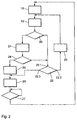
- Figure 2 shows a flow chart of one in connection with the invention Method applicable method for data transmission, that for data transmission can be used between the implant 1 and the external device 2 can.
- the trigger signal for data transmission is always from the transmitter / receiver unit of the implant 1, for which purpose the transmitter / receiver unit in a step 18 is switched on.
- step 19 the first data is then transferred from the implant 1 to the external device 2.
- a string consisting of 17 bytes is transmitted. These are 1 byte synchronization, 4 byte identification, 1 byte sequential number the transmission, 1 byte length of the transmitting string, 8 bytes of data, 2 bytes Security (CRC).
- CRC 2 bytes Security
- step 20 there is then a plausibility check of the first sent Data from the external device.
- the CRC bits related to the string sent or a check to see if the Synchronization bits have the previously known values.
- the string length matches the transmitted string length and / or whether the serial number of the transmission is correct.
- a review of flags is omitted since the external device 2 does not handle the flags.
- Extensions to telemetry can therefore always be the same type of external Device. There is no need to check the implant number because the external device can forward the information of several implants.
- Step 22 determines whether a predetermined number of retransmissions was exceeded.
- step 22 It is determined in step 22 that the predetermined number of retransmissions not exceeded, valid data from the Pacemaker requested.
- This request can be made from synchronization (8 bit), identification (32 bit), the serial number of the message (8 bit) and an agreed Code (8 bit) exist.
- Step 21 after the plausibility check has been carried out, a first receipt to the Implant 1 sent, the first acknowledgment for the first control information Control of the readiness to receive the first transmitter / receiver unit contains. If the data record was recognized as valid, you can use or in the first Received a control record that controls through the implant 1 becomes. There are two options:
- the previously sent first data record is completely sent to the Implant 1 sent back, which is then the one sent with the one received Compares record. Then 187 bits would be sent back.
- step 24 If the first receipt in the implant is negative in step 24, i.e. if the control data are not identical to the original data, the shipment is made of the first record again. The implant then tries a set one Time span again. The external device 2 informs the service center about the number of incorrectly transmitted data packets.
- step 26 the implant 1 then stops all transmission and reception activities.
- step 27 the expiry of a specific time interval is checked, after which a new data record is pending in the implant.
- the handset 3 After receiving the second receipt, the handset 3 is now verified forward the first data to the service center.
- the first record is valid marked and the service center knows that this data with a very high Probability are correct.
- the external device keeps this first data until the implant delivers a new, correctly verified data set.
- the first data will still be sent via SMS sent to the service center, but it is also sent from the external device 2 reported that the second receipt of the implant 1 was not validly transmitted could be.
- the implant 1 after sending the second receipt after a precisely defined time interval Reception goes.
- the external device 2 can, for example Resend the first 88-bit receipt to a new shipment to request.
- the implant 1 can immediately after it has checked that it has responded is to begin the re-transmission without first having received the Data must be evaluated.
- the external device 2 then either the first data record or the second receipt is duplicated and can now decide whether the first record can be accepted as valid.
- the send / receive cycles can be repeated several times. But it has to go In order to save energy, care should be taken that after a certain Number of shipments is canceled to the energy storage of the implant not to discharge unnecessarily.
- the external device should then still send the data to the Send the service center, but the data must be marked as not verified.
- the data is held in the external device 2 until a new data record is dated Implant is sent.
- the last valid data record should be in the external Device that the service center can then query. With several Implants that work together with the external device 2 are each to keep the last records of each implant in the external device 2.
- the receiver of the external device 2 is in the described variant of the Procedure ready at any time to receive data from the implant.
- Zu Shipments from the Implant 1 sent to the external device 2 which either contain data or only indicate that the implant 1 is active and ready to receive. Is more than one Send message, they will be sent one after the other. These broadcasts are received, analyzed and acknowledged by the external partner. The Receipts are expected in a fixed time window after the broadcast, so that the recipient in the implant 1 only has to be active for a short time. In the receipts data can already be transferred to implant 1. Based on the content and The type of the acknowledgments is shown whether there are 2 additional data in the external device Pending transfer in the direction of implant 1.
- a reduction in energy consumption in the external device 2 achieved.
- the implant and the external device are synchronized by setting on time slices, which defines periodic times in which the Receiver of the external device is active.
- the implant 1 may then only send within these time slices to be received.
- the above Instructions are modified accordingly, so that the Implant 1 can only send within the time slices and no longer to any Times.
- the time slices can be used in the normal bidirectional manner described above Communication in the duration of the active as well as the passive phase as well as the synchronization time can be changed. Be about one no more consignments are received from the implant for a certain period of time the active time slice is gradually extended to one at the expense of the passive To drift apart the synchronicity. In extreme cases, the recipient is permanently active in the external device. This is also the reset state when switching on.
- FIG. 3 shows as a flowchart which strategy for the repetitions shipments can be driven through the implant 1.
- Figure 3 represents step 22 from FIG. 2 with the input 22.1 and the outputs 22.2 and 22.3 in detail.
- step 28 it is first checked whether a counter Z has a predetermined first Value, here 2, has not yet exceeded.
- the counter Z represents the Number of attempts to transfer. It goes to zero in step 18 set and incremented by 1 with each step of step 19. Is the default If the first value is not exceeded, a new one is immediately output 22.2 Transfer initiated. So first a second attempt is made to close the program transfer.
- step 29 Set to zero.
- step 30 it is checked whether the counter Z has a predetermined second value, here 3, has not yet exceeded.
- the specified second value is not yet exceeded, the system waits noticeably through the queue 31, because of a systematic error in the transmission can be assumed. This can e.g. be a jammer that makes transmission impossible for some time (e.g. an insufficiently suppressed electrical device). After a waiting period of e.g. B. 5 Another attempt to send is started within minutes. If this is also unsuccessful, the cycle continues at step 28.
- step 32 It is then checked in step 32 whether the counter Z has a predetermined third value, here 4, has not yet exceeded. Is the specified third value not yet exceeded, the system waits longer through queue 33, for example 1 hour and starts a last transmission attempt. Is this also unsuccessful, the cycle continues at step 28 and then exits at 22.3. In this case, the data will only be sent again when there is new data in the pacemaker Shipment ready.
- a predetermined third value here 4
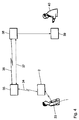
- FIG. 4 shows a block diagram of a variant of a patient monitoring system using the present invention.
- Data is transferred between the implant 1 and the external one Device 2 from Figure 1, the implant 1 is carried by a patient 33.
- the data read out are transmitted from the external device 2 via a mobile radio link 34 of a cellular network to a cellular station 35 of the cellular network transmitted and from there also via a mobile radio link 36 or alternatively sent via a landline connection 37 to a service center 38, which as central storage device and monitoring device is used. All data are sent as SMS messages and mutually acknowledged via SMS.
- the central storage unit 38 is equipped with a fully automatic database.
- the medical data is automatically in via TCP / IP connection the database computer is read in, depending on the time, implant, Patient, external device and medical contact (doctor / clinic) in the provided tables and table fields.
- the access options to the data are regulated by complex rights distribution (e.g. reading, writing, changing, deleting, etc.) for different User groups such as data administrators, clinics or doctors.
- complex rights distribution e.g. reading, writing, changing, deleting, etc.
- User groups such as data administrators, clinics or doctors.
- During the operation of the Database are manual interventions and queries by system administrators at any time and other clients (e.g. the doctor 40) possible.
- Priority-controlled triggers in the database and a coupled expert system make it possible to react specifically to medical issues:
- the Database generates information for the doctor according to predefined rules and the system administrator and gives them via fax, email, internal and external Computer connection to the target devices 39 on.
- the information output are stored in the database for later collective queries. So he can Doctor a summary or lost report regarding the patient request again. He also gets medical information in a few minutes during the investigation and summarized information to the next Follow-up appointment.
- the transmission medium and the destination addresses are included configurable depending on the triggering time and event. This allows the attending doctor 40 in a manner desired by him received about the health of his patient 33
- the patient 33 can also get medical help faster than usual. This emergency is both measured by objectively measured medical data also triggered by pressing a button on the handset 3 2. He receives towards the other events top priority.
- the database can also be set up separately for the patient Data transfers react, for example in this case also information be sent to the doctor and the system administrator. This can do that subjective condition of the patient especially when collecting data be taken into account and included in the diagnostic options.
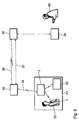
- FIG. 5 shows a block diagram of a variant of a patient monitoring and aftercare system using the present invention.
- the patient 33 with the implant 1 and the external device is located here 2 for aftercare examination in a query area 41 of a aftercare facility. It is triggered by the external device when entering the Interrogation area 41 cooperating trigger device automatically Querying the first data from the implant 1 before the follow-up examination performed by the doctor 40.
- the first data is transferred by means of the long-range telemetry connection between the implant 1 and the external device 2.
- the result of the query is processed in accordance with FIG. 4 described route via the service center 38 to the target device 39, from which it is the doctor 40 is issued for his information. At the same time further patient-related data from the database of the service center 38 output so that the doctor 40 can get a comprehensive picture.
- the routine, immediate examination of the doctor is thus an overall picture added to the time since the last visit to the doctor.
- the doctor receives a picture about for several weeks or months, which is much more meaningful than that current investigation.
- the patient's habits become good pictured, whereas the appointment with the doctor is an exceptional situation from can represent familiar life (trip to the clinic or doctor, climbing stairs, Stress in traffic etc.).
- the doctor can also do the actual examination (e.g. during stress tests) Request a report from the service center 38 immediately, which will then appear after a few Minutes is delivered. This allows parameter changes to be made using the Programmers have been hired, checked immediately and optimized if necessary. Through storage in the database and further evaluation options the expert system or by comparing it to other cases may be more Reports are created. Through advances in medical knowledge so new relationships are recognized. These will then be given to the doctor next report communicated, without being informed of each of his Should check patients for possible effects.
- Figure 6 shows a variant of the embodiment of Figure 5, in the query area 41 of the aftercare device, an external device 2 'is permanently installed.
- the query is triggered as soon as the patient 33 with the implant 1 for one certain period of time is in the query range of the external device 2 '.
- the result of the query is processed directly from the external source Device 2 'to the target device 39, from which it to the doctor 40 for his information is issued.
- other patient-related connections are made via the connection 43 Data from the database of the service center 38 queried and on Target device 39 output, so that the doctor 40 also here a comprehensive picture can make.
- FIG. 7 shows a block diagram of a telemetry device of an electromedical device Implant used in conjunction with the present invention can.
- the telemetry device has a near field transmitter 44, an associated therewith Telemetry unit 45 and an antenna interface device connected to the telemetry unit 45 46, via which a near-field antenna 47 with the Near field transmitter / receiver unit is connected.
- the near field telemetry device and the far field telemetry device have separate energy storage 51 and 52.
- the other necessary system components for a telemetry device such as Buffer, sequence control, coding, decoding and driver with Threshold value detectors are integrated in the telemetry unit 45.
- the Far field telemetry equipment operates at substantially the same effective data rate how the near field telemetry device operated.
- Figure 8 shows the transmitter / receiver unit of an embodiment of the implant 1, in the energy stores 56 and 57 separate for the transmitter 54 and the receiver 55 are provided. These are separate buffer capacities 56 and 57. These capacities 56 and 57 only have to match those for the respective process necessary energy can be charged. The energy consumption of one process does not affect the energy supply for the other process. The operations can thus follow each other immediately, what a bidirectional communication protocol is advantageous without the need to charge a single buffer capacity would be required to double the energy content.
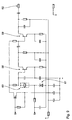
- FIG. 9 shows a circuit diagram of a transmitter according to the invention of the first transmitter / receiver unit a variant of the implant 1 from FIG. 1.
- a stable frequency-modulated transmitter is with two bipolar transistors 58, 59 can be realized, the first transistor 58 in a Colpitts or Clapp circuit with a SAW resonator 60 a SAW stabilized oscillator forms and the second transistor 59 serves as a buffer stage and antenna driver.
- the transistors 58, 59 are at maximum amplification with the lowest collector current designed.
- With a capacitance diode 61 in series with the SAW resonator 60 the frequency can be modulated. The frequency swing, and thus the data rate and / or the range of the transmitter, but can be increased in that the capacitance diode is replaced by a PIN diode, which is replaced by another Transistor is switched.
- a simple wire loop or an open wire (wire antenna) can be used as the antenna. serve in the contour of the head of the implant. Overall, this is at 400 MHz a power consumption of less than 1mA with a range of several Meters possible.
- the circuit can be made directly from a high impedance Battery of the implant 1 fed buffer capacity or a low-resistance Battery are supplied. A charge pump is not required.
- FIG. 10 shows a further exemplary embodiment of a device according to the invention, which corresponds essentially to that of Figure 1, which is why here only the differences should be dealt with.
- Applications can be the remote monitoring of plants, e.g. the filling level of beverage or vending machines, the connection to the Building services, e.g. Control and monitoring of air conditioning or heating that Coupling to alarm systems or glass breakage detection systems, e.g. Intrusion notification via Mobile radio, the coupling to measuring systems, e.g. Weather stations or level meters on rivers, the coupling to systems for monitoring and influencing traffic, e.g. Sign bridges etc. It can also be used as a listening device or as a mobile phone can be used with special digital functions.
- the differences from the embodiment from FIG. 1 essentially concern this Handset 3 'of the external device 2' '.
- the first interface device comprises 4 potential-free inputs 6.1 via optocouplers and 4 potential-free outputs 6.2. Thanks to the potential separation of the inputs and outputs 6.1 and 6.2 is suitable the external device 2 '' for the monitoring and control of digital states.
- the receiving and transmitting part 6 from FIG. 1 is omitted; released serial interface 63 (RS 232) via a 9-pin connector led out.
- a software handshake with three lines is sufficient for the RS 232 (RXD, TXD, GND).
- the transmission rate is also limited to 9600 baud.
- the serial interface 63 is not designed to be potential-free.
- the connector of the mobile radio module 7.1 can be connected to a further connector 64 Microphone, a loudspeaker and optionally a buzzer (6 lines), so that for other areas of application a hearing / speaking combination and a Buzzer can be added.
- Inputs 6.1 are in range 1 at -3V to 1.5V L level, 3.5 to 8V H level and 10 mA input current; in area 2 at -3V to 8V L level, 18V to 30V H level and 10 mA input current.
- the status is recognized via an LED display at a maximum switching frequency of 100 Hz square wave and a separation voltage of 2.5kV.
- the outputs have 15 to 30V DC separate voltage supply, one Load current of 200mA, short-circuit protection, protection against thermal overload and a separation voltage of 2.5kV. Electrical isolation is via optocouplers, the power switching function is implemented via MOS-FETs.
Landscapes
- Health & Medical Sciences (AREA)
- Life Sciences & Earth Sciences (AREA)
- Engineering & Computer Science (AREA)
- Animal Behavior & Ethology (AREA)
- Veterinary Medicine (AREA)
- Public Health (AREA)
- General Health & Medical Sciences (AREA)
- Biomedical Technology (AREA)
- Biophysics (AREA)
- Heart & Thoracic Surgery (AREA)
- Radiology & Medical Imaging (AREA)
- Nuclear Medicine, Radiotherapy & Molecular Imaging (AREA)
- Computer Networks & Wireless Communication (AREA)
- Pathology (AREA)
- Physics & Mathematics (AREA)
- Medical Informatics (AREA)
- Surgery (AREA)
- Molecular Biology (AREA)
- Mobile Radio Communication Systems (AREA)
- Radio Relay Systems (AREA)
- Electrotherapy Devices (AREA)
- Measuring And Recording Apparatus For Diagnosis (AREA)
Applications Claiming Priority (2)
| Application Number | Priority Date | Filing Date | Title |
|---|---|---|---|
| DE19930241A DE19930241A1 (de) | 1999-06-25 | 1999-06-25 | Verfahren zur Datenübertragung bei der Implantatsüberwachung |
| DE19930241 | 1999-06-25 |
Publications (3)
| Publication Number | Publication Date |
|---|---|
| EP1062981A2 true EP1062981A2 (fr) | 2000-12-27 |
| EP1062981A3 EP1062981A3 (fr) | 2004-01-28 |
| EP1062981B1 EP1062981B1 (fr) | 2005-10-19 |
Family
ID=7913237
Family Applications (1)
| Application Number | Title | Priority Date | Filing Date |
|---|---|---|---|
| EP00250198A Expired - Lifetime EP1062981B1 (fr) | 1999-06-25 | 2000-06-23 | Procédé et système de transmission de données dans la surveillance d'un implant |
Country Status (4)
| Country | Link |
|---|---|
| US (1) | US6470215B1 (fr) |
| EP (1) | EP1062981B1 (fr) |
| AT (1) | ATE306966T1 (fr) |
| DE (2) | DE19930241A1 (fr) |
Cited By (3)
| Publication number | Priority date | Publication date | Assignee | Title |
|---|---|---|---|---|
| WO2002089663A1 (fr) * | 2001-05-07 | 2002-11-14 | Cardiosafe International Ag | Dispositif servant a surveiller un patient |
| WO2003072192A1 (fr) * | 2002-02-28 | 2003-09-04 | St. Jude Medical Ab | Gestion de dispositifs implantables |
| WO2003041425A3 (fr) * | 2001-11-09 | 2004-06-10 | Giacomo Vespasiani | Procede de collecte de valeurs mesurees de glycemie et dispositif de mise en oeuvre de ce procede |
Families Citing this family (171)
| Publication number | Priority date | Publication date | Assignee | Title |
|---|---|---|---|---|
| US6738670B1 (en) * | 2000-06-19 | 2004-05-18 | Medtronic, Inc. | Implantable medical device telemetry processor |
| US6708065B2 (en) * | 2001-03-02 | 2004-03-16 | Cardiac Pacemakers, Inc. | Antenna for an implantable medical device |
| US6662048B2 (en) * | 2001-03-30 | 2003-12-09 | Cardiac Pacemakers, Inc. | Implantable medical device with temperature measuring and storing capability |
| US7903043B2 (en) * | 2003-12-22 | 2011-03-08 | Cardiac Pacemakers, Inc. | Radio frequency antenna in a header of an implantable medical device |
| US6456256B1 (en) * | 2001-08-03 | 2002-09-24 | Cardiac Pacemakers, Inc. | Circumferential antenna for an implantable medical device |
| US7729776B2 (en) * | 2001-12-19 | 2010-06-01 | Cardiac Pacemakers, Inc. | Implantable medical device with two or more telemetry systems |
| US6993393B2 (en) | 2001-12-19 | 2006-01-31 | Cardiac Pacemakers, Inc. | Telemetry duty cycle management system for an implantable medical device |
| US6985773B2 (en) * | 2002-02-07 | 2006-01-10 | Cardiac Pacemakers, Inc. | Methods and apparatuses for implantable medical device telemetry power management |
| US7043305B2 (en) | 2002-03-06 | 2006-05-09 | Cardiac Pacemakers, Inc. | Method and apparatus for establishing context among events and optimizing implanted medical device performance |
| US8391989B2 (en) | 2002-12-18 | 2013-03-05 | Cardiac Pacemakers, Inc. | Advanced patient management for defining, identifying and using predetermined health-related events |
| US7983759B2 (en) | 2002-12-18 | 2011-07-19 | Cardiac Pacemakers, Inc. | Advanced patient management for reporting multiple health-related parameters |
| US8043213B2 (en) | 2002-12-18 | 2011-10-25 | Cardiac Pacemakers, Inc. | Advanced patient management for triaging health-related data using color codes |
| US7468032B2 (en) * | 2002-12-18 | 2008-12-23 | Cardiac Pacemakers, Inc. | Advanced patient management for identifying, displaying and assisting with correlating health-related data |
| US20040122294A1 (en) | 2002-12-18 | 2004-06-24 | John Hatlestad | Advanced patient management with environmental data |
| US20040122487A1 (en) | 2002-12-18 | 2004-06-24 | John Hatlestad | Advanced patient management with composite parameter indices |
| US7069086B2 (en) * | 2002-08-08 | 2006-06-27 | Cardiac Pacemakers, Inc. | Method and system for improved spectral efficiency of far field telemetry in a medical device |
| US7027871B2 (en) * | 2002-10-31 | 2006-04-11 | Medtronic, Inc. | Aggregation of data from external data sources within an implantable medical device |
| US7378955B2 (en) * | 2003-01-03 | 2008-05-27 | Cardiac Pacemakers, Inc. | System and method for correlating biometric trends with a related temporal event |
| US7162307B2 (en) * | 2003-02-11 | 2007-01-09 | Medtronic, Inc. | Channel occupancy in multi-channel medical device communication |
| US7016733B2 (en) * | 2003-04-23 | 2006-03-21 | Medtronic, Inc. | Telemetry antenna for an implantable medical device |
| US8460243B2 (en) | 2003-06-10 | 2013-06-11 | Abbott Diabetes Care Inc. | Glucose measuring module and insulin pump combination |
| US7155290B2 (en) * | 2003-06-23 | 2006-12-26 | Cardiac Pacemakers, Inc. | Secure long-range telemetry for implantable medical device |
| US7722536B2 (en) | 2003-07-15 | 2010-05-25 | Abbott Diabetes Care Inc. | Glucose measuring device integrated into a holster for a personal area network device |
| US7228182B2 (en) * | 2004-03-15 | 2007-06-05 | Cardiac Pacemakers, Inc. | Cryptographic authentication for telemetry with an implantable medical device |
| JP4705953B2 (ja) | 2004-04-07 | 2011-06-22 | カーディアック ペースメイカーズ, インコーポレイテッド | 埋込み型医療装置のrfウエイクアップ |
| WO2005119524A2 (fr) | 2004-06-04 | 2005-12-15 | Therasense, Inc. | Architecture hote-client de soins pour le diabete et systemes de gestion de donnees |
| US7794499B2 (en) | 2004-06-08 | 2010-09-14 | Theken Disc, L.L.C. | Prosthetic intervertebral spinal disc with integral microprocessor |
| US7519430B2 (en) * | 2004-06-17 | 2009-04-14 | Cardiac Pacemakers, Inc. | Dynamic telemetry encoding for an implantable medical device |
| US7457669B2 (en) * | 2004-06-17 | 2008-11-25 | Cardiac Pacemakers, Inc. | On-demand retransmission of data with an implantable medical device |
| US7539541B2 (en) * | 2004-08-09 | 2009-05-26 | Cardiac Pacemakers, Inc. | Automatic power control for a radio frequency transceiver of an implantable device |
| US7406349B2 (en) * | 2004-08-09 | 2008-07-29 | Cardiac Pacemakers, Inc. | Dynamic telemetry link selection for an implantable device |
| US7881802B2 (en) * | 2004-08-09 | 2011-02-01 | Cardiac Pacemakers, Inc. | Telemetry switchover state machine with firmware priority control |
| US7890180B2 (en) * | 2004-08-09 | 2011-02-15 | Cardiac Pacemakers, Inc. | Secure remote access for an implantable medical device |
| DE202005021463U1 (de) * | 2005-01-18 | 2008-04-17 | Biotronik Crm Patent Ag | Patientengerät |
| US7218969B2 (en) * | 2005-01-19 | 2007-05-15 | Cardiac Pacemakers, Inc. | Dynamic channel selection for RF telemetry with implantable device |
| US7545272B2 (en) | 2005-02-08 | 2009-06-09 | Therasense, Inc. | RF tag on test strips, test strip vials and boxes |
| US7610065B2 (en) | 2005-02-28 | 2009-10-27 | Cardiac Pacemakers, Inc. | Method and apparatus for antenna selection in a diversity antenna system for communicating with implantable medical device |
| US7664553B2 (en) * | 2005-04-27 | 2010-02-16 | Cardiac Pacemakers, Inc. | System and method for enabling communications with implantable medical devices |
| US8391990B2 (en) | 2005-05-18 | 2013-03-05 | Cardiac Pacemakers, Inc. | Modular antitachyarrhythmia therapy system |
| US9168383B2 (en) | 2005-10-14 | 2015-10-27 | Pacesetter, Inc. | Leadless cardiac pacemaker with conducted communication |
| US8010209B2 (en) | 2005-10-14 | 2011-08-30 | Nanostim, Inc. | Delivery system for implantable biostimulator |
| US8805526B2 (en) | 2006-05-03 | 2014-08-12 | Cardiac Pacemakers, Inc. | Configurable medical telemetry radio system |
| US20070265667A1 (en) * | 2006-05-15 | 2007-11-15 | Dirk Muessig | Semi-automatic atrial defibrillation system, implantable atrial defibrillator and portable communication device |
| US7720544B2 (en) | 2006-06-09 | 2010-05-18 | Cardiac Pacemakers, Inc. | Systems for enabling telemetry in an implantable medical device |
| US7613522B2 (en) | 2006-06-09 | 2009-11-03 | Cardiac Pacemakers, Inc. | Multi-antenna for an implantable medical device |
| US8185204B2 (en) | 2006-07-12 | 2012-05-22 | Cardiac Pacemakers, Inc. | Implantable medical device telemetry with adaptive frequency hopping |
| US8032472B2 (en) * | 2007-04-04 | 2011-10-04 | Tuen Solutions Limited Liability Company | Intelligent agent for distributed services for mobile devices |
| US7978062B2 (en) | 2007-08-31 | 2011-07-12 | Cardiac Pacemakers, Inc. | Medical data transport over wireless life critical network |
| US9848058B2 (en) | 2007-08-31 | 2017-12-19 | Cardiac Pacemakers, Inc. | Medical data transport over wireless life critical network employing dynamic communication link mapping |
| US8649864B2 (en) * | 2007-10-16 | 2014-02-11 | Biotronik Crm Patent Ag | Implantable heart stimulator providing long term cardiac monitoring with automatic notification |
| DE102007051756A1 (de) * | 2007-10-30 | 2009-05-07 | Biotronik Crm Patent Ag | Vorrichtung zur Bestimmung eines Nachsorgetermins für die Versorgung eines implantierbaren medizinischen Gerätes |
| US8401659B2 (en) * | 2008-01-15 | 2013-03-19 | Cardiac Pacemakers, Inc. | Implantable medical device with wireless communications |
| JP5052679B2 (ja) * | 2008-01-15 | 2012-10-17 | カーディアック ペースメイカーズ, インコーポレイテッド | アンテナを有する埋込型医療デバイス |
| US7917226B2 (en) * | 2008-04-23 | 2011-03-29 | Enteromedics Inc. | Antenna arrangements for implantable therapy device |
| US8315694B2 (en) | 2008-10-16 | 2012-11-20 | Biotronik Crm Patent Ag | Method and apparatus for ectopic beat detection |
| US8419645B2 (en) | 2008-10-16 | 2013-04-16 | Biotronik Crm Patent Ag | Respiration measurement by means of morphological operators |
| US8019407B2 (en) | 2008-10-24 | 2011-09-13 | Biotronik Crm Patent Ag | Heart monitoring device and method |
| US8527068B2 (en) | 2009-02-02 | 2013-09-03 | Nanostim, Inc. | Leadless cardiac pacemaker with secondary fixation capability |
| US8319631B2 (en) | 2009-03-04 | 2012-11-27 | Cardiac Pacemakers, Inc. | Modular patient portable communicator for use in life critical network |
| US8812841B2 (en) | 2009-03-04 | 2014-08-19 | Cardiac Pacemakers, Inc. | Communications hub for use in life critical network |
| US8396538B2 (en) | 2009-11-30 | 2013-03-12 | Biotronik Crm Patent Ag | Method and apparatus for improving signal to noise ratio of ECG signals to facilitate cardiac beat detection |
| JP6150523B2 (ja) * | 2010-02-05 | 2017-06-21 | デカ・プロダクツ・リミテッド・パートナーシップ | 注入ポンプ装置、方法およびシステム |
| US9026198B2 (en) | 2010-07-13 | 2015-05-05 | Biotronik Se & Co. Kg | Method and device for noise detection in physiological signals |
| US9060692B2 (en) | 2010-10-12 | 2015-06-23 | Pacesetter, Inc. | Temperature sensor for a leadless cardiac pacemaker |
| EP2627403A4 (fr) | 2010-10-12 | 2014-03-26 | Nanostim Inc | Capteur de température pour stimulateur cardiaque sans fil |
| US9020611B2 (en) | 2010-10-13 | 2015-04-28 | Pacesetter, Inc. | Leadless cardiac pacemaker with anti-unscrewing feature |
| US9126032B2 (en) | 2010-12-13 | 2015-09-08 | Pacesetter, Inc. | Pacemaker retrieval systems and methods |
| EP2651494B1 (fr) | 2010-12-13 | 2017-02-15 | Pacesetter, Inc. | Cathéter pour implantation |
| CN103328040B (zh) | 2010-12-20 | 2016-09-14 | 内诺斯蒂姆股份有限公司 | 具有径向固定机构的无导线起搏器 |
| US10136845B2 (en) | 2011-02-28 | 2018-11-27 | Abbott Diabetes Care Inc. | Devices, systems, and methods associated with analyte monitoring devices and devices incorporating the same |
| US10451897B2 (en) | 2011-03-18 | 2019-10-22 | Johnson & Johnson Vision Care, Inc. | Components with multiple energization elements for biomedical devices |
| US9812730B2 (en) | 2011-08-02 | 2017-11-07 | Johnson & Johnson Vision Care, Inc. | Biocompatible wire battery |
| EP2589333A1 (fr) | 2011-11-04 | 2013-05-08 | BIOTRONIK SE & Co. KG | Appareil et système de surveillance cardiaque cutanée à long terme |
| WO2013067496A2 (fr) | 2011-11-04 | 2013-05-10 | Nanostim, Inc. | Stimulateur cardiaque sans dérivation ayant une batterie intégrale et des soudures redondantes |
| US8857983B2 (en) | 2012-01-26 | 2014-10-14 | Johnson & Johnson Vision Care, Inc. | Ophthalmic lens assembly having an integrated antenna structure |
| US9802054B2 (en) | 2012-08-01 | 2017-10-31 | Pacesetter, Inc. | Biostimulator circuit with flying cell |
| EP2710953B1 (fr) | 2012-09-21 | 2015-03-04 | BIOTRONIK SE & Co. KG | Procédé d'augmentation du rapport signal/bruit (SNR) de signaux de mesure d'électrocardiogramme (ECG) et dispositif cardiaque destiné à être utilisé dans la détection de battements de coeur |
| US9421378B2 (en) | 2013-06-14 | 2016-08-23 | Biotronik Se & Co. Kg | Apparatus and method for spinal cord stimulation to treat pain |
| AU2015204701B2 (en) | 2014-01-10 | 2018-03-15 | Cardiac Pacemakers, Inc. | Systems and methods for detecting cardiac arrhythmias |
| US20150196769A1 (en) | 2014-01-10 | 2015-07-16 | Cardiac Pacemakers, Inc. | Methods and systems for improved communication between medical devices |
| US10627651B2 (en) | 2014-08-21 | 2020-04-21 | Johnson & Johnson Vision Care, Inc. | Methods and apparatus to form biocompatible energization primary elements for biomedical devices with electroless sealing layers |
| US9793536B2 (en) | 2014-08-21 | 2017-10-17 | Johnson & Johnson Vision Care, Inc. | Pellet form cathode for use in a biocompatible battery |
| US10381687B2 (en) | 2014-08-21 | 2019-08-13 | Johnson & Johnson Vision Care, Inc. | Methods of forming biocompatible rechargable energization elements for biomedical devices |
| US10361404B2 (en) | 2014-08-21 | 2019-07-23 | Johnson & Johnson Vision Care, Inc. | Anodes for use in biocompatible energization elements |
| US9715130B2 (en) | 2014-08-21 | 2017-07-25 | Johnson & Johnson Vision Care, Inc. | Methods and apparatus to form separators for biocompatible energization elements for biomedical devices |
| US10361405B2 (en) | 2014-08-21 | 2019-07-23 | Johnson & Johnson Vision Care, Inc. | Biomedical energization elements with polymer electrolytes |
| US9599842B2 (en) | 2014-08-21 | 2017-03-21 | Johnson & Johnson Vision Care, Inc. | Device and methods for sealing and encapsulation for biocompatible energization elements |
| US9941547B2 (en) | 2014-08-21 | 2018-04-10 | Johnson & Johnson Vision Care, Inc. | Biomedical energization elements with polymer electrolytes and cavity structures |
| US9383593B2 (en) | 2014-08-21 | 2016-07-05 | Johnson & Johnson Vision Care, Inc. | Methods to form biocompatible energization elements for biomedical devices comprising laminates and placed separators |
| US9526909B2 (en) | 2014-08-28 | 2016-12-27 | Cardiac Pacemakers, Inc. | Medical device with triggered blanking period |
| EP3827877B1 (fr) | 2015-02-06 | 2024-06-19 | Cardiac Pacemakers, Inc. | Systèmes de traitement d'arythmies cardiaques |
| ES2713231T3 (es) | 2015-02-06 | 2019-05-20 | Cardiac Pacemakers Inc | Sistemas para el suministro seguro de una terapia de estimulación eléctrica |
| WO2016130477A2 (fr) | 2015-02-09 | 2016-08-18 | Cardiac Pacemakers, Inc. | Dispositif médical implantable comportant une étiquette d'identification radio-opaque |
| EP3265172B1 (fr) | 2015-03-04 | 2018-12-19 | Cardiac Pacemakers, Inc. | Systèmes de traitement d'arythmies cardiaques |
| CN107427222B (zh) | 2015-03-18 | 2021-02-09 | 心脏起搏器股份公司 | 使用链路质量评估的医疗设备系统中的通信 |
| US10050700B2 (en) | 2015-03-18 | 2018-08-14 | Cardiac Pacemakers, Inc. | Communications in a medical device system with temporal optimization |
| US9853743B2 (en) | 2015-08-20 | 2017-12-26 | Cardiac Pacemakers, Inc. | Systems and methods for communication between medical devices |
| WO2017031347A1 (fr) | 2015-08-20 | 2017-02-23 | Cardiac Pacemakers, Inc. | Systèmes et procédés de communication entre des dispositifs médicaux |
| US9956414B2 (en) | 2015-08-27 | 2018-05-01 | Cardiac Pacemakers, Inc. | Temporal configuration of a motion sensor in an implantable medical device |
| US9968787B2 (en) | 2015-08-27 | 2018-05-15 | Cardiac Pacemakers, Inc. | Spatial configuration of a motion sensor in an implantable medical device |
| WO2017040115A1 (fr) | 2015-08-28 | 2017-03-09 | Cardiac Pacemakers, Inc. | Système de détection de tamponnade |
| US10226631B2 (en) | 2015-08-28 | 2019-03-12 | Cardiac Pacemakers, Inc. | Systems and methods for infarct detection |
| US10137305B2 (en) | 2015-08-28 | 2018-11-27 | Cardiac Pacemakers, Inc. | Systems and methods for behaviorally responsive signal detection and therapy delivery |
| WO2017044389A1 (fr) | 2015-09-11 | 2017-03-16 | Cardiac Pacemakers, Inc. | Détection et confirmation d'arythmie |
| US10065041B2 (en) | 2015-10-08 | 2018-09-04 | Cardiac Pacemakers, Inc. | Devices and methods for adjusting pacing rates in an implantable medical device |
| JP6608063B2 (ja) | 2015-12-17 | 2019-11-20 | カーディアック ペースメイカーズ, インコーポレイテッド | 植込み型医療装置 |
| US10905886B2 (en) | 2015-12-28 | 2021-02-02 | Cardiac Pacemakers, Inc. | Implantable medical device for deployment across the atrioventricular septum |
| WO2017127548A1 (fr) | 2016-01-19 | 2017-07-27 | Cardiac Pacemakers, Inc. | Dispositifs permettant de recharger sans fil une batterie rechargeable d'un dispositif médical implantable |
| WO2017136548A1 (fr) | 2016-02-04 | 2017-08-10 | Cardiac Pacemakers, Inc. | Système de pose avec capteur de force pour dispositif cardiaque sans fil |
| US10345620B2 (en) | 2016-02-18 | 2019-07-09 | Johnson & Johnson Vision Care, Inc. | Methods and apparatus to form biocompatible energization elements incorporating fuel cells for biomedical devices |
| US11116988B2 (en) | 2016-03-31 | 2021-09-14 | Cardiac Pacemakers, Inc. | Implantable medical device with rechargeable battery |
| US10328272B2 (en) | 2016-05-10 | 2019-06-25 | Cardiac Pacemakers, Inc. | Retrievability for implantable medical devices |
| US10668294B2 (en) | 2016-05-10 | 2020-06-02 | Cardiac Pacemakers, Inc. | Leadless cardiac pacemaker configured for over the wire delivery |
| JP6764956B2 (ja) | 2016-06-27 | 2020-10-07 | カーディアック ペースメイカーズ, インコーポレイテッド | 再同期ペーシング管理に皮下で感知されたp波を使用する心臓治療法システム |
| US11207527B2 (en) | 2016-07-06 | 2021-12-28 | Cardiac Pacemakers, Inc. | Method and system for determining an atrial contraction timing fiducial in a leadless cardiac pacemaker system |
| WO2018009392A1 (fr) | 2016-07-07 | 2018-01-11 | Cardiac Pacemakers, Inc. | Stimulateur cardiaque sans fil utilisant des mesures de pression pour la vérification de la capture de stimulation |
| CN109475743B (zh) | 2016-07-20 | 2022-09-02 | 心脏起搏器股份公司 | 在无引线心脏起搏器系统中利用心房收缩定时基准的系统 |
| WO2018035343A1 (fr) | 2016-08-19 | 2018-02-22 | Cardiac Pacemakers, Inc. | Dispositif médical implantable trans-septal |
| EP3503970B1 (fr) | 2016-08-24 | 2023-01-04 | Cardiac Pacemakers, Inc. | Resynchronisation cardiaque utilisant l'encouragement de la fusion pour la gestion de la synchronisation |
| CN109640809B (zh) | 2016-08-24 | 2021-08-17 | 心脏起搏器股份公司 | 使用p波到起搏定时的集成式多装置心脏再同步治疗 |
| WO2018057318A1 (fr) | 2016-09-21 | 2018-03-29 | Cardiac Pacemakers, Inc. | Dispositif de stimulation sans fil muni d'un boîtier qui abrite des composants interne du dispositif de stimulation sans fil et fonctionne comme boîtier de batterie et borne d'une batterie interne |
| WO2018057626A1 (fr) | 2016-09-21 | 2018-03-29 | Cardiac Pacemakers, Inc. | Moniteur cardiaque implantable |
| US10758737B2 (en) | 2016-09-21 | 2020-09-01 | Cardiac Pacemakers, Inc. | Using sensor data from an intracardially implanted medical device to influence operation of an extracardially implantable cardioverter |
| US10413733B2 (en) | 2016-10-27 | 2019-09-17 | Cardiac Pacemakers, Inc. | Implantable medical device with gyroscope |
| WO2018081237A1 (fr) | 2016-10-27 | 2018-05-03 | Cardiac Pacemakers, Inc. | Utilisation d'un dispositif séparé pour gérer l'énergie d'impulsion de stimulation d'un stimulateur cardiaque |
| AU2017350759B2 (en) | 2016-10-27 | 2019-10-17 | Cardiac Pacemakers, Inc. | Implantable medical device with pressure sensor |
| US10758724B2 (en) | 2016-10-27 | 2020-09-01 | Cardiac Pacemakers, Inc. | Implantable medical device delivery system with integrated sensor |
| WO2018081275A1 (fr) | 2016-10-27 | 2018-05-03 | Cardiac Pacemakers, Inc. | Thérapie de resynchronisation cardiaque à dispositifs multiples avec des améliorations de synchronisation |
| WO2018081133A1 (fr) | 2016-10-27 | 2018-05-03 | Cardiac Pacemakers, Inc. | Dispositif médical implantable présentant un canal d'écoute à réglage de rendement |
| US10434317B2 (en) | 2016-10-31 | 2019-10-08 | Cardiac Pacemakers, Inc. | Systems and methods for activity level pacing |
| EP3532157B1 (fr) | 2016-10-31 | 2020-08-26 | Cardiac Pacemakers, Inc. | Systèmes de stimulation de niveau d'activité |
| WO2018089311A1 (fr) | 2016-11-08 | 2018-05-17 | Cardiac Pacemakers, Inc | Dispositif médical implantable pour déploiement auriculaire |
| WO2018089308A1 (fr) | 2016-11-09 | 2018-05-17 | Cardiac Pacemakers, Inc. | Systèmes, dispositifs et procédés pour régler des paramètres d'impulsion de stimulation cardiaque pour un dispositif de stimulation cardiaque |
| CN109982746B (zh) | 2016-11-21 | 2023-04-04 | 心脏起搏器股份公司 | 提供心脏再同步治疗的无引线心脏起搏器 |
| US10881869B2 (en) | 2016-11-21 | 2021-01-05 | Cardiac Pacemakers, Inc. | Wireless re-charge of an implantable medical device |
| EP3541473B1 (fr) | 2016-11-21 | 2020-11-11 | Cardiac Pacemakers, Inc. | Stimulateur cardiaque sans sonde à communication multimodale |
| US10639486B2 (en) | 2016-11-21 | 2020-05-05 | Cardiac Pacemakers, Inc. | Implantable medical device with recharge coil |
| EP3541472B1 (fr) | 2016-11-21 | 2023-06-07 | Cardiac Pacemakers, Inc. | Dispositif médical implantable comportant un boîtier magnétiquement perméable et une bobine inductive placée autour du boîtier |
| US11207532B2 (en) | 2017-01-04 | 2021-12-28 | Cardiac Pacemakers, Inc. | Dynamic sensing updates using postural input in a multiple device cardiac rhythm management system |
| CN110198759B (zh) | 2017-01-26 | 2023-08-11 | 心脏起搏器股份公司 | 具有可拆卸固定件的无引线可植入装置 |
| CN110234392B (zh) | 2017-01-26 | 2023-08-11 | 心脏起搏器股份公司 | 具有被包覆模制的组件的无引线装置 |
| JP7000438B2 (ja) | 2017-01-26 | 2022-01-19 | カーディアック ペースメイカーズ, インコーポレイテッド | 冗長メッセージ送信を伴う人体デバイス通信 |
| US10821288B2 (en) | 2017-04-03 | 2020-11-03 | Cardiac Pacemakers, Inc. | Cardiac pacemaker with pacing pulse energy adjustment based on sensed heart rate |
| US10905872B2 (en) | 2017-04-03 | 2021-02-02 | Cardiac Pacemakers, Inc. | Implantable medical device with a movable electrode biased toward an extended position |
| WO2019036568A1 (fr) | 2017-08-18 | 2019-02-21 | Cardiac Pacemakers, Inc. | Dispositif médical implantable comprenant un concentrateur de flux et une bobine de réception disposée autour du concentrateur de flux |
| EP3668592B1 (fr) | 2017-08-18 | 2021-11-17 | Cardiac Pacemakers, Inc. | Dispositif médical implantable avec capteur de pression |
| JP6938778B2 (ja) | 2017-09-20 | 2021-09-22 | カーディアック ペースメイカーズ, インコーポレイテッド | 複数の作動モードを備えた移植式医療用装置 |
| US11185703B2 (en) | 2017-11-07 | 2021-11-30 | Cardiac Pacemakers, Inc. | Leadless cardiac pacemaker for bundle of his pacing |
| EP3717060B1 (fr) | 2017-12-01 | 2022-10-05 | Cardiac Pacemakers, Inc. | Stimulateur cardiaque sans fil à comportement réversible |
| EP3717059B1 (fr) | 2017-12-01 | 2024-11-20 | Cardiac Pacemakers, Inc. | Systèmes pour détecter des repères de synchronisation de contraction auriculaire dans une fenêtre de recherche à partir d'un stimulateur cardiaque sans fil implanté de manière ventriculaire |
| EP3717063B1 (fr) | 2017-12-01 | 2023-12-27 | Cardiac Pacemakers, Inc. | Systèmes pour détecter des repères de synchronisation de contraction auriculaire et pour déterminer un intervalle cardiaque à partir d'un stimulateur cardiaque sans fil implanté de manière ventriculaire |
| WO2019108545A1 (fr) | 2017-12-01 | 2019-06-06 | Cardiac Pacemakers, Inc. | Procédés et systèmes pour détecter des repères de synchronisation de contraction auriculaire pendant un remplissage ventriculaire à partir d'un stimulateur cardiaque sans fil implanté de manière ventriculaire |
| US11529523B2 (en) | 2018-01-04 | 2022-12-20 | Cardiac Pacemakers, Inc. | Handheld bridge device for providing a communication bridge between an implanted medical device and a smartphone |
| EP3735293B1 (fr) | 2018-01-04 | 2022-03-09 | Cardiac Pacemakers, Inc. | Stimulation double chambre sans communication battement à battement |
| EP3768369A1 (fr) | 2018-03-23 | 2021-01-27 | Medtronic, Inc. | Thérapie cardiaque du ventricule vers l'atrium (vfa) synchrone atrioventriculaire (av) |
| JP2021518192A (ja) | 2018-03-23 | 2021-08-02 | メドトロニック,インコーポレイテッド | VfA心臓再同期治療 |
| US11058880B2 (en) | 2018-03-23 | 2021-07-13 | Medtronic, Inc. | VFA cardiac therapy for tachycardia |
| EP3856331A1 (fr) | 2018-09-26 | 2021-08-04 | Medtronic, Inc. | Capture dans une thérapie cardiaque du ventricule à partir de l'oreillette |
| US11951313B2 (en) | 2018-11-17 | 2024-04-09 | Medtronic, Inc. | VFA delivery systems and methods |
| EP3897816B1 (fr) | 2018-12-21 | 2024-03-27 | Medtronic, Inc. | Systèmes de pose pour stimulation ventriculaire gauche |
| US11679265B2 (en) | 2019-02-14 | 2023-06-20 | Medtronic, Inc. | Lead-in-lead systems and methods for cardiac therapy |
| US11697025B2 (en) | 2019-03-29 | 2023-07-11 | Medtronic, Inc. | Cardiac conduction system capture |
| US11213676B2 (en) | 2019-04-01 | 2022-01-04 | Medtronic, Inc. | Delivery systems for VfA cardiac therapy |
| US11712188B2 (en) | 2019-05-07 | 2023-08-01 | Medtronic, Inc. | Posterior left bundle branch engagement |
| US11305127B2 (en) | 2019-08-26 | 2022-04-19 | Medtronic Inc. | VfA delivery and implant region detection |
| US11813466B2 (en) | 2020-01-27 | 2023-11-14 | Medtronic, Inc. | Atrioventricular nodal stimulation |
| US12543992B2 (en) | 2020-03-30 | 2026-02-10 | Medtronic, Inc. | Pacing efficacy determination using a representative morphology of external cardiac signals |
| US11911168B2 (en) | 2020-04-03 | 2024-02-27 | Medtronic, Inc. | Cardiac conduction system therapy benefit determination |
| US12605103B2 (en) | 2020-05-21 | 2026-04-21 | Medtronic, Inc. | QRS detection and bracketing |
| US11813464B2 (en) | 2020-07-31 | 2023-11-14 | Medtronic, Inc. | Cardiac conduction system evaluation |
| US12465770B2 (en) | 2020-07-31 | 2025-11-11 | Medtronic, Inc. | Coronary sinus conduction system pacing and delivery |
Citations (1)
| Publication number | Priority date | Publication date | Assignee | Title |
|---|---|---|---|---|
| US5752976A (en) | 1995-06-23 | 1998-05-19 | Medtronic, Inc. | World wide patient location and data telemetry system for implantable medical devices |
Family Cites Families (41)
| Publication number | Priority date | Publication date | Assignee | Title |
|---|---|---|---|---|
| US4172459A (en) | 1977-10-17 | 1979-10-30 | Medtronic, Inc. | Cardiac monitoring apparatus and monitor |
| FR2491659B1 (fr) | 1980-10-07 | 1986-04-04 | Medtronic Inc | Dispositif de telemesure pour un stimulateur implantable |
| US4531527A (en) | 1982-04-23 | 1985-07-30 | Survival Technology, Inc. | Ambulatory monitoring system with real time analysis and telephone transmission |
| DE3220930A1 (de) | 1982-06-03 | 1983-12-08 | Siemens AG, 1000 Berlin und 8000 München | Zweiwegkommunikationssystem zwischen einem implantierbaren elektrischen stimulator und einer externen kontrolleinheit |
| US4741341A (en) | 1986-03-12 | 1988-05-03 | Siemens-Pacesetter, Inc. | Protection circuit and method for implanted ECG telemetry circuits |
| US4809697A (en) | 1987-10-14 | 1989-03-07 | Siemens-Pacesetter, Inc. | Interactive programming and diagnostic system for use with implantable pacemaker |
| EP0344770A1 (fr) | 1988-06-01 | 1989-12-06 | State Of Israel-Ministry Of Agriculture | Appareil de télémetrie sans fils destiné à la mesure de l'impédance de tissus vivants |
| DE3831809A1 (de) | 1988-09-19 | 1990-03-22 | Funke Hermann | Zur mindestens teilweisen implantation im lebenden koerper bestimmtes geraet |
| DE3936547A1 (de) | 1989-11-02 | 1991-05-08 | Siemens Ag | Anordnung zur telemetrischen kommunikation zwischen zwei geraeten mittels eines magnetischen nahfeldes |
| US5127404A (en) | 1990-01-22 | 1992-07-07 | Medtronic, Inc. | Telemetry format for implanted medical device |
| US5187657A (en) | 1990-04-05 | 1993-02-16 | Hewlett-Packard Company | Cardiac analyzer with rem sleep detection |
| US5197480A (en) | 1990-06-08 | 1993-03-30 | Vitatron Medical, B.V. | System and method for monitoring heart transplant rejection |
| US5139028A (en) | 1990-10-26 | 1992-08-18 | Telectronics Pacing Systems, Inc. | Heart rejection monitoring apparatus and method |
| DE4100568A1 (de) | 1991-01-11 | 1992-07-16 | Fehling Guido | Vorrichtung zur ueberwachung eines patienten auf abstossungsreaktionen eines implantierten organs |
| US5191891A (en) | 1991-09-10 | 1993-03-09 | Ralin, Inc. | Portable ECG monitor/recorder |
| EP0537936A1 (fr) | 1991-10-17 | 1993-04-21 | Physio-Control Corporation | Transmission facsimilée pour les données électrocardiographiques |
| US5353793A (en) | 1991-11-25 | 1994-10-11 | Oishi-Kogyo Company | Sensor apparatus |
| US5313953A (en) | 1992-01-14 | 1994-05-24 | Incontrol, Inc. | Implantable cardiac patient monitor |
| US5522396A (en) | 1992-05-12 | 1996-06-04 | Cardiac Telecom Corporation | Method and system for monitoring the heart of a patient |
| US5342408A (en) | 1993-01-07 | 1994-08-30 | Incontrol, Inc. | Telemetry system for an implantable cardiac device |
| US5411536A (en) | 1993-06-03 | 1995-05-02 | Intermedics, Inc. | Method and apparatus for communicating data between medical devices to improve detectability of errors |
| US5411031A (en) | 1993-11-24 | 1995-05-02 | Incontrol, Inc. | Implantable cardiac patient monitor |
| DE4341903A1 (de) | 1993-12-09 | 1995-06-14 | Josef Prof Dr Rer Nat Binder | Implantierbares telemetrisches Endosystem |
| US5413594A (en) | 1993-12-09 | 1995-05-09 | Ventritex, Inc. | Method and apparatus for interrogating an implanted cardiac device |
| US5729203A (en) | 1994-06-28 | 1998-03-17 | Colin Corporation | Emergency call system |
| DE4435602C2 (de) * | 1994-10-05 | 1998-07-16 | Gunter Preis | Verfahren und Vorrichtung zur Versorgung implantierter Meß-, Steuer- und Regelsysteme mit Energie und zum bidirektionalen Datentransfer |
| US5626630A (en) | 1994-10-13 | 1997-05-06 | Ael Industries, Inc. | Medical telemetry system using an implanted passive transponder |
| US5562713A (en) | 1995-01-18 | 1996-10-08 | Pacesetter, Inc. | Bidirectional telemetry apparatus and method for implantable device |
| DE29508772U1 (de) * | 1995-05-26 | 1995-08-17 | Tricumed GmbH, 24106 Kiel | Telemetrieeinrichtung für aktive Implantate |
| US6083248A (en) * | 1995-06-23 | 2000-07-04 | Medtronic, Inc. | World wide patient location and data telemetry system for implantable medical devices |
| US5712628A (en) | 1995-08-31 | 1998-01-27 | Northrop Grumman Corporation | Digitally programmable radio modules for transponder systems |
| US5720770A (en) | 1995-10-06 | 1998-02-24 | Pacesetter, Inc. | Cardiac stimulation system with enhanced communication and control capability |
| DE19622154A1 (de) | 1995-10-30 | 1997-05-15 | Frank Dr Ing Moeller | Elektroakustisches Bauelement und Verfahren zur Fernidentifikation |
| FI118509B (fi) * | 1996-02-12 | 2007-12-14 | Nokia Oyj | Menetelmä ja laitteisto potilaan veren glukoosipitoisuuden ennustamiseksi |
| FI960636L (fi) | 1996-02-12 | 1997-08-13 | Nokia Mobile Phones Ltd | Menetelmä potilaan terveydentilan valvomiseksi |
| US5735887A (en) | 1996-12-10 | 1998-04-07 | Exonix Corporation | Closed-loop, RF-coupled implanted medical device |
| US5999857A (en) | 1996-12-18 | 1999-12-07 | Medtronic, Inc. | Implantable device telemetry system and method |
| US5814089A (en) | 1996-12-18 | 1998-09-29 | Medtronic, Inc. | Leadless multisite implantable stimulus and diagnostic system |
| IT1290220B1 (it) | 1997-01-30 | 1998-10-22 | Ela Medical S P A | Sistema di teleassistenza per il controllo e la programmazione di cardiostimolatori e defibrillatori impiantiabili |
| WO1998042407A1 (fr) | 1997-03-27 | 1998-10-01 | Medtronic, Inc. | Systeme de communication entre un specialiste eloigne et un dispositif medical implantable pour l'implantation et le controle coordonnes du dispositif |
| FI107080B (fi) | 1997-10-27 | 2001-05-31 | Nokia Mobile Phones Ltd | Mittauslaite |
-
1999
- 1999-06-25 DE DE19930241A patent/DE19930241A1/de not_active Withdrawn
-
2000
- 2000-06-23 AT AT00250198T patent/ATE306966T1/de not_active IP Right Cessation
- 2000-06-23 DE DE50011355T patent/DE50011355D1/de not_active Expired - Lifetime
- 2000-06-23 EP EP00250198A patent/EP1062981B1/fr not_active Expired - Lifetime
- 2000-06-26 US US09/603,829 patent/US6470215B1/en not_active Expired - Lifetime
Patent Citations (1)
| Publication number | Priority date | Publication date | Assignee | Title |
|---|---|---|---|---|
| US5752976A (en) | 1995-06-23 | 1998-05-19 | Medtronic, Inc. | World wide patient location and data telemetry system for implantable medical devices |
Cited By (3)
| Publication number | Priority date | Publication date | Assignee | Title |
|---|---|---|---|---|
| WO2002089663A1 (fr) * | 2001-05-07 | 2002-11-14 | Cardiosafe International Ag | Dispositif servant a surveiller un patient |
| WO2003041425A3 (fr) * | 2001-11-09 | 2004-06-10 | Giacomo Vespasiani | Procede de collecte de valeurs mesurees de glycemie et dispositif de mise en oeuvre de ce procede |
| WO2003072192A1 (fr) * | 2002-02-28 | 2003-09-04 | St. Jude Medical Ab | Gestion de dispositifs implantables |
Also Published As
| Publication number | Publication date |
|---|---|
| EP1062981A3 (fr) | 2004-01-28 |
| ATE306966T1 (de) | 2005-11-15 |
| DE19930241A1 (de) | 2000-12-28 |
| EP1062981B1 (fr) | 2005-10-19 |
| US6470215B1 (en) | 2002-10-22 |
| DE50011355D1 (de) | 2005-11-24 |
Similar Documents
| Publication | Publication Date | Title |
|---|---|---|
| EP1062981B1 (fr) | Procédé et système de transmission de données dans la surveillance d'un implant | |
| EP1062984B1 (fr) | Appareil pour la transmission de données, en particulier d'un implant électromédical | |
| EP1062982B1 (fr) | Procédé de demande de données dans l'entretien d'un implant | |
| EP1062985B1 (fr) | Implant avec télémétrie à champ proche et lointain | |
| EP1070517B1 (fr) | Emetteur pour l'unité de télémétrie d'un implant | |
| EP1062983B1 (fr) | Implant électromédical | |
| EP1062980B1 (fr) | Procédé et dispositif de transmission de données entre un implant électromédical et un appareil externe | |
| DE69409809T2 (de) | System zum erkennen von objektpositionen | |
| DE60034965T2 (de) | Dynamische brandbreitenüberwachung und -anpassung zur fernkommunikation mit einer medizinischen vorrichtung | |
| DE69417609T2 (de) | Räumlich getrennte Kontrollvorrichtung für einen implantierbaren Stimulator für das Gewebewachstum | |
| DE60212040T2 (de) | Telemetriesystem im Frequenzsprungbetrieb für eine implantierbare medizinische Vorrichtung | |
| AT500375B1 (de) | Externe sprachprozessoreinheit für eine hörprothese | |
| DE69421723T2 (de) | Übertragungsprotokoll für entfernte datenerfassungsstationen | |
| DE60106141T2 (de) | Gerät zur informationsbeobachtung auf abstand für medizinische vorrichtung | |
| DE3687098T2 (de) | Automatisches personalueberwachungssystem. | |
| DE4441907A1 (de) | Patienten-Notfallreaktionssystem | |
| DE3225223A1 (de) | Interaktive programmiereinrichtung fuer implantierbare biomedizinische vorrichtungen | |
| DE69418188T2 (de) | Patientengesundheitsvorsorge- und kommunikationssystem | |
| DE69332474T2 (de) | Verlässliches nachrichtenablieferungssystem | |
| EP1226783A2 (fr) | Méthode et système médical de surveillance d'un patient atteint d'épilepsie | |
| DE60031440T2 (de) | Integriertes softwaresystem zur installation und verwaltung in implantierbaren medizinischen vorrichtungen | |
| CH719116A2 (de) | Assistenzverfahren und Assistenzvorrichtung zur Bestimmung einer Notfallsituation innerhalb einer Wohneinheit. | |
| EP1382369A1 (fr) | Dispositif d'électrothérapie et son procédé de test et d'opération | |
| WO1992022970A1 (fr) | Systeme de telemesures et de reglage | |
| DE60203256T2 (de) | Implantierbares medizinisches Vorrichtungssystem |
Legal Events
| Date | Code | Title | Description |
|---|---|---|---|
| PUAI | Public reference made under article 153(3) epc to a published international application that has entered the european phase |
Free format text: ORIGINAL CODE: 0009012 |
|
| AK | Designated contracting states |
Kind code of ref document: A2 Designated state(s): AT BE CH CY DE DK ES FI FR GB GR IE IT LI LU MC NL PT SE |
|
| AX | Request for extension of the european patent |
Free format text: AL;LT;LV;MK;RO;SI |
|
| PUAL | Search report despatched |
Free format text: ORIGINAL CODE: 0009013 |
|
| AK | Designated contracting states |
Kind code of ref document: A3 Designated state(s): AT BE CH CY DE DK ES FI FR GB GR IE IT LI LU MC NL PT SE |
|
| AX | Request for extension of the european patent |
Extension state: AL LT LV MK RO SI |
|
| 17P | Request for examination filed |
Effective date: 20040728 |
|
| AKX | Designation fees paid |
Designated state(s): AT BE CH CY DE DK ES FI FR GB GR IE IT LI LU MC NL PT SE |
|
| 17Q | First examination report despatched |
Effective date: 20040909 |
|
| GRAP | Despatch of communication of intention to grant a patent |
Free format text: ORIGINAL CODE: EPIDOSNIGR1 |
|
| RTI1 | Title (correction) |
Free format text: METHOD AND SYSTEM OF TRANSMITTING DATA FOR IMPLANT MONITORING |
|
| GRAS | Grant fee paid |
Free format text: ORIGINAL CODE: EPIDOSNIGR3 |
|
| GRAA | (expected) grant |
Free format text: ORIGINAL CODE: 0009210 |
|
| AK | Designated contracting states |
Kind code of ref document: B1 Designated state(s): AT BE CH CY DE DK ES FI FR GB GR IE IT LI LU MC NL PT SE |
|
| PG25 | Lapsed in a contracting state [announced via postgrant information from national office to epo] |
Ref country code: IE Free format text: LAPSE BECAUSE OF FAILURE TO SUBMIT A TRANSLATION OF THE DESCRIPTION OR TO PAY THE FEE WITHIN THE PRESCRIBED TIME-LIMIT Effective date: 20051019 Ref country code: FI Free format text: LAPSE BECAUSE OF FAILURE TO SUBMIT A TRANSLATION OF THE DESCRIPTION OR TO PAY THE FEE WITHIN THE PRESCRIBED TIME-LIMIT Effective date: 20051019 |
|
| REG | Reference to a national code |
Ref country code: GB Ref legal event code: FG4D Free format text: NOT ENGLISH |
|
| REG | Reference to a national code |
Ref country code: CH Ref legal event code: EP Ref country code: CH Ref legal event code: NV Representative=s name: BRAUNPAT BRAUN EDER AG |
|
| REG | Reference to a national code |
Ref country code: SE Ref legal event code: TRGR |
|
| REG | Reference to a national code |
Ref country code: IE Ref legal event code: FG4D Free format text: LANGUAGE OF EP DOCUMENT: GERMAN |
|
| GBT | Gb: translation of ep patent filed (gb section 77(6)(a)/1977) |
Effective date: 20051101 |
|
| REF | Corresponds to: |
Ref document number: 50011355 Country of ref document: DE Date of ref document: 20051124 Kind code of ref document: P |
|
| PG25 | Lapsed in a contracting state [announced via postgrant information from national office to epo] |
Ref country code: GR Free format text: LAPSE BECAUSE OF FAILURE TO SUBMIT A TRANSLATION OF THE DESCRIPTION OR TO PAY THE FEE WITHIN THE PRESCRIBED TIME-LIMIT Effective date: 20060119 Ref country code: DK Free format text: LAPSE BECAUSE OF FAILURE TO SUBMIT A TRANSLATION OF THE DESCRIPTION OR TO PAY THE FEE WITHIN THE PRESCRIBED TIME-LIMIT Effective date: 20060119 |
|
| PG25 | Lapsed in a contracting state [announced via postgrant information from national office to epo] |
Ref country code: ES Free format text: LAPSE BECAUSE OF FAILURE TO SUBMIT A TRANSLATION OF THE DESCRIPTION OR TO PAY THE FEE WITHIN THE PRESCRIBED TIME-LIMIT Effective date: 20060130 |
|
| PG25 | Lapsed in a contracting state [announced via postgrant information from national office to epo] |
Ref country code: PT Free format text: LAPSE BECAUSE OF FAILURE TO SUBMIT A TRANSLATION OF THE DESCRIPTION OR TO PAY THE FEE WITHIN THE PRESCRIBED TIME-LIMIT Effective date: 20060320 |
|
| REG | Reference to a national code |
Ref country code: IE Ref legal event code: FD4D |
|
| ET | Fr: translation filed | ||
| PG25 | Lapsed in a contracting state [announced via postgrant information from national office to epo] |
Ref country code: BE Free format text: LAPSE BECAUSE OF NON-PAYMENT OF DUE FEES Effective date: 20060630 Ref country code: MC Free format text: LAPSE BECAUSE OF NON-PAYMENT OF DUE FEES Effective date: 20060630 |
|
| PLBE | No opposition filed within time limit |
Free format text: ORIGINAL CODE: 0009261 |
|
| STAA | Information on the status of an ep patent application or granted ep patent |
Free format text: STATUS: NO OPPOSITION FILED WITHIN TIME LIMIT |
|
| 26N | No opposition filed |
Effective date: 20060720 |
|
| PG25 | Lapsed in a contracting state [announced via postgrant information from national office to epo] |
Ref country code: AT Free format text: LAPSE BECAUSE OF NON-PAYMENT OF DUE FEES Effective date: 20060623 |
|
| BERE | Be: lapsed |
Owner name: BIOTRONIK MESS- UND THERAPIEGERATE G.M.B.H. & CO Effective date: 20060630 |
|
| PG25 | Lapsed in a contracting state [announced via postgrant information from national office to epo] |
Ref country code: LU Free format text: LAPSE BECAUSE OF NON-PAYMENT OF DUE FEES Effective date: 20060623 |
|
| PG25 | Lapsed in a contracting state [announced via postgrant information from national office to epo] |
Ref country code: CY Free format text: LAPSE BECAUSE OF FAILURE TO SUBMIT A TRANSLATION OF THE DESCRIPTION OR TO PAY THE FEE WITHIN THE PRESCRIBED TIME-LIMIT Effective date: 20051019 |
|
| PGFP | Annual fee paid to national office [announced via postgrant information from national office to epo] |
Ref country code: NL Payment date: 20090624 Year of fee payment: 10 |
|
| PGFP | Annual fee paid to national office [announced via postgrant information from national office to epo] |
Ref country code: IT Payment date: 20090627 Year of fee payment: 10 |
|
| REG | Reference to a national code |
Ref country code: NL Ref legal event code: V1 Effective date: 20110101 |
|
| PG25 | Lapsed in a contracting state [announced via postgrant information from national office to epo] |
Ref country code: IT Free format text: LAPSE BECAUSE OF NON-PAYMENT OF DUE FEES Effective date: 20100623 |
|
| PG25 | Lapsed in a contracting state [announced via postgrant information from national office to epo] |
Ref country code: NL Free format text: LAPSE BECAUSE OF NON-PAYMENT OF DUE FEES Effective date: 20110101 |
|
| REG | Reference to a national code |
Ref country code: DE Ref legal event code: R082 Ref document number: 50011355 Country of ref document: DE Representative=s name: RANDOLL, SOEREN, DIPL.-CHEM. UNIV. DR. RER. NA, DE |
|
| REG | Reference to a national code |
Ref country code: DE Ref legal event code: R081 Ref document number: 50011355 Country of ref document: DE Owner name: BIOTRONIK SE & CO. KG, DE Free format text: FORMER OWNER: BIOTRONIK MESS- UND THERAPIEGERAETE GMBH & CO. INGENIEURBUERO BERLIN, 12359 BERLIN, DE Effective date: 20111219 |
|
| PGFP | Annual fee paid to national office [announced via postgrant information from national office to epo] |
Ref country code: FR Payment date: 20120705 Year of fee payment: 13 Ref country code: SE Payment date: 20120625 Year of fee payment: 13 Ref country code: GB Payment date: 20120621 Year of fee payment: 13 |
|
| PG25 | Lapsed in a contracting state [announced via postgrant information from national office to epo] |
Ref country code: SE Free format text: LAPSE BECAUSE OF NON-PAYMENT OF DUE FEES Effective date: 20130624 |
|
| REG | Reference to a national code |
Ref country code: SE Ref legal event code: EUG |
|
| GBPC | Gb: european patent ceased through non-payment of renewal fee |
Effective date: 20130623 |
|
| REG | Reference to a national code |
Ref country code: FR Ref legal event code: ST Effective date: 20140228 |
|
| PG25 | Lapsed in a contracting state [announced via postgrant information from national office to epo] |
Ref country code: GB Free format text: LAPSE BECAUSE OF NON-PAYMENT OF DUE FEES Effective date: 20130623 |
|
| PG25 | Lapsed in a contracting state [announced via postgrant information from national office to epo] |
Ref country code: FR Free format text: LAPSE BECAUSE OF NON-PAYMENT OF DUE FEES Effective date: 20130701 |
|
| REG | Reference to a national code |
Ref country code: CH Ref legal event code: PCAR Free format text: NEW ADDRESS: HOLEESTRASSE 87, 4054 BASEL (CH) |
|
| PGFP | Annual fee paid to national office [announced via postgrant information from national office to epo] |
Ref country code: CH Payment date: 20190624 Year of fee payment: 20 |
|
| PGFP | Annual fee paid to national office [announced via postgrant information from national office to epo] |
Ref country code: DE Payment date: 20190626 Year of fee payment: 20 |
|
| REG | Reference to a national code |
Ref country code: DE Ref legal event code: R071 Ref document number: 50011355 Country of ref document: DE |
|
| REG | Reference to a national code |
Ref country code: CH Ref legal event code: PL |